
All Topics  
Laozi


   Email Print
   Bookmark   Link


Laozi


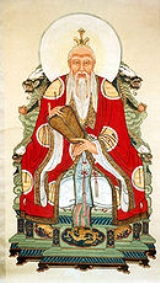
Laozi (; also Lao Tse, Lao-Tzu, Laotze, Lao Zi, Laocius, and other variations) was a philosopher
Chinese philosophy

Chinese philosophy is philosophy written in the China Chinese culture of thought. Chinese philosophy has a history of several thousand years; its origins are often traced back to the I Ching , an ancient compendium of divination, which uses a system of 64 hexagrams to guide action....
 of ancient
Ancient history

Ancient history is the history from the History of writing until the Early Middle Ages in Europe, the Qin Dynasty in China, the Chola Empire in India, and some less defined point in the rest of the world ....
 China
China

China is a Culture of China, an ancient civilization, and, depending on perspective, a national or multinational entity extending over a large area in East Asia....
 and is a central figure in Taoism
Taoism

Taoism refers to a variety of related philosophical and religious traditions and concepts. These traditions have influenced East Asia for over two thousand years and some have spread to the West....
 (also spelled "Daoism"). Laozi literally means "Old Master" and is generally considered an honorific. Laozi is revered as a god
God

God is a deity in theism and deism religions and other belief systems, representing either the sole deity in monotheism, or a principal deity in polytheism....
 in religious forms of Taoism. Taishang Laojun is a title for Laozi in the Taoist religion, which refers to him as "One of the Three Pure Ones
Three Pure Ones

The Three Pure Ones also translated asthe Three Pure Pellucid Ones, the Three Pristine Ones, the Three Clarities, or the Three Purities, are the three highest Taoist deities....
".

According to Chinese tradition, Laozi lived in the 6th century BC.


Discussion
Ask a question about 'Laozi'
Start a new discussion about 'Laozi'
Answer questions from other users
Full Discussion Forum


Recent Posts


Quotations


Being deeply loved by someone gives you strength; loving someone deeply gives you courage.

By letting it go it all gets done. The world is won by those who let it go. But when you try and try, the world is beyond the winning.

Give a man a fish and you feed him for a day. Teach him how to fish and you feed him for a lifetime.

Governing a large country is like frying a small fish. You spoil it with too much poking.

He who knows does not speak; he who speaks does not know.

He who knows that enough is enough will always have enough.


Encyclopedia


Laozi (; also Lao Tse, Lao-Tzu, Laotze, Lao Zi, Laocius, and other variations) was a philosopher
Chinese philosophy

Chinese philosophy is philosophy written in the China Chinese culture of thought. Chinese philosophy has a history of several thousand years; its origins are often traced back to the I Ching , an ancient compendium of divination, which uses a system of 64 hexagrams to guide action....
 of ancient
Ancient history

Ancient history is the history from the History of writing until the Early Middle Ages in Europe, the Qin Dynasty in China, the Chola Empire in India, and some less defined point in the rest of the world ....
 China
China

China is a Culture of China, an ancient civilization, and, depending on perspective, a national or multinational entity extending over a large area in East Asia....
 and is a central figure in Taoism
Taoism

Taoism refers to a variety of related philosophical and religious traditions and concepts. These traditions have influenced East Asia for over two thousand years and some have spread to the West....
 (also spelled "Daoism"). Laozi literally means "Old Master" and is generally considered an honorific. Laozi is revered as a god
God

God is a deity in theism and deism religions and other belief systems, representing either the sole deity in monotheism, or a principal deity in polytheism....
 in religious forms of Taoism. Taishang Laojun is a title for Laozi in the Taoist religion, which refers to him as "One of the Three Pure Ones
Three Pure Ones

The Three Pure Ones also translated asthe Three Pure Pellucid Ones, the Three Pristine Ones, the Three Clarities, or the Three Purities, are the three highest Taoist deities....
".

According to Chinese tradition, Laozi lived in the 6th century BC. Historians variously contend that Laozi is a synthesis of multiple historical figures, that he is a mythical figure, or that he actually lived in the 4th century BC, concurrent with the Hundred Schools of Thought
Hundred Schools of Thought

The Hundred Schools of Thought were philosophers and schools that had flourished from 770 to 221 BC, an era of great cultural and intellectual expansion in China....
 and Warring States Period
Warring States Period

The Warring States Period , also known as the Era of Warring States, covers the period from 476 BCE to the unification of China by the Qin Dynasty in 221 BCE....
. A central figure in Chinese culture, both nobility and common people claim Laozi in their lineage. Zhuangzi
Zhuangzi

Zhuangzi was an influential Chinese philosophy who lived around the 4th century BCE during the Warring States Period, corresponding to the Hundred Schools of Thought philosophical summit of Culture of China thought....
, widely considered the intellectual and spiritual successor of Laozi, had a notable impact on Chinese literature, culture and spirituality. Throughout history, Laozi's work was embraced by various anti-authoritarian movements.

Historicity

Laozi is traditionally regarded as the author of the Daodejing (Tao Te Ching), though its authorship has been debated throughout history.

The earliest reliable reference (circa 100 BC) to Laozi is found in the Records of the Grand Historian (Shiji) by Chinese historian Sima Qian
Sima Qian

Sima Qian was a Prefect of the Grand Scribes of the Han Dynasty. He is regarded as the father of Chinese historiography because of his highly praised work, Records of the Grand Historian , an overview of the history of China covering more than two thousand years from the Yellow Emperor to Emperor Wu of Han China ....
 (ca. 145–86 BC), which combines three stories. In the first, Laozi was said to be a contemporary of Confucius
Confucius

This articles talks about a Chinese thinker and social philosopher. For a food company in China with its brand name "Master Kong", please refer to Tingyi Holding Corporation....
 (551-479 BC). His surname was Li ( "plum"), and his personal name was Er ( "ear") or Dan ( "long ear"). He was an official in the imperial archives, and wrote a book in two parts before departing to the West. In the second, Laozi was Lao Laizi ( "Old Master"), also a contemporary of Confucius, who wrote a book in 15 parts. In the third, Laozi was the Grand Historian and astrologer Lao Dan ( "Old Long-ears"), who lived during the reign (384-362 BC) of Duke Xian of Qin)
Qin (state)

Q?n or Ch'in , was a state during the Spring and Autumn Period and Warring States Periods of China. It eventually grew to dominate the country and unite it in 221 BC, after which it is referred to as the Qin Dynasty....
.

Popular legends say that he was conceived when his mother gazed upon a falling star, stayed in the womb for sixty-two years, and was born when his mother leaned against a plum tree. He accordingly emerged a grown man with a full grey beard and long earlobes, which are a symbol of wisdom and long life. In other versions he was reborn in some thirteen incarnations since the days of Fuxi; in his last incarnation as Laozi he lived to nine hundred and ninety years, and traveled to India
India

India, officially the Republic of India , is a country in South Asia. It is the List of countries and outlying territories by total area country by geographical area, the List of countries by population country, and the most populous liberal democracy in the world....
 to reveal the Dao.

According to popular traditional biographies, he worked as the Keeper of the Archives for the royal court of Zhou
Zhou Dynasty

The Zhou Dynasty was preceded by the Shang Dynasty and followed by the Qin Dynasty in China. The Zhou dynasty lasted longer than any other dynasty in China history?though the actual political and military control of China by the dynasty only lasted during the Western Zhou....
. This reportedly allowed him broad access to the works of the Yellow Emperor
Yellow Emperor

Huang-di, or the Yellow Emperor, is a legendary Chinese sovereign and culture hero who is considered in Chinese mythology to be the ancestor of all Han Chinese....
 and other classics of the time. The stories assert that Laozi never opened a formal school, but he nonetheless attracted a large number of students and loyal disciples. There are numerous variations of a story depicting Confucius consulting Laozi about rituals.

Many of the popular accounts say that Laozi married and had a son named Zong, who became a celebrated soldier. A large number of people trace their lineage back to Laozi, as the Tang Dynasty
Tang Dynasty

The Tang Dynasty was an Dynasties in Chinese history preceded by the Sui Dynasty and followed by the Five Dynasties and Ten Kingdoms Period. It was founded by the Li family, who seized power during the decline and collapse of the Sui Empire....
 did. According to Simpkins & Simpkins, many (if not all) of the lineages may be inaccurate. However, they are a testament to the impact of Laozi on Chinese culture.

Traditional accounts state that Laozi grew weary of the moral decay of city life and noted the kingdom's decline. According to these legends, he ventured west to live as a hermit in the unsettled frontier at the age of 160. At the western gate of the city, or kingdom, he was recognized by a guard. The sentry asked the old master to produce a record of his wisdom. This is the legendary origin of the Daodejing. In some versions of the tale, the sentry is so touched by the work that he leaves with Laozi to never be seen again. Some legends elaborate further that the "Old Master" was the teacher of the Buddha
Gautama Buddha

Siddhartha Gautama was a Spirituality teacher in the northern region of the Indian subcontinent who founded Buddhism. He is generally seen by Buddhists as the Supreme Buddhahood of our age....
, or the Buddha himself.

By the mid-twentieth century, a consensus had emerged among scholars that the historicity of Laozi was doubtful or unprovable and that the Daodejing was "a compilation of Taoist sayings by many hands originating in the -4th century." Alan Watts
Alan Watts

Alan Wilson Watts was a United Kingdom philosopher, writer, speaker, and student of comparative religion. He was best known as an interpreter and popularizer of Asian philosophies for a Western culture audience....
 (1975) held that this view was part of an academic fashion for skepticism about historical spiritual and religious figures, arguing that not enough would be known for years, or possibly ever, to make a firm judgment.

Names

Laozi is an honorific name. Lao means "venerable" or "old". In ancient times it seems to have been a family name, though most scholars assume it to be used here as a descriptive sobriquet. Zi, or tzu is an ancient affix carrying the meaning of "master." (Here it is relevant to note that all of the other ancient thinkers with this title--Confucius, Mozi, Hanfeizi, etc.--have it attached to their family names.)

In popular biographies, Laozi's given name was Er, his surname was Li (forming Li Er, ??) and his courtesy name was Boyang. Dan is a posthumous name given to Laozi, and he is sometimes referred to as Li Dan.

During the Tang Dynasty
Tang Dynasty

The Tang Dynasty was an Dynasties in Chinese history preceded by the Sui Dynasty and followed by the Five Dynasties and Ten Kingdoms Period. It was founded by the Li family, who seized power during the decline and collapse of the Sui Empire....
, he was honoured as an ancestor of the dynasty after Daoists drew a connection between the dynasty's family name of Li and Laozi's bearing of the same name. He was granted the title Taishang xuanyuan huangdi, meaning "Supreme Mysterious and Primordial Emperor". Xuanyuan and Huangdi are also, respectively, the personal and proper names of the Yellow Emperor
Yellow Emperor

Huang-di, or the Yellow Emperor, is a legendary Chinese sovereign and culture hero who is considered in Chinese mythology to be the ancestor of all Han Chinese....
.

Daodejing

Laozi's magnum opus
Magnum opus

Magnum opus , from the Latin meaning great work, refers to the largest, and perhaps the best, greatest, most popular, or most renowned achievement of an author, artist, or composer....
, the Daodejing, is one of the most significant treatises in Chinese cosmogony
Cosmogony

Cosmogony, or cosmogeny, is any theory concerning the coming into existence or origin of the universe, or about how reality came to be. The word comes from the Greek ??s??????a , from ??s??? "cosmos, the world", and the root of ?????a? / ?????a "to be born, come about"....
. As with most other ancient Chinese philosophers, Laozi often explains his ideas by way of paradox, analogy, appropriation of ancient sayings, repetition, symmetry, rhyme, and rhythm.

The Daodejing, often called simply the Laozi after its reputed author, describes the Dao (or Tao) as the mystical source and ideal of all existence: it is unseen, but not transcendent, immensely powerful yet supremely humble, being the root of all things. According to the Daodejing, humans have no special place within the Dao, being just one of its many ("ten thousand") manifestations. People have desires and free will (and thus are able to alter their own nature). Many act "unnaturally", upsetting the natural balance of the Dao. The Daodejing intends to lead students to a "return" to their natural state, in harmony with Dao. Language and conventional wisdom
Conventional wisdom

Conventional wisdom is a term used to describe ideas or explanations that are generally accepted as true by the public or by experts in a field....
 are critically assessed. Taoism views them as inherently biased and artificial, widely using paradoxes to sharpen the point.

Livia Kohn provides an example of how Laozi encouraged a change in approach, or return to "nature", rather than action. Technology may bring about a false sense of progress. The answer provided by Laozi is not the rejection of technology, but instead seeking the calm state of wu wei, free from desires. This relates to many statements by Laozi encouraging rulers to keep their people in "ignorance", or "simple-minded". Some scholars insist this explanation ignores the religious context, and others question it as an apologetic of the philosophical coherence of the text. It would not be unusual political advice if Laozi literally intended to tell rulers to keep their people ignorant. However, some terms in the text, such as "valley spirit" (gushen) and "soul" (po), bear a religious context and cannot be easily reconciled with a purely ethical reading of the work.

Wu wei
Wu wei

Wu wei is an important concept of Taoism , that involves knowing when to act and when not to act. Another perspective to this is that "Wu Wei" means...
, literally "non-action" or "not acting", is a central concept of the Daodejing. The concept of wu wei is very complex and reflected in the words' multiple meanings, even in English translation; it can mean "not doing anything", "not forcing", "not acting" in the theatrical sense, "creating nothingness", "acting spontaneously", and "flowing with the moment."

It is a concept used to explain ziran
Ziran

Ziran is a key concept in Daoism that literally means "self so; so of its own; so of itself" and thus "naturally; natural; spontaneously; freely; in the course of events; of course; doubtlessly" ....
, or harmony with the Dao. It includes the concepts that value distinctions are ideological and seeing ambition of all sorts as originating from the same source. Laozi used the term broadly with simplicity
Simplicity

Simplicity is the property, condition, or quality of being simple or un-combined. It often denotes beauty, purity or clarity. Simple things are usually easier to explain and understand than complicated ones....
 and humility
Humility

Humility, or being humble, is the defining characteristic of an unpretentious and modesty person, someone who does not think that he or she is better or more important than others....
 as key virtues, often in contrast to selfish action. On a political level, it means avoiding such circumstances as war, harsh laws and heavy taxes. Some Taoists see a connection between wu wei and esoteric practices, such as the "sitting in oblivion" (emptying the mind of bodily awareness and thought) found in the Zhuangzi.

According to esoteric adherents, the book contains specific instructions for Daoist adepts relating to qigong
Qigong

Qigong refers to a wide variety of traditional cultivation practices that involve methods of accumulating, circulating, and working with qi, breathing or energy within the body....
 meditations, and in veiled preachings the way to revert to the primordial state. This interpretation supports the view that Taoism is a religion addressing the quest of immortality.

Daoism


Laozi is traditionally regarded as the founder of Daoism, intimately connected with the Daodejing and "primordial" (or "original") Daoism. Popular ("religious") Daoism typically presents the Jade Emperor
Jade Emperor

The Jade Emperor , is the Taoist ruler of Heaven and all realms of existence below including that of Man and Hell according to a version of Chinese mythology....
 as the official head deity
Deity

A deity is a postulated preternatural or supernatural immortal being, who may be thought of as holy, divinity, or sacred, held in high regard, and respected by human beings....
. Intellectual ("elite") Daoists, such as the Celestial Masters sect, usually present Laozi (Laojun, "Lord Lao") and the Three Pure Ones
Three Pure Ones

The Three Pure Ones also translated asthe Three Pure Pellucid Ones, the Three Pristine Ones, the Three Clarities, or the Three Purities, are the three highest Taoist deities....
 at the top of the pantheon of deities.

The story of Laozi has taken on strong religious overtones since the Han dynasty
Han Dynasty

The Han Dynasty followed the Qin Dynasty and preceded the Three Kingdoms in China. The Han Dynasty was ruled by the family known as the Liu clan who had peasant origins....
. As Daoism took root, Laozi was recognized as a god. Belief in the revelation of the Dao from the divine Laozi resulted in the formation of the Way of the Celestial Master, the first organized religious Daoist sect. In later mature Daoist tradition, Laozi came to be seen as a personification of Dao. He is said to have undergone numerous "transformations", or taken on various guises in various incarnations throughout history to initiate the faithful in the Way. Religious Daoism often holds that the "Old Master" did not disappear after writing the Daodejing, but rather traveled to India
India

India, officially the Republic of India , is a country in South Asia. It is the List of countries and outlying territories by total area country by geographical area, the List of countries by population country, and the most populous liberal democracy in the world....
 to reveal the Dao.

Yinxi

Laozi's relationship with the guardian of the western pass, named Yinxi (Wade Giles Yin Hsi), is the subject of numerous legends. It is Yinxi who asked Laozi to write down his wisdom in the traditional account of the Daodejings creation. The story of Laozi transmitting the Daodejing to Yinxi is part of a broader theme involving Laozi the deity delivering salvific truth to a suffering humanity. Regardless, the deliverance of the Daodejing was the ultimate purpose of his human incarnation. Folklore developed around Laozi and Yinxi to demonstrate the ideal interaction of Taoist master and disciple.

A seventh century work,
Sandong zhunang ("Pearly Bag of the Three Caverns"), provides one account of their relationship. Laozi pretended to be a farmer when reaching the western gate, but was recognized by Yinxi, who asked to be taught by the great master. Laozi was not satisfied by simply being noticed by the guard and demanded an explanation. Yinxi expressed his deep desire to find the Tao and explained that his long study of astrology allowed him to recognize Laozi's approach. Yinxi was accepted by Laozi as a disciple. This is considered an exemplary interaction between Daoist master and disciple, reflecting the testing a seeker must undergo before being accepted. A would-be adherent is expected to prove his determination and talent, clearly expressing his wishes and showing that he had made progress on his own towards realizing the Tao.

The
Pearly Bag of the Three Caverns continues the parallel of an adherent's quest. Yinxi received his ordination when Laozi transmitted the Daodejing, along with other texts and precepts, just as Taoist adherents receive a number of methods, teachings and scriptures at ordination. This is only an initial ordination and Yinxi still needed an additional period to perfect his faith, thus Laozi gave him three years to perfect his Dao. Yinxi gave himself over to a full-time devotional life. After the appointed time, Yinxi again demonstrates determination and perfect trust, sending out a black sheep to market as the agreed sign. He eventually meets again with Laozi, who announces that Yinxi's immortal name is listed in the heavens and calls down a heavenly procession to clothe Yinxi in the garb of immortals. The story continues that Laozi bestowed a number of titles upon Yinxi and took him on a journey throughout the universe, even into the nine heavens. After this fantastic journey, the two sages set out to western lands of the barbarians. The training period, reuniting and travels represent the attainment of the highest religious rank in medieval Taoism called "Preceptor of the Three Caverns". In this legend, Laozi is the perfect Daoist master and Yinxi is the ideal Taoist student. Laozi is presented as the Tao personified, giving his teaching to humanity for their salvation. Yinxi follows the formal sequence of preparation, testing, training and attainment.

Influence


Potential officials throughout Chinese history drew on the authority of non-Confucian sages, especially Laozi and Zhuangzi, to deny serving any ruler at any time. Zhuangzi
Zhuangzi

Zhuangzi was an influential Chinese philosophy who lived around the 4th century BCE during the Warring States Period, corresponding to the Hundred Schools of Thought philosophical summit of Culture of China thought....
, Laozi's most famous follower, had a great deal of influence on Chinese literati
Literati

Literati may refer to:*Intellectuals*The scholar-bureaucrats or literati of imperial China**Literati painting, also known as the Southern School of painting, developed by Chinese literati...
 and culture. Zhuangzi is a central authority regarding eremitism, a particular variation of monasticism sacrificing social aspects for religious aspects of life. Zhuangzi considered eremitism the highest ideal, if properly understood.

Scholars such as Aat Vervoom have postulated that Zhuangzi advocated a hermit immersed in society. This view of eremitism holds that seclusion is hiding anonymously in society. To a Zhuangzi hermit, being unknown and drifting freely is a state of mind. This reading is based on the "inner chapters" of the self-titled
Zhuangzi.

Scholars such as James Bellamy hold that this could be true and has been interpreted similarly at various points in Chinese history. However, the "outer chapters" of
Zhuangzi have historically played a pivotal role in the advocacy of reclusion. While some scholars state that Laozi was the central figure of Han Dynasty eremitism, historical texts do not seem to support that position.

Political theorists influenced by Laozi have advocated humility in leadership and a restrained approach to statecraft, either for ethical and pacifist reasons, or for tactical ends. In a different context, various anti-authoritarian
Anti-authoritarian

Anti-authoritarianism is opposition to authoritarianism, which is defined as a "political doctrine advocating the principle of absolute rule: absolutism, autocracy, despotism, dictatorship, totalitarianism." Anti-authoritarians believe in an equal distribution of power among all people....
 movements have embraced the Laozi teachings on the power of the weak.

The economist
Economist

An economist is an expert in the social science of economics. The individual may also study, develop, and apply theories and concepts from economics and write about economic policy....
 Murray N. Rothbard suggests that Laozi was the first libertarian, likening Laozi's ideas on government to F.A. Hayek's theory of spontaneous order
Spontaneous order

Spontaneous order is the spontaneous emergence of order out of seeming chaos; the emergence of various kinds of social order from a combination of self-interested individuals who are not intentionally trying to create order....
. Similarly, the Cato Institute
Cato Institute

The Cato Institute is a libertarian think tank headquartered in Washington, D.C.The Institute's stated mission is "to broaden the parameters of Public policy debate to allow consideration of the traditional United States principles of limited government, individual liberty, free markets, and peace" by striving "to achieve greater involveme...
's David Boaz
David Boaz

David Boaz is the executive vice president of the Cato Institute, an United States Libertarianism think tank. He played a key role in the Institute's development and the American libertarian movement....
 includes passages from the
Daodejing in his 1997 book The Libertarian Reader. Philosopher Roderick Long
Roderick Long

Roderick Tracy Long is a professor of economics at Auburn University and an anarchist/libertarian political commentator. He received a B.A. in philosophy from Harvard University and his Ph.D....
, however, argues that libertarian themes in Taoist thought are actually borrowed from earlier Confucian writers.

Footnotes


Further reading


External links