

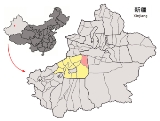
Kucha

Encyclopedia

Uyghur language
Uyghur , formerly known as Eastern Turk, is a Turkic language with 8 to 11 million speakers, spoken primarily by the Uyghur people in the Xinjiang Uyghur Autonomous Region of Western China. Significant communities of Uyghur-speakers are located in Kazakhstan and Uzbekistan, and various other...
(كۇچار), Chinese
Chinese language
The Chinese language is a language or language family consisting of varieties which are mutually intelligible to varying degrees. Originally the indigenous languages spoken by the Han Chinese in China, it forms one of the branches of Sino-Tibetan family of languages...
Simplified: 库车; Traditional: 庫車; pinyin
Pinyin
Pinyin is the official system to transcribe Chinese characters into the Roman alphabet in China, Malaysia, Singapore and Taiwan. It is also often used to teach Mandarin Chinese and spell Chinese names in foreign publications and used as an input method to enter Chinese characters into...
Kùchē; also romanized as Qiuzi, Qiuci, Chiu-tzu, Kiu-che, Kuei-tzu from the traditional Chinese forms 屈支 屈茨; 龜玆; 龟兹, 丘玆, also Po (bai in pinyin
Pinyin
Pinyin is the official system to transcribe Chinese characters into the Roman alphabet in China, Malaysia, Singapore and Taiwan. It is also often used to teach Mandarin Chinese and spell Chinese names in foreign publications and used as an input method to enter Chinese characters into...
?); Sanskrit
Sanskrit
Sanskrit , is a historical Indo-Aryan language and the primary liturgical language of Hinduism, Jainism and Buddhism.Buddhism: besides Pali, see Buddhist Hybrid Sanskrit Today, it is listed as one of the 22 scheduled languages of India and is an official language of the state of Uttarakhand...
: Kueina, Standard Tibetan
Standard Tibetan
Standard Tibetan is the most widely used spoken form of the Tibetan languages. It is based on the speech of Lhasa, an Ü-Tsang dialect belonging to the Central Tibetan languages. For this reason, Standard Tibetan is often called Central Tibetan...
: Kutsahiyui was an ancient Buddhist kingdom located on the branch of the Silk Road
Silk Road
The Silk Road or Silk Route refers to a historical network of interlinking trade routes across the Afro-Eurasian landmass that connected East, South, and Western Asia with the Mediterranean and European world, as well as parts of North and East Africa...
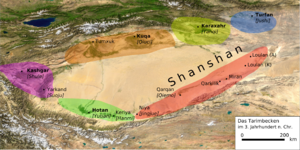
that ran along the northern edge of the Taklamakan Desert in the Tarim Basin
Tarim Basin
The Tarim Basin is a large endorheic basin occupying an area of about . It is located in the Xinjiang Uyghur Autonomous Region in China's far west. Its northern boundary is the Tian Shan mountain range and its southern is the Kunlun Mountains on the northern edge of the Tibetan Plateau. The...
and south of the Muzat River
Muzat River
The Muzart River or Muzat River is a river in Aksu Prefecture of Xinjiang Uyghur Autonomous Region, People's Republic of China, a left tributary of the Tarim River...
. (The area lies in present day Aksu Prefecture
Aksu Prefecture
Aksu Prefecture is located in mid-western Xinjiang, China. It has an area of 132,500 km² and 2.19 million inhabitants .The name Aksu is Turkic for 'white water'.-Geography:...
, Xinjiang
Xinjiang
Xinjiang is an autonomous region of the People's Republic of China. It is the largest Chinese administrative division and spans over 1.6 million km2...
, China
People's Republic of China
China , officially the People's Republic of China , is the most populous country in the world, with over 1.3 billion citizens. Located in East Asia, the country covers approximately 9.6 million square kilometres...
; Kuqa City itself is the county seat of that prefecture's Kuqa County). Its population was given as 74,632 in 1990.
History
Book of Han
The Book of Han, Hanshu or History of the Former Han Dynasty |Fan Ye]] . Various scholars have estimated that the earliest material covered in the book dates back to between 206 and 202 BCE...
, Kucha was the largest of the 'Thirty-six kingdoms of the Western Regions,' with a population of 81,317, including 21,076 persons able to bear arms. During the periods of Tang domination during the Early Middle Ages, the city of Kucha was usually one of the 'Four Garrisons' of An-hsi (Anxi) the 'Pacified West'., typically the capital of it. During periods of Tibetan domination it was usually at least semi-independent. It fell under Uighur domination and became an important center of the later Uighur Kingdom after the Kirghiz destruction of the Uighur steppe empire in 840.
Chinese transcriptions of the Han or the Tang also infer an original form Küchï, but the form Guzan, representing [Küsan], is attested in seventh century Old Tibetan (in the Old Tibetan Annals, s.v. year 687). Mongol Empire-period Uighur and Chinese transcriptions support the form Küsän/Güsän/Kuxian/Quxian rather than Küshän or Kushan (Yuanshi, chap. 12, fol 5a, 7a). (The form Kūsān is still attested in the early-modern work, Tarikh-i-Rashidi, Cf. ELIAS and ROSS, Tarikh-i-Rashidi, in the index, s. v. Kuchar and Kusan: “One MS. [of the Tarikh-i-Rashidi] reads Kus/Kusan. Both names were used for the same place, as also Kos, Kucha, Kujar, etc., and all appear to stand for the modern Kuchar of the Turki-speaking inhabitants, and Kuché of the Chinese. An earlier Chinese name, however, was Ku-sien.” Elias (1895), p. 124, n. 1.) However, transcriptions of the name 'Kushan' in Indic scripts from late Antiquity include the spelling Guṣân, and are apparently reflected in at least one Khotanese-Tibetan transcription. The history of the toponyms corresponding to modern 'Kushan' and 'Kucha' remain somewhat problematic.
Kucha is well known as the home of the great fifth century translator monk Kumārajīva
Kumarajiva
Kumārajīva; was a Kuchean Buddhist monk, scholar, and translator. He first studied teachings of the Sarvastivada schools, later studied under Buddhasvāmin, and finally became a Mahāyāna adherent, studying the Madhyamaka doctrine of Nagarjuna. Kumārajīva settled in Chang'an, which was the imperial...
(344-413). It was an important Buddhist center from Antiquity until the late Middle Ages, with the Sarvāstivāda
Sarvastivada
The Sarvāstivāda were an early school of Buddhism that held to 'the existence of all dharmas in the past, present and future, the 'three times'. Vasubandhu's states:-Name:...
school (a Sthavira school) predominating into the Uighur period, when Mahayana eventually became important. For a long time Kucha was the most populous oasis in the Tarim Basin. The language, as evidenced by surviving manuscripts and inscriptions, was Tokharian (Tocharian
Tocharian languages
Tocharian or Tokharian is an extinct branch of the Indo-European language family. The name is taken from the people known to the Greeks as the Tocharians . These are sometimes identified with the Yuezhi and the Kushans. The term Tokharistan usually refers to 1st millennium Bactria, which the...
), an Indo-European
Indo-European languages
The Indo-European languages are a family of several hundred related languages and dialects, including most major current languages of Europe, the Iranian plateau, and South Asia and also historically predominant in Anatolia...
language. Under the Uighur domination the Kingdom of Kucha gradually became Turkic speaking.
As a Central Asian metropolitan center, Kucha was part of the Silk Road
Silk Road
The Silk Road or Silk Route refers to a historical network of interlinking trade routes across the Afro-Eurasian landmass that connected East, South, and Western Asia with the Mediterranean and European world, as well as parts of North and East Africa...
economy, and was in contact with the rest of Central Asia, including Sogdiana and Bactria, and thus eventually with the peripheral cultures of India, Persia, and China.
Kuchean music was very popular in China during the Tang Dynasty
Tang Dynasty
The Tang Dynasty was an imperial dynasty of China preceded by the Sui Dynasty and followed by the Five Dynasties and Ten Kingdoms Period. It was founded by the Li family, who seized power during the decline and collapse of the Sui Empire...
, particularly the lute which became known in Chinese as pipa
Pipa
The pipa is a four-stringed Chinese musical instrument, belonging to the plucked category of instruments . Sometimes called the Chinese lute, the instrument has a pear-shaped wooden body with a varying number of frets ranging from 12–26...
. The 'music of Kucha' was transmitted from China to Japan, along with other early medieval music, during the same period, and is preserved there, somewhat transformed, as gagaku
Gagaku
Gagaku is a type of Japanese classical music that has been performed at the Imperial Court in Kyoto for several centuries. It consists of three primary repertoires:#Native Shinto religious music and folk songs and dance, called kuniburi no utamai...
, or Japanese court music. See: Picken, Music from the T'ang Court.
The extensive ruins of the ancient capital city, in Chinese Guici [the 'City of Subashi'], lie 20 kilometres (12.4 mi) north of modern Kucha.
Francis Younghusband
Francis Younghusband
Lieutenant Colonel Sir Francis Edward Younghusband, KCSI, KCIE was a British Army officer, explorer, and spiritual writer...
, who passed through the oasis in 1887 on his epic journey from Beijing
Beijing
Beijing , also known as Peking , is the capital of the People's Republic of China and one of the most populous cities in the world, with a population of 19,612,368 as of 2010. The city is the country's political, cultural, and educational center, and home to the headquarters for most of China's...
to India
India
India , officially the Republic of India , is a country in South Asia. It is the seventh-largest country by geographical area, the second-most populous country with over 1.2 billion people, and the most populous democracy in the world...
, described the district as "probably" having some 60,000 inhabitants. The modern Chinese town was about 700 yards (640 m) square with a 25 ft (7.6 m) high wall, with no bastions or protection to the gateways, but a ditch about 20 ft (6 m) deep around it. It was filled with houses and "a few bad shops". The "Turk houses" ran right up to the edge of the ditch and there were remains of an old Turk city to the south-east of the Chinese one, but most of the shops and houses were outside of it. About 800 yards (732 m) north of the Chinese city were barracks for 500 soldiers out of a garrison he estimated to total about 1500 men, who were armed with old Enfield
Lee-Enfield
The Lee-Enfield bolt-action, magazine-fed, repeating rifle was the main firearm used by the military forces of the British Empire and Commonwealth during the first half of the 20th century...
rifles "with the Tower mark."
Kucha and Buddhism
Buddhism
Buddhism is a religion and philosophy encompassing a variety of traditions, beliefs and practices, largely based on teachings attributed to Siddhartha Gautama, commonly known as the Buddha . The Buddha lived and taught in the northeastern Indian subcontinent some time between the 6th and 4th...
, primarily the Sarvāstivāda
Sarvastivada
The Sarvāstivāda were an early school of Buddhism that held to 'the existence of all dharmas in the past, present and future, the 'three times'. Vasubandhu's states:-Name:...
school of the Sthavira or Śrāvakayāna branch, but eventually also Mahāyāna
Mahayana
Mahāyāna is one of the two main existing branches of Buddhism and a term for classification of Buddhist philosophies and practice...
. (In this respect it differed from Khotan
Khotan
Hotan , or Hetian , also spelled Khotan, is the seat of the Hotan Prefecture in Xinjiang, China. It was previously known in Chinese as 于窴/於窴 and to 19th-century European explorers as Ilchi....
, a Mahāyāna
Mahayana
Mahāyāna is one of the two main existing branches of Buddhism and a term for classification of Buddhist philosophies and practice...
-dominated kingdom on the southern side of the desert.)
According to the Chinese
China
Chinese civilization may refer to:* China for more general discussion of the country.* Chinese culture* Greater China, the transnational community of ethnic Chinese.* History of China* Sinosphere, the area historically affected by Chinese culture...
Book of Jin
Book of Jin
The Book of Jin is one of the official Chinese historical works. It covers the history of Jin Dynasty from 265 to 420, which written by a number of officials commissioned by the court of Tang Dynasty, with the lead editor being the Prime Minister Fang Xuanling, drawing mostly from the official...
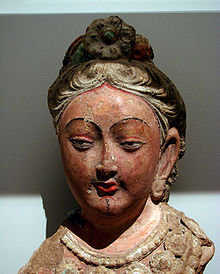
, during the third century there were nearly one thousand Buddhist stupas and temples in Kucha. At this time, Kuchanese monks began to travel to China. The fourth century saw yet further growth for Buddhism within the kingdom. The palace was said to resemble a Buddhist monastery, displaying carved stone Buddhas, and monasteries around the city were numerous.
Monasteries
- Ta-mu had 170 monks
- Che-hu-li on Po-shan (ChineseChinese languageThe Chinese language is a language or language family consisting of varieties which are mutually intelligible to varying degrees. Originally the indigenous languages spoken by the Han Chinese in China, it forms one of the branches of Sino-Tibetan family of languages...
白山?; pinyinPinyinPinyin is the official system to transcribe Chinese characters into the Roman alphabet in China, Malaysia, Singapore and Taiwan. It is also often used to teach Mandarin Chinese and spell Chinese names in foreign publications and used as an input method to enter Chinese characters into...
: bai shan?), a hill to the north of the town, had 50 or 60 monks. - Another monastery, founded by the king of Wen-Su (Uch-Turpan) had 70 monks.
Nunneries
There were two nunneries at A-li (Avanyaka):- Liun-jo-kan: 50 nuns
- A-li-po: 30 nuns
Another nunnery, Tsio-li, was 40 li
Li
Li or li may refer to:* Li , the Confucian concept of ritual** Li , philosophical concept of principle* Li people, an ethnic group of China...
north of Kucha and is famous as the place where Kumārajīva's mother Jīva retired.
Po-Yen
A monk from the royal family known as Po-Yen travelled to the Chinese capital, LuoyangLuoyang
Luoyang is a prefecture-level city in western Henan province of Central China. It borders the provincial capital of Zhengzhou to the east, Pingdingshan to the southeast, Nanyang to the south, Sanmenxia to the west, Jiyuan to the north, and Jiaozuo to the northeast.Situated on the central plain of...
, from AD 256-260. He translated six Buddhist texts to Chinese
Chinese language
The Chinese language is a language or language family consisting of varieties which are mutually intelligible to varying degrees. Originally the indigenous languages spoken by the Han Chinese in China, it forms one of the branches of Sino-Tibetan family of languages...
in 258 at China's famous White Horse Temple
White Horse Temple
White Horse Temple is, according to tradition, the first Buddhist temple in China, established in 68 AD under the patronage of Emperor Ming in the Eastern Han capital Luoyang. Today the site is located just outside the walls of the ancient Eastern Han capital, some east of Luoyang in Henan...
, including the Infinite Life Sutra
Infinite Life Sutra
The Infinite Life Sūtra, or Longer Sukhāvatīvyūha Sūtra is a Mahāyāna Buddhist sūtra, and the primary text of Pure Land Buddhism. It is the longest of the three major texts of Pure Land Buddhism...
, an important sutra in the Pure Land Buddhism
Pure Land Buddhism
Pure Land Buddhism , also referred to as Amidism in English, is a broad branch of Mahāyāna Buddhism and currently one of the most popular traditions of Buddhism in East Asia. Pure Land is a branch of Buddhism focused on Amitābha Buddha...
.
Po-Po-Śrīmitra
Po-ŚrīmitraPo-Srimitra
Po-Śrīmitra was a Kuchean prince and Buddhist monk who travelled to south China from 307-312, translating three Buddhist texts....
was another Kuchean monk who traveled to China from 307-312 and translated three Buddhist texts.
Po-Yen
A second Kuchean Buddhist monk known as Po-Yen also went to Liangzhou (the Wuwei region of modern GansuGansu
' is a province located in the northwest of the People's Republic of China.It lies between the Tibetan and Huangtu plateaus, and borders Mongolia, Inner Mongolia, and Ningxia to the north, Xinjiang and Qinghai to the west, Sichuan to the south, and Shaanxi to the east...
), China and is said to have been well respected, although he is not known to have translated any texts.
Tocharian languages
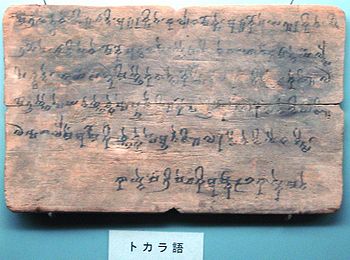
Brahmi
Brāhmī is the modern name given to the oldest members of the Brahmic family of scripts. The best-known Brāhmī inscriptions are the rock-cut edicts of Ashoka in north-central India, dated to the 3rd century BCE. These are traditionally considered to be early known examples of Brāhmī writing...
script. It was soon found that they belonged to the Indo-European
Indo-European
Indo-European may refer to:* Indo-European languages** Aryan race, a 19th century and early 20th century term for those peoples who are the native speakers of Indo-European languages...
family of languages and had not undergone the Satem sound change. The only records of East Tokharian, or "Tokharian A" (from the region of Turfan [Turpan] and Karashahr), and West Tokharian, or "Tokharian B" (mainly from the region of Kucha, but also found in Turfan and elsewhere), are of relatively late date – approximately 6th to 8th century CE (though the dates are contested); but the people arrived in the region much earlier. Their languages became extinct before circa 1000 CE. Scholars are still trying to piece together a fuller picture of these languages, their origins, history and connections, etc.
Neighbors
The kingdom bordered Aksu then KashgarKashgar
Kashgar or Kashi is an oasis city with approximately 350,000 residents in the western part of the Xinjiang Uyghur Autonomous Region of the People's Republic of China. Kashgar is the administrative centre of Kashgar Prefecture which has an area of 162,000 km² and a population of approximately...
to the west, and Karasahr
Karasahr
Yanqi , or Karasahr , is an ancient town on the Silk Road and capital of Yanqi Hui Autonomous County in the Bayin'gholin Mongol Autonomous Prefecture of Xinjiang, in northwestern China...
then Turpan to the east. Across the Taklamakan
Taklamakan
The Taklamakan Desert , also known as Taklimakan and Teklimakan, is a desert in Central Asia, in the Xinjiang Uyghur Autonomous Region of the People's Republic of China...
desert to the south was Khotan
Khotan
Hotan , or Hetian , also spelled Khotan, is the seat of the Hotan Prefecture in Xinjiang, China. It was previously known in Chinese as 于窴/於窴 and to 19th-century European explorers as Ilchi....
.
Sources
- The ChineseChinaChinese civilization may refer to:* China for more general discussion of the country.* Chinese culture* Greater China, the transnational community of ethnic Chinese.* History of China* Sinosphere, the area historically affected by Chinese culture...
Book of HanBook of HanThe Book of Han, Hanshu or History of the Former Han Dynasty |Fan Ye]] . Various scholars have estimated that the earliest material covered in the book dates back to between 206 and 202 BCE... - The ChineseChinaChinese civilization may refer to:* China for more general discussion of the country.* Chinese culture* Greater China, the transnational community of ethnic Chinese.* History of China* Sinosphere, the area historically affected by Chinese culture...
Book of the Later Han - The ChineseChinaChinese civilization may refer to:* China for more general discussion of the country.* Chinese culture* Greater China, the transnational community of ethnic Chinese.* History of China* Sinosphere, the area historically affected by Chinese culture...
Book of JinBook of JinThe Book of Jin is one of the official Chinese historical works. It covers the history of Jin Dynasty from 265 to 420, which written by a number of officials commissioned by the court of Tang Dynasty, with the lead editor being the Prime Minister Fang Xuanling, drawing mostly from the official...
External links
- Silk Road Seattle (The Silk Road Seattle website contains many useful resources including a number of full-text historical works)
- Kucha at Google Maps