

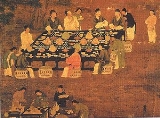
Chinese cuisine

Encyclopedia
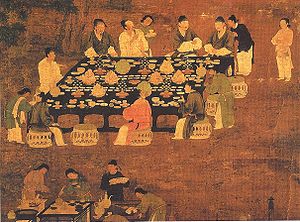
China
Chinese civilization may refer to:* China for more general discussion of the country.* Chinese culture* Greater China, the transnational community of ethnic Chinese.* History of China* Sinosphere, the area historically affected by Chinese culture...
, some of which have become highly popular in other parts of the world – from Asia
Asia
Asia is the world's largest and most populous continent, located primarily in the eastern and northern hemispheres. It covers 8.7% of the Earth's total surface area and with approximately 3.879 billion people, it hosts 60% of the world's current human population...
to the Americas
Americas
The Americas, or America , are lands in the Western hemisphere, also known as the New World. In English, the plural form the Americas is often used to refer to the landmasses of North America and South America with their associated islands and regions, while the singular form America is primarily...
, Australia
Australia
Australia , officially the Commonwealth of Australia, is a country in the Southern Hemisphere comprising the mainland of the Australian continent, the island of Tasmania, and numerous smaller islands in the Indian and Pacific Oceans. It is the world's sixth-largest country by total area...
, Western Europe
Western Europe
Western Europe is a loose term for the collection of countries in the western most region of the European continents, though this definition is context-dependent and carries cultural and political connotations. One definition describes Western Europe as a geographic entity—the region lying in the...
and Southern Africa
Southern Africa
Southern Africa is the southernmost region of the African continent, variably defined by geography or geopolitics. Within the region are numerous territories, including the Republic of South Africa ; nowadays, the simpler term South Africa is generally reserved for the country in English.-UN...
. The history of Chinese cuisine
History of Chinese cuisine
The Cuisine of China spreads both around the world and deep into history and is marked by both variety and change. The archeologist and scholar K.C. Chang says “Chinese people are especially preoccupied with food” and “food is at the center of, or at least it accompanies or symbolizes, many social...
stretches back for many centuries and produced both change from period to period and variety in what could be called traditional Chinese food, leading Chinese to pride themselves on eating a wide range of foods. Major traditions include Anhui
Anhui cuisine
Anhui cuisine is one of the Eight Culinary Traditions of China. It is derived from the native cooking styles of the Huangshan Mountains region in China and is similar to Jiangsu cuisine.-Methods and Ingredients:...
, Cantonese
Cantonese cuisine
Cantonese cuisine comes from Guangdong Province in southern China and is one of 8 superdivisions of Chinese cuisine. Its prominence outside China is due to the great numbers of early emigrants from Guangdong. Cantonese chefs are highly sought after throughout the country...
, Fujian
Fujian cuisine
Fujian cuisine is one of the native Chinese cuisines derived from the native cooking style of the province of Fujian, China. Fujian style cuisine is known to be light but flavourful, soft, and tender, with particular emphasis on umami taste, known in Chinese cooking as "xiānwèi" , as well as...
, Hunan
Hunan cuisine
Hunan cuisine, sometimes called Xiang cuisine , consists of the cuisines of the Xiang River region, Dongting Lake and western Hunan Province, in China. Hunan cuisine consists of three styles:...
, Jiangsu
Jiangsu cuisine
Jiangsu cuisine is one the Eight Culinary Traditions of China. It is derived from the native cooking styles of the Jiangsu region in China. In general, Jiangsu cuisine's texture is characterized as soft, but not to the point of mushy or falling apart. For example, the meat tastes quite soft but...
, Shandong
Shandong cuisine
Shandong cuisine , in Chinese more commonly known as Lu cuisine , is one the Eight Culinary Traditions of China and is also ranked among the four most influential among these . It is derived from the native cooking styles of Shandong, an eastern coastal province of China...
, Szechuan
Szechuan cuisine
Szechuan cuisine, Sichuan cuisine, or Szechwan cuisine is a style of Chinese cuisine originating in the Sichuan Province of southwestern China famed for bold flavors, particularly the pungency and spiciness resulting from liberal use of garlic and chili peppers, as well as the unique flavour of...
, and Zhejiang
Zhejiang cuisine
Zhejiang cuisine is one of the Eight Culinary Traditions of China. It is derived from the native cooking styles of the Zhejiang region in China...
cuisines.
Eight Culinary Traditions of China
Chinese dishes may be categorized as one of the Eight Culinary Traditions of China, also called the "Eight Regional Cuisines" and the "Eight Cuisines of China". They are as follows:- Hui: Anhui
- Yue (Cantonese): Guangdong
- Min: Fujian
- Xiang: Hunan (Can include Xiangjiang Region, Dongting Lake and Xiangxi styles)
- Su (aka Huaiyang Cuisine): Jiangsu
- Lu: Shandong (Include Jinan, Jiaodong styles, etc.)
- Chuan: Sichuan
- Zhe: Zhejiang (Can include Hangzhou, Ningbo, and Shaoxing styles
Regional cuisines
A number of different styles contribute to Chinese cuisine, but perhaps the best known and most influential are Guangdong (Cantonese) cuisine, Shandong cuisineShandong cuisine
Shandong cuisine , in Chinese more commonly known as Lu cuisine , is one the Eight Culinary Traditions of China and is also ranked among the four most influential among these . It is derived from the native cooking styles of Shandong, an eastern coastal province of China...
, Jiangsu cuisine
Jiangsu cuisine
Jiangsu cuisine is one the Eight Culinary Traditions of China. It is derived from the native cooking styles of the Jiangsu region in China. In general, Jiangsu cuisine's texture is characterized as soft, but not to the point of mushy or falling apart. For example, the meat tastes quite soft but...
and Sichuan cuisine
Szechuan cuisine
Szechuan cuisine, Sichuan cuisine, or Szechwan cuisine is a style of Chinese cuisine originating in the Sichuan Province of southwestern China famed for bold flavors, particularly the pungency and spiciness resulting from liberal use of garlic and chili peppers, as well as the unique flavour of...
. These styles are distinctive from one another due to factors such as available resources, climate
Climate
Climate encompasses the statistics of temperature, humidity, atmospheric pressure, wind, rainfall, atmospheric particle count and other meteorological elemental measurements in a given region over long periods...
, geography
Geography of China
China stretches some across the East Asian landmass bordering the East China Sea, Korea Bay, Yellow Sea, and South China Sea, between North Korea and Vietnam in a changing configuration of broad plains, expansive deserts, and lofty mountain ranges, including vast areas of inhospitable terrain...
, history
History of China
Chinese civilization originated in various regional centers along both the Yellow River and the Yangtze River valleys in the Neolithic era, but the Yellow River is said to be the Cradle of Chinese Civilization. With thousands of years of continuous history, China is one of the world's oldest...
, cooking techniques and lifestyle. One style may favour the use of lots of garlic and shallots over lots of chilli and spices, while another may favour preparing seafood
Seafood
Seafood is any form of marine life regarded as food by humans. Seafoods include fish, molluscs , crustaceans , echinoderms . Edible sea plants, such as some seaweeds and microalgae, are also seafood, and are widely eaten around the world, especially in Asia...
over other meats and fowl
Fowl
Fowl is a word for birds in general but usually refers to birds belonging to one of two biological orders, namely the gamefowl or landfowl and the waterfowl...
. Jiangsu cuisine favours cooking techniques such as braising
Braising
Braising , is a combination cooking method using both moist and dry heat; typically the food is first seared at a high temperature and then finished in a covered pot with a variable amount of liquid, resulting in a particular flavour...
and stew
Stew
A stew is a combination of solid food ingredients that have been cooked in liquid and served in the resultant gravy. Ingredients in a stew can include any combination of vegetables , meat, especially tougher meats suitable for slow-cooking, such as beef. Poultry, sausages, and seafood are also used...
ing, while Sichuan cuisine employs baking
Baking
Baking is the technique of prolonged cooking of food by dry heat acting by convection, and not by radiation, normally in an oven, but also in hot ashes, or on hot stones. It is primarily used for the preparation of bread, cakes, pastries and pies, tarts, quiches, cookies and crackers. Such items...
, just to name a few. Hairy crab
Crab
True crabs are decapod crustaceans of the infraorder Brachyura, which typically have a very short projecting "tail" , or where the reduced abdomen is entirely hidden under the thorax...
is a highly sought after local delicacy in Shanghai
Shanghai
Shanghai is the largest city by population in China and the largest city proper in the world. It is one of the four province-level municipalities in the People's Republic of China, with a total population of over 23 million as of 2010...
, as it can be found in lakes within the region. Beijing
Beijing
Beijing , also known as Peking , is the capital of the People's Republic of China and one of the most populous cities in the world, with a population of 19,612,368 as of 2010. The city is the country's political, cultural, and educational center, and home to the headquarters for most of China's...
Roast Duck
Peking Duck
Peking Duck, or Peking Roast Duck is a famous duck dish from Beijing that has been prepared since the imperial era, and is now considered one of China's national foods....
(otherwise known as 'Peking Duck') is another popular dish that's well known outside of China. Based on the raw materials and ingredients used, the method of preparation, and cultural
Culture
Culture is a term that has many different inter-related meanings. For example, in 1952, Alfred Kroeber and Clyde Kluckhohn compiled a list of 164 definitions of "culture" in Culture: A Critical Review of Concepts and Definitions...
differences, a variety of foods with different flavours and textures are prepared in different regions of the country. Many traditional regional cuisines rely on basic methods of preservation
Food preservation
Food preservation is the process of treating and handling food to stop or slow down spoilage and thus allow for longer storage....
such as drying
Drying (food)
Drying is a method of food preservation that works by removing water from the food, which inhibits the growth of microorganisms and hinders quality decay. Drying food using sun and wind to prevent spoilage has been practised since ancient times, and was the earliest form of food curing...
, salting
Salting (food)
Salting is the preservation of food with dry edible salt. It is related to pickling . It is one of the oldest methods of preserving food, and two historically significant salt-cured foods are dried and salted cod and salt-cured meat.Salting is used because most bacteria, fungi and other potentially...
, pickling
Pickling
Pickling, also known as brining or corning is the process of preserving food by anaerobic fermentation in brine to produce lactic acid, or marinating and storing it in an acid solution, usually vinegar . The resulting food is called a pickle. This procedure gives the food a salty or sour taste...
and fermentation
Fermentation (food)
Fermentation in food processing typically is the conversion of carbohydrates to alcohols and carbon dioxide or organic acids using yeasts, bacteria, or a combination thereof, under anaerobic conditions. Fermentation in simple terms is the chemical conversion of sugars into ethanol...
.
Chuan (Sichuan)
Szechuan cuisine, also called Sichuan cuisine, is a style of Chinese cuisine originating in the Sichuan ProvinceSichuan
' , known formerly in the West by its postal map spellings of Szechwan or Szechuan is a province in Southwest China with its capital in Chengdu...
of southwestern China famed for bold flavors, particularly the pungency and spiciness resulting from liberal use of garlic
Garlic
Allium sativum, commonly known as garlic, is a species in the onion genus, Allium. Its close relatives include the onion, shallot, leek, chive, and rakkyo. Dating back over 6,000 years, garlic is native to central Asia, and has long been a staple in the Mediterranean region, as well as a frequent...
and chili pepper
Chili pepper
Chili pepper is the fruit of plants from the genus Capsicum, members of the nightshade family, Solanaceae. The term in British English and in Australia, New Zealand, India, Malaysia and other Asian countries is just chilli without pepper.Chili peppers originated in the Americas...
s, as well as the unique flavour of the Sichuan peppercorn (花椒, huājiāo) and zhitianjiao(指天椒, zhǐtiānjiāo). Peanut
Peanut
The peanut, or groundnut , is a species in the legume or "bean" family , so it is not a nut. The peanut was probably first cultivated in the valleys of Peru. It is an annual herbaceous plant growing tall...
s, sesame paste and ginger
Ginger
Ginger is the rhizome of the plant Zingiber officinale, consumed as a delicacy, medicine, or spice. It lends its name to its genus and family . Other notable members of this plant family are turmeric, cardamom, and galangal....
are also prominent ingredients in Szechuan cooking.
Hui (Anhui)
Anhui cuisine (Chinese: 徽菜 or 安徽菜, Ānhuīcài) is one of the Eight Culinary Traditions of China. It is derived from the native cooking styles of the Huangshan Mountains region in China and is similar to Jiangsu cuisine, but has less emphasis on seafood, and more on a wide variety of local herbs and vegetables. Anhui province is particularly endowed with fresh bamboo and mushroom crops.Lu (Shandong)
Shandong Cuisine is commonly and simply known as Lu cuisine. With a long history, Shandong Cuisine once formed an important part of the imperial cuisine and was widely promoted in the north China. However it isn't so popular in south China and even in the all-embracing Shanghai.Shandong Cuisine is featured by a variety of cooking techniques and seafood. The typical dishes on local menu are braised abalone, braised trepang, sweet and sour carp, Jiuzhuan Dachang and Dezhou Chicken. Various Shandong snacks are also worth trying.
Min (Fujian)

Edible mushroom
Edible mushrooms are the fleshy and edible fruiting bodies of several species of fungi. Mushrooms belong to the macrofungi, because their fruiting structures are large enough to be seen with the naked eye. They can appear either below ground or above ground where they may be picked by hand...
s and bamboo shoot
Bamboo shoot
Bamboo shoots or bamboo sprouts are the edible shoots of many bamboo species including Bambusa vulgaris and Phyllostachys edulis. They are used in numerous Asian dishes and broths...
s are also utilized. Slicing techniques are valued in the cuisine, and utilized to enhance the flavor, aroma and texture of seafood and other foods. Fujian cuisine is often served in a broth or soup, and cooking techniques include braising, stewing, steaming and boiling.
Su (Jiangsu, Huaiyang cuisine)
Jiangsu cuisine, also known as Su (Cai) Cuisine for short, is one of the major components of Chinese cuisine, and consists of the styles of Yangzhou, Nanjing, Suzhou and Zhenjiang dishes. It is very famous in the whole world for its distinctive style and taste. It is especially popular in the lower reach of the Yangtze River.Typical courses of Jiangsu cuisine are Jinling salted dried duck (Nanjing's most famous dish), crystal meat (pork heels in a bright, brown sauce), clear crab shell meatballs (pork meatballs in crab shell powder, fatty, yet fresh), Yangzhou steamed Jerky strips (dried tofu, chicken, ham and pea leaves), triple combo duck, dried duck, and Farewell My Concubine (soft-shelled turtle stewed with many other ingredients such as chicken, mushrooms and wine).
Yue (Hong Kong and Guangdong)
Dim sumDim sum
Dim sum refers to a style of Chinese food prepared as small bite-sized or individual portions of food traditionally served in small steamer baskets or on small plates...
, literally "touch your heart", is a Cantonese
Cantonese
Cantonese is a dialect spoken primarily in south China.Cantonese may also refer to:* Yue Chinese, the Chinese language that includes Cantonese* Cantonese cuisine, the cuisine of Guangdong province...
term for small hearty dishes. These bite-sized portions are prepared using traditional cooking methods such as frying, steaming, stewing and baking. It is designed so that one person may taste a variety of different dishes. Some of these may include rice rolls
Rice noodle roll
A rice noodle roll is a Cantonese dish from southern China and Hong Kong, commonly served as a variety of dim sum. It is a thin roll made from a wide strip of shahe fen , filled with shrimp, pork, beef, vegetables, or other ingredients. Sweet soy sauce is poured over the dish upon serving...
, lotus leaf rice
Lo mai gai
Lo mai gai, pronounced in Cantonese speaking regions or Nuo mi ji pronounced in Mandarin speaking regions, is a classic dim sum dish served during yum cha hours. The dish is also called steamed glutinous rice with chicken in lotus leaf wrap....
, turnip cake
Turnip cake
Turnip cake is a Chinese dim sum dish made of shredded radish and plain rice flour. The less commonly-used daikon cake is a more accurate name, in that Western-style turnips are not used in the dish; it is sometimes also referred to as radish cake...
s, buns, shui jiao
Jiaozi
Jiǎozi 餃子 or 饺子 , bánh bột luộc , gyōza , Mo:Mo: or Momocha म:म: or ममचा , or pot sticker is a Chinese dumpling widely spread to Japan, Eastern and Western Asia.Jiaozi typically consist of a ground meat and/or vegetable filling wrapped into...
-style dumplings, stir-fried green vegetables, congee
Congee
Congee is a type of rice porridge popular in many Asian countries. It can be eaten alone or served with a side dish. Names for congee are as varied as the style of its preparation...
porridge
Porridge
Porridge is a dish made by boiling oats or other cereal meals in water, milk, or both. It is usually served hot in a bowl or dish...
, soups, etc. The Cantonese style of dining, yum cha
Yum cha
Yum cha , also known as Ban ming , is a Chinese style morning or afternoon tea, which involves drinking Chinese tea and eating dim sum dishes...
, combines the variety of dim sum dishes with the drinking of tea
Tea
Tea is an aromatic beverage prepared by adding cured leaves of the Camellia sinensis plant to hot water. The term also refers to the plant itself. After water, tea is the most widely consumed beverage in the world...
. Yum cha literally means 'drink tea'. Cantonese style is the unique and charm dishes, possess reputation abroad or in the domestic. Long, long history. It is common with other parts of the diet and cuisine in Chinese food culture. Back in ancient times, and the Central Plains on Lingnan Yue Chu family has close contacts. With the historical changes and the changes of dynasty, many people escaped the war and crossed the Central Plains, the increasing integration of the two communities. Central Plains culture gradually moved to the south, their food production techniques, cookware, utensils and property turned into a rich combination of Agriculture, and this is the origin of Cantonese food. Cantonese cuisine originated in the Han.
Xiang (Hunan)
Hunan cuisine is well known for its hot spicy flavor, fresh aroma and deep color. Common cooking techniques include stewing, frying, pot-roasting, braising, and smoking. Due to the high agricultural output of the region, ingredients for Hunan dishes are many and varied.Xinjiang
The cuisine of Xinjiang reflects the region's many ethnic groups, and refers particularly to UyghurUyghur people
The Uyghur are a Turkic ethnic group living in Eastern and Central Asia. Today, Uyghurs live primarily in the Xinjiang Uyghur Autonomous Region in the People's Republic of China...
cuisine. Signature ingredients include roast mutton, kebabs, roast fish and rice. Because of the Islamic population, the food is predominantly halal
Halal
Halal is a term designating any object or an action which is permissible to use or engage in, according to Islamic law. The term is used to designate food seen as permissible according to Islamic law...
.
Zhe (Zhejiang)
Zhejiang cuisine (Chinese: 浙菜 or 浙江菜, Zhèjiāngcài), one of the Eight Culinary Traditions of China, derives from the native cooking styles of the Zhejiang region. The dishes are not greasy, having but instead have a fresh, soft flavor with a mellow fragrance.The cuisine consists of at least three styles. These a each originate from a different city in the province:
- Hangzhou style, characterized by rich variations and the use of bamboo shoots
- Shaoxing style, specializing in poultry and freshwater fish
- Ningbo style, specializing in seafood
Other
Many other regions with unique dishes and styles are represented in China, including the cuisine of MacauMacanese cuisine
Macanese cuisine is unique to Macau, China and which consists of a blend of southern Chinese and Portuguese cuisines, with significant influences from Southeast Asia and the Lusophone world. Many unique dishes resulted from the spice blends that the wives of Portuguese sailors used in an attempt to...
and Hainan
Hainan cuisine
Hainan cuisine is derived from the cooking styles of the peoples of Hainan province of China, such as the Li, Miao, and Hui minorities. The food is lighter, with mild seasonings. Seafood predominates the menu, as shrimp, crab, and fish are widely available...
.
Rice
RiceRice
Rice is the seed of the monocot plants Oryza sativa or Oryza glaberrima . As a cereal grain, it is the most important staple food for a large part of the world's human population, especially in East Asia, Southeast Asia, South Asia, the Middle East, and the West Indies...
is a major staple food
Staple food
A staple food is one that is eaten regularly and in such quantities that it constitutes a dominant portion of a diet, and that supplies a high proportion of energy and nutrient needs. Most people live on a diet based on one or more staples...
for people from rice farming areas in southern China. It is most commonly eaten in the form of steamed rice
Steamed rice
Steamed rice refers to rice that has been cooked either by steaming or boiling.It is a staple in Japan, China, Korea, Thailand, Philippines, Brazil, India and numerous other Latin American and Asian countries. It is also used as a main ingredient in many dishes.-Preparation:Steamed rice is...
. Rice is also used to produce beers, wine
Baijiu
Baijiu , or shaojiu is a Chinese distilled alcoholic beverage. The name baijiu literally means "white liquor," "white alcohol" or "white spirits". Baijiu is often translated as "wine" or "white wine"...
s and vinegars.
Noodles
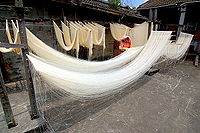
Chinese noodles
Noodles are an essential ingredient and staple in Chinese cuisine. There is a great variety of Chinese noodles, which vary according to their region of production, ingredients, shape or width, and manner of preparation...
come dry or fresh in a variety of sizes, shapes and textures and are often served in soups or fried as toppings. Some varieties, such as Shou Mian (寿面, literally noodles of longevity), are symbolic of long life and good health according to Chinese tradition.
Soybeans
TofuTofu
is a food made by coagulating soy milk and then pressing the resulting curds into soft white blocks. It is part of East Asian and Southeast Asian cuisine such as Chinese, Japanese, Korean, Indonesian, Vietnamese, and others. There are many different varieties of tofu, including fresh tofu and tofu...
is made of soybeans and is another popular product that supplies protein.
Wheat
In wheat farming areas in Northern China, people largely rely on flour based food such as noodles, breads, dumplingJiaozi
Jiǎozi 餃子 or 饺子 , bánh bột luộc , gyōza , Mo:Mo: or Momocha म:म: or ममचा , or pot sticker is a Chinese dumpling widely spread to Japan, Eastern and Western Asia.Jiaozi typically consist of a ground meat and/or vegetable filling wrapped into...
s and steamed buns
Mantou
Mantou, often referred to as Chinese steamed bun/bread, is a kind of steamed bun originating in China. They are typically eaten as a staple in northern parts of China where wheat, rather than rice, is grown. They are made with milled wheat flour, water and leavening agents...
.
Vegetables
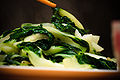
Vegetable
The noun vegetable usually means an edible plant or part of a plant other than a sweet fruit or seed. This typically means the leaf, stem, or root of a plant....
s used in Chinese cuisine include bok choy
Chinese cabbage
Chinese cabbage can refer to two distinct varieties of Chinese leaf vegetables used often in Chinese cuisine. These vegetables are both related to the Western cabbage, and are of the same species as the common turnip...
(Chinese cabbage), Chinese Spinach (dao-mieu), On Choy, Yu Choy, and gailan
Kai-lan
Kai-lan, also known as Chinese broccoli, is a leaf vegetable featuring thick, flat, glossy blue-green leaves with thick stems and a small number of tiny, almost vestigial flower heads similar to those of broccoli. Broccoli and kai-lan belong to the same species Brassica oleracea, but kai-lan is in...
(guy-lahn).
Herbs
HerbHerb
Except in botanical usage, an herb is "any plant with leaves, seeds, or flowers used for flavoring, food, medicine, or perfume" or "a part of such a plant as used in cooking"...
s were important to the Chinese people, especially during the Han Dynasty
Han Dynasty
The Han Dynasty was the second imperial dynasty of China, preceded by the Qin Dynasty and succeeded by the Three Kingdoms . It was founded by the rebel leader Liu Bang, known posthumously as Emperor Gaozu of Han. It was briefly interrupted by the Xin Dynasty of the former regent Wang Mang...
.
Seasonings
When it comes to sauceSauce
In cooking, a sauce is liquid, creaming or semi-solid food served on or used in preparing other foods. Sauces are not normally consumed by themselves; they add flavor, moisture, and visual appeal to another dish. Sauce is a French word taken from the Latin salsus, meaning salted...
s, China is home to soy sauce
Soy sauce
Soy sauce is a condiment produced by fermenting soybeans with Aspergillus oryzae or Aspergillus sojae molds, along with water and salt...
, which is made from fermented soya beans and wheat
Wheat
Wheat is a cereal grain, originally from the Levant region of the Near East, but now cultivated worldwide. In 2007 world production of wheat was 607 million tons, making it the third most-produced cereal after maize and rice...
. Oyster sauce
Oyster sauce
Oyster sauce describes a number of sauces made by cooking oysters. The most common in modern use is a viscous dark brown condiment made from sugar, salt and water thickened with cornstarch, flavoured with a little oyster essence or extract and some versions may be darkened with caramel, though high...
, transparent rice vinegar
Rice vinegar
Rice vinegar is a vinegar made from fermented rice or rice wine in China, Japan, Korea, and Vietnam.-Chinese:Chinese rice vinegars are stronger than Japanese ones, and range in colour from clear to various shades of red and brown...
, Chinkiang black rice vinegar, fish sauce and fermented tofu (furu) are also widely used. A number of sauces are based on fermented soybeans, including Hoisin sauce
Hoisin sauce
Hoisin sauce, or haixian sauce, is a Chinese dipping sauce. The word hoisin is a romanization of the Chinese word for seafood "" as pronounced in Cantonese.-Ingredients:...
, ground bean sauce and yellow bean sauce. Spice
Spice
A spice is a dried seed, fruit, root, bark, or vegetative substance used in nutritionally insignificant quantities as a food additive for flavor, color, or as a preservative that kills harmful bacteria or prevents their growth. It may be used to flavour a dish or to hide other flavours...
s and seasoning
Seasoning
Seasoning is the process of imparting flavor to, or improving the flavor of, food.- General meaning :Seasonings include herbs and spices, which are themselves frequently referred to as "seasonings"...
s such as fresh root ginger
Ginger
Ginger is the rhizome of the plant Zingiber officinale, consumed as a delicacy, medicine, or spice. It lends its name to its genus and family . Other notable members of this plant family are turmeric, cardamom, and galangal....
, garlic
Garlic
Allium sativum, commonly known as garlic, is a species in the onion genus, Allium. Its close relatives include the onion, shallot, leek, chive, and rakkyo. Dating back over 6,000 years, garlic is native to central Asia, and has long been a staple in the Mediterranean region, as well as a frequent...
, spring onion, white pepper
White Pepper
-Singles:* "Even If You Don't" was released as a single on Mushroom Records with the B-side "Cornbread Red".* "Stay Forever" was released as a single on Mushroom Records with "The Grobe" and "Who Dat?"-Musicians featured on the record:* Dean Ween* Gene Ween...
, sesame oil
Sesame oil
Sesame oil is an edible vegetable oil derived from sesame seeds. Besides being used as a cooking oil in South India, it is often used as a flavor enhancer in Chinese, Japanese, Korean, and to a lesser extent Southeast Asian cuisine.The oil from the nutrient rich seed is popular in alternative...
are widely used in many regional cuisines. Sichuan peppercorns, star anise
Star anise
Illicium verum, commonly called Star anise, star aniseed, or Chinese star anise, is a spice that closely resembles anise in flavor, obtained from the star-shaped pericarp of Illicium verum, a small native evergreen tree of northeast Vietnam and southwest China...
, cinnamon
Cinnamon
Cinnamon is a spice obtained from the inner bark of several trees from the genus Cinnamomum that is used in both sweet and savoury foods...
, fennel
Fennel
Fennel is a plant species in the genus Foeniculum . It is a member of the family Apiaceae . It is a hardy, perennial, umbelliferous herb, with yellow flowers and feathery leaves...
, clove
Clove
Cloves are the aromatic dried flower buds of a tree in the family Myrtaceae. Cloves are native to the Maluku islands in Indonesia and used as a spice in cuisines all over the world...
s. To provide extra flavors to dishes, many Chinese cuisines also contain dried Chinese mushrooms, dried baby shrimps, dried tangerine peel, dried Sichuan chillies as well.
Desserts
Chinese tea
The practice of drinking tea has had a long history in China, having originated there. The Chinese drink tea during many parts of the day such as during meals for good health or for simple pleasure.-History:...
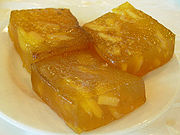
, along with meals or at the end of meals in Chinese cuisine. Bings are baked wheat flour based confections, and include moon cake Red bean paste pancake and sun cakes. Chinese candies and sweets, called táng are usually made with cane sugar, malt sugar, honey, nuts and fruit. Gao or Guo are rice based snacks that are typically steamed and may be made from glutinous or normal rice. Ice cream
Ice cream
Ice cream is a frozen dessert usually made from dairy products, such as milk and cream, and often combined with fruits or other ingredients and flavours. Most varieties contain sugar, although some are made with other sweeteners...
is commonly available throughout China. Another cold dessert is called baobing, which is shaved ice
Shaved ice
Shaved ice is a large family of ice-based dessert made of fine shavings of ice or finely crushed ice topped with sweet condiments or syrups. The dessert is consumed world-wide in various forms and manners. Shaved ice can also mixed with large quantities of liquid to produce shaved ice drinks.Shaved...
with sweet syrup. Chinese jellies are known collectively in the language as ices. Many jelly desserts are traditionally set with agar and are flavored with fruits, though gelatin
Gelatin
Gelatin is a translucent, colorless, brittle , flavorless solid substance, derived from the collagen inside animals' skin and bones. It is commonly used as a gelling agent in food, pharmaceuticals, photography, and cosmetic manufacturing. Substances containing gelatin or functioning in a similar...
based jellies are also common in contemporary desserts. Chinese dessert soups typically consist of sweet and usually hot soups and custards.
Tea
As well as with dim sum, many Chinese drink their tea with snacks such as nuts, plums, dried fruit (in particular jujubeJujube
Ziziphus zizyphus , commonly called jujube , red date, Chinese date, Korean date, or Indian date is a species of Ziziphus in the buckthorn family Rhamnaceae, used primarily as a fruiting shade tree.-Distribution:Its precise natural distribution is uncertain due to extensive cultivation,...
), small sweets, melon seeds, and waxberry
Myrica rubra
Myrica rubra, also called yangmei , yamamomo , Chinese Bayberry, Japanese Bayberry, Red Bayberry,Yumberry, or Chinese strawberry tree is a subtropical tree grown for its sweet, crimson to dark purple-red, edible fruit.- Description :It is a small to medium-sized evergreen tree...
. China was the earliest country to cultivate and drink tea and it is enjoyed by people from all social classes. Tea processing began after the Qin
Qin Dynasty
The Qin Dynasty was the first imperial dynasty of China, lasting from 221 to 207 BC. The Qin state derived its name from its heartland of Qin, in modern-day Shaanxi. The strength of the Qin state was greatly increased by the legalist reforms of Shang Yang in the 4th century BC, during the Warring...
and Han Dynasties
Han Dynasty
The Han Dynasty was the second imperial dynasty of China, preceded by the Qin Dynasty and succeeded by the Three Kingdoms . It was founded by the rebel leader Liu Bang, known posthumously as Emperor Gaozu of Han. It was briefly interrupted by the Xin Dynasty of the former regent Wang Mang...
. Chinese tea is often classified into several different categories according to the species of plant from which it is sourced, the region in which it is grown, and the method of production used. Some of these are green tea
Green tea
Green tea is made solely from the leaves of Camellia sinensis that have undergone minimal oxidation during processing. Green tea originates from China and has become associated with many cultures throughout Asia. It has recently become more widespread in the West, where black tea is traditionally...
, oolong tea, black tea, scented tea, white tea
White tea
White tea is a lightly oxidized tea grown and harvested almost exclusively in China, primarily in the Fujian province.White tea comes from the delicate buds and younger leaves of the Chinese Camellia sinensis plant. These buds and leaves are allowed to wither in natural sunlight before they are...
, and compressed tea. There are four major tea plantation regions in China. They are Jiangbei
Jiangbei
Jiangbei may refer to:*North of the Yangtze River, especially in eastern China, or Jiangsu*Jiangbei District, Chongqing, in Chongqing, China*Jiangbei District, Ningbo, in Zhejiang, China*Jiangbei, Meizhou, in Guangdong, China...
, Jiangnan
Jiangnan
Jiangnan or Jiang Nan is a geographic area in China referring to lands immediately to the south of the lower reaches of the Yangtze River, including the southern part of the Yangtze Delta...
, Huanan
Huanan
Huanan could refer to the following in China:*South China *Huanan County , in Jiamusi, Heilongjiang*Huanan Bridge, a bridge in Guangzhou, China*Huanan Town , county seat of Huanan County...
and the southwestern region. Well known types of green tea include Longjing, Huangshan
Huangshan
Huangshan may refer to:*Huangshan , a scenic mountain range and UNESCO World Heritage Site*Huangshan City, a prefecture-level city centered on the Huangshan Mountains...
, Mao Feng
Mao feng
Mao feng is a term in tea manufacture denoting the picking of a bud and two leaves of equal length. Mao feng teas have a broad, curved, flat shape. It is considered one of the choicest shapes of tea leaf....
, Bilochun, Putuofeng Cha, and Liu'an Guapian. China is the world’s largest exporter of green tea. One of the most ubiquitous accessories in modern China, after a wallet or purse and an umbrella, is a double-walled insulated glass thermos with tea leaves in the top behind a strainer.
Liquor
Yellow wine has a long history in China, where the unique beverage is produced from rice and ranges between 10–15% alcohol content. The most popular brands include Shaoxing Lao Jiu, Shaoxing Hua Diao and Te Jia Fan. WheatWheat
Wheat is a cereal grain, originally from the Levant region of the Near East, but now cultivated worldwide. In 2007 world production of wheat was 607 million tons, making it the third most-produced cereal after maize and rice...
, corn
Corn
Corn is the name used in the United States, Canada, and Australia for the grain maize.In much of the English-speaking world, the term "corn" is a generic term for cereal crops, such as* Barley* Oats* Wheat* Rye- Places :...
and rice are used to produce Chinese liquor which is clear and aromatic, containing approximately 60% alcohol. This also has a long history in China, with production believed to date back to the Song Dynasty
Song Dynasty
The Song Dynasty was a ruling dynasty in China between 960 and 1279; it succeeded the Five Dynasties and Ten Kingdoms Period, and was followed by the Yuan Dynasty. It was the first government in world history to issue banknotes or paper money, and the first Chinese government to establish a...
. Some popular brands of liquor include Er guo tou, Du Kang, Mao Tai, Lu Zhou Te Qu and Wu Liang Ye.
Herbal drinks
Chinese herb tea, also known as medicinal herbal tea, is a kind of tea-soup made from purely Chinese medicinal herbHerb
Except in botanical usage, an herb is "any plant with leaves, seeds, or flowers used for flavoring, food, medicine, or perfume" or "a part of such a plant as used in cooking"...
s.
Medicine Cuisine
Chinese medicine cuisine is an important part in Chinese cuisine. Its origins can be traced to as early as B.C 1046. It developed in Han Dynasty (A.D 200). In Chinese traditional medicine, medicine can be characterized as 'four properties and five flavors (四性五味)'. The 'four properties' refer to 'coldCold
Cold describes the condition of low temperature.Cold may also refer to:*Common cold, a contagious viral infectious disease of the upper respiratory system*Chronic obstructive pulmonary disease...
','cool','warm
Warm
Warm or WARM can refer to:* A somewhat high temperature.* WARM , a radio station licensed to Scranton, Pennsylvania, United States* WARM-FM, a radio station licensed to York, Pennsylvania, United States...
', and 'hot
Hot
Hot or HOT may refer to:*Geographical Places and People:**Hot District, a district of Chiang Mai province, Thailand**Hot, Hot a sub-district of Hot District, Thailand**Hot, Albania, a municipality in the Malësi e Madhe District, Albania...
', and the 'five flavors' refer to 'spicy','sour','sweet','bitter
Bitter
Bitter can refer to:* Bitter , an album by Meshell Ndegeocello* Bitter , a kind of ale particularly popular in England* Bitter Cars, a German car company* Bitter * Bitter , one of the five basic tastes...
', and 'salty
Salty
Salty may refer to the following:* salt* Saltiness, one of the five basic tastes* salt * salience* LondonerFictional characters:* Salty the Seal, character in Disney's Pluto cartoons...
'. Chinese medical doctors believe that some kinds of food have the 'four properties and five flavors' as well, which can not only serve for meal, but are also beneficial for health. This theory is called 'the homology
Homology
Homology may refer to:* Homology , analogy between human beliefs, practices or artifacts owing to genetic or historical connections* Homology , any characteristic of biological organisms that is derived from a common ancestor....
of medicine and food (药食同源)' in traditional Chinese medicine, and this is also the basis for Chinese medicine cuisine.
Chinese medicine cuisine applies 'the homology of medicine and food' theory and makes the food and medicine consistent with each other according to the 'four properties', while the 'five flavors' aim at curing specific symptoms or strengthening body. It is because the medical property of medicine and the edible property of food are combined in cooking that the Chinese medicine cuisine is beneficial for health with good color,flavor, and taste.
Based on the effect, Chinese medicine cuisine can be categorized into four categories.
Health Care
This mainly aims at recuperating or strengthening the body.'Stewed pig heart with the Chinese Arborvitae kernel (柏子仁炖猪心)' may soothe the nerves; 'Semen Cassiae and chicken liver soup (决明子鸡肝汤)' is beneficial for improving eyesight;'Ten Major Tonics DecoctionDecoction
Decoction is a method of extraction, by boiling, of dissolved chemicals, or herbal or plant material, which may include stems, roots, bark and rhizomes. Decoction involves first mashing, and then boiling in water to extract oils, volatile organic compounds, and other chemical substances...
(十全大补汤)' can supplement qi and blood.
Skin Nourishment
This mainly aims at beautifying the skin. 'dahurian angelicaAngelica
Angelica is a genus of about 60 species of tall biennial and perennial herbs in the family Apiaceae, native to temperate and subarctic regions of the Northern Hemisphere, reaching as far North as Iceland and Lapland...
root and Poria cocos porridge (白芷茯苓粥)' may remove freckles on skin; 'Flatstem Milkvetch Seed turtle soup (沙苑子甲鱼汤)' may prevent skin laxity.
Illness Treatment
This mainly aims at curing diseases.'hew jelly (山楂糕)' can deal with dyspepsiaDyspepsia
Dyspepsia , also known as upset stomach or indigestion, refers to a condition of impaired digestion. It is a medical condition characterized by chronic or recurrent pain in the upper abdomen, upper abdominal fullness and feeling full earlier than expected when eating...
; 'the root of angelica
Angelica
Angelica is a genus of about 60 species of tall biennial and perennial herbs in the family Apiaceae, native to temperate and subarctic regions of the Northern Hemisphere, reaching as far North as Iceland and Lapland...
with chicken (当归鸡)' may relieve pain; 'tendril-leaved fritillary bulb steamed with white pear (川贝蒸白梨)' may cure a cough
Cough
A cough is a sudden and often repetitively occurring reflex which helps to clear the large breathing passages from secretions, irritants, foreign particles and microbes...
.
Rehabilitation
'a Chinese hawthornCrataegus pinnatifida
Crataegus pinnatifida, also known as Chinese hawthorn or shānzhā , refers to a small to a medium-sized tree as well as the fruit of the tree. The fruit is bright red, 1.5 inches in diameter.-Culinary use:...
with shelled walnut (山楂桃仁蜜)' may help rehabilitating from coronary heart disease
Coronary heart disease
Coronary artery disease is the end result of the accumulation of atheromatous plaques within the walls of the coronary arteries that supply the myocardium with oxygen and nutrients. It is sometimes also called coronary heart disease...
; 'a fritillary
Fritillary
Fritillaria is a genus of about 100 species of bulbous plants in the family Liliaceae, native to temperate regions of the Northern Hemisphere. The name is derived from the Latin term for a dice-box , and probably refers to the checkered pattern, frequently of chocolate-brown and greenish yellow,...
turtle soup (贝母甲鱼汤)' may help rehabilitating from diabetes.
Styles
In most dishes in Chinese cuisine, food is prepared in bite-sized pieces, ready for direct picking up and eating. In traditional Chinese cultures, chopsticksChopsticks
Chopsticks are small, often tapered, sticks used in pairs of equal length as the traditional eating utensils of China and its diaspora, Japan, Korea, Vietnam and Northern provinces of Laos, Thailand and Burma. Generally believed to have originated in ancient China, they can also be found in some...
are used at the table. Traditional Chinese cuisine is also based on opposites
Yin and yang
In Asian philosophy, the concept of yin yang , which is often referred to in the West as "yin and yang", is used to describe how polar opposites or seemingly contrary forces are interconnected and interdependent in the natural world, and how they give rise to each other in turn. Opposites thus only...
, whereby hot balances cold, pickled balances fresh and spicy balances mild.
Story and legend about Chinese cuisine
- New Year Cake
- Pao Ding Jie Niu
- Madam Song's Fish Soup
Recent trends
According to the United NationsUnited Nations
The United Nations is an international organization whose stated aims are facilitating cooperation in international law, international security, economic development, social progress, human rights, and achievement of world peace...
Food and Agriculture Organization
Food and Agriculture Organization
The Food and Agriculture Organization of the United Nations is a specialised agency of the United Nations that leads international efforts to defeat hunger. Serving both developed and developing countries, FAO acts as a neutral forum where all nations meet as equals to negotiate agreements and...
estimates for 2001–2003, 12% of the population of the People’s Republic of China was undernourished.
The number of undernourished people in the country has fallen from 386.6 million in 1969–1971 to 150.0 million in 2001–2003.
Prior to the increased industrialization and modernization following the establishment of the People's Republic of China in 1949 (and the late 1950s famine), a typical Chinese peasant would have eaten meat or animal products (including eggs) rarely and most meals would have consisted of rice accompanied with green vegetables, with protein coming from foods like peanut
Peanut
The peanut, or groundnut , is a species in the legume or "bean" family , so it is not a nut. The peanut was probably first cultivated in the valleys of Peru. It is an annual herbaceous plant growing tall...
s and soy products. Fats and sugar were luxuries not eaten on a regular basis by most of the population. With increasing wealth, Chinese diets have become richer over time, consuming more meats, fats, and sugar.
Variations
Where there are historical immigrant Chinese populations, the style of food has evolved and been adapted to local tastes and ingredients, and modified by the local cuisine, to greater or lesser extents. This has resulted in a number of forms of fusion cuisineFusion cuisine
Fusion cuisine combines elements of various culinary traditions while not being categorized per any one particular cuisine style, and can pertain to innovations in many contemporary restaurant cuisines since the 1970s.-Categories and types:...
, often very popular in the country in question, and some of these, such as ramen
Ramen
is a Japanese noodle dish. It consists of Chinese-style wheat noodles served in a meat- or fish-based broth, often flavored with soy sauce or miso, and uses toppings such as , , kamaboko, green onions, and occasionally corn...
(Japanese Chinese) have become popular internationally. These include:
- American Chinese cuisineAmerican Chinese cuisineAmerican Chinese cuisine refers to the style of food served by many Chinese restaurants in the United States. This type of cooking typically caters to Western tastes, and differs significantly from the original Chinese cuisine.-History:...
- Canadian Chinese cuisineCanadian Chinese cuisineCanadian Chinese cuisine is a popular style of cooking exclusive to take-out and dine-in eateries found across Canada. It was the first form of commercially available Chinese food available in Canada. This cooking style was invented by early Cantonese immigrants who adapted traditional Chinese...
- Caribbean Chinese cuisineCaribbean Chinese cuisineCaribbean Chinese cuisine is a popular style of food resulting from a fusion of Chinese and West Indian cuisines. The Chinese influence is predominantly Cantonese, the main source of Chinese immigrants to the West Indies...
- Filipino Chinese cuisineFilipino Chinese cuisineThere are many types of foods in the Philippines because of inhabitants residing in the country. Most of the Filipino Chinese are ones who have businesses in Chinese food and service restaurants. Restaurants are frequently seen as places where there is a great amount of Chinese Filipino living in...
- Indian Chinese cuisineIndian Chinese cuisineIndian Chinese cuisine is the adaptation of Chinese seasoning and cooking techniques to Indian tastes. It is said to have been developed by the small Chinese community that has lived in Kolkata for over a century...
- Japanese Chinese cuisineJapanese Chinese cuisineJapanese Chinese cuisine is a unique style of Chinese cuisine served by Chinese restaurants in Japan. Many of these restaurants are Japanese-owned, though there are some which are operated by overseas Chinese...
- Korean Chinese cuisineKorean Chinese cuisineKorean Chinese cuisine is derived from traditional Chinese cuisine but has been influenced by local ingredients in Korea. Due to geographical proximity, most Korean-Chinese dishes are derived from Northern styles of Chinese cuisine such as Beijing and Shandong cuisine. However, some have regarded...
- Pakistani Chinese cuisinePakistani Chinese cuisinePakistani Chinese cuisine refers to the styles and variations of Chinese cuisine that are cooked and consumed in Pakistan. Chinese migrants to Pakistan have developed a distinct Pakistani-style Chinese cuisine.-History:...
- ChifaChifaChifa is a term used in Peru to refer to a style of Chinese cooking in which ingredients which are available in Peru have been substituted for those originally used in China. Chinese immigrants came to Peru mainly from the southern province of Guangdong and particularly its capital city Guangzhou...
See also
- Chinese cooking techniquesChinese cooking techniquesChinese cooking techniques are a set of methods and techniques traditionally used in Chinese cuisine. The cooking techniques can either be grouped into ones that use a single cooking method or a combination of wet and dry cooking methods.-Wet:...
- Chinese table mannersChinese table mannersChinese table manners are the traditional styles that are used for eating in the region of China. In most dishes in Chinese cuisine, food is cooked in bite-sized pieces and easy to hold and eat...
- List of Chinese dishes
- History of Chinese cuisineHistory of Chinese cuisineThe Cuisine of China spreads both around the world and deep into history and is marked by both variety and change. The archeologist and scholar K.C. Chang says “Chinese people are especially preoccupied with food” and “food is at the center of, or at least it accompanies or symbolizes, many social...
- Chinese Cuisine Training InstituteChinese Cuisine Training InstituteChinese Cuisine Training Institute is a cooking school at Pok Fu Lam, Hong Kong. It is established and run by the Vocational Training Council of Hong Kong. It provides both full-time and part-time courses to beginners and practicing chefs in the industry who wish to obtain or upgrade their...
- Chinese Cuisines of Singapore