
All Topics  
Chinese astronomy

 
Chinese Astronomy

   Email Print
   Bookmark   Link


Chinese astronomy


Astronomy in China has a very long history. Oracle bone
Oracle bone

Oracle bones are pieces of bone or animal shell that were heated and cracked, using a bronze pin, during divination, chiefly during the late Shang Dynasty, and then typically inscribed with a record of the reflexes in what is known as oracle bone script....
s from the Shang Dynasty
Shang Dynasty

The Shang Dynasty or Yin Dynasty was according to traditional sources the first Dynasties in Chinese history. They ruled in the northeastern region of the area known as "China proper", in the Yellow River valley....
 (2nd millennium BC) record eclipses and novae. Detailed records of astronomical observations were kept from about the 6th century BC until the introduction of Western astronomy and the telescope in the 16th century. The practice of astronomy in China
China

China is a Culture of China, an ancient civilization, and, depending on perspective, a national or multinational entity extending over a large area in East Asia....
 was fundamentally changed by extended contact with Western astronomy. Today, China continues to be active in astronomy, with many observatories and its own space program
Chinese space program

The space program of the People's Republic of China was initiated soon after the founding of the People's Republic of China. Eventually, this space program would cover Anti-ballistic missile, anti-satellite weaponries, reconnaissance and intelligence satellites, manned spacecrafts, space laboratories, space stations and spaceplanes, culminat...
.

of the main functions was for the purpose of timekeeping.


Discussion
Ask a question about 'Chinese astronomy'
Start a new discussion about 'Chinese astronomy'
Answer questions from other users
Full Discussion Forum


Encyclopedia


Astronomy in China has a very long history. Oracle bone
Oracle bone

Oracle bones are pieces of bone or animal shell that were heated and cracked, using a bronze pin, during divination, chiefly during the late Shang Dynasty, and then typically inscribed with a record of the reflexes in what is known as oracle bone script....
s from the Shang Dynasty
Shang Dynasty

The Shang Dynasty or Yin Dynasty was according to traditional sources the first Dynasties in Chinese history. They ruled in the northeastern region of the area known as "China proper", in the Yellow River valley....
 (2nd millennium BC) record eclipses and novae. Detailed records of astronomical observations were kept from about the 6th century BC until the introduction of Western astronomy and the telescope in the 16th century. The practice of astronomy in China
China

China is a Culture of China, an ancient civilization, and, depending on perspective, a national or multinational entity extending over a large area in East Asia....
 was fundamentally changed by extended contact with Western astronomy. Today, China continues to be active in astronomy, with many observatories and its own space program
Chinese space program

The space program of the People's Republic of China was initiated soon after the founding of the People's Republic of China. Eventually, this space program would cover Anti-ballistic missile, anti-satellite weaponries, reconnaissance and intelligence satellites, manned spacecrafts, space laboratories, space stations and spaceplanes, culminat...
.

Early history


Purpose of astronomical observations in the past

One of the main functions was for the purpose of timekeeping. The Chinese used a lunisolar calendar
Lunisolar calendar

A lunisolar calendar is a calendar in many cultures whose date indicates both the moon phase and the time of the solar year. If the solar year is defined as a tropical year then a lunisolar calendar will give an indication of the season; if it is taken as a sidereal year then the calendar will predict the constellation near which the full moo...
 , but because the cycles of the Sun and the Moon are different, intercalation
Intercalation

Intercalation is the insertion of a leap day, week or month into some calendar years to make the calendar follow the seasons or moon phases. Lunisolar calendars may require intercalations of both days and months....
 had to be done.

The Chinese calendar
Chinese calendar

The Chinese calendar is lunisolar calendar, incorporating elements of a lunar calendar with those of a solar calendar. This measure of time was first introduced by the Babylonians ....
 was considered to be a symbol of a dynasty. As dynasties would rise and fall, astronomers and astrologers of each period would often prepare a new calendar to be made, with observations for that purpose.

Astrological divination
Divination

Divination is the attempt to gain insight into a question or situation by way of a standardized process or ritual. Diviners ascertain their interpretations of how a querent should proceed by reading signs, events, or omens, or through alleged contact with a supernatural agency....
 was also an important part of astronomy. Astronomers took careful note of "guest stars" which suddenly appeared among the fixed star
Fixed star

.The fixed stars are celestial objects that do not seem to move in relation to the other stars of the night sky. Hence, a fixed star is any star except for the Sun....
s. The supernova
Supernova

A supernova is a Astronomy#Stellar astronomy explosion. Supernovae are extremely luminous and cause a burst of radiation that often briefly outshines an entire galaxy, before fading from view over several weeks or months....
 that created the Crab Nebula
Crab Nebula

The Crab Nebula  is a supernova remnant and pulsar wind nebula in the constellation of Taurus . The nebula was first observed by John Bevis, and corresponds to a bright supernova recorded by Chinese astronomy and Islamic astronomy astronomers SN 1054....
 in 1054 is an example of a guest star observed by Chinese astronomers, recorded also by the Arab astronomers
Islamic astronomy

In the history of astronomy, Islamic astronomy or Arabic astronomy refers to the astronomical developments made in the Islamic world, particularly during the Islamic Golden Age , and mostly written in the Arabic language....
, although it was not recorded by their European contemporaries. Ancient astronomical records of phenomena like supernovae and comets are sometimes used in modern astronomical studies.

Chinese constellations


History of Chinese constellations
The divisions of the sky began with the Northern Dipper and the 28 mansions
Twenty-eight mansions

Chinese constellation#The_Twenty-Eight_Mansions are the 28 mansions in Chinese astronomy....
.

In early 1980s, a tomb was found at Xishuipo in Puyang
Puyang

Puyang is a prefecture-level city in northeastern Henan province, China. Located on the northern shore of the Yellow River, it borders Anyang in the west, Xinxiang in the southwest, and the provinces of Shandong and Hebei in the east and north respectively....
, Henan
Henan

Henan , is a Province of the People's Republic of China, located in the central part of the country. Its one-Chinese character abbreviation is ? , named after Yuzhou , a Han Dynasty province that included parts of Henan....
 Province. There were some clamshells and bones forming the images of the Azure Dragon, the White Tiger
White Tiger (Chinese constellation)

The White Tiger is one of the Four Symbols of the Chinese constellations. It is sometimes called the White Tiger of the West , and is known as Byakko in Japan and Baekho in Korea....
 and the Northern Dipper. It is believed that the tomb belongs to the Neolithic
Neolithic

The Neolithic period was a period in the development of human technology, beginning about 9500 Before the Christian Era in the Middle East that is traditionally considered the last part of the Stone Age....
 Age, about 6,000 years ago.

Star names relating to the 28 lunar mansions were found on oracle bones dating back to the Wuding
Wu Ding

Wu Ding was a Shang Dynasty King of China.His is the first historically verifiable name in the history of China dynasties. The records of later historians that recorded his reign were long thought to be little more than legends until contemporary records of his reign were discovered in oracle script inscriptions on oracle bone unearthed at...
 Period, about 3,200 years ago.

In 1977, a lacquer box was excavated from the tomb of Yi, the marquis of Zeng, in Suixian, Hubei
Hubei

is a central province of China of the People's Republic of China. Its abbreviation is ? , an ancient name associated with the eastern part of the province since the Qin Dynasty....
 Province. Names of the 28 lunar mansions were found on the cover of the box, proving that the use of this classification system was made before 433 BC.

As lunar mansions have such an ancient origin, the meaning of most of their names have become obscure. Even worse, name of each lunar mansion consists of only one Chinese word, and the meaning of which could vary at different times in history. So the meaning of the names are still under discussion.

Besides 28 lunar mansions, most constellations are based on the works of Shi Shen-fu
Shi Shen

Shi Shen was a China astronomer and contemporary of Gan De born in the State of Wei, also known as the Master Shi Shen ....
 and Gan De
Gan De

Gan De was a China astronomer/astrologer born in the State of Qi also known as the Lord Gan . Along with Shi Shen, he is believed to be the first in history to compile a star catalogue, followed by the Greek Hipparchus who is the first known in the Western tradition to have compiled a star catalogue....
, who were astrologists during the period of Warring States (481 BC - 221 BC) in China.

In the late period of the Ming Dynasty
Ming Dynasty

The Ming Dynasty , or Empire of the Great Ming , was the ruling Dynasties in Chinese history of China from 1368 to 1644, following the collapse of the Mongol-led Yuan Dynasty....
, the agricultural scientist and mathematician Xu Guangqi
Xu Guangqi

Xu Guangqi , courtesy name Zixian , was a Chinese bureaucrat, agricultural scientist, astronomer, and mathematician in the Ming Dynasty. Xu was a colleague and collaborator of the Italian Jesuits Matteo Ricci and Sabatino de Ursis and they translated several classic Western texts into Chinese, including part of Euclid's Elements....
 (1562 - 1633 AD) introduced 23 additional constellations which are near to the Celestial South Pole, which are based on star catalogues from the West (see Matteo Ricci
Matteo Ricci

Matteo Ricci, SJ was an Italian Jesuit priest.Matteo Ricci was born in 1552 in Macerata, then part of the Papal States. Ricci started learning theology and law in a Rome Jesuits' school....
).

Star catalogues and Maps


Star catalogues

In the 4th century BC the two Chinese astronomers responsible for the earliest information going into the star catalogues are Shi Shen
Shi Shen

Shi Shen was a China astronomer and contemporary of Gan De born in the State of Wei, also known as the Master Shi Shen ....
 and Gan De
Gan De

Gan De was a China astronomer/astrologer born in the State of Qi also known as the Lord Gan . Along with Shi Shen, he is believed to be the first in history to compile a star catalogue, followed by the Greek Hipparchus who is the first known in the Western tradition to have compiled a star catalogue....
 of the Warring States period
Warring States Period

The Warring States Period , also known as the Era of Warring States, covers the period from 476 BCE to the unification of China by the Qin Dynasty in 221 BCE....
.

Author Transliterated name Chinese Catalogue name Pinyin
Shi Shen
Shi Shen

Shi Shen was a China astronomer and contemporary of Gan De born in the State of Wei, also known as the Master Shi Shen ....
 
Shi Shen astronomy ???? Shi Shen tienwen
Gan De
Gan De

Gan De was a China astronomer/astrologer born in the State of Qi also known as the Lord Gan . Along with Shi Shen, he is believed to be the first in history to compile a star catalogue, followed by the Greek Hipparchus who is the first known in the Western tradition to have compiled a star catalogue....
 
Astronomic star observation ???? Tianwen xingzhan


These books appeared to have lasted till the 6th century, but are lost after that. A number of books share similar names, often quoted and named after them. These texts should not be confused with the original catalogues written by them. Notable works that helped preserve the contents include:

Author Transliterated name Chinese name Pinyin Comments
Ma Xian Star Manual of the Masters Gan and Shi ???? Gan Shi Xingjing Despite having the name credited to Shi and Gan, it was actually compiled circa 579 AD as an appendix to a calendar treatise.
Book of Jin
Book of Jin

The Book of Jin is one of the official Chinese historical works. It covers the history of Jin Dynasty from 265 to 420, which written by a number of officials commissioned by the court of Tang Dynasty, with the lead editor being the Prime Minister Fang Xuanling, drawing mostly from the official documents left from the earlier archives....
 
?? Jin shu In the Astronomical chapters of the text
Book of Sui
Book of Sui

The Book of Sui was the official history of the History of China dynasty Sui Dynasty, and it ranks among the official Twenty-Four Histories of imperial China....
 
?? Sui shu  
Gautama Siddha
Gautama Siddha

Gautama Siddha was a China translator, astronomer, astrologer and compiler of History of India descent, known for leading the compilation of the Treatise on Astrology of the Kaiyuan Era during the Tang Dynasty....
 
Treatise on Astrology of the Kaiyuan Era

The Treatise on Astrology of the Kaiyuan Era is a Chinese language astrology encyclopedia compiled by the lead editor Gautama Siddha and numerous scholars from 714 to 724 AD during the Kaiyuan era of Tang Dynasty....
 
???? Kaiyuan Zhanjing During the reign of Emperor Xuanzong of Tang
Emperor Xuanzong of Tang

Emperor Xuanzong of Tang , also commonly known as Emperor Ming of Tang , personal name Li Longji , known as Wu Longji from 690 to 705, was the seventh emperor of the Tang dynasty in China, reigning from 712 to 756....
 (712 - 756 AD). After analyzing and providing summary on the work of Gan De and Shi Shen, Tang era astronomers mentioned the names of more than 800 stars that were found. 121 of them marked with positions. The astronomical table of sines by the Indian astronomer and mathematician
Indian mathematics

Indian mathematics—which here is the mathematics that emerged in South Asia from ancient times until the end of the 18th century—had its beginnings in the Bronze Age Indus Valley civilization and the Iron Age Vedic culture ....
, Aryabhata
Aryabhata

Aryabhaa is the first in the line of great mathematician-astronomers from the classical age of Indian mathematics and Indian astronomy. His most famous works are the Aryabhatiya and Arya-Siddhanta....
, were also translated into the Kaiyuan Zhanjing.
The Great Firmament Star Manual Common to Astrology ??????? Tongzhan taxiangli xingjing This renamed star manual is incorporated in the Taoist book Daozang
Daozang

Daozang , meaning "Treasury of Dao" or "Daoism Canon", consists of almost 5000 individual texts that were collected circa C.E. 400 . They were collected by Daoist monks of the period in an attempt to bring together all of the teachings of Daoism, including all the commentaries and expositions of the various masters from the original teaching...
.


Wu Xian
Wu Xian (astronomer)

Wu Xian was a Chinese astronomy who supposedly lived in the Shang Dynasty of China. He is considered as one of the main ancient Chinese astronomers alongside more historical figures such as Gan De and Shi Shen, the latter two of whom lived during the Warring States ....
has been one of the astronomers in debate. He is often represented as one of the "Three Schools Astronomical tradition" along with Gan and Shi. The Chinese classic text "Star Manual of Master Wu Xian", and its authorship is still in dispute because it mentioned names of Twelve Countries, which did not exist in the Shang Dynasty
Shang Dynasty

The Shang Dynasty or Yin Dynasty was according to traditional sources the first Dynasties in Chinese history. They ruled in the northeastern region of the area known as "China proper", in the Yellow River valley....
, the era of which it was supposed to have been written. Moreover, it was customary in the past for the Chinese to forge works of notable scholars, as this could lead to a possible explanation for the inconsistencies found. Wu Xian is generally mentioned as the astronomer who lived many years before Gan and Shi.

The Han Dynasty
Han Dynasty

The Han Dynasty followed the Qin Dynasty and preceded the Three Kingdoms in China. The Han Dynasty was ruled by the family known as the Liu clan who had peasant origins....
 astronomer and inventor Zhang Heng
Zhang Heng

Zhang Heng was an Chinese astronomy, Chinese mathematics, List of Chinese inventions, Chinese geography, History of cartography#China, Chinese art, Chinese poetry, Government of the Han Dynasty, and Chinese literature from Nanyang, Henan, Henan, and lived during the Eastern Han Dynasty of China....
 (78 - 139 AD) not only catalogued some 2500 different stars, but also recognized over 100 different constellations. Zhang Heng also published his work Ling Xian, a summary of different astronomical theories in China at the time. In subsequent period of the Three Kingdoms
Three Kingdoms

The Three Kingdoms period is a period in the history of China, part of an era of disunity called the Six Dynasties following immediately the loss of de facto power of the Han Dynasty emperors....
 (220 - 280 AD), Chen Zhuo combined the work of his predecessors, forming another star catalogue. This time 283 constellations and 1464 stars were listed. The astronomer Guo Shoujin of the Yuan Dynasty
Yuan Dynasty

The Yuan Dynasty , or Great Yuan Empire was both the continuation of the Mongol Empire and the Mongol founded historical state in Mongolia and China, lasting officially from 1271 to 1368....
 (1279 - 1368 AD) created a new catalogue which was believed to contain thousands of stars. Unfortunately, many of documents at that period were destroyed, including that of Shoujin. Imperial Astronomical Instruments published in 1757 containing 3083 stars exactly.

The Greek
Ancient Greece

The term Ancient Greece refers to the period of History of Greece lasting from the Greek Dark Ages ca. 1100 BC and the Dorian invasion, to 146 BC and the Roman Republic conquest of Greece after the Battle of Corinth ....
 Hipparchus
Hipparchus

Hipparchus, the common Latinization of the Greek Hipparkhos, can mean:* Hipparchus, the ancient Greek astronomer** Hipparchic cycle, an astronomical cycle he created...
 later created the first star catalogue for the Western world during the 2nd century BC.

Star maps

The Chinese drew many maps of stars in the past centuries. It is debatable as to which counts as the oldest star maps, since pottery and old artifacts can also be considered star maps. One of the oldest existent star map in printed form is from Su Song
Su Song

Su Song was a renowned Chinese people Scholar-bureaucrat, Chinese astronomy, History of cartography#China, horology, Traditional Chinese medicine, mineralogy, zoology, botany, mechanics and Chinese architecture, Chinese poetry, antiquarian, and Foreign relations of Imperial China of the Song Dynasty ....
's (1020-1101 AD) celestial
Celestial

The term celestial refers to the sky and/or Heaven. An astronomical object is sometimes referred to as a celestial body or celestial object....
 atlas
Atlas

An atlas is a collection of maps, typically of Earth or a region of Earth, but there are atlases of the other planets in the solar system. Atlases have traditionally been bound into book form, but today many atlases are in multimedia formats....
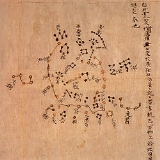
 of 1092 AD, which was included in the horological treatise on his clocktower. The most famous one is perhaps the Dunhuang map
Dunhuang map

The Dunhuang map or Dunhuang Star map is one of the first known graphical representation of stars from ancient Chinese astronomy, dated to the Tang Dynasty ....
 found in Dunhuang
Dunhuang

Dunhuang is a city in Jiuquan, Gansu province of China, China. It is sited in an oasis....
, Gansu
Gansu

or , is a political divisions of China located in the northwest of the People's Republic of China. It lies between Qinghai, Inner Mongolia, and the Loess Plateau, and borders Mongolia to the north and Xinjiang to the west....
. Uncovered by the British archaeologist Marc Aurel Stein
Marc Aurel Stein

Sir Marc Aurel Stein was a Hungarian archaeologist. He was also a professor at various Indian universities. Stein was inspired by Sven Hedin's 1898 work, Through Asia....
 in 1907, the star map was brought to the British Museum
British Museum

The British Museum is a museum of human history and culture situated in London. Its collections, which number more than 7 million Object , are amongst the largest and most comprehensive in the world and originate from all continents, illustrating and documenting the story of human culture from its beginning to the present....
 in London
London

London is the capital of both England and the United Kingdom, and the most populous municipality in the European Union. An important settlement for two millennia, History of London goes back to its founding by the Roman Empire....
. The map was drawn on paper and represents the complete sky with more than 1,350 stars. Though ancient Babylonians and Greeks also observed the sky and catalogued stars, no such complete record of the stars may exist or survive. Hence this is the oldest chart of the actual skies in the present.

According to recent studies, the map may date the manuscript to as early as the 7th century AD (Tang Dynasty). Scholars believe the star map dating from 705 to 710 AD, which is the reign of Emperor Zhongzong of Tang
Emperor Zhongzong of Tang

Emperor Zhongzong of Tang , personal name Li Xian , at times during his life Li Zhe and Wu Xian , was the fourth Table of Chinese monarchs of the Tang Dynasty of China, ruling briefly in 684 and again from 705 to 710....
. Some experts from the West think the chart may be a copy of an earlier existing document. There are some texts (Monthly Ordinances, ??) describing the movement of the sun among the sky each month, which was not based on the observation at that time.

Lunar and solar eclipses

The ancient Chinese
Ancient Chinese

Ancient Chinese may refer to:*Old Chinese*Middle Chinese...
 astronomer Shi Shen
Shi Shen

Shi Shen was a China astronomer and contemporary of Gan De born in the State of Wei, also known as the Master Shi Shen ....
 (fl. 4th century BC) was aware of the relation of the moon in a solar eclipse, as he provided instructions in his writing to predict them by using the relative positions of the moon and sun. The 'radiating influence' theory, where the moon's light was nothing but a reflection of the sun's, was supported by the mathematician and music theorist Jing Fang
Jing Fang

Jing Fang , born Li Fang , courtesy name Junming , was a China music theory, mathematician and astrologer born in present-day Puyang during the Han Dynasty ....
 (78–37 BC) yet opposed by the Chinese philosopher Wang Chong
Wang Chong

Wang Chong , courtesy name Zhongren , was a China philosopher during the Han Dynasty who developed a Rationalism , secular, Philosophical naturalism, and Mechanism account of the world and of human beings....
 (27–97 AD). In his writing, Wang admits that this theory was nothing new in China. The Chinese astronomer and inventor Zhang Heng
Zhang Heng

Zhang Heng was an Chinese astronomy, Chinese mathematics, List of Chinese inventions, Chinese geography, History of cartography#China, Chinese art, Chinese poetry, Government of the Han Dynasty, and Chinese literature from Nanyang, Henan, Henan, and lived during the Eastern Han Dynasty of China....
 (78–139 AD) wrote of both solar eclipse
Solar eclipse

A solar eclipse occurs when the Moon passes between the Sun and the Earth so that the Sun is wholly or partially obscured. This can only happen during a new moon, when the Sun and Moon are in conjunction as seen from the Earth....
 and lunar eclipse
Lunar eclipse

A lunar eclipse occurs whenever the Moon passes through some portion of the Earth's shadow. This can occur only when the Sun, Earth, and Moon are aligned exactly, or very closely so, with the Earth in the middle....
 in the publication of Ling Xian, 120 AD:

The sun is like fire and the moon like water. The fire gives out light and the water reflects it. Thus the moon's brightness is produced from the radiance of the sun, and the moon's darkness (pho) is due to (the light of) the sun being obstructed (pi). The side which faces the sun is fully lit, and the side which is away from it is dark. The planets (as well as the moon) have the nature of water and reflect light. The light pouring forth from the sun (tang jih chih chhung kuang) does not always reach the moon owing to the obstruction (pi) of the earth itself—this is called 'an-hsü', a lunar eclipse. When (a similar effect) happens with a planet (we call it) an occulation (hsing wei); when the moon passes across (kuo) (the sun's path) then there is a solar eclipse (shih).


The later Song Dynasty
Song Dynasty

The Song Dynasty was a ruling Chinese dynasty in China between 960–1279 AD; it succeeded the Five Dynasties and Ten Kingdoms Period, and was followed by the Yuan Dynasty....
 scientist Shen Kuo
Shen Kuo

Shen Kuo or Shen Kua , Chinese style name Cunzhong and Chinese style name#H?o Mengqi Weng, was a polymathic China History of science and technology in China and statesman of the Song Dynasty ....
 (1031–1095) used the models of lunar eclipse and solar eclipse in order to prove that the celestial bodies were round, not flat. This was actually an extension of the reasoning of Jing Fang and other theorists as early as the Han Dynasty. In his Dream Pool Essays
Dream Pool Essays

The Dream Pool Essays was an extensive book written by the polymath Chinese scientist and statesman Shen Kuo by 1088 AD, during the Song Dynasty of China....
 of 1088 AD, Shen related a conversation he had with the Director of the Astronomical Observatory
Observatory

An observatory is a location used for observing terrestrial and/or celestial events. Astronomy, climatology/meteorology, geology, oceanography and volcanology are examples of disciplines for which observatories have been constructed....
, who had asked Shen if the shapes of the sun and moon were round like balls or flat like fans. Shen Kuo explained his reasoning for the former:

If they were like balls they would surely obstruct each other when they met. I replied that these celestial bodies were certainly like balls. How do we know this? By the waxing and waning of the moon. The moon itself gives forth no light, but is like a ball of silver; the light is the light of the sun (reflected). When the brightness is first seen, the sun (-light passes almost) alongside, so the side only is illuminated and looks like a crescent. When the sun gradually gets further away, the light shines slanting, and the moon is full, round like a bullet. If half of a sphere is covered with (white) powder and looked at from the side, the covered part will look like a crescent; if looked at from the front, it will appear round. Thus we know that the celestial bodies are spherical.


When he asked Shen Kuo why eclipses occurred only on an occasional basis while in conjunction and opposition once a day, Shen Kuo wrote:

I answered that the ecliptic and the moon's path are like two rings, lying one over the other, but distant by a small amount. (If this obliquity did not exist), the sun would be eclipsed whenever the two bodies were in conjunction, and the moon would be eclipsed whenever they were exactly in position. But (in fact) though they may occupy the same degree, the two paths are not (always) near (each other), and so naturally the bodies do not (intrude) upon one another.


Equipment and innovation


Armillary sphere

Yixiangkaocheng 02
The earliest development of the armillary sphere
Armillary sphere

An armillary sphere is a model of the celestial sphere....
 in China goes back to the astronomers Shi Shen
Shi Shen

Shi Shen was a China astronomer and contemporary of Gan De born in the State of Wei, also known as the Master Shi Shen ....
 and Gan De
Gan De

Gan De was a China astronomer/astrologer born in the State of Qi also known as the Lord Gan . Along with Shi Shen, he is believed to be the first in history to compile a star catalogue, followed by the Greek Hipparchus who is the first known in the Western tradition to have compiled a star catalogue....
 in the 4th century BC, as they were equipped with a primitive single-ring armillary instrument. This would have allowed them to measure the north polar distance (???, the Chinese form of declination) and measurement that gave the position in a hsiu (???, the Chinese form of right ascension).

During the Western Han Dynasty (202 BC - 9 AD) additional developments made by the astronomers Luoxia Hong, Xiangyu Wangren, and Geng Shouchang advanced the use of the armillary in its early stage of evolution. In 52 BC, it was the astronomer Geng Shou-chang who introduced the first permanently fixed equatorial ring of the armillary sphere. In the subsequent Eastern Han Dynasty ( 23-220 AD) period, the astronomers Fu An and Jia Kui
Jia Kui

Jia Kui, , courtesy name Liangdao , was a general and bureaucrat of the Later Han Dynasty and subsequently of the Cao Wei during the Three Kingdoms period....
 added the elliptical ring by 84 AD. With the famous statesman, astronomer, and inventor Zhang Heng
Zhang Heng

Zhang Heng was an Chinese astronomy, Chinese mathematics, List of Chinese inventions, Chinese geography, History of cartography#China, Chinese art, Chinese poetry, Government of the Han Dynasty, and Chinese literature from Nanyang, Henan, Henan, and lived during the Eastern Han Dynasty of China....
 (78-139 AD), the sphere was totally complete in 125 AD, with horizon and meridian rings. It is of great importance to note that the world's first hydraulic (i.e. water-powered) armillary sphere was created by Zhang Heng, who operated his by use of an inflow clepsydra
Clepsydra

Clepsydra may refer to*Clepsydra , the Greek word for water clock.* Clepsydra Geyser in the Lower Geyser Basin of Yellowstone*Clepsydra , a genus of protists....
 clock (see Zhang's article for more detail).

Abridged armilla

Designed by famous astronomers Guo Shoujing
Guo Shoujing

Guo Shoujing , courtesy name Ruosi , was a China astronomer, engineer, and mathematician born in Xingtai and lived during the Yuan Dynasty ....
 in 1276 AD, it solved most problems found in armillary spheres at that time.

The primary structure of Abridged Armilla contains two large rings that are perpendicular to each other, of which one is parallel with the equatorial plane and is accordingly called “equatorial ring”, and the other is a double-ring which is perpendicular to the center of the equatorial ring, revolves around a metallic shaft, and is called “right ascension double-ring”.

The double-ring holds within itself a sighting tube with crosshairs. When observing, astronomers would aim at the star with the sighting tube, whereupon the stars’ position could be deciphered by observing the dials of the equatorial ring and the right ascension double-ring.

A foreign missionary melted the instrument in 1715 AD. The surviving one was built in 1437 AD, and was taken to what is now Germany
Germany

Germany , officially the Federal Republic of Germany , is a country in Central Europe. It is bordered to the north by the North Sea, Denmark, and the Baltic Sea; to the east by Poland and the Czech Republic; to the south by Austria and Switzerland; and to the west by France, Luxembourg, Belgium, and the Netherlands....
. It was then stored in a French
France

France , officially the French Republic , is a country whose Metropolitan France is located in Western Europe and that also comprises various Overseas departments and territories of France....
 Embassy in 1900 during the Eight-Nation Alliance
Eight-Nation Alliance

The Eight-Nation Alliance was an alliance made up of Austria-Hungary, French Third Republic, German Empire, Kingdom of Italy , Empire of Japan, Imperial Russia, the United Kingdom of Great Britain and Ireland, and the United States whose armies invaded China while putting down the Boxer Rebellion in Qing Dynasty in August 1900....
. Under the pressure of international public discontent, Germany returned the instrument to China. In 1933 it was placed in Purple Mountain Observatory
Purple Mountain Observatory

Purple Mountain Observatory , also known as Zijinshan Astronomical Observatory, is an astronomical observatory located on the Purple Mountain in Nanjing, China....
, which prevented it from being destroyed in the Japanese invasion
Second Sino-Japanese War

The Second Sino-Japanese War was the largest Asian war in the twentieth century. From 1937 to 1941, it was fought between the Republic of China and the Empire of Japan....
. In the 1980s it had become seriously eroded and rusted down, and was nearly destroyed. In order to restore the device, the Nanjing
Nanjing

is the capital city of China's Jiangsu province of China, and a city with a prominent place in Chinese history and Chinese culture. Nanjing served as the capital of China during several historical periods and is listed as one of the Historical capitals of China....
 government spent 11 months to repair it.

Celestial globe before Qing Dynasty

Chinesecelestialglobe
Besides star maps, the Chinese also made Celestial globes, which show stars positions like a star map and can present the actual sky in a specific time. Because of its Chinese name, it is often confused with the Armillary sphere, which is just one word different in Chinese (?? vs. ??).

According to records, the first Celestial globe was made by Geng Shou-chang between 70BC and 50BC. In the Ming Dynasty
Ming Dynasty

The Ming Dynasty , or Empire of the Great Ming , was the ruling Dynasties in Chinese history of China from 1368 to 1644, following the collapse of the Mongol-led Yuan Dynasty....
, the celestial globe at that time was a huge globe, showing the 28 mansions, celestial equator and ecliptic. But just like many other equipment, none of them have survived.

Celestial globe in the Qing Dynasty

Celestial globe was named ???(Miriam celestial bodies) in the Qing Dynasty
Qing Dynasty

The Qing Dynasty , also known as the Manchu Dynasty, followed the Ming Dynasty in History of China, and was the last ruling Chinese Dynasties of China, ruling from 1644 to 1912 ....
. The one in Beijing Ancient Observatory
Beijing Ancient Observatory

The Beijing Ancient Observatory is a pretelescopic astronomy observatory located in Beijing, PRC. The revolutionary tools used within this ancient observatory were built in 1442 during the Ming Dynasty, and later amended during the Qing Dynasty....
 was made by Belgian missionary Ferdinand Verbiest
Ferdinand Verbiest

Father Ferdinand Verbiest was a Flemish people Jesuit missionary in China during the Qing dynasty. He was born in Pittem near Tielt in Flanders, later part of the modern state of Belgium....
1673 AD. Unlike other Chinese celestial globes, it employs 360 degree
Degree (angle)

A degree , usually denoted by ? , is a measurement of plane angle, representing 1/360 of a Turn ; one degree is equivalent to p/180 radians....
s rather than the 365.24 degrees (which is a standard in ancient China). It is also the Chinese-first globe which shows constellations near to the Celestial South Pole.

The Water-powered Armillary Sphere and Celestial Globe Tower

The first to invent the hydraulic-powered armillary sphere was Zhang Heng
Zhang Heng

Zhang Heng was an Chinese astronomy, Chinese mathematics, List of Chinese inventions, Chinese geography, History of cartography#China, Chinese art, Chinese poetry, Government of the Han Dynasty, and Chinese literature from Nanyang, Henan, Henan, and lived during the Eastern Han Dynasty of China....
 (78-139 AD) of the Han Dynasty
Han Dynasty

The Han Dynasty followed the Qin Dynasty and preceded the Three Kingdoms in China. The Han Dynasty was ruled by the family known as the Liu clan who had peasant origins....
. Zhang was well-known for his brilliant applications of mechanical gears, as this was one of his most impressive inventions (alongside his seismograph to detect the cardinal direction
Cardinal direction

The four cardinal directions or cardinal points are north, south, east, and west, commonly denoted by their initials - N, S, E, W. They are mostly used for geography orientation on Earth but may be calculated anywhere on a rotating astronomical object....
 of earthquake
Earthquake

An earthquake is the result of a sudden release of energy in the Earth's crust that creates seismic waves. Earthquakes are recorded with a seismometer, also known as a seismograph....
s that struck hundreds of miles away).

Started by Su Song
Su Song

Su Song was a renowned Chinese people Scholar-bureaucrat, Chinese astronomy, History of cartography#China, horology, Traditional Chinese medicine, mineralogy, zoology, botany, mechanics and Chinese architecture, Chinese poetry, antiquarian, and Foreign relations of Imperial China of the Song Dynasty ....
and his colleagues in 1086 AD and finished in 1092 AD, his large astronomical clock tower
Clock tower

A clock tower is a tower built with one or more clock Clock face. The clock tower is usually part of a church or municipal building such as a town hall, but many clock towers are free-standing....
 featured an armillary sphere, a celestial globe and a mechanical chronograph. It was operated by an escapement
Escapement

In mechanical watches and clocks, an escapement is a device which converts continuous rotational motion into an Oscillatory or back and forth motion....
 mechanism and the earliest known chain drive
Chain drive

Chain drive is a way of transmitting mechanical power from one place to another. It is often used to convey power to the wheels of a vehicle, particularly bicycles and motorcycles....
. However 35 years later the invading Jurchen
Jurchen

Jurchen may refer to:* Jurchen people, Tungusic people who inhabited the region of Manchuria until the 17th century* Jurchen script, writing system of Jurchen people...
 army dismantled the tower in 1127 AD upon taking the capital of Kaifeng
Kaifeng

Kaifeng , formerly known as Bianliang , Bianjing , Daliang , or simply Liang , is a prefecture-level city in eastern Henan province of China, People's Republic of China....
. The armillary sphere part was brought to Beijing
Beijing

is a metropolis in northern China and the Capital of the People's Republic of China. It is one of the four municipality of China, which are equivalent to province in China's Political divisions of China....
, yet the tower was never successfully reinstated, not even by Su Song's son.

Fortunately two versions of Su Song’s treatise written on his clock tower have survived the ages, so that studying his astronomical clock tower is made possible through medieval texts.

True north and planetary motion

The polymath Chinese scientist Shen Kuo
Shen Kuo

Shen Kuo or Shen Kua , Chinese style name Cunzhong and Chinese style name#H?o Mengqi Weng, was a polymathic China History of science and technology in China and statesman of the Song Dynasty ....
 (1031-1095) was not only the first in history to describe the magnetic-needle compass
Compass

A compass, magnetic compass or mariner's compass is a navigational instrument for determining direction relative to the earth's magnetic poles....
, but also a more accurate measurement of the distance between the polestar and true north
True north

True north is the direction along the earth's surface towards the geographic North Pole.True north usually differs from magnetic north pole and grid north ....
 that could be used for navigation
Navigation

Navigation is the process of reading, and controlling the movement of a craft or vehicle from one place to another. It is also the term of art used for the specialized knowledge used by navigators to perform navigation tasks....
. Shen achieved this by making nightly astronomical observations along with his colleague Wei Pu
Wei Pu

Wei Pu was an 11th century History of China astronomer of the Song Dynasty . He was born a commoner, but eventually rose to prominence as an astronomer working for the imperial court at the capital of Kaifeng....
, using Shen's improved design of a wider sighting tube that could be fixed to observe the polestar indefinitely. Along with the polestar, Shen Kuo and Wei Pu also established a project of nightly astronomical observation over a period of five successive years, an intensive work that would even rival the later work of Tycho Brahe
Tycho Brahe

Tycho Brahe, born Tyge Ottesen Brahe , was a Danish nobility known for his accurate and comprehensive astronomy observations. Coming from Sk?neland, then part of Denmark, now part of modern-day Sweden, Brahe was well known in his lifetime as an astronomy and alchemy....
 in Europe. Shen Kuo and Wei Pu charted the exact coordinates of the planets on a star map for this project, and created theories of planetary motion, including retrogradation
Retrogradation

Retrogradation is the term for the landward change in position of the front of a river delta with time. This occurs when the mass balance of sediment into the delta is such that the volume of incoming sediment is less than the volume of the delta that is lost through subsidence, sea-level rise, and/or erosion....
.

Foreign influences


Indian astronomy

Indian astronomy reached China with the expansion of Buddhism
Buddhism

Buddhism is a family of beliefs and practices considered by most to be a religionand is based on the teachings attributed to Siddhartha Gautama, commonly known as "The Buddha" , who was born in what is today Nepal....
 during the Later Han dynasty
Later Han Dynasty (Five Dynasties)

The Later Han Dynasty was founded in 947. It was the fourth of the Five Dynasties and Ten Kingdoms Period and the third consecutive Shatuo Turks dynasty....
 (25–220 CE). Further translation of Indian works on astronomy was completed in China by the Three Kingdoms era
Three Kingdoms

The Three Kingdoms period is a period in the history of China, part of an era of disunity called the Six Dynasties following immediately the loss of de facto power of the Han Dynasty emperors....
 (220–265 CE). However, the most detailed incorporation of Indian astronomy occurred only during the Tang Dynasty (618-907) when a number of Chinese scholars—such as Yi Xing
Yi Xing

Yi Xing , born Zhang Sui , was a China astronomer, mathematician, mechanical engineering, and Buddhist monk of the Tang Dynasty . His astronomical celestial globe was the first to feature a clockwork escapement mechanism, the first in a long tradition of Chinese astronomical clock....
— were versed both in Indian and Chinese astronomy. A system of Indian astronomy was recorded in China as Jiuzhi-li (718 CE), the author of which was an Indian by the name of Qutan Xida
Gautama Siddha

Gautama Siddha was a China translator, astronomer, astrologer and compiler of History of India descent, known for leading the compilation of the Treatise on Astrology of the Kaiyuan Era during the Tang Dynasty....
—a translation of Devanagari Gotama Siddha—the director of the Tang dynasty
Tang Dynasty

The Tang Dynasty was an Dynasties in Chinese history preceded by the Sui Dynasty and followed by the Five Dynasties and Ten Kingdoms Period. It was founded by the Li family, who seized power during the decline and collapse of the Sui Empire....
's national astronomical observatory.

The astronomical table of sines by the Indian astronomer and mathematician
Indian mathematics

Indian mathematics—which here is the mathematics that emerged in South Asia from ancient times until the end of the 18th century—had its beginnings in the Bronze Age Indus Valley civilization and the Iron Age Vedic culture ....
, Aryabhata
Aryabhata

Aryabhaa is the first in the line of great mathematician-astronomers from the classical age of Indian mathematics and Indian astronomy. His most famous works are the Aryabhatiya and Arya-Siddhanta....
, were translated into the Chinese astronomical and mathematical book of the Treatise on Astrology of the Kaiyuan Era
Treatise on Astrology of the Kaiyuan Era

The Treatise on Astrology of the Kaiyuan Era is a Chinese language astrology encyclopedia compiled by the lead editor Gautama Siddha and numerous scholars from 714 to 724 AD during the Kaiyuan era of Tang Dynasty....
 (Kaiyuan Zhanjing), compiled in 718 AD during the Tang Dynasty
Tang Dynasty

The Tang Dynasty was an Dynasties in Chinese history preceded by the Sui Dynasty and followed by the Five Dynasties and Ten Kingdoms Period. It was founded by the Li family, who seized power during the decline and collapse of the Sui Empire....
. The Kaiyuan Zhanjing was compiled by Gautama Siddha
Gautama Siddha

Gautama Siddha was a China translator, astronomer, astrologer and compiler of History of India descent, known for leading the compilation of the Treatise on Astrology of the Kaiyuan Era during the Tang Dynasty....
, an astronomer and astrologer born in Chang'an
Chang'an

Chang'an is an ancient Capital of more than ten Dynasties in Chinese history in Chinese history. Chang'an literally means "Perpetual Peace" in Classical Chinese....
, and whose family was originally from India
History of India

The known history of India begins with the Indus Valley Civilization, which spread and flourished in the north-western part of the Indian subcontinent, from c....
. He was also notable for his translation of the Navagraha
Navagraha

Graha is a 'cosmic influencer' on the living beings of mother Bhumidevi . In Hindu Astrology, the Navagraha are some of these major influencers....
 calendar into Chinese
Chinese language

Chinese or the Sinitic language is a language family consisting of language mutually unintelligible to varying degrees. Originally the indigenous languages spoken by the Han Chinese in China, it forms one of the two branches of Sino-Tibetan languages of languages....
.

Islamic astronomy

Islamic astronomers were brought to work on calendar making and astronomy during the Yuan Dynasty
Yuan Dynasty

The Yuan Dynasty , or Great Yuan Empire was both the continuation of the Mongol Empire and the Mongol founded historical state in Mongolia and China, lasting officially from 1271 to 1368....
. Kublai Khan
Kublai Khan

Sorry, no overview for this topic
 brought Iranians
Iranian peoples

The Iranian peoples are an ethnic and linguistic branch of Indo-European peoples, living mainly in Iranian plateau and beyond in central-, southern-, and southwestern Asia and southeastern Europe....
 to Beijing to construct an observatory
Observatory

An observatory is a location used for observing terrestrial and/or celestial events. Astronomy, climatology/meteorology, geology, oceanography and volcanology are examples of disciplines for which observatories have been constructed....
 and an institution for astronomical studies. Jamal ad-Din
Jamal ad-Din (astronomer)

Jamal ad-Din Mu?ammad ibn ?ahir ibn Mu?ammad al-Zaydi al-Bukhari, also spelt Jamal ud-Din, was a 13th-century Persian people Islamic astronomy....
, a Persian
Persian people

Persian identity, at least in terms of language, is traced to the ancient Indo-Iranians , who arrived in parts of Greater Iran circa 2000-1500 BCE....
 astronomer, presented Kublai Khan
Kublai Khan

Sorry, no overview for this topic
 with seven Persian astronomical instruments
Islamic astronomy

In the history of astronomy, Islamic astronomy or Arabic astronomy refers to the astronomical developments made in the Islamic world, particularly during the Islamic Golden Age , and mostly written in the Arabic language....
, including a Persian globe
Globe

A globe is a three-dimensional scale Model of Earth or other spheroid celestial body such as a planet, star, or moon. It may also refer to a spherical representation of the celestial sphere, showing the apparent positions of the stars in the sky ...
 and an armillary sphere
Armillary sphere

An armillary sphere is a model of the celestial sphere....
, in 1267. Several Chinese astronomers also worked at the Maragheh observatory
Maragheh observatory

Maragheh observatory is an ancient observatory, which was established in 1259 by Nasir al-Din al-Tusi, an Iranian peoples Islamic science and Islamic astronomy....
 in Maragheh
Maragheh

Maragheh is a city in Northern Iran on the bank of the river Safi Chay. It is located in East Azarbaijan Province at , 130 km from Tabriz and has a population of 300,000....
, Persia
Iran

Iran , officially the Islamic Republic of Iran and formerly known internationally as Persian Empire until 1935, is a country in Central Eurasia, located on the northeastern shore of the Persian Gulf and the southern shore of the Caspian Sea....
.

Jesuit activity in China

The introduction of Western science to China by Jesuit priest astronomers was a mixed blessing during the late 16th century and early 17th century.

The telescope
Telescope

A telescope is an instrument designed for the observation of remote objects by the collection of electromagnetic radiation. The first known practically functioning telescopes were invented in the Netherlands at the beginning of the 17th century....
 was introduced to China in the early 17th century. The telescope was first mentioned in Chinese writing by Emanuel Diaz (Yang MaNuo), who wrote his Tian Wen Lüe in 1615. In 1626 Adam Schall von Bell (Tang Ruowang) published the Chinese treatise on the telescope known as the Yuan Jing Shuo (The Far-Seeing Optic Glass). The Chongzhen Emperor
Chongzhen Emperor

The Chongzhen Emperor was the 16th and last emperor of China of the Ming Dynasty in China between 1627 and 1644. Born Zhu Youjian, he was emperor Taichang Emperor's son....
 (???, 1627-1644) of the Ming Dynasty
Ming Dynasty

The Ming Dynasty , or Empire of the Great Ming , was the ruling Dynasties in Chinese history of China from 1368 to 1644, following the collapse of the Mongol-led Yuan Dynasty....
 acquired the telescope of Johannes Terrentius
Johann Schreck

Johann Schreck, also Terrenz or Terrentius Constantiensis, Deng Yuhan Hanpo, Deng Zhen Lohan, was a German Jesuit, Medieval Roman Catholic Missions in China and polymath....
 (or Johann Schreck; Deng Yu-han) in 1634, ten years before the collapse of the Ming Dynasty. However, the impact on Chinese astronomy was limited.

The Jesuit China missions
Jesuit China missions

The history of the missions of the Jesuits in China in the early modern era stands as one of the notable events in the early history of relations between China and the Western world, as well as a prominent example of relations between two cultures and belief systems in the pre-modern age....
 of the 16th and 17th centuries brought Western astronomy, then undergoing its own revolution, to China. After the Galileo affair
Galileo affair

The Galileo affair, in which Galileo Galilei came into conflict with the Catholic Church over his support of heliocentrism, is often considered a defining moment in the history of the relationship between religion and science....
 early in the 17th century, the Roman Catholic Jesuit order was required to adhere to geocentrism and ignore the heliocentric teachings of Copernicus and his followers, even though they were becoming standard in European astronomy. Thus, the Jesuits shared an Earth-centered and largely pre-Copernican astronomy with their Chinese hosts (i.e. the inaccurate Ptolemaic
Ptolemaic

Ptolemaic is the adjective formed from the name Ptolemy.This adjective is usually used in one of three ways:*To describe the Egyptian dynasty founded in 305 BC by Ptolemy I Soter...
-Aristotelian
Aristotelian

Aristotelian matters may refer to:* Aristotle * List of teachings attributed to Aristotle* Aristotelianism, the philosophical tradition begun by Aristotle...
 views from Hellenistic times). The Chinese were often fundamentally opposed to this as well, since the Chinese had long believed (from the ancient doctrine of Xuan Ye) that the celestial bodies floated in a void of infinite space. This contradicted the Aristotelian view of solid concentric crystalline spheres, where there was not a void, but a mass of air between the heavenly bodies.

Of course, the views of Copernicus, Galileo, and Tycho Brahe
Tycho Brahe

Tycho Brahe, born Tyge Ottesen Brahe , was a Danish nobility known for his accurate and comprehensive astronomy observations. Coming from Sk?neland, then part of Denmark, now part of modern-day Sweden, Brahe was well known in his lifetime as an astronomy and alchemy....
 would eventually triumph in European science, and these ideas slowly leaked into China despite Jesuit efforts to curb them in the beginning. In 1627, the Polish
Poles

The Polish people, or Poles , are a West Slavs ethnic group of Central Europe, living predominantly in Poland. Poles are sometimes defined as people who share a common Polish culture and are of Polish descent....
 Jesuit Michael Boym (Bu Mige) introduced Johannes Kepler
Johannes Kepler

Johannes Kepler was a Germans mathematician, astronomer and astrologer, and key figure in the 17th century Scientific revolution. He is best known for his eponymous Kepler's laws of planetary motion, codified by later astronomers based on his works Astronomia nova, Harmonices Mundi, and Epitome of Copernican Astrononomy....
's Copernican Rudolphine Tables with much enthusiasm to the Ming court at Beijing
Beijing

is a metropolis in northern China and the Capital of the People's Republic of China. It is one of the four municipality of China, which are equivalent to province in China's Political divisions of China....
. In Adam Schall von Bell's Chinese-written treatise of Western astronomy in 1640, the names of Copernicus (Ge-Bai-Ni), Galileo (Jia-li-lüe), and Tycho Brahe (Di-gu) were formally introduced to China. There were also Jesuits in China who were in favor of the Copernican theory, such as Nicholas Smogulecki and Wenceslaus Kirwitzer. However, Copernican views were not widespread or wholly accepted in China during this point. In Japan
Japan

Japan is an island country in East Asia. Located in the Pacific Ocean, it lies to the east of the Sea of Japan, People's Republic of China, North Korea, South Korea and Russia, stretching from the Sea of Okhotsk in the north to the East China Sea and Taiwan in the south....
, the Dutch
Dutch people

The Dutch are the people native to the Netherlands, a country in north-western Europe.Dutch people, or descendants of Dutch people, are also found in migrant communities world wide,See the Dutch #Dutch diaspora. and form a mentionable part of the population of Canada,Australia, South Africa and the United States....
 aided the Japanese with the first modern observatory of Japan in 1725, headed by Nakane Genkei, whose observatory of astronomers wholly accepted the Copernican view. In contrast, the Copernican view was not accepted in mainstream China until the early 19th century, with the Protestant missionaries such as Joseph Edkins
Joseph Edkins

Joseph Edkins was a United Kingdom Protestant missionary who spent 57 years in China, 30 of them in Beijing. As a Sinologue, he specialized in Chinese religions....
, Alex Wylie, and John Fryer
John Fryer

John Fryer was the Master Mariner on the HMAV Bounty, a British vessel made famous by the Mutiny on the Bounty.He had the interesting position of being a strong critic of both Captain William Bligh and mutiny leader Fletcher Christian, even at one time accusing Bligh of favoring Christian....
.

Famous Chinese astronomers

  • Gan De
    Gan De

    Gan De was a China astronomer/astrologer born in the State of Qi also known as the Lord Gan . Along with Shi Shen, he is believed to be the first in history to compile a star catalogue, followed by the Greek Hipparchus who is the first known in the Western tradition to have compiled a star catalogue....
  • Guo Shoujing
    Guo Shoujing

    Guo Shoujing , courtesy name Ruosi , was a China astronomer, engineer, and mathematician born in Xingtai and lived during the Yuan Dynasty ....
  • Shen Kuo
    Shen Kuo

    Shen Kuo or Shen Kua , Chinese style name Cunzhong and Chinese style name#H?o Mengqi Weng, was a polymathic China History of science and technology in China and statesman of the Song Dynasty ....
  • Shi Shen
    Shi Shen

    Shi Shen was a China astronomer and contemporary of Gan De born in the State of Wei, also known as the Master Shi Shen ....
  • Su Song
    Su Song

    Su Song was a renowned Chinese people Scholar-bureaucrat, Chinese astronomy, History of cartography#China, horology, Traditional Chinese medicine, mineralogy, zoology, botany, mechanics and Chinese architecture, Chinese poetry, antiquarian, and Foreign relations of Imperial China of the Song Dynasty ....
  • Xu Guangqi
    Xu Guangqi

    Xu Guangqi , courtesy name Zixian , was a Chinese bureaucrat, agricultural scientist, astronomer, and mathematician in the Ming Dynasty. Xu was a colleague and collaborator of the Italian Jesuits Matteo Ricci and Sabatino de Ursis and they translated several classic Western texts into Chinese, including part of Euclid's Elements....
  • Zhang Heng
    Zhang Heng

    Zhang Heng was an Chinese astronomy, Chinese mathematics, List of Chinese inventions, Chinese geography, History of cartography#China, Chinese art, Chinese poetry, Government of the Han Dynasty, and Chinese literature from Nanyang, Henan, Henan, and lived during the Eastern Han Dynasty of China....


Observatory

  • Beijing Ancient Observatory
    Beijing Ancient Observatory

    The Beijing Ancient Observatory is a pretelescopic astronomy observatory located in Beijing, PRC. The revolutionary tools used within this ancient observatory were built in 1442 during the Ming Dynasty, and later amended during the Qing Dynasty....


See also

  • Book of Silk
    Book of Silk

    The Book of Silk is an ancient astronomy book compiled by Chinese astronomers of the Western Han Dynasty and found in the Mawangdui tomb of China in 1973....
  • Chinese astrology
    Chinese astrology

    Chinese astrology is based on the astronomy and traditional calendars. The Chinese astrology does not calculate the positions of the sun, moon and planets at the time of birth....
  • Chinese constellation
    Chinese constellation

    Chinese constellations are the way ancient Chinese grouped the stars. They are very different from the modern International Astronomical Union recognized constellations....
  • Chinese mathematics
    Chinese mathematics

    Mathematics in China emerged independently by the 11th century BC. The Chinese independently developed very large and negative numbers, decimals, a decimal system, a binary system, algebra, geometry, trigonometry....
  • History of astronomy
    History of astronomy

    Astronomy is the oldest of the natural sciences, dating back to ancient history, with its origins in the Religion, mythological, and astrological practices of pre-history: vestiges of these are still found in astrology, a discipline long interwoven with public and governmental astronomy, and not completely disentangled from it until a few centuries...
  • Timeline of Chinese astronomy
    Timeline of Chinese astronomy

    This is a timeline of China records and investigations in astronomy.*2137 BC, October 22- Chinese book Classic of History; records the earliest known solar eclipse on October 22....
  • Indian astronomy
  • Islamic astronomy
    Islamic astronomy

    In the history of astronomy, Islamic astronomy or Arabic astronomy refers to the astronomical developments made in the Islamic world, particularly during the Islamic Golden Age , and mostly written in the Arabic language....


Further reading

  • Encyclopaedia of the History of Science, Technology, and Medicine in Non-Western Cultures, edited by Helaine Selin. Dordrecht: Kluwer, 1997. S.v. "Astronomy in China," by Ho Peng Yoke.
  • Sun Xiaochun, "Crossing the Boundaries Between Heaven and Man: Astronomy in Ancient China," in Astronomy Across Cultures: The History of Non-Western Astronomy, edited by H. Selin, pp. 423-454. Dordrecht: Kluwer, 2000.
  • Chan Ki-hung: Chinese Ancient Star Map, Leisure and Cultural Services Department, 2002, ISBN 962-7054-09-7
  • Gems of the ancient Chinese astronomy relics, ISBN 962-7797-03-0


External links

  • by Helmar Aslaksen
  • by Nathan Sivin
  • by Pingyi Chu