


Funerary art

Encyclopedia

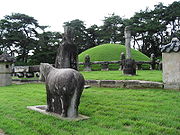

Death
Death is the permanent termination of the biological functions that sustain a living organism. Phenomena which commonly bring about death include old age, predation, malnutrition, disease, and accidents or trauma resulting in terminal injury....
. Tomb
Tomb
A tomb is a repository for the remains of the dead. It is generally any structurally enclosed interment space or burial chamber, of varying sizes...
is a general term for the repository, while grave goods
Grave goods
Grave goods, in archaeology and anthropology, are the items buried along with the body.They are usually personal possessions, supplies to smooth the deceased's journey into the afterlife or offerings to the gods. Grave goods are a type of votive deposit...
are objects—other than the primary human remains—which have been placed inside. Such objects may include the personal possessions of the deceased, objects specially created for the burial, or miniature versions of things believed to be needed in an afterlife
Afterlife
The afterlife is the belief that a part of, or essence of, or soul of an individual, which carries with it and confers personal identity, survives the death of the body of this world and this lifetime, by natural or supernatural means, in contrast to the belief in eternal...
. Knowledge of many non-literate cultures is drawn largely from these sources.
Funerary art may serve many cultural functions. It can play a role in burial rites, serve as an article for use by the dead in the afterlife, and celebrate the life and accomplishments of the dead, whether as part of kinship-centred practices of ancestor veneration or as a publicly directed dynastic
Dynasty
A dynasty is a sequence of rulers considered members of the same family. Historians traditionally consider many sovereign states' history within a framework of successive dynasties, e.g., China, Ancient Egypt and the Persian Empire...
display. It can also function as a reminder of the mortality of humankind, as an expression of cultural values and roles, and help to propitiate the spirits of the dead, maintaining their benevolence and preventing their unwelcome intrusion into the affairs of the living.
The deposit of objects with an apparent aesthetic intention may go back to the Neanderthal
Neanderthal
The Neanderthal is an extinct member of the Homo genus known from Pleistocene specimens found in Europe and parts of western and central Asia...
s over 50,000 years ago, and is found in almost all subsequent cultures—Hindu
Hinduism
Hinduism is the predominant and indigenous religious tradition of the Indian Subcontinent. Hinduism is known to its followers as , amongst many other expressions...
culture, which has little, is a notable exception. Many of the best-known artistic creations of past cultures—from the Egyptian pyramids
Egyptian pyramids
The Egyptian pyramids are ancient pyramid-shaped masonry structures located in Egypt.There are 138 pyramids discovered in Egypt as of 2008. Most were built as tombs for the country's Pharaohs and their consorts during the Old and Middle Kingdom periods.The earliest known Egyptian pyramids are found...
and the Tutankhamun treasure
KV62
KV62 is the tomb of Tutankhamun in the Valley of the Kings , which became famous for the wealth of treasure it contained. The tomb was discovered in 1922 by Howard Carter, underneath the remains of workmen's huts built during the Ramesside Period; this explains why it was spared from the worst of...
to the Terracotta Army
Terracotta Army
The Terracotta Army or the "Terra Cotta Warriors and Horses", is a collection of terracotta sculptures depicting the armies of Qin Shi Huang, the first Emperor of China...
surrounding the tomb of the Qin Emperor
Qin Shi Huang
Qin Shi Huang , personal name Ying Zheng , was king of the Chinese State of Qin from 246 BC to 221 BC during the Warring States Period. He became the first emperor of a unified China in 221 BC...
, the Mausoleum of Halicarnassus, the Sutton Hoo
Sutton Hoo
Sutton Hoo, near to Woodbridge, in the English county of Suffolk, is the site of two 6th and early 7th century cemeteries. One contained an undisturbed ship burial including a wealth of Anglo-Saxon artefacts of outstanding art-historical and archaeological significance, now held in the British...
ship burial and the Taj Mahal
Taj Mahal
The Taj Mahal is a white Marble mausoleum located in Agra, India. It was built by Mughal emperor Shah Jahan in memory of his third wife, Mumtaz Mahal...
—are tombs or objects found in and around them. In most instances, specialized funeral art was produced for the powerful and wealthy, although the burials of ordinary people might include simple monuments and grave goods, usually from their possessions.
An important factor in the development of traditions of funerary art is the division between what was intended to be visible to visitors or the public after completion of the funeral ceremonies. The Tutankhamun treasure, for example, though exceptionally lavish, was never intended to be seen again after it was deposited, while the exterior of the pyramids was a permanent and highly effective demonstration of the power of their creators. A similar division can be seen in grand East Asian tombs. In other cultures, nearly all the art connected with the burial, except for limited grave goods, was intended for later viewing by the public or at least those admitted by the custodians. In these cultures, traditions such as the sculpted sarcophagus
Sarcophagus
A sarcophagus is a funeral receptacle for a corpse, most commonly carved or cut from stone. The word "sarcophagus" comes from the Greek σαρξ sarx meaning "flesh", and φαγειν phagein meaning "to eat", hence sarkophagus means "flesh-eating"; from the phrase lithos sarkophagos...
and tomb monument of the Greek and Roman empires, and later the Christian world, have flourished. The mausoleum
Mausoleum
A mausoleum is an external free-standing building constructed as a monument enclosing the interment space or burial chamber of a deceased person or persons. A monument without the interment is a cenotaph. A mausoleum may be considered a type of tomb or the tomb may be considered to be within the...
intended for visiting was the grandest type of tomb in the classical world, and later common in Islamic culture.
Common terms
A tumulusTumulus
A tumulus is a mound of earth and stones raised over a grave or graves. Tumuli are also known as barrows, burial mounds, Hügelgrab or kurgans, and can be found throughout much of the world. A tumulus composed largely or entirely of stones is usually referred to as a cairn...
, mound, kurgan
Kurgan
Kurgan is the Turkic term for a tumulus; mound of earth and stones raised over a grave or graves, originating with its use in Soviet archaeology, now widely used for tumuli in the context of Eastern European and Central Asian archaeology....
, or long barrow
Long barrow
A long barrow is a prehistoric monument dating to the early Neolithic period. They are rectangular or trapezoidal tumuli or earth mounds traditionally interpreted as collective tombs...
covered important burials in many cultures, and the body may be placed in a sarcophagus, usually of stone, or a coffin
Coffin
A coffin is a funerary box used in the display and containment of dead people – either for burial or cremation.Contemporary North American English makes a distinction between "coffin", which is generally understood to denote a funerary box having six sides in plan view, and "casket", which...
, usually of wood. A mausoleum is a building erected mainly as a tomb, taking its name from the Mausoleum of Mausolus at Halicarnassus
Halicarnassus
Halicarnassus was an ancient Greek city at the site of modern Bodrum in Turkey. It was located in southwest Caria on a picturesque, advantageous site on the Ceramic Gulf. The city was famous for the tomb of Mausolus, the origin of the word mausoleum, built between 353 BC and 350 BC, and...
. Stele
Stele
A stele , also stela , is a stone or wooden slab, generally taller than it is wide, erected for funerals or commemorative purposes, most usually decorated with the names and titles of the deceased or living — inscribed, carved in relief , or painted onto the slab...
is a term for erect stones that are often what are now called gravestones. Ship burial
Ship burial
A ship burial or boat grave is a burial in which a ship or boat is used either as a container for the dead and the grave goods, or as a part of the grave goods itself. If the ship is very small, it is called a boat grave...
s are mostly found in coastal Europe, while chariot burial
Chariot burial
Chariot burials are tombs in which the deceased was buried together with his chariot, usually including his horses and other possessions....
s are found widely across Eurasia
Eurasia
Eurasia is a continent or supercontinent comprising the traditional continents of Europe and Asia ; covering about 52,990,000 km2 or about 10.6% of the Earth's surface located primarily in the eastern and northern hemispheres...
. Catacombs
Catacombs
Catacombs, human-made subterranean passageways for religious practice. Any chamber used as a burial place can be described as a catacomb, although the word is most commonly associated with the Roman empire...
, of which the most famous examples are those in Rome
Catacombs of Rome
The Catacombs of Rome are ancient catacombs, underground burial places under or near Rome, Italy, of which there are at least forty, some discovered only in recent decades. Though most famous for Christian burials, either in separate catacombs or mixed together, they began in the 2nd century, much...
and Alexandria, are underground cemeteries connected by tunnelled passages. A large group of burials with traces remaining above ground can be called a necropolis
Necropolis
A necropolis is a large cemetery or burial ground, usually including structural tombs. The word comes from the Greek νεκρόπολις - nekropolis, literally meaning "city of the dead"...
; if there are no such visible structures, it is a grave field
Grave field
A grave field is a prehistoric cemetery, typically of Bronze Age and Iron Age Europe.Grave fields are distinguished from necropoleis by the former's lack of above-ground structures, buildings, or grave markers.-Types:...
. A cenotaph
Cenotaph
A cenotaph is an "empty tomb" or a monument erected in honour of a person or group of people whose remains are elsewhere. It can also be the initial tomb for a person who has since been interred elsewhere. The word derives from the Greek κενοτάφιον = kenotaphion...
is a memorial without a burial.
Related genres of commemorative art for the dead take many forms, such as the moai
Moai
Moai , or mo‘ai, are monolithic human figures carved from rock on the Chilean Polynesian island of Easter Island between the years 1250 and 1500. Nearly half are still at Rano Raraku, the main moai quarry, but hundreds were transported from there and set on stone platforms called ahu around the...
figures of Easter Island
Easter Island
Easter Island is a Polynesian island in the southeastern Pacific Ocean, at the southeasternmost point of the Polynesian triangle. A special territory of Chile that was annexed in 1888, Easter Island is famous for its 887 extant monumental statues, called moai, created by the early Rapanui people...
, apparently a type of sculpted ancestor portrait, though hardly individualized. These are common in cultures as diverse as Ancient Rome and China, in both of which they are kept in the houses of the descendants, rather than being buried. Many cultures have psychopomp
Psychopomp
Psychopomps are creatures, spirits, angels, or deities in many religions whose responsibility is to escort newly deceased souls to the afterlife. Their role is not to judge the deceased, but simply provide safe passage...
figures, such as the Greek Hermes
Hermes
Hermes is the great messenger of the gods in Greek mythology and a guide to the Underworld. Hermes was born on Mount Kyllini in Arcadia. An Olympian god, he is also the patron of boundaries and of the travelers who cross them, of shepherds and cowherds, of the cunning of thieves, of orators and...
and Etruscan Charun
Charun
In Etruscan mythology, Charun acted as one of the psychopompoi of the underworld, not to be confused with the lord of the underworld, known to the Etruscans as Aita...
, who help conduct the spirits of the dead into the afterlife.
Pre-history
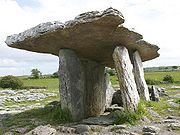
Megalith
A megalith is a large stone that has been used to construct a structure or monument, either alone or together with other stones. Megalithic describes structures made of such large stones, utilizing an interlocking system without the use of mortar or cement.The word 'megalith' comes from the Ancient...
ic, the earliest instances date to within a few centuries of each other, yet show a wide diversity of form and purpose. Tombs in the Iberian peninsula
Iberian Peninsula
The Iberian Peninsula , sometimes called Iberia, is located in the extreme southwest of Europe and includes the modern-day sovereign states of Spain, Portugal and Andorra, as well as the British Overseas Territory of Gibraltar...
have been dated through thermoluminescence
Thermoluminescence
Thermoluminescence is a form of luminescence that is exhibited by certain crystalline materials, such as some minerals, when previously absorbed energy from electromagnetic radiation or other ionizing radiation is re-emitted as light upon heating of the material...
to c. 4510 BCE, and some burials at the Carnac stones
Carnac stones
The Carnac stones are an exceptionally dense collection of megalithic sites around the French village of Carnac, in Brittany, consisting of alignments, dolmens, tumuli and single menhirs. The more than 3,000 prehistoric standing stones were hewn from local rock and erected by the pre-Celtic people...
in Brittany
Brittany
Brittany is a cultural and administrative region in the north-west of France. Previously a kingdom and then a duchy, Brittany was united to the Kingdom of France in 1532 as a province. Brittany has also been referred to as Less, Lesser or Little Britain...
also date back to the fifth millennium BCE. The commemorative value of such burial sites are indicated by the fact that, at some stage, they became elevated, and that the constructs, almost from the earliest, sought to be monumental. This effect was often achieved by encapsulating a single corpse in a basic pit, surrounded by an elaborate ditch and drain. Over-ground commemoration is thought to be tied to the concept of collective memory, and these early tombs were likely intended as a form of ancestor-worship, a development available only to communities that had advanced to the stage of settled livestock and formed social roles and relationships and specialized sectors of activity.
In Neolithic
Neolithic
The Neolithic Age, Era, or Period, or New Stone Age, was a period in the development of human technology, beginning about 9500 BC in some parts of the Middle East, and later in other parts of the world. It is traditionally considered as the last part of the Stone Age...
and Bronze Age
Bronze Age
The Bronze Age is a period characterized by the use of copper and its alloy bronze as the chief hard materials in the manufacture of some implements and weapons. Chronologically, it stands between the Stone Age and Iron Age...
societies, a great variety of tombs are found, with tumulus mounds, megaliths, and pottery as recurrent elements. In Eurasia, a dolmen
Dolmen
A dolmen—also known as a portal tomb, portal grave, dolmain , cromlech , anta , Hünengrab/Hünenbett , Adamra , Ispun , Hunebed , dös , goindol or quoit—is a type of single-chamber megalithic tomb, usually consisting of...
is the exposed stone framework for a chamber tomb
Chamber tomb
A chamber tomb is a tomb for burial used in many different cultures. In the case of individual burials, the chamber is thought to signify a higher status for the interree than a simple grave. Built from rock or sometimes wood, the chambers could also serve as places for storage of the dead from one...
originally covered by earth to make a mound which no longer exists. Stones may be carved with geometric patterns (petroglyph
Petroglyph
Petroglyphs are pictogram and logogram images created by removing part of a rock surface by incising, picking, carving, and abrading. Outside North America, scholars often use terms such as "carving", "engraving", or other descriptions of the technique to refer to such images...
s), for example cup and ring mark
Cup and ring mark
Cup and ring marks or cup marks are a form of prehistoric art found mainly in Atlantic Europe and Mediterranean Europe although similar forms are also found throughout the world including Mexico, Brazil, Greece, and India, where...
s. Group tombs were made, the social context of which is hard to decipher. Urn
Urn
An urn is a vase, ordinarily covered, that usually has a narrowed neck above a footed pedestal. "Knife urns" placed on pedestals flanking a dining-room sideboard were an English innovation for high-style dining rooms of the late 1760s...
burials, where bones are buried in a pottery container, either in a more elaborate tomb, or by themselves, are widespread, by no means restricted to the Urnfield culture
Urnfield culture
The Urnfield culture was a late Bronze Age culture of central Europe. The name comes from the custom of cremating the dead and placing their ashes in urns which were then buried in fields...
which is named after them, or even to Eurasia. Menhir
Menhir
A menhir is a large upright standing stone. Menhirs may be found singly as monoliths, or as part of a group of similar stones. Their size can vary considerably; but their shape is generally uneven and squared, often tapering towards the top...
s, or "standing stone
Standing stone
Standing stones, orthostats, liths, or more commonly megaliths are solitary stones set vertically in the ground and come in many different varieties....
s", seem often to mark graves or serve as memorials, while the later runestones and image stones often are cenotaph
Cenotaph
A cenotaph is an "empty tomb" or a monument erected in honour of a person or group of people whose remains are elsewhere. It can also be the initial tomb for a person who has since been interred elsewhere. The word derives from the Greek κενοτάφιον = kenotaphion...
s, or memorials apart from the grave itself; these continue into the Christian period. The Senegambian stone circles
Senegambian stone circles
The Senegambian stone circles lie in Gambia north of Janjanbureh and in central Senegal. Coordinates: 13° 41 N – 15° 31 W.Approximate area: 15,000 square miles . They are sometimes divided into the Wassu and Sine-Saloum circles, but this is purely a national division.The stones were erected...
are a later African form of tomb markers.
Ancient Egypt and Nubia
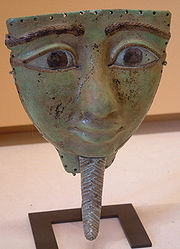
Mummy
A mummy is a body, human or animal, whose skin and organs have been preserved by either intentional or incidental exposure to chemicals, extreme coldness , very low humidity, or lack of air when bodies are submerged in bogs, so that the recovered body will not decay further if kept in cool and dry...
encased in one or more layers of decorated coffin, are famous; canopic jar
Canopic jar
Canopic jars were used by the Ancient Egyptians during the mummification process to store and preserve the viscera of their owner for the afterlife. They were commonly either carved from limestone or were made of pottery...
s preserved the internal organs. A special category of Ancient Egyptian funerary texts
Ancient Egyptian Funerary Texts
The literature that make up the Ancient Egyptian Funerary Texts are a collection of religious documents that were used in Ancient Egypt, usually to help the spirit of the concerned person to be preserved in the afterlife....
clarify the purposes of the burial customs. The early mastaba
Mastaba
A mastaba, or "pr-djt" , is a type of ancient Egyptian tomb in the form of a flat-roofed, rectangular structure with outward sloping sides that marked the burial site of many eminent Egyptians of Egypt's ancient period...
type of tomb had a sealed underground burial chamber but an offering-chamber on the ground level for visits by the living, a pattern repeated in later types of tomb. An effigy of the deceased might be walled up in a serdab
Serdab
A serdab , literally meaning "cold water", which became a loan word in Persian for 'cellar') is an ancient Egyptian tomb structure that served as a chamber for the Ka statue of a deceased individual. Used during the Old Kingdom, the serdab was a sealed chamber with a small slit or hole to allow the...
connected to the offering chamber by vents that allowed the smell of incense
Incense
Incense is composed of aromatic biotic materials, which release fragrant smoke when burned. The term "incense" refers to the substance itself, rather than to the odor that it produces. It is used in religious ceremonies, ritual purification, aromatherapy, meditation, for creating a mood, and for...
to reach the effigy. The walls of important tomb-chambers and offering chambers were heavily decorated with relief
Relief
Relief is a sculptural technique. The term relief is from the Latin verb levo, to raise. To create a sculpture in relief is thus to give the impression that the sculpted material has been raised above the background plane...
s in stone or sometimes wood, or paintings, depicting religious scenes, portraits of the deceased, and at some periods vivid images of everyday life, depicting the afterlife. The chamber decoration usually centred on a "false door", through which only the soul of the deceased could pass, to received the offerings left by the living.
Representational art
Representation (arts)
Representation is the use of signs that stand in for and take the place of something else. It is through representation that people organize the world and reality through the act of naming its elements...
, such as individual portraiture of the deceased, is found extremely early on and continues into the Roman period in the encaustic
Encaustic painting
Encaustic painting, also known as hot wax painting, involves using heated beeswax to which colored pigments are added. The liquid/paste is then applied to a surface—usually prepared wood, though canvas and other materials are often used...
Faiyum funerary portraits applied to coffins. However, it is still hotly debated whether there was realistic portraiture in Ancient Egypt
Portraiture in Ancient Egypt
Portraiture in Ancient Egypt forms a conceptual attempt to portray “the subject from its own perspective rather than the viewpoint of the artist … to communicate essential information about the object itself”...
. The purpose of the life-sized reserve head
Reserve head
Reserve heads are distinctive sculptures made primarily of fine limestone that have been found in a number of non-royal tombs of the Fourth dynasty of Egypt; primarily from the reigns of pyramid-building pharaohs Khufu to Khafre, circa 2551-2496 B.C...
s found in burial shafts or tombs of nobles of the Fourth dynasty
Fourth dynasty of Egypt
The fourth dynasty of ancient Egypt is characterized as a "golden age" of the Old Kingdom. Dynasty IV lasted from ca. 2613 to 2494 BC...
is not well understood; they may have been a discreet method of eliding an edict by Khufu
Khufu
Khufu , also known as Cheops or, in Manetho, Suphis , was a Pharaoh of Ancient Egypt's Old Kingdom. He reigned from around 2589 to 2566 BC. Khufu was the second pharaoh of the Fourth Dynasty. He is generally accepted as being the builder of the Great Pyramid of Giza, one of the Seven Wonders of...
forbidding nobles from creating statues of themselves, or may have protected the deceased's spirit from harm or magically eliminated any evil in it, or perhaps functioned as alternate containers for the spirit if the body should be harmed in any way.
Architectural works such as the massive Great Pyramid
Great Pyramid of Giza
The Great Pyramid of Giza is the oldest and largest of the three pyramids in the Giza Necropolis bordering what is now El Giza, Egypt. It is the oldest of the Seven Wonders of the Ancient World, and the only one to remain largely intact...
and two smaller ones built during the Old Kingdom
Old Kingdom
Old Kingdom is the name given to the period in the 3rd millennium BC when Egypt attained its first continuous peak of civilization in complexity and achievement – the first of three so-called "Kingdom" periods, which mark the high points of civilization in the lower Nile Valley .The term itself was...
in the Giza Necropolis and (much later, from about 1500 BCE) the tombs in the Valley of the Kings
Valley of the Kings
The Valley of the Kings , less often called the Valley of the Gates of the Kings , is a valley in Egypt where, for a period of nearly 500 years from the 16th to 11th century BC, tombs were constructed for the Pharaohs and powerful nobles of the New Kingdom .The valley stands on the west bank of...
were built for royalty and the elite. The Theban Necropolis
Theban Necropolis
The Theban Necropolis is an area of the west bank of the Nile, opposite Thebes in Egypt. It was used for ritual burials for much of Pharaonic times, especially in the New Kingdom of Egypt.-Mortuary Temples:* Deir el-Bahri** Mortuary temple of Hatshepsut...
was later an important site for mortuary temple
Mortuary temple
Mortuary temples were temples constructed adjacent to, or in the vicinity of, royal tombs in the Ancient Egypt. The temples were designed to commemorate the reign of the pharaoh by whom they were built, as well as for use by the pharaoh's cult after death.-History:Mortuary temples were built...
s and mastaba tombs. The Kushite kings who conquered Egypt and ruled as pharaohs during the Twenty-fifth dynasty
Twenty-fifth dynasty of Egypt
The twenty-fifth dynasty of Egypt, known as the Nubian Dynasty or the Kushite Empire, was the last dynasty of the Third Intermediate Period of Ancient Egypt....
were greatly influenced by Egyptian funerary customs, employing mummification, canopic jars and ushabti
Ushabti
The ushabti was a funerary figurine used in Ancient Egypt. Ushabtis were placed in tombs among the grave goods and were intended to act as substitutes for the deceased, should he/she be called upon to do manual labor in the afterlife...
funerary figurines. They also built the Nubian pyramids
Nubian pyramids
Nubian pyramids are pyramids that were built by the rulers of the Kushite and Egyptian kingdoms. Prior to the Kushites building these pyramids , there had been no pyramid construction in Egypt and the Nile Valley for more than 500 years.The area of the Nile valley known as Nubia, which lies within...
, which in both size and design more closely resemble the smaller Seventeenth dynasty
Seventeenth dynasty of Egypt
The Fifteenth, Sixteenth and Seventeenth Dynasties of ancient Egypt are often combined under the group title, Second Intermediate Period. The Seventeenth Dynasty dates approximately from 1580 to 1550 BC.-Rulers:...
pyramids at Thebes than those of the Old Kingdom near Memphis.
Lower-class citizens used common forms of funerary art—including shabti figurines (to perform any labor that might be required of the dead person in the afterlife), models of the scarab beetle and books of the dead—which they believed would protect them in the afterlife. During the Middle Kingdom
Middle Kingdom of Egypt
The Middle Kingdom of Egypt is the period in the history of ancient Egypt stretching from the establishment of the Eleventh Dynasty to the end of the Fourteenth Dynasty, between 2055 BC and 1650 BC, although some writers include the Thirteenth and Fourteenth dynasties in the Second Intermediate...
, miniature wooden or clay models depicting scenes from everyday life became popular additions to tombs. In an attempt to duplicate the activities of the living in the afterlife, these models show laborers, houses, boats and even military formations which are scale representations of the ideal ancient Egyptian afterlife.
Ancient Greece

Charon's obol
Charon's obol is an allusive term for the coin placed in or on the mouth of a dead person before burial. According to Greek and Latin literary sources, the coin was a payment or bribe for the ferryman who conveyed souls across the river that divided the world of the living from the world of the dead...
, the ferryman to Hades
Charon (mythology)
In Greek mythology, Charon or Kharon is the ferryman of Hades who carries souls of the newly deceased across the rivers Styx and Acheron that divided the world of the living from the world of the dead. A coin to pay Charon for passage, usually an obolus or danake, was sometimes placed in or on...
, and pottery; however the epitaphios or funeral oration
Funeral oration (ancient Greece)
A funeral oration or epitaphios logos is a formal speech delivered on the ceremonial occasion of a funeral. Funerary customs comprise the practices used by a culture to remember the dead, from the funeral itself, to various monuments, prayers, and rituals undertaken in their honour...
from which the word epitaph
Epitaph
An epitaph is a short text honoring a deceased person, strictly speaking that is inscribed on their tombstone or plaque, but also used figuratively. Some are specified by the dead person beforehand, others chosen by those responsible for the burial...
comes was regarded as of great importance, and animal sacrifice
Animal sacrifice
Animal sacrifice is the ritual killing of an animal as part of a religion. It is practised by many religions as a means of appeasing a god or gods or changing the course of nature...
s were made. Those who could afford them erected stone monuments, which was one of the functions of kouros
Kouros
A kouros is the modern term given to those representations of male youths which first appear in the Archaic period in Greece. The term kouros, meaning youth, was first proposed for what were previously thought to be depictions of Apollo by V. I...
statues in the Archaic period
Archaic period in Greece
The Archaic period in Greece was a period of ancient Greek history that followed the Greek Dark Ages. This period saw the rise of the polis and the founding of colonies, as well as the first inklings of classical philosophy, theatre in the form of tragedies performed during Dionysia, and written...
before about 500 BCE. These were not intended as portraits, but during the Hellenistic period, realistic portraiture of the deceased was introduced and family groups were often depicted in bas-relief on monuments, usually surrounded by an architectural frame. The walls of tomb chambers were often painted in fresco
Fresco
Fresco is any of several related mural painting types, executed on plaster on walls or ceilings. The word fresco comes from the Greek word affresca which derives from the Latin word for "fresh". Frescoes first developed in the ancient world and continued to be popular through the Renaissance...
, although few examples have survived in as good condition as the Tomb of the Diver
Tomb of the Diver
The Tomb of the Diver is an important archaeological monument, found by the Italian archaeologist Mario Napoli on 3 June 1968 during his excavation of a small necropolis about 1.5 km south of the Greek city of Paestum in Magna Graecia, now southern Italy...
from southern Italy or the tombs at Vergina
Vergina
Vergina is a small town in northern Greece, located in the peripheral unit of Imathia, Central Macedonia. Since the 2011 local government reform it is part of the municipality Veroia, of which it is a municipal unit...
in Macedon. Almost the only surviving painted portraits in the classical Greek tradition are found in Egypt rather than Greece. The Fayum mummy portraits
Fayum mummy portraits
Mummy portraits or Fayum mummy portraits is the modern term given to a type of naturalistic painted portraits on wooden boards attached to mummies from the Coptic period. They belong to the tradition of panel painting, one of the most highly regarded forms of art in the Classical world...
, from the very end of the classical period, were portrait faces, in a Graeco-Roman
Greco-Roman world
The Greco-Roman world, Greco-Roman culture, or the term Greco-Roman , when used as an adjective, as understood by modern scholars and writers, refers to those geographical regions and countries that culturally were directly, protractedly and intimately influenced by the language, culture,...
style, attached to mummies.
Early Greek burials were frequently marked above ground by a large piece of pottery
Pottery of Ancient Greece
As the result of its relative durability, pottery is a large part of the archaeological record of Ancient Greece, and because there is so much of it it has exerted a disproportionately large influence on our understanding of Greek society...
, and remains were also buried in urns. Pottery continued to be used extensively inside tombs and graves throughout the classical period. The larnax
Larnax (Archaeology)
A larnax is a type of small closed coffin, box or "ash-chest" often used as a container for human remains in ancient Greece, either a body or cremated ashes....
is a small coffin or ash-chest, usually of decorated terracotta. The two-handled loutrophoros
Loutrophoros
A loutrophoros is a distinctive type of Greek pottery vessel characterized by an elongated neck with two handles. The loutrophoros was used to hold water during marriage and funeral rituals, and was placed in the tombs of the unmarried...
was primarily associated with weddings, as it was used to carry water for the nuptial bath. However, it was also placed in the tombs of the unmarried, "presumably to make up in some way for what they had missed in life." The one-handled lekythos
Lekythos
A lekythos is a type of Greek pottery used for storing oil , especially olive oil. It has a narrow body and one handle attached to the neck of the vessel. The lekythos was used for anointing dead bodies of unmarried men and many lekythoi are found in tombs. The images on lekythoi were often...
had many household uses, but outside the household, its principal use was the decoration of tombs. Scenes of a descent to the underworld
Descent to the underworld
The descent to the underworld is a mytheme of comparative mythology found in a diverse number of religions from around the world, including Christianity. The hero or upper-world deity journeys to the underworld or to the land of the dead and returns, often with a quest-object or a loved one, or...
of Hades
Hades
Hades , Hadēs, originally , Haidēs or , Aidēs , meaning "the unseen") was the ancient Greek god of the underworld. The genitive , Haidou, was an elision to denote locality: "[the house/dominion] of Hades". Eventually, the nominative came to designate the abode of the dead.In Greek mythology, Hades...
were often painted on these, with the dead depicted beside Hermes
Hermes
Hermes is the great messenger of the gods in Greek mythology and a guide to the Underworld. Hermes was born on Mount Kyllini in Arcadia. An Olympian god, he is also the patron of boundaries and of the travelers who cross them, of shepherds and cowherds, of the cunning of thieves, of orators and...
, Charon or both—though usually only with Charon. Small pottery figurines are often found, though it is hard to decide if these were made especially for placement in tombs; in the case of the Hellenistic Tanagra figurines, this seems probably not the case. But silverware is more often found around the fringes of the Greek world, as in the royal Macedon
Macedon
Macedonia or Macedon was an ancient kingdom, centered in the northeastern part of the Greek peninsula, bordered by Epirus to the west, Paeonia to the north, the region of Thrace to the east and Thessaly to the south....
ian tombs of Vergina
Vergina
Vergina is a small town in northern Greece, located in the peripheral unit of Imathia, Central Macedonia. Since the 2011 local government reform it is part of the municipality Veroia, of which it is a municipal unit...
, or in the neighbouring cultures such as those of Thrace
Thrace
Thrace is a historical and geographic area in southeast Europe. As a geographical concept, Thrace designates a region bounded by the Balkan Mountains on the north, Rhodope Mountains and the Aegean Sea on the south, and by the Black Sea and the Sea of Marmara on the east...
or the Scythians.
The extension of the Greek world after the conquests of Alexander the Great brought peoples with different tomb-making traditions into the Hellenistic sphere, resulting in new formats for art in Greek styles. A generation before Alexander, Mausolus was a Hellenized satrap
Satrap
Satrap was the name given to the governors of the provinces of the ancient Median and Achaemenid Empires and in several of their successors, such as the Sassanid Empire and the Hellenistic empires....
or semi-independent ruler under the Persian Empire, whose enormous tomb (begun 353 BCE) was wholly exceptional in the Greek world – together with the Pyramids it was the only tomb to be included in the Seven Wonders of the Ancient World
Seven Wonders of the Ancient World
The Seven Wonders of the World refers to remarkable constructions of classical antiquity listed by various authors in guidebooks popular among the ancient Hellenic tourists, particularly in the 1st and 2nd centuries BC...
. The exact form of the Mausoleum of Halicarnassus, which gave the name to the form, is now unclear, and there are several alternative reconstructions that seek to reconcile the archaeological evidence with descriptions in literature. It had the size and some elements of the design of the Greek temple
Greek temple
Greek temples were structures built to house deity statues within Greek sanctuaries in Greek paganism. The temples themselves did usually not directly serve a cult purpose, since the sacrifices and rituals dedicated to the respective deity took place outside them...
, but was much more vertical, with a square base and a pyramidal roof. There were quantities of large sculpture, of which most of the few surviving pieces are now in the British Museum
British Museum
The British Museum is a museum of human history and culture in London. Its collections, which number more than seven million objects, are amongst the largest and most comprehensive in the world and originate from all continents, illustrating and documenting the story of human culture from its...
. Other local rulers adapted the high-relief temple frieze
Frieze
thumb|267px|Frieze of the [[Tower of the Winds]], AthensIn architecture the frieze is the wide central section part of an entablature and may be plain in the Ionic or Doric order, or decorated with bas-reliefs. Even when neither columns nor pilasters are expressed, on an astylar wall it lies upon...
for very large sarcophagi, starting a tradition which was to exert a great influence on Western art up to 18th century Neo-Classicism. The late 4th century Alexander Sarcophagus
Alexander Sarcophagus
The Alexander Sarcophagus is a late 4th century BC stone sarcophagus adorned with bas-relief carvings of Alexander the Great. The work is remarkably well preserved and has been celebrated for its high aesthetic achievement...
was in fact made for another Hellenized Eastern ruler, one of a number of important sarcophagi found at Sidon
Sidon
Sidon or Saïda is the third-largest city in Lebanon. It is located in the South Governorate of Lebanon, on the Mediterranean coast, about 40 km north of Tyre and 40 km south of the capital Beirut. In Genesis, Sidon is the son of Canaan the grandson of Noah...
in the modern Lebanon
Lebanon
Lebanon , officially the Republic of LebanonRepublic of Lebanon is the most common term used by Lebanese government agencies. The term Lebanese Republic, a literal translation of the official Arabic and French names that is not used in today's world. Arabic is the most common language spoken among...
. The two long sides show Alexander's great victory at the Battle of Issus
Battle of Issus
The Battle of Issus occurred in southern Anatolia, in November 333 BC. The invading troops, led by the young Alexander of Macedonia, defeated the army personally led by Darius III of Achaemenid Persia in the second great battle for primacy in Asia...
and a lion hunt; such violent scenes were common on ostentatious classical sarcophagi from this period onwards, with a particular revival in Roman art of the 2nd century. More peaceful mythological scenes were popular on smaller sarcophagi, especially of Bacchus
Dionysus
Dionysus was the god of the grape harvest, winemaking and wine, of ritual madness and ecstasy in Greek mythology. His name in Linear B tablets shows he was worshipped from c. 1500—1100 BC by Mycenean Greeks: other traces of Dionysian-type cult have been found in ancient Minoan Crete...
.
Etruscans
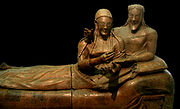
Sarcophagus
A sarcophagus is a funeral receptacle for a corpse, most commonly carved or cut from stone. The word "sarcophagus" comes from the Greek σαρξ sarx meaning "flesh", and φαγειν phagein meaning "to eat", hence sarkophagus means "flesh-eating"; from the phrase lithos sarkophagos...
and cinerary urns, form the basis of much of current knowledge of the ancient Etruscan civilization
Etruscan civilization
Etruscan civilization is the modern English name given to a civilization of ancient Italy in the area corresponding roughly to Tuscany. The ancient Romans called its creators the Tusci or Etrusci...
and its art
Etruscan art
Etruscan art was the form of figurative art produced by the Etruscan civilization in central Italy between the 9th and 2nd centuries BC. Particularly strong in this tradition were figurative sculpture in terracotta and cast bronze, wall-painting and metalworking .-History:The origins of...
, which once competed with the culture of ancient Rome
Culture of ancient Rome
Ancient Roman culture existed throughout the almost 1200-year history of the civilization of Ancient Rome. The term refers to the culture of the Roman Republic, later the Roman Empire, which, at its peak, covered an area from Lowland Scotland and Morocco to the Euphrates.Life in ancient Rome...
, but was eventually absorbed into it. The sarcophagi and the lids of the urns often incorporate a reclining image of the deceased. The reclining figures in some Etruscan funerary art are shown using the mano cornuta to protect the grave.
The motif of the funerary art of the 7th and 6th centuries BCE was typically a feasting scene, sometimes with dancers and musicians, or athletic competitions. Household bowls, cups, and pitchers are sometimes found in the graves, along with food such as eggs, pomegranates, honey, grapes and olives for use in the afterlife. From the 5th century, the mood changed to more somber and gruesome scenes of parting, where the deceased are shown leaving their loved ones, often surrounded by underworld demons, and psychopomps, such as Charun
Charun
In Etruscan mythology, Charun acted as one of the psychopompoi of the underworld, not to be confused with the lord of the underworld, known to the Etruscans as Aita...
or the winged female Vanth
Vanth
Vanth is a chthonic figure in Etruscan mythology shown in a variety of forms of funerary art, such as in tomb paintings and on sarcophagi. Vanth is a female demon in the Etruscan underworld that is often accompanied either by additional Vanth figures or by another demon, Charun . Both Vanth and...
. The underworld figures are sometimes depicted as gesturing impatiently for a human to be taken away. The handshake was another common motif, as the dead took leave of the living. This often took place in front of or near a closed double doorway, presumably the portal to the underworld. Evidence in some art, however, suggests that the "handshake took place at the other end of the journey, and represents the dead being greeted in the Underworld".
Ancient Rome
The burial customs of the ancient RomansAncient Rome
Ancient Rome was a thriving civilization that grew on the Italian Peninsula as early as the 8th century BC. Located along the Mediterranean Sea and centered on the city of Rome, it expanded to one of the largest empires in the ancient world....
were influenced by both of the first significant cultures whose territories they conquered as their state expanded, namely the Greeks of Magna Graecia
Magna Graecia
Magna Græcia is the name of the coastal areas of Southern Italy on the Tarentine Gulf that were extensively colonized by Greek settlers; particularly the Achaean colonies of Tarentum, Crotone, and Sybaris, but also, more loosely, the cities of Cumae and Neapolis to the north...
and the Etruscans. The original Roman custom was cremation
Cremation
Cremation is the process of reducing bodies to basic chemical compounds such as gasses and bone fragments. This is accomplished through high-temperature burning, vaporization and oxidation....
, after which the burnt remains were kept in a pot, ash-chest or urn, often in a columbarium
Columbarium
A columbarium is a place for the respectful and usually public storage of cinerary urns . The term comes from the Latin columba and originally referred to compartmentalized housing for doves and pigeons .The Columbarium of Pomponius Hylas is a particularly fine ancient Roman example, rich in...
; pre-Roman burials around Rome often used hut-urns—little pottery houses. From about the 2nd century CE, inhumation (burial of unburnt remains) in sarcophagi, often elaborately carved, became more fashionable for those who could afford it. Greek-style medallion portrait sculptures on a stela, or small mausoleum for the rich, housing either an urn or sarcophagus, were often placed in a location such as a roadside, where it would be very visible to the living and perpetuate the memory of the dead. Often a couple are shown, signifying a longing for reunion in the afterlife rather than a double burial.
In later periods, life-size sculptures of the deceased reclining as though at a meal or social gathering are found, a common Etruscan style. Family tombs for the grandest late Roman families, like the Tomb of the Scipios
Tomb of the Scipios
The Tomb of the Scipios , also called the hypogaeum Scipionum, was the common tomb of the patrician Scipio family during the Roman Republic for interments between the early 3rd century BC and the early 1st century AD...
, were large mausoleums with facilities for visits by the living, including kitchens and bedrooms. The Castel Sant'Angelo
Castel Sant'Angelo
The Mausoleum of Hadrian, usually known as the Castel Sant'Angelo, is a towering cylindrical building in Parco Adriano, Rome, Italy. It was initially commissioned by the Roman Emperor Hadrian as a mausoleum for himself and his family...
, built for Hadrian
Hadrian
Hadrian , was Roman Emperor from 117 to 138. He is best known for building Hadrian's Wall, which marked the northern limit of Roman Britain. In Rome, he re-built the Pantheon and constructed the Temple of Venus and Roma. In addition to being emperor, Hadrian was a humanist and was philhellene in...
, was later converted into a fortress. Compared to the Etruscans, though, there was less emphasis on provision of a lifestyle for the deceased, although paintings of useful objects or pleasant activities, like hunting, are seen. Ancestor portraits, usually in the form of wax masks, were kept in the home, apparently often in little cupboards, although grand patrician families kept theirs on display in the atrium
Domus
In ancient Rome, the domus was the type of house occupied by the upper classes and some wealthy freedmen during the Republican and Imperial eras. They could be found in almost all the major cities throughout the Roman territories...
. They were worn in the funeral processions of members of the family by persons wearing appropriate costume for the figure represented, as described by Pliny the Elder
Pliny the Elder
Gaius Plinius Secundus , better known as Pliny the Elder, was a Roman author, naturalist, and natural philosopher, as well as naval and army commander of the early Roman Empire, and personal friend of the emperor Vespasian...
and Polybius
Polybius
Polybius , Greek ) was a Greek historian of the Hellenistic Period noted for his work, The Histories, which covered the period of 220–146 BC in detail. The work describes in part the rise of the Roman Republic and its gradual domination over Greece...
. Pliny also describes the custom of having a bust-portrait of an ancestor painted on a round bronze shield (clipeus
Clipeus
In the military of classical antiquity, a clipeus was a large shield worn by the Greeks and Romans as a piece of defensive armor, which they carried upon the arm, to secure them from the blows of their enemies...
), and having it hung in a temple or other public place. No examples of either type have survived.
By the late Republic
Roman Republic
The Roman Republic was the period of the ancient Roman civilization where the government operated as a republic. It began with the overthrow of the Roman monarchy, traditionally dated around 508 BC, and its replacement by a government headed by two consuls, elected annually by the citizens and...
there was considerable competition among wealthy Romans for the best locations for tombs, which lined all the approach roads to the city up to the walls, and a variety of exotic and unusual designs sought to catch the attention of the passer-by and so perpetuate the memory of the deceased and increase the prestige of their family. Examples include the Tomb of Eurysaces the Baker
Tomb of Eurysaces the Baker
The tomb of Marcus Vergilius Eurysaces the baker is one of the largest and most well preserved freedmen funerary monuments in Rome. Its sculpted friezes are classic exemplars of the "plebeian style" in Roman sculpture, which was eventually to overwhelm the Greek influenced style of the Imperial court...
, a freedman
Freedman
A freedman is a former slave who has been released from slavery, usually by legal means. Historically, slaves became freedmen either by manumission or emancipation ....
, the Pyramid of Cestius
Pyramid of Cestius
The Pyramid of Cestius is an ancient pyramid in Rome, Italy, near the Porta San Paolo and the Protestant Cemetery. It stands at a fork between two ancient roads, the Via Ostiensis and another road that ran west to the Tiber along the approximate line of the modern Via della Marmorata...
, and the Mausoleum of Caecilia Metella, all built within a few decades of the start of the Common Era
Common Era
Common Era ,abbreviated as CE, is an alternative designation for the calendar era originally introduced by Dionysius Exiguus in the 6th century, traditionally identified with Anno Domini .Dates before the year 1 CE are indicated by the usage of BCE, short for Before the Common Era Common Era...
.
In Italy, sarcophagi were mostly intended to be set against the wall of the tomb, and only decorated on three sides, in contrast to the free-standing styles of Greece and the Eastern Empire. The relief scenes of Hellenistic art became even more densely crowded in later Roman sarcophagi, as for example in the 2nd century Portonaccio sarcophagus
Portonaccio sarcophagus
The Portonaccio sarcophagus was a 2nd century ancient Roman sarcophagus found in the Portonaccio quarter of Rome and now held at the Museo Nazionale Romano . Dating to between 190 and 200, it was used for the burial of a Roman general involved in the campaigns of Marcus Aurelius and shows...
, and various styles and forms emerged, such as the columnar type with an "architectural background of columns and niches for its figures". A well-known Early Christian example is the Sarcophagus of Junius Bassus
Sarcophagus of Junius Bassus
The Sarcophagus of Junius Bassus is a marble Early Christian sarcophagus used for the burial of Junius Bassus, who died in 359. It has been described as "probably the single most famous piece of early Christian relief sculpture." The sarcophagus was originally placed in or under Old St...
, used for an important new convert who died in 359. Many sarcophagi from leading centres were exported around the Empire. The Romans had already developed the expression of religious and philosophical ideas in narrative scenes from Greek mythology
Greek mythology
Greek mythology is the body of myths and legends belonging to the ancient Greeks, concerning their gods and heroes, the nature of the world, and the origins and significance of their own cult and ritual practices. They were a part of religion in ancient Greece...
, treated allegorically; they later transferred this habit to Christian ideas, using biblical scenes.
China
Funerary art varied greatly across Chinese history. Tombs of early rulers rival the ancient Egyptians for complexity and value of grave goods, and have been similarly pillaged over the centuries by tomb robbers. For a long time, literary references to jade burial suitJade burial suit
A Jade burial suit is a ceremonial suit made of pieces of jade in which royal members in Han Dynasty China were buried.-Structure of a jade burial suit:...
s were regarded by scholars as fanciful myths, but a number of examples were excavated in the 20th century, and it is now believed that they were relatively common among early rulers. Knowledge of pre-dynastic Chinese culture has been expanded by spectacular discoveries at Sanxingdui
Sanxingdui
Sanxingdui is the name of an archaeological site and its deduced culture in China, now believed to be the site of an ancient Chinese city. The previously unknown Bronze Age culture was re-discovered in 1987 when archaeologists excavated remarkable artifacts, that radiocarbon dating dated as being...
and other sites. Very large tumuli could be erected, and later, mausoleums. Several special large shapes of Shang dynasty
Shang Dynasty
The Shang Dynasty or Yin Dynasty was, according to traditional sources, the second Chinese dynasty, after the Xia. They ruled in the northeastern regions of the area known as "China proper" in the Yellow River valley...
bronze ritual vessels may have been made for burial only; the Tomb of Fu Hao
Tomb of Fu Hao
The Tomb of Lady Fu Hao is an archaeological site at the ruins of the ancient Shang Dynasty capital of Yin. It was discovered in 1976 and identified as the final resting place of the queen and military general Fu Hao, likely the Lady Hao inscribed on oracle bones by king Wu Ding and one of his...
(c. BCE 1200) is one of the few undisturbed royal tombs of the period to have been excavated—most funerary art has appeared on the art market without archaeological context.
The discovery in 1974 of the Terracotta army
Terracotta Army
The Terracotta Army or the "Terra Cotta Warriors and Horses", is a collection of terracotta sculptures depicting the armies of Qin Shi Huang, the first Emperor of China...
located the tomb of the First Qin Emperor (died 210 BCE), but the main tumulus, of which literary descriptions survive, has not been excavated. Remains surviving above ground from several imperial tombs of the Han dynasty
Han Dynasty
The Han Dynasty was the second imperial dynasty of China, preceded by the Qin Dynasty and succeeded by the Three Kingdoms . It was founded by the rebel leader Liu Bang, known posthumously as Emperor Gaozu of Han. It was briefly interrupted by the Xin Dynasty of the former regent Wang Mang...
show traditions maintained until the end of imperial rule. The tomb itself is an "underground palace" beneath a sealed tumulus surrounded by a wall, with several buildings set at some distance away down avenues for the observation of rites of veneration, and the accommodation of both permanent staff and those visiting to perform rites, as well as gateways, towers and other buildings.
Chinese imperial tombs are typically approached by a "spirit road
Spirit way
A spirit way is the ornate road leading to a Chinese tomb of a major dignitary.The term is also sometimes translated as spirit road, spirit path or sacred way....
", sometimes several kilometres long, lined by statues of guardian figures, based on both humans and animals. A tablet extolling the virtues of the deceased, mounted on a stone tortoise (bixi
Bixi (tortoise)
Bixi , also called guifu or baxia , is a stone tortoise, used as a pedestal for a stele or tablet. Tortoise-mounted stelae have been traditionally used in the funerary complexes of Chinese emperors and other dignitaries. Later, they have also been used to commemorate an important event, such as...
) is often the centerpiece of the ensemble. In Han tombs the guardian figures are mainly of "lions" and "chimera
Chimera (mythology)
The Chimera or Chimaera was, according to Greek mythology, a monstrous fire-breathing female creature of Lycia in Asia Minor, composed of the parts of multiple animals: upon the body of a lioness with a tail that ended in a snake's head, the head of a goat arose on her back at the center of her...
s"; in later periods they are much more varied. A looted tomb with fine paintings is the Empress Dowager Wenming tomb
Empress Dowager Wenming tomb
The Empress Dowager Wenming tomb is the final resting place of Empress Feng , formally Empress Wenming and the wife of Emperor Wencheng of the Northern Wei Dynasty. The tomb and is located on the famed Silk Route. When her husband died in 465, Empress Dowager Wenming became regent until her...
of the 5th century CE, and the many tombs of the 7th century Tang dynasty
Tang Dynasty
The Tang Dynasty was an imperial dynasty of China preceded by the Sui Dynasty and followed by the Five Dynasties and Ten Kingdoms Period. It was founded by the Li family, who seized power during the decline and collapse of the Sui Empire...
Qianling Mausoleum
Qianling Mausoleum
The Qianling Mausoleum is a Tang Dynasty tomb site located in Qian County, Shaanxi province, China, and is northwest from Xi'an, formerly the Tang capital. Built by 684 , the tombs of the mausoleum complex house the remains of various members of the royal Li family. This includes Emperor...
group are an early example of a generally well-preserved ensemble.
The complex of Goguryeo Tombs
Complex of Goguryeo Tombs
The Complex of Goguryeo Tombs lie in North Korea. In July 2004, they became the first UNESCO World Heritage site in the country. The site consists of 30 individual tombs from the later Goguryeo kingdom, one of Three Kingdoms of Korea, located in the cities of P'yŏngyang and Namp'o...
, from a kingdom of the 5th to 7th centuries which included modern Korea
Korea
Korea ) is an East Asian geographic region that is currently divided into two separate sovereign states — North Korea and South Korea. Located on the Korean Peninsula, Korea is bordered by the People's Republic of China to the northwest, Russia to the northeast, and is separated from Japan to the...
, are especially rich in paintings. Only one of the Imperial Tombs of the Ming and Qing Dynasties
Imperial Tombs of the Ming and Qing Dynasties
Imperial Tombs of the Ming and Qing Dynasties is the designation under which the UNESCO has included several tombs and burial complexes into the list of World Heritage Sites. These tombs date from the Ming and Qing dynasties of China....
has been excavated, in 1956, with such disastrous results
Ming Dynasty Tombs
The Ming Dynasty Tombs are located some 51.35 kilometers due north of central Beijing, within the suburban Changping District of Beijing municipality...
for the conservation of the thousands of objects found, that the current policy is to leave them undisturbed.
The Lei Cheng Uk Han Tomb Museum
Lei Cheng Uk Han Tomb Museum
The Lei Cheng Uk Han Tomb Museum is composed of an ancient brick tomb and of an exhibition hall adjacent to it. It is located at 41 Tonkin Street, in Cheung Sha Wan, Sham Shui Po District, in the northwestern part of the Kowloon Peninsula of Hong Kong.-The tomb:According to the structure,...
in Hong Kong displays a far humbler middle-class Han dynasty tomb, and the mid-2nd century Wu Family tombs of Jiaxiang County
Jiaxiang County
Jiaxiang County is a county of Shandong province, People's Republic of China. It is under the administration of Jining City.The population was in 2009....
, Shandong are the most important group of commoner tombs for funerary stones. The walls of both the offering and burial chambers of tombs of commoners from the Han period may be decorated with stone slabs carved or engraved in very low relief with crowded and varied scenes, which are now the main indication of the style of the lost palace frescoes of the period. A cheaper option was to use large clay tiles which were carved or impressed before firing. After the introduction of Buddhism, carved "funerary couches" featured similar scenes, now mostly religious. During the Han Dynasty, miniature ceramic models of buildings were often made to accompany the deceased in the graves; to them is owed much of what is known of ancient Chinese architecture. Later, during the Six Dynasties
Six Dynasties
Six Dynasties is a collective noun for six Chinese dynasties during the periods of the Three Kingdoms , Jin Dynasty , and Southern and Northern Dynasties ....
, sculptural miniatures depicting buildings, monuments, people and animals adorned the tops of the hunping
Hunping
A hunping is a ceramic funerary vessel often found in the tombs of the Han Dynasty and especially the Six Dynasties periods of China...
funerary vessels. The outsides of tombs often featured monumental brick or stone-carved pillar-gates (que 闕); an example from 121 CE appears to be the earliest surviving Chinese architectural structure standing above ground. Tombs of the Tang Dynasty
Tang Dynasty
The Tang Dynasty was an imperial dynasty of China preceded by the Sui Dynasty and followed by the Five Dynasties and Ten Kingdoms Period. It was founded by the Li family, who seized power during the decline and collapse of the Sui Empire...
(618–907) are often rich in glazed pottery figurines of horses, servants and other subjects, whose forceful and free style is greatly admired today.
Early burial customs show a strong belief in an afterlife and a spirit path to it that needed facilitating. Funerals and memorials were also an opportunity to reaffirm such important cultural values as filial piety
Filial piety
In Confucian ideals, filial piety is one of the virtues to be held above all else: a respect for the parents and ancestors. The Confucian classic Xiao Jing or Classic of Xiào, thought to be written around 470 BCE, has historically been the authoritative source on the Confucian tenet of xiào /...
and "the honor and respect due to seniors, the duties incumbent on juniors" The common Chinese funerary symbol of a woman in the door may represent a "basic male fantasy of an elysian afterlife with no restrictions: in all the doorways of the houses stand available women looking for newcomers to welcome into their chambers" Han Dynasty inscriptions often describe the filial mourning for their subjects, for example text from a funeral stele
Stele
A stele , also stela , is a stone or wooden slab, generally taller than it is wide, erected for funerals or commemorative purposes, most usually decorated with the names and titles of the deceased or living — inscribed, carved in relief , or painted onto the slab...
for the daughter of a scholar-official of the dynasty, which described the "hurt and grief" of her two sons:
| 不享遐年 | She did not enjoy old age |
| 以永春秋 | With long years |
| 往而不返 | She is gone and will not return, |
| 濳淪天幽 | She has sunken deep into the great darkness. |
| 嗚呼哀哉 | Alas, sorrowful indeed! |
| 凡席虛設 | Tables and mats are set but unused, |
| 幃帳空陳 | The curtains and canopies have been put out in vain. |
| 品物猶在 | Her things are still there, |
| 不見其人 | We do not see her person. |
| 魂氣飄飄 | Her ghost drifts about. |
| 焉所安神 | How could we pacify her spirit? |
Korea
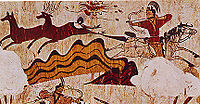
Complex of Goguryeo Tombs
The Complex of Goguryeo Tombs lie in North Korea. In July 2004, they became the first UNESCO World Heritage site in the country. The site consists of 30 individual tombs from the later Goguryeo kingdom, one of Three Kingdoms of Korea, located in the cities of P'yŏngyang and Namp'o...
are examples of Korean painting from its Three Kingdoms
Three Kingdoms of Korea
The Three Kingdoms of Korea refer to the ancient Korean kingdoms of Goguryeo, Baekje and Silla, which dominated the Korean peninsula and parts of Manchuria for much of the 1st millennium...
era. Although thousands of these tombs have been found, only about 100 have murals. These tombs are often named for the dominating theme of the murals – these include the Tomb of the Dancers, the Tomb of the Hunters, the Tomb of the Four Spirits, and the Tomb of the Wrestlers. Heavenly bodies are a common motif, as are depictions of events from the lives of the royalty and nobles whose bodies had been entombed. The former include the sun, represented as a three-legged bird
Three-legged bird
The three-legged crow is a creature found in various mythologies and arts of Asia, Asia Minor, and North Africa. It is believed by many cultures to inhabit and represent the sun....
inside a wheel, and the various constellations, including especially the Four directional constellations
Four Symbols (Chinese constellation)
The Four Symbols are four mythological creatures in the Chinese constellations. They are:*Azure Dragon of the East *Vermilion Bird of the South *White Tiger of the West *Black Tortoise of the North...
: the Azure Dragon of the East, the Vermilion Bird of the South, the White Tiger
White Tiger (Chinese constellation)
The White Tiger is one of the Four Symbols of the Chinese constellations. It is sometimes called the White Tiger of the West , and is known as Baihu in Chinese, Byakko in Japanese, Baekho in Korean and Bạch Hổ in Vietnamese...
of the West, and the Black Tortoise of the North.
The Royal Tombs of the Joseon Dynasty
Royal Tombs of the Joseon Dynasty
The Royal Tombs of the Joseon Dynasty refers to the 40 tombs of members of the Korean Joseon Dynasty . These tombs are scattered in over 18 locations across South Korea. They were built to honour and respect the ancestors and their achievements, and assert their royal authority...
in Korea
Korea
Korea ) is an East Asian geographic region that is currently divided into two separate sovereign states — North Korea and South Korea. Located on the Korean Peninsula, Korea is bordered by the People's Republic of China to the northwest, Russia to the northeast, and is separated from Japan to the...
, built between 1408 and 1966, reflect a combination of Chinese and Japanese traditions, with a tomb mound, often surrounded by a screen wall of stone blocks, and sometimes with stone animal figures above ground, not unlike the Japanese haniwa figures (see below). There is usually one or more T-shaped shrine buildings some distance in front of the tomb, which is set in extensive grounds, usually with a hill behind them, and facing a view towards water and distant hills. They are still a focus for ancestor worship rituals. From the 15th century, they became more simple, while retaining a large landscape setting.
Japan

Kofun period
The is an era in the history of Japan from around 250 to 538. It follows the Yayoi period. The word kofun is Japanese for the type of burial mounds dating from this era. The Kofun and the subsequent Asuka periods are sometimes referred to collectively as the Yamato period...
of Japanese history, from the 3rd to 6th centuries CE, is named after kofun
Kofun
Kofun are megalithic tombs or tumuli in Japan, constructed between the early 3rd century and early 7th century. They gave their name to the Kofun period . Many of the Kofun have a distinctive keyhole-shaped mound , unique to ancient Japan...
, the often enormous keyhole-shaped Imperial mound-tomb, often on a moated island. None of these have ever been allowed to be excavated, so their possibly spectacular contents remain unknown. Late examples which have been investigated, such as the Kitora Tomb
Kitora Tomb
The is an ancient tumulus located in the village of Asuka, Nara Prefecture, Japan. The tomb is believed to have been constructed some time between the 7th and early 8th centuries, but was only discovered in 1983....
, had been robbed of most of their contents, but the Takamatsuzuka Tomb
Takamatsuzuka Tomb
The or "Tall Pine Tree Ancient Burial Mound" in Japanese is an ancient circular tomb in Asuka village, Nara prefecture, Japan.The tomb is thought to have been built at some time between the end of the 7th century and the beginning of the 8th century. It was accidentally discovered by a local...
retains mural paintings. Lower down the social scale in the same period, terracotta haniwa figures, as much as a metre high, were deposited on top of aristocratic tombs as grave markers, with others left inside, apparently representing possessions such as horses and houses for use in the afterlife. Both kofun mounds and haniwa figures appear to have been discontinued as Buddhism became the dominant Japanese religion.
Since then, Japanese tombs have been typically marked by elegant but simple rectangular vertical gravestones with inscriptions. Funerals are one of the areas in Japanese life where Buddhist customs are followed even by those who followed other traditions, such as Shinto
Shinto
or Shintoism, also kami-no-michi, is the indigenous spirituality of Japan and the Japanese people. It is a set of practices, to be carried out diligently, to establish a connection between present day Japan and its ancient past. Shinto practices were first recorded and codified in the written...
. The bodaiji
Bodaiji
A , in Japanese Buddhism is a temple which, generation after generation, takes care of a family's dead giving them burial and performing ceremonies in their soul's favor. The name is because in Japan the term , which originally meant just Buddhist enlightenment , has also come to mean either the...
is a special and very common type of temple whose main purpose is as a venue for rites of ancestor worship, though it is often not the actual burial site. This was originally a custom of the feudal lords, but was adopted by other classes from about the 16th century. Each family would use a particular bodaiji over generations, and it might contain a second "grave" if the actual burial were elsewhere. Many later emperors, from the 13th to 19th centuries, are buried simply at the Imperial bodaiji, the Tsuki no wa no misasagi
Tsuki no wa no misasagi
Tsuki no wa no misasagi is the name of a mausoleum in Higashiyama-ku, Kyoto used by successive generations of the Japanese Imperial Family....
mausoleum in the Sennyū-ji
Sennyu-ji
, formerly written as , is a Buddhist temple in Higashiyama-ku in Kyoto, Japan. For centuries, Sennyū-ji was a mortuary temple for aristocrats and the imperial house. Located here are the official tombs of Emperor Shijō and many of the emperors who came after him....
temple at Kyoto
Kyoto
is a city in the central part of the island of Honshū, Japan. It has a population close to 1.5 million. Formerly the imperial capital of Japan, it is now the capital of Kyoto Prefecture, as well as a major part of the Osaka-Kobe-Kyoto metropolitan area.-History:...
.
The Americas
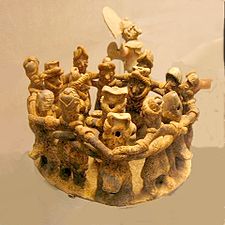
Mesoamerica
Mesoamerica is a region and culture area in the Americas, extending approximately from central Mexico to Belize, Guatemala, El Salvador, Honduras, Nicaragua, and Costa Rica, within which a number of pre-Columbian societies flourished before the Spanish colonization of the Americas in the 15th and...
is generally lacking in sarcophagi, with a few notable exceptions such as that of Pacal the Great
Pacal the Great
K'inich Janaab' Pakal was ruler of the Maya polity of Palenque in the Late Classic period of pre-Columbian Mesoamerican chronology...
or the now-lost sarcophagus from the Olmec
Olmec
The Olmec were the first major Pre-Columbian civilization in Mexico. They lived in the tropical lowlands of south-central Mexico, in the modern-day states of Veracruz and Tabasco....
site of La Venta
La Venta
La Venta is a pre-Columbian archaeological site of the Olmec civilization located in the present-day Mexican state of Tabasco. Some of the artifacts have been moved to the museum "Parque - Museo de La Venta", which is in Villahermosa, the capital of Tabasco....
. Instead, most Mesoamerican funerary art takes the form of grave goods and, in Oaxaca
Oaxaca
Oaxaca , , officially Estado Libre y Soberano de Oaxaca is one of the 31 states which, along with the Federal District, comprise the 32 federative entities of Mexico. It is divided into 571 municipalities; of which 418 are governed by the system of customs and traditions...
, funerary urns. Two well-known examples of Mesoamerican grave goods are those from Jaina Island, a Maya
Maya civilization
The Maya is a Mesoamerican civilization, noted for the only known fully developed written language of the pre-Columbian Americas, as well as for its art, architecture, and mathematical and astronomical systems. Initially established during the Pre-Classic period The Maya is a Mesoamerican...
site off the coast of Campeche
Campeche
Campeche is one of the 31 states which, with the Federal District, comprise the 32 Federal Entities of Mexico. Located in Southeast Mexico, it is bordered by the states of Yucatán to the north east, Quintana Roo to the east, and Tabasco to the south west...
, and those associated with the Western Mexico shaft tomb tradition
Western Mexico shaft tomb tradition
The Western Mexico shaft tomb tradition or shaft tomb culture refers to a set of interlocked cultural traits found in the western Mexican states of Jalisco, Nayarit, and, to a lesser extent, Colima to its south, roughly dating to the period between 300 BCE and 400 CE, although there is not wide...
. The tombs of Mayan rulers can only normally be identified by inferences drawn from the lavishness of the grave goods and, with the possible exception of vessels made from stone rather than pottery, these appear to contain no objects specially made for the burial.
The Jaina Island graves are noted for their abundance of clay figurines. Human remains within the roughly 1,000 excavated graves on the island (out of 20,000 total) were found to be accompanied by glassware, slateware, or pottery, as well as one or more ceramic figurines, usually resting on the occupant's chest or held in their hands. The function of these figurines is not known: due to gender and age mismatches, they are unlikely to be portraits of the grave occupants, although the later figurines are known to be representations of goddesses.
The so-called shaft tomb tradition of western Mexico is known almost exclusively from grave goods, which include hollow ceramic figures, obsidian and shell jewelry, pottery, and other items (see this Flickr photo for a reconstruction). Of particular note are the various ceramic tableaux including village scenes, for example, players engaged in a Mesoamerican ballgame
Mesoamerican ballgame
The Mesoamerican ballgame or Tlatchtli in Náhuatl was a sport with ritual associations played since 1,000 B.C. by the pre-Columbian peoples of Ancient Mexico and Central America...
. Although these tableaux may merely depict village life, it has been proposed that they instead (or also) depict the underworld. Ceramic dogs are also widely known from looted tombs, and are thought by some to represent psychopomp
Psychopomp
Psychopomps are creatures, spirits, angels, or deities in many religions whose responsibility is to escort newly deceased souls to the afterlife. Their role is not to judge the deceased, but simply provide safe passage...
s (soul guides), although it should also be noted that dogs were often the major source of protein in ancient Mesoamerica.
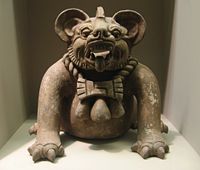
Zapotec civilization
The Zapotec civilization was an indigenous pre-Columbian civilization that flourished in the Valley of Oaxaca of southern Mesoamerica. Archaeological evidence shows their culture goes back at least 2500 years...
of Oaxaca is particularly known for its clay funerary urns, such as the "bat god" shown at right. Numerous types of urns have been identified. While some show deities and other supernatural beings, others seem to be portraits. Art historian George Kubler
George Kubler
George Alexander Kubler was an American art historian and among the foremost scholars on the art of Pre-Columbian America and Ibero-American Art....
is particularly enthusiastic about the craftsmanship of this tradition:
No other American potters ever explored so completely the plastic conditions of wet clay or retained its forms so completely after firing ... [they] used its wet and ductile nature for fundamental geometric modelling and cut the material, when half-dry, into smooth planes with sharp edges of an unmatched brilliance and suggestiveness of form.
The Maya Naj Tunich
Naj Tunich
Naj Tunich is a natural cave and an important archaeological site in Guatemala.The discovery of the Naj Tunich caves, in Poptún southern Peten, Guatemala, in 1979 initiated the interest for Cave Archeology among Mayanists...
cave tombs and other sites contain paintings, carved stelae, and grave goods in pottery, jade
Jade
Jade is an ornamental stone.The term jade is applied to two different metamorphic rocks that are made up of different silicate minerals:...
and metal, including death mask
Death mask
In Western cultures a death mask is a wax or plaster cast made of a person’s face following death. Death masks may be mementos of the dead, or be used for creation of portraits...
s. In dry areas, many ancient textiles have been found in graves from South America's Paracas culture
Paracas culture
The Paracas culture was an important Andean society between approximately 800 BCE and 100 BCE, with an extensive knowledge of irrigation and water management. It developed in the Paracas Peninsula, located in what today is the Paracas District of the Pisco Province in the Ica Region...
, which wrapped its mummies tightly in several layers of elaborately patterned cloth. Elite Moche
Moche
'The Moche civilization flourished in northern Peru from about 100 AD to 800 AD, during the Regional Development Epoch. While this issue is the subject of some debate, many scholars contend that the Moche were not politically organized as a monolithic empire or state...
graves, containing especially fine pottery, were incorporated into large adobe
Adobe
Adobe is a natural building material made from sand, clay, water, and some kind of fibrous or organic material , which the builders shape into bricks using frames and dry in the sun. Adobe buildings are similar to cob and mudbrick buildings. Adobe structures are extremely durable, and account for...
structures also used for human sacrifice
Human sacrifice
Human sacrifice is the act of killing one or more human beings as part of a religious ritual . Its typology closely parallels the various practices of ritual slaughter of animals and of religious sacrifice in general. Human sacrifice has been practised in various cultures throughout history...
s, such as the Huaca de la Luna
Huaca de la Luna
Huaca de la Luna is a large adobe brick structure built mainly by the Moche people of northern Peru. Along with the Huaca del Sol, the Huaca de la Luna is part of Huacas de Moche, which is the remains of an ancient Moche capital city called Cerro Blanco.-Background:The Huacas de Moche site is...
. Andean cultures
Cultural periods of Peru
This is a chart of cultural periods of Peru and the Andean Region developed by Edward Lanning and used by some archaeologists studying the area...
such as the Sican
Sican Culture
The Sican culture is the name that archaeologist Izumi Shimada gave to the culture that inhabited what is now the north coast of Peru between about AD 750 and 1375. According to Shimada, Sican means "temple of the moon". The Sican culture is also referred to as Lambayeque culture, after the name...
often practiced mummification and left grave goods in precious metals with jewels, including tumi
Tumi
- History :Tumi, Inc., a manufacturer of suitcases and bags for travel, is based in South Plainfield, New Jersey. Founded in 1975 by Charlie Clifford after a stint in the Peace Corps in Peru, the company is named after a Peruvian ceremonial knife used for sacrifices. Tumi, Inc. has been a unit of...
ritual knives and gold funerary masks, as well as pottery.
The Mimbres of the Mogollon culture buried their dead with bowls on top of their heads and ceremonially "killed" each bowl with a small hole in the centre so that the deceased's spirit could rise to another world. Mimbres funerary bowls show scenes of hunting, gambling, planting crops, fishing, making love and giving birth.
Some of the North American mounds, such as Grave Creek Mound
Grave Creek Mound
At high and in diameter, the Grave Creek Mound is one of the largest conical type burial mounds in the United States. The builders of the site moved more than 60,000 tons of dirt to create it. It is located in Moundsville, West Virginia near the banks of the Ohio River. The first recorded...
(c. 250–150 BCE) in West Virginia
West Virginia
West Virginia is a state in the Appalachian and Southeastern regions of the United States, bordered by Virginia to the southeast, Kentucky to the southwest, Ohio to the northwest, Pennsylvania to the northeast and Maryland to the east...
, functioned as burial sites, while others had different purposes.
Traditional societies

Indigenous Australians
Indigenous Australians are the original inhabitants of the Australian continent and nearby islands. The Aboriginal Indigenous Australians migrated from the Indian continent around 75,000 to 100,000 years ago....
typically feature body painting
Body painting
Body painting, or sometimes bodypainting, is a form of body art. Unlike tattoo and other forms of body art, body painting is temporary, painted onto the human skin, and lasts for only several hours, or at most a couple of weeks. Body painting that is limited to the face is known as face painting...
; the Yolngu
Yolngu
The Yolngu or Yolŋu are an Indigenous Australian people inhabiting north-eastern Arnhem Land in the Northern Territory of Australia. Yolngu means “person” in the Yolŋu languages.-Yolŋu law:...
and Tiwi
Tiwi people
The Tiwi people are one of the many Indigenous groups of Australia. Nearly 2,500 Tiwi live in the Bathurst and Melville Islands, which make up the Tiwi Islands....
people create carved pukumani burial poles from ironwood
Ironwood
Ironwood is a common name for a large number of woods that have a reputation for hardness. Usage of the name may include the tree that yields this wood...
trunks, while elaborately carved burial tree
Burial tree
A burial tree or burial scaffold is a tree or simple structure used for supporting corpses or coffins. They were once common among the Balinese, the Naga people, certain Australian Aborigines, and some North American Indian groups....
s have been used in south-eastern Australia. The Toraja
Toraja
The Toraja are an ethnic group indigenous to a mountainous region of South Sulawesi, Indonesia. Their population is approximately 650,000, of which 450,000 still live in the regency of Tana Toraja . Most of the population is Christian, and others are Muslim or have local animist beliefs known as aluk...
people of central Sulawesi
Sulawesi
Sulawesi is one of the four larger Sunda Islands of Indonesia and is situated between Borneo and the Maluku Islands. In Indonesia, only Sumatra, Borneo, and Papua are larger in territory, and only Java and Sumatra have larger Indonesian populations.- Etymology :The Portuguese were the first to...
are famous for their burial practices, which include the setting-up of effigies of the dead on cliffs. The 19th and 20th century royal Kasubi Tombs
Kasubi Tombs
The Kasubi Tombs in Kampala, Uganda, is the site of the burial grounds for four kabakas , and a UNESCO World Heritage Site.On 16 March 2010, some of the major buildings there were almost completely destroyed by a fire, the cause of which is under investigation...
in Uganda
Uganda
Uganda , officially the Republic of Uganda, is a landlocked country in East Africa. Uganda is also known as the "Pearl of Africa". It is bordered on the east by Kenya, on the north by South Sudan, on the west by the Democratic Republic of the Congo, on the southwest by Rwanda, and on the south by...
, destroyed by fire in 2010, were a circular compound of thatched buildings similar to those inhabited by the earlier Kabaka
Kabaka of Buganda
Kabaka is the title of the king of the Kingdom of Buganda. According to the traditions of the Baganda they are ruled by two kings, one spiritual and the other material....
s when alive, but with special characteristics.
In several cultures, goods for use in the afterlife are still interred or cremated, for example Hell bank notes (and now credit cards) in Chinese communities. In Ghana, mostly among the Ga people
Ga people
The Ga-Adangbe are an ethnic group in the West African nation of Ghana. It is part of the Dangme ethnic group. The Ga people are grouped as part of theGa–Dangme ethnolinguistic group. They speak Kwa languages...
, elaborate figurative coffins in the shape of cars, boats or animals are made of wood. These were introduced in the 1950s by Seth Kane Kwei
Kane Kwei Carpentry Workshop
The Kane Kwei Carpentry Workshop is a studio established in Teshie, Ghana, since the Fifties. It is known for its Design Coffins that became symbolic of African artistic creativity.- History :...
.
Hinduism
CremationCremation
Cremation is the process of reducing bodies to basic chemical compounds such as gasses and bone fragments. This is accomplished through high-temperature burning, vaporization and oxidation....
is traditional among Hindus, who also believe in reincarnation
Reincarnation
Reincarnation best describes the concept where the soul or spirit, after the death of the body, is believed to return to live in a new human body, or, in some traditions, either as a human being, animal or plant...
, and there is far less of a tradition of funerary monuments in Hinduism than in other major religions. However there are regional, and relatively recent, traditions among royalty, and the samādhi mandir is a memorial temple for a saint. Both may be influenced by Islamic practices. The mausolea of the lings of Orchha
Orchha
Orchha is a town in Tikamgarh district of Madhya Pradesh state, India. The town was established by Maharaja Rudra Pratap Singh in 1501, as the seat of an eponymous former princely state of central India, in the Bundelkhand region. Orchha lies on the Betwa River , 80 km from Tikamgarh &...
, from the 16th century onwards, are among the best known. Other rulers were commemorated by memorial temples of the normal type for the time and place, which like similar buildings from other cultures fall outside the scope of this article, though Angkor Wat
Angkor Wat
Angkor Wat is a temple complex at Angkor, Cambodia, built for the king Suryavarman II in the early 12th century as his state temple and capital city. As the best-preserved temple at the site, it is the only one to have remained a significant religious centre since its foundation – first Hindu,...
in Cambodia
Cambodia
Cambodia , officially known as the Kingdom of Cambodia, is a country located in the southern portion of the Indochina Peninsula in Southeast Asia...
, the most spectacular of all, must be mentioned.
Buddhism
Buddhist tombs themselves are typically simple and modest, although they may be set within temples, sometimes large complexes, built for the purpose in the then-prevailing style. According to tradition, the remains of the BuddhaBuddha
In Buddhism, buddhahood is the state of perfect enlightenment attained by a buddha .In Buddhism, the term buddha usually refers to one who has become enlightened...
's body after cremation
Cremation
Cremation is the process of reducing bodies to basic chemical compounds such as gasses and bone fragments. This is accomplished through high-temperature burning, vaporization and oxidation....
were entirely divided up into relics (cetiya
Cetiya
The cetiya, "reminders" or "memorials" , are objects and places used by Theravada Buddhists to remember Gautama Buddha. These are traditionally divided into three categories: śarīraka, pieces of the body, paribhogaka, things he used, and udeśaka, reminders...
), which played an important part in early Buddhism. The stupa
Stupa
A stupa is a mound-like structure containing Buddhist relics, typically the remains of Buddha, used by Buddhists as a place of worship....
developed as a monument enclosing deposits of relics of the Buddha from plain hemispherical mounds in the 3rd century BCE to elaborate structures such as those at Sanchi
Sanchi
Sanchi is a small village in Raisen District of the state of Madhya Pradesh, India, it is located 46 km north east of Bhopal, and 10 km from Besnagar and Vidisha in the central part of the state of Madhya Pradesh. It is the location of several Buddhist monuments dating from the 3rd...
in India and Borobudur
Borobudur
Borobudur, or Barabudur, is a 9th-century Mahayana Buddhist monument near Magelang, Central Java, Indonesia. The monument comprises six square platforms topped by three circular platforms, and is decorated with 2,672 relief panels and 504 Buddha statues...
in Java
Java
Java is an island of Indonesia. With a population of 135 million , it is the world's most populous island, and one of the most densely populated regions in the world. It is home to 60% of Indonesia's population. The Indonesian capital city, Jakarta, is in west Java...
. Regional variants such as the pagoda
Pagoda
A pagoda is the general term in the English language for a tiered tower with multiple eaves common in Nepal, India, China, Japan, Korea, Vietnam and other parts of Asia. Some pagodas are used as Taoist houses of worship. Most pagodas were built to have a religious function, most commonly Buddhist,...
of China and Japan and the candi of Indonesia
Candi of Indonesia
Candi are the Hindu and Buddhist temples and sanctuaries of Indonesia, mostly built during the 8th to 15th centuries...
evolved from the Indian form. However, none of these can strictly be called tombs. Some important Tibet
Tibet
Tibet is a plateau region in Asia, north-east of the Himalayas. It is the traditional homeland of the Tibetan people as well as some other ethnic groups such as Monpas, Qiang, and Lhobas, and is now also inhabited by considerable numbers of Han and Hui people...
an lama
Lama
Lama is a title for a Tibetan teacher of the Dharma. The name is similar to the Sanskrit term guru .Historically, the term was used for venerated spiritual masters or heads of monasteries...
s are buried in relatively small chortens (Tibetan stupas), sometimes of precious metal, inside or outside monasteries, sometimes after mummification. There are examples at Kursha Monastery
Kursha Monastery
Karsha Monastery or Karsha Gompa is a Buddhist monastery in the Padum Valley of the Zanskar region of the state of Jammu and Kashmir in northern India. The Doda River flows past the monastery from its source at the Drang Drung glacier of the Pensi La . It was founded by the translator, Phagspa...
in Zanskar
Zanskar
Zanskar is a subdistrict or tehsil of the Kargil district, which lies in the eastern half of the Indian state of Jammu and Kashmir. The administrative centre is Padum...
and Tashiding Monastery
Tashiding Monastery
Tashiding Monastery is a Buddhist monastery of the Nyingma sect of Tibetan Buddhism in Western Sikkim, northeastern India. It is located on top of the hill rising between the Rathong chu and the Rangeet River, from Gyalshing and to the south east of Yuksam meaning Yuk-Lamas, Sam- Three in Lepcha...
in Sikkim
Sikkim
Sikkim is a landlocked Indian state nestled in the Himalayan mountains...
, as well as the Potala Palace
Potala Palace
The Potala Palace is located in Lhasa, Tibet Autonomous Region, China. It was named after Mount Potala, the abode of Chenresig or Avalokitesvara...
in Lhasa
Lhasa
Lhasa is the administrative capital of the Tibet Autonomous Region in the People's Republic of China and the second most populous city on the Tibetan Plateau, after Xining. At an altitude of , Lhasa is one of the highest cities in the world...
and many other monasteries. However, most chortens do not function as tombs.
Christianity
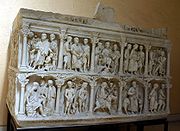
Catacombs of Rome
The Catacombs of Rome are ancient catacombs, underground burial places under or near Rome, Italy, of which there are at least forty, some discovered only in recent decades. Though most famous for Christian burials, either in separate catacombs or mixed together, they began in the 2nd century, much...
contain most of the surviving Christian art
Christian art
Christian art is sacred art produced in an attempt to illustrate, supplement and portray in tangible form the principles of Christianity, though other definitions are possible. Most Christian groups use or have used art to some extent, although some have had strong objections to some forms of...
of the Early Christian
Early Christianity
Early Christianity is generally considered as Christianity before 325. The New Testament's Book of Acts and Epistle to the Galatians records that the first Christian community was centered in Jerusalem and its leaders included James, Peter and John....
period, mainly in the form of fresco
Fresco
Fresco is any of several related mural painting types, executed on plaster on walls or ceilings. The word fresco comes from the Greek word affresca which derives from the Latin word for "fresh". Frescoes first developed in the ancient world and continued to be popular through the Renaissance...
s and sculpted sarcophagi
Early Christian sarcophagi
Early Christian sarcophagi are those produced by the first Christians through to the 5th century, particularly known via 3rd century examples....
. They show a Christian iconography
Iconography
Iconography is the branch of art history which studies the identification, description, and the interpretation of the content of images. The word iconography literally means "image writing", and comes from the Greek "image" and "to write". A secondary meaning is the painting of icons in the...
emerging, initially from Roman popular decorative art, but later borrowing from official imperial and pagan motifs. Initially, Christians avoided iconic images of religious figures, and sarcophagi were decorated with ornaments, Christian symbols like the Chi Rho
Chi Rho
The Chi Rho is one of the earliest forms of christogram, and is used by Christians. It is formed by superimposing the first two letters chi and rho of the Greek word "ΧΡΙΣΤΟΣ" =Christ in such a way to produce the monogram ☧...
monogram and, later, narrative religious scenes. The Early Christians' habit, after the end of their persecution, of building churches (most famously St Peter's, Rome) over the burial places of martyr
Martyr
A martyr is somebody who suffers persecution and death for refusing to renounce, or accept, a belief or cause, usually religious.-Meaning:...
s who had originally been buried discreetly or in a mass grave perhaps led to the most distinctive feature of Christian funerary art, the church monument, or tomb inside a church. The beliefs of many cultures, including Judaism and Hinduism as well as classical paganism, consider the dead ritually impure
Ritual purification
Ritual purification is a feature of many religions. The aim of these rituals is to remove specifically defined uncleanliness prior to a particular type of activity, and especially prior to the worship of a deity...
and avoid mixing temples and cemeteries (though see above for Moche, and below for Islamic culture).
_-_foto_g._dallorto_2_lug_2006_-_08.jpg)
Resurrection of the dead
Resurrection of the Dead is a belief found in a number of eschatologies, most commonly in Christian, Islamic, Jewish and Zoroastrian. In general, the phrase refers to a specific event in the future; multiple prophesies in the histories of these religions assert that the dead will be brought back to...
at the Second Coming of Christ, and the Catholic Church only relaxed its opposition to cremation in 1963. Although mass ossuaries have also been used, burial has always been the preferred Christian tradition, at least until recent times. Burial was, for as long as there was room, usually in a graveyard adjacent to the church, with a gravestone or horizontal slab, or for the wealthy or important clergy, inside it. Wall tombs in churches strictly include the body itself, often in a sarcophagus, while often the body is buried in a crypt
Crypt
In architecture, a crypt is a stone chamber or vault beneath the floor of a burial vault possibly containing sarcophagi, coffins or relics....
or under the church floor, with a monument on the wall. Persons of importance, especially monarchs, might be buried in a free-standing sarcophagus, perhaps surrounded by an elaborate enclosure using metalwork and sculpture; grandest of all were the shrine
Shrine
A shrine is a holy or sacred place, which is dedicated to a specific deity, ancestor, hero, martyr, saint, daemon or similar figure of awe and respect, at which they are venerated or worshipped. Shrines often contain idols, relics, or other such objects associated with the figure being venerated....
s of saints, which became the destinations of pilgrimage
Pilgrimage
A pilgrimage is a journey or search of great moral or spiritual significance. Typically, it is a journey to a shrine or other location of importance to a person's beliefs and faith...
s. The monument to Maximilian I, Holy Roman Emperor in the Hofkirche, Innsbruck
Hofkirche, Innsbruck
The Hofkirche Innsbruck, Austria, is a Gothic church built 1553–1563 by Ferdinand I as a memorial to his grandfather Maximilian I, Holy Roman Emperor , whose cenotaph within boasts a remarkable collection of German Renaissance sculpture...
took decades to complete, while the tomb of Saint Dominic
Arca di San Domenico
The Arca di San Domenico is a monument containing the remains of Saint Dominic. It is located in Dominic’s Chapel in the Basilica of San Domenico in Bologna, Italy.- History :...
in Bologna
Bologna
Bologna is the capital city of Emilia-Romagna, in the Po Valley of Northern Italy. The city lies between the Po River and the Apennine Mountains, more specifically, between the Reno River and the Savena River. Bologna is a lively and cosmopolitan Italian college city, with spectacular history,...
took several centuries to reach its final form.
If only because its strong prejudice against free-standing and life-size sculpture, Eastern Orthodoxy could not have developed the tomb monument in the same way as the Western Church, and the burials of rich or important individuals continued the classical tradition of sarcophagi carved in relief, with the richness of the carving tending to diminish over the centuries, until just simple religious symbols were left. Constantine I and most later Byzantine Emperors up to 1028 were buried in the Church of the Holy Apostles
Church of the Holy Apostles
The Church of the Holy Apostles , also known as the Imperial Polyandreion, was a Christian church built in Constantinople, capital of the Eastern Roman Empire, in 550. It was second only to the Church of the Holy Wisdom among the great churches of the capital...
in Constantinople, which was destroyed after the fall of Constantinople
Fall of Constantinople
The Fall of Constantinople was the capture of the capital of the Byzantine Empire, which occurred after a siege by the Ottoman Empire, under the command of Ottoman Sultan Mehmed II, against the defending army commanded by Byzantine Emperor Constantine XI...
of 1453. Some massive but mostly plain porphyry
Porphyry (geology)
Porphyry is a variety of igneous rock consisting of large-grained crystals, such as feldspar or quartz, dispersed in a fine-grained feldspathic matrix or groundmass. The larger crystals are called phenocrysts...
sarcophagi from the church are now placed outside the Istanbul Archaeology Museums.
The Tomb of Antipope John XXIII
Tomb of Antipope John XXIII
The Tomb of Antipope John XXIII is the marble and bronze tomb monument of Antipope John XXIII , created by Donatello and Michelozzo for the Florence Baptistry adjacent to the Duomo...
in Florence
Florence
Florence is the capital city of the Italian region of Tuscany and of the province of Florence. It is the most populous city in Tuscany, with approximately 370,000 inhabitants, expanding to over 1.5 million in the metropolitan area....
is a grand Early Renaissance wall tomb by Donatello
Donatello
Donato di Niccolò di Betto Bardi , also known as Donatello, was an early Renaissance Italian artist and sculptor from Florence...
and Michelozzo
Michelozzo
thumb|250px|[[Palazzo Medici]] in Florence.Michelozzo di Bartolomeo Michelozzi was an Italian architect and sculptor.-Biography:...
; although classical in style, it reflects the somewhat inharmonious stacking up of different elements typical of major Gothic tombs. It has a life-size effigy lying on the sarcophagus, which was common from the Romanesque period through to the Baroque
Baroque
The Baroque is a period and the style that used exaggerated motion and clear, easily interpreted detail to produce drama, tension, exuberance, and grandeur in sculpture, painting, literature, dance, and music...
and beyond. Ruling dynasties were often buried together, usually in monasteries; the Chartreuse de Champmol was founded for that purpose by the Valois Dukes of Burgundy
Duke of Burgundy
Duke of Burgundy was a title borne by the rulers of the Duchy of Burgundy, a small portion of traditional lands of Burgundians west of river Saône which in 843 was allotted to Charles the Bald's kingdom of West Franks...
in 1383. The Scaliger tombs
Scaliger Tombs
The Scaliger Tombs is a group of five Gothic funerary monuments in Verona, Italy, celebrating the Scaliger family, who ruled in Verona from the 13th to the late 14th century....
in Verona
Verona
Verona ; German Bern, Dietrichsbern or Welschbern) is a city in the Veneto, northern Italy, with approx. 265,000 inhabitants and one of the seven chef-lieus of the region. It is the second largest city municipality in the region and the third of North-Eastern Italy. The metropolitan area of Verona...
are magnificent free-standing Gothic
Gothic art
Gothic art was a Medieval art movement that developed in France out of Romanesque art in the mid-12th century, led by the concurrent development of Gothic architecture. It spread to all of Western Europe, but took over art more completely north of the Alps, never quite effacing more classical...
canopied tombs—they are outside the church in a special enclosure, and so are unrestricted in height. Important churches like Saint Peter's in Rome, Saint Paul's Cathedral, London, Santi Giovanni e Paolo, Venice (twenty-five Doge
Doge
Doge is a dialectal Italian word that descends from the Latin dux , meaning "leader", especially in a military context. The wife of a Doge is styled a Dogaressa....
s), and the Basilica of Santa Croce, Florence contain large numbers of impressive monuments to the great and the good, created by the finest architects and sculptors available. Local parish church
Parish church
A parish church , in Christianity, is the church which acts as the religious centre of a parish, the basic administrative unit of episcopal churches....
es are also often full of monuments, which may include large and artistically significant ones for local landowners and notables. Often a prominent family would add a special chapel for their use, including their tombs; in Catholic countries, bequests would pay for masses
Mass bequest
A bedquest for a Mass is when a person leaves a bequest in their will for a Mass to be said for the repose of their soul....
to be said in perpetuity for their souls. By the High Renaissance
High Renaissance
The expression High Renaissance, in art history, is a periodizing convention used to denote the apogee of the visual arts in the Italian Renaissance...
, led by Michelangelo
Michelangelo
Michelangelo di Lodovico Buonarroti Simoni , commonly known as Michelangelo, was an Italian Renaissance painter, sculptor, architect, poet, and engineer who exerted an unparalleled influence on the development of Western art...
's tombs, the effigies are often sitting up, and later may stand. Often they turn towards the altar, or are kneeling facing it in profile.

Black Death
The Black Death was one of the most devastating pandemics in human history, peaking in Europe between 1348 and 1350. Of several competing theories, the dominant explanation for the Black Death is the plague theory, which attributes the outbreak to the bacterium Yersinia pestis. Thought to have...
and devotional writers, explicit memento mori
Memento mori
Memento mori is a Latin phrase translated as "Remember your mortality", "Remember you must die" or "Remember you will die". It names a genre of artistic work which varies widely, but which all share the same purpose: to remind people of their own mortality...
imagery of death in the forms of skulls or skeletons, or even decomposing corpses overrun with worms in the transi tomb, became common in northern Europe, and may be found in some funerary art, as well as motifs like the Dance of Death
Danse Macabre
Dance of Death, also variously called Danse Macabre , Danza de la Muerte , Dansa de la Mort , Danza Macabra , Dança da Morte , Totentanz , Dodendans , is an artistic genre of late-medieval allegory on the universality of death: no matter one's...
and works like the Ars moriendi
Ars moriendi
The Ars moriendi are two related Latin texts dating from about 1415 and 1450 which offer advice on the protocols and procedures of a good death, explaining how to "die well" according to Christian precepts of the late Middle Ages...
, or "Art of Dying". It took until the Baroque period for such imagery to become popular in Italy, in works like the tomb of Pope Urban VIII by Bernini (1628–1647), where a bronze winged skeleton inscribes the Pope's name on a tablet below his enthroned effigy. As cities became more crowded, bones were sometimes recovered after a period, and placed in ossuaries where they might be arranged for artistic effect, as at the Capuchin Crypt
Capuchin Crypt
The Capuchin Crypt is a small space comprising several tiny chapels located beneath the church of Santa Maria della Concezione dei Cappuccini on the Via Veneto near Piazza Barberini in Rome, Italy. It contains the skeletal remains of 4,000 bodies believed to be Capuchin friars buried by their order...
in Rome or the Czech Sedlec Ossuary
Sedlec Ossuary
The Sedlec Ossuary is a small Roman Catholic chapel, located beneath the Cemetery Church of All Saints in Sedlec, a suburb of Kutná Hora in the Czech Republic...
, which has a chandelier made of skulls and bones.
The church struggled to eliminate the pagan habits of leaving grave goods except for the clothing and usual jewellry of the powerful, especially rings. Kings might be buried with a sceptre
Sceptre
A sceptre is a symbolic ornamental rod or wand borne in the hand by a ruling monarch as an item of royal or imperial insignia.-Antiquity:...
, and bishops with a crozier, their respective symbols of office. The 7th century Stonyhurst Gospel
Stonyhurst Gospel
The Stonyhurst Gospel, also known as the St Cuthbert Gospel or the St Cuthbert Gospel of St John, is a small 7th-century pocket gospel book, written in Latin, which was probably placed in the tomb of Saint Cuthbert of Lindisfarne, a few years after he died in 687...
, with a unique Insular
Insular art
Insular art, also known as Hiberno-Saxon art, is the style of art produced in the post-Roman history of Ireland and Great Britain. The term derives from insula, the Latin term for "island"; in this period Britain and Ireland shared a largely common style different from that of the rest of Europe...
original leather binding, was recovered from St Cuthbert's coffin, itself a significant object; it was probably Cuthbert's personal copy, which he had very likely scribed himself. The armour and sword of a knight might be hung over his tomb, as those of the Black Prince
Edward, the Black Prince
Edward of Woodstock, Prince of Wales, Duke of Cornwall, Prince of Aquitaine, KG was the eldest son of King Edward III of England and his wife Philippa of Hainault as well as father to King Richard II of England....
still are in Canterbury Cathedral
Canterbury Cathedral
Canterbury Cathedral in Canterbury, Kent, is one of the oldest and most famous Christian structures in England and forms part of a World Heritage Site....
. The Early Christian Church, to the frustration of historians of costume, encouraged burial in a plain white winding-sheet, as being all that would be required at the Second Coming. For centuries, most except royalty followed this custom, which at least kept clothing, which was very expensive for rich and poor alike, available for the use of the living. The use of a rich cloth pall to cover the coffin during the funeral grew during the Middle Ages; initially these were brightly coloured and patterned, only later black. They were usually then given to the Church to use for vestment
Vestment
Vestments are liturgical garments and articles associated primarily with the Christian religion, especially among Latin Rite and other Catholics, Eastern Orthodox, Anglicans, and Lutherans...
s or other decorations.
From the early 13th century to the 16th, a popular form of monument north of the Alps, especially for the smaller landowner and merchant classes, was the monumental brass
Monumental brass
Monumental brass is a species of engraved sepulchral memorial which in the early part of the 13th century began to partially take the place of three-dimensional monuments and effigies carved in stone or wood...
, a sheet of brass on which the image of the person or persons commemorated was engraved, often with inscriptions and an architectural surround. They could be on the floor or wall inside a church. These provide valuable evidence as to changes in costume, especially for women. Many bishops and even some German rulers were commemorated with brasses.
The castrum doloris
Castrum doloris
Castrum doloris is a name for the structure and decorations sheltering or accompanying the catafalque or bier that signify the prestige or high estate of the deceased. A Castrum doloris might feature an elaborate baldachin and would include candles, possibly flowers, and in most cases coats of...
was a temporary catafalque
Catafalque
A catafalque is a raised bier, soapbox, or similar platform, often movable, that is used to support the casket, coffin, or body of the deceased during a funeral or memorial service. Following a Roman Catholic Requiem Mass, a catafalque may be used to stand in place of the body at the Absolution of...
erected around the coffin for the lying in state
Lying in state
Lying in state is a term used to describe the tradition in which a coffin is placed on view to allow the public at large to pay their respects to the deceased. It traditionally takes place in the principal government building of a country or city...
of important people, usually in a church, the funerary version of the elaborate temporary decorations for other court festivities, like royal entries. These began in the late Middle Ages, but reached their height of elaboration in the 18th century. A particular feature in Poland was the coffin portrait
Coffin portrait
A Coffin portrait was a realistic portrait of the deceased person put on coffins for the funeral and one of the elements of the castrum doloris, but removed before the burial...
, a bust-length painted portrait of the deceased, attached to the coffin, but removed before burial and often then hung in the church. Elsewhere, death masks were used in similar fashion. Hatchment
Hatchment
A hatchment is a funeral demonstration of the lifetime "achievement" of the arms and any other honours displayed on a black lozenge-shaped frame which used to be suspended against the wall of a deceased person's house...
s were a special lozenge-shaped painted coat of arms
Coat of arms
A coat of arms is a unique heraldic design on a shield or escutcheon or on a surcoat or tabard used to cover and protect armour and to identify the wearer. Thus the term is often stated as "coat-armour", because it was anciently displayed on the front of a coat of cloth...
which was displayed on the house of the deceased for a mourning period, before usually being moved to hang in the church. Like mourning clothes
Mourning
Mourning is, in the simplest sense, synonymous with grief over the death of someone. The word is also used to describe a cultural complex of behaviours in which the bereaved participate or are expected to participate...
, these fall outside a strict definition of art.
For some time after the Protestant Reformation
Protestant Reformation
The Protestant Reformation was a 16th-century split within Western Christianity initiated by Martin Luther, John Calvin and other early Protestants. The efforts of the self-described "reformers", who objected to the doctrines, rituals and ecclesiastical structure of the Roman Catholic Church, led...
, English church monuments formed the majority of large-scale artworks added to Protestant churches, especially in sculpture. The English upper classes ceased to commission altarpieces and other religious art for churches, but their tomb monuments continued to grow in size to fill the empty wall spaces; similar trends were seen in Lutheran countries, but Calvinists
Calvinism
Calvinism is a Protestant theological system and an approach to the Christian life...
tended to be more disapproving of figure sculpture. Many portraits were painted after death, and sometimes dead family members were included along with the living; a variety of indications might be used to suggest the distinction.
The large Baroque
Baroque
The Baroque is a period and the style that used exaggerated motion and clear, easily interpreted detail to produce drama, tension, exuberance, and grandeur in sculpture, painting, literature, dance, and music...
tomb monument continued likely to include a portrait of the deceased, and was more likely to include personified figures of Death, Time, Virtues or other figures than angels. The late medieval transi tomb vocabulary of images of bodily decay, such as skulls and skeletons, was sometimes re-introduced, but in a less confrontational manner. Neo-Classicism, led by Antonio Canova
Antonio Canova
Antonio Canova was an Italian sculptor from the Republic of Venice who became famous for his marble sculptures that delicately rendered nude flesh...
, revived the classical stela, either with a portrait or a personification; in this style there was little or no difference between the demands of Catholic and Protestant patrons.

Old World
The Old World consists of those parts of the world known to classical antiquity and the European Middle Ages. It is used in the context of, and contrast with, the "New World" ....
churchyards and church walls had completely run out of room for new monuments, and cemeteries on the outskirts of cities, towns or villages became the usual place for burials. The rich developed the classical styles of the ancient world for small family tombs, while the rest continued to use gravestones or what were now usually false sarcophagi, placed over a buried coffin. The cemeteries of the large Italian cities are generally accepted to have outdone those of other nations in terms of extravagant statuary, especially the Monumental Cemetery of Staglieno
Monumental Cemetery of Staglieno
The Cimitero monumentale di Staglieno is an extensive cemetery located on a hillside in the district of Staglieno of Genoa, Italy, famous for its monumental sculpture...
in Genoa
Genoa
Genoa |Ligurian]] Zena ; Latin and, archaically, English Genua) is a city and an important seaport in northern Italy, the capital of the Province of Genoa and of the region of Liguria....
, the Cimitero Monumentale di Milano
Cimitero Monumentale di Milano
The Cimitero Monumentale in Milan, Italy is a very large cemetery, noted for its abundance of highly artistic and often imposing tombs.It was designed by the architect Carlo Maciachini...
and the Certosa di Bologna
Certosa di Bologna
The Certosa di Bologna is a former Carthusian monastery in Bologna, central Italy, which was founded in 1334 and suppressed in 1797. In 1801 it became the city’s Monumental Cemetery which would be much praised by Byron and others...
. In Italy at least, funerary sculpture remained of equal status to other types during the 19th and early 20th centuries, and was made by the leading artists, often receiving reviews in the press, and being exhibited, perhaps in maquette
Maquette
A maquette is a small scale model or rough draft of an unfinished architectural work or a sculpture...
form. Monuments kept up with contemporary stylistic developments during the 19th century, embracing Symbolism
Symbolism (arts)
Symbolism was a late nineteenth-century art movement of French, Russian and Belgian origin in poetry and other arts. In literature, the style had its beginnings with the publication Les Fleurs du mal by Charles Baudelaire...
enthusiatically, but then gradually became detached from the avant-garde
Avant-garde
Avant-garde means "advance guard" or "vanguard". The adjective form is used in English to refer to people or works that are experimental or innovative, particularly with respect to art, culture, and politics....
after Art Nouveau
Art Nouveau
Art Nouveau is an international philosophy and style of art, architecture and applied art—especially the decorative arts—that were most popular during 1890–1910. The name "Art Nouveau" is French for "new art"...
and a few Art Deco
Art Deco
Art deco , or deco, is an eclectic artistic and design style that began in Paris in the 1920s and flourished internationally throughout the 1930s, into the World War II era. The style influenced all areas of design, including architecture and interior design, industrial design, fashion and...
examples. Where burials in church crypts or floors took place, memorial stained glass
Stained glass
The term stained glass can refer to coloured glass as a material or to works produced from it. Throughout its thousand-year history, the term has been applied almost exclusively to the windows of churches and other significant buildings...
windows, mostly on normal religious subjects but with a commemorative panel, are often found. War memorial
War memorial
A war memorial is a building, monument, statue or other edifice to celebrate a war or victory, or to commemorate those who died or were injured in war.-Historic usage:...
s, other than on the site of a battle, were relatively unusual until the 19th century, but became increasingly common during it, and after World War I were erected even in villages of the main combatant nations.
Islam
Islamic funerary art is dominated by architecture. Grave goods are discouraged to the point that their absence is frequently one recognition criterion of Muslim burials. Royalty and important religious figures were typically buried in plain stone sarcophagi, perhaps with a religious inscription. However, funerary architecture often offered a means of "moving beyond the strictures of formal Muslim burial rites" and expressing social dimensions such as status, piety, love for the deceased, and Muslim identity. A number of distinct architectural traditions arose for expressing these social elements. The Islamic tradition was slow in starting; the hadithHadith
The term Hadīth is used to denote a saying or an act or tacit approval or criticism ascribed either validly or invalidly to the Islamic prophet Muhammad....
"condemn the building of tombs, and Muhammed himself set the example of requesting burial in an unmarked grave in one of the chambers of his house" in Medina
Medina
Medina , or ; also transliterated as Madinah, or madinat al-nabi "the city of the prophet") is a city in the Hejaz region of western Saudi Arabia, and serves as the capital of the Al Madinah Province. It is the second holiest city in Islam, and the burial place of the Islamic Prophet Muhammad, and...
, though by at least the 12th century, buildings of the vast Al-Masjid al-Nabawi
Al-Masjid al-Nabawi
Al-Masjid al-Nabawi , often called the Prophet's Mosque, is a mosque situated in the city of Medina. As the final resting place of the Islamic prophet Muhammad, it is considered the second holiest site in Islam by Muslims and is one of the largest mosques in the world...
complex already marked the site. The earliest identified Muslim monumental tomb, in Samarra
Samarra
Sāmarrā is a city in Iraq. It stands on the east bank of the Tigris in the Salah ad-Din Governorate, north of Baghdad and, in 2003, had an estimated population of 348,700....
in Iraq, only dates from 862, and was commissioned by the Byzantine princess whose son was buried there. At some point, the tradition incorporated the idea of a garden setting, perhaps following the Islamic concept of Paradise
Paradise
Paradise is a place in which existence is positive, harmonious and timeless. It is conceptually a counter-image of the miseries of human civilization, and in paradise there is only peace, prosperity, and happiness. Paradise is a place of contentment, but it is not necessarily a land of luxury and...
, an association certainly made when the tradition was mature, although the difficulty of reconstructing gardens from archaeology makes the early stages of this process hard to trace. At any rate, gardens surrounding tombs became established in Islamic tradition in many parts of the world, and existing pleasure gardens were sometimes appropriated for this purpose. Versions of the formal Persian charbagh
Charbagh
Charbagh is a Persian-style garden layout. The quadrilateral garden is divided by walkways or flowing water into four smaller parts...
design were widely used in India, Persia and elsewhere.
Another influence may have been the octagonal Dome of the Rock
Dome of the Rock
The Dome of the Rock is a shrine located on the Temple Mount in the Old City of Jerusalem. The structure has been refurbished many times since its initial completion in 691 CE at the order of Umayyad Caliph Abd al-Malik...
in Jerusalem, not a mausoleum itself, but "the earliest Islamic model for centrally planned commemorative buildings", adapting the Byzantine form of the martyrium in a building standing alone, though on a stone platform rather than in a garden. In the Persian sphere, a tradition of relatively small mausoleums evolved, often in the shape of short hexagonal or octagonal dome
Dome
A dome is a structural element of architecture that resembles the hollow upper half of a sphere. Dome structures made of various materials have a long architectural lineage extending into prehistory....
d towers, usually containing a single chamber, like the Malek Tomb
Malek Tomb
Malek Tomb is a tower-like, octagonal, probably Ilkhanid tomb located on a hill in the center of Sonqor Town in Kermanshah Province, Iran. The top part is built out of brick; the basement is made of hewn stone.-References:Website of CHHTO of Kermanshah...
. These single-chambered tombs developed into larger buildings in the Timurid
Timurid Dynasty
The Timurids , self-designated Gurkānī , were a Persianate, Central Asian Sunni Muslim dynasty of Turko-Mongol descent whose empire included the whole of Iran, modern Afghanistan, and modern Uzbekistan, as well as large parts of contemporary Pakistan, North India, Mesopotamia, Anatolia and the...
and Mughal
Mughal Empire
The Mughal Empire , or Mogul Empire in traditional English usage, was an imperial power from the Indian Subcontinent. The Mughal emperors were descendants of the Timurids...
Empires, like the Gur-e Amir
Gur-e Amir
The Gūr-e Amīr or Guri Amir is a mausoleum of the Asian conqueror Tamerlane in Samarkand, Uzbekistan. It occupies an important place in the history of Persian Architecture as the precursor and model for later great Mughal architecture tombs, including Humayun's Tomb in Delhi and the Taj Mahal in...
tomb of Timur
Timur
Timur , historically known as Tamerlane in English , was a 14th-century conqueror of West, South and Central Asia, and the founder of the Timurid dynasty in Central Asia, and great-great-grandfather of Babur, the founder of the Mughal Dynasty, which survived as the Mughal Empire in India until...
at Samarkand
Samarkand
Although a Persian-speaking region, it was not united politically with Iran most of the times between the disintegration of the Seleucid Empire and the Arab conquest . In the 6th century it was within the domain of the Turkic kingdom of the Göktürks.At the start of the 8th century Samarkand came...
and the famous Mughal tombs of India, which culminated in the Taj Mahal
Taj Mahal
The Taj Mahal is a white Marble mausoleum located in Agra, India. It was built by Mughal emperor Shah Jahan in memory of his third wife, Mumtaz Mahal...
. The Mughal tombs are mostly set in a large walled charbagh (chahar-bagh) or Mughal gardens
Mughal Gardens
Mughal gardens are a group of gardens built by the Mughals in the Islamic style of architecture. This style was heavily influenced by the Persian gardens particularly the Charbagh structure. Significant use of rectilinear layouts are made within the walled enclosures...
, often with pavilion
Pavilion (structure)
In architecture a pavilion has two main meanings.-Free-standing structure:Pavilion may refer to a free-standing structure sited a short distance from a main residence, whose architecture makes it an object of pleasure. Large or small, there is usually a connection with relaxation and pleasure in...
s at the corners and a gatehouse. The Taj Mahal is atypically placed at the end of the garden, backing onto the river Yamuna
Yamuna
The Yamuna is the largest tributary river of the Ganges in northern India...
; a central placing is usual. They may have minaret
Minaret
A minaret مناره , sometimes مئذنه) is a distinctive architectural feature of Islamic mosques, generally a tall spire with an onion-shaped or conical crown, usually either free standing or taller than any associated support structure. The basic form of a minaret includes a base, shaft, and gallery....
s, although they do not normally function as mosques. The Tomb of Jahangir
Tomb of Jahangir
Tomb of Jahangir, is the mausoleum built for the Mughal Emperor Jahangir who ruled from 1605 to 1627. The mausoleum is located near the town of Shahdara Bagh in Lahore, Pakistan. His son Shah Jahan built the mausoleum 10 years after his father's death. It is sited in an attractive walled garden....
lacks any dome, while the Tomb of Akbar the Great
Tomb of Akbar the Great
The Tomb of Akbar the Great is an important Mughal architectural masterpiece, built 1605-1613, set in 48 Ha of grounds in Sikandra, a suburb of Agra, Uttar Pradesh, India.-History:...
has only small decorative ones. Other Islamic Indian rulers built similar tombs, of which the Gol Gumbaz
Gol Gumbaz
Gol Gumbaz is the mausoleum of Mohammed Adil Shah, Sultan of Bijapur. The tomb, located in Bijapur, Karnataka in southern India, was completed in 1656 by the architect Yaqut of Dabul...
is perhaps the most remarkable.
In all this tradition, the contemporary architectural style for mosques was adapted for a building with a smaller main room, and usually no courtyard. Decoration was often tilework, and could include parchin kari inlays in semi-precious stone, painting, and decorative carving. No animals would be represented, but geometric patterns and written inscriptions were common. The sarcophagus might be in a small inner chamber, dimly visible through a grille of metal or stone, or might stand in the main room. Money would be bequeathed to pay for continuous readings of the Qur'an
Qur'an
The Quran , also transliterated Qur'an, Koran, Alcoran, Qur’ān, Coran, Kuran, and al-Qur’ān, is the central religious text of Islam, which Muslims consider the verbatim word of God . It is regarded widely as the finest piece of literature in the Arabic language...
in the mausoleum, and they were normally open for visitors to pay their respects. The Mausoleum of Khomeini
Mausoleum of Khomeini
The Mausoleum of Ayatollah Khomeini houses the tomb of Ruhollah Moosavi Khomeini and Ahmad Khomeini, his second son who died in 1995. It is located to the south of Tehran in the Behesht-e Zahra cemetery. Construction commenced in 1989 following Khomeini's death on June 3 of that year...
, still under construction in a Tehran
Tehran
Tehran , sometimes spelled Teheran, is the capital of Iran and Tehran Province. With an estimated population of 8,429,807; it is also Iran's largest urban area and city, one of the largest cities in Western Asia, and is the world's 19th largest city.In the 20th century, Tehran was subject to...
cemetery, and intended to be the centre of a huge complex, continues these traditions.
The tradition evolved differently in the Ottoman
Ottoman Empire
The Ottoman EmpireIt was usually referred to as the "Ottoman Empire", the "Turkish Empire", the "Ottoman Caliphate" or more commonly "Turkey" by its contemporaries...
world, where smaller single-roomed türbe
Turbe
Türbe is the Turkish word for "tomb", and for the characteristic mausoleums, often relatively small, of Ottoman royalty and notables. It is related to the Arabic turba, which can also mean a mausoleum, but more often a funerary complex, or a plot in a cemetery.-Characteristics:A typical türbe...
typically stand on the grounds of mosque complexes, often built by the deceased. The sarcophagi (often purely symbolic, as the body is below the floor) may be draped in a rich pall, and surmounted by a real cloth or stone turban
Turban
In English, Turban refers to several types of headwear popularly worn in the Middle East, North Africa, Punjab, Jamaica and Southwest Asia. A commonly used synonym is Pagri, the Indian word for turban.-Styles:...
, which is also traditional at the top of ordinary Turkish
Turkish people
Turkish people, also known as the "Turks" , are an ethnic group primarily living in Turkey and in the former lands of the Ottoman Empire where Turkish minorities had been established in Bulgaria, Cyprus, Bosnia and Herzegovina, Georgia, Greece, Kosovo, Macedonia, and Romania...
gravestones (usually in stylised form). Two of the most famous are in the Süleymaniye Mosque in Istanbul
Istanbul
Istanbul , historically known as Byzantium and Constantinople , is the largest city of Turkey. Istanbul metropolitan province had 13.26 million people living in it as of December, 2010, which is 18% of Turkey's population and the 3rd largest metropolitan area in Europe after London and...
; the Yeşil Türbe
Yesil Türbe
Yeşil Türbe is a mausoleum of the fifth Ottoman Sultan, Mehmed I, in Bursa, Turkey. It was built by Mehmed's son and successor Murad II following the death of the sovereign in 1421...
("Green Tomb") of 1421 is an unusually large example in Bursa, and also unusual in having extensive tile work on the exterior, which is usually masonry, whereas the interiors are often decorated with brightly colored tiles.
Other parts of the Islamic world reflected local techniques and traditions. The 15th century royal Tomb of Askia
Tomb of Askia
The Tomb of Askia, in Gao, Mali, is believed to be the burial place of Askia Mohammad I, one of the Songhai Empire's most prolific emperors. It was built at the end of the fifteenth century and is designated as a UNESCO World Heritage Site....
in Mali
Mali
Mali , officially the Republic of Mali , is a landlocked country in Western Africa. Mali borders Algeria on the north, Niger on the east, Burkina Faso and the Côte d'Ivoire on the south, Guinea on the south-west, and Senegal and Mauritania on the west. Its size is just over 1,240,000 km² with...
used the local technique of mud-building to erect a 17 metre high pyramidal tomb set in a mosque complex. At the other end of the Islamic world, Java
Java
Java is an island of Indonesia. With a population of 135 million , it is the world's most populous island, and one of the most densely populated regions in the world. It is home to 60% of Indonesia's population. The Indonesian capital city, Jakarta, is in west Java...
nese royalty are mostly buried in royal graveyards such as those at Kota Gede
Kota Gede
Kota Gede also known as Pasar Gede is an area in the Indonesian city of Yogyakarta. One of the old capitals of Mataram, the area now has an archaeological site which contains the remains of the kraton , the royal cemetery, and royal mosque of Mataram, dated from the late 16th and early 17th...
and Imogiri
Imogiri
Imogiri is a royal graveyard complex in Yogyakarta, in south-central Java, Indonesia, as well as a modern village located near the graveyard in Bantul regency. Imogiri is a traditional resting place for the royalty of central Java, including many rulers of the Sultanate of Mataram and of the...
.
In the Arab world, mausoleums of rulers are more likely to be a side-room inside a mosque or form part of a larger complex containing perhaps a hospital, madrasa or library. Large domes, elaborately decorated inside, are common. The tomb-mosque of Sultan Qaitbay
Qaitbay
Al-Ashraf Sayf al-Din Qa'it Bay was the eighteenth Burji Mamluk Sultan of Egypt from 872-901 A.H. . He was Circassian by birth, and was purchased by the ninth sultan Barsbay before being freed by the eleventh sultan Jaqmaq...
(died 1496) is a famous example, one of many in Cairo
Cairo
Cairo , is the capital of Egypt and the largest city in the Arab world and Africa, and the 16th largest metropolitan area in the world. Nicknamed "The City of a Thousand Minarets" for its preponderance of Islamic architecture, Cairo has long been a centre of the region's political and cultural life...
, though here the tomb chamber is unusually large compared to the whole.
Modern period
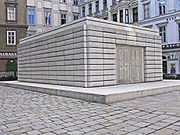
Modernism
Modernism, in its broadest definition, is modern thought, character, or practice. More specifically, the term describes the modernist movement, its set of cultural tendencies and array of associated cultural movements, originally arising from wide-scale and far-reaching changes to Western society...
or other recent styles. Public monuments to the dead continue to be erected, especially war memorials. Some are fairly traditional, while those reflecting more contemporary styles include the Vietnam Veterans Memorial
Vietnam Veterans Memorial
The Vietnam Veterans Memorial is a national memorial in Washington, D.C. It honors U.S. service members of the U.S. armed forces who fought in the Vietnam War, service members who died in service in Vietnam/South East Asia, and those service members who were unaccounted for during the War.Its...
, and several Holocaust memorials
Holocaust memorials
A number of organizations, museums and monuments are intended to serve as memorials to the Holocaust and its millions of victims. They include:-Argentina:* Museo del Holocausto de Buenos Aires -Australia:...
, such as Yad Vashem
Yad Vashem
Yad Vashem is Israel's official memorial to the Jewish victims of the Holocaust, established in 1953 through the Yad Vashem Law passed by the Knesset, Israel's parliament....
in Jerusalem, the Vel d'Hiv Memorial in Paris (1994), the Memorial to the Murdered Jews of Europe
Memorial to the Murdered Jews of Europe
The Memorial to the Murdered Jews of Europe , also known as the Holocaust Memorial , is a memorial in Berlin to the Jewish victims of the Holocaust, designed by architect Peter Eisenman and engineer Buro Happold. It consists of a site covered with 2,711 concrete slabs or "stelae", arranged in a...
in Berlin (2004), and the Judenplatz Holocaust Memorial
Judenplatz Holocaust Memorial
The Judenplatz Holocaust Memorial also known as the Nameless Library stands in Judenplatz in the first district of Vienna. It is the central memorial for the Austrian victims of the Holocaust and was designed by the British artist Rachel Whiteread....
in Vienna (2000). These are in notable contrast to the style of most war memorials to the military of World War II; earlier modernist memorials to the dead of World War I were sometimes removed after a time as inappropriate. Some war memorials, especially in countries like Germany, have had a turbulent political history, for example the much-rededicated Neue Wache
Neue Wache
The Neue Wache is a building in central Berlin, the capital of Germany. It is located on the north side of the Unter den Linden, a major east-west thoroughfare in the centre of the city. Dating from 1816, the Neue Wache was designed by the architect Karl Friedrich Schinkel and is a leading example...
in Berlin. Several critics detect a crisis in public memorial style from 1945, when the traditional figurative symbolic language, and evocation of nationalist values, came to seem inadequate, especially in relation to genocide
Genocide
Genocide is defined as "the deliberate and systematic destruction, in whole or in part, of an ethnic, racial, religious, or national group", though what constitutes enough of a "part" to qualify as genocide has been subject to much debate by legal scholars...
, at least on the Western side of the Iron Curtain
Iron Curtain
The concept of the Iron Curtain symbolized the ideological fighting and physical boundary dividing Europe into two separate areas from the end of World War II in 1945 until the end of the Cold War in 1989...
. In the Communist East
Eastern bloc
The term Eastern Bloc or Communist Bloc refers to the former communist states of Eastern and Central Europe, generally the Soviet Union and the countries of the Warsaw Pact...
the established style of Socialist Realism
Socialist realism
Socialist realism is a style of realistic art which was developed in the Soviet Union and became a dominant style in other communist countries. Socialist realism is a teleologically-oriented style having its purpose the furtherance of the goals of socialism and communism...
was still considered appropriate, at least by the authorities. The generation of abstracted and conceptual
Conceptual art
Conceptual art is art in which the concept or idea involved in the work take precedence over traditional aesthetic and material concerns. Many of the works, sometimes called installations, of the artist Sol LeWitt may be constructed by anyone simply by following a set of written instructions...
war and Holocaust memorials erected in the West from the 1990s onwards seems finally to have found a resolution for these issues.
Many large mausoleums have been constructed for political leaders, including Lenin's Mausoleum
Lenin's Mausoleum
Lenin's Mausoleum also known as Lenin's Tomb, situated in Red Square in the center of Moscow, is the mausoleum that serves as the current resting place of Vladimir Lenin. His embalmed body has been on public display there since shortly after his death in 1924...
and those for Atatürk
Anitkabir
Anıtkabir is the mausoleum of Mustafa Kemal Atatürk, the leader of the Turkish War of Independence and the founder and first president of the Republic of Turkey...
, Jinnah
Mazar-e-Quaid
Mazar-e-Quaid or the National Mausoleum refers to the tomb of the founder of Pakistan, Muhammad Ali Jinnah. It is an iconic symbol of Karachi throughout the world. The mausoleum , completed in the 1960s, is situated at the heart of the city. it is white in colour.- External links :* * * *...
, Kim Il-Sung
Kumsusan Memorial Palace
The Kumsusan Memorial Palace, sometimes referred to as the Kim Il-sung Mausoleum, is a building located northeast of downtown Pyongyang, the capital city of the Democratic People's Republic of Korea . The palace is the former official residence and office of North Korea's president and founder,...
, Che Guevara
Mausoleo Che Guevara
The Che Guevara Mausoleum is a memorial in Santa Clara, Cuba. It houses the remains of executed Marxist revolutionary Ernesto "Che" Guevara and twenty-nine of his fellow combatants killed in 1967 during Guevara's attempt to spur an armed uprising in Bolivia...
and several Presidential memorials in the United States. The Mausoleum of Khomeini is a grand mosque complex, as large as any medieval example, not least because it includes a 20,000 place parking lot.
Further reading
- Curl, James Stevens, A celebration of death: an introduction to some of the buildings, monuments, and settings of funerary architecture in the Western European tradition, B.T. Batsford, 1993, ISBN 0713473363, 9780713473360