
All Topics  
Al-Masjid al-Nabawi

 
Al Masjid Al Nabawi

   Email Print
   Bookmark   Link


Al-Masjid al-Nabawi


The Mosque of the Prophet (or Prophet's Mosque) ( Arabic: ) [IPA /mæs?id æn?æbæwi?], in Medina
Medina

Medina is a city in the Hejaz region of western Saudi Arabia, and serves as the capital of the Al Madinah Province. It is the second holiest city in Islam, and the burial place of the Prophet Muhammad....
, is the second holiest mosque
Mosque

A mosque is a place of worship for followers of Islam. Muslims often refer to the mosque by its Arabic name, masjid, ? . The word "mosque" in English refers to all types of buildings dedicated for Islamic worship, although there is a distinction in Arabic between the smaller, privately owned mosque and the larger, "collective" mosque ,...
 in Islam
Islam

Islam is a Monotheism, Abrahamic religion originating with the teachings of the Prophets of Islam Muhammad, a 7th century Arab religious and political figure....
. It is the final resting place of Muhammad
Muhammad

Muhammad Patronymic#Arabic Abd Allah ibn Abd al Muttalib , is the founder of the Major religious groups of Islam and is regarded by Muslims as a Rasul and prophet of , the last and the greatest law-bearer in a series of prophets....
. Masjid al-Haram
Masjid al-Haram

Al-Masjid al-Ḥaram , is the largest mosque in the world. Located in the city of Mecca, it surrounds the Kaaba, the place which Muslims turn towards while offering daily Salats and is considered the holiest place on Earth by Muslims....
 in Mecca
Mecca

Mecca , also spelled Makkah , Makka is a city in Saudi Arabia. Home to the Masjid al-Haram, it is the holy city in Islam and plays an important role in the faith....
 is the holiest mosque; the Al-Aqsa Mosque
Al-Aqsa Mosque

Al-Aqsa Mosque , also known as al-Aqsa, is an Holiest sites in Islam in the Old City of Jerusalem. The mosque itself forms part of the al-Haram ash-Sharif or "Sacred Noble Sanctuary" , a site also known as the Temple Mount and considered the holiest site in Judaism, since it is believed to be where the Temple in Jerusalem once stoo...
 in Jerusalem
Jerusalem

Jerusalem is the capital of Israel and its List of Israeli cities in both population and area, with a population of 747,600 residents over an area of if Positions on Jerusalem East Jerusalem is included....
 is the third holiest in Islam.

The original mosque was built by Muhammad. Subsequent Islamic rulers greatly expanded and decorated it. The most important feature of the site is the green dome
Green Dome

The Green Dome refers to the green coloured dome built above the tomb of the Islamic Prophet Muhammad in the Prophet's Mosque in Medina, Saudi Arabia. It features prominently in Islamic literature and poetry....
 over the center of the mosque, where the tomb of Muhammad is located.


Discussion
Ask a question about 'Al-Masjid al-Nabawi'
Start a new discussion about 'Al-Masjid al-Nabawi'
Answer questions from other users
Full Discussion Forum


Encyclopedia


The Mosque of the Prophet (or Prophet's Mosque) ( Arabic: ) [IPA /mæs?id æn?æbæwi?], in Medina
Medina

Medina is a city in the Hejaz region of western Saudi Arabia, and serves as the capital of the Al Madinah Province. It is the second holiest city in Islam, and the burial place of the Prophet Muhammad....
, is the second holiest mosque
Mosque

A mosque is a place of worship for followers of Islam. Muslims often refer to the mosque by its Arabic name, masjid, ? . The word "mosque" in English refers to all types of buildings dedicated for Islamic worship, although there is a distinction in Arabic between the smaller, privately owned mosque and the larger, "collective" mosque ,...
 in Islam
Islam

Islam is a Monotheism, Abrahamic religion originating with the teachings of the Prophets of Islam Muhammad, a 7th century Arab religious and political figure....
. It is the final resting place of Muhammad
Muhammad

Muhammad Patronymic#Arabic Abd Allah ibn Abd al Muttalib , is the founder of the Major religious groups of Islam and is regarded by Muslims as a Rasul and prophet of , the last and the greatest law-bearer in a series of prophets....
. Masjid al-Haram
Masjid al-Haram

Al-Masjid al-Ḥaram , is the largest mosque in the world. Located in the city of Mecca, it surrounds the Kaaba, the place which Muslims turn towards while offering daily Salats and is considered the holiest place on Earth by Muslims....
 in Mecca
Mecca

Mecca , also spelled Makkah , Makka is a city in Saudi Arabia. Home to the Masjid al-Haram, it is the holy city in Islam and plays an important role in the faith....
 is the holiest mosque; the Al-Aqsa Mosque
Al-Aqsa Mosque

Al-Aqsa Mosque , also known as al-Aqsa, is an Holiest sites in Islam in the Old City of Jerusalem. The mosque itself forms part of the al-Haram ash-Sharif or "Sacred Noble Sanctuary" , a site also known as the Temple Mount and considered the holiest site in Judaism, since it is believed to be where the Temple in Jerusalem once stoo...
 in Jerusalem
Jerusalem

Jerusalem is the capital of Israel and its List of Israeli cities in both population and area, with a population of 747,600 residents over an area of if Positions on Jerusalem East Jerusalem is included....
 is the third holiest in Islam.

The original mosque was built by Muhammad. Subsequent Islamic rulers greatly expanded and decorated it. The most important feature of the site is the green dome
Green Dome

The Green Dome refers to the green coloured dome built above the tomb of the Islamic Prophet Muhammad in the Prophet's Mosque in Medina, Saudi Arabia. It features prominently in Islamic literature and poetry....
 over the center of the mosque, where the tomb of Muhammad is located. It is not exactly known when the green dome was constructed but manuscripsts dating to the early 12th century describe the dome.It is known as the Dome of the Prophet or the Green Dome
Green Dome

The Green Dome refers to the green coloured dome built above the tomb of the Islamic Prophet Muhammad in the Prophet's Mosque in Medina, Saudi Arabia. It features prominently in Islamic literature and poetry....
. Early Muslim leaders
Islamic religious leaders

CaliphCaliph is the term or title for the Islamic leader of the Ummah, or community of Islam. It is an Anglicized/Latinized version of the Arabic word ????? or Khalifah, which means "successor", that is, successor to the Muhammad....
 Abu Bakr
Abu Bakr

Abu Bakr Abdallah ibn Abi Quhafa As-Siddiq was an early convert to Islam and a senior companion of the Prophets of Islam Muhammad. Throughout his life, Abu Bakr remained a friend and confidante of Muhammad....
 and Umar
Umar

Umar , also known as Umar the Great or Omar the Great was a Muslim from the Banu Adi clan of the Quraysh Tribes of Arabia, and a sahaba of Muhammad....
 are buried in an adjacent area in the mosque.

The edifice was originally Muhammad's house; he settled there after his Hijra
Hijra (Islam)

The Hijra is the migration of the Islamic prophet Muhammad and his followers to the city of Medina in 622 . Alternate spellings of this Arabic language word in the Latin alphabet are Hijrah, or Hegira in Latin....
 (emigration) to Medina, later building a mosque on the grounds. He himself shared in the heavy work of construction. The original mosque was an open-air building. The basic plan of the building has been adopted in the building of other mosques throughout the world.

The mosque also served as a community center, a court, and a religious school. There was a raised platform for the people who taught the Qur'an
Qur'an

The Qur?an is the central religious text of Islam. Muslims believe the Qur?an to be the book of divine guidance and direction for mankind, and consider the original Arabic text to be the final revelation of God....
.

History

The original Mosque was built by Muhammad, next to the house where he settled after his journey to Medina in 622 AD. The original mosque was an open-air building with a raised platform for the reading of the Qur'an. It was a rectangular enclosure of 30x35 meters, built with palm trunks and mud walls, and accessed through three doors: Bab Rahmah to the south, Bab Jibril to the west and Bab al-Nisa' to the east. The basic plan of the building has since been adopted in the building of other mosques throughout the world.

Inside, Muhammad created a shaded area to the south called the suffrah and aligned the prayer space facing north towards Jerusalem. When the qibla
Qibla

Qiblah is an Arabic language word for the direction that should be faced when a Muslim prayer during Salah. Most mosques contain a mihrab in a wall that indicates the qiblah....
 (prayer direction) was changed to Mecca, the mosque was re-oriented to the south. The mosque also served as a community center, a court, and a religious school. Seven years later (629 AD/7 AH), the mosque was doubled in size to accommodate the increasing number of Muslim
Muslim

:A Muslim , , is an adherent of the religion of Islam. The feminine form is Muslimah . Literally, the word means "one who submits "....
s.

Subsequent Islamic rulers continued to enlarge and embellish the Prophet's Mosque over the centuries. In 707, Umayyad Caliph
Caliph

The Caliph is the head of state in a Caliphate, and the title for the leader of the Islamic Ummah, an Islamic community ruled by the Shari'ah....
 Al-Walid ibn Abd al-Malik
Al-Walid I

Al-Walid ibn Abd al-Malik or Al-Walid I was an Umayyad caliph who ruled from 705 - 715. He continued the expansion of the Islamic empire that was sparked by his father, and was an effective ruler....
 (705-715) replaced the old structure and built a larger one in its place, incorporating the tomb of Muhammad. This mosque was 84 by 100 meters in size, with stone foundations and a teak roof supported on stone columns. The mosque walls were decorated with mosaics by Coptic and Greek
Greeks

The Greeks , also known as Hellenes, are a nation and ethnic group native to Greece, Cyprus and neighbouring regions, who can also be found in Greek diaspora communities around the world....
 craftsmen, similar to those seen in the Umayyad Mosque in Damascus
Damascus

Damascus is the capital and largest city of Syria. It is List of oldest continuously inhabited cities and its current population is estimated at about 4,000,000....
 and the Dome of the Rock in Jerusalem (built by the same caliph). The courtyard was surrounded by a gallery on four sides, with four minaret
Minaret

Minarets are distinctive architectural features of Islamic mosques. Minarets are generally tall spires with onion dome, usually either free standing or much taller than any surrounding support structure....
s on its corners. A mihrab
Mihrab

A mihrab is a niche in the wall of a mosque that indicates the qibla, that is, the direction of the Kaaba in Mecca and hence the direction that Muslims should face when praying....
 topped by a small dome was built on the qibla wall.

Abbasid
Abbasid

The Abbasid Caliphate was the third of the Islamic Caliphates of the Islamic Empire. The Caliphate is one of the high points of Islam, and at the time Muslim civilization, together with that of Byzantium, China and India, was the most developed part of the world....
 Caliph al-Mahdi
Al-Mahdi

Muhammad ibn Mansur al-Mahdi , was the third Abbasid Caliph. He succeeded his father, al-Mansur.Al-Mahdi, whose name means "Rightly-guided" or "Redeemer", was proclaimed caliph when his father was on his deathbed....
 (775-785) replaced the northern section of Al-Walid's mosque between 778 and 781 to enlarge it further. He also added 20 doors to the mosque: eight on each of the east and west walls, and four on the north wall.

During the reign of the Mamluk
Mamluk

A mamluk was a slavery soldier who converted to Islam and served the Muslim caliphs and the Ayyubid sultans from the 9th to the 13th centuries....
 Sultan
Sultan

Sultan is an Islamic honorifics, with several historical meanings. Originally it was an Arabic language abstract noun meaning "strength", "authority", or "rulership", derived from the verbal noun ???? sulah, meaning "authority" or "power"....
 Qalawun
Qalawun

Saif al-Din Qalawun Al-Salihi was the seventh Mamluk sultan of Egypt. He was in the Bahri dynasty line and ruled Egypt from 1279 to 1290....
, a dome was erected above tomb of the Prophet and an ablution fountain was built outside of Bab al-Salam. Sultan Al-Nasir Muhammad
Al-Nasir Muhammad

Al-Nasir Muhammad b. Cairo 1285, d. Cairo 1340) Was the ninth Mamluk sultan of Egypt who was inaugurated three times, from December 1293 to December 1294 , from 1299 to 1309 and from 1309 till his death in 1341 ....
 rebuilt the fourth minaret that had been destroyed earlier. After a lightning strike destroyed much of the mosque in 1481, Sultan Qaitbay
Qaitbay

Al-Ashraf Sayf al-Din Qa'it Bay was the eighteenth Burji dynasty Mamluk Sultan of Egypt from 872-901 Islamic calendar . He was Circassian by birth, and was purchased by the ninth sultan Barsbay before being freed by the eleventh sultan az-Zahir Sayf-ad-Din Jaqmaq ....
 rebuilt the east, west and qibla walls.

The Ottoman
Ottoman Empire

The Ottoman Empire , also known by its contemporaries as the Turkish Empire or Turkey , was an empire that lasted from 1299?1923. It was Treaty of Lausanne by the Republic of Turkey, which was officially proclaimed on October 29, 1923....
 sultans who controlled Medina from 1517 until World War I
World War I

World War I, or the First World War , was a global military conflict which involved the Great powers, organized into two opposing military alliances: the Allies of World War I and the Central Powers....
 also made their mark. Sultan Suleiman the Magnificent
Suleiman the Magnificent

Suleiman I, His Imperial Majesty , was the tenth and longest-reigning Sultan of the Ottoman Empire, from 1520 to his death in 1566. He is known in Western world as Suleiman the Magnificent and in Eastern world, as the Lawgiver , for his complete reconstruction of the Ottoman legal system....
 (1520-1566) rebuilt the western and eastern walls of the mosque and built the northeastern minaret known as al-Suleymaniyya. He added a new mihrab (al-Ahnaf) next to prophet Muhammad's mihrab (al-Shafi'iyyah) and placed a new dome covered in lead sheets and painted green above the Prophet's house and tomb.

During the reign of Ottoman Sultan Abdülmecid
Abdülmecid

Abd?lmecid is a name. Variants include Abd?lmecit, Abd?l Mecid, Abulmecid, Abdul Mecid, Abdul Mejid, Abd-ul-Mejid, Abdul Medjit etc....
 (1839-1861), the mosque was entirely remodeled with the exception of Muhammad's Tomb, the three mihrabs, the minbar
Minbar

A minbar is a pulpit in the mosque where the Imam stands to deliver sermons or in the Hussainia where the speaker sits and lectures the congregation....
 and the Suleymaniyya minaret. The precinct was enlarged to include an ablution area to the north. The prayer hall to the south was doubled in width and covered with small domes equal in size except for domes covering the mihrab area, Bab al-Salam and Muhammad's Tomb. The domes were decorated with Qur'anic verses and lines from Qa?ida al-Burda (Poem of the Mantle), the famous poem by 13th century Arabic poet Busiri
Busiri

Busiri was an Egyptians poet who lived in Egypt, where he wrote under the patronage of Ibn Hinna, the vizier. His poems seem to have been wholly on religious subjects....
. The qibla wall was covered with glazed tile
Glazed tile

Glazed tiles were used in China since the Zhou dynasty as building material for roof top. During the Song dynasty, the manufacture of glazed tiles was standardized in Li Jie's Yingzao Fashi....
s featuring Qur'anic calligraphy
Islamic calligraphy

File:Mirror writing2.jpgIslamic calligraphy, equally known as Arabic calligraphy, is the art of artistic handwriting, and by extension, of bookmaking....
. The floors of the prayer hall and the courtyard were paved with marble and red stones and a fifth minaret (al-Majidiyya), was built to the west of the enclosure.

After the foundation of the Kingdom of Saudi Arabia
Saudi Arabia

The Kingdom of Saudi Arabia, KSA , is an Arab country and the largest country of the Arabian Peninsula. It is bordered by Jordan on the northwest, Iraq on the north and northeast, Kuwait, Qatar, Bahrain, and the United Arab Emirates on the east, Oman on the southeast, and Yemen on the south....
 in 1932, the Mosque of prophet Muhammad underwent several major modifications. In 1951 King Ibn Saud
Ibn Saud of Saudi Arabia

*Saud of Saudi Arabia*Faisal of Saudi Arabia*Muhammad bin Abdul Aziz Al Saud*Khalid of Saudi Arabia*Nasr*Saad*Fahd of Saudi Arabia*Mansur*Abdullah of Saudi Arabia...
 (1932-1953) ordered demolitions around the mosque to make way for new wings to the east and west of the prayer hall, which consisted of concrete
Concrete

Concrete is a construction material composed of cement as well as other cementitious materials such as fly ash and slag cement, construction aggregate , water , and Chemistry admixtures....
 columns with pointed arches. Older columns were reinforced with concrete and braced with copper
Copper

Copper is a chemical element with the symbol Cu and atomic number 29.It is a ductile metal with very high thermal and electrical conductivity....
 rings at the top. The Suleymaniyya and Majidiyya minarets were replaced by two minarets in Mamluk revival style. Two additional minarets were erected to the northeast and northwest of the mosque. A library was built along the western wall to house historic Qur'ans and other religious texts.

In 1973 Saudi King Faisal bin Abdul Aziz
Faisal of Saudi Arabia

*Abdullah al Faisal*Muhammad bin Faisal al Saud*Sara al Faisal*Luluwa al Faisal*Khalid al Faisal*Saud bin Faisal bin Abdul Aziz*Sa'd bin Faisal...
 ordered the construction of temporary shelters to the west of the mosque to accommodate the growing number of worshippers in 1981, the old mosque was surrounded by new prayer areas on these sides, enlarging five times its size.

The latest renovations took place under King Fahd
Fahd of Saudi Arabia

King Fahd bin Abdul Aziz Al Saud, Custodian of the Two Holy Mosques, was the King of Saudi Arabia of the Kingdom of Saudi Arabia, Head of the House of Saud as well as Prime Minister....
 and have greatly increased the size of the mosque, allowing it to hold a large number of worshippers and pilgrims and adding modern comforts like air conditioning
Air conditioning

An air conditioner is an appliance, system, or Mechanism designed to extract heat from an area via a refrigeration cycle. In construction, a complete system of heating, Ventilation , and air conditioning is referred to as "HVAC." Its purpose, in a building or an automobile, is to provide comfort during either hot or cold...
. He also installed twenty seven moving domes at the roof of Masjid Nabawi.

Description

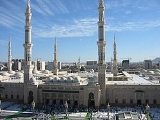
As it stands today, the Prophet's Mosque has a rectangular plan on two floors
Storey

A storey , floor, deck or level is the level of a building above the ground.Buildings are often classified by how many levels they have....
 with the Ottoman prayer hall projecting to the south. The main prayer hall occupies the entire first floor. The mosque enclosure is 100 times bigger than the first mosque built by the Prophet and can accommodate more than half a million worshippers.

The Prophet's Mosque has a flat paved roof
Flat roof

A flat roof is a type of covering of a building. In contrast to the sloped form of a roof, a flat roof is horizontal or nearly horizontal. Materials that cover flat roofs should allow the water to run off freely from a very slight inclination....
 topped with 24 dome
Dome

A dome is a structural element of architecture that resembles the hollow upper half of a sphere. Dome structures made of various materials have a long architectural lineage extending into prehistory....
s on square bases. Holes pierced into the base of each dome illuminate the interior. The roof is also used for prayer during peak times, when the 24 domes slide out on metal tracks to shade areas of the roof, creating light wells for the prayer hall. At these times, the courtyard of the Ottoman mosque is also shaded with umbrellas affixed to freestanding column
Column

File:National Capitol Columns - Washington, D.C..jpgA column in structural engineering is a vertical structural element that transmits, through physical compression, the weight of the structure above to other structural elements below....
s. The roof is accessed by stairs and escalator
Escalator

An escalator is a conveyor transport device for transport people, consisting of individual, linked steps that move up or down on tracks, which keep the treads horizontal....
s. The paved area around the mosque is also used for prayer, equipped with umbrella tents.

The north facade
Facade

A facade or fa?ade is generally one side of the exterior of a building, especially the front, but also sometimes the sides and rear. The Word comes from the French language, literally meaning "frontage" or "face"....
 has three evenly spaced portico
Portico

A portico is a porch that is leading to the entrance of a building, or extended as a colonnade, with a roof structure over a walkway, supported by columns or enclosed by walls....
s, while the east, west and south facades have two. The walls are composed of a series of windows topped by pointed arch
Arch

An arch is a structure that Span a space while supporting weight . Arches appeared as early as the 2nd millennium BC in Mesopotamian brick architecture, but their systematic use started with the Ancient Rome who were the first to apply the technique to a wide range of structures....
es with black and white voussoir
Voussoir

A voussoir is a wedge-shaped element, typically a stone, used in building an arch.Although each unit of stone in an arch or vault is known as a voussoir, there are two specified voussoir components of an arch: the Keystone and the Springer ....
s. There are six peripheral minarets attached to the new extension, and four others frame the Ottoman structure. The mosque is lavishly decorated with polychrome
Polychrome

Polychrome is one of the terms used to describe the use of multiple colors in one entity. Most often, the term is used in conjunction with certain styles of architecture, pottery or sculpture in multiple colours....
 marble
Marble

Marble is a nonfoliated metamorphic rock resulting from the metamorphism of limestone, composed mostly of calcite . It is extensively used for Marble sculpture, as a architecture material, and in many other applications....
 and stones. The columns are of white marble with brass
Brass

Brass is any alloy of copper and zinc; the proportions of zinc and copper can be varied to create a range of brasses with varying properties. In comparison, bronze is principally an alloy of copper and tin....
 capitals
Capital (architecture)

In several traditions of architecture including Classical architecture, the capital forms the crowning member of a column or a pilaster. The capital projects on each side as it rises, in order to support the abacus and unite the form of the latter with the circular shaft of the column....
 supporting slightly pointed arches, built of black and white stones. The column pedestal
Pedestal

Pedestal is a term generally applied to the support of a statue or a vase.Although in Syria, Asia Minor and Tunisia the Romans occasionally raised the columns of their temples or propylaea on square pedestals, in Rome itself they were employed only to give greater importance to isolated columns, such as those of Trajan's Column and Anton...
s have ventilation grills that regulate the temperature inside the prayer hall.

This shiny new Prophet's Mosque contains the older mosque within it. The two sections can be easily distinguished: the older section has many colorful decorations and numerous small pillars; the new section is in gleaming white marble and is completely air-conditioned.

The open courtyard of the mosque can be shaded by folded, umbrella-like canopies, designed by Bodo Rash and Buro Happold
Buro Happold

Buro Happold is a professional services firm providing engineering consultancy, design, planning, project management and consulting services for all aspects of buildings, infrastructure and the environment....


The most notable feature of the Prophet's Mosque is the green "Dome of the Prophet", which rises higher amongst the sea of white domes. This is where the tomb of Muhammad is located; early Muslim leaders Abu Bakr and Umar ibn al-Khattab are buried in an adjacent area as well.

Ar-Rawdah an-Nabawiyah

The heart of the mosque houses a very special but small area named ar-Rawdah an-Nabawiyah, which extends from Muhammad
Muhammad

Muhammad Patronymic#Arabic Abd Allah ibn Abd al Muttalib , is the founder of the Major religious groups of Islam and is regarded by Muslims as a Rasul and prophet of , the last and the greatest law-bearer in a series of prophets....
's tomb to his pulpit. Pilgrim
Pilgrim

A pilgrim is one who undertakes a pilgrimage, literally 'far afield'. This is traditionally a visit to a place of some religious or historic significance; often a considerable distance is traveled....
s attempt to visit and pray in ar-Rawdah, for there is a tradition that supplications and prayers uttered here are never rejected. Entrance into ar-Rawdah is not always possible (especially during the Hajj
Hajj

The Hajj is a pilgrimage to Mecca . It is the largest annual pilgrimage in the world, and is the fifth pillar of Islam, an obligation that must be carried out at least once in their lifetime by every able-bodied Muslim who can afford to do so....
 season), as the tiny area can accommodate only a few hundred people. Ar-Rawdah has two small gateways manned by Saudi police officers. The current marble pulpit was constructed by the Ottomans. The original pulpit was much smaller than the current one, and constructed of palm tree
Arecaceae

Palm or Palmae or Panamea , the palm family, is a family of flowering plants belonging to the Monocotyledon order, Arecales. There are roughly 202 currently known Genus with around 2600 species, most of which are restricted to tropics, subtropics, and warm temperate climates....
 wood, not marble. Ar-Rawdah an-Nabawiyah is considered part of Jannah
Jannah

Jannah is the Islamic conception of paradise. The Arabic form Jannah is a shortened version meaning simply "Garden". According to Islamic eschatology, after death, one will reside in the grave until the appointed resurrection on Islamic view of the Last Judgment....
 (Heaven
Heaven

Heaven may refer to the physical heavens, the atmosphere or the seemingly endless expanse of the universe beyond. This is the traditional literal meaning of the term in English, however since at least AD 1000, it is typically also used to refer to an afterlife plane of existence in various religions and spirituality philosophy, often descri...
 or Paradise
Paradise

Paradise is an idealized place in which existence is positive, harmonious and timeless. It is conceptually a counter-image of the miseries of human civilization, and in paradise there is only peace, prosperity, and happiness....
).

Saudi expansion of the Mosque

The original mosque was not very large, and today the original exists only as a small portion of the larger mosque. From 1925, after Medina surrendered to Ibn Sa'ud, the mosque was gradually expanded until 1955 when extensive renovations were carried out. The latest renovations took place under King Fahd and have greatly increased the size of the mosque, allowing it to hold a large number of worshippers and pilgrims. It is also completely air conditioned and decorated with marble.

The newer and older sections of the mosque are quite distinct. The older section has many colorful decorations and numerous small pillars.

The mosque is located in what was traditionally the center of Medina, with many hotels and old markets nearby. It is a major pilgrimage site and many people who perform the Hajj go on to Medina before or after Hajj to visit the mosque.

Imams

Current Imam
Imam

File:Medaillon chiite.jpgAn imam is an Islamic leadership position. Often the leader of a mosque and the community. Similar to spiritual leaders, the imam is the one who leads the prayer during Islamic gatherings....
s at the Al-Masjid al-Nabawi include:
  • Sheikh
    Sheikh

    Sheikh, also rendered as Sheik, Shaykh, Shaikh, Cheikh, and other variants , is a word or honorific term in the Arabic language that literally means "Elder "....
     Dr. Ali bin Abdur-Rahmaan Al Hudhaifi - President Saudi Hilal Committee (Chief of Imams)
  • Sheikh Abdul Bari Al-Thubaiti
  • Sheikh Husayn al Shaykh
  • Shaikh Dr. Salah Al Budair (has led tarawih
    Tarawih

    Tarawih is an Arabic language phrase referring to extra prayers given by Sunni Muslims at night in the Islam month of Ramadan ....
     prayers at Masjid al-Haram
    Masjid al-Haram

    Al-Masjid al-Ḥaram , is the largest mosque in the world. Located in the city of Mecca, it surrounds the Kaaba, the place which Muslims turn towards while offering daily Salats and is considered the holiest place on Earth by Muslims....
     in 2005 and 2006)
  • Sheikh Abdul Muhsin al Qasim


Former Imams:
  • Sheikh Muhammad Ayub
  • Sheikh Abdullah `Awwaad Al-Juhany(now Masjid al-Haram
    Masjid al-Haram

    Al-Masjid al-Ḥaram , is the largest mosque in the world. Located in the city of Mecca, it surrounds the Kaaba, the place which Muslims turn towards while offering daily Salats and is considered the holiest place on Earth by Muslims....
    , Makkah)
  • Sheikh Maahir Hamad Al-Mu'ayqili (now Masjid al-Haram
    Masjid al-Haram

    Al-Masjid al-Ḥaram , is the largest mosque in the world. Located in the city of Mecca, it surrounds the Kaaba, the place which Muslims turn towards while offering daily Salats and is considered the holiest place on Earth by Muslims....
    , Makkah)


Muezzins

Muezzin
Muezzin

File:Jean-L?on G?r?me 010.jpgThe muezzin is a chosen person at the mosque who leads the call to Friday service and the five daily prayers from one of the mosque's minarets ....
s at the Haram Sharif include:
  • Sheikh Abdul Rehman Kashikjee (Chief of muezzins)
  • Sheikh Abdullah Basnawi
  • Sheikh Abdul Rehman Bassamji
  • Sheikh Mohammed Majid Hakeem
  • Sheikh Esam Bukhari
  • Sheikh Houssain Afifi
  • Sheikh Faisal Abdul Malik Noman


See also

  • Burial places of founders of world religions
    Burial places of founders of world religions

    This article lists the burial places of founders of world religions....
  • Muslim history
    Muslim history

    Muslim history began in Arabia with Muhammad's first recitations of the Qur'an in the 7th century. Islam's historical development has affected political, economic, and military trends both inside and outside the Islamic world....
  • Timeline of Muslim history
    Timeline of Muslim history

    There is much more to Muslim history than its military and political aspects; this particular chronology is almost entirely of military and political nature....
  • Islamic architecture
    Islamic architecture

    Islamic architecture encompasses a wide range of both secular and religious styles from the History of Islam to the present day, influencing the design and construction of buildings and structures in Islamic culture....
  • Islamic art
    Islamic art

    File:Caucasian panel.jpgIslamic art encompasses the arts produced from the 7th century onwards by people who lived within the territory that was inhabited by culturally Islamic populations....
  • List of mosques
    List of mosques

    A list of famous mosques around the world.Group...
  • Mecca
    Mecca

    Mecca , also spelled Makkah , Makka is a city in Saudi Arabia. Home to the Masjid al-Haram, it is the holy city in Islam and plays an important role in the faith....
  • Kaaba
    Kaaba

    The Kaaba "Cube" is a cuboidal building in Mecca, Saudi Arabia, and is the Most holy place#Islam in Islam. The building is more than two thousand years old, and according to Islamic tradition the first building at the site was built by Abraham ....


External links