


Archaic period in Greece

Encyclopedia
The Archaic period in Greece (800 BC – 480 BC
) was a period of ancient Greek
history that followed the Greek Dark Ages
. This period saw the rise of the polis
and the founding of colonies, as well as the first inklings of classical philosophy
, theatre in the form of tragedies performed during Dionysia
, and written poetry, which appeared with the reintroduction of the written language, lost during the Greek Dark Ages
. The term archaic covers these cultural aspects as well.
The termini of the Archaic period are defined as the "structural revolution", meaning a sudden upsurge of population and material goods that occurred c. 750 BC, and the "intellectual revolution" of classical Greece. The end of archaism is conventionally marked by Xerxes
' invasion of Greece in 480 BC.
The sharp rise in population at the start of the Archaic period brought with it the settlement of new towns and the expansion of the older population centres. The Archaic period is also characterized by the spread of colonization
along the Mediterranean and Black Sea coasts that began about 800 B.C. The reason for this phenomenon is described by Greek authors as stenochoria, or "the lack of land", but in practice it was caused by a great number of reasons, such as rivalry between political groups, a desire for adventure, expatriation, the search for trade opportunities, etc.
and sculpture, placing it chronologically between geometric and Classical Greek
art. These styles are considered archaic in the sense that they contain the seeds of Classical art. Modern historians think of the term archaic as a misnomer, as the archaic period is considered to be one of the most fruitful periods of Greek history.
of the Bronze Age had been divided into kingdoms, each containing a territory and a population distributed into both small towns and large estates owned by the nobility. Each kingdom was ruled by a king claiming authority under divine right by descent from a heroic ancestor who ruled from a palace situated within a citadel, or acropolis
. During the Greek Dark Ages
, the palaces, kings, and estates vanished, the population declined, towns were abandoned or became villages in ruins, and government devolved into authority being held by minor officials on a tribal structure.
By the middle of the 8th century the societal structure of Greece had come under immense pressure and the polis was at risk of collapse. Three distinct stressors developed for each stratum of archaic society. By 750 BC these stressors became impossible to reconcile due to an explosive growth of population of about 4% per year. These three factors were in many ways connected and tended to reinforce one another.
Greek farmers lived under a subsistence lifestyle and were frequently subject to crop failures. Hesiod wrote of many different circumstances that could befall an archaic Greek farmer, all of which would force him to borrow goods from his neighbours. Failure to pay back these goods could lead to loss of the farm, debt, or enslavement. Due to the sharp increase in population, arable farmland, which had always been scarce, became insufficient to support all the people in Greece. 750-600 BC in Greece was marked by widespread famines, and by 600 BC almost all of the farmers in Athens had been dispossessed of their property and worked as slaves on the same.
The aristoi, aristocratic families, were constantly competing against one another to gain territory, money, or status. The elegant clothes, jewellery, pottery, artworks etc. from the archaic period were by and large made to the tastes of this part of Greek society. Aristoi in the archaic period existed in a closed community of symposion, festivals, lavish meals, and athletic games that had nothing to do with the commoners or farmers of Greece. However an aristoi's status was predicated on his wealth - if he were to lose it, he would also lose his nobility. The advent of sea trade routes placed the aristoi at risk of losing everything through failed overseas investments.
The commoners the aristoi governed were repeatedly drawn in to the conflicts of the aristoi as soldiers, disrupting their lives with every new power struggle between nobles. They levied much criticism at the aristoi for neglecting the farmers and for living very extravagant lifestyles. As overseas trade became more common in Greece, some commoners found themselves very wealthy, and increasingly began to challenge the authority of the aristoi, posing a political threat to regional monarchies.
These colonies were widespread, and arose in places including southern Italy, Sicily, Sardinia, Corsica, the southern French coast, the eastern Spanish coast, the coast of the Black Sea, and Cyprus, among others. These colonies were not provinces of the poleis from which they came but independent cities entirely, who traced their heritage back to a mother polis within Greece proper. Relations between colonial Greeks and the indigenous populations of the countries they governed were mixed - some cultures met in harmony and others were conquered and enslaved by the Greeks. An important consequence of Greek colonization was the spread of Greek culture, religion, and design throughout the Mediterranean, including sites that would come to great importance later in history.
. Tyrants were never directly followed by pure democracies; however, their behaviour created the political will among the Greeks to develop a more efficient and fair system of governance.
Towards the end of the Archaic period, the power of the basileus
, or king, was reduced as aristocratic gatherings, such as the Council of Elders, increased in power. The sharing of power among powerful families occurred in many poleis, which saw oligarchies established. The Archaic Period was also marked by tyrant
s, or strong rulers who seized power from the aristocracy and ruled as central, dominating figures. A new form of government had evolved, the city-state
, which Hellenes termed the polis
. The kingdoms were not restored, even though in many cases offshoots of the royal families remained. Instead, each major population center became autonomous and was ruled by a republic
an form of government. The ancient Greek term is synoikismos, from which comes the term synoecism
"conurbation", meaning the absorption of villages and the incorporation of their tribes into the substructure of the polis. The akropoleis became the locations of public buildings, typically temples.
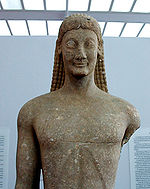
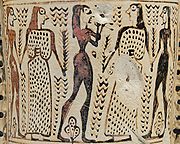
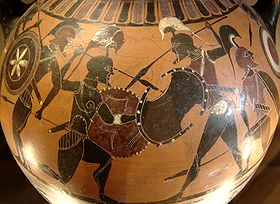
 The period takes its name from what, in art history
, was considered the archaic or old-fashioned style of sculpture and other forms of art and craft that were characteristic of that time, as opposed to the more natural look of work made in the following Classical period
(see Classical sculpture
).
s in limestone
and marble
, terra cotta
, bronze
, wood
, and rarer metals, both free-standing and in relief
, were used to adorn temples and funerary monuments. They mostly had mythical or daily life themes. The creation of life-sized statues began suddenly at about 650 BC. The following three periods have been identified:
, which signalled a shift away from the geometric style
of the later Dark Ages
and the accumulation of influences derived from Phoenicia
and Syria
.
Pottery styles associated with the later part of the Archaic age are black-figure pottery
, which originated in Corinth
during the 7th century BC
, and its successor, the red-figure style
, developed by the Andokides painter
in about 530 BC.
Some notable distinctions an observer can use to determine if a piece is from the archaic period are the Egyptian-like "left foot forward", the "archaic smile", and the very patterned and conventionalized hair, or "helmet hair".
Epic poets
Philosophers
Lyric poets
Logographers
Fabulists
Sculptors
Painters
Tragic poets
Comic poets
480 BC
Year 480 BC was a year of the pre-Julian Roman calendar. At the time, it was known as the Year of the Consulship of Vibulanus and Cincinnatus...
) was a period of ancient Greek
Ancient Greece
Ancient Greece is a civilization belonging to a period of Greek history that lasted from the Archaic period of the 8th to 6th centuries BC to the end of antiquity. Immediately following this period was the beginning of the Early Middle Ages and the Byzantine era. Included in Ancient Greece is the...
history that followed the Greek Dark Ages
Greek Dark Ages
The Greek Dark Age or Ages also known as Geometric or Homeric Age are terms which have regularly been used to refer to the period of Greek history from the presumed Dorian invasion and end of the Mycenaean Palatial civilization around 1200 BC, to the first signs of the Greek city-states in the 9th...
. This period saw the rise of the polis
Polis
Polis , plural poleis , literally means city in Greek. It could also mean citizenship and body of citizens. In modern historiography "polis" is normally used to indicate the ancient Greek city-states, like Classical Athens and its contemporaries, so polis is often translated as "city-state."The...
and the founding of colonies, as well as the first inklings of classical philosophy
Philosophy
Philosophy is the study of general and fundamental problems, such as those connected with existence, knowledge, values, reason, mind, and language. Philosophy is distinguished from other ways of addressing such problems by its critical, generally systematic approach and its reliance on rational...
, theatre in the form of tragedies performed during Dionysia
Dionysia
The Dionysia[p] was a large festival in ancient Athens in honor of the god Dionysus, the central events of which were the theatrical performances of dramatic tragedies and, from 487 BC, comedies. It was the second-most important festival after the Panathenaia...
, and written poetry, which appeared with the reintroduction of the written language, lost during the Greek Dark Ages
Greek Dark Ages
The Greek Dark Age or Ages also known as Geometric or Homeric Age are terms which have regularly been used to refer to the period of Greek history from the presumed Dorian invasion and end of the Mycenaean Palatial civilization around 1200 BC, to the first signs of the Greek city-states in the 9th...
. The term archaic covers these cultural aspects as well.
The termini of the Archaic period are defined as the "structural revolution", meaning a sudden upsurge of population and material goods that occurred c. 750 BC, and the "intellectual revolution" of classical Greece. The end of archaism is conventionally marked by Xerxes
Xerxes I of Persia
Xerxes I of Persia , Ḫšayāršā, ), also known as Xerxes the Great, was the fifth king of kings of the Achaemenid Empire.-Youth and rise to power:...
' invasion of Greece in 480 BC.
The sharp rise in population at the start of the Archaic period brought with it the settlement of new towns and the expansion of the older population centres. The Archaic period is also characterized by the spread of colonization
Colonies in antiquity
Colonies in antiquity were city-states founded from a mother-city—its "metropolis"—, not from a territory-at-large. Bonds between a colony and its metropolis remained often close, and took specific forms...
along the Mediterranean and Black Sea coasts that began about 800 B.C. The reason for this phenomenon is described by Greek authors as stenochoria, or "the lack of land", but in practice it was caused by a great number of reasons, such as rivalry between political groups, a desire for adventure, expatriation, the search for trade opportunities, etc.
Etymology
The term archaic describes things belonging to ancient times and is derived from the Greek word archaikos, which means primitive. This term arose from the study of Greek art, where it mainly refers to styles of surface decorationDecorative art
The decorative arts is traditionally a term for the design and manufacture of functional objects. It includes interior design, but not usually architecture. The decorative arts are often categorized in opposition to the "fine arts", namely, painting, drawing, photography, and large-scale...
and sculpture, placing it chronologically between geometric and Classical Greek
Classical Greece
Classical Greece was a 200 year period in Greek culture lasting from the 5th through 4th centuries BC. This classical period had a powerful influence on the Roman Empire and greatly influenced the foundation of Western civilizations. Much of modern Western politics, artistic thought, such as...
art. These styles are considered archaic in the sense that they contain the seeds of Classical art. Modern historians think of the term archaic as a misnomer, as the archaic period is considered to be one of the most fruitful periods of Greek history.
Crisis and consolidation of the polis
Mycenaean GreeceMycenaean Greece
Mycenaean Greece was a cultural period of Bronze Age Greece taking its name from the archaeological site of Mycenae in northeastern Argolis, in the Peloponnese of southern Greece. Athens, Pylos, Thebes, and Tiryns are also important Mycenaean sites...
of the Bronze Age had been divided into kingdoms, each containing a territory and a population distributed into both small towns and large estates owned by the nobility. Each kingdom was ruled by a king claiming authority under divine right by descent from a heroic ancestor who ruled from a palace situated within a citadel, or acropolis
Acropolis
Acropolis means "high city" in Greek, literally city on the extremity and is usually translated into English as Citadel . For purposes of defense, early people naturally chose elevated ground to build a new settlement, frequently a hill with precipitous sides...
. During the Greek Dark Ages
Greek Dark Ages
The Greek Dark Age or Ages also known as Geometric or Homeric Age are terms which have regularly been used to refer to the period of Greek history from the presumed Dorian invasion and end of the Mycenaean Palatial civilization around 1200 BC, to the first signs of the Greek city-states in the 9th...
, the palaces, kings, and estates vanished, the population declined, towns were abandoned or became villages in ruins, and government devolved into authority being held by minor officials on a tribal structure.
By the middle of the 8th century the societal structure of Greece had come under immense pressure and the polis was at risk of collapse. Three distinct stressors developed for each stratum of archaic society. By 750 BC these stressors became impossible to reconcile due to an explosive growth of population of about 4% per year. These three factors were in many ways connected and tended to reinforce one another.
Greek farmers lived under a subsistence lifestyle and were frequently subject to crop failures. Hesiod wrote of many different circumstances that could befall an archaic Greek farmer, all of which would force him to borrow goods from his neighbours. Failure to pay back these goods could lead to loss of the farm, debt, or enslavement. Due to the sharp increase in population, arable farmland, which had always been scarce, became insufficient to support all the people in Greece. 750-600 BC in Greece was marked by widespread famines, and by 600 BC almost all of the farmers in Athens had been dispossessed of their property and worked as slaves on the same.
The aristoi, aristocratic families, were constantly competing against one another to gain territory, money, or status. The elegant clothes, jewellery, pottery, artworks etc. from the archaic period were by and large made to the tastes of this part of Greek society. Aristoi in the archaic period existed in a closed community of symposion, festivals, lavish meals, and athletic games that had nothing to do with the commoners or farmers of Greece. However an aristoi's status was predicated on his wealth - if he were to lose it, he would also lose his nobility. The advent of sea trade routes placed the aristoi at risk of losing everything through failed overseas investments.
The commoners the aristoi governed were repeatedly drawn in to the conflicts of the aristoi as soldiers, disrupting their lives with every new power struggle between nobles. They levied much criticism at the aristoi for neglecting the farmers and for living very extravagant lifestyles. As overseas trade became more common in Greece, some commoners found themselves very wealthy, and increasingly began to challenge the authority of the aristoi, posing a political threat to regional monarchies.
Reaction 1: Colonization
As a reaction to the overpopulation, economic problems, and rising political tension within Greece between 750 and 600 BC, many Greeks left the mainland by ship to establish new colonies. Some went freely to escape tensions, while others were sent as exiles. Any given expedition consisted of about 100-200 people, mostly young men, and was led by a Greek noble, searching to gain more power and wealth outside of Greece. A citizen who left Greece to go to one of these colonies gave up his Greek citizenship in exchange for citizenship in the new colony.These colonies were widespread, and arose in places including southern Italy, Sicily, Sardinia, Corsica, the southern French coast, the eastern Spanish coast, the coast of the Black Sea, and Cyprus, among others. These colonies were not provinces of the poleis from which they came but independent cities entirely, who traced their heritage back to a mother polis within Greece proper. Relations between colonial Greeks and the indigenous populations of the countries they governed were mixed - some cultures met in harmony and others were conquered and enslaved by the Greeks. An important consequence of Greek colonization was the spread of Greek culture, religion, and design throughout the Mediterranean, including sites that would come to great importance later in history.
Reaction 2: Tyrants
The exceptional success of the move to colonize the rest of the Mediterranean happened in harmony with a consolidation of the Greek poleis into cohesive city-states with social and political order. This process was frequently interrupted between the 6th and 7th centuries BC by numerous aristocrats. These tyrants, a Greek word meaning "unrightful ruler", tended to set up dictatorships within the poleis, raise armies, and attack other poleis to expand their influence. Tyrants were not social reformers, but while ruling they were forced to make laws and arbitrate disputes. A rising Greek distaste for tyrants led to the creation of alternative systems of self government, which eventually led to the Athenian democracyAthenian democracy
Athenian democracy developed in the Greek city-state of Athens, comprising the central city-state of Athens and the surrounding territory of Attica, around 508 BC. Athens is one of the first known democracies. Other Greek cities set up democracies, and even though most followed an Athenian model,...
. Tyrants were never directly followed by pure democracies; however, their behaviour created the political will among the Greeks to develop a more efficient and fair system of governance.
Reaction 3: Reorganization and consolidation of Athens
From the beginning of the 6th century BC, many changes in the social structure and government of Greece were formalized in order to administer to the growing needs of the poleis. Among these changes was the formalization of certain aspects of the Athenian democracy, and as Athens consolidated itself into a formal city-state, political tensions grew within it.Towards the end of the Archaic period, the power of the basileus
Basileus
Basileus is a Greek term and title that has signified various types of monarchs in history. It is perhaps best known in English as a title used by the Byzantine Emperors, but also has a longer history of use for persons of authority and sovereigns in ancient Greece, as well as for the kings of...
, or king, was reduced as aristocratic gatherings, such as the Council of Elders, increased in power. The sharing of power among powerful families occurred in many poleis, which saw oligarchies established. The Archaic Period was also marked by tyrant
Tyrant
A tyrant was originally one who illegally seized and controlled a governmental power in a polis. Tyrants were a group of individuals who took over many Greek poleis during the uprising of the middle classes in the sixth and seventh centuries BC, ousting the aristocratic governments.Plato and...
s, or strong rulers who seized power from the aristocracy and ruled as central, dominating figures. A new form of government had evolved, the city-state
City-state
A city-state is an independent or autonomous entity whose territory consists of a city which is not administered as a part of another local government.-Historical city-states:...
, which Hellenes termed the polis
Polis
Polis , plural poleis , literally means city in Greek. It could also mean citizenship and body of citizens. In modern historiography "polis" is normally used to indicate the ancient Greek city-states, like Classical Athens and its contemporaries, so polis is often translated as "city-state."The...
. The kingdoms were not restored, even though in many cases offshoots of the royal families remained. Instead, each major population center became autonomous and was ruled by a republic
Republic
A republic is a form of government in which the people, or some significant portion of them, have supreme control over the government and where offices of state are elected or chosen by elected people. In modern times, a common simplified definition of a republic is a government where the head of...
an form of government. The ancient Greek term is synoikismos, from which comes the term synoecism
Synoecism
Synoecism or synecism , also spelled synoikism , was originally the amalgamation of villages in Ancient Hellas into poleis, or city-states. Etymologically the word means "dwelling together in the same house ." Subsequently any act of civic union between polities of any size was described by the...
"conurbation", meaning the absorption of villages and the incorporation of their tribes into the substructure of the polis. The akropoleis became the locations of public buildings, typically temples.
Art
History of art
The History of art refers to visual art which may be defined as any activity or product made by humans in a visual form for aesthetical or communicative purposes, expressing ideas, emotions or, in general, a worldview...
, was considered the archaic or old-fashioned style of sculpture and other forms of art and craft that were characteristic of that time, as opposed to the more natural look of work made in the following Classical period
Classical antiquity
Classical antiquity is a broad term for a long period of cultural history centered on the Mediterranean Sea, comprising the interlocking civilizations of ancient Greece and ancient Rome, collectively known as the Greco-Roman world...
(see Classical sculpture
Classical sculpture
Classical sculpture refers to the forms of sculpture from Ancient Greece and Ancient Rome, as well as the Hellenized and Romanized civilizations under their rule or influence from about 500 BC to fall of Rome in AD 476. It also refers stylistically to modern sculptures done in a classical style....
).
Sculpture
SculptureSculpture
Sculpture is three-dimensional artwork created by shaping or combining hard materials—typically stone such as marble—or metal, glass, or wood. Softer materials can also be used, such as clay, textiles, plastics, polymers and softer metals...
s in limestone
Limestone
Limestone is a sedimentary rock composed largely of the minerals calcite and aragonite, which are different crystal forms of calcium carbonate . Many limestones are composed from skeletal fragments of marine organisms such as coral or foraminifera....
and marble
Marble
Marble is a metamorphic rock composed of recrystallized carbonate minerals, most commonly calcite or dolomite.Geologists use the term "marble" to refer to metamorphosed limestone; however stonemasons use the term more broadly to encompass unmetamorphosed limestone.Marble is commonly used for...
, terra cotta
Terra cotta
Terracotta, Terra cotta or Terra-cotta is a clay-based unglazed ceramic, although the term can also be applied to glazed ceramics where the fired body is porous and red in color...
, bronze
Bronze
Bronze is a metal alloy consisting primarily of copper, usually with tin as the main additive. It is hard and brittle, and it was particularly significant in antiquity, so much so that the Bronze Age was named after the metal...
, wood
Wood
Wood is a hard, fibrous tissue found in many trees. It has been used for hundreds of thousands of years for both fuel and as a construction material. It is an organic material, a natural composite of cellulose fibers embedded in a matrix of lignin which resists compression...
, and rarer metals, both free-standing and in relief
Relief
Relief is a sculptural technique. The term relief is from the Latin verb levo, to raise. To create a sculpture in relief is thus to give the impression that the sculpted material has been raised above the background plane...
, were used to adorn temples and funerary monuments. They mostly had mythical or daily life themes. The creation of life-sized statues began suddenly at about 650 BC. The following three periods have been identified:
- Early Archaic, 660 BC - 580 BC
During the period, the major sculpturalSculptureSculpture is three-dimensional artwork created by shaping or combining hard materials—typically stone such as marble—or metal, glass, or wood. Softer materials can also be used, such as clay, textiles, plastics, polymers and softer metals...
forms were the kourosKourosA kouros is the modern term given to those representations of male youths which first appear in the Archaic period in Greece. The term kouros, meaning youth, was first proposed for what were previously thought to be depictions of Apollo by V. I...
and its female equivalent, the koreKore (sculpture)Kore is the name given to a type of ancient Greek sculpture of the Archaic period.There are multiple theories on who they represent, and as to whether they represent mortals or deities - one theory is that they represent Persephone the daughter in the triad of the Mother Goddess cults or votary...
. - Middle Archaic, 580 BC - 535 BC
- Late Archaic, 540 BC - 480 BC
Ceramics
In pottery, the Archaic period saw the development of the orientalizing styleOrientalizing Period
In the history of ancient Greece, the Orientalizing period is the cultural and art historical period informed by the art of Anatolia, Syria, Assyria, Phoenicia and Egypt, which started during the later part of the 7th century BCE. It encompasses a new, Orientalizing style, spurred by a period of...
, which signalled a shift away from the geometric style
Geometric Style
Geometric art is a phase of Greek art, characterised largely by geometric motifs in vase painting, that flourished towards the end of the Greek Dark Ages, circa 900 BCE to 700 BCE...
of the later Dark Ages
Greek Dark Ages
The Greek Dark Age or Ages also known as Geometric or Homeric Age are terms which have regularly been used to refer to the period of Greek history from the presumed Dorian invasion and end of the Mycenaean Palatial civilization around 1200 BC, to the first signs of the Greek city-states in the 9th...
and the accumulation of influences derived from Phoenicia
Phoenicia
Phoenicia , was an ancient civilization in Canaan which covered most of the western, coastal part of the Fertile Crescent. Several major Phoenician cities were built on the coastline of the Mediterranean. It was an enterprising maritime trading culture that spread across the Mediterranean from 1550...
and Syria
Syria
Syria , officially the Syrian Arab Republic , is a country in Western Asia, bordering Lebanon and the Mediterranean Sea to the West, Turkey to the north, Iraq to the east, Jordan to the south, and Israel to the southwest....
.
Pottery styles associated with the later part of the Archaic age are black-figure pottery
Black-figure pottery
Black-figure pottery painting, also known as the black-figure style or black-figure ceramic is one of the most modern styles for adorning antique Greek vases. It was especially common between the 7th and 5th centuries BC, although there are specimens dating as late as the 2nd century BC...
, which originated in Corinth
Corinth
Corinth is a city and former municipality in Corinthia, Peloponnese, Greece. Since the 2011 local government reform it is part of the municipality Corinth, of which it is the seat and a municipal unit...
during the 7th century BC
7th century BC
The 7th century BC started the first day of 700 BC and ended the last day of 601 BC.The Assyrian Empire continued to dominate the Near East during this century, exercising formidable power over neighbors like Babylon and Egypt. In the last two decades of the century, however, the empire began to...
, and its successor, the red-figure style
Red-figure pottery
Red-figure vase painting is one of the most important styles of figural Greek vase painting. It developed in Athens around 530 BC and remained in use until the late 3rd century BC. It replaced the previously dominant style of Black-figure vase painting within a few decades...
, developed by the Andokides painter
Andokides Painter
The Andokides painter was an ancient Athenian vase painter who was active from 530 to approximately 515 BCE. His work is unsigned; he is named after Andokides, the potter for whom he worked. He is believed to be the inventor of the red figure style of vase painting.-Beginnings of his art:The...
in about 530 BC.
Some notable distinctions an observer can use to determine if a piece is from the archaic period are the Egyptian-like "left foot forward", the "archaic smile", and the very patterned and conventionalized hair, or "helmet hair".
Conflicts
- First Messenian WarFirst Messenian WarThe First Messenian War was a war between Messenia and Sparta. It began in 743 BC and ended in 724 BC, according the dates given by Pausanias. They are considered solid....
(Approximately 750-730 BC) - Lelantine WarLelantine WarThe Lelantine War was a long-remembered military conflict between the two ancient Greek city states Chalkis and Eretria in Euboea which took place in the early Archaic period, at some time between ca 710 and 650 BC. The reason for war was, according to tradition, the struggle for the fertile...
(End of 8th century BC) - Second Messenian WarSecond Messenian WarThe Second Messenian War was a war between the Ancient Greek states of Messenia and Sparta. It started around 40 years after the end of the First Messenian War with the uprising of a slave rebellion. This war lasted from 685 to 668.-Prelude:...
(640-620 BC) - Periander's destruction of Epidaurus (approx. 600 BC)
- First Sacred WarFirst Sacred WarThe First Sacred War was fought between the Amphictyonic League of Delphi and the city of Kirrha. The conflict arose due to Kirrha's frequent robbery and mistreatment of pilgrims going to Delphi and their encroachments upon Delphic land. The war resulted in the defeat and destruction of Kirrha...
(595-585 BC) - Thirean War (mid-6th century BC)
- Spartan invasion of Samos (529 BC)
- Arcadian Wars
- Athenian Republic Wars
- Greco-Persian WarsGreco-Persian WarsThe Greco-Persian Wars were a series of conflicts between the Achaemenid Empire of Persia and city-states of the Hellenic world that started in 499 BC and lasted until 449 BC. The collision between the fractious political world of the Greeks and the enormous empire of the Persians began when Cyrus...
Important people
Statesmen- AristomenesAristomenesAristomenes was a king of Messenia, celebrated for his struggle with the Spartans in the Messenian Wars , and his resistance to them on Mount Ida for 11 years...
- CleisthenesCleisthenesCleisthenes was a noble Athenian of the Alcmaeonid family. He is credited with reforming the constitution of ancient Athens and setting it on a democratic footing in 508/7 BC...
- Cleisthenes of SicyonCleisthenes of SicyonCleisthenes was the tyrant of Sicyon from c. 600–570 BC, who aided in the First Sacred War against Kirrha that destroyed that city in 595 BC. He is also told to have organized with success a war against Argos because of his anti-Dorian feelings...
- Cleomenes ICleomenes ICleomenes or Kleomenes was an Agiad King of Sparta in the late 6th and early 5th centuries BC. During his reign, which started around 520 BC, he pursued an adventurous and at times unscrupulous foreign policy aimed at crushing Argos and extending Sparta's influence both inside and outside the...
- CypselusCypselusCypselus was the first tyrant of Corinth in the 7th century BC.With increased wealth and more complicated trade relations and social structures, Greek city-states tended to overthrow their traditional hereditary priest-kings; Corinth, the richest archaic polis, led the way...
- Draco (lawgiver)
- Lycurgus (Sparta)Lycurgus (Sparta)Lycurgus was the legendary lawgiver of Sparta, who established the military-oriented reformation of Spartan society in accordance with the Oracle of Apollo at Delphi...
- Peisistratos (Athens)Peisistratos (Athens)Peisistratos was a tyrant of Athens from 546 to 527/8 BC. His legacy lies primarily in his institution of the Panathenaic Festival and the consequent first attempt at producing a definitive version for Homeric epics. Peisistratos' championing of the lower class of Athens, the Hyperakrioi, can be...
- PerianderPerianderPeriander was the second tyrant of Corinth, Greece in the 7th century BC. He was the son of the first tyrant, Cypselus. Periander succeeded his father in 627 BC. He died in 585 BC....
- PheidonPheidonPheidon was a king of Argos, Greece in the 7th century BC. At that time, the monarch was purely a traditional figurehead with almost no genuine power. Pheidon seized the throne from the reigning aristocracy...
- PolycratesPolycratesPolycrates , son of Aeaces, was the tyrant of Samos from c. 538 BC to 522 BC.He took power during a festival of Hera with his brothers Pantagnotus and Syloson, but soon had Pantagnotus killed and exiled Syloson to take full control for himself. He then allied with Amasis II, pharaoh of Egypt, as...
- SolonSolonSolon was an Athenian statesman, lawmaker, and poet. He is remembered particularly for his efforts to legislate against political, economic and moral decline in archaic Athens...
- TeleclusTeleclusTeleclus or Teleklos was a king of Sparta during the eighth century BC. He was the son of King Archelaus and grandson of King Agesilaus I....
- Theagenes of Megara
- Theopompus (king of Sparta)Theopompus (king of Sparta)Theopompus was a Eurypontid king of Sparta. He is believed to have reigned during the late 8th and early 7th century BC.Theopompus was the son and successor to Nicander....
- Thrasybulus (tyrant)Thrasybulus (tyrant)Thrasybulus was the tyrant of Miletus in the 7th century BC. Under his rule, Miletus fought a lengthy war against Lydia. This war ended without a decisive victor . Following the war, Miletus and Lydia concluded an alliance.Thrasybulus was an ally of Periander, the tyrant of Corinth...
Epic poets
- HomerHomerIn the Western classical tradition Homer , is the author of the Iliad and the Odyssey, and is revered as the greatest ancient Greek epic poet. These epics lie at the beginning of the Western canon of literature, and have had an enormous influence on the history of literature.When he lived is...
os - HesiodHesiodHesiod was a Greek oral poet generally thought by scholars to have been active between 750 and 650 BC, around the same time as Homer. His is the first European poetry in which the poet regards himself as a topic, an individual with a distinctive role to play. Ancient authors credited him and...
os
Philosophers
- AnaximandrosAnaximanderAnaximander was a pre-Socratic Greek philosopher who lived in Miletus, a city of Ionia; Milet in modern Turkey. He belonged to the Milesian school and learned the teachings of his master Thales...
- Anaximenes of MiletusAnaximenes of MiletusAnaximenes of Miletus was an Archaic Greek Pre-Socratic philosopher active in the latter half of the 6th century BC. One of the three Milesian philosophers, he is identified as a younger friend or student of Anaximander. Anaximenes, like others in his school of thought, practiced material monism...
- HerakleitosHeraclitusHeraclitus of Ephesus was a pre-Socratic Greek philosopher, a native of the Greek city Ephesus, Ionia, on the coast of Asia Minor. He was of distinguished parentage. Little is known about his early life and education, but he regarded himself as self-taught and a pioneer of wisdom...
- PythagorasPythagorasPythagoras of Samos was an Ionian Greek philosopher, mathematician, and founder of the religious movement called Pythagoreanism. Most of the information about Pythagoras was written down centuries after he lived, so very little reliable information is known about him...
- ThalesThalesThales of Miletus was a pre-Socratic Greek philosopher from Miletus in Asia Minor, and one of the Seven Sages of Greece. Many, most notably Aristotle, regard him as the first philosopher in the Greek tradition...
- XenophanesXenophanesof Colophon was a Greek philosopher, theologian, poet, and social and religious critic. Xenophanes life was one of travel, having left Ionia at the age of 25 he continued to travel throughout the Greek world for another 67 years. Some scholars say he lived in exile in Siciliy...
Lyric poets
- Alkaios
- AlkmanAlcmanAlcman was an Ancient Greek choral lyric poet from Sparta. He is the earliest representative of the Alexandrinian canon of the nine lyric poets.- Family :...
- AnakreonAnacreonAnacreon was a Greek lyric poet, notable for his drinking songs and hymns. Later Greeks included him in the canonical list of nine lyric poets.- Life :...
- SapphoSapphoSappho was an Ancient Greek poet, born on the island of Lesbos. Later Greeks included her in the list of nine lyric poets. Her birth was sometime between 630 and 612 BC, and it is said that she died around 570 BC, but little is known for certain about her life...
- StesikhorosStesichorusStesichorus was the first great poet of the Greek West. He is best known for telling epic stories in lyric metres but he is also famous for some ancient traditions about his life, such as his opposition to the tyrant Phalaris, and the blindness he is said to have incurred and cured by composing...
- IbykosIbycusIbycus , was an Ancient Greek lyric poet, a citizen of Rhegium in Magna Graecia, probably active at Samos during the reign of the tyrant Polycrates and numbered by the scholars of Hellenistic Alexandria in the canonical list of nine lyric poets...
- Simonides of CeosSimonides of CeosSimonides of Ceos was a Greek lyric poet, born at Ioulis on Kea. The scholars of Hellenistic Alexandria included him in the canonical list of nine lyric poets, along with Bacchylides and Pindar...
- KorinnaCorinnaCorinna or Korinna was an Ancient Greek poet, traditionally attributed to the 6th century BC. According to ancient sources such as Plutarch and Pausanias, she came from Tanagra in Boeotia, where she was a teacher and rival to the better-known Theban poet Pindar...
Logographers
- Kadmos of MiletosCadmus of MiletusCadmus of Miletus was, according to some ancient authorities, the oldest of the logographi. Modern scholars who accept this view, assign him to about 550 BC; others regard him as purely mythical...
- Ekataios of Miletos
- AkusilaosAcusilausAcusilaus of Argos, son of Cabas or Scabras, was a Greek logographer and mythographer who lived in the latter half of the 6th century BC but whose work survives only in fragments and summaries of individual points....
Fabulists
- AisōposAesopAesop was a Greek writer credited with a number of popular fables. Older spellings of his name have included Esop and Isope. Although his existence remains uncertain and no writings by him survive, numerous tales credited to him were gathered across the centuries and in many languages in a...
Sculptors
- ButadesButadesButades of Sicyon, sometimes mistakenly called Dibutades, was the first ancient Greek modeller in clay. The period at which he flourished is unknown, but has been put at about 600 BC...
- AgeladasAgeladasAgeladas or Hagelaidas, was a celebrated Argive sculptor, who flourished in the latter part of the 6th and the early part of the 5th century BC....
- AntenorAntenorAntenor was an Athenian sculptor, of the latter part of the 6th century BC. He was named after the mythological figure also called Antenor. He was the creator of the joint statues of the tyrannicides Harmodius and Aristogeiton, set up by the Athenians on the expulsion of Hippias. These statues...
- ArkhermosArchermusArchermus was a sculptor of Chios working in the middle of the 6th century BC. His father, Micciades, and his sons, Bupalus and Athenis, were sculptors of marble....
- AristoklesAristocles (sculptors)Aristocles is a name attributed to two sculptors in Ancient Greece, as well as a nominal hereditary school of sculpture, started by the elder Aristocles, known to us primarily through different passages in Pausanias....
- BathyklesBathycles of MagnesiaBathycles of Magnesia was an Ionian sculptor of Magnesia on the Maeander. He was commissioned by the Spartans to make a marble throne for the statue of Apollo at Amyclae, about 550 BC. Pausanias gives us a detailed description of this monument, which is of the greatest value to us, showing the...
- BupalosBupalusBupalus and Athenis , were sons of Archermus, and members of the celebrated school of sculpture in marble which flourished in Chios in the 6th century BC. They were contemporaries of the poet Hipponax, whom they were said to have caricatured...
- KanakhosCanachusCanachus was a sculptor of Sicyon in Corinthia, of the latter part of the 6th century BCE. He was especially noted as the author of two great statues of Apollo, one in bronze made for the temple at Miletus, and one in cedar wood made for Thebes. The coins of Miletus furnish us with copies of the...
- Dipoinos and SkyllisDipoenus and ScyllisDipoenus and Scyllis were early ancient Greek sculptors from Crete who worked together and were said to have been pupils of Daedalus. Pliny assigns to them the date 580 BC, and says that they worked at Sicyon, which city from their time onwards became one of the great schools of sculpture. They...
- EndoiosEndoeusEndoeus or Endoios was an ancient Greek sculptor who worked at Athens in the middle of the 6th century BC. We are told that he made an image of Athena dedicated by Callias the contemporary of Pisistratus at Athens about 564 BC. An inscription bearing his name has been found at Athens, written in...
- Hegias of AthensHegias of AthensHegias or Hegesias of Athens was a famous sculptor of Athens, a member of the Late Archaic school of the generation before Pheidias. No surviving work can be securely identified as his, though Pliny mentions a Pyrrhus Supported by Pallas Athena....
- RhoicosRhoecusRhoecus was a Samian sculptor of the 6th century BCE. He and his son Theodorus were especially noted for their work in bronze. Herodotus says that Rhoecus built the temple of Hera at Samos, which was destroyed by fire c. 530 BCE. In the temple of Artemis at Ephesus was a marble figure of night by...
- SmilisSmilisSmilis was a legendary ancient Greek sculptor, the contemporary of Daedalus, whose name was associated with the archaic cult figure of Hera at Samos. Smilis was born in the island of Aegina.-External links:* "The Sculptors: The Archaic Period"...
- TheodorosTheodorus of SamosTheodorus of Samos was a 6th century BC ancient Greek sculptor and architect from the Greek island of Samos. Along with Rhoecus, he was often credited with the invention of ore smelting and, according to Pausanias, the craft of casting. He is also credited with inventing a water level, a...
Painters
- AglaophonAglaophonAglaophon was an ancient Greek painter, born on the island of Thasos. He was the father and instructor of Polygnotus. He had another son named Aristophon. As Polygnotus flourished before the 90th Olympiad, Aglaophon probably lived around the 70th Olympiad, that is, around the late 6th or early...
- ExekiasExekiasExekias was an ancient Greek vase-painter and potter, who worked between approximately 550 BC - 525 BC at Athens. Most of his vases, however, were exported to other regions of the Mediterranean, such as Etruria, while some of his other works remained in Athens. Exekias worked mainly with a...
- Anakles
- Antidoros
- Archikles
- Ergoteles
- Glaukytes
- HermogenesHermogenesHermogenes is a Greek name . It may refer to:* Hermogenes , Attic Greek potter* Hermogenes , Greek* Hermogenes of Priene , Greek architect...
- Kaeltes
- KleitiasKleitiasKleitias was an ancient Athenian vase painter of the black figure style who flourished c. 570–560 BCE. Kleitias' most celebrated work today is the François Vase , which bears over two hundred figures in its six friezes...
- LydosLydosLydos was an Attic vase painter in the black-figure style. Active between '’circa’’ 560 and 530 BC, he was the main representative of the '’’Lydos Group’’’ ....
- Nearchos
- PaseasPaseasPaseas was a tyrant of the ancient Greek city-state of Sicyon in the 3rd century BC. He succeeded his son, Abantidas, in 252 BC. However, he was assassinated by Nicocles in 251 BC....
- PsiaxPsiaxPsiax was an Attic vase painter of the transitional period between the black-figure and red-figure styles. His works date to circa 525 to 505 BC and comprise about 60 surviving vases, two of which bear his signature. Initially he was allocated the name Menon Painter by John Beazley...
- Sakonides
- Sikelos
- SophilosSophilosSophilos was an Attic potter and vase painter in the black-figure style.Sophilos is the oldest Attic vase painter to be so far known by his true name. Fragments of two wine basins '’dinoi’’ in Athens are signed by him, indicating that he both potted and painted them...
- Sosimos
- Teisias
- Xenokles
- Andokides PainterAndokides PainterThe Andokides painter was an ancient Athenian vase painter who was active from 530 to approximately 515 BCE. His work is unsigned; he is named after Andokides, the potter for whom he worked. He is believed to be the inventor of the red figure style of vase painting.-Beginnings of his art:The...
- ApollodrosApollodoros (vase painter)Apollodoros was an ancient Athenian red-figure vase painter who was active in around 500 BCE. His name is found on two cups.-Sources:*...
- EpiktetosEpiktetosEpiktetos was an Attic vase painter in the early red-figure style. Besides Oltos, he is the most important painter of the Pioneer Group. He was active between 520 and 490 BC...
- EuthymidesEuthymidesEuthymides was an ancient Athenian potter and painter of vases, primarily active between 515 and 500 BC. He was a member of the Greek art movement later to be known as "The Pioneers" for their exploration of the new decorative style known as red-figure pottery...
- Hypsis
- MakronMakron (vase painter)Makron was an ancient Greek vase painter active in Athens ca. 490-480 BC. Though only one signed example of his work is known to have survived, some 350 vases have been attributed to him by Sir John Beazley, making him one of the best surviving painters of the red-figure period.Makron is strongly...
- Pheidippos
- PhintiasPhintias (painter)Phintias was an ancient Greek vase painter; along with Euphronios and Euthymides, he was one of the most important representatives of the Pioneer Group of Athenian red-figure vase painters. Ten works from the period between 525 and 510 BC bearing his signature survive: seven vase paintings and...
- PsiaxPsiaxPsiax was an Attic vase painter of the transitional period between the black-figure and red-figure styles. His works date to circa 525 to 505 BC and comprise about 60 surviving vases, two of which bear his signature. Initially he was allocated the name Menon Painter by John Beazley...
- Sikelos
- SkythesSkythesSkythes was an Attic black-figure vase painters actibe between about 520 and 505 BC.Modern scholarship considers Skythes as a kind of artistic loner, whose work cannot easily be categorised among the known workshops and groups. He signed four known kylikes. Further, he another ca...
- SmikrosSmikrosSmikros was an ancient Greek vase painter who flourished in Athens from 510 until 500 BCE. He was active in the workshop of the Euphronios...
Tragic poets
- ThespisThespisThespis of Icaria , according to certain Ancient Greek sources and especially Aristotle, was the first person ever to appear on stage as an actor playing a character in a play...
- PhrynikhosPhrynichusPhrynichus may refer to:*Phrynichus, a genus in the Amblypygi, an order of arachnids-People:*There are two dramatic poets named Phrynicus whose plays only survive in fragments:...
- KhoirilosChoerilus (tragic poet)Choerilus was an Athenian tragic poet, who exhibited plays as early as 524 BC.-Biography:Choerilus was said to have competed with Aeschylus, Pratinas and even Sophocles. According to Friedrich Gottlieb Welcker, however, the rival of Sophocles was a son of Choerilus, who bore the same name. The...
- PratinasPratinasPratinas was one of the earliest tragic poets of Athens, he was a native of Phlius in Peloponnesus. About 500 BC he competed with Choerilus and Aeschylus, when the latter made his first appearance as a writer for the stage....
Comic poets
- SusarionSusarionSusarion, an Archaic Greek comic poet, was a native of Tripodiscus in Megaris and is considered one of the originators of metrical comedy and, by others, he was considered the founder of Attic Comedy."The claim from the Megarian side that comedy developed there in the time of their democracy seems...
of MegaraMegaraMegara is an ancient city in Attica, Greece. It lies in the northern section of the Isthmus of Corinth opposite the island of Salamis, which belonged to Megara in archaic times, before being taken by Athens. Megara was one of the four districts of Attica, embodied in the four mythic sons of King...
(~580 BC) - Epikharmos of KosEpicharmus of KosEpicharmus is thought to have lived within the hundred year period between c. 540 and c. 450 BC. He was a Greek dramatist and philosopher often credited with being one of the first comic writers, having originated the Doric or Sicilian comedic form. Aristotle writes that he and Phormis invented...
(~540-450 BC) - CratinusCratinusCratinus , Athenian comic poet of the Old Comedy.-Life:Cratinus was victorious six times at the City Dionysia, first probably in the mid- to late 450s BCE , and three times at the Lenaia, first probably in the early 430s...
(~520-420 BC), also classical - KhionidesChionidesChionides an Athenian comic poet of the 5th century BC, contemporary of Magnes .The Suda says that Chionides existed 8 years before Greco–Persian Wars, that is, 487 BC...
(also classical) 486 BC
Further reading
- George Grote, J. M. Mitchell, Max Cary, Paul Cartledge, A History of Greece: From the Time of Solon to 403 B.C., Routledge, 2001. ISBN 0415223695
External links
- Archaic period: society, economy, politics, culture — The Foundation of the Hellenic World
- The Archaic Period of Greek Art – Columbia Electronic Encyclopedia
- Ancient Greece: The Archaic Period — by Richard Hookero