
All Topics  
Turban

 
Turban

   Email Print
   Bookmark   Link


Turban


The turban (from Persian
Persian language

name=Persian|nativename=|pronunciation=[f??r'si]|image=|caption=Farsi in Perso-Arabic script |states= Iran, Afghanistan, Tajikistan, Uzbekistan, and Bahrain....
 , dulband via the Turkish
Turkish language

Turkish is a language spoken by over 63 million people worldwide, making it the most commonly spoken of the Turkic languages. Its speakers are located predominantly in Turkey and Cyprus, with smaller groups in Iraq, Greece, Bulgaria, the Republic of Macedonia, Kosovo, Albania and other parts of Eastern Europe....
 ) is a headdress
Headgear

Headgear, headwear or headdress is the name given to any element of clothing which is worn on one's head .Headgear serve a variety of purposes:...
 consisting of a long scarf
Scarf

A scarf is a piece of fabric worn on or near the head or around the neck for warmth, cleanliness, fashion or for religion reasons....
-like single piece of cloth wound around either the head
Head

In anatomy, the head of an animal is the rostral part that usually comprises the brain, eyes, ears, nose, and mouth . Some very simple animals may not have a head, but many bilateria do....
 itself or an inner hat
Hat

A hat is a headcovering. It may be worn for protection against the elements, for religious reasons, for safety, or as a fashion accessory. In the past, hats were an indicator of social status....
. The word "turban" is a common umbrella term
Umbrella term

An umbrella term is a word that provides a superset or wikt:grouping of related concepts, also called a hypernym.For example, cryptology is an umbrella term that encompasses cryptography and cryptanalysis, among other fields....
, loosely used in English to refer to several sorts of head wrap.

In Western countries, men wearing turbans in public are likely to be Sikhs
Sikhism

Sikhism , founded on the teachings of Guru Nanak and ten successive Sikh Gurus in fifteenth century Punjab region, is the Major religious groups organized religion in the world....
, whose religion requires them to cover their long uncut hair.

a class="link1" onMouseover='showByLink("m1221877",this)' onMouseout='hide("m1221877")'href="http://www.absoluteastronomy.com/topics/Hindi">Hindi
Hindi

Standard Hindi, also known as High Hindi, Nagari Hindi or Literary Hindi is a Standard language register of Hindi. It is one of the 22 official languages of India, and is used, along with English language, for administration of the central government....
, a turban is called a pag?i or safa.


Discussion
Ask a question about 'Turban'
Start a new discussion about 'Turban'
Answer questions from other users
Full Discussion Forum


Encyclopedia


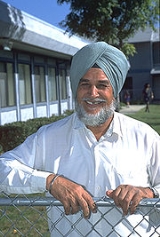
Turbanned Man
The turban (from Persian
Persian language

name=Persian|nativename=|pronunciation=[f??r'si]|image=|caption=Farsi in Perso-Arabic script |states= Iran, Afghanistan, Tajikistan, Uzbekistan, and Bahrain....
 , dulband via the Turkish
Turkish language

Turkish is a language spoken by over 63 million people worldwide, making it the most commonly spoken of the Turkic languages. Its speakers are located predominantly in Turkey and Cyprus, with smaller groups in Iraq, Greece, Bulgaria, the Republic of Macedonia, Kosovo, Albania and other parts of Eastern Europe....
 ) is a headdress
Headgear

Headgear, headwear or headdress is the name given to any element of clothing which is worn on one's head .Headgear serve a variety of purposes:...
 consisting of a long scarf
Scarf

A scarf is a piece of fabric worn on or near the head or around the neck for warmth, cleanliness, fashion or for religion reasons....
-like single piece of cloth wound around either the head
Head

In anatomy, the head of an animal is the rostral part that usually comprises the brain, eyes, ears, nose, and mouth . Some very simple animals may not have a head, but many bilateria do....
 itself or an inner hat
Hat

A hat is a headcovering. It may be worn for protection against the elements, for religious reasons, for safety, or as a fashion accessory. In the past, hats were an indicator of social status....
. The word "turban" is a common umbrella term
Umbrella term

An umbrella term is a word that provides a superset or wikt:grouping of related concepts, also called a hypernym.For example, cryptology is an umbrella term that encompasses cryptography and cryptanalysis, among other fields....
, loosely used in English to refer to several sorts of head wrap.

In Western countries, men wearing turbans in public are likely to be Sikhs
Sikhism

Sikhism , founded on the teachings of Guru Nanak and ten successive Sikh Gurus in fifteenth century Punjab region, is the Major religious groups organized religion in the world....
, whose religion requires them to cover their long uncut hair.

Terminology

In Hindi
Hindi

Standard Hindi, also known as High Hindi, Nagari Hindi or Literary Hindi is a Standard language register of Hindi. It is one of the 22 official languages of India, and is used, along with English language, for administration of the central government....
, a turban is called a pag?i or safa. Sikhs often call it dastar (pronounced dastar), a distinctive and more respectful Punjabi
Punjabi language

'Punjabi' , , is an Indo-Aryan language spoken by inhabitants of the historical Punjab region and their diasporas. Speakers include adherents of the religions of Islam, Sikhism and Hinduism....
 word for a Sikh 'turban'. The word dastar (pronounced destar in Turkish) is also used in the Mevlevi
Mevlevi

The Mevlevi Order or the Mevleviye are a Sufism order founded by the followers of Rumi, a 13th century Persian speaking people poet, Islamic jurist, and theologian, in Konya ....
 order of Whirling Dervishes to refer to the turban that the leader of the Whirling Dervish ceremony wears. In Tuareg
Tuareg

The Tuareg are a nomadic pastoralist people. They are the principal inhabitants of the Saharan interior of North Africa. They call themselves variously Kel Tamasheq or Kel Tamajaq , Imuhagh, Imazaghan or Imashaghen , or Kel Tagelmust, i.e., "People of the Veil"....
 and Berber
Berber

Berber may refer to:*a member of the Berber people**the Berber languages, a family of Afro-Asiatic languages**Berberism, a political-cultural supporting a distinct Berber identity....
 the word Tagelmust refers to the head scarf associated with the turban.

For some pictures/directions to wrap a turban, go to: http://www.stardoll.com/member/ralya (Not a copyrighted site.)

Contemporary turbans


Overview of styles

Touaregniger


Contemporary turbans come in many shapes, sizes, and colors.

Youth turbans are called "turbs" as they are only half a turban.

  • Middle Eastern, Central Asian, South Asian, and Sikh
    Sikh

    Sikh is the title and name given to an adherent of Sikhism. The term has its origin in the Sanskrit ' "disciple, learner" or ' "instruction"....
     turban wearers usually wind their turban anew for each wearing, using long strips of cloth. The cloth is usually five meters or less. However, some elaborate South Asian turbans may be permanently formed and sewn to a foundation. Turbans can be very large or quite modest dependent upon region, culture, and religion.


  • Turbans are worn as women's hats in Western countries. They are usually sewn to a foundation, so that they can be donned or removed easily. Now that fewer Western women wear hats they are less common. However, turbans are still worn by female cancer
    Cancer

    Cancer is a class of diseases in which a group of cell display uncontrolled growth , invasion , and sometimes metastasis . These three malignant properties of cancers differentiate them from benign tumors, which are self-limited, do not invade or metastasize....
     patients who have lost their hair to chemotherapy
    Chemotherapy

    Chemotherapy, in its most general sense, refers to treatment of disease by chemicals that kill cells, specifically those of micro-organisms or cancer....
     and wish to cover their heads. Some women use wigs; others prefer scarves and turbans.


  • Women in many parts of Africa
    Africa

    Africa is the world's second-largest and second most-populous continent, after Asia. At about 30.2 million km? including adjacent islands, it covers 6% of the Earth's total surface area and 20.4% of the total land area....
     and the West Indies often cover their heads with intricately tied scarves which may be called scarves, head wraps, or turbans. In contrast, men of the Tuareg
    Tuareg

    The Tuareg are a nomadic pastoralist people. They are the principal inhabitants of the Saharan interior of North Africa. They call themselves variously Kel Tamasheq or Kel Tamajaq , Imuhagh, Imazaghan or Imashaghen , or Kel Tagelmust, i.e., "People of the Veil"....
    , Berber
    Berber

    Berber may refer to:*a member of the Berber people**the Berber languages, a family of Afro-Asiatic languages**Berberism, a political-cultural supporting a distinct Berber identity....
    , Songhai
    Songhai

    The Songhai are an ethnic group from western Africa akin to the Mand?. The Songhai languages, however, has been connected with the Nilo-Saharan languages language family, unlike their neighboring counterparts....
    , Wodaabe
    Wodaabe

    The Wodaabe are a small subgroup of the Fulani ethnic group. They are traditionally nomadic cattle-herders and traders in the Sahel, with migrations stretching from southern Niger, through northern Nigeria, northeastern Cameroon, and the western region of the Central African Republic....
    , Fulani and Hausa
    Hausa

    Hausa may refer to:*the Hausa language*the Hausa people...
     peoples of North
    North Africa

    North Africa or Northern Africa is the northernmost region of the African continent, separated by the Sahara from Sub-Saharan Africa.Geopolitically, the United Nations subregion of Northern Africa includes the following seven countries or territories:...
     and West Africa
    West Africa

    West Africa or Western Africa is the westernmost region of the African continent. Geopolitically, the United Nations subregion of Western Africa includes the following 16 countries distributed over an area of approximately 5 million square km:...
     wear turbans, often veiling the face to deter dust.


Sikh turbans

The turban is closely associated with the Sikh
Sikh

Sikh is the title and name given to an adherent of Sikhism. The term has its origin in the Sanskrit ' "disciple, learner" or ' "instruction"....
 faith and the vast majority of people who wear turbans in Western countries are Sikhs. Those who undergo initiation, Khande di Pahul (a type of baptism
Baptism

In Christianity, baptism is the ritual act, with the use of water, by which one is admitted as a full member of the Christian Church and, in the view of some, as a member of the particular Church in which the baptism is administered....
) to join the Khalsa
Khalsa

Khalsa is a Persian term which refers to the collective body of all baptism Sikhs. The Khalsa was originally established as a military order of "saint-soldiers" on March 30, 1699, by Guru Gobind Singh, the tenth Sikh Gurus....
, are forbidden to cut their hair as well as non-baptised Sikhs. Such men are required to wear a turban to manage their long hair and also a Sikh Turban is a distinct symbol of the Sikh Identity. Most baptised women also wear turbans; however, non-baptised Sikh women usually do not wear turbans. Un-initiated Sikhs are still required to leave their hair unshorn.

Afghan turbans

Afghan men wear a variety of turbans,known as 'lungee'.Lungee is also worn in north west of pakistan,espically the tribal areas.The lungee is usually worn in tribal meetings,but a majority of afghanis prefrer to wear it in every day life.

Rajasthani turbans

Jats and Rajput
Rajput

A Rajput is a member of one of the major Hindu Kshatriya groups of Indian subcontinent. The Rajputs trace their roots to Rajputana. They enjoy a reputation as formidable soldiers and it is common to find many of them serving in the Indian Armed Forces....
s from the India
India

India, officially the Republic of India , is a country in South Asia. It is the List of countries and outlying territories by total area country by geographical area, the List of countries by population country, and the most populous liberal democracy in the world....
n state of Rajasthan
Rajasthan

Rajasthan is the largest States and territories of India of the Republic of India in terms of area. It encompasses most of the area of the large, inhospitable Great Indian Desert , which has an edge paralleling the Sutlej-Indus river valley along its border with Pakistan....
 wear distinctive turbans. Rajputs traditionally wear coloured turbans whereas Jats wear white turbans. The Marwari
Marwari

Marwari may refer to:* Marwar, a region in Rajasthan, India* Marwari language, a language of the Marwar region* Marwaris, people from the Marwar region...
s wear light coloured turbans. Many styles of turbans are found in Rajasthan; it is said that the style of the turban changes with every 15 km you travel. In some areas, especially in Rajasthan
Rajasthan

Rajasthan is the largest States and territories of India of the Republic of India in terms of area. It encompasses most of the area of the large, inhospitable Great Indian Desert , which has an edge paralleling the Sutlej-Indus river valley along its border with Pakistan....
 the turban's size may indicate the position of the person in society. 'Royalty' in different parts of India have distinctly different styles of turbans, as do the 'peasants', who often just wear a small piece of cloth wound around the head.

Mysori turbans

The people of the Indian districts of Mysore
Mysore

Mysore ; renamed to Mysuru|??????) is the second largest city in the state of Karnataka, India. It is the headquarters of the Mysore district and the Mysore division and lies about southwest of Bangalore, the capital of Karnataka....
 and Kodagu
Kodagu

Kodagu is a districts of Karnataka of Karnataka states and territories of India in Southern India. It is also known by its anglicised name of Coorg....
 wear turbans called Mysore peta. Distinguished people are honoured by the award of a Mysore peta in a formal ceremony. In Kodagu district people wear it with traditional dress on special occasions such as marriages.

Uttarakhand (Kuamaon)

Now going extinct and worn generally during religious functions the Taanka of the Kumaoni
Kumaoni

The Kumaoni are a people of the Kumaon Division of Uttarakhand, a region in the Indian Himalayas. Their Kumaoni language forms the Central subgroup of the Pahari languages....
 Rajputs or Thakur
Thakur

*Thakur *Thakore*Thakur *Thakur one of the scheduled tribes of India.Thakur may refer to:*Hindu Gods: In Bengali, deities are refer to as Thakur....
s is a reminder of their long martial history and valour. It is now however hardly seen.

Turbans as hats in Western countries

Turbans have been worn by men and women since the 17th century, without ever becoming very common. Now that hats are infrequently worn, turbans too are relatively uncommon. They are worn primarily by women of West Indian descent and by female cancer patients. Some women wear them to make a statement of individuality, such as the British social entrepreneur Camila Batmanghelidjh
Camila Batmanghelidjh

Camila Batmanghelidjh is a psychotherapist and social entrepreneur whose work focuses on children marginalised by society. She is the founder and director of Kids Company, a charity based in south London devoted to 'lone' children, i.e....
, who usually wears a colourful matching turban and robe.

Although the turban has been mentioned in the bible, Christians in general do not see wearing turbans as part of their religious practice.

Headdress in Muslim majority countries

Shahjahan
The men of many Islamic cultures have worn or wear a headdress of some sort that may be considered a turban. Islam however does not require any sort of head wrap or headdress for men and for women to wear a headscarf
Headscarf

Headscarves are scarf covering most or all of the top of a woman's hair and her head. Headscarves may be worn for a variety of purposes, such as for warmth, for sanitation, for fashion or social distinction; with religious signifiance, to hide baldness, out of modesty, or other forms of social convention....
 or hijab is obligation. Head wraps that men wear are called several names and worn in different ways dependent on region and culture. Examples include Umamah in Arabic, and dastar in Persian.

  • Many types of head wrap are worn by Islamic scholars in many Muslim countries. Islamic scholars meaning specifically Muslim scholars who study the religion of Islam, most likely being Sheikh
    Sheikh

    Sheikh, also rendered as Sheik, Shaykh, Shaikh, Cheikh, and other variants , is a word or honorific term in the Arabic language that literally means "Elder "....
    s or Imam
    Imam

    File:Medaillon chiite.jpgAn imam is an Islamic leadership position. Often the leader of a mosque and the community. Similar to spiritual leaders, the imam is the one who leads the prayer during Islamic gatherings....
    s.
  • In Shi'a Islam
    Shi'a Islam

    Shia Islam , is the second largest denomination of Islam, after Sunni Islam.Similiar to other branches of Islam, Shi'a Islam is based on the teachings of Islamic holy book, the Qur'an and message of the final prophet of Islam, Muhammad....
    , wearing a black head wrap, around a small white cap is a claim to status as a descendant of Muhammad.
  • In Sudan
    Sudan

    Sudan is a country in northeastern Africa. It is the largest in the African continent and the Arab World, and List of countries and outlying territories by total area by area....
    , large white headdress are worn; they generally are meant connote high social status.


In modern Persian Gulf
Persian Gulf

The Persian Gulf, in the Southwest Asian region, is an extension of the Indian Ocean located between Iran and the Arabian Peninsula. Historically and commonly known as the Persian Gulf, this body of water is sometimes Persian Gulf naming dispute referred to as the Arabian Gulf by certain Arab countries or simply The Gulf, although nei...
 countries, the head wrap has been replaced by the plain or checkered scarf (called keffiyeh
Keffiyeh

The 'keffiyeh' ), also known as a 'shmagh' , 'ghutrah' , or 'mashadah' is a traditional headdress for Arab men made of a square of cloth , usually cotton, folded and wrapped in various styles around the head....
, ghutrah or shumagh), though the Arabic Umamah tradition is still strong in Oman
Oman

Oman , officially the Sultanate of Oman , is an Arab country in southwest Asia on the southeast coast of the Arabian Peninsula. It borders the United Arab Emirates on the northwest, Saudi Arabia on the west and Yemen on the southwest....
 (see Sultan Qaboos of Oman
Qaboos of Oman

Qaboos bin Sa?id Al Sa?id Order of the Bath Order of St Michael and St George Royal Victorian Order is the Sultan of Oman. He rose to power after overthrowing his father, Said bin Taimur, in 1970....
).

History of turbans


Girlwithapearlearringpainting
Sequoyah
Humans have been wearing cloth on their heads since the invention of cloth. Texts and art that survive from many past cultures mention turbans.

  • The Vedas
    Vedas

    The Vedas are a large body of texts originating in History of India. They form the oldest layer of Sanskrit literature and the oldest Hindu scripture of Hinduism....
     contain references to turbans being worn in Vedic India.


  • The ancient Persians
    History of Iran

    History of Iran and Greater Iran consists of the area from the Euphrates in the west to the Indus River and Syr Darya in the east and from the Caucasus, Caspian Sea, and Aral Sea in the north to the Persian Gulf and the Gulf of Oman in the south....
     wore a conical cap sometimes encircled by bands of cloth.


  • It is believed that the Arabs of the time of Muhammad
    Muhammad

    Muhammad Patronymic#Arabic Abd Allah ibn Abd al Muttalib , is the founder of the Major religious groups of Islam and is regarded by Muslims as a Rasul and prophet of , the last and the greatest law-bearer in a series of prophets....
    , the Islamic prophet, wore Umamah . They were very useful for fending off the desert sand and protecting the head and face from very high temperatures and strong sunlight. When the great Islamic empires were established, under the first four caliphs, the Umayyads, and the Abbasids, the new rulers wore Umamah. Head wraps then diffused to populations under Islamic rule, even in countries where they were not previously worn.


  • Probably the largest-ever Turbans were worn by high-ranking Turk
    Ottoman Turks

    The Ottoman Turks were the subdivision of the Ottoman Muslim Millet that dominated the ruling class of the Ottoman Empire. Reliable information about the early history of the Ottomans is scarce....
    s of the Ottoman
    Ottoman Empire

    The Ottoman Empire , also known by its contemporaries as the Turkish Empire or Turkey , was an empire that lasted from 1299?1923. It was Treaty of Lausanne by the Republic of Turkey, which was officially proclaimed on October 29, 1923....
     period, including soldiers. These were enormous round turbans, wrapped around a hollow cone or framework, that often projected at the top. Hence they were called "Sarik", meaning "wrapped". From the 19th century the Turks mostly gave up the turban for the fez
    Fez (clothing)

    The fez , or Tarboosh ?????, not to be confused with North African Checheya, is a red felt hat in the shape of a truncated cone....
     at the same time as they abandoned their kaftan
    Kaftan

    A kaftan is a man's cotton or silk cloak buttoned down the front, with full sleeves, reaching to the ankles and worn with a sash.The kaftans worn by the Ottoman sultans constitute one of the most splendid collections of Topkapi Palace in Istanbul....
     tunics for more Western dress. Broad-rimmed Western hats did not meet the Islamic requirement that the forehead touch the ground during prayer and the Sultan issued a decree enforcing the wearing of the fez, applicable to all religious groups. Suleiman the Magnificent
    Suleiman the Magnificent

    Suleiman I, His Imperial Majesty , was the tenth and longest-reigning Sultan of the Ottoman Empire, from 1520 to his death in 1566. He is known in Western world as Suleiman the Magnificent and in Eastern world, as the Lawgiver , for his complete reconstruction of the Ottoman legal system....
     was renowned for the size of his turban.


  • Many contemporary images show European men of the Middle Ages
    Middle Ages

    File:Karl 1 mit papst gelasius gregor1 sacramentar v karl d kahlen.jpgThe Middle Ages of European history are a period in history which lasted for roughly a millennium, commonly dated from the fall of the Roman Empire in the 5th century to the beginning of the Early Modern Period in the 16th century, marked by the division of Western Christi...
     and Renaissance
    Renaissance

    The Renaissance was a cultural movement that spanned roughly the 14th to the 17th century, beginning in Italy in the late Middle Ages and later spreading to the rest of Europe....
     wearing headgear that looks like turbans. These hats are actually chaperons
    Chaperon (headgear)

    Chaperon was a form of hood or, later, highly versatile hat worn in all parts of Western Europe in the Middle Ages. Initially a utilitarian garment, it first grew a long partly decorative tail behind, and then developed into a complex, versatile and expensive headgear after what was originally the vertical opening for the face began to be u...
    , which could look very similar. Men in Europe were expected to take off their headgear in church, and in the presence of a person of much higher rank, like a king. This is not easy with a turban. Turbans also appear in European religious art, especially in scenes picturing the Holy Land
    Holy Land

    The Holy Land , generally refers to the geographical region of the Levant called Land of Canaan or Land of Israel in the Bible, and constitutes the Promised land....
    , then inhabited by turban-wearers. Turbans did not become a regular part of European headgear until the late 17th century. Men then shaved their heads and wore heavy wigs; when relaxing at home, they removed the wigs and covered their heads with caps or sometimes turbans.


  • European women wore a wide variety of headdresses, some of which appear to be wrapped scarves or occasionally turbans. In the late 18th century and early 19th, turbans became fashionable headgear for women. The first recorded use of the English word "turban" for a Western female headdress is in 1776 (OED). As with all styles, they have waxed and waned in popularity. Later Victorians wore wrapped toques; turbans were fashionable in the early 20th century. , . The French couturier Poiret
    Poiret

    Poiret may refer to several people:*Jean Poiret, author of La Cage aux Folles*Jean Louis Marie Poiret, French botanist*Jean Louis Georges Poiret...
     was known for his Orientalist designs featuring turbans. Turbans were fashionable in the 1940s and 1950s , ; one name given them was cache-misère (French
    French language

    French is a Romance language spoken around the world by around 80 million people as first language, by 190 million as second language, and by about another 200 million people as an acquired tongue, with significant speakers in 54 countries....
    , "hide misery"), a chic solution to a bad-hair day. After a precipitous decline in hat-wearing during the 1960s, turbans are now rather rarely seen on women in the Western World
    Western world

    The term Western world, the West or the Occident can have multiple meanings dependent on its context . Accordingly, the basic definition of what constitutes "the West" varies, expanding and contracting over time, in relation to various historical circumstances....
    .


Harassment of turban-wearers

In the USA a number of turban-wearers have been attacked or abused by persons acting on the false assumption that all turban-wearers are affiliated with terrorism. Amongst others, Sikh
Sikh

Sikh is the title and name given to an adherent of Sikhism. The term has its origin in the Sanskrit ' "disciple, learner" or ' "instruction"....
 men wearing turbans have been harassed, attacked or even killed because of their religious headwear. These attacks have been further fueled by the September 11, 2001 terrorist attacks on the World Trade Center
World trade center

The World Trade Centers Association founded in 1970, is a not-for-profit, non-political association dedicated to the establishment and effective operation of World Trade Centers as instruments for trade expansion representing 316 members in 91 countries....
 in New York
New York

The State of New York is a U.S. state in the Mid-Atlantic States and Northeastern United States regions of the United States and is the nation's List of U.S....
. One widely publicized incident was the murder of Balbir Singh Sodhi
Balbir Singh Sodhi

Balbir Singh Sodhi was a Mesa, Arizona, Arizona, gas station owner who was murdered in the aftermath of the September 11, 2001 attacks. He made headlines because he was the first of several cases across the United States that were reported to the police as acts of retaliation for the terrorist attacks....
. The terms Towelhead
Towelhead

Towelhead can refer to:* an ethnic slur for person of Arab descent ? see List of ethnic slurs#T* a 2005 novel by Alicia Erian ? see Towelhead ...
 and raghead are pejorative references to Middle Eastern and Arab headdresses including turbans. It is mainly used to refer to Arabs and people of Middle Eastern descent.

See also

  • Hat
    Hat

    A hat is a headcovering. It may be worn for protection against the elements, for religious reasons, for safety, or as a fashion accessory. In the past, hats were an indicator of social status....
  • Scarf
    Scarf

    A scarf is a piece of fabric worn on or near the head or around the neck for warmth, cleanliness, fashion or for religion reasons....
  • Millinery
    Millinery

    Millinery refers to hats and other clothing sold by a milliner to women, men and children or the profession or business of designing, making, or selling hats, dresses, and hat trim to women....


External links


Turbans - general


Turbans for cancer patients


Afghan Turbans


Sikh turbans

  • - Short video challenging perceptions and stereotypes to who the Sikhs are.
  • An online shop to buy sikh pagri or turban.


European turbans


Native American turbans