


Resurrection of the dead

Encyclopedia
- This article concerns itself with the belief in the final resurrectionResurrectionResurrection refers to the literal coming back to life of the biologically dead. It is used both with respect to particular individuals or the belief in a General Resurrection of the dead at the end of the world. The General Resurrection is featured prominently in Jewish, Christian, and Muslim...
at the end time, commonly found in the Abrahamic religionsAbrahamic religionsAbrahamic religions are the monotheistic faiths emphasizing and tracing their common origin to Abraham or recognizing a spiritual tradition identified with him...
. It is quite distinct from the Dharmic concept of reincarnationReincarnationReincarnation best describes the concept where the soul or spirit, after the death of the body, is believed to return to live in a new human body, or, in some traditions, either as a human being, animal or plant...
. See resurrection (disambiguation)Resurrection (disambiguation)Resurrection refers to the literal coming back to life of the biologically dead.Resurrection may also refer to:- Film :* Resurrection , a thriller* Resurrection , an American drama...
for other meanings.
Resurrection of the Dead is a belief found in a number of eschatologies
Eschatology
Eschatology is a part of theology, philosophy, and futurology concerned with what are believed to be the final events in history, or the ultimate destiny of humanity, commonly referred to as the end of the world or the World to Come...
, most commonly in Christian
Christian eschatology
Christian eschatology is a major branch of study within Christian theology. Eschatology, from two Greek words meaning last and study , is the study of the end of things, whether the end of an individual life, the end of the age, or the end of the world...
, Islamic
Islamic eschatology
Islamic eschatology is concerned with the al-Qiyāmah . Like the other Abrahamic religions, Islam teaches the bodily resurrection of the dead, the fulfillment of a divine plan for creation, and the judgement of the soul; the righteous are rewarded with the pleasures of Jannah while the unrighteous...
, Jewish
Jewish eschatology
Jewish eschatology is concerned with the Jewish Messiah, afterlife, and the revival of the dead. Eschatology, generically, is the area of theology and philosophy concerned with the final events in the history of the world, the ultimate destiny of humanity, and related concepts.-The Messiah:The...
and Zoroastrian. In general, the phrase refers to a specific event in the future; multiple prophesies in the histories of these religions assert that the dead will be brought back to life at some point in the future, though a minority claim this has already happened in the past or is occurring now without most knowing it. Most eschatologies believe in a universal resurrection
Universal resurrection
Universal resurrection is a doctrine held by most Christian denominations which posits that all of the dead who have ever lived will be resurrected from the dead, generally to stand for a Last Judgment.-Judaism:...
of all of the dead, while a minority, such as the Christadelphians
Christadelphians
Christadelphians is a Christian group that developed in the United Kingdom and North America in the 19th century...
, believe that only a select will be resurrected.
Ancient Egyptian religion
Ancient Egyptian religion included a belief in the resurrection of the dead.Zoroastrianism
Frashokereti is the Zoroastrian doctrine of a final renovation of the universe, when evil will be destroyed, and everything else will be then in perfect unity with God (Ahura MazdaAhura Mazda
Ahura Mazdā is the Avestan name for a divinity of the Old Iranian religion who was proclaimed the uncreated God by Zoroaster, the founder of Zoroastrianism...
). The term probably means "making wonderful, excellent".
The doctrinal premises are (1) good will eventually prevail over evil; (2) creation was initially perfectly good, but was subsequently corrupted by evil; (3) the world will ultimately be restored to the perfection it had at the time of creation; (4) the "salvation for the individual depended on the sum of [that person's] thoughts, words and deeds, and there could be no intervention, whether compassionate or capricious, by any divine being to alter this." Thus, each human bears the responsibility for the fate of his own soul, and simultaneously shares in the responsibility for the fate of the world.
Judaism
The SadduceesSadducees
The Sadducees were a sect or group of Jews that were active in Ancient Israel during the Second Temple period, starting from the second century BC through the destruction of the Temple in 70 AD. The sect was identified by Josephus with the upper social and economic echelon of Judean society...
did not believe in an afterlife
Afterlife
The afterlife is the belief that a part of, or essence of, or soul of an individual, which carries with it and confers personal identity, survives the death of the body of this world and this lifetime, by natural or supernatural means, in contrast to the belief in eternal...
, but the Pharisees
Pharisees
The Pharisees were at various times a political party, a social movement, and a school of thought among Jews during the Second Temple period beginning under the Hasmonean dynasty in the wake of...
believed in a literal resurrection of the body.
Resurrections of dead people are found in the Tanakh
Tanakh
The Tanakh is a name used in Judaism for the canon of the Hebrew Bible. The Tanakh is also known as the Masoretic Text or the Miqra. The name is an acronym formed from the initial Hebrew letters of the Masoretic Text's three traditional subdivisions: The Torah , Nevi'im and Ketuvim —hence...
, such as Elijah and the widow's son at Zarephath
Sarepta
Sarepta was a Phoenician city on the Mediterranean coast between Sidon and Tyre. Most of the objects by which we characterise Phoenician culture are those that have been recovered scattered among Phoenician colonies and trading posts; such carefully excavated colonial sites are in Spain, Sicily,...
: "Behold your son lives." ; Elisha
Elisha
Elisha is a prophet mentioned in the Hebrew Bible and the Qur'an. His name is commonly transliterated into English as Elisha via Hebrew, Eliseus via Greek and Latin, or Alyasa via Arabic.-Biblical biography:...
and the Shunammite woman: "Take up your son." and contact with Elisha's bones reviving a dead man: "as the man touched the bones of Elisha, he revived, and stood up on his feet." Ezekiel's Vision in the Valley of Dry Bones reads, "Thus saith the Lord GOD unto these bones; Behold, I will cause breath to enter into you, and ye shall live".
According to the Jewish Encyclopedia
Jewish Encyclopedia
The Jewish Encyclopedia is an encyclopedia originally published in New York between 1901 and 1906 by Funk and Wagnalls. It contained over 15,000 articles in 12 volumes on the history and then-current state of Judaism and the Jews as of 1901...
article on Resurrection, the topic may be discussed in , , , and is argued in more detail in the extra-canonical books of Enoch
Book of Enoch
The Book of Enoch is an ancient Jewish religious work, traditionally ascribed to Enoch, the great-grandfather of Noah. It is not part of the biblical canon as used by Jews, apart from Beta Israel...
, Jubilees, Apocalypse of Baruch, 2 Esdras
2 Esdras
2 Esdras or Latin Esdras is the name of an apocalyptic book in many English versions of the Bible . Its authorship is ascribed to Ezra. It is reckoned among the Apocrypha by many Protestant churches. Although Second Esdras exists in its complete form only in Latin, it was originally written in...
and the Maccabees
Books of the Maccabees
The Books of the Maccabees are books concerned with the Maccabees, the leaders of the Jewish rebellion against the Seleucid dynasty, or related subjects.The term mostly refers to two deuterocanonical books contained in some canons of the Bible:...
. That same article in the section on Jewish Creed or Not? states: "The belief in resurrection is expressed on all occasions in the Jewish liturgy
Jewish liturgy
Jewish liturgy refers specifically to following the Torah in all of its rites and ceremonies, whether in the home or in the Synagogue. The main purposes of following the carefully laid out observances is to maintain uniformity, and to avoid improper and unacceptable practices at variance with those...
; e.g., in the morning prayer Elohai Neshamah, in the Shemoneh 'Esreh, and in the funeral services. Maimonides
Maimonides
Moses ben-Maimon, called Maimonides and also known as Mūsā ibn Maymūn in Arabic, or Rambam , was a preeminent medieval Jewish philosopher and one of the greatest Torah scholars and physicians of the Middle Ages...
made it the last of his thirteen articles of belief: "I firmly believe that there will take place a revival of the dead at a time which will please the Creator, blessed be His name.""
Orthodox Judaism
Orthodox Judaism
Orthodox Judaism , is the approach to Judaism which adheres to the traditional interpretation and application of the laws and ethics of the Torah as legislated in the Talmudic texts by the Sanhedrin and subsequently developed and applied by the later authorities known as the Gaonim, Rishonim, and...
holds belief in resurrection to be one of the cardinal principles of Rabbinical Judaism. Jewish halakhic
Halakha
Halakha — also transliterated Halocho , or Halacha — is the collective body of Jewish law, including biblical law and later talmudic and rabbinic law, as well as customs and traditions.Judaism classically draws no distinction in its laws between religious and ostensibly non-religious life; Jewish...
authority Maimonides
Maimonides
Moses ben-Maimon, called Maimonides and also known as Mūsā ibn Maymūn in Arabic, or Rambam , was a preeminent medieval Jewish philosopher and one of the greatest Torah scholars and physicians of the Middle Ages...
set down thirteen main principles of the Jewish faith
Jewish principles of faith
The concept of an explicit, paramount definition of faith does not exist in Judaism as it does in other monotheistic religions such as Christianity. Although Jews and religious leaders share a core of monotheistic principles, and there are many fundamental principles quoted in the Talmud to define...
which have ever since been printed in all Rabbi
Rabbi
In Judaism, a rabbi is a teacher of Torah. This title derives from the Hebrew word רבי , meaning "My Master" , which is the way a student would address a master of Torah...
nic Siddur
Siddur
A siddur is a Jewish prayer book, containing a set order of daily prayers. This article discusses how some of these prayers evolved, and how the siddur, as it is known today has developed...
(prayer books). Resurrection is the thirteenth principle:
- "I believe with complete (perfect) faith, that there will be techiat hameitim - revival of the dead, whenever it will be God's, blessed be He, will (desire) to arise and do so. May (God's) Name be blessed, and may His remembrance arise, forever and ever."
There is, however, a minority point of view, held by certain Jewish mystics and others, which asserts that those Jewish beliefs are in contradiction with the resurrection as taught by Isaiah
Isaiah
Isaiah ; Greek: ', Ēsaïās ; "Yahu is salvation") was a prophet in the 8th-century BC Kingdom of Judah.Jews and Christians consider the Book of Isaiah a part of their Biblical canon; he is the first listed of the neviim akharonim, the later prophets. Many of the New Testament teachings of Jesus...
(Isaiah 8:16 and 26:19) and Daniel
Daniel
Daniel is the protagonist in the Book of Daniel of the Hebrew Bible. In the narrative, when Daniel was a young man, he was taken into Babylonian captivity where he was educated in Chaldean thought. However, he never converted to Neo-Babylonian ways...
(12:1 and 13) in which the resurrection was understood as being a doctrine of physical 'Rebirth
Rebirth
-Spiritual:* Reincarnation, the migration of a deceased person's spirit to a newborn body** Rebirth * Baptism, a Christian ritual representing spiritual cleansing* Resurrection of the Dead-Music:* Rebirth Brass Band* Rebirth...
'.
Christianity
New Testament teachings
According to the New TestamentNew Testament
The New Testament is the second major division of the Christian biblical canon, the first such division being the much longer Old Testament....
, Jesus argued with the Sadducees
Sadducees
The Sadducees were a sect or group of Jews that were active in Ancient Israel during the Second Temple period, starting from the second century BC through the destruction of the Temple in 70 AD. The sect was identified by Josephus with the upper social and economic echelon of Judean society...
over the doctrine of the resurrection. These passages are , , . See also Mark 12
Mark 12
Mark 12 is the twelfth chapter of the Gospel of Mark in the New Testament of the Christian Bible. Continuing Jesus' teaching in Jerusalem on what is traditionally celebrated as Holy Tuesday, it contains the parable of The Wicked Husbandmen, Jesus' argument with the Pharisees and Herodians over...
. The Gospel of John
Gospel of John
The Gospel According to John , commonly referred to as the Gospel of John or simply John, and often referred to in New Testament scholarship as the Fourth Gospel, is an account of the public ministry of Jesus...
also contains teachings about the resurrection of the dead .
The "Sign of Jonah" may be about the resurrection of the dead. From the Scholars Version translation of Matthew 12:38-42: "...At judgment time, the citizens of Ninevah will come back to life along with this generation ... At judgment time, the queen of the south will be brought back to life along with this generation ..."
The "resurrection of the righteous" is mentioned at . The "resurrection at the last day" is mentioned at .
In Acts of the Apostles
Acts of the Apostles
The Acts of the Apostles , usually referred to simply as Acts, is the fifth book of the New Testament; Acts outlines the history of the Apostolic Age...
, the Apostles and Paul of Tarsus
Paul of Tarsus
Paul the Apostle , also known as Saul of Tarsus, is described in the Christian New Testament as one of the most influential early Christian missionaries, with the writings ascribed to him by the church forming a considerable portion of the New Testament...
argued in support of the doctrine: , , , , . In Paul argues: "If there is no resurrection of the dead, then not even Christ has been raised." warns of some "who have wandered away from the truth. They say that the resurrection has already taken place, and they destroy the faith of some." Additional verses are ; ; ; ; ; ; ; ; .
Nicene Creed and Early Christianity
Most Christian denominations profess the Nicene CreedNicene Creed
The Nicene Creed is the creed or profession of faith that is most widely used in Christian liturgy. It is called Nicene because, in its original form, it was adopted in the city of Nicaea by the first ecumenical council, which met there in the year 325.The Nicene Creed has been normative to the...
, and most English versions of the Nicene Creed in current use
English versions of the Nicene Creed in current use
The Nicene Creed, composed in part and adopted at the First Council of Nicaea and revised with additions by the First Council of Constantinople , is a creed that summarises the orthodox faith of the Christian Church and is used in the liturgy of most Christian Churches...
include the phrase:
Both "Resurrection of the Dead" and "World to Come
World to Come
The World to Come is an eschatological phrase reflecting the belief that the "current world" is flawed or cursed and will be replaced in the future by a better world or a paradise. The concept is similar to the concepts of Heaven and the afterlife, but Heaven is another place generally seen as...
" are phrases found in Christian Bibles.
Most Christian denominations teach the concept of eternal life
Eternal life (Christianity)
In Christianity the term eternal life traditionally refers to continued life after death, rather than immortality. While scholars such as John H. Leith assert that...
after death, provided through the atonement of Christ as demonstrated by the Resurrection of Jesus
Resurrection of Jesus
The Christian belief in the resurrection of Jesus states that Jesus returned to bodily life on the third day following his death by crucifixion. It is a key element of Christian faith and theology and part of the Nicene Creed: "On the third day he rose again in fulfillment of the Scriptures"...
. Contrary to the idea of the separation of soul and body, the fundamental tenet of Christian doctrine is the resurrection of the flesh at the End Times
End times
The end time, end times, or end of days is a time period described in the eschatological writings in the three Abrahamic religions and in doomsday scenarios in various other non-Abrahamic religions...
.
The centrality of this idea for Christian doctrine is early stated in 1 Corinthians 15
1 Corinthians 15
1 Corinthians: 15 is the fifteenth chapter of the First Epistle to the Corinthians by Paul the Apostle. The first eleven verses are the earliest account of the Resurrection appearances of Jesus in the New Testament. The rest of the chapter stresses the primacy of the resurrection for Christianity...
by Paul the Apostle:
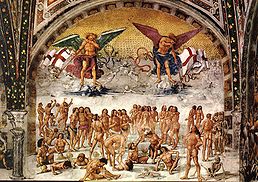
Irenaeus
Saint Irenaeus , was Bishop of Lugdunum in Gaul, then a part of the Roman Empire . He was an early church father and apologist, and his writings were formative in the early development of Christian theology...
and Justin Martyr
Justin Martyr
Justin Martyr, also known as just Saint Justin , was an early Christian apologist. Most of his works are lost, but two apologies and a dialogue survive. He is considered a saint by the Roman Catholic Church and the Eastern Orthodox Church....
, in the 2nd Century
Christianity in the 2nd century
The 2nd century of Christianity was largely the time of the Apostolic Fathers who were the students of the apostles of Jesus, though there is some overlap as John the Apostle may have survived into the 2nd century and the early Apostolic Father Clement of Rome is said to have died at the end of the...
, wrote against the idea that only the soul survived. Martyr insists that a man is both soul and body and Christ has promised to raise both, just as his own body was raised. He wrote: "Seeing as ... the Saviour in the whole Gospel shows that there is salvation for the flesh, why do we any longer endure those unbelieving and dangerous arguments, and fail to see that we are retrograding when we listen to such an argument as this: that the soul is immortal, but the body mortal, and incapable of being revived? For this we used to hear from Pythagoras
Pythagoras
Pythagoras of Samos was an Ionian Greek philosopher, mathematician, and founder of the religious movement called Pythagoreanism. Most of the information about Pythagoras was written down centuries after he lived, so very little reliable information is known about him...
and Plato
Plato
Plato , was a Classical Greek philosopher, mathematician, student of Socrates, writer of philosophical dialogues, and founder of the Academy in Athens, the first institution of higher learning in the Western world. Along with his mentor, Socrates, and his student, Aristotle, Plato helped to lay the...
, even before we learned the truth. If then the Saviour said this, and proclaimed salvation to the soul alone, what new thing, beyond what we heard from Pythagoras and Plato and all their band, did He bring us? But now He has come proclaiming the glad tidings of a new and strange hope to men."
Jesus
Jesus
Jesus of Nazareth , commonly referred to as Jesus Christ or simply as Jesus or Christ, is the central figure of Christianity...
appears to have been in general agreement with the position held by some Pharisees
Pharisees
The Pharisees were at various times a political party, a social movement, and a school of thought among Jews during the Second Temple period beginning under the Hasmonean dynasty in the wake of...
, as illustrated by his response to a question regarding marriage at the resurrection . While the Christian doctrine of resurrection is based on Jewish belief, how the emphasis on this involving the actual flesh increased parallel with Christianity succeeding among the Greek populace may connect to traditional Greek beliefs that true immortality always had to involve both body and soul. Although the Greeks held that a few individuals had been resurrected to physical immortality, there was no ancient Greek belief in a general resurrection of the dead. Indeed they held that once body had been destroyed, there was no possibility of returning to life. A number of early Church Fathers, like Pseudo-Justin, Tatian
Tatian
Tatian the Assyrian was an Assyrian early Christian writer and theologian of the 2nd century.Tatian's most influential work is the Diatessaron, a Biblical paraphrase, or "harmony", of the four gospels that became the standard text of the four gospels in the Syriac-speaking churches until the...
, Irenaeus
Irenaeus
Saint Irenaeus , was Bishop of Lugdunum in Gaul, then a part of the Roman Empire . He was an early church father and apologist, and his writings were formative in the early development of Christian theology...
, and Athenagoras of Athens
Athenagoras of Athens
Athenagoras was a Father of the Church, a Proto-orthodox Christian apologist who lived during the second half of the 2nd century of whom little is known for certain, besides that he was Athenian , a philosopher, and a convert to Christianity. In his writings he styles himself as "Athenagoras, the...
, argues about the Christian resurrection beliefs in ways that answer this traditional Greek scepticism to post-mortal physical continuity.
Most Christian churches continue to uphold the belief that there will be a general and universal resurrection
Universal resurrection
Universal resurrection is a doctrine held by most Christian denominations which posits that all of the dead who have ever lived will be resurrected from the dead, generally to stand for a Last Judgment.-Judaism:...
of the dead at "the end of time", as described by Paul when he said, "...he hath appointed a day, in which he will judge the world
Last Judgment
The Last Judgment, Final Judgment, Day of Judgment, Judgment Day, or The Day of the Lord in Christian theology, is the final and eternal judgment by God of every nation. The concept is found in all the Canonical gospels, particularly the Gospel of Matthew. It will purportedly take place after the...
..." (Acts 17:31 KJV) and "...there shall be a resurrection of the dead, both of the just and unjust." (Acts 24:15 KJV).
Many of the early Church Fathers
Church Fathers
The Church Fathers, Early Church Fathers, Christian Fathers, or Fathers of the Church were early and influential theologians, eminent Christian teachers and great bishops. Their scholarly works were used as a precedent for centuries to come...
cited the Old Testament
Old Testament
The Old Testament, of which Christians hold different views, is a Christian term for the religious writings of ancient Israel held sacred and inspired by Christians which overlaps with the 24-book canon of the Masoretic Text of Judaism...
examples as either foreshadowing
Typology (theology)
Typology in Christian theology and Biblical exegesis is a doctrine or theory concerning the relationship between the Old and New Testaments...
Jesus's resurrection, or foreshadowing or prophesying a future resurrection of all the dead.
In Roman Catholicism
According to the Catholic EncyclopediaCatholic Encyclopedia
The Catholic Encyclopedia, also referred to as the Old Catholic Encyclopedia and the Original Catholic Encyclopedia, is an English-language encyclopedia published in the United States. The first volume appeared in March 1907 and the last three volumes appeared in 1912, followed by a master index...
: ""No doctrine of the Christian Faith", says St. Augustine
St. Augustine
-People:* Augustine of Hippo or Augustine of Hippo , father of the Latin church* Augustine of Canterbury , first Archbishop of Canterbury* Augustine Webster, an English Catholic martyr.-Places:*St. Augustine, Florida, United States...
, "is so vehemently and so obstinately opposed as the doctrine of the resurrection of the flesh"... This opposition had begun long before the days of St. Augustine:"
According to the Catechism of the Catholic Church
Catechism of the Catholic Church
The Catechism of the Catholic Church is the official text of the teachings of the Catholic Church. A provisional, "reference text" was issued by Pope John Paul II on October 11, 1992 — "the thirtieth anniversary of the opening of the Second Vatican Ecumenical Council" — with his apostolic...
the body after resurrection is changed into a spiritual, imperishable body:
According to the Summa Theologica
Summa Theologica
The Summa Theologiæ is the best-known work of Thomas Aquinas , and although unfinished, "one of the classics of the history of philosophy and one of the most influential works of Western literature." It is intended as a manual for beginners in theology and a compendium of all of the main...
, spiritual beings that have been restored to glorified bodies will have the following basic qualities:
- Impassibility (immortal / painless) — immunity from death and pain
- Subtility (permeability) — freedom from restraint by matter
- Agility — obedience to spirit with relation to movement and space (the ability to move through space and time with the speed of thought)
- Clarity — resplendent beauty of the soul manifested in the body (as when Jesus was transfiguredTransfiguration of JesusThe Transfiguration of Jesus is an event reported in the New Testament in which Jesus is transfigured and becomes radiant upon a mountain. The Synoptic Gospels describe it, and 2 Peter 1:16-18 refers to it....
on Mount TaborMount Tabor-Places:*Mount Tabor, a hill in Israel near Nazareth believed by many to be the site of the Transfiguration of ChristIn the United States:*Mount Tabor, Indiana, an unincorporated community...
)
In Lutheranism
Although Martin LutherMartin Luther
Martin Luther was a German priest, professor of theology and iconic figure of the Protestant Reformation. He strongly disputed the claim that freedom from God's punishment for sin could be purchased with money. He confronted indulgence salesman Johann Tetzel with his Ninety-Five Theses in 1517...
personally believed and taught resurrection of the dead in combination with soul sleep, this is not a mainstream teaching of Lutheranism
Lutheranism
Lutheranism is a major branch of Western Christianity that identifies with the theology of Martin Luther, a German reformer. Luther's efforts to reform the theology and practice of the church launched the Protestant Reformation...
and most Lutherans traditionally believe in resurrection of the body in combination with the immortal soul.
According to the Lutheran Church—Missouri Synod (LCMS), on the last day, all the dead will be resurrected. Their souls will then be reunited with the same bodies they had before dying. The bodies will then be changed, those of the wicked to a state of everlasting shame and torment, those of the righteous to an everlasting state of celestial glory.
Anglicanism
However, there are many theologians, such as Thomas Oden, popular Christian writers, such as Randy Alcorn and Christian scholars, such as the Anglican Bishop of Durham, N.T. Wright who have defended the primacy of the resurrection in Christian faith.Interviewed by Time
Time (magazine)
Time is an American news magazine. A European edition is published from London. Time Europe covers the Middle East, Africa and, since 2003, Latin America. An Asian edition is based in Hong Kong...
in 2008 senior Anglican bishop and theologian N. T. Wright spoke of “the idea of bodily resurrection that people deny when they talk about their ‘souls going to Heaven,'" adding: “I've often heard people say, ‘I'm going to heaven soon, and I won't need this stupid body there, thank goodness.’ That's a very damaging distortion, all the more so for being unintentional.” Instead, Wright explains: “In the Bible we are told that you die, and enter an intermediate state." This is "conscious," but "compared to being bodily alive, it will be like being asleep." This will be followed by the resurrrection into new bodies, he says. "Our culture is very interested in life after death, but the New Testament is much more interested in what I've called the life after life after death."
Evangelical belief
Early 20th century American preacher Billy SundayBilly Sunday
William Ashley "Billy" Sunday was an American athlete who, after being a popular outfielder in baseball's National League during the 1880s, became the most celebrated and influential American evangelist during the first two decades of the 20th century.Born into poverty in Iowa, Sunday spent some...
epitomizes the focus on "going to heaven" in his sermon
Sermon
A sermon is an oration by a prophet or member of the clergy. Sermons address a Biblical, theological, religious, or moral topic, usually expounding on a type of belief, law or behavior within both past and present contexts...
“Heaven: A Wonderful Place; Where There is No More Death; Blessed Hope of the Christian.” In the message Sunday characteristically explained the feelings of his audience by saying “Everybody wants to go to Heaven. We are all curious. We want to know, where Heaven is, how it looks, who are there, what they wear, and how to get there!” Sunday speaks of many aspects of the afterlife
Afterlife
The afterlife is the belief that a part of, or essence of, or soul of an individual, which carries with it and confers personal identity, survives the death of the body of this world and this lifetime, by natural or supernatural means, in contrast to the belief in eternal...
such as the nice weather and eternal health, although there is no mention of the resurrection of the dead. He ends with an illustration about a man who dies and goes to heaven exclaiming “Home, home at last!” as if he had arrived at the end of his eschatological journey.
The emphasis on the immortality of the soul in heaven instead of the resurrection of the dead continues largely in the 21st century through popular charismatic and evangelical preaching. Jesus is often spoken of as “the way to heaven” and personal eschatology is generally seen in terms of whether or not a person gets into heaven when they die, rather than how they will fare at the resurrection of the dead.
Conditional immortality
Several churches, such as the Anabaptists and Socinians of the Reformation, then Seventh-day Adventist ChurchSeventh-day Adventist Church
The Seventh-day Adventist Church is a Protestant Christian denomination distinguished by its observance of Saturday, the original seventh day of the Judeo-Christian week, as the Sabbath, and by its emphasis on the imminent second coming of Jesus Christ...
, Christadelphians
Christadelphians
Christadelphians is a Christian group that developed in the United Kingdom and North America in the 19th century...
, Jehovah's Witnesses
Jehovah's Witnesses
Jehovah's Witnesses is a millenarian restorationist Christian denomination with nontrinitarian beliefs distinct from mainstream Christianity. The religion reports worldwide membership of over 7 million adherents involved in evangelism, convention attendance of over 12 million, and annual...
, and theologians of different traditions reject the idea of the immortality of a non-physical soul as a vestige of Neoplatonism
Neoplatonism
Neoplatonism , is the modern term for a school of religious and mystical philosophy that took shape in the 3rd century AD, based on the teachings of Plato and earlier Platonists, with its earliest contributor believed to be Plotinus, and his teacher Ammonius Saccas...
, and other pagan
Paganism
Paganism is a blanket term, typically used to refer to non-Abrahamic, indigenous polytheistic religious traditions....
traditions. In this school of thought, the dead remain dead (and do not immediately progress to a Heaven
Heaven
Heaven, the Heavens or Seven Heavens, is a common religious cosmological or metaphysical term for the physical or transcendent place from which heavenly beings originate, are enthroned or inhabit...
, Hell
Hell
In many religious traditions, a hell is a place of suffering and punishment in the afterlife. Religions with a linear divine history often depict hells as endless. Religions with a cyclic history often depict a hell as an intermediary period between incarnations...
, or Purgatory
Purgatory
Purgatory is the condition or process of purification or temporary punishment in which, it is believed, the souls of those who die in a state of grace are made ready for Heaven...
) until a physical resurrection of some or all of the dead occurs at the end of time. Some groups, Christadelphians
Christadelphians
Christadelphians is a Christian group that developed in the United Kingdom and North America in the 19th century...
in particular, consider that it is not a universal resurrection
Universal resurrection
Universal resurrection is a doctrine held by most Christian denominations which posits that all of the dead who have ever lived will be resurrected from the dead, generally to stand for a Last Judgment.-Judaism:...
, and that at this time of resurrection that the Last Judgment
Last Judgment
The Last Judgment, Final Judgment, Day of Judgment, Judgment Day, or The Day of the Lord in Christian theology, is the final and eternal judgment by God of every nation. The concept is found in all the Canonical gospels, particularly the Gospel of Matthew. It will purportedly take place after the...
will take place.
Church of Jesus Christ of Latter-day Saints
According to The Church of Jesus Christ of Latter-day Saints all those who have lived on the earth will be resurrected, regardless of their righteousness. Those who are righteous will be resurrected at the Second ComingSecond Coming (LDS Church)
Like many other Christian adherents, members of The Church of Jesus Christ of Latter-day Saints believe that there will be a Second Coming of Jesus Christ to the earth sometime in the future...
of Jesus Christ
Jesus
Jesus of Nazareth , commonly referred to as Jesus Christ or simply as Jesus or Christ, is the central figure of Christianity...
. This is referred to as the First Resurrection (Rev. 20:4 KJV). Those who are not righteous will wait until the end of the Millennium
Second Coming (LDS Church)
Like many other Christian adherents, members of The Church of Jesus Christ of Latter-day Saints believe that there will be a Second Coming of Jesus Christ to the earth sometime in the future...
, after which they too will be resurrected (Rev. 20:5 KJV).
Before the resurrection, the spirits of the dead are believed to exist in a place known as the spirit world, which is similar to yet fundamentally distinct from the traditional concept of Heaven and Hell. It is believed that the spirit retains its wants, beliefs, and desires in the afterlife. (1 Pet. 3:19 KJV)
The resurrection is believed to unite the spirit with the body again, and the LDS Church teaches that the body will be made whole and become incorruptible, a state which includes immortality.
According to LDS doctrine, Jesus Christ was the first to be resurrected into incorruptibility, though some who had died were shortly resurrected afterward (Matt. 27:52-53 KJV). There is also a belief in LDS doctrine that a few exceptional individuals were removed from the earth "without tasting of death." This is referred to as translation
Translation (LDS Church)
In the theology of The Church of Jesus Christ of Latter-day Saints , translation refers to being physically changed by God from a mortal human being to an immortal human being. A person that has been translated is referred to as a translated being...
, and these individuals are believed to have retained their bodies in a purified form, though they too will eventually be required to die and receive resurrection. Enoch
Enoch (ancestor of Noah)
Enoch is a figure in the Generations of Adam. Enoch is described as Adam's greatx4 grandson , the son of Jared, the father of Methuselah, and the great-grandfather of Noah...
(Gen. 5:24 KJV), Moses
Moses
Moses was, according to the Hebrew Bible and Qur'an, a religious leader, lawgiver and prophet, to whom the authorship of the Torah is traditionally attributed...
(Deut. 34:5-6 KJV), and Elijah (2 Kings 2:11 KJV) are frequently cited as examples of this.
Modern de-emphasis
Early church fathers defended the resurrection of the dead against the pagan belief that the immortal soul went to the underworld immediately after death. Currently, however, it is a popular Christian belief that the souls of the righteous do go straight to heaven.At the close of the medieval period, the modern era brought a shift in Christian thinking from an emphasis on the resurrection of the body back to the immortality of the soul. This shift was a result of a change in the zeitgeist
Zeitgeist
Zeitgeist is "the spirit of the times" or "the spirit of the age."Zeitgeist is the general cultural, intellectual, ethical, spiritual or political climate within a nation or even specific groups, along with the general ambiance, morals, sociocultural direction, and mood associated with an era.The...
, as a reaction to the Renaissance
Renaissance
The Renaissance was a cultural movement that spanned roughly the 14th to the 17th century, beginning in Italy in the Late Middle Ages and later spreading to the rest of Europe. The term is also used more loosely to refer to the historical era, but since the changes of the Renaissance were not...
and later to the Enlightenment
Age of Enlightenment
The Age of Enlightenment was an elite cultural movement of intellectuals in 18th century Europe that sought to mobilize the power of reason in order to reform society and advance knowledge. It promoted intellectual interchange and opposed intolerance and abuses in church and state...
. Dartigues has observed that especially “from the 17th to the 19th century, the language of popular piety no longer evoked the resurrection of the soul but everlasting life
Eternal life (Christianity)
In Christianity the term eternal life traditionally refers to continued life after death, rather than immortality. While scholars such as John H. Leith assert that...
. Although theological textbooks still mentioned resurrection, they dealt with it as a speculative question more than as an existential problem.”
This shift was supported not by any scripture, but largely by the popular religion
Religion
Religion is a collection of cultural systems, belief systems, and worldviews that establishes symbols that relate humanity to spirituality and, sometimes, to moral values. Many religions have narratives, symbols, traditions and sacred histories that are intended to give meaning to life or to...
of the Enlightenment, deism
Deism
Deism in religious philosophy is the belief that reason and observation of the natural world, without the need for organized religion, can determine that the universe is the product of an all-powerful creator. According to deists, the creator does not intervene in human affairs or suspend the...
. Deism allowed for a supreme being
Supreme Being
The term Supreme Being is often defined simply as "God", and it is used with this meaning by theologians of many religious faiths, including, but not limited to, Christianity, Islam, Hinduism, and Deism. However, the term can also refer to more complex or philosophical interpretations of the...
, such as the philosophical first cause, but denied any significant personal or relational interaction with this figure. Deism, which was largely led by rationality and reason, could allow a belief in the immortality of the soul, but not necessarily in the resurrection of the dead. American deist Ethan Allen
Ethan Allen
Ethan Allen was a farmer, businessman, land speculator, philosopher, writer, and American Revolutionary War patriot, hero, and politician. He is best known as one of the founders of the U.S...
demonstrates this thinking in his work, Reason the Only Oracle of Man (1784) where he argues in the preface that nearly every philosophical problem is beyond humanity’s understanding, including the miracles of Christianity, although he does allow for the immortality of an immaterial soul.
Influence on secular law and custom
Formerly, it was widely believed that to rise on judgement day the body had to be whole and preferably buried with the feet to the east so that the person would rise facing God. A Parliamentary Act from the reign of King Henry VIIIHenry VIII of England
Henry VIII was King of England from 21 April 1509 until his death. He was Lord, and later King, of Ireland, as well as continuing the nominal claim by the English monarchs to the Kingdom of France...
stipulated that only the corpses of executed murder
Murder
Murder is the unlawful killing, with malice aforethought, of another human being, and generally this state of mind distinguishes murder from other forms of unlawful homicide...
ers could be used for dissection. Restricting the supply to the cadaver
Cadaver
A cadaver is a dead human body.Cadaver may also refer to:* Cadaver tomb, tomb featuring an effigy in the form of a decomposing body* Cadaver , a video game* cadaver A command-line WebDAV client for Unix....
s of murderers was seen as an extra punishment for the crime. If one believes dismemberment stopped the possibility of resurrection of an intact body on judgement day, then a posthumous execution
Posthumous execution
Posthumous execution is the ritual or ceremonial mutilation of an already dead body as a punishment.-Examples:* Li Linfu, Chancellor of Tang China during the reign of Emperor Xuanzong in the latter years, was exhumed and executed for crimes of high treason by his rival Yang Guozhong for his...
is an effective way of punishing a criminal. Attitudes towards this issue changed very slowly in the United Kingdom
United Kingdom
The United Kingdom of Great Britain and Northern IrelandIn the United Kingdom and Dependencies, other languages have been officially recognised as legitimate autochthonous languages under the European Charter for Regional or Minority Languages...
and were not manifested in law until the passing of the Anatomy Act
Anatomy Act 1832
The Anatomy Act 1832 was a United Kingdom Act of Parliament that gave freer license to doctors, teachers of anatomy, and bona fide medical students to dissect donated bodies...
in 1832. For much of the British population it was not until the 20th century that the link between the body and resurrection was finally broken as cremation
Cremation
Cremation is the process of reducing bodies to basic chemical compounds such as gasses and bone fragments. This is accomplished through high-temperature burning, vaporization and oxidation....
was only made legal in 1902.
Islam
In IslamIslam
Islam . The most common are and . : Arabic pronunciation varies regionally. The first vowel ranges from ~~. The second vowel ranges from ~~~...
, Yawm al-Qiyāmah ( "the Day of Resurrection") or Yawm ad-Din ( "the Day of Judgment
Last Judgment
The Last Judgment, Final Judgment, Day of Judgment, Judgment Day, or The Day of the Lord in Christian theology, is the final and eternal judgment by God of every nation. The concept is found in all the Canonical gospels, particularly the Gospel of Matthew. It will purportedly take place after the...
") is believed to be God's
God in Islam
In Islamic theology, God is the all-powerful and all-knowing creator, sustainer, ordainer, and judge of the universe. Islam puts a heavy emphasis on the conceptualization of God as strictly singular . God is unique and inherently One , all-merciful and omnipotent. According to the Islamic...
final assessment of humanity. The sequence of events (according to the most commonly-held belief) is the annihilation of all creatures, resurrection
Resurrection
Resurrection refers to the literal coming back to life of the biologically dead. It is used both with respect to particular individuals or the belief in a General Resurrection of the dead at the end of the world. The General Resurrection is featured prominently in Jewish, Christian, and Muslim...
of the body, and the judgment of all sentient creatures.
The exact time when these events will occur is unknown, however there are said to be major and minor signs which are to occur near the time of Qiyamah (End time). Many Qur'anic verses, especially the earlier ones, are dominated by the idea of the nearing of the day of resurrection.