

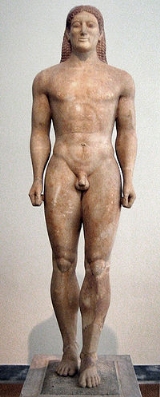
Kouros

Encyclopedia
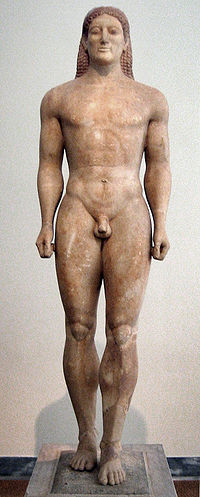
Archaic period in Greece
The Archaic period in Greece was a period of ancient Greek history that followed the Greek Dark Ages. This period saw the rise of the polis and the founding of colonies, as well as the first inklings of classical philosophy, theatre in the form of tragedies performed during Dionysia, and written...
. The term kouros, meaning (male) youth, was first proposed for what were previously thought to be depictions of Apollo by V. I. Leonardos in 1895 in relation to the youth from Keratea
Keratea
Keratea is a town in East Attica, Greece. Since the 2011 local government reform it is part of the municipality Lavreotiki, of which it is a municipal unit.Keratea is linked with a highway to Glyka Nera and Sounio...
, and adopted by Lechat as a generic term for the standing male figure in 1904. Such statues are found across the Greek-speaking world, the preponderance of these were found in sanctuaries of Apollo with more than one hundred from the sanctuary of Apollo Ptoios, Boeotia, alone. These free-standing sculptures were typically marble
Marble
Marble is a metamorphic rock composed of recrystallized carbonate minerals, most commonly calcite or dolomite.Geologists use the term "marble" to refer to metamorphosed limestone; however stonemasons use the term more broadly to encompass unmetamorphosed limestone.Marble is commonly used for...
, but also the form is rendered in limestone, wood, bronze, ivory and terracotta. They are typically life-sized, though early colossal examples are up to 3 meters tall.
The female sculptural counterpart of the Kouros is the Kórē
Kore (sculpture)
Kore is the name given to a type of ancient Greek sculpture of the Archaic period.There are multiple theories on who they represent, and as to whether they represent mortals or deities - one theory is that they represent Persephone the daughter in the triad of the Mother Goddess cults or votary...
or Koúrē (Plural: Korai or Koúrai).
Purpose
Apollo
Apollo is one of the most important and complex of the Olympian deities in Greek and Roman mythology...
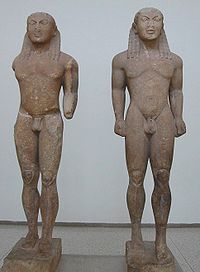
, as attested by its depiction on a vase painting in the presence of suppliants, as does the description of the statue of the Pythian Apollo at Samos by Diodoros as "Egyptian works, with his arms hanging by his sides and his legs parted". However, not all kouroi are images of a deity; many have been discovered in cemeteries where they most likely served as commemorative tombstones of the deceased, also the type was used as a memorial for victors in the games (like trophies) (Pausanias describes the statue of Arrhichion, an Olympic pankratiast, as in the kouros scheme), and some kouroi have been found in sanctuaries other than that of Apollo. Indeed some kouroi placed in sanctuaries were not inscribed with the name of the god but with a mortal, for example the 'Delphi Twins' Kleobis and Biton were honoured for their piety with matching kouroi.
A direct influence between Egyptian monumental sculpture (in particular the figure of Horus) and the kouros type has long been conjectured, not least of all because of known trade and cultural relations that had existed since the mid-seventh century. A 1978 study by Eleanor Guralnick applied stereophotogrammetric
Photogrammetry
Photogrammetry is the practice of determining the geometric properties of objects from photographic images. Photogrammetry is as old as modern photography and can be dated to the mid-nineteenth century....
measurement and cluster analysis to a number of Greek and Egyptian statues and found the correlation between the Second Canon of the 26th Dynasty and Greek kouroi to be widely distributed but not universal.
Origin and evolution
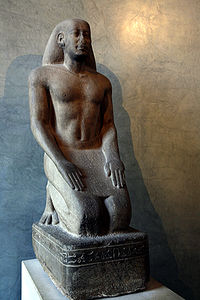
The work of Guralnick along with the previous studies by Erik Iversen and Kim Levin have added considerably to the argument for an imitation by Greek sculptors of Egyptian sculpture. The system of proportion in the second Egyptian canon of the Saite period consisted of a grid of twenty-one and one fourth parts, with twenty-one squares from the soles of the feet to a line drawn through the centres of the eyes. The grid was applied to the surface of the block being carved, allowing the major anatomical features to be located at fixed grid points. Iversen has shown that the New York kouros conforms to this ratio of proportion. It was Guralnick, however, who developed this discovery by comparing other kouroi by means of cluster and Z-score
Standard score
In statistics, a standard score indicates how many standard deviations an observation or datum is above or below the mean. It is a dimensionless quantity derived by subtracting the population mean from an individual raw score and then dividing the difference by the population standard deviation...
profile analysis to the Egyptian Canon II and a control group composed of statistically average Mediterranean men. As a result she has identified two strains within methods of proportioning in sixth century kouroi, where the majority follow the general line of evolution from the foreign model towards an idealized human norm.
Attributes and meaning
Kouroi are invariably nude, beardless and take a formulaic advancing posture. Yet a small number of early kouroi do have a belt around their waists, a practice that dies out at the turn of the sixth century. Such belts have traditionally been assumed to be an abbreviated symbol of a more complex costume, however fully clothed contemporary figures also exists suggesting that it was not just a sculptor's shorthand for clothing but a signifier in itself. This, it has been suggested, may have been an attribute of Apollo, athleticism or magical powers, though its iconography remains obscure. Further there is the problem of the nudity of the kouros and if this is also an attribute. Again this may have represented athletic or heroic nudity - immortalising the youth as he appeared in the palaestraPalaestra
The palaestra was the ancient Greek wrestling school. The events that did not require a lot of space, such as boxing and wrestling, were practised there...
, but no examples have been found at Olympia nor do they bear any allusion to athletic equipment.
As well as being found in the sanctuaries of Apollo at Delphi, Delos and Mt. Ptoion, they were also found dedicated at the sancuaries of Hera at Samos, and those of Athena and Poseidon at Sounion so the contention that they depict Apollo is at the very least problematic. Yet it remains the case that the majority were from Apollonian sites and dedicated to that god, which has led Brunilde Ridgway to suggest that the early, belted form of the kouros type was introduced in the late seventh century as a replacement for the colossal representation of him. And over time the votive and funerary functions of the sculpture became divorced whilst its attributes were shed and its form became more generic until, in the late sixth century, it could serve a number of uses depending on context and location. This 'polyvalent' argument put forward by Ducat was elaborated by Andrew Stewart with his argument that the distribution of kouroi conincides with those city-states where the aristocracy were in ascendancy and that in this alternation between the divine and the memorial is an identification of aristocratic arete
Arete
Areté is the term meaning "virtue" or "excellence", from Greek ἈρετήArete may also be used:*as a given name of persons or things:**Queen Arete , a character in Homer's Odyssey.***197 Arete, an asteroid....
with the immortal.
Development
The earliest extant examples may be the two life-sized marble figures from the Ionic sanctuary on the island of Delos dating from the second or third quarter of the seventh century. The canonical form of the kouros persists until the beginning of the classical period, by which time artists had achieve a high degree of anatomical verisimilitude, if not naturalism, as can be observed on such transitional works as the Kritios BoyKritios Boy
The marble Kritios boy or Kritian Boy belongs to the Late Archaic period of ancient Greek sculpture; "the first beautiful nude in art", as Kenneth Clark thought, it is a precursor to the later classical sculptures of athletes...
, ca. 480 BC.
The absolute chronology of the kouros form is uncertain; none of the sculptures have secure dates. Further there is a strong homogeneity across the various regional schools: where anatomical innovations were adopted they seem to have spread quickly amongst the different workshops so that "regional distinctions become merged in a common progression". Consequently the development of the kouros type as we now understand it is based on the relative chronology delineated by Gisela Richter. She distinguishes six groups by their common anatomical features, with particular reference to the major muscle groups as illustrated in the écorchés below.
Sounion group
C. 615-590 BC. The dates of this period are tentative, roughly late seventh-early sixth century, which Richter infers from the duration of development necessary for the previous generations from the more securely dated Tenea-Volomandra group. Additionally she notes a similarity of sculpture from this time to early Athenian potteryBlack-figure pottery
Black-figure pottery painting, also known as the black-figure style or black-figure ceramic is one of the most modern styles for adorning antique Greek vases. It was especially common between the 7th and 5th centuries BC, although there are specimens dating as late as the 2nd century BC...
, particularly the Nessos amphora
Nessos Painter
The Nessos Painter , was a pioneer of Attic black-figure vase painting...
and the human figures on the Horse amphorae. She also detects a resemblance between the New York-Sounion kouroi and an early Corinthian pyxis of the last quarter of the seventh century. Notable works of the time include the New York kouros (Met 32.11.1), Dermys and Kittylos (NAMA 56), Delphi
Delphi
Delphi is both an archaeological site and a modern town in Greece on the south-western spur of Mount Parnassus in the valley of Phocis.In Greek mythology, Delphi was the site of the Delphic oracle, the most important oracle in the classical Greek world, and a major site for the worship of the god...
Twins (Delphi Mus. 467 and 1524), the Sounion kouros, and the Delos colossus.
The conception of form in this period is abstract and geometrical, emphasis is on architectural shape and the interrelation of parts which favoured expressive pattern over realism. Figures displays the four faces of the block from which they are carved, their form is cubic with details incised, and their anatomy is only partially understood. Harmony and expressive pattern are the goal, and as such the proportions are abnormal. The torso is four-sided and flat, the back is higher than chest with the vertebral column expressed as a straight line. The skull is undeveloped; flat at the back and often on top. The ear is carved in one plane, and highly stylized. Tragus is knob like, either on cheek or lobe. Antitragus
Antitragus
The antitragus is a feature of mammalian ear anatomy. In humans, it is a small tubercle that points anteriorly, but it may be much larger in some other species, most notably bats. It is separated from the tragus by the intertragic notch.-External links:...
is not indicated. The eyes are large and flat, canthus
Canthus (anatomy)
Canthus is either corner of the eye where the upper and lower eyelids meet. More specifically, the medial and lateral canthi would be described as the medial and lateral ends/angles of the palpebral fissure....
is not marked, lachrymal caruncle
Ciaccio's glands
Ciaccio's glands are small tubular accessory lacrimal glands found in the lacrimal caruncle of the eyelid. They are located in the upper border of the tarsus, approximately in the middle between the extremities of the tarsal glands. Sometimes they are situated slightly above the tarsus...
is not indicated. The mouth is horizontal, with lips on same plane, and corners of mouth forming triangular depressions. Hair is arranged in parallel beaded tresses, which rarely radiates from the vertex
Vertex (anatomy)
In arthropod and vertebrate anatomy, the vertex refers to the upper surface of the head.In humans, the vertex is formed by four bones of the skull: the frontal bone, the two parietal bones, and the occipital bone...
. The Sterno-mastoids
Sternocleidomastoid muscle
In human anatomy, the sternocleidomastoid muscle , also known as sternomastoid and commonly abbreviated as SCM, is a paired muscle in the superficial layers of the anterior portion of the neck...
, when marked, are indicated by grooves running to the sternal notch
Suprasternal notch
The suprasternal notch , also known as the jugular notch, is part of human anatomy. It is a large, visible dip.-Anatomical location:...
. There is no indication of swelling of trapezius on the outline of shoulders. The clavicles are flat ridges along whole course of shoulders. Median line is sometimes marked by a groove from sternal notch to navel. The lower boundary of the thorax
Thorax
The thorax is a division of an animal's body that lies between the head and the abdomen.-In tetrapods:...
has the shape of a pointed arch. Rectus abdominis is formed by three or more transverse divisions above navel. The navel is generally a knob in a circular groove. Serratus magnus
Serratus anterior muscle
The serratus anterior is a muscle that originates on the surface of the upper eight or nine ribs at the side of the chest and inserts along the entire anterior length of the medial border of the scapula.-Origin:...
is not indicated. The shoulder blades are outlined by grooves on the surface of back. The erector spinae
Erector spinae
The Erector spinæ is a muscle group of the back in humans and animals. It is also known as sacrospinalis in older texts. A more modern term is extensor spinae, though this is not in widespread use. The name of the muscle is pronounced e-rec-tor speen-aye, or e-rec-tor spinae-ee.It is really not...
attachment to posterior part of the iliac crest
Iliac crest
-External links: - "Superficial muscles of the gluteal region and posterior thigh." - "Anterior Abdominal Wall: Osteology and Surface Anatomy " - "The Back, Posterior View" * *...
is sometimes indicated by grooves in the lumbar
Lumbar
In tetrapod anatomy, lumbar is an adjective that means of or pertaining to the abdominal segment of the torso, between the diaphragm and the sacrum ...
regions. Forearm is supinated
Supination
Supination is a position of either the forearm or foot; in the forearm when the palm faces anteriorly, or faces up . Supination in the foot occurs when a person appears "bow-legged" with their weight supported primarily on the anterior of their feet.The hand is supine in the anatomical position...
, with palm towards the body. Arms often separated from body between armpit and hand. Thumbs are large. Vastus internus
Vastus medialis
The vastus medialis , often called the 'teardrop' muscle, is a medially located muscle of the quadriceps.-Function:The vasti appear to act largely in a co-ordinated manner throughout the control of knee extension...
descends to about the same level as vastus externus
Vastus lateralis muscle
The Vastus lateralis is the largest part of the Quadriceps femoris. It arises by a broad aponeurosis, which is attached to the upper part of the intertrochanteric line, to the anterior and inferior borders of the greater trochanter, to the lateral lip of the gluteal tuberosity, and to the upper...
, the shin is vertical, and the malleoli are level. Weight is evenly distributed on both legs and the flanks are level.
Orchomenos-Thera group
C. 590-570 BC. This period witnesses a lull in Attica with perhaps only two identifiable works from the beginning of the era until the second quarter of century (NAMA 3858 and 4181), this might be due to the Solonic reforms and their restriction on the extravagance of private funerals. Activity is more vigorous in Boeotia, especially those from the Ptoan sanctuary and the Orchomenos kouros (NAMA 9), early work there is probably native. Also Corinth, Actium produces one of best examples of the period (Louvre MNB 767), detailing still of in the form of grooves and ridges but there is the beginning of modeling in the full roundness of natural form. One of the more accomplished products of the time is the Thera kouros (NAMA 8), softer and less muscular in modeling it is more Ionian than Dorian though Thera was a Dorian colony. We may deduce the chronology of this period only if the dates for the Sounion and Volodmera groups are correct since there is no external evidence for the dates of this style; however, we can usefully compare the heads on vase painting of middle Corinthian 600-575 which share the same stolid expression, flat skull, large eyes and horizontal mouth.The characteristics of this style are as follows. The ear is still carved in one plane, but less stylised. Eyes are not so large as before and more rounded. Mouth is horizontal but no longer always in one plane. The slight protrusions of flanks are sometimes prolonged into a girdle-like ridge, the sculptor occasionally marks the anterior spine of the crest. Shoulder blades are now separate raised planes. The erector spinae sometimes indicated as raised planes. Arms are generally joined to body. The depression over great trochanter
Greater trochanter
The greater trochanter of the femur is a large, irregular, quadrilateral eminence and a part of the skeletal system.It is directed a little lateralward and backward, and, in the adult, is about 1 cm lower than the head...
is generally omitted. Shin sometimes curves inwards. Left flank is occasionally placed slightly forward.
Tenea-Volomandra group
Ca. 575-550 BC. Named after an Attic kouros found at Volomandra (NAMA 1906) and a Corinthian specimen from Tenea (Munich 168) this period marks the flowering of the Middle Archaic, and these kouroi are contemporary with such works as the Berlin Standing Kore, the Moschophoros and the Bluebeard Pediment. There is a tension observable in this group between the solid, architectonic quality of early styles and the expressive possibilities of a vigorous, fluid naturalism . The anatomical novelties of this time are as follows. The ear is carved in more than one plane. A roundness of the eye is indicated henceforth. Lips curve upwards and meet more or less at corners, the upper lip protrudes over lower. Construction of neck is generalized, sterno-mastoids when indicated are marked by slightly modelled shapes. On the median line a groove along sternum is generally replaced replaced by modelled shapes and only the linea alba is marked by only a groove. The lower boundary of thorax assumes the shape of a somewhat rounded arch. There is a slight indication of the external oblique bulging over the iliac crestIliac crest
-External links: - "Superficial muscles of the gluteal region and posterior thigh." - "Anterior Abdominal Wall: Osteology and Surface Anatomy " - "The Back, Posterior View" * *...
. Shoulder blades are indicated as modelled shapes. The erector spinae is sometimes modelled. Size of thumb is normal. The vastus internus
Vastus medialis
The vastus medialis , often called the 'teardrop' muscle, is a medially located muscle of the quadriceps.-Function:The vasti appear to act largely in a co-ordinated manner throughout the control of knee extension...
descends lower than vastus externus
Vastus lateralis muscle
The Vastus lateralis is the largest part of the Quadriceps femoris. It arises by a broad aponeurosis, which is attached to the upper part of the intertrochanteric line, to the anterior and inferior borders of the greater trochanter, to the lateral lip of the gluteal tuberosity, and to the upper...
. Shins curve inwards. The external malleolus is lower and further back than the internal one. The little toes slant inwards. The metatarsal bones are lightly indicated.
The absolute chronology of this period is provided by the dedication of Rhombos on the Moschophoros, which may belong to the same time as a decree referring to the Panathenaia of 566. The Moschophoros is stylistically similar to early in this group giving us an approximate upper limit of 570. Additionally the terracotta kneeling boy found in a well in the Agora and dated by its black-figure pottery sherd stratum to circa 550 shares the flat almond eyes, absence of the trapezium and pointed arch of the lower thorax that characterizes the late Tenea-Volomandra, furnishing us with a tentative lower boundary for the style.
Melos group
C. 555-540 BC. Figures of this period are simpler than before; their muscles are no longer separately accentuated. There is a tendency to flowing contour and a generalization of form. The tragus now sometimes assumes its natural form. The anterior part of the helixHelix (ear)
The prominent rim of the auricula is called the helix. Where the helix turns downward behind, a small tubercle is frequently seen: the auricular tubercle of Darwin....
, which is directed backwards (crus helicis), is often prominent, and joined with the upper end of tragus. The antitragus is sometimes tentatively indicated, though wrongly placed. The anterior triangle of the neck is now better understood. Navel generally modelled as a depression. Indication of external oblique bulging over iliac crest. The lower boundary of abdomen occasionally forms a deep curve. Forearm and arm sometimes correctly semi-pronated; both directed towards body. Arms sometimes arched towards body below the armpit. Big toe projects a little further or same as second toe. Four smaller toes and toe nails curve gently downwards.
"Astonishingly uniform" the products of this period are found across the Greek world in large quantities. This group is named after the best preserved example of the era (NAMA 1558). The date of this group is conjectured on the basis that one generation would be required for the development of the Melos group style prior to the more securely dated Anavysos-Ptoon style. However Richter argues there may be some relationship to other contemporary Greek art works, namely: the figures on Late Corinthian pottery circa 550 BC. exhibit the same degree of naturalism, and the archaic column sculptures from the Temple of Artemis Ephesos, thought to have been supplied by Croesus of Lydia, share some anatomical features. Of the important works that come done to us there is the colossal kouros from Megera (NAMA 13), a transitional early piece from Boeotia (Thebes 3) and an early Parian example (Louvre MND 888).
Anavysos-Ptoon 12 group
C. 540-520 BC. This is the era of the Peisistratos dynasty and marks the assumption of Athens as the centre of artistic activity in Greece. In this period of great development the anatomical proportions become normal, the forms modelled and the spine clearly S-shaped. The head is now spherical and well-developed. The tragus takes on its natural form, the antitragus is also indicated. Hair occasionally descends as far as nape of neck. The sterno-mastoids when marked are indicated by modelled shapes. Their attachment to sternum and clavicles is often not indicated, this results in a continuous hollow groove or run above the clavicle. There is an attempt to indicate the backward curve of clavicle. Groove along linea albaLinea alba
The linea alba is a fibrous structure that runs down the midline of the abdomen in humans and other vertebrates. The name means white line and the linea alba is indeed white, being composed mostly of collagen connective tissue....
is sometimes continued below the navel. The lower boundary of thorax arch is indicated. In the flanks the swelling of the external part is well developed. Lower boundary of abdomen assumes shape of small semicircle or deep curve. The erector spinae always indicated as modelled shape. Generally hand and forearm is semi-pronated. Hands are no longer attached to body but joined by short supports. The metacarpal bones are sometimes indicated. The bulge of the vastus internus increases. Toes are no longer parallel but do not recede along a continuous curve. Toes and nails point upwards. The articulation of joints is well rendered. Sometimes the flank of the advanced leg is placed forward and higher than receding leg.
The characteristics of this group can be observed on the Siphnian Treasury
Siphnian Treasury
The Siphnian Treasury was a dedicated building to the Greek polis, or city-state, of Delphi, by the Greek city-state of Siphnos. Such dedications were common among city-states in order to win the favor of the gods....
which is dated on external evidence before 525 BC, therefore allowing time for the maturation of the style we can date the beginning of this group to, roughly, a generation prior. The earliest is perhaps the Munich kouros (Glyptothek 169) judging by the rendering of some of the muscles. Other significant Attic kouroi in this style are the Anavyssos (NAMA 3851), the akropolis torso (Akropolis 665, 596), and the Rayet head (Carlsberg Glyptothek 418). The island of Keos supplies us with one of the best examples of the time (NAMA 3686), notable for its advanced rendering of the back where the greatest protrusion of the back is level with that of the chest. Keos was likely under the cultural influence of Athens at this time and this kouros is comparable to and chronologically close to the Anavyssos kouros and akropolis head. From the Ptoan sanctuary in Boeotia we have the Ptoon 12 kouros (NAMA), "softer, less sturdy" suggests Richter it is, she asserts, a native Boeotian product and not an Athenian import.
Ptoon 20 group
C. 520-485 BC. The last stage in the development of the kouros type is the period in which the Greek sculptor attained a full knowledge of human anatomy and used it to create a harmonious, proportionate whole. The features that now become expressed are as follows. The lachrymal caruncle is sometimes indicated. Lips curved upwards only in early examples, the upper lip protrudes markedly over the lower and lips are well shaped. Hair is generally short or rolled up behind, it radiates from a point near vertex and carved in wavy strands. The structure of neck is now correct. There is an indication of swelling of trapezium on the outline of shoulder, becoming more pronounced over time. Clavicles assume an s-shape and lose themselves in shoulders. The lower boundary of thorax assumes a semicircular arch. The rectus abdominis, now reduced in number to two, with the top one incorporated into lower boundary of thorax. There is a small raised plane caused by projection of xiphoid appendageXiphoid process
The xiphoid process, or xiphisternum or metasternum, is a small cartilaginous process of the lower part of the sternum which is usually ossified in the adult human. By age 15 to 29, the xiphoid usually fuses to the body of the sternum with a fibrous joint. Unlike the synovial articulation of major...
sometimes observable at lower end of sternum. Navel has fold of skin above in most examples. The lower boundary of abdomen assumes shape of semicircle, and the upper edge of torso with two concave curves becomes regular in form. Forearm and hand correctly pronated. Arms sometimes held free from body. Flanks; occasionally at first later regularly, flank and buttock of supporting leg rise in conformity with action.
This period is framed by the stasis of the Peisistratid era and the beginning of Athenian democracy and the Persian war. The upper limit of this group may be fixed by the sculpture of the temple of Apollo, Delphi. Architecturally earlier than the Hekatompedon of Athens the Delphi temple has a probable date of c.520, thus the kouroi of its pediment which betray the swelling trapezium and semicircular lower boundary of the abdomen can be associated with later examples of the group. Yet these same youths have a grooved, narrow lower boundary to the thorax and their flanks are level, suggesting that they are early specimens of the style. Richter names this group after the kouros Ptoon 20, NAMA 20, which is likely a Boeotian work dedicated by Pythias of Akraiphia and Aischrion to Apollo of the silver bow. This along with the torso form Eutresis (Thebes 7) indicate a vigorous Boeotian school of sculpture which may have existed to serve the Ptoan sanctuary. Attic production is considerable up to c.500 BC after which it seems to peter out. Important late kouroi from Athens include the Aristodikos kouros (Ptoon 20 group, NAMA 3938), an akropolis statuette (NAMA 6445) and the bronze Apollo from Piraeus.
See also
- Greek artGreek artGreek art began in the Cycladic and Minoan prehistorical civilization, and gave birth to Western classical art in the ancient period...
- Strangford ApolloStrangford ApolloThe Strangford Apollo is an Ancient Greek kouros sculpture in marble of around 500-490 BC. It is said to be from the island of Anafi, and is named after Percy Smythe, 6th Viscount Strangford, who once owned it. It is now in Room 15 of the British Museum, with the catalogue reference GR...
- Biton and Kleobis
- National Archaeological Museum of AthensNational Archaeological Museum of AthensThe National Archaeological Museum in Athens houses some of the most important artifacts from a variety of archaeological locations around Greece from prehistory to late antiquity. It is considered one of the great museums in the world and contains the richest collection of artifacts from Greek...
- List of museums in Greece
- Rampin RiderRampin RiderThe Rampin Rider or Rampin Horseman is an equestrian statue from the Archaic Period of Ancient Greece. The statue was made of marble and has traces of red and black paint. The head of the rider was found on the Acropolis of Athens in 1877 and donated to the Louvre...
- Getty kourosGetty kourosThe Getty kouros is an over-life-sized statue in the form of a late archaic Greek kouros. The dolomitic marble sculpture was bought by the J. Paul Getty Museum, Malibu, California, in 1985 for $7 million and first exhibited there in October 1986....