


Gothic art

Encyclopedia
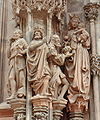

Medieval art
The medieval art of the Western world covers a vast scope of time and place, over 1000 years of art history in Europe, and at times the Middle East and North Africa...
movement
Art movement
An art movement is a tendency or style in art with a specific common philosophy or goal, followed by a group of artists during a restricted period of time, or, at least, with the heyday of the movement defined within a number of years...
that developed in France out of Romanesque art
Romanesque art
Romanesque art refers to the art of Western Europe from approximately 1000 AD to the rise of the Gothic style in the 13th century, or later, depending on region. The preceding period is increasingly known as the Pre-Romanesque...
in the mid-12th century, led by the concurrent development of Gothic architecture
Gothic architecture
Gothic architecture is a style of architecture that flourished during the high and late medieval period. It evolved from Romanesque architecture and was succeeded by Renaissance architecture....
. It spread to all of Western Europe, but took over art more completely north of the Alps
Alps
The Alps is one of the great mountain range systems of Europe, stretching from Austria and Slovenia in the east through Italy, Switzerland, Liechtenstein and Germany to France in the west....
, never quite effacing more classical styles in Italy. In the late 14th century, the sophisticated court style of International Gothic
International Gothic
International Gothic is a phase of Gothic art which developed in Burgundy, Bohemia, France and northern Italy in the late 14th century and early 15th century...
developed, which continued to evolve until the late 15th century. In many areas, especially Germany, Late Gothic art continued well into the 16th century, before being subsumed into Renaissance art. Primary media in the Gothic period included sculpture
Sculpture
Sculpture is three-dimensional artwork created by shaping or combining hard materials—typically stone such as marble—or metal, glass, or wood. Softer materials can also be used, such as clay, textiles, plastics, polymers and softer metals...
, panel painting
Panel painting
A panel painting is a painting made on a flat panel made of wood, either a single piece, or a number of pieces joined together. Until canvas became the more popular support medium in the 16th century, it was the normal form of support for a painting not on a wall or vellum, which was used for...
, stained glass
Stained glass
The term stained glass can refer to coloured glass as a material or to works produced from it. Throughout its thousand-year history, the term has been applied almost exclusively to the windows of churches and other significant buildings...
, fresco
Fresco
Fresco is any of several related mural painting types, executed on plaster on walls or ceilings. The word fresco comes from the Greek word affresca which derives from the Latin word for "fresh". Frescoes first developed in the ancient world and continued to be popular through the Renaissance...
and illuminated manuscript
Illuminated manuscript
An illuminated manuscript is a manuscript in which the text is supplemented by the addition of decoration, such as decorated initials, borders and miniature illustrations...
s. The easily recognisable shifts in architecture from Romanesque to Gothic, and Gothic to Renaissance styles, are typically used to define the periods in art in all media, although in many ways figurative art developed at a different pace.
The earliest Gothic art was monumental sculpture
Monumental sculpture
The term monumental sculpture is often used in art history and criticism, but not always consistently. It combines two concepts, one of function, and one of size, and may include an element of a third more subjective concept. It is often used for all sculptures that are large...
, on the walls of Cathedrals and abbeys. Christian art was often typological
Typology (theology)
Typology in Christian theology and Biblical exegesis is a doctrine or theory concerning the relationship between the Old and New Testaments...
in nature (see Medieval allegory), showing the stories of the New Testament and the Old Testament side by side. Saints' lives were often depicted. Images of the Virgin Mary changed from the Byzantine iconic form to a more human and affectionate mother, cuddling her infant, swaying from her hip, and showing the refined manners of a well-born aristocratic courtly lady.
Secular art came in to its own during this period with the rise of cities, foundation of universities
Medieval university
Medieval university is an institution of higher learning which was established during High Middle Ages period and is a corporation.The first institutions generally considered to be universities were established in Italy, France, and England in the late 11th and the 12th centuries for the study of...
, increase in trade, the establishment of a money-based economy and the creation of a bourgeois class who could afford to patronize the arts and commission works resulting in a proliferation of paintings and illuminated manuscripts. Increased literacy and a growing body of secular vernacular literature
Medieval literature
Medieval literature is a broad subject, encompassing essentially all written works available in Europe and beyond during the Middle Ages . The literature of this time was composed of religious writings as well as secular works...
encouraged the representation of secular themes in art. With the growth of cities, trade guild
Guild
A guild is an association of craftsmen in a particular trade. The earliest types of guild were formed as confraternities of workers. They were organized in a manner something between a trade union, a cartel, and a secret society...
s were formed and artists were often required to be members of a painters' guild—as a result, because of better record keeping, more artists are known to us by name in this period than any previous; some artists were even so bold as to sign their names.
Origins

Île-de-France (province)
The province of Île-de-France or Isle de France is an historical province of France, and the one at the centre of power during most of French history...
, France, in the early 12th century at the Abbey Church of St Denis built by Abbot Suger
Abbot Suger
Suger was one of the last Frankish abbot-statesmen, an historian, and the influential first patron of Gothic architecture....
. The style rapidly spread beyond its origins in architecture to sculpture, both monumental
Monumental sculpture
The term monumental sculpture is often used in art history and criticism, but not always consistently. It combines two concepts, one of function, and one of size, and may include an element of a third more subjective concept. It is often used for all sculptures that are large...
and personal in size, textile art, and painting, which took a variety of forms, including fresco
Fresco
Fresco is any of several related mural painting types, executed on plaster on walls or ceilings. The word fresco comes from the Greek word affresca which derives from the Latin word for "fresh". Frescoes first developed in the ancient world and continued to be popular through the Renaissance...
, stained glass
Stained glass
The term stained glass can refer to coloured glass as a material or to works produced from it. Throughout its thousand-year history, the term has been applied almost exclusively to the windows of churches and other significant buildings...
, the illuminated manuscript
Illuminated manuscript
An illuminated manuscript is a manuscript in which the text is supplemented by the addition of decoration, such as decorated initials, borders and miniature illustrations...
, and panel painting
Panel painting
A panel painting is a painting made on a flat panel made of wood, either a single piece, or a number of pieces joined together. Until canvas became the more popular support medium in the 16th century, it was the normal form of support for a painting not on a wall or vellum, which was used for...
. Monastic orders, especially the Cistercians and the Carthusian
Carthusian
The Carthusian Order, also called the Order of St. Bruno, is a Roman Catholic religious order of enclosed monastics. The order was founded by Saint Bruno of Cologne in 1084 and includes both monks and nuns...
s, were important builders who disseminated the style and developed distinctive variants of it across Europe. Regional variations
Cathedral architecture of Western Europe
The architecture of cathedrals, basilicas and abbey churches is the architecture of those church buildings which are usually of large size, including most cathedrals, and follow one of several branching traditions of form, function and style that stem initially from Early Christian traditions of...
of architecture remained important, even when, by the late 14th century, a coherent universal style known as International Gothic
International Gothic
International Gothic is a phase of Gothic art which developed in Burgundy, Bohemia, France and northern Italy in the late 14th century and early 15th century...
had evolved, which continued until the late 15th century, and beyond in many areas.
Although there was far more secular Gothic art than is often thought today, as generally the survival rate of religious art has been better than for secular equivalents, a large proportion of the art produced in the period was religious, whether commissioned by the church or by the laity.
Gothic art was often typological
Typology (theology)
Typology in Christian theology and Biblical exegesis is a doctrine or theory concerning the relationship between the Old and New Testaments...
in nature, reflecting a belief that the events of the Old Testament pre-figured those of the New, and that this was indeed their main significance. Old and New Testament scenes were shown side by side in works like the Speculum Humanae Salvationis
Speculum Humanae Salvationis
The Speculum Humanae Salvationis or Mirror of Human Salvation was a bestselling anonymous illustrated work of popular theology in the late Middle Ages, part of the genre of encyclopedic speculum literature, in this case concentrating on the medieval theory of typology, whereby the events of the Old...
, and the decoration of churches. The Gothic period coincided with a great resurgence in Marian devotion, in which the visual arts played a major part. Images of the Virgin Mary developed from the Byzantine hieratic types, through the Coronation of the Virgin
Coronation of the Virgin
The Coronation of the Virgin or Coronation of Mary is a subject in Christian art, especially popular in Italy in the 13th to 15th centuries, but continuing in popularity until the 18th century and beyond. Christ, sometimes accompanied by God the Father and the Holy Spirit in the form of a dove,...
, to more human and initimate types, and cycles of the Life of the Virgin
Life of the Virgin
The Life of the Virgin, showing narrative scenes from the life of Mary, the mother of Jesus, is a common subject for pictorial cycles in Christian art, often complementing, or forming part of, a cycle on the Life of Christ. In both cases the number of scenes shown varies greatly with the space...
were very popular. Artists like Giotto, Fra Angelico
Fra Angelico
Fra Angelico , born Guido di Pietro, was an Early Italian Renaissance painter described by Vasari in his Lives of the Artists as having "a rare and perfect talent"...
and Pietro Lorenzetti
Pietro Lorenzetti
Pietro Lorenzetti was an Italian painter, active between approximately 1306 and 1345. His younger brother was the painter Ambrogio Lorenzetti....
in Italy, and Early Netherlandish painting
Early Netherlandish painting
Early Netherlandish painting refers to the work of artists active in the Low Countries during the 15th- and early 16th-century Northern renaissance, especially in the flourishing Burgundian cities of Bruges and Ghent...
, brought realism and a more natural humanity to art. Western artists, and their patrons, became much more confident in innovative iconography
Iconography
Iconography is the branch of art history which studies the identification, description, and the interpretation of the content of images. The word iconography literally means "image writing", and comes from the Greek "image" and "to write". A secondary meaning is the painting of icons in the...
, and much more originality is seen, although copied formulae were still used by most artists.
Iconography was affected by changes in theology, with depictions of the Assumption of Mary
Assumption of Mary
According to the belief of Christians of the Roman Catholic Church, Eastern Orthodoxy, Oriental Orthodoxy, and parts of the Anglican Communion and Continuing Anglicanism, the Assumption of Mary was the bodily taking up of the Virgin Mary into Heaven at the end of her life...
gaining ground on the older Death of the Virgin
Death of the Virgin
The Death of the Virgin Mary is a common theme in Western Christian art, comparable to the Dormition in Eastern Orthodox art. It becomes less common as the doctrine of the Assumption gains support in the Roman Catholic Church from the late Middle Ages onwards...
, and in devotional practices such as the Devotio Moderna
Devotio Moderna
Devotio Moderna, or Modern Devotion, was a 14th century new religious movement, with Gerard Groote as a key founder. Other well known members included Thomas à Kempis who was the likely author of the book The Imitation of Christ which proved to be highly influential for centuries.Groote's initial...
, which produced new treatments of Christ in subjects such as the Man of Sorrows
Man of Sorrows
Among the passages in the Hebrew Bible that have been identified by Christians as prefigurations of the Messiah, the Man of Sorrows of Isaiah 53 is paramount - the various theological traditions are discussed at that article...
, Pensive Christ
Pensive Christ
The Pensive Christ or Christus im Elend is a subject in Christian iconography depicting a contemplating Jesus, sitting with his head supported by his hand with the Crown of Thorns and marks of his flagellation...
and Pietà
Pietà
The Pietà is a subject in Christian art depicting the Virgin Mary cradling the dead body of Jesus, most often found in sculpture. As such, it is a particular form of the Lamentation of Christ, a scene from the Passion of Christ found in cycles of the Life of Christ...
, which emphasized his human suffering and vulnerability, in a parallel movement to that in depictions of the Virgin. Even in Last Judgements Christ was now usually shown exposing his chest to show the wounds of his Passion. Saints were shown more frequently, and altarpiece
Altarpiece
An altarpiece is a picture or relief representing a religious subject and suspended in a frame behind the altar of a church. The altarpiece is often made up of two or more separate panels created using a technique known as panel painting. It is then called a diptych, triptych or polyptych for two,...
s showed saints relevant to the particular church or donor in attendance on a Crucifixion
Crucifixion
Crucifixion is an ancient method of painful execution in which the condemned person is tied or nailed to a large wooden cross and left to hang until dead...
or enthroned Virgin and Child, or occupying the central space themselves (this usually for works designed for side-chapels). Over the period many ancient iconographical features that originated in New Testament apocrypha
New Testament apocrypha
The New Testament apocrypha are a number of writings by early Christians that claim to be accounts of Jesus and his teachings, the nature of God, or the teachings of his apostles and of their lives. These writings often have links with books regarded as "canonical"...
were gradually eliminated under clerical pressure, like the midwives at the Nativity, though others were too well-established, and considered harmless.
Etymology
The word "Gothic" for art was initially used as a synonym for "Barbaric", and was therefore used pejoratively. Its critics saw this type of Medieval art as unrefined and too remote from the aesthetic proportions and shapes of Classical art. RenaissanceRenaissance
The Renaissance was a cultural movement that spanned roughly the 14th to the 17th century, beginning in Italy in the Late Middle Ages and later spreading to the rest of Europe. The term is also used more loosely to refer to the historical era, but since the changes of the Renaissance were not...
authors believed that the Sack of Rome
Sack of Rome (410)
The Sack of Rome occurred on August 24, 410. The city was attacked by the Visigoths, led by Alaric I. At that time, Rome was no longer the capital of the Western Roman Empire, replaced in this position initially by Mediolanum and then later Ravenna. Nevertheless, the city of Rome retained a...
by the Gothic tribes
Goths
The Goths were an East Germanic tribe of Scandinavian origin whose two branches, the Visigoths and the Ostrogoths, played an important role in the fall of the Roman Empire and the emergence of Medieval Europe....
in 410 had triggered the demise of the Classical world and all the values they held dear. In the 15th century, various Italian architects and writers complained that the new 'barbarian' styles filtering down from north of the Alps posed a similar threat to the classical revival promoted by the early Renaissance. The "Gothic" qualifier for this art was first used in Raphael
Raphael
Raffaello Sanzio da Urbino , better known simply as Raphael, was an Italian painter and architect of the High Renaissance. His work is admired for its clarity of form and ease of composition and for its visual achievement of the Neoplatonic ideal of human grandeur...
's letter to Pope Leo X
Pope Leo X
Pope Leo X , born Giovanni di Lorenzo de' Medici, was the Pope from 1513 to his death in 1521. He was the last non-priest to be elected Pope. He is known for granting indulgences for those who donated to reconstruct St. Peter's Basilica and his challenging of Martin Luther's 95 Theses...
c. 1518 and was subsequently popularised by the Italian artist and writer Giorgio Vasari
Giorgio Vasari
Giorgio Vasari was an Italian painter, writer, historian, and architect, who is famous today for his biographies of Italian artists, considered the ideological foundation of art-historical writing.-Biography:...
, who used it as early as 1530, calling Gothic art a "monstrous and barbarous" "disorder". Raphael claimed that the pointed arches of northern architecture were an echo of the primitive huts the Germanic forest dwellers formed by bending trees together - a myth which would resurface much later in a more positive sense in the writings of the German Romantic
Romanticism
Romanticism was an artistic, literary and intellectual movement that originated in the second half of the 18th century in Europe, and gained strength in reaction to the Industrial Revolution...
movement.
"Gothic art" was strongly criticized by French authors such as Boileau
Nicolas Boileau-Despréaux
Nicolas Boileau-Despréaux was a French poet and critic.-Biography:Boileau was born in the rue de Jérusalem, in Paris, France. He was brought up to the law, but devoted to letters, associating himself with La Fontaine, Racine, and Molière...
, La Bruyère
Jean de La Bruyère
Jean de La Bruyère was a French essayist and moralist.-Ancestry:He was born in Paris, not, as was once thought, at Dourdan in 1645...
, Rousseau, before becoming a recognized form of art, and the wording becoming fixed. Molière
Molière
Jean-Baptiste Poquelin, known by his stage name Molière, was a French playwright and actor who is considered to be one of the greatest masters of comedy in Western literature...
would famously comment on Gothic:
In its beginning, Gothic art was initially called "French work" (Opus Francigenum), thus attesting the priority of France in the creation of this style.
Painting
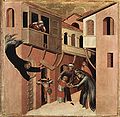
Fresco
Fresco is any of several related mural painting types, executed on plaster on walls or ceilings. The word fresco comes from the Greek word affresca which derives from the Latin word for "fresh". Frescoes first developed in the ancient world and continued to be popular through the Renaissance...
s, panel painting
Panel painting
A panel painting is a painting made on a flat panel made of wood, either a single piece, or a number of pieces joined together. Until canvas became the more popular support medium in the 16th century, it was the normal form of support for a painting not on a wall or vellum, which was used for...
s, manuscript illumination and stained glass
Stained glass
The term stained glass can refer to coloured glass as a material or to works produced from it. Throughout its thousand-year history, the term has been applied almost exclusively to the windows of churches and other significant buildings...
.
Frescoes
Frescoes continued to be used as the main pictorial narrative craft on church walls in southern Europe as a continuation of early Christian and Romanesque traditions. An accident of survival has given DenmarkChurch frescos in Denmark
Church frescos or church wall paintings are to be found in some 600 churches across Denmark, no doubt representing the highest concentration of surviving church murals anywhere in the world. Most of them date back to the Middle Ages...
and other Nordic countries the largest groups of surviving church wall paintings in the Biblia pauperum
Biblia pauperum
The Biblia pauperum was a tradition of picture Bibles beginning in the later Middle Ages. They sought to portray the historical books of the Bible visually. Unlike a simple "illustrated Bible", where the pictures are subordinated to the text, these Bibles placed the illustration in the centre,...
style, usually extending up to recently constructed cross vaults. They were almost all covered with limewash after the Reformation
Reformation in Denmark
The Reformation in Denmark–Norway and Holstein was the transition from Roman Catholicism to Lutheranism in the realms ruled by the Copenhagen-based House of Oldenburg in the first half of the sixteenth century...
which has preserved them. Among the finest examples are those of the Elmelunde Master
Elmelunde Master
The Elmelunde Master, Danish Elmelundemesteren, is the designation given to the nameless 16th century artist who painted the frescoes in the churches of Elmelunde, Fanefjord and Keldby on the island of Møn in south-eastern Denmark....
from the Danish island of Møn
Møn
-Location:Møn is located just off the south-eastern tip of Zealand from which it is separated by the waters of the Hølen strait between Kalvehave and the island of Nyord, at the northern end of Møn. Further south is Stege Bugt...
who decorated the churches of Fanefjord
Fanefjord Church
Fanefjord Church, one of the Danish island of Møn's most famous attractions, is located in an open setting overlooking the Baltic Sea inlet of Fanefjord between Store Damme and Hårbølle. Standing majestically on the top of a small hill, the church's red-tiled roof and whitewashed walls can be seen...
, Keldby
Keldby Church
Keldby Church, famous for its frescoes, is located on the main road to Møns Klint in the village of Keldby, 4 km east of Stege on the Danish island of Møn....
and Elmelunde
Elmelunde Church
Elmelunde Church, famous for its frescos, is located in the village of Elmelunde, Møn, in southeastern Denmark. It stands high above the surroundings just south of the main road from Stege to the white cliffs of Møn...
.
Stained glass
In northern Europe, stained glass was the art of choice until the 15th century. By the 15th century panel painting supplanted stained glass as the dominant form of Gothic painting.Manuscripts and printmaking
Illuminated manuscripts represent the most complete record of Gothic painting, providing a record of styles in places where no monumental works have otherwise survived. The earliest full manuscripts with French Gothic illustrations date to the middle of the 13th century. Many such illuminated manuscripts were royal bibles, although psalterPsalter
A psalter is a volume containing the Book of Psalms, often with other devotional material bound in as well, such as a liturgical calendar and litany of the Saints. Until the later medieval emergence of the book of hours, psalters were the books most widely owned by wealthy lay persons and were...
s also included illustrations; the Parisian Psalter of Saint Louis, dating from 1253 to 1270, features 78 full-page illuminations in tempera
Tempera
Tempera, also known as egg tempera, is a permanent fast-drying painting medium consisting of colored pigment mixed with a water-soluble binder medium . Tempera also refers to the paintings done in this medium. Tempera paintings are very long lasting, and examples from the 1st centuries AD still exist...
paint and gold leaf.
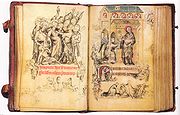
William de Brailes
William de Brailes was an English Early Gothic manuscript illuminator, presumably born in Brailes, Warwickshire. He signed two manuscripts, and apparently worked in Oxford, where he is documented from 1238 to 1252, owning property in Catte Street near the University Church of St Mary the Virgin,...
seems to have written for an unknown laywoman living in a small village
North Hinksey
North Hinksey , is a small civil parish in county Berkshire, 2 miles west of Oxford, and 5 miles north of of Abingdon,situated on the right bank of the Isis...
near Oxford
Oxford
The city of Oxford is the county town of Oxfordshire, England. The city, made prominent by its medieval university, has a population of just under 165,000, with 153,900 living within the district boundary. It lies about 50 miles north-west of London. The rivers Cherwell and Thames run through...
in about 1240. Nobility frequently purchased such texts, paying handsomely for decorative illustrations; among the most well-known creators of these is Jean Pucelle
Jean Pucelle
Jean Pucelle was a Parisian Gothic-era manuscript illuminator, active between 1320 and 1350. His style is characterized by delicate figures rendered in grisaille, accented with touches of color....
, whose work was commissioned by King Charles IV
Charles IV
Charles IV may refer to:* Charles IV of France, "the Fair" * Charles IV, Holy Roman Emperor * Charles IV of Navarre * Charles IV, Duke of Anjou * Charles IV of Alençon...
as a wedding gift for his bride, Jeanne d'Évreux
Jeanne d'Evreux
Jeanne d'Évreux was the third wife of King Charles IV of France, daughter of his uncle Louis d'Évreux and Margaret of Artois. She bore no male heir, thus "causing" the end of the direct line of the Capetian dynasty. Because she was his first cousin, the couple required papal permission to marry...
. Elements of the French Gothic present in such works include the use of decorative page framing reminiscent of the architecture of the time with elongated and detailed figures. The use of spatial indicators such as building elements and natural features such as trees and clouds also denote the French Gothic style of illumination.
From the middle of the 14th century, blockbooks with both text and images cut as woodcut seem to have been affordable by parish priests
Priest
A priest is a person authorized to perform the sacred rites of a religion, especially as a mediatory agent between humans and deities. They also have the authority or power to administer religious rites; in particular, rites of sacrifice to, and propitiation of, a deity or deities...
in the Low Countries
Low Countries
The Low Countries are the historical lands around the low-lying delta of the Rhine, Scheldt, and Meuse rivers, including the modern countries of Belgium, the Netherlands, Luxembourg and parts of northern France and western Germany....
, where they were most popular. By the end of the century, printed books with illustrations, still mostly on religious subjects, were rapidly becoming accessible to the prosperous middle class, as were engraving
Engraving
Engraving is the practice of incising a design on to a hard, usually flat surface, by cutting grooves into it. The result may be a decorated object in itself, as when silver, gold, steel, or glass are engraved, or may provide an intaglio printing plate, of copper or another metal, for printing...
s of fairly high-quality by printmakers like Israhel van Meckenem
Israhel van Meckenem
Israhel van Meckenem , also known as Israhel van Meckenem the Younger, was a German printmaker and goldsmith.He was the most prolific engraver of the fifteenth century and an important figure in the early history of old master prints. He was active from 1465 until his death.-Life:His birth date is...
and Master E. S.
Master E. S.
Master E. S. , is an unidentified German engraver, goldsmith, and printmaker of the late Gothic period. He was the first major German artist of old master prints and was greatly copied and imitated. The name assigned to him by art historians, Master E. S., is derived from the monogram, E...
. In the 15th century, the introduction of cheap prints
Old master print
An old master print is a work of art produced by a printing process within the Western tradition . A date of about 1830 is usually taken as marking the end of the period whose prints are covered by this term. The main techniques concerned are woodcut, engraving and etching, although there are...
, mostly in woodcut
Woodcut
Woodcut—occasionally known as xylography—is a relief printing artistic technique in printmaking in which an image is carved into the surface of a block of wood, with the printing parts remaining level with the surface while the non-printing parts are removed, typically with gouges...
, made it possible even for peasants to have devotional images at home. These images, tiny at the bottom of the market, often crudely coloured, were sold in thousands but are now extremely rare, most having been pasted to walls.
Altarpiece and panel painting
Painting with oil on canvas did not become popular until the 15th and 16th centuries and was a hallmark of Renaissance art. In Northern Europe the important and innovative school of Early Netherlandish paintingEarly Netherlandish painting
Early Netherlandish painting refers to the work of artists active in the Low Countries during the 15th- and early 16th-century Northern renaissance, especially in the flourishing Burgundian cities of Bruges and Ghent...
is in an essentially Gothic style, but can also be regarded as part of the Northern Renaissance
Northern Renaissance
The Northern Renaissance is the term used to describe the Renaissance in northern Europe, or more broadly in Europe outside Italy. Before 1450 Italian Renaissance humanism had little influence outside Italy. From the late 15th century the ideas spread around Europe...
, as there was a long delay before the Italian revival of interest in classicism
Classicism
Classicism, in the arts, refers generally to a high regard for classical antiquity, as setting standards for taste which the classicists seek to emulate. The art of classicism typically seeks to be formal and restrained: of the Discobolus Sir Kenneth Clark observed, "if we object to his restraint...
had a great impact in the north. Painters like Robert Campin
Robert Campin
Robert Campin , now usually identified as the artist known as the Master of Flémalle, is usually considered the first great master of Early Netherlandish painting...
and Jan van Eyck
Jan van Eyck
Jan van Eyck was a Flemish painter active in Bruges and considered one of the best Northern European painters of the 15th century....
, made use of the technique of oil painting
Oil painting
Oil painting is the process of painting with pigments that are bound with a medium of drying oil—especially in early modern Europe, linseed oil. Often an oil such as linseed was boiled with a resin such as pine resin or even frankincense; these were called 'varnishes' and were prized for their body...
to create minutely detailed works, correct in perspective, where apparent realism was combined with richly complex symbolism arising precisely from the realistic detail they could now include, even in small works. In Early Netherlandish painting, from the richest cities of Northern Europe, a new minute realism in oil painting
Oil painting
Oil painting is the process of painting with pigments that are bound with a medium of drying oil—especially in early modern Europe, linseed oil. Often an oil such as linseed was boiled with a resin such as pine resin or even frankincense; these were called 'varnishes' and were prized for their body...
was combined with subtle and complex theological allusions, expressed precisely through the highly detailed settings of religious scenes. The Mérode Altarpiece (1420s) of Robert Campin
Robert Campin
Robert Campin , now usually identified as the artist known as the Master of Flémalle, is usually considered the first great master of Early Netherlandish painting...
, and the Washington Van Eyck Annunciation
Annunciation (van Eyck, Washington)
The Annunciation is an oil painting by the Early Netherlandish master Jan van Eyck, from around 1434-1436. It is in the National Gallery of Art, in Washington D.C. It was originally on panel but has been transferred to canvas. It is thought that it was the left wing of a triptych; there has...
or Madonna of Chancellor Rolin
Madonna of Chancellor Rolin
The Madonna of Chancellor Rolin is an oil painting by the Early Netherlandish master Jan van Eyck, dating from around 1435. It is on display in the Musée du Louvre, Paris....
(both 1430s, by Jan van Eyck
Jan van Eyck
Jan van Eyck was a Flemish painter active in Bruges and considered one of the best Northern European painters of the 15th century....
) are examples. For the wealthy, small panel painting
Panel painting
A panel painting is a painting made on a flat panel made of wood, either a single piece, or a number of pieces joined together. Until canvas became the more popular support medium in the 16th century, it was the normal form of support for a painting not on a wall or vellum, which was used for...
s, even polyptych
Polyptych
A polyptych generally refers to a painting which is divided into sections, or panels. The terminology that follows is in relevance to the number of panels integrated into a particular piece of work: "diptych" describes a two-part work of art; "triptych" describes a three-part work; "tetraptych"...
s in oil painting
Oil painting
Oil painting is the process of painting with pigments that are bound with a medium of drying oil—especially in early modern Europe, linseed oil. Often an oil such as linseed was boiled with a resin such as pine resin or even frankincense; these were called 'varnishes' and were prized for their body...
were becoming increasingly popular, often showing donor portrait
Donor portrait
A donor portrait or votive portrait is a portrait in a larger painting or other work showing the person who commissioned and paid for the image, or a member of his, or her, family...
s alongside, though often much smaller than, the Virgin or saints depicted. These were usually displayed in the home.
Monumental sculpture
French ideas spread. In Germany, from 1225 at the Cathedral in BambergBamberg
Bamberg is a city in Bavaria, Germany. It is located in Upper Franconia on the river Regnitz, close to its confluence with the river Main. Bamberg is one of the few cities in Germany that was not destroyed by World War II bombings because of a nearby Artillery Factory that prevented planes from...
onward, the impact can be found everywhere. The Bamberg Cathedral
Bamberg Cathedral
The Bamberg Cathedral is a church in Bamberg, Germany, completed in the 13th century. The cathedral is under the administration of the Roman Catholic Church and is the seat of the Archbishop of Bamberg....
had the largest assemblage of 13th century sculpture, culminating in 1240 with the Bamberg Rider, the first life-size equestrian statue in Western art since the 6th century. In Italy
Italy
Italy , officially the Italian Republic languages]] under the European Charter for Regional or Minority Languages. In each of these, Italy's official name is as follows:;;;;;;;;), is a unitary parliamentary republic in South-Central Europe. To the north it borders France, Switzerland, Austria and...
there was still a Classical influence, but Gothic made inroads in the sculptures of pulpit
Pulpit
Pulpit is a speakers' stand in a church. In many Christian churches, there are two speakers' stands at the front of the church. Typically, the one on the left is called the pulpit...
s such as the Pisa Baptistery pulpit (1269) and the Siena
Siena
Siena is a city in Tuscany, Italy. It is the capital of the province of Siena.The historic centre of Siena has been declared by UNESCO a World Heritage Site. It is one of the nation's most visited tourist attractions, with over 163,000 international arrivals in 2008...
pulpit. A late masterwork of Italian Gothic sculptures is the series of Scaliger Tombs
Scaliger Tombs
The Scaliger Tombs is a group of five Gothic funerary monuments in Verona, Italy, celebrating the Scaliger family, who ruled in Verona from the 13th to the late 14th century....
in Verona (early-late 14th century).
In northern Europe the Dutch-Burgundian sculptor Claus Sluter
Claus Sluter
Claus Sluter was a sculptor of Dutch origin. He was the most important northern European sculptor of his age and is considered a pioneer of the "northern realism" of the Early Netherlandish painting that came into full flower with the work of Jan van Eyck and others in the next generation.Sluter...
and others introduced naturalism and a degree of classicism at the beginning of the 15th century which continued to develop throughout the century so that when the change to a classicistic Renaissance style eventually arrived it was mainly marked by a change in architectural backgrounds and costumes, and some reduction in the complexity of compositions.
Portable sculpture
Gothic sculptures independent of architectural ornament were primarily created as devotional objects for the home or intended as donations for local churches., although small reliefRelief
Relief is a sculptural technique. The term relief is from the Latin verb levo, to raise. To create a sculpture in relief is thus to give the impression that the sculpted material has been raised above the background plane...
s in ivory
Ivory
Ivory is a term for dentine, which constitutes the bulk of the teeth and tusks of animals, when used as a material for art or manufacturing. Ivory has been important since ancient times for making a range of items, from ivory carvings to false teeth, fans, dominoes, joint tubes, piano keys and...
, bone and wood cover both religious and secular subjects, and were for church and domestic use. Such sculptures were the work of urban artisans, and the most typical subject for three dimensional small staues is the Virgin Mary alone or with child. An exemplar of these independent sculptures is among the collections of the Abbey Church of St Denis; the silver-gilt Virgin and Child dates to 1339 and features Mary enveloped in a flowing cloak holding an infantile Christ figure. Both the simplicity of the cloak and the youth of the child presage other sculptures found in northern Europe dating to the 1300s and early 1400s. Such sculpture shows an evolution from an earlier stiff and elongated style, still partly Romanesque, into a spatial and naturalistic feel in the late 12th and early 13th century. Other French Gothic sculptural subjects included figures and scenes from popular literature of the time. Imagery from the poetry of the troubadour
Troubadour
A troubadour was a composer and performer of Old Occitan lyric poetry during the High Middle Ages . Since the word "troubadour" is etymologically masculine, a female troubadour is usually called a trobairitz....
s was particularly popular among artisans of mirror-cases and small boxes presumably for use by women.
Souvenirs of pilgrimages to shrines, such as clay or lead badges
Pilgrim badge
A pilgrim badge is a badge typically made of base metal such as lead alloy or pewter from the medieval period worn by Roman Catholic pilgrims who had travelled to sites of Christian pilgrimage, such as in England Canterbury Cathedral, the site of the martyrdom of St. Thomas Becket...
, medals and ampullae stamped with images were also popular and cheap. Their secular equivalent, the livery badge, were signs of feudal and political loyalty or alliance that came to be regarded as a social menace in England under bastard feudalism
Bastard feudalism
Bastard feudalism is a term that has been used to describe feudalism in the Late Middle Ages, primarily in England. Its main characteristic is military, political, legal, or domestic service in return for money, office, and/or influence...
. The cheaper forms were sometimes given away free, as with the 13,000 badges ordered in 1483 by King Richard III of England
Richard III of England
Richard III was King of England for two years, from 1483 until his death in 1485 during the Battle of Bosworth Field. He was the last king of the House of York and the last of the Plantagenet dynasty...
in fustian
Fustian
Fustian is a term for a variety of heavy woven, mostly cotton fabrics, chiefly prepared for menswear. It is also used to refer to pompous, inflated or pretentious writing or speech, from at least the time of Shakespeare...
cloth with his emblem of a white boar
White boar
The White Boar was the personal device or badge of the English King Richard III of England , and is an early instance of the use of boars in heraldry....
for the investiture of his son Edward
Edward of Middleham, Prince of Wales
Edward of Middleham, 1st Earl of Salisbury , was the only son of King Richard III of England and his wife Anne Neville. He was Richard's only legitimate child and died aged 11....
as Prince of Wales, a huge number given the population at the time.
Gothic artists
Significant Gothic artists, listed chronologically.- Mastro Guglielmo 12th Century Italian Sculptor
- Maestro Esiguo 13th Century
- Master of the Franciscan Crucifixes 13th Century Italian
- Benedetto AntelamiBenedetto AntelamiBenedetto Antelami was an Italian architect and sculptor of the Romanesque school, whose "sculptural style sprang from local north Italian traditions that can be traced back to late antiquity" Little is known about his life. He was probably originally from Lombardy, perhaps born in Val d'Intelvi...
1178–1196 Italian Sculptor - Bonaventura BerlinghieriBonaventura BerlinghieriBonaventura Berlinghieri was an Italian painter from Lucca, Italy, of the Gothic period. He was the son of painter Berlinghiero Berlinghieri. He painted several panels and wall-paintings at Lucca, in 1235 and 1244. He is most famous for an altarpiece dedicated to the life of Francis of Assisi. This...
1215–1242 Italian Painter - Nicola PisanoNicola PisanoNicola Pisano was an Italian sculptor whose work is noted for its classical Roman sculptural style. Pisano is sometimes considered to be the founder of modern sculpture.- Early life :His birth date or origins are uncertain...
1220–1284 Italian Sculptor - Fra Guglielmo 1235–1310 Italian Sculptor
- Guido Bigarelli 1238–1257 Italian Sculptor
- Giovanni PisanoGiovanni PisanoGiovanni Pisano was an Italian sculptor, painter and architect. Son of the famous sculptor Nicola Pisano, he received his training in the workshop of his father....
1250–1314 Italian Sculptor - Duccio di Buoninsegna 1255–1318 Italian Painter
- Lorenzo MaitaniLorenzo MaitaniLorenzo Maitani was the Italian architect and sculptor primarily responsible for the construction and decoration of the façade of Orvieto Cathedral....
1255–1330 Italian Sculptor/Architect - Arnolfo di CambioArnolfo di CambioArnolfo di Cambio was an Italian architect and sculptor.-Biography:Arnolfo was born in Colle Val d'Elsa, Tuscany....
1264–1302 Italian Sculptor - Master of San Francesco Bardi 14th Century Italian Painter
- Master of San Jacopo a Mucciana 14th Century Italian
- Simone MartiniSimone MartiniSimone Martini was an Italian painter born in Siena.He was a major figure in the development of early Italian painting and greatly influenced the development of the International Gothic style....
1285–1344 Italian Painter - Tino da Camaino 1285–1337 Italian Sculptor
- Evrard d'OrleansEvrard d'OrleansEvrard d'Orleans was a French gothic sculptor, painter, and architect.D'Orleans worked for the French Royal Court, producing a number of paintings and sculptures. He also worked on the Langres Cathedral, to repair and add pieces to it after a fire....
1292–1357 French Sculptor - Andrea PisanoAndrea PisanoAndrea Pisano , also known as Andrea da Pontedera, was an Italian sculptor and architect.-Biography:Andrea Pisano was born at Pontedera, where he also died....
1295–1348 Italian Sculptor - Jacopo del CasentinoJacopo del CasentinoJacopo del Casentino was an Italian painter called Jacopo Landino or da Prato Vecchio, active mainly in Tuscany...
1297–1358 Italian Painter - Segna di Buonaventure 1298–1331 Italian Painter
- Giovanni da Balduccio 1300–1360 Italian Sculptor
- Jean PucelleJean PucelleJean Pucelle was a Parisian Gothic-era manuscript illuminator, active between 1320 and 1350. His style is characterized by delicate figures rendered in grisaille, accented with touches of color....
1300–1355 French Manuscript Illuminator - Goro di Gregorio 1300–1334 Italian Sculptor
- Gano di Fazio 1302–1318 Italian Sculptor
- Vitale da BolognaVitale da Bolognathumb|250px|St. George and the Dragon, detail.Vitale da Bologna , also known as Vitale di Almo de' Cavalli or Vitale degli Equi, was an Italian painter, of the Early Renaissance.left|thumb|Madonna dei denti....
1309–1360 Italian Painter - Agostino di Giovanni 1310–1347 Italian Sculptor
- Allegretto Nuzi 1315–1373 Italian Painter
- GiottinoGiottinoGiottino was an early Italian painter from Florence. His real name was Maso di Stefano or Tommaso di Stefano....
1320–1369 Italian Painter - Giusto de Menabuoi 1320–1397 Italian Painter
- Puccio CapannaPuccio CapannaPuccio Capanna was an Italian painter of the first half of the 14th century, who lived and worked in Assisi, Umbria, Italy between 1341 and 1347. He is also called Puccio Campana.Capanna was originally a Florentine...
1325–1350 Italian Painter - Theodoric of PragueTheodoric of PragueTheodoric of Prague or Master Theoderic Theodoric of Prague or Master Theoderic Theodoric of Prague or Master Theoderic (in Latin Magister Theodoricus (working ca. 1360–1380) was a Gothic painter who was court painter to Charles IV, Holy Roman Emperor and the first Bohemian painter whose name can...
?-1381 Bohemian Painter - AltichieroAltichieroAltichiero da Verona , also called Aldighieri da Zevio, was an Italian painter of the Gothic style. A follower of Giotto, Altichiero is credited with founding the Veronese school...
1330–1384 Italian Painter - Bartolo di FrediBartolo di FrediBartolo di Fredi , sometimes called Bartolo Battiloro, was an Italian painter, born in Siena, classified as a member of the Sienese School....
1330–1410 Italian Painter - Peter ParlerPeter ParlerPeter Parler, , Schwäbisch Gmünd – July 13, 1399, Prague) was a German architect, best known for building Saint Vitus Cathedral and Charles Bridge in Prague, where he lived from about 1356....
1330–1399 German Sculptor - André BeauneveuAndré BeauneveuAndré Beauneveu was an Early Netherlandish sculptor and painter, born in the County of Hainaut , who is best known for his work in the service of the French King Charles V, and of the Valois Duke, Jean de Berry...
1335–1400 Netherlandish Painter/Sculptor - Master of the Dominican Effigies 1336–1345 Italian Painter
- Niccolo di Pietro GeriniNiccolò di Pietro GeriniNiccolò di Pietro Gerini was an Italian painter of the late Gothic period, active mainly in his native Florence. Niccolo di Pietro Gerini's works can be found in major art galleries in Rome, the Vatican, Florence, London, Milan, New York, Los Angeles, Amsterdam, Berlin, Paris, St Petersburg,...
ca. 1340–1414 Italian Painter - Guariento di Arpo 1338–1377 Italian Painter
- Jacobello Dalle Masegne Died 1409 Italian Sculptor
- Giovanni da Campione 1340–1360 Italian Sculptor
- Master of the Rebel AngelsMaster of the Rebel AngelsThe Master of the Rebel Angels is an anonymous master of the Sienese School, during the second quarter of the 14th century .He is only known by two panels of an ancient polyptych painted between 1340 and 1345. They can be seen at the Musée du Louvre.His name is derived from one of these panels...
1340-1345 Italian Painter - Andrea da Firenze 1343–1377 Italian Painter
- Nino PisanoNino Pisanothumb|280px|"Euclid", panel from [[Giotto's Bell Tower]], now in the [[Museo dell'Opera del Duomo |Museo dell'Opera del Duomo]], [[Florence]].Nino Pisano thumb|280px|"Euclid", panel from [[Giotto's Bell Tower]], now in the [[Museo dell'Opera del Duomo (Florence)|Museo dell'Opera del Duomo]],...
1343–1368 Italian Painter/Sculptor - Puccio di SimonePuccio di SimonePuccio di Simone was an Italian Gothic painter, active in Florence.-Biography:Puccio di Simone is also known as the Master of the Fabriano Altarpiece. He was a student of Bernardo Daddi in Florence...
1345–1365 Italian Painter - Nicolo da Bologna 1348–1399 Italian
- Bonino da CampioneBonino da CampioneBonino da Campione was an Italian sculptor in the Gothic style, active between 1350 and 1390.His name indicates that he was born in - or into a family originating in - Campione d'Italia, a Lombardy town in an enclave within Switzerland...
1350–1390 Italian Sculptor - Lluís Borrassà 1350–1424 Spanish Painter
- Jacquemart de HesdinJacquemart de HesdinJacquemart de Hesdin was a French miniature painter working in the International Gothic style. In English, he is also called Jacquemart of Hesdin. During his lifetime, his name was spelt in a number of ways, including as Jacquemart de Odin.-Background:Jacquemart was a painter from Artois...
1350–1410 French Miniaturist - Giovanni da MilanoGiovanni da MilanoGiovanni da Milano was an Italian painter, known to be active in Florence and Rome between 1346 and 1369.His style is, like many Florentine painters of the time, considered to be derivative of Giotto's...
1350–1369 Italian Painter - Master of the Rinuccini Chapel 1350–1375 Italian
- Claus SluterClaus SluterClaus Sluter was a sculptor of Dutch origin. He was the most important northern European sculptor of his age and is considered a pioneer of the "northern realism" of the Early Netherlandish painting that came into full flower with the work of Jan van Eyck and others in the next generation.Sluter...
1350–1406 Flemish Sculptor - Giovanni Bon 1355–1443 Italian Sculptor/Architect
- Melchior BroederlamMelchior BroederlamMelchior Broederlam was one of the earliest Early Netherlandish painters to whom surviving works can be confidently attributed. He worked mostly for Philip the Bold, Duke of Burgundy, and is documented from 1381 to 1409...
1355–1411 Netherlandish Painter - Giovanni del BiondoGiovanni del BiondoGiovanni del Biondo was a 14th century Italian painter of the Gothic and early-Renaissance period, active 1356-1399.From tax records it is known that Giovanni del Biondo lived and flourished in Florence until his death. He specialized in religious-themed works, many of which have survived...
1356–1399 Italian Painter - Gherardo StarninaGherardo StarninaGherardo Starnina was an Italian painter from Florence.According to the biographer Giorgio Vasari, Starnina initially trained with Antonio Veneziano, then with Agnolo Gaddi. He is claimed to have participated in the painting of the frescos in the Castellani Chapel in Santa Croce, Florence...
1360–1413 Italian Painter - Jean de Liege 1361–1382 Flemish Sculptor
- Taddeo di BartoloTaddeo di BartoloTaddeo di Bartolo , also known as Taddeo Bartoli, was an Italian painter of the Sienese School during the early Renaissance. He is among the artists profiled in Vasari's Le Vite delle più eccellenti pittori, scultori, ed architettori...
1362–1422 Italian Painter - Jean MalouelJean MalouelJean Malouel, or Jan Maelwael in his native Dutch, was a Netherlandish artist, sometimes classified as French, who was the court painter of Philip the Bold, Duke of Burgundy and his successor John the Fearless, working in the International Gothic style.-Documented life:He was presumably born in...
1365–1415 Netherlandish Painter - Gentile da FabrianoGentile da FabrianoGentile da Fabriano was an Italian painter known for his participation in the International Gothic style. He worked in various places in central Italy, mostly in Tuscany. His best known works are his Adoration of the Magi and the Flight into Egypt.-Biography:Gentile was born in or near Fabriano,...
1370–1427 Italian Painter - Lorenzo MonacoLorenzo MonacoLorenzo Monaco was an Italian painter of the late Gothic-early Renaissance age.-Biography:...
1370–1425 Italian Painter - Stefano da VeronaStefano da VeronaStefano da Verona was an Italian painter who was active in Verona.He was the son of the French painter Jean d'Arbois, who had come to Italy at the court for Gian Galeazzo Visconti after working for Philip II of Burgundy. He likely apprenticed at Pavia in the workshops of illuminators of the Visconti...
1375–1438 Italian Painter - Master of Saint Veronica 1395–1420 German Painter
- Fra AngelicoFra AngelicoFra Angelico , born Guido di Pietro, was an Early Italian Renaissance painter described by Vasari in his Lives of the Artists as having "a rare and perfect talent"...
1395–1455 Italian Painter - Jacopo BelliniJacopo BelliniJacopo Bellini was an Italian painter. Jacopo was one of the founders of the Renaissance style of painting in Venice and northern Italy. His sons Gentile and Giovanni Bellini, and his son-in-law Andrea Mantegna, were also famous painters....
1400–1470 Italian Painter - Hermann Jean and Paul LimbourgLimbourg brothersThe Limbourg brothers, or in Dutch Gebroeders van Limburg , were famous Dutch miniature painters from the city of Nijmegen. They were active in the early 15th century in France and Burgundy, working in the style known as International Gothic...
1400 Netherlandish Manuscript Illuminator - Master of the Berswordt AltarMaster of the Berswordt AltarThe Master of the Berswordt Altar was a German painter, active in the area around Dortmund during the 14th and 15th centuries. A number of works around Westphalia, including one in Bielefeld, are attributed to him....
1400 German Painter - Henri BellechoseHenri BellechoseHenri Bellechose was a painter from the South Netherlands. He was one of the most significant artists at the beginning of panel painting in Northern Europe, and among the earliest artists of Early Netherlandish painting.-Biography:Bellechose was an artist who came from the South Netherlands to...
1415–1440 Flemish Painter - Bernt NotkeBernt Notke' was the most important German painter and sculptor in Northern Europe in his times....
ca. 1435–1508 German Sculptor and Painter - Jan PolackJan PolackJan Polack Johannes Polack , was a 15th-century painter....
Polish-German Painter - Nicolaus Haberschrack Polish Painter
- Jan Goraj Polish Painter
- Veit StossVeit StossVeit Stoss was a leading Bavarian sculptor, mostly in wood, whose career covered the transition between the late Gothic and the Northern Renaissance. His style emphasized pathos and emotion, helped by his virtuoso carving of billowing drapery; it has been called "late Gothic Baroque"...
ca.1450-1533 German Sculptor
See also
- Renaissance of the 12th centuryRenaissance of the 12th centuryThe Renaissance of the 12th century was a period of many changes at the outset of the High Middle Ages. It included social, political and economic transformations, and an intellectual revitalization of Western Europe with strong philosophical and scientific roots...
- International GothicInternational GothicInternational Gothic is a phase of Gothic art which developed in Burgundy, Bohemia, France and northern Italy in the late 14th century and early 15th century...
- BlackletterBlackletterBlackletter, also known as Gothic script, Gothic minuscule, or Textura, was a script used throughout Western Europe from approximately 1150 to well into the 17th century. It continued to be used for the German language until the 20th century. Fraktur is a notable script of this type, and sometimes...
(also known as Gothic script) - The Ten Virgins
- Danse MacabreDanse MacabreDance of Death, also variously called Danse Macabre , Danza de la Muerte , Dansa de la Mort , Danza Macabra , Dança da Morte , Totentanz , Dodendans , is an artistic genre of late-medieval allegory on the universality of death: no matter one's...
- History of PaintingHistory of paintingThe history of painting reaches back in time to artifacts from pre-historic humans, and spans all cultures. It represents a continuous, though periodically disrupted tradition from Antiquity. Across cultures, and spanning continents and millennia, the history of painting is an ongoing river of...
- Western paintingWestern paintingThe history of Western painting represents a continuous, though disrupted, tradition from antiquity. Until the mid-19th century it was primarily concerned with representational and Classical modes of production, after which time more modern, abstract and conceptual forms gained favor.Developments...
- Church frescos in DenmarkChurch frescos in DenmarkChurch frescos or church wall paintings are to be found in some 600 churches across Denmark, no doubt representing the highest concentration of surviving church murals anywhere in the world. Most of them date back to the Middle Ages...
- Timeline of Italian artists to 1800
External links
- Gothic Art and Architecture
- Gothic art, from ArtCyclopedia.com
- Gothic art, from Encyclopedia Britannica Online.
- Gothic art (Archived 2009-10-31), from Microsoft Encarta.
- Gothic art, from The Columbia Encyclopedia, Sixth Edition. 2001.
- Gothic art, Museumsportal Schleswig-Holstein
- Gothic art, from "A World History of Art" and http://www.all-art.org/gothic_era/01.html.