


Valley of the Kings

Encyclopedia
The Valley of the Kings , less often called the Valley of the Gates of the Kings , is a valley
in Egypt
where, for a period of nearly 500 years from the 16th
to 11th century BC, tomb
s were constructed for the Pharaoh
s and powerful nobles of the New Kingdom (the Eighteenth
to the Twentieth Dynasties
of Ancient Egypt
).
The valley stands on the west bank of the Nile
, opposite Thebes
(modern Luxor
), within the heart of the Theban Necropolis
. The wadi
consists of two valleys, East Valley (where the majority of the royal tombs are situated) and West Valley.
With the 2006 discovery of a new chamber (KV63
), and the 2008 discovery of 2 further tomb entrances, the valley is known to contain 63 tombs and chambers (ranging in size from a simple pit
to a complex tomb with over 120 chambers
), and was the principal burial place of the major royal figures of the Egyptian
New Kingdom, together with those of a number of privileged nobles. The royal tombs are decorated with scenes from Egyptian mythology and give clues to the beliefs and funerary rituals of the period. Almost all of the tombs seem to have been opened and robbed in antiquity, but they still give an idea of the opulence and power of the rulers of this time.
This area has been a focus of archaeological
and egyptological
exploration since the end of the eighteenth century, and its tombs and burials continue to stimulate research and interest. In modern times the valley has become famous for the discovery of the tomb
of Tutankhamun
(with its rumours of the Curse of the Pharaohs
), and is one of the most famous archaeological sites in the world. In 1979, it became a World Heritage Site
, along with the rest of the Theban Necropolis. Exploration, excavation and conservation continues in the valley, and a new tourist centre has recently been opened.
and other sedimentary rock (which form the cliffs in the valley and the nearby Deir el-Bahri
) and soft layers of marl
. The sedimentary rock was originally deposited between 35–56 million years ago during a time when the precursor to the Mediterranean Sea
covered an area that extended much further inland than today. During the Pleistocene
the valley was carved out of the plateau by steady rains. There is currently little year-round rain in this part of Egypt, but there are occasional flash flood
s that hit the valley, dumping tons of debris into the open tombs.
The quality of the rock in the Valley is inconsistent, ranging from finely-grained to coarse stone, the latter with the potential to be structurally unsound. The occasional layer of shale
also caused construction and conservation difficulties, as this rock expands in the presence of water, forcing apart the stone surrounding it. It is thought that some tombs were altered in shape and size depending on the types of rock the builders encountered.
Builders took advantage of available geological features when constructing the tombs. Some tombs were quarried out of existing limestone clefts, others behind slopes of scree
, or were at the edge of rock spurs created by ancient flood channels.
The problems of tomb construction can be seen with tombs of Ramesses III
and his father Setnakhte
. Setnakhte started to excavate KV11
but broke into the tomb of Amenmesse
, so construction was abandoned and he instead usurped the tomb of Twosret
, KV14
. When looking for a tomb, Ramesses III extended the part-excavated tomb started by his father. The tomb of Ramesses II returned to an early style, with a bent axis, probably due to the quality of the rock being excavated (following the Esna shale).
Between 1998 and 2002 the Amarna Royal Tombs Project
investigated the valley floor using ground-penetrating radar
and found that, below the modern surface, the Valley's cliffs descend beneath the scree in a series of abrupt, natural "shelves", arranged one below the other, descending several metres down to the bedrock in the valley floor.
.
, known to the Ancient Egyptians as ta dehent, or 'The Peak'. It has a pyramid shaped appearance, and it is probable that this echoed the pyramids of the Old Kingdom, more than a thousand years prior to the first royal burials carved here. Its isolated position also resulted in reduced access, and special tomb police (the Medjay
) were able to guard the necropolis.
While the iconic pyramid complexes of the Giza plateau
have come to symbolize ancient Egypt, the majority of tombs were cut into rock. Most pyramids and mastabas contain sections which are cut into ground level, and there are full rock-cut tombs in Egypt that date back to the Old Kingdom.
After the defeat of the Hyksos
and the reunification of Egypt under Ahmose I
, the Theban rulers
began to construct elaborate tombs that would reflect their newfound power. The tombs of Ahmose and his son Amenhotep I
(their exact location remains unknown) were probably in the Seventeenth Dynasty
necropolis of Dra' Abu el-Naga'
. The first royal tombs in the valley were those of Amenhotep I
(although this identification is also disputed), and Thutmose I
, whose advisor Ineni
notes in his tomb that he advised his king to place his tomb in the desolate valley (the identity of this actual tomb is unclear, but it is probably KV20
or KV38
).
The Valley was used for primary burials from approximately 1539 BC to 1075 BC, and contains at least 63 tombs, beginning with Thutmose I
(or possibly earlier, during the reign of Amenhotep I
), and ending with Ramesses X
or XI
, although non-Royal burials continued in usurped tombs.
Despite the name, the Valley of the Kings also contains the tombs of favorite nobles as well as the wives and children of both nobles and pharaohs, meaning that only about 20 of the tombs actually contain the burials of kings; the burials of nobles and the royal family, together with unmarked pits and embalming caches make up the rest. Around the time of Ramesses I
(ca. 1301 BC) construction commenced in the separate Valley of the Queens
.
G41-G1-Aa1:D21-O1-O29:Y1-A50-s-Z4:Y1-G7-N35-C11-Z2:N35-M4-M4-M4-t:Z2:N35-O29:O1*O1-G7-S34-U28-s-D2:Z1-R14-t:t-N23*Z1:N35-R19-t:O49-G7
At the start of the Eighteenth Dynasty
, only the kings were buried within the valley in large tombs; when a non-royal was buried, it was in a small rock cut chamber, close to the tomb of their master. Amenhotep III
's tomb was constructed in the Western Valley, and while his son Akhenaten
moved his tomb's construction to Amarna
, it is thought that the unfinished WV25 may have originally been intended for him. With the return to religious orthodoxy at the end of the Eighteenth Dynasty, Tutankhamun
, Ay
and then Horemheb
returned to the royal necropolis.
The Nineteenth
and Twentieth Dynasties
saw an increase in the number of burials (both here and in the Valley of the Queens), with Ramesses II
and later Ramesses III
constructing a massive tomb that was used for the burial of his sons (KV5
and KV3
respectively). There are some kings that are not buried within the valley or whose tomb has not been located: Thutmose II
may have been buried in Dra' Abu el-Naga'
(although his mummy was in the Deir el-Bahri tomb cache
),
Smenkhkare's burial has never been located, and Ramesses VIII
seems to have been buried elsewhere.
In the Pyramid Age the tomb of the king was associated with a mortuary temple located close to the pyramid. As the tomb of the king was hidden, this mortuary temple was located away from the burial, closer to the cultivation facing towards Thebes
. These mortuary temples became places visited during the various festivals held in the Theban necropolis, most notably the Beautiful festival of the valley
, where the sacred barques of Amun-Re, his consort Mut
and son Khonsu left the temple at Karnak
in order to visit the funerary temples of deceased kings on the West Bank and their shrines in the Theban Necropolis
.
The tombs were constructed and decorated by the workers of the village of Deir el-Medina, located in a small wadi between this valley and the Valley of the Queens
, facing Thebes
. The workers journeyed to the tombs via routes over the Theban hills. The daily lives of these workers are quite well known, recorded in tombs and official documents. Amongst the events document is perhaps the first recorded worker's strike, detailed in the Turin strike papyrus.
.jpg) The area has been a major area of modern Egyptological exploration for the last two centuries. Before this the area was a site for tourism in antiquity (especially during Roman
The area has been a major area of modern Egyptological exploration for the last two centuries. Before this the area was a site for tourism in antiquity (especially during Roman
times). This area illustrates the changes in the study of ancient Egypt, starting as antiquity hunting, and ending as scientific excavation of the whole Theban Necropolis
. Despite the exploration and investigation noted below, only eleven of the tombs have actually been completely recorded.
Many of the tombs have graffiti written by these ancient tourists. Jules Baillet located over 2100 Greek and Latin
graffiti, along with a smaller number in Phoenician, Cypriot
, Lycian
, Coptic
, and other languages. The majority of the ancient graffiti are found in KV9, which contains just under a thousand of them. The earliest positively dated graffiti dates to 278 B.C.
In 1799, Napoleon's expedition (especially Dominique Vivant
) drew maps and plans of the known tombs, and for the first time noted the Western Valley (where Prosper Jollois and Édouard de Villiers du Terrage
located the tomb of Amenhotep III
, WV22
). The Description de l'Égypte
contains two volumes (out a total of 24) on the area around Thebes.
European exploration continued in the area around Thebes during the nineteenth century, boosted by Champollion's translation of hieroglyphs early in the century. Early in the century, the area was visited by Belzoni
, working for Henry Salt
, who discovered several tombs, including those of Ay
in the West Valley (WV23
) in 1816 and Seti I
(KV17
) the next year. At the end of his visits, Belzoni declared that all of the tombs had been found and nothing of note remained to be found. Working at the same time (and a great rival of Belzoni and Salt) was Bernardino Drovetti
, the French
Consul-General.
When Gaston Maspero
was reappointed to head the Egyptian Antiquities Service, the nature of the exploration of the valley changed again. Maspero appointed Howard Carter
as the Chief Inspector of Upper Egypt and the young man discovered several new tombs and explored several others, clearing KV42 and KV20.
Around the turn of the twentieth century, the American Theodore M. Davis
had the excavation permit in the valley, and his team (led mostly by Edward R. Ayrton
) discovered several royal and non-royal tombs (including KV43
, KV46
and KV57
). In 1907 they discovered the possible Amarna Period cache in KV55. After finding what they thought was all that remained of the burial of Tutankhamun (items recovered from KV54 and KV58), it was announced that the valley was completely explored and no further burials were to be found, in Davis's 1912 publication, The Tombs of Harmhabi and Touatânkhamanou; the book closes with the comment, "I fear that the Valley of Kings is now exhausted."
After Davis's death early in 1915 Lord Carnarvon
acquired the concession to excavate the valley and he employed Carter to explore it. After a systematic search they discovered the actual tomb of Tutankhamun (KV62) in November 1922.
Various expeditions have continued to explore the valley, adding greatly to the knowledge of the area. In 2001 the Theban Mapping Project
designed new signs for the tombs, providing information and plans of the open tombs.
The earliest tombs were located in cliffs at the top of scree
slopes, under storm-fed waterfalls (for example KV34
and KV43
). As these locations were soon used, burials then descended to the valley floor, gradually moving back up the slopes as the valley bottom filled up with debris. This explains the location of the tombs KV62
and KV63
buried in the valley floor.
Architecture
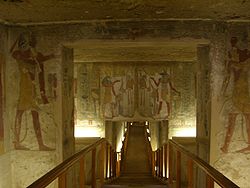 The usual tomb plan consisted of a long inclined rock-cut corridor, descending through one or more halls (possibly mirroring the descending path of the sun-god into the underworld), to the burial chamber. In the earlier tombs the corridors turn through 90 degrees at least once (such as KV43
, the tomb of Thutmose IV
), and the earliest had cartouche
-shaped burial chambers (for example, KV43
, the tomb of Thutmose IV
). This layout is known as 'Bent Axis', and after the burial the upper corridors were meant to be filled with rubble, and the entrance to the tomb hidden. After the Amarna Period
, the layout gradually straightened, with an intermediate 'Jogged Axis' (the tomb of Horemheb
, KV57
is typical of this, and is one of the tombs that is sometimes open to the public), to the generally 'Straight Axis' of the late Nineteenth and Twentieth Dynasty tombs (Ramesses III
's and Ramesses IX
's tombs, KV11
and KV6
respectively). As the tomb's axes straightened, the slope also lessened, and almost disappeared in the late Twentieth Dynasty. Another feature that is common to most tombs is the 'well', which may have originated as an actual barrier intended to stop flood waters entering the lower parts of the tombs. It later seems to have developed a 'magical' purpose as a symbolic shaft. In the later Twentieth Dynasty, the well itself was sometimes not excavated, but the well room was still present.
Decoration
The majority of the royal tombs were decorated with religious texts and images. The early tombs were decorated with scenes from Amduat
('That Which is in the Underworld'), which describes the journey of the sun-god through the twelve hours of the night. From the time of Horemheb, tombs were decorated with the Book of Gates
, which shows the sun-god passing through the twelve gates that divide the night time, and ensure the tomb owner's own safe passage through the night. These earliest tombs were generally sparsely decorated, and those of a non-royal nature were totally undecorated.
Late in the Nineteenth Dynasty the Book of Caverns
, which divided the underworld into massive caverns containing deities and the deceased waiting for the sun to pass through and restore them to life, was placed in the upper parts of tombs; a complete version appears in the tomb of Ramesses VI. The burial of Ramesses III saw the Book of the Earth
, where the underworld is divided into 4 sections, climaxing in the sun disc being pulled from the earth by Naunet
.
The ceilings of the burial chambers were decorated (from the burial of Seti I onwards) with what become formalised as the Book of the Heavens, which again describes the sun's journey through the twelve hours of night. Again from Seti I's time, the Litany of Re
, a lengthy hymn to the sun god began to appear.
Tomb equipment
Each burial was provided with equipment that would enable a continued existence in the afterlife in comfort. Also present in the tombs were ritual magical items, such as Shabtis and divine figurines. Some equipment was that which the king may have used in their lifetime (Tutankhamun
's sandals for example), and some was specially constructed for the burial.
(KV1
) to KV63
(which was discovered in 2005), although many of the tombs have been open since antiquity, and KV5
was only rediscovered in the 1990s (after being dismissed as unimportant by previous investigators). The West Valley tombs often have the "WV" prefix but follow the same numbering system. A number of the tombs are unoccupied, the owners of others remain unknown, and others are merely pits used for storage. Most of the open tombs in the Valley of the Kings are located in the East Valley, and this is where most tourists and facilities can be found.
of Hatshepsut
is of a unique shape, twisting and turning down over 200 metres from the entrance so that the burial chamber is 97 metres below the surface. The tombs gradually became more regular and formalised, and the tombs of Thutmose III
and Thutmose IV
, KV34
and KV43
are good examples of Eighteenth Dynasty tombs, both with their bent axis, and simple decoration.
Perhaps the most imposing tomb of this period is that of Amenhotep III
, WV22
located in the West Valley. It has been re-investigated in 1990s (by a team from Waseda University
, Japan
) but is not open to the public.
At the same time, powerful and influential nobles started to be buried with the royal family; the most famous of these tombs is the joint tomb of Yuya
and Tjuyu
, KV46
. They were possibly the parents of Queen Tiy, and until the discovery of the tomb of Tutankhamun, this was the best preserved tomb to be found in the Valley.
, but it is no more than a gateway and a series of steps. Close by to this tomb is the tomb of Ay
, Tutankhamun
's successor. It is likely that this tomb was started for Tutankhamun (its decoration is of a similar style) but later usurped for Ay's burial. This would mean that KV62
may have been Ay's original tomb, which would explain the smaller size and unusual layout for a royal tomb.
The other Amarna period tombs are located in a smaller, central area in the centre of the East Valley, with a possible mummy cache (KV55
) that may contain the burials of several Amarna Period royals—Tiy and Smenkhkare
or Akhenaten
.
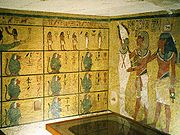 Close to this is the burial of Tutankhamun, which is perhaps the most famous discovery of modern Western archaeology
and was made here by Howard Carter
on November 4, 1922, with clearance and conservation work continuing until 1932. This was the first royal tomb to be discovered that was still largely intact (although tomb robbers had entered it), and was, until the excavation of KV63
on 10 March 2005, considered the last major discovery in the valley. The opulence of his grave goods notwithstanding, Tutankhamun
was a rather minor king and other burials probably had more numerous treasures.
In the same central area as KV62 and KV63, is 'KV64
', a radar anomaly believed to be a tomb or chamber announced on 28 July 2006. It is not an official designation, and indeed the actual existence of a tomb at all is dismissed by the Supreme Council of Antiquities
.
The nearby tomb of Horemheb
, (KV57
) is rarely open for visitors, but it has many unique features, and is extensively decorated. The decoration shows a transition from the pre-Amarna tombs to those of the 19th dynasty tombs that followed.
was hurriedly finished due to the death of the king and is little more than a truncated descending corridor and a burial chamber; however, KV16
has vibrant decoration, and still contains the sarcophagus
of the king. Its central location means that it is one of the frequently visited tombs. It shows the development of the tomb entrance and passage and of decoration.
His son and successor, Seti I
's tomb, KV17
(also known as Belzoni's tomb, the tomb of Apis, or the tomb of Psammis, son of Necho) is usually thought to be the finest tomb in the valley, with extensive relief work and paintings. When it was rediscovered by Belzoni in 1817, he referred to it as "..a fortunate day.."
The son of Seti, Ramesses the Great
constructed a massive tomb, KV7
, but it is in a ruinous state, and it is currently undergoing excavation and conservation by a Franco-Egyptian team led by Christian Leblanc
. It is a vast size, being about the same length, and a larger area, of the tomb of his father.
 At the same time, and just opposite his own tomb, Ramesses enlarged the earlier small tomb of an unknown Eighteenth Dynasty noble (KV5
) for his numerous sons. With 120 known rooms and excavation work still underway, it is probably the largest tomb in the valley. Originally opened (and robbed) in antiquity, it is a low-lying structure that has been particularly prone to the flash floods that sometimes hit the area, which washed in tonnes of debris and material over the centuries, ultimately concealing its vast size. It is not currently open to the public.
Ramesses II's son and eventual successor, Merenptah's tomb
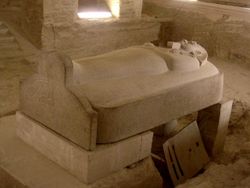
has been open since antiquity; it extends 160 metres, ending in a burial chamber that once contained a set of four nested sarcophagi
. Well decorated, it is typically open to the public most years.
The last kings of the dynasty also constructed tombs in the valley, all of which follow the same general pattern of layout and decoration, notable amongst these is the tomb
of Siptah
, which is well decorated, especially the ceiling decoration.
, actually had two tombs constructed for himself; he started to excavate the eventual tomb of his son, Ramesses III
, but broke into another tomb and abandoned it in order to usurp and complete the tomb
of the Nineteenth Dynasty female pharaoh Twosret
. This tomb therefore has two burial chambers, the later extensions making the tomb one of the largest of the Royal tombs, at over 150 metres.
.jpg) The tomb
The tomb
of Ramesses III
(known Bruce's Tomb or The Harper's Tomb due to its decoration) is one of the largest tombs in the valley and is open to the public; it is located close to the central 'rest–area' and its location and superb decoration usually makes this one of the tombs visited by tourists.
The successors and offspring of Ramesses III
constructed tombs that had straight axes and were decorated in much the same manner as each other; notable amongst these is KV2
, the tomb of Ramesses IV
, which has been open since antiquity, containing a large amount of hieratic
graffiti. The tomb is mostly intact and is decorated with scenes from several religious texts. The joint tomb of Ramesses V
and Ramesses VI
, KV9
(also known as the Tomb of Memnon or La Tombe de la Métempsychose), is decorated with many sunk-relief carvings, depicting illustrated scenes from religious texts. Open since antiquity, it contains over a thousand graffiti in ancient Greek, Latin and Coptic. The spoil from the excavation and later clearance of this tomb, together with later construction of workers huts, covered the earlier burial of KV62 and seems to have been what protected that tomb from earlier discovery and looting.
 The tomb of Ramesses IX
, KV6
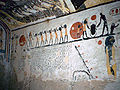
, has been open since antiquity, as can be seen by the graffiti left on its walls by Roman and Coptic visitors. Located in the central part of the valley, it stands between and slightly above KV5 and KV55. The tomb extends a total distance of 105 metres into the hillside, including extensive side chambers that were neither decorated nor finished. The hasty and incomplete nature of the rock-cutting and decorations (it is only decorated for a litte over half its length) within the tomb indicate that the tomb was not completed by the time of Ramesses' death, with the completed hall of pillars serving as the burial chamber.
Another notable tomb from this dynasty is KV19
, the tomb of Mentuherkhepshef (son of Ramesses IX
). The tomb is small and is simply a converted, unfinished corridor, but the decoration is extensive and the tomb has been newly restored and open for visitors.
controlled Lower Egypt. Some attempt at using the open tombs was made at the start of the Twenty-first Dynasty
, with the High Priest of Amun, Pinedjem I
, adding his cartouche to KV4
. The Valley began to be heavily plundered, so during the Twenty-first Dynasty the priests of Amun
opened most of the tombs and moved the mummies into three tombs in order to better protect them, even removing most of their treasure in order to further protect the bodies from robbers. Most of these were later moved to a single cache near Deir el-Bari (known as TT320
); located in the cliffs overlooking Hatshepsut
's famous temple, this mass reburial contained a large number of royal mummies. They were found in a great state of disorder, many placed in other's coffins, and several are still unidentified. Other mummies were moved to the tomb
of Amenhotep II
, where over a dozen mummies, many of them royal, were later relocated.
During the later Third Intermediate Period and later periods, intrusive burials were introduced into many of the open tombs. In Copt
ic times, some of the tombs were used as churches, stables and even houses.
have been found that describe the trials of tomb robbers; these date mostly from the late Twentieth Dynasty. One of these (Papyrus Mayer B) describes the robbery of the tomb of Ramesses VI and was probably written in Year 9 of Ramesses IX:
The valley also seems to have suffered an official plundering during the virtual civil war
, which started in the reign of Ramesses XI
. The tombs were opened, all the valuables removed, and the mummies collected into two large caches. One in the tomb of Amenhotep II
, contained sixteen, and others were hidden within Amenhotep I
's tomb. A few years later most of them were moved to the Deir el-Bahri
cache, contained no less than forty royal mummies and their coffins. Only those tombs whose locations were lost (KV62
, KV63
and KV46
, although both KV62 and KV46 were robbed soon after their actual closure) were undisturbed in this period.
In 1997, 58 tourists and 4 Egyptians were massacred
at nearby Deir el-Bahri
by Islamist militants from Al-Gama'a al-Islamiyya
. This led to an overall drop in tourism in the area.
On most days of the week an average of four to five thousand tourists visit the main valley. On the days that the Nile
Cruises arrive the number can rise to over nine thousand. These levels are expected to rise to 25,000 by 2015. The West Valley is much less visited, as there is only one tomb that is open to the public.
Valley
In geology, a valley or dale is a depression with predominant extent in one direction. A very deep river valley may be called a canyon or gorge.The terms U-shaped and V-shaped are descriptive terms of geography to characterize the form of valleys...
in Egypt
Egypt
Egypt , officially the Arab Republic of Egypt, Arabic: , is a country mainly in North Africa, with the Sinai Peninsula forming a land bridge in Southwest Asia. Egypt is thus a transcontinental country, and a major power in Africa, the Mediterranean Basin, the Middle East and the Muslim world...
where, for a period of nearly 500 years from the 16th
16th century BC
The 16th century BC is a century which lasted from 1600 BC to 1501 BC.-Events:* 1700 BC – 1500 BC: Hurrian conquests.* 1595 BC: Sack of Babylon by the Hittite king Mursilis I....
to 11th century BC, tomb
Tomb
A tomb is a repository for the remains of the dead. It is generally any structurally enclosed interment space or burial chamber, of varying sizes...
s were constructed for the Pharaoh
Pharaoh
Pharaoh is a title used in many modern discussions of the ancient Egyptian rulers of all periods. The title originates in the term "pr-aa" which means "great house" and describes the royal palace...
s and powerful nobles of the New Kingdom (the Eighteenth
Eighteenth dynasty of Egypt
The eighteenth dynasty of ancient Egypt is perhaps the best known of all the dynasties of ancient Egypt...
to the Twentieth Dynasties
Twentieth dynasty of Egypt
The Eighteenth, Nineteenth, and Twentieth Dynasties of ancient Egypt are often combined under the group title, New Kingdom. This dynasty is considered to be the last one of the New Kingdom of Egypt, and was followed by the Third Intermediate Period....
of Ancient Egypt
Ancient Egypt
Ancient Egypt was an ancient civilization of Northeastern Africa, concentrated along the lower reaches of the Nile River in what is now the modern country of Egypt. Egyptian civilization coalesced around 3150 BC with the political unification of Upper and Lower Egypt under the first pharaoh...
).
The valley stands on the west bank of the Nile
Nile
The Nile is a major north-flowing river in North Africa, generally regarded as the longest river in the world. It is long. It runs through the ten countries of Sudan, South Sudan, Burundi, Rwanda, Democratic Republic of the Congo, Tanzania, Kenya, Ethiopia, Uganda and Egypt.The Nile has two major...
, opposite Thebes
Thebes, Egypt
Thebes is the Greek name for a city in Ancient Egypt located about 800 km south of the Mediterranean, on the east bank of the river Nile within the modern city of Luxor. The Theban Necropolis is situated nearby on the west bank of the Nile.-History:...
(modern Luxor
Luxor
Luxor is a city in Upper Egypt and the capital of Luxor Governorate. The population numbers 487,896 , with an area of approximately . As the site of the Ancient Egyptian city of Thebes, Luxor has frequently been characterized as the "world's greatest open air museum", as the ruins of the temple...
), within the heart of the Theban Necropolis
Theban Necropolis
The Theban Necropolis is an area of the west bank of the Nile, opposite Thebes in Egypt. It was used for ritual burials for much of Pharaonic times, especially in the New Kingdom of Egypt.-Mortuary Temples:* Deir el-Bahri** Mortuary temple of Hatshepsut...
. The wadi
Wadi
Wadi is the Arabic term traditionally referring to a valley. In some cases, it may refer to a dry riverbed that contains water only during times of heavy rain or simply an intermittent stream.-Variant names:...
consists of two valleys, East Valley (where the majority of the royal tombs are situated) and West Valley.
With the 2006 discovery of a new chamber (KV63
KV63
KV63 is the most recently opened chamber in Egypt's Valley of the Kings pharaonic necropolis. Initially believed to be a royal tomb, it is now believed to have been a storage chamber for the mummification process....
), and the 2008 discovery of 2 further tomb entrances, the valley is known to contain 63 tombs and chambers (ranging in size from a simple pit
KV54
Tomb KV54 is located in the Valley of the Kings, in Egypt. It was originally excavated by Edward R. Ayrton on behalf of the American lawyer Theodore M. Davis, who funded the work.-Site history:...
to a complex tomb with over 120 chambers
KV5
Tomb KV5 is a subterranean, rock-cut tomb in the Valley of the Kings.It belonged to the sons of Ramesses II. Though KV5 was partially excavated as early as 1825, its true extent was discovered by Dr Kent R. Weeks and his exploration team. The tomb is now known to be the largest in the Valley of the...
), and was the principal burial place of the major royal figures of the Egyptian
Ancient Egypt
Ancient Egypt was an ancient civilization of Northeastern Africa, concentrated along the lower reaches of the Nile River in what is now the modern country of Egypt. Egyptian civilization coalesced around 3150 BC with the political unification of Upper and Lower Egypt under the first pharaoh...
New Kingdom, together with those of a number of privileged nobles. The royal tombs are decorated with scenes from Egyptian mythology and give clues to the beliefs and funerary rituals of the period. Almost all of the tombs seem to have been opened and robbed in antiquity, but they still give an idea of the opulence and power of the rulers of this time.
This area has been a focus of archaeological
Archaeology
Archaeology, or archeology , is the study of human society, primarily through the recovery and analysis of the material culture and environmental data that they have left behind, which includes artifacts, architecture, biofacts and cultural landscapes...
and egyptological
Egyptology
Egyptology is the study of ancient Egyptian history, language, literature, religion, and art from the 5th millennium BC until the end of its native religious practices in the AD 4th century. A practitioner of the discipline is an “Egyptologist”...
exploration since the end of the eighteenth century, and its tombs and burials continue to stimulate research and interest. In modern times the valley has become famous for the discovery of the tomb
KV62
KV62 is the tomb of Tutankhamun in the Valley of the Kings , which became famous for the wealth of treasure it contained. The tomb was discovered in 1922 by Howard Carter, underneath the remains of workmen's huts built during the Ramesside Period; this explains why it was spared from the worst of...
of Tutankhamun
Tutankhamun
Tutankhamun , Egyptian , ; approx. 1341 BC – 1323 BC) was an Egyptian pharaoh of the 18th dynasty , during the period of Egyptian history known as the New Kingdom...
(with its rumours of the Curse of the Pharaohs
Curse of the Pharaohs
The curse of the pharaohs refers to the belief that any person who disturbs the mummy of an Ancient Egyptian pharaoh is placed under a curse.There are occasional instances of curses appearing inside or on the facade of a tomb as in the case of the mastaba of Khentika Ikhekhi of the 6th dynasty at...
), and is one of the most famous archaeological sites in the world. In 1979, it became a World Heritage Site
World Heritage Site
A UNESCO World Heritage Site is a place that is listed by the UNESCO as of special cultural or physical significance...
, along with the rest of the Theban Necropolis. Exploration, excavation and conservation continues in the valley, and a new tourist centre has recently been opened.
Geology
The types of soil where the Valley of the Kings is located are an alternating sandwich of dense limestoneLimestone
Limestone is a sedimentary rock composed largely of the minerals calcite and aragonite, which are different crystal forms of calcium carbonate . Many limestones are composed from skeletal fragments of marine organisms such as coral or foraminifera....
and other sedimentary rock (which form the cliffs in the valley and the nearby Deir el-Bahri
Deir el-Bahri
Deir el-Bahari or Deir el-Bahri is a complex of mortuary temples and tombs located on the west bank of the Nile, opposite the city of Luxor, Egypt....
) and soft layers of marl
Marl
Marl or marlstone is a calcium carbonate or lime-rich mud or mudstone which contains variable amounts of clays and aragonite. Marl was originally an old term loosely applied to a variety of materials, most of which occur as loose, earthy deposits consisting chiefly of an intimate mixture of clay...
. The sedimentary rock was originally deposited between 35–56 million years ago during a time when the precursor to the Mediterranean Sea
Mediterranean Sea
The Mediterranean Sea is a sea connected to the Atlantic Ocean surrounded by the Mediterranean region and almost completely enclosed by land: on the north by Anatolia and Europe, on the south by North Africa, and on the east by the Levant...
covered an area that extended much further inland than today. During the Pleistocene
Pleistocene
The Pleistocene is the epoch from 2,588,000 to 11,700 years BP that spans the world's recent period of repeated glaciations. The name pleistocene is derived from the Greek and ....
the valley was carved out of the plateau by steady rains. There is currently little year-round rain in this part of Egypt, but there are occasional flash flood
Flash flood
A flash flood is a rapid flooding of geomorphic low-lying areas—washes, rivers, dry lakes and basins. It may be caused by heavy rain associated with a storm, hurricane, or tropical storm or meltwater from ice or snow flowing over ice sheets or snowfields...
s that hit the valley, dumping tons of debris into the open tombs.
The quality of the rock in the Valley is inconsistent, ranging from finely-grained to coarse stone, the latter with the potential to be structurally unsound. The occasional layer of shale
Shale
Shale is a fine-grained, clastic sedimentary rock composed of mud that is a mix of flakes of clay minerals and tiny fragments of other minerals, especially quartz and calcite. The ratio of clay to other minerals is variable. Shale is characterized by breaks along thin laminae or parallel layering...
also caused construction and conservation difficulties, as this rock expands in the presence of water, forcing apart the stone surrounding it. It is thought that some tombs were altered in shape and size depending on the types of rock the builders encountered.
Builders took advantage of available geological features when constructing the tombs. Some tombs were quarried out of existing limestone clefts, others behind slopes of scree
Scree
Scree, also called talus, is a term given to an accumulation of broken rock fragments at the base of crags, mountain cliffs, or valley shoulders. Landforms associated with these materials are sometimes called scree slopes or talus piles...
, or were at the edge of rock spurs created by ancient flood channels.
The problems of tomb construction can be seen with tombs of Ramesses III
Ramesses III
Usimare Ramesses III was the second Pharaoh of the Twentieth Dynasty and is considered to be the last great New Kingdom king to wield any substantial authority over Egypt. He was the son of Setnakhte and Queen Tiy-Merenese. Ramesses III is believed to have reigned from March 1186 to April 1155 BCE...
and his father Setnakhte
Setnakhte
Userkhaure-setepenre Setnakhte was the first Pharaoh of the Twentieth Dynasty of the New Kingdom of Ancient Egypt and the father of Ramesses III....
. Setnakhte started to excavate KV11
KV11
Tomb KV11 is the tomb of Ancient Egyptian Pharaoh Ramesses III. Located in the main valley of the Valley of the Kings, the tomb was originally started by Setnakhte, but abandoned when it broke into the earlier tomb of Amenmesse . Setnakhte was buried in KV14...
but broke into the tomb of Amenmesse
Amenmesse
Amenmesse was the 5th ruler of the Nineteenth Dynasty in Ancient Egypt, possibly the son of Merneptah and Queen Takhat. Others consider him to be one of the innumerable sons of Ramesses II. Very little is known about this king, who ruled Egypt for only three to four years...
, so construction was abandoned and he instead usurped the tomb of Twosret
Twosret
Queen Twosret was the last known ruler and the final Pharaoh of the Nineteenth Dynasty.She is recorded in Manetho's Epitome as a certain Thuoris, who in Homer is called Polybus, husband of Alcandara, and in whose time Troy was taken. She was said to have ruled Egypt for seven years, but this...
, KV14
KV14
Tomb KV14 is a joint tomb, used originally by Twosret and then reused and extended by Setnakhte. It has been open since antiquity, but was not properly recorded until Hartwig Altenmüller excavated it from 1983 to 1987....
. When looking for a tomb, Ramesses III extended the part-excavated tomb started by his father. The tomb of Ramesses II returned to an early style, with a bent axis, probably due to the quality of the rock being excavated (following the Esna shale).
Between 1998 and 2002 the Amarna Royal Tombs Project
Amarna Royal Tombs Project
The Amarna Royal Tombs Project is an archaeological expedition set up in 1998 to investigate on the ground and in the records the fate of the missing Amarna royal dead transferred on the abandonment of El-Amarna to the Valley of the Kings during the reign of Tutankhamun. ARTP's director is...
investigated the valley floor using ground-penetrating radar
Ground-penetrating radar
Ground-penetrating radar is a geophysical method that uses radar pulses to image the subsurface. This nondestructive method uses electromagnetic radiation in the microwave band of the radio spectrum, and detects the reflected signals from subsurface structures...
and found that, below the modern surface, the Valley's cliffs descend beneath the scree in a series of abrupt, natural "shelves", arranged one below the other, descending several metres down to the bedrock in the valley floor.
Hydrology
The area of the Theban hills is subject to infrequent violent thunder storms, causing flash floods in the valley. Recent studies have shown that there are at least 7 active flood stream beds, leading down into the central area of the valley. This central area appears to have been flooded at the end of the Eighteenth Dynasty and buried several tombs under metres of debris. The tombs KV63, KV62 and KV55 are dug into the actual wadi bedrock rather the debris, showing that the then level of the valley was 5 m below its present level. After this event later dynasties leveled the floor of the valley, making the floods deposit their load further down the valley, and the buried tombs were forgotten and only discovered in the early 20th century. This was the area that was the subject of the Amarna Royal Tombs Project ground scanning radar investigation, which showed several anomalies, one of which was proved to be KV63.Prehistory
The site of Valley of the Kings is populated at least since the Middle PaleolithicMiddle Paleolithic
The Middle Paleolithic is the second subdivision of the Paleolithic or Old Stone Age as it is understood in Europe, Africa and Asia. The term Middle Stone Age is used as an equivalent or a synonym for the Middle Paleolithic in African archeology. The Middle Paleolithic and the Middle Stone Age...
.
History
The Theban Hills are dominated by the peak of al-QurnAl-Qurn
Located on the West bank of the Nile, opposite Thebes, modern Luxor, the peak of Al-Qurn, el-Qorn the horn is the modern name for the highest point in the Theban Hills. Its ancient name was Ta Dehent, or 'the peak'...
, known to the Ancient Egyptians as ta dehent, or 'The Peak'. It has a pyramid shaped appearance, and it is probable that this echoed the pyramids of the Old Kingdom, more than a thousand years prior to the first royal burials carved here. Its isolated position also resulted in reduced access, and special tomb police (the Medjay
Medjay
The Medjay –from mDA, represents the name Ancient Egyptians gave to a region in northern Sudan–where an ancient people of Nubia inhabited...
) were able to guard the necropolis.
While the iconic pyramid complexes of the Giza plateau
Giza pyramid complex
The Giza Necropolis is an archaeological site on the Giza Plateau, on the outskirts of Cairo, Egypt. This complex of ancient monuments includes the three pyramid complexes known as the Great Pyramids, the massive sculpture known as the Great Sphinx, several cemeteries, a workers' village and an...
have come to symbolize ancient Egypt, the majority of tombs were cut into rock. Most pyramids and mastabas contain sections which are cut into ground level, and there are full rock-cut tombs in Egypt that date back to the Old Kingdom.
After the defeat of the Hyksos
Hyksos
The Hyksos were an Asiatic people who took over the eastern Nile Delta during the twelfth dynasty, initiating the Second Intermediate Period of ancient Egypt....
and the reunification of Egypt under Ahmose I
Ahmose I
Ahmose I was a pharaoh of ancient Egypt and the founder of the Eighteenth dynasty. He was a member of the Theban royal house, the son of pharaoh Tao II Seqenenre and brother of the last pharaoh of the Seventeenth dynasty, King Kamose...
, the Theban rulers
Eighteenth dynasty of Egypt
The eighteenth dynasty of ancient Egypt is perhaps the best known of all the dynasties of ancient Egypt...
began to construct elaborate tombs that would reflect their newfound power. The tombs of Ahmose and his son Amenhotep I
Amenhotep I
Amenhotep I was the second Pharaoh of the 18th dynasty of Egypt. His reign is generally dated from 1526 to 1506 BC. He was born to Ahmose I and Ahmose-Nefertari, but had at least two elder brothers, Ahmose-ankh and Ahmose Sapair, and was not expected to inherit the throne...
(their exact location remains unknown) were probably in the Seventeenth Dynasty
Seventeenth dynasty of Egypt
The Fifteenth, Sixteenth and Seventeenth Dynasties of ancient Egypt are often combined under the group title, Second Intermediate Period. The Seventeenth Dynasty dates approximately from 1580 to 1550 BC.-Rulers:...
necropolis of Dra' Abu el-Naga'
Dra' Abu el-Naga'
The necropolis of Dra' Abu el-Naga' is located on the West Bank of the Nile at Thebes, Egypt, just by the entrance of the dry bay that leads up to Deir el-Bahri, and north of the necropolis of el-Assasif....
. The first royal tombs in the valley were those of Amenhotep I
Amenhotep I
Amenhotep I was the second Pharaoh of the 18th dynasty of Egypt. His reign is generally dated from 1526 to 1506 BC. He was born to Ahmose I and Ahmose-Nefertari, but had at least two elder brothers, Ahmose-ankh and Ahmose Sapair, and was not expected to inherit the throne...
(although this identification is also disputed), and Thutmose I
Thutmose I
Thutmose I was the third Pharaoh of the 18th dynasty of Egypt. He was given the throne after the death of the previous king Amenhotep I. During his reign, he campaigned deep into the Levant and Nubia, pushing the borders of Egypt further than ever before...
, whose advisor Ineni
Ineni
Ineni was an Ancient Egyptian architect and government official of the 18th Dynasty, responsible for major construction projects under the pharaohs Amenhotep I, Thutmose I, Thutmose II and the joint reigns of Hatshepsut and Thutmose III...
notes in his tomb that he advised his king to place his tomb in the desolate valley (the identity of this actual tomb is unclear, but it is probably KV20
KV20
KV20 is a tomb in the Valley of the Kings . It was probably the first royal tomb to be constructed in the valley. KV20 was the original burial place of Thutmose I and later was adapted by his daughter Hatshepsut to accommodate both her and her father...
or KV38
KV38
KV38 is a tomb in the Valley of the Kings that was used for the reburial of Pharaoh Thutmose I of the Eighteenth dynasty, and was where his body was removed to by Thutmose III.-External links:...
).
The Valley was used for primary burials from approximately 1539 BC to 1075 BC, and contains at least 63 tombs, beginning with Thutmose I
Thutmose I
Thutmose I was the third Pharaoh of the 18th dynasty of Egypt. He was given the throne after the death of the previous king Amenhotep I. During his reign, he campaigned deep into the Levant and Nubia, pushing the borders of Egypt further than ever before...
(or possibly earlier, during the reign of Amenhotep I
Amenhotep I
Amenhotep I was the second Pharaoh of the 18th dynasty of Egypt. His reign is generally dated from 1526 to 1506 BC. He was born to Ahmose I and Ahmose-Nefertari, but had at least two elder brothers, Ahmose-ankh and Ahmose Sapair, and was not expected to inherit the throne...
), and ending with Ramesses X
Ramesses X
Khepermare Ramesses X was the ninth ruler of the 20th dynasty of Ancient Egypt. His birth name was Amonhirkhepeshef. It is uncertain if his reign was 3 or 4 Years, but there is now a strong consensus among Egyptologists that it did not last as long as 9 Years, as was previously assumed...
or XI
Ramesses XI
Ramesses XI reigned from 1107 BC to 1078 BC or 1077 BC and was the tenth and final king of the Twentieth dynasty of Egypt. He ruled Egypt for at least 29 years although some Egyptologists think he could have ruled for as long as 30...
, although non-Royal burials continued in usurped tombs.
Despite the name, the Valley of the Kings also contains the tombs of favorite nobles as well as the wives and children of both nobles and pharaohs, meaning that only about 20 of the tombs actually contain the burials of kings; the burials of nobles and the royal family, together with unmarked pits and embalming caches make up the rest. Around the time of Ramesses I
Ramesses I
Menpehtyre Ramesses I was the founding Pharaoh of Ancient Egypt's 19th dynasty. The dates for his short reign are not completely known but the time-line of late 1292-1290 BC is frequently cited as well as 1295-1294 BC...
(ca. 1301 BC) construction commenced in the separate Valley of the Queens
Valley of the Queens
The Valley of the Queens is a place in Egypt where wives of Pharaohs were buried in ancient times. In ancient times, it was known as Ta-Set-Neferu, meaning –‘the place of the Children of the Pharaoh’, because along with the Queens of the 18th, 19th and 20th dynasties many princes and princesses...
.
Royal Necropolis
The official name for the site in ancient times was The Great and Majestic Necropolis of the Millions of Years of the Pharaoh, Life, Strength, Health in The West of Thebes (see below for the hieroglyphic spelling), or more usually, Ta-sekhet-ma'at (the Great Field).At the start of the Eighteenth Dynasty
Eighteenth dynasty of Egypt
The eighteenth dynasty of ancient Egypt is perhaps the best known of all the dynasties of ancient Egypt...
, only the kings were buried within the valley in large tombs; when a non-royal was buried, it was in a small rock cut chamber, close to the tomb of their master. Amenhotep III
Amenhotep III
Amenhotep III also known as Amenhotep the Magnificent was the ninth pharaoh of the Eighteenth dynasty. According to different authors, he ruled Egypt from June 1386 to 1349 BC or June 1388 BC to December 1351 BC/1350 BC after his father Thutmose IV died...
's tomb was constructed in the Western Valley, and while his son Akhenaten
Akhenaten
Akhenaten also spelled Echnaton,Ikhnaton,and Khuenaten;meaning "living spirit of Aten") known before the fifth year of his reign as Amenhotep IV , was a Pharaoh of the Eighteenth dynasty of Egypt who ruled for 17 years and died perhaps in 1336 BC or 1334 BC...
moved his tomb's construction to Amarna
Amarna
Amarna is an extensive Egyptian archaeological site that represents the remains of the capital city newly–established and built by the Pharaoh Akhenaten of the late Eighteenth Dynasty , and abandoned shortly afterwards...
, it is thought that the unfinished WV25 may have originally been intended for him. With the return to religious orthodoxy at the end of the Eighteenth Dynasty, Tutankhamun
Tutankhamun
Tutankhamun , Egyptian , ; approx. 1341 BC – 1323 BC) was an Egyptian pharaoh of the 18th dynasty , during the period of Egyptian history known as the New Kingdom...
, Ay
Ay
Ay was the penultimate Pharaoh of Ancient Egypt's 18th dynasty. He held the throne of Egypt for a brief four-year period , although he was a close advisor to two and perhaps three of the pharaohs who ruled before him and was the power behind the throne during Tutankhamun's reign...
and then Horemheb
Horemheb
Horemheb was the last Pharaoh of the 18th Dynasty from either 1319 BC to late 1292 BC, or 1306 to late 1292 BC although he was not related to the preceding royal family and is believed to have been of common birth.Before he became pharaoh, Horemheb was the commander in chief...
returned to the royal necropolis.
The Nineteenth
Nineteenth dynasty of Egypt
The Nineteenth Dynasty of ancient Egypt was one of the periods of the Egyptian New Kingdom. Founded by Vizier Ramesses I, whom Pharaoh Horemheb chose as his successor to the throne, this dynasty is best known for its military conquests in Palestine, Lebanon, and Syria.The warrior kings of the...
and Twentieth Dynasties
Twentieth dynasty of Egypt
The Eighteenth, Nineteenth, and Twentieth Dynasties of ancient Egypt are often combined under the group title, New Kingdom. This dynasty is considered to be the last one of the New Kingdom of Egypt, and was followed by the Third Intermediate Period....
saw an increase in the number of burials (both here and in the Valley of the Queens), with Ramesses II
Ramesses II
Ramesses II , referred to as Ramesses the Great, was the third Egyptian pharaoh of the Nineteenth dynasty. He is often regarded as the greatest, most celebrated, and most powerful pharaoh of the Egyptian Empire...
and later Ramesses III
Ramesses III
Usimare Ramesses III was the second Pharaoh of the Twentieth Dynasty and is considered to be the last great New Kingdom king to wield any substantial authority over Egypt. He was the son of Setnakhte and Queen Tiy-Merenese. Ramesses III is believed to have reigned from March 1186 to April 1155 BCE...
constructing a massive tomb that was used for the burial of his sons (KV5
KV5
Tomb KV5 is a subterranean, rock-cut tomb in the Valley of the Kings.It belonged to the sons of Ramesses II. Though KV5 was partially excavated as early as 1825, its true extent was discovered by Dr Kent R. Weeks and his exploration team. The tomb is now known to be the largest in the Valley of the...
and KV3
KV3
Tomb KV3, located in Egypt's Valley of the Kings, was intended for the burial of an unidentified son of Pharaoh Ramesses III during the early part of the Twentieth Dynasty...
respectively). There are some kings that are not buried within the valley or whose tomb has not been located: Thutmose II
Thutmose II
Thutmose II was the fourth Pharaoh of the Eighteenth dynasty of Egypt. He built some minor monuments and initiated at least two minor campaigns but did little else during his rule and was probably strongly influenced by his wife, Hatshepsut...
may have been buried in Dra' Abu el-Naga'
Dra' Abu el-Naga'
The necropolis of Dra' Abu el-Naga' is located on the West Bank of the Nile at Thebes, Egypt, just by the entrance of the dry bay that leads up to Deir el-Bahri, and north of the necropolis of el-Assasif....
(although his mummy was in the Deir el-Bahri tomb cache
DB320
Tomb DB320 is located next to Deir el-Bahri, in the Theban Necropolis, opposite modern Luxor contained an extraordinary cache of mummified remains and funeral equipment of more than 50 kings, queens, royals and various nobility.-Usage of tomb:The tomb is thought to have initially been the last...
),
Smenkhkare's burial has never been located, and Ramesses VIII
Ramesses VIII
Usermare Akhenamun Ramesses VIII or Ramesses Sethherkhepshef Meryamun , was the seventh Pharaoh of the Twentieth Dynasty of the New Kingdom of Ancient Egypt and was one of the last surviving sons of Ramesses...
seems to have been buried elsewhere.
In the Pyramid Age the tomb of the king was associated with a mortuary temple located close to the pyramid. As the tomb of the king was hidden, this mortuary temple was located away from the burial, closer to the cultivation facing towards Thebes
Thebes, Egypt
Thebes is the Greek name for a city in Ancient Egypt located about 800 km south of the Mediterranean, on the east bank of the river Nile within the modern city of Luxor. The Theban Necropolis is situated nearby on the west bank of the Nile.-History:...
. These mortuary temples became places visited during the various festivals held in the Theban necropolis, most notably the Beautiful festival of the valley
Beautiful festival of the valley
The Beautiful Festival of the Valley was an Ancient Egyptian festival, celebrated annually in Thebes, during the Middle Kingdom period and later....
, where the sacred barques of Amun-Re, his consort Mut
Mut
Mut, which meant mother in the ancient Egyptian language, was an ancient Egyptian mother goddess with multiple aspects that changed over the thousands of years of the culture. Alternative spellings are Maut and Mout. She was considered a primal deity, associated with the waters from which...
and son Khonsu left the temple at Karnak
Karnak
The Karnak Temple Complex—usually called Karnak—comprises a vast mix of decayed temples, chapels, pylons, and other buildings, notably the Great Temple of Amun and a massive structure begun by Pharaoh Ramses II . Sacred Lake is part of the site as well. It is located near Luxor, some...
in order to visit the funerary temples of deceased kings on the West Bank and their shrines in the Theban Necropolis
Theban Necropolis
The Theban Necropolis is an area of the west bank of the Nile, opposite Thebes in Egypt. It was used for ritual burials for much of Pharaonic times, especially in the New Kingdom of Egypt.-Mortuary Temples:* Deir el-Bahri** Mortuary temple of Hatshepsut...
.
The tombs were constructed and decorated by the workers of the village of Deir el-Medina, located in a small wadi between this valley and the Valley of the Queens
Valley of the Queens
The Valley of the Queens is a place in Egypt where wives of Pharaohs were buried in ancient times. In ancient times, it was known as Ta-Set-Neferu, meaning –‘the place of the Children of the Pharaoh’, because along with the Queens of the 18th, 19th and 20th dynasties many princes and princesses...
, facing Thebes
Thebes, Egypt
Thebes is the Greek name for a city in Ancient Egypt located about 800 km south of the Mediterranean, on the east bank of the river Nile within the modern city of Luxor. The Theban Necropolis is situated nearby on the west bank of the Nile.-History:...
. The workers journeyed to the tombs via routes over the Theban hills. The daily lives of these workers are quite well known, recorded in tombs and official documents. Amongst the events document is perhaps the first recorded worker's strike, detailed in the Turin strike papyrus.
Exploration of the valley
Ancient Rome
Ancient Rome was a thriving civilization that grew on the Italian Peninsula as early as the 8th century BC. Located along the Mediterranean Sea and centered on the city of Rome, it expanded to one of the largest empires in the ancient world....
times). This area illustrates the changes in the study of ancient Egypt, starting as antiquity hunting, and ending as scientific excavation of the whole Theban Necropolis
Theban Necropolis
The Theban Necropolis is an area of the west bank of the Nile, opposite Thebes in Egypt. It was used for ritual burials for much of Pharaonic times, especially in the New Kingdom of Egypt.-Mortuary Temples:* Deir el-Bahri** Mortuary temple of Hatshepsut...
. Despite the exploration and investigation noted below, only eleven of the tombs have actually been completely recorded.
Many of the tombs have graffiti written by these ancient tourists. Jules Baillet located over 2100 Greek and Latin
Latin
Latin is an Italic language originally spoken in Latium and Ancient Rome. It, along with most European languages, is a descendant of the ancient Proto-Indo-European language. Although it is considered a dead language, a number of scholars and members of the Christian clergy speak it fluently, and...
graffiti, along with a smaller number in Phoenician, Cypriot
Cyprus
Cyprus , officially the Republic of Cyprus , is a Eurasian island country, member of the European Union, in the Eastern Mediterranean, east of Greece, south of Turkey, west of Syria and north of Egypt. It is the third largest island in the Mediterranean Sea.The earliest known human activity on the...
, Lycian
Lycian language
Lycian language refers to the inscriptional language of ancient Lycia, populated by Lycians, as well as its presumed spoken counterpart.-The speakers:...
, Coptic
Coptic language
Coptic or Coptic Egyptian is the current stage of the Egyptian language, a northern Afro-Asiatic language spoken in Egypt until at least the 17th century. Egyptian began to be written using the Greek alphabet in the 1st century...
, and other languages. The majority of the ancient graffiti are found in KV9, which contains just under a thousand of them. The earliest positively dated graffiti dates to 278 B.C.
In 1799, Napoleon's expedition (especially Dominique Vivant
Dominique Vivant
Dominique Vivant, Baron de Denon was a French artist, writer, diplomat, author, and archaeologist. He was appointed first director of the Louvre Museum by Napoleon after the Egyptian campaign of 1798-1801.-Biography:...
) drew maps and plans of the known tombs, and for the first time noted the Western Valley (where Prosper Jollois and Édouard de Villiers du Terrage
Édouard de Villiers du Terrage
Édouard de Villiers du Terrage was a French engineer who together with Jean-Baptiste Prosper Jollois journeyed with Napoleon to Egypt, and prepared the Description de l'Égypte....
located the tomb of Amenhotep III
Amenhotep III
Amenhotep III also known as Amenhotep the Magnificent was the ninth pharaoh of the Eighteenth dynasty. According to different authors, he ruled Egypt from June 1386 to 1349 BC or June 1388 BC to December 1351 BC/1350 BC after his father Thutmose IV died...
, WV22
WV22
Tomb WV22, in the Western arm of the Valley of the Kings, was used as the resting place of one of the greatest rulers of Egypt's New Kingdom, Amenhotep III...
). The Description de l'Égypte
Description de l'Egypte
Description de l'Égypte is the title of several books.* Description de l'Égypte - Description de l'Égypte ou Recueil des observations et des recherches qui ont été faites en Égypte pendant l'expédition de l'armée française Pub; First Edition , L'Imprimerie Imperiale, 1809-1813; l'Imprimerie...
contains two volumes (out a total of 24) on the area around Thebes.
European exploration continued in the area around Thebes during the nineteenth century, boosted by Champollion's translation of hieroglyphs early in the century. Early in the century, the area was visited by Belzoni
Giovanni Battista Belzoni
Giovanni Battista Belzoni , sometimes known as The Great Belzoni, was a prolific Venetian explorer of Egyptian antiquities.-Early life:...
, working for Henry Salt
Henry Salt (Egyptologist)
Henry Salt was an English artist, traveller, diplomat, and Egyptologist.-Biography:Salt, the son of a physician, was born in Lichfield. He trained as a portrait painter, first in Lichfield and then in London under Joseph Farington and John Hoppner. In 1802 he was appointed secretary and...
, who discovered several tombs, including those of Ay
Ay
Ay was the penultimate Pharaoh of Ancient Egypt's 18th dynasty. He held the throne of Egypt for a brief four-year period , although he was a close advisor to two and perhaps three of the pharaohs who ruled before him and was the power behind the throne during Tutankhamun's reign...
in the West Valley (WV23
WV23
Tomb WV23, located at the end of the Western Valley of the Kings near modern-day Luxor, was the final resting place of Pharaoh Ay of the 18th Dynasty....
) in 1816 and Seti I
Seti I
Menmaatre Seti I was a Pharaoh of Ancient Egypt , the son of Ramesses I and Queen Sitre, and the father of Ramesses II...
(KV17
KV17
Tomb KV17, located in Egypt's Valley of the Kings and also known by the names "Belzoni's tomb", "the Tomb of Apis", and "the Tomb of Psammis, son of Nechois", is the tomb of Pharaoh Seti I of the Nineteenth Dynasty. It is one of the best decorated tombs in the valley, but now is almost always...
) the next year. At the end of his visits, Belzoni declared that all of the tombs had been found and nothing of note remained to be found. Working at the same time (and a great rival of Belzoni and Salt) was Bernardino Drovetti
Bernardino Drovetti
Bernardino Michele Maria Drovetti was an Italian diplomat, lawyer, explorer and antiquarian, appointed by Napoleon as French consul to Egypt at a time when the country and its antiquities were being opened rapidly to European knowledge and acquisition. His methods were deplorable...
, the French
France
The French Republic , The French Republic , The French Republic , (commonly known as France , is a unitary semi-presidential republic in Western Europe with several overseas territories and islands located on other continents and in the Indian, Pacific, and Atlantic oceans. Metropolitan France...
Consul-General.
When Gaston Maspero
Gaston Maspero
Gaston Camille Charles Maspero was a French Egyptologist.-Life:Gaston Maspero was born in Paris to parents of Lombard origin. While at school he showed a special taste for history, and by the age of fourteen he was already interested in hieroglyphic writing...
was reappointed to head the Egyptian Antiquities Service, the nature of the exploration of the valley changed again. Maspero appointed Howard Carter
Howard Carter (archaeologist)
Howard Carter was an English archaeologist and Egyptologist, noted as a primary discoverer of the tomb of Tutankhamun.-Beginning of career:...
as the Chief Inspector of Upper Egypt and the young man discovered several new tombs and explored several others, clearing KV42 and KV20.
Around the turn of the twentieth century, the American Theodore M. Davis
Theodore M. Davis
Theodore M. Davis was an American lawyer and is best known for his excavations in Egypt's Valley of the Kings between 1902 and 1914.-Biography:...
had the excavation permit in the valley, and his team (led mostly by Edward R. Ayrton
Edward R. Ayrton
Edward Russell Ayrton was an English Egyptologist and archaeologist.He was the son of William Scrope Ayrton and his wife Ellen Louisa McClatchie, and was born in Wuhu, China, on 17 December 1882...
) discovered several royal and non-royal tombs (including KV43
KV43
Tomb KV43 is the tomb of Pharaoh Thutmose IV in the Valley of the Kings in Luxor, Egypt. It has a dog-leg shape, typical of the layout of early 18th Dynasty tombs. KV43 was rediscovered in 1903 by Howard Carter Tomb KV43 is the tomb of Pharaoh Thutmose IV in the Valley of the Kings in Luxor, Egypt....
, KV46
KV46
Tomb KV46 in the Valley of the Kings is the tomb of Yuya and his wife Tjuyu, the parents of Queen Tiye, the wife of Amenhotep III, and King Ay, and grandparents of Nefertiti. It was discovered in February 1905 by James E. Quibell. Quibell was sponsored by Theodore M...
and KV57
KV57
Tomb KV57, located in the Valley of the Kings in Egypt, was used for the burial of Horemheb, the last Pharaoh of the Eighteenth dynasty.The tomb was located by Edward Ayrton in February 1908, who was working for Theodore Davis...
). In 1907 they discovered the possible Amarna Period cache in KV55. After finding what they thought was all that remained of the burial of Tutankhamun (items recovered from KV54 and KV58), it was announced that the valley was completely explored and no further burials were to be found, in Davis's 1912 publication, The Tombs of Harmhabi and Touatânkhamanou; the book closes with the comment, "I fear that the Valley of Kings is now exhausted."
After Davis's death early in 1915 Lord Carnarvon
George Herbert, 5th Earl of Carnarvon
George Edward Stanhope Molyneux Herbert, 5th Earl of Carnarvon was an English aristocrat best known as the financial backer of the search for and the excavation of Tutankhamun's tomb in the Valley of the Kings.-Biography:...
acquired the concession to excavate the valley and he employed Carter to explore it. After a systematic search they discovered the actual tomb of Tutankhamun (KV62) in November 1922.
Various expeditions have continued to explore the valley, adding greatly to the knowledge of the area. In 2001 the Theban Mapping Project
Theban Mapping Project
Theban Mapping Project was established in 1978 by the Theban Foundation, itself established by British archaeologist and Egyptologist John Romer with the goal to create a masterplan of the Valley of the Kings and of the sites of the Theban Necropolis in general....
designed new signs for the tombs, providing information and plans of the open tombs.
Tomb development
LocationThe earliest tombs were located in cliffs at the top of scree
Scree
Scree, also called talus, is a term given to an accumulation of broken rock fragments at the base of crags, mountain cliffs, or valley shoulders. Landforms associated with these materials are sometimes called scree slopes or talus piles...
slopes, under storm-fed waterfalls (for example KV34
KV34
Tomb KV34 in the Valley of the Kings was the final resting place of 18th dynasty Pharaoh Thutmose III....
and KV43
KV43
Tomb KV43 is the tomb of Pharaoh Thutmose IV in the Valley of the Kings in Luxor, Egypt. It has a dog-leg shape, typical of the layout of early 18th Dynasty tombs. KV43 was rediscovered in 1903 by Howard Carter Tomb KV43 is the tomb of Pharaoh Thutmose IV in the Valley of the Kings in Luxor, Egypt....
). As these locations were soon used, burials then descended to the valley floor, gradually moving back up the slopes as the valley bottom filled up with debris. This explains the location of the tombs KV62
KV62
KV62 is the tomb of Tutankhamun in the Valley of the Kings , which became famous for the wealth of treasure it contained. The tomb was discovered in 1922 by Howard Carter, underneath the remains of workmen's huts built during the Ramesside Period; this explains why it was spared from the worst of...
and KV63
KV63
KV63 is the most recently opened chamber in Egypt's Valley of the Kings pharaonic necropolis. Initially believed to be a royal tomb, it is now believed to have been a storage chamber for the mummification process....
buried in the valley floor.
Architecture
KV43
Tomb KV43 is the tomb of Pharaoh Thutmose IV in the Valley of the Kings in Luxor, Egypt. It has a dog-leg shape, typical of the layout of early 18th Dynasty tombs. KV43 was rediscovered in 1903 by Howard Carter Tomb KV43 is the tomb of Pharaoh Thutmose IV in the Valley of the Kings in Luxor, Egypt....
, the tomb of Thutmose IV
Thutmose IV
Thutmose IV was the 8th Pharaoh of the 18th dynasty of Egypt, who ruled in approximately the 14th century BC...
), and the earliest had cartouche
Cartouche
In Egyptian hieroglyphs, a cartouche is an ellipse with a horizontal line at one end, indicating that the text enclosed is a royal name, coming into use during the beginning of the Fourth Dynasty under Pharaoh Sneferu, replacing the earlier serekh...
-shaped burial chambers (for example, KV43
KV43
Tomb KV43 is the tomb of Pharaoh Thutmose IV in the Valley of the Kings in Luxor, Egypt. It has a dog-leg shape, typical of the layout of early 18th Dynasty tombs. KV43 was rediscovered in 1903 by Howard Carter Tomb KV43 is the tomb of Pharaoh Thutmose IV in the Valley of the Kings in Luxor, Egypt....
, the tomb of Thutmose IV
Thutmose IV
Thutmose IV was the 8th Pharaoh of the 18th dynasty of Egypt, who ruled in approximately the 14th century BC...
). This layout is known as 'Bent Axis', and after the burial the upper corridors were meant to be filled with rubble, and the entrance to the tomb hidden. After the Amarna Period
Amarna Period
The Amarna Period was an era of Egyptian history during the latter half of the Eighteenth Dynasty when the royal residence of the pharaoh and his queen was shifted to Akhetaten in what is now modern-day Amarna...
, the layout gradually straightened, with an intermediate 'Jogged Axis' (the tomb of Horemheb
Horemheb
Horemheb was the last Pharaoh of the 18th Dynasty from either 1319 BC to late 1292 BC, or 1306 to late 1292 BC although he was not related to the preceding royal family and is believed to have been of common birth.Before he became pharaoh, Horemheb was the commander in chief...
, KV57
KV57
Tomb KV57, located in the Valley of the Kings in Egypt, was used for the burial of Horemheb, the last Pharaoh of the Eighteenth dynasty.The tomb was located by Edward Ayrton in February 1908, who was working for Theodore Davis...
is typical of this, and is one of the tombs that is sometimes open to the public), to the generally 'Straight Axis' of the late Nineteenth and Twentieth Dynasty tombs (Ramesses III
Ramesses III
Usimare Ramesses III was the second Pharaoh of the Twentieth Dynasty and is considered to be the last great New Kingdom king to wield any substantial authority over Egypt. He was the son of Setnakhte and Queen Tiy-Merenese. Ramesses III is believed to have reigned from March 1186 to April 1155 BCE...
's and Ramesses IX
Ramesses IX
Ramesses IX was the eighth king of the Twentieth dynasty of Egypt. He was the third longest serving king of this Dynasty after Ramesses III and Ramesses XI...
's tombs, KV11
KV11
Tomb KV11 is the tomb of Ancient Egyptian Pharaoh Ramesses III. Located in the main valley of the Valley of the Kings, the tomb was originally started by Setnakhte, but abandoned when it broke into the earlier tomb of Amenmesse . Setnakhte was buried in KV14...
and KV6
KV6
Tomb KV6 in Egypt's Valley of the Kings was the final resting place of the 20th-dynasty Pharaoh Ramesses IX. However, the archaeological evidence and the quality of decoration it contains indicates that the tomb was not finished in time for Ramesses's death but was hastily rushed through to...
respectively). As the tomb's axes straightened, the slope also lessened, and almost disappeared in the late Twentieth Dynasty. Another feature that is common to most tombs is the 'well', which may have originated as an actual barrier intended to stop flood waters entering the lower parts of the tombs. It later seems to have developed a 'magical' purpose as a symbolic shaft. In the later Twentieth Dynasty, the well itself was sometimes not excavated, but the well room was still present.
Decoration
The majority of the royal tombs were decorated with religious texts and images. The early tombs were decorated with scenes from Amduat
Amduat
The Amduat is an important Ancient Egyptian funerary text of the New Kingdom. Like many funerary texts, it was found written on the inside of the pharaoh's tomb for reference...
('That Which is in the Underworld'), which describes the journey of the sun-god through the twelve hours of the night. From the time of Horemheb, tombs were decorated with the Book of Gates
Book of Gates
The Book of Gates is an Ancient Egyptian funerary text dating from the New Kingdom. It narrates the passage of a newly deceased soul into the next world, corresponding to the journey of the sun though the underworld during the hours of the night. The soul is required to pass though a series of...
, which shows the sun-god passing through the twelve gates that divide the night time, and ensure the tomb owner's own safe passage through the night. These earliest tombs were generally sparsely decorated, and those of a non-royal nature were totally undecorated.
Late in the Nineteenth Dynasty the Book of Caverns
Book of Caverns
The Book of Caverns is an important Ancient Egyptian funerary text of the New Kingdom. Like many funerary texts, it was written on the inside of the tomb for reference by the deceased...
, which divided the underworld into massive caverns containing deities and the deceased waiting for the sun to pass through and restore them to life, was placed in the upper parts of tombs; a complete version appears in the tomb of Ramesses VI. The burial of Ramesses III saw the Book of the Earth
Book of the Earth
The Book of the Earth is an important Ancient Egyptian funerary text of the New Kingdom and later.-External links:*...
, where the underworld is divided into 4 sections, climaxing in the sun disc being pulled from the earth by Naunet
Naunet
In Egyptian mythology, Nu or Nun is the deification of the primordial watery abyss. In the Ogdoad cosmogony, the name nu means "abyss"....
.
The ceilings of the burial chambers were decorated (from the burial of Seti I onwards) with what become formalised as the Book of the Heavens, which again describes the sun's journey through the twelve hours of night. Again from Seti I's time, the Litany of Re
Litany of Re
The Litany of Re is an important Ancient Egyptian funerary text of the New Kingdom. Like many funerary texts, it was written on the inside of the tomb for reference by the deceased...
, a lengthy hymn to the sun god began to appear.
Tomb equipment
Each burial was provided with equipment that would enable a continued existence in the afterlife in comfort. Also present in the tombs were ritual magical items, such as Shabtis and divine figurines. Some equipment was that which the king may have used in their lifetime (Tutankhamun
Tutankhamun
Tutankhamun , Egyptian , ; approx. 1341 BC – 1323 BC) was an Egyptian pharaoh of the 18th dynasty , during the period of Egyptian history known as the New Kingdom...
's sandals for example), and some was specially constructed for the burial.
Tomb numbering
The modern abbreviation "KV" stands for "Kings' Valley", and the tombs are numbered in the order of 'discovery' from Ramesses VIIRamesses VII
Usermaatre Meryamun Setepenre Ramesses VII was the sixth pharaoh of the 20th dynasty of Ancient Egypt. He reigned from about 1136 to 1129 BC and was the son of Ramesses VI. Other dates for his reign are 1138-1131 BC...
(KV1
KV1
Tomb KV1, located in the Valley of the Kings in Egypt, was used for the burial of Pharaoh Ramesses VII of the Twentieth Dynasty. Although it has been open since antiquity, it was only properly investigated and cleared by Edwin Brock in 1984 and 1985...
) to KV63
KV63
KV63 is the most recently opened chamber in Egypt's Valley of the Kings pharaonic necropolis. Initially believed to be a royal tomb, it is now believed to have been a storage chamber for the mummification process....
(which was discovered in 2005), although many of the tombs have been open since antiquity, and KV5
KV5
Tomb KV5 is a subterranean, rock-cut tomb in the Valley of the Kings.It belonged to the sons of Ramesses II. Though KV5 was partially excavated as early as 1825, its true extent was discovered by Dr Kent R. Weeks and his exploration team. The tomb is now known to be the largest in the Valley of the...
was only rediscovered in the 1990s (after being dismissed as unimportant by previous investigators). The West Valley tombs often have the "WV" prefix but follow the same numbering system. A number of the tombs are unoccupied, the owners of others remain unknown, and others are merely pits used for storage. Most of the open tombs in the Valley of the Kings are located in the East Valley, and this is where most tourists and facilities can be found.
Eighteenth Dynasty
The Eighteenth Dynasty tombs within the valley vary a good deal in decoration, style and location. At first there seems to have been no fixed plan; indeed the tombKV20
KV20 is a tomb in the Valley of the Kings . It was probably the first royal tomb to be constructed in the valley. KV20 was the original burial place of Thutmose I and later was adapted by his daughter Hatshepsut to accommodate both her and her father...
of Hatshepsut
Hatshepsut
Hatshepsut also Hatchepsut; meaning Foremost of Noble Ladies;1508–1458 BC) was the fifth pharaoh of the eighteenth dynasty of Ancient Egypt...
is of a unique shape, twisting and turning down over 200 metres from the entrance so that the burial chamber is 97 metres below the surface. The tombs gradually became more regular and formalised, and the tombs of Thutmose III
Thutmose III
Thutmose III was the sixth Pharaoh of the Eighteenth Dynasty. During the first twenty-two years of Thutmose's reign he was co-regent with his stepmother, Hatshepsut, who was named the pharaoh...
and Thutmose IV
Thutmose IV
Thutmose IV was the 8th Pharaoh of the 18th dynasty of Egypt, who ruled in approximately the 14th century BC...
, KV34
KV34
Tomb KV34 in the Valley of the Kings was the final resting place of 18th dynasty Pharaoh Thutmose III....
and KV43
KV43
Tomb KV43 is the tomb of Pharaoh Thutmose IV in the Valley of the Kings in Luxor, Egypt. It has a dog-leg shape, typical of the layout of early 18th Dynasty tombs. KV43 was rediscovered in 1903 by Howard Carter Tomb KV43 is the tomb of Pharaoh Thutmose IV in the Valley of the Kings in Luxor, Egypt....
are good examples of Eighteenth Dynasty tombs, both with their bent axis, and simple decoration.
Perhaps the most imposing tomb of this period is that of Amenhotep III
Amenhotep III
Amenhotep III also known as Amenhotep the Magnificent was the ninth pharaoh of the Eighteenth dynasty. According to different authors, he ruled Egypt from June 1386 to 1349 BC or June 1388 BC to December 1351 BC/1350 BC after his father Thutmose IV died...
, WV22
WV22
Tomb WV22, in the Western arm of the Valley of the Kings, was used as the resting place of one of the greatest rulers of Egypt's New Kingdom, Amenhotep III...
located in the West Valley. It has been re-investigated in 1990s (by a team from Waseda University
Waseda University
, abbreviated as , is one of the most prestigious private universities in Japan and Asia. Its main campuses are located in the northern part of Shinjuku, Tokyo. Founded in 1882 as Tokyo Senmon Gakko, the institution was renamed "Waseda University" in 1902. It is known for its liberal climate...
, Japan
Japan
Japan is an island nation in East Asia. Located in the Pacific Ocean, it lies to the east of the Sea of Japan, China, North Korea, South Korea and Russia, stretching from the Sea of Okhotsk in the north to the East China Sea and Taiwan in the south...
) but is not open to the public.
At the same time, powerful and influential nobles started to be buried with the royal family; the most famous of these tombs is the joint tomb of Yuya
Yuya
Yuya was a powerful Egyptian courtier during the eighteenth dynasty of Ancient Egypt...
and Tjuyu
Tjuyu
Tjuyu was an Egyptian noble goddess, and the mother of queen Tiye, wife of pharaoh Amenhotep III...
, KV46
KV46
Tomb KV46 in the Valley of the Kings is the tomb of Yuya and his wife Tjuyu, the parents of Queen Tiye, the wife of Amenhotep III, and King Ay, and grandparents of Nefertiti. It was discovered in February 1905 by James E. Quibell. Quibell was sponsored by Theodore M...
. They were possibly the parents of Queen Tiy, and until the discovery of the tomb of Tutankhamun, this was the best preserved tomb to be found in the Valley.
Amarna Period
The return of royal burials to Thebes after the end of Amarna period marks a change to the layout of royal burials, with the intermediate 'jogged axis' gradually giving way to the 'straight axis' of later dynasties. In the Western valley, there is a tomb commencement that is thought to have been started for AkhenatenAkhenaten
Akhenaten also spelled Echnaton,Ikhnaton,and Khuenaten;meaning "living spirit of Aten") known before the fifth year of his reign as Amenhotep IV , was a Pharaoh of the Eighteenth dynasty of Egypt who ruled for 17 years and died perhaps in 1336 BC or 1334 BC...
, but it is no more than a gateway and a series of steps. Close by to this tomb is the tomb of Ay
Ay
Ay was the penultimate Pharaoh of Ancient Egypt's 18th dynasty. He held the throne of Egypt for a brief four-year period , although he was a close advisor to two and perhaps three of the pharaohs who ruled before him and was the power behind the throne during Tutankhamun's reign...
, Tutankhamun
Tutankhamun
Tutankhamun , Egyptian , ; approx. 1341 BC – 1323 BC) was an Egyptian pharaoh of the 18th dynasty , during the period of Egyptian history known as the New Kingdom...
's successor. It is likely that this tomb was started for Tutankhamun (its decoration is of a similar style) but later usurped for Ay's burial. This would mean that KV62
KV62
KV62 is the tomb of Tutankhamun in the Valley of the Kings , which became famous for the wealth of treasure it contained. The tomb was discovered in 1922 by Howard Carter, underneath the remains of workmen's huts built during the Ramesside Period; this explains why it was spared from the worst of...
may have been Ay's original tomb, which would explain the smaller size and unusual layout for a royal tomb.
The other Amarna period tombs are located in a smaller, central area in the centre of the East Valley, with a possible mummy cache (KV55
KV55
KV55 is a tomb in the Valley of the Kings in Egypt. It was discovered by Edward R. Ayrton in 1907 while he was working in the Valley for Theodore M. Davis. It has long been speculated, as well as much-disputed, that the body found in this tomb was that of the famous 'heretic king' Akhenaten...
) that may contain the burials of several Amarna Period royals—Tiy and Smenkhkare
Smenkhkare
Smenkhkare was an ephemeral Ancient Egyptian Pharaoh of the late Eighteenth Dynasty, of whom very little is known for certain...
or Akhenaten
Akhenaten
Akhenaten also spelled Echnaton,Ikhnaton,and Khuenaten;meaning "living spirit of Aten") known before the fifth year of his reign as Amenhotep IV , was a Pharaoh of the Eighteenth dynasty of Egypt who ruled for 17 years and died perhaps in 1336 BC or 1334 BC...
.
Archaeology
Archaeology, or archeology , is the study of human society, primarily through the recovery and analysis of the material culture and environmental data that they have left behind, which includes artifacts, architecture, biofacts and cultural landscapes...
and was made here by Howard Carter
Howard Carter (archaeologist)
Howard Carter was an English archaeologist and Egyptologist, noted as a primary discoverer of the tomb of Tutankhamun.-Beginning of career:...
on November 4, 1922, with clearance and conservation work continuing until 1932. This was the first royal tomb to be discovered that was still largely intact (although tomb robbers had entered it), and was, until the excavation of KV63
KV63
KV63 is the most recently opened chamber in Egypt's Valley of the Kings pharaonic necropolis. Initially believed to be a royal tomb, it is now believed to have been a storage chamber for the mummification process....
on 10 March 2005, considered the last major discovery in the valley. The opulence of his grave goods notwithstanding, Tutankhamun
Tutankhamun
Tutankhamun , Egyptian , ; approx. 1341 BC – 1323 BC) was an Egyptian pharaoh of the 18th dynasty , during the period of Egyptian history known as the New Kingdom...
was a rather minor king and other burials probably had more numerous treasures.
In the same central area as KV62 and KV63, is 'KV64
KV64
"KV64" is the designation tentatively given to a radar anomaly detected by the use of ground-penetrating radar in the Valley of the Kings, near Luxor, Egypt by the Amarna Royal Tombs Project , led by Nicholas Reeves, in the autumn of 2000. No actual tomb has yet been uncovered....
', a radar anomaly believed to be a tomb or chamber announced on 28 July 2006. It is not an official designation, and indeed the actual existence of a tomb at all is dismissed by the Supreme Council of Antiquities
Supreme Council of Antiquities
The Supreme Council of Antiquities is the branch of the Egyptian Ministry of Culture responsible for the conservation, protection and regulation of all antiquities and archaeological excavations in Egypt...
.
The nearby tomb of Horemheb
Horemheb
Horemheb was the last Pharaoh of the 18th Dynasty from either 1319 BC to late 1292 BC, or 1306 to late 1292 BC although he was not related to the preceding royal family and is believed to have been of common birth.Before he became pharaoh, Horemheb was the commander in chief...
, (KV57
KV57
Tomb KV57, located in the Valley of the Kings in Egypt, was used for the burial of Horemheb, the last Pharaoh of the Eighteenth dynasty.The tomb was located by Edward Ayrton in February 1908, who was working for Theodore Davis...
) is rarely open for visitors, but it has many unique features, and is extensively decorated. The decoration shows a transition from the pre-Amarna tombs to those of the 19th dynasty tombs that followed.
Nineteenth Dynasty
The Nineteenth Dynasty saw a further standardisation of tomb layout and decoration. The tomb of the first king of the dynasty Ramesses IRamesses I
Menpehtyre Ramesses I was the founding Pharaoh of Ancient Egypt's 19th dynasty. The dates for his short reign are not completely known but the time-line of late 1292-1290 BC is frequently cited as well as 1295-1294 BC...
was hurriedly finished due to the death of the king and is little more than a truncated descending corridor and a burial chamber; however, KV16
KV16
Tomb KV16, located in the Valley of the Kings in Egypt, was used for the burial of Pharaoh Ramesses I of the Nineteenth Dynasty. It was discovered by Giovanni Belzoni in October 1817....
has vibrant decoration, and still contains the sarcophagus
Sarcophagus
A sarcophagus is a funeral receptacle for a corpse, most commonly carved or cut from stone. The word "sarcophagus" comes from the Greek σαρξ sarx meaning "flesh", and φαγειν phagein meaning "to eat", hence sarkophagus means "flesh-eating"; from the phrase lithos sarkophagos...
of the king. Its central location means that it is one of the frequently visited tombs. It shows the development of the tomb entrance and passage and of decoration.
His son and successor, Seti I
Seti I
Menmaatre Seti I was a Pharaoh of Ancient Egypt , the son of Ramesses I and Queen Sitre, and the father of Ramesses II...
's tomb, KV17
KV17
Tomb KV17, located in Egypt's Valley of the Kings and also known by the names "Belzoni's tomb", "the Tomb of Apis", and "the Tomb of Psammis, son of Nechois", is the tomb of Pharaoh Seti I of the Nineteenth Dynasty. It is one of the best decorated tombs in the valley, but now is almost always...
(also known as Belzoni's tomb, the tomb of Apis, or the tomb of Psammis, son of Necho) is usually thought to be the finest tomb in the valley, with extensive relief work and paintings. When it was rediscovered by Belzoni in 1817, he referred to it as "..a fortunate day.."
The son of Seti, Ramesses the Great
Ramesses II
Ramesses II , referred to as Ramesses the Great, was the third Egyptian pharaoh of the Nineteenth dynasty. He is often regarded as the greatest, most celebrated, and most powerful pharaoh of the Egyptian Empire...
constructed a massive tomb, KV7
KV7
Tomb KV7 in the Valley of the Kings was the final resting place of Ancient Egyptian Pharaoh Ramesses II of the Nineteenth Dynasty. It is located in the main valley, opposite the tomb of his sons, KV5, and near to the tomb of his son and successor, Merenptah, KV8...
, but it is in a ruinous state, and it is currently undergoing excavation and conservation by a Franco-Egyptian team led by Christian Leblanc
Christian LeBlanc
Christian Jules LeBlanc is an American actor.LeBlanc currently plays Michael Baldwin on The Young and the Restless. He first played the role from 1991 to 1993, and then resumed the role in 1997. He was nominated for a Daytime Emmy Award for the role six times, and won for Outstanding Lead Actor...
. It is a vast size, being about the same length, and a larger area, of the tomb of his father.
KV5
Tomb KV5 is a subterranean, rock-cut tomb in the Valley of the Kings.It belonged to the sons of Ramesses II. Though KV5 was partially excavated as early as 1825, its true extent was discovered by Dr Kent R. Weeks and his exploration team. The tomb is now known to be the largest in the Valley of the...
) for his numerous sons. With 120 known rooms and excavation work still underway, it is probably the largest tomb in the valley. Originally opened (and robbed) in antiquity, it is a low-lying structure that has been particularly prone to the flash floods that sometimes hit the area, which washed in tonnes of debris and material over the centuries, ultimately concealing its vast size. It is not currently open to the public.
Ramesses II's son and eventual successor, Merenptah's tomb
KV8
Tomb KV8, located in the Valley of the Kings, was used for the burial of Pharaoh Merenptah of Ancient Egypt's Nineteenth Dynasty.The burial chamber, located at the end of 160 metres of corridor, originally held a set of four nested sarcophagi...
has been open since antiquity; it extends 160 metres, ending in a burial chamber that once contained a set of four nested sarcophagi
Sarcophagus
A sarcophagus is a funeral receptacle for a corpse, most commonly carved or cut from stone. The word "sarcophagus" comes from the Greek σαρξ sarx meaning "flesh", and φαγειν phagein meaning "to eat", hence sarkophagus means "flesh-eating"; from the phrase lithos sarkophagos...
. Well decorated, it is typically open to the public most years.
The last kings of the dynasty also constructed tombs in the valley, all of which follow the same general pattern of layout and decoration, notable amongst these is the tomb
KV47
Tomb KV47, located in the Valley of the Kings in Egypt, was used for the burial of Pharaoh Siptah of the Nineteenth Dynasty, though Siptah's mummy was found in KV35. KV47 was discovered on December 18, 1905 by Edward R. Ayrton. Theodore M...
of Siptah
Siptah
Akhenre Setepenre Siptah or Merneptah Siptah was the penultimate ruler of the 19th Dynasty. His father's identity is currently unknown. Both Seti II and Amenmesse have been suggested. He was not the crown prince, but succeeded to the throne as a child after the death of Seti II...
, which is well decorated, especially the ceiling decoration.
Twentieth Dynasty
The first ruler of the dynasty, SetnakhteSetnakhte
Userkhaure-setepenre Setnakhte was the first Pharaoh of the Twentieth Dynasty of the New Kingdom of Ancient Egypt and the father of Ramesses III....
, actually had two tombs constructed for himself; he started to excavate the eventual tomb of his son, Ramesses III
Ramesses III
Usimare Ramesses III was the second Pharaoh of the Twentieth Dynasty and is considered to be the last great New Kingdom king to wield any substantial authority over Egypt. He was the son of Setnakhte and Queen Tiy-Merenese. Ramesses III is believed to have reigned from March 1186 to April 1155 BCE...
, but broke into another tomb and abandoned it in order to usurp and complete the tomb
KV14
Tomb KV14 is a joint tomb, used originally by Twosret and then reused and extended by Setnakhte. It has been open since antiquity, but was not properly recorded until Hartwig Altenmüller excavated it from 1983 to 1987....
of the Nineteenth Dynasty female pharaoh Twosret
Twosret
Queen Twosret was the last known ruler and the final Pharaoh of the Nineteenth Dynasty.She is recorded in Manetho's Epitome as a certain Thuoris, who in Homer is called Polybus, husband of Alcandara, and in whose time Troy was taken. She was said to have ruled Egypt for seven years, but this...
. This tomb therefore has two burial chambers, the later extensions making the tomb one of the largest of the Royal tombs, at over 150 metres.
KV11
Tomb KV11 is the tomb of Ancient Egyptian Pharaoh Ramesses III. Located in the main valley of the Valley of the Kings, the tomb was originally started by Setnakhte, but abandoned when it broke into the earlier tomb of Amenmesse . Setnakhte was buried in KV14...
of Ramesses III
Ramesses III
Usimare Ramesses III was the second Pharaoh of the Twentieth Dynasty and is considered to be the last great New Kingdom king to wield any substantial authority over Egypt. He was the son of Setnakhte and Queen Tiy-Merenese. Ramesses III is believed to have reigned from March 1186 to April 1155 BCE...
(known Bruce's Tomb or The Harper's Tomb due to its decoration) is one of the largest tombs in the valley and is open to the public; it is located close to the central 'rest–area' and its location and superb decoration usually makes this one of the tombs visited by tourists.
The successors and offspring of Ramesses III
Ramesses III
Usimare Ramesses III was the second Pharaoh of the Twentieth Dynasty and is considered to be the last great New Kingdom king to wield any substantial authority over Egypt. He was the son of Setnakhte and Queen Tiy-Merenese. Ramesses III is believed to have reigned from March 1186 to April 1155 BCE...
constructed tombs that had straight axes and were decorated in much the same manner as each other; notable amongst these is KV2
KV2
Tomb KV2, found in the Valley of the Kings, is the tomb of Ramesses IV, and is located low down in the main valley, between KV7 and KV1. It has been open since antiquity and contains a large amount of graffiti.-Contemporary plans of the tomb:...
, the tomb of Ramesses IV
Ramesses IV
Heqamaatre Ramesses IV was the third pharaoh of the Twentieth Dynasty of the New Kingdom of Ancient Egypt. His name prior to assuming the crown was Amonhirkhopshef...
, which has been open since antiquity, containing a large amount of hieratic
Hieratic
Hieratic refers to a cursive writing system that was used in the provenance of the pharaohs in Egypt and Nubia that developed alongside the hieroglyphic system, to which it is intimately related...
graffiti. The tomb is mostly intact and is decorated with scenes from several religious texts. The joint tomb of Ramesses V
Ramesses V
Usermare Sekhepenre Ramesses V was the fourth pharaoh of the Twentieth dynasty of Egypt and was the son of Ramesses IV and Queen Duatentopet.- Reign :...
and Ramesses VI
Ramesses VI
Ramesses VI was the fifth ruler of the Twentieth dynasty of Egypt who reigned from 1145 BC to 1137 BC and a son of Ramesses III by Iset Ta-Hemdjert...
, KV9
KV9
Tomb KV9 in Egypt's Valley of the Kings was originally constructed by Pharaoh Ramesses V. He was interred here, but his uncle Ramesses VI later reused the tomb as his own....
(also known as the Tomb of Memnon or La Tombe de la Métempsychose), is decorated with many sunk-relief carvings, depicting illustrated scenes from religious texts. Open since antiquity, it contains over a thousand graffiti in ancient Greek, Latin and Coptic. The spoil from the excavation and later clearance of this tomb, together with later construction of workers huts, covered the earlier burial of KV62 and seems to have been what protected that tomb from earlier discovery and looting.
Ramesses IX
Ramesses IX was the eighth king of the Twentieth dynasty of Egypt. He was the third longest serving king of this Dynasty after Ramesses III and Ramesses XI...
, KV6
KV6
Tomb KV6 in Egypt's Valley of the Kings was the final resting place of the 20th-dynasty Pharaoh Ramesses IX. However, the archaeological evidence and the quality of decoration it contains indicates that the tomb was not finished in time for Ramesses's death but was hastily rushed through to...
, has been open since antiquity, as can be seen by the graffiti left on its walls by Roman and Coptic visitors. Located in the central part of the valley, it stands between and slightly above KV5 and KV55. The tomb extends a total distance of 105 metres into the hillside, including extensive side chambers that were neither decorated nor finished. The hasty and incomplete nature of the rock-cutting and decorations (it is only decorated for a litte over half its length) within the tomb indicate that the tomb was not completed by the time of Ramesses' death, with the completed hall of pillars serving as the burial chamber.
Another notable tomb from this dynasty is KV19
KV19
Tomb KV19, located in a side branch of Egypt's Valley of the Kings, was intended as the burial place of Prince Ramesses Sethherkhepshef, better known as Pharaoh Ramesses VIII, but was later used for the burial of Prince Mentuherkhepshef instead, the son of Ramesses IX, who predeceased his...
, the tomb of Mentuherkhepshef (son of Ramesses IX
Ramesses IX
Ramesses IX was the eighth king of the Twentieth dynasty of Egypt. He was the third longest serving king of this Dynasty after Ramesses III and Ramesses XI...
). The tomb is small and is simply a converted, unfinished corridor, but the decoration is extensive and the tomb has been newly restored and open for visitors.
Twenty-first Dynasty and the decline of the necropolis
By the end of the New Kingdom, Egypt had entered a long period of political and economic decline. The priests at Thebes grew in power and effectively administered Upper Egypt, while kings ruling from TanisTanis, Egypt
Tanis , the Greek name of ancient Djanet , is a city in the north-eastern Nile delta of Egypt. It is located on the Tanitic branch of the Nile which has long since silted up.-History:...
controlled Lower Egypt. Some attempt at using the open tombs was made at the start of the Twenty-first Dynasty
Twenty-first dynasty of Egypt
The Twenty-First, Twenty-Second, Twenty-Third, Twenty-Fourth, and Twenty-Fifth Dynasties of ancient Egypt are often combined under the group title, Third Intermediate Period.-Rulers:...
, with the High Priest of Amun, Pinedjem I
Pinedjem I
Pinedjem I was the High Priest of Amun at Thebes in Ancient Egypt from 1070 BC to 1032 BC and the de facto ruler of the south of the country from 1054 BC. He was the son of the High Priest Piankh. However, many Egyptologists today believe that the succession in the Amun priesthood actually ran from...
, adding his cartouche to KV4
KV4
KV4 is a tomb in the Valley of the Kings . The tomb was initiated for the burial of Ramesses XI but it is likely that its construction was abandoned and that it was never used for Ramesses's interment. It also seems likely that Pinedjem I intended to usurp this tomb for his own burial, but that he...
. The Valley began to be heavily plundered, so during the Twenty-first Dynasty the priests of Amun
Amun
Amun, reconstructed Egyptian Yamānu , was a god in Egyptian mythology who in the form of Amun-Ra became the focus of the most complex system of theology in Ancient Egypt...
opened most of the tombs and moved the mummies into three tombs in order to better protect them, even removing most of their treasure in order to further protect the bodies from robbers. Most of these were later moved to a single cache near Deir el-Bari (known as TT320
DB320
Tomb DB320 is located next to Deir el-Bahri, in the Theban Necropolis, opposite modern Luxor contained an extraordinary cache of mummified remains and funeral equipment of more than 50 kings, queens, royals and various nobility.-Usage of tomb:The tomb is thought to have initially been the last...
); located in the cliffs overlooking Hatshepsut
Hatshepsut
Hatshepsut also Hatchepsut; meaning Foremost of Noble Ladies;1508–1458 BC) was the fifth pharaoh of the eighteenth dynasty of Ancient Egypt...
's famous temple, this mass reburial contained a large number of royal mummies. They were found in a great state of disorder, many placed in other's coffins, and several are still unidentified. Other mummies were moved to the tomb
KV35
Tomb KV35 in the Valley of the Kings is the tomb of Amenhotep II.It was discovered by Victor Loret in March 1898.-Layout and history:...
of Amenhotep II
Amenhotep II
Amenhotep II was the seventh Pharaoh of the 18th dynasty of Egypt. Amenhotep inherited a vast kingdom from his father Thutmose III, and held it by means of a few military campaigns in Syria; however, he fought much less than his father, and his reign saw the effective cessation of hostilities...
, where over a dozen mummies, many of them royal, were later relocated.
During the later Third Intermediate Period and later periods, intrusive burials were introduced into many of the open tombs. In Copt
Copt
The Copts are the native Egyptian Christians , a major ethnoreligious group in Egypt....
ic times, some of the tombs were used as churches, stables and even houses.
Minor tombs in the Valley of the Kings
The majority of the 65 numbered tombs in the Valley of the Kings can be considered as being minor tombs, either because at present they have yielded little information or because the results of their investigation was only poorly recorded by their explorers, while some have received very little attention or were only cursorily noted. Most of these tombs are small, often only consisting of a single burial chamber accessed by means of a shaft or a staircase with a corridor or a series of corridors leading to the chamber, but some are larger, multiple chambered tombs. These minor tombs served various purposes: some were intended for burials of lesser royalty or for private burials, some contained animal burials and others apparently never received a primary burial. In many cases these tombs also served secondary functions and later intrusive material has been found related to these secondary activities. While some of these tombs have been open since antiquity, the majority were discovered in the 19th and early 20th centuries during the height of exploration in the valley.Tomb robbers
Almost all of the tombs have been ransacked. Several papyriPapyrus
Papyrus is a thick paper-like material produced from the pith of the papyrus plant, Cyperus papyrus, a wetland sedge that was once abundant in the Nile Delta of Egypt....
have been found that describe the trials of tomb robbers; these date mostly from the late Twentieth Dynasty. One of these (Papyrus Mayer B) describes the robbery of the tomb of Ramesses VI and was probably written in Year 9 of Ramesses IX:
The valley also seems to have suffered an official plundering during the virtual civil war
Whm Mswt
The period of Ancient Egyptian history known as wehem mesut can be literally translated as Repetition of Births, but is usually referred to as the Era of the Renaissance. It began in about year 19 of the reign of Ramesses XI, around the end of the New Kingdom and the start of the Third...
, which started in the reign of Ramesses XI
Ramesses XI
Ramesses XI reigned from 1107 BC to 1078 BC or 1077 BC and was the tenth and final king of the Twentieth dynasty of Egypt. He ruled Egypt for at least 29 years although some Egyptologists think he could have ruled for as long as 30...
. The tombs were opened, all the valuables removed, and the mummies collected into two large caches. One in the tomb of Amenhotep II
Amenhotep II
Amenhotep II was the seventh Pharaoh of the 18th dynasty of Egypt. Amenhotep inherited a vast kingdom from his father Thutmose III, and held it by means of a few military campaigns in Syria; however, he fought much less than his father, and his reign saw the effective cessation of hostilities...
, contained sixteen, and others were hidden within Amenhotep I
Amenhotep I
Amenhotep I was the second Pharaoh of the 18th dynasty of Egypt. His reign is generally dated from 1526 to 1506 BC. He was born to Ahmose I and Ahmose-Nefertari, but had at least two elder brothers, Ahmose-ankh and Ahmose Sapair, and was not expected to inherit the throne...
's tomb. A few years later most of them were moved to the Deir el-Bahri
Deir el-Bahri
Deir el-Bahari or Deir el-Bahri is a complex of mortuary temples and tombs located on the west bank of the Nile, opposite the city of Luxor, Egypt....
cache, contained no less than forty royal mummies and their coffins. Only those tombs whose locations were lost (KV62
KV62
KV62 is the tomb of Tutankhamun in the Valley of the Kings , which became famous for the wealth of treasure it contained. The tomb was discovered in 1922 by Howard Carter, underneath the remains of workmen's huts built during the Ramesside Period; this explains why it was spared from the worst of...
, KV63
KV63
KV63 is the most recently opened chamber in Egypt's Valley of the Kings pharaonic necropolis. Initially believed to be a royal tomb, it is now believed to have been a storage chamber for the mummification process....
and KV46
KV46
Tomb KV46 in the Valley of the Kings is the tomb of Yuya and his wife Tjuyu, the parents of Queen Tiye, the wife of Amenhotep III, and King Ay, and grandparents of Nefertiti. It was discovered in February 1905 by James E. Quibell. Quibell was sponsored by Theodore M...
, although both KV62 and KV46 were robbed soon after their actual closure) were undisturbed in this period.
Tourism
Most of the tombs are not open to the public (18 of the tombs can be opened, but they are rarely open at the same time), and officials occasionally close those that are open for restoration work. The number of visitors to KV62 has led to a separate charge for entry into the tomb. The West Valley has only one open tomb—that of Ay—and a separate ticket is needed to visit this tomb. The tour guides are no longer allowed to lecture inside the tombs and visitors are expected to proceed quietly and in single file through the tombs. This is to minimize time in the tombs and prevent the crowds from damaging the surfaces of the decoration. Photography is no longer allowed in the tombs.In 1997, 58 tourists and 4 Egyptians were massacred
November 1997 Luxor massacre
The Luxor Massacre refers to the killing of 62 people, mostly tourists, that took place on 17 November 1997, at Deir el-Bahri, an archaeological site and major tourist attraction located across the River Nile from Luxor in Egypt....
at nearby Deir el-Bahri
Deir el-Bahri
Deir el-Bahari or Deir el-Bahri is a complex of mortuary temples and tombs located on the west bank of the Nile, opposite the city of Luxor, Egypt....
by Islamist militants from Al-Gama'a al-Islamiyya
Al-Gama'a al-Islamiyya
Al-Gama'a al-Islamiyya is an Egyptian Islamist movement, and is considered a terrorist organization by the United States, European Union and Egyptian governments...
. This led to an overall drop in tourism in the area.
On most days of the week an average of four to five thousand tourists visit the main valley. On the days that the Nile
Nile
The Nile is a major north-flowing river in North Africa, generally regarded as the longest river in the world. It is long. It runs through the ten countries of Sudan, South Sudan, Burundi, Rwanda, Democratic Republic of the Congo, Tanzania, Kenya, Ethiopia, Uganda and Egypt.The Nile has two major...
Cruises arrive the number can rise to over nine thousand. These levels are expected to rise to 25,000 by 2015. The West Valley is much less visited, as there is only one tomb that is open to the public.
See also
- Valley of the QueensValley of the QueensThe Valley of the Queens is a place in Egypt where wives of Pharaohs were buried in ancient times. In ancient times, it was known as Ta-Set-Neferu, meaning –‘the place of the Children of the Pharaoh’, because along with the Queens of the 18th, 19th and 20th dynasties many princes and princesses...
– Nearby burials of queens and offspring of kings. - Royal Wadi and tombsRoyal Wadi and tombsThe Royal Wadi at Amarna is a where the Royal Family of Amarna were to be buried. It can be thought of as being an Amarna replacement for the Valley of the Kings....
– Burial place of AkhenatenAkhenatenAkhenaten also spelled Echnaton,Ikhnaton,and Khuenaten;meaning "living spirit of Aten") known before the fifth year of his reign as Amenhotep IV , was a Pharaoh of the Eighteenth dynasty of Egypt who ruled for 17 years and died perhaps in 1336 BC or 1334 BC...
and his royal family. - Naqsh-e RustamNaqsh-e RustamNaqsh-e Rustam also referred to as Necropolis is an archaeological site located about 12 km northwest of Persepolis, in Fars province, Iran. Naqsh-e Rustam lies a few hundred meters from Naqsh-e Rajab....
- PersianAchaemenid EmpireThe Achaemenid Empire , sometimes known as First Persian Empire and/or Persian Empire, was founded in the 6th century BCE by Cyrus the Great who overthrew the Median confederation...
"Valley of the Kings" royal tombs. - Ming and Qing Imperial TombsImperial Tombs of the Ming and Qing DynastiesImperial Tombs of the Ming and Qing Dynasties is the designation under which the UNESCO has included several tombs and burial complexes into the list of World Heritage Sites. These tombs date from the Ming and Qing dynasties of China....
- Royal tombs of the Ming and Qing Dynasties.