

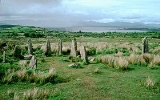
Standing stone

Encyclopedia
Standing stones, orthostats, liths, or more commonly megalith
s (because of their large and cumbersome size) are solitary stones set vertically in the ground and come in many different varieties.
Standing stones are usually difficult to date, but pottery found underneath some in Atlantic Europe
connects them with the Beaker people; others in the region appear to be earlier or later however.
Where they appear in groups together, often in a circular, oval, henge
or horseshoe formation, they are sometimes called megalithic monuments. These are sites [it is thought] of ancient religious ceremonies, sometimes containing burial chambers.
Megalith
A megalith is a large stone that has been used to construct a structure or monument, either alone or together with other stones. Megalithic describes structures made of such large stones, utilizing an interlocking system without the use of mortar or cement.The word 'megalith' comes from the Ancient...
s (because of their large and cumbersome size) are solitary stones set vertically in the ground and come in many different varieties.
Standing stones are usually difficult to date, but pottery found underneath some in Atlantic Europe
Atlantic Europe
Atlantic Europe is a geographical and anthropological term for the western portion of Europe which borders the Atlantic Ocean. The term may refer to the idea of Atlantic Europe as a cultural unit and/or as an biogeographical region....
connects them with the Beaker people; others in the region appear to be earlier or later however.
Where they appear in groups together, often in a circular, oval, henge
Henge
There are three related types of Neolithic earthwork which are all sometimes loosely called henges. The essential characteristic of all three types is that they feature a ring bank and ditch but with the ditch inside the bank rather than outside...
or horseshoe formation, they are sometimes called megalithic monuments. These are sites [it is thought] of ancient religious ceremonies, sometimes containing burial chambers.
See also
- Carlin stoneCarlin stoneCarlin Stone or Carlin Stane is the name given to a number of prehistoric standing stones and natural stone or landscape features in Scotland. The significance of the name is unclear, other than its association with old hags, witches, and the legends of the Cailleach.- Etymology :A 'Carle' in...
- Carnac stonesCarnac stonesThe Carnac stones are an exceptionally dense collection of megalithic sites around the French village of Carnac, in Brittany, consisting of alignments, dolmens, tumuli and single menhirs. The more than 3,000 prehistoric standing stones were hewn from local rock and erected by the pre-Celtic people...
- Cove (standing stones)Cove (standing stones)Cove is a term used to describe a tightly concentrated group of large standing stones found in Neolithic and Bronze Age England. Coves are square or rectangular in plan and seem to have served as small enclosures within other henge, stone circle or avenue features. They consist of three or four...
- CromlechCromlechCromlech is a Brythonic word used to describe prehistoric megalithic structures, where crom means "bent" and llech means "flagstone". The term is now virtually obsolete in archaeology, but remains in use as a colloquial term for two different types of megalithic monument.In English it usually...
- DolmenDolmenA dolmen—also known as a portal tomb, portal grave, dolmain , cromlech , anta , Hünengrab/Hünenbett , Adamra , Ispun , Hunebed , dös , goindol or quoit—is a type of single-chamber megalithic tomb, usually consisting of...
- Fulacht fiadhFulacht fiadhA fulacht fiadh is a type of archaeological site found in Ireland. In England, Scotland, Wales and the Isle of Man they are known as burnt mounds. They commonly survive as a low horseshoe-shaped mound of charcoal-enriched soil and heat shattered stone with a slight depression at its centre showing...
- Gowk StoneGowk StoneA Gowk Stone or 'Stane' in Scots means the stone of the 'Cuckoo' or 'Fool'. In Scotland the name 'Gowk' has been applied to certain standing stones and glacial erratics boulders, often found in prominent geographical situations...
- HengeHengeThere are three related types of Neolithic earthwork which are all sometimes loosely called henges. The essential characteristic of all three types is that they feature a ring bank and ditch but with the ditch inside the bank rather than outside...
- Ley Lines
- MenhirMenhirA menhir is a large upright standing stone. Menhirs may be found singly as monoliths, or as part of a group of similar stones. Their size can vary considerably; but their shape is generally uneven and squared, often tapering towards the top...
- Nature worshipNature worshipNature worship describes a variety of religious, spiritual and devotional practices that focus on natural phenomenon. A nature deity can be in charge of nature, the biosphere, the cosmos or the universe. Nature worship can be found in panentheism, pantheism, deism, polytheism, animism, totemism,...
- Orthostat
- Stone circleStone circleA stone circle is a monument of standing stones arranged in a circle. Such monuments have been constructed across the world throughout history for many different reasons....
- Stone rowStone rowA stone row , is a linear arrangement of upright, parallel megalithic standing stones set at intervals along a common axis or series of axes, usually dating from the later Neolithic or Bronze Age. Rows may be individual or grouped, and three or more stones aligned can constitute a stone row...
- Stone shipStone shipThe Stone ship or ship setting was an early Germanic burial custom, characteristically Scandinavian but also found in Germany and the Baltic states. The grave or cremation burial is surrounded by tightly or loosely fit slabs or stones in the outline of a ship...