


Alexander Sarcophagus

Encyclopedia
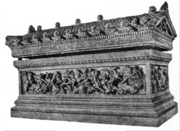
Sarcophagus
A sarcophagus is a funeral receptacle for a corpse, most commonly carved or cut from stone. The word "sarcophagus" comes from the Greek σαρξ sarx meaning "flesh", and φαγειν phagein meaning "to eat", hence sarkophagus means "flesh-eating"; from the phrase lithos sarkophagos...
adorned with bas-relief carvings of Alexander the Great. The work is remarkably well preserved and has been celebrated for its high aesthetic achievement. It is considered the outstanding holding of the Istanbul Archaeology Museum
Istanbul Archaeology Museum
The Istanbul Archaeology Museums is a group of three archeological museums located in the Eminönü district of Istanbul, Turkey, near Gülhane Park and Topkapı Palace.The Istanbul Archaeology Museums consists of three museums....
.
Discovery and interpretation
The Alexander Sarcophagus is one of four massive carved sarcophagi, forming two pairs, that were discovered during the excavations conducted by Osman Hamdi BeyOsman Hamdi Bey
Osman Hamdi Bey was an Ottoman statesman, intellectual, art expert and also a prominent and pioneering Turkish painter. He was also an accomplished archaeologist, and is considered as the pioneer of the museum curator's profession in Turkey...
at the necropolis
Necropolis
A necropolis is a large cemetery or burial ground, usually including structural tombs. The word comes from the Greek νεκρόπολις - nekropolis, literally meaning "city of the dead"...
near Sidon
Sidon
Sidon or Saïda is the third-largest city in Lebanon. It is located in the South Governorate of Lebanon, on the Mediterranean coast, about 40 km north of Tyre and 40 km south of the capital Beirut. In Genesis, Sidon is the son of Canaan the grandson of Noah...
, Lebanon
Lebanon
Lebanon , officially the Republic of LebanonRepublic of Lebanon is the most common term used by Lebanese government agencies. The term Lebanese Republic, a literal translation of the official Arabic and French names that is not used in today's world. Arabic is the most common language spoken among...
in 1887. Originally thought to have been the sarcophagus of Abdalonymus
Abdalonymus
Abdalonymus or, variously, Abdolonymus, Abdolonimus, and Abdalonimus was a gardener, but of royal descent, who was made king of Sidon by Alexander the Great in 332 BC.-Life:...
(died 311 BC), the king of Sidon appointed by Alexander immediately following the Battle of Issus
Battle of Issus
The Battle of Issus occurred in southern Anatolia, in November 333 BC. The invading troops, led by the young Alexander of Macedonia, defeated the army personally led by Darius III of Achaemenid Persia in the second great battle for primacy in Asia...
(333) it was demonstrated convincingly by Karl Schefold
Karl Schefold
Karl Schefold was a classical archaeologist based in Basel, Switzerland. Born and educated in Germany, he was forced in 1935 to emigrate to Switzerland, which he adopted as his home country...
to have been made before Abdalonymus's death, its still-classical manner uninfluenced by the style of Lysippos
Lysippos
Lysippos was a Greek sculptor of the 4th century BC. Together with Scopas and Praxiteles, he is considered one of the three greatest sculptors of the Classical Greek era, bringing transition into the Hellenistic period. Problems confront the study of Lysippos because of the difficulty of...
. Some scholars now believe the sarcophagus was made for Mazaeus, a Persian noble and governor of Babylon. Six Ionia
Ionia
Ionia is an ancient region of central coastal Anatolia in present-day Turkey, the region nearest İzmir, which was historically Smyrna. It consisted of the northernmost territories of the Ionian League of Greek settlements...
n sculptors' hands have been distinguished, working in an Attic
Attica
Attica is a historical region of Greece, containing Athens, the current capital of Greece. The historical region is centered on the Attic peninsula, which projects into the Aegean Sea...
idiom, most probably in Sidon.
Description
The sarcophagus is constructed of Pentelic marble retaining traces of its polychromyPolychrome
Polychrome is one of the terms used to describe the use of multiple colors in one entity. It has also been defined as "The practice of decorating architectural elements, sculpture, etc., in a variety of colors." Polychromatic light is composed of a number of different wavelengths...
, in the form of a Greek temple
Greek temple
Greek temples were structures built to house deity statues within Greek sanctuaries in Greek paganism. The temples themselves did usually not directly serve a cult purpose, since the sacrifices and rituals dedicated to the respective deity took place outside them...
.
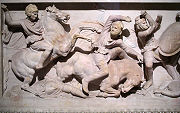
The carvings on one long side of the piece depict Alexander fighting the Persians at the Battle of Issus
Battle of Issus
The Battle of Issus occurred in southern Anatolia, in November 333 BC. The invading troops, led by the young Alexander of Macedonia, defeated the army personally led by Darius III of Achaemenid Persia in the second great battle for primacy in Asia...
. Volkmar von Graeve has compared the motif to the famous Alexander Mosaic
Alexander Mosaic
The Alexander Mosaic, dating from circa 100 BC, is a famous Roman floor mosaic originally from the House of the Faun in Pompeii. It depicts a battle between the armies of Alexander the Great and Darius III of Persia and measures 5.82 x 3.13m .-Battle:The mosaic illustrates a battle in which...
at Naples, concluding that the iconography of both derives from a common original, a lost painting by Philoxenos of Eretria. Alexander is shown mounted, wearing a lionskin on his head, and preparing to throw a spear at the Persian cavalry. The "historicity" of the figures accepted by von Graeve seems to Karl Schefold to be less stressed than the mythic content of battle and royal hunt, but some scholars believe that a second mounted Macedon
Macedon
Macedonia or Macedon was an ancient kingdom, centered in the northeastern part of the Greek peninsula, bordered by Epirus to the west, Paeonia to the north, the region of Thrace to the east and Thessaly to the south....
ian figure near the center represents Hephaestion
Hephaestion
Hephaestion , son of Amyntor, was a Macedonian nobleman and a general in the army of Alexander the Great...
, Alexander's older close friend. A third mounted Macedonian figure is often identified as Perdiccas
Perdiccas
Perdiccas was one of Alexander the Great's generals. After Alexander's death in 323 BC he became regent of all Alexander's empire.Arrian tells us he was son of Orontes, a descendant of the independent princes of the Macedonian province of Orestis...
.
The opposite long side shows Alexander and the Macedonians hunting lions together with Abdalonymus and the Persians.
The short ends lead the eye towards the mythic lion hunt: one short end portrays a scene in which Abdalonymus is hunting a panther; the other short end depicts a battle, perhaps the Battle of Gaza
Battle of Gaza
Battle of Gaza may refer to:* Battle of Gaza , fought between Ptolemy I of Egypt and Demetrius I of Macedon* Battle of Raphia, also known as Battle of Gaza, fought between Ptolemy IV of Egypt and Antiochus III the Great of the Seleucid kingdom in 217 BC* Three World War I battles between British...
, in which case the pediment above that end would be showing the murder of Perdiccas. The pediment
Pediment
A pediment is a classical architectural element consisting of the triangular section found above the horizontal structure , typically supported by columns. The gable end of the pediment is surrounded by the cornice moulding...
on the lid above shows Abdalonymus in battle.