
All Topics  
Neanderthal

 
Neanderthal

   Email Print
   Bookmark   Link


Neanderthal


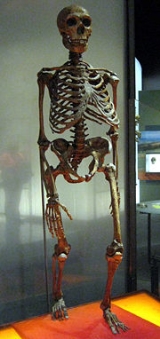
The Neanderthal (also with and ), or Neandertal, is an extinct member of the Homo
Homo (genus)

Homo is the genus that includes anatomically modern humanss and their close relatives. The genus is estimated to be about 2.5 million years old, evolving from Australopithecine ancestors with the appearance of Homo habilis....
 genus that is known from Pleistocene
Pleistocene

The Pleistocene is the epoch from 1.8 million to 10,000 years Before Present covering the world's recent period of repeated glaciations. The name pleistocene is derived from the Greek and ....
 specimen
Specimen

In biology, a Laboratory specimen is an individual animal, part of an animal, plant, part of a plant, or microorganism used as a representative to study the properties of the whole population of that species or subspecies....
s found in Europe
Europe

Europe is, conventionally, one of the world's seven continents. Comprising the westernmost peninsula of Eurasia, Europe is generally divided from Asia to its east by the water divide of the Ural Mountains, the Ural , the Caspian Sea, and by the Caucasus Mountains to the southeast....
 and parts of western and central Asia
Central Asia

Central Asia is a region of Asia from the Caspian Sea in the west to central China in the east, and from southern Russia in the north to northern India in the south....
. Neanderthals are either classified as a subspecies of human
Human

A human being, also human or man, is a member of a species of bipedalism primates in the family Hominidae . Mitochondrial DNA evidence indicates that modern humans originated in east Africa about 200,000 years ago....
s (Homo sapiens neanderthalensis) or as a separate species (Homo neanderthalensis). The first proto-Neanderthal traits
Trait (biology)

A trait is a distinct variant of a phenotype character of an organism that may be inherited, environmentally determined or somewhere in between....
 appeared in Europe as early as 600,000–350,000 years ago.


Discussion
Ask a question about 'Neanderthal'
Start a new discussion about 'Neanderthal'
Answer questions from other users
Full Discussion Forum


Recent Posts


Encyclopedia


The Neanderthal (also with and ), or Neandertal, is an extinct member of the Homo
Homo (genus)

Homo is the genus that includes anatomically modern humanss and their close relatives. The genus is estimated to be about 2.5 million years old, evolving from Australopithecine ancestors with the appearance of Homo habilis....
 genus that is known from Pleistocene
Pleistocene

The Pleistocene is the epoch from 1.8 million to 10,000 years Before Present covering the world's recent period of repeated glaciations. The name pleistocene is derived from the Greek and ....
 specimen
Specimen

In biology, a Laboratory specimen is an individual animal, part of an animal, plant, part of a plant, or microorganism used as a representative to study the properties of the whole population of that species or subspecies....
s found in Europe
Europe

Europe is, conventionally, one of the world's seven continents. Comprising the westernmost peninsula of Eurasia, Europe is generally divided from Asia to its east by the water divide of the Ural Mountains, the Ural , the Caspian Sea, and by the Caucasus Mountains to the southeast....
 and parts of western and central Asia
Central Asia

Central Asia is a region of Asia from the Caspian Sea in the west to central China in the east, and from southern Russia in the north to northern India in the south....
. Neanderthals are either classified as a subspecies of human
Human

A human being, also human or man, is a member of a species of bipedalism primates in the family Hominidae . Mitochondrial DNA evidence indicates that modern humans originated in east Africa about 200,000 years ago....
s (Homo sapiens neanderthalensis) or as a separate species (Homo neanderthalensis). The first proto-Neanderthal traits
Trait (biology)

A trait is a distinct variant of a phenotype character of an organism that may be inherited, environmentally determined or somewhere in between....
 appeared in Europe as early as 600,000–350,000 years ago. Proto-Neanderthal traits are occasionally grouped to another cladistic
Cladistics

Cladistics is the hierarchical classification of species based on evolutionary ancestry. Cladistics is distinguished from other taxonomic systems because it focuses on evolution rather than similarities between species, and because it places heavy emphasis on objective, quantitative analysis....
 'species', Homo heidelbergensis
Homo heidelbergensis

Homo heidelbergensis is an extinct species of the genus Homo which may be the direct ancestor of Homo neanderthalensis in Europe. The best evidence found for these hominins date between 600,000 and 400,000 years ago....
, or a migrant form, Homo rhodesiensis. By 130,000 years ago, complete Neanderthal characteristics had appeared. These characteristics then disappeared in Asia by 50,000 years ago and in Europe by 30,000 years ago. The youngest Neanderthal finds include Hyaena Den (UK), considered older than 30,000 years ago, while the Vindija (Croatia) Neanderthals have been re-dated to between 32,000 and 33,000 years ago. No definite specimens younger than 30,000 years ago have been found; however, evidence of fire by Neanderthals at Gibraltar indicate that they may have survived there until 24,000 years ago. Modern human skeletal remains with 'Neanderthal traits' were found in Lagar Velho (Portugal), dated to 24,500 years ago and interpreted as indications of extensively admixed populations.

Neanderthal stone tools provide further evidence for their presence where skeletal remains have not been found. The last traces of Mousterian culture, a type of stone tools associated with Neanderthals, were found in Gorham's Cave
Gorham's Cave

Gorham's Cave is a natural sea cave in Gibraltar, and is considered to be one of the last known habitations of the Neanderthals.Gorham's Cave is located on the south side of the Rock of Gibraltar....
 on the remote south-facing coast of Gibraltar
Gibraltar

Gibraltar is a British overseas territory located near the southernmost tip of the Iberian Peninsula overlooking the Strait of Gibraltar. The territory shares a border with Spain to the north....
. Other tool culture
Archaeological culture

In addition to its usual meaning in social science, in archaeology, the term wikt:culture is also used in reference to several related concepts unique to the discipline....
s sometimes associated with Neanderthal include Châtelperronian
Châtelperronian

Ch?telperronian was the earliest archaeological industry of the Upper Palaeolithic in central and south western France, extending also into Northern Spain....
, Aurignacian
Aurignacian

The Aurignacian culture is an archaeological culture of the Upper Palaeolithic, located in Europe and southwest Asia. It dates to between 32,000 and 26,000 Before Christ....
, and Gravettian
Gravettian

The Gravettian was an archaeological industry of the European Upper Palaeolithic. It is named after the type site of La Gravette in the Dordogne region of France....
, with the latter extending to 22,000 years ago, the last indication of Neanderthal presence.

Neanderthal cranial capacity
Cranial capacity

Cranial capacity is a measure of the volume of the interior of the cranium of those vertebrates who have both a cranium and a brain. The most commonly used unit of measure is the cubic centimetre or cubic centimetre....
 is often thought to have been as large or larger than modern humans, indicating that their brain size
Human brain

The human brain is the center of the human nervous system and is a highly complex organ. It has the same general structure as the brains of other mammals, but is over five times as large as the "average brain" of a mammal with the same body size....
 may have been the same or greater; however, a 1993 analysis of 118 hominid crania concluded that the cranial capacity of H.s. neandertal averaged 1412cc while that of fossil modern H.s. sapiens averaged 1487cc. They were almost exclusively carnivorous and apex predator
Apex predator

Apex predators are predators that, as adults, are not normally preyed upon in the wild by other large animals in significant parts of their range....
s. On average, the height of Neanderthals was comparable to contemporaneous Homo sapiens. Neanderthal males stood about 165–168 cm tall (about 5'5") and were heavily built with robust bone structure. They were much stronger, having particularly strong arms and hands. Females stood about 152–156 cm tall (about 5'1").

Etymology and classification

The Neandertal is a small valley of the river Düssel
Düssel

The D?ssel is a small right tributary of the River Rhine in North Rhine Westphalia, Germany. Its source is between W?lfrath and Velbert. It flows westward through the Neandertal, Germany where the fossils of the first Neanderthal man were found in 1856....
 in the German
Germany

Germany , officially the Federal Republic of Germany , is a country in Central Europe. It is bordered to the north by the North Sea, Denmark, and the Baltic Sea; to the east by Poland and the Czech Republic; to the south by Austria and Switzerland; and to the west by France, Luxembourg, Belgium, and the Netherlands....
 federal state of North Rhine-Westphalia
North Rhine-Westphalia

North Rhine - Westphalia is the westernmost and - in terms of population and economic output - the largest States of Germany of Germany. North Rhine - Westphalia has over 18 million inhabitants, contributes about 22% of Germany's gross domestic product and comprises a land area of 34,083 km? ....
, located about east of Düsseldorf
Düsseldorf

D?sseldorf is the capital city of the Germany state of North Rhine-Westphalia. It is an economic centre of Germany. The city is situated on the River Rhine and has a high population density - the Rhine-Ruhr metropolitan area has over 10 million inhabitants alone....
. Neanderthal is now spelled two ways: the old spelling of the German
German language

German is a West Germanic languages, thus related to and classified alongside English language and Dutch language. It is one of the world's world language and the most widely spoken mother tongue in the European Union....
 word Thal, meaning "valley
Valley

In geology, a valley is a Depression with predominant extent in one direction. A very deep river valley may be called a canyon or gorge....
 or dale", was changed to Tal in 1901, but the former spelling is often retained in English
English language

English is a West Germanic language that originated in Anglo-Saxon England and has lingua franca status in many parts of the world as a result of the military, economic, scientific, political and cultural influence of the British Empire in the 18th, 19th and early 20th centuries and that of the United States from the mid 20th century onwa...
 and always in scientific names, while the modern spelling is used in German while referring to the valley itself.

The Neandertal was named after theologian Joachim Neander
Joachim Neander

Joachim Neander was a German Reformed Christian Church teacher, theologian and hymn writer whose most famous hymn, Praise to The Lord, The Almighty, the King of Creation is generally regarded as one of the greatest hymns of praise of the Christianity church and appears in most major hymnals....
, who lived nearby in Düsseldorf
Düsseldorf

D?sseldorf is the capital city of the Germany state of North Rhine-Westphalia. It is an economic centre of Germany. The city is situated on the River Rhine and has a high population density - the Rhine-Ruhr metropolitan area has over 10 million inhabitants alone....
 in the late 17th century. "Neander" is a classicized form of the common German surname Neumann. In turn, Neanderthals were named after "Neander Valley", where the first Neanderthal remains were found. The term Neanderthal Man was coined in 1863 by Anglo-Irish
Anglo-Irish

"Anglo-Irish" was a term used historically to describe a privileged social class in Ireland, whose members were the descendants and successors of the Protestant Ascendancy, mostly belonging to the Anglicanism Church of Ireland, which was the established church of Ireland until 1871, or to a lesser extent one of the English Dissenters churches...
 geologist
Geologist

For other uses, see Geologist .A geologist is a contributor to the science of geology, studying the physical structure and processes of the Earth and planets of the solar system ....
 William King
William King (geologist)

William King , an Anglo-Irish geologist at Queen's College Galway was the first to propose that the bones found in Neanderthal, Germany in 1856 were not of human origin, but of a distinct species: Neanderthal....
.

The original German pronunciation
German phonology

This article is about the phonology of the German language based on the Standard German. It deals with current phonology and phonetics as well as with historical developments thereof, including geographical variants ....
 (regardless of spelling) is with the sound /t/. In American English, the term is commonly anglicised to /?/ (th as in thin), though scientists usually use /t/, and the latter, non-anglicised, pronunciation (followed by the German long a) is preferred in British English.

For some time, professionals debated whether Neanderthals should be classified as Homo neanderthalensis or as Homo sapiens neanderthalensis, the latter placing Neanderthals as a subspecies
Subspecies

In biology, subspecies is the taxonomic rank immediately subordinate to a species. A subspecies is a taxonomic group which is less distinct than the Common descent or species from which it originates....
 of Homo sapiens. Genetic statistical calculation (2006 results) suggests at least 5% of the modern human gene pool can be attributed to ancient admixture, with the European contribution being from the Neanderthal. Some morphological studies support that Homo neanderthalensis is a separate species and not a subspecies. Some suggest inherited admixture. Others, for example University of Cambridge
University of Cambridge

The University of Cambridge , located in Cambridge, England, is the List of oldest universities in continuous operation university in the Anglosphere....
 Professor Paul Mellars
Paul Mellars

Paul Mellars is Professor of Pre-History and Human Evolution in the Department of Archeology at the University of Cambridge....
, say "no evidence has been found of cultural interaction" and evidence from mitochondrial DNA
Mitochondrial DNA

Mitochondrial DNA is the DNA located in organelles called mitochondrion. Most other DNA present in eukaryotic organisms is found in the cell nucleus....
 studies have been interpreted as evidence Neanderthals were not a subspecies of H. sapiens. A controversial study of Homo sapiens mtDNA from Australia (Mungo Man
Mungo Man

The Mungo Man was an early human inhabitant of the continent of Australia, who is believed to have lived about 40,000 years ago, during the Pleistocene epoch ....
 40ky ) suggested that its lineage was not part of the recent human genomic pool and mtDNA sequences for temporally comparative African specimens are not yet available.

Discovery

Neanderthal skulls
Craniometry

Craniometry is the technique of measuring the bones of the skull. It is distinct from phrenology, the study of personality and character, and physiognomy, the study of facial features....
 were first discovered in Engis
Engis

Engis is a Wallonia municipality located in the Belgium province of Li?ge . On January 1 2006 Engis had a total population of 5,686. The total area is 27.74 km? which gives a population density of 205 inhabitants per km?....
, Belgium
Belgium

* A small German-speaking Community of Belgium exists in eastern Wallonia. Belgium's linguistic diversity and related political and cultural conflicts are reflected in the history of Belgium and a complex Communities and regions of Belgium....
 (1829) and in Forbes' Quarry, Gibraltar
Gibraltar

Gibraltar is a British overseas territory located near the southernmost tip of the Iberian Peninsula overlooking the Strait of Gibraltar. The territory shares a border with Spain to the north....
 (1848), both prior to the "original" discovery in a limestone
Limestone

File:Limestone Formation In Waitomo.jpgLimestone is a sedimentary rock composed largely of the mineral calcite . The deposition of limestone strata is often a by-product and indicator of biological activity in the geology record....
 quarry of the Neander Valley
Neanderthal, Germany

The Neandertal is a small valley of the river D?ssel in the Germany Federal State of North Rhine-Westphalia, located about east of D?sseldorf, the capital city of North Rhine-Westphalia....
 in Erkrath
Erkrath

Erkrath is a town in the Mettmann , in North Rhine-Westphalia, Germany...
 near Düsseldorf
Düsseldorf

D?sseldorf is the capital city of the Germany state of North Rhine-Westphalia. It is an economic centre of Germany. The city is situated on the River Rhine and has a high population density - the Rhine-Ruhr metropolitan area has over 10 million inhabitants alone....
 in August, 1856, three years before Charles Darwin
Charles Darwin

Charles Robert Darwin Royal Society was an English people natural history who realised and presented compelling evidence that all species of life have evolution over time from common descent, through the process he called natural selection....
's On the Origin of Species was published. The type specimen, dubbed Neanderthal 1
Neanderthal 1

Feldhofer 1, Neanderthal 1 is the common name for the initial 40 ky old Neanderthal specimen found in Kleine Feldhofer Grotte in August 1856....
, consisted of a skull cap, two femora
Femur

The femur, or thigh bone, is the most proximal bone of the leg in vertebrates capable of walking or jumping, such as most land mammals, birds, many reptiles such as lizards, and amphibians such as frogs....
, three bones from the right arm, two from the left arm, part of the left ilium
Pelvis

The pelvis or pelvic girdle is the irregular bone structure located at the base of the spine . In the adult human, it is formed by the sacrum and the coccyx, the caudal part of the axial skeleton, and a pair of hip bones, part of the appendicular skeleton or human leg....
, fragments of a scapula
Scapula

In anatomy, the scapula, omo, or shoulder blade, is the bone that connects the humerus with the clavicle .The scapula forms the posterior part of the shoulder girdle....
, and ribs. The workers who recovered this material originally thought it to be the remains of a bear
Bear

Bears are mammals of the family Ursidae. Bears are classified as caniforms, or doglike carnivorans, with the pinnipeds being their closest living relatives....
. They gave the material to amateur naturalist Johann Carl Fuhlrott
Johann Carl Fuhlrott

Johann Carl Fuhlrott was born December 31 1803 in Leinefelde, Germany, and died October 17 1877 in Elberfeld, . He is famous for the discovery of the Neanderthal 1, a Neanderthal specimen found during an archaeology dig in August 1856....
, who turned the fossils over to anatomist Hermann Schaaffhausen
Hermann Schaaffhausen

Hermann Schaaffhausen studied medicine in University of Berlin and received his doctor degree in 1839, and became a Professor of Anatomy at the University of Bonn....
. The discovery was jointly announced in 1857.

The original Neanderthal discovery is now considered the beginning of paleoanthropology
Paleoanthropology

Paleoanthropology, which combines the disciplines of paleontology and physical anthropology, is the study of ancient humans as found in fossil Hominidae evidence such as Petrifaction bones and footprints....
. These and other discoveries led to the idea that these remains were from ancient Europe
Europe

Europe is, conventionally, one of the world's seven continents. Comprising the westernmost peninsula of Eurasia, Europe is generally divided from Asia to its east by the water divide of the Ural Mountains, the Ural , the Caspian Sea, and by the Caucasus Mountains to the southeast....
ans who had played an important role in modern human origins
Human evolution

Human evolution, or anthropogenesis, is the part of biological evolution concerning the emergence of Homo sapiens as a distinct species from other hominans, great apes and placental mammals....
. The bones of over 400 Neanderthals have been found since.

Specimens

  • La Ferrassie 1
    La Ferrassie 1

    La Ferrassie 1 is a fossilized skull of the species Homo neanderthalensis. It was discovered in La Ferrassie, France by R. Capitan in 1909....
    : A fossilized skull discovered in La Ferrassie, France by R. Capitan in 1909. It is estimated to be 70,000 years old. Its characteristics include a large occipital bun, low-vaulted cranium and heavily worn teeth.
  • Shanidar 1: Found in the Zagros Mountains in northern Iraq; a total of nine skeletons found believed to have lived in the Middle Paleolithic
    Middle Paleolithic

    The Middle Paleolithic is the second subdivision of the Paleolithic or Old Stone Age as it is understood in Europe, Africa and Asia. The term Middle Stone Age is used as an equivalent or a synonym for the Middle Paleolithic in African archeology....
    . One of the nine remains was missing part of its right arm; theorized to have been broken off or amputated
    Amputation

    Amputation is the removal of a body extremity by Physical trauma or surgery. As a surgical measure, it is used to control pain or a disease process in the affected limb, such as cancer or gangrene....
    . The find is also significant because it shows that stone tools were present amoung this tribe's culture. One was buried with flowers, showing that some type of burial ceremony may have occurred.
  • La Chapelle-aux-Saints 1
    La Chapelle-aux-Saints 1

    La Chapelle-aux-Saints 1 is a partial skeleton of the species Homo neanderthalensis. It was discovered in La Chapelle-aux-Saints, France by A....
    : Called the Old Man, a fossilized skull discovered in La Chapelle-aux-Saints
    La Chapelle-aux-Saints

    La Chapelle-aux-Saints is a Communes of France in the Departments of France of Corr?ze in central France....
    , France by A. and J. Bouyssonie, and L. Bardon in 1908. Characteristics include a low vaulted cranium and large browridge typical of Neanderthals. Estimated to be about 60,000 years old, the specimen was severely arthritic and had lost all his teeth, with evidence of healing. For him to have lived on would have required that someone process his food for him, one of the earliest examples of Neanderthal altruism (similar to Shanidar I.)
  • Le Moustier
    Le Moustier

    Le Moustier is an archeological site consisting of two rock shelters in Peyzac-le-Moustier, Dordogne , France. It is known for a fossilized skull of the species Homo neanderthalensis that was discovered in 1909....
    : A fossilized skull, discovered in 1909, at the archaeological site in Peyzac-le-Moustier, Dordogne, France. The Mousterian tool culture is named after Le Moustier. The skull, estimated to be less than 45,000 years old, includes a large nasal cavity and a somewhat less developed brow ridge and occipital bun as might be expected in a juvenile.
Neandertal 1856
* Neanderthal 1
Neanderthal 1

Feldhofer 1, Neanderthal 1 is the common name for the initial 40 ky old Neanderthal specimen found in Kleine Feldhofer Grotte in August 1856....
: Initial Neanderthal specimen found during an archaeological dig in August 1856. Discovered in a limestone quarry at the Feldhofer grotto in Neanderthal, Germany. The find consisted of a skull cap, two femora, the three right arm bones, two of the left arm bones, ilium, and fragments of a scapula and ribs.

Chronology

Bones with Neanderthal traits in chronological order.
  • > 350 Sima de los Huesos c. 500:350 hh/hn
  • 350–200 kya: Pontnewydd 225 kya.
  • 200–135: Atapuerca, Vértesszöllos, Ehringsdorf, Casal de'Pazzi, Biache, La Chaise, Montmaurin, Prince, Lazaret, Fontéchevade
  • 135–45: Krapina
    Krapina

    Krapina is a town in northern Croatia and the administrative centre of Krapina-Zagorje county with a population of 4,647 and a total municipality population of 12,950 ....
    , Saccopastore, Malarnaud, Altamura, Gánovce, Denisova, Okladnikov Altai, Pech de l'Azé, Tabun 120k ÷ 100±5 , Qafzeh
    Qafzeh

    Qafzeh or Kafzeh is a paleoanthropology site at Mount Kafzeh south of Nazareth, Israel. Since 1933, eleven significant fossilised Homo sapiens skeletons have been found at the main rock shelter and nearby Skhul cave....
    9 100, Shanidar 1 to 9
    Shanidar

    The cave site of Shanidar is located in the Zagros Mountains of Kurdistan in Iraq. It was excavated between 1957-1961 by Ralph Solecki and his team from Columbia University and yielded the first adult Neanderthal skeletons in Iraq, dating between 60-80,000 years Before Present....
     80–60, La Ferrassie 1
    La Ferrassie 1

    La Ferrassie 1 is a fossilized skull of the species Homo neanderthalensis. It was discovered in La Ferrassie, France by R. Capitan in 1909....
     70, Kebara
    Kebara Cave

    Kebara Cave is an Israeli limestone cave locality of the Wadi Kebara, situated at 60 - 65 metres above mean sea level on the western escarpment of the Mount Carmel, some 10km north-east of Caesarea Maritima....
     60, Régourdou, Mt. Circeo, Combe Grenal, Erd
    Érd

    ?rd is an Counties of Hungary in Pest county, Budapest metropolitan area, Hungary....
     50, La Chapelle-aux Saints 1 60, Amud, Teshik-Tash
    Teshik-Tash

    Teshik-Tash is an archaeological site in Uzbekistan in central Asia, and the easternmost site to contain remains of the Neanderthal people. The inhabitants were "Transition Neanderthals" rather than "Classic Neanderthals." The site includes the remains of a Neanderthal child in association with Ibex horns which may have been funerary offering...
    , .
  • 45–35: Le Moustier
    Le Moustier

    Le Moustier is an archeological site consisting of two rock shelters in Peyzac-le-Moustier, Dordogne , France. It is known for a fossilized skull of the species Homo neanderthalensis that was discovered in 1909....
     45, Feldhofer
    Neanderthal 1

    Feldhofer 1, Neanderthal 1 is the common name for the initial 40 ky old Neanderthal specimen found in Kleine Feldhofer Grotte in August 1856....
     42, La Quina, l'Horus, Hortus, Kulna, Šipka, Saint Césaire, Bacho Kiro, El Castillo, Bñnolas, Arcy-sur-Cure
    Arcy-sur-Cure

    Arcy-sur-Cure is a Communes of France in the Yonne Departments of France in Bourgogne in north-central France.The caves of Arcy-sur-Cure just south of the commune, hold the second-oldest cave paintings known to man, after those of Chauvet Cave....
    .
  • < 35: Chatelperron, Pestera cu Oase
    Pestera cu Oase

    Pestera cu Oase is a system of 12 karst topography galleries and chambers located N. 45? 01?; E. 21? 50? in south-western Romania, where the oldest Human remains in Europe have been discovered....
     35k, Figueria Brava, Mladec
    Mladec

    Mladec is a village 20 km NW of Olomouc in central Moravia, Czech Republic. The Mladec caves are located near Mladec.Mladec is an archaeological site with the oldest directly dated remains of modern human in Europe....
     31k, Zafaraya 30,, Vogelherd 3? , Pestera Muierii 30k (n/s) , Vindija (Vi208, 32400]), Velika Pecina, Lagar Velho 24.5.


Anatomy

Neanderthals were generally only 12 to 14 cm (4½–5½ in) shorter than modern humans, contrary to a common view of them as "very short" or "just over 5 feet". Based on 45 long bones from (at most) 14 males and 7 females, Neanderthal males averaged between 164 to 168 cm (5 ft 4½ in to 5 ft 6 in) and females 152 to 156 cm (5 ft to 5 ft 1½) tall. Compared to Europeans some 20,000 years ago, it is nearly identical, perhaps slightly higher. Considering the body build of Neanderthals, new body weight estimates show they are only slightly above the cm/weight or the Body Mass Index
Body mass index

The body mass index , or Quetelet index, is a statistical measurement which compares a person's weight and height. Though it does not actually measure the Body fat percentage, it is a useful tool to estimate a healthy body weight based on how tall a person is....
 of modern Americans or Canadians.

Neanderthals had more robust build and distinctive morphological
Comparative anatomy

Comparative anatomy is the study of similarities and differences in the anatomy of organisms. It is closely related to evolutionary biology and phylogeny ....
 features, especially of the cranium
Skull

The skull is a bone structure found in the head of many animals. The skull supports the structures of the face and protects the head against injury....
, which gradually accumulated more derived aspects, particularly in certain relatively isolated geographic regions. Evidence suggests they were much stronger than modern humans; their relatively robust stature is thought to be an adaptation to the cold climate of Europe during the Pleistocene
Pleistocene

The Pleistocene is the epoch from 1.8 million to 10,000 years Before Present covering the world's recent period of repeated glaciations. The name pleistocene is derived from the Greek and ....
 epoch.

A 2007 study suggested some Neanderthals may have had red hair and pale skin color
Human skin color

Human skin color can range from almost black to nearly colorless in different homo sapiens. Skin color is determined by the amount and type of melanin, the pigment in the skin....
.

Distinguishing physical traits

Neandertal Vs Sapiens
The magnitude of autapomorphic
Autapomorphy

An autapomorphy in cladistics is a derived trait that is unique to a given terminal group. That is, it is found only in one member of a clade, but not found in any others or outgroup taxa, not even those most closely related to the group ....
 traits in specimens differ in time. In the latest specimens, autapomorphy is fuzzy. The following is a list of physical traits which distinguish Neanderthals from modern humans; however, not all of them can be used to distinguish specific Neanderthal populations, from various geographic areas or periods of evolution, from other extinct humans. Also, many of these traits occasionally manifest in modern humans, particularly among certain ethnic groups traced to neanderthal habitat ranges. Nothing is certain (from unearthed bones) about the shape of soft parts such as eyes, ears, and lips of Neanderthals.

When comparing traits to worldwide average present day human traits in Neanderthal specimens, the following traits are distinguished. The magnitude on particular trait changes with 300,000 years timeline.
  • Cranial
    • Suprainiac fossa, a groove above the inion
      Inion

      The inion is the most prominent projection of the occipital bone at the posterioinferior part of the skull. The nuchal ligament and trapezius muscle attach to it....
    • Occipital bun
      Occipital bun

      Occipital bun is a Comparative anatomy term used to describe a prominent bulge, or projection, of the occipital bone at the back of the skull. The term is most often used in connection with scientific descriptions of classic Neanderthal crania....
      , a protuberance of the occipital bone
      Occipital bone

      The occipital bone, a saucer-shaped membrane bone situated at the back and lower part of the skull, is trapezoid in shape and curved on itself. It is pierced by a large oval aperture, the foramen magnum, through which the cranial cavity communicates with the vertebral canal....
       which looks like a hair knot
    • Projecting mid-face
    • Low, flat, elongated skull
    • A flat basicranium
    • Supraorbital torus, a prominent, trabecular (spongy) brow ridge
    • 1200–1900 cm³ skull capacity
    • Lack of a protruding chin (mental protuberance; although later specimens possess a slight protuberance)
    • Crest on the mastoid process
      Mastoid process

      The mastoid process is a conical prominence projecting from the undersurface of the mastoid portion of the temporal bone. It is located just behind the external acoustic meatus, and lateral to the styloid process ....
       behind the ear opening
    • No groove on canine teeth
    • A retromolar space
      Retromolar space

      The retromolar space or retromolar gap is a space at the rear of a mandible, between the back of the last Molar and the anterior edge of the ascending ramus where it crosses the Alveolar ridge....
       posterior to the third molar
    • Bony projections on the sides of the nasal
      Nasal

      Nasal may refer to:*Nasal consonant*Nasal vowel*Nose**Nasal cavity**Nasal bone**Nasal Helm**Nasal hair*Nasal scale of reptiles...
       opening, projecting nose
      Nose

      Anatomically, a nose is a protuberance in vertebrates that houses the nostrils, or nares, which admit and expel air for Respiration in conjunction with the mouth....
    • Distinctive shape of the bony labyrinth
      Labyrinth (inner ear)

      The labyrinth is a system of fluid passages in the inner ear, including both the cochlea which is part of the auditory system, and the vestibular system which provides the sense of balance....
       in the ear
    • Larger mental foramen
      Mental foramen

      The mental foramen is one of two holes located on the anterior surface of the mandible. It permits passage of the mental nerve and vessels. The mental foramen descends slightly in edentulous individuals....
       in mandible for facial blood supply
  • Sub-cranial
    • Considerably more robust, stronger build
    • Long collar bones, wider shoulder
      Shoulder

      In human anatomy, the shoulder joint comprises the part of the body where the humerus attaches to the scapula. The shoulder refers to the group of structures in the region of the joint....
      s
    • Barrel-shaped rib cage
      Human rib cage

      The human rib cage, also known as the thoracic cage, is a bony and cartilaginous structure which surrounds the thoracic cavity and supports the pectoral girdle, forming a core portion of the human skeleton....
    • Short, bowed shoulder blades
      Scapula

      In anatomy, the scapula, omo, or shoulder blade, is the bone that connects the humerus with the clavicle .The scapula forms the posterior part of the shoulder girdle....
    • Larger round finger
      Finger

      A finger is a type of digit , an organ of manipulation and sensation found in the hands of humans and other primates.Normally humans have five digits, termed phalanges, on each hand ....
       tips
    • Large kneecaps
    • Thick, bowed shaft of the thigh bones, bowed femur
      Femur

      The femur, or thigh bone, is the most proximal bone of the leg in vertebrates capable of walking or jumping, such as most land mammals, birds, many reptiles such as lizards, and amphibians such as frogs....
    • Short shinbones
      Tibia

      The tibia, shinbone, or shankbone is the larger and stronger of the two bones in the leg below the knee in vertebrates and connects the knee with the ankle bones....
       and calf bones
      Fibula

      The fibula or calf bone is a bone located on the lateral side of the tibia, with which it is connected above and below. It is the smaller of the two bones, and, in proportion to its length, the most slender of all the long bones....
      , shorter torus
      Torus

      In geometry, a torus is a surface of revolution generated by revolving a circle in three dimensional space about an axis coplanar with the circle, which does not touch the circle....
       proportionally longer leg
      Leg

      Leg may refer to the following places in Poland:*A former name for the town of Elk *Leg, Lower Silesian Voivodeship *Leg, Kuyavian-Pomeranian Voivodeship ...
      s
    • Long, gracile pelvic pubis
      Pubis

      Pubis may refer to:* Pubis * Mons pubis, a padding of fat that protects the pubis bone...
       (superior pubic ramus
      Superior pubic ramus

      The superior pubic ramus is a part of the pubic bone which forms a portion of the obturator foramen.It extends from the body to the median plane where it articulates with its fellow of the opposite side....
      )


Genome

Previous investigations concentrated on mitochondrial DNA (mtDNA), which, owing to strictly matrilineal inheritance and subsequent vulnerability to genetic drift
Genetic drift

Genetic drift or allelic drift is the change in the relative frequency with which a gene variant occurs in a population that results from the fact that alleles in offspring are a Sampling of those in the parents, and because of the role of chance in determining whether a given individual survives and reproduces....
, is of limited value to disprove interbreeding. More recent investigations have access to growing strings of sequenced
Sequencing

In genetics and biochemistry, sequencing means to determine the primary structure of an unbranched biopolymer. Sequencing results in a symbolic linear depiction known as a sequence which succinctly summarizes much of the atomic-level structure of the sequenced molecule....
 nuclear (nDNA). The ongoing scientific efforts may be conceptually divided into:
  1. sequencing recovered remains of aDNA
  2. present day DNA (mtDNA, nDNA) sequencing to find differences in ancient signals in subpopulation gene pool
    Gene pool

    In population genetics, a gene pool is the complete set of unique alleles in a species or population....
    s.

aDNA

In July 2006, the Max Planck Institute for Evolutionary Anthropology
Max Planck Institute for Evolutionary Anthropology

The Max Planck Institute for Evolutionary Anthropology is a research institute based in Leipzig, Germany, founded in 1997. It is part of the Max-Planck-Gesellschaft network....
 and 454 Life Sciences
454 Life Sciences

454 Life Sciences, a Roche company, is a biotechnology company based in Branford, Connecticut specializing in high-throughput DNA sequencing using a novel massively parallel sequencing-by-synthesis approach....
 announced that they would be sequencing
Sequencing

In genetics and biochemistry, sequencing means to determine the primary structure of an unbranched biopolymer. Sequencing results in a symbolic linear depiction known as a sequence which succinctly summarizes much of the atomic-level structure of the sequenced molecule....
 the Neanderthal genome over the next two years. This genome
Genome

In classical genetics, the genome of a diploid organism including eukarya refers to a full set of chromosomes or genes in a gamete; thereby, a regular somatic cell contains two full sets of genomes....
 is very likely to be roughly the size of the human genome
Human genome

The human genome is the genome of Homo sapiens, which is stored on 23 chromosome pairs. Twenty-two of these are autosome, while the remaining pair is XY sex-determination system....
, three-billion base pairs, and probably shares most of its genes
Gênes

G?nes is the name of a d?partement in France of the First French Empire in present Italy. It was named after the city Genoa. It was formed in 1805, when Napoleon Bonaparte occupied the Republic of Genoa....
. It is thought a comparison will expand understanding of Neanderthals as well as the evolution of humans and human brains.

Svante Pääbo
Svante Pääbo

Svante P??bo is a biologist specializing in evolutionary genetics. He was born in 1955 in Stockholm, Sweden and earned his PhD from Uppsala University in 1986....
 has tested more than 70 Neanderthal specimens and found only one which had enough DNA to sample. Preliminary DNA sequencing from a 38,000-year-old bone fragment of a femur found at Vindija cave, Croatia
Croatia

Croatia , officially the Republic of Croatia , is a Central European country at the crossroads of Pannonian Plain, Balkans, and the Mediterranean Sea....
, in 1980 shows that Homo neanderthalensis and Homo sapiens share about 99.5% of their DNA. From mtDNA analysis estimates, the two species shared a common ancestor about 500,000 years ago. An article appearing in the journal Nature
Nature (journal)

Nature is a prominent scientific journal, first published on 4 November 1869. Although most scientific journals are now highly specialized, Nature is one of the few journals, along with other weekly journals such as Science and Proceedings of the National Academy of Sciences, that still publishes original research articles ac...
 has calculated the species diverged about 516,000 years ago, whereas fossil records show a time of about 400,000 years ago. From DNA records, scientists hope to falsify or confirm the theory that there was interbreeding between the species. A 2007 study pushes the point of divergence back to around 800,000 years ago.

Edward Rubin
Edward Rubin

Edward M. "Eddy" Rubin is a researcher at the Lawrence Berkeley National Laboratory in Berkeley, California and the director of the United States Department of Energy's Joint Genome Institute....
 of the Lawrence Berkeley National Laboratory
Lawrence Berkeley National Laboratory

The Ernest Orlando Lawrence Berkeley National Laboratory , is a United States Department of Energy United States Department of Energy National Labs conducting unclassified scientific research....
 in Berkeley, California
Berkeley, California

Berkeley is a city on the east shore of San Francisco Bay in Northern California, in the United States. Its neighbors to the south are the cities of Oakland, California and Emeryville, California....
 states that recent genome testing of Neanderthals suggests human and Neanderthal DNA are some 99.5% to nearly 99.9% identical.

On November 16, 2006, Science Daily published an interview that suggested that Neanderthals and ancient humans probably did not interbreed. Edward M. Rubin, director of the U.S. Department of Energy’s Lawrence Berkeley National Laboratory and the Joint Genome Institute (JGI), sequenced a fraction (0.00002) of genomic nuclear DNA
Nuclear DNA

Nuclear DNA, nuclear deoxyribonucleic acid , is DNA contained within a cell nucleus of eukaryote. In most cases it encodes more of the genome than the mitochondrial DNA and is passed sexually rather than matrilineally....
 (nDNA) from a 38,000-year-old Vindia Neanderthal femur bone. They calculated the common ancestor to be about 353,000 years ago, and a complete separation of the ancestors of the species about 188,000 years ago. Their results show the genomes of modern humans and Neanderthals are at least 99.5% identical, but despite this genetic similarity, and despite the two species having coexisted in the same geographic region for thousands of years, Rubin and his team did not find any evidence of any significant crossbreeding between the two. Rubin said, “While unable to definitively conclude that interbreeding between the two species of humans did not occur, analysis of the nuclear DNA from the Neanderthal suggests the low likelihood of it having occurred at any appreciable level.”

A main proponent of the interbreeding hypothesis is Erik Trinkaus
Erik Trinkaus

Erik Trinkaus, PhD, is a prominent paleoanthropologist and expert on Neanderthal biology and Human origin. Trinkaus researches the evolution of the species Homo sapiens and recent human diversity, focusing on the paleoanthropology and emergence of late Archaic Homo sapiens and early modern humans, and the subsequent evolution of 'Anatom...
 of Washington University. In a 2006 study published in Proceedings of the National Academy of Sciences
Proceedings of the National Academy of Sciences

The Proceedings of the National Academy of Sciences of the United States of America, usually referred to as PNAS, is the official journal of the United States National Academy of Sciences....
, Trinkaus and his co-authors report a possibility that Neanderthals and humans did interbreed. The study claims to settle the extinction controversy; according to researchers, the human and neanderthal populations blended together through sexual reproduction. Trinkaus states, "Extinction through absorption is a common phenomenon," and "From my perspective, the replacement vs. continuity debate that raged through the 1990s is now dead." Trinkaus thinks he sees evidence of interbreeding between Neanderthals and modern humans in some fossils like the 24,500-year-old skeleton of a child found in Lagar Velho in Portugal.

Recently, Richard E. Green et al. from Max Planck Institute for Evolutionary Anthropology published the full sequence of Neanderthal mitochondrial DNA
Mitochondrial DNA

Mitochondrial DNA is the DNA located in organelles called mitochondrion. Most other DNA present in eukaryotic organisms is found in the cell nucleus....
 (mtDNA) and suggested that "Neandertals had a long-term effective population size smaller than that of modern humans." While reporting in Nature
Nature

File:Jungle in Punjab.JPGNature, in the broadest sense, is equivalent to the natural world, physical universe, material world or material universe....
 Journal about the same publication, James Morgan asserted that the mtDNA sequence contained clues that Neanderthals lived in "small and isolated populations, and probably did not interbreed with their human neighbours." The study unequivocally established that Neanderthal mtDNA fall outside the variation of modern human mtDNA.

There is a possibility Neanderthals and Cro-Magnon
Cro-Magnon

Cro-Magnon is one of the main types of archaic Homo sapiens of the Paleolithic Europe Upper Paleolithic, living approximately 40,000 to 10,000 years ago....
s interbred but left little genetic evidence. There is an ongoing debate about whether the hunter-gatherers of the middle stone age started farming when they came in contact with agriculture, or were completely replaced by the farmers moving in from the Middle East. If modern Europeans are mainly descendants of these farming people with little or no genetic input from the foragers of the middle stone age, then possible interbreeding between them and the Neanderthals would not have had a great effect on the modern gene pool. On February 2009, Green et al announced that they had established a draft version of the complete Neanderthal Genome.

Gene pool

Statistical analysis strongly suggests that 5% of the genetic material of modern West Africans and Europeans has an archaic origin, due to interbreeding with Neanderthal and a hitherto unknown archaic African population. Plagnol and Wall arrived at this result by first calculating a "null model" of genetic characteristics which would fulfill the requirement of descent from Homo sapiens sapiens in a straight line. Next they compared this model to the current distribution and characteristics of existing genetic polymorphisms, and concluded this "null model" deviated considerably from what would be expected. Genetic simulations indicated the 5% of DNA not accounted for by the null model corresponds to a substantial contribution to the European gene pool of up to 25%. Future investigation, including a full scale Neanderthal genome project, is expected to cast more light on the subject of genetic polymorphisms to supply more details. Contrary to the investigation of mtDNA, the study of polymorph mutations has the potential to answer the question whether, and to what extent, Homo neanderthalensis and Homo sapiens interbred.

The case for sexual reproduction
Sexual reproduction

Sexual reproduction is characterized by processes that pass a Genetic recombination of Genetics material to offspring, resulting in Genetic diversity....
 recently revived by studies that claim signs of admixture (introgression
Introgression

Introgression, in genetics , is the movement of a gene from one species into the gene pool of another by backcrossing an interspecific hybrid with one of its parents....
), finding unusually deep genealogies in highly divergent clades (genetic branches). The genetic variation at the microcephalin
Microcephalin

Microcephalin is one of six genes causing primary microcephaly when non-functional mutations exist in the homozygous state. Derived from the Greek language words for "small" and "head", this condition is characterised by a severely diminished human brain....
 gene, a critical regulator of brain size whose loss-of-function by damaging mutations may also cause primary microcephaly
Microcephaly

Microcephaly is a neurodevelopmental disorder in which the circumference of the head is more than two standard deviations smaller than average for the person's age and sex....
, is claimed to be the most compelling evidence of admixture thus far. One type of the gene, dubbed haplogroup D, having an exceptionally high worldwide frequency (about 70%), was shown to have a remarkably young coalescence age to its most recent common ancestor around 37,000 years ago. The remaining types (non-D) coalesce to approximately 990,000 years ago, while the separation time between D and non-D was estimated at some 1,100,000 years ago. An evolutionary advance was assumed, even though positive selection was never as all-decisive as to wipe out the remaining 30% of non-D haplogroups (in which case no introgression could have been suggested) and as for now, a measurable genetic advance has not been attested. Both the worldwide frequency distribution of the D allele, exceptionally high outside of Africa but low in sub-Saharan Africa (29%) that suggests involvement of an archaic Eurasian population, and current estimates of the divergence time between modern humans and Neanderthals based on mitochondrial DNA (mtDNA), are in favor of the Neanderthal lineage as the most likely archaic Homo population from which introgression into the modern human gene pool took place.

Key dates

  • 1829: Neanderthal skulls were discovered in Engis
    Engis

    Engis is a Wallonia municipality located in the Belgium province of Li?ge . On January 1 2006 Engis had a total population of 5,686. The total area is 27.74 km? which gives a population density of 205 inhabitants per km?....
    , Belgium
    Belgium

    * A small German-speaking Community of Belgium exists in eastern Wallonia. Belgium's linguistic diversity and related political and cultural conflicts are reflected in the history of Belgium and a complex Communities and regions of Belgium....
    .
  • 1848: Skull of an ancient human was found in Forbes' Quarry
    Gorham's Cave

    Gorham's Cave is a natural sea cave in Gibraltar, and is considered to be one of the last known habitations of the Neanderthals.Gorham's Cave is located on the south side of the Rock of Gibraltar....
    , Gibraltar
    Gibraltar

    Gibraltar is a British overseas territory located near the southernmost tip of the Iberian Peninsula overlooking the Strait of Gibraltar. The territory shares a border with Spain to the north....
    . Its significance was not realised at the time.
  • 1856: Johann Karl Fuhlrott first recognised the fossil called “Neanderthal man”, discovered in Neanderthal
    Neanderthal, Germany

    The Neandertal is a small valley of the river D?ssel in the Germany Federal State of North Rhine-Westphalia, located about east of D?sseldorf, the capital city of North Rhine-Westphalia....
    , a valley near Mettmann
    Mettmann

    Mettmann is a Lower Lorraine town in North Rhine-Westphalia, Germany. It is the administrative centre of the Mettmann , Germany's most densely populated rural district....
     in what is now North Rhine-Westphalia
    North Rhine-Westphalia

    North Rhine - Westphalia is the westernmost and - in terms of population and economic output - the largest States of Germany of Germany. North Rhine - Westphalia has over 18 million inhabitants, contributes about 22% of Germany's gross domestic product and comprises a land area of 34,083 km? ....
    , Germany
    Germany

    Germany , officially the Federal Republic of Germany , is a country in Central Europe. It is bordered to the north by the North Sea, Denmark, and the Baltic Sea; to the east by Poland and the Czech Republic; to the south by Austria and Switzerland; and to the west by France, Luxembourg, Belgium, and the Netherlands....
    .
  • 1880: The mandible of a Neanderthal child was found in a secure context and associated with cultural debris, including hearths, Mousterian tools, and bones of extinct animals.
  • 1886: two nearly perfect skeletons of a man and woman were found at Spy, Belgium
    Spy, Belgium

    Spy is a village in the municipality of Jemeppe-sur-Sambre near Namur , Belgium.Here in 1886, in Betche aux Roches cavern, Maximin Lohest and Marcel de Puydt found two nearly perfect skeletons at the depth of 16 ft., with numerous implements of the Mousterian type....
     at the depth of 16 ft. with numerous Mousterian-type implements.
  • 1899: Hundreds of Neanderthal bones were described in stratigraphic position in association with cultural remains and extinct animal bones.
  • 1908: A nearly complete Neanderthal skeleton was discovered in association with Mousterian
    Mousterian

    Mousterian is a name given by archaeologists to a style of predominantly flint tools associated primarily with Neanderthal and dating to the Middle Paleolithic, the middle part of the Old Stone Age....
     tools and bones of extinct animals.
  • 1953–1957: Ralph Solecki
    Ralph Solecki

    General Info'Ralph Stefan Solecki is an United States archaeologist. He was born in New York City, New York in 1917. He is a former member of the faculty at Columbia University , and his best-known excavations were at the Neanderthal site at Shanidar Cave in Iraq....
     uncovered nine Neanderthal skeletons in Shanidar
    Shanidar

    The cave site of Shanidar is located in the Zagros Mountains of Kurdistan in Iraq. It was excavated between 1957-1961 by Ralph Solecki and his team from Columbia University and yielded the first adult Neanderthal skeletons in Iraq, dating between 60-80,000 years Before Present....
     Cave in northern Iraq.
  • 1975: Erik Trinkaus
    Erik Trinkaus

    Erik Trinkaus, PhD, is a prominent paleoanthropologist and expert on Neanderthal biology and Human origin. Trinkaus researches the evolution of the species Homo sapiens and recent human diversity, focusing on the paleoanthropology and emergence of late Archaic Homo sapiens and early modern humans, and the subsequent evolution of 'Anatom...
    ’s study of Neanderthal feet confirmed that they walked like modern humans.
  • 1987: Thermoluminescence
    Thermoluminescence

    Thermoluminescence is a form of luminescence when absorbed light is re-emitted on heating.Some mineral substances such as fluorite store energy when exposed to ultraviolet or other ionising radiation....
     results from Israeli fossils date Neanderthals at Kebara
    Kebara Cave

    Kebara Cave is an Israeli limestone cave locality of the Wadi Kebara, situated at 60 - 65 metres above mean sea level on the western escarpment of the Mount Carmel, some 10km north-east of Caesarea Maritima....
     to 60,000 BP and humans at Qafzeh
    Qafzeh

    Qafzeh or Kafzeh is a paleoanthropology site at Mount Kafzeh south of Nazareth, Israel. Since 1933, eleven significant fossilised Homo sapiens skeletons have been found at the main rock shelter and nearby Skhul cave....
     to 90,000 BP. These dates were confirmed by Electron Spin Resonance (ESR) dates for Qafzeh (90,000 BP) and Es Skhul
    Es Skhul

    Es Skhul is a cave site situated c. 20 kilometers south of the Israeli town of Haifa, and c. 3 kilometers from the Mediterranean Sea. The site, believed to be prehistoric, was first excavated by Dorothy Garrod in the summer of 1928....
     (80,000 BP).
  • 1991: ESR dates showed that the Tabun Neanderthal
    Tabun, Israel

    Tabun Cave located at Mount Carmel, Israel, was occupied intermittently during the Lower and Middle Paleolithic ages . In the course of this extremely long period of time, deposits of sand, silt and clay of up to 25 meters accumulated in the cave....
     was contemporaneous with modern humans from Skhul and Qafzeh.
  • 1997 Matthias Krings et al. are the first to amplify Neanderthal mitochondrial DNA (mtDNA) using a specimen from Feldhofer grotto in the Neander valley. Their work is published in the journal Cell.
  • 2000: Igor Ovchinnikov, Kirsten Liden, William Goodman et al. retrieved DNA from a Late Neanderthal (29,000 BP) infant from Mezmaikaya Cave in the Caucasus.
  • 2005: The Max Planck Institute for Evolutionary Anthropology
    Max Planck Institute for Evolutionary Anthropology

    The Max Planck Institute for Evolutionary Anthropology is a research institute based in Leipzig, Germany, founded in 1997. It is part of the Max-Planck-Gesellschaft network....
     launched a project to reconstruct the Neanderthal genome.
  • 2006: The Max Planck Institute for Evolutionary Anthropology announced that it planned to work with Connecticut-based 454 Life Sciences
    454 Life Sciences

    454 Life Sciences, a Roche company, is a biotechnology company based in Branford, Connecticut specializing in high-throughput DNA sequencing using a novel massively parallel sequencing-by-synthesis approach....
     to reconstruct the Neanderthal genome.
  • 2009: The Max Planck Institute for Evolutionary Anthropology annouced that the "first draft" of a complete Neanderthal genome is completed.


Language

The idea that Neanderthals lacked complex language
Language

A language is a form of symbol communication in which elements are combined to represents something other than themselves. Language can also refer to the use of such systems as a general phenomenon....
 was widespread, despite concerns about the accuracy of reconstructions of the Neanderthal vocal tract, until 1983, when a Neanderthal hyoid bone
Hyoid bone

The hyoid bone is a horseshoe shaped bone situated in the anterior midline of the neck between the chin and the thyroid cartilage. At rest, it lies at the level of the base of the mandible in the front and the third cervical vertebra behind....
 was found at the Kebara Cave
Kebara Cave

Kebara Cave is an Israeli limestone cave locality of the Wadi Kebara, situated at 60 - 65 metres above mean sea level on the western escarpment of the Mount Carmel, some 10km north-east of Caesarea Maritima....
 in Israel. The hyoid is a small bone which connects the musculature of the tongue
Tongue

The tongue is skeletal muscle on the floor of the mouth that manipulates food for chewing . It is the primary organ of taste. Much of the upper surface of the tongue is covered in papillae and taste buds....
 and the larynx
Larynx

The larynx , colloquially known as the voicebox, is an organ in the neck of mammals involved in protection of the vertebrate trachea and sound production....
, and by bracing these structures against each other, allows a wider range of tongue and laryngeal movements than would otherwise be possible. The presence of this bone implies that speech was anatomically possible. The bone which was found is virtually identical to that of modern humans.

The morphology of the outer and middle ear of Neanderthal ancestors, Homo heidelbergensis
Homo heidelbergensis

Homo heidelbergensis is an extinct species of the genus Homo which may be the direct ancestor of Homo neanderthalensis in Europe. The best evidence found for these hominins date between 600,000 and 400,000 years ago....
, found in Spain, suggests they had an auditory sensitivity similar to modern humans and very different from chimpanzees. They were probably able to differentiate between many different sounds.

Neurological evidence for potential speech in neanderthalensis exists in the form of the hypoglossal canal
Hypoglossal canal

The hypoglossal canal is a bony canal in the occipital bone of the skull....
. The canal of neanderthalensis is the same size or larger than in modern humans, which are significantly larger than the canal of australopithecine
Australopithecine

The term australopithecine refers to two very closely related genus within the Hominina subtribe of the Hominini tribe . They appeared in the Pliocene:...
s and modern chimpanzees. The canal carries the hypoglossal nerve, which controls the muscles of the tongue. This indicates that neanderthalensis had vocal capabilities similar to modern humans. A research team from the University of California, Berkeley
University of California, Berkeley

The University of California, Berkeley is a public university research university located in Berkeley, California, California, United States. The oldest of the ten major campuses affiliated with the University of California, Berkeley offers some 300 undergraduate and graduate degree programs in a wide range of disciplines....
, led by David DeGusta, suggests that the size of the hypoglossal canal is not an indicator of speech. His team's research, which shows no correlation between canal size and speech potential, shows there are a number of extant non-human primates and fossilized australopithecines which have equal or larger hypoglossal canal.

Another anatomical difference between Neanderthals and modern humans is their lack of a mental protuberance
Mental protuberance

The Symphysis menti of the external surface of the mandible divides below and encloses a triangular eminence, the mental protuberance, the base of which is depressed in the center but raised on either side to form the mental tubercle....
 (the point at the tip of the chin). This may be relevant to speech as the mentalis
Mentalis

The Mentalis is situated at the tip of the chin. It raises and pushes up the lower lip, causing wrinkling of the chin, as in doubt or displeasure....
 muscle contributes to moving the lower lip and is used to voice a bilabial click
Bilabial click

The bilabial clicks are a family of click consonants found as phonemes only in the Tuu languages, in the language of Botswana, in a single word in Hadza language, and in the Damin ritual jargon of Australia....
. While some Neanderthal individuals do possess a mental protuberance, their chins never show the inverted T-shape of modern humans. In contrast, some Neanderthal individuals show inferior lateral mental tubercles (little bumps at the side of the chin).

A recent extraction of DNA from Neanderthal bones indicates that Neanderthals had the same version of the FOXP2
FOXP2

FOXP2 is a gene that is implicated in the Language development, including grammatical competence....
 gene as modern humans. This gene is known to play a role in human language..

Steven Mithen
Steven Mithen

Steve Mithen is a Professor of Archaeology at the University of Reading. He has written a number of books including The Singing Neanderthals and The Prehistory of the Mind: The Cognitive Origins of Art, Religion and Science....
 (2006) proposes that the Neanderthals had an elaborate proto-linguistic system of communication which was more musical than modern human language, and which predated the separation of language
Language

A language is a form of symbol communication in which elements are combined to represents something other than themselves. Language can also refer to the use of such systems as a general phenomenon....
 and music
Music

Music is an art form whose media is sound organized in time. Common elements of music are pitch , rhythm , dynamics , and the sonic qualities of timbre and texture ....
 into two separate modes of cognition.

Tools

Neanderthal and Middle Paleolithic
Middle Paleolithic

The Middle Paleolithic is the second subdivision of the Paleolithic or Old Stone Age as it is understood in Europe, Africa and Asia. The term Middle Stone Age is used as an equivalent or a synonym for the Middle Paleolithic in African archeology....
 archaeological sites show a smaller and different toolkit than those which have been found in Upper Paleolithic
Upper Paleolithic

The Upper Paleolithic is the third and last subdivision of the Paleolithic or Old Stone Age as it is understood in Europe, Africa and Asia. Very broadly it dates to between 40,000 and 9th millennium BC years ago, roughly coinciding with the appearance of "high" culture and before the advent of agriculture....
 sites, which were perhaps occupied by modern humans which superseded them. Fossil evidence indicating who may have made the tools found in Early Upper Paleolithic sites is still missing.

Neanderthals are thought to have used tools of the Mousterian class, which were often produced using soft hammer percussion, with hammers made of materials like bones, antlers, and wood, rather than hard hammer percussion, using stone hammers. A result of this is that their bone industry was relatively simple. However, there is good evidence that they routinely constructed a variety of stone implements. Neanderthal (Mousterian
Mousterian

Mousterian is a name given by archaeologists to a style of predominantly flint tools associated primarily with Neanderthal and dating to the Middle Paleolithic, the middle part of the Old Stone Age....
) tools most often consisted of sophisticated stone-flakes
Lithic flake

In archaeology, a lithic flake is a "portion of rock removed from an objective piece by percussion or pressure," and may also be referred to as a chip or spall, or collectively as debitage....
, task-specific hand axe
Hand axe

A hand axe is a bifacial Lower and Middle Paleolithic core tool. This kind of axe is typical of the lower Paleolithic and the middle Palaeolithic and is the longest-used tool of human history....
s, and spear
Spear

A spear is a pole weapon consisting of a shaft, usually of wood, with a sharpened head. The head may be simply the sharpened end of the shaft itself, as is the case with bamboo spears, or it may be of another material fastened to the shaft, such as obsidian, iron or bronze....
s. Many of these tools were very sharp. There is also good evidence that they used a lot of wood, objects which are unlikely to have been preserved until today. Also, while they had weapon
Weapon

A weapon is a tool used to apply or threaten to apply force for the purpose of hunting, attack or defense in combat, subduing enemy personnel, or to destroy enemy weapons, equipment and defensive structures....
s, whether they had implements which were used as projectile
Projectile

A projectile is any object propelled through space by the exertion of a force, which ceases after launch. In a general sense, even a Football or baseball may be considered a projectile....
 weapons is controversial. They had spear
Spear

A spear is a pole weapon consisting of a shaft, usually of wood, with a sharpened head. The head may be simply the sharpened end of the shaft itself, as is the case with bamboo spears, or it may be of another material fastened to the shaft, such as obsidian, iron or bronze....
s, made of long wooden shafts with spearheads firmly attached, but they are thought by some to have been thrusting spears. Still, a Levallois
Levallois technique

The Levallois technique is a name given by archaeologists to a distinctive type of lithic reduction developed by humans during the Palaeolithic period....
 point embedded in a vertebra shows an angle of impact suggesting that it entered by a "parabolic trajectory" suggesting that it was the tip of a projectile. Moreover, a number of 400,000 year old wooden projectile spears were found at Schöningen
Schöningen

Sch?ningen is a city of 13,000 inhabitants in the district of Helmstedt , Lower Saxony, Germany. In its current form, it was created in 1974 by joining the municipalities of Esbeck, Hoiersdorf, and Sch?ningen....
 in northern Germany. These are thought to have been made by the Neanderthal's ancestors, Homo erectus
Homo Erectus

Homo Erectus is a 2007 comedy film about cavemen that was written and directed by Adam Rifkin, and starring Giuseppe Andrews, Gary Busey, David Carradine, Ron Jeremy, Ali Larter, Hayes MacArthur, Adam Rifkin, and Talia Shire....
 or Homo heidelbergensis
Homo heidelbergensis

Homo heidelbergensis is an extinct species of the genus Homo which may be the direct ancestor of Homo neanderthalensis in Europe. The best evidence found for these hominins date between 600,000 and 400,000 years ago....
. Generally, projectile weapons are more commonly associated with H. sapiens. The lack of projectile weaponry is an indication of different sustenance methods, rather than inferior technology or abilities. The situation is identical to that of native New Zealand Maori
Maori

The Maori are the indigenous people Polynesian people of Aotearoa . The group probably arrived in south-western Polynesia in several waves at some time before 1300....
 — modern Homo sapiens, who also rarely threw objects, but used spears and clubs instead.

Although much has been made of the Neanderthals' burial
Burial

Burial, also called interment and inhumation, is the act of placing a person or object into the ground. This is accomplished by excavating a pit or trench, placing an object in it, and covering it over....
 of their dead, their burials were less elaborate than those of anatomically modern humans. The interpretation of the Shanidar
Shanidar

The cave site of Shanidar is located in the Zagros Mountains of Kurdistan in Iraq. It was excavated between 1957-1961 by Ralph Solecki and his team from Columbia University and yielded the first adult Neanderthal skeletons in Iraq, dating between 60-80,000 years Before Present....
 IV burials as including flowers, and therefore being a form of ritual
Ritual

A ritual is a set of repeated actions, often thought to have symbolic value, the performance of which is usually prescribed by a religion or by the traditions of a community by religious or political laws because of the perceived efficacy of those actions....
 burial, has been questioned. On the other hand, five of the six flower pollens found with Shanidar IV are known to have had 'traditional' medical uses, even among relatively recent 'modern' populations. In some cases Neanderthal burials include grave goods
Grave goods

Grave goods, in archaeology and anthropology, are the items buried along with the body.They are usually personal possessions, supplies to smooth the deceased's journey into the afterlife or offerings to the gods....
, such as bison
Wisent

File:Bison bonasus right eye close-up.jpgThe wisent , or European bison , is a bison species and the heaviest surviving Terrestrial animal in Europe....
 and aurochs
Aurochs

The aurochs or urus was a very large type of cattle that was prevalent in Europe until its extinction in 1627. The animal's original scientific name, Bos primigenius, was meant as a Latin translation of the German language term Auerochse or Urochs, which was interpreted as literally meaning "primeval ox" or "proto-ox"....
 bones, tools, and the pigment
Pigment

A pigment is a material that changes the color of light it Reflection as the result of selective color absorption. This physical process differs from fluorescence, phosphorescence, and other forms of luminescence, in which the material itself emits light....
 ochre
Ochre

Ochre or Ocher is a color, usually described as Gold -yellow or light yellow brown....
.

Neanderthals also performed many sophisticated tasks which are normally associated only with humans. For example, it is known that they controlled fire, constructed complex shelters, and skinned animals. A trap excavated at La Cotte de St Brelade
La Cotte de St Brelade

La Cotte de St Brelade is a Paleolithic site of early habitation in Saint Br?lade, Jersey, Jersey. Cotte means "cave" in J?rriais; the cave is also known as L? Creux ?s F?es....
 in Jersey
Jersey

The Bailiwick of Jersey is a British Crown dependency off the coast of Normandy, France. As well as the island of Jersey itself, the bailiwick includes the nearly uninhabited islands of the Minquiers, ?cr?hous, the Pierres de Lecq and other rocks and reefs....
 gives testament to their intelligence and success as hunters .

Particularly intriguing is a hollowed-out bear femur
Femur

The femur, or thigh bone, is the most proximal bone of the leg in vertebrates capable of walking or jumping, such as most land mammals, birds, many reptiles such as lizards, and amphibians such as frogs....
 with holes which may have been deliberately bored into it. This bone was found in western Slovenia
Slovenia

Slovenia , officially the Republic of Slovenia , is a country in southern Central Europe bordering Italy to the west, the Adriatic Sea to the southwest, Croatia to the south and east, Hungary to the northeast, and Austria to the north....
 in 1995, near a Mousterian fireplace, but its significance is still a matter of dispute. Some paleoanthropologists have hypothesized that it was a flute, while others believe it was created by accident through the chomping action of another bear. See: Divje Babe
Divje Babe

The Divje Babe flute is a cave bear femur pierced by spaced holes that was found at the Divje Babe archaeology park located near Cerkno in northwestern Slovenia....
.

Pendants and other jewelry showing traces of ochre dye and of deliberate grooving have also been found with later finds, particularly in France but whether or not they were created by Neanderthals or traded to them by Cro-Magnons is a matter of controversy.

Habitat and range

Early Neanderthals lived in the Last Glacial age for a span of about 100,000 years. Because of the damaging effects which the glacial period had on the Neanderthal sites, not much is known about the early species. Countries where their remains are known include Portugal
Portugal

Portugal , officially the Portuguese Republic , is a country on the Iberian Peninsula. Located in southwestern Europe, Portugal is the westernmost country of mainland Europe and is bordered by the Atlantic Ocean to the west and south and by Spain to the north and east....
, France
France

France , officially the French Republic , is a country whose Metropolitan France is located in Western Europe and that also comprises various Overseas departments and territories of France....
 and Spain
Spain

Spain or the Kingdom of Spain , is a country located in Southern Europe on the Iberian Peninsula.The Spanish constitution does not establish any official denomination of the country, even though Espa?a , Estado espa?ol and Naci?n espa?ola are used interchangeably....
, Britain
Great Britain

Great Britain is an island lying to the northwest of Continental Europe. It is the List of islands by area, and the largest in Europe. With a population of 58.9 million people it is List of islands by population....
, Germany
Germany

Germany , officially the Federal Republic of Germany , is a country in Central Europe. It is bordered to the north by the North Sea, Denmark, and the Baltic Sea; to the east by Poland and the Czech Republic; to the south by Austria and Switzerland; and to the west by France, Luxembourg, Belgium, and the Netherlands....
, Czech Republic
Czech Republic

The Czech Republic , is a landlocked country in Central Europe. The country borders Poland to the northeast, Germany to the west, Austria to the south and Slovakia to the east....
, Slovakia
Slovakia

Slovakia . It was amended in September 1998 to allow direct election of the president and again in February 2001 due to EU admission requirements....
, Croatia
Croatia

Croatia , officially the Republic of Croatia , is a Central European country at the crossroads of Pannonian Plain, Balkans, and the Mediterranean Sea....
, Greece
Greece

Greece , officially the Hellenic Republic , is a country in southeastern Europe, situated on the southern end of the Balkans. It has borders with Albania, Bulgaria and the former Yugoslav Republic of Macedonia to the north, and Turkey to the east....
, Iraq
Iraq

Iraq , officially the Republic of Iraq , is a country in Western Asia spanning most of the northwestern end of the Zagros Mountains, the eastern part of the Syrian Desert and the northern part of the Arabian Desert....
, Israel
Israel

Israel officially the State of Israel , is a country in the Middle East located on the eastern shore of the Mediterranean Sea. It borders Lebanon in the north, Syria in the northeast, Jordan in the east, and Egypt on the southwest, and contains geographically diverse features within its relatively small area....
, Iran
Iran

Iran , officially the Islamic Republic of Iran and formerly known internationally as Persian Empire until 1935, is a country in Central Eurasia, located on the northeastern shore of the Persian Gulf and the southern shore of the Caspian Sea....
, Romania and Russia. Classic Neanderthal fossils have been found over a large area, from northern Germany to Israel and Mediterranean countries like Spain and Italy in the south and from England and Portugal in the west to Uzbekistan
Uzbekistan

Uzbekistan, officially the Republic of Uzbekistan , is a Landlocked_country#Doubly_landlocked_country country in Central Asia, formerly part of the Soviet Union....
 in the east. This area probably was not occupied all at the same time; the northern border of their range in particular would have contracted frequently with the onset of cold periods. On the other hand, the northern border of their range as represented by fossils may not be the real northern border of the area they occupied, since Middle-Palaeolithic looking artifacts have been found even further north, up to 60° on the Russian plain. Recent evidence has extended the Neanderthal range by about east into southern Siberia
Siberia

Siberia , is the name given to the vast region constituting almost all of North Asia and for the most part currently serving as the massive central and eastern portion of the Russian Federation, having served in the same capacity previously for the Soviet Union from its beginning, and the Russian Empire beginning in the 16th century....
's Altay Mountains
Altay Mountains

File:2006-07_altaj_belucha.jpgThe Altai Mountains are a mountain range in central Asia, where Russia, China, Mongolia and Kazakhstan come together, and where the rivers Irtysh, Ob River and Yenisei have their sources....
.

The fate of the Neanderthals

Possible hypotheses for the fate of Neanderthals include the following:

  1. Neanderthals were a separate species from modern humans, did not interbreed, and became extinct (due to climate change or interaction with humans) and were replaced by early modern humans traveling from Africa.
  2. Neanderthals were a contemporary subspecies which incidentally bred with Homo sapiens and disappeared through absorption (see Neanderthal interaction with Cro-Magnons
    Neanderthal interaction with Cro-Magnons

    Around 28,000 years ago typhological Neanderthal traits cease to exist. However some old genetic traits exist and are subject of ongoing research.The first attested archaic Homo sapiens outside Africa are found at Skhul and Qazfah and are dated about 100 tya, though the Middle East seems to have been occupied by Neanderthals until 40 kya, wh...
    )
  3. Neanderthals never split from Homo sapiens and most of their populations transformed into anatomically modern humans between 50-30 kya (see Multiregional origin of modern humans).


The anthropogeneses according to hypotheses #1 and #2 are basically in agreement with the Recent African origin of modern humans or RAO hypothesis.

Neanderthal extinction

According to the oldest view (#1), modern humans (Homo sapiens) began replacing Neanderthals around 45,000 years ago, as the Cro-Magnon
Cro-Magnon

Cro-Magnon is one of the main types of archaic Homo sapiens of the Paleolithic Europe Upper Paleolithic, living approximately 40,000 to 10,000 years ago....
 people appeared in Europe
Europe

Europe is, conventionally, one of the world's seven continents. Comprising the westernmost peninsula of Eurasia, Europe is generally divided from Asia to its east by the water divide of the Ural Mountains, the Ural , the Caspian Sea, and by the Caucasus Mountains to the southeast....
, pushing populations of Neanderthals into regional pockets, such as modern-day Croatia
Croatia

Croatia , officially the Republic of Croatia , is a Central European country at the crossroads of Pannonian Plain, Balkans, and the Mediterranean Sea....
, Iberia
Iberian Peninsula

The Iberian Peninsula, or Iberia, is located in the extreme southwest of Europe and includes modern-day Spain, Portugal, Andorra and Gibraltar and a very small area of France....
, and the Crimean peninsula, where they held on for thousands of years. The last traces of Mousterian culture (without human specimens) have been found in Gorham's Cave
Gorham's Cave

Gorham's Cave is a natural sea cave in Gibraltar, and is considered to be one of the last known habitations of the Neanderthals.Gorham's Cave is located on the south side of the Rock of Gibraltar....
 on the remote south-facing coast of Gibraltar
Gibraltar

Gibraltar is a British overseas territory located near the southernmost tip of the Iberian Peninsula overlooking the Strait of Gibraltar. The territory shares a border with Spain to the north....
, dated 30,000 to 24,500 years ago. Proponents of this model believe that modern humans and the neanderthals were separate species that were not interfertile. They cite the following evidence:
  • The Neanderthals and Modern humans were contemporaneous species. The two species maintained distinct morphologies over hundreds of thousands of years. On a number of occasions the habitats of modern humans and the Neanderthals overlapped. However, despite this overlap, the respective morphologies remained distinct based on the available fossil record.
  • For example, remains associated with modern human anatomy have been found at Qafzeh
    Qafzeh

    Qafzeh or Kafzeh is a paleoanthropology site at Mount Kafzeh south of Nazareth, Israel. Since 1933, eleven significant fossilised Homo sapiens skeletons have been found at the main rock shelter and nearby Skhul cave....
     in Israel dating to 90,000 years ago. These remains predate Neanderthal remains such as those at Kebara Cave
    Kebara Cave

    Kebara Cave is an Israeli limestone cave locality of the Wadi Kebara, situated at 60 - 65 metres above mean sea level on the western escarpment of the Mount Carmel, some 10km north-east of Caesarea Maritima....
    , also in Israel, by about 30,000 years. Since Neanderthals appear after modern humans, it is unlikely that these modern humans evolved from the Neanderthals.
  • No incontrovertible fossils that demonstrate intermediate characteristics between modern humans and Neanderthals have been found.
  • Studies using non-recombinant DNA point to a recent African origin of Europeans. Mitochondrial DNA studies of a Neanderthal specimen revealed modern humans and Neanderthals last shared a common ancestor circa 600kya.
  • Currently all European mtDNA lineages trace back to African lineages. Haplogroup N (mtDNA)
    Haplogroup N (mtDNA)

    In human genetics, Haplogroup N is a human mitochondrial DNA haplogroup.An enormous haplogroup spanning many continents, the macro-haplogroup N is a branch of the mtDNA haplogroup Haplogroup L3 , and is believed to have originated in West Asia some 50,000 to 80,000 years before present, with 65,000 years being thought of as the most likely...
    , the ancestral haplogroup for all Europeans, is thought to have emerged in East Africa 60–80,000 years ago.
  • A recent statistical simulation found either no or insignificant admixing between modern humans and Neanderthals. Another mtDNA analysis showed no evidence for Neanderthal contributions to the gene pool of modern humans. The authors of the study concede this does not exclude Neanderthal contributions of other genes. They nevertheless argue other genetic and morphological data also suggest little or no Neanderthal contribution.
  • The most recent common ancestor of all living humans (traced via Y-chromosome inheritance), Y-chromosomal Adam
    Y-chromosomal Adam

    In human genetics, Y-chromosomal Adam is the Patrilineality human most recent common ancestor from whom all Y chromosomes in living men are descended....
    , is estimated to have lived in Africa 60,000 years ago.


Interbreeding hypotheses

The validity of such an extensive period of cornered Neanderthal groups is recently questioned. There is no longer certainty regarding the identity of the humans who produced the Aurignacian
Aurignacian

The Aurignacian culture is an archaeological culture of the Upper Palaeolithic, located in Europe and southwest Asia. It dates to between 32,000 and 26,000 Before Christ....
 culture, even though the presumed westward spread of anatomically modern humans (AMHs) across Europe is still based on the controversial first dates of the Aurignacian. Currently, the oldest European anatomically modern Homo sapiens is represented by a robust modern human mandible discovered at Pestera cu Oase (south-west Romania), dated to 34–36 kya (thousand years ago). Human skeletal remains from the German site of Vogelherd, so far regarded the best association between anatomically modern Homo sapiens and Aurignacian culture, were revealed to represent intrusive Neolithic
Neolithic

The Neolithic period was a period in the development of human technology, beginning about 9500 Before the Christian Era in the Middle East that is traditionally considered the last part of the Stone Age....
 burials into the Aurignacian levels and subsequently all the key Vogelherd fossils are now dated to 3.9–5.0 thousand years ago instead. As for now, the expansion of the first anatomically modern humans into Europe can not be located by diagnostic and well-dated anatomically modern human fossils "west of the Iron Gates of the Danube" before 32 kya. Consequently, the exact nature of biological and cultural interactions between Neanderthals and other human groups between 50 and 30 thousand years ago is currently hotly contested. A new proposal resolves the issue by taking the Gravettians rather than the Aurignacians as the anatomically modern humans which contributed to the post-30 kya Eurasian genetic pool. Correspondingly, the human skull fragment found at the Elbe River bank at Hahnöfersand near Hamburg was once radiocarbon dated to 36,000 years ago and seen as possible evidence for the intermixing of Neanderthals and anatomically modern humans. It is now dated to the more recent Mesolithic
Mesolithic

The Mesolithic or Middle Stone Age was a period in the development of human technology in between the Paleolithic or Old Stone Age and the Neolithic or New Stone Age....
.

Modern human findings in Abrigo do Lagar Velho, Portugal
Portugal

Portugal , officially the Portuguese Republic , is a country on the Iberian Peninsula. Located in southwestern Europe, Portugal is the westernmost country of mainland Europe and is bordered by the Atlantic Ocean to the west and south and by Spain to the north and east....
 of 24,500 years ago, allegedly featuring Neanderthal admixtures, have been published.However the interpretation of the Portuguese specimen is disputed. In another study, researchers have recently found in Pestera Muierii, Romania, remains of European humans from 30 kya who possessed mostly diagnostic "modern" anatomical features, but also had distinct Neanderthal features not present in ancestral modern humans in Africa, including a large bulge at the back of the skull, a more prominent projection around the elbow joint, and a narrow socket at the shoulder joint. Analysis of one skeleton's shoulder showed that these humans, like Neanderthal, did not have the full capability for throwing spears.

The paleontological analysis of modern human emergence in Europe has been shifting from considerations of the Neanderthals to assessments of the biology and chronology of the earliest modern humans in western Eurasia. This focus, involving morphologically modern humans before 28,000 years ago shows accumulating evidence that they present a variable mosaic of derived modern human, archaic human, and Neanderthal features. Studies of fossils from the upper levels of the Sima de las Palomas, Murcia
Murcia

Murcia is the capital city of the Region of Murcia, located at the river Segura in south-eastern Spain. Its population is 433,850 , and the population of its metropolitan area is 743,326 ranking as the ninth-largest metropolitan area of Spain....
, Spain, dated to 40,000 years ago, establish the late persistence of Neanderthals in Iberia. This reinforces the conclusion that the Neanderthals were not merely swept away by advancing modern humans. In addition, the Palomas Neanderthals variably exhibit a series of modern human features rare or absent in earlier Neanderthals. Either they were evolving on their own towards the modern human pattern, or more likely, they had contact with early modern humans around the Pyrenees
Pyrenees

The Pyrenees are a mountain range in southwest Europe that form a natural border between France and Spain. They separate the Iberian Peninsula from the rest of continental Europe, and extend for about from the Bay of Biscay to the Mediterranean Sea ....
. If the latter, it implies that the persistence of the Middle Paleolithic in Iberia was a matter of choice, and not cultural retardation.

Cannibalism or ritual defleshing?

Neanderthals hunted large animals, such as the mammoth. Stone-tipped wooden spears were used for hunting and stone knives and poleaxes were used for butchering the animals or as weapon
Weapon

A weapon is a tool used to apply or threaten to apply force for the purpose of hunting, attack or defense in combat, subduing enemy personnel, or to destroy enemy weapons, equipment and defensive structures....
s. However, they are believed to have practiced ritual defleshing. This hypothesis has been represented after researchers found marks on Neanderthal bones similar to the bones of a dead deer butchered by Neanderthals.
Neanderthal Burial
Intentional burial and the inclusion of grave goods are the most typical representations of ritual behavior in the Neanderthals and denote a developing ideology. However, another much debated and controversial manifestation of this ritual treatment of the dead comes from the evidence of cut-marks on the bone which has 'historically been viewed' as evidence of ritual defleshing.

Neanderthal bones from various sites (Combe-Grenal and Abri Moula in France
France

France , officially the French Republic , is a country whose Metropolitan France is located in Western Europe and that also comprises various Overseas departments and territories of France....
, Krapina
Krapina

Krapina is a town in northern Croatia and the administrative centre of Krapina-Zagorje county with a population of 4,647 and a total municipality population of 12,950 ....
 in Croatia
Croatia

Croatia , officially the Republic of Croatia , is a Central European country at the crossroads of Pannonian Plain, Balkans, and the Mediterranean Sea....
 and Grotta Guattari in Italy
Italy

Italy , officially the Italian Republic , is a country located on the Italian Peninsula in Southern Europe and on the two largest islands in the Mediterranean Sea, Sicily and Sardinia....
) have all been cited as bearing cut marks made by stone tools. However, results of technological tests reveal varied causes.

Re-evaluation of these marks using high-powered microscopes, comparisons to contemporary butchered animal remains and recent ethnographic cases of excarnation
Excarnation

In archaeology and anthropology the term excarnation refers to the burial practice adopted by some societies of removing the flesh of Dead body, leaving only the bones....
 mortuary practises have shown that perhaps this was a case of ritual defleshing.
  • At Grotta Guattari, the apparently purposefully widened base of the skull (for access to the brains) has been shown to be caused by carnivore action, with hyena
    Hyena

    The Hyaenidae is a mammalian family of order Carnivora. The Hyaenidae family, native to both African and Asian continents consists of four living species, the Striped Hyena and Brown Hyena , the Spotted Hyena and the Aardwolf ....
     tooth marks found on the skull and mandible.
  • According to some studies, fragments of bones from Krapina show marks which are similar to those seen on bones from secondary burials at a Michigan ossuary (14th century AD) and are indicative of removing the flesh of a partially decomposed body.
  • According to others, the marks on the bones found at Krapina are indicative of defleshing, although whether this was for nutritional or ritual purposes cannot be determined with certainty.
  • Analysis of bones from Abri Moula in France does seem to suggest cannibalism was practiced here. Cut-marks are concentrated in places expected in the case of butchery, instead of defleshing. Additionally the treatment of the bones was similar to that of roe deer bones, assumed to be food remains, found in the same shelter.


The evidence indicating cannibalism would not distinguish Neanderthals from modern Homo sapiens. Ancient and existing Homo sapiens are known to have practiced cannibalism (e.g. the Korowai
Korowai

The Korowai, also called the Kolufo, are a people of southeastern Papua . Their numbers are very roughly estimated at about 3,000. Until the 1970s, they were unaware of the existence of any people besides themselves and some immediately neighboring villages....
) and/or mortuary defleshing (e.g. the sky burial
Sky burial

Sky burial or ritual dissection was once a common funeral practice in Tibet wherein a human corpse is cut into small pieces and placed on a mountaintop, exposing it to the elements or the mahabhuta and animals ? especially to birds of prey....
 of Tibet
Tibet

Tibet is a Tibetan Plateau in Asia, north of the Himalayas, and the home to the indigenous Tibetan people and its related ethnic groups. With an average elevation of 4,900 metres , it is the highest region on Earth and has in recent decades increasingly been referred to as the "Roof of the World"....
).

Grooves in bones are hypothesized to be cuts by Neanderthal tools, not animal teeth. The chances of them being random, as some writers attributing them to animals have proposed, is debated
Divje Babe

The Divje Babe flute is a cave bear femur pierced by spaced holes that was found at the Divje Babe archaeology park located near Cerkno in northwestern Slovenia....
.

Pathology

Within the west Asian and European record there are five broad groups of pathology or injury noted in Neanderthal skeletons.

Fractures

Neanderthals seemed to suffer a high frequency of fractures, especially common on the ribs (Shanidar
Shanidar

The cave site of Shanidar is located in the Zagros Mountains of Kurdistan in Iraq. It was excavated between 1957-1961 by Ralph Solecki and his team from Columbia University and yielded the first adult Neanderthal skeletons in Iraq, dating between 60-80,000 years Before Present....
 IV, La Chapelle-aux-Saints 1
La Chapelle-aux-Saints 1

La Chapelle-aux-Saints 1 is a partial skeleton of the species Homo neanderthalensis. It was discovered in La Chapelle-aux-Saints, France by A....
 ‘Old Man’), the femur (La Ferrassie 1), fibulae (La Ferrassie 2 and Tabun
Tabun, Israel

Tabun Cave located at Mount Carmel, Israel, was occupied intermittently during the Lower and Middle Paleolithic ages . In the course of this extremely long period of time, deposits of sand, silt and clay of up to 25 meters accumulated in the cave....
 1), spine (Kebara
Kebara Cave

Kebara Cave is an Israeli limestone cave locality of the Wadi Kebara, situated at 60 - 65 metres above mean sea level on the western escarpment of the Mount Carmel, some 10km north-east of Caesarea Maritima....
 2) and skull (Shanidar I, Krapina
Krapina

Krapina is a town in northern Croatia and the administrative centre of Krapina-Zagorje county with a population of 4,647 and a total municipality population of 12,950 ....
, Sala
Sala

Sala is the name of:...
 1). These fractures are often healed and show little or no sign of infection, suggesting that injured individuals were cared for during times of incapacitation. The pattern of fractures, along with the absence of throwing weapons, suggests that they may have hunted by leaping onto their prey and stabbing or even wrestling it to the ground.

Trauma

Particularly related to fractures are cases of trauma seen on many skeletons of Neanderthals. These usually take the form of stab wounds, as seen on Shanidar III
Shanidar

The cave site of Shanidar is located in the Zagros Mountains of Kurdistan in Iraq. It was excavated between 1957-1961 by Ralph Solecki and his team from Columbia University and yielded the first adult Neanderthal skeletons in Iraq, dating between 60-80,000 years Before Present....
, whose lung was probably punctured by a stab wound to the chest between the 8th and 9th ribs. This may have been an intentional attack or merely a hunting accident; either way the man survived for some weeks after his injury before being killed by a rock fall in the Shanidar cave
Shanidar

The cave site of Shanidar is located in the Zagros Mountains of Kurdistan in Iraq. It was excavated between 1957-1961 by Ralph Solecki and his team from Columbia University and yielded the first adult Neanderthal skeletons in Iraq, dating between 60-80,000 years Before Present....
. Other signs of trauma include blows to the head (Shanidar I and IV, Krapina), all of which seemed to have healed, although traces of the scalp wounds are visible on the surface of the skulls.

Degenerative disease

Arthritis is particularly common in the older Neanderthal population, specifically targeting areas of articulation such as the ankle (Shanidar III), spine and hips (La Chapelle-aux-Saints ‘Old Man’), arms (La Quina 5, Krapina, Feldhofer) knees, fingers and toes. This is closely related to degenerative joint disease, which can range from normal, use-related degeneration to painful, debilitating restriction of movement and deformity and is seen in varying degree in the Shanidar skeletons (I–IV).

Hypoplastic disease

Dental enamel hypoplasia
Hypoplasia

Hypoplasia is underdevelopment or incomplete development of a tissue or organ. Although the term is not always used precisely, it properly refers to an inadequate or below-normal number of cells....
 is an indicator of stress during the development of teeth and records in the striations and grooves in the enamel periods of food scarcity, trauma or disease. A study of 669 Neanderthal dental crowns showed that 75% of individuals suffered some degree of hypoplasia and that nutritional deficiencies were the main cause of hypoplasia and eventual tooth loss. All particularly aged skeletons show evidence of hypoplasia and it is especially evident in the Old Man of La Chapelle-aux-Saints and La Ferrassie 1 teeth.

Infection

Evidence of infections on Neanderthal skeletons is usually visible in the form of lesions on the bone, which are created by systematic infection on areas closest to the bone. Shanidar I has evidence of the degenerative lesions as does La Ferrassie 1, whose lesions on both femora, tibiae and fibulae are indicative of a systemic infection or carcinoma (malignant tumour/cancer).

Childhood

Neanderthal children might have grown faster than modern human children. Modern humans have the slowest body growth of any mammal during childhood
Childhood

Childhood is a broad term usually applied to the phase of Human_development_ in humans between Infant and adulthood....
 (the period between infancy and puberty
Puberty

Puberty refers to the process of physical changes by which a child's body becomes an adult body capable of reproduction. Puberty is initiated by hormone signals from the brain to the gonads ....
) with lack of growth during this period being made up later in an adolescent growth spurt
Puberty

Puberty refers to the process of physical changes by which a child's body becomes an adult body capable of reproduction. Puberty is initiated by hormone signals from the brain to the gonads ....
. The possibility that Neanderthal childhood growth was different was first raised in 1928 by the excavators of the Mousterian
Mousterian

Mousterian is a name given by archaeologists to a style of predominantly flint tools associated primarily with Neanderthal and dating to the Middle Paleolithic, the middle part of the Old Stone Age....
 rock-shelter of a Neanderthal juvenile. Arthur Keith
Arthur Keith

Sir Arthur Keith was a Scotland anatomist and anthropologist, who became a fellow of the Royal College of Surgeons of England and Hunterian Professor and conservator of the Hunterian Museum of the Royal College of Surgeons in London ....
 in 1931 wrote, “Apparently Neanderthal children assumed the appearances of maturity at an earlier age than modern children”. The earliness of body maturation can be inferred from the maturity of a juvenile's fossile remains and estimated age of death. The age at which juveniles die can be indirectly inferred from their tooth morphology, development and emergence
Tooth development

Tooth development is the complex process by which tooth form from embryonic cell , cell growth, and erupt into the mouth. Although many diverse species have teeth, non-human tooth development is largely the same as in humans....
. This has been argued to both support and question the existence of a maturation difference between Neanderthals and modern humans. Since 2007 tooth age can be directly calculated using the noninvasive imaging of growth patterns in tooth enamel by means of x-ray synchrotron microtomography
Microtomography

Microtomography, like tomography, uses x-rays to create cross-sections of a 3D-object that later can be used to recreate a virtual model without destroying the original model....
. This research supports the existence of a much quicker physical development in Neanderthals than in modern human children. The x-ray synchrotron microtomography study of early H. sapiens sapiens argues that this difference existed between the two species as far back as 160,000 years before present.

Popular culture

In popular idiom the word neanderthal is sometimes used as an insult, to suggest that a person combines a deficiency of intelligence and an attachment to brute force, as well as perhaps implying the person is old fashioned or attached to outdated ideas, much in the same way as "dinosaur" is also used. Although they are frequently characterized in this manner, research showing Neanderthals were as intelligent as contemporaneous Homo sapiens, with early stone tool technologies of comparable efficiency, is debunking long-held beliefs. Counterbalancing this are sympathetic literary portrayals of Neanderthals, as in the novel The Inheritors
The Inheritors (William Golding)

The Inheritors is the 1955 in literature second novel by the British author William Golding, best known for Lord of the Flies. It was his personal favorite of all his novels and concerns the extinction of the last remaining tribe of Neanderthals at the hands of the more sophisticated newly-evolved Homo sapiens....
 by William Golding
William Golding

Sir William Gerald Golding was a United Kingdom novelist, poet and Nobel Prize for Literature laureate best known for his novel Lord of the Flies....
, Isaac Asimov
Isaac Asimov

Isaac Asimov , was a Russian-born United States author and professor of biochemistry, best known for his works of science fiction and for his popular science books....
's The Ugly Little Boy
The Ugly Little Boy

The Ugly Little Boy is a science fiction short story by Isaac Asimov. The story first appeared in the September 1958 issue of Galaxy Science Fiction under the title Lastborn, and was reprinted under its current title in the 1959 collection Nine Tomorrows....
, and Jean M. Auel
Jean M. Auel

Jean M. Auel , n?e Jean Marie Untinen is an United States and Finland writer. She is best known for her Earth's Children books, a series of historical fiction novels set in prehistoric Europe that explores interactions of Cro-Magnon people with Neanderthals....
's Earth's Children
Earth's Children

Earth's Children is a book series of historical fiction novels written by Jean M. Auel. There are five novels in the series so far and a sixth is being written....
 series, though Auel repeatedly compares Neanderthals to modern humans unfavorably within the series, showing them to be less advanced in nearly every facet of their lives. Instead she gives them access to a 'race memory' and uses it to explain both their cultural richness and eventual stagnation. A more serious treatment is offered by Finnish palaeontologist Björn Kurtén
Björn Kurtén

Bj?rn Olof Lennartson Kurt?n was a distinguished vertebrate paleontologist. He belonged to the Swedish-speaking Finns minority in Finland. He was also the author of an acclaimed series of books about modern man's encounter with Neanderthals, such as Dance of the Tiger ....
, in several works including Dance of the Tiger
Dance of the Tiger

Dance of the Tiger is a short novel, published in English in 1980, by palaeontologist Bj?rn Kurt?n that deals with the interaction between Neanderthals and Cro-Magnons....
, and British psychologist Stan Gooch
Stan Gooch

Stan Gooch , is a British psychologist and paranormal researcher who is probably best known as the proponent of the hybrid-origin theory....
 in his hybrid-origin theory of humans. The Neanderthal Parallax
The Neanderthal Parallax

The Neanderthal Parallax is a trilogy of novels by Robert J. Sawyer. It depicts the effects of the opening of a connection between two alternate Earths: the world familiar to the reader, and another where Neanderthals became the dominant, sentient hominid....
, a trilogy of science fiction novels dealing with neanderthals, written by Robert J. Sawyer
Robert J. Sawyer

Robert James Sawyer is a Canada science fiction writer, born in Ottawa in 1960 and now resident in Mississauga. He has published 18 novels, and his short fiction has appeared in Analog Science Fiction and Fact, Amazing Stories, On Spec, Nature, and numerous anthologies....
, explores a scenario where neanderthals are seen as a distinct species from humans and survive in a parallel universe version of earth. The novels explore what happens when they, having developed a sophisticated technological culture of their own, open a portal to this version of the earth. The three novels are titled Hominids, Humans, and Hybrids, respectively, and together form essentially one story.

In the Thursday Next
Thursday Next

Thursday Next is the main protagonist in a series of comic fantasy, alternate history novels by the United Kingdom author Jasper Fforde. She was first introduced in Fforde's first published novel, The Eyre Affair, released on July 19 2001 by Hodder & Stoughton....
 series of novels by Jasper Fforde
Jasper Fforde

Jasper Fforde is an England novelist. Fforde's first novel, The Eyre Affair, was published in 2001. Fforde is mainly known for his Thursday Next novels, although he has written another series, the Nursery Crime Stories series....
, a small population of Neanderthals were re-created in modern Britain by advanced cloning techniques in the early years of the twenthieth century. These fictional Neanderthals have equivalent intelligence to normal humans, but have a radically different culture in which aggression and competition are virtually unthinkable.

See also

  • List of Neanderthal sites
    List of neanderthal sites

    This is a list of archeological sites where remains and/or tools of Neanderthals were found.* Western Europe north of the Alps and Pyrenees** Ehringsdorf Protoneanderthals...
  • Neanderthal Genome Project
    Neanderthal Genome Project

    File:Leipzig MPI-EVA.JPGIn July 2006, the Max Planck Institute for Evolutionary Anthropology in Germany and 454 Life Sciences in the United States announced that they would be DNA sequencing the Neanderthal genome over the next several years....
  • Neanderthal extinction hypotheses
  • List of fossil sites
    List of fossil sites

    This is a worldwide list of important and/or well-known localities where fossils have been found. Such locations may either be a geological formation or a single site....
     (with link directory)
  • List of primate and hominin fossils (with images)
  • Physical anthropology
    Physical anthropology

    Biological anthropology, or physical anthropology is a branch of anthropology that studies the mechanisms of biological evolution, genetics inheritance, human Adaptation and variation, primatology, primate Morphology , and the List of human fossils of human evolution....
  • Caveman
    Caveman

    A caveman is a popular stock character based upon stereotyped concepts of the way in which early prehistoric humans or homininans may have looked and behaved....
  • Abrigo do Lagar Velho
    Abrigo do Lagar Velho

    The Lagar Velho site is a rock-shelter in the Lapedo valley, a limestone canyon ca. 140 km north of Lisbon, in the District of Leiria, central Portugal....
     — More about "the Lapedo child"
  • Almas: wild man of Mongolia
    Almas (cryptozoology)

    The Almas, Mongolian language for 'wild man', is a Cryptozoology species of presumed Hominidae reputed to inhabit the Caucasus Mountains and Pamir Mountains of central Asia, and the Altai Mountains of southern Mongolia....
  • Homo floresiensis
    Homo floresiensis

    Homo floresiensis is a possible species in the genus Homo , remarkable for its small body and brain and for its survival until relatively recent times....
  • Pleistocene megafauna
    Pleistocene megafauna

    Pleistocene megafauna is the set of species of large animals — mammals, birds and reptiles — that lived on Earth during the Pleistocene epoch and went extinct in a Quaternary extinction event....


Footnotes


Solecki, Ralph S. "Shanidar." Grolier Multimedia Encyclopedia. 2007. Grolier Online. 25 Nov. 2007 .

External links

  • : Modern humans contain a little bit of Neanderthal, according to a new theory, because the two interbred and became one species. (Cosmos magazine, November 2006)
  • — 'Neanderthals "mated with modern humans": A hybrid skeleton showing features of both Neanderthal and early modern humans has been discovered, challenging the theory that our ancestors drove Neanderthals to extinction', BBC (April 21, 1999)
  • — 'Neanderthals "had hands like ours": The popular image of Neanderthals as clumsy, backward creatures has been dealt another blow', Helen Briggs, BBC (March 27, 2003)


  • — 'The Neanderthal Sites at Veldwezelt-Hezerwater
    Veldwezelt-Hezerwater

    Veldwezelt-Hezerwater is a Palaeolithic archaeological site in Belgium....
    , Belgium
    Belgium

    * A small German-speaking Community of Belgium exists in eastern Wallonia. Belgium's linguistic diversity and related political and cultural conflicts are reflected in the history of Belgium and a complex Communities and regions of Belgium....
    '
  • — 'Neanderthals: A Cyber Perspective', Kharlena María Ramanan, Indiana State University
    Indiana State University

    Indiana State University is a public university located in Terre Haute, Indiana.The Princeton Review has named Indiana State as one of the "Best in the Midwest" five years running, and the College of Education's Graduate Program was recently named as a 'Top 100' by U.S....
     (1997)
  • — 'Krapina
    Krapina

    Krapina is a town in northern Croatia and the administrative centre of Krapina-Zagorje county with a population of 4,647 and a total municipality population of 12,950 ....
    : The World's Largest Neanderthal Finding Site'
  • — 'Neanderthal Museum'
  • — 'Neanderthal DNA' Includes Neanderthal mtDNA sequences
  • — 'Neanderthals and Neanderthaloids in Cryptozoology' (modern sightings promoted by the pseudoscience
    Pseudoscience

    Pseudoscience is any knowledge, methodology, belief, or practice that is claimed to be scientific, or that is made to appear to be scientific, but which does not adhere to the scientific method, lacks supporting evidence or plausibility, or otherwise lacks scientific status....
     of cryptozoology
    Cryptozoology

    Cryptozoology is a pseudoscience focused on the search for animals which are considered to be fictional or otherwise nonexistent by mainstream biology....
    )
  • — 'Comparing Neanderthals and modern humans: Neanderthals differ from anatomically modern Homo sapiens in a suite of cranial features' (cranio-facial reconstructions), Institut für Informatik der Universität Zürich
  • — 'IMG_6922 The Neandertal foot prints' (photo of ~25K years old fossilized footprints discovered in 1970 on volcanic layers near Demirkopru Dam Reservoir, Manisa
    Manisa

    Manisa is a large city in Turkey's Aegean Region, Turkey and the administrative seat of Manisa Province. Historically, the city was also called Magnesia , and more precisely as Magnesia ad Sipylum, by the name of the Mount Sipylus that towers over the city....
    , Turkey
    Turkey

    Turkey , known officially as the Republic of Turkey , is a Eurasian country that stretches across the Anatolian peninsula in southwest Asia and Thrace in the Balkans region of Southern Europe....
    )
  • [https://nespos-live01.pxpgroup.com/display/openspace/Home interactive database on the archaeology and anthropology of Neanderthals]
  • — Electronic articles published by the Division of Anthropology, American Museum of Natural History.
  • A digitally enhanced single frame philatelic exhibit dedicated to the Neanderthal.