
Donato di Niccolò di Betto Bardi (circa 1386 – December 13, 1466), also known as
Donatello, was an early
RenaissanceThe Renaissance was a cultural movement that spanned roughly the 14th to the 17th century, beginning in Italy in the Late Middle Ages and later spreading to the rest of Europe. The term is also used more loosely to refer to the historical era, but since the changes of the Renaissance were not...
ItalianItaly , officially the Italian Republic languages]] under the European Charter for Regional or Minority Languages. In each of these, Italy's official name is as follows:;;;;;;;;), is a unitary parliamentary republic in South-Central Europe. To the north it borders France, Switzerland, Austria and...
artist and
sculptorSculpture is three-dimensional artwork created by shaping or combining hard materials—typically stone such as marble—or metal, glass, or wood. Softer materials can also be used, such as clay, textiles, plastics, polymers and softer metals...
from
FlorenceFlorence is the capital city of the Italian region of Tuscany and of the province of Florence. It is the most populous city in Tuscany, with approximately 370,000 inhabitants, expanding to over 1.5 million in the metropolitan area....
. He is, in part, known for his work in bas-relief, a form of shallow relief sculpture that, in Donatello's case, incorporated significant 15th century developments in perspectival illusionism.
Early life
Donatello was the son of Niccolò di Betto Bardi, who was a member of the Florentine Wool Combers Guild, and was born in Florence, most likely in the year 1386. Donatello was educated in the house of the Martelli family. He apparently received his early artistic training in a goldsmith's workshop, and then worked briefly in the studio of
Lorenzo GhibertiLorenzo Ghiberti , born Lorenzo di Bartolo, was an Italian artist of the early Renaissance best known for works in sculpture and metalworking.-Early life:...
.
While undertaking study and excavations with
Filippo BrunelleschiFilippo Brunelleschi was one of the foremost architects and engineers of the Italian Renaissance. He is perhaps most famous for inventing linear perspective and designing the dome of the Florence Cathedral, but his accomplishments also included bronze artwork, architecture , mathematics,...
in Rome (1404–1407), work that gained the two men the reputation of treasure seekers, Donatello made a living by working at goldsmiths' shops. Their Roman sojourn was decisive for the entire development of Italian art in the 15th century, for it was during this period that Brunelleschi undertook his measurements of the Pantheon dome and of other Roman buildings. Brunelleschi's buildings and Donatello's sculptures are both considered supreme expressions of the spirit of this era in architecture and sculpture, and they exercised a potent influence upon the painters of the age.
Work in Florence
In Florence, Donatello assisted
Lorenzo GhibertiLorenzo Ghiberti , born Lorenzo di Bartolo, was an Italian artist of the early Renaissance best known for works in sculpture and metalworking.-Early life:...
with the statues of prophets for the north door of the Florence Baptistery, for which he received payment in November 1406 and early 1408. In 1409–1411 he executed the colossal seated figure of
Saint John the Evangelist, which until 1588 occupied a niche of the old cathedral facade, and is now placed in the Museo dell'Opera del Duomo. This work marks a decisive step forward from late
GothicGothic art was a Medieval art movement that developed in France out of Romanesque art in the mid-12th century, led by the concurrent development of Gothic architecture. It spread to all of Western Europe, but took over art more completely north of the Alps, never quite effacing more classical...
MannerismMannerism is a period of European art that emerged from the later years of the Italian High Renaissance around 1520. It lasted until about 1580 in Italy, when a more Baroque style began to replace it, but Northern Mannerism continued into the early 17th century throughout much of Europe...
in the search for naturalism and the rendering of human feelings. The face, the shoulders and the bust are still idealized, while the hands and the fold of cloth over the legs are more realistic.
In 1411–1413, Donatello worked on a statue of
St. MarkDonatello's Saint Mark is a marble statue that stands approximately seven feet and nine inches high in an exterior niche of the Orsanmichele church, Florence. Donatello was commissioned by the linen weavers' guild to complete three pieces for the project. St. Mark was the first of his...
for the church of
OrsanmicheleOrsanmichele is a church in the Italian city of Florence...
. In 1417 he completed the
St. George for the
ConfraternityA confraternity is normally a Roman Catholic or Orthodox organization of lay people created for the purpose of promoting special works of Christian charity or piety, and approved by the Church hierarchy...
of the Cuirass-makers. The elegant
St. George and the Dragon relief on the statue's base, executed in schiacciato (also known as bas-relief or
basso rilievo) is one of the first examples of central-point perspective in sculpture.
From 1423 is the
St. Louis of Toulouse, now in the Museum of the Basilica di Santa Croce. Donatello had also sculpted a tabernacle for this work, but it was sold in 1460 to house the
Incredulity of St. Thomas by Verrocchio.
Between 1415 and 1426, Donatello created five statues for the campanile of
Santa Maria del FioreThe Basilica di Santa Maria del Fiore is the cathedral church of Florence, Italy. The Duomo, as it is ordinarily called, was begun in 1296 in the Gothic style to the design of Arnolfo di Cambio and completed structurally in 1436 with the dome engineered by Filippo Brunelleschi...
in Florence, also known as the
DuomoDuomo is a term for a cathedral church. The formal word for a church that is presently a cathedral is cattedrale; a Duomo may be either a present or a former cathedral . Some, like the Duomo of Monza, have never been cathedrals, although old and important...
. These works are the
Beardless Prophet;
Bearded Prophet (both from 1415); the
Sacrifice of Isaac (1421);
Habbakuk (1423–1425); and
Jeremiah (1423–1426); which follow the classical models for orators and are characterized by strong portrait details. From the late teens is the
Pazzi Madonna relief in
BerlinBerlin is the capital city of Germany and is one of the 16 states of Germany. With a population of 3.45 million people, Berlin is Germany's largest city. It is the second most populous city proper and the seventh most populous urban area in the European Union...
. In 1425, he executed the notable
Crucifix for Santa Croce; this work portrays Christ in a moment of the agony, eyes and mouth partially opened, the body contracted in an ungraceful posture.
Between 1425–1427, Donatello collaborated with
Michelozzothumb|250px|[[Palazzo Medici]] in Florence.Michelozzo di Bartolomeo Michelozzi was an Italian architect and sculptor.-Biography:...
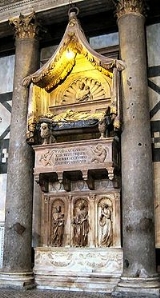
on the funerary monument of the
Antipope John XXIIIBaldassarre Cossa was Pope John XXIII during the Western Schism. The Catholic Church regards him as an antipope.-Biography:...
for the
BattisteroIn Christian architecture the baptistry or baptistery is the separate centrally-planned structure surrounding the baptismal font. The baptistry may be incorporated within the body of a church or cathedral and be provided with an altar as a chapel...
in Florence. Surely by Donatello is the recumbent bronze figure of the deceased, under a shell. In 1427, he completed in
PisaPisa is a city in Tuscany, Central Italy, on the right bank of the mouth of the River Arno on the Tyrrhenian Sea. It is the capital city of the Province of Pisa...
a marble panel for the funerary monument of Cardinal Rainaldo Brancacci at the church of
Sant'Angelo a NiloSant'Angelo a Nilo is a church in Naples, Italy. It is known for containing the monumental tomb of Cardinal Rainaldo Brancacci by Donatello and Michelozzo, one of the major sculptural works in the city....
in
NaplesNaples is a city in Southern Italy, situated on the country's west coast by the Gulf of Naples. Lying between two notable volcanic regions, Mount Vesuvius and the Phlegraean Fields, it is the capital of the region of Campania and of the province of Naples...
. In the same period, he executed the relief of the
Feast of Herod and the statues of
Faith and
Hope for the Baptstery of San Giovanni in Siena. The relief is mostly in stiacciato, while the foreground figures are done in bas-relief.
Major commissions in Florence
Around 1430,
Cosimo de' MediciCòsimo di Giovanni degli Mèdici was the first of the Medici political dynasty, de facto rulers of Florence during much of the Italian Renaissance; also known as "Cosimo 'the Elder'" and "Cosimo Pater Patriae" .-Biography:Born in Florence, Cosimo inherited both his wealth and his expertise in...
, the foremost art patron of his era, commissioned from Donatello the
bronzeBronze is the most popular metal for cast metal sculptures; a cast bronze sculpture is often called simply a "bronze".Common bronze alloys have the unusual and desirable property of expanding slightly just before they set, thus filling the finest details of a mold. Then, as the bronze cools, it...
DavidDavid is the name of two statues by Italian early Renaissance sculptor Donatello.- The biblical text :The story of David and Goliath comes from 1 Samuel 17. The Israelites are fighting the Philistines, whose best warrior - Goliath - repeatedly offers to meet the Israelites' best warrior in...
(now in the
BargelloThe Bargello, also known as the Bargello Palace or Palazzo del Popolo is a former barracks and prison, now an art museum, in Florence, Italy.-Terminology:...
) for the court of his Palazzo Medici. This is now Donatello's most famous work. At the time of its creation, it was the first known free-standing nude statue produced since ancient times. Conceived fully in the round, independent of any architectural surroundings, and largely representing an allegory of the civic virtues triumphing over brutality and irrationality, it was the first major work of
RenaissanceThe Renaissance was a cultural movement that spanned roughly the 14th to the 17th century, beginning in Italy in the Late Middle Ages and later spreading to the rest of Europe. The term is also used more loosely to refer to the historical era, but since the changes of the Renaissance were not...
sculpture. Also from this period is the disquietingly small
Love-Atys, housed in the Bargello.
Some have perceived the David as having
homo-eroticHomoeroticism refers to the erotic attraction between members of the same sex, either male–male or female–female , most especially as it is depicted or manifested in the visual arts and literature. It can also be found in performative forms; from theatre to the theatricality of uniformed movements...
qualities, and have argued that this reflected the artist's own orientation. Yet, details of Donatello's relationships remain speculative. The historian Paul Strathern makes the claim that Donatello made no secret of his
homosexualityHomosexuality is romantic or sexual attraction or behavior between members of the same sex or gender. As a sexual orientation, homosexuality refers to "an enduring pattern of or disposition to experience sexual, affectional, or romantic attractions" primarily or exclusively to people of the same...
, and that his behaviour was tolerated by his friends. This may not be surprising in the context of attitudes prevailing in the 15th and 16th century Florentine republic. However, little detail is known with certainty about his private life, and no mention of his sexuality has been found in the Florentine archives (in terms of denunciations) albeit which during this period are incomplete.
When Cosimo was exiled from Florence, Donatello went to Rome, remaining until 1433. The two works that testify to his presence in this city, the
Tomb of Giovanni Crivelli at
Santa Maria in AracoeliThe Basilica of St. Mary of the Altar of Heaven is a titular basilica in Rome, located on the highest summit of the Campidoglio. It is still the designated Church of the city council of Rome, which uses the ancient title of Senatus Populusque Romanus...
, and the
Ciborium at
St. Peter's BasilicaThe Papal Basilica of Saint Peter , officially known in Italian as ' and commonly known as Saint Peter's Basilica, is a Late Renaissance church located within the Vatican City. Saint Peter's Basilica has the largest interior of any Christian church in the world...
, bear a strong stamp of classical influence.
Donatello's return to Florence almost coincided with Cosimo's. In May of 1434, he signed a contract for the marble pulpit on the facade of
Prato cathedralThe Cathedral of Prato is the main Catholic church of Prato, Tuscany, Central Italy and seat of the bishop. It is dedicated to St. Stephen, the first Christian martyr. It is one of the most ancient churches in the city, existing already in the 10th century and having been built and in several...
, the last project executed in collaboration with
Michelozzothumb|250px|[[Palazzo Medici]] in Florence.Michelozzo di Bartolomeo Michelozzi was an Italian architect and sculptor.-Biography:...
. This work, a passionate, pagan, rhythmically-conceived bacchanalian dance of half-nude putti, was the forerunner of the great
Cantoria, or singing tribune, at the Duomo in Florence on which Donatello worked intermittently from 1433 to 1440 and was inspired by ancient sarcophagi and Byzantine ivory chests. In 1435, he executed the
Annunciation for the Cavalcanti altar in Santa Croce, inspired by 14th century iconography, and in 1437–1443, he worked in the Old Sacristy of the
San LorenzoThe Basilica di San Lorenzo is one of the largest churches of Florence, Italy, situated at the centre of the city’s main market district, and the burial place of all the principal members of the Medici family from Cosimo il Vecchio to Cosimo III...
in Florence, on two doors and lunettes portraying saints, as well as eight stucco tondoes. From 1438 is the wooden statue of St. John the Evangelist for Santa Maria Gloriosa dei Frari in
VeniceVenice is a city in northern Italy which is renowned for the beauty of its setting, its architecture and its artworks. It is the capital of the Veneto region...
. Around 1440, he executed a bust of a
Young Man with a Cameo now in the Bargello, the first example of a lay bust portrait since the classical era.
In Padua
In 1443, Donatello was called to Padua by the heirs of the famous condottiero Erasmo da Narni, who had died that year. Completed in 1450 and placed in the square facing the
Basilica of St. AnthonyThe Pontifical Basilica of Saint Anthony of Padua is a Roman Catholic church and minor basilica in Padua, northern Italy. Although the Basilica is visited as a place of pilgrimage by people from all over the world, it is not the titular cathedral of the city, a title belonging to the...
, his equestrian statue of Erasmo (better known as the
Gattamelata, or "Honey-Cat") was the first example of such a monument since ancient times. (Other equestrian statues, from the 14th century, had not been executed in bronze and had been placed over tombs rather than erected independently, in a public place.) This work became the prototype for other equestrian monuments executed in Italy and Europe in the following centuries.
For the Basilica of St. Anthony, Donatello created, most famously, the bronze Crucifix of 1444–1447 and additional statues for the choir, including a
Madonna with Child and six saints, constituting a
Holy ConversationIn art, a sacra conversazione or sacred conversation is a depiction of the Virgin and Child amidst a group of saints in a relatively informal grouping, as opposed to the more rigid and hierarchical compositions of earlier periods...
, which is no longer visible since the renovation by
Camillo BoitoCamillo Boito was an Italian architect and engineer, and a noted art critic, art historian and novelist.-Biography:...
in 1895. The
Madonna with Child portrays the Child being displayed to the faithful, on a throne flanked by two
sphinxA sphinx is a mythical creature with a lion's body and a human head or a cat head.The sphinx, in Greek tradition, has the haunches of a lion, the wings of a great bird, and the face of a woman. She is mythicised as treacherous and merciless...
es, allegorical figures of knowledge. On the throne's back is a relief of Adam and Eve. During this period—1446–50—Donatello also executed four extremely important reliefs with scenes from the life of St. Anthony for the high altar.
Last years in Florence
Donatello returned to Florence in 1453. The Judith and Holofernes, begun for the Duomo di Siena date from 1455 to 1460 but were later acquired by the Medici. Until 1461, Donatello remained in Siena, where he created a
St. John the Baptist, also for the Duomo, and models for its gates, now lost.
For his last commission in Florence, Donatello produced reliefs for the bronze pulpits in the church of San Lorenzo, with help from students
Bartolomeo BellanoBartolomeo Bellano, also known as Bartolomeo Vellano, was an Italian renaissance sculptor and architect who was born in Padua in 1437 or 1438...
and
Bertoldo di GiovanniBertoldo di Giovanni was an Italian sculptor and medallist.Born in Florence, he was a pupil of Donatello and for a long time worked in his master's workshop, carrying out his unfinished works after his death in 1466, for example the bronze pulpit reliefs from the life of Christ in the Basilica di...
. Donatello provided the general design and personally executed the
Martyrdom of St. Lawrence and the
Deposition from the Cross; he worked on the reliefs of
Christ before Pilate and
Christ before Caiphus, with Bellano. This work is characterized by an intense, free, indeed sketchy and suggestively unfinished—in Italian a
non-finito—technique that heightens the dramatic effect of the scenes and emphasizes their spiritual intensity. Donatello died in Florence in 1466 and was buried in the Basilica of San Lorenzo, next to
Cosimo de' MediciCòsimo di Giovanni degli Mèdici was the first of the Medici political dynasty, de facto rulers of Florence during much of the Italian Renaissance; also known as "Cosimo 'the Elder'" and "Cosimo Pater Patriae" .-Biography:Born in Florence, Cosimo inherited both his wealth and his expertise in...
the Elder.
Main works
- "St. Mark
Donatello's Saint Mark is a marble statue that stands approximately seven feet and nine inches high in an exterior niche of the Orsanmichele church, Florence. Donatello was commissioned by the linen weavers' guild to complete three pieces for the project. St. Mark was the first of his...
" (1411–1413), OrsanmicheleOrsanmichele is a church in the Italian city of Florence...
, Florence
- St. George Tabernacle (c. 1415–1417) — Museo Nazionale del Bargello, Florence
- "Prophet Habacuc" (1423–1425) — Museo dell'Opera del Duomo
The Museo dell'Opera del Duomo in Florence, Italy is a museum containing many of the original works of art created for the Basilica di Santa Maria del Fiore, the cathedral of Florence. The museum is located just east of the Duomo, near its apse...
, Florence
- "The Feast of Herod" (c. 1425) — Baptismal font, Baptistry of San Giovanni
The Battistero di San Giovanni is a religious building in Siena, Italy. It is located in the square with the same name, near the final spans of the choir of the city's cathedral....
, SienaSiena is a city in Tuscany, Italy. It is the capital of the province of Siena.The historic centre of Siena has been declared by UNESCO a World Heritage Site. It is one of the nation's most visited tourist attractions, with over 163,000 international arrivals in 2008...
- "David" (c. 1425–1430) — Museo Nazionale del Bargello, Florence
- "Equestrian Monument of Gattamelata" (1445–1450) — Piazza del Santo, Padua
Padua is a city and comune in the Veneto, northern Italy. It is the capital of the province of Padua and the economic and communications hub of the area. Padua's population is 212,500 . The city is sometimes included, with Venice and Treviso, in the Padua-Treviso-Venice Metropolitan Area, having...
- "Magdalene Penitent
"Magdalene Penitent" is a wooden sculpture by the Renaissance Italian artist Donatello, executed around 1453-1455. Executed likely for the Baptistery of Florence, it was received with astonishment for its unprecedented realism...
" (c. 1455) — Museo dell'Opera del Duomo, Florence
- "Judith and Holofernes" (1455–1460) — Palazzo Vecchio
The Palazzo Vecchio is the town hall of Florence, Italy. This massive, Romanesque, crenellated fortress-palace is among the most impressive town halls of Tuscany...
, Florence
- "Virgin and Child with Four Angels
The Virgin and Child with Four Angels is a bronze roundel by Florentine artist Donatello .It is also known as the Chellini Madonna as Donatello gave it to his doctor Giovanni Chellini in 1456...
" or "Chellini Madonna" (1456), Victoria and Albert MuseumThe Victoria and Albert Museum , set in the Brompton district of The Royal Borough of Kensington and Chelsea, London, England, is the world's largest museum of decorative arts and design, housing a permanent collection of over 4.5 million objects...
External links
- Donatello: Biography, style and artworks
- Donatello: Art in Tuscany
- Donatello at the The Metropolitan Museum of Art
- Donatello: Photo Gallery
- Donatello, by David Lindsay, 27th Earl of Crawford
David Alexander Edward Lindsay, 27th Earl of Crawford and 10th Earl of Balcarres KT, PC, DL, FRS, FSA , styled Lord Balniel between 1880 and 1913, was a British Conservative politician and art connoisseur....
, from Project GutenbergProject Gutenberg is a volunteer effort to digitize and archive cultural works, to "encourage the creation and distribution of eBooks". Founded in 1971 by Michael S. Hart, it is the oldest digital library. Most of the items in its collection are the full texts of public domain books...
- The Chellini Madonna Sculpture. Victoria and Albert Museum
The Victoria and Albert Museum , set in the Brompton district of The Royal Borough of Kensington and Chelsea, London, England, is the world's largest museum of decorative arts and design, housing a permanent collection of over 4.5 million objects...