
|
|
|
|
Catacombs
|
| |
|
| |
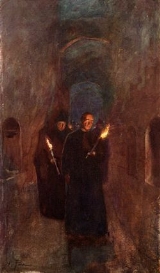
Catacombs are ancient, human-made underground passageways or subterranean cemeteries composed thereof. Many are under cities and have served during historic times as a refuge for safety during wars or as a meeting place for cults.

Discussion
Ask a question about 'Catacombs'
Start a new discussion about 'Catacombs'
Answer questions from other users
|
Encyclopedia
Catacombs are ancient, human-made underground passageways or subterranean cemeteries composed thereof. Many are under cities and have served during historic times as a refuge for safety during wars or as a meeting place for cults. The first burial galleries to be referred to as catacombs lie beneath San Sebastiano fuori le mura, in Rome. The derivation of the word itself is disputed and it remains unclear if it ultimately derives from the cemetery itself or from the locality in which it is found. There is no doubt however that the San Sebastiano catacombs are the first to be referred to as such.
The word now refers to any network of caves, grottos, or subterranean galleries that were used in medieval times as refuges during wars, as worship places, or for burial of the dead.
Catacombs around the world
Famous examples include:
- Catacombs of Rome in Italy.
- Catacombs of Paris in France.
- Catacombs of Kom el Shoqafa (or Kom al Sukkfa, Shuqafa, etc.), in Alexandria, Egypt.
- Maltese Catacomb Complexes in Rabat, Malta.
- Catacombs of Sacromonte in Granada, Spain.
- Capuchin catacombs of Palermo, in Italy.
- Catacombs of the Convento de San Francisco in Lima, Peru.
- Catacombs of St. Stephen's Cathedral in Vienna, Austria.
- Catacombs of St. Mary's Knockbeg College in Carlow, Ireland.
- Catacombs of Edinburgh in Scotland.
- Catacombs of London in England.
There are also catacomb-like burial chambers in Anatolia, Turkey; in Sousse, North Africa; in Naples, Italy; in Syracuse, Italy; Trier, Germany; Kiev. Capuchin catacombs of Palermo, Sicily were used as late as 1920s. Catacombs were popular in England in the 19th Century, and can be seen in many of the grand cemeteries of the time, such as Sheffield General Cemetery. There are catacombs in Bulgaria near Aladzha Monastery and in Romania as medieval underground galleries in Bucharest.
In Ukraine and Russia, catacomb (used in the local languages' plural katakomby) also refers to the network of abandoned caves and tunnels earlier used to mine stone, especially limestone. Such catacombs are situated in Crimea and the Black Sea coast of these two countries. The most famous are Odessa Catacombs and Ajimushkay, Crimea, Ukraine. In the early days of Christianity, believers conducted secret worship services in these burial caves for safety and reverence for the dead. Later, they served as bases for Soviet World War II guerrillas (see also Great Patriotic War). Ajimushkay catacombs hosted about 10,000 fighters and refugee. Many of them died and were buried there, and memorials and museums were later established (it is now a territory of Kerch city).
Catacomb decorations Catacombs although most notable for the underground passage ways and cemeteries are also the home of many decorations. There are thousands of decorations in the centuries old catacombs of Rome, catacombs of Paris, and other known and unknown catacombs, some of which include inscriptions, paintings and statues among other things such as ornaments which were placed in the graves over the years. Most of these decorations were used to identify, immortalize, and to show respect to the dead.
Inscriptions
Although thousands of the inscriptions were lost as the time past, they still serve as an indication of what the social rank or the job title of it's inhabitants, most of the inscriptions just indicate how loving a couple was, or the love of parents and such.
Paintings
Paintings can also be seen throughout the burial chambers on the walls and the ceilings. The paintings conveyed the same ideas as the inscriptions found throughout the catacombs.
See also
External links
|
| |
|
|