


Canopic jar

Encyclopedia
Mummy
A mummy is a body, human or animal, whose skin and organs have been preserved by either intentional or incidental exposure to chemicals, extreme coldness , very low humidity, or lack of air when bodies are submerged in bogs, so that the recovered body will not decay further if kept in cool and dry...
process to store and preserve the viscera of their owner for the afterlife
Afterlife
The afterlife is the belief that a part of, or essence of, or soul of an individual, which carries with it and confers personal identity, survives the death of the body of this world and this lifetime, by natural or supernatural means, in contrast to the belief in eternal...
. They were commonly either carved from limestone
Limestone
Limestone is a sedimentary rock composed largely of the minerals calcite and aragonite, which are different crystal forms of calcium carbonate . Many limestones are composed from skeletal fragments of marine organisms such as coral or foraminifera....
or were made of pottery. These jars were used by Ancient Egyptians from the time of the Old Kingdom
Old Kingdom
Old Kingdom is the name given to the period in the 3rd millennium BC when Egypt attained its first continuous peak of civilization in complexity and achievement – the first of three so-called "Kingdom" periods, which mark the high points of civilization in the lower Nile Valley .The term itself was...
up until the time of the Late Period
Late Period of Ancient Egypt
The Late Period of Ancient Egypt refers to the last flowering of native Egyptian rulers after the Third Intermediate Period from the 26th Saite Dynasty into Persian conquests and ended with the death of Alexander the Great...
or the Ptolemaic Period, by which time the viscera were simply wrapped and placed with the body. The viscera were not kept in a single canopic jar: each jar was reserved for specific organs. The name "canopic" reflects the mistaken association by early Egyptologists with the Greek legend of Canopus
Canopus (mythology)
In Greek mythology, Canopus was the pilot of the ship of King Menelaus of Sparta during the Trojan War. He is described as a young handsome man, who was loved by Theonoe, the Egyptian prophetess, but never answered her feelings. According to legend, while visiting the coasts of Egypt, he was...
.
Canopic jars of the Old Kingdom were rarely inscribed to death and weddings, and had a plain lid. In the Middle Kingdom
Middle Kingdom
Middle Kingdom may refer to:*China, traditional translation of its common name, Zhōngguó *Middle Kingdom of Egypt*Middle kingdoms of India...
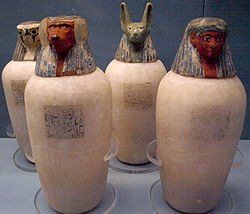
inscriptions became more usual, and the lids were often in the form of human heads. By the Nineteenth dynasty each of the four lids depicted one of the four sons of Horus
Horus
Horus is one of the oldest and most significant deities in the Ancient Egyptian religion, who was worshipped from at least the late Predynastic period through to Greco-Roman times. Different forms of Horus are recorded in history and these are treated as distinct gods by Egyptologists...
, as guardians of the organs.
Use and design
The jars were four in number, each for the safekeeping of particular human organs: the stomach, intestines, lungs, and liver, all of which, it was believed, would be needed in the afterlife. There was no jar for the heart: the Egyptians believed it to be the seat of the soul, and so it was left inside the body.thumb
The design of canopic jars changed over time. The oldest date from the Eleventh
Eleventh dynasty of Egypt
The eleventh dynasty of ancient Egypt was one group of rulers, whose earlier members are grouped with the four preceding dynasties to form the First Intermediate Period, while the later members are considered part of the Middle Kingdom...
or the Twelfth dynasty
Twelfth dynasty of Egypt
The twelfth dynasty of ancient Egypt is often combined with Dynasties XI, XIII and XIV under the group title Middle Kingdom.-Rulers:Known rulers of the twelfth dynasty are as follows :...
, and are made of stone or wood. The last jars date from the New Kingdom
New Kingdom
The New Kingdom of Egypt, also referred to as the Egyptian Empire is the period in ancient Egyptian history between the 16th century BC and the 11th century BC, covering the Eighteenth, Nineteenth, and Twentieth Dynasties of Egypt....
. In the Old Kingdom
Old Kingdom
Old Kingdom is the name given to the period in the 3rd millennium BC when Egypt attained its first continuous peak of civilization in complexity and achievement – the first of three so-called "Kingdom" periods, which mark the high points of civilization in the lower Nile Valley .The term itself was...
the jars had plain lids, though by the First Intermediate Period jars with human heads (assumed to represent the dead) began to appear. Sometimes the covers of the jars were modelled after (or painted to resemble) the head of Anubis
Anubis
Anubis is the Greek name for a jackal-headed god associated with mummification and the afterlife in ancient Egyptian religion. In the ancient Egyptian language, Anubis is known as Inpu . According to the Akkadian transcription in the Amarna letters, Anubis' name was vocalized as Anapa...
, the god of death and embalming. By the late Eighteenth dynasty
Eighteenth dynasty of Egypt
The eighteenth dynasty of ancient Egypt is perhaps the best known of all the dynasties of ancient Egypt...
canopic jars had come to feature the four sons of Horus
Four sons of Horus
The four sons of Horus were a group of four gods in Egyptian religion, who were essentially the personifications of the four canopic jars, which accompanied mummified bodies. Since the heart was thought to embody the soul, it was left inside the body. The brain was thought only to be the origin of...
. Many sets of jars survive from this period, in alabaster, aragonite, calcareous stone, and blue or green glazed porcelain. The sons of Horus were also the gods of the cardinal compass points. Each god was responsible for protecting a particular organ, and was himself protected by a companion goddess. They were:
- DuamutefDuamutefDuamutef was one of the Four Sons of Horus and a protectiongod of the Canopic jars. Commonly he is said to be the son of the god Horus the Elder and the goddess Isis. There is another myth that describes...
, the jackal-headed god representing the east, whose jar contained the stomach and was protected by the goddess NeithNeithIn Egyptian mythology, Neith was an early goddess in the Egyptian pantheon. She was the patron deity of Sais, where her cult was centered in the Western Nile Delta of Egypt and attested as early as the First Dynasty... - Hapi, the baboon-headed god representing the north, whose jar contained the lungs and was protected by the goddess NephthysNephthysIn Egyptian mythology, Nephthys is a member of the Great Ennead of Heliopolis, a daughter of Nut and Geb. Nephthys was typically paired with her sister Isis in funerary rites because of their role as protectors of the mummy and the god Osiris and as the sister-wife of Seth.Nephthys is regarded as...
- Imseti, the human-headed god representing the south, whose jar contained the liver and was protected by the goddess IsisIsisIsis or in original more likely Aset is a goddess in Ancient Egyptian religious beliefs, whose worship spread throughout the Greco-Roman world. She was worshipped as the ideal mother and wife as well as the matron of nature and magic...
- QebehsenuefQebehsenuefQebehsenuef was one of the sons of Horus in Egyptian mythology, the god of protection and of the West. In the preparation of mummies, his canopic jar was used for the intestines. He is seen as a mummy with a falcon head...
, the falcon-headed god representing the west, whose jar contained the intestines and was protected by the goddess Selket.
Early canopic jars were placed inside a canopic chest
Canopic chest
Canopic chests are cases used by Ancient Egyptians to contain the internal organs removed during the process of mummification. Although the first proven canopic burials date from the 4th Dynasty reign of Sneferu, there is evidence to suggest that there were canopic installations at Saqqara dating...
and buried in tombs together with the sarcophagus of the dead. Later, they were sometimes arranged in rows beneath the bier, or at the four corners of the chamber. After the early periods there were usually inscriptions on the outsides of the jars, sometimes quite long and complex. The scholar Sir Ernest Budge
E. A. Wallis Budge
Sir Ernest Alfred Thompson Wallis Budge was an English Egyptologist, Orientalist, and philologist who worked for the British Museum and published numerous works on the ancient Near East.-Earlier life:...
quoted an inscription from the Saïte
Twenty-sixth dynasty of Egypt
The Twenty-sixth Dynasty of Egypt was the last native dynasty to rule Egypt before the Persian conquest in 525 BC . The Dynasty's reign The Twenty-sixth Dynasty of Egypt (also written Dynasty XXVI or Dynasty 26) was the last native dynasty to rule Egypt before the Persian conquest in 525 BC...
or Ptolemaic period that begins: "Thy bread is to thee. Thy beer is to thee. Thou livest upon that on which Ra lives." Other inscriptions tell of purification in the afterlife.
In the Third Intermediate Period and later, dummy canopic jars were introduced. Improved embalming techniques allowed the viscera to remain in the body; the traditional jars remained a feature of tombs, but were no longer hollowed out for storage of the organs.
Copious numbers of the jars were produced, and surviving examples of them can be seen in museums around the world.
See also
- Hetepheres IHetepheres IQueen Hetepheres I was a Queen of Egypt during the 4th dynasty.- Biography :Hetepheres I may have been a daughter of pharaoh Huni. Her title God's Daughter suggests she was the daughter of a king and the most likely candidate is Huni, the predecessor of Sneferu...
- oldest known use of Egyptian canopic jars and mummies