

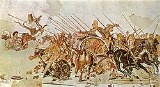
Battle of Issus

Overview
Anatolia
Anatolia is a geographic and historical term denoting the westernmost protrusion of Asia, comprising the majority of the Republic of Turkey...
, in November 333 BC
333 BC
Year 333 BC was a year of the pre-Julian Roman calendar. At the time, it was known as the Year of the Dictatorship of Rufinus...
. The invading troops, led by the young Alexander of Macedon
Macedon
Macedonia or Macedon was an ancient kingdom, centered in the northeastern part of the Greek peninsula, bordered by Epirus to the west, Paeonia to the north, the region of Thrace to the east and Thessaly to the south....
ia, defeated the army personally led by Darius III
Darius III of Persia
Darius III , also known by his given name of Codomannus, was the last king of the Achaemenid Empire of Persia from 336 BC to 330 BC....
of Achaemenid
Achaemenid Empire
The Achaemenid Empire , sometimes known as First Persian Empire and/or Persian Empire, was founded in the 6th century BCE by Cyrus the Great who overthrew the Median confederation...
Persia
Achaemenid Empire
The Achaemenid Empire , sometimes known as First Persian Empire and/or Persian Empire, was founded in the 6th century BCE by Cyrus the Great who overthrew the Median confederation...
in the second great battle for primacy in Asia. After Alexander's forces successfully forced a crossing of the Hellespont (the Dardanelles
Dardanelles
The Dardanelles , formerly known as the Hellespont, is a narrow strait in northwestern Turkey connecting the Aegean Sea to the Sea of Marmara. It is one of the Turkish Straits, along with its counterpart the Bosphorus. It is located at approximately...
) and defeated the Persian satrap
Satrap
Satrap was the name given to the governors of the provinces of the ancient Median and Achaemenid Empires and in several of their successors, such as the Sassanid Empire and the Hellenistic empires....
s led by a Greek mercenary, Memnon of Rhodes
Memnon of Rhodes
Memnon of Rhodes was the commander of the Greek mercenaries working for the Persian king Darius III when Alexander the Great of Macedonia invaded Persia in 334 BC. He commanded the mercenaries at the Battle of the Granicus River, where his troops were massacred by the victorious Macedonians...
, in a prior encounter, the Battle of the Granicus
Battle of the Granicus
The Battle of the Granicus River in May 334 BC was the first of three major battles fought between Alexander the Great and the Persian Empire...
, Darius took personal charge of his army, gathered a large army from the depths of the empire, and maneuvered to cut the Macedonian line of supply, requiring Alexander to countermarch his forces, setting the stage for the battle near the mouth of the Pinarus River
Pinarus River
The Pinarus River is a small mountain spring fed stream famous in antiquity as the site of the First Battle of Issus, near a small coastal village or town which was reported to straddle the stream which by similar sources, was said to run red with blood after Alexander the Great leading his elite...
and south of the village of Issus
Issus (town)
Issus is an ancient settlement on the strategic coastal plain straddling the small Pinarus river below the navigationally difficult inland mountains towering above to the east in the Turkish Province of Hatay, near the border with Syria...
.
Eventual accounts tell of bodies piled within the waters high enough to dam its flow, and the river running red with blood.
Unanswered Questions

Discussions