


Tomb of Fu Hao

Encyclopedia
Shang Dynasty
The Shang Dynasty or Yin Dynasty was, according to traditional sources, the second Chinese dynasty, after the Xia. They ruled in the northeastern regions of the area known as "China proper" in the Yellow River valley...
capital of Yin. It was discovered in 1976 and identified as the final resting place of the queen and military general Fu Hao
Fu Hao
Fu Hao , posthumously Mu Xin , was one of the many wives of King Wu Ding of the Shang Dynasty and, unusually for that time, also served as a military general and high priestess....
, likely the Lady Hao (who was killed by a different state officer) inscribed on oracle bone
Oracle bone
Oracle bones are pieces of bone normally from ox scapula or turtle plastron which were used for divination chiefly during the late Shang Dynasty. The bones were first inscribed with divination in oracle bone script by using a bronze pin, and then heated until crack lines appeared in which the...
s by king Wu Ding
Wu Ding
Wu Ding was a Shang Dynasty King of China.His is the first historically verifiable name in the history of Chinese dynasties...
and one of his many wives.
One of the best-preserved Shang royal tombs it was excavated by the Anyang Working Team of the Archaeological Institute of the Chinese Academy of Social Sciences
Chinese Academy of Social Sciences
The Chinese Academy of Social Sciences , established in 1977, is the premier and highest academic research organization in the fields of philosophy and social sciences as well as a national center for comprehensive studies in the People's Republic of China. It was described by Foreign Policy...
, extensively restored, and open to the public in 1999.
Archaeological discoveries
In 19761976 in archaeology
The year 1976 in archaeology involved some significant events.-Excavations:*The Chaco Project excavates fourteen rooms at Pueblo Alto from 1976 to 1978....
archaeologists probing the area around Yinxu
Yinxu
Yinxu is the ruins of the last capital of China's Shang Dynasty. The capital served 255 years for 12 kings in 8 generations.Rediscovered in 1899, it is one of the oldest and largest archeological sites in China and is one of the historical capitals of China and a UNESCO World Heritage Site...
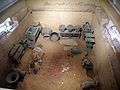
with a long shovel, called a Luoyang shovel, recovered some samples of red lacquer. The burial pit uncovered, officially titled tomb number 5, is a single pit, 5.6 meters by 4 m, just outside the main royal cemetery. The tomb has been dated to around BCE 1200 and identified, from ritual bronze inscriptions, to be that of Fu Hao
Fu Hao
Fu Hao , posthumously Mu Xin , was one of the many wives of King Wu Ding of the Shang Dynasty and, unusually for that time, also served as a military general and high priestess....
.
Her tomb, one of the smaller tombs, is one of the best-preserved Shang Dynasty
Shang Dynasty
The Shang Dynasty or Yin Dynasty was, according to traditional sources, the second Chinese dynasty, after the Xia. They ruled in the northeastern regions of the area known as "China proper" in the Yellow River valley...
royal tombs and the only one not to have been looted before excavation. Inside the pit was evidence of a wooden chamber 5 meters long, 3.5 m wide and 1.3 m high containing a lacquer
Lacquer
In a general sense, lacquer is a somewhat imprecise term for a clear or coloured varnish that dries by solvent evaporation and often a curing process as well that produces a hard, durable finish, in any sheen level from ultra matte to high gloss and that can be further polished as required...
ed wooden coffin that has since completely rotted away.
The floor level housed the royal corpse and most of the utensils and implements buried with her. Rare Jade artifacts, such as those of the Liangzhu culture
Liangzhu culture
The Liangzhu culture was the last Neolithic jade culture in the Yangtze River Delta of China. Its area of influence extended from around Lake Tai north to Nanjing and the Chang Jiang, east to Shanghai and the sea, and south to Hangzhou...
, were probably collected by Fu Hao as antiques and while some of the bronze artifacts were probably used by the lady and her household others inscribed with her posthumous name of Mu Xin were undoubtedly cast as grave good. The artifacts unearthed within the grave consisted of:
- 755 jade objects (including LongshanLongshan cultureThe Longshan culture was a late Neolithic culture in China, centered on the central and lower Yellow River and dated from about 3000 BC to 2000 BC...
, LiangzhuLiangzhu cultureThe Liangzhu culture was the last Neolithic jade culture in the Yangtze River Delta of China. Its area of influence extended from around Lake Tai north to Nanjing and the Chang Jiang, east to Shanghai and the sea, and south to Hangzhou...
, HongshanHongshan cultureThe Hongshan culture was a Neolithic culture in northeastern China. Hongshan sites have been found in an area stretching from Inner Mongolia to Liaoning, and dated from about 4700 BC to 2900 BC....
and ShijiaheShijiahe cultureThe Shijiahe culture was a late Neolithic culture centered around the middle Yangtze River region in Hubei, China. It succeeded the Qujialing culture in the same region and inherited its unique artefact of painted spindle whorls. Pottery figurines and distinct jade worked with advanced techniques...
cultural artifacts) - 564 bone objects (including 500 hairpins and 20 arrowheads)
- 468 bronze objects (including 130 weapons, 23 bells, 27 knives, 4 mirrors, and 4 tiger statues)
- 63 stone objects
- 11 pottery objects
- 5 ivory objects
- 6,900 cowryCowryCowry, also sometimes spelled cowrie, plural cowries, is the common name for a group of small to large sea snails, marine gastropod molluscs in the family Cypraeidae, the cowries...
shells (Shang Dynasty currency)
Below the corpse was a small pit holding the remains of six dogs, and along the edge lay the skeletons of 16 human slaves, evidence of human sacrifice.
There is also evidence above ground of a structure built over the tomb that probably served as an ancestral hall for holding memorial ceremonies; this has since been restored.