
All Topics  
Sikkim


   Email Print
   Bookmark   Link


Sikkim


Sikkim (Nepali
Nepali language

Nepali is a language in the Indo-Aryan languages of the Indo-European languages.It is the lingua-franca of Nepal and is also spoken in Bhutan, parts of India and parts of Myanmar ....
: , also Drejong) is a landlocked
Landlocked

A landlocked country is commonly defined as one enclosed or nearly enclosed by land. As of 2008, there are 44 landlocked countries in the world....
 Indian state
States and territories of India

India is a Federal_republic union of states comprising twenty-eight State s and seven Union Territory. The states and territories are further Subdivisions of India into districts and so on....
 nestled in the Himalayas. It is the least populous state in India, and the second-smallest in area after Goa
Goa

Goa is India's smallest states and territories of India in terms of area and the List of states and territories of India by population. Located on the west coast of India in the region known as the Konkan, it is bounded by the state of Maharashtra to the north, and by Karnataka to the east and south, while the Arabian Sea forms its western...
. The thumb-shaped state borders Nepal
Nepal

Nepal , officially the Federal Democratic Republic of Nepal, is a landlocked country in South Asia and is the world's youngest republic. It is bordered to the north by the People's Republic of China, and to the south, east, and west by India....
 in the west, Tibet Autonomous Region
Tibet Autonomous Region

The Tibet Autonomous Region , also called Xizang Autonomous Region , is a Province -level Autonomous regions of China of the People's Republic of China ....
 of China
China

China is a Culture of China, an ancient civilization, and, depending on perspective, a national or multinational entity extending over a large area in East Asia....
 to the north and east, and Bhutan
Bhutan

The Kingdom of Bhutan is a landlocked nation in South Asia, located at the eastern end of the Himalaya Mountains and is bordered to the south, east and west by India and to the north by the Tibet Autonomous Region of the People's Republic of China....
 in the southeast. The Indian state of West Bengal
West Bengal

West Bengal is a States and territories of India in eastern India. With Bangladesh, which lies on its eastern border, the state forms the ethno-linguistic region of Bengal....
 borders Sikkim to its south. The official language of the state is English, but there is a sizable population that converses in Nepali
Nepali language

Nepali is a language in the Indo-Aryan languages of the Indo-European languages.It is the lingua-franca of Nepal and is also spoken in Bhutan, parts of India and parts of Myanmar ....
 (the lingua franca
Lingua franca

A lingua franca is a language systematically used to communicate between persons not sharing a mother tongue, in particular when it is a third language, distinct from both persons' mother tongues....
 of the state), Lepcha
Lepcha language

Lepcha is a language spoken by the Lepcha people in Sikkim in India, and parts of Nepal and Bhutan. The Lepcha script is a syllabary script which has a lot of special marks and requires ligatures....
, Bhutia
Sikkimese language

Sikkimese Tibetan language is a sublanguage of South Tibetan language. It is a minority language spoken by the Bhutia community in Northern Sikkim. Its own name is Dranjongke ....
, and Limbu
Limbu language

Limbu is a Tibeto-Burman language spoken in Nepal, Sikkim, Kashmir and Darjeeling district, West Bengal, India, by the Limbu people community. Virtually all Limbus are bilingual in Nepali language....
.


Discussion
Ask a question about 'Sikkim'
Start a new discussion about 'Sikkim'
Answer questions from other users
Full Discussion Forum


Recent Posts


Encyclopedia


Sikkim (Nepali
Nepali language

Nepali is a language in the Indo-Aryan languages of the Indo-European languages.It is the lingua-franca of Nepal and is also spoken in Bhutan, parts of India and parts of Myanmar ....
: , also Drejong) is a landlocked
Landlocked

A landlocked country is commonly defined as one enclosed or nearly enclosed by land. As of 2008, there are 44 landlocked countries in the world....
 Indian state
States and territories of India

India is a Federal_republic union of states comprising twenty-eight State s and seven Union Territory. The states and territories are further Subdivisions of India into districts and so on....
 nestled in the Himalayas. It is the least populous state in India, and the second-smallest in area after Goa
Goa

Goa is India's smallest states and territories of India in terms of area and the List of states and territories of India by population. Located on the west coast of India in the region known as the Konkan, it is bounded by the state of Maharashtra to the north, and by Karnataka to the east and south, while the Arabian Sea forms its western...
. The thumb-shaped state borders Nepal
Nepal

Nepal , officially the Federal Democratic Republic of Nepal, is a landlocked country in South Asia and is the world's youngest republic. It is bordered to the north by the People's Republic of China, and to the south, east, and west by India....
 in the west, Tibet Autonomous Region
Tibet Autonomous Region

The Tibet Autonomous Region , also called Xizang Autonomous Region , is a Province -level Autonomous regions of China of the People's Republic of China ....
 of China
China

China is a Culture of China, an ancient civilization, and, depending on perspective, a national or multinational entity extending over a large area in East Asia....
 to the north and east, and Bhutan
Bhutan

The Kingdom of Bhutan is a landlocked nation in South Asia, located at the eastern end of the Himalaya Mountains and is bordered to the south, east and west by India and to the north by the Tibet Autonomous Region of the People's Republic of China....
 in the southeast. The Indian state of West Bengal
West Bengal

West Bengal is a States and territories of India in eastern India. With Bangladesh, which lies on its eastern border, the state forms the ethno-linguistic region of Bengal....
 borders Sikkim to its south. The official language of the state is English, but there is a sizable population that converses in Nepali
Nepali language

Nepali is a language in the Indo-Aryan languages of the Indo-European languages.It is the lingua-franca of Nepal and is also spoken in Bhutan, parts of India and parts of Myanmar ....
 (the lingua franca
Lingua franca

A lingua franca is a language systematically used to communicate between persons not sharing a mother tongue, in particular when it is a third language, distinct from both persons' mother tongues....
 of the state), Lepcha
Lepcha language

Lepcha is a language spoken by the Lepcha people in Sikkim in India, and parts of Nepal and Bhutan. The Lepcha script is a syllabary script which has a lot of special marks and requires ligatures....
, Bhutia
Sikkimese language

Sikkimese Tibetan language is a sublanguage of South Tibetan language. It is a minority language spoken by the Bhutia community in Northern Sikkim. Its own name is Dranjongke ....
, and Limbu
Limbu language

Limbu is a Tibeto-Burman language spoken in Nepal, Sikkim, Kashmir and Darjeeling district, West Bengal, India, by the Limbu people community. Virtually all Limbus are bilingual in Nepali language....
. It is the only state in India with an ethnic Nepalese majority. It is an ancient land also known as Indrakil, the garden of Indra
Indra

Indra is the god of War and Weather, also the King of the gods or Deva and Lord of Heaven or Swarga in Hinduism. Mentioned first as the chief deity in the sacred Hindu text of Rig Veda, Indra is bestowed with a heroic and almost brash and amorous character....
, the king-god of heaven in Hindu religious texts. The predominant religions are Hinduism
Hinduism

'Hinduism' is the predominant religion of the Indian subcontinent. Hinduism is often referred to as , a Sanskrit phrase meaning "the eternal dharma", by its practitioners....
 and Vajrayana Buddhism. Gangtok
Gangtok

Gangtok is the capital and largest town of the Indian state of Sikkim. Gangtok is located in the Shivalik Hills of the eastern Himalayan range, at an altitude of ....
 is the capital and largest town.

Despite its tiny size, with an area of 2,745 sq mi
Square mile

The square mile is an Imperial system and US customary system of measure for an area equal to the area of a square of one mile. It should not be confused with miles square, which refers to the number of miles on each side squared....
 (7,110 km²), Sikkim is geographically diverse, owing to its location on the Himalaya. The climate ranges from subtropical to high alpine
Alpine climate

Alpine climate is the average weather for a region above the tree line. The climate becomes colder at high elevations—this characteristic is described by the adiabatic lapse rate of air: air tends to get colder as it rises, since it expands....
. Kangchenjunga
Kangchenjunga

Kangchenjunga SewaLungma is the third highest mountain in the world , with an elevation of 8,586 metres . Kangchenjunga translated means "The Five Treasures of Snows", as it contains five peaks, four of them over 8,450 metres....
, the world's third highest peak, is located in the northwestern part of the state on the boundary with Nepal
Nepal

Nepal , officially the Federal Democratic Republic of Nepal, is a landlocked country in South Asia and is the world's youngest republic. It is bordered to the north by the People's Republic of China, and to the south, east, and west by India....
, and can be seen from most parts of the state. Sikkim is a popular tourist destination for its culture, scenic beauty and biodiversity.

Origin of name

The most widely accepted origin of the name Sikkim is that it is a combination of two words in the Limbu
Limbu language

Limbu is a Tibeto-Burman language spoken in Nepal, Sikkim, Kashmir and Darjeeling district, West Bengal, India, by the Limbu people community. Virtually all Limbus are bilingual in Nepali language....
 Su, which means "new", and Khyim, which means "palace" or house, in reference to the palace built by the state's first ruler, Phuntsog Namgyal
Phuntsog Namgyal

Phuntsog Namgyal was the first chogyal of Sikkim, now an Indian state. He consecrated in 1642 at the age of 38. Phuntsog was a fifth generation descendant of Guru Tashi, a 13th century prince from the Mi-nyak House in Kham in Eastern Tibet....
. The Tibetan
Tibetan language

The Tibetan languages are a cluster of mutually unintelligible Tibeto-Burman languages spoken primarily by Tibetan peoples who live across a wide area of eastern Central Asia bordering South Asia, including the Tibetan Plateau and the northern Indian subcontinent in Baltistan, Ladakh, Nepal, Sikkim, and Bhutan....
 name for Sikkim is Denjong, which means the "valley of rice". The Lepcha
Lepcha

Lepcha may refer to:*Lepcha people*Lepcha language*Lepcha script...
s, original inhabitants of Sikkim called it Nye-mae-el or paradise and the Bhutia
Bhutia

The Bhutias are people of Tibetan origin, who migrated to Sikkim, other parts of India and Bhutan some time after the 15th century. They migrated through the different passes in the Himalayas....
s call it Beymul Demazong, which means the hidden valley of rice.

History

The earliest recorded event related to Sikkim is the passage of the Buddhist saint Guru Rinpoche through the land in the 8th century. The Guru is reported to have blessed the land, introduced Buddhism
Buddhism

Buddhism is a family of beliefs and practices considered by most to be a religionand is based on the teachings attributed to Siddhartha Gautama, commonly known as "The Buddha" , who was born in what is today Nepal....
 to Sikkim, and foretold the era of monarchy in the state that would arrive centuries later. In the 14th century, according to legend, Khye Bumsa
Khye Bumsa

Khye Bumsa was a 13th century prince from the Minyak House in Kham in Eastern Tibet. He had a divine revelation one night instructing him to travel south to seek his fortunes and reached Sikkim where he established his lineage....
, a prince from the Minyak
Minyak

Minyak is a place in Eastern Tibet. Guru Tashi a 13th century Buddhist saint hailed from Minyak....
 House in Kham
Kham

Kham , is a region presently divided between the China provinces of the Tibetan Autonomous Region, and Sichuan where Khampas, a subgroup within the Tibetan ethnicity, live....
 in Eastern Tibet
Tibet

Tibet is a Tibetan Plateau in Asia, north of the Himalayas, and the home to the indigenous Tibetan people and its related ethnic groups. With an average elevation of 4,900 metres , it is the highest region on Earth and has in recent decades increasingly been referred to as the "Roof of the World"....
, had a divine revelation one night instructing him to travel south to seek his fortunes. His descendants were later to form the royal family of Sikkim. In 1642, the fifth-generation descendant of Khye Bumsa, Phuntsog Namgyal
Phuntsog Namgyal

Phuntsog Namgyal was the first chogyal of Sikkim, now an Indian state. He consecrated in 1642 at the age of 38. Phuntsog was a fifth generation descendant of Guru Tashi, a 13th century prince from the Mi-nyak House in Kham in Eastern Tibet....
, was consecrated as the first Chogyal
Chogyal

The Chogyal were the monarchs of the former kingdom of Sikkim. The Chogyal or divine ruler was the absolute potentate of the nation from 1642 to 1975, when the monarchy was abrogated and the people voted to make Sikkim India's 22nd states and territories of India....
 (king) of Sikkim by the three venerated Lamas who came from the north, west and south to Yuksom
Yuksom

Yuksom was the first capital of Sikkim. It was consecrated in 1642 after three venerated Lamas who came from the north, west, and south to Yuksom and consecrated Phuntsog Namgyal as the first Chogyal of Sikkim....
, marking the beginning of the monarchy.
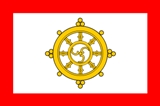
Sikkimflag
Phuntsog Namgyal was succeeded in 1670 by his son, Tensung Namgyal
Tensung Namgyal

Tensung Namgyal was the second chogyal of Sikkim. He succeeded his father Phuntsog Namgyal in 1670. He moved the capital from Yuksom to Rabdentse near Geyzing in 1670....
, who moved the capital from Yuksom to Rabdentse
Rabdentse

Rabdentse was the second capital of Sikkim. It was shifted from Yuksom in 1670 by Tensung Namgyal, the second chogyal . However Rabdentse was too close to the Nepal border which had cold relations with Sikkim....
. In 1700, Sikkim was invaded by the Bhutan
Bhutan

The Kingdom of Bhutan is a landlocked nation in South Asia, located at the eastern end of the Himalaya Mountains and is bordered to the south, east and west by India and to the north by the Tibet Autonomous Region of the People's Republic of China....
ese with the help of the half-sister of the Chogyal, who had been denied the throne. The Bhutanese were driven away by the Tibetans, who restored the throne to the Chogyal ten years later. Between 1717 and 1733, the kingdom faced many raids by the Nepalese in the west and Bhutanese in the east, culminating with the destruction of the capital Rabdentse by the Nepalese. In 1791, China sent troops to support Sikkim and defend Tibet
Tibet

Tibet is a Tibetan Plateau in Asia, north of the Himalayas, and the home to the indigenous Tibetan people and its related ethnic groups. With an average elevation of 4,900 metres , it is the highest region on Earth and has in recent decades increasingly been referred to as the "Roof of the World"....
 against the Gurkha
Gurkha

Gurkha, also spelled as Gorkha, are people from Nepal and northern India who take their name from the eighth century Hindu warrior-saint Guru Gorakhnath....
s. Following Nepal's subsequent defeat, the Qing Dynasty
Qing Dynasty

The Qing Dynasty , also known as the Manchu Dynasty, followed the Ming Dynasty in History of China, and was the last ruling Chinese Dynasties of China, ruling from 1644 to 1912 ....
 established control over Sikkim. Following the arrival of the British Raj
British Raj

British Raj primarily refers to the British rule in the Indian subcontinent between 1858 and 1947; it can also refer to the period of dominion, and even the region under the rule....
 in neighbouring India, Sikkim allied with them against their common enemy, Nepal. The Nepalese attacked Sikkim, overrunning most of the region including the Terai
Terai

The Terai is a belt of marshy grasslands, savannas, and forests at the base of the Himalaya range in India, Nepal, and Bhutan, from the Yamuna River in the west to the Brahmaputra River in the east....
. This prompted the British East India Company
British East India Company

The East India Company was an early England joint-stock company that was formed initially for pursuing trade with the Indies, but that ended up trading with the Indian subcontinent and China....
 to attack Nepal, resulting in the Gurkha War of 1814. Treaties signed between Sikkim and Nepal — the Sugauli Treaty
Sugauli Treaty

The Sugauli Treaty was signed on December 2, 1815 and ratified by March 4, 1816, between the British East India Company and Nepal, which was a kingdom during that era....
 — and Sikkim and British India — the Titalia Treaty — returned the territory annexed by the Nepalese to Sikkim in 1817. Ties between Sikkim and the British administrators of India grew sour, however, with the beginning of British taxation of the Morang region. In 1849 two British doctor
Physician

A physician, medical practitioner, doctor of medicine, or medical doctor practices medicine, and is concerned with maintaining or restoring human health through the study, diagnosis, and treatment of disease and injury....
s, Sir Joseph Dalton Hooker
Joseph Dalton Hooker

Sir Joseph Dalton Hooker, Order of Merit, Order of the Star of India, Order of the Bath, Doctor of Medicine, Fellow of the Royal Society was an England botanist and explorer....
 and Dr Archibald Campbell
Arthur Campbell (British East India Company)

Archibald Campbell of the Bengal Medical Service was the first superintendent of the sanitarium of Darjeeling town in India. Several sources differ regarding the first name of Dr Campbell....
, the latter being in charge of relations between the British and Sikkim Government, ventured into the mountains of Sikkim unannounced and unauthorised. The doctors were detained by the Sikkim government, leading to a punitive British expedition against the Himalayan kingdom, after which the Darjeeling
Darjeeling

Darjeeling is a town in the Indian state of West Bengal.It is the headquarters of Darjeeling district, in the Siwalik Hills on the lower range of the Himalaya, at an average elevation of ....
 district and Morang were annexed to India in 1853. The invasion led to the Chogyal becoming a puppet king under the directive of the British governor.
Dodrulchortenstupa
In 1947, a popular vote rejected Sikkim's joining the Indian Union and Prime Minister
Prime Minister of India

The Prime Minister of India is the head of government of the India, and head of the Council of Ministers of the Republic of India, appointed by the President of India to assist the latter in the administration of the affairs of the Executive in India....
 Jawaharlal Nehru
Jawaharlal Nehru

Jawaharlal Nehru The son of the wealthy Indian barrister and politician Motilal Nehru, Nehru became a leader of the left-wing of the Indian National Congress at a remarkably young age....
 agreed to a special protectorate
Protectorate

A protectorate, in international law, is an autonomous territory that is protected diplomatically or militarily against third parties by a stronger state or entity, in exchange for which the protectorate usually accepts specified obligations, which may vary greatly, depending on the real nature of their relationship....
 status for Sikkim. Sikkim came under the suzerainty
Suzerainty

Suzerainty is a situation in which a region or nation is a tributary state to a more powerful entity which allows the tributary some limited domestic Wiktionary:autonomy to control its foreign affairs....
 of India, which controlled its external affairs, defence, diplomacy and communications, but Sikkim otherwise retained autonomy. A state council was established in 1955 to allow for constitutional government under the Chogyal. Meanwhile trouble was brewing in the state after the Sikkim National Congress demanded fresh elections and greater representation for the Nepalese. In 1973, riots in front of the palace led to a formal request for protection from India. The Chogyal was proving to be extremely unpopular with the people. In 1975, the Kazi (Prime Minister) appealed to the Indian Parliament for a change in Sikkim's status so that it could become a state of India. In April, the Indian Army moved into Sikkim, seizing the city of Gangtok and disarming the Palace Guards. A referendum
Referendum

A referendum , ballot question, or plebiscite is a direct vote in which an entire Constituency is asked to either accept or reject a particular proposal....
 was held in which 97.5% of the people voted to join the Indian Union. A few weeks later, on May 16, 1975, Sikkim officially became the 22nd state of the Indian Union and the monarchy was abolished. In 2000, the seventeenth Karmapa
Karmapa

The Karmapa is the head of the Karma Kagyu, the largest sub-school of the Kagyupa , itself one of the four major schools of Tibetan Buddhism....
 Urgyen Trinley Dorje
Karmapa controversy

The recognition of the Seventeenth Karmapa, the head of the Karma Kagyu sect of Tibetan Buddhism Buddhism, has been the subject of controversy. Since the death of the Rangjung Rigpe Dorje, Rangjung Rigpe Dorje, in 1981, two candidates have been put forward:...
, who had been proclaimed a Lama by China, made a dramatic escape from Tibet to the Rumtek Monastery
Rumtek Monastery

Rumtek , also called the Dharmachakra Centre, is a Tibetan Buddhist monastery located in the Indian state of Sikkim near the capital Gangtok....
 in Sikkim. Chinese officials were in a quandary on this issue, as any protests to India would mean an explicit endorsement of India's governance of Sikkim, which the Chinese still regarded as an independent state occupied by India. China eventually recognised Sikkim as an Indian state in 2003, on the condition that India accepted Tibet as a part of China. This mutual agreement led to a thaw in Sino-Indian relations
Sino-Indian relations

, also called 'China-India relations' refer to the ties and relations between China and Greater India. The economic and diplomatic importance of People's Republic of China and the India, which are the two most populous states in the world, as emerging economies, has in recent years increased the significance of their bilateral relations...
. On July 6, 2006 the Himalayan pass of Nathula was opened to cross-border trade, further evidence of improving relations in the region.

Geography

Sikkimpolitical
The thumb-shaped state of Sikkim is characterised by wholly mountainous terrain. Almost the entire state is hilly, with the elevation ranging from 280 metres (920 ft) to 8,585 metres (28,000 ft). The summit of the Kangchenjunga
Kangchenjunga

Kangchenjunga SewaLungma is the third highest mountain in the world , with an elevation of 8,586 metres . Kangchenjunga translated means "The Five Treasures of Snows", as it contains five peaks, four of them over 8,450 metres....
 is the highest point which falls in Nepal among the top 8 mountains residing on Nepal. For the most part, the land is unfit for agriculture
Agriculture

Agriculture refers to the production of food and goods through farming and forestry. Agriculture was the key development that led to the rise of civilization, with the animal husbandry of domestication animals and plants creating food surpluses that enabled the development of more Population density and Social stratification societies....
 because of the precipitous and rocky slopes. However, certain hill slopes have been converted into farm lands using terrace farming techniques. Numerous snow-fed streams in Sikkim have carved out river valleys in the west and south of the state. These streams combine into the Teesta and its tributary, the Rangeet. The Teesta, described as the "lifeline of Sikkim", flows through the state from north to south. About a third of the land is heavily forested.

The lofty Himalayan ranges surround the northern, eastern and western borders of Sikkim in a crescent
Crescent

In art and symbolism, a crescent is generally the shape produced when a circle disk has a segment of another circle removed from its edge, so that what remains is a shape enclosed by two circular arcs of different diameters which intersect at two points ....
. The populated areas lie in the southern reaches of the state, in the Lower Himalayas. The state has twenty-eight mountain peaks, twenty-one glacier
Glacier

A glacier is a large, slow-moving mass of ice, formed from compacted layers of snow, that slowly deforms and flows in response to gravity and high pressure....
s, 227 high-altitude lake
Lake

A lake is a terrain feature , a body of liquid on the surface of a world that is localized to the bottom of basin and moves slowly if it moves at all....
s, including the Tsongmo Lake, Gurudongmar and Khecheopalri Lake
Khecheopalri Lake

[Image:Khachoedpaldri lake is a Holy Lake for Buddhists in West Sikkim, in Sikkim, the tiny Himalayan former Buddhist Kingdom in eastern India, now a part of the democratic republic....
s, five hot springs
Hot Springs

Hot Springs may refer to:* Hot Springs, Arkansas* Hot Springs, Montana* Hot Springs, North Carolina* Hot Springs, South Dakota* Hot Springs, Virginia...
, and over 100 rivers and streams. Eight mountain passes connect the state to Tibet, Bhutan and Nepal.

Geology

The hills of Sikkim mainly consist of gneiss
Gneiss

Gneiss is a common and widely distributed type of Rock formed by high-grade regional metamorphic rock processes from pre-existing formations that were originally either igneous rock or Sedimentary rock rocks....
ose and half-schistose
Schist

The schists form a group of Erins metamorphic rocks, chiefly notable for the preponderance of lamellar minerals such as micas, Chlorite group, talc, hornblende, graphite, and others....
 rocks, making their soil brown clay, and generally poor and shallow. The soil is coarse, with large amounts of iron oxide
Iron oxide

Iron oxides are chemical compounds composed of iron and oxygen. Altogether, there are sixteen known iron oxides and oxyhydroxides....
 concentrations, ranging from neutral to acidic and has poor organic and mineral nutrients. This type of soil tends to support evergreen and deciduous forests.

A large portion of the Sikkim territory is covered by the Precambrian
Precambrian

The Precambrian is an informal name for the supereon comprising the eon of the geologic timescale that came before the current Phanerozoic eon....
 rock and is much younger in age than the hills. The rock consists of phyllite
Phyllite

Phyllite is a type of Foliation metamorphic rock primarily composed of quartz, sericite mica, and Chlorite group; the rock represents a gradiation in the degree of metamorphism between slate and mica schist....
s and schist
Schist

The schists form a group of Erins metamorphic rocks, chiefly notable for the preponderance of lamellar minerals such as micas, Chlorite group, talc, hornblende, graphite, and others....
s and therefore the slopes are highly susceptible to weathering
Weathering

Weathering is the decomposition of earth Rock , soils and their minerals through direct contact with the planet's atmosphere. Weathering occurs in situ, or "with no movement", and thus should not be confused with erosion, which involves the movement of rocks and minerals by agents such as water, ice, wind, and gravity....
 and prone to erosion
Erosion

For morphological image processing operations, see Erosion 'For use of in dermatopathology, see Erosion Erosion is the removal of solids in the natural environment....
. This, combined with the intense rain, causes extensive soil erosion and heavy loss of soil nutrients through leaching
Leaching (agriculture)

In agriculture, leaching refers to the loss of water-soluble plant nutrients from the soil, due to rain and irrigation. Soil structure, crop planting, type and application rates of fertilizers, and other factors are taken into account to avoid excessive nutrient loss....
. As a result, landslide
Landslide

File:Guatemala landslide.jpgA landslide is a List of geological phenomena which includes a wide range of ground movement, such as rock falls, deep failure of slopes and shallow debris flows, which can occur in offshore, coastal and onshore environments....
s are frequent, isolating the numerous small towns and villages from the major urban centres.

Hot springs

Sikkim has many hot springs
Hot Springs

Hot Springs may refer to:* Hot Springs, Arkansas* Hot Springs, Montana* Hot Springs, North Carolina* Hot Springs, South Dakota* Hot Springs, Virginia...
 known for medicinal and therapeutic values. The most important hot springs are at Phurchachu (Reshi), Yumthang, Borang, Ralang, Taram-chu and Yumey Samdong. All these hot springs have high sulphur content and are located near river banks. The average temperature of the water in these hot springs is 50°C.

Climate

The climate ranges from sub-tropical in the south to tundra
Tundra

In physical geography, tundra is an biome where the tree growth is hindered by low temperatures and short growing seasons. The term tundra comes from Kildin Sami tund?r, which means "uplands, treeless mountain tract." There are two types of tundra: Arctic tundra and alpine tundra....
 in the northern parts. Most of the inhabited regions of Sikkim, however, enjoy a temperate
Temperate

In geography, temperate or tepid latitudes of the globe lie between the tropics and the polar circles. The changes in these regions between summer and winter are generally mild, rather than extreme hot or cold....
 climate, with the temperatures seldom exceeding 28 °C
Celsius

Celsius is a temperature scale that is named after the Swedish astronomer Anders Celsius , who developed a similar temperature scale two years before his death....
 (82 °F
Fahrenheit

Fahrenheit is a temperature scale named after the physicist Daniel Gabriel Fahrenheit , who proposed it in 1724. Today, the scale has largely been replaced by the Celsius scale; it is still in use for non-scientific purposes in the United States and a few other countries such as Belize....
) in summer or dropping below 0 °C (32 °F) in winter. The state enjoys five seasons: winter, summer, spring, and autumn, and a monsoon
Monsoon

A monsoon is a seasonal prevailing wind that lasts for several months. The term was first used in English in India, Bangladesh, Pakistan, and neighboring countries to refer to the big seasonal winds blowing from the Indian Ocean and Arabian Sea in the southwest bringing heavy rainfall to the region....
 season between June and September. The average annual temperature for most of Sikkim is around 18 °C (64 °F). Sikkim is one of the few states in India to receive regular snow
Snow

Snow is a type of precipitation in the form of crystalline water ice, consisting of a multitude of snowflakes that fall from clouds. The process of this precipitation is called snowfall....
fall. The snow line
Snow line

File:2008-06-27 01DSC 7583.jpgThe climatic snow line is the point above which snow and ice cover the ground throughout the year. The actual snow line may seasonally be significantly lower....
 is around 6 000 metre
Metre

The metre or meter is a Unit of measurement of length. It is the SI base unit of length in the metric system and in the International System of Units , used around the world for general and scientific purposes....
s (19,600 feet).

During the monsoon months, the state is lashed by heavy rains that increase the number of landslides. The state record for the longest period of non-stop rain is eleven days. In the northern region, because of high altitude, temperatures drop below -40 °C in winter. Fog
Fog

Fog is a cloud bank that is in contact with the ground. A cloud may be considered partly fog; for example, the part of a cloud that is suspended in the air above the ground is not considered fog, whereas the part of the cloud that comes in contact with higher ground is considered fog....
 also affects many parts of the state during winter and the monsoons, making transportation extremely perilous.

Subdivisions

Sikkimdistricts
Sikkim has four districts, each overseen by a Central Government appointee, the district collector
District collector

The District Collector is a Government of India appointee who is in charge of the governance of a List of Indian districts in a States and territories of India....
, who is in charge of the administration of the civilian areas of the districts. The Indian army
Indian Army

The Indian Army is the largest branch of the Indian Armed Forces of India and has the responsibility for army military operations. Its primary objectives include defending India from external aggression, maintaining peace and security within the country, patrolling borders and conducting counter-terrorist operations....
 has control of a large territory, as the state is a sensitive border area. Many areas are restricted and permits
Foreigners (Protected Areas) Order 1958 (India)

The Foreigners Order states that a Protected Area Permit is required for non-Indians to visit certain areas in India . Certain requirements have to be fulfilled in order to get this permit....
 are needed to visit them. There are a total of eight towns and nine subdivisions in Sikkim.

The four districts are East Sikkim
East Sikkim

East Sikkim is one of the four administrative districts of the Indian States and territories of India of Sikkim. Geographically, East Sikkim occupies the south-east corner of the state....
, West Sikkim
West Sikkim

West Sikkim is a list of Indian districts of theIndian states and territories of India of Sikkim. Its capital is Geyzing, also known as Gyalshing....
, North Sikkim
North Sikkim

North Sikkim is a list of Indian districts of the Indian states and territories of India of Sikkim. Its capital is Mangan. It is the largest of the four districts of Sikkim....
 and South Sikkim
South Sikkim

South Sikkim is a list of Indian districts of the Indian states and territories of India of Sikkim. Its capital is Namchi. South Sikkim lies at an altitude of 400 m to 2000 metres and hence enjoys a temperate climate for most of the year....
. The district capitals are Gangtok, Geyzing
Geyzing

Gyalshing or Geyzing is the capital of the district of West Sikkim in the Indian states and territories of India of Sikkim. The town is connected to the capital Gangtok by a metalled road....
, Mangan
Mangan

GeographyMangan is located at . It has an average elevation of 956 metres ....
 and Namchi
Namchi

Namchi is the capital of the South Sikkim in the Indian States and territories of India of Sikkim. The appellation Namchi means Sky High in Bhutia....
 respectively. These Four Districts are further divided into Subdivisions. "Pakyong" is the subdivision of East District. "Soreng" is the subdivision of West District. "Chungthang" is the subdivision of North District. "Ravongla" is the subdivision of South District.

Languages

  1. Sikkimese
    Sikkimese language

    Sikkimese Tibetan language is a sublanguage of South Tibetan language. It is a minority language spoken by the Bhutia community in Northern Sikkim. Its own name is Dranjongke ....
  2. Róng
    Lepcha language

    Lepcha is a language spoken by the Lepcha people in Sikkim in India, and parts of Nepal and Bhutan. The Lepcha script is a syllabary script which has a lot of special marks and requires ligatures....
  3. Yakthung Pan
    Limbu language

    Limbu is a Tibeto-Burman language spoken in Nepal, Sikkim, Kashmir and Darjeeling district, West Bengal, India, by the Limbu people community. Virtually all Limbus are bilingual in Nepali language....
  4. Tibetan
    Tibetan language

    The Tibetan languages are a cluster of mutually unintelligible Tibeto-Burman languages spoken primarily by Tibetan peoples who live across a wide area of eastern Central Asia bordering South Asia, including the Tibetan Plateau and the northern Indian subcontinent in Baltistan, Ladakh, Nepal, Sikkim, and Bhutan....
  5. Nepali
    Nepali language

    Nepali is a language in the Indo-Aryan languages of the Indo-European languages.It is the lingua-franca of Nepal and is also spoken in Bhutan, parts of India and parts of Myanmar ....


Flora and fauna

Rhodo Ss Arborea
Sikkim is situated in an ecological hotspot of the lower Himalayas, one of only three among the Ecoregions of India. The forested regions of the state exhibit a diverse range of fauna and flora. Owing to its altitudinal gradation, the state has a wide variety of plants, from tropical to temperate to alpine and tundra, and is perhaps one of the few regions to exhibit such a diversity within such a small area.

The flora of Sikkim includes the rhododendron
Rhododendron

Rhododendron is a genus of flowering plants in the family Ericaceae. It is a large genus with over 1000 species and most have showy flower displays....
, the state tree, with a huge range of species occurring from subtropical to alpine regions. Orchids, fig
FIG

FIG may refer to:* F?d?ration Internationale de Gymnastique* International Federation of Surveyors...
s, laurel
Lauraceae

The Lauraceae or Laurel family comprises a group of flowering plants included in the order Laurales. The family contains about 55 genera and over 2000 species world-wide, mostly from warm or tropical regions, especially Southeast Asia and Brazil....
, banana
Banana

File:Banana and cross section.jpgBanana is the common name for a fruit and also the herbaceous plants of the genus Musa which produce this commonly eaten fruit....
s, sal trees and bamboo
Bamboo

The bamboos are a group of woody perennial plant evergreen plants in the true grass family Poaceae, subfamily Bambusoideae, tribe Bambuseae....
 in the lower altitudes of Sikkim, which enjoy a subtropical-type climate. In the temperate elevations above 1,500 metres, oak
Oak

The term oak can be used as part of the common name of any of about 400 species of trees and shrubs in the genus Quercus , which are listed in the List of Quercus species, and some related genera, notably Lithocarpus....
s, chestnut
Chestnut

Chestnut , is a genus of eight or nine species of deciduous trees and shrubs in the Beech family Fagaceae, native to temperate climate regions of the Northern Hemisphere....
s, maple
Maple

Acer is a genus of trees or shrubs commonly known as Maple. Maples are variously classified in a family of their own, the Aceraceae, or included in the family Sapindaceae....
s, birch
Birch

Birch is the name of any tree of the genus Betula , in the family Betulaceae, closely related to the beech/oak family, Fagaceae....
es, alder
Alder

Alder is the common name of a genus of flowering plants belonging to the birch family . The genus comprises about 30 species of Plant sexuality trees and shrubs, few reaching large size, distributed throughout the North Temperate Zone and in the New World also along the Andes southwards to Argentina....
s, and magnolia
Magnolia

Magnolia is a large genus of about 210 flowering plant species in the subclass Magnolioideae of the Family Magnoliaceae.The natural range of Magnolia species is a disjunct distribution, with a main center in east and southeast Asia and a secondary center in eastern North America, Central America, the West Indies, and some species i...
s grow in large numbers. The alpine-type
Alpine climate

Alpine climate is the average weather for a region above the tree line. The climate becomes colder at high elevations—this characteristic is described by the adiabatic lapse rate of air: air tends to get colder as it rises, since it expands....
 vegetation includes juniper
Juniper

Junipers are coniferous plants in the genus Juniperus of the cypress family Cupressaceae. Depending on taxonomic viewpoint, there are between 50-67 species of juniper, widely distributed throughout the northern hemisphere, from the Arctic, south to tropical Africa in the Old World, and to the mountains of Central America....
, pine
Pine

Pines are Pinophyta trees in the genus Pinus, in the family Pinaceae. They make up the monotypic subfamily Pinoideae. There are about 115 species of pine, although different authorities accept between 105 and 125 species....
, fir
Fir

Firs are a genus of between 45-55 species of evergreen Pinophyta in the family Pinaceae. All are trees, reaching heights of 10-80 m tall and trunk diameters of 0.5-4 m when mature....
s, cypress
Cupressus

The genus Cupressus is one of several genera within the Family Cupressaceae that have the common name cypress; for the others, see cypress....
es and rhododendrons, and is typically found between an altitude of 3,500 to 5 000 m. Sikkim boasts around 5,000 flowering plants, 515 rare orchids, 60 primula
Primula

Primula is a genus of 400?500 species of low-growing herbs in the family Primulaceae. They include Primula vulgaris, Primula auricula, Primula veris and Primula elatior....
 species, 36 rhododendron species, 11 oak varieties, 23 bamboo varieties, 16 conifer species, 362 types of fern
Fern

A fern is any one of a group of about 20,000 species of plants classified in the phylum or division Pteridophyta, also known as Filicophyta....
s and ferns allies, 8 tree ferns, and over 424 medicinal plants. A variant of the Poinsettia
Poinsettia

Euphorbia pulcherrima, commonly named poinsettia, is a species of flowering plant indigenous to Mexico and Guatemala.The name "poinsettia" is after Joel Roberts Poinsett, the first United States Ambassador to Mexico, who introduced the plant into the United States in 1828....
, locally known as "Christmas Flower", can be found in abundance in the mountainous state. The orchid Dendrobium nobile
Dendrobium nobile

The Noble Dendrobium, Dendrobium nobile, is a member of the family Orchidaceae. It is one of the Chinese herbology#50 fundamental herbs used in traditional Chinese medicine, where it has the name sh? h? or sh? h? l?n ....
 is the official flower of Sikkim.

The fauna includes the snow leopard
Snow Leopard

The snow leopard , sometimes known as "ounce," is a moderately large Felidae native to the mountain ranges of Central Asia. The classification of this species has been subject to change and its exact taxonomy position is still unclear....
, the musk deer
Musk deer

Musk deer are artiodactyls of the genus Moschus, the only genus of family Moschidae. They are more primitive than the Cervidae, or true deer, in not having antlers or facial glands, in having only a single pair of teats, and in possessing a gall bladder, a caudal gland, a pair of tusk-like teeth and—of particular econom...
, the Himalayan Tahr
Himalayan Tahr

The Himalayan Tahr is a large ungulate related to the wild goat. Its native habitat is in the rugged wooded hills and mountain slopes of the Himalaya from northern India to Tibet....
, the red panda
Red Panda

The Red Panda, also called the Firefox or Lesser Panda , is a mostly herbivorous mammal, specialized as a bamboo feeder. It is slightly larger than a domestic cat ....
, the Himalayan marmot
Himalayan marmot

Himalayan Marmots are marmots found in the Himalayan regions ranging in elevation from 300 metres to 4,500 metres. They are about the size of a large cat, and live in colonies....
, the serow
Serow

Serow may refer to:*Three species of Asian ungulate in the genus Capricornis**Japanese Serow**Mainland Serow**Taiwan Serow*Alternative spelling of Serov...
, the goral
Nemorhaedus

The gorals are the four species in the genus of controversial spelling Nemorhaedus or Naemorhedus. They are small ungulates with a goat-like or antelope-like appearance....
, the barking deer, the common langur, the Himalayan Black Bear, the clouded leopard
Clouded Leopard

The Clouded Leopard is a medium-sized felidae, 55 to 110 cm long and weighing between 15 and 23 kilograms . It has a tan or tawny coat, and is distinctively marked with large, irregularly-shaped, dark-edged ellipses which are said to be shaped like clouds, hence both its common and original scientific name....
, the Marbled Cat
Marbled Cat

The Marbled Cat is similar in size to the Domestic Cat, with a longer, more thickly furred tail, an indicator of an arboreal life-style, where the tail is used as a counterbalance....
, the leopard cat
Leopard Cat

The Leopard Cat is a small Felidae of Southeast Asia....
, the wild dog
Dog

The dog is a domesticated subspecies of the Gray Wolf, a member of the Canidae family of the order Carnivora. The term is used for both feral and pet varieties....
, the Tibetan wolf
Tibetan wolf

The Tibetan wolf is a gray wolf species found in parts of Central China, southwest Russia, Manchuria, Tibet and the Himalayas regions of India, Nepal and Bhutan....
, the hog badger
Hog Badger

The Hog Badger is a terrestrial mammal up to long, with medium-length brown hair, stocky body, white throat, two black stripes on an elongated white face and a pink pig-like snout....
, the binturong
Binturong

The Binturong , also known as the Asian Bearcat, the Palawan Bearcat, or simply the Bearcat, is a species of the family Viverridae, which includes the civets and genet s....
, the jungle cat
Jungle Cat

File:FelisChausMunsiari1.jpgThe jungle cat , also called the swamp lynx , is a medium-small cat, but is now considered the largest remaining species of the wild cat genus Felis....
 and the civet cat
Civet cat

Civet cat is an imprecise term that is used for a variety of cat-like creatures such as:*The Ring-tailed Cat or North American Civet Cat , related to the raccoons;...
. Among the animals more commonly found in the alpine zone are yak
Yak

The yak is a long-haired bovine found throughout the Himalayan region of south Central Asia, the Qinghai-Tibetan Plateau and as far north as Mongolia....
s, mainly reared for their milk
Milk

Milk is an opaque white liquid produced by the mammary glands of female mammals . It provides the primary source of nutrition for newborn mammals before they are able to digestion other types of food....
, meat, and as a beast of burden.

The avifauna
Avifauna

The term avifauna can be used in one of two senses:* to mean "bird fauna" i.e. the bird species found in a particular geographic region * to refer to a book about the status of the bird fauna of a particular geographic region ....
 of Sikkim consists of the Impeyan pheasant, the crimson horned pheasant
Satyr Tragopan

The Satyr Tragopan Tragopan satyra also known as the crimson horned pheasant is a pheasant found in the Himalayan reaches of India, Nepal and Bhutan....
, the snow partridge
Snow Partridge

The Snow Partridge is a gamebird in the pheasant family Phasianidae of the order Galliformes, gallinaceous birds. It is a large spurred partridge found in the Himalayan regions of Pakistan and the Republic of India, Nepal and China....
, the snow cock, the lammergeyer and griffon vulture
Griffon Vulture

The Griffon Vulture or Eurasian Griffon Vulture is an Old World vulture in the bird of prey family Accipitridae.The Griffon Vulture is 95?110 cm long with a 230?265 cm wingspan, and it weighs between 6 and 13 kg ....
s, as well as golden eagle
Golden Eagle

The Golden Eagle is one of the best known bird of prey in the Northern Hemisphere. Like all eagles, it belongs to the family Accipitridae. Once widespread across the Holarctic, it has disappeared from many of the more heavily populated areas....
s, quail
Quail

Quail is a collective name for several genera of mid-sized birds in the pheasant family Phasianidae. New World quails and buttonquails and are not closely related but named for their similar appearance and behaviour....
, plover
Plover

Plovers are a widely distributed group of wader birds belonging to the subfamily Charadriinae. They are known to dive in lakes looking for fish....
s, woodcock
Woodcock

The woodcocks are a group of seven extant very similar wader bird species in the genus Scolopax, characterised by a long slender bill and cryptic brown and blackish plumage....
, sandpipers, pigeons, Old World flycatcher
Old World flycatcher

The Old World flycatcher family Muscicapidae is a large family of small passerine birds restricted to the Old World. These are mainly small arboreal insectivores, many of which, as the name implies, take their prey on the wing....
s, babbler
Old World babbler

The Old World babblers or timaliids are a large family of mostly Old World passerine birds. They are rather diverse in size and coloration, but are characterised by soft fluffy plumage....
s and robins. A total of 550 species of birds have been recorded in Sikkim, some of which have been declared endangered
Endangered species

An endangered species is a population of an organism which is at risk of becoming extinct because it is either few in numbers, or threatened by changing environmental or predation parameters....
.

Sikkim also has a rich diversity of arthropods, much of which remains unexplored even today. The best studied group remains, as with the rest of India, the butterflies
Butterfly

A butterfly is an insect of the Order Lepidoptera. Like all Lepidoptera, butterflies are notable for their unusual Biological life cycle with a larval caterpillar stage, an inactive pupal stage, and a spectacular metamorphosis into a familiar and colourful winged adult form....
. Of the approximately 1438 butterfly species found in the Indian subcontinent
Indian subcontinent

The Indian subcontinent is a large section of the Asian continent consisting of the land lying substantially on the Indian Plate. The subcontinent includes parts of various countries in South Asia, including those on the continental crust , an Island#Continental islands country on the continental shelf , and an Island#Oceanic islands countr...
, 695 have been recorded from Sikkim. These include the endangered Kaiser-i-hind
Teinopalpus imperialis

The Kaiser-i-Hind is a rare species of swallowtail butterfly native to India. The common name literally means Emperor of India. The Kaiser-i-hind is a much sought after by butterfly collectors for its beauty and rarity....
, Yellow Gorgon
Meandrusa payeni

The Yellow Gorgon, Meandrusa payeni, is a species of swallowtail found in parts of South Asia and Southeast Asia. It belongs to the Hooked Swallowtails genus, Meandrusa, of the Papilionidae family....
 and the Bhutan Glory
Bhutanitis lidderdalii

The Bhutan Glory, Bhutanitis lidderdalii, is a species of butterfly found in Bhutan, parts of northeastern India and parts of Southeast Asia....
 amongst others..

Economy


Macro-economic trend

This is a chart of trend of gross state domestic product of Sikkim at market prices estimated by the Ministry of Statistics and Programme Implementation with figures in millions of Indian Rupees.
Year Gross State Domestic Product
1980 520
1985 1,220
1990 2,340
1995 5,200
2000 9,710
2003 23,786


Sikkim's gross state domestic product for 2004 is estimated at $478 million in current prices.

Sikkim's economy is largely agrarian
Agriculture

Agriculture refers to the production of food and goods through farming and forestry. Agriculture was the key development that led to the rise of civilization, with the animal husbandry of domestication animals and plants creating food surpluses that enabled the development of more Population density and Social stratification societies....
, based on traditional farming methods, on terraced slopes. The rural populace grows crops such as cardamom
Cardamom

The name cardamom is used for herbs within two genera of the ginger family Zingiberaceae, namely Elettaria and Amomum. Both varieties take the form of a small seedpod, triangular in cross-section and spindle-shaped, with a thin papery outer shell and small black seeds....
, ginger
Ginger

Ginger is a spice which is used for cooking and is also consumed whole as a delicacy or medicine. It is the rhizome of the Zingiber, Zingiber officinale....
, oranges
Orange (fruit)

An orange?specifically, the sweet orange?is the citrus Citrus sinensis and its fruit. The orange is a Hybrid of ancient cultivated origin, possibly between pomelo and tangerine ....
, apple
APPLE

This article is about the satellite APPLE. For the fruit apple, see Apple. For other uses see Apple .The Ariane Passenger PayLoad Experiment , was an experimental communication satellite with a C-Band transponder launched by Indian Space Research Organisation satellite on June 19, 1981 by Ariane 1, a launch vehicle of the European Spac...
s, tea
Tea

Tea refers to the agricultural products of the leaves, leaf buds, and internodes of the Camellia sinensis plant, prepared and cured by various methods....
 and orchids. Rice
Rice

Rice is a staple food for a large part of the world's human population, especially in tropical Latin America, and East Asia, South Asia and Southeast Asia, making it the second-most consumed cereal grain, after maize....
 is grown on terraced hillsides in the southern reaches. Sikkim has the highest production and largest cultivated area of cardamom in India. Because of the hilly terrain, and lack of reliable transportation infrastructure, there are no large-scale industries. Breweries
Brewery

A brewery is a dedicated building for the making of beer, though beer can be made in the home, and has been for much of beer's history. A company which makes beer is called either a brewery or a brewing company....
, distilleries, tanning and watch
Watch

A watch is a timepiece that is made to be worn on a person. The term now usually refers to a wristwatch, which is worn on the wrist with a strap or bracelet....
making are the main industries. These are located in the southern reaches of the state, primarily in the towns of Melli
Melli

Melli is a town on the West Bengal-Sikkim border on the River Teesta. The appellation Melli in Nepali language means "the place where the dead are cremated"....
 and Jorethang
Jorethang

Jorethang is a major town in South Sikkim district in the Indian state of Sikkim. The town is situated at an altitude of about 300 m above sea level and has a temperate climate....
. The state has an impressive growth rate of 8.3%, which is the second highest in the country after Delhi
Delhi

Delhi , sometimes referred to as Dilli , is the List of most populous cities in India metropolis in India and, with over 11 million residents, the List of metropolitan areas by population....
.
Elaichi
In recent years, the government of Sikkim has promoted tourism. Sikkim has a vast tourism potential and by tapping into this the state has grossed an earnings windfall. With the general improvement in infrastructure, tourism is slated to be the mainstay of Sikkim's economy. A fledgling industry the state has recently invested in is online gambling
Online gambling

Online gambling is a general term for gambling using the Internet. This article provides a brief introduction to some of the forms of online gambling, as well as discussing general issues....
. The "Playwin" lottery
Lottery

A lottery is a form of gambling which involves the drawing of lots for a prize. Some governments outlaw it, while others endorse it to the extent of organizing a national lottery....
, which is played on custom-built terminals connected to the Internet
Internet

The Internet is a global network of interconnected computers, enabling users to share information along multiple channels. Typically, a computer that connects to the Internet can access information from a vast array of available server and other computers by moving information from them to the computer's local memory....
, has been a commercial success, with operations all over the country. Among the minerals mined in Sikkim are copper
Copper

Copper is a chemical element with the symbol Cu and atomic number 29.It is a ductile metal with very high thermal and electrical conductivity....
, dolomite
Dolomite

Dolomite is the name of a sedimentary carbonate rock and a mineral, both composed of calcium magnesium carbonate calciummagnesium2 found in crystals....
, limestone
Limestone

File:Limestone Formation In Waitomo.jpgLimestone is a sedimentary rock composed largely of the mineral calcite . The deposition of limestone strata is often a by-product and indicator of biological activity in the geology record....
, graphite
Graphite

The mineral graphite is one of the allotropes of carbon. It was named by Abraham Gottlob Werner in 1789 from the Greek language ??afe?? : "to draw/write", for its use in pencils, where it is commonly called lead, as distinguished from the actual metallic element lead....
, mica
Mica

The mica group of sheet silicate minerals includes several closely related materials having highly perfect basal cleavage. All are monoclinic with a tendency towards pseudo-hexagonal crystals and are similar in chemical composition....
, iron
Iron

Iron is a chemical element with the symbol Fe and atomic number 26. Iron is a Group 8 element and period 4 element. Iron is lustrous and silvery in color....
 and coal
Coal

Coal is a readily combustion black or brownish-black sedimentary rock. The harder forms, such as anthracite, can be regarded as metamorphic rock because of later exposure to elevated temperature and pressure....
.

The opening of the Nathula Pass on July 6, 2006 connecting Lhasa
Lhasa

Lhasa, sometimes spelled Lasa, is the administrative capital of the Tibet Autonomous Region in the People's Republic of China. Lhasa is located at the foot of Mount Gephel....
, Tibet
Tibet

Tibet is a Tibetan Plateau in Asia, north of the Himalayas, and the home to the indigenous Tibetan people and its related ethnic groups. With an average elevation of 4,900 metres , it is the highest region on Earth and has in recent decades increasingly been referred to as the "Roof of the World"....
 to India is expected to give a boost to the local economy, though the financial benefits will be slow to arrive. The Pass, closed since the 1962 Sino-Indian War
Sino-Indian War

The Sino-Indian War , also known as the Sino-Indian Border Conflict, was a war between People's Republic of China and India. Although China had been preparing an offensive against India for several years for a variety of motives, the pretext given was a territorial dispute concerning a Himalayas region known in India as Arunachal Prades...
, was an offshoot of the ancient Silk Road
Silk Road

The Silk Road is an extensive interconnected network of trade routes across the Asian continent connecting East, South, and Western Asia with the Mediterranean world, including North Africa and Europe....
, which was essential to the wool
Wool

Wool is the fiber derived from the specialized skin cells, called follicles, of animals in the Caprinae family, principally domestic sheep, but the hair of certain species of other Mammalia such as cashmere goat, llamas, rabbits and keeshonds may also be called wool....
, fur
Fur

Fur is a Hair of any non-human mammal, also known as the pelage. It may consist of short ground hair, long guard hair, and, in some cases, medium awn hair....
 and spice
Spice

A spice is a dried seed, fruit, root, bark, leaf, or vegetable used in nutritionally insignificant quantities as a food additive for the purpose of flavor, color, or as a preservative that kills harmful bacteria or prevents their growth....
 trade.

Transport

Riverteesta
Sikkim does not have any airports or railheads because of its rough terrain, however a Government Grant has been approved for an airport in Pakyong
Pakyong

Pakyong is a town in the Sivalik Hills located in the East Sikkim district of the Indian state of Sikkim. Pakyong used to be a small settlement until the Central government grant for the first airport in Sikkim to be built in this town brought it into the limelight in the late nineties....
. The closest airport, Bagdogra Airport
Bagdogra Airport

Bagdogra Airport or Civil Aerodrome Bagdogra , a military airport that is open for civilian flights, is located about from the city of Siliguri in northern West Bengal, India....
, is near the town of Siliguri
Siliguri

Siliguri is a rapidly developing metropolis in the Indian states and territories of India of West Bengal. It is located in the Siliguri Corridor or Chicken's Neck ? a very narrow strip of land linking mainland India to its North East India....
, West Bengal
West Bengal

West Bengal is a States and territories of India in eastern India. With Bangladesh, which lies on its eastern border, the state forms the ethno-linguistic region of Bengal....
. The airport is about 124 km away from Gangtok. A regular helicopter
Helicopter

A helicopter is an aircraft that is Lift and propelled by one or more horizontal plane Helicopter rotors, each rotor consisting of two or more rotor blades....
 service run by the Sikkim Helicopter Service connects Gangtok to Bagdogra; the flight is thirty minutes long, operates only once a day, and can carry 4 people. The Gangtok helipad
Helipad

The word helipad is a portmanteau word meaning helicopter landing pad, a landing area for helicopters. Though helicopters can usually land anywhere flat, a fabricated helipad provides a clearly marked hard surface away from obstacles where a helicopter can land....
 is the only civilian helipad in the state. The closest railway
Indian Railways

Indian Railways , abbreviated as IR , is the state-owned railway company of India, which owns and operates most of the country's rail transport....
 station is New Jalpaiguri
New Jalpaiguri

New Jalpaiguri is a sister city of the city of Siliguri in India's states and territories of India of West Bengal. The appellation Jalpaiguri means olives in Bengali language....
 which is situated sixteen kilometre
Kilometre

The kilometre , symbol km is a Units of measurement of length in the metric system, equal to one thousand metres.Slang terms for kilometre include click and kay ....
s from Siliguri.

National Highway 31A links Siliguri to Gangtok. The highway is an all-weather metalled road which mostly runs parallel to the river Teesta, entering Sikkim at Rangpo
Rangpo

Rangpo is a town in East Sikkim in the Indian States and territories of India of Sikkim. The town borders West Bengal and is situated along the river Teesta....
. Numerous public and privately run bus and jeep services connect the airport, railway station, and Siliguri to Gangtok. A branch of the highway from Melli
Melli

Melli is a town on the West Bengal-Sikkim border on the River Teesta. The appellation Melli in Nepali language means "the place where the dead are cremated"....
 connects western Sikkim. Towns in southern and western Sikkim are connected to the northern West Bengal hill station
Hill station

Hill station is a term used for a town usually at somewhat higher elevations. The term was used in colonial Asia , where towns have been founded by European colonial rulers as refuges from the summer heat....
s of Kalimpong
Kalimpong

Kalimpong is a hill station nestled in the Siwalik Hills in the Indian states and territories of India of West Bengal. It is located at an average elevation of ....
 and Darjeeling
Darjeeling

Darjeeling is a town in the Indian state of West Bengal.It is the headquarters of Darjeeling district, in the Siwalik Hills on the lower range of the Himalaya, at an average elevation of ....
. Within the state, four wheel drive
Four Wheel Drive

The Four Wheel Drive Auto Company, more often known as Four Wheel Drive or just FWD, was founded in 1909 in Clintonville, Wisconsin as the Badger Four-Wheel Drive Auto Company by Otto Zachow and William Besserdich....
s are the most popular means of transport, as they can navigate rocky slopes. Minibuses link the smaller towns to the state and district headquarters.

Demographics


Today the majority of Sikkim's residents are of Nepal
Nepal

Nepal , officially the Federal Democratic Republic of Nepal, is a landlocked country in South Asia and is the world's youngest republic. It is bordered to the north by the People's Republic of China, and to the south, east, and west by India....
i ethnic-national origin who came to the province in the 19th century. The native Sikkimese
Native Sikkimese

Native Sikkimese refers to indigenous peoples of Sikkim, including Lepcha people and Bhutias, compared to immigrant Sikkimese, referring to Nepali people and Tibetan people....
 consist of the Bhutia
Bhutia

The Bhutias are people of Tibetan origin, who migrated to Sikkim, other parts of India and Bhutan some time after the 15th century. They migrated through the different passes in the Himalayas....
s, who migrated from the Kham district of Tibet in the 14th century, and the Lepcha
Lepcha people

The Lepcha .They are the aboriginal inhabitants of present day Sikkim. Many Lepcha are also found in western and southwestern Bhutan, Tibet, Darjeeling, the Ilam District of eastern Nepal and even the hills of West Bengal....
s who are believed to have migrated from the Far East. Tibet
Tibet

Tibet is a Tibetan Plateau in Asia, north of the Himalayas, and the home to the indigenous Tibetan people and its related ethnic groups. With an average elevation of 4,900 metres , it is the highest region on Earth and has in recent decades increasingly been referred to as the "Roof of the World"....
ans reside mostly in the northern and eastern reaches of the state. Immigrant resident communities not native to the state include the Marwaris
Marwaris

Marwaris are the people from the Marwar region of Rajasthan in India. Though Marwari as a genre originated from a place name, the Marwari people have spread to many regions of India, and even to neighboring countries, as they expanded their business and trade networks....
, who own most of the shops in South Sikkim
South Sikkim

South Sikkim is a list of Indian districts of the Indian states and territories of India of Sikkim. Its capital is Namchi. South Sikkim lies at an altitude of 400 m to 2000 metres and hence enjoys a temperate climate for most of the year....
 and Gangtok; the Bihari
Bihari

Bihari may mean:* of Bihar, a state in central eastern India** Bihari people*** Stranded Pakistanis popularly known as "Biharis", people of Bihari origin in Bangladesh...
s, most of whom are employed in blue collar
Blue collar

Blue collar can refer to:*Blue-collar worker, a traditional designation of the working class*Blue-collar crime, the types of crimes typically associated with the working class...
 jobs; and the Bengal
Bengal

Bengal , is a historical and geographical region in the northeast of South Asia. Today it is mainly divided between the independent sovereign nation of the Bangladesh and the state of West Bengal in India, although some regions of the previous kingdoms of Bengal are now part of the neighboring Indian states of Bihar, Assam, Tripura and Oris...
is. Hinduism
Hinduism

'Hinduism' is the predominant religion of the Indian subcontinent. Hinduism is often referred to as , a Sanskrit phrase meaning "the eternal dharma", by its practitioners....
 is the majority religion in the state with 60.9% of the population adhering to the religion. Buddhism
Buddhism

Buddhism is a family of beliefs and practices considered by most to be a religionand is based on the teachings attributed to Siddhartha Gautama, commonly known as "The Buddha" , who was born in what is today Nepal....
 forms a large minority with 28.1% of the population following the religion. Christian
Christian

A Christian is a person who adheres to Christianity, a Monotheism#Christian view religion centered on the life and teachings of Jesus and interpreted by Christians to have been prophesied in the Hebrew Bible/Old Testament....
s form 6.7% of the population, consisting mostly of people of Lepcha origin, converted to the faith after British
United Kingdom

The United Kingdom of Great Britain and Northern Ireland, commonly known as the United Kingdom , the UK or Britain,is a sovereign state located off the northwestern coast of continental Europe....
 missionaries started preaching in the region in the late 19th century. The state has never had inter-religious strife. Mosque
Mosque

A mosque is a place of worship for followers of Islam. Muslims often refer to the mosque by its Arabic name, masjid, ? . The word "mosque" in English refers to all types of buildings dedicated for Islamic worship, although there is a distinction in Arabic between the smaller, privately owned mosque and the larger, "collective" mosque ,...
s in downtown Gangtok and Mangan
Mangan

GeographyMangan is located at . It has an average elevation of 956 metres ....
 also serve the Muslim
Muslim

:A Muslim , , is an adherent of the religion of Islam. The feminine form is Muslimah . Literally, the word means "one who submits "....
 population, which numbers at 1.4% of the population.

Nepali
Nepali language

Nepali is a language in the Indo-Aryan languages of the Indo-European languages.It is the lingua-franca of Nepal and is also spoken in Bhutan, parts of India and parts of Myanmar ....
 is the lingua franca of Sikkim. English
Indian English

Indian English comprises several dialects or varieties of English language spoken primarily in India, and by first-generation members of the Non-resident Indian and Person of Indian Origin....
 and Hindi
Hindi

Standard Hindi, also known as High Hindi, Nagari Hindi or Literary Hindi is a Standard language register of Hindi. It is one of the 22 official languages of India, and is used, along with English language, for administration of the central government....
 are also spoken and understood in most of Sikkim. Other languages spoken in Sikkim include Bhutia, Dzongkha, Groma
Groma language

Groma is a language spoken in Sikkim and Tibet. It belongs to the southern group of Tibetan languages. Its speakers identify as Tibetan people....
, Gurung
Gurung language

Gurung is a term used to collectively refer to Eastern Gurung and Western Gurung , nevertheless, mutual intelligibility between the two languages is limited....
, Lepcha
Lepcha language

Lepcha is a language spoken by the Lepcha people in Sikkim in India, and parts of Nepal and Bhutan. The Lepcha script is a syllabary script which has a lot of special marks and requires ligatures....
, Limbu
Limbu language

Limbu is a Tibeto-Burman language spoken in Nepal, Sikkim, Kashmir and Darjeeling district, West Bengal, India, by the Limbu people community. Virtually all Limbus are bilingual in Nepali language....
, Magar
Magar language

Not to be confused with the Magyar language, known in English as Hungarian languageMagar is a language spoken in parts of Nepal and Sikkim in India by Magar people....
, Majhi
Majhi language

Majhi is a language spoken in parts of Nepal and Sikkim. Total population: 22,087.External links...
, Majhwar
Majhwar language

Majhwar is a language spoken in parts of Nepal and Sikkim. Total population: 27,958.External links...
, Nepal Bhasa, Rai
Rai language

In Nepal, Rai may refer to*the Indic Dhanwar language*the Tibeto-Burman language Kiranti languages...
, Sikkimese
Sikkimese

Sikkimese may refer to:* Of or related to Sikkim* Sikkimese language* Sikkimese people...
, Sherpa
Sherpa language

Sherpa is a language spoken in parts of Nepal and Sikkim mainly by the Sherpa community. About 130,000 speakers live in Nepal , some 20,000 in India , and some 800 in Tibet ....
, Sunuwar, Tamang
Tamang language

Tamang is a term used to collectively refer to a dialect cluster spoken in parts of Nepal and Sikkim. It comprises Eastern Tamang, Northwestern Tamang, Southwestern Tamang, Eastern Gorkha Tamang, and Western Tamang....
, Thulung
Thulung language

Thulung is a Kiranti languages language spoken in parts of Nepal and Sikkim. It is also known as Thulunge Rai, Thulu Luwa, Thululoa, Thulung La, Tholong Lo, Thulung Jemu, Toaku Lwa. Total population: 33,313....
, Tibetan
Tibetan language

The Tibetan languages are a cluster of mutually unintelligible Tibeto-Burman languages spoken primarily by Tibetan peoples who live across a wide area of eastern Central Asia bordering South Asia, including the Tibetan Plateau and the northern Indian subcontinent in Baltistan, Ladakh, Nepal, Sikkim, and Bhutan....
, and Yakha
Yakha language

Yakha or Yakkha is a language spoken in parts of Nepal and Sikkim. Total population: 17,003.External links...
.

As India's least populous state, Sikkim has only 540,493 inhabitants, with 288,217 males and 252,276 females. It is also one of the least densely populated states with only 76 persons per square kilometre. Its growth rate is 32.98% (1991–2001). The sex ratio
Human sex ratio

In anthropology and demography, the human sex ratio is the sex ratio for Homo sapiens . Like most sexual species, the sex ratio is approximately 1:1....
 is 875 female
Female

Female is the sex of an organism, or a part of an organism, which produces mobile ovum . The ova are defined as the larger gametes in a heterogamous reproduction system, while the smaller, usually motile gamete, the spermatozoon, is produced by the male....
s per 1000 male
Malé

Mal? , population 104,403 , is the Capital , the largest city in terms of population, and the name of an island in the Maldives. It is located at the southern edge of North Male' Atoll Kaafu Atoll....
s. With 50,000 inhabitants, Gangtok is the state's only significant town. The urban population in Sikkim is 11.06%. The per capita income
Per capita income

Per capita income means how much each individual receives, in monetary terms, of the yearly income generated in the country. This is what each citizen is to receive if the yearly national income is divided equally among everyone....
 stands at Rs. 11,356, which is one of the highest in the country.

Culture

Gumpa
Sikkim residents celebrate all major Indian festivals such as Diwali
Diwali

Diwali is a significant festival in Hinduism, Sikhism, Buddhism, and Jainism, and an official holiday in India. Adherents of these religions celebrate Diwali as the Festival of Lights....
 and Dussera, the popular Hindu festivals. Losar
Losar

Losar is the Tibetan language word for "new year." ' holds the semantic field "year, age"; ' holds the semantic field "new, fresh". Losar is the most important holiday in Tibet....
, Loosong, Saga Dawa, Lhabab Duechen, Drupka Teshi
Drupka Teshi

Drupka Teshi is a Buddhist festival celebrated to observe Gautama Buddha's first preaching of the "Noble Truths" at the Deer park in Sarnath. It falls on the fourth day of the sixth month in the Tibetan calendar, ....
 and Bhumchu
Bhumchu

Bhumchu is a Buddhist festival celebrated to predict the future. In this water stored in a vase is opened during the festival by the lamas who inspect the water level....
 are Buddhist festivals that are also celebrated. During the Losar – the Tibetan New Year – most government offices and tourist centres are closed for a week. Christmas
Christmas

Christmas , also referred to as Christmas Day, is an annual holiday celebrated on December 25 that commemorates the birth of Jesus. The day marks the beginning of the larger season of Christmastide, which lasts Twelve Days of Christmas....
 has also recently been promoted in Gangtok to attract tourists during the off-season. It is common to hear Western
Western world

The term Western world, the West or the Occident can have multiple meanings dependent on its context . Accordingly, the basic definition of what constitutes "the West" varies, expanding and contracting over time, in relation to various historical circumstances....
 rock music
Rock music

Rock music is a loosely defined genre of popular music that entered the mainstream in the mid 1950's. It has its roots in 1940s and 1950s rhythm and blues, country music and other influences....
 being played in homes and in restaurants even in the countryside. Hindi songs have gained wide acceptance among the masses. Indigenous Nepali rock, music suffused with a Western rock beat and Nepali lyrics, is also particularly popular. Football
Football (soccer)

Association football, more commonly known as football or soccer, is a team sport played between two teams of eleven players, and is widely considered to be the most popular sport in the world....
 and cricket
Cricket

Cricket is a Bat-and-ball games team sport that originated in southern England. The earliest definite reference is dated 1598, and it is now played in more than 100 countries....
 are the two most popular sports.

Noodle
Noodle

A noodle is food made from unleavened dough that is cooked in a boiling liquid. Depending upon the type, noodles may be dried or refrigerated before cooking....
-based dishes such as the thukpa
Thukpa

Thukpa is a Tibetan noodle soup, usually served with meat. It is popular in Tibet, Bhutan, Nepal, and also in the state of Sikkim, Ladakh and some other parts of India....
, chowmein, thanthuk, fakthu, gyathuk and wonton
Wonton

A wonton is a type of dumpling commonly found in a number of Chinese cuisines....
 are common in Sikkim. Momo
Momo (food)

Momo , also momo-cha, is a type of Tibetan, Ladakh and Nepali dumpling, similar to Mongolian buuz, Chinese jiaozi, or Central Asian manti, closely related to Russian pelmeni or Italian ravioli....
s, steamed dumplings filled with vegetable, buff (buffalo meat) or pork
Pork

Pork is the culinary name for meat from the domestic pig . The word, pork, is often meant to denote specifically the fresh meat of the pig, but it can be used as an all-inclusive term, to include cured, smoked, or processed meats It is one of the most-commonly consumed meats worldwide, with evidence of pig animal husbandry dating back...
 and served with a soup are a popular snack. The mountain peoples have a diet rich in beef, pork and other meats. Alcohol
Alcohol

In chemistry, an alcohol is any organic compound in which a hydroxyl Functional group is bound to a carbon atom of an alkyl or substituted alkyl group....
 is cheap owing to the low excise duty in Sikkim and beer
Beer

Beer is the world's oldest and most widely consumed alcoholic beverage and the third most popular drink overall after water and tea. It is produced by the brewing and Fermentation of starches, mainly derived from cereal?the most common of which is malted barley, although wheat, maize , and rice are widely used....
, whiskey, rum
Rûm

R?m, also Roum or Rhum , is a very indefinite term used at different times in the Muslim world to refer to the Balkans and Anatolia generally, and for the Byzantine Empire in particular, for the Seljuk Sultanate of R?m in Asia Minor, and for Greeks inhabiting Ottoman Empire or modern Turkey territory as well as for Greek Cypriots....
 and brandy
Brandy

Brandy is a distilled_beverage produced by Distillation wine, the wine having first been produced by Fermentation grapes. Brandy contains 36%?60% alcohol by volume and is typically taken as an after-dinner drink....
 are consumed by many Sikkimese - indeed, Sikkim has the highest alcoholism rate per capita of any Indian state.

Government and politics

Whitehall
Like all states of India
States and territories of India

India is a Federal_republic union of states comprising twenty-eight State s and seven Union Territory. The states and territories are further Subdivisions of India into districts and so on....
, the head of the state government is a governor
Governor

A governor is a governing official, usually the Executive of a non-sovereign level of government, ranking under the head of state. In federations, a governor may be the title of each appointed or elected politician who governs a constitutive state....
 appointed by the Central Indian Government
Government of India

The Government of India , officially referred to as the Union Government, and also as Central Government, was established by the Constitution of India, and is the governing authority of a federal union of States and territories of India, collectively called the Republic of India....
. His appointment is largely ceremonial, and his main role is to oversee the swearing in of the Chief Minister
Chief Minister

A Chief Minister is the elected head of government of a sub-national state, notably a state of India, a territory of Australia or a United Kingdom crown colony that has attained self-government....
. The Chief Minister, who holds the real executive powers, is the head of the party or coalition garnering the largest majority in the state elections. The governor also appoints the cabinet ministers on the advice of the Chief Minister. Sikkim has a unicameral legislature like most other Indian states. Sikkim is allocated one seat in each of both chambers of India's national bicameral legislature, the Lok Sabha
Lok Sabha

The Lok Sabha is the direct election lower house of the Parliament of India. As of 2008 there have been fourteen Lok Sabhas elected by the people of India....
, and the Rajya Sabha
Rajya Sabha

The Rajya Sabha is the upper house of the Parliament of India. Membership is limited to 250 members, 12 of whom are chosen by the President of India for their expertise in specific fields of art, literature, science, and social services....
. There are a total of 32 state assembly seats including one reserved for the Sangha
Sangha

Sangha is a word in Pali or Sanskrit that can be translated roughly as "association" or "assembly," "company" or "community" with common goal, vision or purpose....
. The Sikkim High Court
Sikkim High Court

The Sikkim High Court is the High Courts of India of the Indian state of Sikkim. Sikkim became a part of India in 1975, and the court, which was earlier the national court, now became a state court....
 is the smallest high court in the country.
State symbols
State animal Red Panda
Red Panda

The Red Panda, also called the Firefox or Lesser Panda , is a mostly herbivorous mammal, specialized as a bamboo feeder. It is slightly larger than a domestic cat ....
State bird
List of Indian state birds

This is a list of Indian state birds:...
Blood Pheasant
Blood Pheasant

The Blood Pheasant, Ithaginis cruentus, is the only species in genus Ithaginis of the Pheasant family. It has 15 different subspecies....
State tree Rhododendron
Rhododendron

Rhododendron is a genus of flowering plants in the family Ericaceae. It is a large genus with over 1000 species and most have showy flower displays....
State flower Noble orchid
Noble orchid

The Noble Orchid is an orchid found in Himalayas regions and in temperate locations. It is the state flower of Sikkim.External links*...
In 1975, after the abrogation of Sikkim's monarchy, the Congress Party
Indian National Congress

Indian National Congress-I is a major political party in India. Founded in 1885 by Dadabhai Naoroji, Dinshaw Edulji Wacha, Womesh Chandra Bonerjee, Surendranath Banerjee, Monomohun Ghose, Allan Octavian Hume, and William Wedderburn, the Indian National Congress became the leader of the Indian Independence Movement, with over 15 million memb...
 got the largest majority in the 1977 elections. In 1979, after a period of instability, a popular ministry headed by Nar Bahadur Bhandari
Nar Bahadur Bhandari

Nar Bahadur Bhandari was the former Chief Minister of Sikkim from the Sikkim Sangram Parishad. He was appointed in 1979, after a period of instability in the state....
, leader of the Sikkim Sangram Parishad Party
Sikkim Sangram Parishad Party

The Sikkim Sangram Parishad Party is a political party based in the state of Sikkim in India. It was formed in 1984 by N.B. Bhandari which won 31 of the 32 seats in the general elections in 1984....
 was sworn in. Bhandari held on to power in the 1984 and 1989 elections. In the 1994 elections Pawan Kumar Chamling
Pawan Kumar Chamling

Pawan Kumar Chamling is the Chief Minister of the Indian states and territories of India of Sikkim. He is the fifth Chief Minister of the state, since it joined India in 1975....
 from the Sikkim Democratic Front
Sikkim Democratic Front

The Sikkim Democratic Front is the largest and ruling party of the Indian states and territories of India of Sikkim. The party is led by the Chief Minister — Pawan Kumar Chamling and has ruled the state since 1994....
 becoming the Chief Minister of the state. The party has since held on to power by winning the 1999 and 2004 elections.

See also: Elections in Sikkim
Assembly election results of Sikkim

Legislative Assembly election results of SikkimThe total number of seats in the assembly is 32, including one seat reserved for the Sangha. Results list national parties first, state parties second and unrecognized parties last....


Infrastructure

Namgyal Research Institute of Tibetology
Although roads in Sikkim are often exposed to landslide
Landslide

File:Guatemala landslide.jpgA landslide is a List of geological phenomena which includes a wide range of ground movement, such as rock falls, deep failure of slopes and shallow debris flows, which can occur in offshore, coastal and onshore environments....
s and flooding by nearby streams, the roads are significantly better than the equivalent roads of other Indian states. The roads are maintained by the Border Roads Organisation
Border Roads Organisation

The Border Roads Organisation, or more famously The BRO, is a combination of Border Roads Engineering Service officers from General Reserve Engineer Force and officers from the Indian Army Corps of Engineers of the Indian Army to maintain roads that serve the borders areas of India....
 (BRO), an offshoot of the Indian army
Indian Army

The Indian Army is the largest branch of the Indian Armed Forces of India and has the responsibility for army military operations. Its primary objectives include defending India from external aggression, maintaining peace and security within the country, patrolling borders and conducting counter-terrorist operations....
. The roads in South Sikkim and NH-31A are in good condition, landslides being less frequent in these areas. The state government maintains 1857.35 km of roadways that do not fall in the BRO jurisdiction.

Sikkim has a number of hydroelectric power stations, providing a steady electricity source. However the voltage is unstable and voltage stabilisers are needed. Per capita
Per capita

Per capita is a Latin phrase meaning per head with per meaning "through" or "by" and capita meaning "heads." Both words together equate to the phrase "for each head."...
 consumption of electricity in Sikkim is 182 kWh. 73.2% of households have access to safe drinking water, and the large number of streams assures abundant water supply, thus the state never witnesses droughts. A number of hydroelectric projects are under construction on the Teesta river and their likely environmental impact is a matter of concern.

Media

Rumtek Monastery
The southern urban areas have English, Nepali and Hindi dailies. Nepali language newspapers as well as some English newspapers are locally printed, whereas Hindi and English newspapers are printed in Siliguri
Siliguri

Siliguri is a rapidly developing metropolis in the Indian states and territories of India of West Bengal. It is located in the Siliguri Corridor or Chicken's Neck ? a very narrow strip of land linking mainland India to its North East India....
. Important local dailies are the , Sikkim Express (English), Sikkim Now (English), and Himalibela. The regional editions of English newspapers include The Statesman
The Statesman

The Statesman is among the leading daily newspapers of India. It is published simultaneously in Kolkata, New Delhi, Siliguri and Bhubaneshwar....
 and The Telegraph
The Telegraph (kolkata)

#REDIRECT The Telegraph...
, which are printed in Siliguri and available in the same day, as well as The Hindu
The Hindu

The Hindu is a leading English language Indian daily. With a circulation of 1.17 million copies, The Hindu is the Third largest circulated English Daily in India after Times of India and Hindustan Times and slightly ahead of Economic Times and has its largest base of Newspaper circulation in South India, especially Tamil Nadu....
 and The Times of India
The Times of India

The Times of India is a leading English language broadsheet daily newspaper in India. It is owned and managed by Bennett, Coleman & Co. Ltd....
, printed in Calcutta, which are received with a day's delay in the towns of Gangtok, Jorethang
Jorethang

Jorethang is a major town in South Sikkim district in the Indian state of Sikkim. The town is situated at an altitude of about 300 m above sea level and has a temperate climate....
, Melli
Melli

Melli is a town on the West Bengal-Sikkim border on the River Teesta. The appellation Melli in Nepali language means "the place where the dead are cremated"....
 and Geyzing
Geyzing

Gyalshing or Geyzing is the capital of the district of West Sikkim in the Indian states and territories of India of Sikkim. The town is connected to the capital Gangtok by a metalled road....
. Himalaya Darpan, a Nepali daily being published from Siliguri is one of the leading Nepali dailies in the region. The Sikkim Herald is an official weekly publication of the government. The first Nepali language newspaper online is . It is now in Nepali and English with colourful feature photos and other relevant information on Sikkim. The is the only international standard daily news portal from Sikkim. Now Sahitya Srijana Shakari Samiti Ltd runs the first Indian Nepali literary online magazine .

Internet
Internet

The Internet is a global network of interconnected computers, enabling users to share information along multiple channels. Typically, a computer that connects to the Internet can access information from a vast array of available server and other computers by moving information from them to the computer's local memory....
 cafés are well established in the district capitals, but broadband connectivity is not widely available, and many rural areas have yet to be linked to the Internet. Satellite television channels through dish antennae are available in most homes in the state. Channels served are the same available throughout India along with a Nepali language channels. The main service providers are Dish TV
Dish TV

Dish Tv is a Direct broadcast satellite satellite television provider in India, using MPEG-2 digital compression technology, transmitting using NSS Satellite at 95.0...
, Doordarshan
DoorDarshan

Doordarshan is the public television Broadcasting of India and a division of Prasar Bharati, a public service broadcaster nominated by the Government of India....
 and Nayuma. The area is well serviced by local cellular companies such as BSNL, Vodafone
Vodafone

Vodafone is a mobile network operator with its headquarters in Newbury, Berkshire, Berkshire, England, UK. It is the largest mobile telecommunications network company in the world by turnover and has a market value of about ?75 billion ....
, Reliance Infocomm, and Airtel. BSNL has state wide coverage, whereas Reliance Infocomm, Vodafone
Vodafone

Vodafone is a mobile network operator with its headquarters in Newbury, Berkshire, Berkshire, England, UK. It is the largest mobile telecommunications network company in the world by turnover and has a market value of about ?75 billion ....
 and Airtel have coverage only in urban areas. The national All India Radio
All India Radio

File:AIR FM Tower Mangalore 0203.jpgAll India Radio , officially known as Akashvani is the radio broadcaster of India and a division of Prasar Bharati , an autonomous corporation of the Ministry of Information and Broadcasting, Government of India....
 is the only radio station
Radio station

This article is about radio broadcasting, for other uses see Radio .Radio broadcasting is an audio broadcasting service, traditionally broadcast through the air as radio waves from a transmitter to an antenna and a thus to a receiving device....
 in the state.

Education

Literacy is 69.68%, which breaks down into 76.73% for males and 61.46% for females. There are a total of 1545 government-run educational institutions and eighteen private schools mostly located in the towns. There are about twelve colleges and other institutions in Sikkim that offer higher education. The largest institution is the Sikkim Manipal University
Sikkim Manipal University

The Sikkim Manipal University of Health, Medical and Technological Sciences, established in 1995, is the first government-private initiative in the region....
 of Technological Sciences which offers higher education in engineering, medicine and management. It also runs a host of distance education in diverse fields. There are two state-run polytechnics, Advanced Technical Training Centre (ATTC) and Centre for Computers and Communication Technology (CCCT) in Sikkim which offer diploma courses in various branches of engineering. ATTC is situated at Bardang, Singtam and CCCT at Chisopani, Namchi. Sikkim University
Sikkim University

Sikkim University is a National University established under Sikkim University Act, 2006. It started functioning from July 2008. The university campus is expected to be built at Yangang in South Sikkim district of Sikkim....
 a central university is going to start functioning from 2008 at Yangang
Yangang

Yangang is a small town in South Sikkim district of the Indian state of Sikkim. Sikkim University, a central university is going to start functioning from 2008 at Yangang....
 which is situated about 28 km from Singtam
Singtam

Singtam is a town in East Sikkim district in the Indian States and territories of India of Sikkim....
. Many students however, migrate to Siliguri, Calcutta, Bangalore
Bangalore

Bangalore , officially Bengaluru , is the capital of the Indian States and territories of India of Karnataka. Located on the Deccan Plateau in the south-eastern part of Karnataka, Bangalore is India's List of most populous cities in India and List of most populous metropolitan areas in India....
 and other Indian cities for their higher education.

See also


  • List of Indian Princely States
    List of Indian Princely States

    Before the Partition of India in 1947, hundreds of princely state, also called Native States, existed in India which were not part of British India....


External links

  • — Flora, Fauna, Mountain passes, climate mentioned here.
  • Figures on Sikkim's population, per capita income, density etc.
  • ; Amit Baruah; The Hindu
    The Hindu

    The Hindu is a leading English language Indian daily. With a circulation of 1.17 million copies, The Hindu is the Third largest circulated English Daily in India after Times of India and Hindustan Times and slightly ahead of Economic Times and has its largest base of Newspaper circulation in South India, especially Tamil Nadu....
     2005-04-12.
  • , BBC News.