


Kurgan

Encyclopedia
Kurgan is the Turkic term for a tumulus
; mound of earth and stones raised over a grave or graves, originating with its use in Soviet archaeology, now widely used for tumuli in the context of Eastern European and Central Asian archaeology.
The word is ultimately of Turkic origin, more specifically from Tatar
according to the Oxford English Dictionary
, from a word meaning "fortress". Another theory is that the word comes from the Mongolic
"kurgan" or "korgon" meaning a "refuge or hiding place for the dead" from the Mongolic verb "korgodok" (to linger in hiding after death, to take refuge after death).
The distribution of such tumuli in Eastern Europe
corresponds closely to the area of the Pit Grave or Kurgan culture in South-Eastern Europe.
Kurgans were built in the Eneolithic, Bronze
, Iron
, Antiquity
and Middle Age
s, with old traditions still active in Southern Siberia
and Central Asia
. Kurgan cultures are divided archeologically into different sub-cultures, such as Timber Grave
, Pit Grave, Scythian, Sarmatian, Hunnish and Kuman
-Kipchak.
A plethora of placenames that include the word "kurgan" appear from Lake Baikal
to the Black Sea
.
peoples, from the Altay Mountains
to the Caucasus
, Romania
, and Bulgaria
. Burial mounds are complex structures with internal chambers. Within the burial chamber at the heart of the kurgan, elite individuals were buried with grave goods and sacrificial offerings, sometimes including horses and chariot
s. Kurgans were used in the Russian Steppes but spread into eastern, central, and northern Europe
in the third millennium BC.
The monuments of these cultures coincide with Scythian-Saka
-Siberian monuments. Scythian-Saka-Siberian monuments have common features, and sometimes common genetic roots. Also associated with these spectacular burial mounds are the Pazyryk
, an ancient people who lived in the Altai Mountains lying in Siberian Russia
on the Ukok Plateau
, near the borders with China
, Kazakhstan
and Mongolia
. The archaeological site on the Ukok Plateau associated with the Pazyryk culture
is included in the Golden Mountains of Altai
UNESCO World Heritage Site.
Scythian-Saka-Siberian classification includes monuments from the 8th century to the 3rd century BC. This period is called the Early or Ancient Nomads epoch. "Hunnic" monuments date from the 3rd century BC to the 6th century AD, and other Turkic
ones from the 6th century AD to the 13th century AD, leading up to the Mongolian
epoch. In all periods, the development of the kurgan structure tradition in the various ethnocultural zones can be distinguished by common components or typical features in the construction of the monuments. They include:
Depending on a combination of elements, each historical and cultural nomadic zone has its architectural peculiarities. The structures of the earlier Neolithic
period from the 4th to the 3rd millenniums BC, and Bronze Age until the first millennium BC display continuity of the archaic forming methods driven by the common ritual-mythological
ideas.
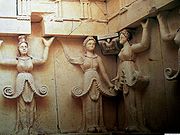 Pre-Scythian-Saka-Sibirian kurgans were surface kurgans and underground wooden or stone tombs constructed on the surface or underground and then covered with a kurgan. The kurgans of Bronze culture across Europe and Asia were similar to housing; the methods of house construction applied to the construction of the tombs. Kurgan Ak-su - Aüly (12th - 11th centuries BC) with a tomb covered by a pyramidal timber roof under a kurgan has space surrounded by double walls serving as a bypass corridor. This design has analogies with Begazy, Sanguyr, Begasar, and Dandybay kurgans. These building traditions survived into the early Middle Ages, to the 8th-10th centuries AD. The Bronze Pre-Scythian-Saka-Sibirian culture developed in close similarity with the cultures of Yenisei, Altai
, Kazakhstan
, southern, and southeast Amur
regions. In the second millennium BC appeared so-called "kurgans-maidans". On a prepared platform were made earthen images of a swan
, a turtle
, a snake
, or other image, with and without burials. Similar structures were found in Ukraine
, in South America
, and in India
.
Some kurgans had facing or tiling. One tomb in Ukraine has 29 large limestone slabs set on end in a circle underground. They were decorated with carved geometrical ornamentation of rhombus
es, triangle
s, cross
es, and on one slab, figures of people. Another example has an earthen kurgan under a wooden cone of thick logs topped by an ornamented cornice up to 2 m in height.
The Scythian-Saka-Sibirian kurgans in the Early Iron Age
are notable for their grandiose mounds throughout the Eurasia
n continent. The base diameters of the kurgans reach 500 m in Siberia (Great Salbyk kurgan of the settled Tagar culture); in neighboring China they reach 5000 m (kurgan of the first emperor of China in the 3rd century BC near Sian) (Mason, 1997: 71). Kurgans could be extremely tall: the Great Salbyk kurgan is 22 – 27 m (the height of a 7-story building); the kurgan of the Chinese emperor is over 100 m. The presence of such structures in Siberia testifies to a high standard of living
and a developed construction culture of the nomads.
In the Bronze Age were built kurgans with stone reinforcements. Some of them are believed to be Scythian burials with built-up soil, and embankments reinforced with stone (Olhovsky, 1991).
The most obvious archeological remains associated with the Scythians are the great burial mounds, some over 20 m high, which dot the Ukrainian and Russian steppe
belts and extend in great chains for many kilometers along ridges and watersheds. From them much has been learnt about Scythian life and art.
region during the Yamna
and Poltavka culture
s. Two thousand years later, females dressed as warriors were buried in the same region. David Anthony notes, "About 20% of Scythian-Sarmatian "warrior graves" on the lower Don
and lower Volga
contained females dressed for battle as if they were men, a phenomenon that probably inspired the Greek tales about the Amazons
."
A near-equal ratio of male-to-female graves was found in the eastern Manych
steppes and Kuban
-Azov
steppes during the Yamna culture. In Ukraine, the ratio was intermediate between the other two regions.
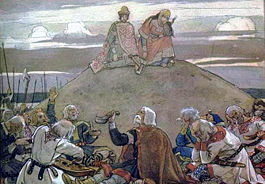 The tradition of kurgan burials touched not only the peoples who buried their deceased in kurgan structures, but also neighboring peoples without this tradition. Various Thracian kings and chieftains were buried in elaborate mound tombs found in modern Bulgaria; Philip II of Macedon
, the father of Alexander the Great, was buried in a magnificent kurgan in present Greece; and Midas
, a king of ancient Phrygia
, was buried in a kurgan near his ancient capital of Gordion
postulates that the Proto-Indo-Europeans
were the bearers of the Kurgan culture of the Black Sea
and the Caucasus
and west of the Urals. The hypothesis was introduced by Marija Gimbutas
in 1956, combining kurgan archaeology with linguistics to locate the origins of the Proto-Indo-European
(PIE) speaking peoples. She tentatively named the culture "Kurgan" after their distinctive burial mounds and traced its diffusion into Europe. This hypothesis has had a significant impact on Indo-European studies
. Those scholars who follow Gimbutas identify a "Kurgan culture" as reflecting an early Indo-European
ethnicity which existed in the steppes and southeastern Europe from the fifth to third millennia BC. Marija Gimbutas' Kurgan hypothesis is opposed by Paleolithic Continuity Theory
, which associates Pit Grave and Sredny Stog Kurgan cultures with Turkic peoples
, and the Anatolian hypothesis
, and is also opposed by the Black Sea deluge theory
. In Kurgan cultures, most of the burials were in kurgans, either clan kurgans or individual ones. Most prominent leaders were buried in individual kurgans, now called "Royal kurgans", which attract the greatest attention and publicity.
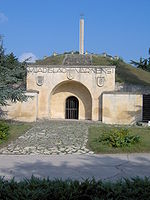 Kurgan building has a long history in Poland. The Polish word for kurgan is kopiec or kurhan.
Some excavated kurgans in Poland:
Tumulus
A tumulus is a mound of earth and stones raised over a grave or graves. Tumuli are also known as barrows, burial mounds, Hügelgrab or kurgans, and can be found throughout much of the world. A tumulus composed largely or entirely of stones is usually referred to as a cairn...
; mound of earth and stones raised over a grave or graves, originating with its use in Soviet archaeology, now widely used for tumuli in the context of Eastern European and Central Asian archaeology.
The word is ultimately of Turkic origin, more specifically from Tatar
Tatar language
The Tatar language , or more specifically Kazan Tatar, is a Turkic language spoken by the Tatars of historical Kazan Khanate, including modern Tatarstan and Bashkiria...
according to the Oxford English Dictionary
Oxford English Dictionary
The Oxford English Dictionary , published by the Oxford University Press, is the self-styled premier dictionary of the English language. Two fully bound print editions of the OED have been published under its current name, in 1928 and 1989. The first edition was published in twelve volumes , and...
, from a word meaning "fortress". Another theory is that the word comes from the Mongolic
Mongolic languages
The Mongolic languages are a group of languages spoken in East-Central Asia, mostly in Mongolia and surrounding areas plus in Kalmykia. The best-known member of this language family, Mongolian, is the primary language of most of the residents of Mongolia and the Mongolian residents of Inner...
"kurgan" or "korgon" meaning a "refuge or hiding place for the dead" from the Mongolic verb "korgodok" (to linger in hiding after death, to take refuge after death).
The distribution of such tumuli in Eastern Europe
Eastern Europe
Eastern Europe is the eastern part of Europe. The term has widely disparate geopolitical, geographical, cultural and socioeconomic readings, which makes it highly context-dependent and even volatile, and there are "almost as many definitions of Eastern Europe as there are scholars of the region"...
corresponds closely to the area of the Pit Grave or Kurgan culture in South-Eastern Europe.
Kurgans were built in the Eneolithic, Bronze
Bronze Age
The Bronze Age is a period characterized by the use of copper and its alloy bronze as the chief hard materials in the manufacture of some implements and weapons. Chronologically, it stands between the Stone Age and Iron Age...
, Iron
Iron Age
The Iron Age is the archaeological period generally occurring after the Bronze Age, marked by the prevalent use of iron. The early period of the age is characterized by the widespread use of iron or steel. The adoption of such material coincided with other changes in society, including differing...
, Antiquity
Classical antiquity
Classical antiquity is a broad term for a long period of cultural history centered on the Mediterranean Sea, comprising the interlocking civilizations of ancient Greece and ancient Rome, collectively known as the Greco-Roman world...
and Middle Age
Middle age
Middle age is the period of age beyond young adulthood but before the onset of old age. Various attempts have been made to define this age, which is around the third quarter of the average life span of human beings....
s, with old traditions still active in Southern Siberia
Siberia
Siberia is an extensive region constituting almost all of Northern Asia. Comprising the central and eastern portion of the Russian Federation, it was part of the Soviet Union from its beginning, as its predecessor states, the Tsardom of Russia and the Russian Empire, conquered it during the 16th...
and Central Asia
Central Asia
Central Asia is a core region of the Asian continent from the Caspian Sea in the west, China in the east, Afghanistan in the south, and Russia in the north...
. Kurgan cultures are divided archeologically into different sub-cultures, such as Timber Grave
Srubna culture
The Srubna culture , was a Late Bronze Age culture. It is a successor to the Yamna culture, the Pit Grave culture and the Poltavka culture....
, Pit Grave, Scythian, Sarmatian, Hunnish and Kuman
Kuman
Kuman may refer to:*Kuman, Albania, a municipality in the Fier District, Fier County, southwestern Albania*Küman, a municipality in Azerbaijan*Cumans, an ancient people*Cuman language, their language*Kuman language in Papua New Guinea...
-Kipchak.
A plethora of placenames that include the word "kurgan" appear from Lake Baikal
Lake Baikal
Lake Baikal is the world's oldest at 30 million years old and deepest lake with an average depth of 744.4 metres.Located in the south of the Russian region of Siberia, between Irkutsk Oblast to the northwest and the Buryat Republic to the southeast, it is the most voluminous freshwater lake in the...
to the Black Sea
Black Sea
The Black Sea is bounded by Europe, Anatolia and the Caucasus and is ultimately connected to the Atlantic Ocean via the Mediterranean and the Aegean seas and various straits. The Bosphorus strait connects it to the Sea of Marmara, and the strait of the Dardanelles connects that sea to the Aegean...
.
Archaeology
Kurgan barrows were characteristic of Bronze AgeBronze Age
The Bronze Age is a period characterized by the use of copper and its alloy bronze as the chief hard materials in the manufacture of some implements and weapons. Chronologically, it stands between the Stone Age and Iron Age...
peoples, from the Altay Mountains
Altay Mountains
The Altai Mountains are a mountain range in East-Central Asia, where Russia, China, Mongolia and Kazakhstan come together, and where the rivers Irtysh and Ob have their sources. The Altai Mountains are known as the original locus of the speakers of Turkic as well as other members of the proposed...
to the Caucasus
Caucasus
The Caucasus, also Caucas or Caucasia , is a geopolitical region at the border of Europe and Asia, and situated between the Black and the Caspian sea...
, Romania
Romania
Romania is a country located at the crossroads of Central and Southeastern Europe, on the Lower Danube, within and outside the Carpathian arch, bordering on the Black Sea...
, and Bulgaria
Bulgaria
Bulgaria , officially the Republic of Bulgaria , is a parliamentary democracy within a unitary constitutional republic in Southeast Europe. The country borders Romania to the north, Serbia and Macedonia to the west, Greece and Turkey to the south, as well as the Black Sea to the east...
. Burial mounds are complex structures with internal chambers. Within the burial chamber at the heart of the kurgan, elite individuals were buried with grave goods and sacrificial offerings, sometimes including horses and chariot
Chariot
The chariot is a type of horse carriage used in both peace and war as the chief vehicle of many ancient peoples. Ox carts, proto-chariots, were built by the Proto-Indo-Europeans and also built in Mesopotamia as early as 3000 BC. The original horse chariot was a fast, light, open, two wheeled...
s. Kurgans were used in the Russian Steppes but spread into eastern, central, and northern Europe
Europe
Europe is, by convention, one of the world's seven continents. Comprising the westernmost peninsula of Eurasia, Europe is generally 'divided' from Asia to its east by the watershed divides of the Ural and Caucasus Mountains, the Ural River, the Caspian and Black Seas, and the waterways connecting...
in the third millennium BC.
The monuments of these cultures coincide with Scythian-Saka
Saka
The Saka were a Scythian tribe or group of tribes....
-Siberian monuments. Scythian-Saka-Siberian monuments have common features, and sometimes common genetic roots. Also associated with these spectacular burial mounds are the Pazyryk
Pazyryk
The Pazyryk burials are a number of Iron Age tombs found in the Pazyryk Valley of the Ukok plateau in the Altai Mountains, Siberia, south of the modern city of Novosibirsk, Russia; the site is close to the borders with China, Kazakhstan and Mongolia.The tombs are Scythian kurgans, that is...
, an ancient people who lived in the Altai Mountains lying in Siberian Russia
Russia
Russia or , officially known as both Russia and the Russian Federation , is a country in northern Eurasia. It is a federal semi-presidential republic, comprising 83 federal subjects...
on the Ukok Plateau
Ukok Plateau
Ukok Plateau is a remote and pristine grasslands area located in the heart of southwestern Siberia, the Altai Mountains region of Russia near the borders with China, Kazakhstan and Mongolia...
, near the borders with China
China
Chinese civilization may refer to:* China for more general discussion of the country.* Chinese culture* Greater China, the transnational community of ethnic Chinese.* History of China* Sinosphere, the area historically affected by Chinese culture...
, Kazakhstan
Kazakhstan
Kazakhstan , officially the Republic of Kazakhstan, is a transcontinental country in Central Asia and Eastern Europe. Ranked as the ninth largest country in the world, it is also the world's largest landlocked country; its territory of is greater than Western Europe...
and Mongolia
Mongolia
Mongolia is a landlocked country in East and Central Asia. It is bordered by Russia to the north and China to the south, east and west. Although Mongolia does not share a border with Kazakhstan, its western-most point is only from Kazakhstan's eastern tip. Ulan Bator, the capital and largest...
. The archaeological site on the Ukok Plateau associated with the Pazyryk culture
Pazyryk culture
The Pazyryk culture is an Iron Age archaeological culture identified by excavated artifacts and mummified humans found in the Siberian permafrost in the Altay Mountains. The mummies are buried in long barrows similar to the tomb mounds of western Scythian culture in modern Ukraine...
is included in the Golden Mountains of Altai
Golden Mountains of Altai
Golden Mountains of Altai is the name of an UNESCO World Heritage Site consisting of the Altai and Katun Natural Reserves, Lake Teletskoye, Belukha Mountain, and the Ukok Plateau...
UNESCO World Heritage Site.
Scythian-Saka-Siberian classification includes monuments from the 8th century to the 3rd century BC. This period is called the Early or Ancient Nomads epoch. "Hunnic" monuments date from the 3rd century BC to the 6th century AD, and other Turkic
Turkic peoples
The Turkic peoples are peoples residing in northern, central and western Asia, southern Siberia and northwestern China and parts of eastern Europe. They speak languages belonging to the Turkic language family. They share, to varying degrees, certain cultural traits and historical backgrounds...
ones from the 6th century AD to the 13th century AD, leading up to the Mongolian
Mongols
Mongols ) are a Central-East Asian ethnic group that lives mainly in the countries of Mongolia, China, and Russia. In China, ethnic Mongols can be found mainly in the central north region of China such as Inner Mongolia...
epoch. In all periods, the development of the kurgan structure tradition in the various ethnocultural zones can be distinguished by common components or typical features in the construction of the monuments. They include:
- funeral chambers
- tombs
- surface and underground constructions of different configurations
- a mound of earth or stone, with or without an entrance
- funeral, ritual, and other traits
- the presence of an altar in the chamber
- stone fence
- moatMoatA moat is a deep, broad ditch, either dry or filled with water, that surrounds a castle, other building or town, historically to provide it with a preliminary line of defence. In some places moats evolved into more extensive water defences, including natural or artificial lakes, dams and sluices...
- bulwarkBulwarkBulwark may refer to:*A bastion or fortifications in general*In naval terminology, an extension of a ship's sides above deck level*HMS Bulwark, any of several Royal Navy ships*USS Bulwark, any of several US Navy ships...
- the presence of an entryway into the chamber, into the tomb, into the fence, or into the kurgan
- the location of a sacrificialSacrificeSacrifice is the offering of food, objects or the lives of animals or people to God or the gods as an act of propitiation or worship.While sacrifice often implies ritual killing, the term offering can be used for bloodless sacrifices of cereal food or artifacts...
site on the embankments, inside the mound, inside the moat, inside the embankments, and in their links, entryways, and around the kurgan - the location of a fire pit in the chamber
- a wooden roof over or under the kurgan, at the top of the kurgan, or around the kurgan
- the location of stone statues, columns, poles and other objects; bypass passages inside the kurgan, inside tombs, or around the kurgan
- funeral paths from the moat or bulwark.
Depending on a combination of elements, each historical and cultural nomadic zone has its architectural peculiarities. The structures of the earlier Neolithic
Neolithic
The Neolithic Age, Era, or Period, or New Stone Age, was a period in the development of human technology, beginning about 9500 BC in some parts of the Middle East, and later in other parts of the world. It is traditionally considered as the last part of the Stone Age...
period from the 4th to the 3rd millenniums BC, and Bronze Age until the first millennium BC display continuity of the archaic forming methods driven by the common ritual-mythological
Mythology
The term mythology can refer either to the study of myths, or to a body or collection of myths. As examples, comparative mythology is the study of connections between myths from different cultures, whereas Greek mythology is the body of myths from ancient Greece...
ideas.
Altay people
The Altay or Altai are an ethnic group of Turkic people living in the Siberian Altai Republic and Altai Krai and surrounding areas of Tuva and Mongolia. For alternative ethnonyms see also Teleut, Tele, Telengit, Mountain Kalmuck, White Kalmuck, Black Tatar, Oirat/Oirot.The Uriankhai people were...
, Kazakhstan
Kazakhstan
Kazakhstan , officially the Republic of Kazakhstan, is a transcontinental country in Central Asia and Eastern Europe. Ranked as the ninth largest country in the world, it is also the world's largest landlocked country; its territory of is greater than Western Europe...
, southern, and southeast Amur
Amur Oblast
Amur Oblast is a federal subject of Russia , situated about east of Moscow on the banks of the Amur and Zeya Rivers. It shares its border with the Sakha Republic in the north, Khabarovsk Krai and the Jewish Autonomous Oblast in the east, People's Republic of China in the south, and Zabaykalsky...
regions. In the second millennium BC appeared so-called "kurgans-maidans". On a prepared platform were made earthen images of a swan
Swan
Swans, genus Cygnus, are birds of the family Anatidae, which also includes geese and ducks. Swans are grouped with the closely related geese in the subfamily Anserinae where they form the tribe Cygnini. Sometimes, they are considered a distinct subfamily, Cygninae...
, a turtle
Turtle
Turtles are reptiles of the order Testudines , characterised by a special bony or cartilaginous shell developed from their ribs that acts as a shield...
, a snake
Snake
Snakes are elongate, legless, carnivorous reptiles of the suborder Serpentes that can be distinguished from legless lizards by their lack of eyelids and external ears. Like all squamates, snakes are ectothermic, amniote vertebrates covered in overlapping scales...
, or other image, with and without burials. Similar structures were found in Ukraine
Ukraine
Ukraine is a country in Eastern Europe. It has an area of 603,628 km², making it the second largest contiguous country on the European continent, after Russia...
, in South America
South America
South America is a continent situated in the Western Hemisphere, mostly in the Southern Hemisphere, with a relatively small portion in the Northern Hemisphere. The continent is also considered a subcontinent of the Americas. It is bordered on the west by the Pacific Ocean and on the north and east...
, and in India
India
India , officially the Republic of India , is a country in South Asia. It is the seventh-largest country by geographical area, the second-most populous country with over 1.2 billion people, and the most populous democracy in the world...
.
Some kurgans had facing or tiling. One tomb in Ukraine has 29 large limestone slabs set on end in a circle underground. They were decorated with carved geometrical ornamentation of rhombus
Rhombus
In Euclidean geometry, a rhombus or rhomb is a convex quadrilateral whose four sides all have the same length. The rhombus is often called a diamond, after the diamonds suit in playing cards, or a lozenge, though the latter sometimes refers specifically to a rhombus with a 45° angle.Every...
es, triangle
Triangle
A triangle is one of the basic shapes of geometry: a polygon with three corners or vertices and three sides or edges which are line segments. A triangle with vertices A, B, and C is denoted ....
s, cross
Cross
A cross is a geometrical figure consisting of two lines or bars perpendicular to each other, dividing one or two of the lines in half. The lines usually run vertically and horizontally; if they run obliquely, the design is technically termed a saltire, although the arms of a saltire need not meet...
es, and on one slab, figures of people. Another example has an earthen kurgan under a wooden cone of thick logs topped by an ornamented cornice up to 2 m in height.
The Scythian-Saka-Sibirian kurgans in the Early Iron Age
Iron Age
The Iron Age is the archaeological period generally occurring after the Bronze Age, marked by the prevalent use of iron. The early period of the age is characterized by the widespread use of iron or steel. The adoption of such material coincided with other changes in society, including differing...
are notable for their grandiose mounds throughout the Eurasia
Eurasia
Eurasia is a continent or supercontinent comprising the traditional continents of Europe and Asia ; covering about 52,990,000 km2 or about 10.6% of the Earth's surface located primarily in the eastern and northern hemispheres...
n continent. The base diameters of the kurgans reach 500 m in Siberia (Great Salbyk kurgan of the settled Tagar culture); in neighboring China they reach 5000 m (kurgan of the first emperor of China in the 3rd century BC near Sian) (Mason, 1997: 71). Kurgans could be extremely tall: the Great Salbyk kurgan is 22 – 27 m (the height of a 7-story building); the kurgan of the Chinese emperor is over 100 m. The presence of such structures in Siberia testifies to a high standard of living
Standard of living
Standard of living is generally measured by standards such as real income per person and poverty rate. Other measures such as access and quality of health care, income growth inequality and educational standards are also used. Examples are access to certain goods , or measures of health such as...
and a developed construction culture of the nomads.
In the Bronze Age were built kurgans with stone reinforcements. Some of them are believed to be Scythian burials with built-up soil, and embankments reinforced with stone (Olhovsky, 1991).
The most obvious archeological remains associated with the Scythians are the great burial mounds, some over 20 m high, which dot the Ukrainian and Russian steppe
Steppe
In physical geography, steppe is an ecoregion, in the montane grasslands and shrublands and temperate grasslands, savannas, and shrublands biomes, characterized by grassland plains without trees apart from those near rivers and lakes...
belts and extend in great chains for many kilometers along ridges and watersheds. From them much has been learnt about Scythian life and art.
Gender
Females were buried in about 20% of graves of the lower and middle Volga riverVolga River
The Volga is the largest river in Europe in terms of length, discharge, and watershed. It flows through central Russia, and is widely viewed as the national river of Russia. Out of the twenty largest cities of Russia, eleven, including the capital Moscow, are situated in the Volga's drainage...
region during the Yamna
Yamna culture
The Yamna culture is a late copper age/early Bronze Age culture of the Southern Bug/Dniester/Ural region , dating to the 36th–23rd centuries BC...
and Poltavka culture
Poltavka culture
Poltavka culture, 2700—2100 BC, an early to middle Bronze Age archaeological culture of the middle Volga from about where the Don-Volga canal begins up to the Samara bend, with an easterly extension north of present Kazakhstan along the Samara River valley to somewhat west of Orenburg.It is...
s. Two thousand years later, females dressed as warriors were buried in the same region. David Anthony notes, "About 20% of Scythian-Sarmatian "warrior graves" on the lower Don
Don River (Russia)
The Don River is one of the major rivers of Russia. It rises in the town of Novomoskovsk 60 kilometres southeast from Tula, southeast of Moscow, and flows for a distance of about 1,950 kilometres to the Sea of Azov....
and lower Volga
Volga River
The Volga is the largest river in Europe in terms of length, discharge, and watershed. It flows through central Russia, and is widely viewed as the national river of Russia. Out of the twenty largest cities of Russia, eleven, including the capital Moscow, are situated in the Volga's drainage...
contained females dressed for battle as if they were men, a phenomenon that probably inspired the Greek tales about the Amazons
Amazons
The Amazons are a nation of all-female warriors in Greek mythology and Classical antiquity. Herodotus placed them in a region bordering Scythia in Sarmatia...
."
A near-equal ratio of male-to-female graves was found in the eastern Manych
Manych River
Manych is a river in the western and central part of the Kuma-Manych Depression in southern Russia.Tributary to the river Don. The river is 219 km long; its source is Lake Manych-Gudilo in the south-westerm part of the Russian republic of Kalmykia...
steppes and Kuban
Kuban
Kuban is a geographic region of Southern Russia surrounding the Kuban River, on the Black Sea between the Don Steppe, Volga Delta and the Caucasus...
-Azov
Azov
-External links:** *...
steppes during the Yamna culture. In Ukraine, the ratio was intermediate between the other two regions.
Cultural influences
Philip II of Macedon
Philip II of Macedon "friend" + ἵππος "horse" — transliterated ; 382 – 336 BC), was a king of Macedon from 359 BC until his assassination in 336 BC. He was the father of Alexander the Great and Philip III.-Biography:...
, the father of Alexander the Great, was buried in a magnificent kurgan in present Greece; and Midas
Midas
For the legend of Gordias, a person who was taken by the people and made King, in obedience to the command of the oracle, see Gordias.Midas or King Midas is popularly remembered in Greek mythology for his ability to turn everything he touched into gold. This was called the Golden touch, or the...
, a king of ancient Phrygia
Phrygia
In antiquity, Phrygia was a kingdom in the west central part of Anatolia, in what is now modern-day Turkey. The Phrygians initially lived in the southern Balkans; according to Herodotus, under the name of Bryges , changing it to Phruges after their final migration to Anatolia, via the...
, was buried in a kurgan near his ancient capital of Gordion
Kurgan hypothesis
The Kurgan hypothesisKurgan hypothesis
The Kurgan hypothesis is one of the proposals about early Indo-European origins, which postulates that the people of an archaeological "Kurgan culture" in the Pontic steppe were the most likely speakers of the Proto-Indo-European language...
postulates that the Proto-Indo-Europeans
Proto-Indo-Europeans
The Proto-Indo-Europeans were the speakers of the Proto-Indo-European language , a reconstructed prehistoric language of Eurasia.Knowledge of them comes chiefly from the linguistic reconstruction, along with material evidence from archaeology and archaeogenetics...
were the bearers of the Kurgan culture of the Black Sea
Black Sea
The Black Sea is bounded by Europe, Anatolia and the Caucasus and is ultimately connected to the Atlantic Ocean via the Mediterranean and the Aegean seas and various straits. The Bosphorus strait connects it to the Sea of Marmara, and the strait of the Dardanelles connects that sea to the Aegean...
and the Caucasus
Caucasus
The Caucasus, also Caucas or Caucasia , is a geopolitical region at the border of Europe and Asia, and situated between the Black and the Caspian sea...
and west of the Urals. The hypothesis was introduced by Marija Gimbutas
Marija Gimbutas
Marija Gimbutas , was a Lithuanian-American archeologist known for her research into the Neolithic and Bronze Age cultures of "Old Europe", a term she introduced. Her works published between 1946 and 1971 introduced new views by combining traditional spadework with linguistics and mythological...
in 1956, combining kurgan archaeology with linguistics to locate the origins of the Proto-Indo-European
Proto-Indo-European language
The Proto-Indo-European language is the reconstructed common ancestor of the Indo-European languages, spoken by the Proto-Indo-Europeans...
(PIE) speaking peoples. She tentatively named the culture "Kurgan" after their distinctive burial mounds and traced its diffusion into Europe. This hypothesis has had a significant impact on Indo-European studies
Indo-European studies
Indo-European studies is a field of linguistics dealing with Indo-European languages, both current and extinct. Its goal is to amass information about the hypothetical proto-language from which all of these languages are descended, a language dubbed Proto-Indo-European , and its speakers, the...
. Those scholars who follow Gimbutas identify a "Kurgan culture" as reflecting an early Indo-European
Proto-Indo-Europeans
The Proto-Indo-Europeans were the speakers of the Proto-Indo-European language , a reconstructed prehistoric language of Eurasia.Knowledge of them comes chiefly from the linguistic reconstruction, along with material evidence from archaeology and archaeogenetics...
ethnicity which existed in the steppes and southeastern Europe from the fifth to third millennia BC. Marija Gimbutas' Kurgan hypothesis is opposed by Paleolithic Continuity Theory
Paleolithic Continuity Theory
The Paleolithic Continuity Theory , since 2010 relabelled as the Paleolithic Continuity Paradigm , is a hypothesis suggesting that the Proto-Indo-European language can be traced back to the Upper Paleolithic, several millennia earlier than the Chalcolithic or at the most Neolithic estimates in other...
, which associates Pit Grave and Sredny Stog Kurgan cultures with Turkic peoples
Turkic peoples
The Turkic peoples are peoples residing in northern, central and western Asia, southern Siberia and northwestern China and parts of eastern Europe. They speak languages belonging to the Turkic language family. They share, to varying degrees, certain cultural traits and historical backgrounds...
, and the Anatolian hypothesis
Anatolian hypothesis
The Anatolian hypothesis is also called Renfrew's Neolithic Discontinuity Theory ; it proposes that the dispersal of Proto-Indo-Europeans originated in Neolithic Anatolia...
, and is also opposed by the Black Sea deluge theory
Black Sea deluge theory
The Black Sea deluge is a hypothesized catastrophic rise in the level of the Black Sea circa 5600 BC due to waters from the Mediterranean Sea breaching a sill in the Bosporus Strait. The hypothesis made headlines when The New York Times published it in December 1996, shortly before it was published...
. In Kurgan cultures, most of the burials were in kurgans, either clan kurgans or individual ones. Most prominent leaders were buried in individual kurgans, now called "Royal kurgans", which attract the greatest attention and publicity.
Excavated kurgans
Some excavated kurgans include:- The Ipatovo kurganIpatovo kurganIpatovo kurgan refers to kurgan 2 of the Ipatovo Barrow Cemetery 3, a cemetery of kurgan burial mounds, located near Ipatovo, some 120 km north-east of Stavropol, Stavropol Krai, Russia.With a height of 7 metres, it was one of the largest kurgans in the area...
revealed a long sequence of burials from the Maykop cultureMaykop cultureThe Maykop culture , ca. 3700 BC—2500 BC, was a major Bronze Age archaeological culture situated in Southern Russia running from the Taman Peninsula at the Kerch Strait nearly to the modern border of Dagestan, centered approximately on the modern Republic of Adygea in the Kuban River valley...
ca. 4 000 BC down to the burial of a Sarmatian princess of the 3rd century BC, excavated 1998&–99. - Kurgan 4 at Kutuluk near SamaraSamara, RussiaSamara , is the sixth largest city in Russia. It is situated in the southeastern part of European Russia at the confluence of the Volga and Samara Rivers. Samara is the administrative center of Samara Oblast. Population: . The metropolitan area of Samara-Tolyatti-Syzran within Samara Oblast...
, Russia, dated to ca. 24th century BC, contains the skeleton of a man, estimated to have been 35 to 40 years old and about 152 cm tall. Resting on the skeleton's bent left elbow was a copper object 65 cm long with a blade of a diamond-shaped cross-section and sharp edges, but no point, and a handle, originally probably wrapped in leather. No similar object is known from Bronze Age Eurasian steppe cultures, and the object has been compared to the vajraVajraVajra is a Sanskrit word meaning both thunderbolt and diamond...
thunderbolt of Indian IndraIndra' or is the King of the demi-gods or Devas and Lord of Heaven or Svargaloka in Hindu mythology. He is also the God of War, Storms, and Rainfall.Indra is one of the chief deities in the Rigveda...
. - The Maikop kurganMaikop kurganThe Maikop kurgan , excavated by Nikolay Veselovsky in 1897 near Maikop, Adygeja, Kuban, Southern Russia, is the eponym of the Early Bronze Age Maikop culture of the Northern Caucasus. Dating to the 3rd millennium BC, the kurgan had a height of about 10 m and a circumference of about 200 m...
dates to the 3rd millennium BC. - The Novovelichkovskaya kurgan of ca. 2 000 BC on the Ponura River, KrasnodarKrasnodarKrasnodar is a city in Southern Russia, located on the Kuban River about northeast of the Black Sea port of Novorossiysk. It is the administrative center of Krasnodar Krai . Population: -Name:...
region, southern Russia, contains the remains of 11 people, including an embracing couple, buried with bronze tools, stone carvings, jewelry, and ceramic vessels decorated with red ocher. The tomb is associated with the Novotitorovka cultureNovotitorovka cultureNovotitorovka culture, 3300—2700 BC, a Bronze Age archaeological culture of the North Caucasus immediately to the north of and largely overlapping portions of the Maykop culture facing the Sea of Azov, running from the Kerch Strait eastwards, almost to the Caspian, roughly coterminous with...
nomads. - The Issyk kurganIssyk kurganThe Issyk kurgan, in south-eastern Kazakhstan, less than 20 km east from the Talgar alluvial fan, near Issyk, is a burial mound discovered in 1969. It has a height of six meters and a circumference of sixty meters. It is dated to the 4th or 3rd century BC . A notable item is a silver cup...
, in southern KazakhstanKazakhstanKazakhstan , officially the Republic of Kazakhstan, is a transcontinental country in Central Asia and Eastern Europe. Ranked as the ninth largest country in the world, it is also the world's largest landlocked country; its territory of is greater than Western Europe...
, contains a skeleton, possibly female, ca. 4th century BC, with an inscribed silver cup, gold ornaments, Scythian animal art objects and headdress reminiscent of Kazakh bridal hats; discovered in 1 969. - Kurgan 11 of the Berel cemetery, in the Bukhtarma RiverBukhtarma RiverThe Bukhtarma River is a river of Kazakhstan. It flows through East Kazakhstan Province, and is a right tributary of the Irtysh. The length of the river is 336 km, with a basin area of 12,660 km ². The source of the river is located in the Southern Altai Mountains. The average water flow...
valley of Kazakhstan, contains a tomb of ca. 300 BC, with a dozen sacrificed horses preserved with their skin, hair, harnesses, and saddles intact, buried side by side on a bed of birch bark next to a funeral chamber containing the pillaged burial of two Scythian nobles; excavated in 1 998. - The Ryzhanovka kurgan, a 10 metre high kurgan 125 km south of KievKievKiev or Kyiv is the capital and the largest city of Ukraine, located in the north central part of the country on the Dnieper River. The population as of the 2001 census was 2,611,300. However, higher numbers have been cited in the press....
, UkraineUkraineUkraine is a country in Eastern Europe. It has an area of 603,628 km², making it the second largest contiguous country on the European continent, after Russia...
, containing the tomb of a Scythian chieftain, 3rd century BC, was excavated in 1 996. - The Solokha kurgan, in the Zaporizhia OblastZaporizhia OblastZaporizhia Oblast is an oblast of southern Ukraine. Its capital is Zaporizhia.This oblast is an important part of Ukraine's industry and agriculture.-Geography:...
of Ukraine, Scythian, dates to the early 4th century BC. - The Thracian Tomb of KazanlakThracian Tomb of KazanlakThe Thracian Tomb of Kazanlak is a vaulted brickwork "beehive" tomb near the town of Kazanlak in central Bulgaria.The tomb is part of a large Thracian necropolis. It comprises a narrow corridor and a round burial chamber, both decorated with murals representing a Thracian couple at a ritual...
, near the town of KazanlakKazanlakKazanlak, formerly Kazanlık is a Bulgarian town in Stara Zagora Province, located in the middle of the plain of the same name, at the foot of the Balkan mountain range, at the eastern end of the Rose Valley...
in central BulgariaBulgariaBulgaria , officially the Republic of Bulgaria , is a parliamentary democracy within a unitary constitutional republic in Southeast Europe. The country borders Romania to the north, Serbia and Macedonia to the west, Greece and Turkey to the south, as well as the Black Sea to the east...
, is a ThraciaThraciaThracia is a Web-Based computer game created and developed by an exclusively Romanian team, part of Infotrend Consulting, and launched in 2009. At the time, it was the first endeavor of its kind. All browser games were text based, made up mostly of static content...
n kurgan of ca. the 4th century BC. - The Aleksandrovo kurgan is a Thracian kurgan of ca. the 4th century BC.
- The Thracian Tomb of SveshtariThracian Tomb of SveshtariThe Thracian Tomb of Sveshtari is situated 2.5 km southwest of the village of Sveshtari, Razgrad Province, which is located 42 km northeast of Razgrad, in the northeast of Bulgaria....
, Bulgaria, is a Thracian kurgan of ca. the 3rd century BC. - The Håga KurganHåga KurganThe Håga Kurgan or King Björn's Mound is a large Nordic Bronze Age kurgan in the western outskirts of Uppsala, Sweden. It is one of the most magnificent remains from the Nordic Bronze Age.-Hågahögen:...
, located on the outskirts of UppsalaUppsala- Economy :Today Uppsala is well established in medical research and recognized for its leading position in biotechnology.*Abbott Medical Optics *GE Healthcare*Pfizer *Phadia, an offshoot of Pharmacia*Fresenius*Q-Med...
, SwedenSwedenSweden , officially the Kingdom of Sweden , is a Nordic country on the Scandinavian Peninsula in Northern Europe. Sweden borders with Norway and Finland and is connected to Denmark by a bridge-tunnel across the Öresund....
, is a large Nordic Bronze AgeNordic Bronze AgeThe Nordic Bronze Age is the name given by Oscar Montelius to a period and a Bronze Age culture in Scandinavian pre-history, c. 1700-500 BC, with sites that reached as far east as Estonia. Succeeding the Late Neolithic culture, its ethnic and linguistic affinities are unknown in the absence of...
kurgan from ca. 1 000 BC. - The Pereshchepina KurganPereshchepina TreasureThe Pereshchepina Treasure is a major deposit of Bulgarian, Sassanian, Sogdian, Turkic and Avarian objects from the period of the Volkerwanderung....
is a burial memorial of the Great Bulgaria Khan KubratKubratKubrat or Kurt was a Bulgar ruler credited with establishing the confederation of Old Great Bulgaria in 632. He is said to have achieved this by conquering the Avars and uniting all the Bulgar tribes under one rule....
from ca. 660 AD. - Noin-Ula kurgan, located by the Selenga River in the northern MongoliaMongoliaMongolia is a landlocked country in East and Central Asia. It is bordered by Russia to the north and China to the south, east and west. Although Mongolia does not share a border with Kazakhstan, its western-most point is only from Kazakhstan's eastern tip. Ulan Bator, the capital and largest...
hills north of Ulan Bator, is the tomb of Uchjulü-Chanuy (8 BC – 13 AD), head of the Hun confederation.
In Poland
Some excavated kurgans in Poland:
- Burial mounds of the Unetice culture include fourteen kurgans dated to 2 000–1 800 BC
- KraśnikKrasnikKraśnik is a town in eastern Poland with 37,989 inhabitants , situated in the Lublin Voivodeship. It is the seat of Kraśnik County.-History:First settled in the 13th century, it received its city charter in 1377....
Neolithic (stone age) kurhans - Tombs at PleśnikPlesnikPleśnik is a village in the administrative district of Gmina Bisztynek, within Bartoszyce County, Warmian-Masurian Voivodeship, in northern Poland...
- Trawiasta Buczyna — hundreds of stone kurhans dated to 1 200–1 000 BC
- SkalbmierzSkalbmierzSkalbmierz is a town in south eastern Poland, in Świętokrzyskie Voivodeship, in Kazimierza County. It has 1,326 inhabitants .- History :First half of 12th century – Presumably Skalbmierz foundation...
has kurgans dated 4000 BC. - Zambrow
- Mounds at Jawczyce were described by Bishop Nankerus in 1322. Kurgan mounds dated to the Neolithic or Bronze Age included a burial of an elderly person, probably male. Some weapons and pottery fragments were also found in the tomb.
- Near SieradzSieradzSieradz is a town on the Warta river in central Poland with 44,326 inhabitants . It is situated in the Łódź Voivodship , but was previously the eponymous capital of the Sieradz Voivodship , and historically one of the minor duchies in Greater Poland.It is one of the oldest towns in Poland,...
a tomb dated to the Trzciniec cultureTrzciniec cultureThe Trzciniec culture was an ancient tradition that subsisted in central Europe. Archeologists speculate its existence to have been between the years 1700 and 1200 BC....
of circa 1500 BC contains a man and woman buried together. - A kurgan burial site at Łubna-Jakusy and a kurgan cremation near GuciówGuciówGuciów is a village in the administrative district of Gmina Zwierzyniec, within Zamość County, Lublin Voivodeship, in eastern Poland. It lies approximately south-east of Zwierzyniec, south-west of Zamość, and south-east of the regional capital Lublin....
are examples of Trzciniec culture of circa 1 500 BC. - The Krakus MoundKrakus MoundKrakus Mound is a tumulus located in the Podgórze district of Kraków, Poland; assumed to be the resting place of the legendary prince Krakus. It is located on Lasota Hill, approximately south of the city centre, at an altitude of , with the base diameter of and the height of .The age and the...
is located in KrakówKrakówKraków also Krakow, or Cracow , is the second largest and one of the oldest cities in Poland. Situated on the Vistula River in the Lesser Poland region, the city dates back to the 7th century. Kraków has traditionally been one of the leading centres of Polish academic, cultural, and artistic life...
. Legend says it is the burial place of KrakusKrakusKrakus, Krak or Grakch was a legendary Polish prince and founder of Kraków, the ruler of the tribe of Lechitians . Krakus is also credited with building Wawel Castle. The first recorded mention of Krakus, then spelled Grakch, is in the Chronica seu originale regum et principum Poloniae from 1190...
, founder of the city. - Wanda MoundWanda MoundWanda Mound is a tumulus located in Mogiła in Kraków, Poland. The mound is assumed to be the resting place of the legendary princess Wanda. According to one version of the story, she committed suicide by drowning in the Vistula river to avoid unwanted marriage...
, burial place of the daughter of Krakus, is located in Kraków. - Piłakno near MrągowoMragowoMrągowo is a town in the Warmian-Masurian Voivodeship of northeastern Poland, the capital of Mrągowo County and the seat the Gmina Mrągowo...
, excavated in 1 988, is an example of west Baltic kurhan culture. - In Bełchatow there is a pagan temple built upon a kurgan. Dating of this structure awaits results of carbon 14 tests.
- The mound called Kopiec Tatarski at PrzemyślPrzemyslPrzemyśl is a city in south-eastern Poland with 66,756 inhabitants, as of June 2009. In 1999, it became part of the Podkarpackie Voivodeship; it was previously the capital of Przemyśl Voivodeship....
is trangular in shape, 10 meters in length, and pointing east. In 1 869, T. Żebrawski found bones and ancient coins. In 1 958, A. Kunysz found skulls and bones and medieval ceramicCeramicA ceramic is an inorganic, nonmetallic solid prepared by the action of heat and subsequent cooling. Ceramic materials may have a crystalline or partly crystalline structure, or may be amorphous...
s. a structure called Templum S. Leonardi was constructed around 1 534 on top of the mound; it was destroyed in World War IIWorld War IIWorld War II, or the Second World War , was a global conflict lasting from 1939 to 1945, involving most of the world's nations—including all of the great powers—eventually forming two opposing military alliances: the Allies and the Axis...
. - Kopiec Esterki was erected in the fourteenth century by Casimir III of PolandCasimir III of PolandCasimir III the Great , last King of Poland from the Piast dynasty , was the son of King Władysław I the Elbow-high and Hedwig of Kalisz.-Biography:...
for his deceased wife. - Kopiec Władysław III of Poland was buried after 1 444 in VarnaVarnaVarna is the largest city and seaside resort on the Bulgarian Black Sea Coast and third-largest in Bulgaria after Sofia and Plovdiv, with a population of 334,870 inhabitants according to Census 2011...
:Image:VarnaMemorial.jpg - Kościuszko MoundKosciuszko MoundKościuszko Mound in Kraków, Poland, erected by Cracovians in commemoration of the Polish national leader Tadeusz Kościuszko, is an artificial mound modeled after Kraków's prehistoric mounds of Krak and Wanda. A serpentine path leads to the top, approx. above sea level, with a panoramic view of...
in Kraków was completed in November 1 823 as a memorial to Tadeusz KościuszkoTadeusz KosciuszkoAndrzej Tadeusz Bonawentura Kościuszko was a Polish–Lithuanian and American general and military leader during the Kościuszko Uprising. He is a national hero of Poland, Lithuania, the United States and Belarus... - The Union of Lublin MoundUnion of Lublin MoundUnion of Lublin Mound is an artificial hill, 29 m high, in Lwów created in 1869-1890 to commemorate the 300th anniversary of the Union of Lublin...
was completed in LvivLvivLviv is a city in western Ukraine. The city is regarded as one of the main cultural centres of today's Ukraine and historically has also been a major Polish and Jewish cultural center, as Poles and Jews were the two main ethnicities of the city until the outbreak of World War II and the following...
in 1 980. - A Mound of ImmortalityMound of ImmortalityMound of Immortality is the name of several memorials/monuments in several places of the former Soviet Union that commemorate the Soviet soldiers and ordinary citizens who fought and perished during the German-Soviet War....
was constructed to honor poet Adam MickiewiczAdam MickiewiczAdam Bernard Mickiewicz ) was a Polish poet, publisher and political writer of the Romantic period. One of the primary representatives of the Polish Romanticism era, a national poet of Poland, he is seen as one of Poland's Three Bards and the greatest poet in all of Polish literature...
in 1 898. - Kopiec Wyzwolenia (Mound of Liberation) commemorates the 250th anniversary of the passage of the Polish Hussars through the city of Piekary ŚląskiePiekary SlaskiePiekary Śląskie is a city in Silesia in southern Poland, near Katowice. The north district of the Upper Silesian Metropolitan Union - metropolis with the population of 2 million...
under John III SobieskiJohn III SobieskiJohn III Sobieski was one of the most notable monarchs of the Polish–Lithuanian Commonwealth, from 1674 until his death King of Poland and Grand Duke of Lithuania. Sobieski's 22-year-reign was marked by a period of the Commonwealth's stabilization, much needed after the turmoil of the Deluge and...
. It was completed in 1 937.
- Piłsudski's Mound in Kraków honors Polish general and politician Józef Piłsudski.
See also
- Animal sacrificeAnimal sacrificeAnimal sacrifice is the ritual killing of an animal as part of a religion. It is practised by many religions as a means of appeasing a god or gods or changing the course of nature...
, AshvamedhaAshvamedhaThe Ashvamedha was one of the most important royal rituals of Vedic religion, described in detail in the Yajurveda... - Mamayev KurganMamayev KurganMamayev Kurgan is a dominant height overlooking the city of Volgograd in Southern Russia. The name in Russian means "tumulus of Mamai"....
, used during the Battle of StalingradBattle of StalingradThe Battle of Stalingrad was a major battle of World War II in which Nazi Germany and its allies fought the Soviet Union for control of the city of Stalingrad in southwestern Russia. The battle took place between 23 August 1942 and 2 February 1943...
. - ScythiaScythiaIn antiquity, Scythian or Scyths were terms used by the Greeks to refer to certain Iranian groups of horse-riding nomadic pastoralists who dwelt on the Pontic-Caspian steppe...
- TarpanTarpanTarpan is an extinct subspecies of wild horse. The last individual of this subspecies died in captivity in Russia in 1909....
- Ukrainian stone stela
- Yamna cultureYamna cultureThe Yamna culture is a late copper age/early Bronze Age culture of the Southern Bug/Dniester/Ural region , dating to the 36th–23rd centuries BC...
- Kleczanów WoodKleczanów WoodKleczanów Forest is a small Polish forest complex in the vicinity of Kleczanów village in Sandomierz County, Poland. It is known for featuring an ancient site of 37 Slavic kurgans 4–10 metres high....
Literature
- "Proto-Türkic rune-like inscription on silver cup (Issyk Inscription)" by A.S. Amanjolov, in "History Of Ancient Türkic Script", Almaty 2003
- "In Search of the Indo-Europeans: Language, Archaeology and Myth" by J. P. Mallory, ISBN 0-500-27616-1
- "The Kurgan Culture and the Indo-Europeanization of Europe: Selected Articles Form 1952 to 1993" von Marija Gimbutas u.a., ISBN 0-941694-56-9
- "Encyclopedia of Indo-European CultureEncyclopedia of Indo-European CultureThe Encyclopedia of Indo-European Culture is an encyclopedia of Indo-European studies and the Proto-Indo-Europeans. The encyclopedia was edited by J. P. Mallory and Douglas Q. Adams and published in 1997 by Fitzroy Dearborn...
" ed. James Mallory, D. Q. Adams, ISBN 1-884964-98-2 - D. Ya. Telegin et al., Srednestogovskaya i Novodanilovskaya Kul'tury Eneolita Azovo-Chernomorskogo Regiona. Kiev: Shlyakh, 2001. Reviewed by J.P. Mallory, JIES vol. 32, 3/4, p. 363–366.
- "Reconstruction Of The Genofond Peculiarities Of The Ancient Pazyryk Population (I-II Millennium BC) From Gorny Altai According To The mtDNA Structure" Voevoda M.I., Sitnikova V.V., Romashchenko A.G., Chikisheva T.A., Polosmak N.V., Molodin V. I http://www.bionet.nsc.ru/bgrs/thesis/99/.
- O.IsmagulovOrazak IsmagulovOrazak Ismagulov is an internationally-known anthropologist, Doctor of historical sciences , corresponding member of the Kazakhstan National Academy of Sciences . Ismagulov uses anthropological studies of ancient and modern people as a source of historical information for ethnogenesis and ethnic...
'Population of Kazakhstan from Bronze Epoch to Present (Paleoanthropological research)', Science, Alma-Ata, 1970
External links
- Kurgan Culture
- excavated kurgans (archaeology.org).
- Ritual Sites, and Settlements: Eurasian Bronze and Iron Age book for download (www.csen.org)
- An extensive list of mounds in Poland