
All Topics  
Great Pyramid of Giza

 
Great Pyramid of Giza

   Email Print
   Bookmark   Link


Great Pyramid of Giza


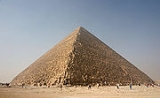
The Great Pyramid of Giza, also called Khufu's Pyramid or the Pyramid of Khufu, and Pyramid of Cheops, is the oldest and largest of the three pyramid
Egyptian pyramids

File:All Gizah Pyramids.jpgFile:EgyptianPyramidsandSphinx2006.jpgThe Egyptian pyramids are ancient pyramid shaped masonry structures located in Egypt....
s in the Giza Necropolis bordering what is now Cairo
Cairo

Cairo , which means "the triumphant", is the Cairo and largest city of Egypt.It is the most populous metropolitan area in Egypt and is also one of the most populous in the world....
  , Egypt
Egypt

Egypt is a country mainly in North Africa, with the Sinai Peninsula forming a land bridge in Western Asia. Covering an area of about , Egypt borders the Mediterranean Sea to the north, the Gaza Strip and Israel to the northeast, the Red Sea to the east, Sudan to the south and Libya to the west....
, and is the only remaining member of the Seven Wonders of the Ancient World
Seven Wonders of the Ancient World

The Seven Wonders of the World is a well known list of seven remarkable constructions of classical antiquity. It was based on guide-books popular among Ancient Greece tourists and only includes works located around the Mediterranean rim....
. It is believed the pyramid was built as a tomb for Fourth dynasty
Fourth dynasty of Egypt

The Fourth Dynasty of Ancient Egypt, also written Dynasty 4 and Dynasty IV, is characterized as a golden age of the Old Kingdom....
 Egyptian
Ancient Egypt

Ancient Egypt was an Ancient history civilization in eastern North Africa, concentrated along the lower reaches of the Nile in what is now the modern nation of Egypt....
 King Khufu
Khufu

Khufu was a Pharaoh of Ancient Egypt's Old Kingdom. He reigned from around 2589 to 2566 B.C. Khufu was the second pharaoh of the Fourth dynasty of Egypt....
 (Cheops in Greek) and constructed over a 20 year period concluding around 2560 BC.


Discussion
Ask a question about 'Great Pyramid of Giza'
Start a new discussion about 'Great Pyramid of Giza'
Answer questions from other users
Full Discussion Forum


Recent Posts


Encyclopedia


The Great Pyramid of Giza, also called Khufu's Pyramid or the Pyramid of Khufu, and Pyramid of Cheops, is the oldest and largest of the three pyramid
Egyptian pyramids

File:All Gizah Pyramids.jpgFile:EgyptianPyramidsandSphinx2006.jpgThe Egyptian pyramids are ancient pyramid shaped masonry structures located in Egypt....
s in the Giza Necropolis bordering what is now Cairo
Cairo

Cairo , which means "the triumphant", is the Cairo and largest city of Egypt.It is the most populous metropolitan area in Egypt and is also one of the most populous in the world....
  , Egypt
Egypt

Egypt is a country mainly in North Africa, with the Sinai Peninsula forming a land bridge in Western Asia. Covering an area of about , Egypt borders the Mediterranean Sea to the north, the Gaza Strip and Israel to the northeast, the Red Sea to the east, Sudan to the south and Libya to the west....
, and is the only remaining member of the Seven Wonders of the Ancient World
Seven Wonders of the Ancient World

The Seven Wonders of the World is a well known list of seven remarkable constructions of classical antiquity. It was based on guide-books popular among Ancient Greece tourists and only includes works located around the Mediterranean rim....
. It is believed the pyramid was built as a tomb for Fourth dynasty
Fourth dynasty of Egypt

The Fourth Dynasty of Ancient Egypt, also written Dynasty 4 and Dynasty IV, is characterized as a golden age of the Old Kingdom....
 Egyptian
Ancient Egypt

Ancient Egypt was an Ancient history civilization in eastern North Africa, concentrated along the lower reaches of the Nile in what is now the modern nation of Egypt....
 King Khufu
Khufu

Khufu was a Pharaoh of Ancient Egypt's Old Kingdom. He reigned from around 2589 to 2566 B.C. Khufu was the second pharaoh of the Fourth dynasty of Egypt....
 (Cheops in Greek) and constructed over a 20 year period concluding around 2560 BC. The Great Pyramid was the tallest man-made structure
List of tallest buildings and structures in the world

While determining the world's tallest Nonbuilding structure has generally been straightforward, the definition of the List of tallest buildings in the world or the List of towers is less clear....
 in the world for over 3,800 years. Originally the Great Pyramid was covered by casing stones that formed a smooth outer surface, and what is seen today is the underlying core structure. Some of the casing stones that once covered the structure can still be seen around the base. There have been varying scientific and alternative theories regarding the Great Pyramid's construction techniques. Most accepted construction theories are based on the idea that it was built by moving huge stones from a quarry and dragging and lifting them into place.

There are three known chambers inside the Great Pyramid. The lowest chamber is cut into the bedrock upon which the pyramid was built and was unfinished. The so-called Queen's Chamber and King's Chamber are higher up within the pyramid structure. The Great Pyramid of Giza is the main part of a complex setting of buildings that included two mortuary temples
Mortuary temples

Mortuary Temples are temples that were constructed as establishments where the dead are prepared for burial or cremation , where the body may be viewed, or where funeral services may be held....
 in honor of Khufu (one close to the pyramid and one near the Nile), three smaller pyramids for Khufu's wives, an even smaller "satellite" pyramid, a raised causeway connecting the two temples, and small mastaba
Mastaba

A mastaba was a kind of Ancient Egyptian tomb in the form of a flat-roofed, rectangular with outward sloping sides that marked the burial site of many eminent Egyptians of Egypt's History of Egypt....
 tombs surrounding the pyramid for nobles.

Building the pyramid

It is believed the pyramid was built as a tomb for Fourth dynasty
Fourth dynasty of Egypt

The Fourth Dynasty of Ancient Egypt, also written Dynasty 4 and Dynasty IV, is characterized as a golden age of the Old Kingdom....
 Egyptian
Ancient Egypt

Ancient Egypt was an Ancient history civilization in eastern North Africa, concentrated along the lower reaches of the Nile in what is now the modern nation of Egypt....
 pharaoh Khufu
Khufu

Khufu was a Pharaoh of Ancient Egypt's Old Kingdom. He reigned from around 2589 to 2566 B.C. Khufu was the second pharaoh of the Fourth dynasty of Egypt....
 and constructed over a 14 to 20 year period concluding around 2560 BC. Khufu's vizier
Vizier (Ancient Egypt)

The vizier was the highest official in Ancient Egypt to serve the king, or pharaoh during the Old, Middle, and New Kingdoms. Vizier is the generally accepted rendering of ancient Egyptian tjati, tjaty etc, among Egyptologists....
, Hemon
Hemon

Hemiunu or is believed to be the architect of the Great Pyramid of Giza Plateau, Egypt. He was the son of Nefermaat, a relative of Khufu, the Old Kingdom pharaoh whose pyramid it is....
, or Hemiunu, is believed by some to be the architect of the Great Pyramid. It is thought that, at construction, the Great Pyramid was 280 Egyptian royal cubits tall, 146.6 meters, (480.97 feet) but with erosion
Erosion

For morphological image processing operations, see Erosion 'For use of in dermatopathology, see Erosion Erosion is the removal of solids in the natural environment....
 and the loss of its pyramidion
Pyramidion

In archaeology parlance, a pyramidion, , is the uppermost piece, or capstone, of an Egyptian pyramids. They were called benbenet in Ancient Egyptian, which associated the pyramid as a whole with the sacred benben stone....
, its current height is 138.8 m (455 feet). Each base side was 440 royal cubit
Cubit

File:Cubit rule Egyptian NK from Liverpool museum.jpgA cubit is the first recorded unit of length and was one of many different standards of measurement used through history....
s, with each royal cubit measuring 0.524 meters. The total mass of the pyramid is estimated at 5.9 million tonnes. The volume, including an internal hillock, is believed to be roughly 2,500,000 cubic meters. Based on these estimates building this in 20 years would involve installing approximately 800 tonnes of stone every day. The first precision measurements of the pyramid were done by Egyptologist
Egyptology

Egyptology is a major field of archaeology, the study of ancient Egyptian History of Egypt, Egyptian language, Ancient Egyptian literature, Ancient Egyptian religion, and Art of ancient Egypt from the 5th millennium BC until the end of its native religious practices in the AD 4th century....
 Sir Flinders Petrie in 1880–82 and published as The Pyramids and Temples of Gizeh. Almost all reports are based on his measurements. Petrie found the pyramid is oriented 4' west of North and the second pyramid is similarly oriented. Many of the casing stones and interior chamber blocks of the great pyramid were fit together with extremely high precision. Based on measurements taken on the north eastern casing stones, the mean opening of the joints are only 1/50th of an inch wide.

Pyramiddatepalms
The pyramid remained the tallest man-made structure
List of tallest buildings and structures in the world

While determining the world's tallest Nonbuilding structure has generally been straightforward, the definition of the List of tallest buildings in the world or the List of towers is less clear....
 in the world for over 3,800 years, unsurpassed until the 160 meter tall spire of Lincoln Cathedral
Lincoln Cathedral

Lincoln Cathedral is a historic Anglican cathedral in Lincoln, Lincolnshire in England and seat of the Diocese of Lincoln in the Church of England....
 was completed c. 1300. The accuracy of the pyramid's workmanship is such that the four sides of the base have a mean error of only 58 millimeter in length, and 1 minute in angle
Angle

In geometry and trigonometry, an angle is the figure formed by two Ray sharing a common endpoint, called the vertex of the angle . The magnitude of the angle is the "amount of rotation" that separates the two rays, and can be measured by considering the length of circular arc swept out when one ray is rotated about the vertex to coincide...
 from a perfect square. The base is horizontal and flat to within 15 mm. The sides of the square are closely aligned to the four cardinal compass points (within 3 minutes of arc
Minute of arc

A minute of arc, arcminute, or MOA is a unit of angle, equal to one sixtieth of one degree . Since one degree is defined as one three hundred sixtieth of a circle, 1 minute of arc is 1/21600 of the amount of arc in a closed circle....
 based on true north
True north

True north is the direction along the earth's surface towards the geographic North Pole.True north usually differs from magnetic north pole and grid north ....
 not magnetic north). The completed design dimensions, as suggested by Petrie's survey and later studies, are estimated to have originally been 280 cubits in height by 4 × 440 cubits at its base. These proportions equate to 2p
Pi

Pi or p is a mathematical constant whose value is the ratio of any circle's circumference to its diameter in Euclidean geometry; this is the same value as the ratio of a circle's area to the square of its radius....
 to an accuracy of better than 0.05% which some Egyptologists consider to have been the result of deliberate design proportion. Verner wrote, "We can conclude that although the ancient Egyptians could not precisely define the value of p, in practise they used it". Petrie, author of ‘The Pyramids and Temples of Gizeh', who was the first accurate surveyor of Giza and the excavator and surveyor of the Pyramid of Meidum, concluded: "but these relations of areas and of circular ratio are so systematic that we should grant that they were in the builders design" Earlier in the chapter he wrote more specifically, that: “We conclude therefore that the approximation of 7 to 22 as the ratio of diameter to circumference was recognised”

Materials


The Great Pyramid consists of more than 2.3 million limestone blocks. The Egyptians shipped the limestone blocks from quarries all along the Nile River. The stone was cut by hammering wedges into the stone. Then the wedges were soaked with water. The wedges expanded, causing the rock to crack. Once they were cut, they were carried by boat either up or down the Nile River to the pyramid (citation needed).

Casing stones

At completion, the Great Pyramid was surfaced by white 'casing stones' – slant-faced, but flat-topped, blocks of highly polished white limestone
Limestone

File:Limestone Formation In Waitomo.jpgLimestone is a sedimentary rock composed largely of the mineral calcite . The deposition of limestone strata is often a by-product and indicator of biological activity in the geology record....
. Visibly all that remains is the underlying step-pyramid core structure seen today. In AD 1301, a massive earthquake loosened many of the outer casing stones, which were then carted away by Bahri Sultan
Bahri dynasty

The Bahri dynasty or Bahriyya Mamluks was a Mamluk dynasty of mostly Kipchaks Turkic peoples origin that ruled Egypt from 1250 to 1382 when they were succeeded by the Burji dynasty, another group of Mamluks....
 An-Nasir Nasir-ad-Din al-Hasan in 1356 in order to build mosque
Mosque

A mosque is a place of worship for followers of Islam. Muslims often refer to the mosque by its Arabic name, masjid, ? . The word "mosque" in English refers to all types of buildings dedicated for Islamic worship, although there is a distinction in Arabic between the smaller, privately owned mosque and the larger, "collective" mosque ,...
s and fortresses in nearby Cairo
Cairo

Cairo , which means "the triumphant", is the Cairo and largest city of Egypt.It is the most populous metropolitan area in Egypt and is also one of the most populous in the world....
. The stones can still be seen as parts of these structures to this day. Later explorers reported massive piles of rubble at the base of the pyramids left over from the continuing collapse of the casing stones, which were subsequently cleared away during continuing excavations of the site. Nevertheless, many of the casing stones can be seen to this day in situ around the base of the Great Pyramid, and display the same workmanship and precision as has been reported for centuries. Petrie also found a different orientation in the core and in the casing measuring 193 centimeters ± 25 centimeters. He suggested a redetermination of north was made after the construction of the core, but a mistake was made, and the casing was built with a different orientation.

Construction theories


There have been varying alternative theories proposed regarding the Pyramid's construction techniques. Most accepted construction theories are based on the idea that it was built by moving huge stones from a quarry and dragging and lifting them into place. The disagreements center on the method by which the stones were conveyed and placed. In addition to the many theories as to the techniques involved, there are also disagreements as to the kind of workforce that was used. One theory, suggested by the Greeks
Greeks

The Greeks , also known as Hellenes, are a nation and ethnic group native to Greece, Cyprus and neighbouring regions, who can also be found in Greek diaspora communities around the world....
, posits that slaves were forced to work until the pyramid was done. This theory is no longer accepted in the modern era, however. Egyptologists believe that the Great Pyramid was built by tens of thousands of skilled workers who camped near the pyramids and worked for a salary or as a form of paying taxes until the construction was completed (citation needed). The worker's cemeteries were discovered in 1990 by archaeologists Zahi Hawass
Zahi Hawass

Zahi Hawass is an Egyptians archaeology and List of Egyptologists and the current Secretary General of the Egyptian Supreme Council of Antiquities....
 and Mark Lehner
Mark Lehner

Mark Lehner, Ph.D., is an United States archaeology with more than thirty years of experience excavating in Egypt. His approach, as director of Ancient Egypt Research Associates, is to conduct interdisciplinary archaeological investigation....
. Verner posited that the labor was organized into a hierarchy
Hierarchy

A 'hierarchy' is an arrangement of items The word derives from the Greek language , from ?e?????? , "president of sacred rites, high-priest" and that from , "sacred" + , "to lead, to rule"....
, consisting of two gangs of 100,000 men, divided into five zaa or phyle of 20,000 men each, which may have been further divided according to the skills of the workers.

One of the mysteries of the pyramid's construction is how they planned its construction. John Romer suggests that they used the same method that had been used for earlier and later constructions, laying out parts of the plan on the ground at a 1 to 1 scale. He writes that "such a working diagram would also serve to generate the architecture of the pyramid with a precision unmatched by any other means." He devotes a chapter of his book to the physical evidence that there was such a plan.

Interior

The Great Pyramid is the only pyramid known to contain both ascending and descending passages. There are three known chambers inside the Great Pyramid. These are arranged centrally, on the vertical axis of the pyramid. From the entrance, an 18 meter corridor leads down and splits in two directions. One way leads to the lowest and unfinished chamber. This chamber is cut into the bedrock upon which the pyramid was built. It is the largest of the three, but totally unfinished, only rough-cut into the rock. The other passage leads to the Grand Gallery (49 m x 3 m x 11 m), where it splits again. One tunnel leads to the Queen's Chamber, a misnomer
Misnomer

A misnomer is a term which suggests an interpretation that is known to be untrue. Such incorrect terms sometimes derived their names because of the form, action, or origin of the subject?becoming named popularly or widely referenced?long before their true natures were known....
, while the other winds to intersect with the descending corridor. The Grand Gallery itself features a corbel
Corbel

In architecture a corbel is a piece of stone jutting out of a wall to carry any superincumbent weight. A piece of timber projecting in the same way was called a "tassel" or a "bragger"....
 haloed design and several cut "sockets" spaced at regular intervals along the length of each side of its raised base with a "trench" running along its center length at floor level. What purpose these sockets served is unknown. An antechamber leads from the Grand Gallery to the King's Chamber.

King's Chamber

At the end of the lengthy series of entrance ways leading into the interior is the structure's main chamber, the King's Chamber. This chamber was originally 10 × 20 × 11.2 cubits, or about 5.25 m × 10.5 m × 6 m, comprising a double 10 × 10 cubit square, and a height equal to half the double square's diagonal. Some believe that this is consistent with the geometric methods for determining the Golden Ratio
Golden ratio

In mathematics and the arts, two quantities are in the golden ratio if the ratio between the sum of those quantities and the larger one is the same as the ratio between the larger one and the smaller....
 f (phi), which can be derived from other dimensions of the pyramid, such that if f had been the design objective, then p automatically follows to 'square the circle'.

The sarcophagus
Sarcophagus

A sarcophagus is a funeral receptacle for a corpse, most commonly carved or cut from stone. The word "sarcophagus" comes from the Greek language sa?? sarx meaning "flesh", and fa?e?? phagein meaning "to eat", hence sarkophagus means "flesh-eating"; from the phrase lithos sarkophagos the word came to refer to the limestone t...
 of the King's Chamber was hollowed out of a single piece of Red Aswan granite
Granite

Granite is a common and widely occurring type of Intrusion , felsic, igneous rock rock . Granite has a medium to coarse texture, occasionally with some individual crystals larger than the groundmass forming a rock known as Porphyry ....
 and has been found to be too large to fit through the passageway leading to the chamber. Whether the sarcophagus was ever intended to house a body is unknown. It is too short to accommodate a medium height individual without the bending of the knees, a technique not practiced in Egyptian burial, and no lid was ever found. The King's Chamber contains two small shafts that ascend out of the pyramid. These shafts were once thought to have been used for ventilation, but this idea was eventually abandoned, which left Egyptologists to conclude they were instead used for ceremonial purposes. It is now thought that they were to allow the Pharaoh's spirit to rise up and out to heaven.

The King's Chamber is lined with red granite brought from Aswan 935 km (580 miles) to the south. There are 5 relieving chambers above the kings chamber. The first one is reached through a breach in the wall at the upper end of the Grand Gallery, this was named the Davidson chamber. Howard Vyse suspected there was another chamber above this when he found that he was able to thrust a long reed through a crack in the ceiling. He blasted through to find 4 more relieving chambers. These chambers were named the Wellington, Nelson, Lady Arbuthnot and Cambell's chambers. The kings chamber and the first 4 relieving chambers have roofs made out granite. Each roof includes 8 or 9 granite slabs weighing 25 to 80 tonnes each. Cambell's chamber has a pented roof made of large limestone slabs. Egyptologists believe they were transported on barges down the Nile river.

Queen's Chamber

The Queen's Chamber is the middle and the smallest, measuring approximately 5.74 by 5.23 meters, and 4.57 meters in height. The chamber is lined with fine limestone blocks and the pented roof is made of large limestone slabs. Its eastern wall has a large angular doorway or niche. Egyptologist Mark Lehner
Mark Lehner

Mark Lehner, Ph.D., is an United States archaeology with more than thirty years of experience excavating in Egypt. His approach, as director of Ancient Egypt Research Associates, is to conduct interdisciplinary archaeological investigation....
 believes that the Queen's chamber was intended as a serdab, a structure found in several other Egyptian pyramids, and that the niche would have contained a statue of the interred. The Ancient Egyptians believed that the statue would serve as a "back up" vessel for the Ka
Egyptian soul

The Ancient Egyptians believed that a human soul was made up of five parts: the Ren, the Ba, the Ka, the Sheut, and the Ib. In addition to these components of the soul there was the human body ....
 of the Pharaoh, should the original mummified body be destroyed. The true purpose of the chamber, however, remains uncertain. The Queens Chamber has a pair of shafts similar to those in the King's Chamber, which were explored using a robot, Upuaut 2, created by the German engineer Rudolf Gantenbrink. In 1992, Upuaut 2 discovered that these shafts were blocked by limestone "doors" with two eroded copper handles. The National Geographic Society
National Geographic Society

The National Geographic Society , headquartered in Washington, D.C. in the United States, is one of the largest non-profit scientific and educational institutions in the world....
 filmed the drilling of a small hole in the southern door, only to find another larger door behind it. The northern passage, which was harder to navigate due to twists and turns, was also found to be blocked by a door.

Unfinished chamber

The "unfinished chamber" lies 27.5 meters below ground level and is rough-hewn, lacking the precision of the other chambers. Egyptologists suggest the chamber was intended to be the original burial chamber, but that King Khufu later changed his mind and wanted it to be higher up in the pyramid.

Pyramid complex

Giza Pyramid Complex (map)
The Great Pyramid of Giza is the main part of a complex setting of buildings that included two mortuary temples
Mortuary temples

Mortuary Temples are temples that were constructed as establishments where the dead are prepared for burial or cremation , where the body may be viewed, or where funeral services may be held....
 in honor of Khufu (one close to the pyramid and one near the Nile), three smaller pyramids for Khufu's wives, an even smaller "satellite" pyramid, a raised causeway connecting the two temples, and small mastaba
Mastaba

A mastaba was a kind of Ancient Egyptian tomb in the form of a flat-roofed, rectangular with outward sloping sides that marked the burial site of many eminent Egyptians of Egypt's History of Egypt....
 tombs surrounding the pyramid for nobles. One of the small pyramids contains the tomb of queen Hetepheres
Hetepheres

Queen Hetepheres I was the sister and wife of the Egyptian Pharaoh Sneferu, and mother of Khufu , and is thought to have been the daughter of Huni....
 (discovered in 1925), sister and wife of Sneferu
Sneferu

Sneferu, also spelled as Snefru or Snofru , was the founder of the Fourth dynasty of Egypt, reigning from around 2613 BC to 2589 BC....
 and the mother of Khufu. There was a town for the workers of Giza, which included a cemetery, bakeries, a beer factory and a copper smelting complex. A few hundred meters south-west of the Great Pyramid lies the slightly smaller Pyramid of Khafre, one of Khufu's successors who is also commonly considered the builder of the Great Sphinx
Great Sphinx of Giza

The Great Sphinx of Giza is a statue of a reclining lion with a human head that stands on the Giza Plateau on the west bank of the Nile, near modern-day Cairo, in Egypt....
, and a few hundred meters further south-west is the Pyramid of Menkaure, Khafre's successor, which is about half as tall. In May 1954, 41 blocking stones were uncovered close to the south side of the Great Pyramid. They covered a 30.8 meter long rock-cut pit that contained the remains of a 43 meter long ship of cedar wood. In antiquity, it had been dismantled into 650 parts comprising 1224 pieces. This funeral boat of Khufu has been reconstructed and is now housed in a museum on the site of its discovery. A second boat pit was later discovered nearby.

Thieves, tourists and excavators

Although succeeding pyramids were smaller, pyramid building continued until the end of the Middle Kingdom. However, as authors Briar and Hobbs claim, "all the pyramids were robbed" by the New Kingdom, when the construction of royal tombs in a desert valley, now known as the Valley of the Kings
Valley of the Kings

The Valley of the Kings is a valley in Egypt where, for a period of nearly 500 years from the 16th century BC to 11th century BC, tombs were constructed for the Pharaoh and powerful nobles of the Conventional Egyptian chronology#New Kingdom ....
, began. Joyce Tyldesley states that the Great Pyramid itself "is known to have been opened and emptied by the Middle Kingdom", before the Arab caliph Abdullah Al Mamun entered the pyramid around 820 A.D.

See also

  • List of Egypt-related topics
    List of Egypt-related topics

    Articles related to Egypt include:...
  • World's tallest free standing structure on land
  • Pyramid inch
    Pyramid inch

    The pyramid inch, infrequently called the sacred Jewish inch, is a unit of measure claimed by pyramidology to have been used in ancient times....
  • List of Egyptian pyramids
    List of Egyptian pyramids

    Over the course of 3,500 years there were 118 Egyptian pyramids constructed by the Pharaohs of Ancient Egypt. This list presents the vital statistics of the pyramids listed in chronological order, when available....
  • List of megalithic sites
    List of megalithic sites

    This is a list of ancient sites that moved megalithic stones, organized according to the size of the largest megalith on the site. A megalith is a large stone which has been used to construct a structure or monument, either alone or together with other stones....
  • List of archaeoastronomical sites sorted by country
    List of archaeoastronomical sites sorted by country

    This is a list of sites where claims for the use of archaeoastronomy have been made, sorted by country....


External links