
All Topics  
Kyoto


   Email Print
   Bookmark   Link


Kyoto


(IPA ' is a city
Cities of Japan

|||}A is a local administrative unit in Japan. Cities are ranked on the same level as and , with the difference that they are not a component of ....
 in the central part of the island of Honshu
Honshu

or Honshu is the largest island of Japan. The nation's main island, it is south of Hokkaido across the Tsugaru Strait, north of Shikoku across the Inland Sea, and northeast of Kyushu across the Kanmon Strait....
, Japan
Japan

Japan is an island country in East Asia. Located in the Pacific Ocean, it lies to the east of the Sea of Japan, People's Republic of China, North Korea, South Korea and Russia, stretching from the Sea of Okhotsk in the north to the East China Sea and Taiwan in the south....
. It has a population close to 1.5 million. Formerly the imperial capital of Japan
Capital of Japan

Tokyo, the seat of the Government of Japan and home of the Emperor of Japan, is de-facto Capital of Japan. This is generally not in dispute, but it is not legally defined....
, it is now the capital of Kyoto Prefecture
Kyoto Prefecture

is a Prefectures of Japan of Japan located in the Kinki region of the island of Honshu. The capital is the city of Kyoto....
, as well as a major part of the Osaka-Kobe-Kyoto
Osaka-Kobe-Kyoto

is a metropolitan region encompassing the metropolitan areas of the cities of Osaka in Osaka prefecture, Kobe in Hyogo Prefecture, and Kyoto in Kyoto prefecture....
 metropolitan area.

ough archaeological
Archaeology

Archaeology, archeology, or arch?ology is the science that studies Homo cultures through the recovery, documentation, analysis, and interpretation of material remains and environmental data, including architecture, Artifact , features, Biofact s, and cultural landscape....
 evidence places the first human settlement on the islands of Japan to approximately 10,000 BC, relatively little is known about human activity in the area before the 6th century AD.


Discussion
Ask a question about 'Kyoto'
Start a new discussion about 'Kyoto'
Answer questions from other users
Full Discussion Forum


Encyclopedia


(IPA ' is a city
Cities of Japan

|||}A is a local administrative unit in Japan. Cities are ranked on the same level as and , with the difference that they are not a component of ....
 in the central part of the island of Honshu
Honshu

or Honshu is the largest island of Japan. The nation's main island, it is south of Hokkaido across the Tsugaru Strait, north of Shikoku across the Inland Sea, and northeast of Kyushu across the Kanmon Strait....
, Japan
Japan

Japan is an island country in East Asia. Located in the Pacific Ocean, it lies to the east of the Sea of Japan, People's Republic of China, North Korea, South Korea and Russia, stretching from the Sea of Okhotsk in the north to the East China Sea and Taiwan in the south....
. It has a population close to 1.5 million. Formerly the imperial capital of Japan
Capital of Japan

Tokyo, the seat of the Government of Japan and home of the Emperor of Japan, is de-facto Capital of Japan. This is generally not in dispute, but it is not legally defined....
, it is now the capital of Kyoto Prefecture
Kyoto Prefecture

is a Prefectures of Japan of Japan located in the Kinki region of the island of Honshu. The capital is the city of Kyoto....
, as well as a major part of the Osaka-Kobe-Kyoto
Osaka-Kobe-Kyoto

is a metropolitan region encompassing the metropolitan areas of the cities of Osaka in Osaka prefecture, Kobe in Hyogo Prefecture, and Kyoto in Kyoto prefecture....
 metropolitan area.

History

Although archaeological
Archaeology

Archaeology, archeology, or arch?ology is the science that studies Homo cultures through the recovery, documentation, analysis, and interpretation of material remains and environmental data, including architecture, Artifact , features, Biofact s, and cultural landscape....
 evidence places the first human settlement on the islands of Japan to approximately 10,000 BC, relatively little is known about human activity in the area before the 6th century AD. During the 8th century, when the powerful Buddhist clergy became involved in the affairs of the Imperial government, the Emperor
Emperor

An emperor is a monarch, usually the sovereign ruler of an empire or another type of imperial realm. Empress is the female equivalent. As a title, "empress" may indicate the wife of an emperor or a woman who rules in her own right ....
 chose to relocate the capital to a region far from the Buddhist influence. Emperor Kammu
Emperor Kammu

was the 50th Emperor of Japan of Japan, according to the traditional order of succession. His reign spanned the years from 781 through 806....
 selected the village of Uda, at the time in the Kadono district of Yamashiro Province
Yamashiro Province

was a Provinces of Japan of Japan, located in Kinai. It overlaps the southern part of modern Kyoto Prefecture on Honshu. Aliases include , the rare , and ....
, for this honor.

The new city,
Heian-kyo
Heian-kyo

Heian-kyo , was one of several former names for the city now known as Kyoto. It was the capital of Japan for over one thousand years, from 794 to 1868....
(??? "tranquility and peace capital"), became the seat of Japan's imperial court in 794, beginning the Heian period
Heian period

The is the last division of classical History of Japan, running from 794 to 1185. It is the period in Japanese history when Confucianism and other Chinese culture were at their height....
 of Japanese history. In Japanese, the city has been called
Kyo, Miyako or Kyo no Miyako. In the 11th century, the city was renamed Kyoto ("capital city"). Kyoto remained Japan's capital until the transfer of the government to Edo
Edo

, literally: Headlands and bays-door, "estuary", ), also Romanization of Japanese as Yedo or Yeddo, is the Geographical renaming of the Capital of Japan Tokyo, and was the seat of power for the Tokugawa shogunate which ruled Japan from 1603 to 1868....
 in 1868 at the time of the Imperial Restoration
Meiji Restoration

The , also known as the Meiji Ishin, Revolution, or Renewal, was a chain of events that led to enormous changes in Japan's political and social structure....
. (Some believe that it is still a legal capital: see Capital of Japan
Capital of Japan

Tokyo, the seat of the Government of Japan and home of the Emperor of Japan, is de-facto Capital of Japan. This is generally not in dispute, but it is not legally defined....
.) After Edo
Edo

, literally: Headlands and bays-door, "estuary", ), also Romanization of Japanese as Yedo or Yeddo, is the Geographical renaming of the Capital of Japan Tokyo, and was the seat of power for the Tokugawa shogunate which ruled Japan from 1603 to 1868....
 was renamed Tokyo
Tokyo

, officially , is one of the 47 prefectures of Japan of Japan and located on the eastern side of the main island Honshu. The twenty-three special wards of Tokyo, each governed as a city, cover the area that was once the Tokyo City in the eastern part of the prefecture, and total over 8 million people....
 (meaning "Eastern Capital"), Kyoto was known for a short time as
Saikyo (?? Saikyo, meaning "Western Capital").

An obsolete spelling for the city's name is
Kioto; it was formerly known to the West as Meaco or Miako (; miyako, meaning "the seat of Imperial palace" or "capital".). Another term commonly used to refer to the city in the pre-modern period was Keishi, meaning "metropolis" or "capital". The city suffered extensive destruction in the Onin War
Onin War

The was a civil war from 1467 to 1477 during the Muromachi period in Japan. A dispute between Hosokawa Katsumoto and Yamana Sozen escalated into a nationwide war involving the Ashikaga shogunate and a number of daimyo in many regions of Japan....
 of 1467-1477, and did not really recover until the mid-16th century. Battles between samurai factions spilled into the streets, and came to involve the court nobility (kuge
Kuge

The kuge was a Japanese aristocratic Social class that dominated the Japanese imperial court in Kyoto until the rise of the Shogunate in the 12th century at which point it was eclipsed by the daimyo....
) and religious factions as well. Nobles' mansions were transformed into fortresses, deep trenches dug throughout the city for defense and as firebreaks, and numerous buildings burned. The city has not seen such widespread destruction since. There was some consideration by the United States
United States

The United States of America is a Federal government constitutional republic comprising U.S. state and a federal district. The country is situated mostly in central North America, where its Contiguous United States and Washington, D.C., the Capital districts and territories, lie between the Pacific Ocean and Atlantic Oceans, Borders of the U...
 of targeting Kyoto with an atomic bomb at the end of World War II
World War II

World War II, or the Second World War , was a global military conflict which involved a Participants in World War II, including all of the great powers, organised into two opposing military alliances: the Allies of World War II and the Axis powers....
 because, as an intellectual center of Japan, it had a population "better able to appreciate the significance of the weapon." In the end it was decided to remove the city from the list of targets due to the insistence of Henry L. Stimson
Henry L. Stimson

Henry Lewis Stimson was an American statesman, who served as United States Secretary of War, Governor-General of the Philippines of the Philippines, and United States Secretary of State....
, Secretary of War in the Roosevelt and Truman administrations. The city was largely spared from conventional bombing as well, although small-scale air raids did result in casualties.

As a result, Kyoto is one of the few Japanese cities that still has an abundance of prewar buildings, such as the traditional townhouses known as machiya
Machiya

are traditional wooden townhouses found throughout Japan and typified in the historical capital of Kyoto. Machiya and noka constitute the two categories of Japanese vernacular architecture known as minka ....
. However, modernization is continually breaking down the traditional Kyoto in favor of newer architecture, such as the Kyoto Station
Kyoto Station

is the most important transportation hub in Kyoto, Japan. It has Japan's second-largest train station building and is one of the country's largest buildings, incorporating a shopping mall, hotel, movie theater, Isetan department store, and several local government facilities under one 15-story roof....
 complex.

Kyoto became a city designated by government ordinance on September 1, 1956. In 1997, Kyoto hosted the conference that resulted in the protocol
Kyoto Protocol

The Kyoto Protocol is a Protocol to the United Nations Framework Convention on Climate Change , an international environmental treaty produced at the United Nations Conference on Environment and Development , informally known as the Earth Summit, held in Rio de Janeiro, Brazil, from 3–14 June 1992....
 on greenhouse gas
Greenhouse gas

Greenhouse gases are gases in an atmosphere that Absorption and Emission radiation within the Infrared#Different regions in the infrared range....
 emissions that bears the city's name.

Geography

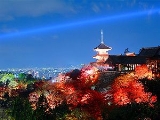
Kyotoautumn
Kyoto is located in a valley, part of the Yamashiro (or Kyoto) Basin, in the eastern part of the mountainous region known as the Tamba highlands. The Yamashiro Basin is surrounded on three sides by mountains known as Higashiyama, Kitayama and Nishiyama, with a height just above 1000 meters above sea level. This interior positioning results in hot summers and cold winters. There are three rivers in the basin, the Ujigawa to the south, the Katsuragawa
Katsura River

The is a continuation of two other rivers, the Hozu River, a small, speedy river which begins in the mountains near Kameoka and then slithers through the mountains separating Kameoka and Kyoto; and the Oi River , which emerges from those mountains and expands into a shallow, slow-flowing river until Togetsukyo Bridge in Arashiyama....
 to the west, and the Kamogawa
Kamo River

The Kamo River is a river in Kyoto, Japan. It is 31 km long and is a tributary of the Yodo River.It rises from Mount Sajikigatake in the north of Kyoto, and goes through the center of the city and then meets the Katsura River at Fushimi, Kyoto....
 to the east. Kyoto City takes up 1.9% of the land in the prefecture with an area of 827.9 km˛.

The original city was arranged in accordance with traditional Chinese
China

China is a Culture of China, an ancient civilization, and, depending on perspective, a national or multinational entity extending over a large area in East Asia....
 geomancy
Geomancy

File:Geomantic_instrument_Egypt_or_Syria_1241_1242_CE_Muhammad_ibn_Khutlukh_al_Mawsuli.jpgFile:Geomantic instrument Egypt or Syria 1241 1242 CE detail 1.jpg...
 following the model of the ancient Chinese capital of Chang'an
Chang'an

Chang'an is an ancient Capital of more than ten Dynasties in Chinese history in Chinese history. Chang'an literally means "Perpetual Peace" in Classical Chinese....
 (present-day Xi'an
Xi'an

Xi'an , is the Capital of the Shaanxi Provinces of China in the People's Republic of China and a sub-provincial city. As one of the oldest cities in Chinese history, Xi'an is one of the Historical capitals of China because it has been the capital of some of the most important Dynasties in Chinese history in Chinese history, including the Zh...
). The Imperial Palace
Heian Palace

The Heian Palace was the original imperial palace of Heian-kyo , the capital of Japan, from 794 to 1227. In Japan, this palace is called Daidairi....
 faced south, resulting in Ukyo (the right sector of the capital) being on the west while Sakyo (the left sector) is on the east. The streets in the modern-day wards of Nakagyo
Nakagyo-ku, Kyoto

is one of the eleven Wards of Kyoto in the Municipalities of Japan of Kyoto, Kyoto, in Kyoto Prefecture, Japan. Its name means "central capital ward." As of 2008, the ward has an estimated population of 102,620 people....
, Shimogyo
Shimogyo-ku, Kyoto

is one of the eleven Wards of Kyoto in the Municipalities of Japan of Kyoto, Kyoto, in Kyoto Prefecture, Japan. First established in 1879, it has been merged and split, and took on its present boundaries in 1955, with the establishment of a separate Minami-ku, Kyoto....
, and Kamigyo
Kamigyo-ku, Kyoto

is one of the eleven Wards of Kyoto in the Municipalities of Japan of Kyoto, Kyoto, in Kyoto Prefecture, Japan. Located in the center of the present-day city of Kyoto, Japan it previously occupied the northern region of the ancient capital of Kyoto....
 still follow a grid pattern.

Today, the main business district is located to the south of the old Imperial Palace
Kyoto Gosho

The is an imperial palace of Japan, though the Emperor of Japan is not in residence. The Emperor has resided at the Tokyo Imperial Palace since 1869 and ordered the preservation of the Kyoto Imperial Palace in 1877....
, with the less-populated northern area retaining a far greener feel. Surrounding areas do not follow the same grid pattern as the center of the city, though streets throughout Kyoto share the distinction of having names.

Kyoto sits atop a large natural water table that provides the city with ample freshwater wells. Due to large scale urbanization, the amount of rain draining into the table is dwindling and wells across the area are drying at an increasing rate.


Politics and government

The directly elected executive mayor in Kyoto as of 2008 is Daisaku Kadokawa, an independent supported by the Liberal Democratic Party
Liberal Democratic Party (Japan)

The , frequently abbreviated to LDP or , is a centre right, Conservatism political party and the largest party in Japan and one of the most consistently successful political parties in the democratic world....
. The legislative city assembly has 68 elected members.

Elections


  • Kyoto mayoral election, 2008


Wards

Kyotofushimiinarilarge
Kyoto has eleven wards
Wards of Japan

A ku , conventionally translated as ward is a district in a large Japanese city. Wards are used to subdivide each City designated by government ordinance , as well as Tokyo ....
. They are (colors from the map above)

  • Fushimi-ku
    Fushimi-ku, Kyoto

    is one of the eleven Wards of Kyoto in the Municipalities of Japan of Kyoto, in Kyoto Prefecture, Japan. Famous places in Fushimi include the Fushimi Inari Jinja , with thousands of torii lining the paths up and down a mountain; Fushimi Castle, originally built by Toyotomi Hideyoshi, with its rebuilt towers and gold-lined tea-room; and Teradaya...
    - orange
  • Higashiyama-ku
    Higashiyama-ku, Kyoto

    is one of the eleven Wards of Kyoto in the Municipalities of Japan of Kyoto, Kyoto, in Kyoto Prefecture, Japan. It was created in 1929 when it was split off from Shimogyo-ku, Kyoto....
    - pink
  • Kamigyo-ku
    Kamigyo-ku, Kyoto

    is one of the eleven Wards of Kyoto in the Municipalities of Japan of Kyoto, Kyoto, in Kyoto Prefecture, Japan. Located in the center of the present-day city of Kyoto, Japan it previously occupied the northern region of the ancient capital of Kyoto....
    - dark blue
  • Kita-ku
    Kita-ku, Kyoto

    is one of the eleven Wards of Kyoto in the Municipalities of Japan of Kyoto, Kyoto, in Kyoto Prefecture, Japan. Its name means "North Ward." As of 2008, the ward has an estimated population of 122,391 people....
    - light blue
  • Minami-ku
    Minami-ku, Kyoto

    is one of the eleven Wards of Kyoto in the Municipalities of Japan of Kyoto, Kyoto, in Kyoto Prefecture, Japan. Its name means "South Ward." It was established in 1955 when it was separated from Shimogyo-ku....
    - light green
  • Nakagyo-ku
    Nakagyo-ku, Kyoto

    is one of the eleven Wards of Kyoto in the Municipalities of Japan of Kyoto, Kyoto, in Kyoto Prefecture, Japan. Its name means "central capital ward." As of 2008, the ward has an estimated population of 102,620 people....
    - yellow
  • Nishikyo-ku
    Nishikyo-ku, Kyoto

    is one of the eleven Wards of Kyoto in the Municipalities of Japan of Kyoto, Kyoto, in Kyoto Prefecture, Japan. Its name means "west capital ward" and it is situated on the western edge of the city, to the south of center....
    - forest green
  • Sakyo-ku
    Sakyo-ku, Kyoto

    is one of the eleven Wards of Kyoto in the Municipalities of Japan of Kyoto, Kyoto, in Kyoto Prefecture, Japan. It was created in 1929 when it was split off from Kamigyo-ku, Kyoto....
    - olive green
  • Shimogyo-ku
    Shimogyo-ku, Kyoto

    is one of the eleven Wards of Kyoto in the Municipalities of Japan of Kyoto, Kyoto, in Kyoto Prefecture, Japan. First established in 1879, it has been merged and split, and took on its present boundaries in 1955, with the establishment of a separate Minami-ku, Kyoto....
    - red
  • Ukyo-ku
    Ukyo-ku, Kyoto

    is one of the eleven Wards of Kyoto in the cities of Japan of Kyoto, Kyoto, in Kyoto Prefecture, Japan. The word , as opposed to , refers to the western half of the ancient capital of Heiankyo ....
    - brown
  • Yamashina-ku
    Yamashina-ku, Kyoto

    is one of the eleven Wards of Kyoto in the Municipalities of Japan of Kyoto, Kyoto, in Kyoto Prefecture, Japan. It lies in the southeastern part of the city, and Yamashina Station is one stop away from Kyoto Station on the Tokaido Main Line ....
    - purple


Together, they comprise the city of Kyoto. Like other cities in Japan, Kyoto has a single mayor and a city council.

Culture

Although ravaged by wars, fires, and earthquakes during its eleven centuries as the imperial capital, Kyoto was spared from the firebombing
Firebombing

Firebombing is a bombing technique designed to damage a target, generally an urban area, through the use of fire, caused by incendiary devices, rather than from the blast effect of large bombs....
 of World War II. With its 2000 Buddhist
Buddhism

Buddhism is a family of beliefs and practices considered by most to be a religionand is based on the teachings attributed to Siddhartha Gautama, commonly known as "The Buddha" , who was born in what is today Nepal....
 temples and Shinto shrines, as well as palaces, gardens and architecture intact, it is one of the best preserved cities in Japan. Among the most famous temples in Japan are Kiyomizu-dera
Kiyomizu-dera

, full name is an independent Buddhism temple in eastern Kyoto. The temple is part of the Historic Monuments of Ancient Kyoto UNESCO World Heritage site....
, a magnificent wooden temple supported by pillars off the slope of a mountain; Kinkaku-ji
Kinkaku-ji

or "Golden Temple" is the informal name of or "Deer Garden Temple" in Kyoto, Japan. It was originally built in 1397 to serve as a retirement villa for Shogun Ashikaga Yoshimitsu, as part of his estate then known as Kitayama....
, the Temple of the Golden Pavilion; Ginkaku-ji
Ginkaku-ji

, the "Temple of the Silver Pavilion," is a Buddhist temple in the Sakyo-ku, Kyoto of Kyoto, Japan.Ashikaga Yoshimasa initiated plans for creating a retirement villa and gardens as early as 1460; and after his death, Yoshimasa would arrange for this property to become a Buddhist temple....
, the Temple of the Silver Pavilion; and Ryoan-ji
Ryoan-ji

is a Zen temple located in northwest Kyoto, Japan. Belonging to the Myoshin-ji school of the Rinzai branch of Zen Buddhism, the temple is one of the Historic Monuments of Ancient Kyoto, a UNESCO World Heritage Site....
, famous for its rock garden. The Heian Jingu
Heian Jingu

The is a Jinja located in Kyoto, Kyoto, Japan. The torii before the main gate is one of the largest in Japan, and the main building, or shaden , is designed to imitate the Kyoto Imperial Palace on a three-fourth scale....
 is a Shinto shrine, built in 1895, celebrating the Imperial family and commemorating the first and last emperors to reside in Kyoto. Three special sites have connections to the imperial family: the Kyoto Gyoen area including the Kyoto Imperial Palace
Kyoto Gosho

The is an imperial palace of Japan, though the Emperor of Japan is not in residence. The Emperor has resided at the Tokyo Imperial Palace since 1869 and ordered the preservation of the Kyoto Imperial Palace in 1877....
 and Sento Imperial Palace
Sento Imperial Palace

The Sento Imperial Palace or Sento-gosho is a large garden in Kyoto, Japan, formerly the grounds of a palace for retired emperors . It is administered by the Imperial Household Agency and may be visited by appointment....
, homes of the Emperors of Japan
List of Emperors of Japan

The following is a traditional list of Emperor of Japan. Dates for the first 28 emperors, and especially the first 16, are based on the Japanese era name system....
 for many centuries; Katsura Imperial Villa
Katsura Imperial Villa

The , or Katsura Detached Palace, is a villa with associated gardens and outbuildings in the western suburbs of Kyoto, Japan . It is one of Japan's most important large-scale cultural treasures....
, one of the nation's finest architectural treasures; and Shugaku-in Imperial Villa
Shugaku-in Imperial Villa

The , or Shugaku-in Detached Palace, is a set of gardens and outbuildings in the hills of the eastern suburbs of Kyoto, Japan . It is one of Japan's most important large-scale cultural treasures; its gardens are one of the great masterpieces of Japanese gardening....
, one of its best Japanese gardens.

Other notable sites in Kyoto include Arashiyama
Arashiyama

is a district on the western outskirts of Kyoto, Japan. It also refers to the mountain across the Katsura River, which forms a backdrop to the district....
 and its picturesque lake, the Gion
Gion

Gion is a district of Kyoto, Japan, originally developed in the Middle Ages, in front of Yasaka Shrine. The district was built to accommodate the needs of travelers and visitors to the shrine....
 and Pontocho
Pontocho

Pontocho is a district in Kyoto, Japan, known for geisha and home to many geisha houses and traditional tea houses. Like Gion, Pontocho is famous for the preservation of forms of traditional architecture and entertainment....
 geisha
Geisha

, or are traditional, female Japanese entertainers, whose skills include performing various Japanese arts, such as classical music and dance....
 quarters, the Philosopher's Walk
Philosopher's Walk

The follows a cherry tree-lined canal in Kyoto, between Ginkaku-ji and Nyakuōji-jinja. The route is so-named because a Kyoto University philosophy professor, Nishida Kitaro, is thought to have used it for daily meditation....
, and the canals which line some of the older streets.
Geisha Kyoto 2004 11 21
Japanese Buddhist Monk By Arashiyama Cut
The "Historic Monuments of Ancient Kyoto
Historic Monuments of Ancient Kyoto

The UNESCO World Heritage Site Historic Monuments of Ancient Kyoto encompasses 17 locations in Japan. The locations are in three cities: Kyoto and Uji, Kyoto in Kyoto Prefecture and Otsu, Shiga in Shiga Prefecture....
" are listed by the UNESCO
UNESCO

United Nations Educational, Scientific and Cultural Organization is a specialized agency of the United Nations established on 16 November 1945....
 as a World Heritage Site
World Heritage Site

A UNESCO World Heritage Site is a site that is on the list maintained by the international World Heritage Programme administered by the UNESCO World Heritage Committee, composed of 21 Sovereign state which are elected by their General Assembly for a four-year term....
. These include the Kamo Shrine
Kamo Shrine

File:Kamo-wakeikazuchi-jinja31ss4272.jpgThe Kamo Shrines, ' and ' are a pair of Shinto Jinja which were formerly located outside Kyoto, Kyoto, but in the 20th century they came to be incorporated within the expanded boundaries of the ancient capital city....
s (Kami and Shimo), Kyo-o-Gokokuji
To-ji

is a Buddhist temple of the Shingon sect in Kyoto, Japan. Its name means East Temple, and it once had a partner, Sai-ji . They stood alongside the Rashomon Gate, the gate to the Heian capital....
 (To-ji), Kiyomizu-dera
Kiyomizu-dera

, full name is an independent Buddhism temple in eastern Kyoto. The temple is part of the Historic Monuments of Ancient Kyoto UNESCO World Heritage site....
, Daigo-ji
Daigo-ji

is a Shingon Buddhism temple in Fushimi-ku, Kyoto, Kyoto, Japan. The main image is Bhaisajyaguru....
, Ninna-ji
Ninna-ji

is a large Omuro-ha Shingon Buddhist temple complex in western Kyoto, Japan, founded in AD 888 by the retired Emperor Uda. It is part of the "Historic Monuments of Ancient Kyoto", a UNESCO World Heritage Site....
, Saiho-ji
Saiho-ji

is a Rinzai school Zen temple located in Matsuo, Nishikyo Ward, Kyoto, Japan. The temple, which is famed for its moss garden, is commonly referred to as , meaning "moss temple", and is also known as ....
 (Kokedera), Tenryu-ji
Tenryu-ji

?more formally known as ?is the head temple of the Tenryu sect of Rinzai Zen Buddhism, located in Susukinobaba-cho, Ukyo Ward, Kyoto, Japan. The temple was founded by Ashikaga Takauji in 1339, primarily to venerate Gautama Buddha, and its first chief priest was Muso Soseki....
, Rokuon-ji
Kinkaku-ji

or "Golden Temple" is the informal name of or "Deer Garden Temple" in Kyoto, Japan. It was originally built in 1397 to serve as a retirement villa for Shogun Ashikaga Yoshimitsu, as part of his estate then known as Kitayama....
 (Kinkaku-ji), Jisho-ji
Ginkaku-ji

, the "Temple of the Silver Pavilion," is a Buddhist temple in the Sakyo-ku, Kyoto of Kyoto, Japan.Ashikaga Yoshimasa initiated plans for creating a retirement villa and gardens as early as 1460; and after his death, Yoshimasa would arrange for this property to become a Buddhist temple....
 (Ginkaku-ji), Ryoan-ji
Ryoan-ji

is a Zen temple located in northwest Kyoto, Japan. Belonging to the Myoshin-ji school of the Rinzai branch of Zen Buddhism, the temple is one of the Historic Monuments of Ancient Kyoto, a UNESCO World Heritage Site....
, Hongan-ji
Hongan-ji

, also archaically romanized as Hongwanji, is the collective name of the largest school of Jodo Shinshu Buddhism . 'Hongan-ji' may also refer to any one of several actual temple buildings associated with the sect....
, Kozan-ji
Kozan-ji

, or , is an Omuro Buddhist temple located in Ume-ga-hata Toganoo-cho, Ukyo Ward, Kyoto, Japan. The temple was founded by famous monk Myoe and is renowned for its numerous national treasures and important cultural properties, in particular the famous picture scroll called Choju-giga....
 and the Nijo Castle
Nijo Castle

is a flatland castle located in Kyoto, Japan. The castle consists of two concentric rings of fortifications, the Ninomaru Palace, the ruins of the Honmaru Palace, various support buildings and several gardens....
, primarily built by the Tokugawa shoguns
Tokugawa shogunate

The Tokugawa shogunate, also known as the , and the , was a feudalism regime of Japan established by Tokugawa Ieyasu and ruled by the shoguns of the Tokugawa family....
. Other sites outside the city are also on the list.

Kyoto is renowned for its abundance of delicious Japanese foods and cuisine. The special circumstances of Kyoto as a city away from the sea and home to many Buddhist temples resulted in the development of a variety of vegetables peculiar to the Kyoto area (kyoyasai ???).

Japan's television and film industry has its center in Kyoto. Many jidaigeki
Jidaigeki

is a genre of film, television, and theatre in Japan. The name means "period drama", and the period is usually the Edo period of History of Japan, from 1603 to 1868....
, action films featuring samurai, were shot at Toei Uzumasa Eigamura. A film set and theme park in one, Eigamura features replicas of traditional Japanese buildings which are used for jidaigeki. Among the sets are a replica of the old Nihonbashi
Nihonbashi

, or Nihombashi, is a business district of Chuo, Tokyo, Japan which grew up around the bridge of the same name which has linked two sides of the Nihonbashi River at this site since the 17th century....
 (the bridge at the entry to Edo
Edo

, literally: Headlands and bays-door, "estuary", ), also Romanization of Japanese as Yedo or Yeddo, is the Geographical renaming of the Capital of Japan Tokyo, and was the seat of power for the Tokugawa shogunate which ruled Japan from 1603 to 1868....
), a traditional courthouse, a Meiji Period police box
Koban (police box)

A koban is a type of police box found in Japan, and southwestern China . In addition to central police stations, Japanese uniformed police work is done from small buildings located within the community, a form of community policing....
 and part of the former Yoshiwara
Yoshiwara

Yoshiwara was a famous Akasen district in Edo, present-day Tokyo, Japan.In the early 17th century, there was widespread male and female prostitution throughout the cities of Kyoto, Edo, and Osaka....
 red-light district. Actual film shooting takes place occasionally, and visitors are welcome to observe the action.

Kyoto International Manga Museum

The is located in Nakagyo-ku, Kyoto, Kyoto, Japan. The building housing the museum is the former Tatsuike Elementary School. The museum opened on November 25, 2006....
 is also situated in Kyoto. For an entrance fee visitors are able to view exhibitions and read as much manga
Manga

, , are comics and print cartoons , in the Japanese language and conforming to the style developed in Japan in the late 20th century. In their modern form, manga date from shortly after World War II, but they have a long, complex pre-history in earlier Japanese art....
 as they desire. It is trying to acquire every manga ever published and so far houses approximately 200,000 titles.


Economy

Nintendo Office
Tourism
Tourism

Tourism is travel for recreational or leisure purposes. The World Tourism Organization defines tourists as people who "travel to and stay in places outside their usual environment for not more than one consecutive year for leisure, business and other purposes not related to the exercise of an activity remunerated from...
 forms a large base of Kyoto's economy. The city's cultural heritages are constantly visited by school groups from across Japan, and many foreign tourists also stop in Kyoto. In 2007, the city government announced that a record number of tourists had visited Kyoto for the sixth year in a row , and it was chosen as the second most beautiful city in Japan, in a regional brand survey.

The city's industry consists mainly of small plants, most of which are run by artisans who produce traditional Japanese crafts
Japanese handicrafts

The many and varied traditional handicrafts of Japan are officially recognised and protected and, owing to the Folk art, are much in demand. Some enjoy status as a meibutsu or regional specialty....
. Kyoto's kimono
Kimono

The is the national costume of Japan. Originally the word "kimono" literally meant "thing to wear" but now has come to denote a particular type of traditional full-length Japanese garment....
 weavers are particularly renowned, and the city remains the premier center of kimono manufacturing. Such businesses, vibrant in past centuries, have declined in recent years as sales of traditional goods stagnate.

Kyoto's only sizable heavy industry is electronics: the city is home to the headquarters of Nintendo
Nintendo

is a global company located in Kyoto, Japan founded on September 23, 1889 by Fusajiro Yamauchi to produce handmade hanafuda cards. By 1963, the company had tried several small niche businesses, such as a cab company and a love hotel....
, OMRON
OMRON

is a Japan electronics company based in Kyoto, Kyoto.Omron was established by Kazuma Tateishi in 1933 and incorporated in 1948. Omron's primary business is the manufacture and sale of automation components, equipment and systems, but it is generally known for medical equipment such as digital medical thermometers, sphygmomanometers and nebuli...
, Kyocera
Kyocera

is a Japanese company based in Kyoto, Kyoto, Japan. The company was founded as in 1959 by Kazuo Inamori. It manufactures ceramics and printing-related devices, as well as a comprehensive line of imaging products....
, and Murata Machinery
Murata Machinery

, abbrev. MML, is a privately held Japanese multinational corporation founded in 1935 with its Head Office at Fushimi-ku, Kyoto.In 1972 at the dawn of modern telecommunication, MML began distributing fax and copier machines in Japan under an agreement with Graphic Science, inc....
. The apparel giant Wacoal
Wacoal

is a worldwide lingerie manufacturer and marketer headquartered in Kyoto, Japan. It is a subsidiary wholly owned by .Wako Shoji was founded by Koichi Tsukamoto in 1946....
 also operates in Kyoto. However, the growth of high-tech industry has not outpaced the decline in traditional industry, and as a result, Kyoto's total output has declined relative to other cities in Japan.

Colleges and universities

Campusplaza Kyoto Jpn
Home to thirty-seven institutions of higher education, Kyoto is one of the academic centers of the country. Kyoto University
Kyoto University

, or is a major Japanese national university in Kyoto, Japan. It is the second oldest university in Japan, and formerly one of the Imperial university of Japan....
, one of Japan's national universities
Japanese national university

As of 2007, there are 87 in Japan, while there are 89 public universities and 568 private universities. National universities, especially former imperial universities, tend to be held in higher regards in higher education in Japan than private or public universities....
, is considered to be one of the top universities in Japan, with several Nobel laureates, for example Yukawa Hideki. The Kyoto Institute of Technology
Kyoto Institute of Technology

The in Sakyo-ku, Kyoto, Japan is one of the Japanese national university. Established in 1949, its nickname is Kosen . Together with Shinshu University and Tokyo University of Agriculture and Technology, it is one of Japan's Three Textile Universities....
 is also among the most famous universities in Japan, and is considered to be one of the best universities for architecture and design in the country.

Kyoto also has a unique higher education network called the Consortium of Universities in Kyoto, which consists of three national, five public (prefectural and municipal), and 41 private universities, as well as the city and four other organizations. The consortium does not offer a degree, but offers the courses as part of a degree at participating universities.

As well as more than 30 Japanese universities and colleges, American universities also find the city as an important city of education and research. Kyoto Consortium for Japanese Studies
Kyoto Consortium for Japanese Studies

The , or KCJS, is a study abroad program founded in 1989 and currently housed at Kyoto University in Kyoto, Japan. Operated by a consortium of universities, the program is centered on advanced Japanese language training combined with English-language coursework for college credit....
 (KCJS) is a consortium of 14 American universities that sponsors a rigorous, two-semester academic program for undergraduates who wish to do advanced work in Japanese language and cultural studies. In addition, Stanford University
Stanford University

Leland Stanford Junior University, commonly referred to as Stanford University or Stanford, is a private university research university located in Stanford, California, California, United States....
 has its own Japan Center in Kyoto.

Transportation

Kyoto Station
Jr West Type 281
Kyoto Station
Kyoto Station

is the most important transportation hub in Kyoto, Japan. It has Japan's second-largest train station building and is one of the country's largest buildings, incorporating a shopping mall, hotel, movie theater, Isetan department store, and several local government facilities under one 15-story roof....
 is the center for transportation in the city. The second-largest in Japan, it houses a shopping mall, hotel, movie theater, Isetan
Isetan

is a Japan depato. Based in Shinjuku, Tokyo, Tokyo, Isetan has branches throughout Japan and East Asia, including Bangkok, Jinan, Kaohsiung, Kuala Lumpur, Shanghai, Singapore and Tianjin and formerly in Hong Kong, London and Vienna....
 department store, and several local government facilities under one fifteen-story roof. The Tokaido Shinkansen
Tokaido Shinkansen

is a Japanese high-speed Shinkansen line, opened in 1964 between Tokyo Station and Shin-Osaka Station. It is operated by the Central Japan Railway Company , and formerly by JNR, Japan National Railways....
 Line (see below) as well as all local rail lines connect here. Buses operating on routes within the city, the region, and the nation stop here as well.

There are also frequent services on JR West
West Japan Railway Company

, also referred to as , is one of the Japan Railways Group companies and operates in western Honshu....
, Keihan
Keihan Electric Railway

is a Japanese railway operator in Osaka Prefecture, Kyoto Prefecture, and Shiga Prefecture Prefectures. It is known as , or ....
, Hankyu
Hankyu Railway

Hankyu Railway is a Japanese private railway that provides commuter and interurban service to the northern Kansai region. Its main terminal is at Umeda Station in Osaka....
, Kintetsu
Kintetsu

, named Kinki Nippon Railway Co., Ltd. in English until June 27, 2003, is a Japanese rail transit corporation commonly known as . It is the largest private railway in Japan....
, and other rail networks to other cities in the Kansai
Kansai

The or the lies in the southern-central region of Japan's main island Honshu. The region includes the prefectures of Nara Prefecture, Wakayama Prefecture, Kyoto Prefecture, Osaka Prefecture, Hyogo Prefecture, and Shiga Prefecture....
 region. JR West and Kintetsu connect at Kyoto Station. Hankyu has a terminal at the intersection of Shijo Kawaramachi, Kyoto's most thriving shopping and amusement district. Keihan has a terminal at Sanjo Keihan Station
Sanjo Keihan Station

Sanjo Keihan Station is a Rapid transit station on Kyoto's Tozai Line . It intersects with the Keihan Electric Railway's Keihan Main Line, and is connected to the adjacent Sanjo Station ....
 which is not far from Shijo Kawaramachi.

The Kyoto Municipal Transportation Bureau
Kyoto Municipal Transportation Bureau

operates municipal subways and city buses in Kyoto, Japan.*Kyoto Municipal Subway**Karasuma Line**Tozai Line *City Bus...
 operates Kyoto's subway and bus system. The city operates two subway lines: Karasuma Line
Karasuma Line

The is one of two lines of Kyoto Municipal Subway. It runs from south to north. Kyoto Municipal Transportation Bureau, the operator of the Karasuma Line, and Kintetsu jointly operate the through services from the Karasuma Line to the Kintetsu Kyoto Line to Kintetsu Nara Station in Nara, Nara....
 and Tozai Line
Tozai Line (Kyoto)

The is a Kyoto Municipal Subway line that runs from the southeastern area of the city , then east to west through the Kyoto, Kyoto downtown area. The Kyoto Municipal Transportation Bureau operates the system along with the Karasuma Line and the City Bus....
. The Karasuma Line runs beneath north-south Karasuma Street and links to Hankyu trains running beneath Shijo Street
Shijo Street

runs center of Kyoto, Japan east to west through the commercial center of the city. Shijo literally means fourth street of Heian-kyo, the ancient capital....
 at the intersection of Shijo Karasuma, Kyoto's central business district
Central business district

A central business district is the commercial and often geographic heart of a city. In Australia, China , Republic of Ireland, Kenya, New Zealand, Philippines, Singapore and South Africa, the phrase is commonly used, and is often colloquially abbreviated to "CBD"....
, to the west of Shijo Kawaramachi. The Tozai Line runs beneath east-west Oike Street and connects to Keihan at Sanjo Keihan and to JR at Nijo Station
Nijo Station

Nijo Station may refer to either of the following railway stations in Japan:* Nijo Station on the Sanin Main Line and the Kyoto Subway Tozai Line in Nakagyo-ku, Kyoto...
. The two subway lines meet at Karasuma Oike Station
Karasuma Oike Station

is a train station on the Kyoto Municipal Subway Karasuma Line and Tozai Line in Nakagyo-ku, Kyoto, Kyoto, Japan....
.

Access to Kyoto


From Kansai Airport and Itami Airport in Osaka
Although Kyoto does not have its own airport, you can get to the city via Kansai International Airport
Kansai International Airport

is an international airport located on an artificial island in the middle of Osaka Bay, off the shore of the cities of Sennan, Osaka and Izumisano, Osaka and the town of Tajiri, Osaka in Osaka Prefecture, Japan....
 and Itami Airport in Osaka
Osaka Prefecture

is a Prefectures of Japan located in the Kinki region on Honshu, the main island of Japan. The capital is the city of Osaka, Osaka. It is the center of Osaka-Kobe-Kyoto area....
. The Haruka Express operated by JR West carries passengers from Kansai Airport to Kyoto Station
Kyoto Station

is the most important transportation hub in Kyoto, Japan. It has Japan's second-largest train station building and is one of the country's largest buildings, incorporating a shopping mall, hotel, movie theater, Isetan department store, and several local government facilities under one 15-story roof....
 in 73 minutes.


Osaka Airport Transport buses connect Itami Airport and Kyoto Station Hachijo Exit in an hour and cost 1,280 yen for a one-way trip. Some buses go further, make stops at major hotels and intersections in downtown, and get to Nijo Station
Nijo Station (Kyoto)

is a train station in Nakagyo-ku, Kyoto, Kyoto, Japan....
 or the Westin Miyako Hotel Kyoto near Keage Station
Keage Station

is a train station on the Kyoto Municipal Subway Tozai Line in Higashiyama-ku, Kyoto, Kyoto, Japan.This is the closest subway station to Eikan-do Zenrin-ji....
 of Municipal Subway Tozai Line
Tozai Line (Kyoto)

The is a Kyoto Municipal Subway line that runs from the southeastern area of the city , then east to west through the Kyoto, Kyoto downtown area. The Kyoto Municipal Transportation Bureau operates the system along with the Karasuma Line and the City Bus....
.


Tokaido-San'yo Shinkansen
The Tokaido Shinkansen
Tokaido Shinkansen

is a Japanese high-speed Shinkansen line, opened in 1964 between Tokyo Station and Shin-Osaka Station. It is operated by the Central Japan Railway Company , and formerly by JNR, Japan National Railways....
 operated by JR Central provides passenger rail service linking Kyoto with Nagoya
Nagoya, Aichi

is the List of Japanese cities by population and the fourth most populous urban area in Japan.Located on the Pacific coast in the Chubu region on central Honshu, it is the Capital of Aichi Prefecture and is one of Japan's major seaports along with those of Tokyo, Osaka, Kobe, Yokohama, Chiba, Chiba, and Hakata-ku, Fukuoka....
, Yokohama
Yokohama

is the capital city of Kanagawa Prefecture. It lies on Tokyo Bay, south of Tokyo, in the Kanto region of the main island of Honshu. It is a major commercial hub of the Greater Tokyo Area....
 and Tokyo
Tokyo

, officially , is one of the 47 prefectures of Japan of Japan and located on the eastern side of the main island Honshu. The twenty-three special wards of Tokyo, each governed as a city, cover the area that was once the Tokyo City in the eastern part of the prefecture, and total over 8 million people....
 to the east of Kyoto and with nearby Osaka
Osaka

is a Cities of Japan in Japan, located at the mouth of the Yodo River on Osaka Bay, in the Kansai region of the main island of Honshu.Osaka is a City designated by government ordinance under the Local Autonomy Law and the capital city of Osaka Prefecture....
 and points west on the San'yo Shinkansen, such as Kobe
Kobe

is the List of Japanese cities by population in Japan and as the capital city of Hyogo Prefecture and a prominent port city in Japan with a population of about 1.5 million....
, Okayama, Hiroshima
Hiroshima

The Japanese city of is the capital of Hiroshima Prefecture, and the largest city in the Chugoku region of western Honshu, the largest of Japan's islands....
, Kitakyushu and Fukuoka
Fukuoka, Fukuoka

is the capital cities of Japan of Fukuoka Prefecture and is situated on the northern shore of the island of Kyushu in Japan, across the Korea Strait from South Korea Busan....
. The trip from Tokyo takes about two hours and twenty-two minutes. From Hakata
Hakata Station

Hakata Station is the main railway terminal of the city of Fukuoka, Fukuoka, Japan. It is the largest and busiest station on Kyushu, and is a gateway to other cities in Kyushu for travellers from Honshu....
 in Fukuoka, Nozomi
Nozomi (Shinkansen)

is the fastest train service running on the Tokaido Shinkansen/Sanyo Shinkansen Shinkansen. Along the stretch between Shin-Kobe Station and Hakata station, Nozomi services using 500 series and N700 series equipment reach speeds of 300 km/h ....
 takes you to Kyoto in just over three hours. All trains including Nozomi
Nozomi (Shinkansen)

is the fastest train service running on the Tokaido Shinkansen/Sanyo Shinkansen Shinkansen. Along the stretch between Shin-Kobe Station and Hakata station, Nozomi services using 500 series and N700 series equipment reach speeds of 300 km/h ....
 stop at Kyoto Station, serving as a gateway to not only Kyoto Prefecture
Kyoto Prefecture

is a Prefectures of Japan of Japan located in the Kinki region of the island of Honshu. The capital is the city of Kyoto....
 but also northeast Osaka
Osaka Prefecture

is a Prefectures of Japan located in the Kinki region on Honshu, the main island of Japan. The capital is the city of Osaka, Osaka. It is the center of Osaka-Kobe-Kyoto area....
, south Shiga
Shiga Prefecture

is a Prefectures of Japan of Japan which is part of the Kansai region on Honshu Island. The capital is the city of Otsu, Shiga....
 and north Nara
Nara Prefecture

is a Prefectures of Japan in the Kansai region on Honshu Island, Japan. The capital is the city of Nara, Nara....
.

Buses


Kyoto's municipal bus network
Kyoto Municipal Transportation Bureau

operates municipal subways and city buses in Kyoto, Japan.*Kyoto Municipal Subway**Karasuma Line**Tozai Line *City Bus...
 is extensive. Private carriers also operate within the city. Many tourists join commuters on the public buses, or take taxis or tour buses. Kyoto's buses have announcements in English and electronic signs with stops written in the Latin alphabet.

Most city buses have a fixed fare, but a one-day bus pass and a combined unlimited train and bus pass are also available. These are especially useful for visiting many different points of interest within Kyoto. The bus information center just outside the central station handles tickets and passes. The municipal transport company publishes a very useful leaflet called "Bus Navi." It contains a route map for the bus lines to most sights and fare information. This too is available at the information center in front of the main station.

In addition to Kyoto Station
Kyoto Station

is the most important transportation hub in Kyoto, Japan. It has Japan's second-largest train station building and is one of the country's largest buildings, incorporating a shopping mall, hotel, movie theater, Isetan department store, and several local government facilities under one 15-story roof....
, you can transfer buses at the intersections of Shijo Kawaramachi and Sanjo Keihan
Sanjo Keihan Station

Sanjo Keihan Station is a Rapid transit station on Kyoto's Tozai Line . It intersects with the Keihan Electric Railway's Keihan Main Line, and is connected to the adjacent Sanjo Station ....
. The intersection of Karasuma Kitaoji
Kitaoji Station

is a train station on the Kyoto Municipal Subway Karasuma Line in Kita-ku, Kyoto, Kyoto, Japan....
 to the north of downtown has a major bus terminal serving passengers who take the Karasuma Line
Karasuma Line

The is one of two lines of Kyoto Municipal Subway. It runs from south to north. Kyoto Municipal Transportation Bureau, the operator of the Karasuma Line, and Kintetsu jointly operate the through services from the Karasuma Line to the Kintetsu Kyoto Line to Kintetsu Nara Station in Nara, Nara....
 running beneath Karasuma Street, Kyoto's main north-south street.

Cycling


Cycling
Cycling

Cycling is the use of bicycles, or - less commonly - unicycles, tricycles, Quadracycle s and other similar wheeled human powered vehicles as a means of transport, a form of recreation or a sport....
 forms a very important form of personal transportation in the city, to an extent that bicycle culture
Bicycle culture

Bicycle culture is a phrase with two related, but different meanings. It can be used for countries with a culture that supports, encourages, and has high bicycle usage....
 forms a part of Kyoto's urban identity. The geography and scale of the city are such that the city may be easily navigated on a bicycle.

Tourism


The UNESCO World Heritage Site


About 20% of Japan's National Treasures and 14% of Important Cultural Properties exist in the city proper. The UNESCO World Heritage Site
Historic Monuments of Ancient Kyoto (Kyoto, Uji and Otsu Cities) includes 17 locations in Kyoto, Uji in Kyoto Prefecture and Otsu in Shiga Prefecture. The site has been designated as World Heritage in 1994.

Iwatayama monkey park


in Nishikyo-ku
Nishikyo-ku, Kyoto

is one of the eleven Wards of Kyoto in the Municipalities of Japan of Kyoto, Kyoto, in Kyoto Prefecture, Japan. Its name means "west capital ward" and it is situated on the western edge of the city, to the south of center....
 is a park where monkeys roam freely. The park itself is inhabited by a troupe of over 170 Japanese macaque
Japanese Macaque

The Japanese Macaque , also known as the Snow Monkey, is a terrestrial Old World monkey species native to Japan, although an introduced free-ranging population has been living near Laredo, Texas since 1972....
 monkeys. After paying admission, one walks up a steep hill, at the top of which is an enclosure where visitors may go in and safely feed the monkeys. As there are no fences, the monkeys can come and go as they please, but they are especially tempted by food such as apples or peanuts. Even though the animals are wild, they have become accustomed to humans, and so are not afraid to come close to tourists bearing food.

Museums and Gardens


Kyoto National Museum
  • Umekoji Steam Locomotive Museum (?????????)
  • Onishi Seiwemon Museum (?????????)
  • Kitamura Museum
  • The Kyoto Arashiyama Orgel Museum (????????????)
  • Kyoto City Heiankyo Sosei-Kan Museum (?????????)
  • Kyoto Municipal Museum of Art
    Kyoto Municipal Museum of Art

    The Kyoto Municipal Museum of Art is an art museum in the city of Kyoto which opened in 1933. It was conceived in 1928 as a commemoration of the Emperor Hirohito's coronation ceremony, and it was initially called the Showa Imperial Coronation Art Museum of Kyoto....
  • Kyoto City Archaeological Museum (????????)
  • Kyoto Art Center (????????)
  • The Kyoto International Manga Museum
    Kyoto International Manga Museum

    The is located in Nakagyo-ku, Kyoto, Kyoto, Japan. The building housing the museum is the former Tatsuike Elementary School. The museum opened on November 25, 2006....
     (?????????????)
  • The National Museum of Modern Art, Kyoto
    National Museum of Modern Art, Kyoto

    is an art museum in Kyoto, Japan.This Kyoto museum is also known by the English acronym MOMAK ....
     (?????????)
  • The Kyoto National Museum
    Kyoto National Museum

    The is one of the three formerly imperially-mandated art museums in Japan. The museum is located in Higashiyama Ward in Kyoto. The collections of the Kyoto National Museum focus on pre-modern Japanese and Asian art....
     (???????)
  • The Kyoto University Museum (?????????)
  • Kyoto Museum of Traditional Crafts (???????????)
  • The Museum of Kyoto (??????????)
  • The Kyoto Botanical Garden
    Kyoto Botanical Garden

    The Kyoto Botanical Garden , also known as the Kyoto Prefectural Botanical Garden, is a major botanical garden with conservatory located next to the Kamo River, Hangi-cho Simogamo, Sakyo-ku, Kyoto, Kyoto, Kyoto, Japan....
     (???????)
  • Garden of Fine Arts, Kyoto (??????????)
  • Kyoto Prefectural Insho-Domoto Museum of Fire Arts (???????????)
  • Koryo Museum of Art
  • Joutenkaku Museum
  • Sen-oku Hakuko Kan
  • Toei Movie Land (???????)
  • Nomura Art Museum
  • Namikawa Cloisonne Museum of Kyoto (?????????)
  • The Yurinkan Museum (????????)
  • The Tin Toy Museum (???????????)
  • The Hosomi Museum
  • Hakusasonso Hashimoto Kansetsu Memorial Museum and Garden (???? ???????)
  • The Raku Museum
  • Kyoto Museum for World Peace
    Kyoto Museum for World Peace

    The is part of Ritsumeikan University in Kita-ku, Kyoto, Kyoto, Japan. The Museum is accessible to the public for a 400-600 Yen fee. The displays and materials are mostly in Japanese but there is a 25 page English booklet describing the exhibits....
     of Ritsumeikan University
    Ritsumeikan University

    is a private university in Kyoto, Japan. With the Kinugasa Campus, the university also has a satellite campus called Biwako-Kusatsu Campus in Kusatsu, Shiga, Shiga Prefecture, and an internationalized Ritsumeikan Asia Pacific University in Beppu, Oita Prefecture....
     (???????????????)


Festivals

Major festivals punctuate Kyoto's calendar. The first is the Aoi Matsuri
Aoi Matsuri

The is celebrated on May 15 and is one of the three main annual Japanese festivals held in Kyoto, Japan.Aoi Matsuri dates back to the 7th century....
 on May 15. Two months later (July 14 to 17) is the Gion Matsuri
Gion Matsuri

The takes place annually in Kyoto and is one of the most famous festivals in Japan. It spans the entire month of July and is crowned by a parade, the on July 17....
, culminating in a massive parade. Kyoto marks the Bon Festival
Bon Festival

or just is a Japanese Buddhism custom to honor the departed spirits of one's ancestors. This Buddhist custom has evolved into a family reunion holiday during which people return to ancestral family places and visit and clean their ancestors' graves, and when the spirits of ancestors are supposed to revisit the household altars....
 with the Gozan Okuribi, lighting fires on mountains to guide the spirits home (August 16). The October 22 Jidai Matsuri
Jidai Matsuri

The is a traditional Japanese festival held on October 22 annually in Kyoto, Japan. It is one of Kyoto's renowned three great festivals, with the other two being the Aoi Matsuri, held annually on May 15, and the Gion Matsuri, which is held annually from 17 to July 24....
, Festival of the Ages, celebrates Kyoto's illustrious past.

Sports


Football

In football
Football (soccer)

Association football, more commonly known as football or soccer, is a team sport played between two teams of eleven players, and is widely considered to be the most popular sport in the world....
 (soccer), Kyoto is represented by Kyoto Sanga F.C. who rose to J. League
J. League

The , or , is the top professional football league in Japan and one of the most successful leagues in Asian club football. Currently, J. League Division 1 and 2 are the first and second levels of the Japanese football league system....
's Division 1 in 2005. Kyoto Sanga has a long history as an amateur non-company club, although it was only with the advent of professionalization that it was able to compete in the Japanese top division.

Amateur football clubs such as F.C. Kyoto BAMB 1993 and Kyoto Shiko Club (both breakaway factions of the original Kyoto Shiko club that became Kyoto Sanga) as well as unrelated AS Laranja Kyoto compete in the regional Kansai football league.

Baseball

With the popularity of the nearby Hanshin Tigers
Hanshin Tigers

The are a Nippon Professional Baseball team based in Koshien, Nishinomiya, Hyogo, Hyogo Prefecture, Japan, and are in the Central League. Hanshin Electric Railway Co., Ltd., the subsidiary of Hankyu Hanshin Holdings Inc., owns the Hanshin Tigers directly....
, Kyoto has never had a team in Nippon Professional Baseball, though the Tigers play several neutral-site games at Kyoto's Nishikyogoku Athletic Stadium
Nishikyogoku Athletic Stadium

, or is a multi-use stadium in Ukyo-ku, Kyoto, Kyoto, Japan.It is currently used mostly for football matches and is the home stadium of J. League club Kyoto Sanga F.C....
 every year.

Additionally, Kyoto's high school baseball teams are strong, with Heian and Toba in particular making strong showings recently at the annual tournament
High school baseball in Japan

In Japan, high school baseball generally refers to the 2 annual baseball tournaments played by high schools nationwide culminating at a final showdown at Koshien Stadium in Nishinomiya, Japan....
 held in Koshien Stadium
Koshien Stadium

is a baseball park located near Kobe, Hyogo in Nishinomiya, Hyogo Prefecture, Japan. The stadium was built to host the High school baseball in Japan, and opened on April 1, 1924....
, Nishinomiya
Nishinomiya, Hyogo

is a cities of Japan located in Hyogo Prefecture, Japan, between the cities of Osaka and Kobe. On April 1, 2005, the city of Nishinomiya celebrated its 80th anniversary....
, near Osaka.

Sister cities


Boston
Boston, Massachusetts

Boston is the State capital and largest city of the Commonwealth of Massachusetts, and is one of the oldest cities in the United States. The largest city in New England, Boston is considered the economic and cultural center of the region, and is sometimes regarded as the unofficial "Capital of New England." Boston city proper had a 2007 est...
, United States
United States

The United States of America is a Federal government constitutional republic comprising U.S. state and a federal district. The country is situated mostly in central North America, where its Contiguous United States and Washington, D.C., the Capital districts and territories, lie between the Pacific Ocean and Atlantic Oceans, Borders of the U...
Paris
Paris

Paris is the Capital of France and the country's largest city. It is situated on the river Seine, in northern France, at the heart of the ?le-de-France Regions of France ....
, France
France

France , officially the French Republic , is a country whose Metropolitan France is located in Western Europe and that also comprises various Overseas departments and territories of France....
 (Friendship Pledge city) Cologne
Cologne

Cologne is Germany's fourth-largest city , and is the largest city both in the German Federal State of North Rhine-Westphalia and within the Rhine-Ruhr, one of the major European metropolitan areas with more than ten million inhabitants....
, Germany
Germany

Germany , officially the Federal Republic of Germany , is a country in Central Europe. It is bordered to the north by the North Sea, Denmark, and the Baltic Sea; to the east by Poland and the Czech Republic; to the south by Austria and Switzerland; and to the west by France, Luxembourg, Belgium, and the Netherlands....
Prague
Prague

Prague is the Capital and World's largest cities of the Czech Republic. Its official name is Hlavn? mesto Praha, meaning Prague, the Capital City....
, Czech Republic
Czech Republic

The Czech Republic , is a landlocked country in Central Europe. The country borders Poland to the northeast, Germany to the west, Austria to the south and Slovakia to the east....
Florence
Florence

Florence is the Capital city of the Italy Regions of Italy of Tuscany and of the provinces of Italy Province of Florence. It is the most populous city in Tuscany and has a population of 364,779 ....
, Italy
Italy

Italy , officially the Italian Republic , is a country located on the Italian Peninsula in Southern Europe and on the two largest islands in the Mediterranean Sea, Sicily and Sardinia....
Kiev
Kiev

Kiev, also known as Kyiv , is the Capital and the largest city of Ukraine, located in the north central part of the country on the Dnieper River....
, Ukraine
Ukraine

Ukraine is a country in Eastern Europe. It is bordered by Russia to the east; Belarus to the north; Poland, Slovakia, and Hungary to the west; Romania and Moldova to the southwest; and the Black Sea and Sea of Azov to the south....
Xi'an
Xi'an

Xi'an , is the Capital of the Shaanxi Provinces of China in the People's Republic of China and a sub-provincial city. As one of the oldest cities in Chinese history, Xi'an is one of the Historical capitals of China because it has been the capital of some of the most important Dynasties in Chinese history in Chinese history, including the Zh...
, People's Republic of China
People's Republic of China

The People's Republic of China , commonly known as China, is the largest country in East Asia and the List of countries by population in the world with over 1.3 billion people, approximately a fifth of the world's population....
 (Friendship city) Guadalajara
Guadalajara, Jalisco

Guadalajara is the capital city of the Mexico state of Jalisco, and the seat of the municipality of Guadalajara. The city is located in the central region of the state and in the western-Pacific area of Mexico....
, Mexico
Mexico

The United Mexican States , commonly known as Mexico , is a federalism constitutionalism republic in North America. It is bordered on the north by the United States; on the south and west by the Pacific Ocean; on the southeast by Guatemala, Belize, and the Caribbean Sea; and on the east by the Gulf of Mexico....
Zagreb
Zagreb

Zagreb is the Capital and the largest city of Croatia. Zagreb is the Culture of Croatia, Croatian Academy of Sciences and Arts, Cinema of Croatia, Economy of Croatia and Government of Croatia center of the Croatia....
, Croatia
Croatia

Croatia , officially the Republic of Croatia , is a Central European country at the crossroads of Pannonian Plain, Balkans, and the Mediterranean Sea....
Reference: , Kyoto's official web site.

See also

  • List of Shinto shrines in Kyoto
    List of Shinto shrines in Kyoto

    List of Shinto shrines in Kyoto includes many Jinja s; but this list encompasses only some of the 400 Shinto shrines with scattered locations throughout the municipality of Kyoto and the prefecture of Kyoto Prefecture:...
  • List of Kyoto's Buddhist Temples
  • List of Kyoto's Bridges
    List of Kyoto's Bridges

    These are some, but not all of the bridges of the City of Kyoto:* Misono-bashi* Kamigamo Bridge* Nakagamo-bashi* Idzumoji-bashi* Aoi-bashi* Kojin-bashi...
  • List of Kyoto's Fires
    List of Kyoto's Fires

    These are the major fires which have devastated Kyoto:* Hoei fire -- Hoei era* Nishijin fire* Temmei fire -- Tenmei era* Ganji fire...


External links

  • —Guide including interactive map & over 1,200 pictures.
  • —Photos and cultural info on over 50 temples and shrines in Kyoto
  • —Detailed explanation of selected 26 temples and shrines with photos in Kyoto