


Arca di San Domenico

Encyclopedia
The Arca di San Domenico (Ark of Saint Dominic) is a monument containing the remains of Saint Dominic
. It is located in Dominic’s Chapel in the Basilica of San Domenico
in Bologna
, Italy
.
Saint Dominic died in the convent of the church of San Nicolò delle Vigne on 6 August 1221. He was buried behind the altar. The church of San Nicolò was expanded into the Basilica of San Domenico
between 1228 and 1240. The remains of the saint were moved in 1233 from its place behind the altar into a simple marble sarcophagus, situated on the floor in the right aisle of the church for the faithful. Since most of the pilgrims, who came in great numbers to see the grave, were not able to see this shrine, hidden by so many people standing in front of it, the need was felt for a new shrine.
In 1264, the Dominicans then commissioned a new tomb for their founder to Nicola Pisano
, the famous sculptor of the pulpit
of the Pisa Baptistery
. He was certainly responsible for the design of the new sarcophagus, but in 1265 he was already at work on another assignment, the pulpit for the Siena Cathedral
. The front side was done in his workshop, partially by Nicola Pisano himself but mostly by his assistant Lapo di Ricevuto. The rectangular sarcophagus was originally borne on caryatid
figures. When the Ark was later redesigned, these supports were dispersed and are now tentatively identified in several museums: the archangels "Michael" and "Gabriel" (in the Victoria and Albert Museum
, London), the statue "Faith" (Louvre
, Paris), a group of three deacons (in the Bargello
, Florence) and a similar group in the Museum of Fine Arts, Boston
.
The sarcophagus was relocated in the middle of the church in 1411. Between 1469 and 1473 a crowning was added on the flat top of the sarcophagus by Niccolò dell'Arca and several other masters in their art. Among them was the young Michelangelo
, who added the statuettes of San Petronio
(the patron saint of Bologna), a candlestic-holding angel and San Procolo
(closely recalling the statue of David, made ten years later).
In 1532, a step was added between the sarcophagus and the altar slab by Alfonso Lombardi
.
The Saint Dominic’s chapel was built by the Bolognese architect Floriano Ambrosini from 1597, replacing the small gothic chapel from 1413. The Dominicans wanted a chapel for their founder to match the splendour of the other existing chapels. The fresco on the cupola of the apse St. Dominic’s Glory, a masterpiece by Guido Reni
, painted between 1613 and 1615, matches the artistic value of the underlying Ark of St. Dominic.
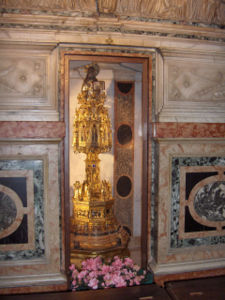
Finally the whole tomb was put on a marble altar in the 18th century. In a little chapel, on the back of the tomb, is the golden reliquary with the Head of St. Dominic, a masterpiece by Jacopo Roseto da Bologna (1383).
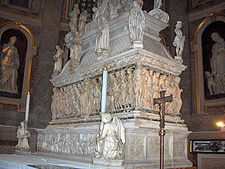
is the middle part and also the oldest part of the shrine. It contains the remains of Saint Dominic in a cypress coffin, with the exception of his head (which is preserved in the reliquary
at the back of the monument). Nicola Pisano
, already famous for his pulpit in the Pisa Baptistery
, was asked in 1264 to construct this sarcophagus. He was certainly responsible for the design, but left the brunt of the work to his workshop, since in 1265 he was already at work on a new commission (the pulpit for the Siena Cathedral).
The front side was done in his workshop, partially by Nicola Pisano himself but mostly by his assistant Lapo di Ricevuto. and another famous sculptor Arnolfo di Cambio
. The Dominican brother fra Guglielmo da Pisa (who also designed in 1270 a pulpit in San Giovanni Fuorcivitas in Pistoia
) made a small contribution. According to Gnudi (see ref.) an anonymous Fifth Master was also involved. A collaboration of several sculptors on a such a large commission was normal practice in medieval sculpture.
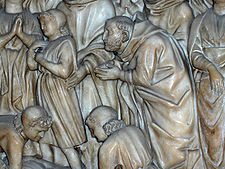 The sarcophagus recounts the life and miracles of Saint Dominic in a series of six carved panels. The compositions are neatly filled with figures in organized rows, giving a single approach to space. The sarcophagus is flanked on each corner by statues in high-relief of the Four Doctors of the Church.
The scenes are arranged in following sequence from left to right and counterclockwise:
Work on the sarcophagus was finished in 1267. This sarcophagus, originally with its caryatid
supports, was taken as model for other tombs: the shrine of St Peter Martyr in the basilica of San Eustorgio in Milan
, the shrine of St Luke (1316) in the basilica of San Giustina in Padua
and the tomb of Beato Bertrando (c. 1334-1350) in Udine
.
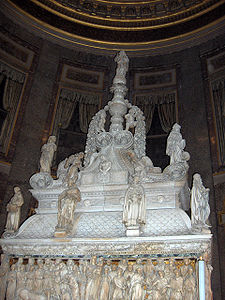 The ambitious addition of a crowning to the sarcophagus was commissioned in 1469 to Niccolò da Bari to complete this funeral monument. Work at this elaborate spire continued till 1473. But it is not clear why Niccolò did not complete his contract, even if he did continue intermittently at it until his death.in 1494.
On top of a candelabrum, rising from the cyma
, stands the impressive statue of the Eternal Father. The candelabrum is held by two putti, symbols of the sky, and four dolphins, symbols of the sea, all covered with festoon
s with fruit, symbols of the earth.
On the cornice at its base is in the middle a small Pietà, flanked by two winged angels (the Angel of the Annunciation and the Angel of the Passion), while on the four corners stand the four Evangelist
s in oriental robes. The lower part of the cyma is surrounded by several free-standing figures, the Patron Saints of Bologna: Saint Francis of Assisi
, San Petronio (began by Niccolò but finished by young Michelangelo
in 1494), Saint Dominic
and Saint Florian
. On the back stand the statues St Anne, St John the Baptist (sculpted by Girolamo Cortellini in 1539), San Vitale and San Procolo (Michelangelo, 1494 – the resemblance and the posture of this statue shows that he had already his "David
" in mind at that time).
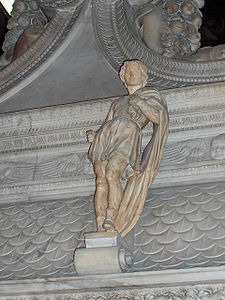 Niccolò also added the delicate Candlestick-holding Angel on the left side of the altar slab, below the sarcophagus, while the one on the right side with its youthful strength is by Michelangelo. Michelangelo was paid thirty ducats by his patron Francesco Aldovrandi.
Because of the admiration he received for this splendid masterpiece, he was renamed Niccolò dell'Arca. Art critics perceive in this masterpiece a blend of influences: Burgundian, Florentine and non-Tuscan (such as details in clothing). The way these statuettes express their emotions and the patterns in their dresses and hair evoke the style of Jacopo della Quercia
(1497–1547). Again it depicts a number of episodes form the life of Saint Dominic.
The frontal was sculpted in G. Battista Boudard's workshop in Parma in 1768. It represents St. Dominic's Burial, as designed by Carlo Bianconi (1732–1802).
Saint Dominic
Saint Dominic , also known as Dominic of Osma, often called Dominic de Guzmán and Domingo Félix de Guzmán was the founder of the Friars Preachers, popularly called the Dominicans or Order of Preachers , a Catholic religious order...
. It is located in Dominic’s Chapel in the Basilica of San Domenico
Basilica of San Domenico
The Basilica of San Domenico is one of the major churches in Bologna, Italy. The remains of Saint Dominic, founder of the Order of Preachers , are buried inside the exquisite shrine Arca di San Domenico, made by Nicola Pisano and his workshop, Arnolfo di Cambio and with later additions by Niccolò...
in Bologna
Bologna
Bologna is the capital city of Emilia-Romagna, in the Po Valley of Northern Italy. The city lies between the Po River and the Apennine Mountains, more specifically, between the Reno River and the Savena River. Bologna is a lively and cosmopolitan Italian college city, with spectacular history,...
, Italy
Italy
Italy , officially the Italian Republic languages]] under the European Charter for Regional or Minority Languages. In each of these, Italy's official name is as follows:;;;;;;;;), is a unitary parliamentary republic in South-Central Europe. To the north it borders France, Switzerland, Austria and...
.
History
The elaboration of this artistic masterpiece was performed in separate stages by the best sculptors of their time and took almost 500 years to finish.Saint Dominic died in the convent of the church of San Nicolò delle Vigne on 6 August 1221. He was buried behind the altar. The church of San Nicolò was expanded into the Basilica of San Domenico
Basilica of San Domenico
The Basilica of San Domenico is one of the major churches in Bologna, Italy. The remains of Saint Dominic, founder of the Order of Preachers , are buried inside the exquisite shrine Arca di San Domenico, made by Nicola Pisano and his workshop, Arnolfo di Cambio and with later additions by Niccolò...
between 1228 and 1240. The remains of the saint were moved in 1233 from its place behind the altar into a simple marble sarcophagus, situated on the floor in the right aisle of the church for the faithful. Since most of the pilgrims, who came in great numbers to see the grave, were not able to see this shrine, hidden by so many people standing in front of it, the need was felt for a new shrine.
In 1264, the Dominicans then commissioned a new tomb for their founder to Nicola Pisano
Nicola Pisano
Nicola Pisano was an Italian sculptor whose work is noted for its classical Roman sculptural style. Pisano is sometimes considered to be the founder of modern sculpture.- Early life :His birth date or origins are uncertain...
, the famous sculptor of the pulpit
Pulpit
Pulpit is a speakers' stand in a church. In many Christian churches, there are two speakers' stands at the front of the church. Typically, the one on the left is called the pulpit...
of the Pisa Baptistery
Baptistry (Pisa)
The Baptistry of St. John is a religious building in Pisa, Italy. It started construction in 1152, in replacement of an older baptistry, and completed in 1363...
. He was certainly responsible for the design of the new sarcophagus, but in 1265 he was already at work on another assignment, the pulpit for the Siena Cathedral
Duomo di Siena
The Cathedral of Siena , dedicated from its earliest days as a Roman Catholic Marian church and now to Santa Maria Assunta , is a medieval church in Siena, central Italy....
. The front side was done in his workshop, partially by Nicola Pisano himself but mostly by his assistant Lapo di Ricevuto. The rectangular sarcophagus was originally borne on caryatid
Caryatid
A caryatid is a sculpted female figure serving as an architectural support taking the place of a column or a pillar supporting an entablature on her head. The Greek term karyatides literally means "maidens of Karyai", an ancient town of Peloponnese...
figures. When the Ark was later redesigned, these supports were dispersed and are now tentatively identified in several museums: the archangels "Michael" and "Gabriel" (in the Victoria and Albert Museum
Victoria and Albert Museum
The Victoria and Albert Museum , set in the Brompton district of The Royal Borough of Kensington and Chelsea, London, England, is the world's largest museum of decorative arts and design, housing a permanent collection of over 4.5 million objects...
, London), the statue "Faith" (Louvre
Louvre
The Musée du Louvre – in English, the Louvre Museum or simply the Louvre – is one of the world's largest museums, the most visited art museum in the world and a historic monument. A central landmark of Paris, it is located on the Right Bank of the Seine in the 1st arrondissement...
, Paris), a group of three deacons (in the Bargello
Bargello
The Bargello, also known as the Bargello Palace or Palazzo del Popolo is a former barracks and prison, now an art museum, in Florence, Italy.-Terminology:...
, Florence) and a similar group in the Museum of Fine Arts, Boston
Museum of Fine Arts, Boston
The Museum of Fine Arts in Boston, Massachusetts, is one of the largest museums in the United States, attracting over one million visitors a year. It contains over 450,000 works of art, making it one of the most comprehensive collections in the Americas...
.
The sarcophagus was relocated in the middle of the church in 1411. Between 1469 and 1473 a crowning was added on the flat top of the sarcophagus by Niccolò dell'Arca and several other masters in their art. Among them was the young Michelangelo
Michelangelo
Michelangelo di Lodovico Buonarroti Simoni , commonly known as Michelangelo, was an Italian Renaissance painter, sculptor, architect, poet, and engineer who exerted an unparalleled influence on the development of Western art...
, who added the statuettes of San Petronio
Saint Petronius
Saint Petronius was bishop of Bologna during the fifth century. He is a patron saint of the city. Born of a noble Roman family, he became a convert to Christianity and subsequently a priest...
(the patron saint of Bologna), a candlestic-holding angel and San Procolo
Proculus of Pozzuoli
Saint Proculus of Pozzuoli was martyred around 305 AD, at the same time as Saint Januarius.He was martyred with:*Sossius or Sosius, deacon of Miseno *Festus, lector *Desiderius, lector *Acutius, layman *Eutyches , layman...
(closely recalling the statue of David, made ten years later).
In 1532, a step was added between the sarcophagus and the altar slab by Alfonso Lombardi
Alfonso Lombardi
Alfonso Lombardi , also known as Lombardi da Lucca, Alfonso da Ferrara and as Alfonso Lombardo, was an Italian sculptor and medalist who was born in Ferrara, Italy in 1497, and died in Bologna in 1537. He was very active in Bologna where he created a number of works that are still present in the...
.
The Saint Dominic’s chapel was built by the Bolognese architect Floriano Ambrosini from 1597, replacing the small gothic chapel from 1413. The Dominicans wanted a chapel for their founder to match the splendour of the other existing chapels. The fresco on the cupola of the apse St. Dominic’s Glory, a masterpiece by Guido Reni
Guido Reni
Guido Reni was an Italian painter of high-Baroque style.-Biography:Born in Bologna into a family of musicians, Guido Reni was the son of Daniele Reni and Ginevra de’ Pozzi. As a child of nine, he was apprenticed under the Bolognese studio of Denis Calvaert. Soon after, he was joined in that...
, painted between 1613 and 1615, matches the artistic value of the underlying Ark of St. Dominic.
Finally the whole tomb was put on a marble altar in the 18th century. In a little chapel, on the back of the tomb, is the golden reliquary with the Head of St. Dominic, a masterpiece by Jacopo Roseto da Bologna (1383).
The sarcophagus
The sarcophagusSarcophagus
A sarcophagus is a funeral receptacle for a corpse, most commonly carved or cut from stone. The word "sarcophagus" comes from the Greek σαρξ sarx meaning "flesh", and φαγειν phagein meaning "to eat", hence sarkophagus means "flesh-eating"; from the phrase lithos sarkophagos...
is the middle part and also the oldest part of the shrine. It contains the remains of Saint Dominic in a cypress coffin, with the exception of his head (which is preserved in the reliquary
Reliquary
A reliquary is a container for relics. These may be the physical remains of saints, such as bones, pieces of clothing, or some object associated with saints or other religious figures...
at the back of the monument). Nicola Pisano
Nicola Pisano
Nicola Pisano was an Italian sculptor whose work is noted for its classical Roman sculptural style. Pisano is sometimes considered to be the founder of modern sculpture.- Early life :His birth date or origins are uncertain...
, already famous for his pulpit in the Pisa Baptistery
Baptistry (Pisa)
The Baptistry of St. John is a religious building in Pisa, Italy. It started construction in 1152, in replacement of an older baptistry, and completed in 1363...
, was asked in 1264 to construct this sarcophagus. He was certainly responsible for the design, but left the brunt of the work to his workshop, since in 1265 he was already at work on a new commission (the pulpit for the Siena Cathedral).
The front side was done in his workshop, partially by Nicola Pisano himself but mostly by his assistant Lapo di Ricevuto. and another famous sculptor Arnolfo di Cambio
Arnolfo di Cambio
Arnolfo di Cambio was an Italian architect and sculptor.-Biography:Arnolfo was born in Colle Val d'Elsa, Tuscany....
. The Dominican brother fra Guglielmo da Pisa (who also designed in 1270 a pulpit in San Giovanni Fuorcivitas in Pistoia
Pistoia
Pistoia is a city and comune in the Tuscany region of Italy, the capital of a province of the same name, located about 30 km west and north of Florence and is crossed by the Ombrone Pistoiese, a tributary of the River Arno.-History:...
) made a small contribution. According to Gnudi (see ref.) an anonymous Fifth Master was also involved. A collaboration of several sculptors on a such a large commission was normal practice in medieval sculpture.
The scenes are arranged in following sequence from left to right and counterclockwise:
- On the left corner stands Paul the Apostle.
- St. Dominic resurrects the young Napoleone Orsini, after a fatal fall from his horse. The expressive face of Saint Dominic, so different from the blander faces in this front panel, is attributed to Arnolfo di Cambio.
- In the middle: a high-relief of A Virgin and Child.
- The Miracle of the Book rejected by Fire, acting out a story of Dominic’s preaching in FanjeauxFanjeauxFanjeaux is a commune in the Aude department in southern France.Fanjeaux is located west of Carcassonne. Between 1206 and 1215, Fanjeaux was the home of Saint Dominic, the founder of the Roman Catholic Church's Dominican Order.-Population:-References:...
, southern France, against the AlbigensianCatharCatharism was a name given to a Christian religious sect with dualistic and gnostic elements that appeared in the Languedoc region of France and other parts of Europe in the 11th century and flourished in the 12th and 13th centuries...
heresy. - on the right corner St. Dominic with the Book and the Scourge.
- The Angels bring Bread to the Friars thanks to Dominic’s Intercession, representing one of the first miracles of the saint.
- The back of the tomb gives two scenes (each with three episodes), divided by a statue of Christ the Redeemer.
- On the left a scene of the life of Blessed Reginald of Orléans, founder of the monastery in Bologna; the Blessed promises St Dominic to enter the Order; the Blessed falls ill; the Virgin heals him and gives him the habit of the Preaching Friars
- on the right: St. Dominic asks pope Innocent III to approve the Order; the pope dreams of the Saint supporting the basilica of the Lateran; the pope approves the foundation of the Order.
- In the corner on the right: a high-relief of St. Augustine, author of the Dominican Rule.
- The last relief gives two more episodes: The Apostles Peter and Paul appear to Saint Dominic, while he was praying in the basilica of St. Peter, and give him the staff and the Book (symbols of the Apostolic mission); the Saint sends his followers out on their mission to preach in the world.
Work on the sarcophagus was finished in 1267. This sarcophagus, originally with its caryatid
Caryatid
A caryatid is a sculpted female figure serving as an architectural support taking the place of a column or a pillar supporting an entablature on her head. The Greek term karyatides literally means "maidens of Karyai", an ancient town of Peloponnese...
supports, was taken as model for other tombs: the shrine of St Peter Martyr in the basilica of San Eustorgio in Milan
Milan
Milan is the second-largest city in Italy and the capital city of the region of Lombardy and of the province of Milan. The city proper has a population of about 1.3 million, while its urban area, roughly coinciding with its administrative province and the bordering Province of Monza and Brianza ,...
, the shrine of St Luke (1316) in the basilica of San Giustina in Padua
Padua
Padua is a city and comune in the Veneto, northern Italy. It is the capital of the province of Padua and the economic and communications hub of the area. Padua's population is 212,500 . The city is sometimes included, with Venice and Treviso, in the Padua-Treviso-Venice Metropolitan Area, having...
and the tomb of Beato Bertrando (c. 1334-1350) in Udine
Udine
Udine is a city and comune in northeastern Italy, in the middle of Friuli-Venezia Giulia region, between the Adriatic sea and the Alps , less than 40 km from the Slovenian border. Its population was 99,439 in 2009, and that of its urban area was 175,000.- History :Udine is the historical...
.
The crowning
On top of a candelabrum, rising from the cyma
Cyma
Cyma may refer to either:* A style of molding* Cyma Zarghami, the president of Nickelodeon and MTV Networks' Kids & Family Group* CYMA – Canadian Youth Mission to Armenia, a Canadian-run humanitarian program...
, stands the impressive statue of the Eternal Father. The candelabrum is held by two putti, symbols of the sky, and four dolphins, symbols of the sea, all covered with festoon
Festoon
Festoon , a wreath or garland, and so in architecture a conventional arrangement of flowers, foliage or fruit bound together and suspended by ribbons, either from a decorated knot, or held in the mouths of lions, or suspended across the back of bulls heads as...
s with fruit, symbols of the earth.
On the cornice at its base is in the middle a small Pietà, flanked by two winged angels (the Angel of the Annunciation and the Angel of the Passion), while on the four corners stand the four Evangelist
Four Evangelists
In Christian tradition the Four Evangelists are Matthew, Mark, Luke, and John, the authors attributed with the creation of the four Gospel accounts in the New Testament that bear the following titles:*Gospel according to Matthew*Gospel according to Mark...
s in oriental robes. The lower part of the cyma is surrounded by several free-standing figures, the Patron Saints of Bologna: Saint Francis of Assisi
Francis of Assisi
Saint Francis of Assisi was an Italian Catholic friar and preacher. He founded the men's Franciscan Order, the women’s Order of St. Clare, and the lay Third Order of Saint Francis. St...
, San Petronio (began by Niccolò but finished by young Michelangelo
Michelangelo
Michelangelo di Lodovico Buonarroti Simoni , commonly known as Michelangelo, was an Italian Renaissance painter, sculptor, architect, poet, and engineer who exerted an unparalleled influence on the development of Western art...
in 1494), Saint Dominic
Saint Dominic
Saint Dominic , also known as Dominic of Osma, often called Dominic de Guzmán and Domingo Félix de Guzmán was the founder of the Friars Preachers, popularly called the Dominicans or Order of Preachers , a Catholic religious order...
and Saint Florian
Saint Florian
Florian lived in the time of the Roman emperors Diocletian and Maximian, and was commander of the imperial army in the Roman province of Noricum. In addition to his military duties, he was also responsible for organizing firefighting brigades....
. On the back stand the statues St Anne, St John the Baptist (sculpted by Girolamo Cortellini in 1539), San Vitale and San Procolo (Michelangelo, 1494 – the resemblance and the posture of this statue shows that he had already his "David
David (Michelangelo)
David is a masterpiece of Renaissance sculpture created between 1501 and 1504, by the Italian artist Michelangelo. It is a marble statue of a standing male nude. The statue represents the Biblical hero David, a favoured subject in the art of Florence...
" in mind at that time).
Because of the admiration he received for this splendid masterpiece, he was renamed Niccolò dell'Arca. Art critics perceive in this masterpiece a blend of influences: Burgundian, Florentine and non-Tuscan (such as details in clothing). The way these statuettes express their emotions and the patterns in their dresses and hair evoke the style of Jacopo della Quercia
Jacopo della Quercia
Jacopo della Quercia was an Italian sculptor of the Italian Renaissance, a contemporary of Brunelleschi, Ghiberti and Donatello. He is considered a precursor of Michelangelo.-Biography:...
The step
The step, between the sarcophagus and the altar slab, was the third addition to the monument. It was sculpted in 1532 by Alfonso LombardiAlfonso Lombardi
Alfonso Lombardi , also known as Lombardi da Lucca, Alfonso da Ferrara and as Alfonso Lombardo, was an Italian sculptor and medalist who was born in Ferrara, Italy in 1497, and died in Bologna in 1537. He was very active in Bologna where he created a number of works that are still present in the...
(1497–1547). Again it depicts a number of episodes form the life of Saint Dominic.
- front: (left) St Dominic’s birth; the young Dominic sleeping on the floor as a penance; Saint Dominic shows his charity by selling his valuable hand-glossed parchments to help the poor (while he was studying in Palencia)
- front (middle part) The Adoration of the Magi (with the inscription: Alphonsus de Lombardis Ferraniensis F(ecit))
- front (right) The Saint is taken to Heaven on a ladder supported by Christ and the Virgin.
The altar
The marble altar was the last addition to the Arca. It was designed by Mauro Tesi (1730–1766) and later built by Alessandro Salviolini in 1768. On the altar slab stand the two statuettes of the angels holding a candlestick; on the left by Niccolò dell'Arca, on the right by Michelangelo.The frontal was sculpted in G. Battista Boudard's workshop in Parma in 1768. It represents St. Dominic's Burial, as designed by Carlo Bianconi (1732–1802).