
All Topics  
Sidon

 
Sidon

   Email Print
   Bookmark   Link


Sidon


Sidon,or Saïda, (Arabic
Arabic language

Arabic is a Central Semitic language, thus related to and classified alongside other Semitic languages languages such as Hebrew language and Aramaic language....
  ; Phoenician  ?ydwn, Greek
Greek language

Greek is an Indo-European languages native to the southern Balkan peninsula, the language of the Greek people. It forms an independent branch within Indo-European....
 S?d??, Hebrew
Hebrew language

Hebrew is a Semitic languages of the Afro-Asiatic languages. Modern Hebrew is spoken by more than seven million people in Israel and Classical Hebrew is used for prayer or study in Jews communities around the world....
 ????? ?i?on, ) is the third-largest city in Lebanon
Lebanon

Lebanon , officially the Republic of Lebanon or Lebanese Republic , is a country in Western Asia, on the eastern shore of the Mediterranean Sea....
.


Discussion
Ask a question about 'Sidon'
Start a new discussion about 'Sidon'
Answer questions from other users
Full Discussion Forum


Recent Posts


Encyclopedia


Sidon,or Saïda, (Arabic
Arabic language

Arabic is a Central Semitic language, thus related to and classified alongside other Semitic languages languages such as Hebrew language and Aramaic language....
  ; Phoenician
Phoenician Sade
Phoenician Yodh
Phoenician Daleth
Phoenician Waw
Phoenician Nun
 ?ydwn, Greek
Greek language

Greek is an Indo-European languages native to the southern Balkan peninsula, the language of the Greek people. It forms an independent branch within Indo-European....
 S?d??, Hebrew
Hebrew language

Hebrew is a Semitic languages of the Afro-Asiatic languages. Modern Hebrew is spoken by more than seven million people in Israel and Classical Hebrew is used for prayer or study in Jews communities around the world....
 ????? ?i?on, ) is the third-largest city in Lebanon
Lebanon

Lebanon , officially the Republic of Lebanon or Lebanese Republic , is a country in Western Asia, on the eastern shore of the Mediterranean Sea....
. It is located in the South Governorate of Lebanon, on the Mediterranean
Mediterranean Sea

The Mediterranean Sea is a sea or Ocean off the Atlantic Ocean surrounded by the Mediterranean region and almost completely enclosed by land: on the north by Europe, on the south by Africa, and on the east by Asia....
 coast, about 40 km (25 mi) north of Tyre and 40 km (25 mi) south of the capital Beirut
Beirut

Beirut is the Capital and largest city of Lebanon with a population of over 2.1 million as of 2007. Located on a peninsula at the midpoint of Lebanon's coastline with the Mediterranean sea, it serves as the country's largest and main seaport and also forms the Beirut District area, which consists of the city and its suburbs....
. Its name means a fishery. It is a city of 200,000 inhabitants mainly of the Muslim Sunni, Shiite, and Christian Greek Catholic and Maronite.

History

Sidon has been inhabited since 4000 BC and perhaps as early as Neolithic times (6000 - 4000 B.C.). It was one of the most important Phoenicia
Phoenicia

Phoenicia was an ancient civilization centered in the north of ancient Canaan, with its heartland along the coastal regions of modern day Lebanon, extending to parts of Israel, Syria and the Palestinian territories....
n cities, and may have been the oldest. From here, and other ports, a great Mediterranean commercial empire was founded. Homer
Homer

Homer is traditionally held to be the author of the ancient Greek language epic poems the Iliad and the Odyssey, as well as of the Homeric Hymns....
 praised the skill of its craftsmen in producing glass and purple dyes. It was also from here that a colonizing party went to found the city of Tyre. Tyre also grew into a great city, and in subsequent years there was competition between the two, each claiming to be the metropolis ('Mother City') of Phoenicia. Glass manufacturing, Sidon's most important enterprise in the Phoenician era, was conducted on a vast scale, and the production of purple dye was almost as important. The small shell of the Murex trunculus was broken in order to extract the pigment that was so rare it became the mark of royalty.

In 1855 AD, the sarcophagus of King Eshmun’azar
Eshmunazar

Eshmunazar was the name of several Phoenician kings of Sidon.The sarcophagus of Eshmunazar II, which is now in the Louvre, was unearthed in 1855 in a site near Sidon, and contains an inscription, in Phoenician languages Canaanite languages, inscribed using the Phoenician alphabet....
 II was discovered. From a Phoenician inscription on its lid, it appears that he was a "king of the Sidonians," probably in the 5th century BC, and that his mother was a priestess of ‘Ashtart, "the goddess of the Sidonians." In this inscription the gods Eshmun
Eshmun

Eshmun was a Phonicia god of healing and the tutelary god of Sidon.This god was known at least from the Iron Age period at Sidon and was worshipped also in Tyre , Beirut, Cyprus, Sardinia, and in Carthage where the site of Eshmun's temple is now occupied by the chapel of Louis IX of France....
 and Ba‘al
Baal

Ba'al is a Northwest Semitic title and honorific meaning "master" or "lord" that is used for various gods who were patrons of cities in the Levant, cognate to East Semitic Bel ....
 Sidon 'Lord of Sidon' (who may or may not be the same) are mentioned as chief gods of the Sidonians. ‘Ashtart is entitled ‘Ashtart-Shem-Ba‘al '‘Ashtart the name of the Lord', a title also found in an Ugaritic text.

Sidonseacastle
In the years before Jesus
Jesus

Jesus of Nazareth , also known as Jesus Christ, is the central figure of Christianity and is revered by most Christian churches as the Son of God and the Incarnation ....
, Sidon had many conquerors: Assyria
Assyria

Assyria was a political state centered on the Upper Tigris river, in Mesopotamia , that came to rule regional empires a number of times in history....
ns, Babylon
Babylon

Babylon was a city-state of ancient Mesopotamia, sometimes considered an empire, the remains of which can be found in present-day Al Hillah, Babil Governorate, Iraq, about 85 kilometers south of Baghdad....
ians, Egypt
Egypt

Egypt is a country mainly in North Africa, with the Sinai Peninsula forming a land bridge in Western Asia. Covering an area of about , Egypt borders the Mediterranean Sea to the north, the Gaza Strip and Israel to the northeast, the Red Sea to the east, Sudan to the south and Libya to the west....
ians, Greeks
Ancient Greece

The term Ancient Greece refers to the period of History of Greece lasting from the Greek Dark Ages ca. 1100 BC and the Dorian invasion, to 146 BC and the Roman Republic conquest of Greece after the Battle of Corinth ....
, and finally Romans
Ancient Rome

Ancient Rome was a civilization that grew out of a small agricultural community founded on the Italian Peninsula as early as the 10th century BC....
. Herod the Great
Herod the Great

Herod , also known as Herod I or Herod the Great , was a Roman Empire client state of Israel. Herod is known for his colossal building projects in Jerusalem and other parts of the ancient world, including the rebuilding of the Second Temple in Jerusalem, sometimes referred to as Herod's Temple....
 visited Sidon. Both Jesus and Saint Paul
Paul of Tarsus

Saint Paul, also called Paul the Apostle, the Apostle Paul or Paul of Tarsus , was a Hellenistic Judaism, who called himself the "Apostle to the Gentiles", and was, together with Saint Peter and James the Just, the most notable of early Christian missionaries....
 are said to have visited it too (see Biblical Sidon below). The city was eventually conquered by the Arabs and then by the Ottoman Turks.

Like other Phoenician city-states, Sidon suffered from a succession of conquerors. At the end of the Persian
Persian Empire

The 'Persian Empire' was a series of successive Iranian or Persianization empires that ruled over the Iranian plateau, the original Persian homeland, and beyond in Southwest Asia, South Asia, Central Asia and the Caucasus....
 era in 351 BC, it was invaded by the emperor Artaxerxes III and then by Alexander the Great
Alexander the Great

Alexander the Great , also known as Alexander III of Macedon was an ancient Greeks King of Macedon . He was one of the most successful military commanders of all time and is presumed undefeated in battle....
 in 333 BC when the Hellenistic era of Sidon began. Under the successors of Alexander, it enjoyed relative freedom and organized games and competitions in which the greatest athletes of the region participated. In the Necropolis of Sidon, important finds such as the Alexander Sarcophagus, the Lycian tomb and the Sarcophagus of the Crying Women were discovered, which are now on display at the Istanbul Archaeology Museum
Istanbul Archaeology Museum

The Istanbul Archaeology Museums is an archeological museum, located in the Emin?n? district of Istanbul, Turkey, near G?lhane Park and Topkapi Palace....
 in Istanbul
Istanbul

Istanbul is the largest city in Turkey, List of metropolitan areas in Europe by population, and List of cities proper by population in the world with a population of 12.6 million....
.

When Sidon fell under Roman domination, it continued to mint its own silver coins. The Romans also built a theater and other major monuments in the city. In the reign of Elagabalus a Roman colonia was established there, and it was given the name of Colonia Aurelia Pia Sidon. During the Byzantine
Byzantine

The word Byzantine may refer to:Topics directly related to the Byzantine Empire* A citizen of Byzantine Empire, or native Greeks during the Middle Ages ....
 period, when the great earthquake of 551 AD destroyed most of the cities of Phoenicia, Beirut
Beirut

Beirut is the Capital and largest city of Lebanon with a population of over 2.1 million as of 2007. Located on a peninsula at the midpoint of Lebanon's coastline with the Mediterranean sea, it serves as the country's largest and main seaport and also forms the Beirut District area, which consists of the city and its suburbs....
's School of Law took refuge in Sidon. The town continued quietly for the next century, until it was conquered by the Arab
Arab

An Arab is a person who Identity as such on linguistic or cultural grounds. The plural form, Arabs , refers to the Ethnocultural group at large....
s in 636 AD.

On December 4, 1110 Sidon was sacked in the First Crusade
First Crusade

The First Crusade was launched in 1095 by Pope Urban II with the primary goal of responding to the appeal from Byzantine Emperor Alexius I. The Emperor requested that western volunteers come to their aid and repel the Seljuk Turks in Anatolia, Modern day Turkey....
 by King Baldwin of Jerusalem and King Sigurd of Norway. It then became the centre of the Lordship of Sidon
Lordship of Sidon

The Lordship of Sidon was one of the four major fiefdoms of the Kingdom of Jerusalem, one of the Crusader States. However, in reality, it appears to have been much smaller than the others and had the same level of significance as several neighbors, such as Toron and Beirut, which were sub-vassals....
, an important seigneury in the Kingdom of Jerusalem
Kingdom of Jerusalem

The Kingdom of Jerusalem was a Christianity kingdom established in the Levant in 1099 after the First Crusade. It lasted nearly two hundred years, from 1099 until 1291 when the last remaining possession, Acre, Israel, was destroyed by the Mamluks....
. During the Crusades it was sacked several times: it was finally destroyed by the Saracens in 1249. In 1260 it was again destroyed by the Mongols
Mongols

The name Mongol specifies one or several ethnic groups, now mainly located in Mongolia, China, and Russia....
. The remains of the original walls are still visible.

After Sidon came under Ottoman Turkish
Ottoman Empire

The Ottoman Empire , also known by its contemporaries as the Turkish Empire or Turkey , was an empire that lasted from 1299?1923. It was Treaty of Lausanne by the Republic of Turkey, which was officially proclaimed on October 29, 1923....
 rule in the seventeenth century, it regained a great deal of its earlier commercial importance. After World War I
World War I

World War I, or the First World War , was a global military conflict which involved the Great powers, organized into two opposing military alliances: the Allies of World War I and the Central Powers....
 it became part of the French Mandate
League of Nations mandate

A League of Nations mandate refers to a legal status for certain territories transferred from the control of one country to another following World War I, or the legal instruments that contained the terms for administering the territory on behalf of the League....
 of Lebanon
French Mandate of Lebanon

The French Mandate of Lebanon was a League of Nations League of Nations Mandate created at the end of World War I. When the Ottoman Empire was formally split up by the Treaty of S?vres in 1920, it was decided that four of its territories in the Middle East should be League of Nations mandates temporarily governed by the United Kingdom and Fra...
. During World War II
World War II

World War II, or the Second World War , was a global military conflict which involved a Participants in World War II, including all of the great powers, organised into two opposing military alliances: the Allies of World War II and the Axis powers....
 the city, together with the rest of Lebanon, was captured by British
United Kingdom

The United Kingdom of Great Britain and Northern Ireland, commonly known as the United Kingdom , the UK or Britain,is a sovereign state located off the northwestern coast of continental Europe....
 forces fighting against the Vichy
Vichy

Vichy is a Communes of France in the Departments of France of Allier in Auvergne in central France. It is known as a Spa town and resort town....
 French
France

France , officially the French Republic , is a country whose Metropolitan France is located in Western Europe and that also comprises various Overseas departments and territories of France....
, and following the war it became a major city of independent Lebanon
Lebanon

Lebanon , officially the Republic of Lebanon or Lebanese Republic , is a country in Western Asia, on the eastern shore of the Mediterranean Sea....
.

Following the Palestinian exodus
1948 Palestinian exodus

The 1948 Palestinian exodus , referred to by Palestinians as al Nakba , meaning the "disaster", "catastrophe", or "cataclysm," was the creation of the Palestinian people refugee problem during and after the 1948 Palestine war....
 in 1948, a considerable number of Palestinian refugees arrived in Sidon, as in other Lebanese cities, and were settled at the large refugee camps of Ein el-Hilweh and Mia Mia
Mia Mia

Mia Mia may refer to the following:*Mia Mia is a temporary shelter used by some Indigenous Australians*Mia Mia, Victoria is a town in the State of Victoria in Australia...
. At first these consisted of enormous rows of tents, but gradually houses were constructed. The refugee camps constituted de-facto neighborhoods of Sidon, but had a separate legal and political status which made them into a kind of enclaves. At the same time, the remaining Jews of the city fled, and the Jewish cemetery fell into disrepair, threatened by coastal erosion.

Sidon today

In 1900 it was a town of 10,000 inhabitants; in 2000 its population was around 200,000. Although there is little level land around the city, some wheat and vegetables are grown and there is much fruit also; some fishing is carried on. The heavily-silted ancient port is now used only by small coastal vessels. There is also a refinery there.

A state-of-the-art stadium
Saida International Stadium

Saida International Stadium is a 22,600 capacity multi-use stadium in Saida, Lebanon , Lebanon. The stadium was built on the expanded grounds of the old Saida Municipal Stadium, as one of the venues to host matches during the 2000 AFC Asian Cup that was held in Lebanon....
 was inaugurated in 2000 for the Asian Football Confederation's Cup 2000.

Tourism

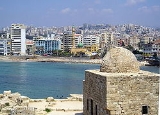
  • Sidon Sea Castle


Sidon Sea Castle is a fortress built by the Crusaders
Crusaders

The Crusaders are a New Zealand rugby union team based in Christchurch that compete in the Super 14 . They are the most successful team in Super Rugby history....
 in the early 13th century. It is located near the Port of Sidon.

  • Sidon Soap Museum


The Sidon Soap Museum traces the history of the soap making in the region and its different manufacturing steps.

  • Khan el Franj


Khan el Franj, which means “Caravan of the Foreigners”, was built by Emir Fakhreddine in the 17th century to accommodate merchants and goods. This is a typical khan with a large rectangular courtyard and a central fountain surrounded by covered galleries.

  • Debbane Palace


Debbane Palace is a historical residence built in 1721 AD and is open for the public for visitors to witness the Arab-Ottoman architecture and details of that era (18th Century). It is currently in the process of being transformed into the History Museum of Sidon.

  • Old Souks


Between the Sea Castle and the Castle of St. Louis stretches the old town and a picturesque vaulted old market

  • The Castle of St. Louis or Qalaat Al Muizz


The Castle of St. Louis was built by the Crusaders
Crusaders

The Crusaders are a New Zealand rugby union team based in Christchurch that compete in the Super 14 . They are the most successful team in Super Rugby history....
 in the 13th century on top of the remains of a fortress built by the Fatimid
Fatimid

The Fatimid Caliphate or al-Fatimiyyun was an Arab Shi'a dynasty that ruled over varying areas of the Maghreb, Egypt, Sicily, Malta and the Levant from 5 January 909 to 1171....
 caliph Al Muizz. It is located to the south of old souks near Murex hill.

  • Eshmun Temple
    Eshmun Temple

    Category:Ancient Middle EastCategory:Ancient Lebanon...


The temple of Eshmun
Eshmun

Eshmun was a Phonicia god of healing and the tutelary god of Sidon.This god was known at least from the Iron Age period at Sidon and was worshipped also in Tyre , Beirut, Cyprus, Sardinia, and in Carthage where the site of Eshmun's temple is now occupied by the chapel of Louis IX of France....
, the Phoenicia
Phoenicia

Phoenicia was an ancient civilization centered in the north of ancient Canaan, with its heartland along the coastal regions of modern day Lebanon, extending to parts of Israel, Syria and the Palestinian territories....
n God of healing, was built in the 7th century BC and is located in the north of Sidon near the Awali river.

The Biblical Sidon

The Bible
Bible

The Bible is the central religious text of Judaism and Christianity. The exact Books of the Bible is dependent on the religious traditions of specific denominations....
 describes Sidon at various places:
  • It received its name from the "first-born" of Canaan
    Canaan

    Canaan is an ancient term for a region encompassing modern-day Israel and Lebanon, the Palestinian Territories, plus adjoining coastal lands and parts of Jordan, Syria and northeastern Egypt....
    , the grandson of Noah
    Noah

    Noah was, according to the Bible, the tenth and last of the antediluvian Patriarchs ; and a prophet according to the Qur'an. The biblical story of Noah is contained in the book of Book of Genesis, chapters 5-9, while the Qur'an has a whole sura named after and devoted to his story with other references elsewhere....
     (Genesis 10:15, 19).
  • It was the first home of the Phoenicia
    Phoenicia

    Phoenicia was an ancient civilization centered in the north of ancient Canaan, with its heartland along the coastal regions of modern day Lebanon, extending to parts of Israel, Syria and the Palestinian territories....
    ns on the coast of Canaan, and from its extensive commercial relations became a "great" city. (Joshua 11:8; 19:28).
  • It was the mother city of Tyre. It lay within the lot of the tribe of Asher, but was never subdued (Judges 1:31).
  • The Sidonians long oppressed Israel (Judges 10:12).
  • From the time of David
    David

    David , was the second king of the united Kingdom of Israel according to the Hebrew Bible/Old Testament. He is depicted as a righteous king, although not without fault, as well as an acclaimed warrior, musician and poet ....
     its glory began to wane, and Tyre, its "virgin daughter" (Isaiah 23:12), rose to its place of pre-eminence.
  • Solomon
    Solomon

    Solomon is a figure described in the Hebrew Bible and the Qur'an. The biblical accounts identify Solomon as the son of David. He is also called Jedidiah in the Tanakh , and is described as the third king of the United Monarchy, and the final king before the northern Kingdom of Israel and the southern Kingdom of Judah split; following th...
     entered into a matrimonial alliance with the Sidonians, and thus their form of idolatrous worship found a place in the land of Israel
    Land of Israel

    For other uses, see Israel The Land of Israel is the region which, according to the Hebrew Bible, was promised by God to the descendants of Abraham through his son Isaac and to the Israelites, descendants of Jacob, Abraham's grandson....
     (1 Kings 11:1, 33).
  • Jezebel
    Jezebel (Bible)

    Jezebel is the name of two women in the Bible....
     was a Sidonian princess (1 Kings 16:31).
  • It was famous for its manufactures and arts, as well as for its commerce (1 Kings 5:6; 1 Chronicles 22:4; Ezekiel 27:8).
  • It is frequently referred to by the prophets (Isaiah 23:2, 4, 12; Jeremiah 25:22; 27:3; 47:4; Ezekiel 27:8; 28:21, 22; 32:30; Joel 3:4).
  • Elijah sojourned in Sidon, performing miracles (1 Kings 17:9-24; ).
  • Jesus
    Jesus

    Jesus of Nazareth , also known as Jesus Christ, is the central figure of Christianity and is revered by most Christian churches as the Son of God and the Incarnation ....
     visited the "coasts" of Tyre and Sidon (; ) and from this region many came forth to hear him preaching (Mark 3:8; Luke 6:17).
  • From Sidon, at which the ship put in after leaving Caesarea, Paul
    Paul of Tarsus

    Saint Paul, also called Paul the Apostle, the Apostle Paul or Paul of Tarsus , was a Hellenistic Judaism, who called himself the "Apostle to the Gentiles", and was, together with Saint Peter and James the Just, the most notable of early Christian missionaries....
     finally sailed for Rome
    Rome

    Rome is the capital city of Italy and Lazio, and is Italy's largest and most populous city, with 2,724,347 residents in an urban area of some ....
     (Acts 27:3, 4).

Sanchuniathon

  • The account ascribed to the Phoenician historian Sanchuniathon
    Sanchuniathon

    Sanchuniathon is the purported Phoenician author of three lost works originally in the Phoenician language, surviving only in partial paraphrase and summary of a Greek language translation by Philo of Byblos, according to the Christian bishop Eusebius of Caesarea....
     makes Sidon a daughter of Pontus, son of Nereus
    Nereus

    Nereus , in Greek Mythology, was the eldest son of Pontus and Gaia , a Titan who fathered the Nereids, with whom Nereus lived in the Aegean Sea....
    . She is said there to have first invented musical song from the sweetness of her voice.


Twin towns - Sister cities

Sidon is twinned
Town twinning

Town twinning, also known as sister cities, is a concept whereby towns or city in geographically and politically distinct areas are paired, with the goal of fostering human contact and cultural links between their inhabitants....
 with:
Constanta
Constanta

Constanta is the oldest living city in Romania, founded around 600 BC. The city is located on the Black Sea coast. Constan?a is part of the group of four equal size cities which ranks after Bucharest, Romania's capital, Timisoara, Cluj-Napoca and Ia?i....
 in Romania
Romania

Romania is a country located in Southeastern Europe Central Europe, North of the Balkan Peninsula, on the Lower Danube, within and outside the Carpathian Mountains, bordering on the Black Sea....
Sofia
Sofia

Sofia , is the Capital and largest city of the Bulgaria, with 2,5 million people living in the Capital Municipality. It is located in western Bulgaria, at the foot of the mountain massif Vitosha, and is the administrative, cultural, economic, and educational centre of the country....
 in Bulgaria
Bulgaria

The state of Bulgaria , Scientific transliteration Balgarija, officially the Republic of Bulgaria has played a significant role in the Balkans in south-eastern Europe for over fourteen centuries....
Odessa
Odessa

Odessa or Odesa is the Capital of the Odessa Oblast located in southern Ukraine. The city is a major port located on the shore of the Black Sea and the fourth largest city in Ukraine with a population of 1,029,000 ....
 in Ukraine
Ukraine

Ukraine is a country in Eastern Europe. It is bordered by Russia to the east; Belarus to the north; Poland, Slovakia, and Hungary to the west; Romania and Moldova to the southwest; and the Black Sea and Sea of Azov to the south....
Sochi
Sochi

Sochi is a Russian resort types of inhabited localities in Russia, situated in Krasnodar Krai just north of the southern Russian border. It sprawls along the shores of the Black Sea and against the background of the snow-capped peaks of the Caucasus Mountains....
 in Russia
Russia

Russia , or the Russian Federation , is a list of countries spanning more than one continent country extending over much of northern Eurasia....


Notable people

  • Dorotheus
    Dorotheus of Sidon

    Dorotheus of Sidon was a first-century Hellenistic astrologer who wrote a didactic poem on horoscopic astrology known in Greek as the Pentateuch , or in Latin as the Carmen Astrologicum ....
     (1st century BC) Greek astrologer
  • Fouad Siniora
    Fouad Siniora

    Fouad Siniora is the List of Prime Ministers of Lebanon of Lebanon, a position he held from 19 July, 2005 to May 25, 2008, the date of the election of the new List of Presidents of Lebanon; he was renominated to the post on 28 May 2008 and held the post as Acting President between those dates....
    : Current prime minister of Lebanon
  • Europa
    Europa (mythology)

    Europa was a Phoenician woman of high lineage in Greek mythology, from whom the name of the continent Europe has ultimately been taken. The story of her abduction by Zeus in the form of a white bull was a Cretan story, as K?roly Ker?nyi points out; "most of the love-stories concerning Zeus originated from more ancient tales describing his ma...
    : A maiden whom the Greek god Zeus supposedly abducted disguised as a white bull, was a princess of Sidon.
  • Adel Osseiran
    Adel Osseiran

    Adel Osseiran was a prominent Lebanese politician and statesman, a former Speaker of the Lebanese Parliament, and one of the founding fathers of the Lebanese Republic....
    , co-founder of modern Lebanon
  • Rafic Hariri, a former Prime Minister and late leader of the Future Movement
  • Sheikh Mohamad Osseiran
    Sheikh Mohamad Osseiran

    Sheikh Mohamad Osseiran is the Jaafari mufti of Saida and Zahrani districts of South Lebanon, Lebanon. Sheikh Osseiran is famous as a highly moderate Shi'a-Muslim Lebanese politician who focuses much of his efforts on interfaith dialogue....
    , Jaafari Mufti of Sidon


External links

(includes a virtual tour of The Soap Museum and other heritage sites in the Old City)