
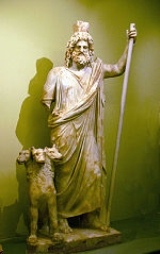
Hades (ˈheɪdiːz; from
GreekGreek is an independent branch of the Indo-European family of languages. Native to the southern Balkans, it has the longest documented history of any Indo-European language, spanning 34 centuries of written records. Its writing system has been the Greek alphabet for the majority of its history;...
(older form Ἀϝίδης),
Hadēs, originally ,
Haidēs or ,
Aidēs (
DoricDoric or Dorian was a dialect of ancient Greek. Its variants were spoken in the southern and eastern Peloponnese, Crete, Rhodes, some islands in the southern Aegean Sea, some cities on the coasts of Asia Minor, Southern Italy, Sicily, Epirus and Macedon. Together with Northwest Greek, it forms the...
Ἀΐδας
Aidas), meaning "the unseen") was the ancient
GreekGreek mythology is the body of myths and legends belonging to the ancient Greeks, concerning their gods and heroes, the nature of the world, and the origins and significance of their own cult and ritual practices. They were a part of religion in ancient Greece...
god of the underworld. The
genitiveIn grammar, genitive is the grammatical case that marks a noun as modifying another noun...
,
Haidou, was an
elisionElision is the omission of one or more sounds in a word or phrase, producing a result that is easier for the speaker to pronounce...
to denote locality: "[the house/dominion]
of Hades". Eventually, the
nominativeThe nominative case is one of the grammatical cases of a noun or other part of speech, which generally marks the subject of a verb or the predicate noun or predicate adjective, as opposed to its object or other verb arguments...
came to designate the abode of the dead.
In
Greek mythologyGreek mythology is the body of myths and legends belonging to the ancient Greeks, concerning their gods and heroes, the nature of the world, and the origins and significance of their own cult and ritual practices. They were a part of religion in ancient Greece...
, Hades is the oldest male child of
CronusIn Greek mythology, Cronus or Kronos was the leader and the youngest of the first generation of Titans, divine descendants of Gaia, the earth, and Uranus, the sky...
and
RheaRhea was the Titaness daughter of Uranus, the sky, and Gaia, the earth, in Greek mythology. She was known as "the mother of gods". In earlier traditions, she was strongly associated with Gaia and Cybele, the Great Goddess, and was later seen by the classical Greeks as the mother of the Olympian...
. According to myth, he and his brothers
ZeusIn the ancient Greek religion, Zeus was the "Father of Gods and men" who ruled the Olympians of Mount Olympus as a father ruled the family. He was the god of sky and thunder in Greek mythology. His Roman counterpart is Jupiter and his Etruscan counterpart is Tinia.Zeus was the child of Cronus...
and
PoseidonPoseidon was the god of the sea, and, as "Earth-Shaker," of the earthquakes in Greek mythology. The name of the sea-god Nethuns in Etruscan was adopted in Latin for Neptune in Roman mythology: both were sea gods analogous to Poseidon...
defeated the
TitansIn Greek mythology, the Titans were a race of powerful deities, descendants of Gaia and Uranus, that ruled during the legendary Golden Age....
and claimed rulership over the cosmos, ruling the underworld, air, and sea, respectively; the solid earth, long the province of
GaiaGaia was the primordial Earth-goddess in ancient Greek religion. Gaia was the great mother of all: the heavenly gods and Titans were descended from her union with Uranus , the sea-gods from her union with Pontus , the Giants from her mating with Tartarus and mortal creatures were sprung or born...
, was available to all three concurrently. Because of his association with the underworld, Hades is often interpreted in modern times as the
personification of deathThe concept of death as a sentient entity has existed in many societies since the beginning of history. In English, Death is often given the name Grim Reaper and, from the 15th century onwards, came to be shown as a skeletal figure carrying a large scythe and clothed in a black cloak with a hood...
, even though he was not.
Hades was also called "Plouton" (
GreekGreek is an independent branch of the Indo-European family of languages. Native to the southern Balkans, it has the longest documented history of any Indo-European language, spanning 34 centuries of written records. Its writing system has been the Greek alphabet for the majority of its history;...
: ,
gen.: Πλούτωνος, meaning "Rich One"), a name which the Romans
LatinizedLatinisation is the practice of rendering a non-Latin name in a Latin style. It is commonly met with for historical personal names, with toponyms, or for the standard binomial nomenclature of the life sciences. It goes further than Romanisation, which is the writing of a word in the Latin alphabet...
as
PlutoIn ancient Greek religion and myth, Pluto was a name for the ruler of the underworld; the god was also known as Hades, a name for the underworld itself...
. The Romans would associate Hades/Pluto with their own
chthonicChthonic designates, or pertains to, deities or spirits of the underworld, especially in relation to Greek religion. The Greek word khthon is one of several for "earth"; it typically refers to the interior of the soil, rather than the living surface of the land or the land as territory...
gods,
Dis PaterDis Pater, or Dispater was a Roman god of the underworld, later subsumed by Pluto or Hades. Originally a chthonic god of riches, fertile agricultural land, and underground mineral wealth, he was later commonly equated with the Roman deities Pluto and Orcus, becoming an underworld deity.Dis Pater...
and
OrcusOrcus was a god of the underworld, punisher of broken oaths in Italic and Roman mythology. As with Hades, the name of the god was also used for the underworld itself. In the later tradition, he was conflated with Dis Pater, who was the Roman equivalent of Pluto.Orcus was portrayed in paintings in...
. The corresponding
EtruscanThe Etruscans were a diachronically continuous population, with a distinct language and culture during the period of earliest European writing, in the Mediterranean Iron Age in the second half of the first millennium BC...
god was
AitaAita is the name of the Etruscan equivalent to the Greek Hades, the divine ruler of the underworld...
.
SymbolA symbol is something which represents an idea, a physical entity or a process but is distinct from it. The purpose of a symbol is to communicate meaning. For example, a red octagon may be a symbol for "STOP". On a map, a picture of a tent might represent a campsite. Numerals are symbols for...
s associated with him are the Helm of Darkness and the three-headed dog,
CerberusCerberus , or Kerberos, in Greek and Roman mythology, is a multi-headed hound which guards the gates of the Underworld, to prevent those who have crossed the river Styx from ever escaping...
.
The term
hades in Christian theologyAccording to various Christian faiths, Hades is "the place or state of departed spirits".-Hades in the Old Testament:In the Septuagint , the Greek term "ᾅδης" is used to translate the Hebrew term "שׁאול" in, for example,...
(and in New Testament Greek) is parallel to Hebrew
sheolSheol |Hebrew]] Šʾôl) is the "grave", "pit", or "abyss" in Hebrew. She'ol is the earliest conception of the afterlife in the Jewish scriptures. It is a place of darkness to which all dead go, regardless of the moral choices made in life, and where they are "removed from the light of God"...
(שאול, grave or dirt-pit), and refers to the abode of the dead. The Christian concept of
hell is more akin to and communicated by the Greek concept of
TartarusIn classic mythology, below Uranus , Gaia , and Pontus is Tartarus, or Tartaros . It is a deep, gloomy place, a pit, or an abyss used as a dungeon of torment and suffering that resides beneath the underworld. In the Gorgias, Plato In classic mythology, below Uranus (sky), Gaia (earth), and Pontus...
, a deep, gloomy part of
hades used as a dungeon of torment and suffering.
God of the underworld
In
Greek mythologyGreek mythology is the body of myths and legends belonging to the ancient Greeks, concerning their gods and heroes, the nature of the world, and the origins and significance of their own cult and ritual practices. They were a part of religion in ancient Greece...
,
Hades (the "unseen"), the god of the underworld, was a son of the
TitanIn Greek mythology, the Titans were a race of powerful deities, descendants of Gaia and Uranus, that ruled during the legendary Golden Age....
s,
CronusIn Greek mythology, Cronus or Kronos was the leader and the youngest of the first generation of Titans, divine descendants of Gaia, the earth, and Uranus, the sky...
and
RheaRhea was the Titaness daughter of Uranus, the sky, and Gaia, the earth, in Greek mythology. She was known as "the mother of gods". In earlier traditions, she was strongly associated with Gaia and Cybele, the Great Goddess, and was later seen by the classical Greeks as the mother of the Olympian...
. He had three sisters,
DemeterIn Greek mythology, Demeter is the goddess of the harvest, who presided over grains, the fertility of the earth, and the seasons . Her common surnames are Sito as the giver of food or corn/grain and Thesmophoros as a mark of the civilized existence of agricultural society...
,
HestiaIn Greek mythology Hestia , first daughter of Cronus and Rhea , is the virgin goddess of the hearth, architecture, and of the right ordering of domesticity and the family. She received the first offering at every sacrifice in the household. In the public domain, the hearth of the prytaneum...
, and
HeraHera was the wife and one of three sisters of Zeus in the Olympian pantheon of Greek mythology and religion. Her chief function was as the goddess of women and marriage. Her counterpart in the religion of ancient Rome was Juno. The cow and the peacock were sacred to her...
, as well as two brothers,
ZeusIn the ancient Greek religion, Zeus was the "Father of Gods and men" who ruled the Olympians of Mount Olympus as a father ruled the family. He was the god of sky and thunder in Greek mythology. His Roman counterpart is Jupiter and his Etruscan counterpart is Tinia.Zeus was the child of Cronus...
, the youngest of the three, and
PoseidonPoseidon was the god of the sea, and, as "Earth-Shaker," of the earthquakes in Greek mythology. The name of the sea-god Nethuns in Etruscan was adopted in Latin for Neptune in Roman mythology: both were sea gods analogous to Poseidon...
, collectively comprising the original six
Olympian godsThe Twelve Olympians, also known as the Dodekatheon , in Greek mythology, were the principal deities of the Greek pantheon, residing atop Mount Olympus. Zeus, Hera, Poseidon, Demeter, Hestia, and Hades were siblings. Ares, Hermes, Hephaestus, Athena, Apollo, and Artemis were children of Zeus...
.
Upon reaching adulthood, Zeus managed to force his father to disgorge his siblings. After their release the six younger gods, along with allies they managed to gather, challenged the elder gods for power in the
TitanomachyIn Greek mythology, the Titanomachy or War of the Titans , was the ten-year series of battles fought in Thessaly between the two camps of deities long before the existence of mankind: the Titans, based on Mount Othrys, and the Olympians, who would come to reign on Mount Olympus...
, a divine war. Zeus, Poseidon, and Hades received weapons from the three
CyclopesA cyclops , in Greek mythology and later Roman mythology, was a member of a primordial race of giants, each with a single eye in the middle of his forehead...
to help in the war: Zeus the thunderbolt, Hades the
Helm of DarknessIn classical mythology, the Cap of Invisibility is a helmet or cap that can turn the wearer invisible. It is also known as the Cap of Hades, Helm of Hades, or Helm of Darkness. Wearers of the cap in Greek myths include the goddess of wisdom Athena, the messenger god Hermes, and the hero Perseus...
, and Poseidon the
tridentA trident , also called a trishul or leister or gig, is a three-pronged spear. It is used for spear fishing and was also a military weapon. Tridents are featured widely in mythical, historical and modern culture. The major Hindu god, Shiva the Destroyer and the sea god Poseidon or Neptune are...
. The night before the first battle, Hades put on his helmet and, being invisible, slipped over to the Titans' camp and destroyed their weapons. The war lasted for ten years and ended with the victory of the younger gods. Following their victory, according to a single famous passage in the
IliadThe Iliad is an epic poem in dactylic hexameters, traditionally attributed to Homer. Set during the Trojan War, the ten-year siege of the city of Troy by a coalition of Greek states, it tells of the battles and events during the weeks of a quarrel between King Agamemnon and the warrior Achilles...
(xv.187–93), Hades and his two brothers, Poseidon and Zeus, drew lots for realms to rule. Zeus got the sky, Poseidon got the seas, and Hades received the underworld, the unseen realm to which the dead go upon leaving the world as well as any and all things beneath the earth.
Hades obtained his eventual consort and queen,
PersephoneIn Greek mythology, Persephone , also called Kore , is the daughter of Zeus and the harvest-goddess Demeter, and queen of the underworld; she was abducted by Hades, the god-king of the underworld....
, through trickery, a story that connected the ancient
Eleusinian MysteriesThe Eleusinian Mysteries were initiation ceremonies held every year for the cult of Demeter and Persephone based at Eleusis in ancient Greece. Of all the mysteries celebrated in ancient times, these were held to be the ones of greatest importance...
with the Olympian pantheon in a founding myth for the realm of the dead.
HeliosHelios was the personification of the Sun in Greek mythology. Homer often calls him simply Titan or Hyperion, while Hesiod and the Homeric Hymn separate him as a son of the Titans Hyperion and Theia or Euryphaessa and brother of the goddesses Selene, the moon, and Eos, the dawn...
told the grieving Demeter that Hades was not unworthy as a consort for Persephone:
"Aidoneus, the Ruler of Many, is no unfitting husband among the deathless gods for your child, being your own brother and born of the same stock: also, for honor, he has that third share which he received when division was made at the first, and is appointed lord of those among whom he dwells."
- — Homeric Hymn to Demeter
Despite modern connotations of death as evil, Hades was actually more
altruisticallyAltruism is a concern for the welfare of others. It is a traditional virtue in many cultures, and a core aspect of various religious traditions, though the concept of 'others' toward whom concern should be directed can vary among cultures and religions. Altruism is the opposite of...
inclined in mythology. Hades was often portrayed as passive rather than evil; his role was often maintaining relative balance.
Hades ruled the dead, assisted by others over whom he had complete authority. He strictly forbade his subjects to leave his domain and would become quite enraged when anyone tried to leave, or if someone tried to steal the souls from his realm. His wrath was equally terrible for anyone who tried to cheat death or otherwise crossed him, as
SisyphusIn Greek mythology Sisyphus was a king punished by being compelled to roll an immense boulder up a hill, only to watch it roll back down, and to repeat this throughout eternity...
and
PirithousIn Greek mythology, Pirithous - Πειρίθοος was the King of the Lapiths in Thessaly and husband of Hippodamia, at whose wedding the famous Battle of Lapiths and Centaurs occurred....
found out to their sorrow.
Besides
HeraclesHeracles ,born Alcaeus or Alcides , was a divine hero in Greek mythology, the son of Zeus and Alcmene, foster son of Amphitryon and great-grandson of Perseus...
, the only other living people who ventured to the Underworld were all heroes:
OdysseusOdysseus or Ulysses was a legendary Greek king of Ithaca and the hero of Homer's epic poem the Odyssey. Odysseus also plays a key role in Homer's Iliad and other works in the Epic Cycle....
,
AeneasAeneas , in Greco-Roman mythology, was a Trojan hero, the son of the prince Anchises and the goddess Aphrodite. His father was the second cousin of King Priam of Troy, making Aeneas Priam's second cousin, once removed. The journey of Aeneas from Troy , which led to the founding a hamlet south of...
(accompanied by the
SibylThe ageless Cumaean Sibyl was the priestess presiding over the Apollonian oracle at Cumae, a Greek colony located near Naples, Italy.The word sibyl comes from the ancient Greek word sibylla, meaning prophetess. There were many Sibyls in different locations throughout the ancient world...
),
OrpheusOrpheus was a legendary musician, poet, and prophet in ancient Greek religion and myth. The major stories about him are centered on his ability to charm all living things and even stones with his music; his attempt to retrieve his wife from the underworld; and his death at the hands of those who...
,
TheseusFor other uses, see Theseus Theseus was the mythical founder-king of Athens, son of Aethra, and fathered by Aegeus and Poseidon, both of whom Aethra had slept with in one night. Theseus was a founder-hero, like Perseus, Cadmus, or Heracles, all of whom battled and overcame foes that were...
with
PirithousIn Greek mythology, Pirithous - Πειρίθοος was the King of the Lapiths in Thessaly and husband of Hippodamia, at whose wedding the famous Battle of Lapiths and Centaurs occurred....
, and, in a late romance,
PsycheCupid and Psyche , is a legend that first appeared as a digressionary story told by an old woman in Lucius Apuleius' novel, The Golden Ass, written in the 2nd century CE. Apuleius likely used an earlier tale as the basis for his story, modifying it to suit the thematic needs of his novel.It has...
. None of them were pleased with what they witnessed in the realm of the dead. In particular, the Greek war hero
AchillesIn Greek mythology, Achilles was a Greek hero of the Trojan War, the central character and the greatest warrior of Homer's Iliad.Plato named Achilles the handsomest of the heroes assembled against Troy....
, whom Odysseus conjured with a blood
libationA libation is a ritual pouring of a liquid as an offering to a god or spirit or in memory of those who have died. It was common in many religions of antiquity and continues to be offered in various cultures today....
, said:
"O shining Odysseus, never try to console me for dying.
I would rather follow the plow as thrall to another
man, one with no land allotted to him and not much to live on,
than be a king over all the perished dead."
- — Achilles' soul to Odysseus. Homer
In the Western classical tradition Homer , is the author of the Iliad and the Odyssey, and is revered as the greatest ancient Greek epic poet. These epics lie at the beginning of the Western canon of literature, and have had an enormous influence on the history of literature.When he lived is...
, OdysseyThe Odyssey is one of two major ancient Greek epic poems attributed to Homer. It is, in part, a sequel to the Iliad, the other work ascribed to Homer. The poem is fundamental to the modern Western canon, and is the second—the Iliad being the first—extant work of Western literature...
11.488-491
Cult
Hades, god of the dead, was a fearsome figure to those still living; in no hurry to meet him, they were reticent to swear oaths in his name, and averted their faces when sacrificing to him. Since to many, simply to say the word "Hades" was frightening,
euphemismA euphemism is the substitution of a mild, inoffensive, relatively uncontroversial phrase for another more frank expression that might offend or otherwise suggest something unpleasant to the audience...
s were pressed into use. Since precious minerals come from under the earth (i.e., the "underworld" ruled by Hades), he was considered to have control of these as well, and was referred to as Πλούτων (Plouton, related to the word for "wealth"), hence the Roman name
PlutoIn ancient Greek religion and myth, Pluto was a name for the ruler of the underworld; the god was also known as Hades, a name for the underworld itself...
.
SophoclesSophocles is one of three ancient Greek tragedians whose plays have survived. His first plays were written later than those of Aeschylus, and earlier than or contemporary with those of Euripides...
explained referring to Hades as "the rich one" with these words: "the gloomy Hades enriches himself with our sighs and our tears." In addition, he was called Clymenus ("notorious"), Polydegmon ("who receives many"), and perhaps
EubuleusIn ancient Greek religion and myth, Eubuleus is a god known primarily from devotional inscriptions for mystery religions. The name appears several times in the corpus of the so-called Orphic gold tablets spelled variously, with forms including Euboulos, Eubouleos and Eubolos...
("good counsel" or "well-intentioned"), all of them
euphemismA euphemism is the substitution of a mild, inoffensive, relatively uncontroversial phrase for another more frank expression that might offend or otherwise suggest something unpleasant to the audience...
s for a name that was unsafe to pronounce, which evolved into
epithetAn epithet or byname is a descriptive term accompanying or occurring in place of a name and having entered common usage. It has various shades of meaning when applied to seemingly real or fictitious people, divinities, objects, and binomial nomenclature. It is also a descriptive title...
s.
Although he was an Olympian, he spent most of the time in his dark realm. Formidable in battle, he proved his ferocity in the famous
TitanomachyIn Greek mythology, the Titanomachy or War of the Titans , was the ten-year series of battles fought in Thessaly between the two camps of deities long before the existence of mankind: the Titans, based on Mount Othrys, and the Olympians, who would come to reign on Mount Olympus...
, the battle of the Olympians versus the
TitansIn Greek mythology, the Titans were a race of powerful deities, descendants of Gaia and Uranus, that ruled during the legendary Golden Age....
, which established the rule of Zeus.
Feared and loathed, Hades embodied the inexorable finality of death: "Why do we loathe Hades more than any god, if not because he is so adamantine and unyielding?" The rhetorical question is
AgamemnonIn Greek mythology, Agamemnon was the son of King Atreus and Queen Aerope of Mycenae, the brother of Menelaus, the husband of Clytemnestra, and the father of Electra and Orestes. Mythical legends make him the king of Mycenae or Argos, thought to be different names for the same area...
's (
IliadThe Iliad is an epic poem in dactylic hexameters, traditionally attributed to Homer. Set during the Trojan War, the ten-year siege of the city of Troy by a coalition of Greek states, it tells of the battles and events during the weeks of a quarrel between King Agamemnon and the warrior Achilles...
, ix). He was not, however, an evil god, for although he was stern, cruel, and unpitying, he was still just. Hades ruled the Underworld and was therefore most often associated with death and feared by men, but he was not Death itself — the actual embodiment of Death was
ThanatosIn Greek mythology, Thanatos was the daemon personification of death. He was a minor figure in Greek mythology, often referred to but rarely appearing in person...
.
When the Greeks propitiated Hades, they banged their hands on the ground to be sure he would hear them. Black animals, such as sheep, were sacrificed to him, and the very vehemence of the rejection of human sacrifice expressed in myth suggests an unspoken memory of some distant past. The blood from all chthonic sacrifices including those to propitiate Hades dripped into a pit or cleft in the ground. The person who offered the sacrifice had to avert his face.
One ancient source says that he possessed the
Cap of invisibilityIn classical mythology, the Cap of Invisibility is a helmet or cap that can turn the wearer invisible. It is also known as the Cap of Hades, Helm of Hades, or Helm of Darkness. Wearers of the cap in Greek myths include the goddess of wisdom Athena, the messenger god Hermes, and the hero Perseus...
. His chariot, drawn by four black horses, made for a fearsome and impressive sight. His other ordinary attributes were the Narcissus and Cypress plants, the Key of Hades and
CerberusCerberus , or Kerberos, in Greek and Roman mythology, is a multi-headed hound which guards the gates of the Underworld, to prevent those who have crossed the river Styx from ever escaping...
, the three-headed dog. He sat on an ebony throne.
The philosopher Heraclitus, unifying opposites, declared that Hades and
DionysusDionysus was the god of the grape harvest, winemaking and wine, of ritual madness and ecstasy in Greek mythology. His name in Linear B tablets shows he was worshipped from c. 1500—1100 BC by Mycenean Greeks: other traces of Dionysian-type cult have been found in ancient Minoan Crete...
, the very essence of indestructible life
zoëLife is a characteristic that distinguishes objects that have signaling and self-sustaining processes from those that do not, either because such functions have ceased , or else because they lack such functions and are classified as inanimate...
, are the same god. Amongst other evidence
Karl KerenyiKároly Kerényi was a Hungarian scholar in classical philology, one of the founders of modern studies in Greek mythology.- Hungary 1897–1943 :...
notes that the grieving goddess Demeter refused to drink wine, which is the gift of Dionysus, after Persephone's abduction, because of this association, and suggests that Hades may in fact have been a 'cover name' for the underworld Dionysus. Furthermore he suggests that this dual identity may have been familiar to those who came into contact with the
MysteriesThe Eleusinian Mysteries were initiation ceremonies held every year for the cult of Demeter and Persephone based at Eleusis in ancient Greece. Of all the mysteries celebrated in ancient times, these were held to be the ones of greatest importance...
(Kerenyi 1976, p. 240). One of the epithets of Dionysus was "Chthonios", meaning "the subterranean" (Kerenyi 1976, p. 83).
Artistic representations
Hades is rarely represented in classical arts, save in depictions of the Rape of Persephone.
Persephone
The consort of Hades was
PersephoneIn Greek mythology, Persephone , also called Kore , is the daughter of Zeus and the harvest-goddess Demeter, and queen of the underworld; she was abducted by Hades, the god-king of the underworld....
, represented by the Greeks as the beautiful daughter of
DemeterIn Greek mythology, Demeter is the goddess of the harvest, who presided over grains, the fertility of the earth, and the seasons . Her common surnames are Sito as the giver of food or corn/grain and Thesmophoros as a mark of the civilized existence of agricultural society...
.
Persephone did not submit to Hades willingly, but was abducted by him while picking flowers in the fields of
NysaIn Greek mythology, the mountainous district of Nysa, variously associated with Ethiopia, Libya, Tribalia, India or Arabia by Greek mythographers, was the traditional place where the rain nymphs, the Hyades, raised the infant god Dionysus, the "Zeus of Nysa"...
. In protest of his act, Demeter cast a curse on the land and there was a great famine; though, one by one, the gods came to request she lift it, lest mankind perish, she asserted that the earth would remain barren until she saw her daughter again. Finally, Zeus intervened; via
HermesHermes is the great messenger of the gods in Greek mythology and a guide to the Underworld. Hermes was born on Mount Kyllini in Arcadia. An Olympian god, he is also the patron of boundaries and of the travelers who cross them, of shepherds and cowherds, of the cunning of thieves, of orators and...
, he requested that Hades return Persephone. Hades complied,
"But he on his part secretly gave her sweet pomegranate seed to eat, taking care for himself that she might not remain continually with grave, dark-robed Demeter."
Demeter questioned Persephone on her return to light and air:
"...but if you have tasted food, you must go back
again beneath the secret places of the earth, there to dwell a
third part of the seasons every year: yet for the two parts you
shall be with me and the other deathless gods."
This bound her to Hades and the Underworld, much to the dismay of Demeter. It is not clear whether Persephone was accomplice to the ploy. Zeus proposed a compromise, to which all parties agreed: of the year, Persephone would spend one third with her husband.
It is during this time that
winterWinter is the coldest season of the year in temperate climates, between autumn and spring. At the winter solstice, the days are shortest and the nights are longest, with days lengthening as the season progresses after the solstice.-Meteorology:...
casts on the earth "an aspect of sadness and mourning."
Theseus and Pirithous
TheseusFor other uses, see Theseus Theseus was the mythical founder-king of Athens, son of Aethra, and fathered by Aegeus and Poseidon, both of whom Aethra had slept with in one night. Theseus was a founder-hero, like Perseus, Cadmus, or Heracles, all of whom battled and overcame foes that were...
and
PirithousIn Greek mythology, Pirithous - Πειρίθοος was the King of the Lapiths in Thessaly and husband of Hippodamia, at whose wedding the famous Battle of Lapiths and Centaurs occurred....
pledged to kidnap and marry daughters of
ZeusIn the ancient Greek religion, Zeus was the "Father of Gods and men" who ruled the Olympians of Mount Olympus as a father ruled the family. He was the god of sky and thunder in Greek mythology. His Roman counterpart is Jupiter and his Etruscan counterpart is Tinia.Zeus was the child of Cronus...
. Theseus chose Helen and together they kidnapped her and decided to hold onto her until she was old enough to marry. Pirithous chose
PersephoneIn Greek mythology, Persephone , also called Kore , is the daughter of Zeus and the harvest-goddess Demeter, and queen of the underworld; she was abducted by Hades, the god-king of the underworld....
. They left Helen with Theseus' mother, Aethra and traveled to the Underworld. Hades knew of their plan to capture his wife, so he pretended to offer them hospitality and set a feast; as soon as the pair sat down, snakes coiled around their feet and held them there. Theseus was eventually rescued by
HeraclesHeracles ,born Alcaeus or Alcides , was a divine hero in Greek mythology, the son of Zeus and Alcmene, foster son of Amphitryon and great-grandson of Perseus...
but Pirithous remained trapped as punishment for daring to seek the wife of a god for his own.
Heracles
HeraclesHeracles ,born Alcaeus or Alcides , was a divine hero in Greek mythology, the son of Zeus and Alcmene, foster son of Amphitryon and great-grandson of Perseus...
' final labour was to capture
CerberusCerberus , or Kerberos, in Greek and Roman mythology, is a multi-headed hound which guards the gates of the Underworld, to prevent those who have crossed the river Styx from ever escaping...
. First, Heracles went to Eleusis to be initiated into the
Eleusinian MysteriesThe Eleusinian Mysteries were initiation ceremonies held every year for the cult of Demeter and Persephone based at Eleusis in ancient Greece. Of all the mysteries celebrated in ancient times, these were held to be the ones of greatest importance...
. He did this to absolve himself of guilt for killing the
centaurIn Greek mythology, a centaur or hippocentaur is a member of a composite race of creatures, part human and part horse...
s and to learn how to enter and exit the underworld alive. He found the entrance to the underworld at Taenarum.
AthenaIn Greek mythology, Athena, Athenê, or Athene , also referred to as Pallas Athena/Athene , is the goddess of wisdom, courage, inspiration, civilization, warfare, strength, strategy, the arts, crafts, justice, and skill. Minerva, Athena's Roman incarnation, embodies similar attributes. Athena is...
and
HermesHermes is the great messenger of the gods in Greek mythology and a guide to the Underworld. Hermes was born on Mount Kyllini in Arcadia. An Olympian god, he is also the patron of boundaries and of the travelers who cross them, of shepherds and cowherds, of the cunning of thieves, of orators and...
helped him through and back from Hades. Heracles asked Hades for permission to take Cerberus. Hades agreed as long as Heracles didn't harm Cerberus. When Heracles dragged the dog out of Hades, he passed through the cavern
AcherusiaIn Greek mythology, Acherusia , was a name given by the ancients to several lakes or swamps, which, like the various rivers called Acheron, were at some time believed to be connected with the lower world, until at last the Acherusia came to be considered to be in the lower world itself.The lake to...
.
Minthe
According to
OvidPublius Ovidius Naso , known as Ovid in the English-speaking world, was a Roman poet who is best known as the author of the three major collections of erotic poetry: Heroides, Amores, and Ars Amatoria...
, Hades pursued and would have won the nymph
MintheIn Greek mythology, Minthe was a naiad associated with the river Cocytus. She was dazzled by Hades' golden chariot and was about to be seduced by him had not Queen Persephone intervened and metamorphosed Minthe into the pungently sweet-smelling mint, which some call hedyosmus...
, associated with the river
CocytusCocytus or Kokytos, meaning "the river of wailing" , is a river in the underworld in Greek mythology. Cocytus flows into the river Acheron, across which dwells the underworld, the mythological abode of the dead. There are five rivers encircling Hades...
, had not Persephone turned Minthe into the plant called
mintMentha is a genus of flowering plants in the family Lamiaceae . The species are not clearly distinct and estimates of the number of species varies from 13 to 18. Hybridization between some of the species occurs naturally...
.
Realm of Hades
In older Greek myths, the realm of Hades is the misty and gloomy abode of the dead (also called
ErebusIn Greek mythology, Erebus , also Erebos , was often conceived as a primordial deity, representing the personification of darkness; for instance, Hesiod's Theogony places him as the first five beings to come into existence from Chaos...
), where all mortals go. Later Greek philosophy introduced the idea that all mortals are judged after death and are either rewarded or cursed. Very few mortals could leave his realm once they entered: the exceptions,
HeraclesHeracles ,born Alcaeus or Alcides , was a divine hero in Greek mythology, the son of Zeus and Alcmene, foster son of Amphitryon and great-grandson of Perseus...
,
TheseusFor other uses, see Theseus Theseus was the mythical founder-king of Athens, son of Aethra, and fathered by Aegeus and Poseidon, both of whom Aethra had slept with in one night. Theseus was a founder-hero, like Perseus, Cadmus, or Heracles, all of whom battled and overcame foes that were...
, are heroic. Even Odysseus in his
NekyiaIn ancient Greek cult-practice and literature, a nekyia is a "rite by which ghosts were called up and questioned about the future," i.e., necromancy. A nekyia is not necessarily the same thing as a katabasis...
(
Odyssey, xi) calls up the spirits of the departed, rather than descend to them.
There were several sections of the realm of Hades, including
ElysiumElysium is a conception of the afterlife that evolved over time and was maintained by certain Greek religious and philosophical sects, and cults. Initially separate from Hades, admission was initially reserved for mortals related to the gods and other heroes...
, the
Asphodel MeadowsThe Asphodel Meadows is a section of the Ancient Greek underworld where indifferent and ordinary souls were sent to live after death.-Geography:...
, and
TartarusIn classic mythology, below Uranus , Gaia , and Pontus is Tartarus, or Tartaros . It is a deep, gloomy place, a pit, or an abyss used as a dungeon of torment and suffering that resides beneath the underworld. In the Gorgias, Plato In classic mythology, below Uranus (sky), Gaia (earth), and Pontus...
. Greek
mythographerA mythographer, or a mythologist is a compiler of myths. The word derives from the Greek "μυθογραφία" , "writing of fables", from "μῦθος" , "speech, word, fact, story, narrative" + "γράφω" , "to write, to inscribe". Mythography is then the rendering of myths in the arts...
s were not perfectly consistent about the geography of the
afterlifeThe afterlife is the belief that a part of, or essence of, or soul of an individual, which carries with it and confers personal identity, survives the death of the body of this world and this lifetime, by natural or supernatural means, in contrast to the belief in eternal...
. A contrasting myth of the afterlife concerns the
Garden of the HesperidesIn Greek mythology, the Hesperides are nymphs who tend a blissful garden in a far western corner of the world, located near the Atlas mountains in North Africa at the edge of the encircling Oceanus, the world-ocean....
, often identified with the
Isles of the BlessedIn the Fortunate Isles, also called the Isles of the Blessed , heroes and other favored mortals in Greek mythology and Celtic mythology were received by the gods into a winterless blissful paradise...
, where the blessed heroes may dwell.
In
Roman mythologyRoman mythology is the body of traditional stories pertaining to ancient Rome's legendary origins and religious system, as represented in the literature and visual arts of the Romans...
, the entrance to the
UnderworldThe Underworld is a region which is thought to be under the surface of the earth in some religions and in mythologies. It could be a place where the souls of the recently departed go, and in some traditions it is identified with Hell or the realm of death...
located at
AvernusAvernus was an ancient name for a crater near Cumae , Italy, in the Region of Campania west of Naples. It is approximately in circumference. Within the crater is Lake Avernus .-Role in ancient Roman society:...
, a crater near
CumaeCumae is an ancient Greek settlement lying to the northwest of Naples in the Italian region of Campania. Cumae was the first Greek colony on the mainland of Italy , and the seat of the Cumaean Sibyl...
, was the route
AeneasAeneas , in Greco-Roman mythology, was a Trojan hero, the son of the prince Anchises and the goddess Aphrodite. His father was the second cousin of King Priam of Troy, making Aeneas Priam's second cousin, once removed. The journey of Aeneas from Troy , which led to the founding a hamlet south of...
used to descend to the realm of the dead. By
synecdocheSynecdoche , meaning "simultaneous understanding") is a figure of speech in which a term is used in one of the following ways:* Part of something is used to refer to the whole thing , or...
, "Avernus" could be substituted for the underworld as a whole. The
Inferi Dii were the Roman gods of the underworld.
For Hellenes, the deceased entered the underworld by crossing the
AcheronThe Acheron is a river located in the Epirus region of northwest Greece. It flows into the Ionian Sea in Ammoudia, near Parga.-In mythology:...
, ferried across by
CharonIn Greek mythology, Charon or Kharon is the ferryman of Hades who carries souls of the newly deceased across the rivers Styx and Acheron that divided the world of the living from the world of the dead. A coin to pay Charon for passage, usually an obolus or danake, was sometimes placed in or on...
(kair'-on), who charged an
obolusThe obol was an ancient silver coin. In Classical Athens, there were six obols to the drachma, lioterally "handful"; it could be excahnged for eight chalkoi...
, a
small coin for passage placed in the mouthCharon's obol is an allusive term for the coin placed in or on the mouth of a dead person before burial. According to Greek and Latin literary sources, the coin was a payment or bribe for the ferryman who conveyed souls across the river that divided the world of the living from the world of the dead...
of the deceased by pious relatives.
PaupersPoverty is the lack of a certain amount of material possessions or money. Absolute poverty or destitution is inability to afford basic human needs, which commonly includes clean and fresh water, nutrition, health care, education, clothing and shelter. About 1.7 billion people are estimated to live...
and the friendless gathered for a hundred years on the near shore according to Book VI of Vergil's
AeneidThe Aeneid is a Latin epic poem, written by Virgil between 29 and 19 BC, that tells the legendary story of Aeneas, a Trojan who travelled to Italy, where he became the ancestor of the Romans. It is composed of roughly 10,000 lines in dactylic hexameter...
. Greeks offered propitiatory
libationA libation is a ritual pouring of a liquid as an offering to a god or spirit or in memory of those who have died. It was common in many religions of antiquity and continues to be offered in various cultures today....
s to prevent the deceased from returning to the upper world to "haunt" those who had not given them a proper burial. The far side of the river was guarded by
CerberusCerberus , or Kerberos, in Greek and Roman mythology, is a multi-headed hound which guards the gates of the Underworld, to prevent those who have crossed the river Styx from ever escaping...
, the three-headed dog defeated by
HeraclesHeracles ,born Alcaeus or Alcides , was a divine hero in Greek mythology, the son of Zeus and Alcmene, foster son of Amphitryon and great-grandson of Perseus...
(Roman
HerculesHercules is the Roman name for Greek demigod Heracles, son of Zeus , and the mortal Alcmene...
). Passing beyond Cerberus, the shades of the departed entered the land of the dead to be judged.
The five rivers of the realm of Hades, and their symbolic meanings, are
AcheronThe Acheron is a river located in the Epirus region of northwest Greece. It flows into the Ionian Sea in Ammoudia, near Parga.-In mythology:...
(the river of sorrow, or woe),
CocytusCocytus or Kokytos, meaning "the river of wailing" , is a river in the underworld in Greek mythology. Cocytus flows into the river Acheron, across which dwells the underworld, the mythological abode of the dead. There are five rivers encircling Hades...
(lamentation),
PhlegethonIn Greek mythology, the river Phlegethon or Pyriphlegethon was one of the five rivers in the infernal regions of the underworld, along with the rivers Styx, Lethe, Cocytus, and Acheron...
(fire),
LetheIn Greek mythology, Lethe was one of the five rivers of Hades. Also known as the Ameles potamos , the Lethe flowed around the cave of Hypnos and through the Underworld, where all those who drank from it experienced complete forgetfulness...
(oblivion), and
StyxIn Greek mythology the Styx is the river that forms the boundary between the underworld and the world of the living, as well as a goddess and a nymph that represents the river.Styx may also refer to:-Popular culture:...
(hate), the river upon which even the gods swore and in which Achilles was dipped to render him invincible. The Styx forms the boundary between the upper and lower worlds. See also
EridanosThe river Eridanos or Eridanus is a river mentioned in Greek mythology. Virgil considered it one of the rivers of Hades in his Aeneid VI, 659.-Ancient references:...
.
The first region of Hades comprises the
Fields of AsphodelThe Asphodel Meadows is a section of the Ancient Greek underworld where indifferent and ordinary souls were sent to live after death.-Geography:...
, described in
OdysseyThe Odyssey is one of two major ancient Greek epic poems attributed to Homer. It is, in part, a sequel to the Iliad, the other work ascribed to Homer. The poem is fundamental to the modern Western canon, and is the second—the Iliad being the first—extant work of Western literature...
xi, where the shades of heroes wander despondently among lesser spirits, who twitter around them like bats. Only
libationA libation is a ritual pouring of a liquid as an offering to a god or spirit or in memory of those who have died. It was common in many religions of antiquity and continues to be offered in various cultures today....
s of blood offered to them in the world of the living can reawaken in them for a time the sensations of humanity.
Beyond lay
ErebusIn Greek mythology, Erebus , also Erebos , was often conceived as a primordial deity, representing the personification of darkness; for instance, Hesiod's Theogony places him as the first five beings to come into existence from Chaos...
, which could be taken for a euphonym of Hades, whose own name was dread. There were two pools, that of
LetheIn Greek mythology, Lethe was one of the five rivers of Hades. Also known as the Ameles potamos , the Lethe flowed around the cave of Hypnos and through the Underworld, where all those who drank from it experienced complete forgetfulness...
, where the common souls flocked to erase all memory, and the pool of
MnemosyneMnemosyne , source of the word mnemonic, was the personification of memory in Greek mythology. This titaness was the daughter of Gaia and Uranus and the mother of the nine Muses by Zeus:* Calliope * Clio * Erato...
("memory"), where the initiates of the Mysteries drank instead. In the forecourt of the palace of Hades and Persephone sit the three judges of the Underworld:
MinosIn Greek mythology, Minos was a king of Crete, son of Zeus and Europa. Every year he made King Aegeus pick seven men and seven women to go to Daedalus' creation, the labyrinth, to be eaten by The Minotaur. After his death, Minos became a judge of the dead in Hades. The Minoan civilization of Crete...
,
RhadamanthusIn Greek mythology, Rhadamanthus was a wise king, the son of Zeus and Europa. Later accounts even make him out to be one of the judges of the dead. His brothers were Sarpedon and Minos . Rhadamanthus was raised by Asterion. He had two sons, Gortys and Erythrus. Other sources In Greek mythology,...
, and
AeacusAeacus was a mythological king of the island of Aegina in the Saronic Gulf.He was son of Zeus and Aegina, a daughter of the river-god Asopus. He was born on the island of Oenone or Oenopia, to which Aegina had been carried by Zeus to secure her from the anger of her parents, and whence this...
. There at the trivium sacred to
HecateHecate or Hekate is a chthonic Greco-Roman goddess associated with magic, witchcraft, necromancy, and crossroads.She is attested in poetry as early as Hesiod's Theogony...
, where three roads meet, souls are judged, returned to the Fields of Asphodel if they are neither virtuous nor evil, sent by the road to Tartarus if they are impious or evil, or sent to
ElysiumElysium is a conception of the afterlife that evolved over time and was maintained by certain Greek religious and philosophical sects, and cults. Initially separate from Hades, admission was initially reserved for mortals related to the gods and other heroes...
(Islands of the Blessed) with the "blameless" heroes.
In the
Sibylline oraclesThe Sibylline Oracles are a collection of oracular utterances written in Greek hexameters ascribed to the Sibyls, prophetesses who uttered divine revelations in a frenzied state. Fourteen books and eight fragments of Sibylline Oracles survive...
, a curious hodgepodge of Greco-Roman and Judaeo-Christian elements, Hades again appears as the abode of the dead, and by way of folk etymology, it even derives
Hades from the name
AdamAdam and Eve were, according to the Genesis creation narratives, the first human couple to inhabit Earth, created by YHWH, the God of the ancient Hebrews...
(the first man), saying it is because he was the first to enter there.
Charon the ferryman
In ancient Greece it was customary to place
a coin in or on the mouth of the deadCharon's obol is an allusive term for the coin placed in or on the mouth of a dead person before burial. According to Greek and Latin literary sources, the coin was a payment or bribe for the ferryman who conveyed souls across the river that divided the world of the living from the world of the dead...
since the dead were required to pay a fare to
CharonIn Greek mythology, Charon or Kharon is the ferryman of Hades who carries souls of the newly deceased across the rivers Styx and Acheron that divided the world of the living from the world of the dead. A coin to pay Charon for passage, usually an obolus or danake, was sometimes placed in or on...
, the ferryman of Hades.
Judeo-Christian Hades
Hades is the standard translation for
SheolSheol |Hebrew]] Šʾôl) is the "grave", "pit", or "abyss" in Hebrew. She'ol is the earliest conception of the afterlife in the Jewish scriptures. It is a place of darkness to which all dead go, regardless of the moral choices made in life, and where they are "removed from the light of God"...
in the
Septuagint,
JosephusTitus Flavius Josephus , also called Joseph ben Matityahu , was a 1st-century Romano-Jewish historian and hagiographer of priestly and royal ancestry who recorded Jewish history, with special emphasis on the 1st century AD and the First Jewish–Roman War, which resulted in the Destruction of...
, Philo of Alexandria, and other Jewish works written in Greek.
In the Greek version of an obscure Judaeo-Christian work known as
3 Baruch3 Baruch or the Greek Apocalypse of Baruch is a visionary, Jewish pseudepedigraphic text thought to have been written after 130 CE, perhaps as late as the early 3rd century CE, after the fall of Jerusalem to the Romans in 70 CE...
(never considered
canonicalA biblical canon, or canon of scripture, is a list of books considered to be authoritative as scripture by a particular religious community. The term itself was first coined by Christians, but the idea is found in Jewish sources. The internal wording of the text can also be specified, for example...
by any known group), "
Hades" is described as a dark, serpent-like monster or
dragonA dragon is a legendary creature, typically with serpentine or reptilian traits, that feature in the myths of many cultures. There are two distinct cultural traditions of dragons: the European dragon, derived from European folk traditions and ultimately related to Greek and Middle Eastern...
who drinks a
cubitThe cubit is a traditional unit of length, based on the length of the forearm. Cubits of various lengths were employed in many parts of the world in Antiquity, in the Middle Ages and into Early Modern Times....
of water from the sea every day, and is 200
plethraPlethron is a measurement used in Ancient times, equal to 100 Greek feet . It was roughly the width of a typical athletic running-track, and was used as the standard width and length of a Wrestling square, since wrestling competitions were held on the racing track in early times.A plethron is...
(20,200 English feet, or nearly four miles) in length.
Like other first-century Jews literate in Greek, early Christians used the Greek word
Hades to translate the Hebrew word
SheolSheol |Hebrew]] Šʾôl) is the "grave", "pit", or "abyss" in Hebrew. She'ol is the earliest conception of the afterlife in the Jewish scriptures. It is a place of darkness to which all dead go, regardless of the moral choices made in life, and where they are "removed from the light of God"...
. Thus, in , the Hebrew phrase in appears in the form: "you will not abandon my soul to Hades." Death and Hades are repeatedly associated in the
Book of RevelationThe Book of Revelation is the final book of the New Testament. The title came into usage from the first word of the book in Koine Greek: apokalupsis, meaning "unveiling" or "revelation"...
.
The
New TestamentThe New Testament is the second major division of the Christian biblical canon, the first such division being the much longer Old Testament....
uses the Greek word
Hades to refer to the temporary abode of the dead (e.g. Acts 2:31; Revelation 20:13). Only one passage describes
hades as a place of torment, the story of
Lazarus and DivesThe Parable of the rich man and Lazarus is a well known parable of Jesus which appears in one of the Four Gospels of the New Testament....
. Here, Jesus depicts a wicked man suffering fiery torment in
hades, which is contrasted with the
bosom of Abraham"Bosom of Abraham" refers to the place of comfort in sheol where the Jews said the righteous dead awaited Judgment Day.-Origin of the phrase:The word found in the Greek text for "bosom" is , meaning "lap" "bay"...
, and explains that it is impossible to cross over from one location to the other. Some scholars believe that this parable reflects the intertestamental Jewish view of
hades (or
sheol) as containing separate divisions for the wicked and righteous. In
hades is itself thrown into the "lake of fire" after being emptied of the dead.
In Latin, Hades could be translated as
Purgatorium (
PurgatoryPurgatory is the condition or process of purification or temporary punishment in which, it is believed, the souls of those who die in a state of grace are made ready for Heaven...
in English use) after about 1200 A.D., but no modern English translations relates Hades to
PurgatoryPurgatory is the condition or process of purification or temporary punishment in which, it is believed, the souls of those who die in a state of grace are made ready for Heaven...
.
See also
- Ereshkigal
In Mesopotamian mythology, Ereshkigal was the goddess of Irkalla, the land of the dead or underworld. Sometimes her name is given as Irkalla, similar to the way the name Hades was used in Greek mythology for both the underworld and its ruler.Ereshkigal was the only one who could pass judgment and...
- Ghosts in Mesopotamian religions
There are many references to ghosts in Mesopotamian religions - the religions of Sumer, Babylon, Assyria and other early states in Mesopotamia. Traces of these beliefs survive in the later Abrahamic religions that came to dominate the region....
- Hades in popular culture
The mythological Greek deity Hades often appears in popular culture.Despite his appearances in Greek mythology as being largely impartial, Hades is often portrayed in fiction as a villain.-Film:...
- Irkalla
In Babylonian mythology, Irkalla is the hell-like underworld from which there is no return. It is also called Arali, Kigal, Gizal, and the lower world...
- Saveasi'uleo
Saveasi'uleo is the God of Pulotu, the underworld of spirits or Hades in Samoan mythology.He is the father of Nafanua the Goddess of War in Samoa...
- The Golden Bough (mythology)
The Golden Bough is one of the episodic tales written in the epic Aeneid, book VI, by ancient Roman poet Vergil , which narrates the adventures of the Trojan hero Aeneas after the Trojan War.-Story:...
- Yama (Buddhism and Chinese mythology)
Yama the name of the Buddhist dharmapala and judge of the dead, who presides over the Buddhist Narakas , "Hells" or "Purgatories". Although ultimately based on the god Yama of the Hindu Vedas, the Buddhist Yama has developed different myths and different functions from the Hindu deity...
External links
Maps of the Underworld (Greek mythology)
The God Hades