

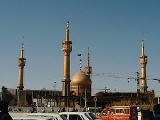
Mausoleum of Khomeini

Encyclopedia
The Mausoleum
of Ayatollah
Khomeini houses the tomb of Ruhollah Moosavi Khomeini
and Ahmad Khomeini
, his second son who died in 1995. It is located to the south of Tehran
in the Behesht-e Zahra
(the Paradise of Zahra) cemetery. Construction commenced in 1989 following Khomeini's death on June 3 of that year. It is still under construction, but when completed will be the centerpiece in a complex spread over 5000 acres (20.2 km²), housing a cultural and tourist center, a university for Islam
ic studies, a seminary, a shopping mall, and a 20,000-car parking lot. The Iran
ian government has reportedly devoted US$
2 billion to this development.
The site is a place of pilgrimage
for followers of Khomeini. It is used symbolically by government figures, and is on occasion visited by foreign dignitaries. Khomeini's grandson Hassan Khomeini
is in charge of caring for the mausoleum.
On June 20, 2009 a suicide bomb attack reportedly occurred near the site of the Mausoleum, according to Iranian state-controlled media.
 The architect of the tomb was Mohammed Tehrani. The exterior of the shrine complex is a highly recognizable landmark. It has a gold dome sitting on a high drum, surrounded by four free-standing minaret
s. The shrine is surrounded by a large rectangular plaza which has been designed to hold vast numbers of visitors. With its size, inclusion of a qibla
wall and a maqsura, the tomb resembles a mosque
, but has been called an Hussainia
.
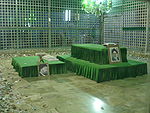
Inside, Khomeini's sarcophagus
is centrally placed under the gilded dome. The dome sits above a transition zone with two layers of clerestories
, decorated with stained glass depicting tulip
s (an Iranian symbol of martyrdom). The dome is supported by eight large marble
columns that circle the sarcophagus, that together with other smaller columns support the space frame ceiling. The ceiling is also punctuated by clerestories. The floor and wall surfaces are made of polished white marble. The floor is covered with fine carpets.
_by_night2.jpg) Non-Muslims are allowed inside the complex.
Non-Muslims are allowed inside the complex.
Mausoleum
A mausoleum is an external free-standing building constructed as a monument enclosing the interment space or burial chamber of a deceased person or persons. A monument without the interment is a cenotaph. A mausoleum may be considered a type of tomb or the tomb may be considered to be within the...
of Ayatollah
Ayatollah
Ayatollah is a high ranking title given to Usuli Twelver Shī‘ah clerics. Those who carry the title are experts in Islamic studies such as jurisprudence, ethics, and philosophy and usually teach in Islamic seminaries. The next lower clerical rank is Hojatoleslam wal-muslemin...
Khomeini houses the tomb of Ruhollah Moosavi Khomeini
Ruhollah Khomeini
Grand Ayatollah Sayyed Ruhollah Musavi Khomeini was an Iranian religious leader and politician, and leader of the 1979 Iranian Revolution which saw the overthrow of Mohammad Reza Pahlavi, the Shah of Iran...
and Ahmad Khomeini
Ahmad Khomeini
Ahmad Khomeini , was the younger son of Ayatollah Ruhollah Khomeini. His wife is Fatemeh Soltani Tabatabai, daughter of Grand Ayatollah Mohammad Bagher Soltani Tabatabai Borujerdi and niece of Imam Musa Sadr, the Shī‘ah religious leader of Libanon.Ahmad Khomeini was close to his father, the leader...
, his second son who died in 1995. It is located to the south of Tehran
Tehran
Tehran , sometimes spelled Teheran, is the capital of Iran and Tehran Province. With an estimated population of 8,429,807; it is also Iran's largest urban area and city, one of the largest cities in Western Asia, and is the world's 19th largest city.In the 20th century, Tehran was subject to...
in the Behesht-e Zahra
Behesht-e Zahra
Behesht-e Zahra , is the largest cemetery in Iran. Located in the southern part of metropolitan Tehran, it is connected to the city by a metro line. The cemetery has been one of the inspirations for the popular webcomic, Zahra's Paradise.-History:...
(the Paradise of Zahra) cemetery. Construction commenced in 1989 following Khomeini's death on June 3 of that year. It is still under construction, but when completed will be the centerpiece in a complex spread over 5000 acres (20.2 km²), housing a cultural and tourist center, a university for Islam
Islam
Islam . The most common are and . : Arabic pronunciation varies regionally. The first vowel ranges from ~~. The second vowel ranges from ~~~...
ic studies, a seminary, a shopping mall, and a 20,000-car parking lot. The Iran
Iran
Iran , officially the Islamic Republic of Iran , is a country in Southern and Western Asia. The name "Iran" has been in use natively since the Sassanian era and came into use internationally in 1935, before which the country was known to the Western world as Persia...
ian government has reportedly devoted US$
United States dollar
The United States dollar , also referred to as the American dollar, is the official currency of the United States of America. It is divided into 100 smaller units called cents or pennies....
2 billion to this development.
The site is a place of pilgrimage
Pilgrimage
A pilgrimage is a journey or search of great moral or spiritual significance. Typically, it is a journey to a shrine or other location of importance to a person's beliefs and faith...
for followers of Khomeini. It is used symbolically by government figures, and is on occasion visited by foreign dignitaries. Khomeini's grandson Hassan Khomeini
Hassan Khomeini
Seyyed Hassan Khomeini is a "mid-ranking" Iranian cleric. He is the grandson of the founder of the Islamic Republic of Iran, Ayatollah Khomeini, and son of the late Hojat-Ol Eslam Ahmad Khomeini...
is in charge of caring for the mausoleum.
On June 20, 2009 a suicide bomb attack reportedly occurred near the site of the Mausoleum, according to Iranian state-controlled media.
Specifications
Minaret
A minaret مناره , sometimes مئذنه) is a distinctive architectural feature of Islamic mosques, generally a tall spire with an onion-shaped or conical crown, usually either free standing or taller than any associated support structure. The basic form of a minaret includes a base, shaft, and gallery....
s. The shrine is surrounded by a large rectangular plaza which has been designed to hold vast numbers of visitors. With its size, inclusion of a qibla
Qibla
The Qiblah , also transliterated as Qibla, Kiblah or Kibla, is the direction that should be faced when a Muslim prays during salah...
wall and a maqsura, the tomb resembles a mosque
Mosque
A mosque is a place of worship for followers of Islam. The word is likely to have entered the English language through French , from Portuguese , from Spanish , and from Berber , ultimately originating in — . The Arabic word masjid literally means a place of prostration...
, but has been called an Hussainia
Hussainia
A Hussainia, also known as an Ashurkhana or Imambargah, is a congregation hall for Shia commemoration ceremonies, especially those associated with the Remembrance of Muharram. The name comes from Husayn Ibn Ali, the grandson of Muhammad and an Imam of the Shia. Hussain was killed by Yazid I in...
.
Inside, Khomeini's sarcophagus
Sarcophagus
A sarcophagus is a funeral receptacle for a corpse, most commonly carved or cut from stone. The word "sarcophagus" comes from the Greek σαρξ sarx meaning "flesh", and φαγειν phagein meaning "to eat", hence sarkophagus means "flesh-eating"; from the phrase lithos sarkophagos...
is centrally placed under the gilded dome. The dome sits above a transition zone with two layers of clerestories
Clerestory
Clerestory is an architectural term that historically denoted an upper level of a Roman basilica or of the nave of a Romanesque or Gothic church, the walls of which rise above the rooflines of the lower aisles and are pierced with windows. In modern usage, clerestory refers to any high windows...
, decorated with stained glass depicting tulip
Tulip
The tulip is a perennial, bulbous plant with showy flowers in the genus Tulipa, which comprises 109 species and belongs to the family Liliaceae. The genus's native range extends from as far west as Southern Europe, North Africa, Anatolia, and Iran to the Northwest of China. The tulip's centre of...
s (an Iranian symbol of martyrdom). The dome is supported by eight large marble
Marble
Marble is a metamorphic rock composed of recrystallized carbonate minerals, most commonly calcite or dolomite.Geologists use the term "marble" to refer to metamorphosed limestone; however stonemasons use the term more broadly to encompass unmetamorphosed limestone.Marble is commonly used for...
columns that circle the sarcophagus, that together with other smaller columns support the space frame ceiling. The ceiling is also punctuated by clerestories. The floor and wall surfaces are made of polished white marble. The floor is covered with fine carpets.
See also
- Behesht-e ZahraBehesht-e ZahraBehesht-e Zahra , is the largest cemetery in Iran. Located in the southern part of metropolitan Tehran, it is connected to the city by a metro line. The cemetery has been one of the inspirations for the popular webcomic, Zahra's Paradise.-History:...
- Holiest sites in Islam (Shia)Holiest sites in Islam (Shia)In addition to the three Mosques accepted by all Muslims as holy sites, Shī'ah Muslims consider sites associated with Muhammad, his family members and descendants , their companions, and the Prophets as holy places...
- Imām Ridhā MosqueImam Reza shrineImām Reza shrine in Mashhad, Iran is a complex which contains the mausoleum of Imam Reza, the eighth Imām of Twelver Shi'ites. It is the largest mosque in the world by dimension and the second largest in capacity...
- Fatimah al-Ma'sūmah MosqueFatima al-Masumeh ShrineThe shrine of Fatema Mæ'sume is located in Qom, the second most sacred city in Iran after Mashhad. Much of the shrine complex was first built by Shah Abbas I in the early 17th century. The shrine has attracted to itself dozens of seminaries and religious schools...
- Shāh Abdol Azīm Mosque