

Moai

Encyclopedia
Monolith
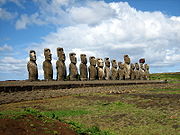
A monolith is a geological feature such as a mountain, consisting of a single massive stone or rock, or a single piece of rock placed as, or within, a monument...
ic human figures carved from rock on the Chilean Polynesia
Polynesia
Polynesia is a subregion of Oceania, made up of over 1,000 islands scattered over the central and southern Pacific Ocean. The indigenous people who inhabit the islands of Polynesia are termed Polynesians and they share many similar traits including language, culture and beliefs...
n island of Easter Island
Easter Island
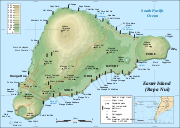
Easter Island is a Polynesian island in the southeastern Pacific Ocean, at the southeasternmost point of the Polynesian triangle. A special territory of Chile that was annexed in 1888, Easter Island is famous for its 887 extant monumental statues, called moai, created by the early Rapanui people...
between the years 1250 and 1500. Nearly half are still at Rano Raraku
Rano Raraku
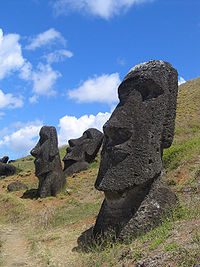
Rano Raraku is a volcanic crater formed of consolidated volcanic ash, or tuff, and located on the lower slopes of Terevaka in the Rapa Nui National Park on Easter Island. It was a quarry for about 500 years until the early eighteenth century, and supplied the stone from which about 95% of the...
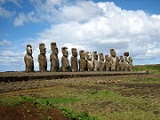
, the main moai quarry, but hundreds were transported from there and set on stone platforms called ahu around the island's perimeter. Almost all moai have overly large heads three-fifths the size of their bodies. The moai are chiefly the living faces (aringa ora) of deified ancestors (aringa ora ata tepuna). The statues still gazed inland across their clan lands when Europeans first visited the island, but most would be cast down during later conflicts between clans.
The 887 statues' production and transportation is considered a remarkable creative and physical feat. The tallest moai erected, called Paro, was almost 10 metres (32.8 ft) high and weighed 82 ton
Ton
The ton is a unit of measure. It has a long history and has acquired a number of meanings and uses over the years. It is used principally as a unit of weight, and as a unit of volume. It can also be used as a measure of energy, for truck classification, or as a colloquial term.It is derived from...
s; the heaviest erected was a shorter but squatter moai at Ahu Tongariki
Ahu Tongariki
Ahu Tongariki is the largest ahu on Rapa Nui/Easter Island . Its moai were toppled during the island's civil wars and in the twentieth century the ahu was swept inland by a tsunami. It has since been restored and has fifteen moai including an 86 tonne moai that was the heaviest ever erected on the...
, weighing 86 tons
Tons
Tons can refer to:* Tons River, a major river in India* the plural of ton, a unit of mass, force, volume, energy or power* short ton, 2,000 pounds, used in the United States...
; and one unfinished sculpture, if completed, would have been approximately 21 metres (68.9 ft) tall with a weight of about 270 tons
Tons
Tons can refer to:* Tons River, a major river in India* the plural of ton, a unit of mass, force, volume, energy or power* short ton, 2,000 pounds, used in the United States...
.
Description
Polynesia
Polynesia is a subregion of Oceania, made up of over 1,000 islands scattered over the central and southern Pacific Ocean. The indigenous people who inhabit the islands of Polynesia are termed Polynesians and they share many similar traits including language, culture and beliefs...
. Moai are carved in relatively flat planes, the faces bearing proud but enigmatic expressions. The over-large heads (a three-to-five ratio between the head and the body, a sculptural trait that demonstrates the Polynesian belief in the sanctity of the chiefly head) have heavy brows and elongated noses with a distinctive fish-hook-shaped curl of the nostrils. The lips protrude in a thin pout. Like the nose, the ears are elongated and oblong in form. The jaw lines stand out against the truncated neck. The torsos are heavy, and, sometimes, the clavicles are subtly outlined in stone. The arms are carved in bas relief and rest against the body in various positions, hands and long slender fingers resting along the crests of the hips, meeting at the hami (loincloth), with the thumbs sometimes pointing towards the navel. Generally, the anatomical features of the backs are not detailed, but sometimes bear a ring and girdle motif on the buttocks and lower back. Except for one kneeling moai, the statues do not have legs.
Though moai are whole-body statues, they are commonly referred to as "Easter Island heads". This is partly because of the disproportionate size of most moai heads and partly because, from the invention of photography until the 1950s, the only moai standing on the island were the statues on the slopes of Rano Raraku
Rano Raraku
Rano Raraku is a volcanic crater formed of consolidated volcanic ash, or tuff, and located on the lower slopes of Terevaka in the Rapa Nui National Park on Easter Island. It was a quarry for about 500 years until the early eighteenth century, and supplied the stone from which about 95% of the...
, many of which are buried to their shoulders. Some of the "heads" at Rano Raraku have been excavated and their bodies seen, and observed to have markings that had been protected from erosion by their burial.
All but 53 of the 887 moai known to date were carved from tuff
Tuff
Tuff is a type of rock consisting of consolidated volcanic ash ejected from vents during a volcanic eruption. Tuff is sometimes called tufa, particularly when used as construction material, although tufa also refers to a quite different rock. Rock that contains greater than 50% tuff is considered...
(a compressed volcanic ash). At the end of carving, the builders would rub the statue with pumice from Rano Raraku, where 394 moai and incomplete moai are still visible today (there are also 13 moai carved from basalt
Basalt
Basalt is a common extrusive volcanic rock. It is usually grey to black and fine-grained due to rapid cooling of lava at the surface of a planet. It may be porphyritic containing larger crystals in a fine matrix, or vesicular, or frothy scoria. Unweathered basalt is black or grey...
, 22 from trachyte
Trachyte
Trachyte is an igneous volcanic rock with an aphanitic to porphyritic texture. The mineral assemblage consists of essential alkali feldspar; relatively minor plagioclase and quartz or a feldspathoid such as nepheline may also be present....
and 17 from fragile red scoria
Scoria
Scoria is a volcanic rock containing many holes or vesicles. It is most generally dark in color , and basaltic or andesitic in composition. Scoria is relatively low in mass as a result of its numerous macroscopic ellipsoidal vesicles, but in contrast to pumice, all scoria has a specific gravity...
).
Characteristics
Eyes
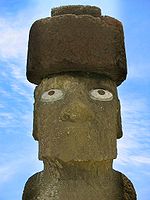
In 1979, Sergio Rapu Haoa and a team of archaeologists discovered that the hemispherical or deep elliptical eye sockets were designed to hold coral eyes with either black obsidianObsidian
Obsidian is a naturally occurring volcanic glass formed as an extrusive igneous rock.It is produced when felsic lava extruded from a volcano cools rapidly with minimum crystal growth...
or red scoria pupils. The discovery was made by collecting and reassembling broken fragments of white coral that were found at the various sites. Subsequently, previously uncategorized finds in the Easter Island museum were re-examined and recategorized as eye fragments. It is thought that the moai with carved eye sockets were probably allocated to the ahu and ceremonial sites, suggesting that a selective Rapa Nui hierarchy was attributed to the moai design until its demise with the advent of the Birdman religion, Tangata Manu
Tangata manu
The Tangata manu , was the winner of a traditional competition on Rapa Nui . The ritual was an annual competition to collect the first Sooty Tern egg of the season from the islet of Motu Nui, swim back to Rapa Nui and climb the sea cliff of Rano Kau to the clifftop village of Orongo.-Myth:In the...
.
Pukao topknots and headdresses
Some moai had pukao on their heads; these were carved out of red scoria, a very light rock from a quarry at Puna PauPuna Pau
Puna Pau is a quarry in a small crater or cinder cone on the outskirts of Hanga Roa in the south west of Easter Island...
.

Markings (post stone working)
When first carved, the surface of the moai was polished smooth by rubbing with pumice. Unfortunately, the easily worked tuff from which most moai were carved is also easily eroded, and, today, the best place to see the surface detail is on the few moai carved from basalt or in photographs and other archaeological records of moai surfaces protected by burial.Those moai that are less eroded typically have designs carved on their backs and posteriors. The Routledge
Katherine Routledge
Katherine Maria Routledge, née Pease was a British archaeologist who initiated the first true survey of Easter Island....
expedition of 1914 established a cultural link between these designs and the island's traditional tattooing, which had been repressed by missionaries a half-century earlier. Until modern DNA analysis of the islanders and their ancestors, this was key scientific evidence that the moai had been carved by the Rapa Nui and not by a separate group from South America
South America
South America is a continent situated in the Western Hemisphere, mostly in the Southern Hemisphere, with a relatively small portion in the Northern Hemisphere. The continent is also considered a subcontinent of the Americas. It is bordered on the west by the Pacific Ocean and on the north and east...
.
At least some of the moai were painted; Hoa Hakananai'a
Hoa Hakananai'a
Hoa Hakananai'a is a moai housed in the British Museum in London. The name Hoa hakanani'a is from the Rapa Nui language; it means "stolen or hidden friend." It was removed from Orongo, Easter Island on 7 November 1868 by the crew of the English ship HMS Topaze, and arrived in Portsmouth on 25...
was decorated with maroon and white paint until 1868, when it was removed from the island. It is now housed in the British Museum
British Museum
The British Museum is a museum of human history and culture in London. Its collections, which number more than seven million objects, are amongst the largest and most comprehensive in the world and originate from all continents, illustrating and documenting the story of human culture from its...
, London.
History
Polynesians
The Polynesian peoples is a grouping of various ethnic groups that speak Polynesian languages, a branch of the Oceanic languages within the Austronesian languages, and inhabit Polynesia. They number approximately 1,500,000 people...
colonizers of the island, mostly between circa 1250 CE and 1500 CE. In addition to representing deceased ancestors, the moai, once they were erected on ahu, may also have been regarded as the embodiment of powerful living or former chiefs and important lineage status symbols.
Completed statues were moved to ahu mostly on the coast, then erected, sometimes with red stone cylinders (pukao) on their heads. Moai must have been extremely expensive to craft and transport; not only would the actual carving of each statue require effort and resources, but the finished product was then hauled to its final location and erected.
The quarries in Rano Raraku appear to have been abandoned abruptly, with a litter of stone tools, many completed moai outside the quarry awaiting transport and almost as many incomplete statues still in situ as were installed on ahu. In the nineteenth century, this led to conjecture that the island was the remnant of a sunken continent and that most completed moai were under the sea. That idea has long been debunked, and now it is understood that:
- Some statues were rock carvings and never intended to be completed.
- Some were incomplete because, when inclusions were encountered, the carvers would abandon a partial statue and start a new one (tuff is a soft rock with occasional lumps of much harder rock included in it).
- Some completed statues at Rano Raraku were placed there permanently and not parked temporarily awaiting removal.
- Some were indeed incomplete when the statue-building era came to an end.
Craftsmen
The moai were either carved by a distinguished class of professional carvers who were comparable in status to high-ranking members of other Polynesian craft guilds, or, alternatively, by members of each clan. The oral histories show that the Rano RarakuRano Raraku
Rano Raraku is a volcanic crater formed of consolidated volcanic ash, or tuff, and located on the lower slopes of Terevaka in the Rapa Nui National Park on Easter Island. It was a quarry for about 500 years until the early eighteenth century, and supplied the stone from which about 95% of the...
quarry was subdivided into different territories for each clan.
Transportation
Since the island was treeless by the time the Europeans first visited, the movement of the statues was a mystery for a long time; pollen analysis has now established that the island was almost totally forested until 1200 CE. The tree pollen disappeared from the record by 1650, and the statues stopped being made around that time.It is not known exactly how the moai were moved across the island, but the process almost certainly required human energy, ropes, and possibly wooden sledges (sleds) and/or rollers, as well as leveled tracks across the island (the Easter Island roads).
Oral histories recount how various people used divine power to command the statues to walk. The earliest accounts say a king named Tuu Ku Ihu moved them with the help of the god Makemake
Makemake (mythology)
Makemake in the Rapa Nui mythology of Easter Island, was the creator of humanity, the god of fertility and the chief god of the "Tangata manu" or bird-man cult .He is a frequent subject of the island's Petroglyphs.-In Astronomy:The trans-Neptunian...
, while later stories tell of a woman who lived alone on the mountain ordering them about at her will. Scholars currently support the theory that the main method was that the moai were "walked" upright (some assume by a rocking process), as laying it prone on a sledge (the method used by the Easter Islanders to move stone in the 1860s) would have required an estimated 1500 people to move the largest moai that had been successfully erected. In 1998, Jo Anne Van Tilburg
Jo Anne Van Tilburg
Jo Anne Van Tilburg is an American archaeologist best known for her research on the statues of Easter Island . Her primary specialty is rock art....
suggested fewer than half that number could do it by placing the sledge on lubricated rollers. In 1999, she supervised an experiment to move a nine-ton moai. They attempted to load a replica on a sledge built in the shape of an A frame that was placed on rollers. A total of 60 people pulled on several ropes in two attempts to tow the moai. The first attempt failed when the rollers jammed up. The second attempt succeeded when they embedded tracks in the ground. This was on flat ground; further experiments may be necessary to determine whether this will work on rougher terrain.
Pavel Pavel
Pavel Pavel is a Czech engineer and experimental archaeologist investigating how the ancient civilizations did transport heavy weights....
, Thor Heyerdahl
Thor Heyerdahl
Thor Heyerdahl was a Norwegian ethnographer and adventurer with a background in zoology and geography. He became notable for his Kon-Tiki expedition, in which he sailed by raft from South America to the Tuamotu Islands...
and the Kon Tiki Museum experimented with a five-ton moai and a nine-ton moai. With a rope around the head of the statue and another around the base, using eight workers for the smaller statue and 16 for the larger, they "walked" the moai forward by swiveling and rocking it from side to side; however, the experiment was ended early due to damage to the statue bases from chipping. Despite the early end to the experiment, Thor Heyerdahl estimated that this method for a 20-ton statue over Easter Island terrain would allow 320 feet (97.5 m) per day. Other scholars concluded that it was probably not the way the moai were moved.
Around the same time, archaeologist Charles Love experimented with a 10-ton replica. His first experiment found rocking the statue to walk it was too unstable over more than a few hundred yards. He then found that placing the statue upright on two sled runners atop log rollers, 25 men were able to move the statue 150 feet (45.7 m) in two minutes. In 2003, further research indicated this method could explain the regularly spaced post holes where the statues were moved over rough ground. He suggested the holes contained upright posts on either side of the path so that as the statue passed between them, they were used as cantilevers for poles to help push the statue up a slope without the requirement of extra people pulling on the ropes and similarly to slow it on the downward slope. The poles could also act as a brake when needed.
1722–1868 toppling of the moai
After the 1722 RoggeveenJakob Roggeveen
Jacob Roggeveen was a Dutch explorer who was sent to find Terra Australis, but he instead came across Easter Island...
visit, all of the moai that had been erected on ahus were toppled, with the last standing statues reported in 1838 by Abel Aubert Dupetit Thouars
Abel Aubert Dupetit Thouars
Abel Aubert Dupetit Thouars was a French naval officer important in France's anexation of French Polynesia.He was born at the castle of La Fessardière, near Saumur. His uncle Aristide Aubert Dupetit-Thouars was of the heroes of the Battle of the Nile...
, and no upright statues by 1868, apart from the partially buried ones on the outer slopes of Rano Raraku. Oral histories indicate that this was part of a deadly conflict among the islanders, rather than an earthquake or other cause. Most of the moai were toppled forward to where their faces were hidden and often were toppled in such a way that their necks broke. Today, about 50 moai have been re-erected on their ahus or museums elsewhere.
Removal
Eleven or more moai have been removed from the island and transported to locations around the world, including six out of the thirteen moai that were carved from basalt.Preservation and restoration
William Mulloy
William Thomas Mulloy, Jr. was an American anthropologist. While his early research established him as a formidable scholar and skillful fieldwork supervisor in the province of North American Plains archaeology, he is best known for his studies of Polynesian prehistory, especially his...
, undertook extensive investigation of the production, transportation and erection of Easter Island's monumental statuary
Monument
A monument is a type of structure either explicitly created to commemorate a person or important event or which has become important to a social group as a part of their remembrance of historic times or cultural heritage, or simply as an example of historic architecture...
. Mulloy's Rapa Nui projects include the investigation of the Akivi-Vaiteka Complex
Ahu Akivi
Ahu Akivi is an ahu with seven moai on Rapa Nui in Chilean Polynesia. The ahu and its moai were restored in 1960 by the American archaeologist William Mulloy and his Chilean colleague, Gonzalo Figueroa García-Huidobro...
and the physical restoration of Ahu Akivi
Ahu Akivi
Ahu Akivi is an ahu with seven moai on Rapa Nui in Chilean Polynesia. The ahu and its moai were restored in 1960 by the American archaeologist William Mulloy and his Chilean colleague, Gonzalo Figueroa García-Huidobro...
(1960); the investigation and restoration of Ahu Ko Te Riku
Ahu Tahai
The Tahai Ceremonial Complex is an archaeological site on Rapa Nui in Chilean Polynesia. Restored in 1974 by the late Dr. William Mulloy, an American archaeologist, Tahai comprises three principal ahu from north to south: Ko Te Riku , Tahai, and Vai Ure...
and Ahu Vai Uri
Ahu Tahai
The Tahai Ceremonial Complex is an archaeological site on Rapa Nui in Chilean Polynesia. Restored in 1974 by the late Dr. William Mulloy, an American archaeologist, Tahai comprises three principal ahu from north to south: Ko Te Riku , Tahai, and Vai Ure...
and the Tahai Ceremonial Complex
Ahu Tahai
The Tahai Ceremonial Complex is an archaeological site on Rapa Nui in Chilean Polynesia. Restored in 1974 by the late Dr. William Mulloy, an American archaeologist, Tahai comprises three principal ahu from north to south: Ko Te Riku , Tahai, and Vai Ure...
(1970); the investigation and restoration of two ahu at Hanga Kio'e (1972); the investigation and restoration of the ceremonial village at Orongo
Orongo
‘Orongo is a stone village and ceremonial centre at the southwestern tip of Rapa Nui . The first half of the ceremonial village's 53 stone masonry houses were investigated and restored in 1974 by American archaeologist William Mulloy...
(1974) and numerous other archaeological surveys throughout the island.
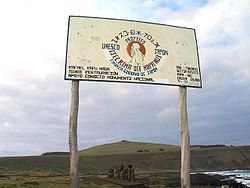
The Rapa Nui National Park
Rapa Nui National Park
Rapa Nui National Park is a World Heritage Site located on Easter Island, Chile. The park is divided into seven sections:*Rano Kau *Puna Pau ....
and the moai are included on the 1994 list of UNESCO
UNESCO
The United Nations Educational, Scientific and Cultural Organization is a specialized agency of the United Nations...
World Heritage sites and consequently the 1972 UN convention concerning the protection of the world's cultural and natural heritage.
The EISP (Easter Island Statue Project) is the latest research and documentation project of the moai on Rapa Nui and the artifacts held in museums overseas. The purpose of the project is to understand the figures' original use, context, and meaning, with the results being provided to the Rapa Nui families and the island's public agencies that are responsible for conservation and preservation of the moai.
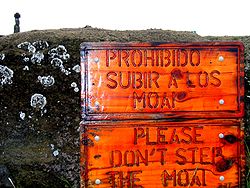
In 2008, a Finnish tourist chipped a piece off the ear of one moai. The tourist was fined $17,000 in damages and was banned from the island for three years.
See also
- MaraeMaraeA marae malae , malae , is a communal or sacred place which serves religious and social purposes in Polynesian societies...
— The PolynesiaPolynesiaPolynesia is a subregion of Oceania, made up of over 1,000 islands scattered over the central and southern Pacific Ocean. The indigenous people who inhabit the islands of Polynesia are termed Polynesians and they share many similar traits including language, culture and beliefs...
n ceremonial sites from which the moai and ahu traditions evolved. - Ancestor worship
- List of megalithic sites
- Dol hareubangDol hareubangDol hareubangs, also called tol harubangs, hareubangs, harubangs, are large mushroom-like statues found on Jeju Island off the southern tip of Korea...