
In Depth
See Also

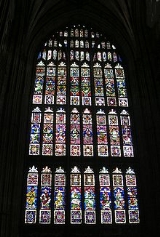
Stained glass

The term stained glass refers either to the material of coloured glass Glass

Glass is a uniform amorphous solid [i] material, usually produced when the viscous molten material cools ... 

 or to the art and craft of working with it. As a material the term generally refers to glass that has been coloured by adding metallic salts during its manufacture. Painted details and yellow stain are often used to enhance the design. The term is also applied to windows in which all the colours have been painted onto the glass and then annealed in a furnace. Stained glass, as an art Art

By its original and broadest definition, art is the product or process of the effective application... 

 and a craft, requires the artistic skill to conceive the design, and the engineering skills necessary to assemble the decorative piece, traditionally a window, so that it is capable of supporting its own weight and surviving the elements.

Discussions

  Discussion Features

   Ask a question about 'Stained glass'

   Start a new discussion about 'Stained glass'

   Answer questions about 'Stained glass'

   'Stained glass' discussion forum

Timeline

406   Stained glass is used for the first time in churches in Rome. =


Encyclopedia


The term stained glass refers either to the material of coloured glass Glass

Glass is a uniform amorphous solid [i] material, usually produced when the viscous molten material cools ... 

 or to the art and craft of working with it.

As a material the term generally refers to glass that has been coloured by adding metallic salts during its manufacture. Painted details and yellow stain are often used to enhance the design. The term is also applied to windows in which all the colours have been painted onto the glass and then annealed in a furnace.

Stained glass, as an art Art

By its original and broadest definition, art is the product or process of the effective application... 

 and a craft, requires the artistic skill to conceive the design, and the engineering skills necessary to assemble the decorative piece, traditionally a window, so that it is capable of supporting its own weight and surviving the elements.

Although usually described as stained glass windows the purpose of stained glass is not to allow those within a building to see out or even primarily to admit light but rather to control it. As such stained glass windows have been described as 'illuminated wall decorations'.

The design of a window may be non-figurative or figurative. It may incorporate narratives drawn from the Bible, History or Literature, or represent saints or patrons. It may have symbolic motifs, in particular armorial. Windows within a building may be thematic, for example:- within a church- episodes from the life of Christ; within a parliament building- shields of the constituencies; within a college hall- figures representing the arts and sciences.

Manufacture


Glass production


From the 10th or 11th century, when stained glass began to flourish as an art, glass factories were set up where there was a ready supply of silica, the essential product of glass manufacture. Glass was usually coloured by adding metallic oxides to the glass while in a molten state in a clay pot over a furnace. Glass coloured in this way was known as pot metal. Copper oxides were added to produce green, cobalt for blue, and gold was added to produce red glass.

Cylinder glass
This glass was then collected from the pot into a molten globule and blown, being continually manipulated until it formed a large cylindrical bottle shape of even diameter and wall-thickness. It was then cut open, laid flat and annealed to make it stable. This is the type of glass most commonly used for ancient stained glass windows.

Crown glass
This glass was partly blown into a hollow vessel, then put onto a revolving table which could be rapidly spun like a potter's wheel. The centrifugal force caused the molten material to flattened and spread outwards. It could then be cut into small sheets. This glass could be made coloured and used for stained glass windows, but is typically associated with small paned windows of 16th and 17th century houses. The curving ripples are characteristic. At the centre of each piece of glass thus produced was a thicker piece. These were sometimes used for the special effect created by their lumpy, refractive quality. They are known as bull's eyes and are feature of late 19th century domestic lead lighting and are sometimes used with cathedral glass Cathedral glass

Cathedral glass is the name given commercially to monochromatic sheet glass, which is thin by comparison... 

or quarry glass in church windows of that date.

Table glass
This glass was produced by tipping the molten glass onto a metal table and sometimes rolling it. The glass thus produced was heavily textured by the reaction of the glass with the cold metal. Glass of this appearance is commercially produced and widely used today, under the name of cathedral glass Cathedral glass

Cathedral glass is the name given commercially to monochromatic sheet glass, which is thin by comparison... 

, although it was not the type of glass favoured for stained glass in ancient cathedrals. It has been much used for lead lighting in churches in the 20th century.

Flashed glass
Red pot metal glass was often undesirably dark in colour and prohibitively expensive. The method developed to produce red glass was called flashing. In this procedure, a semi-molten cylinder of colourless glass was dipped into a pot of red glass so that the red glass formed a thin coating. The laminated glass thus formed was cut, flattened and heat annealed.

There were a number of advantages to this technique. It allowed a variety in the depth of red, ranging from very dark and almost opaque, through ruby red to pale and sometimes streaky red that was often used for thin border pieces. The other advantage was that the red of double-layered glass could be engraved or abraded to show colourless glass underneath. In the late Medieval glass this method was often employed to add rich patterns to the robes of Saints. The other advantage, much exploited by late Victorian and early 20th century artists, was that sheets could be flashed in which the depth of colour varied across the sheet. Some stained glass studios, notably Lavers and Barraud, made extensive use of large segments of irregularly flashed glass in robes and draperies.

There still exist a number of glass factories, notably in Germany, USA,
England, France, Poland and Russia which continue to produce high quality glass by traditional methods primarily for the restoration of ancient windows. Modern stained glass windows often use machine made glass, slab glass, which as its name suggests is very thick, and so-called cathedral glass Cathedral glass

Cathedral glass is the name given commercially to monochromatic sheet glass, which is thin by comparison... 

 which is sometimes heavily textured.

Creating stained glass windows


  • The first stage in the production of a window was to make, or acquire from the architect or owners of the building, an accurate template of the window opening that the glass was to fit.


  • The subject matter of the window was determined to suit the location, a particular theme, or the whim of the patron. A small design called a Vidimus was prepared which could be shown to the patron.


  • A narrative window would have glass panels which related a story. A figurative window would have rows of saints. Certain scriptural texts would sometimes be included and perhaps the names of the patrons or the person as whose memorial the window was dedicated. It was usually at the discretion of the designer to fill the surrounding areas with borders, floral motifs and canopies.


  • A full sized cartoon was drawn for every "light" of the window. A small window might typically be of two lights, with some simple tracery lights above. A large window might have four or five lights. The east or west window of a large cathedral might have seven lights in three tiers with elaborate tracery. In Medieval times the cartoon was drawn straight onto a whitewashed table, which was then used for cutting, painting and assembling the window.


  • The designer would take into account the design, the structure of the window, the nature and size of the glass available and his own preferred technique. The cartoon would then be divided into a patchwork as a template for each small glass piece. The exact position of the lead which held the glass in place was part of the calculated visual effect.


  • Each piece of glass was selected for the desired coloured and cut to match a section of the template. An exact fit was ensured by grozing the edges with a tool which could nibble off small pieces.


  • Details of faces, hair and hands were painted onto the inner surface of the glass in a special glass paint which contained finely ground lead or copper filings, ground glass, gum arabic and a medium such as wine, vinegar or urine. The art of painting details became increasingly elaborate and reached its height in the early 20th century.


  • Once the window was cut and painted, the pieces were assembled by slotting them into H-sectioned lead cames. The joints were then all soldered together and the glass pieces were stopped from rattling and the window made weatherproof by forcing a soft oily cement or mastic between the glass and the cames.


  • When the windows were inserted into the window spaces, iron rods were put across at various point, to support the weight of the window, which was tied to the rod by copper wire. Some very large early Gothic windows are divided into sections by heavy metal frames. This method of support was also favoured for large, usually painted, windows of the Baroque period.


  • From 1300 onwards, artists started using silver stain which was made with silver nitrate. It gave a yellow effect ranging from pale lemon to deep orange. It was usually painted onto the outside of a piece of glass, then fired to make it permanent. This yellow was particularly useful for enhancing borders, canopies and haloes, and turning blue glass into green grass.


  • By about 1450 a stain know as Cousin's Rose was used to enhance flesh tones.


  • In the 1500s a range of glass stains were introduced, most of them coloured by ground glass particles. They were a form of enamel. Painting on glass with these stains was initially used for small heraldic designs and other details. By the 1600s a style of stained glass had evolved that was no longer dependent upon the skilful cutting of coloured glass into sections. Scenes were painted onto glass panels of square format, like tiles. The colours were annealed to the glass and the pieces were assembled into metal frames.


  • In modern windows, copper foil is now sometimes used instead of lead. For further technical details, see Lead came and copper foil glasswork Lead came and copper foil glasswork

    Lead came and Copper foil glasswork are the arts and crafts [i] of cutting colored glass [i] and j ... 

    .

Technical details


History


Origins


Coloured glass has been produced since ancient times. Both the Egyptians and the Romans excelled at the manufacture of small coloured glass objects. The British Museum holds two of the finest Roman pieces, the Lycurgis Cup, which is a murky mustard colour but glows purple-red to transmitted light, and the Portland vase which is midnight blue, with a carved white overlay.

In Early Christian churches of the 4th and 5th centuries there are many remaining windows which are filled with ornate patterns of thinly-sliced alabaster set into wooden frames, giving a stained-glass like effect. Similar effects were achieved with greater elaboration using coloured glass rather than stone by Muslim designers in Western Aisa.

Medieval glass


Stained glass, as an art form, reached its height in the Middle Ages. In the Romanesque and Early Gothic period, from about 950 CE to 1240 CE, the untraceried windows demanded large expanses of glass which of necessity were supported by robust iron frames, such as may be seen at Chartres Cathedral and at the Eastern end of Canterbury Cathedral. As Gothic architecture developed into a more ornate form, windows grew larger, affording greater illumination to the interiors, but were divided into sections by vertical shafts and tracery of stone. The elaboration of form reached its height of complexity in the Flamboyant style in Europe and windows grew still larger with the development of the Perpendicular style in England.

Integrated with the lofty verticals of Gothic cathedrals and parish churches, the glass designs became more daring. The circular form, or rose window Rose window

Most commonly, and especially in Gothic architecture, a rose window is a circular stained glass window [i] ... 

 developed in France from relatively simple windows with pierced openings through slabs of thin stone to wheel windows, as exemplified by that in the West front of Chartres Chartres

Chartres is a town and commune [i] of France [i], prfecture [i] of the Eure-et-Loir [i] ... 

 cathedral, and ultimately to designs of enormous complexity, the tracery being drafted from hundreds of different points, such as those at St. Chapelle, Paris and the Bishop's Eye, Lincoln.

Destruction and continuation


At the Reformation Protestant Reformation

The Protestant Reformation, also referred to as the Protestant Revolution, was a movement in the 1... 

, in England large numbers of these windows were smashed and replaced with plain glass. The dissolution of the monasteries Dissolution of the Monasteries

The Dissolution of the Monasteries, referred to by Roman Catholic [i] writers as the Suppression of t ... 

 under Henry VIII and the injunctions of Oliver Cromwell against 'abused images' resulted in the loss of thousands of windows. Few remain undamaged; of them the windows in the private chapel at Hengrave Hall in Suffolk are among the finest. With the latter wave of destruction the art of glass painting died and was not to be rediscovered in England until the nineteenth century.

In Europe, however, stained glass continued to be produced in the Classical style widely represented in Germany, despite the rise of Protestantism, in Belgium, in France, particularly at the Limoges factory, and at Murano in Italy where stained glass and facetted lead crystal are sometimes in evidence in the same window.
Ultimately, in France the French Revolution brought about the neglect or destruction of many windows.

Revival


The Catholic revival in England, gaining force in the early 19th century, with its renewed interest in the mediaeval church brought a revival of church building in the Gothic style, claimed by John Ruskin John Ruskin

John Ruskin is best known for his work as an art critic [i] and social critic [i], but is remembered as ... 

 to be "the true Catholic style". The architectural movement was led by Augustus Welby Pugin. Many new churches were planted in large towns and many old churches were restored. This brought about a great demand for the revival of the art of stained glass window making.

Hardman of Birmingham

Because of the technical requirements, stained glass making was generally on an industrial scale. Firms such as Hardmans of Birmingham and Clayton and Bell of London employed artists who were never known outside their particular trade but who filled English churches with their glass. Hardmans did much work for other designers. Initially Hardmans used A.W.N. Pugin for their design work, mostly on buildings which he had designed, but on his death in 1852, his nephew J. Hardman Powell took over. A keen Catholic, Powell's work appealed to Anglo-Catholic tastes but he also had a commercial eye and exhibited his works at the Philadephia Exhibition of 1873. After that the firm did a good deal of work in the United States of America.

Famous manufacturers of the mid 19th century

William Morris

Among the foremost designers were the Pre-Raphaelites Pre-Raphaelite Brotherhood

The Pre-Raphaelite Brotherhood was a group of English [i] painter [i]s, poets [i] and critics, f ... 

, William Morris William Morris

William Morris was an English [i] artist, writer, socialist [i] activist and pioneer... 

  and Edward Burne-Jones Edward Burne-Jones

Sir Edward Coley Burne-Jones was an English [i] artist [i]and designer closely associated with t ... 

 . While Burne-Jones was best known as a painter, William Morris's studios created designs for architectural and interior decorating of many sorts including paintings, furniture, tiles and textiles. As part of Morris's enterprise, he set up his own glass works, producing glass to his own and Burne-Jones designs.

Clayton and Bell, and Kempe

Clayton and Bell's output was considerable and it was said that most English churches had one of their windows and many had nothing else. Among their designers was Charles Eamer Kempe Charles Eamer Kempe

Charles Eamer Kempe was a well-known Victorian stained glass [i] designer. ... 

  who set up his own workshop in 1869. His designs were lighter than that of his former employers: it was he who designed all the windows for the chapel of Selwyn College, Cambridge. He is credited with having produced over 3,000 windows. His cousin Walter Tower took over the business - adding a Tower to the Wheatsheaf emblem used by Kempe - and which continued until 1934.

Gallery of 19th and early 20th century windows, displaying four very different styles.

Ward and Hughes, William Wailes

Another important firm was Ward and Hughes which, though it had begun by following the Gothic style changed direction in the 1870s towards a style influenced by the Aesthetic Movement. The firm remained operational until the late 1920s. Yet another was William Wailes  whose firm produced the West window of Gloucester cathedral. Wailes himself was a business man, not a designer but used designers such as Joseph Baguley who eventually set up his own firm.

Tiffany and La Farge

Notable American practitioners include John La Farge John LaFarge

John LaFarge was an American [i] painter, stained glass window maker, decorator, and write ... 

  who invented opalesent glass and for which he received a US patent in 1878, and Louis Comfort Tiffany Louis Comfort Tiffany

Louis Comfort Tiffany was an American artist and designer who is best known for his work in stained glass [i] ... 

 , who is believed to have invented the copper foil method as an alternative to lead, and used it extensively in windows, lamps and other decorations.

Twentieth century


Many of these firms failed in the twentieth century. Much of the work had become merely washed out and colourless; the Gothic movement had been superseded by newer styles. A revival occurred because of the desire to restore the thousands of church windows throughout Europe, destroyed as a result of bombing during the World War II World War II

World War II, or the Second World War, was a worldwide [i] conflict [i] fought betwe ... 

. German artists led the way. Notable artists include Ervin Bossanyi Ervin Bossanyi

[i] until his [[emigration]... 

, Ludwig Schaffrath, Johannes Shreiter and many others who transformed an ancient art form into a contemporary art form.

Thus while there is a deal of often mundane representational work, much of which is not made by its designers but industrially produced, there have been notable examples of symmbolic work of which the west windows of Manchester cathedral Manchester Cathedral

Manchester Cathedral is a Medieval [i] church [i] located on Victoria Street in central Manchester [i] ... 

 in England by Tony Hollaway are some of the finest.

Today there are a few academic establishments that teach the traditional skills. One of those establishments is Florida State University's Master Craftsman Program who recently completed the world's largest secular stained-glass windows installed in Bobby Bowden Field at Doak Campbell Stadium Bobby Bowden Field at Doak Campbell Stadium

Bobby Bowden Field at Doak Campbell Stadium is the football [i] stadium [i] on the campus [i] ... 

. More info at

See also


Technical
  • Architectural glass Architectural glass

    Architectural glass has been used in buildings since the 11th century.... 

  • Arts and crafts
  • Art glass
  • Beveled glass
  • Cathedral glass Cathedral glass

    Cathedral glass is the name given commercially to monochromatic sheet glass, which is thin by comparison... 

  • Drapery glass Drapery glass

    Drapery glass refers to a sheet of heavily folded glass [i] that suggests fabric folds.... 

  • Favrile, Tiffany's iridescent glass
  • Float glass
  • Fracture glass Fracture glass

    Fracture glass refers to a sheet of glass with a pattern of irregularly shaped, thin glass wafers affixe... 

  • Fracture-streamer glass Fracture-streamer glass

    Fracture-streamer glass refers to a sheet of glass with a pattern of glass strings, and irregularly shap... 

  • Glass mosaic
  • Glassblowing Glassblowing

    Glassblowing is the process of forming glass [i] into useful shapes while the glass is in a molten, semi ... 

  • Glass beadmaking Glass beadmaking

    Bead [i]s are amongst the oldest human art and technology, dating back 30,000 years. ... 

  • Hot glass
  • Lead came and copper foil glasswork Lead came and copper foil glasswork

    Lead came and Copper foil glasswork are the arts and crafts [i] of cutting colored glass [i] and j ... 

  • Ring mottle glass Ring mottle glass

    Ring mottle glass refers to sheet glass with a pronounced mottle created by localized, heat-treated opac... 

  • Rippled glass Rippled glass

    Ripple glass refers to a sheet of textured glass with marked surface waves.... 

  • Rose window Rose window

    Most commonly, and especially in Gothic architecture, a rose window is a circular stained glass window [i] ... 

  • Streamer glass Streamer glass

    Streamer glass refers to a sheet of glass with a pattern of glass strings affixed to its surface.... 


Artists
  • Stained glass artists Stained Glass Artists

    Sorry, no overview for this topic 

  • Max Emanuel Ainmiller
  • Mordecai Ardon
  • Ervin Bossanyi Ervin Bossanyi

    [i] until his [[emigration]... 

  • G. Owen Bonawit
  • Marc Chagall Marc Chagall

    Marc Chagall was a Jewish [i] painter who was born in Belarus [i], then part of the Russian Empire [i] ... 

  • Charles Crodel Charles Crodel

    Charles Crodel was a German [i] painter [i] and stained glass [i] artist who also taught at Penn State University [i] ... 

  • Harry Clarke Harry Clarke

    Harry Clarke was an Irish [i] stained glass [i] artist and book illustrator. ... 

  • Marcelle Ferron Marcelle Ferron

    Marcelle Ferron, a Qubcoise [i] painter [i] and stained glass [i] artist, was a maj... 

  • Jim Gary, versatile sculptor whose media included stained glass
  • George Kruger Gray
  • Evie Hone
  • Charles Eamer Kempe Charles Eamer Kempe

    Charles Eamer Kempe was a well-known Victorian stained glass [i] designer. ... 

  • John LaFarge John LaFarge

    John LaFarge was an American [i] painter, stained glass window maker, decorator, and write ... 

  • Francis Lathrop
  • Margaret MacDonald
  • Henri Matisse Henri Matisse

    Henri Matisse was a French [i] artist [i], noted for his use of color [i] and his fluid, brillia ... 

  • Patrick Pye
  • John Radecki
  • Louis Comfort Tiffany Louis Comfort Tiffany

    Louis Comfort Tiffany was an American artist and designer who is best known for his work in stained glass [i] ... 


Other related articles
  • Venetian glass
  • Icons Icon

    An icon is an image, picture, or representation; it is a sign or likeness that stands for an object by ... 

  • Mosaic Mosaic

    Mosaic is the art [i] of decoration with small pieces of colored glass, stone or other material. ... 

  • Paint by number


Business
  • Stained Glass Dealers

Buildings incorporating stained glass windows

Churches and Cathedrals

Stained glass windows were commonly used in churches for decorative and informative purposes. Many windows are donated to churches by members of the congregation as memorials of loved ones. For more information on the use of stained glass to depict religious subjects, see Poor Man's Bible Poor Man's Bible

The term Poor Man's Bible has come into use in modern times to describe works of art within churches... 


  • Churches
  • Cathedrals Cathedral architecture of Western Europe

    The Cathedral [i] is a Christian church housing the seat of a bishop and so takes its name from the word ... 

  • Chapel Chapel

    A chapel is a church [i] or area of worship [i], often small and attached to a larger institution such a ... 

    s


  • Important examples
    • Sainte-Chapelle Sainte-Chapelle

      [i] on the [[Ile de la Cite|Ile de la Cit]... 

      , in Paris Paris

      native_name = Ville de Paris

|common_name = Paris
... 

, France France

France, officially the French Republic, is a country [i] whose metropolitan territory [i] ... 


    • Cathedral of Chartres Cathedral of Chartres

      The Cathedral of Chartres, located in Chartres [i], about 50 miles from Paris [i], is considered one of ... 

      , in Chartres Chartres

      Chartres is a town and commune [i] of France [i], prfecture [i] of the Eure-et-Loir [i] ... 

      , France
    • Canterbury Cathedral Canterbury Cathedral

      Canterbury Cathedral is one of the oldest and most famous

... 

, in England

Houses

Stained glass windows in house House

People construct houses as dwelling-spaces for human habitation.... 

s were particularly popular in Victorian era Victorian era

The Victorian era of Great Britain [i] marked the height of ... 

 and many domestic examples survive.In their simplest form they typically depict birds and flowers in small panels, often surrounded with machine-made cathedral glass Cathedral glass

Cathedral glass is the name given commercially to monochromatic sheet glass, which is thin by comparison... 

, which, despite what the name suggests, is pale-coloured and textured. Some large homes have splendid examples of secular pictorial glass.

  • See
    • Art glass
    • Beveled glass
    • Cathedral glass Cathedral glass

      Cathedral glass is the name given commercially to monochromatic sheet glass, which is thin by comparison... 


  • Prairie style Prairie School

    Prairie School was a late 19th [i] and early 20th century [i] architectural style, most com ... 

      homes
  • The houses of Frank Lloyd Wright Frank Lloyd Wright

    Frank Lloyd Wright , Master of the Organic Architecture [i], was one of the most prominent and inf ... 

  • Stained glass lamp Lead came and copper foil glasswork

    Lead came and Copper foil glasswork are the arts and crafts [i] of cutting colored glass [i] and j ... 

     / Lampshades
  • Tiffany lamp Tiffany lamp

    A Tiffany lamp is a type of lamp [i] with a stained glass [i] shade.... 


Public and commercial use of stained glass

Town halls and other public buildings often incorporate stained glass or leadlighting.

  • Public house Public house

    A public house, usually known as a pub, is an establishment which serves alcoholic drinks [i] ... 

    s - In Britain, traditional pubs make extensive use of stained glass and leaded lights to create a comfortable atmosphere and retain privacy.
  • Sculpture Sculpture

    A sculpture is a three-dimensional [i], human-made object selected for spec ... 


Gallery


External links