
Encyclopedia
Tehran , population 7,160,094 , and a land area of 658 square kilometers, is the capital city of
Iran and the center of
Tehran Province. Tehran is located at .
More than half of the country's industry is based there. Industries include the manufacturing of automobiles, electronics and electrical equipment, military weaponry, textiles, sugar, cement, and chemical products. It is also a leading center for the sale of carpets and furniture. There is an oil refinery nearby.
Tehran is a sprawling
city at the foot of the
Alborz mountain range with an immense network of highways unparalleled in
western Asia. It is also the hub of the country's railway network. The city has numerous large museums, art centers, palace complexes and cultural centers.
In addition to
Persians, there is a population of
Azeris in Tehran, as well as other ethnicities including
Armenian,
Assyrian,
Kurdish and
Jewish communities. 98.3% of Tehran's residents speak
Persian. The city is dotted with
mosques, and there are a number of churches and
synagogues.
Etymology
There are various theories pertaining to the origin of the name
Tehran. One plausible theory is that the word 'Tehran' is derived from
Tiran/Tirgan, "The Abode of Tir" . The ancient
Parthian town of Tiran was a neighbor to the town of Mehran . Both of these were mere villages in the suburbs of the great city of
Ray/Rhages. Mehran is still extant and forms a residential district inside the Greater Tehran, as is also
Ray--which forms the southern suburbs of Tehran.
Another theory is that Tehran means "a warm place", as opposed to "a cool place" - a cooler district in northern Tehran. Some current texts in this regard claim that the word Tehran in Persian means "warm mountain slope" .
The official City of Tehran website says that “Tehran” comes from the Persians words "Tah" meaning "end or bottom" and "Ran" meaning “[mountain] slope" - literally, bottom of the mountain slope. Given Tehran's geographic position at the bottom of the slope of the Alborz Mountains, this appears to be the most plausible explanation of the origin of the name of the city .
History
Excavations place the existence of settlements in Tehran as far back as 6000 BC. Tehran was well known as a village in the
9th century, but was less well-known than the city of
Rhages which was flourishing nearby in the pre-
Mongol era. In the
13th century, following the destruction of Ray by
Mongols, many of its inhabitants fled to Tehran. In some sources of the Mongol era the city is mentioned as "Rhages's Tehran" . The city is later mentioned in
Hamdollah Mostowfi's
Nuz'hat al-Qulub as a famous village.
Don Ruy Gonzáles de Clavijo, a
Castilian ambassador, was probably the first European to visit Tehran, stopping in July 1404, while on a journey to
Samarkand and the Mongol capital at the time. At this time, the city of Tehran was unwalled.
Tehran became a residence of the
Safavid rulers in the
17th century.
Tahmasp I built a
bazaar and a wall around the city, but it somewhat fell out of favour after
Abbas I turned sick when he was passing the city to go to a war with the
Uzbeks.
In the early
18th century,
Karim Khan Zand ordered a
palace, a
harem, and a government office to be built in Tehran, possibly to declare the city his capital, but later moved his government to
Shiraz. Tehran finally became the capital of
Persia in 1795, when the
Qajar king
Agha Mohammad Khan was crowned in the city. It remains the capital to this day.
During
World War II,
British and
Soviet troops entered the city. Tehran was the site of the
Teheran Conference in 1943, attended by
US President Franklin D. Roosevelt,
British Prime Minister Winston Churchill, and Soviet Premier
Joseph Stalin.
Following the war, the city's older landmarks suffered under the rule of
Mohammad Reza Shah. The shah believed that ancient buildings such as large parts of the
Golestan Palace, Takieh-ye Dowlat, The Toopkhooneh Square , and others should not be part of a modern city. They were systematically destroyed and modern 1950s and 1960s buildings were built in their place. The decision to carry this out is presently largely seen as a foolish mistake that hurt the visual fabric of the city beyond repair.
On September 8 1978, demonstrations against the Shah led to riots. The army reportedly opened fire on the demonstrating mob. Martial law was installed in the wake of the ensuing revolution, from 1978-80.
During the 1980-88
Iran-Iraq War, Tehran was the scene of repeated
Scud missile attacks and air strikes against random residential and industrial targets within the city, resulting in thousands of civilian casualties.
Modern Tehran
The
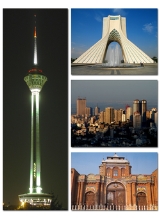
Azadi Tower is the first landmark visitors come across when arriving from the Mehrabad International Airport. The tower has become an icon for Tehran and a national symbol of Iran.
Tehran suffers from extremely serious traffic congestion and pollution problems. Respiratory ailments such as
asthma are very common. Tehran has become so congested over the past decade that the government has considered moving the nation's capital to another city to alleviate these problems and help de-centralize the economy and population. But because Iran's economy and politics are so centralized, millions have little choice but to live and work in Tehran.
The
Peacock Throne of the Persian Shahs can be found in Tehran's
Golestan Palace. Some of the important museums are National Museum of Iran, Sa'dabad Palaces Complex, Glassware and Ceramics Museum of Iran,
The Carpet Museum of Iran, Tehran's Underglass painting Museum, and
Niavaran Palace Complex. The
Tehran Museum of Contemporary Art is also appealing to many because it features the works of great artists such as
Van Gogh,
Pablo Picasso and
Andy Warhol.
The huge Tehran International Fair organises many expositions. Its book expositions are especially popular. Tehran is also the seat of
Iran's Parliament . And Tehran is also home to the world's fourth tallest free standing structure, the
Milad Tower.
Location and Subdivisions
Tehran county borders
Shemiranat county to the north,
Damavand county to the east, Eslamshahr, Pakdasht, and Ray counties to the south, and
Karaj and
Shahriar counties to the west.
Neighborhoods and Districts of Tehran
The city of Tehran is divided into 22 municipal districts, each with its own administrative centers. Within these 22 districts, Tehran contains the following major neighborhoods :
Abbas Abad, Afsariyeh,
Amir Abad, Bagh Feiz, Baharestan, Darakeh, Darband, Dardasht, Dar Abad, Darrous, Dehkadeh Olampik, Ekhtiyariyeh,
Elahiyeh, Evin, Farmanieh,Gheitariye, Gholhak,
Gisha, Gomrok,
Hasan Abad, Jamaran, Jannat Abad, Javadiyeh, Jomhuri, Jordan, Narmak, Navvab, Nazi Abad,
Niavaran, Park-e Shahr, Pasdaran, Punak,
Ray, Sa'adat Abad,
Sadeghiyeh, Shahrara, Shahr-e ziba, Shahrak-e Gharb,
Shemiran,
Tajrish, Tehranpars, Vanak, Velenjak, Yaft Abad, Yusef Abad, Zafaraniyeh, etc.
For the full list, see List of the localities around Tehran.
The older neighborhoods of Tehran
Tehran's old city fabric changed dramatically during the first
Pahlavi era. Some of the older remaining districts of Tehran are: Udlajan, Sangelaj,
Bazaar, Chaleh Meydan, Dowlat. Chaleh Meydan is the oldest neighborhood of the aforementioned.
Economy
About 30% of Iran’s public-sector workforce and 45% of large industrial firms are located in Tehran and almost half of these workers work for the government. Most of the remainder of workers are factory workers, shopkeepers, labourers, and transport workers. Few foreign companies operate in Tehran because of the Islamic government and its poor relations with the west. But before the
Islamic revolution many western companies were active in this region. Today many modern industries of this city include the manufacturing of automobiles, electronics and electrical equipment, weaponry, textiles, sugar, cement, and chemical products. It is also a leading center for the sale of carpets and furniture. There is an oil refinery nearby. The city has two airports, including Mehrabad International Airport, and Imam Khomeini International Airport. Tehran relies heavily on private cars, buses, motorcycles, and taxis, and is one of the most car-dependent cities in the world. The Tehran Stock Exchange, which is a full member of the Federation Internationale des Bourses de Valeurs and a founding member of the Federation of Euro-Asian Stock Exchanges, was one of the world's best performing stock exchanges in recent years..
Transport
In 2001 a metro system that had been in planning since the
1970s opened the first two of seven envisaged lines -- even though the city is prone to earthquakes. Work has been slow and coverage remains very limited. Development of the
Tehran metro system had been interrupted by the
Islamic Revolution and the
Iran-Iraq War. Problems arising from the late completion of the metro led to buses taking on the role of the metro lines, serving mainly long distance routes. Taxis filled the void for local journeys. The taxis only drive on main roads, and only within the local area, so it can be necessary to take several taxis to get to one's final destination. This has all led to extreme congestion and air pollution within the city.
Tehran is served by Mehrabad International Airport, the old airport which doubles as a military base located in the western part of the city, and Imam Khomeini International Airport, 50 kilometers south, which handles flights from the
Persian Gulf but which will eventually handle all international flights. The new airport is more than overdue, but is efficient, although security concerns have made the governments of Britain and Australia warn their foreign nationals in Iran.
Tehran also has a central train station with connecting services round the clock to various cities in the country. There are four bus terminals that also provide connections at low fares. These are the
South,
East,
West, and
Bei-haghi Park-Drive Terminals.
While the center of the city houses the government ministries and headquarters, the commercial centers are more located toward Valiasr Street, Taleghani Ave, and Beheshti Ave. further north. Although administratively separate,
Rey,
Shemiran, and
Karaj are often considered part of the larger Tehran metropolitan area.
See also: List of Tehran metro stations, Tehran Monorail
Pollution
Tehran, like many big cities, suffers from severe air pollution and the city is often covered by
smog making breathing difficult and causing widespread pulmonary illnesses. It is estimated that about 27 persons die each day from pollution-related diseases.
The air pollution is due to several different reasons: 1) Economical: most Iranian industries are located on the outskirts of Tehran. The city is also overrun with old and aging cars which do not meet today's emission regulations. Furthermore, Iran's busiest airport, Mehrabad International Airport, is located in the west of the city; 2) Infrastructure: Tehran has a poor public transportation network. Buses and metros do not cover every area of the city. Most people are then obliged to either use private cars or hire taxis. This has created severe traffic and congestion; 3) Geographical: Tehran is bound in the north by the massive
Alborz mountain range that is stopping the flow of the humid Caspian wind. As a result,
thermal inversion that traps Tehran's polluted air is frequently observed. The lack of humidity and clouds makes Tehran a very sunny city. The UV radiations then combined with the existing pollutants significantly raise the level of the
ozone.
The government, however, is engaged in a battle to reduce the air pollution. It has for instance encouraged taxis and buses to convert from petrol engines to engines that run on
compressed natural gas. Furthermore, since 1979 the government of the Islamic Republic of Iran has setup a "Traffic Zone" covering the city center during peak traffic hours. Entering and driving inside this zone is only allowed with a special permit. The government is also trying to raise people's awareness about the hazards of the pollution. One method that is currently been employed is the installation of Pollution Indicator Boards all around the city to monitor the current level of
particulate matter ,
nitrogen dioxide , ozone ,
sulfur dioxide , and
carbon monoxide . The board also displays the Pollutant Standard Index , which is a general indication of air quality based on the measurements of the above-mentioned five pollutants. The Pollution Indicator Boards classify the level of each pollutants as either safe, hazardous or dangerous.
Research and education
Ever since the establishment of Darolfonoon in the mid 1800s, Tehran has amassed an abundance of institutions of higher education. Some of these institutions have played crucial roles in the unfolding of Iranian political events.
Tehran University is the earliest state university and the largest university of Iran.
Samuel M. Jordan, whom "Jordan Avenue" in Tehran is named after, was also one of the founding pioneers of the
American College of Tehran. Today There are nearly 50 major colleges and universities in total in Greater Tehran, listed below:
Tehran also contains Iran's largest military academy, and several religious schools and seminaries. See List of colleges and universities in Tehran for a more comprehensive listing.
Sport
Tehran was the first city in the Middle East to host the
Asian Games. The 7th Asian Summer Games in 1974, was held with the participation of 2,363 athletes and officials from 25 countries.
Tehran is also the site of Iran's national football stadium on
Azadi Sport Complex with 100,000 seating capacity. Many of the top matches of Iran's Premier League are held here. In 2005,
FIFA ordered Iran to limit spectators allowed into Azadi stadium because of a fatal crush and inadequate safety procedures. Other stadiums in Tehran are
Shahid Dastgerdi Stadium, Takhti Stadium, and Shahid Shirudi Stadium, among others.
Within 10 minutes of driving distance from Tehran lies a ski resort.
Tochal is the world's fifth highest ski resort at over 3730m at its highest
7th station. The resort was completed in 1976 shortly before the overthrow of the Shah.
Here, one must first ride the eight km long gondola lift which covers a huge vertical. The 7th station has three slopes. The resort's longest slope is the south side U shaped slope which goes from the 7th station to 5th station. The other two slopes are located on the north side of the 7th station. Here, there are two parallel chair ski lifts that go up to 3900m near Tochal's peak , rising higher than the gondola 7th station. This altitude is higher than any of the European resorts.
From the Tochal peak, one has a spectacular view of the Alborz range, including the 5671 metre high Mt. Damavand, a dormant volcano.
At the bottom of the lifts in a valley behind the Tochal peak is Tochal hotel, located at 3500m altitude. From there a T lift takes skiers up the 3800 metres of Shahneshin peak, where the third slope of Tochal is.
Tochal 7th station has skiing eight months of the year. But there are also some glaciers and year-round snow fields near Tehran where skiing began in 1938, thanks to the efforts of two German railway engineers. Today, 12 ski resorts operate in Iran, but the most famous are
Tochal,
Dizin, and Shemshak, all within one to three hours of Tehran.
See also: Sports in IranFootball
In
football , Tehran is host to seven football clubs in Iran's Premier Football League, namely:
These clubs have on numerous occasions won Asian titles, and some of their players are known internationally. The prominent matches are usually held at
Azadi stadium.
Outdoors
...
...
...
- Sa'ei Park
- Daneshju Park
- Shahr-e Bazi amusement park.
- Shatranj Park
- Darabad hiking trail
- Darakeh hiking trail
- Jahan-e Kudak Park
- Azadi Sports complex
- Enghelab Sports Complex and Golf course
- Several caves, springs, and waterfalls outisde Tehran.
- Latyan Lake
- Lavizan Forest Park
- Vardavard Forest Park
- Khajeer National Park
- Kavir National Park
- Tar Lake
- Amir Kabir Lake
- Lar Protected Natural Habitat
- Varjeen Protected Natural Habitat
- Pardisan
- Tangeh Savashi
...
Images of Tehran
Culture and attractions
Tehran, as Iran's showcase and historical capital city, has a wealth of cultural attractions, some of which are listed below.
Religious centers
...
era mosque.
- The new Sepahsalar mosque
- Filsuf o-dowleh Mosque, Qajar era
- Moshir ol-Saltaneh Mosque, Qajar era
- Mo'ayyer ol-Mamalik Mosque, Qajar era
- Shahr Banu Mausoleum
- Javan-mard Qassab Mausoleum, a pre-Islamic semi-mythical hero
- Dozens of Imam-zadeh shrines, hundreds of years old, including that of Imam Zadeh Saleh.
- Dozens of Saqa Khanehs: traditional places of prayer
- Several Tekyeh