

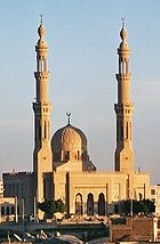
Minaret

Encyclopedia
A minaret is a distinctive architectural feature of Islam
Islam
Islam . The most common are and . : Arabic pronunciation varies regionally. The first vowel ranges from ~~. The second vowel ranges from ~~~...
ic mosque
Mosque
A mosque is a place of worship for followers of Islam. The word is likely to have entered the English language through French , from Portuguese , from Spanish , and from Berber , ultimately originating in — . The Arabic word masjid literally means a place of prostration...
s, generally a tall spire with an onion-shaped
Onion dome
An onion dome is a dome whose shape resembles the onion, after which they are named. Such domes are often larger in diameter than the drum upon which they are set, and their height usually exceeds their width...
or conical crown, usually either free standing or taller than any associated support structure. The basic form of a minaret includes a base, shaft, and gallery. Styles vary regionally and by period. Minarets provide a visual focal point and are used for the call to prayer (adhan
Adhan
The adhān is the Islamic call to prayer, recited by the muezzin at prescribed times of the day. The root of the word is meaning "to permit"; another derivative of this word is , meaning "ear"....
).
Functions
As well as providing a visual cue to a Muslim community, the main function of the minaret is to provide a vantage point from which the call to prayer is made. The call to prayer is issued five times each day: dawn, noon, mid-afternoon, sunset, and night.In most modern mosques, the adhan is called from the musallah, or prayer hall, via microphone
Microphone
A microphone is an acoustic-to-electric transducer or sensor that converts sound into an electrical signal. In 1877, Emile Berliner invented the first microphone used as a telephone voice transmitter...
to a speaker
Loudspeakers in mosques
Loudspeakers in mosques are generally used for Adhan or "call to prayer", or sometimes for Khutbah or sermons. External loudspeakers are generally mounted on tall minarets. Mosque loudspeakers are used for a call to prayer, five times a day...
system on the minaret.
Minarets also function as air conditioning mechanisms: as the sun heats the dome, air is drawn in through open windows then up and out of the minaret, thereby providing natural ventilation.
History
The earliest mosques were built without minarets, the call to prayer was performed elsewhere; hadiths relay that the MuslimMuslim
A Muslim, also spelled Moslem, is an adherent of Islam, a monotheistic, Abrahamic religion based on the Quran, which Muslims consider the verbatim word of God as revealed to prophet Muhammad. "Muslim" is the Arabic term for "submitter" .Muslims believe that God is one and incomparable...
community of Madina gave the call to prayer from the roof of the house of Muhammad
Muhammad
Muhammad |ligature]] at U+FDF4 ;Arabic pronunciation varies regionally; the first vowel ranges from ~~; the second and the last vowel: ~~~. There are dialects which have no stress. In Egypt, it is pronounced not in religious contexts...
, which doubled as a place for prayer.
Around 80 years after Muhammad's death the first known minarets appeared.
Minarets have been described as the "gate from heaven and earth", and as the Arabic language
Arabic language
Arabic is a name applied to the descendants of the Classical Arabic language of the 6th century AD, used most prominently in the Quran, the Islamic Holy Book...
letter alif (which is a straight vertical line).
The massive minaret of the Great Mosque of Kairouan in Tunisia
Tunisia
Tunisia , officially the Tunisian RepublicThe long name of Tunisia in other languages used in the country is: , is the northernmost country in Africa. It is a Maghreb country and is bordered by Algeria to the west, Libya to the southeast, and the Mediterranean Sea to the north and east. Its area...
is the oldest standing minaret. Its construction began during the first third of the 8th century and was completed in 836 CE. The imposing square-plan tower consists of three sections of decreasing size reaching 31.5 meters. Considered as the prototype for minarets of the western Islamic world, it served as a model for
many later minarets. Despite the austerity of its decoration, the minaret of the Great Mosque of Kairouan stands out by its harmonious appearance and striking majesty.
The tallest minaret, at 210 metres (689 ft.) is located at the Hassan II Mosque
Hassan II Mosque
The Hassan II Mosque is a religious building in Casablanca, Morocco. It is the largest mosque in the country and the 7th largest mosque in the world. Its minaret is the world's tallest at .It stands on a promontory looking out to the Atlantic...
in Casablanca
Casablanca
Casablanca is a city in western Morocco, located on the Atlantic Ocean. It is the capital of the Grand Casablanca region.Casablanca is Morocco's largest city as well as its chief port. It is also the biggest city in the Maghreb. The 2004 census recorded a population of 2,949,805 in the prefecture...
, Morocco
Morocco
Morocco , officially the Kingdom of Morocco , is a country located in North Africa. It has a population of more than 32 million and an area of 710,850 km², and also primarily administers the disputed region of the Western Sahara...
The tallest brick minaret is Qutub Minar
Qutub Minar
Qutub Minar also Qutb Minar, is a UNESCO World Heritage Site. Located in Delhi, India. The Qutub Minar is constructed with red sandstone and marble, and is the tallest minaret in India, with a height of 72.5 meters , contains 379 stairs to reach the top, and the diameter of base is 14.3 meters...
located in Delhi
Delhi
Delhi , officially National Capital Territory of Delhi , is the largest metropolis by area and the second-largest by population in India, next to Mumbai. It is the eighth largest metropolis in the world by population with 16,753,265 inhabitants in the Territory at the 2011 Census...
, India
India
India , officially the Republic of India , is a country in South Asia. It is the seventh-largest country by geographical area, the second-most populous country with over 1.2 billion people, and the most populous democracy in the world...
.
In some of the oldest mosques, such as the Great Mosque of Damascus, minarets originally served as illuminated watchtowers (hence the derivation of the word from the Arabic nur, meaning "light").
Construction
Minarets basic form consist of three parts: a base, shaft, and a gallery. For the base, the ground is excavated until a hard foundation is reached. GravelGravel
Gravel is composed of unconsolidated rock fragments that have a general particle size range and include size classes from granule- to boulder-sized fragments. Gravel can be sub-categorized into granule and cobble...
and other supporting materials may be used as a foundation; it is unusual for the minaret to be built directly upon ground-level soil. Minarets may be conical (tapering), square, cylindrical, or polygonal (faceted). Stairs circle the shaft in a counter-clockwise fashion, providing necessary structural support to the highly elongated shaft. The gallery is a balcony which encircles the upper sections from which the muezzin
Muezzin
A muezzin , or muzim, is the chosen person at a mosque who leads the call to prayer at Friday services and the five daily times for prayer from one of the mosque's minarets; in most modern mosques, electronic amplification aids the muezzin in his task.The professional muezzin is chosen for his...
may give the call to prayer. It is covered by a roof-like canopy and adorned with ornamentation, such as decorative brick and tile work, cornices, arches and inscriptions, with the transition from the shaft to the gallery typically sporting muqarnas
Muqarnas
Muqarnas is a type of corbel used as a decorative device in traditional Islamic architecture. The term is similar to mocárabe, but mocárabe only refers to designs with formations resembling stalactites, by the use of elements known as alveole.Muqarnas takes the form of small pointed niches,...
. Originally plain in style, a minaret's origin in time can be determined by its level of ostentation.
Local styles
Styles and architectureArchitecture
Architecture is both the process and product of planning, designing and construction. Architectural works, in the material form of buildings, are often perceived as cultural and political symbols and as works of art...
can vary widely according to region and time period. Here are a few styles and the localities from which they derive:
Tunisia
Tunisia
Tunisia , officially the Tunisian RepublicThe long name of Tunisia in other languages used in the country is: , is the northernmost country in Africa. It is a Maghreb country and is bordered by Algeria to the west, Libya to the southeast, and the Mediterranean Sea to the north and east. Its area...
:(7th century) Quadrangular, the Mosque of Uqba of kairouan have the oldest Minaret in the Muslim world.
Turkish
Turkey
Turkey , known officially as the Republic of Turkey , is a Eurasian country located in Western Asia and in East Thrace in Southeastern Europe...
(11th century) : 1, 2, 4 or 6 minarets related to the size of the mosque. Slim, circular minarets of equal cross-section are common.
Egypt
Egypt
Egypt , officially the Arab Republic of Egypt, Arabic: , is a country mainly in North Africa, with the Sinai Peninsula forming a land bridge in Southwest Asia. Egypt is thus a transcontinental country, and a major power in Africa, the Mediterranean Basin, the Middle East and the Muslim world...
(7th century) / Syria
Syria
Syria , officially the Syrian Arab Republic , is a country in Western Asia, bordering Lebanon and the Mediterranean Sea to the West, Turkey to the north, Iraq to the east, Jordan to the south, and Israel to the southwest....
(until 13th century) : Low square towers sitting at the four corners of the mosque
Mosque
A mosque is a place of worship for followers of Islam. The word is likely to have entered the English language through French , from Portuguese , from Spanish , and from Berber , ultimately originating in — . The Arabic word masjid literally means a place of prostration...
.
Iraq
Iraq
Iraq ; officially the Republic of Iraq is a country in Western Asia spanning most of the northwestern end of the Zagros mountain range, the eastern part of the Syrian Desert and the northern part of the Arabian Desert....
: For a free-standing conical minaret surrounded by a spiral staircase, see Malwiya
Malwiya
The Minaret of Samarra, also known as the Malwiya Minaret or Malwiya Tower is part of the Great Mosque of Samarra in Samarra, Iraq. The mosque is one of the largest in the world, and was built by the Abbasid caliph Al-Mutawakkil...
.
Egypt
Egypt
Egypt , officially the Arab Republic of Egypt, Arabic: , is a country mainly in North Africa, with the Sinai Peninsula forming a land bridge in Southwest Asia. Egypt is thus a transcontinental country, and a major power in Africa, the Mediterranean Basin, the Middle East and the Muslim world...
(15th century) : Octagonal. Two balconies, the upper smaller than the lower, projecting mukarnas, surmounted by an elongated finial
Finial
The finial is an architectural device, typically carved in stone and employed decoratively to emphasize the apex of a gable or any of various distinctive ornaments at the top, end, or corner of a building or structure. Smaller finials can be used as a decorative ornament on the ends of curtain rods...
.
Persia (17th century) : Generally two pairs of slim, blue tile clad towers flanking the mosque entrance, terminating in covered balconies.
Tatar
Tatarstan
The Republic of Tatarstan is a federal subject of Russia located in the Volga Federal District. Its capital is the city of Kazan, which is one of Russia's largest and most prosperous cities. The republic borders with Kirov, Ulyanovsk, Samara, and Orenburg Oblasts, and with the Mari El, Udmurt,...
(18th century): Tatar mosque
Tatar mosque
Tatar mosque — is the typical mosque architecture in Tatarstan and other Volga Tatar-populated areas of Russia. Occasionally found in other regions of Russia, modern Tatar religious architecture was developed in the late 18th century and gained popularity in the 19th century Idel-Ural.- History...
:A sole minaret is used, placed at the centre of a gabled roof.
Morocco
Morocco
Morocco , officially the Kingdom of Morocco , is a country located in North Africa. It has a population of more than 32 million and an area of 710,850 km², and also primarily administers the disputed region of the Western Sahara...
: Typically a single square minaret. Notable exceptions are the octagonal minaret located in Chefchaouen
Chefchaouen
Chefchaouen or Chaouen is a city in northwest Morocco. It is the chief town of the province of the same name, and is noted for its buildings in shades of blue....
and the round minaret located in Moulay Idriss
Moulay Idriss
Moulay Idriss or Moulay Idriss Zerhoun , a town in northern Morocco located at, is named after Moulay Idris I, the founder of the Idrisid Dynasty. Moulay is a term roughly equivalent to "Prince" or "Lord". Idris founded both Fez and the city that bears his name. His tomb, located in Moulay Idriss,...
.
South Asia
South Asia
South Asia, also known as Southern Asia, is the southern region of the Asian continent, which comprises the sub-Himalayan countries and, for some authorities , also includes the adjoining countries to the west and the east...
: Octagonal, generally three balconied, with the upper most roofed by an onion dome
Onion dome
An onion dome is a dome whose shape resembles the onion, after which they are named. Such domes are often larger in diameter than the drum upon which they are set, and their height usually exceeds their width...
and topped by a small finial
Finial
The finial is an architectural device, typically carved in stone and employed decoratively to emphasize the apex of a gable or any of various distinctive ornaments at the top, end, or corner of a building or structure. Smaller finials can be used as a decorative ornament on the ends of curtain rods...
.