
All Topics  
High Renaissance


   Email Print
   Bookmark   Link


High Renaissance


The High Renaissance, in the history of art
History of art

The history of art usually refers to the history of the visual arts of painting, sculpture and architecture as well as architecture. It is the history of one of the fine arts, others of which are the performing arts and literary arts....
, denotes the culmination of the art of the Italian Renaissance
Italian Renaissance

The Italian Renaissance began the opening phase of the Renaissance, a period of great cultural change and achievement in Europe that spanned the period from the end of the 13th century to about 1600, marking the transition between Medieval and Early Modern Europe....
 between 1450 and 1527. Because Pope Julius II
Pope Julius II

Pope Julius II , nicknamed Il Papa Terribile , was born Giuliano della Rovere. He was Pope from 1503 to 1513. His reign was marked by an aggressive foreign policy, ambitious building projects, and patronage for the arts....
 patronized many artists during this time, the movement was centered in Rome
Rome

Rome is the capital city of Italy and Lazio, and is Italy's largest and most populous city, with 2,724,347 residents in an urban area of some ....
; it had previously been centered in Florence
Florence

Florence is the Capital city of the Italy Regions of Italy of Tuscany and of the provinces of Italy Province of Florence. It is the most populous city in Tuscany and has a population of 364,779 ....
.

The High Renaissance is generally held to have emerged in the late 1490s, when Leonardo da Vinci
Leonardo da Vinci

Leonardo di ser Piero da Vinci was an Italy polymath, being a scientist, mathematician, engineer, inventor, anatomist, Painting, sculptor, architect, botanist, musician and writer....
 executed his Last Supper
The Last Supper (Leonardo)

The Last Supper is a 15th century mural painting in Milan created by Leonardo da Vinci for his patron List of rulers of Milan Ludovico Sforza and his duchess Beatrice d'Este....
 in Milan
Milan

Milan is the second largest city of Italy, located in the plains of Lombardy. It is the capital in the Province of Milan, as well as the Regions of Italy capital of Lombardy....
.


Discussion
Ask a question about 'High Renaissance'
Start a new discussion about 'High Renaissance'
Answer questions from other users
Full Discussion Forum


Encyclopedia


God2 Sistine Chapel
The High Renaissance, in the history of art
History of art

The history of art usually refers to the history of the visual arts of painting, sculpture and architecture as well as architecture. It is the history of one of the fine arts, others of which are the performing arts and literary arts....
, denotes the culmination of the art of the Italian Renaissance
Italian Renaissance

The Italian Renaissance began the opening phase of the Renaissance, a period of great cultural change and achievement in Europe that spanned the period from the end of the 13th century to about 1600, marking the transition between Medieval and Early Modern Europe....
 between 1450 and 1527. Because Pope Julius II
Pope Julius II

Pope Julius II , nicknamed Il Papa Terribile , was born Giuliano della Rovere. He was Pope from 1503 to 1513. His reign was marked by an aggressive foreign policy, ambitious building projects, and patronage for the arts....
 patronized many artists during this time, the movement was centered in Rome
Rome

Rome is the capital city of Italy and Lazio, and is Italy's largest and most populous city, with 2,724,347 residents in an urban area of some ....
; it had previously been centered in Florence
Florence

Florence is the Capital city of the Italy Regions of Italy of Tuscany and of the provinces of Italy Province of Florence. It is the most populous city in Tuscany and has a population of 364,779 ....
.

The High Renaissance is generally held to have emerged in the late 1490s, when Leonardo da Vinci
Leonardo da Vinci

Leonardo di ser Piero da Vinci was an Italy polymath, being a scientist, mathematician, engineer, inventor, anatomist, Painting, sculptor, architect, botanist, musician and writer....
 executed his Last Supper
The Last Supper (Leonardo)

The Last Supper is a 15th century mural painting in Milan created by Leonardo da Vinci for his patron List of rulers of Milan Ludovico Sforza and his duchess Beatrice d'Este....
 in Milan
Milan

Milan is the second largest city of Italy, located in the plains of Lombardy. It is the capital in the Province of Milan, as well as the Regions of Italy capital of Lombardy....
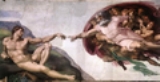
. The paintings in the Vatican by Michelangelo
Michelangelo

Michelangelo di Lodovico Buonarroti Simoni , commonly known as Michelangelo, was an Italian Renaissance Painting, sculptor, architect, poet, and engineer....
 and Raphael
Raphael

Raphael Sanzio, usually known by his first name alone was an Italy Painting and architect of the High Renaissance, celebrated for the perfection and grace of his paintings and drawings....
 represent the culmination of the style in painting. The style was introduced to architecture by Donato Bramante
Donato Bramante

Donato Bramante was an Italian architect, who introduced the Early Renaissance style to Milan and the High Renaissance style to Rome, where his most famous design was St....
, who in 1502 built the Tempietto, with its majestic proportions signifying the full-scale revival of ancient Roman architecture
Roman architecture

The Architecture of Ancient Rome adopted the external Greek Architecture for their own purposes, which were so different from Greek buildings as to create a new architecture style....
. High Renaissance sculpture, as exemplified by Michelangelo
Michelangelo

Michelangelo di Lodovico Buonarroti Simoni , commonly known as Michelangelo, was an Italian Renaissance Painting, sculptor, architect, poet, and engineer....
's Pietà
Pietà (Michelangelo)

The Piet? is a masterpiece of Renaissance sculpture by Michelangelo in St. Peter's Basilica in Vatican City. It is the first of a number of works of the same theme by the artist....
 and David
David (Michelangelo)

David is a masterpiece of Renaissance sculpture sculpted by Michelangelo from 1501 to 1504. The 5.17 meter marble statue portrays the Bible David in the depictions of nudity....
, is characterized by the ideal balance between statics and movement. The serene mood and luminous colours of Giorgione
Giorgione

Giorgione is the familiar name of Giorgio Barbarelli da Castelfranco, an Italy painter, a seminal artist of the High Renaissance in Venice....
 and young Titian
Titian

File:Tizian 090.jpg Tiziano Vecelli or Tiziano Vecellio, born 1473/1490 , died 27 August 1576, better known as Titian , was the leading painter of the 16th-century Venice school of the Italian Renaissance....
 exemplify the High Renaissance in Venice
Venice

Venice is a city in northern Italy, the capital city of the Italian regions Veneto, a population of 271,251 . Together with Padua, Italy, the city is included in the Padua-Venice Metropolitan Area ....
.

The High Renaissance is widely viewed as the greatest explosion of creative genius in history. Even relatively minor painters active during the period, such as Fra Bartolomeo and Mariotto Albertinelli
Mariotto Albertinelli

Mariotto di Bigio di Bindo Albertinelli was a High Renaissance Italy Painting of the Florentine school, closely involved with Fra Bartolomeo and influenced by Raphael Sanzio....
, produced works remarkable for their perfect harmony and total control of the painterly mediums. The elongated proportions and exaggerated poses in the late works of Michelangelo, Andrea del Sarto
Andrea del Sarto

Andrea del Sarto was an Italy painter from Florence, whose career flourished during the High Renaissance and early-Mannerism. Though highly regarded by his contemporaries as an artist "senza errori" , he is overshadowed now by equally talented contemporaries like Raphael....
 and Correggio prefigure the nascent Mannerism
Mannerism

Mannerism is a Art periods of European art which emerged from the later years of the Italian High Renaissance around 1520. It lasted until about 1580 in Italy, when a more Baroque style began to replace it, but continued into the seventeenth century throughout much of Europe....
, as the Late Renaissance is referred to in the history of art. Raphael's death in 1520 and the sack of Rome
Sack of Rome (1527)

The Sack of Rome on 6 May 1527, carried out by the mutinous troops of Charles V, Holy Roman Emperor, marked a crucial imperial victory in the conflict between the Holy Roman Empire and the League of Cognac ? the alliance of France, Milan, Venice, Florence and the Papacy....
 in 1527 spelled the end of the High Renaissance.

High Renaissance Sculpture was normally commissioned by the public and the state, this becoming more popular for sculpture is an expensive art form. Sculpture was often used to decorate or embellish architecture, normally within courtyards where others were able to study and admire the commissioned art work. Wealthy individuals like Carnivals, rulers and bankers were the more likely private patrons along with very wealthy families; Pope Julius II also patronized many artists. During the High Renaissance there was the development of small scale statuettes for private patrons, the creation of busts and tombs also developing. The subject matter related to sculpture was mostly religious but also with a significant strand of classical individuals in the form of tomb sculpture and paintings.The High Renaissance was the culmination of the artistic developments of the Early Renaissance, and one of the great explosions of creative genius in history. It is notable for three of the greatest artists in history: Michelangelo Buonarroti, Raphael Sanzio and Leonardo da Vinci
Leonardo da Vinci

Leonardo di ser Piero da Vinci was an Italy polymath, being a scientist, mathematician, engineer, inventor, anatomist, Painting, sculptor, architect, botanist, musician and writer....
.

Also active at this time were such masters as Giorgione, Titian and Giovanni Bellini.

By about the 1520s, High Renaissance art
Art

Art is the process or product of deliberately arranging elements in a way that appeals to the senses or emotions. It encompasses a diverse range of human activities, creations, and modes of expression, including music and literature....
 had become exaggerated into the style known as Mannerism
Mannerism

Mannerism is a Art periods of European art which emerged from the later years of the Italian High Renaissance around 1520. It lasted until about 1580 in Italy, when a more Baroque style began to replace it, but continued into the seventeenth century throughout much of Europe....
.