


Abu Simbel

Encyclopedia
Egyptian temple
Egyptian temples were built for the official worship of the gods and commemoration of pharaohs in Ancient Egypt and in regions under Egyptian control. These temples were seen as houses for the gods or kings to whom they were dedicated...
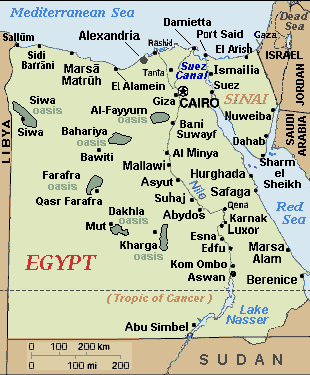
s in Abu Simbel ( in Arabic) in Nubia
Nubia
Nubia is a region along the Nile river, which is located in northern Sudan and southern Egypt.There were a number of small Nubian kingdoms throughout the Middle Ages, the last of which collapsed in 1504, when Nubia became divided between Egypt and the Sennar sultanate resulting in the Arabization...
, southern Egypt
Egypt
Egypt , officially the Arab Republic of Egypt, Arabic: , is a country mainly in North Africa, with the Sinai Peninsula forming a land bridge in Southwest Asia. Egypt is thus a transcontinental country, and a major power in Africa, the Mediterranean Basin, the Middle East and the Muslim world...
on the western bank of Lake Nasser
Lake Nasser
Lake Nasser is a vast reservoir in southern Egypt, and northern Sudan, and is one of the largest man-made lakes in the world. Strictly, "Lake Nasser" refers only to the much larger portion of the lake that is in Egyptian territory , with the Sudanese preferring to call their smaller body of water...
about 230 km southwest of Aswan
Aswan
Aswan , formerly spelled Assuan, is a city in the south of Egypt, the capital of the Aswan Governorate.It stands on the east bank of the Nile at the first cataract and is a busy market and tourist centre...
(about 300 km by road). The complex is part of the UNESCO
UNESCO
The United Nations Educational, Scientific and Cultural Organization is a specialized agency of the United Nations...
World Heritage Site
World Heritage Site
A UNESCO World Heritage Site is a place that is listed by the UNESCO as of special cultural or physical significance...
known as the "Nubian Monuments," which run from Abu Simbel downriver to Philae
Philae
Philae is an island in the Nile River and the previous site of an Ancient Egyptian temple complex in southern Egypt...
(near Aswan).
The twin temples were originally carved out of the mountainside during the reign of Pharaoh
Pharaoh
Pharaoh is a title used in many modern discussions of the ancient Egyptian rulers of all periods. The title originates in the term "pr-aa" which means "great house" and describes the royal palace...
Ramesses II
Ramesses II
Ramesses II , referred to as Ramesses the Great, was the third Egyptian pharaoh of the Nineteenth dynasty. He is often regarded as the greatest, most celebrated, and most powerful pharaoh of the Egyptian Empire...
in the 13th century BC, as a lasting monument to himself and his queen Nefertari
Nefertari
Nefertari also known as Nefertari Merytmut was one of the Great Royal Wives of Ramesses the Great. Nefertari means 'Beautiful Companion' and Meritmut means 'Beloved of [the Goddess] Mut'. She is one of the best known Egyptian queens, next to Cleopatra, Nefertiti and Hatshepsut...
, to commemorate his alleged victory at the Battle of Kadesh
Battle of Kadesh
The Battle of Kadesh took place between the forces of the Egyptian Empire under Ramesses II and the Hittite Empire under Muwatalli II at the city of Kadesh on the Orontes River, in what is now the Syrian Arab Republic....
, and to intimidate his Nubia
Nubia
Nubia is a region along the Nile river, which is located in northern Sudan and southern Egypt.There were a number of small Nubian kingdoms throughout the Middle Ages, the last of which collapsed in 1504, when Nubia became divided between Egypt and the Sennar sultanate resulting in the Arabization...
n neighbors. However, the complex was relocated
Structure relocation
A structure relocation is the process of moving a structure from one location to another. There are two main ways for a structure to be moved: disassembling and then reassembling it at the required destination, or transporting it whole. For the latter, the building may be pushed on temporary rails...
in its entirety in 1968, on an artificial hill made from a domed structure, high above the Aswan High Dam reservoir.
The relocation of the temples was necessary to avoid their being submerged during the creation of Lake Nasser
Lake Nasser
Lake Nasser is a vast reservoir in southern Egypt, and northern Sudan, and is one of the largest man-made lakes in the world. Strictly, "Lake Nasser" refers only to the much larger portion of the lake that is in Egyptian territory , with the Sudanese preferring to call their smaller body of water...
, the massive artificial water reservoir formed after the building of the Aswan High Dam on the Nile
Nile
The Nile is a major north-flowing river in North Africa, generally regarded as the longest river in the world. It is long. It runs through the ten countries of Sudan, South Sudan, Burundi, Rwanda, Democratic Republic of the Congo, Tanzania, Kenya, Ethiopia, Uganda and Egypt.The Nile has two major...
River. Abu Simbel remains one of Egypt's top tourist attraction
Tourist attraction
A tourist attraction is a place of interest where tourists visit, typically for its inherent or exhibited cultural value, historical significance, natural or built beauty, or amusement opportunities....
s.
Construction
Construction of the temple complex started in approximately 1244 BCE and lasted for about 20 years, until 1264 BCE. Known as the "Temple of Ramesses, beloved by AmunAmun
Amun, reconstructed Egyptian Yamānu , was a god in Egyptian mythology who in the form of Amun-Ra became the focus of the most complex system of theology in Ancient Egypt...
," it was one of six rock temples erected in Nubia during the long reign of Ramesses II. Their purpose was to impress Egypt's southern neighbors, and also to reinforce the status of Egyptian religion in the region. Historians say that the design of Abu Simbel expresses a measure of ego and pride in Ramesses II.
Rediscovery
With the passage of time, the temples fell into disuse and eventually became covered by sand. Already in the 6th century BC, the sand covered the statues of the main temple up to their knees. The temple was forgotten until 1813, when SwissSwitzerland
Switzerland name of one of the Swiss cantons. ; ; ; or ), in its full name the Swiss Confederation , is a federal republic consisting of 26 cantons, with Bern as the seat of the federal authorities. The country is situated in Western Europe,Or Central Europe depending on the definition....
orientalist JL Burckhardt
Johann Ludwig Burckhardt
Johann Ludwig Burckhardt was a Swiss traveller and orientalist. He wrote his letters in French and signed Louis...
found the top frieze
Frieze
thumb|267px|Frieze of the [[Tower of the Winds]], AthensIn architecture the frieze is the wide central section part of an entablature and may be plain in the Ionic or Doric order, or decorated with bas-reliefs. Even when neither columns nor pilasters are expressed, on an astylar wall it lies upon...
of the main temple. Burckhardt talked about his discovery with Italian
Italy
Italy , officially the Italian Republic languages]] under the European Charter for Regional or Minority Languages. In each of these, Italy's official name is as follows:;;;;;;;;), is a unitary parliamentary republic in South-Central Europe. To the north it borders France, Switzerland, Austria and...
explorer Giovanni Belzoni
Giovanni Battista Belzoni
Giovanni Battista Belzoni , sometimes known as The Great Belzoni, was a prolific Venetian explorer of Egyptian antiquities.-Early life:...
, who travelled to the site, but was unable to dig out an entry to the temple. Belzoni returned in 1817, this time succeeding in his attempt to enter the complex. He took everything valuable and portable with him. Tour guides at the site relate the legend that "Abu Simbel" was a young local boy who guided these early re-discoverers to the site of the buried temple which he had seen from time to time in the shifting sands. Eventually, they named the complex after him.
Relocation
Monument
A monument is a type of structure either explicitly created to commemorate a person or important event or which has become important to a social group as a part of their remembrance of historic times or cultural heritage, or simply as an example of historic architecture...
s of Nubia
Nubia
Nubia is a region along the Nile river, which is located in northern Sudan and southern Egypt.There were a number of small Nubian kingdoms throughout the Middle Ages, the last of which collapsed in 1504, when Nubia became divided between Egypt and the Sennar sultanate resulting in the Arabization...
began: the southernmost relics of this ancient human civilization were under threat from the rising waters of the Nile that were about to result from the construction of the Aswan High Dam.
One scheme to save the temples was based on an idea by William MacQuitty
William MacQuitty
William MacQuitty was a British film producer and also a writer and photographer. He is most noted for his production of the 1958 Rank Organisation / Pinewood Studios film, A Night to Remember, which recreates the story of the sinking of RMS Titanic, based on the book of the same name by Walter...
to build a clear fresh water dam around the temples, with the water inside kept at the same height as the Nile. There were to be underwater viewing chambers. In 1962 the idea was made into a proposal by architects Jane Drew
Jane Drew
Dame Jane Drew, DBE, FRIBA was an English modernist architect and town planner. She qualified at the AA School in London, and prior to World War II became one of the leading exponents of the Modern Movement in London....
and Maxwell Fry
Maxwell Fry
Edwin Maxwell Fry, CBE, RA, FRIBA, FRTPI, known as Maxwell Fry , was an English modernist architect of the middle and late 20th century, known for his buildings in Britain, Africa and India....
and civil engineer Ove Arup
Ove Arup
Sir Ove Nyquist Arup, CBE, MICE, MIStructE known as Ove Arup, was a leading Anglo-Danish engineer and generally considered to be one of the foremost architectural structural engineers of his time...
. They considered that raising the temples ignored the effect of erosion of the sandstone by desert winds. However the proposal, though acknowledged to be extremely elegant, was rejected.
The salvage of the Abu Simbel temples began in 1964 by a multinational team of archeologists, engineers and skilled heavy equipment operators working together under the UNESCO
UNESCO
The United Nations Educational, Scientific and Cultural Organization is a specialized agency of the United Nations...
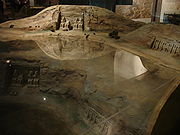
banner; it cost some $40 million at the time. Between 1964 and 1968, the entire site was carefully cut into large blocks (up to 30 tons, averaging 20 tons), dismantled, lifted and reassembled in a new location 65 meters higher and 200 meters back from the river, in one of the greatest challenges of archaeological engineering in history. Some structures were even saved from under the waters of Lake Nasser. Today, thousands of tourists visit the temples daily. Guarded convoys of buses and cars depart twice a day from Aswan, the nearest city. Many visitors also arrive by plane, at an airfield that was specially constructed for the temple complex.
The complex consists of two temples. The larger one is dedicated to Ra-Harakhty
Ra
Ra is the ancient Egyptian sun god. By the Fifth Dynasty he had become a major deity in ancient Egyptian religion, identified primarily with the mid-day sun...
, Ptah
Ptah
In Ancient Egyptian Religion, Ptah was the deification of the primordial mound in the Ennead cosmogony, which was more literally referred to as Ta-tenen , meaning risen land, or as Tanen, meaning submerged land, though Tatenen was a god in his...
and Amun
Amun
Amun, reconstructed Egyptian Yamānu , was a god in Egyptian mythology who in the form of Amun-Ra became the focus of the most complex system of theology in Ancient Egypt...
, Egypt's three state deities of the time, and features four large statues of Ramesses II in the facade. The smaller temple is dedicated to the goddess Hathor
Hathor
Hathor , is an Ancient Egyptian goddess who personified the principles of love, beauty, music, motherhood and joy. She was one of the most important and popular deities throughout the history of Ancient Egypt...
, personified by Nefertari
Nefertari
Nefertari also known as Nefertari Merytmut was one of the Great Royal Wives of Ramesses the Great. Nefertari means 'Beautiful Companion' and Meritmut means 'Beloved of [the Goddess] Mut'. She is one of the best known Egyptian queens, next to Cleopatra, Nefertiti and Hatshepsut...
, Ramesses's most beloved of his many wives.
The temple is now open to the public.
The Great Temple
The Great Temple at Abu Simbel, which took about twenty years to build, was completed around year 24 of the reign of Ramesses the Great (which corresponds to 1265 BCE). It was dedicated to the gods AmunAmun
Amun, reconstructed Egyptian Yamānu , was a god in Egyptian mythology who in the form of Amun-Ra became the focus of the most complex system of theology in Ancient Egypt...
, Ra-Horakhty, and Ptah
Ptah
In Ancient Egyptian Religion, Ptah was the deification of the primordial mound in the Ennead cosmogony, which was more literally referred to as Ta-tenen , meaning risen land, or as Tanen, meaning submerged land, though Tatenen was a god in his...
, as well as to the deified Rameses himself. It is generally considered the grandest and most beautiful of the temples commissioned during the reign of Rameses II, and one of the most beautiful in Egypt.
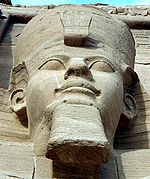
Four colossal 20 meter statues of the pharaoh with the double Atef crown of Upper and Lower Egypt decorate the facade of the temple, which is 35 meters wide and is topped by a frieze with 22 baboons, worshippers of the sun and flank the entrance. The colossal statues were sculptured directly from the rock in which the temple was located before it was moved. All statues represent Ramesses II, seated on a throne and wearing the double crown
Pschent
The Pschent was the name of the Double Crown of Ancient Egypt. The Ancient Egyptians generally referred to it as sekhemti , the Two Powerful Ones. It combined the Red Deshret Crown of Lower Egypt and the White Hedjet Crown of Upper Egypt....
of Upper and Lower Egypt
Upper and Lower Egypt
Ancient Egypt was divided into two regions, namely Upper Egypt and Lower Egypt. To the north was Lower Egypt where the Nile stretched out with its several branches to form the Nile Delta. To the south was Upper Egypt, stretching to Syene. The two kingdoms of Upper and Lower Egypt were united c....
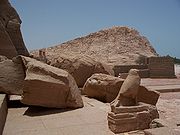
. The statue to the left of the entrance was damaged in an earthquake, leaving only the lower part of the statue still intact. The head and torso can still be seen at the statue's feet.
Next to the legs of the colossi, there are other statues no higher than the knees of the pharaoh. These depict Nefertari
Nefertari
Nefertari also known as Nefertari Merytmut was one of the Great Royal Wives of Ramesses the Great. Nefertari means 'Beautiful Companion' and Meritmut means 'Beloved of [the Goddess] Mut'. She is one of the best known Egyptian queens, next to Cleopatra, Nefertiti and Hatshepsut...
, Ramesses's chief wife, and queen mother Mut-Tuy
Queen Tuya
Queen Tuya was the wife of Pharaoh Seti I of Egypt and mother of Princess Tia, Ramesses II and perhaps Henutmire. She was the daughter of Raia who was a military officer based on his title of Lieutenant of the chariotry...
, his first two sons Amun-her-khepeshef
Amun-her-khepeshef
Amun-her-khepeshef or Amonhirkhopshef or Amun-her-wenemef was the firstborn son of Pharaoh Ramesses II and Queen Nefertari.-Name:...
, Ramesses
Ramesses B
Ramesses was an Ancient Egyptian prince, the eldest son of Pharaoh Ramesses II and Queen Isetnofret.-Family:Ramesses was the eldest son of Ramesses II and Queen Isetnofret. He had at least two sister and two brothers. His sister Bintanath was elevated to the position of great royal wife later in...
, and his first six daughters Bintanath
Bintanath
Bintanath was the firstborn daughter and later Great Royal Wife of the Egyptian Pharaoh Ramesses II.-Family:Bintanath was likely born during the reign of her grandfather Seti I. Her mother was Isetnofret, one of the two most prominent wives of Ramesses II...
, Baketmut, Nefertari, Meritamen
Meritamen
Meritamen was a daughter and later Great Royal Wife of Pharaoh Ramesses the Great.- Family :...
, Nebettawy
Nebettawy
Nebettawy was an Ancient Egyptian princess and queen, the fifth daughter and one of the eight Great Royal Wives of Pharaoh Ramesses II.-Life:...
and Isetnofret.
The entrance itself is crowned by a bas-relief representing two images of the king worshiping the falcon
Falcon
A falcon is any species of raptor in the genus Falco. The genus contains 37 species, widely distributed throughout Europe, Asia, and North America....
-headed Ra Harakhti, whose statue stands in a large niche. This god is holding the hieroglyph “user” and a feather in his right hand, with Ma'at, (the goddess of truth and justice) in his left; this is nothing less than a gigantic cryptogram for Ramesses II's throne name, User-Maat-Re. The facade is topped by a row of 22 baboon
Baboon
Baboons are African and Arabian Old World monkeys belonging to the genus Papio, part of the subfamily Cercopithecinae. There are five species, which are some of the largest non-hominoid members of the primate order; only the mandrill and the drill are larger...
s, their arms raised in the air, supposedly worshipping the rising sun. Another notable feature of the facade is a stele which records the marriage of Ramesses with a daughter of king Hattusili III
Hattusili III
Hattusili III was a king of the Hittite empire ca. 1267–1237 BC . He was the fourth and last son of Mursili II...
, which sealed the peace between Egypt and the Hittites.
The inner part of the temple has the same triangular layout that most ancient Egyptian temples follow, with rooms decreasing in size from the entrance to the sanctuary. The temple is complex in structure and quite unusual because of its many side chambers. The hypostyle
Hypostyle
In architecture, a hypostyle hall has a roof which is supported by columns, as in the Great Hypostyle Hall at Karnak. The word hypostyle comes from the Ancient Greek hypóstȳlos meaning "under columns"...
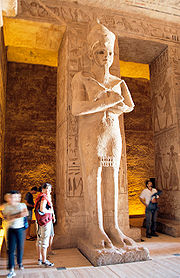
hall (sometimes also called a pronaos) is 18 meters long and 16.7 meters wide and is supported by eight huge Osirid pillars depicting the deified Ramses linked to the god Osiris
Osiris
Osiris is an Egyptian god, usually identified as the god of the afterlife, the underworld and the dead. He is classically depicted as a green-skinned man with a pharaoh's beard, partially mummy-wrapped at the legs, wearing a distinctive crown with two large ostrich feathers at either side, and...
, the god of the Underworld, to indicate the everlasting nature of the pharaoh. The colossal statues along the left-hand wall bear the white crown of Upper Egypt
Upper Egypt
Upper Egypt is the strip of land, on both sides of the Nile valley, that extends from the cataract boundaries of modern-day Aswan north to the area between El-Ayait and Zawyet Dahshur . The northern section of Upper Egypt, between El-Ayait and Sohag is sometimes known as Middle Egypt...
, while those on the opposite side are wearing the double crown of Upper and Lower Egypt
Lower Egypt
Lower Egypt is the northern-most section of Egypt. It refers to the fertile Nile Delta region, which stretches from the area between El-Aiyat and Zawyet Dahshur, south of modern-day Cairo, and the Mediterranean Sea....
(pschent). The bas-reliefs on the walls of the pronaos depict battle scenes in the military campaigns the ruler waged. Much of the sculpture is given to the Battle of Kadesh
Battle of Kadesh
The Battle of Kadesh took place between the forces of the Egyptian Empire under Ramesses II and the Hittite Empire under Muwatalli II at the city of Kadesh on the Orontes River, in what is now the Syrian Arab Republic....
, on the Orontes river in present-day Syria
Syria
Syria , officially the Syrian Arab Republic , is a country in Western Asia, bordering Lebanon and the Mediterranean Sea to the West, Turkey to the north, Iraq to the east, Jordan to the south, and Israel to the southwest....
, in which the Egyptian king fought against the Hittites
Hittites
The Hittites were a Bronze Age people of Anatolia.They established a kingdom centered at Hattusa in north-central Anatolia c. the 18th century BC. The Hittite empire reached its height c...
. The most famous relief shows the king on his chariot shooting arrows against his fleeing enemies, who are being taken prisoner. Other scenes show Egyptian victories in Libya
Libya
Libya is an African country in the Maghreb region of North Africa bordered by the Mediterranean Sea to the north, Egypt to the east, Sudan to the southeast, Chad and Niger to the south, and Algeria and Tunisia to the west....
and Nubia.
From the hypostyle hall, one enters the second pillared hall, which has four pillars decorated with beautiful scenes of offerings to the gods. There are depictions of Ramesses and Nefertari with the sacred boats of Amun and Ra-Harakhti. This hall gives access to a transverse vestibule in the middle of which is the entrance to the sanctuary. Here, on a black wall, are rock cut sculptures of four seated figures: Ra-Horakhty, the deified king Ramesses, and the gods Amun Ra and Ptah
Ptah
In Ancient Egyptian Religion, Ptah was the deification of the primordial mound in the Ennead cosmogony, which was more literally referred to as Ta-tenen , meaning risen land, or as Tanen, meaning submerged land, though Tatenen was a god in his...
. Ra-Horakhty, Amun Ra and Ptah
Ptah
In Ancient Egyptian Religion, Ptah was the deification of the primordial mound in the Ennead cosmogony, which was more literally referred to as Ta-tenen , meaning risen land, or as Tanen, meaning submerged land, though Tatenen was a god in his...
were the main divinities in that period and their cult centers were at Heliopolis
Heliopolis (ancient)
Heliopolis was one of the oldest cities of ancient Egypt, the capital of the 13th Lower Egyptian nome that was located five miles east of the Nile to the north of the apex of the Nile Delta...
, Thebes
Thebes, Egypt
Thebes is the Greek name for a city in Ancient Egypt located about 800 km south of the Mediterranean, on the east bank of the river Nile within the modern city of Luxor. The Theban Necropolis is situated nearby on the west bank of the Nile.-History:...
and Memphis
Memphis, Egypt
Memphis was the ancient capital of Aneb-Hetch, the first nome of Lower Egypt. Its ruins are located near the town of Helwan, south of Cairo.According to legend related by Manetho, the city was founded by the pharaoh Menes around 3000 BC. Capital of Egypt during the Old Kingdom, it remained an...
respectively.
Solar phenomena
It is believed that the axis of the temple was positioned by the ancient Egyptian architects in such a way that on October 21 and February 21 (61 days before and 61 days after the Winter SolsticeWinter solstice
Winter solstice may refer to:* Winter solstice, astronomical event* Winter Solstice , former band* Winter Solstice: North , seasonal songs* Winter Solstice , 2005 American film...
), the rays of the sun would penetrate the sanctuary and illuminate the sculptures on the back wall, except for the statue of Ptah
Ptah
In Ancient Egyptian Religion, Ptah was the deification of the primordial mound in the Ennead cosmogony, which was more literally referred to as Ta-tenen , meaning risen land, or as Tanen, meaning submerged land, though Tatenen was a god in his...
, the god connected with the Underworld
Underworld
The Underworld is a region which is thought to be under the surface of the earth in some religions and in mythologies. It could be a place where the souls of the recently departed go, and in some traditions it is identified with Hell or the realm of death...
, who always remained in the dark.
These dates are allegedly the king's birthday and coronation day respectively, but there is no evidence to support this, though it is quite logical to assume that these dates had some relation to a great event, such as the jubilee celebrating the thirtieth anniversary of the pharaoh
Pharaoh
Pharaoh is a title used in many modern discussions of the ancient Egyptian rulers of all periods. The title originates in the term "pr-aa" which means "great house" and describes the royal palace...
's rule.
In fact, according to calculations made on the basis of the heliacal rising
Heliacal rising
The heliacal rising of a star occurs when it first becomes visible above the eastern horizon for a brief moment just before sunrise, after a period of time when it had not been visible....
of the star Sirius
Sirius
Sirius is the brightest star in the night sky. With a visual apparent magnitude of −1.46, it is almost twice as bright as Canopus, the next brightest star. The name "Sirius" is derived from the Ancient Greek: Seirios . The star has the Bayer designation Alpha Canis Majoris...
(Sothis) and inscriptions found by archaeologists, this date must have been October 22. This image of the king was enhanced and revitalized by the energy of the solar star, and the deified Ramesses the Great could take his place next to Amun Ra and Ra-Horakhty.
Due to the displacement of the temple and/or the accumulated drift of the Tropic of Cancer
Tropic of Cancer
The Tropic of Cancer, also referred to as the Northern tropic, is the circle of latitude on the Earth that marks the most northerly position at which the Sun may appear directly overhead at its zenith...
during the past 3,280 years, it is widely believed that each of these two events has moved one day closer to the Solstice, so they would be occurring on October 22 and February 20 (60 days before and 60 days after the Solstice, respectively).
The NOAA Solar Position Calculator may be used to verify the declination
Declination
In astronomy, declination is one of the two coordinates of the equatorial coordinate system, the other being either right ascension or hour angle. Declination in astronomy is comparable to geographic latitude, but projected onto the celestial sphere. Declination is measured in degrees north and...
of the Sun for any location on Earth, at any particular date and time. For the latitude
Latitude
In geography, the latitude of a location on the Earth is the angular distance of that location south or north of the Equator. The latitude is an angle, and is usually measured in degrees . The equator has a latitude of 0°, the North pole has a latitude of 90° north , and the South pole has a...
of Abu Simbel 22°20′13"N 31°37′32"E, the calculator will yield values close to -11º for both Oct 22 and Feb 20.
The Small Temple
The temple of HathorHathor
Hathor , is an Ancient Egyptian goddess who personified the principles of love, beauty, music, motherhood and joy. She was one of the most important and popular deities throughout the history of Ancient Egypt...
and Nefertari
Nefertari
Nefertari also known as Nefertari Merytmut was one of the Great Royal Wives of Ramesses the Great. Nefertari means 'Beautiful Companion' and Meritmut means 'Beloved of [the Goddess] Mut'. She is one of the best known Egyptian queens, next to Cleopatra, Nefertiti and Hatshepsut...
, also known as the Small Temple, was built about one hundred meters northeast of the temple of Ramesses II and was dedicated to the goddess Hathor
Hathor
Hathor , is an Ancient Egyptian goddess who personified the principles of love, beauty, music, motherhood and joy. She was one of the most important and popular deities throughout the history of Ancient Egypt...
and Ramesses II's chief consort, Nefertari. This was in fact the second time in ancient Egyptian history that a temple was dedicated to a queen. The first time, Akhenaten dedicated a temple to his great royal wife, Nefertiti. The rock-cut facade is decorated with two groups of colossi that are separated by the large gateway. The statues, slightly more than ten meters high, are of the king and his queen. On either side of the portal are two statues of the king, wearing the white crown of Upper Egypt
Upper Egypt
Upper Egypt is the strip of land, on both sides of the Nile valley, that extends from the cataract boundaries of modern-day Aswan north to the area between El-Ayait and Zawyet Dahshur . The northern section of Upper Egypt, between El-Ayait and Sohag is sometimes known as Middle Egypt...
(south colossus) and the double crown
Pschent
The Pschent was the name of the Double Crown of Ancient Egypt. The Ancient Egyptians generally referred to it as sekhemti , the Two Powerful Ones. It combined the Red Deshret Crown of Lower Egypt and the White Hedjet Crown of Upper Egypt....
(north colossus); these are flanked by statues of the queen and the king. What is truly surprising is that for the only time in Egyptian art
Art of Ancient Egypt
Ancient Egyptian art is the painting, sculpture, architecture and other arts produced by the civilization in the lower Nile Valley from 5000 BC to 300 AD. Ancient Egyptian art reached a high level in painting and sculpture, and was both highly stylized and symbolic...
, the statues of the king and his consort are equal in size.
Traditionally, the statues of the queens stood next to those of the pharaoh
Pharaoh
Pharaoh is a title used in many modern discussions of the ancient Egyptian rulers of all periods. The title originates in the term "pr-aa" which means "great house" and describes the royal palace...
, but were never taller than his knees. This exception to such a long standing rule bears witness to the special importance attached to Nefertari by Ramesses, who went to Abu Simbel with his beloved wife in the 24th year of his reign. As the Great Temple of the king, there are small statues of princes and princesses next to their parents. In this case they are positioned symmetrically: on the south side (at left as you face the gateway) are, from left to right, princes Meryatum
Meryatum
Meryatum was an Ancient Egyptian prince and High Priest of Re, the son of Pharaoh Ramesses II and Nefertari.He is shown as 16th on the processions of princes, and is likely to have been the last child born to Ramesses and Nefertari...
and Meryre, princesses Meritamen
Meritamen
Meritamen was a daughter and later Great Royal Wife of Pharaoh Ramesses the Great.- Family :...
and Henuttawy, and princes Rahirwenemef and Amun-her-khepeshef
Amun-her-khepeshef
Amun-her-khepeshef or Amonhirkhopshef or Amun-her-wenemef was the firstborn son of Pharaoh Ramesses II and Queen Nefertari.-Name:...
, while on the north side the same figures are in reverse order. The plan of the Small Temple is a simplified version of that of the Great Temple.
As the larger temple dedicated to the king, the hypostyle hall or pronaos is supported by six pillar
Column
A column or pillar in architecture and structural engineering is a vertical structural element that transmits, through compression, the weight of the structure above to other structural elements below. For the purpose of wind or earthquake engineering, columns may be designed to resist lateral forces...
s; in this case, however, they are not Osirid pillars depicting the king, but are decorated with scenes with the queen playing the sinistrum (an instrument sacred to the goddess Hathor), together with the gods
Deity
A deity is a recognized preternatural or supernatural immortal being, who may be thought of as holy, divine, or sacred, held in high regard, and respected by believers....
Horus
Horus
Horus is one of the oldest and most significant deities in the Ancient Egyptian religion, who was worshipped from at least the late Predynastic period through to Greco-Roman times. Different forms of Horus are recorded in history and these are treated as distinct gods by Egyptologists...
, Khnum, Khonsu, and Thoth
Thoth
Thoth was considered one of the more important deities of the Egyptian pantheon. In art, he was often depicted as a man with the head of an ibis or a baboon, animals sacred to him. His feminine counterpart was Seshat...
, and the goddess
Goddess
A goddess is a female deity. In some cultures goddesses are associated with Earth, motherhood, love, and the household. In other cultures, goddesses also rule over war, death, and destruction as well as healing....
es Hathor
Hathor
Hathor , is an Ancient Egyptian goddess who personified the principles of love, beauty, music, motherhood and joy. She was one of the most important and popular deities throughout the history of Ancient Egypt...
, Isis
Isis
Isis or in original more likely Aset is a goddess in Ancient Egyptian religious beliefs, whose worship spread throughout the Greco-Roman world. She was worshipped as the ideal mother and wife as well as the matron of nature and magic...
, Maat
Maat
Maat is a naval rank of the German navy equivalent to the army rank of Unteroffizier. A Maat is considered the equivalent of a junior Petty Officer in the navies of many other nations....
, Mut of Asher, Satis
Satis
In Egyptian mythology, Satis was the deification of the floods of the Nile River, and her cult originated in the ancient city of Swenet, now called Aswan on the southern edge of Egypt. Her name means she who shoots forth referring to the annual flooding of the river...
and Taweret; in one scene Ramesses is presenting flower
Flower
A flower, sometimes known as a bloom or blossom, is the reproductive structure found in flowering plants . The biological function of a flower is to effect reproduction, usually by providing a mechanism for the union of sperm with eggs...
s or burning incense
Incense
Incense is composed of aromatic biotic materials, which release fragrant smoke when burned. The term "incense" refers to the substance itself, rather than to the odor that it produces. It is used in religious ceremonies, ritual purification, aromatherapy, meditation, for creating a mood, and for...
. The capitals of the pillars bear the face of the goddess Hathor; this type of column is known as Hathoric. The bas-reliefs in the pillared hall illustrate the deification of the king
Monarch
A monarch is the person who heads a monarchy. This is a form of government in which a state or polity is ruled or controlled by an individual who typically inherits the throne by birth and occasionally rules for life or until abdication...
, the destruction of his enemies in the north and south (in this scenes the king is accompanied by his wife), and the queen making offerings to the goddess Hathor
Hathor
Hathor , is an Ancient Egyptian goddess who personified the principles of love, beauty, music, motherhood and joy. She was one of the most important and popular deities throughout the history of Ancient Egypt...
and Mut
Mut
Mut, which meant mother in the ancient Egyptian language, was an ancient Egyptian mother goddess with multiple aspects that changed over the thousands of years of the culture. Alternative spellings are Maut and Mout. She was considered a primal deity, associated with the waters from which...
. The hypostyle hall is followed by a vestibule, access to which is given by three large doors. On the south and the north walls of this chamber there are two graceful and poetic bas-reliefs of the king and his consort presenting papyrus
Papyrus
Papyrus is a thick paper-like material produced from the pith of the papyrus plant, Cyperus papyrus, a wetland sedge that was once abundant in the Nile Delta of Egypt....
plants to Hathor
Hathor
Hathor , is an Ancient Egyptian goddess who personified the principles of love, beauty, music, motherhood and joy. She was one of the most important and popular deities throughout the history of Ancient Egypt...
, who is depicted as a cow on a boat sailing in a thicket of papyri. On the west wall, Ramesses II and Nefertari are depicted making offerings to god Horus
Horus
Horus is one of the oldest and most significant deities in the Ancient Egyptian religion, who was worshipped from at least the late Predynastic period through to Greco-Roman times. Different forms of Horus are recorded in history and these are treated as distinct gods by Egyptologists...
and the divinities of the Cataracts — Satis
Satis
In Egyptian mythology, Satis was the deification of the floods of the Nile River, and her cult originated in the ancient city of Swenet, now called Aswan on the southern edge of Egypt. Her name means she who shoots forth referring to the annual flooding of the river...
, Anubis
Anubis
Anubis is the Greek name for a jackal-headed god associated with mummification and the afterlife in ancient Egyptian religion. In the ancient Egyptian language, Anubis is known as Inpu . According to the Akkadian transcription in the Amarna letters, Anubis' name was vocalized as Anapa...
and Khnum.
The rock cut sanctuary
Sanctuary
A sanctuary is any place of safety. They may be categorized into human and non-human .- Religious sanctuary :A religious sanctuary can be a sacred place , or a consecrated area of a church or temple around its tabernacle or altar.- Sanctuary as a sacred place :#Sanctuary as a sacred place:#:In...
and the two side chambers
Chambers
Chambers may refer to:Places*In Canada:**Chambers Township, Ontario*In the United States:**Chambers County, Alabama**Chambers, Arizona, an unincorporated community in Apache County**Chambers, Nebraska**Chambers Township, Holt County, Nebraska...
are connected to the transverse vestibule and are aligned with the axis of the temple. The bas-reliefs on the side walls of the small sanctuary represent scenes of offering
Offering
Offering may refer to:* Offering, a collection of donations during religious worship, see alms, tithe or charity* Offering, a religious sacrifice of plant, animal or human life* Offering , a part of devotional practice*Phan...
s to various god
God
God is the English name given to a singular being in theistic and deistic religions who is either the sole deity in monotheism, or a single deity in polytheism....
s made either by the pharaoh
Pharaoh
Pharaoh is a title used in many modern discussions of the ancient Egyptian rulers of all periods. The title originates in the term "pr-aa" which means "great house" and describes the royal palace...
or the queen
Great Royal Wife
Great Royal Wife or Chief King's Wife is the term used to refer to the chief wife of the pharaoh of Ancient Egypt. While most Ancient Egyptians were monogamous, the pharaoh would have had other, lesser wives and concubines in addition to the Great Royal Wife...
. On the back wall, which lies to the west along the axis of the temple
Temple
A temple is a structure reserved for religious or spiritual activities, such as prayer and sacrifice, or analogous rites. A templum constituted a sacred precinct as defined by a priest, or augur. It has the same root as the word "template," a plan in preparation of the building that was marked out...
, there is a niche in which Hathor
Hathor
Hathor , is an Ancient Egyptian goddess who personified the principles of love, beauty, music, motherhood and joy. She was one of the most important and popular deities throughout the history of Ancient Egypt...
, as a divine cow, seems to be coming out of the mountain
Mountain
Image:Himalaya_annotated.jpg|thumb|right|The Himalayan mountain range with Mount Everestrect 58 14 160 49 Chomo Lonzorect 200 28 335 52 Makalurect 378 24 566 45 Mount Everestrect 188 581 920 656 Tibetan Plateaurect 250 406 340 427 Rong River...
: the goddess is depicted as the Mistress of the temple dedicated to her and to queen Nefertari
Nefertari
Nefertari also known as Nefertari Merytmut was one of the Great Royal Wives of Ramesses the Great. Nefertari means 'Beautiful Companion' and Meritmut means 'Beloved of [the Goddess] Mut'. She is one of the best known Egyptian queens, next to Cleopatra, Nefertiti and Hatshepsut...
, who is intimately linked to the goddess
Goddess
A goddess is a female deity. In some cultures goddesses are associated with Earth, motherhood, love, and the household. In other cultures, goddesses also rule over war, death, and destruction as well as healing....
.
Each temple has its own priest that represents the king in daily religious ceremonies. In theory, the Pharaoh should be the only celebrant in daily religious ceremonies performed in different temples throughout Egypt. In reality, the high priest also played that role. To reach that position, an extensive education in art and science was necessary, like the one pharaoh had. Reading, writing, engineering, arithmetic, geometry, astronomy, space measurement, time calculations, were all part of this learning. The priests of Heliopolis, for example, became guardians of sacred knowledge and earned the reputation of wise men.
In popular culture
- The temple is the fictional field headquarters of MI6 in the 1977 James BondJames BondJames Bond, code name 007, is a fictional character created in 1953 by writer Ian Fleming, who featured him in twelve novels and two short story collections. There have been a six other authors who wrote authorised Bond novels or novelizations after Fleming's death in 1964: Kingsley Amis,...
film The Spy Who Loved MeThe Spy Who Loved Me (film)The Spy Who Loved Me is a spy film, the tenth film in the James Bond series, and the third to star Roger Moore as the fictional secret agent James Bond. It was directed by Lewis Gilbert and the screenplay was written by Christopher Wood and Richard Maibaum...
, containing M's office, a conference room, and Q's laboratory. - The temple is a setting of the 1978 film Agatha ChristieAgatha ChristieDame Agatha Christie DBE was a British crime writer of novels, short stories, and plays. She also wrote romances under the name Mary Westmacott, but she is best remembered for her 66 detective novels and 14 short story collections , and her successful West End plays.According to...
's Death on the NileDeath on the Nile (1978 film)Death on the Nile is a 1978 film based on the Agatha Christie mystery novel Death on the Nile, directed by John Guillermin. The film features the Belgian detective Hercule Poirot played by Peter Ustinov plus an all-star cast. It takes place in Egypt, mostly on the Nile River...
, where the statues "sing" because of the wind in the crevices (similar to wind blowing over a bottle). - The temple is shown in 2001's The Mummy ReturnsThe Mummy ReturnsThe Mummy Returns is a 2001 American adventure film written and directed by Stephen Sommers, starring Brendan Fraser, Rachel Weisz, John Hannah, Arnold Vosloo, Oded Fehr, Patricia Velásquez and Freddie Boath. The film is a sequel to the 1999 film The Mummy...
, as a way to the Oasis of Ahm-Shere. - Team America mistakenly blows up the temple when they miss fleeing terrorists in Team America: World PoliceTeam America: World PoliceTeam America: World Police, often referred to as simply Team America, is a 2004 action comedy film written by Trey Parker, Matt Stone, and Pam Brady and directed by Parker, all of whom are also known for the popular animated television series South Park...
(2004). - The temple can be seen briefly in the background of the city-planet of Coruscant when Queen Amidala's ship first arrives in Star Wars Episode One: The Phantom Menace.
- In Anne MichaelsAnne Michaels-Background:Anne Michaels was born in Toronto, Ontario, in 1958. Michaels attended Vaughan Road Academy and then later the University of Toronto, where she is an adjunct faculty in the Department of English. Her first book, The Weight of Oranges , a volume of poetry, was awarded the Commonwealth...
' second novel The Winter VaultThe Winter VaultThe Winter Vault is Anne Michaels' second novel. The Winter Vault is the story of Avery and Jean who are living in Egypt in 1964, when the great temple at Abu Simbel must be rescued from the rising waters of the Asawan Dam. Avery is overseeing how the temple is taken apart and rebuilt again....
the relocation of Abu Simbel is one of the main themes. - The temple is a playable tomb in The Sims 3: World AdventuresThe Sims 3: World AdventuresDuring an interview, producer Lyndsay Pearson said that real-world locations were a draw for their players and that users had been creating famous buildings on the exchange. The expansion pack represented an extension of that desire...
. - In the video game TimeSplittersTimeSplittersTimeSplitters is a series of first-person shooter video games created by Free Radical Design. The games are often compared to Rare's shooters GoldenEye 007 and Perfect Dark since Free Radical Design was founded by a group of ex-Rare employees who developed these games...
, the entrance to the tomb in the first level – "1935 Tomb" – looks like Abu Simbel, except that the fourth statue is broken in addition to the second. - The 1985 computer game Abu Simbel Profanation written by Dinamic Software and released by Gremlin Graphics in the UK, has gameplay based around the temples and Egyptian setting.
See also
- List of archaeoastronomical sites sorted by country
- List Of Colossal Sculpture In Situ
- Luxor TempleLuxor TempleLuxor Temple is a large Ancient Egyptian temple complex located on the east bank of the River Nile in the city today known as Luxor and was founded in 1400 BCE.,...
External links
- Abu Simbel archeological site @ Google Maps
- Abu Simbel at the website of Egypt State Information Service
- Abu Simbel at Aldokkan
- Abu Simbel temples' plan
- Abu Simbel temples images
- Lake Nasser and Abu Simbel Temple images
