

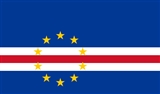
Cape Verde

Encyclopedia
The Republic of Cape Verde is an island country, spanning an archipelago
of 10 islands located in the central Atlantic Ocean
, 570 kilometres off the coast of Western Africa
. The islands, covering a combined area of slightly over 4000 square kilometres (1,544.4 sq mi), are of volcanic origin and while three of them (Sal
, Boa Vista
and Maio
) are fairly flat, sandy and dry, the remaining ones are generally rockier and have more vegetation. However, because of the infrequent occurrence of rainfall the overall landscape is not particularly green, despite what the country's name suggests (verde is Portuguese
for "green"). The name of the country stems instead from the nearby Cap Vert, on the Senegal
ese coast, which in its turn was originally named "Cabo Verde" when it was sighted by Portuguese explorers in 1444, a few years before the islands were discovered.
The previously uninhabited island
s were discovered and colonized
by the Portuguese
in the 15th Century, and became an important location in the Atlantic slave trade
due to their geographically advantageous position. The islands' prosperity often attracted pirates, including Sir Francis Drake, a corsair
under the British crown, who twice sacked the (then) capital Ribeira Grande
, in the 1580s. The islands were also visited by Charles Darwin
's expedition in 1832. The decline in the slave trade in the 19th century resulted in an economic crisis for the islands. With few natural resources, and without strong sustainable investment from the Portuguese, the citizens grew increasingly discontent with the colonial masters, who nevertheless refused to provide the local authorities with more autonomy. This discontent festered and culminated in 1975, when a movement led by Amílcar Cabral
achieved independence for the archipelago.
The country has an estimated population (most of creole ethnicity) of about 500,000, with its capital city Praia
accounting for a quarter of its citizens. Nearly 38% of the population lives in rural areas according to the 2010 Cape Verdean census; about 20% lives below the poverty threshold
, and the literacy rate is around 85%. Politically, the country is a very stable democracy, with notable economic growth and improvements of living conditions despite its lack of natural resources, and has garnered international recognition by other countries and international organizations, which often provide development aid
. Since 2007, Cape Verde has been classified as a developing nation
.
Tough economic times during the last decades of its colonization and the first years of Cape Verde's independence led many to migrate to Europe, the Americas and other African countries. This migration was so significant that the number of Cape Verdeans and their descendants living abroad currently exceeds the population of Cape Verde itself. Historically, the influx of remittances from these immigrant communities to their families has provided a substantial contribution to help strengthen the country's economy. Currently, the Cape Verdean economy is mostly service-oriented with a growing focus on tourism and foreign investment, which benefits from the islands' warm climate throughout the year, diverse landscape, welcoming people and cultural richness, especially in music
.
Before the arrival of Europeans, the Cape Verde Islands were uninhabited. The islands of the Cape Verde archipelago were discovered by Italian and Portuguese navigator
s around 1456. According to Portuguese official records the first discoveries were made by Genoese
born Antonio de Noli
, who was afterwards appointed governor of Cape Verde by Portuguese King Afonso V
. Other navigators mentioned as contributing with discoveries in the Cape Verde archipelago are Diogo Gomes
, Diogo Dias
, Diogo Afonso and the Italian Alvise Cadamosto.
In 1462, Portuguese
settlers arrived at Santiago
and founded a settlement they called Ribeira Grande (now called Cidade Velha
, to avoid being confused with the town of Ribeira Grande
on the Santo Antão island). Ribeira Grande was the first permanent European settlement in the tropics
.
In the 16th century, the archipelago prospered from the transatlantic slave trade. Pirates occasionally attacked the Portuguese settlements. Sir Francis Drake, a British corsair, sacked Ribeira Grande in 1585. After a French attack in 1712, the town declined in importance relative to nearby Praia
, which became the capital in 1770.
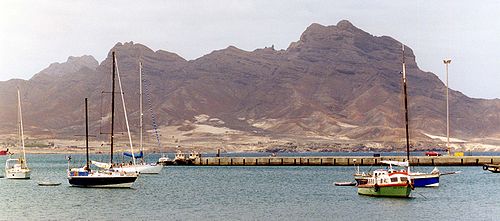
With the decline in the slave trade, Cape Verde's early prosperity slowly vanished. However, the islands' position astride mid-Atlantic shipping lanes made Cape Verde an ideal location for re-supplying ships. Because of its excellent harbour, Mindelo
(on the island of São Vicente
) became an important commercial centre during the 19th century.
In 1951, Portugal changed Cape Verde's status from a colony to an overseas province in an attempt to blunt growing nationalism
. In 1956, Amilcar Cabral
, and a group of fellow Cape Verdeans and Guineans organised (in Portuguese Guinea
) the clandestine African Party for the Independence of Guinea and Cape Verde
(PAIGC), which demanded improvement in economic, social and political conditions in Cape Verde and Portuguese Guinea and formed the basis of the two nations' independence movement. Moving its headquarters to Conakry
, Guinea in 1960, the PAIGC began an armed rebellion against Portugal in 1961. Acts of sabotage eventually grew into a war in Portuguese Guinea
that pitted 10,000 Soviet bloc-supported PAIGC soldiers against 35,000 Portuguese and African troops.
By 1972, the PAIGC controlled much of Portuguese Guinea despite the presence of the Portuguese troops, but the organization did not attempt to disrupt Portuguese control in Cape Verde. Portuguese Guinea declared independence in 1973 and was granted de jure independence in 1974. Following the April 1974 revolution in Portugal
, the PAIGC became an active political movement in Cape Verde. In December 1974, the PAIGC and Portugal signed an agreement providing for a transitional government composed of Portuguese and Cape Verdeans. On June 30, 1975, Cape Verdeans elected a National Assembly which received the instruments of independence from Portugal on July 5, 1975.
Immediately following the November 1980 coup in Guinea-Bissau, relations between Cape Verde and Guinea-Bissau became strained. Cape Verde abandoned its hope for unity with Guinea-Bissau and formed the African Party for the Independence of Cape Verde
(PAICV). Problems have since been resolved and relations between the countries are good. The PAICV and its predecessor established a one-party system and ruled Cape Verde from independence until 1990.
Responding to growing pressure for pluralistic democracy, the PAICV called an emergency congress in February 1990 to discuss proposed constitutional changes to end one-party rule. Opposition groups came together to form the Movement for Democracy
(MPD) in Praia in April 1990. Together, they campaigned for the right to contest the presidential election scheduled for December 1990.
The one-party state was abolished September 28, 1990, and the first multi-party elections were held in January 1991. The MPD won a majority of the seats in the National Assembly, and MPD presidential candidate António Mascarenhas Monteiro
defeated the PAICV's candidate with 73.5% of the votes. Legislative elections in December 1995 increased the MPD majority in the National Assembly. The party won 50 of the National Assembly's 72 seats.
A February 1996 presidential election returned President Monteiro to office. Legislative elections in January 2001 returned power to the PAICV, with the PAICV holding 40 of the National Assembly seats, MPD 30, and Party for Democratic Convergence (PCD) and Party for Labor and Solidarity (PTS) 1 each. In February 2001, the PAICV-supported presidential candidate Pedro Pires
defeated former MPD leader Carlos Veiga
by only 13 votes.

 The Cape Verde archipelago is located in the Atlantic Ocean
, approximately 570 kilometres (354.2 mi) off the coast of West Africa, near Mauritania
and Senegal
, and is part of the Macaronesia
ecoregion
. It lies between latitudes 14°
and 18°N
, and longitudes 22°
and 26°W
.
The country is a horseshoe-shaped cluster of ten islands (nine inhabited) and eight islets, that constitute an area of 4033 km².
The islands are spatially divided into two groups:
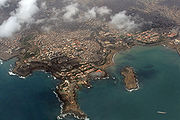
The largest island, both in size and population, is Santiago
, which hosts the nation's capital, Praia
, the principal agglomeration in the archipelago.
, and reached its peak at the end of this period, when the islands reached their maximum sizes. Historical volcanism (within human settlement) has been restricted to the island of Fogo.
The origin of the islands' volcanism has been attributed to a hotspot
, associated with bathymetric swell that formed the Cape Verde Rise. The Rise is one of the largest protuberances in the world's oceans, rising 2.2 kilometers in a semi-circular region of 1200 km², associated with a rise of the geoid
and elevated surface heat flow.
Though Cape Verde's islands are all volcanic
in origin, they vary widely in terrain.
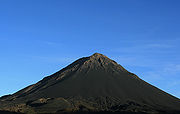
Most recently erupting in 1995, Pico do Fogo is the largest active volcano
in the region. It has a 8 km (5 mi) diameter caldera
, whose rim is 1600 m (5,249 ft) altitude and an interior cone that rises to 2829 m (9,281 ft) above sea level. The caldera resulted from subsidence, following the partial evacuation (eruption) of the magma
chamber, along a cylindrical column from within magma chamber (at a depth of 8 km (5 mi)).
Geologically, the islands are principally composed of igneous rock
s, with volcanic structures and pyroclastic debris comprising the majority of the archipelago's total volume. The volcanic and plutonic rocks
are distinctly basic; the archipelago is a soda-alkaline petrographic province, with a petrologic
succession which is similar to that found in other Macaronesia
n islands.
Extensive salt flats are found on Sal and Maio. On Santiago, Santo Antão, and São Nicolau, arid slopes give way in places to sugarcane fields or banana plantations spread along the base of towering mountains.
, with nothing like the rainfall levels of nearby West Africa. It does rain irregularly between August and October, with frequent brief-but-heavy downpours. A desert
is usually defined as terrain which receives less than 250 mm (9.8 in) of annual rainfall. Cape Verde's total (261 mm (10.3 in)) is slightly above this criterion, which makes the area climate semi-desert.
The islands, covering a combined area of slightly over 4000 square kilometres (1,544.4 sq mi), are of volcanic origin and while three of them (Sal
, Boa Vista
and Maio
) are fairly flat, sandy and dry, the remaining ones are generally rockier and have more vegetation. However, because of the infrequent occurrence of rainfall the overall landscape is not particularly green. However, the archipelago can be divided into four broad ecological zones: arid, semiarid, subhumid and humid, according to altitude and average annual rainfall ranging from 200 mm in the arid areas of the coast to more than 1000 mm in the humid mountain. Mostly rainfall precipitation is due to condensation of the ocean mist.
In some islands, as Santiago
, the wetter climate of the interior and the eastern coast contrasts with the dryer one in the south/southwest coast. Praia
, located in the southeast coast, is the largest city of the island, and also the largest city and capital of the country.
The Cape Verde islands are a very degradated area. Due to its proximity to the Sahara, most of the Cape Verde islands are dry, but on islands with high mountains and farther away from the coast, by orography, the humidity is much higher, giving a rainforest habitat, very degraded by the strong human presence.
Northeastern slopes of high mountains often receive a lot of rain and Southwest slopes not. This umbria areas are identified with cool and moisture.
Some islands, with steep mountains, are covered with vegetation where the dense ocean moisture
condense and soak the plants, rocks, soil, logs, moss etc.
cloud forests
developed about mountain
s, where the dense moisture
from the sea or ocean, is precipitated by the action of the relief. Opposing the terrain to a front of warm, moist air mass, it forces to increase the height above sea level of that body wet and warm air mass, which cools and decreases the dew point
, causing it to condense part of the moisture that falls as rain or fog, creating an habitat especially cool, saturated with moisture in the air and soil.
Hurricanes that form near the Cape Verde Islands are sometimes referred to as Cape Verde-type hurricane
s. These hurricanes can become very intense as they cross warm Atlantic waters.
species
, particularly bird and reptiles, many of which are endangered
by human development. Endemic birds include Alexander's Swift
(Apus alexandri), Bourne's Heron
(Ardea purpurea bournei), the Raso Lark
(Alauda razae), the Cape Verde Warbler (Acrocephalus brevipennis), and the Iago Sparrow
(Passer iagoensis). The islands are also an important breeding area for seabirds including the Cape Verde Shearwater
. Reptile
s include the Cape Verde Giant Gecko (Tarentola gigas).
 Cape Verde is divided into 22 municipalities (concelhos) and subdivided into 32 parishes (freguesias), based on the religious parishes that existed during the colonial period:
 Most of the population is of creole ethnicity, mixed from black African
and European
descent. The European men who colonized Cape Verde did not usually bring wives or families with them. As female African slaves
were brought to the islands inter-marriages occurred.
A genetic study revealed that the ancestry of the population in Cape Verde is 57% African and 43% European.
Around 95% of the population is Christian (more than 85 percent of the population is nominally Roman Catholic, though for a minority of the population Catholicism is syncretized
with African influences). The largest Protestant denomination is the Church of the Nazarene
; other groups include the Seventh-day Adventist Church
, the Church of Jesus Christ of Latter-day Saints, the Assemblies of God
, the Universal Church of the Kingdom of God
, and various other Pentecostal and evangelical
groups.) There are small Baha'i communities and a small Muslim
community. The number of atheists is estimated at less than 1 percent of the population.
Cape Verde's official language is Portuguese. It is the language of instruction and government. However, the Cape Verdean Creole is used colloquially and is the mother tongue of virtually all Cape Verdeans. Cape Verdean Creole or Kriolu is a dialect continuum of a Portuguese-based creole
, which varies from island to island. There is a substantial body of literature in Creole, especially in the Santiago Creole and the São Vicente Creole. Creole has been gaining prestige since the nation's independence from Portugal. However, the differences between the varied forms of the language within the islands have been a major obstacle in the way of standardization of the language. Some people have advocated the development of two standards: a North (Barlavento) standard, centered on the São Vicente Creole, and a South (Sotavento) standard, centered on the Santiago Creole. Manuel Veiga, PhD, a linguist by training, and Minister of Culture of Cape Verde, is the premier proponent of Kriolu's officialization and standardization. The demographic statistics site ESA says Cape Verde has a population of 567,000 in 2010.
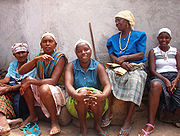 Today, more Cape Verdeans live abroad than in Cape Verde itself, with significant emigrant
Cape Verdean communities in the United States (500,000 Cape Verdeans descent, with a major concentration on the New England
coast from Providence, Rhode Island
, to New Bedford, Massachusetts
). There are also significant Cape Verde populations in Portugal
(150,000), Angola
(45,000), São Tomé and Príncipe
(25,000), Senegal
(25,000), the Netherlands (20,000, of which 15,000 are concentrated in Rotterdam
), France (25,000), Scandinavia (7,000), Italy (10,000) and Spain (12,500). There is also a Cape Verdean community in Argentina
numbering 8,000. A large number of Cape Verdeans and people of Cape Verdean descent that immigrated before 1975 are not included in these statistics, because all the Cape Verdeans had Portuguese passports before 1975.
There are approximately 2,000 Chinese immigrants in Cape Verde, as well as citizens of the African mainland (most of these immigrants hail from West Africa), there are also a significant number of citizens of Europe and South America (Brazil
) residing in the country. There are an estimated 20,000 immigrants in Cape Verde of which 14,000 are legal residents.
In the USA, the children and grandchildren of the first immigrant waves became involved in the Civil Rights movement of the 1960s. This led them to make links with other US black groups. Cape-Verdean Americans have also been involved in the US Army for centuries; in the Revolutionary War, Civil War, the First and Second World Wars, as well as the Korean and Vietnam Wars. Cape Verdeans moved to places all over the world, from Macau
to Haiti
to Argentina to northern Europe.
 Cape Verde is a stable representative
Parliamentary republic
. The constitution —adopted in 1980 and revised in 1992, 1995 and 1999— defines the basic principles of its government. The president is the head of state
and is elected by popular vote for a 5-year term. The prime minister is the head of government
and proposes other ministers and secretaries of state. The prime minister is nominated by the National Assembly
and appointed by the president. Members of the National Assembly are elected by popular vote for 5-year terms. Three parties now hold seats in the National Assembly—PAICV 40, MPD 30, and Cape Verdean Independent Democratic Union (UCID) 2.
The judicial system consists of a Supreme Court of Justice — whose members are appointed by the president, the National Assembly, and the Board of the Judiciary — and regional courts. Separate courts hear civil, constitutional, and criminal cases. Appeal is to the Supreme Court.
Cape Verde follows a policy of nonalignment
and seeks cooperative relations with all friendly states. Angola
, Brazil, the People's Republic of China, Cuba
, France, Germany, Portugal, Spain, Senegal
, Russia and the United States maintain embassies in Praia
. Cape Verde is actively interested in foreign affairs, especially in Africa. It has bilateral relations
with some Lusophone
nations and holds membership in a number of international organisations. It also participates in most international conferences on economic and political issues. Since 2007, Cape Verde has a special partnership status with the EU, under the Cotonou Agreement
, and might apply for special membership.
The military of Cape Verde
consists of a coast guard
and an army
; 0.7% of the country's GDP was spent on the military in 2005.
Moreover, on 10 October 2011 Cape Verde became the 119th state which ratified the Rome Statute of the International Criminal Court (Cape Verde becomes the 119th State to Join the Rome Statute System).
.jpg) Cape Verde has few natural resource
Cape Verde has few natural resource
s, scant rainfall and limited supplies of fresh water
. Only four of the ten main islands (Santiago, Santo Antão, Fogo, and Brava) normally support significant agricultural production, and over 90% of all food consumed in Cape Verde is imported. Mineral resources include salt, pozzolana
(a volcanic rock used in cement production), and limestone
. Its small number of wineries making Portuguese-style wines have traditionally focused on the domestic market, but have recently met with some international acclaim. A number of wine tours of Cape Verde's various microclimates began to be offered in spring 2010 and can be arranged through the tourism office.
The economy
of Cape Verde is service-oriented, with commerce, transport, and public services accounting for more than 70% of GDP. Although nearly 38% of the population lives in rural
areas, agriculture and fishing contribute only about 9% of GDP. Light manufacturing accounts for most of the remainder. Fish
and shellfish
are plentiful, and small quantities are export
ed. Cape Verde has cold storage and freezing facilities and fish processing
plants in Mindelo, Praia, and on Sal. Expatriate Cape Verdeans contribute an amount estimated at about 20% of GDP to the domestic economy through remittances.
Since 1991, the government has pursued market-oriented economic policies, including an open welcome to foreign investors and a far-reaching privatization
programme. It established as top development priorities the promotion of a market economy
and of the private sector; the development of tourism
, light manufacturing industries, and fisheries; and the development of transport
, communications
, and energy
facilities. From 1994 to 2000 about $407 million in foreign investments were made or planned, of which 58% were in tourism
, 17% in industry, 4% in infrastructure, and 21% in fisheries
and services.
In 2011, on 4 islands a windfarm was built, that in total supplies about 25% of the electricity of the country. With this amount it is one of the top countries for renewable energy.
Between 2000 and 2009, real GDP increased on average by over 7 percent a year, well above the average for Sub-Saharan countries and faster than most small island economies in the region. Strong economic performance was bolstered by one of the fastest growing tourism industries in the world, as well as by substantial capital inflows that allowed Cape Verde to build up national currency reserves to the current 3.5 months of imports. Unemployment has been falling rapidly, and the country is on track to achieve most of the UN Millenium Development Goals – including halving its 1990 poverty level.
In 2007, Cape Verde joined the World Trade Organization
(WTO) and in 2008 the country graduated from Least Developed Country (LDC) to Middle Income Country (MIC) status.
Cape Verde has significant cooperation with Portugal at every level of the economy, which has led it to link its currency first to the Portuguese escudo
and, in 1999, to the euro
. On June 23, 2008 Cape Verde became the 153rd member of the WTO.
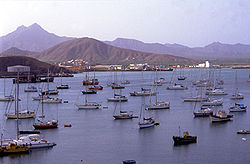 Cape Verde's strategic location at the crossroads of mid-Atlantic air and sea lanes has been enhanced by significant improvements at Mindelo
's harbor (Porto Grande
) and at Sal's
and Praia's international airports
. A new international airport
was opened in Boa Vista
in December 2007, and on the island of Sao Vicente, the newest international airport (Sao Pedro Airport
) in Cape Verde, was opened in late 2009. Ship repair facilities at Mindelo were opened in 1983. The major ports are Mindelo and Praia, but all other islands have smaller port facilities. In addition to the international airport on Sal, airports have been built on all of the inhabited islands. All but the airport on Brava enjoy scheduled air service. The archipelago has 3050 km (1,895 mi) of roads, of which 1010 km (628 mi) are paved, most using cobblestone
.
The country's future economic prospects depend heavily on the maintenance of aid flows, the encouragement of tourism, remittances, outsourcing labor to neighboring African countries, and the momentum of the government's development program.
Tourism
has increased in recent years. Large hotels have been built across the country in an effort to boost tourism. In particular, on the islands of Boa Vista (Club Hotel Riu Karamboa (750 rooms)), and Sal (Club Hotel Riu Funana/Garopa (1000 rooms)--the largest hotel in all of West Africa). The Cape Verde islands have a relatively low crime rate and beautiful beaches, as well as having engaging local people. Tourists and leisure seekers from across Europe and the world are coming to the country in larger numbers.
In 2010, about 382,000 tourists visited the archipelago.
 Cape Verdean social and cultural patterns are similar to those of rural Portugal and Africa. Soccer (Futebol) games and church activities are typical sources of social interaction and entertainment. The traditional walk around the praça (town square
) to meet friends is practiced regularly in Cape Verde towns. In towns with electricity, television is available on two channels (Cape Verdean and Portuguese).
Cape Verde music incorporates Portuguese, Caribbean, African, and Brazilian influences. Cape Verde's quintessential national music is the morna, a melancholy and lyrical song form typically sung in Cape Verdean Creole. The most popular music genre after morna is the coladeira followed by funaná
and batuque
music. Amongst the most worldwide known Cape Verdean singers, are the singers Ildo Lobo
and Cesaria Evora
whose songs became a hallmark of the country and its culture.
There are also well known artists born to Cape Verdean parents who excelled themselves. Amongst these artists are jazz pianist Horace Silver
, Duke Ellington
's saxophonist Paul Gonsalves
and singer Lura
.
Dance forms include the soft dance morna, the extreme sensuality of coladeira including the modernized version called passada (zouk
), the Funaná
(a sensual mixed Portuguese and African dance), and the Batuque
dance.
Cape Verdean literature is one of the richest of Lusophone
Africa. Famous poets include Paulino Vieira, Manuel de Novas, Sergio Frusoni, Eugénio Tavares, and B. Léza, and famous authors include Baltasar Lopes da Silva
, António Aurélio Gonçalves, Manuel Lopes
, Orlanda Amarílis
, Henrique Teixeira de Sousa
, and Germano Almeida
.
and rice
. Vegetable
s available during most of the year are potato
es, onion
s, tomatoes, manioc, cabbage
, kale
, and dried beans. Fruit
s such as banana
and papaya
s are available year-round, while others like mango
s and avocado
s are seasonal. A popular dish served in Cape Verde is Cachupa
, a slow cooked stew
of corn (hominy), beans, and fish
or meat.
Cape Verde has been steadily developing since its independence, and besides having been promoted to the group of "medium development" countries in 2007, leaving the Least Developed Countries
category (which is only the second time it has happened to a country), is currently the 10th best ranked country in Africa in terms of Human Development Index
.
represents Cape Verde abroad, many internationally known football players were born in Cape Verde, or were descendants of Cape Verdeans, and play for other nation's teams. Several currently play, or have played, in the Portuguese league or national team, such as Nani, Jorge Andrade, Rolando
or Nélson Marcos
. Henrik Larsson
(whose father is Cape Verdean) played for Sweden, Patrick Vieira
(whose mother is Cape Verdean) played for France, while Gelson Fernandes
(who was born in Praia) plays for Switzerland.
Mitu Monteiro, a local kitesurfer, was the 2008 Kite Surfing World Champion in the wave discipline. The lives of Mitu and his 2 lifelong friends Titik and Djo and their very unique exposure to windsurfing and kitesurfing is chronicled in a short film by Thierry Albert and Marcus Werner Hed called "The Boys from Ponta Preta"
Archipelago
An archipelago , sometimes called an island group, is a chain or cluster of islands. The word archipelago is derived from the Greek ἄρχι- – arkhi- and πέλαγος – pélagos through the Italian arcipelago...
of 10 islands located in the central Atlantic Ocean
Atlantic Ocean
The Atlantic Ocean is the second-largest of the world's oceanic divisions. With a total area of about , it covers approximately 20% of the Earth's surface and about 26% of its water surface area...
, 570 kilometres off the coast of Western Africa
West Africa
West Africa or Western Africa is the westernmost region of the African continent. Geopolitically, the UN definition of Western Africa includes the following 16 countries and an area of approximately 5 million square km:-Flags of West Africa:...
. The islands, covering a combined area of slightly over 4000 square kilometres (1,544.4 sq mi), are of volcanic origin and while three of them (Sal
Sal, Cape Verde
Sal is an island in Cape Verde. It belongs to the northern group of islands, called Barlavento. The island is composed by a single administrative division, the Sal municipality. The island is home to Amílcar Cabral International Airport, the main airport of Cape Verde.- Geography :The island is...
, Boa Vista
Boa Vista, Cape Verde
Boa Vista is the easternmost island of Cape Verde. It is located in the Barlavento group of the archipelago. The island is known for marine turtles and traditional music, as well as its ultramarathon and its sand dunes and beaches...
and Maio
Maio, Cape Verde
Maio is the easternmost of the Sotavento islands of Cape Verde. Maio is located south of the islands of Boa Vista and east of Santiago. The island is also known for its large forest, which is unusual for Cape Verde.-Geography:The island covers an area of 269 km²...
) are fairly flat, sandy and dry, the remaining ones are generally rockier and have more vegetation. However, because of the infrequent occurrence of rainfall the overall landscape is not particularly green, despite what the country's name suggests (verde is Portuguese
Portuguese language
Portuguese is a Romance language that arose in the medieval Kingdom of Galicia, nowadays Galicia and Northern Portugal. The southern part of the Kingdom of Galicia became independent as the County of Portugal in 1095...
for "green"). The name of the country stems instead from the nearby Cap Vert, on the Senegal
Senegal
Senegal , officially the Republic of Senegal , is a country in western Africa. It owes its name to the Sénégal River that borders it to the east and north...
ese coast, which in its turn was originally named "Cabo Verde" when it was sighted by Portuguese explorers in 1444, a few years before the islands were discovered.
The previously uninhabited island
Desert island
A desert island or uninhabited island is an island that has yet to be populated by humans. Uninhabited islands are often used in movies or stories about shipwrecked people, and are also used as stereotypes for the idea of "paradise". Some uninhabited islands are protected as nature reserves and...
s were discovered and colonized
Colony
In politics and history, a colony is a territory under the immediate political control of a state. For colonies in antiquity, city-states would often found their own colonies. Some colonies were historically countries, while others were territories without definite statehood from their inception....
by the Portuguese
Portugal
Portugal , officially the Portuguese Republic is a country situated in southwestern Europe on the Iberian Peninsula. Portugal is the westernmost country of Europe, and is bordered by the Atlantic Ocean to the West and South and by Spain to the North and East. The Atlantic archipelagos of the...
in the 15th Century, and became an important location in the Atlantic slave trade
Atlantic slave trade
The Atlantic slave trade, also known as the trans-atlantic slave trade, refers to the trade in slaves that took place across the Atlantic ocean from the sixteenth through to the nineteenth centuries...
due to their geographically advantageous position. The islands' prosperity often attracted pirates, including Sir Francis Drake, a corsair
Corsair
Corsairs were privateers, authorized to conduct raids on shipping of a nation at war with France, on behalf of the French Crown. Seized vessels and cargo were sold at auction, with the corsair captain entitled to a portion of the proceeds...
under the British crown, who twice sacked the (then) capital Ribeira Grande
Cidade Velha
Cidade Velha , or simplyCidadi in Cape Verdean Creole, is a city located 15 km from Praia on the island of Santiago. It is the oldest settlement in Cape Verde and used to serve as the capital of Cape Verde...
, in the 1580s. The islands were also visited by Charles Darwin
Charles Darwin
Charles Robert Darwin FRS was an English naturalist. He established that all species of life have descended over time from common ancestry, and proposed the scientific theory that this branching pattern of evolution resulted from a process that he called natural selection.He published his theory...
's expedition in 1832. The decline in the slave trade in the 19th century resulted in an economic crisis for the islands. With few natural resources, and without strong sustainable investment from the Portuguese, the citizens grew increasingly discontent with the colonial masters, who nevertheless refused to provide the local authorities with more autonomy. This discontent festered and culminated in 1975, when a movement led by Amílcar Cabral
Amílcar Cabral
Amílcar Lopes da Costa Cabral was a Guinea-Bissauan and Cape Verdean agricultural engineer, writer, and a nationalist thinker and politician. Also known by his nom de guerre Abel Djassi, Cabral led the nationalist movement of Guinea-Bissau and Cape Verde Islands and the ensuing war of independence...
achieved independence for the archipelago.
The country has an estimated population (most of creole ethnicity) of about 500,000, with its capital city Praia
Praia
Praia , is the capital and largest city of Cape Verde, an island nation in the Atlantic Ocean west of Senegal. It lies on the southern coast of Santiago island in the Sotavento Islands group. It is the island's ferry port and is home to one of the nation’s four international airports...
accounting for a quarter of its citizens. Nearly 38% of the population lives in rural areas according to the 2010 Cape Verdean census; about 20% lives below the poverty threshold
Poverty threshold
The poverty threshold, or poverty line, is the minimum level of income deemed necessary to achieve an adequate standard of living in a given country...
, and the literacy rate is around 85%. Politically, the country is a very stable democracy, with notable economic growth and improvements of living conditions despite its lack of natural resources, and has garnered international recognition by other countries and international organizations, which often provide development aid
Development aid
Development aid or development cooperation is aid given by governments and other agencies to support the economic, environmental, social and political development of developing countries.It is distinguished...
. Since 2007, Cape Verde has been classified as a developing nation
Developing country
A developing country, also known as a less-developed country, is a nation with a low level of material well-being. Since no single definition of the term developing country is recognized internationally, the levels of development may vary widely within so-called developing countries...
.
Tough economic times during the last decades of its colonization and the first years of Cape Verde's independence led many to migrate to Europe, the Americas and other African countries. This migration was so significant that the number of Cape Verdeans and their descendants living abroad currently exceeds the population of Cape Verde itself. Historically, the influx of remittances from these immigrant communities to their families has provided a substantial contribution to help strengthen the country's economy. Currently, the Cape Verdean economy is mostly service-oriented with a growing focus on tourism and foreign investment, which benefits from the islands' warm climate throughout the year, diverse landscape, welcoming people and cultural richness, especially in music
Music
Music is an art form whose medium is sound and silence. Its common elements are pitch , rhythm , dynamics, and the sonic qualities of timbre and texture...
.
History
Before the arrival of Europeans, the Cape Verde Islands were uninhabited. The islands of the Cape Verde archipelago were discovered by Italian and Portuguese navigator
Navigator
A navigator is the person on board a ship or aircraft responsible for its navigation. The navigator's primary responsibility is to be aware of ship or aircraft position at all times. Responsibilities include planning the journey, advising the Captain or aircraft Commander of estimated timing to...
s around 1456. According to Portuguese official records the first discoveries were made by Genoese
Genoa
Genoa |Ligurian]] Zena ; Latin and, archaically, English Genua) is a city and an important seaport in northern Italy, the capital of the Province of Genoa and of the region of Liguria....
born Antonio de Noli
António Noli
Antonio de Noli was a 15th century Genoese nobleman and navigator, and the first governor of the earliest European overseas colony in Subsaharan Africa. He discovered some of the Cape Verde islands on behalf of Henry the Navigator and he was made first Governor of Cape Verde by King Afonso V...
, who was afterwards appointed governor of Cape Verde by Portuguese King Afonso V
Afonso V of Portugal
Afonso V KG , called the African , was the twelfth King of Portugal and the Algarves. His sobriquet refers to his conquests in Northern Africa.-Early life:...
. Other navigators mentioned as contributing with discoveries in the Cape Verde archipelago are Diogo Gomes
Diogo Gomes
Diogo Gomes , was a Portuguese navigator, explorer and writer.Diogo Gomes was a servant and explorer of Portuguese prince Henry the Navigator. His memoirs were dictated late in his life to Martin Behaim...
, Diogo Dias
Diogo Dias
Diogo Dias, also known as Diogo Gomes, was a 15th-century Portuguese explorer. He was the brother of Bartolomeu Dias and discovered some of the Cape Verde islands together with António Noli....
, Diogo Afonso and the Italian Alvise Cadamosto.
In 1462, Portuguese
Portugal
Portugal , officially the Portuguese Republic is a country situated in southwestern Europe on the Iberian Peninsula. Portugal is the westernmost country of Europe, and is bordered by the Atlantic Ocean to the West and South and by Spain to the North and East. The Atlantic archipelagos of the...
settlers arrived at Santiago
Santiago, Cape Verde
Santiago , or Santiagu in Cape Verdean Creole, is the largest island of Cape Verde, its most important agricultural centre and home to half the nation’s population. At the time of Darwin's voyage it was called St. Jago....
and founded a settlement they called Ribeira Grande (now called Cidade Velha
Cidade Velha
Cidade Velha , or simplyCidadi in Cape Verdean Creole, is a city located 15 km from Praia on the island of Santiago. It is the oldest settlement in Cape Verde and used to serve as the capital of Cape Verde...
, to avoid being confused with the town of Ribeira Grande
Ribeira Grande, Cape Verde
Ribeira Grande is a municipality on the island of Santo Antão of the Barlavento group in Cape Verde. It covers one-third of the island and is home to two-thirds of the population....
on the Santo Antão island). Ribeira Grande was the first permanent European settlement in the tropics
Tropics
The tropics is a region of the Earth surrounding the Equator. It is limited in latitude by the Tropic of Cancer in the northern hemisphere at approximately N and the Tropic of Capricorn in the southern hemisphere at S; these latitudes correspond to the axial tilt of the Earth...
.
In the 16th century, the archipelago prospered from the transatlantic slave trade. Pirates occasionally attacked the Portuguese settlements. Sir Francis Drake, a British corsair, sacked Ribeira Grande in 1585. After a French attack in 1712, the town declined in importance relative to nearby Praia
Praia
Praia , is the capital and largest city of Cape Verde, an island nation in the Atlantic Ocean west of Senegal. It lies on the southern coast of Santiago island in the Sotavento Islands group. It is the island's ferry port and is home to one of the nation’s four international airports...
, which became the capital in 1770.
With the decline in the slave trade, Cape Verde's early prosperity slowly vanished. However, the islands' position astride mid-Atlantic shipping lanes made Cape Verde an ideal location for re-supplying ships. Because of its excellent harbour, Mindelo
Mindelo
For the parish in Portugal, see Mindelo, PortugalMindelo , is a port city in the northern part of the island of São Vicente in Cape Verde. Mindelo is also the seat of the parish of Nossa Senhora da Luz, and this island's municipality...
(on the island of São Vicente
São Vicente, Cape Verde
São Vicente , also Son Visent or Son Sent in Cape Verdean Creole, is one of the Barlavento islands of Cape Verde. It is located between the islands of Santo Antão and Santa Luzia, with the Canal de São Vicente separating it from Santo Antão.- Geography :The island is roughly rectangular in shape...
) became an important commercial centre during the 19th century.
In 1951, Portugal changed Cape Verde's status from a colony to an overseas province in an attempt to blunt growing nationalism
Nationalism
Nationalism is a political ideology that involves a strong identification of a group of individuals with a political entity defined in national terms, i.e. a nation. In the 'modernist' image of the nation, it is nationalism that creates national identity. There are various definitions for what...
. In 1956, Amilcar Cabral
Amílcar Cabral
Amílcar Lopes da Costa Cabral was a Guinea-Bissauan and Cape Verdean agricultural engineer, writer, and a nationalist thinker and politician. Also known by his nom de guerre Abel Djassi, Cabral led the nationalist movement of Guinea-Bissau and Cape Verde Islands and the ensuing war of independence...
, and a group of fellow Cape Verdeans and Guineans organised (in Portuguese Guinea
Portuguese Guinea
Portuguese Guinea was the name for what is today Guinea-Bissau from 1446 to September 10, 1974.-History:...
) the clandestine African Party for the Independence of Guinea and Cape Verde
African Party for the Independence of Guinea and Cape Verde
The African Party for the Independence of Guinea and Cape Verde or PAIGC is a political party that governed Guinea-Bissau from the independence of the then Portuguese Guinea in 1974, until the late 1990s, and from 2004 to 2005. Currently it is the party with the largest number of seats in the...
(PAIGC), which demanded improvement in economic, social and political conditions in Cape Verde and Portuguese Guinea and formed the basis of the two nations' independence movement. Moving its headquarters to Conakry
Conakry
Conakry is the capital and largest city of Guinea. Conakry is a port city on the Atlantic Ocean and serves as the economic, financial and cultural centre of Guinea with a 2009 population of 1,548,500...
, Guinea in 1960, the PAIGC began an armed rebellion against Portugal in 1961. Acts of sabotage eventually grew into a war in Portuguese Guinea
Guinea-Bissau War of Independence
Guinea-Bissau War of Independence was an armed conflict and national liberation struggle in Portuguese Guinea between 1963 and 1974.-Background:...
that pitted 10,000 Soviet bloc-supported PAIGC soldiers against 35,000 Portuguese and African troops.
By 1972, the PAIGC controlled much of Portuguese Guinea despite the presence of the Portuguese troops, but the organization did not attempt to disrupt Portuguese control in Cape Verde. Portuguese Guinea declared independence in 1973 and was granted de jure independence in 1974. Following the April 1974 revolution in Portugal
Carnation Revolution
The Carnation Revolution , also referred to as the 25 de Abril , was a military coup started on 25 April 1974, in Lisbon, Portugal, coupled with an unanticipated and extensive campaign of civil resistance...
, the PAIGC became an active political movement in Cape Verde. In December 1974, the PAIGC and Portugal signed an agreement providing for a transitional government composed of Portuguese and Cape Verdeans. On June 30, 1975, Cape Verdeans elected a National Assembly which received the instruments of independence from Portugal on July 5, 1975.
Immediately following the November 1980 coup in Guinea-Bissau, relations between Cape Verde and Guinea-Bissau became strained. Cape Verde abandoned its hope for unity with Guinea-Bissau and formed the African Party for the Independence of Cape Verde
African Party for the Independence of Cape Verde
The African Party of Independence of Cape Verde is a former socialist party and presently a social-democratic political party in Cape Verde. Its members are nicknamed “os tambarinas” in Portuguese , and they identify themselves with the color yellow.-Forerunner:In 1956, its forerunner, the African...
(PAICV). Problems have since been resolved and relations between the countries are good. The PAICV and its predecessor established a one-party system and ruled Cape Verde from independence until 1990.
Responding to growing pressure for pluralistic democracy, the PAICV called an emergency congress in February 1990 to discuss proposed constitutional changes to end one-party rule. Opposition groups came together to form the Movement for Democracy
Movement for Democracy (Cape Verde)
The Movimento para a Democracia is a ideological liberal party in Cape Verde. It was in power between 1991 and 2001. MPD was created on March 14, 1990, and their first convention was held in November 1990. They won the first elections after the end of the one-party system in Cape Verde, with more...
(MPD) in Praia in April 1990. Together, they campaigned for the right to contest the presidential election scheduled for December 1990.
The one-party state was abolished September 28, 1990, and the first multi-party elections were held in January 1991. The MPD won a majority of the seats in the National Assembly, and MPD presidential candidate António Mascarenhas Monteiro
António Mascarenhas Monteiro
António Manuel Mascarenhas Gomes Monteiro was the President of Cape Verde from March 22, 1991 to March 22, 2001.-Education:Monteiro went to university in Belgium and graduated with his law degree from the Catholic University of Leuven...
defeated the PAICV's candidate with 73.5% of the votes. Legislative elections in December 1995 increased the MPD majority in the National Assembly. The party won 50 of the National Assembly's 72 seats.
A February 1996 presidential election returned President Monteiro to office. Legislative elections in January 2001 returned power to the PAICV, with the PAICV holding 40 of the National Assembly seats, MPD 30, and Party for Democratic Convergence (PCD) and Party for Labor and Solidarity (PTS) 1 each. In February 2001, the PAICV-supported presidential candidate Pedro Pires
Pedro Pires
Pedro Verona Rodrigues Pires was the President of Cape Verde from March 2001 to September 2011. Before becoming President, he was Prime Minister from 1975 to 1991....
defeated former MPD leader Carlos Veiga
Carlos Veiga
Carlos Alberto Wahnon de Carvalho Veiga is a Cape Verdean politician. He was Prime Minister of Cape Verde from April 4, 1991 to July 29, 2000, and he unsuccessfully ran for President as the candidate of the Movement for Democracy in 2001 and 2006....
by only 13 votes.
Geography
Atlantic Ocean
The Atlantic Ocean is the second-largest of the world's oceanic divisions. With a total area of about , it covers approximately 20% of the Earth's surface and about 26% of its water surface area...
, approximately 570 kilometres (354.2 mi) off the coast of West Africa, near Mauritania
Mauritania
Mauritania is a country in the Maghreb and West Africa. It is bordered by the Atlantic Ocean in the west, by Western Sahara in the north, by Algeria in the northeast, by Mali in the east and southeast, and by Senegal in the southwest...
and Senegal
Senegal
Senegal , officially the Republic of Senegal , is a country in western Africa. It owes its name to the Sénégal River that borders it to the east and north...
, and is part of the Macaronesia
Macaronesia
Macaronesia is a modern collective name for several groups of islands in the North Atlantic Ocean near Europe and North Africa belonging to three countries: Portugal, Spain, and Cape Verde...
ecoregion
Ecoregion
An ecoregion , sometimes called a bioregion, is an ecologically and geographically defined area that is smaller than an ecozone and larger than an ecosystem. Ecoregions cover relatively large areas of land or water, and contain characteristic, geographically distinct assemblages of natural...
. It lies between latitudes 14°
14th parallel north
The 14th parallel north is a circle of latitude that is 14 degrees north of the Earth's equatorial plane. It crosses Africa, Asia, the Indian Ocean, the Pacific Ocean, Central America, the Caribbean and the Atlantic Ocean....
and 18°N
18th parallel north
The 18th parallel north is a circle of latitude that is 18 degrees north of the Earth's equatorial plane. It crosses Africa, Asia, the Indian Ocean, the Pacific Ocean, Central America, the Caribbean and the Atlantic Ocean....
, and longitudes 22°
22nd meridian west
The meridian 22° west of Greenwich is a line of longitude that extends from the North Pole across the Arctic Ocean, Greenland, Iceland, the Atlantic Ocean, the Southern Ocean, and Antarctica to the South Pole....
and 26°W
26th meridian west
The meridian 26° west of Greenwich is a line of longitude that extends from the North Pole across the Arctic Ocean, Greenland, the Atlantic Ocean, the Southern Ocean, and Antarctica to the South Pole....
.
The country is a horseshoe-shaped cluster of ten islands (nine inhabited) and eight islets, that constitute an area of 4033 km².
The islands are spatially divided into two groups:
- The Ilhas de Barlavento (): Santo Antão, São VicenteSão Vicente, Cape VerdeSão Vicente , also Son Visent or Son Sent in Cape Verdean Creole, is one of the Barlavento islands of Cape Verde. It is located between the islands of Santo Antão and Santa Luzia, with the Canal de São Vicente separating it from Santo Antão.- Geography :The island is roughly rectangular in shape...
, Santa LuziaSanta Luzia, Cape VerdeSanta Luzia is an island of the Barlavento archipelago in Cape Verde located between São Nicolau and São Vicente. The area is 35 km² . The highest point is Monte Grande elevating 395 m...
, São Nicolau, SalSal, Cape VerdeSal is an island in Cape Verde. It belongs to the northern group of islands, called Barlavento. The island is composed by a single administrative division, the Sal municipality. The island is home to Amílcar Cabral International Airport, the main airport of Cape Verde.- Geography :The island is...
, Boa VistaBoa Vista, Cape VerdeBoa Vista is the easternmost island of Cape Verde. It is located in the Barlavento group of the archipelago. The island is known for marine turtles and traditional music, as well as its ultramarathon and its sand dunes and beaches...
; and - The Ilhas de Sotavento (): MaioMaio, Cape VerdeMaio is the easternmost of the Sotavento islands of Cape Verde. Maio is located south of the islands of Boa Vista and east of Santiago. The island is also known for its large forest, which is unusual for Cape Verde.-Geography:The island covers an area of 269 km²...
, SantiagoSantiago, Cape VerdeSantiago , or Santiagu in Cape Verdean Creole, is the largest island of Cape Verde, its most important agricultural centre and home to half the nation’s population. At the time of Darwin's voyage it was called St. Jago....
, FogoFogo, Cape VerdeFogo is an island in the Sotavento group of Cape Verde. It is the most prominent of the group, rising to nearly 3,000 m above sea level at Pico do Fogo.-Geography:...
, BravaBrava, Cape VerdeBrava is an island in Cape Verde. It is the smallest inhabited island, but at the same time the greenest, of Cape Verde, in the Sotavento group. First settled in the 1540s, its population grew after Mount Fogo on neighbouring Fogo erupted in 1675...
.
The largest island, both in size and population, is Santiago
Santiago, Cape Verde
Santiago , or Santiagu in Cape Verdean Creole, is the largest island of Cape Verde, its most important agricultural centre and home to half the nation’s population. At the time of Darwin's voyage it was called St. Jago....
, which hosts the nation's capital, Praia
Praia
Praia , is the capital and largest city of Cape Verde, an island nation in the Atlantic Ocean west of Senegal. It lies on the southern coast of Santiago island in the Sotavento Islands group. It is the island's ferry port and is home to one of the nation’s four international airports...
, the principal agglomeration in the archipelago.
Physical geography
Magnetic anomalies identified in the vicinity of the archipelago indicate that the structures forming the islands date back 125-150 million years: the islands themselves date from 8 million (in the west) to 20 million years (in the east). The oldest exposed rocks occurred on Maio and northern peninsula of Santiago and are 128-131 million year old pillow lavas. The first stage of volcanism in the islands began in the early MioceneMiocene
The Miocene is a geological epoch of the Neogene Period and extends from about . The Miocene was named by Sir Charles Lyell. Its name comes from the Greek words and and means "less recent" because it has 18% fewer modern sea invertebrates than the Pliocene. The Miocene follows the Oligocene...
, and reached its peak at the end of this period, when the islands reached their maximum sizes. Historical volcanism (within human settlement) has been restricted to the island of Fogo.
The origin of the islands' volcanism has been attributed to a hotspot
Hotspot (geology)
The places known as hotspots or hot spots in geology are volcanic regions thought to be fed by underlying mantle that is anomalously hot compared with the mantle elsewhere. They may be on, near to, or far from tectonic plate boundaries. There are two hypotheses to explain them...
, associated with bathymetric swell that formed the Cape Verde Rise. The Rise is one of the largest protuberances in the world's oceans, rising 2.2 kilometers in a semi-circular region of 1200 km², associated with a rise of the geoid
Geoid
The geoid is that equipotential surface which would coincide exactly with the mean ocean surface of the Earth, if the oceans were in equilibrium, at rest , and extended through the continents . According to C.F...
and elevated surface heat flow.
Though Cape Verde's islands are all volcanic
Volcano
2. Bedrock3. Conduit 4. Base5. Sill6. Dike7. Layers of ash emitted by the volcano8. Flank| 9. Layers of lava emitted by the volcano10. Throat11. Parasitic cone12. Lava flow13. Vent14. Crater15...
in origin, they vary widely in terrain.
Most recently erupting in 1995, Pico do Fogo is the largest active volcano
Volcano
2. Bedrock3. Conduit 4. Base5. Sill6. Dike7. Layers of ash emitted by the volcano8. Flank| 9. Layers of lava emitted by the volcano10. Throat11. Parasitic cone12. Lava flow13. Vent14. Crater15...
in the region. It has a 8 km (5 mi) diameter caldera
Caldera
A caldera is a cauldron-like volcanic feature usually formed by the collapse of land following a volcanic eruption, such as the one at Yellowstone National Park in the US. They are sometimes confused with volcanic craters...
, whose rim is 1600 m (5,249 ft) altitude and an interior cone that rises to 2829 m (9,281 ft) above sea level. The caldera resulted from subsidence, following the partial evacuation (eruption) of the magma
Magma
Magma is a mixture of molten rock, volatiles and solids that is found beneath the surface of the Earth, and is expected to exist on other terrestrial planets. Besides molten rock, magma may also contain suspended crystals and dissolved gas and sometimes also gas bubbles. Magma often collects in...
chamber, along a cylindrical column from within magma chamber (at a depth of 8 km (5 mi)).
Geologically, the islands are principally composed of igneous rock
Igneous rock
Igneous rock is one of the three main rock types, the others being sedimentary and metamorphic rock. Igneous rock is formed through the cooling and solidification of magma or lava...
s, with volcanic structures and pyroclastic debris comprising the majority of the archipelago's total volume. The volcanic and plutonic rocks
Pluton
A pluton in geology is a body of intrusive igneous rock that crystallized from magma slowly cooling below the surface of the Earth. Plutons include batholiths, dikes, sills, laccoliths, lopoliths, and other igneous bodies...
are distinctly basic; the archipelago is a soda-alkaline petrographic province, with a petrologic
Petrology
Petrology is the branch of geology that studies rocks, and the conditions in which rocks form....
succession which is similar to that found in other Macaronesia
Macaronesia
Macaronesia is a modern collective name for several groups of islands in the North Atlantic Ocean near Europe and North Africa belonging to three countries: Portugal, Spain, and Cape Verde...
n islands.
Extensive salt flats are found on Sal and Maio. On Santiago, Santo Antão, and São Nicolau, arid slopes give way in places to sugarcane fields or banana plantations spread along the base of towering mountains.
Climate
Cape Verde's climate is milder than that of the African mainland because the surrounding sea moderates temperatures on the islands. Average daily high temperatures range from 25 °C (77 °F) in January to 29 °C (84.2 °F) in September. Cape Verde is part of the Sahelian arid beltSahel
The Sahel is the ecoclimatic and biogeographic zone of transition between the Sahara desert in the North and the Sudanian Savannas in the south.It stretches across the North African continent between the Atlantic Ocean and the Red Sea....
, with nothing like the rainfall levels of nearby West Africa. It does rain irregularly between August and October, with frequent brief-but-heavy downpours. A desert
Desert
A desert is a landscape or region that receives an extremely low amount of precipitation, less than enough to support growth of most plants. Most deserts have an average annual precipitation of less than...
is usually defined as terrain which receives less than 250 mm (9.8 in) of annual rainfall. Cape Verde's total (261 mm (10.3 in)) is slightly above this criterion, which makes the area climate semi-desert.
The islands, covering a combined area of slightly over 4000 square kilometres (1,544.4 sq mi), are of volcanic origin and while three of them (Sal
Sal, Cape Verde
Sal is an island in Cape Verde. It belongs to the northern group of islands, called Barlavento. The island is composed by a single administrative division, the Sal municipality. The island is home to Amílcar Cabral International Airport, the main airport of Cape Verde.- Geography :The island is...
, Boa Vista
Boa Vista, Cape Verde
Boa Vista is the easternmost island of Cape Verde. It is located in the Barlavento group of the archipelago. The island is known for marine turtles and traditional music, as well as its ultramarathon and its sand dunes and beaches...
and Maio
Maio, Cape Verde
Maio is the easternmost of the Sotavento islands of Cape Verde. Maio is located south of the islands of Boa Vista and east of Santiago. The island is also known for its large forest, which is unusual for Cape Verde.-Geography:The island covers an area of 269 km²...
) are fairly flat, sandy and dry, the remaining ones are generally rockier and have more vegetation. However, because of the infrequent occurrence of rainfall the overall landscape is not particularly green. However, the archipelago can be divided into four broad ecological zones: arid, semiarid, subhumid and humid, according to altitude and average annual rainfall ranging from 200 mm in the arid areas of the coast to more than 1000 mm in the humid mountain. Mostly rainfall precipitation is due to condensation of the ocean mist.
In some islands, as Santiago
Santiago, Cape Verde
Santiago , or Santiagu in Cape Verdean Creole, is the largest island of Cape Verde, its most important agricultural centre and home to half the nation’s population. At the time of Darwin's voyage it was called St. Jago....
, the wetter climate of the interior and the eastern coast contrasts with the dryer one in the south/southwest coast. Praia
Praia
Praia , is the capital and largest city of Cape Verde, an island nation in the Atlantic Ocean west of Senegal. It lies on the southern coast of Santiago island in the Sotavento Islands group. It is the island's ferry port and is home to one of the nation’s four international airports...
, located in the southeast coast, is the largest city of the island, and also the largest city and capital of the country.
The Cape Verde islands are a very degradated area. Due to its proximity to the Sahara, most of the Cape Verde islands are dry, but on islands with high mountains and farther away from the coast, by orography, the humidity is much higher, giving a rainforest habitat, very degraded by the strong human presence.
Northeastern slopes of high mountains often receive a lot of rain and Southwest slopes not. This umbria areas are identified with cool and moisture.
Some islands, with steep mountains, are covered with vegetation where the dense ocean moisture
Moisture
Humidity is the amount of moisture the air can hold before it rains. Moisture refers to the presence of a liquid, especially water, often in trace amounts...
condense and soak the plants, rocks, soil, logs, moss etc.
cloud forests
Cloud forest
A cloud forest, also called a fog forest, is a generally tropical or subtropical evergreen montane moist forest characterized by a persistent, frequent or seasonal low-level cloud cover, usually at the canopy level. Cloud forests often exhibit an abundance of mosses covering the ground and...
developed about mountain
Mountain
Image:Himalaya_annotated.jpg|thumb|right|The Himalayan mountain range with Mount Everestrect 58 14 160 49 Chomo Lonzorect 200 28 335 52 Makalurect 378 24 566 45 Mount Everestrect 188 581 920 656 Tibetan Plateaurect 250 406 340 427 Rong River...
s, where the dense moisture
Moisture
Humidity is the amount of moisture the air can hold before it rains. Moisture refers to the presence of a liquid, especially water, often in trace amounts...
from the sea or ocean, is precipitated by the action of the relief. Opposing the terrain to a front of warm, moist air mass, it forces to increase the height above sea level of that body wet and warm air mass, which cools and decreases the dew point
Dew point
The dew point is the temperature to which a given parcel of humid air must be cooled, at constant barometric pressure, for water vapor to condense into liquid water. The condensed water is called dew when it forms on a solid surface. The dew point is a saturation temperature.The dew point is...
, causing it to condense part of the moisture that falls as rain or fog, creating an habitat especially cool, saturated with moisture in the air and soil.
Hurricanes that form near the Cape Verde Islands are sometimes referred to as Cape Verde-type hurricane
Cape Verde-type hurricane
A Cape Verde-type hurricane is an Atlantic hurricane that develops near the Cape Verde islands, off the west coast of Africa. The average hurricane season has about two Cape Verde-type hurricanes, which are usually the largest and most intense storms of the season because they often have plenty of...
s. These hurricanes can become very intense as they cross warm Atlantic waters.
Biome
Cape Verde's isolation has resulted in the islands having a number of endemicEndemic (ecology)
Endemism is the ecological state of being unique to a defined geographic location, such as an island, nation or other defined zone, or habitat type; organisms that are indigenous to a place are not endemic to it if they are also found elsewhere. For example, all species of lemur are endemic to the...
species
Species
In biology, a species is one of the basic units of biological classification and a taxonomic rank. A species is often defined as a group of organisms capable of interbreeding and producing fertile offspring. While in many cases this definition is adequate, more precise or differing measures are...
, particularly bird and reptiles, many of which are endangered
Endangered species
An endangered species is a population of organisms which is at risk of becoming extinct because it is either few in numbers, or threatened by changing environmental or predation parameters...
by human development. Endemic birds include Alexander's Swift
Alexander's Swift
The Cape Verde Swift or Alexander's Swift is a small bird of the swift family found only in the Cape Verde Islands. It has been recorded from all the islands except Santa Luzia although it probably breeds only on Santiago, Fogo, Brava, Santo Antão and São Nicolau. It is generally common with a...
(Apus alexandri), Bourne's Heron
Bourne's Heron
Bourne's Heron , also known as the Cape Verde Heron, Cape Verde Purple Heron or Santiago Heron, or locally in Portuguese as the garça vermelha, is an endangered subspecies of the Purple Heron that is endemic to the Cape Verde archipelago, in the Atlantic Ocean off the coast of West Africa...
(Ardea purpurea bournei), the Raso Lark
Raso Lark
The Raso Lark is a small passerine bird with a highly restricted range, being found only on Raso islet in the Cape Verde Islands...
(Alauda razae), the Cape Verde Warbler (Acrocephalus brevipennis), and the Iago Sparrow
Iago Sparrow
The Iago Sparrow , is a passerine bird of the sparrow family Passeridae. It is also known as the Cape Verde Sparrow and the Rufous-backed Sparrow. It is endemic to the Cape Verde Islands, in the eastern Atlantic Ocean....
(Passer iagoensis). The islands are also an important breeding area for seabirds including the Cape Verde Shearwater
Cape Verde Shearwater
The Cape Verde Shearwater , or Cagarra locally, is a medium-large shearwater, a seabird in the petrel family Procellariidae. It is a breeding endemic of the Cape Verde archipelago of Macaronesia in the Atlantic Ocean, off the coast of West Africa.-Taxonomy:The Cape Verde Shearwater was originally...
. Reptile
Reptile
Reptiles are members of a class of air-breathing, ectothermic vertebrates which are characterized by laying shelled eggs , and having skin covered in scales and/or scutes. They are tetrapods, either having four limbs or being descended from four-limbed ancestors...
s include the Cape Verde Giant Gecko (Tarentola gigas).
Human geography
Demographics
Black people
The term black people is used in systems of racial classification for humans of a dark skinned phenotype, relative to other racial groups.Different societies apply different criteria regarding who is classified as "black", and often social variables such as class, socio-economic status also plays a...
and European
White people
White people is a term which usually refers to human beings characterized, at least in part, by the light pigmentation of their skin...
descent. The European men who colonized Cape Verde did not usually bring wives or families with them. As female African slaves
African slave trade
Systems of servitude and slavery were common in many parts of Africa, as they were in much of the ancient world. In some African societies, the enslaved people were also indentured servants and fully integrated; in others, they were treated much worse...
were brought to the islands inter-marriages occurred.
A genetic study revealed that the ancestry of the population in Cape Verde is 57% African and 43% European.
Around 95% of the population is Christian (more than 85 percent of the population is nominally Roman Catholic, though for a minority of the population Catholicism is syncretized
Syncretism
Syncretism is the combining of different beliefs, often while melding practices of various schools of thought. The term means "combining", but see below for the origin of the word...
with African influences). The largest Protestant denomination is the Church of the Nazarene
Church of the Nazarene
The Church of the Nazarene is an evangelical Christian denomination that emerged from the 19th century Holiness movement in North America with its members colloquially referred to as Nazarenes. It is the largest Wesleyan-holiness denomination in the world. At the end of 2010, the Church of the...
; other groups include the Seventh-day Adventist Church
Seventh-day Adventist Church
The Seventh-day Adventist Church is a Protestant Christian denomination distinguished by its observance of Saturday, the original seventh day of the Judeo-Christian week, as the Sabbath, and by its emphasis on the imminent second coming of Jesus Christ...
, the Church of Jesus Christ of Latter-day Saints, the Assemblies of God
Assemblies of God
The Assemblies of God , officially the World Assemblies of God Fellowship, is a group of over 140 autonomous but loosely-associated national groupings of churches which together form the world's largest Pentecostal denomination...
, the Universal Church of the Kingdom of God
Universal Church of the Kingdom of God
Universal Church of the Kingdom of God is a Pentecostal Christian organisation established in Brazil on July 9, 1977, with a presence in many countries...
, and various other Pentecostal and evangelical
Evangelicalism
Evangelicalism is a Protestant Christian movement which began in Great Britain in the 1730s and gained popularity in the United States during the series of Great Awakenings of the 18th and 19th century.Its key commitments are:...
groups.) There are small Baha'i communities and a small Muslim
Islam
Islam . The most common are and . : Arabic pronunciation varies regionally. The first vowel ranges from ~~. The second vowel ranges from ~~~...
community. The number of atheists is estimated at less than 1 percent of the population.
Cape Verde's official language is Portuguese. It is the language of instruction and government. However, the Cape Verdean Creole is used colloquially and is the mother tongue of virtually all Cape Verdeans. Cape Verdean Creole or Kriolu is a dialect continuum of a Portuguese-based creole
Creole language
A creole language, or simply a creole, is a stable natural language developed from the mixing of parent languages; creoles differ from pidgins in that they have been nativized by children as their primary language, making them have features of natural languages that are normally missing from...
, which varies from island to island. There is a substantial body of literature in Creole, especially in the Santiago Creole and the São Vicente Creole. Creole has been gaining prestige since the nation's independence from Portugal. However, the differences between the varied forms of the language within the islands have been a major obstacle in the way of standardization of the language. Some people have advocated the development of two standards: a North (Barlavento) standard, centered on the São Vicente Creole, and a South (Sotavento) standard, centered on the Santiago Creole. Manuel Veiga, PhD, a linguist by training, and Minister of Culture of Cape Verde, is the premier proponent of Kriolu's officialization and standardization. The demographic statistics site ESA says Cape Verde has a population of 567,000 in 2010.
Emigration
Emigration
Emigration is the act of leaving one's country or region to settle in another. It is the same as immigration but from the perspective of the country of origin. Human movement before the establishment of political boundaries or within one state is termed migration. There are many reasons why people...
Cape Verdean communities in the United States (500,000 Cape Verdeans descent, with a major concentration on the New England
New England
New England is a region in the northeastern corner of the United States consisting of the six states of Maine, New Hampshire, Vermont, Massachusetts, Rhode Island, and Connecticut...
coast from Providence, Rhode Island
Providence, Rhode Island
Providence is the capital and most populous city of Rhode Island and was one of the first cities established in the United States. Located in Providence County, it is the third largest city in the New England region...
, to New Bedford, Massachusetts
New Bedford, Massachusetts
New Bedford is a city in Bristol County, Massachusetts, United States, located south of Boston, southeast of Providence, Rhode Island, and about east of Fall River. As of the 2010 census, the city had a total population of 95,072, making it the sixth-largest city in Massachusetts...
). There are also significant Cape Verde populations in Portugal
Portugal
Portugal , officially the Portuguese Republic is a country situated in southwestern Europe on the Iberian Peninsula. Portugal is the westernmost country of Europe, and is bordered by the Atlantic Ocean to the West and South and by Spain to the North and East. The Atlantic archipelagos of the...
(150,000), Angola
Angola
Angola, officially the Republic of Angola , is a country in south-central Africa bordered by Namibia on the south, the Democratic Republic of the Congo on the north, and Zambia on the east; its west coast is on the Atlantic Ocean with Luanda as its capital city...
(45,000), São Tomé and Príncipe
São Tomé and Príncipe
São Tomé and Príncipe, officially the Democratic Republic of São Tomé and Príncipe, is a Portuguese-speaking island nation in the Gulf of Guinea, off the western equatorial coast of Central Africa. It consists of two islands: São Tomé and Príncipe, located about apart and about , respectively, off...
(25,000), Senegal
Senegal
Senegal , officially the Republic of Senegal , is a country in western Africa. It owes its name to the Sénégal River that borders it to the east and north...
(25,000), the Netherlands (20,000, of which 15,000 are concentrated in Rotterdam
Rotterdam
Rotterdam is the second-largest city in the Netherlands and one of the largest ports in the world. Starting as a dam on the Rotte river, Rotterdam has grown into a major international commercial centre...
), France (25,000), Scandinavia (7,000), Italy (10,000) and Spain (12,500). There is also a Cape Verdean community in Argentina
Argentina
Argentina , officially the Argentine Republic , is the second largest country in South America by land area, after Brazil. It is constituted as a federation of 23 provinces and an autonomous city, Buenos Aires...
numbering 8,000. A large number of Cape Verdeans and people of Cape Verdean descent that immigrated before 1975 are not included in these statistics, because all the Cape Verdeans had Portuguese passports before 1975.
There are approximately 2,000 Chinese immigrants in Cape Verde, as well as citizens of the African mainland (most of these immigrants hail from West Africa), there are also a significant number of citizens of Europe and South America (Brazil
Brazil
Brazil , officially the Federative Republic of Brazil , is the largest country in South America. It is the world's fifth largest country, both by geographical area and by population with over 192 million people...
) residing in the country. There are an estimated 20,000 immigrants in Cape Verde of which 14,000 are legal residents.
In the USA, the children and grandchildren of the first immigrant waves became involved in the Civil Rights movement of the 1960s. This led them to make links with other US black groups. Cape-Verdean Americans have also been involved in the US Army for centuries; in the Revolutionary War, Civil War, the First and Second World Wars, as well as the Korean and Vietnam Wars. Cape Verdeans moved to places all over the world, from Macau
Macau
Macau , also spelled Macao , is, along with Hong Kong, one of the two special administrative regions of the People's Republic of China...
to Haiti
Haiti
Haiti , officially the Republic of Haiti , is a Caribbean country. It occupies the western, smaller portion of the island of Hispaniola, in the Greater Antillean archipelago, which it shares with the Dominican Republic. Ayiti was the indigenous Taíno or Amerindian name for the island...
to Argentina to northern Europe.
Politics
Representative democracy
Representative democracy is a form of government founded on the principle of elected individuals representing the people, as opposed to autocracy and direct democracy...
Parliamentary republic
Parliamentary republic
A parliamentary republic or parliamentary constitutional republic is a type of republic which operates under a parliamentary system of government - meaning a system with no clear-cut separation of powers between the executive and legislative branches. There are a number of variations of...
. The constitution —adopted in 1980 and revised in 1992, 1995 and 1999— defines the basic principles of its government. The president is the head of state
Head of State
A head of state is the individual that serves as the chief public representative of a monarchy, republic, federation, commonwealth or other kind of state. His or her role generally includes legitimizing the state and exercising the political powers, functions, and duties granted to the head of...
and is elected by popular vote for a 5-year term. The prime minister is the head of government
Head of government
Head of government is the chief officer of the executive branch of a government, often presiding over a cabinet. In a parliamentary system, the head of government is often styled prime minister, chief minister, premier, etc...
and proposes other ministers and secretaries of state. The prime minister is nominated by the National Assembly
National Assembly of Cape Verde
The unicameral National Assembly is the legislative body of the Republic of Cape Verde.- National People's Assembly :The country's first legislative election took place in June 1975...
and appointed by the president. Members of the National Assembly are elected by popular vote for 5-year terms. Three parties now hold seats in the National Assembly—PAICV 40, MPD 30, and Cape Verdean Independent Democratic Union (UCID) 2.
The judicial system consists of a Supreme Court of Justice — whose members are appointed by the president, the National Assembly, and the Board of the Judiciary — and regional courts. Separate courts hear civil, constitutional, and criminal cases. Appeal is to the Supreme Court.
Cape Verde follows a policy of nonalignment
Non-Aligned Movement
The Non-Aligned Movement is a group of states considering themselves not aligned formally with or against any major power bloc. As of 2011, the movement had 120 members and 17 observer countries...
and seeks cooperative relations with all friendly states. Angola
Angola
Angola, officially the Republic of Angola , is a country in south-central Africa bordered by Namibia on the south, the Democratic Republic of the Congo on the north, and Zambia on the east; its west coast is on the Atlantic Ocean with Luanda as its capital city...
, Brazil, the People's Republic of China, Cuba
Cuba
The Republic of Cuba is an island nation in the Caribbean. The nation of Cuba consists of the main island of Cuba, the Isla de la Juventud, and several archipelagos. Havana is the largest city in Cuba and the country's capital. Santiago de Cuba is the second largest city...
, France, Germany, Portugal, Spain, Senegal
Senegal
Senegal , officially the Republic of Senegal , is a country in western Africa. It owes its name to the Sénégal River that borders it to the east and north...
, Russia and the United States maintain embassies in Praia
Praia
Praia , is the capital and largest city of Cape Verde, an island nation in the Atlantic Ocean west of Senegal. It lies on the southern coast of Santiago island in the Sotavento Islands group. It is the island's ferry port and is home to one of the nation’s four international airports...
. Cape Verde is actively interested in foreign affairs, especially in Africa. It has bilateral relations
Bilateralism
Bilateralism consists of the political, economic, or cultural relations between two sovereign states. For example, free trade agreements signed by two states are examples of bilateral treaties. It is in contrast to unilateralism or multilateralism, which refers to the conduct of diplomacy by a...
with some Lusophone
Lusophone
A Lusophone is someone who speaks the Portuguese language, either as a native, as an additional language, or as a learner. As an adjective, it means "Portuguese-speaking"...
nations and holds membership in a number of international organisations. It also participates in most international conferences on economic and political issues. Since 2007, Cape Verde has a special partnership status with the EU, under the Cotonou Agreement
Cotonou Agreement
The Cotonou Agreement is a treaty between the European Union and the African, Caribbean and Pacific Group of States . It was signed in June 2000 in Cotonou, the largest city in Benin, by 78 ACP countries and the then fifteen Member States of the European Union...
, and might apply for special membership.
The military of Cape Verde
Military of Cape Verde
Currently, the People's Revolutionary Armed Forces of Cape Verde are undergoing major reorganisation. The force has two independent branches, the Army and the Coast Guard. Both branches have their own air arm made up of mostly surveillance and transport aircraft...
consists of a coast guard
Coast guard
A coast guard or coastguard is a national organization responsible for various services at sea. However the term implies widely different responsibilities in different countries, from being a heavily armed military force with customs and security duties to being a volunteer organization tasked with...
and an army
Army
An army An army An army (from Latin arma "arms, weapons" via Old French armée, "armed" (feminine), in the broadest sense, is the land-based military of a nation or state. It may also include other branches of the military such as the air force via means of aviation corps...
; 0.7% of the country's GDP was spent on the military in 2005.
International recognition
Cape Verde is often praised as an example among African nations, for its stability and developmental growth despite its lack of natural resources. Among others, it has been recognized with the following assessments:| Index | Score | PALOP rank | CPLP rank | African rank | World rank | Year |
|---|---|---|---|---|---|---|
| Human Development Index Human Development Index The Human Development Index is a composite statistic used to rank countries by level of "human development" and separate "very high human development", "high human development", "medium human development", and "low human development" countries... |
0.568 | 2011 | ||||
| Ibrahim Index of African Governance Ibrahim Index of African Governance The Ibrahim Index of African Governance is an attempt to statistically monitor African governance levels throughout all the countries of Africa. Funded and led by the Mo Ibrahim Foundation, it uses a number of different indicators to compile an overall ranking of countries, which is designed to be... |
75.5 | 2011 | ||||
| Freedom of the Press Freedom of the Press (report) Freedom of the Press is a yearly report by US-based non-governmental organization Freedom House, measuring the level of freedom and editorial independence enjoyed by the press in every nation and significant disputed territories around the world. Levels of freedom are scored on a scale from 1 to 100... |
28 (Free) | 2009 | ||||
| Freedom in the World | 1/11/1 is the highest possible rating. | 2011 | ||||
| Press Freedom Index Press Freedom Index The Press Freedom Index is an annual ranking of countries compiled and published by Reporters Without Borders based upon the organization's assessment of their press freedom records. Small countries, such as Andorra, are excluded from this report... |
8 | 2010 | ||||
| Democracy Index Democracy Index The Democracy Index is an index compiled by the Economist Intelligence Unit that claims to measure the state of democracy in 167 countries, of which 166 are sovereign states and 165 are UN member states... |
7.94 | 2010 | ||||
| Corruption Perceptions Index Corruption Perceptions Index Since 1995, Transparency International publishes the Corruption Perceptions Index annually ranking countries "by their perceived levels of corruption, as determined by expert assessments and opinion surveys." The CPI generally defines corruption as "the misuse of public power for private... |
5.5 | 2011 | ||||
| Index of Economic Freedom Index of Economic Freedom The Index of Economic Freedom is a series of 10 economic measurements created by The Heritage Foundation and The Wall Street Journal. Its stated objective is to measure the degree of economic freedom in the world's nations.... |
64.6 | 2010 | ||||
| e-Government Readiness Index | 0.4054 | 2010 | ||||
| Failed States Index | 77.2 | 2010 | ||||
| Networked Readiness Index Networked readiness index The World Economic Forum's Networked Readiness Index measures the propensity for countries to exploit the opportunities offered by information and communications technology. It is published annually. The NRI seeks to better comprehend the impact of ICT on the competitiveness of nations... |
3.57 | 2011 |
Moreover, on 10 October 2011 Cape Verde became the 119th state which ratified the Rome Statute of the International Criminal Court (Cape Verde becomes the 119th State to Join the Rome Statute System).
Economy
Natural resource
Natural resources occur naturally within environments that exist relatively undisturbed by mankind, in a natural form. A natural resource is often characterized by amounts of biodiversity and geodiversity existent in various ecosystems....
s, scant rainfall and limited supplies of fresh water
Fresh Water
Fresh Water is the debut album by Australian rock and blues singer Alison McCallum, released in 1972. Rare for an Australian artist at the time, it came in a gatefold sleeve...
. Only four of the ten main islands (Santiago, Santo Antão, Fogo, and Brava) normally support significant agricultural production, and over 90% of all food consumed in Cape Verde is imported. Mineral resources include salt, pozzolana
Pozzolana
Pozzolana, also known as pozzolanic ash , is a fine, sandy volcanic ash. Pozzolanic ash was first discovered and dug in Italy, at Pozzuoli. It was later discovered at a number of other sites as well...
(a volcanic rock used in cement production), and limestone
Limestone
Limestone is a sedimentary rock composed largely of the minerals calcite and aragonite, which are different crystal forms of calcium carbonate . Many limestones are composed from skeletal fragments of marine organisms such as coral or foraminifera....
. Its small number of wineries making Portuguese-style wines have traditionally focused on the domestic market, but have recently met with some international acclaim. A number of wine tours of Cape Verde's various microclimates began to be offered in spring 2010 and can be arranged through the tourism office.
The economy
Economy
An economy consists of the economic system of a country or other area; the labor, capital and land resources; and the manufacturing, trade, distribution, and consumption of goods and services of that area...
of Cape Verde is service-oriented, with commerce, transport, and public services accounting for more than 70% of GDP. Although nearly 38% of the population lives in rural
Rural
Rural areas or the country or countryside are areas that are not urbanized, though when large areas are described, country towns and smaller cities will be included. They have a low population density, and typically much of the land is devoted to agriculture...
areas, agriculture and fishing contribute only about 9% of GDP. Light manufacturing accounts for most of the remainder. Fish
Fish
Fish are a paraphyletic group of organisms that consist of all gill-bearing aquatic vertebrate animals that lack limbs with digits. Included in this definition are the living hagfish, lampreys, and cartilaginous and bony fish, as well as various extinct related groups...
and shellfish
Shellfish
Shellfish is a culinary and fisheries term for exoskeleton-bearing aquatic invertebrates used as food, including various species of molluscs, crustaceans, and echinoderms. Although most kinds of shellfish are harvested from saltwater environments, some kinds are found only in freshwater...
are plentiful, and small quantities are export
Export
The term export is derived from the conceptual meaning as to ship the goods and services out of the port of a country. The seller of such goods and services is referred to as an "exporter" who is based in the country of export whereas the overseas based buyer is referred to as an "importer"...
ed. Cape Verde has cold storage and freezing facilities and fish processing
Fish processing
The term fish processing refers to the processes associated with fish and fish products between the time fish are caught or harvested, and the time the final product is delivered to the customer...
plants in Mindelo, Praia, and on Sal. Expatriate Cape Verdeans contribute an amount estimated at about 20% of GDP to the domestic economy through remittances.
Since 1991, the government has pursued market-oriented economic policies, including an open welcome to foreign investors and a far-reaching privatization
Privatization
Privatization is the incidence or process of transferring ownership of a business, enterprise, agency or public service from the public sector to the private sector or to private non-profit organizations...
programme. It established as top development priorities the promotion of a market economy
Market economy
A market economy is an economy in which the prices of goods and services are determined in a free price system. This is often contrasted with a state-directed or planned economy. Market economies can range from hypothetically pure laissez-faire variants to an assortment of real-world mixed...
and of the private sector; the development of tourism
Tourism in Cape Verde
Tourism in Cape Verde, a group of islands off the coast of Senegal, started in the 1970s on the island Sal and increased slowly in the 1980s and 1990s....
, light manufacturing industries, and fisheries; and the development of transport
Transport in Cape Verde
In Cape Verde, most of the transportation between islands is done by plane. There are regular flights to and from the major islands , with less frequent flights to the other islands. Boat transportation is also available, though not widely used nor dependable. In the major cities, public bus...
, communications
Communications in Cape Verde
Communications in Cape Verde.Telephones - main lines in use:72 764 Telephones - mobile cellular:496 900 Telephone system:general assessment:...
, and energy
Energy
In physics, energy is an indirectly observed quantity. It is often understood as the ability a physical system has to do work on other physical systems...
facilities. From 1994 to 2000 about $407 million in foreign investments were made or planned, of which 58% were in tourism
Tourism
Tourism is travel for recreational, leisure or business purposes. The World Tourism Organization defines tourists as people "traveling to and staying in places outside their usual environment for not more than one consecutive year for leisure, business and other purposes".Tourism has become a...
, 17% in industry, 4% in infrastructure, and 21% in fisheries
Fishery
Generally, a fishery is an entity engaged in raising or harvesting fish which is determined by some authority to be a fishery. According to the FAO, a fishery is typically defined in terms of the "people involved, species or type of fish, area of water or seabed, method of fishing, class of boats,...
and services.
In 2011, on 4 islands a windfarm was built, that in total supplies about 25% of the electricity of the country. With this amount it is one of the top countries for renewable energy.
Between 2000 and 2009, real GDP increased on average by over 7 percent a year, well above the average for Sub-Saharan countries and faster than most small island economies in the region. Strong economic performance was bolstered by one of the fastest growing tourism industries in the world, as well as by substantial capital inflows that allowed Cape Verde to build up national currency reserves to the current 3.5 months of imports. Unemployment has been falling rapidly, and the country is on track to achieve most of the UN Millenium Development Goals – including halving its 1990 poverty level.
In 2007, Cape Verde joined the World Trade Organization
World Trade Organization
The World Trade Organization is an organization that intends to supervise and liberalize international trade. The organization officially commenced on January 1, 1995 under the Marrakech Agreement, replacing the General Agreement on Tariffs and Trade , which commenced in 1948...
(WTO) and in 2008 the country graduated from Least Developed Country (LDC) to Middle Income Country (MIC) status.
Cape Verde has significant cooperation with Portugal at every level of the economy, which has led it to link its currency first to the Portuguese escudo
Portuguese escudo
The escudo was the currency of Portugal prior to the introduction of the Euro on 1 January 1999 and its removal from circulation on 28 February 2002. The escudo was subdivided into 100 centavos....
and, in 1999, to the euro
Euro
The euro is the official currency of the eurozone: 17 of the 27 member states of the European Union. It is also the currency used by the Institutions of the European Union. The eurozone consists of Austria, Belgium, Cyprus, Estonia, Finland, France, Germany, Greece, Ireland, Italy, Luxembourg,...
. On June 23, 2008 Cape Verde became the 153rd member of the WTO.
Development
The European Commission's total allocation for the period of 2008–2013 foreseen for Cape Verde to address "poverty reduction, in particular in rural and periurban areas where women are heading the households, as well as good governance" amounts to €54.1 million.Tourism
Mindelo
For the parish in Portugal, see Mindelo, PortugalMindelo , is a port city in the northern part of the island of São Vicente in Cape Verde. Mindelo is also the seat of the parish of Nossa Senhora da Luz, and this island's municipality...
's harbor (Porto Grande
Porto Grande, Cape Verde
Porto Grande is Mindelo's and São Vicente's main port located in the west of the city and northwest of the island overlooking the Mindelo Bay. The port is authorized by ENACOR and is located about 1 km from the city centre...
) and at Sal's
Amilcar Cabral International Airport
Amílcar Cabral International Airport , also known as Sal International Airport or Amílcar Cabral Airport, is the principal international airport of Cape Verde. The airport is named after the revolutionary leader Amílcar Cabral....
and Praia's international airports
Francisco Mendes International Airport
Francisco Mendes International Airport was an airport located on Santiago Island in Cape Verde. It was opened in 1961, and was named after African nationalist Francisco Mendes. It was located about 2 km east of central Praia in the southeastern part of the island of Santiago.In late 2005, the...
. A new international airport
Rabil Airport
The Aristides Pereira Airport is an airport in Cape Verde located in the island of Boa Vista, about 5 km southeast of the island capital Sal Rei. Its IATA code means Boa Vista, Cape Verde, and the last two letters of the ICAO code is Boa Vista...
was opened in Boa Vista
Boa Vista, Cape Verde
Boa Vista is the easternmost island of Cape Verde. It is located in the Barlavento group of the archipelago. The island is known for marine turtles and traditional music, as well as its ultramarathon and its sand dunes and beaches...
in December 2007, and on the island of Sao Vicente, the newest international airport (Sao Pedro Airport
São Pedro Airport
São Pedro Airport is Cape Verde's third most-used airport located in the island of São Vicente, located nearly from the centre of Mindelo and serves the entire island and the island of Santo Antão. It is located in the valley area of the island and is north of the village of São Pedro...
) in Cape Verde, was opened in late 2009. Ship repair facilities at Mindelo were opened in 1983. The major ports are Mindelo and Praia, but all other islands have smaller port facilities. In addition to the international airport on Sal, airports have been built on all of the inhabited islands. All but the airport on Brava enjoy scheduled air service. The archipelago has 3050 km (1,895 mi) of roads, of which 1010 km (628 mi) are paved, most using cobblestone
Cobblestone
Cobblestones are stones that were frequently used in the pavement of early streets. "Cobblestone" is derived from the very old English word "cob", which had a wide range of meanings, one of which was "rounded lump" with overtones of large size...
.
The country's future economic prospects depend heavily on the maintenance of aid flows, the encouragement of tourism, remittances, outsourcing labor to neighboring African countries, and the momentum of the government's development program.
Tourism
Tourism
Tourism is travel for recreational, leisure or business purposes. The World Tourism Organization defines tourists as people "traveling to and staying in places outside their usual environment for not more than one consecutive year for leisure, business and other purposes".Tourism has become a...
has increased in recent years. Large hotels have been built across the country in an effort to boost tourism. In particular, on the islands of Boa Vista (Club Hotel Riu Karamboa (750 rooms)), and Sal (Club Hotel Riu Funana/Garopa (1000 rooms)--the largest hotel in all of West Africa). The Cape Verde islands have a relatively low crime rate and beautiful beaches, as well as having engaging local people. Tourists and leisure seekers from across Europe and the world are coming to the country in larger numbers.
In 2010, about 382,000 tourists visited the archipelago.
Culture
Town square
A town square is an open public space commonly found in the heart of a traditional town used for community gatherings. Other names for town square are civic center, city square, urban square, market square, public square, and town green.Most town squares are hardscapes suitable for open markets,...
) to meet friends is practiced regularly in Cape Verde towns. In towns with electricity, television is available on two channels (Cape Verdean and Portuguese).
Cape Verde music incorporates Portuguese, Caribbean, African, and Brazilian influences. Cape Verde's quintessential national music is the morna, a melancholy and lyrical song form typically sung in Cape Verdean Creole. The most popular music genre after morna is the coladeira followed by funaná
Funana
The Funaná is a music and dance genre from Cape Verde. Funaná is an accordion-based music. It is perhaps the most upbeat form of Cape Verdean music...
and batuque
Batuque (music)
The batuque is a music and dance genre from Cape Verde.- As a music genre :As a music genre, the batuque is characterized by having an andante tempo, a 6/8 or 3/4 measure and traditionally it is just melodic, i.e., it is just sung, it has no polyphonic accompaniment...
music. Amongst the most worldwide known Cape Verdean singers, are the singers Ildo Lobo
Ildo Lobo
Ildo Lobo was a famous Cape Verdean singer. His versatile and melodic voice, commanding stage presence and trademark beret hats made him one of the all time great performers of Cape Verde...
and Cesaria Evora
Cesária Évora
Cesária Évora is a Cape Verdean popular singer. Nicknamed the "barefoot diva" for performing without shoes, Évora is perhaps the best internationally known practitioner of "morna."-Early life:...
whose songs became a hallmark of the country and its culture.
There are also well known artists born to Cape Verdean parents who excelled themselves. Amongst these artists are jazz pianist Horace Silver
Horace Silver
Horace Silver , born Horace Ward Martin Tavares Silva in Norwalk, Connecticut, is an American jazz pianist and composer....
, Duke Ellington
Duke Ellington
Edward Kennedy "Duke" Ellington was an American composer, pianist, and big band leader. Ellington wrote over 1,000 compositions...
's saxophonist Paul Gonsalves
Paul Gonsalves
Paul Gonsalves, was an American jazz tenor saxophonist best known for his association with Duke Ellington. At the 1956 Newport Jazz Festival, Gonsalves played a 27-chorus solo in the middle of Ellington's "Diminuendo and Crescendo in Blue"...
and singer Lura
Lura (musician)
Lura, born Maria de Lurdes Assunção Pina is a Portuguese singer and musician, of Cape Verdean descent. Her compositions are based on traditional Cape-Verdean music as for example the Morna, Funaná and Batuque, and influenced by African and contemporary Western music.-Biography:Lura was born in...
.
Dance forms include the soft dance morna, the extreme sensuality of coladeira including the modernized version called passada (zouk
Zouk
Zouk is a style of rhythmic music originating from the Caribbean islands of Guadeloupe & Martinique. Zouk means "party" or "festival" in the local Antillean Creole of French, although the word originally referred to, and is still used to refer to, a popular dance, based on the Polish dance, the...
), the Funaná
Funana
The Funaná is a music and dance genre from Cape Verde. Funaná is an accordion-based music. It is perhaps the most upbeat form of Cape Verdean music...
(a sensual mixed Portuguese and African dance), and the Batuque
Batuque (music)
The batuque is a music and dance genre from Cape Verde.- As a music genre :As a music genre, the batuque is characterized by having an andante tempo, a 6/8 or 3/4 measure and traditionally it is just melodic, i.e., it is just sung, it has no polyphonic accompaniment...
dance.
Cape Verdean literature is one of the richest of Lusophone
Lusophone
A Lusophone is someone who speaks the Portuguese language, either as a native, as an additional language, or as a learner. As an adjective, it means "Portuguese-speaking"...
Africa. Famous poets include Paulino Vieira, Manuel de Novas, Sergio Frusoni, Eugénio Tavares, and B. Léza, and famous authors include Baltasar Lopes da Silva
Baltasar Lopes da Silva
Baltasar Lopes da Silva was a writer, poet and linguist from Cape Verde, who wrote in both Portuguese and Cape Verdean Creole. With Manuel Lopes and Jorge Barbosa, he was the founder of Claridade. In 1947 he published Chiquinho, considered the greatest Cape Verdean novel...
, António Aurélio Gonçalves, Manuel Lopes
Manuel Lopes
Manuel António de Sousa Lopes was a Cape Verdean novelist, poet and essayist and a founder of modern Cape Verdean literature. With Baltasar Lopes da Silva and Jorge Barbosa he was a creator of the paper named Claridade...
, Orlanda Amarílis
Orlanda Amarílis
Orlanda Amarílis Lopes Rodrigues Fernandes Ferreira, known as Orlanda Amarílis , is a Cape Verdean writer...
, Henrique Teixeira de Sousa
Henrique Teixeira de Sousa
Henrique Teixeira de Sousa was a doctor and author from Cape Verde.-Biography:...
, and Germano Almeida
Germano Almeida
Germano Almeida is a Cape Verde author and lawyer. Born on the Cape island Boa Vista, Almeida studied law in Lisbon and currently practices in Mindelo. His novels have been translated into several languages...
.
Cuisine
The Cape Verde diet is mostly based on fish and staple foods like cornMaize
Maize known in many English-speaking countries as corn or mielie/mealie, is a grain domesticated by indigenous peoples in Mesoamerica in prehistoric times. The leafy stalk produces ears which contain seeds called kernels. Though technically a grain, maize kernels are used in cooking as a vegetable...
and rice
Rice
Rice is the seed of the monocot plants Oryza sativa or Oryza glaberrima . As a cereal grain, it is the most important staple food for a large part of the world's human population, especially in East Asia, Southeast Asia, South Asia, the Middle East, and the West Indies...
. Vegetable
Vegetable
The noun vegetable usually means an edible plant or part of a plant other than a sweet fruit or seed. This typically means the leaf, stem, or root of a plant....
s available during most of the year are potato
Potato
The potato is a starchy, tuberous crop from the perennial Solanum tuberosum of the Solanaceae family . The word potato may refer to the plant itself as well as the edible tuber. In the region of the Andes, there are some other closely related cultivated potato species...
es, onion
Onion
The onion , also known as the bulb onion, common onion and garden onion, is the most widely cultivated species of the genus Allium. The genus Allium also contains a number of other species variously referred to as onions and cultivated for food, such as the Japanese bunching onion The onion...
s, tomatoes, manioc, cabbage
Cabbage
Cabbage is a popular cultivar of the species Brassica oleracea Linne of the Family Brassicaceae and is a leafy green vegetable...
, kale
Kale
Kale is very high in beta carotene, vitamin K, vitamin C, lutein, zeaxanthin, and reasonably rich in calcium. Kale, as with broccoli and other brassicas, contains sulforaphane , a chemical with potent anti-cancer properties. Boiling decreases the level of sulforaphane; however, steaming,...
, and dried beans. Fruit
Fruit
In broad terms, a fruit is a structure of a plant that contains its seeds.The term has different meanings dependent on context. In non-technical usage, such as food preparation, fruit normally means the fleshy seed-associated structures of certain plants that are sweet and edible in the raw state,...
s such as banana
Banana
Banana is the common name for herbaceous plants of the genus Musa and for the fruit they produce. Bananas come in a variety of sizes and colors when ripe, including yellow, purple, and red....
and papaya
Papaya
The papaya , papaw, or pawpaw is the fruit of the plant Carica papaya, the sole species in the genus Carica of the plant family Caricaceae...
s are available year-round, while others like mango
Mango
The mango is a fleshy stone fruit belonging to the genus Mangifera, consisting of numerous tropical fruiting trees in the flowering plant family Anacardiaceae. The mango is native to India from where it spread all over the world. It is also the most cultivated fruit of the tropical world. While...
s and avocado
Avocado
The avocado is a tree native to Central Mexico, classified in the flowering plant family Lauraceae along with cinnamon, camphor and bay laurel...
s are seasonal. A popular dish served in Cape Verde is Cachupa
Cachupa
Cachupa is a famous dish from the Cape Verde islands, West Africa. This slow cooked stew of corn , beans, and fish or meat is often referred to as the country's national dish. Each island has its own regional variation...
, a slow cooked stew
Stew
A stew is a combination of solid food ingredients that have been cooked in liquid and served in the resultant gravy. Ingredients in a stew can include any combination of vegetables , meat, especially tougher meats suitable for slow-cooking, such as beef. Poultry, sausages, and seafood are also used...
of corn (hominy), beans, and fish
Fish (food)
Fish is a food consumed by many species, including humans. The word "fish" refers to both the animal and to the food prepared from it. Fish has been an important source of protein for humans throughout recorded history.-Terminology:...
or meat.
Health
The infant mortality rate in Cape Verde is 21 per 1,000 live births. The AIDS prevalence rate is 0.8%, the literacy rate is 85%, and 99% among Cape Verdean youth. The mean years of schooling of adults over 25 years is 7. Life expectancy in Cape Verde is 70.5 years for males and 77.7 years for females according to Cape Verdean statistics.Cape Verde has been steadily developing since its independence, and besides having been promoted to the group of "medium development" countries in 2007, leaving the Least Developed Countries
Least Developed Countries
Least developed country is the name given to a country which, according to the United Nations, exhibits the lowest indicators of socioeconomic development, with the lowest Human Development Index ratings of all countries in the world...
category (which is only the second time it has happened to a country), is currently the 10th best ranked country in Africa in terms of Human Development Index
Human Development Index
The Human Development Index is a composite statistic used to rank countries by level of "human development" and separate "very high human development", "high human development", "medium human development", and "low human development" countries...
.
Education
Primary school education in Cape Verde is mandatory between the ages of 6 and 14 years and free for children ages 6 to 12. In 2008, the net enrollment ratio for primary school was 84%. While enrollment rates indicate a level of commitment to education, they do not always reflect children's participation in school. Textbooks have been made available to 90 percent of school children, and 83 percent of the teachers have attended in-service teacher training. Although most children have access to education, some problems remain. For example, many students and some teachers speak Creole at home and have a poor command of Portuguese (the language of instruction); there is insufficient spending on school materials, lunches, and books; and there is a high repetition rate for certain grades.Football
Although the Cape Verde national football teamCape Verde national football team
The Cape Verde national football team, nicknamed either the Tubarões Azuis or Crioulos , is the national team of Cape Verde and is controlled by the Federação Caboverdiana de Futebol.-Overview:...
represents Cape Verde abroad, many internationally known football players were born in Cape Verde, or were descendants of Cape Verdeans, and play for other nation's teams. Several currently play, or have played, in the Portuguese league or national team, such as Nani, Jorge Andrade, Rolando
Rolando (Portuguese footballer)
Rolando Jorge Pires da Fonseca , simply Rolando, is a Cape Verdean-born Portuguese footballer who plays for F.C. Porto as a central defender.-Club career:...
or Nélson Marcos
Nélson Marcos
Nélson Augusto Tomar Marcos , simply Nélson, is a Portuguese footballer of Cape Verdean descent who plays for Real Betis in Spain, as a right defender.-Early years:...
. Henrik Larsson
Henrik Larsson
Henrik Edward Larsson MBE is a retired Swedish footballer and current manager of Landskrona BoIS.Larsson began his career with Högaborgs BK. He moved to Helsingborg, where he was one of the key players when they qualified to Allsvenskan 1993. Larsson then moved to Feyenoord for four years before...
(whose father is Cape Verdean) played for Sweden, Patrick Vieira
Patrick Vieira
Patrick Vieira is a retired French footballer of Senegalese descent who is the Football Development Executive at Manchester City....
(whose mother is Cape Verdean) played for France, while Gelson Fernandes
Gelson Fernandes
Gelson Tavares Fernandes is a Swiss footballer, who currently plays as a midfielder for Leicester City on loan from AS Saint Etienne...
(who was born in Praia) plays for Switzerland.
Windsports
Cape Verde is famous for wavesailing (a type of windsurfing) and kiteboarding. Josh Angulo, a Hawaiian and 2009 PWA Wave World Champion, has done much to promote the archipelago as a windsurfing destination. Cape Verde is now his adopted country.Mitu Monteiro, a local kitesurfer, was the 2008 Kite Surfing World Champion in the wave discipline. The lives of Mitu and his 2 lifelong friends Titik and Djo and their very unique exposure to windsurfing and kitesurfing is chronicled in a short film by Thierry Albert and Marcus Werner Hed called "The Boys from Ponta Preta"
External links
- Official website of the Government of Cape Verde
- Official website of the President of Cape Verde
- Cape Verde from State.gov
- Country Profile from BBC NewsBBC NewsBBC News is the department of the British Broadcasting Corporation responsible for the gathering and broadcasting of news and current affairs. The department is the world's largest broadcast news organisation and generates about 120 hours of radio and television output each day, as well as online...
- Cape Verde entry on Encyclopædia Britannica
- Cape Verde from UCB Libraries GovPubs