


Human rights

Encyclopedia
Human rights are "commonly understood as inalienable fundamental rights
to which a person is inherently entitled simply because she or he is a human being." Human rights are thus conceived as universal
(applicable everywhere) and egalitarian
(the same for everyone). These rights may exist as natural rights
or as legal rights, in both national and international law
. The doctrine of human rights in international practice, within international law, global and regional institutions, in the policies of states
and the activities of non-governmental organizations has been a cornerstone of public policy
around the world. It has been said that: "if the public discourse of peacetime global society can be said to have a common moral language, it is that of human rights." Despite this, the strong claims made by the doctrine of human rights continue to provoke considerable skepticism and debates about the content, nature and justifications of human rights continue to this day. Indeed, the question of what is meant by a "right" is itself controversial and the subject of continued philosophical debate.
Many of the basic ideas that animated the movement developed in the aftermath of the Second World War and the atrocities of the Holocaust, culminating in the adoption of the Universal Declaration of Human Rights
in Paris by the United Nations General Assembly
in 1948. The ancient world did not possess the concept of universal human rights. Ancient societies had "elaborate systems of duties... conceptions of justice, political legitimacy, and human flourishing that sought to realize human dignity, flourishing, or well-being entirely independent of human rights". The modern concept of human rights developed during the early Modern period
, alongside the European secularization of Judeo-Christian ethics. The true forerunner of human rights discourse was the concept of natural rights which appeared as part of the medieval Natural law
tradition, became prominent during the Enlightenment
with such philosophers as John Locke
, Francis Hutcheson
, and Jean-Jacques Burlamaqui
, and featured prominently in the political discourse of the American Revolution
and the French Revolution
.
From this foundation, the modern human rights movement emerged over the latter half of the twentieth century. Gelling as social activism and political rhetoric in many nations put it high on the world agenda.
Europe and the Protestant Reformation
, alongside the disappearance of the feudal
authoritarianism and religious conservativism that dominated the Middle Ages
. Human rights were defined as a result of European scholars attempting to form a "secularized version of Judeo-Christian ethics". Although ideas of rights and liberty have existed in some form for much of human history, they do not resemble the modern conception of human rights. According to Jack Donnelly, in the ancient world, "traditional societies typically have had elaborate systems of duties... conceptions of justice, political legitimacy, and human flourishing that sought to realize human dignity, flourishing, or well-being entirely independent of human rights. These institutions and practices are alternative to, rather than different formulations of, human rights". The concept of universal human rights was not known in the ancient world, not in Ancient Greece and Rome, Ancient India, Ancient China, nor among the Hebrews; slavery, for instance, was justified in ancient times as a natural condition. Medieval charters of liberty such as the English Magna Carta
were not charters of human rights, let alone general charters of rights: they instead constituted a form of limited political and legal agreement to address specific political circumstances, in the case of Magna Carta later being mythologized in the course of early modern debates about rights.
The basis of most modern legal interpretations of human rights can be traced back to recent European history. The Twelve Articles (1525) are considered to be the first record of human rights in Europe. They were part of the peasants' demands raised towards the Swabian League
in the German Peasants' War
in Germany. In Spain in 1542 Bartolomé de Las Casas
argued against Juan Ginés de Sepúlveda
in the famous Valladolid debate
, Sepúlveda mainted an Aristotelian view of humanity as divided into classes of different worth, while Las Casas argued in favor of equal rights to freedom of slavery for all humans regardless of race or religion. In Britain in 1683, the English Bill of Rights
(or "An Act Declaring the Rights and Liberties of the Subject and Settling the Succession of the Crown") and the Scottish Claim of Right
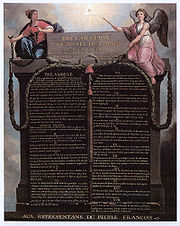
each made illegal a range of oppressive governmental actions. Two major revolutions occurred during the 18th century, in the United States (1776) and in France (1789), leading to the adoption of the United States Declaration of Independence
and the French Declaration of the Rights of Man and of the Citizen
respectively, both of which established certain legal rights. Additionally, the Virginia Declaration of Rights
of 1776 encoded into law a number of fundamental civil rights and civil freedoms.
These were followed by developments in philosophy of human rights by philosophers such as Thomas Paine
, John Stuart Mill
and G.W.F. Hegel
during the 18th and 19th centuries. The term human rights probably came into use some time between Paine's The Rights of Man and William Lloyd Garrison
's 1831 writings in The Liberator, in which he stated that he was trying to enlist his readers in "the great cause of human rights".
In the 19th century, human rights became a central concern over the issue of slavery
. A number of reformers, such as William Wilberforce
in Britain, worked towards the abolition of slavery. This was achieved in the British Empire
by the Slave Trade Act 1807 and the Slavery Abolition Act 1833. In the United States, all the northern states had abolished the institution of slavery between 1777 and 1804, although southern states clung tightly to the "peculiar institution". Conflict and debates over the expansion of slavery to new territories constituted one of the reasons for the southern states' secession
and the American Civil War
. During the reconstruction period immediately following the war, several amendments to the United States Constitution
were made. These included the 13th amendment
, banning slavery, the 14th amendment
, assuring full citizenship and civil rights to all people born in the United States, and the 15th amendment
, guaranteeing African Americans the right to vote.
Many groups and movements have achieved profound social changes over the course of the 20th century in the name of human rights. In Western Europe
and North America, labour union
s brought about laws granting workers the right to strike, establishing minimum work conditions and forbidding or regulating child labor
. The women's rights
movement succeeded in gaining for many women the right to vote
. National liberation movements
in many countries succeeded in driving out colonial
powers. One of the most influential was Mahatma Gandhi
's movement to free his native India from British rule. Movements by long-oppressed racial and religious minorities succeeded in many parts of the world, among them the African American Civil Rights Movement, and more recent diverse identity politics
movements, on behalf of women and minorities in the United States.
The establishment of the International Committee of the Red Cross
, the 1864 Lieber Code
and the first of the Geneva Conventions
in 1864 laid the foundations of International humanitarian law
, to be further developed following the two World Wars.
The World Wars, and the huge losses of life and gross abuses of human rights that took place during them, were a driving force behind the development of modern human rights instruments
. The League of Nations
was established in 1919 at the negotiations over the Treaty of Versailles
following the end of World War I
. The League's goals included disarmament, preventing war through collective security, settling disputes between countries through negotiation and diplomacy, and improving global welfare. Enshrined in its charter was a mandate to promote many of the rights later included in the Universal Declaration of Human Rights.
At the 1945 Yalta Conference
, the Allied Powers agreed to create a new body to supplant the League's role; this was to be the United Nations
. The United Nations has played an important role in international human-rights law since its creation. Following the World Wars, the United Nations and its members developed much of the discourse and the bodies of law that now make up international humanitarian law
and international human rights law
.
One of the oldest Western philosophies on human rights is that they are a product of a natural law, stemming from different philosophical or religious grounds. Other theories hold that human rights codify moral behavior which is a human social product developed by a process of biological and social evolution (associated with Hume
). Human rights are also described as a sociological pattern of rule setting (as in the sociological theory of law and the work of Weber
). These approaches include the notion that individuals in a society accept rules from legitimate authority in exchange for security and economic advantage (as in Rawls
) – a social contract. The two theories that dominate contemporary human rights discussion are the interest theory and the will theory. Interest theory argues that the principal function of human rights is to protect and promote certain essential human interests, while will theory attempts to establish the validity of human rights based on the unique human capacity for freedom. The strong claims made by human rights to universality have led to persistent criticism. Philosophers who have criticized the concept of human rights include Jeremy Bentham
, Edmund Burke
, Friedrich Nietzsche
and Karl Marx
. Political philosophy professor Charles Blattberg
argues that discussion of human rights, being abstract, demotivates people from upholding the values that rights are meant to affirm.
Civil and political rights are enshrined in articles 3 to 21 of the Universal Declaration of Human Rights
(UDHR) and in the International Covenant on Civil and Political Rights
(ICCPR). Economic, social and cultural rights are enshrined in articles 22 to 28 of the Universal Declaration of Human Rights
(UDHR) and in the International Covenant on Economic, Social and Cultural Rights
(ICESCR).
This is held to be true because without civil and political rights the public cannot assert their economic, social and cultural rights. Similarly, without livelihoods and a working society, the public cannot assert or make use of civil or political rights (known as the full belly thesis).
The indivisibility and interdependence of all human rights has been confirmed by the 1993 Vienna Declaration and Programme of Action
:
This statement was again endorsed at the 2005 World Summit in New York (paragraph 121).
Although accepted by the signatories to the UDHR, most do not in practice give equal weight to the different types of rights. Some Western cultures have often given priority to civil and political rights, sometimes at the expense of economic and social rights such as the right to work
, to education
, health
and housing. Similarly the ex Soviet bloc countries and Asian countries have tended to give priority to economic, social and cultural rights, but have often failed to provide civil and political rights.
Similarly civil and political rights are categorized as:
Olivia Ball and Paul Gready argue that for both civil and political rights and economic, social and cultural rights, it is easy to find examples which do not fit into the above categorisation. Among several others, they highlight the fact that maintaining a judicial system, a fundamental requirement of the civil right to due process before the law and other rights relating to judicial process, is positive, resource-intensive, progressive and vague, while the social right to housing is precise, justiciable and can be a real 'legal' right.
, is that there are three generations of human rights
: first-generation civil and political rights (right to life and political participation), second-generation economic, social and cultural rights (right to subsistence) and third-generation solidarity rights (right to peace, right to clean environment). Out of these generations, the third generation is the most debated and lacks both legal and political recognition. This categorisation is at odds with the indivisibility of rights, as it implicitly states that some rights can exist without others. Prioritisation of rights for pragmatic reasons is however a widely accepted necessity. Human rights expert Philip Alston
argues:
He, and others, urge caution with prioritisation of rights:
Some human rights are said to be "inalienable rights". The term inalienable rights (or unalienable rights) refers to "a set of human rights that are fundamental, are not awarded by human power, and cannot be surrendered."
and the provisions of the United Nations Charter would provide a basis for a comprehensive system of international law and practise for the protection of human rights. The term "international human rights law" is often used as a category of reference to describe these systems, but this can be a source of confusion as there is no separate entity as "international human rights law" but an interlocking system of non-binding conventions, international treaties, domestic law, international organisations and political bodies ..
Of particular importance is Article 56 of the charter:"All Members pledge themselves to take joint and separate action in co-operation with the Organization for the achievement of the purposes set forth in Article 55." This is a binding treaty provision applicable to both the Organisation and its members and has been taken to constitute a legal obligation for the members of the United Nations. Overall, the references to human rights in the Charter are general and vague. The Charter does not contain specific legal rights, nor does it mandate any enforcement procedures to protect these rights. Despite this, the significance of the espousal of human rights within the UN charter must not be understated. The importance of human rights on the global stage can be traced to the importance of human rights within the United Nations framework and the UN Charter can be seen as the starting point for the development of a broad array of declarations, treaties, implementation and enforcement mechanisms, UN organs, committees and reports on the protection of human rights. The rights espoused in the UN charter would be codified and defined in the International Bill of Human Rights, composing the Universal Declaration of Human Rights
, the International Covenant on Civil and Political Rights
and the International Covenant on Economic, Social and Cultural Rights
.
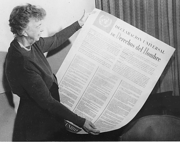 The Universal Declaration of Human Rights (UDHR) was adopted by the United Nations General Assembly in 1948, partly in response to the atrocities of World War II
. Although the UDHR was a non-binding resolution, it is now considered by some to have acquired the force of international customary law
which may be invoked in appropriate circumstances by national and other judiciaries. The UDHR urges member nations to promote a number of human, civil, economic and social rights, asserting these rights as part of the "foundation of freedom, justice
and peace
in the world." The declaration was the first international legal effort to limit the behaviour of states and press upon them duties to their citizens following the model of the rights-duty duality
.
The UDHR was framed by members of the Human Rights Commission, with former First Lady
Eleanor Roosevelt
as Chair, who began to discuss an International Bill of Rights in 1947. The members of the Commission did not immediately agree on the form of such a bill of rights, and whether, or how, it should be enforced. The Commission proceeded to frame the UDHR and accompanying treaties, but the UDHR quickly became the priority. Canadian law professor John Humphrey
and French lawyer René Cassin
were responsible for much of the cross-national research and the structure of the document respectively, where the articles of the declaration were interpretative of the general principle of the preamble. The document was structured by Cassin to include the basic principles of dignity, liberty, equality and brotherhood in the first two articles, followed successively by rights pertaining to individuals; rights of individuals in relation to each other and to groups; spiritual, public and political rights; and economic, social and cultural rights. The final three articles place, according to Cassin, rights in the context of limits, duties and the social and political order in which they are to be realized. Humphrey and Cassin intended the rights in the UDHR to be legally enforceable through some means, as is reflected in the third clause of the preamble:
Some of the UDHR was researched and written by a committee of international experts on human rights, including representatives from all continents and all major religions, and drawing on consultation with leaders such as Mahatma Gandhi. The inclusion of civil, political, economic, social and cultural rights was predicated on the assumption that all human rights are indivisible and that the different types of rights listed are inextricably linked. This principle was not then opposed by any member states (the declaration was adopted unanimously, Byelorussian SSR
, Czechoslovakia
, Poland
, Saudi Arabia
, Ukrainian SSR
, Union of South Africa
, USSR, Yugoslavia
.); however, this principle was later subject to significant challenges.
The Universal Declaration was bifurcated into treaties, a Covenant on Civil and Political Rights and another on social, economic, and cultural rights, due to questions about the relevance and propriety of economic and social provisions in covenants on human rights. Both covenants begin with the right of people to self-determination and to sovereignty over their natural resources. This debate over whether human rights are more fundamental than economic rights has continued to the present day.
The drafters of the Covenants initially intended only one instrument. The original drafts included only political and civil rights, but economic and social rights were also proposed. The disagreement over which rights were basic human rights resulted in there being two covenants. The debate was whether economic and social rights are aspirational, as contrasted with basic human rights which all people possess purely by being human, because economic and social rights depend on wealth and the availability of resources. In addition, which social and economic rights should be recognised depends on ideology or economic theories, in contrast to basic human rights, which are defined purely by the nature (mental and physical abilities) of human beings. It was debated whether economic rights were appropriate subjects for binding obligations and whether the lack of consensus over such rights would dilute the strength of political-civil rights. There was wide agreement and clear recognition that the means required to enforce or induce compliance with socio-economic undertakings were different from the means required for civil-political rights.
This debate and the desire for the greatest number of signatories to human-rights law led to the two covenants. The Soviet bloc and a number of developing countries had argued for the inclusion of all rights in a so-called Unity Resolution. Both covenants allowed states to derogate some rights. Those in favor of a single treaty could not gain sufficient consensus.
(ICCPR) and the International Covenant on Economic, Social and Cultural Rights
(ICESCR) were adopted by the United Nations
, between them making the rights contained in the UDHR binding on all states that have signed this treaty, creating human-rights law.
Since then numerous other treaties (pieces of legislation
) have been offered at the international level. They are generally known as human rights instruments. Some of the most significant, referred to (with ICCPR and ICESCR) as "the seven core treaties", are:
, the founder of the International Committee of the Red Cross
. The conventions safeguard the human rights of individuals involved in armed conflict, and build on the 1899 and 1907 Hague Conventions
, the international community's first attempt to formalize the laws of war and war crimes in the nascent body of secular international law. The conventions were revised as a result of World War II and readopted by the international community in 1949.
for universal human-rights legislation. Within the UN machinery, human-rights issues are primarily the concern of the United Nations Security Council
and the United Nations Human Rights Council
, and there are numerous committees within the UN with responsibilities for safeguarding different human-rights treaties. The most senior body of the UN in the sphere of human rights is the Office of the High Commissioner for Human Rights. The United Nations has an international mandate to:
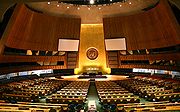
The general Assembly of the United Nations, Under Article 13 of the UN Charter, the general assembly has the power to initiate studies and make recommendations on human rights issues. Under this provision, the general assembly passed the Universal Declaration of Human Rights in 1948, and since then a wide variety of other human rights instruments. The assembly has several subsidiary organs that deal with specific human rights issues, such as the Special Committee on Decolonisation and the Special Commission against Apartheid (no longer operational). In addition the general assembly has set up a number of subsidiary organs that consider human rights issues in a number of high-profile contexts: such as the UN Council on Namibia, the Special Committee to Investigate Israeli Practises in the Occupied territories and the Committee on the Exercise of the Inalienable rights of the Palestine People.
The United Nations Human Rights Council, created at the 2005 World Summit
to replace the United Nations Commission on Human Rights
, has a mandate to investigate violations of human rights. The Human Rights Council is a subsidiary body of the General Assembly
and reports directly to it. It ranks below the Security Council, which is the final authority for the interpretation of the United Nations Charter
. Forty-seven of the one hundred ninety-one member states sit on the council, elected by simple majority in a secret ballot of the United Nations General Assembly
. Members serve a maximum of six years and may have their membership suspended for gross human rights abuses. The Council is based in Geneva
, and meets three times a year; with additional meetings to respond to urgent situations.
Independent experts (rapporteurs) are retained by the Council to investigate alleged human rights abuses and to provide the Council with reports.
The Human Rights Council may request that the Security Council take action when human rights violations occur. This action may be direct actions, may involve sanctions
, and the Security Council may also refer cases to the International Criminal Court
(ICC) even if the issue being referred is outside the normal jurisdiction of the ICC.
The United Nations Security Council
has the primary responsibility for maintaining international peace and security and is the only body of the UN that can authorize the use of force. It has been criticised for failing to take action to prevent human rights abuses, including the Darfur crisis
, the Srebrenica massacre
and the Rwandan Genocide
. For example, critics blamed the presence of non-democracies on the Security Council for its failure regarding.
On April 28, 2006 the Security Council adopted resolution 1674
that reaffirmed the responsibility to protect populations from genocide
, war crime
s, ethnic cleansing
and crimes against humanity
" and committed the Security Council to action to protect civilians in armed conflict.
(UNHCHR) and the UN Center for Human Rights.
Each treaty body receives secretariat support from the Human Rights Council and Treaties Division of Office of the High Commissioner on Human Rights (OHCHR) in Geneva except CEDAW, which is supported by the Division for the Advancement of Women (DAW). CEDAW formerly held all its sessions at United Nations headquarters in New York but now frequently meets at the United Nations Office in Geneva; the other treaty bodies meet in Geneva. The Human Rights Committee usually holds its March session in New York City.
, the American Convention on Human Rights
(the Americas) and the European Convention on Human Rights
. The European Convention on Human Rights has since 1950 defined and guaranteed human rights and fundamental freedoms in Europe. All 47 member states of the Council of Europe have signed the Convention and are therefore under the jurisdiction of the European Court of Human Rights in Strasbourg
.
, Human Rights Watch
, International Service for Human Rights
and FIDH
monitor what they see as human rights issues around the world and promote their views on the subject. Human rights organizations have been said to ""translate complex international issues into activities to be undertaken by concerned citizens in their own community".
Human rights organizations frequently engage in lobbying
and advocacy
in an effort to convince the United Nations, supranational bodies and national governments to adopt their policies on human rights. Many human-rights organizations have observer status at the various UN bodies tasked with protecting human rights. A new (in 2009) nongovernmental human-rights conference is the Oslo Freedom Forum
, a gathering described by The Economist
as "on its way to becoming a human-rights equivalent of the Davos economic forum." The same article noted that human-rights advocates are more and more divided amongst themselves over how violations of human rights are to be defined, notably as regards the Middle East.
There is criticism of human-rights organisations who use their status but allegedly move away from their stated goals. For example, Gerald M. Steinberg
, an Israel-based academic, maintains that NGOs take advantage of a "halo effect
" and are "given the status of impartial moral watchdogs" by governments and the media. Such critics claim that this may be seen at various governmental levels, including when human-rights groups testify before investigation committees.
play an increasingly large role in the world, and have been responsible for numerous human rights abuses. Although the legal and moral environment surrounding the actions of governments is reasonably well developed, that surrounding multinational companies is both controversial and ill-defined. Multinational companies' primary responsibility is to their shareholder
s, not to those affected by their actions. Such companies may be larger than the economies of some of the states within which they operate, and can wield significant economic and political power. No international treaties exist to specifically cover the behavior of companies with regard to human rights, and national legislation is very variable. Jean Ziegler
, Special Rapporteur of the UN Commission on Human Rights
on the right to food stated in a report in 2003:
In August 2003 the Human Rights Commission's Sub-Commission on the Promotion and Protection of Human Rights produced draft Norms on the responsibilities of transnational corporations and other business enterprises with regard to human rights. These were considered by the Human Rights Commission in 2004, but have no binding status on corporations and are not monitored.
laws, Article 39 of the United Nations Charter
designates the UN Security Council
(or an appointed authority) as the only tribunal that may determine UN human rights violations.
Human rights abuses are monitored by United Nations committees, national institutions and governments and by many independent non-governmental organization
s, such as Amnesty International
, International Federation of Human Rights
, Human Rights Watch
, World Organisation Against Torture
, Freedom House
, International Freedom of Expression Exchange
and Anti-Slavery International
. These organisations collect evidence and documentation of alleged human rights abuses and apply pressure to enforce human rights laws.
Wars of aggression, war crime
s and crimes against humanity
, including genocide
, are breaches of International humanitarian law
and represent the most serious of human rights violations.
In efforts to eliminate violations of human rights, building awareness and protesting inhumane treatment has often led to calls for action and sometimes improved conditions. The UN Security Council has interceded with peace keeping forces, and other states and treaties (NATO) have intervened in situations to protect human rights.
to live, particularly that a human being has the right not to be kill
ed by another human being. The concept
of a right to life is central to debates on the issues of abortion
, capital punishment
, euthanasia
, self defense
and war
. According to many human rights activists, the death penalty violates this right. The United Nations
has called on retentionist states to establish a moratorium on capital punishment with a view to its abolition. States which do not do so face considerable moral and political pressure.
.
Torture is prohibited under international law
and the domestic laws of most countries in the 21st century. It is considered to be a violation of human rights, and is declared to be unacceptable by Article 5 of the UN
Universal Declaration of Human Rights
. Signatories of the Third Geneva Convention
and Fourth Geneva Convention
officially agree not to torture prisoners in armed conflicts. Torture is also prohibited by the United Nations Convention Against Torture
, which has been ratified by 147 states.
National and international legal prohibitions on torture derive from a consensus that torture and similar ill-treatment are immoral, as well as impractical. Despite these international conventions, organizations that monitor abuses of human rights (e.g. Amnesty International
, the International Rehabilitation Council for Torture Victims
) report widespread use condoned by states in many regions of the world. Amnesty International estimates that at least 81 world governments currently practice torture, some of them openly.
states:
Despite this, the number of slaves today is higher than at any point in history
, remaining as high as 12 million
to 27 million, Most are debt slaves
, largely in South Asia
, who are under debt bondage
incurred by lenders, sometimes even for generations. Human trafficking
is primarily for prostituting women
and child
ren into sex industries
.
Groups such as the American Anti-Slavery Group
, Anti-Slavery International
, Free the Slaves
, the Anti-Slavery Society
, and the Norwegian Anti-Slavery Society continue to campaign to rid the world of slavery.
. It is one of the most extensive human rights and all international human rights instruments enshrine it in more than one article. The right to a fair trial is one of the most litigated human rights and substantial case law has been established on the interpretation of this human right. Despite variations in wording and placement of the various fair trial rights, international human rights instrument define the right to a fair trial in broadly the same terms. The aim of the right is to ensure the proper administration of justice. As a minimum the right to fair trial includes the following fair trial rights in civil
and criminal
proceedings:
The right to freedom of expression is recognized as a human right under Article 19 of the Universal Declaration of Human Rights and recognized in international human rights law in the International Covenant on Civil and Political Rights (ICCPR). Article 19 of the ICCPR states that "[e]veryone shall have the right to hold opinions without interference" and "everyone shall have the right to freedom of expression; this right shall include freedom to seek, receive and impart information and ideas of all kinds, regardless of frontiers, either orally, in writing or in print, in the form of art, or through any other media of his choice".
or belief
in teaching
, practice, worship
, and observance; the concept is generally recognized also to include the freedom to change religion
or not to follow any religion
. The freedom to leave or discontinue membership in a religion or religious group —in religious terms called "apostasy
" —is also a fundamental part of religious freedom, covered by Article 18 of the Universal Declaration of Human Rights
.
Human rights groups such as Amnesty International
organises campaigns to protect those arrested and or incarcerated as a prisoner of conscience
because of their conscientious beliefs, particularly concerning intellectual, political and artistic freedom of expression and association. In legislation, a conscience clause
is a provision in a statute that excuses a health professional from complying with the law (for example legalising surgical or pharmaceutical abortion
) if it is incompatible with religious or conscientious beliefs.
of human rights thinking.
adopted the Declaration on the Responsibilities of the Present Generation Towards the Future Generation. The Declaration opens with the words:
Article 1 of the declaration states "the present generations have the responsibility of ensuring that the needs and interests of present and future generations are fully safeguarded." The preamble to the declaration states that "at this point in history, the very existence of humankind and its environment are threatened" and the declaration covers a variety of issues including protection of the environment
, the human genome
, biodiversity
, cultural heritage, peace
, development, and education
. The preamble recalls that the responsibilities of the present generations towards future generations has been referred to in various international instruments, including the Convention for the Protection of the World Cultural and Natural Heritage (UNESCO 1972), the United Nations Framework Convention on Climate Change
and the Convention on Biological Diversity
(Rio de Janeiro, 1992), the Rio Declaration on Environment and Development
(UN Conference on Environment and Development, 1992), the Vienna Declaration and Programme of Action
(World Conference on Human Rights, 1993) and a number of UN General Assembly resolutions relating to the protection of the global climate for present and future generations adopted since 1990.
, gender identity
, and gender expression based on the right to respect for private life and the right not to be discriminated against on the ground of “other status” as defined in various human rights conventions, such as article 17 and 26 in the United Nations International Covenant on Civil and Political Rights
and article 8 and article 14 in the European Convention on Human Rights.
Through the way many because of their religious beliefs claim that they support human rights in general while denying that LGBT rights are human rights, LGBT rights stand prominent in the very defense of the universal principle of the human rights. If human rights are understood in a way that makes it possible to exclude the basic rights of certain groups only because of certain religious and cultural prejudices, we find that the principle of universality is taken right out of the human rights, and human rights are transformed to a set of rules only reflecting certain historically values.
In 77 countries, homosexuality remains a criminal offense, punishable by execution in seven countries. The decriminalization of private, consensual, adult sexual relations, especially in countries where corporal or capital punishment is involved, remains one of the primary concerns of LGBT human rights advocates.
Other issues include but are not limited to: government recognition of same-sex relationships
, LGBT adoption, sexual orientation and military service
, immigration equality, anti-discrimination laws, hate crime laws regarding violence against LGBT people, sodomy laws, anti-lesbianism laws, and equal age of consent for same-sex activity.
A global charter for LGBT rights has been proposed in the form of the 'Yogyakarta Principles
', a set of 29 principles whose authors say they apply International Human Rights Law
statutes and precedent to situations relevant to LGBT people's experience. The principles were presented at a United Nations
event in New York on November 7, 2007, co-sponsored by Argentina
, Brazil
and Uruguay
.
The principles have been acknowledged with influencing the French proposed UN declaration on sexual orientation and gender identity
, which focuses on ending violence, criminalization and capital punishment and does not include dialogue about same-sex marriage or right to start a family. The proposal was supported by 67 of the then 192 member countries of the United Nations, including all EU nations and the United States. An alternative statement opposing the proposal was initiated by Syria
and signed by 57 member nations, including all 27 nations of the Arab League
as well as Iran
and North Korea
.
and the International Covenant on Economic, Social and Cultural Rights
emphasize the importance of a right to work, neither of these documents explicitly mention trade as a mechanism for ensuring this fundamental right. And yet trade plays a key role in providing jobs.
Some experts argue that trade is inherent to human nature and that when governments inhibit international trade they directly inhibit the right to work and the other indirect benefits, like the right to education, that increased work and investment help accrue. Others have argued that the ability to trade does not affect everyone equally—often groups like the rural poor, indigenous groups and women are less likely to access the benefits of increased trade.
On the other hand, others think that it is no longer primarily individuals but companies that trade, and therefore it cannot be guaranteed as a human right. Additionally, trying to fit too many concepts under the umbrella of what qualifies as a human right has the potential to dilute their importance. Finally, it is difficult to define a right to trade as either "fair" or "just" in that the current trade regime produces winners and losers but its reform is likely to produce (different) winners and losers.
See also: The Recognition of Labour Standards within the World Trade Organisation
and Investor state dispute settlement
This principle was reaffirmed at the 3rd and 4th World Water Council
s in 2003 and 2006. This marks a departure from the conclusions of the 2nd World Water Forum in The Hague in 2000, which stated that water was a commodity to be bought and sold, not a right. There are calls from many NGOs and politicians to enshrine access to water as a binding human right, and not as a commodity. According to the United Nations, nearly 900 million people lack access to clean water and more than 2.6 billion people lack access to basic sanitation. On July 28, 2010, the UN declared water and sanitation as human rights. By declaring safe and clean drinking water and sanitation as a human right, the U.N. General Assembly made a step towards the Millennium Development Goal to ensure environmental sustainability, which in part aims to "halve, by 2015, the proportion of the population without sustainable access to safe drinking water and basic sanitation".
are right
s relating to reproduction
and reproductive health
. The World Health Organisation defines reproductive rights as follows:
Reproductive rights were first established as a subset of human rights at the United Nation's 1968 International Conference on Human Rights. The sixteenth article of the resulting Proclamation of Teheran states, "Parents have a basic human right to determine freely and responsibly
the number and the spacing of their children."
Reproductive rights may include some or all of the following rights: the right to legal or safe abortion
, the right to control one's reproductive functions
, the right to quality reproductive health
care, and the right to education and access
in order to make reproductive choices free from coercion
, discrimination
, and violence
.
Reproductive rights may also be understood to include education
about contraception
and sexually transmitted infections
, and freedom from coerced sterilization
and contraception, protection from gender-based practices such as female genital cutting
(FGC) and male genital mutilation (MGM).
was the first country to make 1-megabit broadband Web access a legal right.
In a survey conducted by the BBC in 2010, nearly four out of five people around the world believe that access to the internet is a fundamental right.
, and Article 11 of the San Salvador Protocol to the American Convention on Human Rights
). The second conception is the idea that environmental human rights can be derived from other human rights, usually – the right to life, the right to health, the right to private family life and the right to property (among many others). This second theory enjoys much more widespread use in human rights courts around the world, as those rights are contained in many human rights documents.
The onset of various environmental issues, especially climate change
, has created potential conflicts between different human rights. Human rights ultimately require a working ecosystem and healthy environment, but the granting of certain rights to individuals may damage these. Such as the conflict between right to decide number of offspring and the common need for a healthy environment, as noted in the tragedy of the commons
. In the area of environmental rights, the responsibilities of multinational corporations, so far relatively unaddressed by human rights legislation, is of paramount consideration.
Environmental Rights revolve largely around the idea of a right to a livable environment both for the present and the future generations.
Rights that cannot be derogated for reasons of national security in any circumstances are known as peremptory norms or jus cogens
. Such United Nations Charter
obligations are binding on all states and cannot be modified by treaty.
Examples of national security being used to justify human rights violations include the Japanese American internment
during World War II
, Stalin's Great Purge
, and the modern-day abuses of terror suspects rights by some countries, often in the name of the War on Terror
.
 The UDHR enshrines universal rights that apply to all humans equally, whichever geographical location, state, race or culture they belong to. However, in academia there is a dispute between scholars that advocate moral relativism
and scholars that advocate moral universalism
. Relativists do not argue against human rights, but concede that human rights are social constructed
and are shaped by cultural and environmental contexts. Universalists argue that human rights have always existed, and apply to all people regardless of culture, race, sex, or religion.
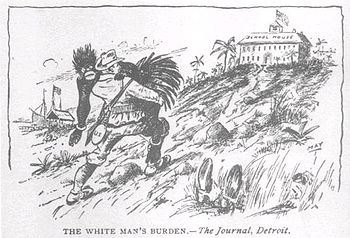
More specifically, proponents of cultural relativism argue for acceptance of different cultures, which may have practices conflicting with human rights. Relativists caution that universalism could be used as a form of cultural, economic or political imperialism. The White Man's Burden
is used as an example of imperialism and the destruction of local cultures justified by the desire to spread Eurocentric
values. In particular, the concept of human rights is often claimed to be fundamentally rooted in a politically liberal
outlook which, although generally accepted in Europe, Japan or North America, is not necessarily taken as standard elsewhere.
Opponents of relativism argue that some practices exist that violate the norms of all human cultures. A common example is female genital mutilation, which occurs in different cultures in Africa, Asia and South America. It is not mandated by any religion, but has become a tradition in many cultures. It is considered a violation of women's and girl's rights by much of the international community, and is outlawed in some countries.
The former Prime Ministers of Singapore
, Lee Kuan Yew
, and of Malaysia, Mahathir bin Mohamad
both claimed in the 1990s that Asian values
were significantly different from western values and included a sense of loyalty and foregoing personal freedoms for the sake of social stability and prosperity, and therefore authoritarian government is more appropriate in Asia than democracy. Lee Kuan Yew
argued that:
In response, critics have pointed out that cultural relativism could be used as a justification for authoritarianism. An example is in 1981, when the Iranian representative to the United Nations
, Said Rajaie-Khorassani, articulated the position of his country regarding the Universal Declaration of Human Rights by saying that the UDHR was "a secular
understanding of the Judeo-Christian
tradition", which could not be implemented by Muslims without trespassing the Islamic law. The Asian Values argument was criticized by Mahathir's former deputy:
and by Singapore's opposition leader Chee Soon Juan
, who states that it is racist to assert that Asians do not want human rights.
Defenders of moral universalism argue that relativistic arguments neglect the fact that modern human rights are new to all cultures, dating back no further than the UDHR in 1948. They argue that the UDHR was drafted by people from many different cultures and traditions, including a US Roman Catholic, a Chinese Confucian philosopher, a French zionist and a representative from the Arab League, amongst others, and drew upon advice from thinkers such as Mahatma Gandhi. Michael Ignatieff
has argued that cultural relativism is almost exclusively an argument used by those who wield power in cultures which commit human rights abuses, and that those whose human rights are compromised are the powerless. This reflects the fact that the difficulty in judging universalism versus relativism lies in who is claiming to represent a particular culture.
Although the argument between universalism and relativism is far from complete, it is an academic discussion in that all international human rights instruments adhere to the principle that human rights are universally applicable. The 2005 World Summit
reaffirmed the international community's adherence to this principle:
Rights
Rights are legal, social, or ethical principles of freedom or entitlement; that is, rights are the fundamental normative rules about what is allowed of people or owed to people, according to some legal system, social convention, or ethical theory...
to which a person is inherently entitled simply because she or he is a human being." Human rights are thus conceived as universal
Universality (philosophy)
In philosophy, universalism is a doctrine or school claiming universal facts can be discovered and is therefore understood as being in opposition to relativism. In certain religions, universality is the quality ascribed to an entity whose existence is consistent throughout the universe...
(applicable everywhere) and egalitarian
Egalitarianism
Egalitarianism is a trend of thought that favors equality of some sort among moral agents, whether persons or animals. Emphasis is placed upon the fact that equality contains the idea of equity of quality...
(the same for everyone). These rights may exist as natural rights
Natural rights
Natural and legal rights are two types of rights theoretically distinct according to philosophers and political scientists. Natural rights are rights not contingent upon the laws, customs, or beliefs of any particular culture or government, and therefore universal and inalienable...
or as legal rights, in both national and international law
International law
Public international law concerns the structure and conduct of sovereign states; analogous entities, such as the Holy See; and intergovernmental organizations. To a lesser degree, international law also may affect multinational corporations and individuals, an impact increasingly evolving beyond...
. The doctrine of human rights in international practice, within international law, global and regional institutions, in the policies of states
Sovereign state
A sovereign state, or simply, state, is a state with a defined territory on which it exercises internal and external sovereignty, a permanent population, a government, and the capacity to enter into relations with other sovereign states. It is also normally understood to be a state which is neither...
and the activities of non-governmental organizations has been a cornerstone of public policy
Public policy
Public policy as government action is generally the principled guide to action taken by the administrative or executive branches of the state with regard to a class of issues in a manner consistent with law and institutional customs. In general, the foundation is the pertinent national and...
around the world. It has been said that: "if the public discourse of peacetime global society can be said to have a common moral language, it is that of human rights." Despite this, the strong claims made by the doctrine of human rights continue to provoke considerable skepticism and debates about the content, nature and justifications of human rights continue to this day. Indeed, the question of what is meant by a "right" is itself controversial and the subject of continued philosophical debate.
Many of the basic ideas that animated the movement developed in the aftermath of the Second World War and the atrocities of the Holocaust, culminating in the adoption of the Universal Declaration of Human Rights
Universal Declaration of Human Rights
The Universal Declaration of Human Rights is a declaration adopted by the United Nations General Assembly . The Declaration arose directly from the experience of the Second World War and represents the first global expression of rights to which all human beings are inherently entitled...
in Paris by the United Nations General Assembly
United Nations General Assembly
For two articles dealing with membership in the General Assembly, see:* General Assembly members* General Assembly observersThe United Nations General Assembly is one of the five principal organs of the United Nations and the only one in which all member nations have equal representation...
in 1948. The ancient world did not possess the concept of universal human rights. Ancient societies had "elaborate systems of duties... conceptions of justice, political legitimacy, and human flourishing that sought to realize human dignity, flourishing, or well-being entirely independent of human rights". The modern concept of human rights developed during the early Modern period
Early modern period
In history, the early modern period of modern history follows the late Middle Ages. Although the chronological limits of the period are open to debate, the timeframe spans the period after the late portion of the Middle Ages through the beginning of the Age of Revolutions...
, alongside the European secularization of Judeo-Christian ethics. The true forerunner of human rights discourse was the concept of natural rights which appeared as part of the medieval Natural law
Natural law
Natural law, or the law of nature , is any system of law which is purportedly determined by nature, and thus universal. Classically, natural law refers to the use of reason to analyze human nature and deduce binding rules of moral behavior. Natural law is contrasted with the positive law Natural...
tradition, became prominent during the Enlightenment
Age of Enlightenment
The Age of Enlightenment was an elite cultural movement of intellectuals in 18th century Europe that sought to mobilize the power of reason in order to reform society and advance knowledge. It promoted intellectual interchange and opposed intolerance and abuses in church and state...
with such philosophers as John Locke
John Locke
John Locke FRS , widely known as the Father of Liberalism, was an English philosopher and physician regarded as one of the most influential of Enlightenment thinkers. Considered one of the first of the British empiricists, following the tradition of Francis Bacon, he is equally important to social...
, Francis Hutcheson
Francis Hutcheson (philosopher)
Francis Hutcheson was a philosopher born in Ireland to a family of Scottish Presbyterians who became one of the founding fathers of the Scottish Enlightenment....
, and Jean-Jacques Burlamaqui
Jean-Jacques Burlamaqui
Jean-Jacques Burlamaqui was a Swiss legal and political theorist, who popularised a number of ideas propounded by other thinkers.-Life:...
, and featured prominently in the political discourse of the American Revolution
American Revolution
The American Revolution was the political upheaval during the last half of the 18th century in which thirteen colonies in North America joined together to break free from the British Empire, combining to become the United States of America...
and the French Revolution
French Revolution
The French Revolution , sometimes distinguished as the 'Great French Revolution' , was a period of radical social and political upheaval in France and Europe. The absolute monarchy that had ruled France for centuries collapsed in three years...
.
From this foundation, the modern human rights movement emerged over the latter half of the twentieth century. Gelling as social activism and political rhetoric in many nations put it high on the world agenda.
History
The modern sense of human rights can be traced to RenaissanceRenaissance
The Renaissance was a cultural movement that spanned roughly the 14th to the 17th century, beginning in Italy in the Late Middle Ages and later spreading to the rest of Europe. The term is also used more loosely to refer to the historical era, but since the changes of the Renaissance were not...
Europe and the Protestant Reformation
Protestant Reformation
The Protestant Reformation was a 16th-century split within Western Christianity initiated by Martin Luther, John Calvin and other early Protestants. The efforts of the self-described "reformers", who objected to the doctrines, rituals and ecclesiastical structure of the Roman Catholic Church, led...
, alongside the disappearance of the feudal
Feudalism
Feudalism was a set of legal and military customs in medieval Europe that flourished between the 9th and 15th centuries, which, broadly defined, was a system for ordering society around relationships derived from the holding of land in exchange for service or labour.Although derived from the...
authoritarianism and religious conservativism that dominated the Middle Ages
Middle Ages
The Middle Ages is a periodization of European history from the 5th century to the 15th century. The Middle Ages follows the fall of the Western Roman Empire in 476 and precedes the Early Modern Era. It is the middle period of a three-period division of Western history: Classic, Medieval and Modern...
. Human rights were defined as a result of European scholars attempting to form a "secularized version of Judeo-Christian ethics". Although ideas of rights and liberty have existed in some form for much of human history, they do not resemble the modern conception of human rights. According to Jack Donnelly, in the ancient world, "traditional societies typically have had elaborate systems of duties... conceptions of justice, political legitimacy, and human flourishing that sought to realize human dignity, flourishing, or well-being entirely independent of human rights. These institutions and practices are alternative to, rather than different formulations of, human rights". The concept of universal human rights was not known in the ancient world, not in Ancient Greece and Rome, Ancient India, Ancient China, nor among the Hebrews; slavery, for instance, was justified in ancient times as a natural condition. Medieval charters of liberty such as the English Magna Carta
Magna Carta
Magna Carta is an English charter, originally issued in the year 1215 and reissued later in the 13th century in modified versions, which included the most direct challenges to the monarch's authority to date. The charter first passed into law in 1225...
were not charters of human rights, let alone general charters of rights: they instead constituted a form of limited political and legal agreement to address specific political circumstances, in the case of Magna Carta later being mythologized in the course of early modern debates about rights.
The basis of most modern legal interpretations of human rights can be traced back to recent European history. The Twelve Articles (1525) are considered to be the first record of human rights in Europe. They were part of the peasants' demands raised towards the Swabian League
Swabian League
The Swabian League was an association of Imperial States - cities, prelates, principalities and knights - principally in the territory of the Early medieval stem duchy of Swabia, established in 1488 at the behest of Emperor Frederick III of Habsburg and supported as well by Bertold von...
in the German Peasants' War
German Peasants' War
The German Peasants' War or Great Peasants' Revolt was a widespread popular revolt in the German-speaking areas of Central Europe, 1524–1526. At its height in the spring and summer of 1525, the conflict involved an estimated 300,000 peasants: contemporary estimates put the dead at 100,000...
in Germany. In Spain in 1542 Bartolomé de Las Casas
Bartolomé de Las Casas
Bartolomé de las Casas O.P. was a 16th-century Spanish historian, social reformer and Dominican friar. He became the first resident Bishop of Chiapas, and the first officially appointed "Protector of the Indians"...
argued against Juan Ginés de Sepúlveda
Juan Ginés de Sepúlveda
Juan Ginés de Sepúlveda was a Spanish humanist, philosopher and theologian. In 1533 and 1534 he wrote to Desiderius Erasmus from Rome concerning differences between Erasmus's Greek New Testament , and the Codex Vaticanus Graecus 1209...
in the famous Valladolid debate
Valladolid debate
The Valladolid debate concerned the treatment of natives of the New World. Held in the Colegio de San Gregorio, in the Spanish city of Valladolid, it opposed two main attitudes towards the conquests of the Americas...
, Sepúlveda mainted an Aristotelian view of humanity as divided into classes of different worth, while Las Casas argued in favor of equal rights to freedom of slavery for all humans regardless of race or religion. In Britain in 1683, the English Bill of Rights
Bill of Rights 1689
The Bill of Rights or the Bill of Rights 1688 is an Act of the Parliament of England.The Bill of Rights was passed by Parliament on 16 December 1689. It was a re-statement in statutory form of the Declaration of Right presented by the Convention Parliament to William and Mary in March 1689 ,...
(or "An Act Declaring the Rights and Liberties of the Subject and Settling the Succession of the Crown") and the Scottish Claim of Right
Claim of Right Act 1689
The Claim of Right is an Act passed by the Parliament of Scotland in April 1689. It is one of the key documents of Scottish constitutional law.-Background:...
each made illegal a range of oppressive governmental actions. Two major revolutions occurred during the 18th century, in the United States (1776) and in France (1789), leading to the adoption of the United States Declaration of Independence
United States Declaration of Independence
The Declaration of Independence was a statement adopted by the Continental Congress on July 4, 1776, which announced that the thirteen American colonies then at war with Great Britain regarded themselves as independent states, and no longer a part of the British Empire. John Adams put forth a...
and the French Declaration of the Rights of Man and of the Citizen
Declaration of the Rights of Man and of the Citizen
The Declaration of the Rights of Man and of the Citizen is a fundamental document of the French Revolution, defining the individual and collective rights of all the estates of the realm as universal. Influenced by the doctrine of "natural right", the rights of man are held to be universal: valid...
respectively, both of which established certain legal rights. Additionally, the Virginia Declaration of Rights
Virginia Declaration of Rights
The Virginia Declaration of Rights is a document drafted in 1776 to proclaim the inherent rights of men, including the right to rebel against "inadequate" government...
of 1776 encoded into law a number of fundamental civil rights and civil freedoms.
These were followed by developments in philosophy of human rights by philosophers such as Thomas Paine
Thomas Paine
Thomas "Tom" Paine was an English author, pamphleteer, radical, inventor, intellectual, revolutionary, and one of the Founding Fathers of the United States...
, John Stuart Mill
John Stuart Mill
John Stuart Mill was a British philosopher, economist and civil servant. An influential contributor to social theory, political theory, and political economy, his conception of liberty justified the freedom of the individual in opposition to unlimited state control. He was a proponent of...
and G.W.F. Hegel
Georg Wilhelm Friedrich Hegel
Georg Wilhelm Friedrich Hegel was a German philosopher, one of the creators of German Idealism. His historicist and idealist account of reality as a whole revolutionized European philosophy and was an important precursor to Continental philosophy and Marxism.Hegel developed a comprehensive...
during the 18th and 19th centuries. The term human rights probably came into use some time between Paine's The Rights of Man and William Lloyd Garrison
William Lloyd Garrison
William Lloyd Garrison was a prominent American abolitionist, journalist, and social reformer. He is best known as the editor of the abolitionist newspaper The Liberator, and as one of the founders of the American Anti-Slavery Society, he promoted "immediate emancipation" of slaves in the United...
's 1831 writings in The Liberator, in which he stated that he was trying to enlist his readers in "the great cause of human rights".
In the 19th century, human rights became a central concern over the issue of slavery
Slavery
Slavery is a system under which people are treated as property to be bought and sold, and are forced to work. Slaves can be held against their will from the time of their capture, purchase or birth, and deprived of the right to leave, to refuse to work, or to demand compensation...
. A number of reformers, such as William Wilberforce
William Wilberforce
William Wilberforce was a British politician, a philanthropist and a leader of the movement to abolish the slave trade. A native of Kingston upon Hull, Yorkshire, he began his political career in 1780, eventually becoming the independent Member of Parliament for Yorkshire...
in Britain, worked towards the abolition of slavery. This was achieved in the British Empire
British Empire
The British Empire comprised the dominions, colonies, protectorates, mandates and other territories ruled or administered by the United Kingdom. It originated with the overseas colonies and trading posts established by England in the late 16th and early 17th centuries. At its height, it was the...
by the Slave Trade Act 1807 and the Slavery Abolition Act 1833. In the United States, all the northern states had abolished the institution of slavery between 1777 and 1804, although southern states clung tightly to the "peculiar institution". Conflict and debates over the expansion of slavery to new territories constituted one of the reasons for the southern states' secession
Secession
Secession is the act of withdrawing from an organization, union, or especially a political entity. Threats of secession also can be a strategy for achieving more limited goals.-Secession theory:...
and the American Civil War
American Civil War
The American Civil War was a civil war fought in the United States of America. In response to the election of Abraham Lincoln as President of the United States, 11 southern slave states declared their secession from the United States and formed the Confederate States of America ; the other 25...
. During the reconstruction period immediately following the war, several amendments to the United States Constitution
United States Constitution
The Constitution of the United States is the supreme law of the United States of America. It is the framework for the organization of the United States government and for the relationship of the federal government with the states, citizens, and all people within the United States.The first three...
were made. These included the 13th amendment
Thirteenth Amendment to the United States Constitution
The Thirteenth Amendment to the United States Constitution officially abolished and continues to prohibit slavery and involuntary servitude, except as punishment for a crime. It was passed by the Senate on April 8, 1864, passed by the House on January 31, 1865, and adopted on December 6, 1865. On...
, banning slavery, the 14th amendment
Fourteenth Amendment to the United States Constitution
The Fourteenth Amendment to the United States Constitution was adopted on July 9, 1868, as one of the Reconstruction Amendments.Its Citizenship Clause provides a broad definition of citizenship that overruled the Dred Scott v...
, assuring full citizenship and civil rights to all people born in the United States, and the 15th amendment
Fifteenth Amendment to the United States Constitution
The Fifteenth Amendment to the United States Constitution prohibits each government in the United States from denying a citizen the right to vote based on that citizen's "race, color, or previous condition of servitude"...
, guaranteeing African Americans the right to vote.
Many groups and movements have achieved profound social changes over the course of the 20th century in the name of human rights. In Western Europe
Western Europe
Western Europe is a loose term for the collection of countries in the western most region of the European continents, though this definition is context-dependent and carries cultural and political connotations. One definition describes Western Europe as a geographic entity—the region lying in the...
and North America, labour union
Trade union
A trade union, trades union or labor union is an organization of workers that have banded together to achieve common goals such as better working conditions. The trade union, through its leadership, bargains with the employer on behalf of union members and negotiates labour contracts with...
s brought about laws granting workers the right to strike, establishing minimum work conditions and forbidding or regulating child labor
Child labor
Child labour refers to the employment of children at regular and sustained labour. This practice is considered exploitative by many international organizations and is illegal in many countries...
. The women's rights
Women's rights
Women's rights are entitlements and freedoms claimed for women and girls of all ages in many societies.In some places these rights are institutionalized or supported by law, local custom, and behaviour, whereas in others they may be ignored or suppressed...
movement succeeded in gaining for many women the right to vote
Voting
Voting is a method for a group such as a meeting or an electorate to make a decision or express an opinion—often following discussions, debates, or election campaigns. It is often found in democracies and republics.- Reasons for voting :...
. National liberation movements
Wars of national liberation
In Marxist terminology, wars of national liberation or national liberation revolutions are conflicts fought by oppressed nationalities against imperial powers to establish separate sovereign states for the subjugated nationality. From a Western point of view, these same wars are called insurgencies...
in many countries succeeded in driving out colonial
Colony
In politics and history, a colony is a territory under the immediate political control of a state. For colonies in antiquity, city-states would often found their own colonies. Some colonies were historically countries, while others were territories without definite statehood from their inception....
powers. One of the most influential was Mahatma Gandhi
Mahatma Gandhi
Mohandas Karamchand Gandhi , pronounced . 2 October 1869 – 30 January 1948) was the pre-eminent political and ideological leader of India during the Indian independence movement...
's movement to free his native India from British rule. Movements by long-oppressed racial and religious minorities succeeded in many parts of the world, among them the African American Civil Rights Movement, and more recent diverse identity politics
Identity politics
Identity politics are political arguments that focus upon the self interest and perspectives of self-identified social interest groups and ways in which people's politics may be shaped by aspects of their identity through race, class, religion, sexual orientation or traditional dominance...
movements, on behalf of women and minorities in the United States.
The establishment of the International Committee of the Red Cross
International Committee of the Red Cross
The International Committee of the Red Cross is a private humanitarian institution based in Geneva, Switzerland. States parties to the four Geneva Conventions of 1949 and their Additional Protocols of 1977 and 2005, have given the ICRC a mandate to protect the victims of international and...
, the 1864 Lieber Code
Lieber Code
The Lieber Code of April 24, 1863, also known as Instructions for the Government of Armies of the United States in the Field, General Order № 100, or Lieber Instructions, was an instruction signed by President Abraham Lincoln to the Union Forces of the United States during the American Civil War...
and the first of the Geneva Conventions
Geneva Conventions
The Geneva Conventions comprise four treaties, and three additional protocols, that establish the standards of international law for the humanitarian treatment of the victims of war...
in 1864 laid the foundations of International humanitarian law
International humanitarian law
International humanitarian law , often referred to as the laws of war, the laws and customs of war or the law of armed conflict, is the legal corpus that comprises "the Geneva Conventions and the Hague Conventions, as well as subsequent treaties, case law, and customary international law." It...
, to be further developed following the two World Wars.
The World Wars, and the huge losses of life and gross abuses of human rights that took place during them, were a driving force behind the development of modern human rights instruments
International human rights instruments
International human rights instruments are treaties and other international documents relevant to international human rights law and the protection of human rights in general...
. The League of Nations
League of Nations
The League of Nations was an intergovernmental organization founded as a result of the Paris Peace Conference that ended the First World War. It was the first permanent international organization whose principal mission was to maintain world peace...
was established in 1919 at the negotiations over the Treaty of Versailles
Treaty of Versailles
The Treaty of Versailles was one of the peace treaties at the end of World War I. It ended the state of war between Germany and the Allied Powers. It was signed on 28 June 1919, exactly five years after the assassination of Archduke Franz Ferdinand. The other Central Powers on the German side of...
following the end of World War I
World War I
World War I , which was predominantly called the World War or the Great War from its occurrence until 1939, and the First World War or World War I thereafter, was a major war centred in Europe that began on 28 July 1914 and lasted until 11 November 1918...
. The League's goals included disarmament, preventing war through collective security, settling disputes between countries through negotiation and diplomacy, and improving global welfare. Enshrined in its charter was a mandate to promote many of the rights later included in the Universal Declaration of Human Rights.
At the 1945 Yalta Conference
Yalta Conference
The Yalta Conference, sometimes called the Crimea Conference and codenamed the Argonaut Conference, held February 4–11, 1945, was the wartime meeting of the heads of government of the United States, the United Kingdom, and the Soviet Union, represented by President Franklin D...
, the Allied Powers agreed to create a new body to supplant the League's role; this was to be the United Nations
United Nations
The United Nations is an international organization whose stated aims are facilitating cooperation in international law, international security, economic development, social progress, human rights, and achievement of world peace...
. The United Nations has played an important role in international human-rights law since its creation. Following the World Wars, the United Nations and its members developed much of the discourse and the bodies of law that now make up international humanitarian law
International humanitarian law
International humanitarian law , often referred to as the laws of war, the laws and customs of war or the law of armed conflict, is the legal corpus that comprises "the Geneva Conventions and the Hague Conventions, as well as subsequent treaties, case law, and customary international law." It...
and international human rights law
International human rights law
International human rights law refers to the body of international law designed to promote and protect human rights at the international, regional and domestic levels...
.
Philosophy
The philosophy of human rights attempts to examine the underlying basis of the concept of human rights and critically looks at its content and justification. Several theoretical approaches have been advanced to explain how and why human rights have become a part of social expectations.One of the oldest Western philosophies on human rights is that they are a product of a natural law, stemming from different philosophical or religious grounds. Other theories hold that human rights codify moral behavior which is a human social product developed by a process of biological and social evolution (associated with Hume
David Hume
David Hume was a Scottish philosopher, historian, economist, and essayist, known especially for his philosophical empiricism and skepticism. He was one of the most important figures in the history of Western philosophy and the Scottish Enlightenment...
). Human rights are also described as a sociological pattern of rule setting (as in the sociological theory of law and the work of Weber
Max Weber
Karl Emil Maximilian "Max" Weber was a German sociologist and political economist who profoundly influenced social theory, social research, and the discipline of sociology itself...
). These approaches include the notion that individuals in a society accept rules from legitimate authority in exchange for security and economic advantage (as in Rawls
John Rawls
John Bordley Rawls was an American philosopher and a leading figure in moral and political philosophy. He held the James Bryant Conant University Professorship at Harvard University....
) – a social contract. The two theories that dominate contemporary human rights discussion are the interest theory and the will theory. Interest theory argues that the principal function of human rights is to protect and promote certain essential human interests, while will theory attempts to establish the validity of human rights based on the unique human capacity for freedom. The strong claims made by human rights to universality have led to persistent criticism. Philosophers who have criticized the concept of human rights include Jeremy Bentham
Jeremy Bentham
Jeremy Bentham was an English jurist, philosopher, and legal and social reformer. He became a leading theorist in Anglo-American philosophy of law, and a political radical whose ideas influenced the development of welfarism...
, Edmund Burke
Edmund Burke
Edmund Burke PC was an Irish statesman, author, orator, political theorist and philosopher who, after moving to England, served for many years in the House of Commons of Great Britain as a member of the Whig party....
, Friedrich Nietzsche
Friedrich Nietzsche
Friedrich Wilhelm Nietzsche was a 19th-century German philosopher, poet, composer and classical philologist...
and Karl Marx
Karl Marx
Karl Heinrich Marx was a German philosopher, economist, sociologist, historian, journalist, and revolutionary socialist. His ideas played a significant role in the development of social science and the socialist political movement...
. Political philosophy professor Charles Blattberg
Charles Blattberg
Charles Blattberg is a professor of political philosophy at the Université de Montréal. Blattberg grew up in Toronto and completed his undergraduate degree at the University of Toronto, where he also served as president of its Students’ Administrative Council during the 1989–90 academic...
argues that discussion of human rights, being abstract, demotivates people from upholding the values that rights are meant to affirm.
Classification of human rights
Human rights can be classified and organized in a number of different ways, at an international level the most common categorisation of human rights has been to split them into civil and political rights, and economic, social and cultural rights.Civil and political rights are enshrined in articles 3 to 21 of the Universal Declaration of Human Rights
Universal Declaration of Human Rights
The Universal Declaration of Human Rights is a declaration adopted by the United Nations General Assembly . The Declaration arose directly from the experience of the Second World War and represents the first global expression of rights to which all human beings are inherently entitled...
(UDHR) and in the International Covenant on Civil and Political Rights
International Covenant on Civil and Political Rights
The International Covenant on Civil and Political Rights is a multilateral treaty adopted by the United Nations General Assembly on December 16, 1966, and in force from March 23, 1976...
(ICCPR). Economic, social and cultural rights are enshrined in articles 22 to 28 of the Universal Declaration of Human Rights
Universal Declaration of Human Rights
The Universal Declaration of Human Rights is a declaration adopted by the United Nations General Assembly . The Declaration arose directly from the experience of the Second World War and represents the first global expression of rights to which all human beings are inherently entitled...
(UDHR) and in the International Covenant on Economic, Social and Cultural Rights
International Covenant on Economic, Social and Cultural Rights
The International Covenant on Economic, Social and Cultural Rights is a multilateral treaty adopted by the United Nations General Assembly on December 16, 1966, and in force from January 3, 1976...
(ICESCR).
Indivisibility
The UDHR included both economic, social and cultural rights and civil and political rights because it was based on the principle that the different rights could only successfully exist in combination:This is held to be true because without civil and political rights the public cannot assert their economic, social and cultural rights. Similarly, without livelihoods and a working society, the public cannot assert or make use of civil or political rights (known as the full belly thesis).
The indivisibility and interdependence of all human rights has been confirmed by the 1993 Vienna Declaration and Programme of Action
Vienna Declaration and Programme of Action
The Vienna Declaration and Programme of Action, also known as VDPA, is a human rights declaration adopted by consensus at the World Conference on Human Rights on 25 June 1993 in Vienna, Austria...
:
This statement was again endorsed at the 2005 World Summit in New York (paragraph 121).
Although accepted by the signatories to the UDHR, most do not in practice give equal weight to the different types of rights. Some Western cultures have often given priority to civil and political rights, sometimes at the expense of economic and social rights such as the right to work
Right to work
The right to work is the concept that people have a human right to work, or engage in productive employment, and may not be prevented from doing so...
, to education
Right to education
The right to education is a universal entitlement to education, a right that is recognized as a human right. According to the International Covenant on Economic, Social and Cultural Rights the right to education includes the right to free, compulsory primary education for all, an obligation to...
, health
Right to health
The right to health is the economic, social and cultural right to the highest attainable standard of health. It is recognised in the Universal Declaration of Human Rights and International Covenant on Economic, Social and Cultural Rights.- Definition :...
and housing. Similarly the ex Soviet bloc countries and Asian countries have tended to give priority to economic, social and cultural rights, but have often failed to provide civil and political rights.
Categorization
Opponents of the indivisibility of human rights argue that economic, social and cultural rights are fundamentally different from civil and political rights and require completely different approaches. Economic, social and cultural rights are argued to be:- positive, meaning that they require active provision of entitlements by the state (as opposed to the state being required only to prevent the breach of rights)
- resource-intensive, meaning that they are expensive and difficult to provide
- progressive, meaning that they will take significant time to implement
- vague, meaning they cannot be quantitatively measured, and whether they are adequately provided or not is difficult to judge
- ideologically divisive/political, meaning that there is no consensus on what should and shouldn't be provided as a right
- socialistSocialismSocialism is an economic system characterized by social ownership of the means of production and cooperative management of the economy; or a political philosophy advocating such a system. "Social ownership" may refer to any one of, or a combination of, the following: cooperative enterprises,...
, as opposed to capitalistCapitalismCapitalism is an economic system that became dominant in the Western world following the demise of feudalism. There is no consensus on the precise definition nor on how the term should be used as a historical category... - non-justiciable, meaning that their provision, or the breach of them, cannot be judged in a court of law
- aspirations or goals, as opposed to real 'legal' rights
Similarly civil and political rights are categorized as:
- negative, meaning the state can protect them simply by taking no action
- cost-free
- immediate, meaning they can be immediately provided if the state decides to
- precise, meaning their provision is easy to judge and measure
- non-ideological/non-political
- capitalist
- justiciable
- real 'legal' rights
Olivia Ball and Paul Gready argue that for both civil and political rights and economic, social and cultural rights, it is easy to find examples which do not fit into the above categorisation. Among several others, they highlight the fact that maintaining a judicial system, a fundamental requirement of the civil right to due process before the law and other rights relating to judicial process, is positive, resource-intensive, progressive and vague, while the social right to housing is precise, justiciable and can be a real 'legal' right.
Three generations
Another categorization, offered by Karel VasakKarel Vasak
Karel Vašák is a Czech-French international official and university professor.Vasak was born in Czechoslovakia and later moved to France to study law. He decided to remain there after the Soviet invasion of Czechoslovakia in 1968...
, is that there are three generations of human rights
Three generations of human rights
The division of human rights into three generations was initially proposed in 1979 by the Czech jurist Karel Vasak at the International Institute of Human Rights in Strasbourg. He used the term at least as early as November 1977...
: first-generation civil and political rights (right to life and political participation), second-generation economic, social and cultural rights (right to subsistence) and third-generation solidarity rights (right to peace, right to clean environment). Out of these generations, the third generation is the most debated and lacks both legal and political recognition. This categorisation is at odds with the indivisibility of rights, as it implicitly states that some rights can exist without others. Prioritisation of rights for pragmatic reasons is however a widely accepted necessity. Human rights expert Philip Alston
Philip Alston
Philip G. Alston is an international law scholar and human rights practitioner. He is John Norton Pomeroy Professor of Law at New York University School of Law, and co-Chair of the law school's Center for Human Rights and Global Justice...
argues:
He, and others, urge caution with prioritisation of rights:
Some human rights are said to be "inalienable rights". The term inalienable rights (or unalienable rights) refers to "a set of human rights that are fundamental, are not awarded by human power, and cannot be surrendered."
International protection
In the aftermath of the atrocities of World War II there was increased concern in the social and legal protection of human rights as fundamental freedoms. The foundation of the United NationsUnited Nations
The United Nations is an international organization whose stated aims are facilitating cooperation in international law, international security, economic development, social progress, human rights, and achievement of world peace...
and the provisions of the United Nations Charter would provide a basis for a comprehensive system of international law and practise for the protection of human rights. The term "international human rights law" is often used as a category of reference to describe these systems, but this can be a source of confusion as there is no separate entity as "international human rights law" but an interlocking system of non-binding conventions, international treaties, domestic law, international organisations and political bodies ..
United Nations Charter
The provisions of the United Nations charter provided a basis for the development of international human rights protection. The preamble of the charter provides that the members "reaffirm faith in fundamental human rights, in the equal rights of men and women" and Article 1(3) of the United Nations charter states that one of the purposes of the UN is: "to achieve international cooperation in solving international problems of an economic, social, cultural, or humanitarian character, and in promoting and encouraging respect for human rights and for fundamental freedoms for all without distinction as to race, sex, language, or religion". Article 55 provides that:Of particular importance is Article 56 of the charter:"All Members pledge themselves to take joint and separate action in co-operation with the Organization for the achievement of the purposes set forth in Article 55." This is a binding treaty provision applicable to both the Organisation and its members and has been taken to constitute a legal obligation for the members of the United Nations. Overall, the references to human rights in the Charter are general and vague. The Charter does not contain specific legal rights, nor does it mandate any enforcement procedures to protect these rights. Despite this, the significance of the espousal of human rights within the UN charter must not be understated. The importance of human rights on the global stage can be traced to the importance of human rights within the United Nations framework and the UN Charter can be seen as the starting point for the development of a broad array of declarations, treaties, implementation and enforcement mechanisms, UN organs, committees and reports on the protection of human rights. The rights espoused in the UN charter would be codified and defined in the International Bill of Human Rights, composing the Universal Declaration of Human Rights
Universal Declaration of Human Rights
The Universal Declaration of Human Rights is a declaration adopted by the United Nations General Assembly . The Declaration arose directly from the experience of the Second World War and represents the first global expression of rights to which all human beings are inherently entitled...
, the International Covenant on Civil and Political Rights
International Covenant on Civil and Political Rights
The International Covenant on Civil and Political Rights is a multilateral treaty adopted by the United Nations General Assembly on December 16, 1966, and in force from March 23, 1976...
and the International Covenant on Economic, Social and Cultural Rights
International Covenant on Economic, Social and Cultural Rights
The International Covenant on Economic, Social and Cultural Rights is a multilateral treaty adopted by the United Nations General Assembly on December 16, 1966, and in force from January 3, 1976...
.
Universal Declaration of Human Rights
World War II
World War II, or the Second World War , was a global conflict lasting from 1939 to 1945, involving most of the world's nations—including all of the great powers—eventually forming two opposing military alliances: the Allies and the Axis...
. Although the UDHR was a non-binding resolution, it is now considered by some to have acquired the force of international customary law
Custom (law)
Custom in law is the established pattern of behavior that can be objectively verified within a particular social setting. A claim can be carried out in defense of "what has always been done and accepted by law." Customary law exists where:...
which may be invoked in appropriate circumstances by national and other judiciaries. The UDHR urges member nations to promote a number of human, civil, economic and social rights, asserting these rights as part of the "foundation of freedom, justice
Justice
Justice is a concept of moral rightness based on ethics, rationality, law, natural law, religion, or equity, along with the punishment of the breach of said ethics; justice is the act of being just and/or fair.-Concept of justice:...
and peace
Peace
Peace is a state of harmony characterized by the lack of violent conflict. Commonly understood as the absence of hostility, peace also suggests the existence of healthy or newly healed interpersonal or international relationships, prosperity in matters of social or economic welfare, the...
in the world." The declaration was the first international legal effort to limit the behaviour of states and press upon them duties to their citizens following the model of the rights-duty duality
Corelative
Correlative is the term adopted by Wesley Newcomb Hohfeld to describe the philosophical relationships between fundamental legal concepts in jurisprudence.- Hohfeldian analysis :...
.
The UDHR was framed by members of the Human Rights Commission, with former First Lady
First Lady
First Lady or First Gentlemanis the unofficial title used in some countries for the spouse of an elected head of state.It is not normally used to refer to the spouse or partner of a prime minister; the husband or wife of the British Prime Minister is usually informally referred to as prime...
Eleanor Roosevelt
Eleanor Roosevelt
Anna Eleanor Roosevelt was the First Lady of the United States from 1933 to 1945. She supported the New Deal policies of her husband, distant cousin Franklin Delano Roosevelt, and became an advocate for civil rights. After her husband's death in 1945, Roosevelt continued to be an international...
as Chair, who began to discuss an International Bill of Rights in 1947. The members of the Commission did not immediately agree on the form of such a bill of rights, and whether, or how, it should be enforced. The Commission proceeded to frame the UDHR and accompanying treaties, but the UDHR quickly became the priority. Canadian law professor John Humphrey
John Peters Humphrey
John Peters Humphrey, OC was a Canadian legal scholar, jurist, and human rights advocate. He is most famous as the author of the first draft of the Universal Declaration on Human Rights....
and French lawyer René Cassin
René Cassin
René Samuel Cassin was a French jurist, law professor and judge. A soldier in World War I, he later went on to form the Union Fédérale, a leftist, pacifist Veterans organisation...
were responsible for much of the cross-national research and the structure of the document respectively, where the articles of the declaration were interpretative of the general principle of the preamble. The document was structured by Cassin to include the basic principles of dignity, liberty, equality and brotherhood in the first two articles, followed successively by rights pertaining to individuals; rights of individuals in relation to each other and to groups; spiritual, public and political rights; and economic, social and cultural rights. The final three articles place, according to Cassin, rights in the context of limits, duties and the social and political order in which they are to be realized. Humphrey and Cassin intended the rights in the UDHR to be legally enforceable through some means, as is reflected in the third clause of the preamble:
Some of the UDHR was researched and written by a committee of international experts on human rights, including representatives from all continents and all major religions, and drawing on consultation with leaders such as Mahatma Gandhi. The inclusion of civil, political, economic, social and cultural rights was predicated on the assumption that all human rights are indivisible and that the different types of rights listed are inextricably linked. This principle was not then opposed by any member states (the declaration was adopted unanimously, Byelorussian SSR
Byelorussian SSR
The Byelorussian Soviet Socialist Republic was one of fifteen constituent republics of the Soviet Union. It was one of the four original founding members of the Soviet Union in 1922, together with the Ukrainian SSR, the Transcaucasian SFSR and the Russian Soviet Federative Socialist Republic...
, Czechoslovakia
Czechoslovakia
Czechoslovakia or Czecho-Slovakia was a sovereign state in Central Europe which existed from October 1918, when it declared its independence from the Austro-Hungarian Empire, until 1992...
, Poland
Poland
Poland , officially the Republic of Poland , is a country in Central Europe bordered by Germany to the west; the Czech Republic and Slovakia to the south; Ukraine, Belarus and Lithuania to the east; and the Baltic Sea and Kaliningrad Oblast, a Russian exclave, to the north...
, Saudi Arabia
Saudi Arabia
The Kingdom of Saudi Arabia , commonly known in British English as Saudi Arabia and in Arabic as as-Sa‘ūdiyyah , is the largest state in Western Asia by land area, constituting the bulk of the Arabian Peninsula, and the second-largest in the Arab World...
, Ukrainian SSR
Ukrainian SSR
The Ukrainian Soviet Socialist Republic or in short, the Ukrainian SSR was a sovereign Soviet Socialist state and one of the fifteen constituent republics of the Soviet Union lasting from its inception in 1922 to the breakup in 1991...
, Union of South Africa
Union of South Africa
The Union of South Africa is the historic predecessor to the present-day Republic of South Africa. It came into being on 31 May 1910 with the unification of the previously separate colonies of the Cape, Natal, Transvaal and the Orange Free State...
, USSR, Yugoslavia
Yugoslavia
Yugoslavia refers to three political entities that existed successively on the western part of the Balkans during most of the 20th century....
.); however, this principle was later subject to significant challenges.
The Universal Declaration was bifurcated into treaties, a Covenant on Civil and Political Rights and another on social, economic, and cultural rights, due to questions about the relevance and propriety of economic and social provisions in covenants on human rights. Both covenants begin with the right of people to self-determination and to sovereignty over their natural resources. This debate over whether human rights are more fundamental than economic rights has continued to the present day.
The drafters of the Covenants initially intended only one instrument. The original drafts included only political and civil rights, but economic and social rights were also proposed. The disagreement over which rights were basic human rights resulted in there being two covenants. The debate was whether economic and social rights are aspirational, as contrasted with basic human rights which all people possess purely by being human, because economic and social rights depend on wealth and the availability of resources. In addition, which social and economic rights should be recognised depends on ideology or economic theories, in contrast to basic human rights, which are defined purely by the nature (mental and physical abilities) of human beings. It was debated whether economic rights were appropriate subjects for binding obligations and whether the lack of consensus over such rights would dilute the strength of political-civil rights. There was wide agreement and clear recognition that the means required to enforce or induce compliance with socio-economic undertakings were different from the means required for civil-political rights.
This debate and the desire for the greatest number of signatories to human-rights law led to the two covenants. The Soviet bloc and a number of developing countries had argued for the inclusion of all rights in a so-called Unity Resolution. Both covenants allowed states to derogate some rights. Those in favor of a single treaty could not gain sufficient consensus.
Treaties
In 1966, the International Covenant on Civil and Political RightsInternational Covenant on Civil and Political Rights
The International Covenant on Civil and Political Rights is a multilateral treaty adopted by the United Nations General Assembly on December 16, 1966, and in force from March 23, 1976...
(ICCPR) and the International Covenant on Economic, Social and Cultural Rights
International Covenant on Economic, Social and Cultural Rights
The International Covenant on Economic, Social and Cultural Rights is a multilateral treaty adopted by the United Nations General Assembly on December 16, 1966, and in force from January 3, 1976...
(ICESCR) were adopted by the United Nations
United Nations
The United Nations is an international organization whose stated aims are facilitating cooperation in international law, international security, economic development, social progress, human rights, and achievement of world peace...
, between them making the rights contained in the UDHR binding on all states that have signed this treaty, creating human-rights law.
Since then numerous other treaties (pieces of legislation
International human rights instruments
International human rights instruments are treaties and other international documents relevant to international human rights law and the protection of human rights in general...
) have been offered at the international level. They are generally known as human rights instruments. Some of the most significant, referred to (with ICCPR and ICESCR) as "the seven core treaties", are:
- Convention on the Elimination of All Forms of Racial DiscriminationConvention on the Elimination of All Forms of Racial DiscriminationThe International Convention on the Elimination of All Forms of Racial Discrimination is a United Nations convention. A second-generation human rights instrument, the Convention commits its members to the elimination of racial discrimination and the promotion of understanding among all races...
(CERD) (adopted 1966, entry into force: 1969) - Convention on the Elimination of All Forms of Discrimination Against WomenConvention on the Elimination of All Forms of Discrimination Against WomenThe Convention on the Elimination of all Forms of Discrimination against Women is an international convention adopted in 1979 by the United Nations General Assembly....
(CEDAW) (adopted 1979, entry into force: 1981) - United Nations Convention Against TortureUnited Nations Convention Against TortureThe United Nations Convention against Torture and Other Cruel, Inhuman or Degrading Treatment or Punishment is an international human rights instrument, under the review of the United Nations, that aims to prevent torture around the world....
(CAT) (adopted 1984, entry into force: 1984) - Convention on the Rights of the ChildConvention on the Rights of the ChildThe United Nations Convention on the Rights of the Child is a human rights treaty setting out the civil, political, economic, social, health and cultural rights of children...
(CRC) (adopted 1989, entry into force: 1989) - Convention on the Rights of Persons with DisabilitiesConvention on the Rights of Persons with DisabilitiesThe Convention on the Rights of Persons with Disabilities is an international human rights instrument of the United Nations intended to protect the rights and dignity of persons with disabilities...
(CRPD) (adopted 2006, entry into force: 2008) - International Convention on the Protection of the Rights of All Migrant Workers and Members of their Families (ICRMW or more often MWC) (adopted 1990, entry into force: 2003)
Customary international law
In addition to protection by international treaties, some human rights may be protected by customary international law through the practise of states. The prohibition of torture, genocide and slavery and the principle of non-discrimination may be regarded as prohibited by customary international law.International Humanitarian Law
The Geneva Conventions came into being between 1864 and 1949 as a result of efforts by Henry DunantHenry Dunant
Jean Henri Dunant , aka Henry Dunant, was a Swiss businessman and social activist. During a business trip in 1859, he was witness to the aftermath of the Battle of Solferino in modern day Italy...
, the founder of the International Committee of the Red Cross
International Committee of the Red Cross
The International Committee of the Red Cross is a private humanitarian institution based in Geneva, Switzerland. States parties to the four Geneva Conventions of 1949 and their Additional Protocols of 1977 and 2005, have given the ICRC a mandate to protect the victims of international and...
. The conventions safeguard the human rights of individuals involved in armed conflict, and build on the 1899 and 1907 Hague Conventions
Hague Conventions (1899 and 1907)
The Hague Conventions were two international treaties negotiated at international peace conferences at The Hague in the Netherlands: The First Hague Conference in 1899 and the Second Hague Conference in 1907...
, the international community's first attempt to formalize the laws of war and war crimes in the nascent body of secular international law. The conventions were revised as a result of World War II and readopted by the international community in 1949.
United Nations System
Under the mandate of the UN charter, the and the multilateral UN human rights treaties, the United Nations (UN) as an intergovernmental body seeks to apply international jurisdictionJurisdiction
Jurisdiction is the practical authority granted to a formally constituted legal body or to a political leader to deal with and make pronouncements on legal matters and, by implication, to administer justice within a defined area of responsibility...
for universal human-rights legislation. Within the UN machinery, human-rights issues are primarily the concern of the United Nations Security Council
United Nations Security Council
The United Nations Security Council is one of the principal organs of the United Nations and is charged with the maintenance of international peace and security. Its powers, outlined in the United Nations Charter, include the establishment of peacekeeping operations, the establishment of...
and the United Nations Human Rights Council
United Nations Human Rights Council
The United Nations Human Rights Council is an inter-governmental body within the United Nations System. The UNHRC is the successor to the United Nations Commission on Human Rights , and is a subsidiary body of the United Nations General Assembly...
, and there are numerous committees within the UN with responsibilities for safeguarding different human-rights treaties. The most senior body of the UN in the sphere of human rights is the Office of the High Commissioner for Human Rights. The United Nations has an international mandate to:
General Assembly
The general Assembly of the United Nations, Under Article 13 of the UN Charter, the general assembly has the power to initiate studies and make recommendations on human rights issues. Under this provision, the general assembly passed the Universal Declaration of Human Rights in 1948, and since then a wide variety of other human rights instruments. The assembly has several subsidiary organs that deal with specific human rights issues, such as the Special Committee on Decolonisation and the Special Commission against Apartheid (no longer operational). In addition the general assembly has set up a number of subsidiary organs that consider human rights issues in a number of high-profile contexts: such as the UN Council on Namibia, the Special Committee to Investigate Israeli Practises in the Occupied territories and the Committee on the Exercise of the Inalienable rights of the Palestine People.
Human Rights Council
The United Nations Human Rights Council, created at the 2005 World Summit
2005 World Summit
The 2005 World Summit, 14–16 September 2005, was a follow-up summit meeting to the United Nations' 2000 Millennium Summit, which led to the Millennium Declaration of the Millennium Development Goals...
to replace the United Nations Commission on Human Rights
United Nations Commission on Human Rights
The United Nations Commission on Human Rights was a functional commission within the overall framework of the United Nations from 1946 until it was replaced by the United Nations Human Rights Council in 2006...
, has a mandate to investigate violations of human rights. The Human Rights Council is a subsidiary body of the General Assembly
United Nations General Assembly
For two articles dealing with membership in the General Assembly, see:* General Assembly members* General Assembly observersThe United Nations General Assembly is one of the five principal organs of the United Nations and the only one in which all member nations have equal representation...
and reports directly to it. It ranks below the Security Council, which is the final authority for the interpretation of the United Nations Charter
United Nations Charter
The Charter of the United Nations is the foundational treaty of the international organization called the United Nations. It was signed at the San Francisco War Memorial and Performing Arts Center in San Francisco, United States, on 26 June 1945, by 50 of the 51 original member countries...
. Forty-seven of the one hundred ninety-one member states sit on the council, elected by simple majority in a secret ballot of the United Nations General Assembly
United Nations General Assembly
For two articles dealing with membership in the General Assembly, see:* General Assembly members* General Assembly observersThe United Nations General Assembly is one of the five principal organs of the United Nations and the only one in which all member nations have equal representation...
. Members serve a maximum of six years and may have their membership suspended for gross human rights abuses. The Council is based in Geneva
Geneva
Geneva In the national languages of Switzerland the city is known as Genf , Ginevra and Genevra is the second-most-populous city in Switzerland and is the most populous city of Romandie, the French-speaking part of Switzerland...
, and meets three times a year; with additional meetings to respond to urgent situations.
Independent experts (rapporteurs) are retained by the Council to investigate alleged human rights abuses and to provide the Council with reports.
The Human Rights Council may request that the Security Council take action when human rights violations occur. This action may be direct actions, may involve sanctions
International sanctions
International sanctions are actions taken by countries against others for political reasons, either unilaterally or multilaterally.There are several types of sanctions....
, and the Security Council may also refer cases to the International Criminal Court
International Criminal Court
The International Criminal Court is a permanent tribunal to prosecute individuals for genocide, crimes against humanity, war crimes, and the crime of aggression .It came into being on 1 July 2002—the date its founding treaty, the Rome Statute of the...
(ICC) even if the issue being referred is outside the normal jurisdiction of the ICC.
The United Nations Security Council
United Nations Security Council
The United Nations Security Council is one of the principal organs of the United Nations and is charged with the maintenance of international peace and security. Its powers, outlined in the United Nations Charter, include the establishment of peacekeeping operations, the establishment of...
has the primary responsibility for maintaining international peace and security and is the only body of the UN that can authorize the use of force. It has been criticised for failing to take action to prevent human rights abuses, including the Darfur crisis
War in Darfur
The Darfur Conflict was a guerrilla conflict or civil war centered on the Darfur region of Sudan. It began in February 2003 when the Sudan Liberation Movement/Army and Justice and Equality Movement groups in Darfur took up arms, accusing the Sudanese government of oppressing non-Arab Sudanese in...
, the Srebrenica massacre
Srebrenica massacre
The Srebrenica massacre, also known as the Srebrenica genocide, refers to the July 1995 killing, during the Bosnian War, of more than 8,000 Bosniaks , mainly men and boys, in and around the town of Srebrenica in Bosnia and Herzegovina, by units of the Army of Republika Srpska under the command of...
and the Rwandan Genocide
Rwandan Genocide
The Rwandan Genocide was the 1994 mass murder of an estimated 800,000 people in the small East African nation of Rwanda. Over the course of approximately 100 days through mid-July, over 500,000 people were killed, according to a Human Rights Watch estimate...
. For example, critics blamed the presence of non-democracies on the Security Council for its failure regarding.
On April 28, 2006 the Security Council adopted resolution 1674
United Nations Security Council Resolution 1674
United Nations Security Council Resolution 1674, adopted unanimously on April 28, 2006, after reaffirming resolutions 1265 and 1296 concerning the protection of civilians in armed conflict and Resolution 1631 on co-operation between the United Nations and regional organisations, the Council...
that reaffirmed the responsibility to protect populations from genocide
Genocide
Genocide is defined as "the deliberate and systematic destruction, in whole or in part, of an ethnic, racial, religious, or national group", though what constitutes enough of a "part" to qualify as genocide has been subject to much debate by legal scholars...
, war crime
War crime
War crimes are serious violations of the laws applicable in armed conflict giving rise to individual criminal responsibility...
s, ethnic cleansing
Ethnic cleansing
Ethnic cleansing is a purposeful policy designed by one ethnic or religious group to remove by violent and terror-inspiring means the civilian population of another ethnic orreligious group from certain geographic areas....
and crimes against humanity
Crime against humanity
Crimes against humanity, as defined by the Rome Statute of the International Criminal Court Explanatory Memorandum, "are particularly odious offenses in that they constitute a serious attack on human dignity or grave humiliation or a degradation of one or more human beings...
" and committed the Security Council to action to protect civilians in armed conflict.
Treaty Bodies
In addition to the political bodies whose mandate flows from the UN charter, the UN has set up a number of treaty-based bodies, comprising committees of independent experts who monitor compliance with human rights standards and norms flowing from the core international human rights treaties. They are supported by and are created by the treaty that they monitor, With the exception of the the CESCR, which was established under a resolution of the Economic and Social Council to carry out the monitoring functions originally assigned to that body under the Covenant, they are technically autonomous bodies, established by the treaties that they monitor and accountable to the state parties of those treaties - rather than subsidiary to the United Nations. Though in practise they are closely intertwined with the United Nations system and are supported by the UN High Commissioner for Human RightsOffice of the United Nations High Commissioner for Human Rights
The Office of the United Nations High Commissioner for Human Rights is a United Nations agency that works to promote and protect the human rights that are guaranteed under international law and stipulated in the Universal Declaration of Human Rights of 1948...
(UNHCHR) and the UN Center for Human Rights.
- The Human Rights CommitteeHuman Rights CommitteeThe United Nations Human Rights Committee is a United Nations body of 18 experts that meets three times a year for four-week sessions to consider the five-yearly reports submitted by 162 UN member states on their compliance with the International Covenant on Civil and Political Rights,...
promotes participation with the standards of the ICCPRInternational Covenant on Civil and Political RightsThe International Covenant on Civil and Political Rights is a multilateral treaty adopted by the United Nations General Assembly on December 16, 1966, and in force from March 23, 1976...
. The eighteen members of the committee express opinions on member countries and make judgments on individual complaints against countries which have ratified an Optional Protocol to the treaty. The judgments, termed "views", are not legally binding.
- The Committee on Economic, Social and Cultural RightsCommittee on Economic, Social and Cultural RightsThe Committee on Economic, Social and Cultural Rights is a United Nations body of 18 experts that meets three times a year to consider the five-yearly reports submitted by UN member states on their compliance with the International Covenant on Economic, Social and Cultural Rights...
monitors the ICESCRInternational Covenant on Economic, Social and Cultural RightsThe International Covenant on Economic, Social and Cultural Rights is a multilateral treaty adopted by the United Nations General Assembly on December 16, 1966, and in force from January 3, 1976...
and makes general comments on ratifying countries performance. It will have the power to receive complaints against the countries that opted into the Optional Protocol once it has come into force. It is important to note that unlike the other treaty bodies, the economic committee is not an autonomous body responsible to the treaty parties, but directly responsible to the Economic and Social Council and ultimately to the General Assembly. This means that the Economic Committee faces particular difficulties at its disposal only relatively "weak" means of implementation in comparison to other treaty bodies. Particular difficulties noted by commentators include: perceived vagueness of the principles of the treaty, relative lack of legal texts and decisions, ambivalence of many states in addressing economic, social and cultural rights, comparatively few non-governmental organisations focused on the area and problems with obtaining relevant and precise information.
- The Committee on the Elimination of Racial Discrimination monitors the CERDConvention on the Elimination of All Forms of Racial DiscriminationThe International Convention on the Elimination of All Forms of Racial Discrimination is a United Nations convention. A second-generation human rights instrument, the Convention commits its members to the elimination of racial discrimination and the promotion of understanding among all races...
and conducts regular reviews of countries' performance. It can make judgments on complaints against member states allowing it, but these are not legally binding. It issues warnings to attempt to prevent serious contraventions of the convention.
- The Committee on the Elimination of Discrimination against Women monitors the CEDAWConvention on the Elimination of All Forms of Discrimination Against WomenThe Convention on the Elimination of all Forms of Discrimination against Women is an international convention adopted in 1979 by the United Nations General Assembly....
. It receives states' reports on their performance and comments on them, and can make judgments on complaints against countries which have opted into the 1999 Optional Protocol.
- The Committee Against Torture monitors the CATUnited Nations Convention Against TortureThe United Nations Convention against Torture and Other Cruel, Inhuman or Degrading Treatment or Punishment is an international human rights instrument, under the review of the United Nations, that aims to prevent torture around the world....
and receives states' reports on their performance every four years and comments on them. Its subcommittee may visit and inspect countries which have opted into the Optional Protocol.
- The Committee on the Rights of the ChildCommittee on the Rights of the ChildThe Committee on the Rights of the Child is a body of independent experts that monitors and reports on implementation of the United Nations Convention on the Rights of the Child by governments that ratify the Convention...
monitors the CRCConvention on the Rights of the ChildThe United Nations Convention on the Rights of the Child is a human rights treaty setting out the civil, political, economic, social, health and cultural rights of children...
and makes comments on reports submitted by states every five years. It does not have the power to receive complaints.
- The Committee on Migrant Workers was established in 2004 and monitors the ICRMW and makes comments on reports submitted by states every five years. It will have the power to receive complaints of specific violations only once ten member states allow it.
- The Committee on the Rights of Persons with DisabilitiesCommittee on the Rights of Persons with DisabilitiesThe Committee on the Rights of Persons with Disabilities is one of the human rights bodies in the Office of the High Commissioner for Human Rights of the United Nations. It is tasked with monitoring the implementation of the Convention on the Rights of Persons with Disabilities...
was established in 2008 to monitor the Convention on the Rights of Persons with DisabilitiesConvention on the Rights of Persons with DisabilitiesThe Convention on the Rights of Persons with Disabilities is an international human rights instrument of the United Nations intended to protect the rights and dignity of persons with disabilities...
. It has the power to receive complaints against the countries which have opted into the Optional Protocol to the Convention on the Rights of Persons with DisabilitiesOptional Protocol to the Convention on the Rights of Persons with DisabilitiesThe Optional Protocol to the Convention on the Rights of Persons with Disabilities is a side-agreement to the Convention on the Rights of Persons with Disabilities. It was adopted on 13 December 2006, and entered into force at the same time as its parent Convention on 3 May 2008...
.
Each treaty body receives secretariat support from the Human Rights Council and Treaties Division of Office of the High Commissioner on Human Rights (OHCHR) in Geneva except CEDAW, which is supported by the Division for the Advancement of Women (DAW). CEDAW formerly held all its sessions at United Nations headquarters in New York but now frequently meets at the United Nations Office in Geneva; the other treaty bodies meet in Geneva. The Human Rights Committee usually holds its March session in New York City.
Regional human rights regimes
International human rights regime's are in several cases "nested" within more comprehensive and overlapping regional agreements. These regional regimes can be seen as relatively independently coherent human rights sub-regimes. Three principle regional human rights instruments can be identified, the African Charter on Human and Peoples' RightsAfrican Charter on Human and Peoples' Rights
The African Charter on Human and Peoples' Rights is an international human rights instrument that is intended to promote and protect human rights and basic freedoms in the African continent....
, the American Convention on Human Rights
American Convention on Human Rights
The American Convention on Human Rights is an international human rights instrument.It was adopted by the nations of the Americas meeting in San José, Costa Rica, in 22 November 1969...
(the Americas) and the European Convention on Human Rights
European Convention on Human Rights
The Convention for the Protection of Human Rights and Fundamental Freedoms is an international treaty to protect human rights and fundamental freedoms in Europe. Drafted in 1950 by the then newly formed Council of Europe, the convention entered into force on 3 September 1953...
. The European Convention on Human Rights has since 1950 defined and guaranteed human rights and fundamental freedoms in Europe. All 47 member states of the Council of Europe have signed the Convention and are therefore under the jurisdiction of the European Court of Human Rights in Strasbourg
Strasbourg
Strasbourg is the capital and principal city of the Alsace region in eastern France and is the official seat of the European Parliament. Located close to the border with Germany, it is the capital of the Bas-Rhin département. The city and the region of Alsace are historically German-speaking,...
.
Non-governmental Organizations
International non-governmental human rights organizations such as Amnesty InternationalAmnesty International
Amnesty International is an international non-governmental organisation whose stated mission is "to conduct research and generate action to prevent and end grave abuses of human rights, and to demand justice for those whose rights have been violated."Following a publication of Peter Benenson's...
, Human Rights Watch
Human Rights Watch
Human Rights Watch is an international non-governmental organization that conducts research and advocacy on human rights. Its headquarters are in New York City and it has offices in Berlin, Beirut, Brussels, Chicago, Geneva, Johannesburg, London, Los Angeles, Moscow, Paris, San Francisco, Tokyo,...
, International Service for Human Rights
International Service for Human Rights
The International Service for Human Rights is a Geneva- and New York-based human rights NGO that specializes in providing training, information and advice for defenders of human rights worldwide. Established in 1984, ISHR provides information on both international and regional human rights law...
and FIDH
International Federation of Human Rights
The International Federation for Human Rights is a non-governmental federation for human rights organizations. Founded in 1922, FIDH is the oldest international human rights organisation worldwide and today brings together 164 member organisations in over 100 countries.FIDH is nonpartisan,...
monitor what they see as human rights issues around the world and promote their views on the subject. Human rights organizations have been said to ""translate complex international issues into activities to be undertaken by concerned citizens in their own community".
Human rights organizations frequently engage in lobbying
Lobbying
Lobbying is the act of attempting to influence decisions made by officials in the government, most often legislators or members of regulatory agencies. Lobbying is done by various people or groups, from private-sector individuals or corporations, fellow legislators or government officials, or...
and advocacy
Advocacy
Advocacy is a political process by an individual or a large group which normally aims to influence public-policy and resource allocation decisions within political, economic, and social systems and institutions; it may be motivated from moral, ethical or faith principles or simply to protect an...
in an effort to convince the United Nations, supranational bodies and national governments to adopt their policies on human rights. Many human-rights organizations have observer status at the various UN bodies tasked with protecting human rights. A new (in 2009) nongovernmental human-rights conference is the Oslo Freedom Forum
Oslo Freedom Forum
Oslo Freedom Forum is a conference about human rights first held in May 2009 in Oslo, Norway. Founded by the Human Rights Foundation. According to Thor Halvorssen , "the Oslo Freedom Forum is an intimate gathering where leaders who are transforming the world present effective solutions and...
, a gathering described by The Economist
The Economist
The Economist is an English-language weekly news and international affairs publication owned by The Economist Newspaper Ltd. and edited in offices in the City of Westminster, London, England. Continuous publication began under founder James Wilson in September 1843...
as "on its way to becoming a human-rights equivalent of the Davos economic forum." The same article noted that human-rights advocates are more and more divided amongst themselves over how violations of human rights are to be defined, notably as regards the Middle East.
There is criticism of human-rights organisations who use their status but allegedly move away from their stated goals. For example, Gerald M. Steinberg
Gerald M. Steinberg
Gerald M. Steinberg is an Israeli academic and political scientist.-Biography:Gerald M. Steinberg obtained his doctorate in government from Cornell University, in 1981. M.A. Government Department, Cornell University, 1978. M.Sc. Physics Department, University of California, San Diego, 1975. B.A...
, an Israel-based academic, maintains that NGOs take advantage of a "halo effect
Halo effect
The halo effect is a cognitive bias whereby one trait influences another trait or traits of that person or object. This is very common among physically attractiveness...
" and are "given the status of impartial moral watchdogs" by governments and the media. Such critics claim that this may be seen at various governmental levels, including when human-rights groups testify before investigation committees.
Human Rights Defenders
Human rights defender is a term used to describe people who, individually or with others, act to promote or protect human rights. Human rights defenders (HRDs) are those men and women who act peacefully for the promotion and protection of those rights.Corporations
Multinational companiesMultinational corporation
A multi national corporation or enterprise , is a corporation or an enterprise that manages production or delivers services in more than one country. It can also be referred to as an international corporation...
play an increasingly large role in the world, and have been responsible for numerous human rights abuses. Although the legal and moral environment surrounding the actions of governments is reasonably well developed, that surrounding multinational companies is both controversial and ill-defined. Multinational companies' primary responsibility is to their shareholder
Shareholder
A shareholder or stockholder is an individual or institution that legally owns one or more shares of stock in a public or private corporation. Shareholders own the stock, but not the corporation itself ....
s, not to those affected by their actions. Such companies may be larger than the economies of some of the states within which they operate, and can wield significant economic and political power. No international treaties exist to specifically cover the behavior of companies with regard to human rights, and national legislation is very variable. Jean Ziegler
Jean Ziegler
Jean Ziegler is a former professor of sociology at the University of Geneva and the Sorbonne, Paris. He was a Member of Parliament for the Social Democrats in the Federal Assembly of Switzerland from 1981 to 1999...
, Special Rapporteur of the UN Commission on Human Rights
United Nations Commission on Human Rights
The United Nations Commission on Human Rights was a functional commission within the overall framework of the United Nations from 1946 until it was replaced by the United Nations Human Rights Council in 2006...
on the right to food stated in a report in 2003:
In August 2003 the Human Rights Commission's Sub-Commission on the Promotion and Protection of Human Rights produced draft Norms on the responsibilities of transnational corporations and other business enterprises with regard to human rights. These were considered by the Human Rights Commission in 2004, but have no binding status on corporations and are not monitored.
Human rights violations
Human rights violations occur when actions by state (or non-state) actors abuse, ignore, or deny basic human rights (including civil, political, cultural, social, and economic rights). Furthermore, violations of human rights can occur when any state or non-state actor breaches any part of the UDHR treaty or other international human rights or humanitarian law. In regard to human rights violations of United NationsUnited Nations
The United Nations is an international organization whose stated aims are facilitating cooperation in international law, international security, economic development, social progress, human rights, and achievement of world peace...
laws, Article 39 of the United Nations Charter
United Nations Charter
The Charter of the United Nations is the foundational treaty of the international organization called the United Nations. It was signed at the San Francisco War Memorial and Performing Arts Center in San Francisco, United States, on 26 June 1945, by 50 of the 51 original member countries...
designates the UN Security Council
United Nations Security Council
The United Nations Security Council is one of the principal organs of the United Nations and is charged with the maintenance of international peace and security. Its powers, outlined in the United Nations Charter, include the establishment of peacekeeping operations, the establishment of...
(or an appointed authority) as the only tribunal that may determine UN human rights violations.
Human rights abuses are monitored by United Nations committees, national institutions and governments and by many independent non-governmental organization
Non-governmental organization
A non-governmental organization is a legally constituted organization created by natural or legal persons that operates independently from any government. The term originated from the United Nations , and is normally used to refer to organizations that do not form part of the government and are...
s, such as Amnesty International
Amnesty International
Amnesty International is an international non-governmental organisation whose stated mission is "to conduct research and generate action to prevent and end grave abuses of human rights, and to demand justice for those whose rights have been violated."Following a publication of Peter Benenson's...
, International Federation of Human Rights
International Federation of Human Rights
The International Federation for Human Rights is a non-governmental federation for human rights organizations. Founded in 1922, FIDH is the oldest international human rights organisation worldwide and today brings together 164 member organisations in over 100 countries.FIDH is nonpartisan,...
, Human Rights Watch
Human Rights Watch
Human Rights Watch is an international non-governmental organization that conducts research and advocacy on human rights. Its headquarters are in New York City and it has offices in Berlin, Beirut, Brussels, Chicago, Geneva, Johannesburg, London, Los Angeles, Moscow, Paris, San Francisco, Tokyo,...
, World Organisation Against Torture
World Organisation Against Torture
The World Organisation Against Torture is the world’s largest coalition of non-governmental organisations fighting against arbitrary detention, torture, summary and extrajudicial executions, forced disappearances and other forms of violence...
, Freedom House
Freedom House
Freedom House is an international non-governmental organization based in Washington, D.C. that conducts research and advocacy on democracy, political freedom and human rights...
, International Freedom of Expression Exchange
International Freedom of Expression Exchange
The International Freedom of Expression eXchange , founded in 1992, is a global network of around 90 non-governmental organisations that promotes and defends the right to freedom of expression....
and Anti-Slavery International
Anti-Slavery International
Anti-Slavery International is an international nongovernmental organization, charity and a lobby group, based in the United Kingdom. Founded in 1839, it is the world's oldest international human rights organization, and the only charity in the United Kingdom to work exclusively against slavery and...
. These organisations collect evidence and documentation of alleged human rights abuses and apply pressure to enforce human rights laws.
Wars of aggression, war crime
War crime
War crimes are serious violations of the laws applicable in armed conflict giving rise to individual criminal responsibility...
s and crimes against humanity
Crime against humanity
Crimes against humanity, as defined by the Rome Statute of the International Criminal Court Explanatory Memorandum, "are particularly odious offenses in that they constitute a serious attack on human dignity or grave humiliation or a degradation of one or more human beings...
, including genocide
Genocide
Genocide is defined as "the deliberate and systematic destruction, in whole or in part, of an ethnic, racial, religious, or national group", though what constitutes enough of a "part" to qualify as genocide has been subject to much debate by legal scholars...
, are breaches of International humanitarian law
International humanitarian law
International humanitarian law , often referred to as the laws of war, the laws and customs of war or the law of armed conflict, is the legal corpus that comprises "the Geneva Conventions and the Hague Conventions, as well as subsequent treaties, case law, and customary international law." It...
and represent the most serious of human rights violations.
In efforts to eliminate violations of human rights, building awareness and protesting inhumane treatment has often led to calls for action and sometimes improved conditions. The UN Security Council has interceded with peace keeping forces, and other states and treaties (NATO) have intervened in situations to protect human rights.
Right to life
The right to life describes the essential rightRight
Rights are legal, social, or ethical principles of freedom or entitlement; that is, rights are the fundamental normative rules about what is allowed of people or owed to people, according to some legal system, social convention, or ethical theory...
to live, particularly that a human being has the right not to be kill
KILL
KILL is the sixth album by Detroit rock band Electric Six.In initial press releases, the band described the album as being a return to a sound more akin to their debut album, but this was later revealed by front-man Dick Valentine to be more gimmick than truth.An explicit video was released for...
ed by another human being. The concept
Concept
The word concept is used in ordinary language as well as in almost all academic disciplines. Particularly in philosophy, psychology and cognitive sciences the term is much used and much discussed. WordNet defines concept: "conception, construct ". However, the meaning of the term concept is much...
of a right to life is central to debates on the issues of abortion
Abortion
Abortion is defined as the termination of pregnancy by the removal or expulsion from the uterus of a fetus or embryo prior to viability. An abortion can occur spontaneously, in which case it is usually called a miscarriage, or it can be purposely induced...
, capital punishment
Capital punishment
Capital punishment, the death penalty, or execution is the sentence of death upon a person by the state as a punishment for an offence. Crimes that can result in a death penalty are known as capital crimes or capital offences. The term capital originates from the Latin capitalis, literally...
, euthanasia
Euthanasia
Euthanasia refers to the practice of intentionally ending a life in order to relieve pain and suffering....
, self defense
Self-defense (theory)
The right of self-defense is the right for civilians acting on their own behalf to engage in violence for the sake of defending one's own life or the lives of others, including the use of deadly force.- Theory :The...
and war
Just War
Just war theory is a doctrine of military ethics of Roman philosophical and Catholic origin, studied by moral theologians, ethicists and international policy makers, which holds that a conflict ought to meet philosophical, religious or political criteria.-Origins:The concept of justification for...
. According to many human rights activists, the death penalty violates this right. The United Nations
United Nations
The United Nations is an international organization whose stated aims are facilitating cooperation in international law, international security, economic development, social progress, human rights, and achievement of world peace...
has called on retentionist states to establish a moratorium on capital punishment with a view to its abolition. States which do not do so face considerable moral and political pressure.
Freedom from torture
Throughout history, torture has often been used as a method of political re-education, interrogation, punishment, and coercion. In addition to state-sponsored torture, individuals or groups may be motivated to inflict torture on others for similar reasons to those of a state; however, the motive for torture can also be for the sadistic gratification of the torturer, as in the Moors murdersMoors murders
The Moors murders were carried out by Ian Brady and Myra Hindley between July 1963 and October 1965, in and around what is now Greater Manchester, England. The victims were five children aged between 10 and 17—Pauline Reade, John Kilbride, Keith Bennett, Lesley Ann Downey and Edward Evans—at least...
.
Torture is prohibited under international law
International law
Public international law concerns the structure and conduct of sovereign states; analogous entities, such as the Holy See; and intergovernmental organizations. To a lesser degree, international law also may affect multinational corporations and individuals, an impact increasingly evolving beyond...
and the domestic laws of most countries in the 21st century. It is considered to be a violation of human rights, and is declared to be unacceptable by Article 5 of the UN
United Nations
The United Nations is an international organization whose stated aims are facilitating cooperation in international law, international security, economic development, social progress, human rights, and achievement of world peace...
Universal Declaration of Human Rights
Universal Declaration of Human Rights
The Universal Declaration of Human Rights is a declaration adopted by the United Nations General Assembly . The Declaration arose directly from the experience of the Second World War and represents the first global expression of rights to which all human beings are inherently entitled...
. Signatories of the Third Geneva Convention
Third Geneva Convention
The Third Geneva Convention, relative to the treatment of prisoners of war, is one of the four treaties of the Geneva Conventions. It was first adopted in 1929, but was significantly updated in 1949...
and Fourth Geneva Convention
Fourth Geneva Convention
The Geneva Convention relative to the Protection of Civilian Persons in Time of War, commonly referred to as the Fourth Geneva Convention and abbreviated as GCIV, is one of the four treaties of the Geneva Conventions. It was adopted in August 1949, and defines humanitarian protections for civilians...
officially agree not to torture prisoners in armed conflicts. Torture is also prohibited by the United Nations Convention Against Torture
United Nations Convention Against Torture
The United Nations Convention against Torture and Other Cruel, Inhuman or Degrading Treatment or Punishment is an international human rights instrument, under the review of the United Nations, that aims to prevent torture around the world....
, which has been ratified by 147 states.
National and international legal prohibitions on torture derive from a consensus that torture and similar ill-treatment are immoral, as well as impractical. Despite these international conventions, organizations that monitor abuses of human rights (e.g. Amnesty International
Amnesty International
Amnesty International is an international non-governmental organisation whose stated mission is "to conduct research and generate action to prevent and end grave abuses of human rights, and to demand justice for those whose rights have been violated."Following a publication of Peter Benenson's...
, the International Rehabilitation Council for Torture Victims
International Rehabilitation Council for Torture Victims
The International Rehabilitation Council for Torture Victims , is an independent, international health professional organisation that promotes and supports the rehabilitation of torture victims and works for the prevention of torture worldwide....
) report widespread use condoned by states in many regions of the world. Amnesty International estimates that at least 81 world governments currently practice torture, some of them openly.
Freedom from slavery
Freedom from slavery is an internationally recognized human right. Article 4 of the Universal Declaration of Human RightsUniversal Declaration of Human Rights
The Universal Declaration of Human Rights is a declaration adopted by the United Nations General Assembly . The Declaration arose directly from the experience of the Second World War and represents the first global expression of rights to which all human beings are inherently entitled...
states:
Despite this, the number of slaves today is higher than at any point in history
History of slavery
The history of slavery covers slave systems in historical perspective in which one human being is legally the property of another, can be bought or sold, is not allowed to escape and must work for the owner without any choice involved...
, remaining as high as 12 million
Million
One million or one thousand thousand, is the natural number following 999,999 and preceding 1,000,001. The word is derived from the early Italian millione , from mille, "thousand", plus the augmentative suffix -one.In scientific notation, it is written as or just 106...
to 27 million, Most are debt slaves
Debt bondage
Debt bondage is when a person pledges him or herself against a loan. In debt bondage, the services required to repay the debt may be undefined, and the services' duration may be undefined...
, largely in South Asia
South Asia
South Asia, also known as Southern Asia, is the southern region of the Asian continent, which comprises the sub-Himalayan countries and, for some authorities , also includes the adjoining countries to the west and the east...
, who are under debt bondage
Debt bondage
Debt bondage is when a person pledges him or herself against a loan. In debt bondage, the services required to repay the debt may be undefined, and the services' duration may be undefined...
incurred by lenders, sometimes even for generations. Human trafficking
Human trafficking
Human trafficking is the illegal trade of human beings for the purposes of reproductive slavery, commercial sexual exploitation, forced labor, or a modern-day form of slavery...
is primarily for prostituting women
Woman
A woman , pl: women is a female human. The term woman is usually reserved for an adult, with the term girl being the usual term for a female child or adolescent...
and child
Child
Biologically, a child is generally a human between the stages of birth and puberty. Some vernacular definitions of a child include the fetus, as being an unborn child. The legal definition of "child" generally refers to a minor, otherwise known as a person younger than the age of majority...
ren into sex industries
Prostitution
Prostitution is the act or practice of providing sexual services to another person in return for payment. The person who receives payment for sexual services is called a prostitute and the person who receives such services is known by a multitude of terms, including a "john". Prostitution is one of...
.
Groups such as the American Anti-Slavery Group
American Anti-Slavery Group
The American Anti-Slavery Group is a non profit coalition of abolitionist organizations that engages in political activism to abolish slavery in the world today...
, Anti-Slavery International
Anti-Slavery International
Anti-Slavery International is an international nongovernmental organization, charity and a lobby group, based in the United Kingdom. Founded in 1839, it is the world's oldest international human rights organization, and the only charity in the United Kingdom to work exclusively against slavery and...
, Free the Slaves
Free the Slaves
Free the Slaves is an international non-governmental organization and lobby group, established to campaign against the modern practice of slavery around the world. Formed in 2001, it is the largest anti-slavery organization in the U.S. It is the sister-organization of Anti-Slavery International...
, the Anti-Slavery Society
Anti-Slavery Society
The Anti-Slavery Society or A.S.S. was the everyday name of two different British organizations.The first was founded in 1823 and was committed to the abolition of slavery in the British Empire. Its official name was the Society for the Mitigation and Gradual Abolition of Slavery Throughout the...
, and the Norwegian Anti-Slavery Society continue to campaign to rid the world of slavery.
Right to a fair trial
The right to a fair trial has been defined in numerous regional and international human rights instrumentsInternational human rights instruments
International human rights instruments are treaties and other international documents relevant to international human rights law and the protection of human rights in general...
. It is one of the most extensive human rights and all international human rights instruments enshrine it in more than one article. The right to a fair trial is one of the most litigated human rights and substantial case law has been established on the interpretation of this human right. Despite variations in wording and placement of the various fair trial rights, international human rights instrument define the right to a fair trial in broadly the same terms. The aim of the right is to ensure the proper administration of justice. As a minimum the right to fair trial includes the following fair trial rights in civil
Civil law (common law)
Civil law, as opposed to criminal law, is the branch of law dealing with disputes between individuals or organizations, in which compensation may be awarded to the victim...
and criminal
Criminal law
Criminal law, is the body of law that relates to crime. It might be defined as the body of rules that defines conduct that is not allowed because it is held to threaten, harm or endanger the safety and welfare of people, and that sets out the punishment to be imposed on people who do not obey...
proceedings:
- the right to be heard by a competent, independent and impartial tribunal
- the right to a public hearing
- the right to be heard within a reasonable time
- the right to counselRight to counselRight to counsel is currently generally regarded as a constituent of the right to a fair trial, allowing for the defendant to be assisted by counsel , and if he cannot afford his own lawyer, requiring that the government should appoint one for him/her, or pay his/her legal expenses...
- the right to interpretation
Freedom of speech
Freedom of speech is the freedom to speak freely without censorship. The term freedom of expression is sometimes used synonymously, but includes any act of seeking, receiving and imparting information or ideas, regardless of the medium used. In practice, the right to freedom of speech is not absolute in any country and the right is commonly subject to limitations, such as on libel, slander, obscenity, incitement to commit a crime, etc.The right to freedom of expression is recognized as a human right under Article 19 of the Universal Declaration of Human Rights and recognized in international human rights law in the International Covenant on Civil and Political Rights (ICCPR). Article 19 of the ICCPR states that "[e]veryone shall have the right to hold opinions without interference" and "everyone shall have the right to freedom of expression; this right shall include freedom to seek, receive and impart information and ideas of all kinds, regardless of frontiers, either orally, in writing or in print, in the form of art, or through any other media of his choice".
Freedom of thought, conscience and religion
Freedom of thought, conscience and religion are closely related rights that protect the freedom of an individual or community, in public or private, to think and freely hold conscientious beliefs and to manifest religionReligion
Religion is a collection of cultural systems, belief systems, and worldviews that establishes symbols that relate humanity to spirituality and, sometimes, to moral values. Many religions have narratives, symbols, traditions and sacred histories that are intended to give meaning to life or to...
or belief
Belief
Belief is the psychological state in which an individual holds a proposition or premise to be true.-Belief, knowledge and epistemology:The terms belief and knowledge are used differently in philosophy....
in teaching
Religious education
In secular usage, religious education is the teaching of a particular religion and its varied aspects —its beliefs, doctrines, rituals, customs, rites, and personal roles...
, practice, worship
Worship
Worship is an act of religious devotion usually directed towards a deity. The word is derived from the Old English worthscipe, meaning worthiness or worth-ship — to give, at its simplest, worth to something, for example, Christian worship.Evelyn Underhill defines worship thus: "The absolute...
, and observance; the concept is generally recognized also to include the freedom to change religion
Religious conversion
Religious conversion is the adoption of a new religion that differs from the convert's previous religion. Changing from one denomination to another within the same religion is usually described as reaffiliation rather than conversion.People convert to a different religion for various reasons,...
or not to follow any religion
Irreligion by country
Irreligion varies in the different countries around the world....
. The freedom to leave or discontinue membership in a religion or religious group —in religious terms called "apostasy
Apostasy
Apostasy , 'a defection or revolt', from ἀπό, apo, 'away, apart', στάσις, stasis, 'stand, 'standing') is the formal disaffiliation from or abandonment or renunciation of a religion by a person. One who commits apostasy is known as an apostate. These terms have a pejorative implication in everyday...
" —is also a fundamental part of religious freedom, covered by Article 18 of the Universal Declaration of Human Rights
Universal Declaration of Human Rights
The Universal Declaration of Human Rights is a declaration adopted by the United Nations General Assembly . The Declaration arose directly from the experience of the Second World War and represents the first global expression of rights to which all human beings are inherently entitled...
.
Human rights groups such as Amnesty International
Amnesty International
Amnesty International is an international non-governmental organisation whose stated mission is "to conduct research and generate action to prevent and end grave abuses of human rights, and to demand justice for those whose rights have been violated."Following a publication of Peter Benenson's...
organises campaigns to protect those arrested and or incarcerated as a prisoner of conscience
Prisoner of conscience
Prisoner of conscience is a term defined in Peter Benenson's 1961 article "The Forgotten Prisoners" often used by the human rights group Amnesty International. It can refer to anyone imprisoned because of their race, religion, or political views...
because of their conscientious beliefs, particularly concerning intellectual, political and artistic freedom of expression and association. In legislation, a conscience clause
Conscience Clause (medical)
Conscience clauses are clauses in laws in some parts of the United States which permit pharmacists, physicians, and other providers of health care not to provide certain medical services for reasons of religion or conscience. Those who choose not to provide services may not be disciplined or...
is a provision in a statute that excuses a health professional from complying with the law (for example legalising surgical or pharmaceutical abortion
Abortion
Abortion is defined as the termination of pregnancy by the removal or expulsion from the uterus of a fetus or embryo prior to viability. An abortion can occur spontaneously, in which case it is usually called a miscarriage, or it can be purposely induced...
) if it is incompatible with religious or conscientious beliefs.
Rights debates
Events and new possibilities can affect existing rights or require new ones. Advances of technology, medicine, and philosophy constantly challenge the status quoStatus quo
Statu quo, a commonly used form of the original Latin "statu quo" – literally "the state in which" – is a Latin term meaning the current or existing state of affairs. To maintain the status quo is to keep the things the way they presently are...
of human rights thinking.
Future generations
In 1997 UNESCOUNESCO
The United Nations Educational, Scientific and Cultural Organization is a specialized agency of the United Nations...
adopted the Declaration on the Responsibilities of the Present Generation Towards the Future Generation. The Declaration opens with the words:
Article 1 of the declaration states "the present generations have the responsibility of ensuring that the needs and interests of present and future generations are fully safeguarded." The preamble to the declaration states that "at this point in history, the very existence of humankind and its environment are threatened" and the declaration covers a variety of issues including protection of the environment
Natural environment
The natural environment encompasses all living and non-living things occurring naturally on Earth or some region thereof. It is an environment that encompasses the interaction of all living species....
, the human genome
Human genome
The human genome is the genome of Homo sapiens, which is stored on 23 chromosome pairs plus the small mitochondrial DNA. 22 of the 23 chromosomes are autosomal chromosome pairs, while the remaining pair is sex-determining...
, biodiversity
Biodiversity
Biodiversity is the degree of variation of life forms within a given ecosystem, biome, or an entire planet. Biodiversity is a measure of the health of ecosystems. Biodiversity is in part a function of climate. In terrestrial habitats, tropical regions are typically rich whereas polar regions...
, cultural heritage, peace
Peace
Peace is a state of harmony characterized by the lack of violent conflict. Commonly understood as the absence of hostility, peace also suggests the existence of healthy or newly healed interpersonal or international relationships, prosperity in matters of social or economic welfare, the...
, development, and education
Education
Education in its broadest, general sense is the means through which the aims and habits of a group of people lives on from one generation to the next. Generally, it occurs through any experience that has a formative effect on the way one thinks, feels, or acts...
. The preamble recalls that the responsibilities of the present generations towards future generations has been referred to in various international instruments, including the Convention for the Protection of the World Cultural and Natural Heritage (UNESCO 1972), the United Nations Framework Convention on Climate Change
United Nations Framework Convention on Climate Change
The United Nations Framework Convention on Climate Change is an international environmental treaty produced at the United Nations Conference on Environment and Development , informally known as the Earth Summit, held in Rio de Janeiro from June 3 to 14, 1992...
and the Convention on Biological Diversity
Convention on Biological Diversity
The Convention on Biological Diversity , known informally as the Biodiversity Convention, is an international legally binding treaty...
(Rio de Janeiro, 1992), the Rio Declaration on Environment and Development
Rio Declaration on Environment and Development
The Rio Declaration on Environment and Development, often shortened to Rio Declaration, was a short document produced at the 1992 United Nations "Conference on Environment and Development" , informally known as the Earth Summit...
(UN Conference on Environment and Development, 1992), the Vienna Declaration and Programme of Action
Vienna Declaration and Programme of Action
The Vienna Declaration and Programme of Action, also known as VDPA, is a human rights declaration adopted by consensus at the World Conference on Human Rights on 25 June 1993 in Vienna, Austria...
(World Conference on Human Rights, 1993) and a number of UN General Assembly resolutions relating to the protection of the global climate for present and future generations adopted since 1990.
Lesbian, Gay, Bisexual, Transgender (LGBT) rights
LGBT rights are rights that relate to sexual orientationSexual orientation
Sexual orientation describes a pattern of emotional, romantic, or sexual attractions to the opposite sex, the same sex, both, or neither, and the genders that accompany them. By the convention of organized researchers, these attractions are subsumed under heterosexuality, homosexuality,...
, gender identity
Gender identity
A gender identity is the way in which an individual self-identifies with a gender category, for example, as being either a man or a woman, or in some cases being neither, which can be distinct from biological sex. Basic gender identity is usually formed by age three and is extremely difficult to...
, and gender expression based on the right to respect for private life and the right not to be discriminated against on the ground of “other status” as defined in various human rights conventions, such as article 17 and 26 in the United Nations International Covenant on Civil and Political Rights
International Covenant on Civil and Political Rights
The International Covenant on Civil and Political Rights is a multilateral treaty adopted by the United Nations General Assembly on December 16, 1966, and in force from March 23, 1976...
and article 8 and article 14 in the European Convention on Human Rights.
Through the way many because of their religious beliefs claim that they support human rights in general while denying that LGBT rights are human rights, LGBT rights stand prominent in the very defense of the universal principle of the human rights. If human rights are understood in a way that makes it possible to exclude the basic rights of certain groups only because of certain religious and cultural prejudices, we find that the principle of universality is taken right out of the human rights, and human rights are transformed to a set of rules only reflecting certain historically values.
In 77 countries, homosexuality remains a criminal offense, punishable by execution in seven countries. The decriminalization of private, consensual, adult sexual relations, especially in countries where corporal or capital punishment is involved, remains one of the primary concerns of LGBT human rights advocates.
Other issues include but are not limited to: government recognition of same-sex relationships
Civil union in the United States
A civil union is a legally recognized union similar to marriage. Many people are critical of civil unions because they say they represent separate status unequal to marriage...
, LGBT adoption, sexual orientation and military service
Sexual orientation and military service
The military forces of the world have differing approaches to the enlistment of homosexual and bisexual individuals. The armed forces of most developed countries have now removed policies excluding non-heterosexual individuals...
, immigration equality, anti-discrimination laws, hate crime laws regarding violence against LGBT people, sodomy laws, anti-lesbianism laws, and equal age of consent for same-sex activity.
A global charter for LGBT rights has been proposed in the form of the 'Yogyakarta Principles
Yogyakarta Principles
The Yogyakarta Principles on the Application of International Human Rights Law in relation to Sexual Orientation and Gender Identity is a set of principles relating to sexual orientation and gender identity, intended to apply international human rights law standards to address the abuse of the...
', a set of 29 principles whose authors say they apply International Human Rights Law
International human rights law
International human rights law refers to the body of international law designed to promote and protect human rights at the international, regional and domestic levels...
statutes and precedent to situations relevant to LGBT people's experience. The principles were presented at a United Nations
United Nations
The United Nations is an international organization whose stated aims are facilitating cooperation in international law, international security, economic development, social progress, human rights, and achievement of world peace...
event in New York on November 7, 2007, co-sponsored by Argentina
Argentina
Argentina , officially the Argentine Republic , is the second largest country in South America by land area, after Brazil. It is constituted as a federation of 23 provinces and an autonomous city, Buenos Aires...
, Brazil
Brazil
Brazil , officially the Federative Republic of Brazil , is the largest country in South America. It is the world's fifth largest country, both by geographical area and by population with over 192 million people...
and Uruguay
Uruguay
Uruguay ,officially the Oriental Republic of Uruguay,sometimes the Eastern Republic of Uruguay; ) is a country in the southeastern part of South America. It is home to some 3.5 million people, of whom 1.8 million live in the capital Montevideo and its metropolitan area...
.
The principles have been acknowledged with influencing the French proposed UN declaration on sexual orientation and gender identity
UN declaration on sexual orientation and gender identity
Since its founding in 1945, the United Nations has not touched on the issue of sexual orientation or gender identity until December of 2008, when a Dutch/French-initiated, European Union-backed statement was presented to the United Nations General Assembly. The statement, originally intended to be...
, which focuses on ending violence, criminalization and capital punishment and does not include dialogue about same-sex marriage or right to start a family. The proposal was supported by 67 of the then 192 member countries of the United Nations, including all EU nations and the United States. An alternative statement opposing the proposal was initiated by Syria
Syria
Syria , officially the Syrian Arab Republic , is a country in Western Asia, bordering Lebanon and the Mediterranean Sea to the West, Turkey to the north, Iraq to the east, Jordan to the south, and Israel to the southwest....
and signed by 57 member nations, including all 27 nations of the Arab League
Arab League
The Arab League , officially called the League of Arab States , is a regional organisation of Arab states in North and Northeast Africa, and Southwest Asia . It was formed in Cairo on 22 March 1945 with six members: Egypt, Iraq, Transjordan , Lebanon, Saudi Arabia, and Syria. Yemen joined as a...
as well as Iran
Iran
Iran , officially the Islamic Republic of Iran , is a country in Southern and Western Asia. The name "Iran" has been in use natively since the Sassanian era and came into use internationally in 1935, before which the country was known to the Western world as Persia...
and North Korea
North Korea
The Democratic People’s Republic of Korea , , is a country in East Asia, occupying the northern half of the Korean Peninsula. Its capital and largest city is Pyongyang. The Korean Demilitarized Zone serves as the buffer zone between North Korea and South Korea...
.
Trade
Although both the Universal Declaration of Human RightsUniversal Declaration of Human Rights
The Universal Declaration of Human Rights is a declaration adopted by the United Nations General Assembly . The Declaration arose directly from the experience of the Second World War and represents the first global expression of rights to which all human beings are inherently entitled...
and the International Covenant on Economic, Social and Cultural Rights
International Covenant on Economic, Social and Cultural Rights
The International Covenant on Economic, Social and Cultural Rights is a multilateral treaty adopted by the United Nations General Assembly on December 16, 1966, and in force from January 3, 1976...
emphasize the importance of a right to work, neither of these documents explicitly mention trade as a mechanism for ensuring this fundamental right. And yet trade plays a key role in providing jobs.
Some experts argue that trade is inherent to human nature and that when governments inhibit international trade they directly inhibit the right to work and the other indirect benefits, like the right to education, that increased work and investment help accrue. Others have argued that the ability to trade does not affect everyone equally—often groups like the rural poor, indigenous groups and women are less likely to access the benefits of increased trade.
On the other hand, others think that it is no longer primarily individuals but companies that trade, and therefore it cannot be guaranteed as a human right. Additionally, trying to fit too many concepts under the umbrella of what qualifies as a human right has the potential to dilute their importance. Finally, it is difficult to define a right to trade as either "fair" or "just" in that the current trade regime produces winners and losers but its reform is likely to produce (different) winners and losers.
See also: The Recognition of Labour Standards within the World Trade Organisation
The Recognition of Labour Standards within the World Trade Organisation
Labour Standards in the World Trade Organization are binding rules, which form a part of the jurisprudence and principles applied within the rule making institutions of the World Trade Organization...
and Investor state dispute settlement
Investor state dispute settlement
Investor State Dispute Settlement provisions in international trade treaties grant investors covered by provisions with a right to initiate dispute settlement proceedings against foreign governments in their own right under international law....
Water
In November 2002, the United Nations Committee on Economic, Social and Cultural Rights issued a non-binding comment affirming that access to water was a human right:This principle was reaffirmed at the 3rd and 4th World Water Council
World Water Council
The World Water Council is an international think tank founded in 1996, with its headquarters in Marseilles, France. It has 323 members from the private sector , government ministries, academic institutions, international financial institutions , the UN...
s in 2003 and 2006. This marks a departure from the conclusions of the 2nd World Water Forum in The Hague in 2000, which stated that water was a commodity to be bought and sold, not a right. There are calls from many NGOs and politicians to enshrine access to water as a binding human right, and not as a commodity. According to the United Nations, nearly 900 million people lack access to clean water and more than 2.6 billion people lack access to basic sanitation. On July 28, 2010, the UN declared water and sanitation as human rights. By declaring safe and clean drinking water and sanitation as a human right, the U.N. General Assembly made a step towards the Millennium Development Goal to ensure environmental sustainability, which in part aims to "halve, by 2015, the proportion of the population without sustainable access to safe drinking water and basic sanitation".
Reproductive rights
Reproductive rightsReproductive rights
Reproductive rights are legal rights and freedoms relating to reproduction and reproductive health. The World Health Organization defines reproductive rights as follows:...
are right
Right
Rights are legal, social, or ethical principles of freedom or entitlement; that is, rights are the fundamental normative rules about what is allowed of people or owed to people, according to some legal system, social convention, or ethical theory...
s relating to reproduction
Human reproduction
Human reproduction is any form of sexual reproduction resulting in the conception of a child, typically involving sexual intercourse between a man and a woman. During intercourse, the interaction between the male and female reproductive systems results in fertilization of the woman's ovum by the...
and reproductive health
Reproductive health
Within the framework of the World Health Organization's definition of health as a state of complete physical, mental and social well-being, and not merely the absence of disease or infirmity, reproductive health, or sexual health/hygiene, addresses the reproductive processes, functions and system...
. The World Health Organisation defines reproductive rights as follows:
Reproductive rights were first established as a subset of human rights at the United Nation's 1968 International Conference on Human Rights. The sixteenth article of the resulting Proclamation of Teheran states, "Parents have a basic human right to determine freely and responsibly
Moral responsibility
Moral responsibility usually refers to the idea that a person has moral obligations in certain situations. Disobeying moral obligations, then, becomes grounds for justified punishment. Deciding what justifies punishment, if anything, is a principle concern of ethics.People who have moral...
the number and the spacing of their children."
Reproductive rights may include some or all of the following rights: the right to legal or safe abortion
Abortion
Abortion is defined as the termination of pregnancy by the removal or expulsion from the uterus of a fetus or embryo prior to viability. An abortion can occur spontaneously, in which case it is usually called a miscarriage, or it can be purposely induced...
, the right to control one's reproductive functions
Birth control
Birth control is an umbrella term for several techniques and methods used to prevent fertilization or to interrupt pregnancy at various stages. Birth control techniques and methods include contraception , contragestion and abortion...
, the right to quality reproductive health
Reproductive health
Within the framework of the World Health Organization's definition of health as a state of complete physical, mental and social well-being, and not merely the absence of disease or infirmity, reproductive health, or sexual health/hygiene, addresses the reproductive processes, functions and system...
care, and the right to education and access
Family planning
Family planning is the planning of when to have children, and the use of birth control and other techniques to implement such plans. Other techniques commonly used include sexuality education, prevention and management of sexually transmitted infections, pre-conception counseling and...
in order to make reproductive choices free from coercion
Coercion
Coercion is the practice of forcing another party to behave in an involuntary manner by use of threats or intimidation or some other form of pressure or force. In law, coercion is codified as the duress crime. Such actions are used as leverage, to force the victim to act in the desired way...
, discrimination
Discrimination
Discrimination is the prejudicial treatment of an individual based on their membership in a certain group or category. It involves the actual behaviors towards groups such as excluding or restricting members of one group from opportunities that are available to another group. The term began to be...
, and violence
Violence
Violence is the use of physical force to apply a state to others contrary to their wishes. violence, while often a stand-alone issue, is often the culmination of other kinds of conflict, e.g...
.
Reproductive rights may also be understood to include education
Sex education
Sex education refers to formal programs of instruction on a wide range of issues relating to human sexuality, including human sexual anatomy, sexual reproduction, sexual intercourse, reproductive health, emotional relations, reproductive rights and responsibilities, abstinence, contraception, and...
about contraception
Contraception
Contraception is the prevention of the fusion of gametes during or after sexual activity. The term contraception is a contraction of contra, which means against, and the word conception, meaning fertilization...
and sexually transmitted infections
Sexually transmitted disease
Sexually transmitted disease , also known as a sexually transmitted infection or venereal disease , is an illness that has a significant probability of transmission between humans by means of human sexual behavior, including vaginal intercourse, oral sex, and anal sex...
, and freedom from coerced sterilization
Compulsory sterilization
Compulsory sterilization also known as forced sterilization programs are government policies which attempt to force people to undergo surgical sterilization...
and contraception, protection from gender-based practices such as female genital cutting
Female genital cutting
Female genital mutilation , also known as female genital cutting and female circumcision, is defined by the World Health Organization as "all procedures that involve partial or total removal of the external female genitalia, or other injury to the female genital organs for non-medical reasons."FGM...
(FGC) and male genital mutilation (MGM).
Information and communication technologies
In 2009, FinlandFinland
Finland , officially the Republic of Finland, is a Nordic country situated in the Fennoscandian region of Northern Europe. It is bordered by Sweden in the west, Norway in the north and Russia in the east, while Estonia lies to its south across the Gulf of Finland.Around 5.4 million people reside...
was the first country to make 1-megabit broadband Web access a legal right.
In a survey conducted by the BBC in 2010, nearly four out of five people around the world believe that access to the internet is a fundamental right.
Human rights and the environment
There are two basic conceptions of environmental human rights in the current human rights system. The first is that the right to a healthy or adequate environment is itself a human right (as seen in both Article 24 of the African Charter on Human and Peoples' RightsAfrican Charter on Human and Peoples' Rights
The African Charter on Human and Peoples' Rights is an international human rights instrument that is intended to promote and protect human rights and basic freedoms in the African continent....
, and Article 11 of the San Salvador Protocol to the American Convention on Human Rights
American Convention on Human Rights
The American Convention on Human Rights is an international human rights instrument.It was adopted by the nations of the Americas meeting in San José, Costa Rica, in 22 November 1969...
). The second conception is the idea that environmental human rights can be derived from other human rights, usually – the right to life, the right to health, the right to private family life and the right to property (among many others). This second theory enjoys much more widespread use in human rights courts around the world, as those rights are contained in many human rights documents.
The onset of various environmental issues, especially climate change
Climate change
Climate change is a significant and lasting change in the statistical distribution of weather patterns over periods ranging from decades to millions of years. It may be a change in average weather conditions or the distribution of events around that average...
, has created potential conflicts between different human rights. Human rights ultimately require a working ecosystem and healthy environment, but the granting of certain rights to individuals may damage these. Such as the conflict between right to decide number of offspring and the common need for a healthy environment, as noted in the tragedy of the commons
Tragedy of the commons
The tragedy of the commons is a dilemma arising from the situation in which multiple individuals, acting independently and rationally consulting their own self-interest, will ultimately deplete a shared limited resource, even when it is clear that it is not in anyone's long-term interest for this...
. In the area of environmental rights, the responsibilities of multinational corporations, so far relatively unaddressed by human rights legislation, is of paramount consideration.
Environmental Rights revolve largely around the idea of a right to a livable environment both for the present and the future generations.
National security
With the exception of non-derogable human rights (international conventions class the right to life, the right to be free from slavery, the right to be free from torture and the right to be free from retroactive application of penal laws as non-derogable), the UN recognises that human rights can be limited or even pushed aside during times of national emergency – althoughRights that cannot be derogated for reasons of national security in any circumstances are known as peremptory norms or jus cogens
Peremptory norm
A peremptory norm is a fundamental principle of international law which is accepted by the international community of states as a norm from which no derogation is ever permitted.There is no clear agreement regarding precisely which norms are jus cogens nor how a norm reaches that status, but...
. Such United Nations Charter
United Nations Charter
The Charter of the United Nations is the foundational treaty of the international organization called the United Nations. It was signed at the San Francisco War Memorial and Performing Arts Center in San Francisco, United States, on 26 June 1945, by 50 of the 51 original member countries...
obligations are binding on all states and cannot be modified by treaty.
Examples of national security being used to justify human rights violations include the Japanese American internment
Japanese American internment
Japanese-American internment was the relocation and internment by the United States government in 1942 of approximately 110,000 Japanese Americans and Japanese who lived along the Pacific coast of the United States to camps called "War Relocation Camps," in the wake of Imperial Japan's attack on...
during World War II
World War II
World War II, or the Second World War , was a global conflict lasting from 1939 to 1945, involving most of the world's nations—including all of the great powers—eventually forming two opposing military alliances: the Allies and the Axis...
, Stalin's Great Purge
Great Purge
The Great Purge was a series of campaigns of political repression and persecution in the Soviet Union orchestrated by Joseph Stalin from 1936 to 1938...
, and the modern-day abuses of terror suspects rights by some countries, often in the name of the War on Terror
War on Terror
The War on Terror is a term commonly applied to an international military campaign led by the United States and the United Kingdom with the support of other North Atlantic Treaty Organisation as well as non-NATO countries...
.
Relativism and universalism
Moral relativism
Moral relativism may be any of several descriptive, meta-ethical, or normative positions. Each of them is concerned with the differences in moral judgments across different people and cultures:...
and scholars that advocate moral universalism
Moral universalism
Moral universalism is the meta-ethical position that some system of ethics, or a universal ethic, applies universally, that is, for "all similarly situated individuals", regardless of culture, race, sex, religion, nationality, sexuality, or any other distinguishing feature...
. Relativists do not argue against human rights, but concede that human rights are social constructed
Social constructionism
Social constructionism and social constructivism are sociological theories of knowledge that consider how social phenomena or objects of consciousness develop in social contexts. A social construction is a concept or practice that is the construct of a particular group...
and are shaped by cultural and environmental contexts. Universalists argue that human rights have always existed, and apply to all people regardless of culture, race, sex, or religion.
More specifically, proponents of cultural relativism argue for acceptance of different cultures, which may have practices conflicting with human rights. Relativists caution that universalism could be used as a form of cultural, economic or political imperialism. The White Man's Burden
The White Man's Burden
"The White Man's Burden" is a poem by the English poet Rudyard Kipling. It was originally published in the popular magazine McClure's in 1899, with the subtitle The United States and the Philippine Islands...
is used as an example of imperialism and the destruction of local cultures justified by the desire to spread Eurocentric
Eurocentrism
Eurocentrism is the practice of viewing the world from a European perspective and with an implied belief, either consciously or subconsciously, in the preeminence of European culture...
values. In particular, the concept of human rights is often claimed to be fundamentally rooted in a politically liberal
Liberalism
Liberalism is the belief in the importance of liberty and equal rights. Liberals espouse a wide array of views depending on their understanding of these principles, but generally, liberals support ideas such as constitutionalism, liberal democracy, free and fair elections, human rights,...
outlook which, although generally accepted in Europe, Japan or North America, is not necessarily taken as standard elsewhere.
Opponents of relativism argue that some practices exist that violate the norms of all human cultures. A common example is female genital mutilation, which occurs in different cultures in Africa, Asia and South America. It is not mandated by any religion, but has become a tradition in many cultures. It is considered a violation of women's and girl's rights by much of the international community, and is outlawed in some countries.
The former Prime Ministers of Singapore
Singapore
Singapore , officially the Republic of Singapore, is a Southeast Asian city-state off the southern tip of the Malay Peninsula, north of the equator. An island country made up of 63 islands, it is separated from Malaysia by the Straits of Johor to its north and from Indonesia's Riau Islands by the...
, Lee Kuan Yew
Lee Kuan Yew
Lee Kuan Yew, GCMG, CH is a Singaporean statesman. He was the first Prime Minister of the Republic of Singapore, governing for three decades...
, and of Malaysia, Mahathir bin Mohamad
Mahathir bin Mohamad
Tun Dr. Mahathir bin Mohamad . is a Malaysian politician who was the fourth Prime Minister of Malaysia. He held the post for 22 years from 1981 to 2003, making him Malaysia's longest serving Prime Minister. His political career spanned almost 40 years.Born and raised in Alor Setar, Kedah, Mahathir...
both claimed in the 1990s that Asian values
Asian values
Asian values was a concept that came into vogue briefly in the 1990s to justify authoritarian regimes in Asia, predicated on the belief in the existence within Asian countries of a unique set of institutions and political ideologies which reflected the region's culture and history...
were significantly different from western values and included a sense of loyalty and foregoing personal freedoms for the sake of social stability and prosperity, and therefore authoritarian government is more appropriate in Asia than democracy. Lee Kuan Yew
Lee Kuan Yew
Lee Kuan Yew, GCMG, CH is a Singaporean statesman. He was the first Prime Minister of the Republic of Singapore, governing for three decades...
argued that:
In response, critics have pointed out that cultural relativism could be used as a justification for authoritarianism. An example is in 1981, when the Iranian representative to the United Nations
United Nations
The United Nations is an international organization whose stated aims are facilitating cooperation in international law, international security, economic development, social progress, human rights, and achievement of world peace...
, Said Rajaie-Khorassani, articulated the position of his country regarding the Universal Declaration of Human Rights by saying that the UDHR was "a secular
Secularism
Secularism is the principle of separation between government institutions and the persons mandated to represent the State from religious institutions and religious dignitaries...
understanding of the Judeo-Christian
Judeo-Christian
Judeo-Christian is a term used in the United States since the 1940s to refer to standards of ethics said to be held in common by Judaism and Christianity, for example the Ten Commandments...
tradition", which could not be implemented by Muslims without trespassing the Islamic law. The Asian Values argument was criticized by Mahathir's former deputy:
and by Singapore's opposition leader Chee Soon Juan
Chee Soon Juan
Chee Soon Juan, PhD is a politician and political activist from Singapore. He is currently the leader of the opposition Singapore Democratic Party ....
, who states that it is racist to assert that Asians do not want human rights.
Defenders of moral universalism argue that relativistic arguments neglect the fact that modern human rights are new to all cultures, dating back no further than the UDHR in 1948. They argue that the UDHR was drafted by people from many different cultures and traditions, including a US Roman Catholic, a Chinese Confucian philosopher, a French zionist and a representative from the Arab League, amongst others, and drew upon advice from thinkers such as Mahatma Gandhi. Michael Ignatieff
Michael Ignatieff
Michael Grant Ignatieff is a Canadian author, academic and former politician. He was the leader of the Liberal Party of Canada and Leader of the Official Opposition from 2008 until 2011...
has argued that cultural relativism is almost exclusively an argument used by those who wield power in cultures which commit human rights abuses, and that those whose human rights are compromised are the powerless. This reflects the fact that the difficulty in judging universalism versus relativism lies in who is claiming to represent a particular culture.
Although the argument between universalism and relativism is far from complete, it is an academic discussion in that all international human rights instruments adhere to the principle that human rights are universally applicable. The 2005 World Summit
2005 World Summit
The 2005 World Summit, 14–16 September 2005, was a follow-up summit meeting to the United Nations' 2000 Millennium Summit, which led to the Millennium Declaration of the Millennium Development Goals...
reaffirmed the international community's adherence to this principle:
See also
- Public international law
- International human rights instrumentsInternational human rights instrumentsInternational human rights instruments are treaties and other international documents relevant to international human rights law and the protection of human rights in general...
- List of human rights organisations
- Rule of lawRule of lawThe rule of law, sometimes called supremacy of law, is a legal maxim that says that governmental decisions should be made by applying known principles or laws with minimal discretion in their application...
Books
}}http://www.hrea.org/erc/Library/display_doc.php?url=http%3A%2F%2Fwww.hrc.upeace.org%2Ffiles%2Fhuman%2520rights%2520reference%2520handbook.pdf&external=NFurther reading
- Abouharb, R. and D. Cingranelli (2007). "Human Rights and Structural Adjustment". New York: Cambridge University Press.
- Ankerl, Guy (2011) Relativity of human rights (Sacha Journal of Human Rights, Sept. 2011, 14-36.)
- Anstis, Sebastian and Zacher, Mark (June 2010). "The Normative Bases of the Global Territorial Order." Diplomacy and Statecraft 21: 306-323.
- Barsh, R. (1993). “Measuring Human Rights: Problems of Methodology and Purpose.” Human Rights Quarterly 15: 87-121.
- Chauhan, O.P. (2004). Human Rights: Promotion and Protection. Anmol Publications PVT. LTD. ISBN 812612119X
- Forsythe, David P. (2000). Human Rights in International Relations. Cambridge: Cambridge University Press. International Progress Organization. ISBN 3-900704-08-2
- Forsythe, Frederick P.(2009, Encyclopedia of Human Rights (New York: Oxford University Press)
- Landman, Todd (2006). Studying Human Rights. Oxford and London: Routledge ISBN 0-415-32605-2
- Robertson, Arthur Henry; Merrills, John Graham (1996). Human Rights in the World: An Introduction to the Study of the International Protection of Human Rights. Manchester University Press. ISBN 0719049237.
- Steiner, J. & Alston, PhilipPhilip AlstonPhilip G. Alston is an international law scholar and human rights practitioner. He is John Norton Pomeroy Professor of Law at New York University School of Law, and co-Chair of the law school's Center for Human Rights and Global Justice...
. (1996). International Human Rights in Context: Law, Politics, Morals. Oxford: Clarendon Press. ISBN 019825427X - Shute, Stephen & Hurley, SusanSusan HurleySusan Lynn Hurley was appointed professor in the department of Politics and International Studies at the University of Warwick in 1994, professor of philosophy at Bristol University from 2006 and the first woman fellow of All Souls, Oxford. She wrote on practical philosophy as well as on...
(eds.). (1993). On Human Rights: The Oxford Amnesty Lectures. New York: BasicBooks. ISBN 046505224X
External links
- United Nations: Human Rights
- UN Practitioner's Portal on HRBA Programming UN centralised webportal on the Human Rights-Based Approach to Development Programming
- Simple Guide to the UN Treaty Bodies (International Service for Human Rights)
- International Center for Transitional Justice (ICTJ)
- IHRLaw.org International Human Rights Law – comprehensive online resources and news