

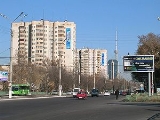
Tashkent

Encyclopedia
Tashkent is the capital of Uzbekistan
and of the Tashkent Province. The officially registered population of the city in 2008 was about 2.2 million. Unofficial sources estimate the actual population may be as much as 4.45 million.
of Ferdowsi also refers to the city as Chach. Later the town came to be known as Chachkand/Chashkand, meaning "Chach City".
(Tash in Turkic languages means stone. Kand, qand, kent, kad, kath, kud—all meaning a city—are derived from the Persian
/Sogdian
کنده kanda, meaning a town or a city. They are found in city names like Samarkand
, Yarkand, Penjikent, Khujand
etc.). After the 16th century, the name was steadily changed slightly from Chachkand/Chashkand to Tashkand, which, as "stone city", was more meaningful to the new inhabitants than the old name. The modern spelling of Tashkent reflects Russian orthography.
Tashkent started as an oasis
on the Chirchik River, near the foothills of the West Tian Shan
Mountains. In ancient times, this area contained Beitian, probably the summer "capital" of the Kangju
confederacy.
The principality of Chach, whose main town had a square
citadel built around the 5th to 3rd centuries BC, some 8 kilometres (5 mi) south of the Syr Darya
River. By the 7th century AD, Chach had over 30 towns and a network of over 50 canals, forming a trade center between the Sogdians
and Turkic
nomads. The region came under the sway of Islam
in the early parts of the 8th century.
The Buddhist monk Xuánzàng 玄奘
[602/603? - 664 CE] mentioned the name of the city as Zhěshí 赭時. The Chinese chronicles Suí shū 隋書 (Book of Suí)
, Běi shǐ 北史 (History of Northern Dynasties)
and Táng shū 唐書 (Book of Táng)
mention a possession called Shí 石 or Zhěshí 赭時 with a capital of the same name since the fifth century AD [Bichurin, 1950. v. II].
Under the Samanid
dynasty
, the city came to be known as Binkath. However, the Arabs retained the old name of Chach for the surrounding region, pronouncing it al-Shash instead. The modern Turkic name of Tashkent (City of Stone) comes from Kara-Khanid rule in the 10th century.
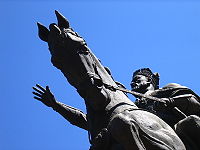 The city was destroyed by Genghis Khan
in 1219, although the great conqueror had found that the Khorezmshah had already sacked the city in 1214. Under the Timurid
s and subsequent Shaybanid dynasties the city revived, despite occasional attacks by the Uzbeks
, Kazakhs
, Persians, Mongols
, Oirats
and Kalmyks.
In 1809, Tashkent was annexed to the Khanate of Kokand
. At the time, Tashkent had a population of around 100,000 and was considered the richest city in Central Asia
. It prospered greatly through trade to Russia, but chafed under Kokand’s high taxes. The Tashkent clergy also favored the clergy of Bukhara
over that of Kokand. However, before the Emir
of Bukhara could capitalize on this discontent, the Russian army arrived.
, and outnumbered at least 15-1 staged a daring night attack against a city with a wall 25 kilometres (15.5 mi) long with 11 gates and 30,000 defenders. While a small contingent staged a diversionary attack, the main force penetrated the walls, led by a Russian Orthodox priest armed only with a crucifix. Although defense was stiff, the Russians captured the city after two days of heavy fighting and the loss of only 25 dead as opposed to several thousand of the defenders (including Alimqul
, the ruler of the Kokand Khanate). Chernyayev, dubbed the "Lion of Tashkent" by city elders, staged a "hearts-and-minds" campaign to win the population over. He abolished taxes for a year, rode unarmed through the streets and bazaars meeting common people, and appointed himself "Military Governor of Tashkent", recommending to Tsar Alexander II that the city be made an independent khanate under Russian protection.
The Tsar liberally rewarded Chernyayev and his men with medals and bonuses, but regarded the impulsive general as a "loose cannon", and soon replaced him with General Konstantin Petrovich von Kaufman
. Far from being granted independence, Tashkent became the capital of the new territory of Russian Turkistan, with Kaufman as first Governor-General. A cantonment
and Russian settlement were built across the Ankhor Canal from the old city, and Russian settlers and merchants poured in. Tashkent was a center of espionage in the Great Game rivalry between Russia and the United Kingdom over Central Asia. The Turkestan Military District
was established as part of the military reforms of 1874. The Trans-Caspian Railway
arrived in 1889, and the railway workers who built it settled in Tashkent as well, bringing with them the seeds of Bolshevik Revolution.
, the Russian Provisional Government
removed all civil restrictions based on religion and nationality, contributing to local enthusiasm for the February Revolution
. The Tashkent Soviet
of Soldiers' and Workers' Deputies was soon set up, but primarily represented Russian residents, who made up about a fifth of the Tashkent population. Muslim leaders quickly set up the Tashkent Muslim Council (Tashkand Shura-yi-Islamiya) based in the old city. On 10 March 1917, there was a parade with Russian workers marching with red flags, Russian soldiers singing the La Marseillaise
and thousands of local Central Asians. Following various speeches, Governor-General Aleksey Kuropatkin
closed the vents with words "Long Live a great free Russia". The First Turkestan Muslim Conference in Tashkent 16–20 April 1917. Like the Muslim Council this was dominated by the Jadid
, Muslim reformers. However, a more conservative faction emerged in Tashkent centered around the Ulema
. This faction proved more successful during the local elections of July 1917. They formed an alliance with Russian conservatives, while the Soviet became more radical. The Soviet attempt to seize power in September 1917 proved unsuccessful.
In April 1918, Tashkent became the capital of the Turkestan Autonomous Soviet Socialist Republic (Turkestan ASSR). The new regime was threatened by White forces, basmachi, revolts from within, and purges ordered from Moscow. Tashkent fell within the borders of the Uzbek SSR
, and became the capital of the Uzbek SSR in 1930, displacing Samarkand
.
would eventually comprise more than half of the total residents of Tashkent.
On 26 April 1966, Tashkent was destroyed by a huge earthquake
(7.5 on the Richter scale
) and over 300,000 were left homeless. Some 78,000 poorly engineered
homes were destroyed mainly in the densely packed areas of the old city where traditional adobe housing predominated. The Soviet republics and some other countries such as Finland sent "battalions of fraternal peoples” and urban planners to help rebuild devastated Tashkent. They created a “model Soviet city” of wide shady streets, parks, immense plazas for military parades, fountains, monuments, and acres of apartment blocks. About 100,000 new homes were built by 1970, many of which were filled with the families of the builders. Further development in the following years increased the size of the city with major new developments in the Chilonzar area, north-east and south-east of the city.
At the time of the collapse of the Soviet Union
in 1991, Tashkent was the fourth largest city in the country and a center of learning in the science and engineering fields.
With the 1966 earthquake and the Soviet redevelopment afterward, very little is left of Tashkent's ancient history, including its significance as a trading point on the historic Silk Road
.
.
Since 1991, the city has changed economically, culturally, and architecturally. The largest statue ever erected for Lenin was replaced with a globe, complete with a geographic map of Uzbekistan over it. Buildings from the Soviet era have been replaced with new, modern buildings. One example is the "Downtown Tashkent" district which includes the 22-story NBU Bank building, the Intercontinental Hotel, the International Business Center, and the Plaza Building.
In 2007, Tashkent was named the cultural capital of the Islamic world as the city is home to numerous historic mosques and Islamic locations of interest. Tashkent also houses the earliest written Qur'an
which has been in Tashkent since 1924.
and Samarkand
. Tashkent sits at the confluence of the Chirchik river and several of its tributaries and is built on deep alluvial deposits up to 15 metres (49.2 ft). The city is located in a lively tectonic area suffering large numbers of tremors and some earthquakes. One earthquake in 1966 measured 7.5 on the Richter scale
. The local time in Tashkent is UTC/GMT
+5 hours.
(Köppen
: Csa) with long, hot and dry summers from May to September and short but cold winters from December to February. The climate has continental
influences, and features two peaks of precipitation in the early winter and spring. The slightly unusual precipitation pattern is partially due to the 500 m (roughly 1600 feet) altitude that the city features. The temperature
s in Tashkent can be extremely hot during July and August. Most precipitation
occurs in the months of winter and spring
, while the period between July and September is dry.
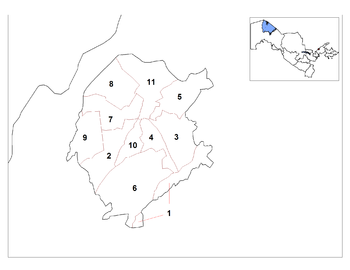
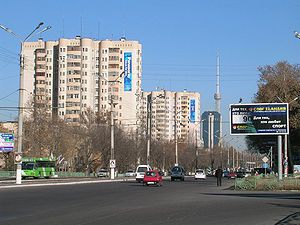 Tashkent is currently divided into the following districts (Uzbek tuman):
At the time of the Tsarist take over it had four districts (Uzbek daha):
In 1940 it had the following districts (Russian район):
By 1981 they were reorganized into:
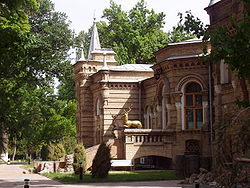
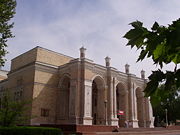
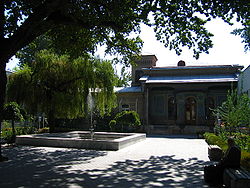

and, later, to the 1966 earthquake, little remains of Tashkent's traditional architectural heritage. Tashkent is, however, rich in museums and Soviet-era monuments. They include:
Russian Orthodox church in Amir Temur Square, built in 1898, was demolished in 2009, along with Soviet-time World War II memorial park and Defender of Motherland monument.
, and FC Bunyodkor
, both of which compete in the Uzbek League
.
Cyclist Djamolidine Abdoujaparov
and footballer Vassilis Hatzipanagis
were born in the city. Tennis player Denis Istomin
was born and lives in the city.
Gymnast Alina Kabayeva was also born in Tashkent, as were tennis players Akgul Amanmuradova
and Iroda Tulyaganova
.
Footballer Peter Odemwingie
was born in Tashkent but plays for the Nigeria national football team
.
Former world champion and Olympic bronze medalist sprint canoer in the K-1 500 m event Michael Kolganov
was also born in Tashkent.
with: Almaty
, Kazakhstan
Ankara
, Turkey
Astana
, Kazakhstan
Beijing
, China
Berlin
, Germany
Bishkek
, Kyrgyzstan
Cairo
, Egypt
Dnipropetrovsk
, Ukraine
Istanbul
, Turkey
Karachi
, Pakistan
Kiev
, Ukraine
Kortrijk
, Belgium
Moscow
, Russia
Riga
, Latvia
Seattle
, USA Skopje
, Macedonia
Tunis
, Tunisia
Seoul
, South Korea
The central Asian Arabs of Afghanistan: pastoral nomadism in transition By Thomas Jefferson Barfield
Uzbekistan
Uzbekistan , officially the Republic of Uzbekistan is a doubly landlocked country in Central Asia and one of the six independent Turkic states. It shares borders with Kazakhstan to the west and to the north, Kyrgyzstan and Tajikistan to the east, and Afghanistan and Turkmenistan to the south....
and of the Tashkent Province. The officially registered population of the city in 2008 was about 2.2 million. Unofficial sources estimate the actual population may be as much as 4.45 million.
Early Islamic History
In pre-Islamic and early Islamic times the town and the province were known as "Chach". The ShahnamehShahnameh
The Shahnameh or Shah-nama is a long epic poem written by the Persian poet Ferdowsi between c.977 and 1010 AD and is the national epic of Iran and related societies...
of Ferdowsi also refers to the city as Chach. Later the town came to be known as Chachkand/Chashkand, meaning "Chach City".
(Tash in Turkic languages means stone. Kand, qand, kent, kad, kath, kud—all meaning a city—are derived from the Persian
Persian language
Persian is an Iranian language within the Indo-Iranian branch of the Indo-European languages. It is primarily spoken in Iran, Afghanistan, Tajikistan and countries which historically came under Persian influence...
/Sogdian
Sogdian language
The Sogdian language is a Middle Iranian language that was spoken in Sogdiana , located in modern day Uzbekistan and Tajikistan ....
کنده kanda, meaning a town or a city. They are found in city names like Samarkand
Samarkand
Although a Persian-speaking region, it was not united politically with Iran most of the times between the disintegration of the Seleucid Empire and the Arab conquest . In the 6th century it was within the domain of the Turkic kingdom of the Göktürks.At the start of the 8th century Samarkand came...
, Yarkand, Penjikent, Khujand
Khujand
Khujand , also transliterated as Khudzhand, , formerly Khodjend or Khodzhent until 1936 and Leninabad until 1991, is the second-largest city of Tajikistan. It is situated on the Syr Darya River at the mouth of the Fergana Valley...
etc.). After the 16th century, the name was steadily changed slightly from Chachkand/Chashkand to Tashkand, which, as "stone city", was more meaningful to the new inhabitants than the old name. The modern spelling of Tashkent reflects Russian orthography.
Tashkent started as an oasis
Oasis
In geography, an oasis or cienega is an isolated area of vegetation in a desert, typically surrounding a spring or similar water source...
on the Chirchik River, near the foothills of the West Tian Shan
Tian Shan
The Tian Shan , also spelled Tien Shan, is a large mountain system located in Central Asia. The highest peak in the Tian Shan is Victory Peak , ....
Mountains. In ancient times, this area contained Beitian, probably the summer "capital" of the Kangju
Kangju
Kangju was the name of an ancient people and kingdom in Central Asia. It was a nomadic federation of unknown ethnic and linguistic origin which became for a couple of centuries the second greatest power in Transoxiana after the Yuezhi....
confederacy.
The principality of Chach, whose main town had a square
Square (geometry)
In geometry, a square is a regular quadrilateral. This means that it has four equal sides and four equal angles...
citadel built around the 5th to 3rd centuries BC, some 8 kilometres (5 mi) south of the Syr Darya
Syr Darya
The Syr Darya , also transliterated Syrdarya or Sirdaryo, is a river in Central Asia, sometimes known as the Jaxartes or Yaxartes from its Ancient Greek name . The Greek name is derived from Old Persian, Yakhsha Arta , a reference to the color of the river's water...
River. By the 7th century AD, Chach had over 30 towns and a network of over 50 canals, forming a trade center between the Sogdians
Sogdiana
Sogdiana or Sogdia was the ancient civilization of an Iranian people and a province of the Achaemenid Empire, eighteenth in the list on the Behistun Inscription of Darius the Great . Sogdiana is "listed" as the second of the "good lands and countries" that Ahura Mazda created...
and Turkic
Turkic peoples
The Turkic peoples are peoples residing in northern, central and western Asia, southern Siberia and northwestern China and parts of eastern Europe. They speak languages belonging to the Turkic language family. They share, to varying degrees, certain cultural traits and historical backgrounds...
nomads. The region came under the sway of Islam
Islam
Islam . The most common are and . : Arabic pronunciation varies regionally. The first vowel ranges from ~~. The second vowel ranges from ~~~...
in the early parts of the 8th century.
The Buddhist monk Xuánzàng 玄奘
Xuanzang
Xuanzang was a famous Chinese Buddhist monk, scholar, traveler, and translator who described the interaction between China and India in the early Tang period...
[602/603? - 664 CE] mentioned the name of the city as Zhěshí 赭時. The Chinese chronicles Suí shū 隋書 (Book of Suí)
Book of Sui
The Book of Sui was the official history of the Chinese dynasty Sui Dynasty, and it ranks among the official Twenty-Four Histories of imperial China. It was compiled by a team of historians led by the Tang Dynasty official Wei Zheng and was completed in 636.-External links:* of the Book of Sui,...
, Běi shǐ 北史 (History of Northern Dynasties)
History of Northern Dynasties
The History of Northern Dynasties is one of the official Chinese historical works in the Twenty-Four Histories canon. It contain 100 volumes and covers the period from 386 to 618, the histories of Northern Wei, Western Wei, Eastern Wei, Northern Zhou, Northern Qi, and Sui Dynasty...
and Táng shū 唐書 (Book of Táng)
Book of Tang
The Book of Tang , Jiu Tangshu or the Old Book of Tang is the first classic work about the Tang Dynasty. The book began when Gaozu of Later Jin ordered its commencement in 941...
mention a possession called Shí 石 or Zhěshí 赭時 with a capital of the same name since the fifth century AD [Bichurin, 1950. v. II].
Under the Samanid
Samanid
The Samani dynasty , also known as the Samanid Empire, or simply Samanids was a Persian state and empire in Central Asia and Greater Iran, named after its founder Saman Khuda, who converted to Sunni Islam despite being from Zoroastrian theocratic nobility...
dynasty
Dynasty
A dynasty is a sequence of rulers considered members of the same family. Historians traditionally consider many sovereign states' history within a framework of successive dynasties, e.g., China, Ancient Egypt and the Persian Empire...
, the city came to be known as Binkath. However, the Arabs retained the old name of Chach for the surrounding region, pronouncing it al-Shash instead. The modern Turkic name of Tashkent (City of Stone) comes from Kara-Khanid rule in the 10th century.
Genghis Khan
Genghis Khan , born Temujin and occasionally known by his temple name Taizu , was the founder and Great Khan of the Mongol Empire, which became the largest contiguous empire in history after his death....
in 1219, although the great conqueror had found that the Khorezmshah had already sacked the city in 1214. Under the Timurid
Timurid Dynasty
The Timurids , self-designated Gurkānī , were a Persianate, Central Asian Sunni Muslim dynasty of Turko-Mongol descent whose empire included the whole of Iran, modern Afghanistan, and modern Uzbekistan, as well as large parts of contemporary Pakistan, North India, Mesopotamia, Anatolia and the...
s and subsequent Shaybanid dynasties the city revived, despite occasional attacks by the Uzbeks
Uzbeks
The Uzbeks are a Turkic ethnic group in Central Asia. They comprise the majority population of Uzbekistan, and large populations can also be found in Afghanistan, Tajikstan, Kyrgyzstan, Turkmenistan, Kazakhstan, Russia, Pakistan, Mongolia and the Xinjiang Uyghur Autonomous Region of China...
, Kazakhs
Kazakhs
The Kazakhs are a Turkic people of the northern parts of Central Asia ....
, Persians, Mongols
Mongols
Mongols ) are a Central-East Asian ethnic group that lives mainly in the countries of Mongolia, China, and Russia. In China, ethnic Mongols can be found mainly in the central north region of China such as Inner Mongolia...
, Oirats
Oirats
Oirats are the westernmost group of the Mongols who unified several tribes origin whose ancestral home is in the Altai region of western Mongolia. Although the Oirats originated in the eastern parts of Central Asia, the most prominent group today is located in the Republic of Kalmykia, a federal...
and Kalmyks.
In 1809, Tashkent was annexed to the Khanate of Kokand
Khanate of Kokand
The Khanate of Kokand was a state in Central Asia that existed from 1709–1883 within the territory of modern eastern Uzbekistan, southern Kazakhstan, Tajikistan and Kyrgyzstan...
. At the time, Tashkent had a population of around 100,000 and was considered the richest city in Central Asia
Central Asia
Central Asia is a core region of the Asian continent from the Caspian Sea in the west, China in the east, Afghanistan in the south, and Russia in the north...
. It prospered greatly through trade to Russia, but chafed under Kokand’s high taxes. The Tashkent clergy also favored the clergy of Bukhara
Bukhara
Bukhara , from the Soghdian βuxārak , is the capital of the Bukhara Province of Uzbekistan. The nation's fifth-largest city, it has a population of 263,400 . The region around Bukhara has been inhabited for at least five millennia, and the city has existed for half that time...
over that of Kokand. However, before the Emir
Emir
Emir , meaning "commander", "general", or "prince"; also transliterated as Amir, Aamir or Ameer) is a title of high office, used throughout the Muslim world...
of Bukhara could capitalize on this discontent, the Russian army arrived.
Tsarist Period
In May, 1865, Mikhail Grigorevich Chernyayev (Cherniaev), acting against the direct orders of the tsarTsar
Tsar is a title used to designate certain European Slavic monarchs or supreme rulers. As a system of government in the Tsardom of Russia and Russian Empire, it is known as Tsarist autocracy, or Tsarism...
, and outnumbered at least 15-1 staged a daring night attack against a city with a wall 25 kilometres (15.5 mi) long with 11 gates and 30,000 defenders. While a small contingent staged a diversionary attack, the main force penetrated the walls, led by a Russian Orthodox priest armed only with a crucifix. Although defense was stiff, the Russians captured the city after two days of heavy fighting and the loss of only 25 dead as opposed to several thousand of the defenders (including Alimqul
Alimqul
`Alimqul was a warlord in the Kokand Khanate, and its de facto ruler from 1863 to 1865....
, the ruler of the Kokand Khanate). Chernyayev, dubbed the "Lion of Tashkent" by city elders, staged a "hearts-and-minds" campaign to win the population over. He abolished taxes for a year, rode unarmed through the streets and bazaars meeting common people, and appointed himself "Military Governor of Tashkent", recommending to Tsar Alexander II that the city be made an independent khanate under Russian protection.
The Tsar liberally rewarded Chernyayev and his men with medals and bonuses, but regarded the impulsive general as a "loose cannon", and soon replaced him with General Konstantin Petrovich von Kaufman
Konstantin Petrovich Von Kaufman
Konstantin Petrovich von Kaufman was the first Governor-General of Russian Turkestan.-Early life:His family was Austrian in origin, but had been in the service of the Tsars for over 100 years, and had long since converted to Orthodoxy...
. Far from being granted independence, Tashkent became the capital of the new territory of Russian Turkistan, with Kaufman as first Governor-General. A cantonment
Cantonment
A cantonment is a temporary or semi-permanent military or police quarters. The word cantonment is derived from the French word canton meaning corner or district, as is the name of the Cantons of Switzerland. In South Asia, the term cantonment also describes permanent military stations...
and Russian settlement were built across the Ankhor Canal from the old city, and Russian settlers and merchants poured in. Tashkent was a center of espionage in the Great Game rivalry between Russia and the United Kingdom over Central Asia. The Turkestan Military District
Turkestan Military District
The Turkestan Military District was a military district of both the Imperial Russian Army and the Soviet Armed Forces, with its headquarters at Tashkent. The District was first created during the 1874 Russian military reform when by order of Minister D.A. Milyutinym the territory of Russia was...
was established as part of the military reforms of 1874. The Trans-Caspian Railway
Trans-Caspian railway
The Trans-Caspian Railway is a railway that follows the path of the Silk Road through much of western Central Asia. It was built by the Russian Empire during its expansion into Central Asia in the 19th century. The railway was started in 1879, following the Russian defeat of Khokand...
arrived in 1889, and the railway workers who built it settled in Tashkent as well, bringing with them the seeds of Bolshevik Revolution.
Impact of the Russian revolution
With the fall of the Russian EmpireRussian Empire
The Russian Empire was a state that existed from 1721 until the Russian Revolution of 1917. It was the successor to the Tsardom of Russia and the predecessor of the Soviet Union...
, the Russian Provisional Government
Russian Provisional Government
The Russian Provisional Government was the short-lived administrative body which sought to govern Russia immediately following the abdication of Tsar Nicholas II . On September 14, the State Duma of the Russian Empire was officially dissolved by the newly created Directorate, and the country was...
removed all civil restrictions based on religion and nationality, contributing to local enthusiasm for the February Revolution
February Revolution
The February Revolution of 1917 was the first of two revolutions in Russia in 1917. Centered around the then capital Petrograd in March . Its immediate result was the abdication of Tsar Nicholas II, the end of the Romanov dynasty, and the end of the Russian Empire...
. The Tashkent Soviet
Tashkent Soviet
The Tashkent Soviet was a public organisation set up in Tashkent during the Russian Revolution.The Tashkent Soviet was established on 2 March 1917 at an inaugural meeting which consisted of thirty five workers from the Central Asian Railway. It was headed by a technician by the name of I. I. Bel'kov...
of Soldiers' and Workers' Deputies was soon set up, but primarily represented Russian residents, who made up about a fifth of the Tashkent population. Muslim leaders quickly set up the Tashkent Muslim Council (Tashkand Shura-yi-Islamiya) based in the old city. On 10 March 1917, there was a parade with Russian workers marching with red flags, Russian soldiers singing the La Marseillaise
La Marseillaise
"La Marseillaise" is the national anthem of France. The song, originally titled "Chant de guerre pour l'Armée du Rhin" was written and composed by Claude Joseph Rouget de Lisle in 1792. The French National Convention adopted it as the Republic's anthem in 1795...
and thousands of local Central Asians. Following various speeches, Governor-General Aleksey Kuropatkin
Aleksey Kuropatkin
Alexei Nikolayevich Kuropatkin was the Russian Imperial Minister of War who is often held responsible for major Russian drawbacks in the Russian-Japanese War, notably the Battle of Mukden and the Battle of Liaoyang.-Early years:Kuropatkin was born in 1848 in what is now Pskov, in the Russian...
closed the vents with words "Long Live a great free Russia". The First Turkestan Muslim Conference in Tashkent 16–20 April 1917. Like the Muslim Council this was dominated by the Jadid
Jadid
The Jadids were Muslim modernist reformers within the Russian Empire in the late 19th and early 20th century. They normally referred to themselves by the Turkic terms Taraqqiparvarlar , Ziyalilar , or simply Yäşlär/Yoshlar...
, Muslim reformers. However, a more conservative faction emerged in Tashkent centered around the Ulema
Ulema
Ulama , also spelt ulema, refers to the educated class of Muslim legal scholars engaged in the several fields of Islamic studies. They are best known as the arbiters of shari‘a law...
. This faction proved more successful during the local elections of July 1917. They formed an alliance with Russian conservatives, while the Soviet became more radical. The Soviet attempt to seize power in September 1917 proved unsuccessful.
In April 1918, Tashkent became the capital of the Turkestan Autonomous Soviet Socialist Republic (Turkestan ASSR). The new regime was threatened by White forces, basmachi, revolts from within, and purges ordered from Moscow. Tashkent fell within the borders of the Uzbek SSR
Uzbek SSR
The Uzbek Soviet Socialist Republic , also known as the Uzbek SSR for short, was one of the republics of the Soviet Union since its creation in 1924...
, and became the capital of the Uzbek SSR in 1930, displacing Samarkand
Samarkand
Although a Persian-speaking region, it was not united politically with Iran most of the times between the disintegration of the Seleucid Empire and the Arab conquest . In the 6th century it was within the domain of the Turkic kingdom of the Göktürks.At the start of the 8th century Samarkand came...
.
Soviet period
The city began to industrialize in the 1920s and 1930s, but industry increased tremendously during World War II, with the relocation of factories from western Russia to preserve the Soviet industrial capacity from the invading Nazis. The Russian population increased dramatically as well, with evacuees from the war zones increasing the population to well over a million. The Russians and UkrainiansUkrainians
Ukrainians are an East Slavic ethnic group native to Ukraine, which is the sixth-largest nation in Europe. The Constitution of Ukraine applies the term 'Ukrainians' to all its citizens...
would eventually comprise more than half of the total residents of Tashkent.
On 26 April 1966, Tashkent was destroyed by a huge earthquake
Earthquake
An earthquake is the result of a sudden release of energy in the Earth's crust that creates seismic waves. The seismicity, seismism or seismic activity of an area refers to the frequency, type and size of earthquakes experienced over a period of time...
(7.5 on the Richter scale
Richter magnitude scale
The expression Richter magnitude scale refers to a number of ways to assign a single number to quantify the energy contained in an earthquake....
) and over 300,000 were left homeless. Some 78,000 poorly engineered
Earthquake engineering
Earthquake engineering is the scientific field concerned with protecting society, the natural and the man-made environment from earthquakes by limiting the seismic risk to socio-economically acceptable levels...
homes were destroyed mainly in the densely packed areas of the old city where traditional adobe housing predominated. The Soviet republics and some other countries such as Finland sent "battalions of fraternal peoples” and urban planners to help rebuild devastated Tashkent. They created a “model Soviet city” of wide shady streets, parks, immense plazas for military parades, fountains, monuments, and acres of apartment blocks. About 100,000 new homes were built by 1970, many of which were filled with the families of the builders. Further development in the following years increased the size of the city with major new developments in the Chilonzar area, north-east and south-east of the city.
At the time of the collapse of the Soviet Union
Soviet Union
The Soviet Union , officially the Union of Soviet Socialist Republics , was a constitutionally socialist state that existed in Eurasia between 1922 and 1991....
in 1991, Tashkent was the fourth largest city in the country and a center of learning in the science and engineering fields.
With the 1966 earthquake and the Soviet redevelopment afterward, very little is left of Tashkent's ancient history, including its significance as a trading point on the historic Silk Road
Silk Road
The Silk Road or Silk Route refers to a historical network of interlinking trade routes across the Afro-Eurasian landmass that connected East, South, and Western Asia with the Mediterranean and European world, as well as parts of North and East Africa...
.
Capital of Uzbekistan
At the moment, Tashkent is the most cosmopolitan city in Uzbekistan. The city is noted for its tree lined streets, numerous fountains, and pleasant parks. As capital of the nation, it has also been the target of several terrorist attacks since Uzbekistan gained independence, which the government has attributed to Islamic fundamentalistsIslamic fundamentalism
Islamic fundamentalism is a term used to describe religious ideologies seen as advocating a return to the "fundamentals" of Islam: the Quran and the Sunnah. Definitions of the term vary. According to Christine L...
.
Since 1991, the city has changed economically, culturally, and architecturally. The largest statue ever erected for Lenin was replaced with a globe, complete with a geographic map of Uzbekistan over it. Buildings from the Soviet era have been replaced with new, modern buildings. One example is the "Downtown Tashkent" district which includes the 22-story NBU Bank building, the Intercontinental Hotel, the International Business Center, and the Plaza Building.
In 2007, Tashkent was named the cultural capital of the Islamic world as the city is home to numerous historic mosques and Islamic locations of interest. Tashkent also houses the earliest written Qur'an
Uthman Qur'an
The Othman Qur'an , named for the third Caliph, Uthman ibn Affan, is a manuscript Qur'an kept in the Hast Imam library...
which has been in Tashkent since 1924.
Geography & Climate
Geography
Tashkent 41°18′N 69°16′E is situated in a well-watered plain to the west of the last Altai mountains on the road between ShymkentShymkent
Shymkent , formerly known as Chimkent , is the capital city of South Kazakhstan Province, the most populated region in Kazakhstan. It is the third most populous city in Kazakhstan behind Almaty and Astana with a population of 629,600 . A major railroad junction on the Turkestan-Siberia Railway, the...
and Samarkand
Samarkand
Although a Persian-speaking region, it was not united politically with Iran most of the times between the disintegration of the Seleucid Empire and the Arab conquest . In the 6th century it was within the domain of the Turkic kingdom of the Göktürks.At the start of the 8th century Samarkand came...
. Tashkent sits at the confluence of the Chirchik river and several of its tributaries and is built on deep alluvial deposits up to 15 metres (49.2 ft). The city is located in a lively tectonic area suffering large numbers of tremors and some earthquakes. One earthquake in 1966 measured 7.5 on the Richter scale
Richter magnitude scale
The expression Richter magnitude scale refers to a number of ways to assign a single number to quantify the energy contained in an earthquake....
. The local time in Tashkent is UTC/GMT
Coordinated Universal Time
Coordinated Universal Time is the primary time standard by which the world regulates clocks and time. It is one of several closely related successors to Greenwich Mean Time. Computer servers, online services and other entities that rely on having a universally accepted time use UTC for that purpose...
+5 hours.
Climate
Tashkent has a Mediterranean climateMediterranean climate
A Mediterranean climate is the climate typical of most of the lands in the Mediterranean Basin, and is a particular variety of subtropical climate...
(Köppen
Köppen climate classification
The Köppen climate classification is one of the most widely used climate classification systems. It was first published by Crimea German climatologist Wladimir Köppen in 1884, with several later modifications by Köppen himself, notably in 1918 and 1936...
: Csa) with long, hot and dry summers from May to September and short but cold winters from December to February. The climate has continental
Continental climate
Continental climate is a climate characterized by important annual variation in temperature due to the lack of significant bodies of water nearby...
influences, and features two peaks of precipitation in the early winter and spring. The slightly unusual precipitation pattern is partially due to the 500 m (roughly 1600 feet) altitude that the city features. The temperature
Temperature
Temperature is a physical property of matter that quantitatively expresses the common notions of hot and cold. Objects of low temperature are cold, while various degrees of higher temperatures are referred to as warm or hot...
s in Tashkent can be extremely hot during July and August. Most precipitation
Precipitation (meteorology)
In meteorology, precipitation In meteorology, precipitation In meteorology, precipitation (also known as one of the classes of hydrometeors, which are atmospheric water phenomena is any product of the condensation of atmospheric water vapor that falls under gravity. The main forms of precipitation...
occurs in the months of winter and spring
Spring (season)
Spring is one of the four temperate seasons, the transition period between winter and summer. Spring and "springtime" refer to the season, and broadly to ideas of rebirth, renewal and regrowth. The specific definition of the exact timing of "spring" varies according to local climate, cultures and...
, while the period between July and September is dry.
Districts
- Bektemir
- Chilanzar
- Hamza
- Mirobod
- Mirzo Ulugbek
- Sergeli
- Shaykhontohur
- Olmazar
- Uchtepa
- Yakkasaray
- Yunusabad
At the time of the Tsarist take over it had four districts (Uzbek daha):
- Beshyoghoch
- Kukcha
- Shaykhontokhur
- Sebzor
In 1940 it had the following districts (Russian район):
- OktyabrOctober RevolutionThe October Revolution , also known as the Great October Socialist Revolution , Red October, the October Uprising or the Bolshevik Revolution, was a political revolution and a part of the Russian Revolution of 1917...
- KirovSergey KirovSergei Mironovich Kirov , born Sergei Mironovich Kostrikov, was a prominent early Bolshevik leader in the Soviet Union. Kirov rose through the Communist Party ranks to become head of the Party organization in Leningrad...
- StalinJoseph StalinJoseph Vissarionovich Stalin was the Premier of the Soviet Union from 6 May 1941 to 5 March 1953. He was among the Bolshevik revolutionaries who brought about the October Revolution and had held the position of first General Secretary of the Communist Party of the Soviet Union's Central Committee...
- FrunzeMikhail FrunzeMikhail Vasilyevich Frunze was a Bolshevik leader during and just prior to the Russian Revolution of 1917.-Life and Political Activity:Frunze was born in Bishkek, then a small Imperial Russian garrison town in the Kyrgyz part of Turkestan, to a Moldovan medical practitioner and his Russian wife...
- LeninVladimir LeninVladimir Ilyich Lenin was a Russian Marxist revolutionary and communist politician who led the October Revolution of 1917. As leader of the Bolsheviks, he headed the Soviet state during its initial years , as it fought to establish control of Russia in the Russian Civil War and worked to create a...
- Kuybishev
By 1981 they were reorganized into:
- Bektemir
- Akmal-Ikramov (Uchtepa)
- Khamza
- Lenin (Mirobod)
- Kuybishev (Mirzo Ulugbek)
- Sergeli
- Oktober (Shaykhontokhur)
- Sobir Rakhimov
- Chilanzar
- Frunze (Yakkasaray)
- Kirov (Yunusabad)
Main sights
Due to the destruction of most of the ancient city during the 1917 revolutionRussian Revolution of 1917
The Russian Revolution is the collective term for a series of revolutions in Russia in 1917, which destroyed the Tsarist autocracy and led to the creation of the Soviet Union. The Tsar was deposed and replaced by a provisional government in the first revolution of February 1917...
and, later, to the 1966 earthquake, little remains of Tashkent's traditional architectural heritage. Tashkent is, however, rich in museums and Soviet-era monuments. They include:
- Kukeldash Madrasah. Dating back to the reign of Abdullah KhanAbdullah KhanAbdullah Khan is a citizen of Afghanistan who was held in extrajudicial detention in the United States Guantanamo Bay detainment camps, in Cuba. The Department of Defense estimates he was born in 1956....
(1557–1598) it is currently being restored by the provincial Religious Board of Mawarannahr MoslemMuslimA Muslim, also spelled Moslem, is an adherent of Islam, a monotheistic, Abrahamic religion based on the Quran, which Muslims consider the verbatim word of God as revealed to prophet Muhammad. "Muslim" is the Arabic term for "submitter" .Muslims believe that God is one and incomparable...
s. There is talk of making it into a museum, but it is currently being used as a mosqueMosqueA mosque is a place of worship for followers of Islam. The word is likely to have entered the English language through French , from Portuguese , from Spanish , and from Berber , ultimately originating in — . The Arabic word masjid literally means a place of prostration...
. - Chorsu Bazaar, located near the Kukeldash Madrassa. This huge open air bazaarBazaarA bazaar , Cypriot Greek: pantopoula) is a permanent merchandising area, marketplace, or street of shops where goods and services are exchanged or sold. The term is sometimes also used to refer to the "network of merchants, bankers and craftsmen" who work that area...
is the center of the old town of Tashkent. Everything imaginable is for sale. - Telyashayakh Mosque (Khast Imam Mosque). It Contains the Uthman Qur'anUthman Qur'anThe Othman Qur'an , named for the third Caliph, Uthman ibn Affan, is a manuscript Qur'an kept in the Hast Imam library...
, considered to be the oldest extant Qur'anQur'anThe Quran , also transliterated Qur'an, Koran, Alcoran, Qur’ān, Coran, Kuran, and al-Qur’ān, is the central religious text of Islam, which Muslims consider the verbatim word of God . It is regarded widely as the finest piece of literature in the Arabic language...
in the world. Dating from 655 and stained with the blood of murdered caliph, UthmanUthmanUthman ibn Affan was one of the companions of Islamic prophet, Muhammad. He played a major role in early Islamic history as the third Sunni Rashidun or Rightly Guided Caliph....
, it was brought by Timur to SamarkandSamarkandAlthough a Persian-speaking region, it was not united politically with Iran most of the times between the disintegration of the Seleucid Empire and the Arab conquest . In the 6th century it was within the domain of the Turkic kingdom of the Göktürks.At the start of the 8th century Samarkand came...
, seized by the Russians as a war trophy and taken to Saint PetersburgSaint PetersburgSaint Petersburg is a city and a federal subject of Russia located on the Neva River at the head of the Gulf of Finland on the Baltic Sea...
. It was returned to Uzbekistan in 1924. - Yunus Khan Mausoleum. It is a group of three 15th century mausoleums, restored in the 19th century. The biggest is the grave of Yunus KhanYunus KhanYunus Khan , was Khan of Moghulistan from 1462 until his death. He is identified by many historians with Ḥājjī `Ali , of the contemporary Chinese records.- Background and Family :...
, grandfather of Mughal EmpireMughal EmpireThe Mughal Empire , or Mogul Empire in traditional English usage, was an imperial power from the Indian Subcontinent. The Mughal emperors were descendants of the Timurids...
founder BaburBaburBabur was a Muslim conqueror from Central Asia who, following a series of setbacks, finally succeeded in laying the basis for the Mughal dynasty of South Asia. He was a direct descendant of Timur through his father, and a descendant also of Genghis Khan through his mother...
. - Palace of Prince Romanov. During the 19th century Grand DukeGrand DukeThe title grand duke is used in Western Europe and particularly in Germanic countries for provincial sovereigns. Grand duke is of a protocolary rank below a king but higher than a sovereign duke. Grand duke is also the usual and established translation of grand prince in languages which do not...
Nikolai Konstantinovich, a first cousin of Alexander III of RussiaAlexander III of RussiaAlexander Alexandrovich Romanov , historically remembered as Alexander III or Alexander the Peacemaker reigned as Emperor of Russia from until his death on .-Disposition:...
was banished to Tashkent for some shady deals involving the Russian Crown Jewels. His palace still survives in the centre of the city. Once a museum, it has been appropriated by the Ministry of Foreign Affairs. - Alisher Navoi Opera and Ballet Theatre, built by the same architect who designed Lenin's Tomb in Moscow, Aleksey Shchusev, with JapaneseEmpire of JapanThe Empire of Japan is the name of the state of Japan that existed from the Meiji Restoration on 3 January 1868 to the enactment of the post-World War II Constitution of...
prisoner of warPrisoner of warA prisoner of war or enemy prisoner of war is a person, whether civilian or combatant, who is held in custody by an enemy power during or immediately after an armed conflict...
labor in World War II. It hosts Russian balletBalletBallet is a type of performance dance, that originated in the Italian Renaissance courts of the 15th century, and which was further developed in France and Russia as a concert dance form. The early portions preceded the invention of the proscenium stage and were presented in large chambers with...
and operaOperaOpera is an art form in which singers and musicians perform a dramatic work combining text and musical score, usually in a theatrical setting. Opera incorporates many of the elements of spoken theatre, such as acting, scenery, and costumes and sometimes includes dance...
. - Fine Arts Museum of Uzbekistan. It contains a major collection of art from the pre-Russian period, including SogdianSogdian languageThe Sogdian language is a Middle Iranian language that was spoken in Sogdiana , located in modern day Uzbekistan and Tajikistan ....
murals, Buddhist statues and Zoroastrian art, along with a more modern collection of 19th and 20th century applied artApplied artApplied art is the application of design and aesthetics to objects of function and everyday use. Whereas fine arts serve as intellectual stimulation to the viewer or academic sensibilities, the applied arts incorporate design and creative ideals to objects of utility, such as a cup, magazine or...
, such as suzaniSuzaniSuzani may refer to:*Suzani, an embroidered tribal textile made in Central Asia..*Suzani, Shamseddin Taj-ul Shu'ara is the name of a 12th century Persian poet from Samarqand....
embroidered hangings. Of more interest is the large collection of paintings "borrowed" from the HermitageHermitage MuseumThe State Hermitage is a museum of art and culture in Saint Petersburg, Russia. One of the largest and oldest museums of the world, it was founded in 1764 by Catherine the Great and has been opened to the public since 1852. Its collections, of which only a small part is on permanent display,...
by Grand DukeGrand DukeThe title grand duke is used in Western Europe and particularly in Germanic countries for provincial sovereigns. Grand duke is of a protocolary rank below a king but higher than a sovereign duke. Grand duke is also the usual and established translation of grand prince in languages which do not...
RomanovRomanovThe House of Romanov was the second and last imperial dynasty to rule over Russia, reigning from 1613 until the February Revolution abolished the crown in 1917...
to decorate his palace in exile in Tashkent, and never returned. Behind the museum is a small park, containing the neglected graves of the Bolsheviks who died in the Russian Revolution of 1917Russian Revolution of 1917The Russian Revolution is the collective term for a series of revolutions in Russia in 1917, which destroyed the Tsarist autocracy and led to the creation of the Soviet Union. The Tsar was deposed and replaced by a provisional government in the first revolution of February 1917...
and to Ossipov's treachery in 1919, along with first Uzbekistani President Yuldosh Akhunbabayev. - Museum of Applied Arts. Housed in a traditional house originally commissioned for a wealthy tsarist diplomat, the house itself is the main attraction, rather than its collection of 19th and 20th century applied arts.
- History Museumm the largest museum in the city. It is housed in the ex-Lenin Museum.
- Amir Timur MuseumAmir Timur MuseumThe Amir Timur Museum is a museum in the city of Tashkent, the capital of Uzbekistan. It is well known for its distinctive blue dome and ornate interior and features the exhibits of Timur and President Islam Karimov. The museum was established to commemorate the 660th birthday of Timur...
, housed in a building with brilliant blue dome and ornate interior. It houses exhibits of TimurTimurTimur , historically known as Tamerlane in English , was a 14th-century conqueror of West, South and Central Asia, and the founder of the Timurid dynasty in Central Asia, and great-great-grandfather of Babur, the founder of the Mughal Dynasty, which survived as the Mughal Empire in India until...
and of President Islam Karimov. The gardens outside contain a statue of Timur on horseback, surrounded by some of the nicest gardens and fountains in the city. - Navoi Literary Museum, commemorating Uzbekistan's adopted literary hero, Alisher Navoi, with replica manuscripts, PersianPersian languagePersian is an Iranian language within the Indo-Iranian branch of the Indo-European languages. It is primarily spoken in Iran, Afghanistan, Tajikistan and countries which historically came under Persian influence...
calligraphyCalligraphyCalligraphy is a type of visual art. It is often called the art of fancy lettering . A contemporary definition of calligraphic practice is "the art of giving form to signs in an expressive, harmonious and skillful manner"...
and 15th century miniature paintingMiniature paintingMiniature painting may refer to:* Miniature * Persian miniature* Ottoman miniature* Portrait miniature* Painting miniature figures used in wargaming or role-playing games...
s.
Russian Orthodox church in Amir Temur Square, built in 1898, was demolished in 2009, along with Soviet-time World War II memorial park and Defender of Motherland monument.
City built environment
- The only metroRapid transitA rapid transit, underground, subway, elevated railway, metro or metropolitan railway system is an electric passenger railway in an urban area with a high capacity and frequency, and grade separation from other traffic. Rapid transit systems are typically located either in underground tunnels or on...
system in Central AsiaCentral AsiaCentral Asia is a core region of the Asian continent from the Caspian Sea in the west, China in the east, Afghanistan in the south, and Russia in the north...
. (Astana'sAstanaAstana , formerly known as Akmola , Tselinograd and Akmolinsk , is the capital and second largest city of Kazakhstan, with an officially estimated population of 708,794 as of 1 August 2010...
and Almaty'sAlmatyAlmaty , also known by its former names Verny and Alma-Ata , is the former capital of Kazakhstan and the nation's largest city, with a population of 1,348,500...
are only in their construction stages.) - The largest city square (Independence Square) in the former Soviet Union, which once held the tallest statue of Lenin (30 meters tall) in the Soviet Union. Lenin was replaced in 1992 by a globe showing a map of Uzbekistan.
- Government, trade union and private medical and dental facilities.
- Offices of several American and European consulting firms like Ernst & YoungErnst & YoungErnst & Young is one of the largest professional services networks in the world and one of the "Big Four" accountancy firms, along with Deloitte, KPMG and PricewaterhouseCoopers ....
Ltd, Deloitte & Touche, PricewaterhouseCoopersPricewaterhouseCoopersPricewaterhouseCoopers is a global professional services firm headquartered in London, United Kingdom. It is the world's largest professional services firm measured by revenues and one of the "Big Four" accountancy firms....
and Gravamen Fidelis and Fides LLP.
Education
- Several universitiesUniversityA university is an institution of higher education and research, which grants academic degrees in a variety of subjects. A university is an organisation that provides both undergraduate education and postgraduate education...
and institutions of higher learningHigher LearningHigher Learning is a 1995 American drama film, starring an ensemble cast. It also featured Tyra Banks' first performance in a theatrical film...
:- Tashkent Automobile & Road Construction institute
- Tashkent State Technical University
- Tashkent Institute of Architecture and Construction
- International Business School "Kelajak Ilmi"
- Tashkent University of Information TechnologiesTashkent University of Information TechnologiesTashkent University of Information Technology , in Tashkent, Uzbekistan, is the largest university in Uzbekistan. The Tashkent University of Information Technology was founded as the Tashkent Electro Technical Institute of Communication in 1955...
- Westminster International University in TashkentWestminster International University in TashkentWestminster International University in Tashkent is Uzbekistan's first international university. The university is the first in Central Asia to offer a Western education, with UK qualifications...
- National University of UzbekistanNational University of UzbekistanNational University of Uzbekistan is the oldest and largest university of Uzbekistan; it has 13 schools. The university was founded in 1918 as Turkestan People's University, with 1,200 students; in 1920 it was reorganized as Turkestan State University , and in July 1923 it was renamed the First...
- University of World Economy and DiplomacyUniversity of World Economy and DiplomacyThe University of World Economy and Diplomacy is located in Tashkent, the capital of Uzbekistan. It was founded in 1992 by the decree of the President Karimov to train future leaders of the country....
- Tashkent State Economic University
- Tashkent State Institute of LawTashkent State Institute of LawTashkent State Institute of Law is a public law school in Tashkent, Uzbekistan.-History:Tashkent State Institute of Law was created in 1991 after having been the department of law of the University of Tashkent....
- Tashkent Institute of Finance
- State University of Foreign Languages
- Conservatory of Music
- Tashkent State Medicine Academy
- Institute of Oriental Studies.
- Tashkent Islamic University
- Management Development Institute of Singapore in Tashkent
- Tashkent Institute of Textile and Light Industry
- Tashkent Institute of Railway Transport EngineersTashkent Institute of Railway Transport EngineersTashkent Institute of Railway Transport Engineers is higher education institution in the field of railway transport in Uzbekistan.-Faculties:* Electromechanical Faculty* Organization of transportation and control * Faculty of Economics...
Media
- 9 Uzbek languageUzbek languageUzbek is a Turkic language and the official language of Uzbekistan. It has about 25.5 million native speakers, and it is spoken by the Uzbeks in Uzbekistan and elsewhere in Central Asia...
newspapers, 4 in English and 9 publications in Russian - Several television and cable television facilities, including Tashkent TowerTashkent TowerThe Tashkent Television Tower is a high tower, located in Tashkent, Uzbekistan. Construction started in 1978 and it began operation 6 years later, on 15 January 1985. It was the 3rd tallest tower in the world from 1985 to 1991....
, the tallest structure in Central Asia
Transportation
- Metro systemTashkent MetroThe Tashkent Metro is the rapid transit system serving the city of Tashkent, the capital of Uzbekistan. It is the only currently operating subway system in Central Asia. It was the seventh metro to be built in the former USSR, opening in 1977...
- Tashkent International Airport is the largest in the country, connecting the city to Asia, Europe, North and South American continents.
- Tashkent–Samarkand high-speed rail line
- Trolleybus system was closed down in 2010.
Sport
Tashkent's most prominent football clubs are Pakhtakor TashkentFC Pakhtakor Tashkent
FC Pakhtakor Tashkent is an Uzbek professional football club, based in the capital Tashkent. Pakhtakor means cotton-grower in English.Playing in the Uzbek League since 1992, the club has been the undisputed powerhouse in Uzbekistan since the fall of the Soviet Union, winning eight Uzbek League...
, and FC Bunyodkor
FC Bunyodkor
FC Bunyodkor is an Uzbek football club based in Tashkent, Uzbekistan.The club finished second in the 2007 Uzbek League season and made the semi-finals of the 2008 AFC Champions League...
, both of which compete in the Uzbek League
Uzbek League
The Uzbekistan Professional Football League , is the top division of football in Uzbekistan, and is operated under the auspices of the Uzbekistan Football Federation.-Soviet time champions:*1926 : FC Tashkent*1927 : FC Tashkent*1928 : FC Fergana...
.
Cyclist Djamolidine Abdoujaparov
Djamolidine Abdoujaparov
Djamolidine Abdoujaparov is a former professional road racing cyclist from Uzbekistan. Abdoujaparov was a sprinter, nicknamed "The Tashkent Terror" as he was so ferocious in the sprints...
and footballer Vassilis Hatzipanagis
Vassilis Hatzipanagis
Vassilis Hatzipanagis is a retired football attacking midfield. He played for Iraklis FC in Greek Alpha Ethniki and Pakhtakor Tashkent in the Soviet Top League...
were born in the city. Tennis player Denis Istomin
Denis Istomin
Denis Istomin is a professional Uzbek tennis player. His career high rank is #39, achieved on August 30, 2010. He is coached by his mother.- 2006 :...
was born and lives in the city.
Gymnast Alina Kabayeva was also born in Tashkent, as were tennis players Akgul Amanmuradova
Akgul Amanmuradova
Akgul Amanmuradova is a professional female tennis player from Uzbekistan.In 2005, she reached her first ever WTA singles final in Tashkent, the capital of her home country. In the final she lost to 16-year old Michaëlla Krajicek of the Netherlands...
and Iroda Tulyaganova
Iroda Tulyaganova
Iroda Tulyaganova is a professional tennis player who comes from Uzbekistan.She has been ranked as high as No.16 on the WTA Tour and has won three WTA singles titles in her career...
.
Footballer Peter Odemwingie
Peter Odemwingie
Peter Osaze Odemwingie is a footballer who plays as a winger or forward for Premier League side West Bromwich Albion. His name, Osaze, means "God chooses "....
was born in Tashkent but plays for the Nigeria national football team
Nigeria national football team
The Nigeria national football team, nicknamed the Super Eagles or Green Eagles, is the national team of Nigeria and is controlled by the Nigeria Football Federation . The team has ranked as high as 5th in the FIFA World Rankings, in April 1994...
.
Former world champion and Olympic bronze medalist sprint canoer in the K-1 500 m event Michael Kolganov
Michael Kolganov
Michael Kolganov is a Soviet-born, Israeli sprint canoer and former world champion. Competing in three Summer Olympics, he won the bronze medal in the K-1 500 m event at Sydney in 2000...
was also born in Tashkent.
Twin towns — sister cities
Tashkent is twinnedTown twinning
Twin towns and sister cities are two of many terms used to describe the cooperative agreements between towns, cities, and even counties in geographically and politically distinct areas to promote cultural and commercial ties.- Terminology :...
with: Almaty
Almaty
Almaty , also known by its former names Verny and Alma-Ata , is the former capital of Kazakhstan and the nation's largest city, with a population of 1,348,500...
, Kazakhstan
Kazakhstan
Kazakhstan , officially the Republic of Kazakhstan, is a transcontinental country in Central Asia and Eastern Europe. Ranked as the ninth largest country in the world, it is also the world's largest landlocked country; its territory of is greater than Western Europe...
Ankara
Ankara
Ankara is the capital of Turkey and the country's second largest city after Istanbul. The city has a mean elevation of , and as of 2010 the metropolitan area in the entire Ankara Province had a population of 4.4 million....
, Turkey
Turkey
Turkey , known officially as the Republic of Turkey , is a Eurasian country located in Western Asia and in East Thrace in Southeastern Europe...
Astana
Astana
Astana , formerly known as Akmola , Tselinograd and Akmolinsk , is the capital and second largest city of Kazakhstan, with an officially estimated population of 708,794 as of 1 August 2010...
, Kazakhstan
Kazakhstan
Kazakhstan , officially the Republic of Kazakhstan, is a transcontinental country in Central Asia and Eastern Europe. Ranked as the ninth largest country in the world, it is also the world's largest landlocked country; its territory of is greater than Western Europe...
Beijing
Beijing
Beijing , also known as Peking , is the capital of the People's Republic of China and one of the most populous cities in the world, with a population of 19,612,368 as of 2010. The city is the country's political, cultural, and educational center, and home to the headquarters for most of China's...
, China
China
Chinese civilization may refer to:* China for more general discussion of the country.* Chinese culture* Greater China, the transnational community of ethnic Chinese.* History of China* Sinosphere, the area historically affected by Chinese culture...
Berlin
Berlin
Berlin is the capital city of Germany and is one of the 16 states of Germany. With a population of 3.45 million people, Berlin is Germany's largest city. It is the second most populous city proper and the seventh most populous urban area in the European Union...
, Germany
Germany
Germany , officially the Federal Republic of Germany , is a federal parliamentary republic in Europe. The country consists of 16 states while the capital and largest city is Berlin. Germany covers an area of 357,021 km2 and has a largely temperate seasonal climate...
Bishkek
Bishkek
Bishkek , formerly Pishpek and Frunze, is the capital and the largest city of Kyrgyzstan.Bishkek is also the administrative centre of Chuy Province which surrounds the city, even though the city itself is not part of the province but rather a province-level unit of Kyrgyzstan.The name is thought to...
, Kyrgyzstan
Kyrgyzstan
Kyrgyzstan , officially the Kyrgyz Republic is one of the world's six independent Turkic states . Located in Central Asia, landlocked and mountainous, Kyrgyzstan is bordered by Kazakhstan to the north, Uzbekistan to the west, Tajikistan to the southwest and China to the east...
Cairo
Cairo
Cairo , is the capital of Egypt and the largest city in the Arab world and Africa, and the 16th largest metropolitan area in the world. Nicknamed "The City of a Thousand Minarets" for its preponderance of Islamic architecture, Cairo has long been a centre of the region's political and cultural life...
, Egypt
Egypt
Egypt , officially the Arab Republic of Egypt, Arabic: , is a country mainly in North Africa, with the Sinai Peninsula forming a land bridge in Southwest Asia. Egypt is thus a transcontinental country, and a major power in Africa, the Mediterranean Basin, the Middle East and the Muslim world...
Dnipropetrovsk
Dnipropetrovsk
Dnipropetrovsk or Dnepropetrovsk formerly Yekaterinoslav is Ukraine's third largest city with one million inhabitants. It is located southeast of Ukraine's capital Kiev on the Dnieper River, in the south-central region of the country...
, Ukraine
Ukraine
Ukraine is a country in Eastern Europe. It has an area of 603,628 km², making it the second largest contiguous country on the European continent, after Russia...
Istanbul
Istanbul
Istanbul , historically known as Byzantium and Constantinople , is the largest city of Turkey. Istanbul metropolitan province had 13.26 million people living in it as of December, 2010, which is 18% of Turkey's population and the 3rd largest metropolitan area in Europe after London and...
, Turkey
Turkey
Turkey , known officially as the Republic of Turkey , is a Eurasian country located in Western Asia and in East Thrace in Southeastern Europe...
Karachi
Karachi
Karachi is the largest city, main seaport and the main financial centre of Pakistan, as well as the capital of the province of Sindh. The city has an estimated population of 13 to 15 million, while the total metropolitan area has a population of over 18 million...
, Pakistan
Pakistan
Pakistan , officially the Islamic Republic of Pakistan is a sovereign state in South Asia. It has a coastline along the Arabian Sea and the Gulf of Oman in the south and is bordered by Afghanistan and Iran in the west, India in the east and China in the far northeast. In the north, Tajikistan...
Kiev
Kiev
Kiev or Kyiv is the capital and the largest city of Ukraine, located in the north central part of the country on the Dnieper River. The population as of the 2001 census was 2,611,300. However, higher numbers have been cited in the press....
, Ukraine
Ukraine
Ukraine is a country in Eastern Europe. It has an area of 603,628 km², making it the second largest contiguous country on the European continent, after Russia...
Kortrijk
Kortrijk
Kortrijk ; , ; ) is a Belgian city and municipality located in the Flemish province West Flanders...
, Belgium
Belgium
Belgium , officially the Kingdom of Belgium, is a federal state in Western Europe. It is a founding member of the European Union and hosts the EU's headquarters, and those of several other major international organisations such as NATO.Belgium is also a member of, or affiliated to, many...
Moscow
Moscow
Moscow is the capital, the most populous city, and the most populous federal subject of Russia. The city is a major political, economic, cultural, scientific, religious, financial, educational, and transportation centre of Russia and the continent...
, Russia
Russia
Russia or , officially known as both Russia and the Russian Federation , is a country in northern Eurasia. It is a federal semi-presidential republic, comprising 83 federal subjects...
Riga
Riga
Riga is the capital and largest city of Latvia. With 702,891 inhabitants Riga is the largest city of the Baltic states, one of the largest cities in Northern Europe and home to more than one third of Latvia's population. The city is an important seaport and a major industrial, commercial,...
, Latvia
Latvia
Latvia , officially the Republic of Latvia , is a country in the Baltic region of Northern Europe. It is bordered to the north by Estonia , to the south by Lithuania , to the east by the Russian Federation , to the southeast by Belarus and shares maritime borders to the west with Sweden...
Seattle
Seattle, Washington
Seattle is the county seat of King County, Washington. With 608,660 residents as of the 2010 Census, Seattle is the largest city in the Northwestern United States. The Seattle metropolitan area of about 3.4 million inhabitants is the 15th largest metropolitan area in the country...
, USA Skopje
Skopje
Skopje is the capital and largest city of the Republic of Macedonia with about a third of the total population. It is the country's political, cultural, economic, and academic centre...
, Macedonia
Republic of Macedonia
Macedonia , officially the Republic of Macedonia , is a country located in the central Balkan peninsula in Southeast Europe. It is one of the successor states of the former Yugoslavia, from which it declared independence in 1991...
Tunis
Tunis
Tunis is the capital of both the Tunisian Republic and the Tunis Governorate. It is Tunisia's largest city, with a population of 728,453 as of 2004; the greater metropolitan area holds some 2,412,500 inhabitants....
, Tunisia
Tunisia
Tunisia , officially the Tunisian RepublicThe long name of Tunisia in other languages used in the country is: , is the northernmost country in Africa. It is a Maghreb country and is bordered by Algeria to the west, Libya to the southeast, and the Mediterranean Sea to the north and east. Its area...
Seoul
Seoul
Seoul , officially the Seoul Special City, is the capital and largest metropolis of South Korea. A megacity with a population of over 10 million, it is the largest city proper in the OECD developed world...
, South Korea
South Korea
The Republic of Korea , , is a sovereign state in East Asia, located on the southern portion of the Korean Peninsula. It is neighbored by the People's Republic of China to the west, Japan to the east, North Korea to the north, and the East China Sea and Republic of China to the south...
Further reading
- Stronski, Paul. Tashkent: Forging a Soviet City, 1930-1966 (University of Pittsburgh Press; 2010) 350 pages; scholarly history
The central Asian Arabs of Afghanistan: pastoral nomadism in transition By Thomas Jefferson Barfield
External links
- Photos of historical monuments and modern buildings in Tashkent
- Recent photos of Tashkent with comments in English
- Disability Information Resource Centre in Tashkent
- Tashkent Directory