

Barbados

Encyclopedia
Barbados is an island country in the Lesser Antilles
. It is 34 kilometres (21.1 mi) in length and as much as 23 kilometres (14.3 mi) in width, amounting to 431 square kilometres (166.4 sq mi). It is situated in the western area of the North Atlantic and 100 kilometres (62 mi) east of the Windward Islands
and the Caribbean Sea
; therein, it is about 168 kilometres (104.4 mi) east of the islands of Saint Vincent and the Grenadines
, and 400 kilometres (248.5 mi) north-east of Trinidad and Tobago
. Barbados is outside of the principal Atlantic hurricane belt
.
Barbados was initially visited by the Spanish around the late 1400s to early 1500s and first appears on a Spanish map from 1511. The Spanish explorers may have plundered the island of whatever native peoples resided therein to become slaves. Thereafter, the Portuguese in 1536 then visited, but they too left it unclaimed, with their only remnants being an introduction of wild hogs for a good supply of meat whenever the island was visited. The first English ship, the Olive Blossom, arrived in Barbados in 1625. They took possession of it in the name of 'James I, King of England'. Two years later in 1627 the first permanent settlers arrived from England and it became an English and later British colony.
Barbados has an estimated population of 284,589 people, with around 80,000 living in or around Bridgetown
, the largest city and the country's capital. In 1966, Barbados became an independent state and Commonwealth realm
, retaining Queen Elizabeth II as Head of State
. Barbados is one of the Caribbean's leading tourist destinations and is one of the most developed islands in the region, with an HDI
number of 0.788. In 2010 Barbados also ranked in the top 3 in The Americas on Transparency International
's Corruption Perception Index beating out Chile
in 3rd, and coming after Canada in the top spot.
-speaking tribes in other regional areas, the original name for Barbados was Ichirouganaim, with possible translations including "Red Land with White Teeth", "Redstone island with teeth outside (reefs)", or simply "Teeth".
The reason for the later name Barbados is controversial. According to some sources The Portuguese, en route to Brazil
, were the first Europeans to come upon the island, while others say it was the Spanish which gave the Spanish name "Los Barbudos". The word Barbados means "bearded ones", but it is a matter of conjecture whether "bearded" refers to the long, hanging roots of the bearded fig-tree (Ficus citrifolia
), indigenous to the island; to allegedly bearded Caribs once inhabiting the island; or, more fancifully, to the foam spraying over the outlying reefs giving the impression of a beard. In 1519, a map produced by the Genoese
mapmaker Visconte Maggiolo
showed and named Barbados in its correct position.
Other names or nicknames associated with Barbados include "Bim", "Bimshire" and "da Rock". The origin is uncertain but several theories exist. The National Cultural Foundation
of Barbados says that "Bim" was a word commonly used by slaves and that it derives from the phrase "bi mu" or either ("bem", "Ndi bem", "Nwanyi ibem" or "Nwoke ibem") from an Igbo
phrase meaning "my people". In colloquial or literary contexts, "Bim" can also take a more deific tone, referring to the "goddess" Barbados.
The word Bim and Bimshire are recorded in the Oxford English Dictionary
and the Chamber's Twentieth Century Dictionaries.
Another possible source for "Bim" is reported to be in the Agricultural Reporter of 25 April 1868, The Rev. N Greenidge (father of one of the island's most famous scholars, Abel Hendy Jones Greenidge) suggested the listing of Bimshire as a county of England. Expressly named were "Wiltshire, Hampshire, Berkshire and Bimshire".
Lastly in the Daily Argosy (of Demerara i.e. Guyana) of 1652 it referred to Bim as a possible corruption of the word "Byam", who was a Royalist leader against the Parliamentarians. That source suggested the followers of Byam became known as Bims and became a word for all Barbadians.
The Portuguese
briefly claimed Barbados from the mid-16th to the 17th centuries, and may have seized the Arawaks on Barbados and used them as slave labour
. Other Arawaks are believed to have fled to neighbouring islands. Apart from possibly displacing the Caribs, the Portuguese left little impact and by the 1610s left for South America, leaving the island uninhabited. Some Arawaks arrived from Guyana in the 1800s and continue to live in Barbados.
, 1620:Plymouth Colony
, 1627: Barbados. The British Leeward Islands
were occupied at about the same time as Barbados: 1623: St Kitts, 1628: Nevis
, 1632: Montserrat
, 1632: Antigua
.) In the period 1640–60 the West Indies attracted over two thirds of English emigrants to the New World. By 1650 there were 44,000 English in the Caribbean, 12,000 on the Chesapeake
and 23,000 in New England
. The population of Barbados was estimated at 30,000. Most emigrants arrived as indentured servants. After five years of labor they were given 'freedom dues' of about ₤10, usually in goods. Before the mid-1630s they also received 5 to 10 acres of land but after that time the island filled up and there was no more free land. Around the time of Cromwell a number of rebels and criminals were also transported. The death rate was very high (Parish registers from the 1650s show, for the white population, four times as many deaths as marriages.) The main export was tobacco, but tobacco prices fell in the 1630s as Chesapeake production expanded.
From the 1640s the introduction of sugar
from Dutch Brazil
completely transformed society and the economy. A workable sugar plantation required a large investment and a great deal of heavy labor. White smallholders were bought out and the island was filled up with large slave-worked sugar plantations. At first, Dutch traders supplied the equipment, finance and slaves and carried most of the sugar to Europe. In 1644 there were about 800 slaves on the island. By 1660 there were 27,000 blacks and 26,000 whites. By 1666 at least 12,000 white smallholders had been bought out, died or left the island. Many of the remaining whites were increasingly poor. By 1680 there were seventeen slaves for every indentured servant. By 1700 there were 15,000 free whites and 50,000 enslaved blacks. In 1680 over half the arable land was held by 175 large planters who held at least 60 slaves. The great planters had connections with the English aristocracy and great influence on Parliament. (In 1668 the West Indian sugar crop sold for £180,000 after customs of £18,000. Chesapeake tobacco earned £50,000 after customs of £75,000). So much land was devoted to sugar that most food had to be imported from New England. The poorer whites that were squeezed off the island went to the British Leeward Islands or, especially, Jamaica. In 1670 South Carolina was founded from Barbados.
By 1660 Barbados generated more trade than all the other English colonies combined. It was surpassed by Jamaica in 1713. Even though, in 1730–31 the estimated value of the colony of Barbados was as much as ₤5,500,000. Bridgetown, the capital, was one of the three largest cities in British America (the other two were Boston, Massachusetts and Port Royal, Jamaica.) By 1700 the English West Indies produced 25,000 tons of sugar, compared to 20,000 for Brazil, 10,000 for the French islands and 4,000 for the Dutch islands.
English sailors who landed on Barbados in 1625 arrived at the site of present-day Holetown
. The English then took possession of Barbados in the name of James I
. From the arrival of the first English settlers in 1627–1628 until independence in 1966, Barbados was under uninterrupted British governance (and was the only Caribbean island that did not change hands during the colonial period). Nevertheless, Barbados always enjoyed a large measure of local autonomy. Its House of Assembly
began meeting in 1639. Among the initial important figures was Anglo-Dutchman Sir William Courten
.
Fighting during the War of the Three Kingdoms and the Interregnum spilled over into Barbados and Barbadian territorial waters. The island was not involved in the war
until after the execution of Charles I
, when the island's government fell under the control of Royalists (ironically the Governor, Philip Bell, remained loyal to Parliament
while the Barbadian House of Assembly
, under the influence of Humphrey Walrond, supported Charles II
). To try to bring the recalcitrant colony to heel, the Commonwealth Parliament passed an act on 3 October 1650 which prohibited trade between England and the island, and because the island also traded with the Netherlands
, further navigation acts
were passed prohibiting any but English vessels trading with Dutch colonies. These acts were a precursor to the First Anglo-Dutch War
. The Commonwealth of England
sent an invasion force under the command of Sir George Ayscue
which arrived in October 1651. After some skirmishing, the Royalists supporters in the Barbados House of Assembly led by Lord Willoughby
surrendered. The conditions of surrender were incorporated into the Charter of Barbados (Treaty of Oistins), which was signed in the Mermaid's Inn, Oistins
, on 17 January 1652.
With the increased implementation of slave codes
, which created differential treatment between Africans and the white workers and planters, the island became increasingly unattractive to poor whites
. Black or slave codes were implemented in 1661, 1676, 1682, and 1688. In response to these codes, several slave rebellions were attempted or planned during this time, but none succeeded. Nevertheless, poor whites who had or acquired the means to emigrate often did so. Planters expanded their importation of African slaves to cultivate sugar cane.
Barbados eventually had one of the world's biggest sugar industries after starting sugar cane cultivation in 1640. One group which was instrumental for ensuring the early success of the sugar cane industry were the Sephardic Jews
, who originally been expelled from the Iberian peninsula
to end up in Dutch Brazil
. This quickly replaced tobacco plantations on the islands which were previously the main export. As the sugar industry developed into its main commercial enterprise, Barbados was divided into large plantation estates that replaced the smallholdings of the early English settlers. Some of the displaced farmers moved to other English colonies in the Americas, most notably North
and South Carolina
, and British Guiana
, as well as Panama
. To work the plantations, planters imported enslaved West Africans to Barbados and other Caribbean islands.
The British abolished the slave trade in 1807 but not the institution itself. In 1816, slaves rose up in the largest major slave rebellion in the island's history. Twenty thousand slaves from over 70 plantations rebelled. They drove whites off the plantations, but widespread killings did not take place. This was later termed “Bussa's Rebellion” after the slave ranger, Bussa
, who with his assistants hated slavery, found the treatment of slaves on Barbados to be “intolerable”, and believed the political climate in the UK made the time ripe to peacefully negotiate with planters for freedom (Davis, p. 211; Northrup, p. 191). Bussa's Rebellion failed. One hundred and twenty slaves died in combat or were immediately executed; another 144 were brought to trial and executed; remaining rebels were shipped off the island (Davis, pp. 212–213).
Slavery was finally abolished in the British Empire 18 years later in 1834. In Barbados and the rest of the British West Indian colonies, full emancipation from slavery was preceded by an apprenticeship period that lasted four years.
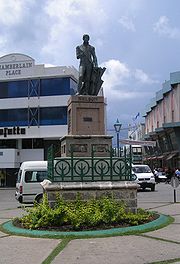 In 1884, the Barbados Agricultural Society sent a letter to Sir Francis Hincks
requesting his private and public views on whether the Dominion of Canada would favourably entertain having the then colony of Barbados admitted as a member of the Canadian Confederation
. Asked of Canada were the terms of the Canadian side to initiate discussions, and whether or not the island of Barbados could depend on the full influence of Canada in getting the change agreed to by the United Kingdom. Then in 1952 the Barbados Advocate newspaper polled several prominent Barbadian politicians, lawyers, businessmen, the Speaker of the Barbados House of Assembly
and later as first President of the Senate
, Sir Theodore Branker, Q.C. and found them to be in favour of immediate federation of Barbados along with the rest of the British Caribbean
with complete Dominion Status within five years from the date of inauguration of the West Indies Federation
with Canada.
However, plantation owners and merchants of British descent still dominated local politics, owing to the high-income qualification required for voting. More than 70% of the population, many of them disenfranchised women, were excluded from the democratic process. It was not until the 1930s that the descendants of emancipated slaves began a movement for political rights. One of the leaders of this movement, Sir Grantley Adams, founded the Barbados Labour Party
in 1938, then known as the Barbados Progressive League.
Adams and his party demanded more rights for the poor and for the people, and staunchly supported the monarchy. Progress toward a more democratic government in Barbados was made in 1942, when the exclusive income qualification was lowered and women were given the right to vote. By 1949 governmental control was wrested from the planters and, in 1958, Adams became Premier of Barbados.
From 1958 to 1962, Barbados was one of the ten members of the West Indies Federation
, an organisation doomed by nationalistic attitudes and by the fact that its members, as British colonies, held limited legislative power. Adams served as its first and only "Premier", but his leadership failed in attempts to form similar unions, and his continued defence of the monarchy was used by his opponents as evidence that he was no longer in touch with the needs of his country. Errol Walton Barrow, a fervent reformer, became the new people's advocate. Barrow had left the BLP and formed the Democratic Labour Party
as a liberal alternative to Adams' conservative government. Barrow instituted many progressive social programmes, such as free education for all Barbadians and the school meals system. By 1961, Barrow had replaced Adams as Premier and the DLP controlled the government.
With the Federation dissolved, Barbados reverted to its former status, that of a self-governing colony
. The island negotiated its own independence at a constitutional conference with Britain in June 1966. After years of peaceful and democratic progress, Barbados finally became an independent state on 30 November 1966, with Errol Barrow its first Prime Minister, although Queen Elizabeth II remained the monarch. Upon independence Barbados maintained historical linkages with Britain by establishing membership to the Commonwealth of Nations
grouping. A year later Barbados' international linkages were expanded by obtaining membership to the United Nations and the Organization of American States
.
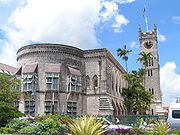
Barbados has been an independent country since 30 November 1966. It functions as a constitutional monarchy
and parliamentary democracy, modelled on the British Westminster system
, with Elizabeth II, Queen of Barbados, as head of state
represented locally by the Governor-General, Elliot Belgrave
and the Prime Minister
as the head of the government. The number of representatives within the House of Assembly
has gradually increased from twenty four at independence, to its present composition of thirty seats.
Barbados functions as a two-party system
, the two dominant parties being the ruling Democratic Labour Party
and the opposition, Barbados Labour Party
. Until 2003, each party had served two terms in office alternately. The election of 2003 gave the BLP a third term victory, at which time the Barbados Labour Party (BLP) achieved being in government for 14 years, (1994 until the 2008 elections
). Under that administration, the former Prime Minister, The Right Honourable Owen S. Arthur acted as the Regional Leader
of the CSM (Caribbean Single Market).
The Honourable David Thompson
, who was elected Prime Minister of Barbados in 2008, died of pancreatic cancer
on 23 October 2010. He was succeeded by Deputy Prime Minister Freundel Stewart, who was sworn in the same day.
Barbados has had several third parties over a period of time since independence: The People's Pressure Movement formed in the early 1970s and contested the 1976 elections; The National Democratic Party, which contested the 1994 elections; and the People's Democratic Congress, which contested the 2008 elections. Apart from these there were several independents who contested the elections, but independents are yet to win a seat in Parliament.
. Historically, Barbadian law was based entirely on English common law with a few local adaptations. At the time of independence, the British Parliament ceased having the ability to change local legislation at its own discretion. British law and various legal statutes within British law at this time, and other prior measures adopted by the Barbadian parliament became the basis of the modern-day law system.
More recently, however, local Barbadian legislation may be shaped or influenced by such organisations as the United Nations, the Organization of American States
, or other international fora to which Barbados has obligatory commitments by treaty. Additionally, through international cooperation, other institutions may supply the Barbados Parliament with key sample legislation to be adapted to meet local circumstances before crafting it as local law.
Laws are passed by the Barbadian Parliament, whereby upon their passage, are given official vice-regal
assent by the Governor-General to become law.
In Barbados, camouflage
clothing is reserved for military use and forbidden for civilians to wear.
As of October 2010, it is illegal for persons to smoke in public areas.
(CARICOM), Caribbean Single Market and Economy (CSME), and the Association of Caribbean States
(ACS). Organization of American States
(OAS), Commonwealth of Nations
, and the Caribbean Court of Justice
(CCJ), which currently pertains only to Barbados, Belize
and Guyana
. In 2001 the Caribbean Community heads of government voted on a measure declaring that the region should work towards replacing the UK's Judicial Committee of the Privy Council
with the Caribbean Court of Justice.
Barbados is an original Member (1995) of the World Trade Organisation (WTO), and participates actively in its work. It grants at least MFN treatment to all its trading partners. As of December 2007, Barbados is linked by an Economic Partnership Agreement
with the European Commission
. The pact involves the Caribbean Forum (CARIFORUM) subgroup of the Group of African, Caribbean, and Pacific states (ACP). CARIFORUM presently the only part of the wider ACP-bloc that has concluded the full regional trade-pact with the European Union
.
Trade policy has also sought to protect a small number of domestic activities, mostly food production, from foreign competition, while recognizing that most domestic needs are best met by imports.
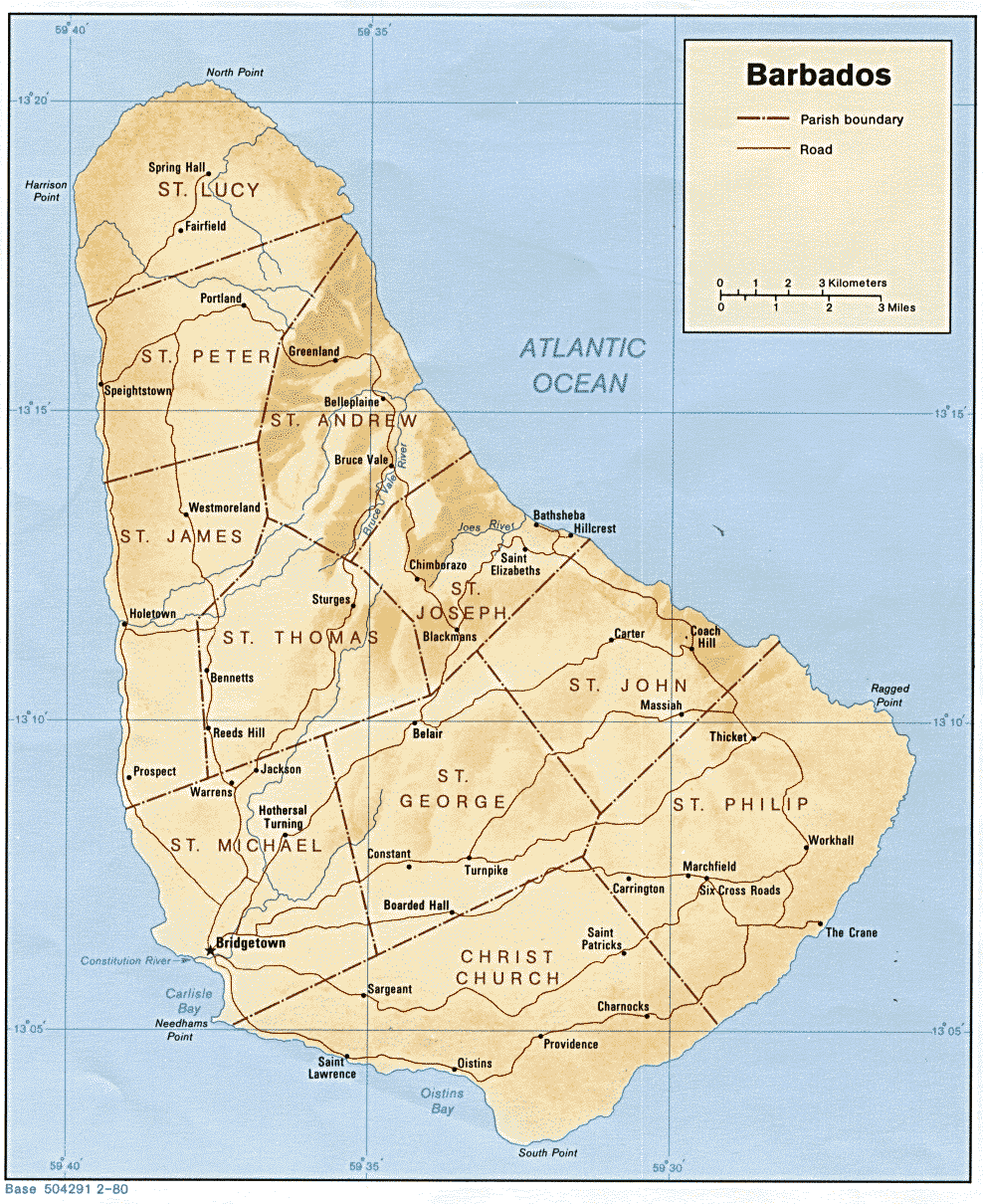
 Barbados is the easternmost island in the Lesser Antilles
. It is flat in comparison to its island neighbours to the west, the Windward Islands
. The island rises gently to the central highland region, with the highpoint of the nation being Mount Hillaby
, in the Scotland District, 340 metres (1,115.5 ft) above sea level. The island is situated in the Atlantic Ocean, east of the other West Indies Islands.
In the parish of Saint Michael lies Barbados' capital and main city, Bridgetown
. Other major towns scattered across the island include Holetown
, in the parish of Saint James; Oistins
, in the parish of Christ Church; and Speightstown
, in the parish of Saint Peter.
and the Caribbean Plate
s. The shift of the South American plate beneath the Caribbean plate scrapes sediment from the South American plate and deposits it above the subduction zone forming an accretionary prism
. The rate of this depositing of material allows Barbados to rise at a rate of about 25 millimetre (0.984251968503937 in) per 1,000 years. This subduction means geologically
the island is composed of coral
roughly (90 m (295.3 ft) thick), where reefs formed above the sediment. The land slopes in a series of "terraces" in the west and goes into an incline in the east. A large proportion of the island is circled by coral reefs.
The erosion of limestone rock in the North East of the island, in the Scotland District has resulted in the formation of various cave
s and gully
s, some of which have become popular tourist attractions such as Harrison's Cave
and Welchman Hall Gully. On the Atlantic East coast of the island coastal landforms including stacks have been created due to the limestone composition of the area.
", this period runs from March–November, In contrast, the "dry season
" runs December–May. The annual precipitation ranges between 40 inches (1,016 mm) and 90 inches (2,286 mm).
From December–May the average temperatures range from 21 to 31 °C (69.8 to 87.8 F), while between June–November, they range from 23 to 31 °C (73.4 to 87.8 F).
On the Köppen climate classification
scale, much of Barbados is regarded as a Tropical monsoon climate
(Am). However, gentle breezes of 12–16 kilometres per hour (8–10 mph) abound throughout the year and give Barbados a warm climate
which is moderately tropical.
Infrequent natural hazards include: earthquake
s, landslips, tropical cyclone
s, and hurricanes. Barbados is often spared the worst effects of the region's tropical storms and hurricanes during the rainy season. The far eastern location in the Atlantic Ocean puts the country just outside the principal hurricane strike zone. On average, a major hurricane strikes about once every 26 years. The last significant hit from a hurricane to cause severe damage to Barbados was Hurricane Janet
in 1955, and more recently in 2010 the island was struck by Hurricane Tomas
, but this only caused minor damage across the country.
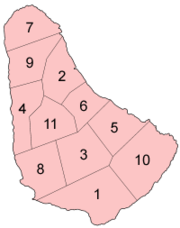 Barbados is divided into 11 parishes:
St. George and St. Thomas located in the middle of the country are the only two parishes without coastlines.
, and a moderately high standard of living
. According to the World Bank, Barbados is classified as being in its 66 top High income economies of the world.
Historically, the economy of Barbados had been dependent on sugarcane
cultivation and related activities, but in the late 1970s and early 1980s it has diversified into the manufacturing and tourism sectors. Offshore finance and information services have become important foreign exchange earners, and there is a healthy light manufacturing sector. Since the 1990s the Barbados Government has been seen as business-friendly and economically sound. The island has seen a construction boom, with the development and redevelopment of hotels, office complexes, and homes.
Recent government administrations have continued efforts to reduce unemployment, encourage foreign direct investment
, and privatise remaining state-owned enterprises. Unemployment has been reduced from around 14 percent in the past to under 10 percent.
The economy contracted in 2001 and 2002 due to slowdowns in tourism, consumer spending and the impact of the 11 September 2001 attacks, but rebounded in 2003 and has shown growth since 2004. Traditional trading partners include Canada, the Caribbean Community
(especially Trinidad and Tobago
), the United Kingdom and the United States.
Business links and investment flows have become substantial: as of 2003 the island saw from Canada CA$
25 billion in investment holdings, placing it as one of Canada's top five destinations for Canadian foreign direct investment (FDI). Businessman Eugene Melnyk
of Toronto, Canada, is said to be Barbados' richest permanent resident.
It has been reported that the year 2006 would have been one of the busiest years for building construction ever in Barbados, as the building-boom on the island entered the final stages for several multi-million dollar commercial projects.
The European Union is presently assisting Barbados with a €10 million programme of modernisation of the country's International Business and Financial Services Sector.
Barbados maintains the third largest stock exchange
in the Caribbean region. At present, officials at the stock exchange are investigating the possibility of augmenting the local exchange with an International Securities Market (ISM) venture.
ed-Rs"), travelling to most points on the island. These small buses can at times be crowded, as passengers are generally never turned down, regardless of the number. However, they will usually take the more scenic routes to destinations. They generally depart from the capital Bridgetown
or from Speightstown in the northern part of the island.
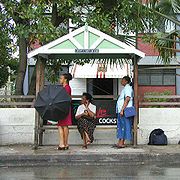
Including the ZRs there are three bus systems running seven days a week (though less frequently on Sundays). There's ZRs, the yellow minibuses and the blue Transport Board buses
. A ride on any of them costs BBD$2.00. The smaller buses from the two privately owned systems ("ZRs" and "minibuses") can give change; the larger blue buses from the government-operated Barbados Transport Board
system cannot, but do give receipts. Children in school uniform ride for free on the Government buses and for $1.50 on the minibuses and ZRs. Most routes require a connection in Bridgetown. Some drivers within the competitive privately owned systems are reluctant to advise persons to use competing services, even if those would be more suitable.
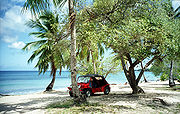 Some hotels also provide visitors with shuttles to points of interest on the island from outside the hotel lobby. There are several locally owned and operated vehicle rental agencies in Barbados but there are no multi-national companies.
The island's lone airport is the Grantley Adams International Airport
. It receives daily flights by several major airlines from points around the globe, as well as several smaller regional commercial airlines and charters. The airport serves as the main air-transportation hub for the eastern Caribbean. In the first decade of 21st century it underwent a US$100 million upgrade and expansion.
There is also a helicopter shuttle service, which offers air taxi services to a number of sites around the island, mainly on the West Coast tourist belt. Air and maritime traffic is regulated by the Barbados Port Authority
.
. Some areas remain risky to swimmers due to under-tow currents.
Shopping
districts are popular in Barbados, with ample duty-free shopping. There is also a festive night-life in mainly tourist areas such as the Saint Lawrence Gap. Other attractions include wildlife reserves (Graeme Hall Nature Sanctuary
), jewelry stores, scuba diving
, helicopter rides, golf
, festivals (the largest being the annual Crop Over
festival July/Aug), sightseeing, cave exploration (Harrison's Cave
), exotic drink
s and fine clothes shopping
.
Name / Parish Location:
List of: Cities, towns and villages in Barbados.
 Barbados has a population of about 281,968 and a population growth rate of 0.33% (Mid-2005 estimates). It currently ranks as: the 4th most densely populated country in the Americas (18th globally), and the 10th most populated island country in the region, (101st globally). Close to 90% of all Barbadians (also known colloquially as Bajan) are of African descent ("Afro-Bajans") and mixed-descent. The remainder of the population includes groups of Europeans ("Anglo-Bajans" / "Euro-Bajans") mainly from the United Kingdom, Ireland, Chinese, Bajan Muslims from India.
Other groups in Barbados include people from the United Kingdom, United States and Canada. Barbadians who return after years of residence in the U.S. and children born in America to Bajan parents are called "Bajan Yankees" , this term is considered derogatory by some. Generally, Bajans recognize and accept all 'children-of-the-island' as Bajans, and refer to each other as such.
The biggest communities outside the Afro-Caribbean community are:
The average life expectancy is 77 years for both males and females. Barbados and Japan have the distinction of having highest number of centenarians (on a per capita basis) in the world.
of Barbados, and is used for communications, administration, and public services all over the island. In its capacity as the official language of the country, the standard of English tends to conform to the vocabulary, pronunciations, spellings, and conventions akin to, but not exactly the same as, those of British English
. A regional variant of English, referred to locally as Bajan, is spoken by most Barbadians in everyday life, especially in informal settings. In its full-fledged form, Bajan sounds markedly different from the Standard English heard on the island.
The degree of intelligibility between Bajan and general English changes depending on the speakers' origins and the "rawness" of one's accent. In rare instances, a Bajan speaker may be completely unintelligible to an outside English speaker if sufficient slang
terminology is present in a sentence. Bajan is somewhat differentiated from, but highly influenced by other Caribbean English
dialects; it is a fusion of British English
and elements borrowed from the languages of West Africa. Hindi
and Bhojpuri are also spoken on the island by a small Indo-Bajan minority. Spanish is considered the most popular second language on the island, followed by French.
(40%). Other Christian denominations with significant followings in Barbados are the Roman Catholic Church
,Pentecostals (Evangelicals) Jehovah's Witnesses, Seventh-Day Adventist and Spiritual Baptist
s. The Church of England
was the official state religion until its legal disenfranchisement by the Parliament of Barbados following independence. Religious minorities include Hindus
, Muslims
, the Baha'i Faith
,, Jews
and Wiccans.
all Barbadian citizens are covered by national healthcare. Barbados has over twenty polyclinic
s throughout the country in addition to the Queen Elizabeth Hospital
(General Hospital) located in Bridgetown. In 2011 the Government of Barbados signed a Memorandum of Understanding
to lease its 22-acre Saint Joseph Hospital to Denver, Colorado based America World Clinics. Under the deal the group will use Barbados as one of its main destinations for medical tourism
at that facility.
of the University of the West Indies
. Barbados has brought forth several great cricketers, including Sir Garfield Sobers
and Frank Worrell
.
Citizens are officially called Barbadians. The term "Bajan" may have come from a localised pronunciation of the word Barbadian which at times can sound more like "Bar-bajan".
The largest carnival
-like cultural event which takes place on the island is the Crop Over
festival. As in many other Caribbean and Latin American countries, Crop Over is an important event for many people on the island, as well as the thousands of tourists that flock to the island to participate in the annual events. The festival includes musical competitions and other traditional activities. The male and female Barbadian that harvested the most sugarcane are also crowned as the King and Queen of the crop. It gets under way from the beginning of July, and ends with the costumed parade on Kadooment Day, held on the first Monday of August.
In the music business, Rihanna
is currently one of Barbados' most well known Grammy winning artists. As of 2009 she was appointed as an official Honorary Ambassador of youth and culture for Barbados by the late Prime Minister, David Thompson
. In 2008, Barbados recognized her achievements on "Rihanna Day".
is very popular on the island. Barbadians play on the West Indies cricket team. In addition to several warm-up matches and six "Super Eight" matches, and the country hosted the final of the 2007 Cricket World Cup
. They have had many great cricketers such as Sir Garfield Sobers, Sir Frank Worrell, Sir Clyde Walcott, Sir Everton Weekes, Gordon Greenidge
, Joel Garner
and Malcolm Marshall
.
Obadele Thompson
is a world class sprinter from Barbados; he won a bronze medal at Olympic Games over 100m in 2000. Ryan Brathwaite
, a hurdler, reached the 2008 Olympic semi-finals in Beijing. Brathwaite also earned Barbados its first ever medal at the world championships in Berlin, Germany on 20 August 2009, when he won the men's 110 meter hurdles title. The 21-year-old timed a national record of 13.14 seconds to win the Gold Medal.
Polo
is very popular amongst the rich 'elite' on the island and the 'High-Goal' Apes Hill team is based in the St James's Club. It is also played at the private Holders Festival ground.
In golf, the Barbados Open
is an annual stop on the European Seniors Tour
. In December 2006 the WGC-World Cup
took place at the country's Sandy Lane
resort on the Country Club course, an 18-hole course designed by Tom Fazio
. The Barbados Golf Club is the other main course on the island. Sanctioned by the PGA European Tour to host a PGA Seniors Tournament in 2003 and it has also hosted the Barbados Open on several occasions.
Basketball is a popular sport played at school or college and is increasing in popularity, as is volleyball, though volleyball is mainly played indoors.
Motorsports also play a role, with Rally Barbados occurring each summer and currently being listed on the FIA NACAM calendar.
The presence of the trade winds along with favourable swells make the southern tip of the Island an ideal location for wave sailing (an extreme form of the sport of windsurfing
).
Netball
is also popular with women in Barbados.
Barbadian team The Flyin' Fish, are the 2009 Segway
Polo World Champions.
–
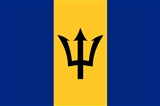
, god of the sea. The trident in its original unbroken form was taken from the former colonial seal, which itself was replaced by the current coat of arms. Used within the national flag, the left and right shafts of the trident were then designed as 'broken' representing the nation of Barbados breaking away from its historical and constitutional ties as a former colony.
The three points of the trident
represent in Barbados the three principles of democracy—"government of, for and by the people." The broken trident is set in a centred vertical band of gold representing the sands of Barbados' beaches. The gold band itself is surrounded on both sides by vertical bands of ultramarine (blue) representing the sea and sky of Barbados.
The design for the flag was created by Grantley W. Prescod and was chosen from an open competition arranged by the Barbados government. Over a thousand entries were received.
depicts two animals which are supporting the shield. On the left is a "dolphin" which is symbolic of the fishing industry. On the right is a pelican
which is symbolic of a small island named Pelican Island that once existed off the coast of Bridgetown. Above the shield is the helmet of Barbados with an extended arm clutching two sugar-cane stalks. The "cross" formation made by the cane stalks represents the saltire cross upon which Saint Andrew
was crucified. On the base of the Coat of Arms reads "Pride and Industry".
) and the "bearded" fig tree, which was common on the island at the time of its settlement by the British and may have contributed to Barbados being so named.
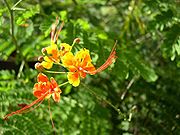 The national flower is the Pride of Barbados or Caesalpinia pulcherrima
(L.) Sw., which grows across the island.
. According to the government, the act established that 28 April (the centenary of the birth of Sir Grantley Adams) would be celebrated as National Heroes' Day. The act also declared that there are ten national heroes of Barbados, all of whom would be elevated to the title of "The Right Excellent".
The ten official National Heroes of Barbados are:
Barbados ( or b) is an island country in the Lesser Antilles
. It is 34 kilometres (21.1 mi) in length and as much as 23 kilometres (14.3 mi) in width, amounting to 431 square kilometres (166.4 sq mi). It is situated in the western area of the North Atlantic and 100 kilometres (62 mi) east of the Windward Islands
and the Caribbean Sea
; therein, it is about 168 kilometres (104.4 mi) east of the islands of Saint Vincent and the Grenadines
, and 400 kilometres (248.5 mi) north-east of Trinidad and Tobago
. Barbados is outside of the principal Atlantic hurricane belt
.
Barbados was initially visited by the Spanish around the late 1400s to early 1500s and first appears on a Spanish map from 1511. The Spanish explorers may have plundered the island of whatever native peoples resided therein to become slaves. Thereafter, the Portuguese in 1536 then visited, but they too left it unclaimed, with their only remnants being an introduction of wild hogs for a good supply of meat whenever the island was visited. The first English ship, the Olive Blossom, arrived in Barbados in 1625. They took possession of it in the name of 'James I, King of England'. Two years later in 1627 the first permanent settlers arrived from England and it became an English and later British colony.
Barbados has an estimated population of 284,589 people, with around 80,000 living in or around Bridgetown
, the largest city and the country's capital. In 1966, Barbados became an independent state and Commonwealth realm
, retaining Queen Elizabeth II as Head of State
. Barbados is one of the Caribbean's leading tourist destinations and is one of the most developed islands in the region, with an HDI
number of 0.788. In 2010 Barbados also ranked in the top 3 in The Americas on Transparency International
's Corruption Perception Index beating out Chile
in 3rd, and coming after Canada in the top spot.
According to accounts by descendants of the indigenous Arawakan
-speaking tribes in other regional areas, the original name for Barbados was Ichirouganaim, with possible translations including "Red Land with White Teeth", "Redstone island with teeth outside (reefs)", or simply "Teeth".
The reason for the later name Barbados is controversial. According to some sources The Portuguese, en route to Brazil
, were the first Europeans to come upon the island, while others say it was the Spanish which gave the Spanish name "Los Barbudos". The word Barbados means "bearded ones", but it is a matter of conjecture whether "bearded" refers to the long, hanging roots of the bearded fig-tree (Ficus citrifolia
), indigenous to the island; to allegedly bearded Caribs once inhabiting the island; or, more fancifully, to the foam spraying over the outlying reefs giving the impression of a beard. In 1519, a map produced by the Genoese
mapmaker Visconte Maggiolo
showed and named Barbados in its correct position.
Other names or nicknames associated with Barbados include "Bim", "Bimshire" and "da Rock". The origin is uncertain but several theories exist. The National Cultural Foundation
of Barbados says that "Bim" was a word commonly used by slaves and that it derives from the phrase "bi mu" or either ("bem", "Ndi bem", "Nwanyi ibem" or "Nwoke ibem") from an Igbo
phrase meaning "my people". In colloquial or literary contexts, "Bim" can also take a more deific tone, referring to the "goddess" Barbados.
The word Bim and Bimshire are recorded in the Oxford English Dictionary
and the Chamber's Twentieth Century Dictionaries.
Another possible source for "Bim" is reported to be in the Agricultural Reporter of 25 April 1868, The Rev. N Greenidge (father of one of the island's most famous scholars, Abel Hendy Jones Greenidge) suggested the listing of Bimshire as a county of England. Expressly named were "Wiltshire, Hampshire, Berkshire and Bimshire".
Lastly in the Daily Argosy (of Demerara i.e. Guyana) of 1652 it referred to Bim as a possible corruption of the word "Byam", who was a Royalist leader against the Parliamentarians. That source suggested the followers of Byam became known as Bims and became a word for all Barbadians.
The Portuguese
briefly claimed Barbados from the mid-16th to the 17th centuries, and may have seized the Arawaks on Barbados and used them as slave labour
. Other Arawaks are believed to have fled to neighbouring islands. Apart from possibly displacing the Caribs, the Portuguese left little impact and by the 1610s left for South America, leaving the island uninhabited. Some Arawaks arrived from Guyana in the 1800s and continue to live in Barbados.
, 1620:Plymouth Colony
, 1627: Barbados. The British Leeward Islands
were occupied at about the same time as Barbados: 1623: St Kitts, 1628: Nevis
, 1632: Montserrat
, 1632: Antigua
.) In the period 1640–60 the West Indies attracted over two thirds of English emigrants to the New World. By 1650 there were 44,000 English in the Caribbean, 12,000 on the Chesapeake
and 23,000 in New England
. The population of Barbados was estimated at 30,000. Most emigrants arrived as indentured servants. After five years of labor they were given 'freedom dues' of about ₤10, usually in goods. Before the mid-1630s they also received 5 to 10 acres of land but after that time the island filled up and there was no more free land. Around the time of Cromwell a number of rebels and criminals were also transported. The death rate was very high (Parish registers from the 1650s show, for the white population, four times as many deaths as marriages.) The main export was tobacco, but tobacco prices fell in the 1630s as Chesapeake production expanded.
From the 1640s the introduction of sugar
from Dutch Brazil
completely transformed society and the economy. A workable sugar plantation required a large investment and a great deal of heavy labor. White smallholders were bought out and the island was filled up with large slave-worked sugar plantations. At first, Dutch traders supplied the equipment, finance and slaves and carried most of the sugar to Europe. In 1644 there were about 800 slaves on the island. By 1660 there were 27,000 blacks and 26,000 whites. By 1666 at least 12,000 white smallholders had been bought out, died or left the island. Many of the remaining whites were increasingly poor. By 1680 there were seventeen slaves for every indentured servant. By 1700 there were 15,000 free whites and 50,000 enslaved blacks. In 1680 over half the arable land was held by 175 large planters who held at least 60 slaves. The great planters had connections with the English aristocracy and great influence on Parliament. (In 1668 the West Indian sugar crop sold for £180,000 after customs of £18,000. Chesapeake tobacco earned £50,000 after customs of £75,000). So much land was devoted to sugar that most food had to be imported from New England. The poorer whites that were squeezed off the island went to the British Leeward Islands or, especially, Jamaica. In 1670 South Carolina was founded from Barbados.
By 1660 Barbados generated more trade than all the other English colonies combined. It was surpassed by Jamaica in 1713. Even though, in 1730–31 the estimated value of the colony of Barbados was as much as ₤5,500,000. Bridgetown, the capital, was one of the three largest cities in British America (the other two were Boston, Massachusetts and Port Royal, Jamaica.) By 1700 the English West Indies produced 25,000 tons of sugar, compared to 20,000 for Brazil, 10,000 for the French islands and 4,000 for the Dutch islands.
English sailors who landed on Barbados in 1625 arrived at the site of present-day Holetown
. The English then took possession of Barbados in the name of James I
. From the arrival of the first English settlers in 1627–1628 until independence in 1966, Barbados was under uninterrupted British governance (and was the only Caribbean island that did not change hands during the colonial period). Nevertheless, Barbados always enjoyed a large measure of local autonomy. Its House of Assembly
began meeting in 1639. Among the initial important figures was Anglo-Dutchman Sir William Courten
.
Fighting during the War of the Three Kingdoms and the Interregnum spilled over into Barbados and Barbadian territorial waters. The island was not involved in the war
until after the execution of Charles I
, when the island's government fell under the control of Royalists (ironically the Governor, Philip Bell, remained loyal to Parliament
while the Barbadian House of Assembly
, under the influence of Humphrey Walrond, supported Charles II
). To try to bring the recalcitrant colony to heel, the Commonwealth Parliament passed an act on 3 October 1650 which prohibited trade between England and the island, and because the island also traded with the Netherlands
, further navigation acts
were passed prohibiting any but English vessels trading with Dutch colonies. These acts were a precursor to the First Anglo-Dutch War
. The Commonwealth of England
sent an invasion force under the command of Sir George Ayscue
which arrived in October 1651. After some skirmishing, the Royalists supporters in the Barbados House of Assembly led by Lord Willoughby
surrendered. The conditions of surrender were incorporated into the Charter of Barbados (Treaty of Oistins), which was signed in the Mermaid's Inn, Oistins
, on 17 January 1652.
With the increased implementation of slave codes
, which created differential treatment between Africans and the white workers and planters, the island became increasingly unattractive to poor whites
. Black or slave codes were implemented in 1661, 1676, 1682, and 1688. In response to these codes, several slave rebellions were attempted or planned during this time, but none succeeded. Nevertheless, poor whites who had or acquired the means to emigrate often did so. Planters expanded their importation of African slaves to cultivate sugar cane.
Barbados eventually had one of the world's biggest sugar industries after starting sugar cane cultivation in 1640. One group which was instrumental for ensuring the early success of the sugar cane industry were the Sephardic Jews
, who originally been expelled from the Iberian peninsula
to end up in Dutch Brazil
. This quickly replaced tobacco plantations on the islands which were previously the main export. As the sugar industry developed into its main commercial enterprise, Barbados was divided into large plantation estates that replaced the smallholdings of the early English settlers. Some of the displaced farmers moved to other English colonies in the Americas, most notably North
and South Carolina
, and British Guiana
, as well as Panama
. To work the plantations, planters imported enslaved West Africans to Barbados and other Caribbean islands.
The British abolished the slave trade in 1807 but not the institution itself. In 1816, slaves rose up in the largest major slave rebellion in the island's history. Twenty thousand slaves from over 70 plantations rebelled. They drove whites off the plantations, but widespread killings did not take place. This was later termed “Bussa's Rebellion” after the slave ranger, Bussa
, who with his assistants hated slavery, found the treatment of slaves on Barbados to be “intolerable”, and believed the political climate in the UK made the time ripe to peacefully negotiate with planters for freedom (Davis, p. 211; Northrup, p. 191). Bussa's Rebellion failed. One hundred and twenty slaves died in combat or were immediately executed; another 144 were brought to trial and executed; remaining rebels were shipped off the island (Davis, pp. 212–213).
Slavery was finally abolished in the British Empire 18 years later in 1834. In Barbados and the rest of the British West Indian colonies, full emancipation from slavery was preceded by an apprenticeship period that lasted four years.
In 1884, the Barbados Agricultural Society sent a letter to Sir Francis Hincks
requesting his private and public views on whether the Dominion of Canada would favourably entertain having the then colony of Barbados admitted as a member of the Canadian Confederation
. Asked of Canada were the terms of the Canadian side to initiate discussions, and whether or not the island of Barbados could depend on the full influence of Canada in getting the change agreed to by the United Kingdom. Then in 1952 the Barbados Advocate newspaper polled several prominent Barbadian politicians, lawyers, businessmen, the Speaker of the Barbados House of Assembly
and later as first President of the Senate
, Sir Theodore Branker, Q.C. and found them to be in favour of immediate federation of Barbados along with the rest of the British Caribbean
with complete Dominion Status within five years from the date of inauguration of the West Indies Federation
with Canada.
However, plantation owners and merchants of British descent still dominated local politics, owing to the high-income qualification required for voting. More than 70% of the population, many of them disenfranchised women, were excluded from the democratic process. It was not until the 1930s that the descendants of emancipated slaves began a movement for political rights. One of the leaders of this movement, Sir Grantley Adams, founded the Barbados Labour Party
in 1938, then known as the Barbados Progressive League.
Adams and his party demanded more rights for the poor and for the people, and staunchly supported the monarchy. Progress toward a more democratic government in Barbados was made in 1942, when the exclusive income qualification was lowered and women were given the right to vote. By 1949 governmental control was wrested from the planters and, in 1958, Adams became Premier of Barbados.
From 1958 to 1962, Barbados was one of the ten members of the West Indies Federation
, an organisation doomed by nationalistic attitudes and by the fact that its members, as British colonies, held limited legislative power. Adams served as its first and only "Premier", but his leadership failed in attempts to form similar unions, and his continued defence of the monarchy was used by his opponents as evidence that he was no longer in touch with the needs of his country. Errol Walton Barrow, a fervent reformer, became the new people's advocate. Barrow had left the BLP and formed the Democratic Labour Party
as a liberal alternative to Adams' conservative government. Barrow instituted many progressive social programmes, such as free education for all Barbadians and the school meals system. By 1961, Barrow had replaced Adams as Premier and the DLP controlled the government.
With the Federation dissolved, Barbados reverted to its former status, that of a self-governing colony
. The island negotiated its own independence at a constitutional conference with Britain in June 1966. After years of peaceful and democratic progress, Barbados finally became an independent state on 30 November 1966, with Errol Barrow its first Prime Minister, although Queen Elizabeth II remained the monarch. Upon independence Barbados maintained historical linkages with Britain by establishing membership to the Commonwealth of Nations
grouping. A year later Barbados' international linkages were expanded by obtaining membership to the United Nations and the Organization of American States
.
Barbados has been an independent country since 30 November 1966. It functions as a constitutional monarchy
and parliamentary democracy, modelled on the British Westminster system
, with Elizabeth II, Queen of Barbados, as head of state
represented locally by the Governor-General, Elliot Belgrave
and the Prime Minister
as the head of the government. The number of representatives within the House of Assembly
has gradually increased from twenty four at independence, to its present composition of thirty seats.
Barbados functions as a two-party system
, the two dominant parties being the ruling Democratic Labour Party
and the opposition, Barbados Labour Party
. Until 2003, each party had served two terms in office alternately. The election of 2003 gave the BLP a third term victory, at which time the Barbados Labour Party (BLP) achieved being in government for 14 years, (1994 until the 2008 elections
). Under that administration, the former Prime Minister, The Right Honourable Owen S. Arthur acted as the Regional Leader
of the CSM (Caribbean Single Market).
The Honourable David Thompson
, who was elected Prime Minister of Barbados in 2008, died of pancreatic cancer
on 23 October 2010. He was succeeded by Deputy Prime Minister Freundel Stewart, who was sworn in the same day.
Barbados has had several third parties over a period of time since independence: The People's Pressure Movement formed in the early 1970s and contested the 1976 elections; The National Democratic Party, which contested the 1994 elections; and the People's Democratic Congress, which contested the 2008 elections. Apart from these there were several independents who contested the elections, but independents are yet to win a seat in Parliament.
. Historically, Barbadian law was based entirely on English common law with a few local adaptations. At the time of independence, the British Parliament ceased having the ability to change local legislation at its own discretion. British law and various legal statutes within British law at this time, and other prior measures adopted by the Barbadian parliament became the basis of the modern-day law system.
More recently, however, local Barbadian legislation may be shaped or influenced by such organisations as the United Nations, the Organization of American States
, or other international fora to which Barbados has obligatory commitments by treaty. Additionally, through international cooperation, other institutions may supply the Barbados Parliament with key sample legislation to be adapted to meet local circumstances before crafting it as local law.
Laws are passed by the Barbadian Parliament, whereby upon their passage, are given official vice-regal
assent by the Governor-General to become law.
In Barbados, camouflage
clothing is reserved for military use and forbidden for civilians to wear.
As of October 2010, it is illegal for persons to smoke in public areas.
(CARICOM), Caribbean Single Market and Economy (CSME), and the Association of Caribbean States
(ACS). Organization of American States
(OAS), Commonwealth of Nations
, and the Caribbean Court of Justice
(CCJ), which currently pertains only to Barbados, Belize
and Guyana
. In 2001 the Caribbean Community heads of government voted on a measure declaring that the region should work towards replacing the UK's Judicial Committee of the Privy Council
with the Caribbean Court of Justice.
Barbados is an original Member (1995) of the World Trade Organisation (WTO), and participates actively in its work. It grants at least MFN treatment to all its trading partners. As of December 2007, Barbados is linked by an Economic Partnership Agreement
with the European Commission
. The pact involves the Caribbean Forum (CARIFORUM) subgroup of the Group of African, Caribbean, and Pacific states (ACP). CARIFORUM presently the only part of the wider ACP-bloc that has concluded the full regional trade-pact with the European Union
.
Trade policy has also sought to protect a small number of domestic activities, mostly food production, from foreign competition, while recognizing that most domestic needs are best met by imports.
Barbados is the easternmost island in the Lesser Antilles
. It is flat in comparison to its island neighbours to the west, the Windward Islands
. The island rises gently to the central highland region, with the highpoint of the nation being Mount Hillaby
, in the Scotland District, 340 metres (1,115.5 ft) above sea level. The island is situated in the Atlantic Ocean, east of the other West Indies Islands.
In the parish of Saint Michael lies Barbados' capital and main city, Bridgetown
. Other major towns scattered across the island include Holetown
, in the parish of Saint James; Oistins
, in the parish of Christ Church; and Speightstown
, in the parish of Saint Peter.
and the Caribbean Plate
s. The shift of the South American plate beneath the Caribbean plate scrapes sediment from the South American plate and deposits it above the subduction zone forming an accretionary prism
. The rate of this depositing of material allows Barbados to rise at a rate of about 25 millimetre (0.984251968503937 in) per 1,000 years. This subduction means geologically
the island is composed of coral
roughly (90 m (295.3 ft) thick), where reefs formed above the sediment. The land slopes in a series of "terraces" in the west and goes into an incline in the east. A large proportion of the island is circled by coral reefs.
The erosion of limestone rock in the North East of the island, in the Scotland District has resulted in the formation of various cave
s and gully
s, some of which have become popular tourist attractions such as Harrison's Cave
and Welchman Hall Gully. On the Atlantic East coast of the island coastal landforms including stacks have been created due to the limestone composition of the area.
", this period runs from March–November, In contrast, the "dry season
" runs December–May. The annual precipitation ranges between 40 inches (1,016 mm) and 90 inches (2,286 mm).
From December–May the average temperatures range from 21 to 31 °C (69.8 to 87.8 F), while between June–November, they range from 23 to 31 °C (73.4 to 87.8 F).
On the Köppen climate classification
scale, much of Barbados is regarded as a Tropical monsoon climate
(Am). However, gentle breezes of 12–16 kilometres per hour (8–10 mph) abound throughout the year and give Barbados a warm climate
which is moderately tropical.
Infrequent natural hazards include: earthquake
s, landslips, tropical cyclone
s, and hurricanes. Barbados is often spared the worst effects of the region's tropical storms and hurricanes during the rainy season. The far eastern location in the Atlantic Ocean puts the country just outside the principal hurricane strike zone. On average, a major hurricane strikes about once every 26 years. The last significant hit from a hurricane to cause severe damage to Barbados was Hurricane Janet
in 1955, and more recently in 2010 the island was struck by Hurricane Tomas
, but this only caused minor damage across the country.
Barbados is divided into 11 parishes:
St. George and St. Thomas located in the middle of the country are the only two parishes without coastlines.
, and a moderately high standard of living
. According to the World Bank, Barbados is classified as being in its 66 top High income economies of the world.
Historically, the economy of Barbados had been dependent on sugarcane
cultivation and related activities, but in the late 1970s and early 1980s it has diversified into the manufacturing and tourism sectors. Offshore finance and information services have become important foreign exchange earners, and there is a healthy light manufacturing sector. Since the 1990s the Barbados Government has been seen as business-friendly and economically sound. The island has seen a construction boom, with the development and redevelopment of hotels, office complexes, and homes.
Recent government administrations have continued efforts to reduce unemployment, encourage foreign direct investment
, and privatise remaining state-owned enterprises. Unemployment has been reduced from around 14 percent in the past to under 10 percent.
The economy contracted in 2001 and 2002 due to slowdowns in tourism, consumer spending and the impact of the 11 September 2001 attacks, but rebounded in 2003 and has shown growth since 2004. Traditional trading partners include Canada, the Caribbean Community
(especially Trinidad and Tobago
), the United Kingdom and the United States.
Business links and investment flows have become substantial: as of 2003 the island saw from Canada CA$
25 billion in investment holdings, placing it as one of Canada's top five destinations for Canadian foreign direct investment (FDI). Businessman Eugene Melnyk
of Toronto, Canada, is said to be Barbados' richest permanent resident.
It has been reported that the year 2006 would have been one of the busiest years for building construction ever in Barbados, as the building-boom on the island entered the final stages for several multi-million dollar commercial projects.
The European Union is presently assisting Barbados with a €10 million programme of modernisation of the country's International Business and Financial Services Sector.
Barbados maintains the third largest stock exchange
in the Caribbean region. At present, officials at the stock exchange are investigating the possibility of augmenting the local exchange with an International Securities Market (ISM) venture.
ed-Rs"), travelling to most points on the island. These small buses can at times be crowded, as passengers are generally never turned down, regardless of the number. However, they will usually take the more scenic routes to destinations. They generally depart from the capital Bridgetown
or from Speightstown in the northern part of the island.
Including the ZRs there are three bus systems running seven days a week (though less frequently on Sundays). There's ZRs, the yellow minibuses and the blue Transport Board buses
. A ride on any of them costs BBD$2.00. The smaller buses from the two privately owned systems ("ZRs" and "minibuses") can give change; the larger blue buses from the government-operated Barbados Transport Board
system cannot, but do give receipts. Children in school uniform ride for free on the Government buses and for $1.50 on the minibuses and ZRs. Most routes require a connection in Bridgetown. Some drivers within the competitive privately owned systems are reluctant to advise persons to use competing services, even if those would be more suitable.
Some hotels also provide visitors with shuttles to points of interest on the island from outside the hotel lobby. There are several locally owned and operated vehicle rental agencies in Barbados but there are no multi-national companies.
The island's lone airport is the Grantley Adams International Airport
. It receives daily flights by several major airlines from points around the globe, as well as several smaller regional commercial airlines and charters. The airport serves as the main air-transportation hub for the eastern Caribbean. In the first decade of 21st century it underwent a US$100 million upgrade and expansion.
There is also a helicopter shuttle service, which offers air taxi services to a number of sites around the island, mainly on the West Coast tourist belt. Air and maritime traffic is regulated by the Barbados Port Authority
.
. Some areas remain risky to swimmers due to under-tow currents.
Shopping
districts are popular in Barbados, with ample duty-free shopping. There is also a festive night-life in mainly tourist areas such as the Saint Lawrence Gap. Other attractions include wildlife reserves (Graeme Hall Nature Sanctuary
), jewelry stores, scuba diving
, helicopter rides, golf
, festivals (the largest being the annual Crop Over
festival July/Aug), sightseeing, cave exploration (Harrison's Cave
), exotic drink
s and fine clothes shopping
.
Name / Parish Location:
List of: Cities, towns and villages in Barbados.
Barbados has a population of about 281,968 and a population growth rate of 0.33% (Mid-2005 estimates). It currently ranks as: the 4th most densely populated country in the Americas (18th globally), and the 10th most populated island country in the region, (101st globally). Close to 90% of all Barbadians (also known colloquially as Bajan) are of African descent ("Afro-Bajans") and mixed-descent. The remainder of the population includes groups of Europeans ("Anglo-Bajans" / "Euro-Bajans") mainly from the United Kingdom, Ireland, Chinese, Bajan Muslims from India.
Other groups in Barbados include people from the United Kingdom, United States and Canada. Barbadians who return after years of residence in the U.S. and children born in America to Bajan parents are called "Bajan Yankees" , this term is considered derogatory by some. Generally, Bajans recognize and accept all 'children-of-the-island' as Bajans, and refer to each other as such.
The biggest communities outside the Afro-Caribbean community are:
The average life expectancy is 77 years for both males and females. Barbados and Japan have the distinction of having highest number of centenarians (on a per capita basis) in the world.
of Barbados, and is used for communications, administration, and public services all over the island. In its capacity as the official language of the country, the standard of English tends to conform to the vocabulary, pronunciations, spellings, and conventions akin to, but not exactly the same as, those of British English
. A regional variant of English, referred to locally as Bajan, is spoken by most Barbadians in everyday life, especially in informal settings. In its full-fledged form, Bajan sounds markedly different from the Standard English heard on the island.
The degree of intelligibility between Bajan and general English changes depending on the speakers' origins and the "rawness" of one's accent. In rare instances, a Bajan speaker may be completely unintelligible to an outside English speaker if sufficient slang
terminology is present in a sentence. Bajan is somewhat differentiated from, but highly influenced by other Caribbean English
dialects; it is a fusion of British English
and elements borrowed from the languages of West Africa. Hindi
and Bhojpuri are also spoken on the island by a small Indo-Bajan minority. Spanish is considered the most popular second language on the island, followed by French.
(40%). Other Christian denominations with significant followings in Barbados are the Roman Catholic Church
,Pentecostals (Evangelicals) Jehovah's Witnesses, Seventh-Day Adventist and Spiritual Baptist
s. The Church of England
was the official state religion until its legal disenfranchisement by the Parliament of Barbados following independence. Religious minorities include Hindus
, Muslims
, the Baha'i Faith
,, Jews
and Wiccans.
all Barbadian citizens are covered by national healthcare. Barbados has over twenty polyclinic
s throughout the country in addition to the Queen Elizabeth Hospital
(General Hospital) located in Bridgetown. In 2011 the Government of Barbados signed a Memorandum of Understanding
to lease its 22-acre Saint Joseph Hospital to Denver, Colorado based America World Clinics. Under the deal the group will use Barbados as one of its main destinations for medical tourism
at that facility.
of the University of the West Indies
. Barbados has brought forth several great cricketers, including Sir Garfield Sobers
and Frank Worrell
.
Citizens are officially called Barbadians. The term "Bajan" may have come from a localised pronunciation of the word Barbadian which at times can sound more like "Bar-bajan".
The largest carnival
-like cultural event which takes place on the island is the Crop Over
festival. As in many other Caribbean and Latin American countries, Crop Over is an important event for many people on the island, as well as the thousands of tourists that flock to the island to participate in the annual events. The festival includes musical competitions and other traditional activities. The male and female Barbadian that harvested the most sugarcane are also crowned as the King and Queen of the crop. It gets under way from the beginning of July, and ends with the costumed parade on Kadooment Day, held on the first Monday of August.
In the music business, Rihanna
is currently one of Barbados' most well known Grammy winning artists. As of 2009 she was appointed as an official Honorary Ambassador of youth and culture for Barbados by the late Prime Minister, David Thompson
. In 2008, Barbados recognized her achievements on "Rihanna Day".
is very popular on the island. Barbadians play on the West Indies cricket team. In addition to several warm-up matches and six "Super Eight" matches, and the country hosted the final of the 2007 Cricket World Cup
. They have had many great cricketers such as Sir Garfield Sobers, Sir Frank Worrell, Sir Clyde Walcott, Sir Everton Weekes, Gordon Greenidge
, Joel Garner
and Malcolm Marshall
.
Obadele Thompson
is a world class sprinter from Barbados; he won a bronze medal at Olympic Games over 100m in 2000. Ryan Brathwaite
, a hurdler, reached the 2008 Olympic semi-finals in Beijing. Brathwaite also earned Barbados its first ever medal at the world championships in Berlin, Germany on 20 August 2009, when he won the men's 110 meter hurdles title. The 21-year-old timed a national record of 13.14 seconds to win the Gold Medal.
Polo
is very popular amongst the rich 'elite' on the island and the 'High-Goal' Apes Hill team is based in the St James's Club. It is also played at the private Holders Festival ground.
In golf, the Barbados Open
is an annual stop on the European Seniors Tour
. In December 2006 the WGC-World Cup
took place at the country's Sandy Lane
resort on the Country Club course, an 18-hole course designed by Tom Fazio
. The Barbados Golf Club is the other main course on the island. Sanctioned by the PGA European Tour to host a PGA Seniors Tournament in 2003 and it has also hosted the Barbados Open on several occasions.
Basketball is a popular sport played at school or college and is increasing in popularity, as is volleyball, though volleyball is mainly played indoors.
Motorsports also play a role, with Rally Barbados occurring each summer and currently being listed on the FIA NACAM calendar.
The presence of the trade winds along with favourable swells make the southern tip of the Island an ideal location for wave sailing (an extreme form of the sport of windsurfing
).
Netball
is also popular with women in Barbados.
Barbadian team The Flyin' Fish, are the 2009 Segway
Polo World Champions.
–
, god of the sea. The trident in its original unbroken form was taken from the former colonial seal, which itself was replaced by the current coat of arms. Used within the national flag, the left and right shafts of the trident were then designed as 'broken' representing the nation of Barbados breaking away from its historical and constitutional ties as a former colony.
The three points of the trident
represent in Barbados the three principles of democracy—"government of, for and by the people." The broken trident is set in a centred vertical band of gold representing the sands of Barbados' beaches. The gold band itself is surrounded on both sides by vertical bands of ultramarine (blue) representing the sea and sky of Barbados.
The design for the flag was created by Grantley W. Prescod and was chosen from an open competition arranged by the Barbados government. Over a thousand entries were received.
depicts two animals which are supporting the shield. On the left is a "dolphin" which is symbolic of the fishing industry. On the right is a pelican
which is symbolic of a small island named Pelican Island that once existed off the coast of Bridgetown. Above the shield is the helmet of Barbados with an extended arm clutching two sugar-cane stalks. The "cross" formation made by the cane stalks represents the saltire cross upon which Saint Andrew
was crucified. On the base of the Coat of Arms reads "Pride and Industry".
) and the "bearded" fig tree, which was common on the island at the time of its settlement by the British and may have contributed to Barbados being so named.
The national flower is the Pride of Barbados or Caesalpinia pulcherrima
(L.) Sw., which grows across the island.
. According to the government, the act established that 28 April (the centenary of the birth of Sir Grantley Adams) would be celebrated as National Heroes' Day. The act also declared that there are ten national heroes of Barbados, all of whom would be elevated to the title of "The Right Excellent".
The ten official National Heroes of Barbados are:
Barbados ( or b) is an island country in the Lesser Antilles
. It is 34 kilometres (21.1 mi) in length and as much as 23 kilometres (14.3 mi) in width, amounting to 431 square kilometres (166.4 sq mi). It is situated in the western area of the North Atlantic and 100 kilometres (62 mi) east of the Windward Islands
and the Caribbean Sea
; therein, it is about 168 kilometres (104.4 mi) east of the islands of Saint Vincent and the Grenadines
, and 400 kilometres (248.5 mi) north-east of Trinidad and Tobago
. Barbados is outside of the principal Atlantic hurricane belt
.
Barbados was initially visited by the Spanish around the late 1400s to early 1500s and first appears on a Spanish map from 1511. The Spanish explorers may have plundered the island of whatever native peoples resided therein to become slaves. Thereafter, the Portuguese in 1536 then visited, but they too left it unclaimed, with their only remnants being an introduction of wild hogs for a good supply of meat whenever the island was visited. The first English ship, the Olive Blossom, arrived in Barbados in 1625. They took possession of it in the name of 'James I, King of England'. Two years later in 1627 the first permanent settlers arrived from England and it became an English and later British colony.
Barbados has an estimated population of 284,589 people, with around 80,000 living in or around Bridgetown
, the largest city and the country's capital. In 1966, Barbados became an independent state and Commonwealth realm
, retaining Queen Elizabeth II as Head of State
. Barbados is one of the Caribbean's leading tourist destinations and is one of the most developed islands in the region, with an HDI
number of 0.788. In 2010 Barbados also ranked in the top 3 in The Americas on Transparency International
's Corruption Perception Index beating out Chile
in 3rd, and coming after Canada in the top spot.
According to accounts by descendants of the indigenous Arawakan
-speaking tribes in other regional areas, the original name for Barbados was Ichirouganaim, with possible translations including "Red Land with White Teeth", "Redstone island with teeth outside (reefs)", or simply "Teeth".
The reason for the later name Barbados is controversial. According to some sources The Portuguese, en route to Brazil
, were the first Europeans to come upon the island, while others say it was the Spanish which gave the Spanish name "Los Barbudos". The word Barbados means "bearded ones", but it is a matter of conjecture whether "bearded" refers to the long, hanging roots of the bearded fig-tree (Ficus citrifolia
), indigenous to the island; to allegedly bearded Caribs once inhabiting the island; or, more fancifully, to the foam spraying over the outlying reefs giving the impression of a beard. In 1519, a map produced by the Genoese
mapmaker Visconte Maggiolo
showed and named Barbados in its correct position.
Other names or nicknames associated with Barbados include "Bim", "Bimshire" and "da Rock". The origin is uncertain but several theories exist. The National Cultural Foundation
of Barbados says that "Bim" was a word commonly used by slaves and that it derives from the phrase "bi mu" or either ("bem", "Ndi bem", "Nwanyi ibem" or "Nwoke ibem") from an Igbo
phrase meaning "my people". In colloquial or literary contexts, "Bim" can also take a more deific tone, referring to the "goddess" Barbados.
The word Bim and Bimshire are recorded in the Oxford English Dictionary
and the Chamber's Twentieth Century Dictionaries.
Another possible source for "Bim" is reported to be in the Agricultural Reporter of 25 April 1868, The Rev. N Greenidge (father of one of the island's most famous scholars, Abel Hendy Jones Greenidge) suggested the listing of Bimshire as a county of England. Expressly named were "Wiltshire, Hampshire, Berkshire and Bimshire".
Lastly in the Daily Argosy (of Demerara i.e. Guyana) of 1652 it referred to Bim as a possible corruption of the word "Byam", who was a Royalist leader against the Parliamentarians. That source suggested the followers of Byam became known as Bims and became a word for all Barbadians.
The Portuguese
briefly claimed Barbados from the mid-16th to the 17th centuries, and may have seized the Arawaks on Barbados and used them as slave labour
. Other Arawaks are believed to have fled to neighbouring islands. Apart from possibly displacing the Caribs, the Portuguese left little impact and by the 1610s left for South America, leaving the island uninhabited. Some Arawaks arrived from Guyana in the 1800s and continue to live in Barbados.
, 1620:Plymouth Colony
, 1627: Barbados. The British Leeward Islands
were occupied at about the same time as Barbados: 1623: St Kitts, 1628: Nevis
, 1632: Montserrat
, 1632: Antigua
.) In the period 1640–60 the West Indies attracted over two thirds of English emigrants to the New World. By 1650 there were 44,000 English in the Caribbean, 12,000 on the Chesapeake
and 23,000 in New England
. The population of Barbados was estimated at 30,000. Most emigrants arrived as indentured servants. After five years of labor they were given 'freedom dues' of about ₤10, usually in goods. Before the mid-1630s they also received 5 to 10 acres of land but after that time the island filled up and there was no more free land. Around the time of Cromwell a number of rebels and criminals were also transported. The death rate was very high (Parish registers from the 1650s show, for the white population, four times as many deaths as marriages.) The main export was tobacco, but tobacco prices fell in the 1630s as Chesapeake production expanded.
From the 1640s the introduction of sugar
from Dutch Brazil
completely transformed society and the economy. A workable sugar plantation required a large investment and a great deal of heavy labor. White smallholders were bought out and the island was filled up with large slave-worked sugar plantations. At first, Dutch traders supplied the equipment, finance and slaves and carried most of the sugar to Europe. In 1644 there were about 800 slaves on the island. By 1660 there were 27,000 blacks and 26,000 whites. By 1666 at least 12,000 white smallholders had been bought out, died or left the island. Many of the remaining whites were increasingly poor. By 1680 there were seventeen slaves for every indentured servant. By 1700 there were 15,000 free whites and 50,000 enslaved blacks. In 1680 over half the arable land was held by 175 large planters who held at least 60 slaves. The great planters had connections with the English aristocracy and great influence on Parliament. (In 1668 the West Indian sugar crop sold for £180,000 after customs of £18,000. Chesapeake tobacco earned £50,000 after customs of £75,000). So much land was devoted to sugar that most food had to be imported from New England. The poorer whites that were squeezed off the island went to the British Leeward Islands or, especially, Jamaica. In 1670 South Carolina was founded from Barbados.
By 1660 Barbados generated more trade than all the other English colonies combined. It was surpassed by Jamaica in 1713. Even though, in 1730–31 the estimated value of the colony of Barbados was as much as ₤5,500,000. Bridgetown, the capital, was one of the three largest cities in British America (the other two were Boston, Massachusetts and Port Royal, Jamaica.) By 1700 the English West Indies produced 25,000 tons of sugar, compared to 20,000 for Brazil, 10,000 for the French islands and 4,000 for the Dutch islands.
English sailors who landed on Barbados in 1625 arrived at the site of present-day Holetown
. The English then took possession of Barbados in the name of James I
. From the arrival of the first English settlers in 1627–1628 until independence in 1966, Barbados was under uninterrupted British governance (and was the only Caribbean island that did not change hands during the colonial period). Nevertheless, Barbados always enjoyed a large measure of local autonomy. Its House of Assembly
began meeting in 1639. Among the initial important figures was Anglo-Dutchman Sir William Courten
.
Fighting during the War of the Three Kingdoms and the Interregnum spilled over into Barbados and Barbadian territorial waters. The island was not involved in the war
until after the execution of Charles I
, when the island's government fell under the control of Royalists (ironically the Governor, Philip Bell, remained loyal to Parliament
while the Barbadian House of Assembly
, under the influence of Humphrey Walrond, supported Charles II
). To try to bring the recalcitrant colony to heel, the Commonwealth Parliament passed an act on 3 October 1650 which prohibited trade between England and the island, and because the island also traded with the Netherlands
, further navigation acts
were passed prohibiting any but English vessels trading with Dutch colonies. These acts were a precursor to the First Anglo-Dutch War
. The Commonwealth of England
sent an invasion force under the command of Sir George Ayscue
which arrived in October 1651. After some skirmishing, the Royalists supporters in the Barbados House of Assembly led by Lord Willoughby
surrendered. The conditions of surrender were incorporated into the Charter of Barbados (Treaty of Oistins), which was signed in the Mermaid's Inn, Oistins
, on 17 January 1652.
With the increased implementation of slave codes
, which created differential treatment between Africans and the white workers and planters, the island became increasingly unattractive to poor whites
. Black or slave codes were implemented in 1661, 1676, 1682, and 1688. In response to these codes, several slave rebellions were attempted or planned during this time, but none succeeded. Nevertheless, poor whites who had or acquired the means to emigrate often did so. Planters expanded their importation of African slaves to cultivate sugar cane.
Barbados eventually had one of the world's biggest sugar industries after starting sugar cane cultivation in 1640. One group which was instrumental for ensuring the early success of the sugar cane industry were the Sephardic Jews
, who originally been expelled from the Iberian peninsula
to end up in Dutch Brazil
. This quickly replaced tobacco plantations on the islands which were previously the main export. As the sugar industry developed into its main commercial enterprise, Barbados was divided into large plantation estates that replaced the smallholdings of the early English settlers. Some of the displaced farmers moved to other English colonies in the Americas, most notably North
and South Carolina
, and British Guiana
, as well as Panama
. To work the plantations, planters imported enslaved West Africans to Barbados and other Caribbean islands.
The British abolished the slave trade in 1807 but not the institution itself. In 1816, slaves rose up in the largest major slave rebellion in the island's history. Twenty thousand slaves from over 70 plantations rebelled. They drove whites off the plantations, but widespread killings did not take place. This was later termed “Bussa's Rebellion” after the slave ranger, Bussa
, who with his assistants hated slavery, found the treatment of slaves on Barbados to be “intolerable”, and believed the political climate in the UK made the time ripe to peacefully negotiate with planters for freedom (Davis, p. 211; Northrup, p. 191). Bussa's Rebellion failed. One hundred and twenty slaves died in combat or were immediately executed; another 144 were brought to trial and executed; remaining rebels were shipped off the island (Davis, pp. 212–213).
Slavery was finally abolished in the British Empire 18 years later in 1834. In Barbados and the rest of the British West Indian colonies, full emancipation from slavery was preceded by an apprenticeship period that lasted four years.
In 1884, the Barbados Agricultural Society sent a letter to Sir Francis Hincks
requesting his private and public views on whether the Dominion of Canada would favourably entertain having the then colony of Barbados admitted as a member of the Canadian Confederation
. Asked of Canada were the terms of the Canadian side to initiate discussions, and whether or not the island of Barbados could depend on the full influence of Canada in getting the change agreed to by the United Kingdom. Then in 1952 the Barbados Advocate newspaper polled several prominent Barbadian politicians, lawyers, businessmen, the Speaker of the Barbados House of Assembly
and later as first President of the Senate
, Sir Theodore Branker, Q.C. and found them to be in favour of immediate federation of Barbados along with the rest of the British Caribbean
with complete Dominion Status within five years from the date of inauguration of the West Indies Federation
with Canada.
However, plantation owners and merchants of British descent still dominated local politics, owing to the high-income qualification required for voting. More than 70% of the population, many of them disenfranchised women, were excluded from the democratic process. It was not until the 1930s that the descendants of emancipated slaves began a movement for political rights. One of the leaders of this movement, Sir Grantley Adams, founded the Barbados Labour Party
in 1938, then known as the Barbados Progressive League.
Adams and his party demanded more rights for the poor and for the people, and staunchly supported the monarchy. Progress toward a more democratic government in Barbados was made in 1942, when the exclusive income qualification was lowered and women were given the right to vote. By 1949 governmental control was wrested from the planters and, in 1958, Adams became Premier of Barbados.
From 1958 to 1962, Barbados was one of the ten members of the West Indies Federation
, an organisation doomed by nationalistic attitudes and by the fact that its members, as British colonies, held limited legislative power. Adams served as its first and only "Premier", but his leadership failed in attempts to form similar unions, and his continued defence of the monarchy was used by his opponents as evidence that he was no longer in touch with the needs of his country. Errol Walton Barrow, a fervent reformer, became the new people's advocate. Barrow had left the BLP and formed the Democratic Labour Party
as a liberal alternative to Adams' conservative government. Barrow instituted many progressive social programmes, such as free education for all Barbadians and the school meals system. By 1961, Barrow had replaced Adams as Premier and the DLP controlled the government.
With the Federation dissolved, Barbados reverted to its former status, that of a self-governing colony
. The island negotiated its own independence at a constitutional conference with Britain in June 1966. After years of peaceful and democratic progress, Barbados finally became an independent state on 30 November 1966, with Errol Barrow its first Prime Minister, although Queen Elizabeth II remained the monarch. Upon independence Barbados maintained historical linkages with Britain by establishing membership to the Commonwealth of Nations
grouping. A year later Barbados' international linkages were expanded by obtaining membership to the United Nations and the Organization of American States
.
Barbados has been an independent country since 30 November 1966. It functions as a constitutional monarchy
and parliamentary democracy, modelled on the British Westminster system
, with Elizabeth II, Queen of Barbados, as head of state
represented locally by the Governor-General, Elliot Belgrave
and the Prime Minister
as the head of the government. The number of representatives within the House of Assembly
has gradually increased from twenty four at independence, to its present composition of thirty seats.
Barbados functions as a two-party system
, the two dominant parties being the ruling Democratic Labour Party
and the opposition, Barbados Labour Party
. Until 2003, each party had served two terms in office alternately. The election of 2003 gave the BLP a third term victory, at which time the Barbados Labour Party (BLP) achieved being in government for 14 years, (1994 until the 2008 elections
). Under that administration, the former Prime Minister, The Right Honourable Owen S. Arthur acted as the Regional Leader
of the CSM (Caribbean Single Market).
The Honourable David Thompson
, who was elected Prime Minister of Barbados in 2008, died of pancreatic cancer
on 23 October 2010. He was succeeded by Deputy Prime Minister Freundel Stewart, who was sworn in the same day.
Barbados has had several third parties over a period of time since independence: The People's Pressure Movement formed in the early 1970s and contested the 1976 elections; The National Democratic Party, which contested the 1994 elections; and the People's Democratic Congress, which contested the 2008 elections. Apart from these there were several independents who contested the elections, but independents are yet to win a seat in Parliament.
. Historically, Barbadian law was based entirely on English common law with a few local adaptations. At the time of independence, the British Parliament ceased having the ability to change local legislation at its own discretion. British law and various legal statutes within British law at this time, and other prior measures adopted by the Barbadian parliament became the basis of the modern-day law system.
More recently, however, local Barbadian legislation may be shaped or influenced by such organisations as the United Nations, the Organization of American States
, or other international fora to which Barbados has obligatory commitments by treaty. Additionally, through international cooperation, other institutions may supply the Barbados Parliament with key sample legislation to be adapted to meet local circumstances before crafting it as local law.
Laws are passed by the Barbadian Parliament, whereby upon their passage, are given official vice-regal
assent by the Governor-General to become law.
In Barbados, camouflage
clothing is reserved for military use and forbidden for civilians to wear.
As of October 2010, it is illegal for persons to smoke in public areas.
(CARICOM), Caribbean Single Market and Economy (CSME), and the Association of Caribbean States
(ACS). Organization of American States
(OAS), Commonwealth of Nations
, and the Caribbean Court of Justice
(CCJ), which currently pertains only to Barbados, Belize
and Guyana
. In 2001 the Caribbean Community heads of government voted on a measure declaring that the region should work towards replacing the UK's Judicial Committee of the Privy Council
with the Caribbean Court of Justice.
Barbados is an original Member (1995) of the World Trade Organisation (WTO), and participates actively in its work. It grants at least MFN treatment to all its trading partners. As of December 2007, Barbados is linked by an Economic Partnership Agreement
with the European Commission
. The pact involves the Caribbean Forum (CARIFORUM) subgroup of the Group of African, Caribbean, and Pacific states (ACP). CARIFORUM presently the only part of the wider ACP-bloc that has concluded the full regional trade-pact with the European Union
.
Trade policy has also sought to protect a small number of domestic activities, mostly food production, from foreign competition, while recognizing that most domestic needs are best met by imports.
Barbados is the easternmost island in the Lesser Antilles
. It is flat in comparison to its island neighbours to the west, the Windward Islands
. The island rises gently to the central highland region, with the highpoint of the nation being Mount Hillaby
, in the Scotland District, 340 metres (1,115.5 ft) above sea level. The island is situated in the Atlantic Ocean, east of the other West Indies Islands.
In the parish of Saint Michael lies Barbados' capital and main city, Bridgetown
. Other major towns scattered across the island include Holetown
, in the parish of Saint James; Oistins
, in the parish of Christ Church; and Speightstown
, in the parish of Saint Peter.
and the Caribbean Plate
s. The shift of the South American plate beneath the Caribbean plate scrapes sediment from the South American plate and deposits it above the subduction zone forming an accretionary prism
. The rate of this depositing of material allows Barbados to rise at a rate of about 25 millimetre (0.984251968503937 in) per 1,000 years. This subduction means geologically
the island is composed of coral
roughly (90 m (295.3 ft) thick), where reefs formed above the sediment. The land slopes in a series of "terraces" in the west and goes into an incline in the east. A large proportion of the island is circled by coral reefs.
The erosion of limestone rock in the North East of the island, in the Scotland District has resulted in the formation of various cave
s and gully
s, some of which have become popular tourist attractions such as Harrison's Cave
and Welchman Hall Gully. On the Atlantic East coast of the island coastal landforms including stacks have been created due to the limestone composition of the area.
", this period runs from March–November, In contrast, the "dry season
" runs December–May. The annual precipitation ranges between 40 inches (1,016 mm) and 90 inches (2,286 mm).
From December–May the average temperatures range from 21 to 31 °C (69.8 to 87.8 F), while between June–November, they range from 23 to 31 °C (73.4 to 87.8 F).
On the Köppen climate classification
scale, much of Barbados is regarded as a Tropical monsoon climate
(Am). However, gentle breezes of 12–16 kilometres per hour (8–10 mph) abound throughout the year and give Barbados a warm climate
which is moderately tropical.
Infrequent natural hazards include: earthquake
s, landslips, tropical cyclone
s, and hurricanes. Barbados is often spared the worst effects of the region's tropical storms and hurricanes during the rainy season. The far eastern location in the Atlantic Ocean puts the country just outside the principal hurricane strike zone. On average, a major hurricane strikes about once every 26 years. The last significant hit from a hurricane to cause severe damage to Barbados was Hurricane Janet
in 1955, and more recently in 2010 the island was struck by Hurricane Tomas
, but this only caused minor damage across the country.
Barbados is divided into 11 parishes:
St. George and St. Thomas located in the middle of the country are the only two parishes without coastlines.
, and a moderately high standard of living
. According to the World Bank, Barbados is classified as being in its 66 top High income economies of the world.
Historically, the economy of Barbados had been dependent on sugarcane
cultivation and related activities, but in the late 1970s and early 1980s it has diversified into the manufacturing and tourism sectors. Offshore finance and information services have become important foreign exchange earners, and there is a healthy light manufacturing sector. Since the 1990s the Barbados Government has been seen as business-friendly and economically sound. The island has seen a construction boom, with the development and redevelopment of hotels, office complexes, and homes.
Recent government administrations have continued efforts to reduce unemployment, encourage foreign direct investment
, and privatise remaining state-owned enterprises. Unemployment has been reduced from around 14 percent in the past to under 10 percent.
The economy contracted in 2001 and 2002 due to slowdowns in tourism, consumer spending and the impact of the 11 September 2001 attacks, but rebounded in 2003 and has shown growth since 2004. Traditional trading partners include Canada, the Caribbean Community
(especially Trinidad and Tobago
), the United Kingdom and the United States.
Business links and investment flows have become substantial: as of 2003 the island saw from Canada CA$
25 billion in investment holdings, placing it as one of Canada's top five destinations for Canadian foreign direct investment (FDI). Businessman Eugene Melnyk
of Toronto, Canada, is said to be Barbados' richest permanent resident.
It has been reported that the year 2006 would have been one of the busiest years for building construction ever in Barbados, as the building-boom on the island entered the final stages for several multi-million dollar commercial projects.
The European Union is presently assisting Barbados with a €10 million programme of modernisation of the country's International Business and Financial Services Sector.
Barbados maintains the third largest stock exchange
in the Caribbean region. At present, officials at the stock exchange are investigating the possibility of augmenting the local exchange with an International Securities Market (ISM) venture.
ed-Rs"), travelling to most points on the island. These small buses can at times be crowded, as passengers are generally never turned down, regardless of the number. However, they will usually take the more scenic routes to destinations. They generally depart from the capital Bridgetown
or from Speightstown in the northern part of the island.
Including the ZRs there are three bus systems running seven days a week (though less frequently on Sundays). There's ZRs, the yellow minibuses and the blue Transport Board buses
. A ride on any of them costs BBD$2.00. The smaller buses from the two privately owned systems ("ZRs" and "minibuses") can give change; the larger blue buses from the government-operated Barbados Transport Board
system cannot, but do give receipts. Children in school uniform ride for free on the Government buses and for $1.50 on the minibuses and ZRs. Most routes require a connection in Bridgetown. Some drivers within the competitive privately owned systems are reluctant to advise persons to use competing services, even if those would be more suitable.
Some hotels also provide visitors with shuttles to points of interest on the island from outside the hotel lobby. There are several locally owned and operated vehicle rental agencies in Barbados but there are no multi-national companies.
The island's lone airport is the Grantley Adams International Airport
. It receives daily flights by several major airlines from points around the globe, as well as several smaller regional commercial airlines and charters. The airport serves as the main air-transportation hub for the eastern Caribbean. In the first decade of 21st century it underwent a US$100 million upgrade and expansion.
There is also a helicopter shuttle service, which offers air taxi services to a number of sites around the island, mainly on the West Coast tourist belt. Air and maritime traffic is regulated by the Barbados Port Authority
.
. Some areas remain risky to swimmers due to under-tow currents.
Shopping
districts are popular in Barbados, with ample duty-free shopping. There is also a festive night-life in mainly tourist areas such as the Saint Lawrence Gap. Other attractions include wildlife reserves (Graeme Hall Nature Sanctuary
), jewelry stores, scuba diving
, helicopter rides, golf
, festivals (the largest being the annual Crop Over
festival July/Aug), sightseeing, cave exploration (Harrison's Cave
), exotic drink
s and fine clothes shopping
.
Name / Parish Location:
List of: Cities, towns and villages in Barbados.
Barbados has a population of about 281,968 and a population growth rate of 0.33% (Mid-2005 estimates). It currently ranks as: the 4th most densely populated country in the Americas (18th globally), and the 10th most populated island country in the region, (101st globally). Close to 90% of all Barbadians (also known colloquially as Bajan) are of African descent ("Afro-Bajans") and mixed-descent. The remainder of the population includes groups of Europeans ("Anglo-Bajans" / "Euro-Bajans") mainly from the United Kingdom, Ireland, Chinese, Bajan Muslims from India.
Other groups in Barbados include people from the United Kingdom, United States and Canada. Barbadians who return after years of residence in the U.S. and children born in America to Bajan parents are called "Bajan Yankees" , this term is considered derogatory by some. Generally, Bajans recognize and accept all 'children-of-the-island' as Bajans, and refer to each other as such.
The biggest communities outside the Afro-Caribbean community are:
The average life expectancy is 77 years for both males and females. Barbados and Japan have the distinction of having highest number of centenarians (on a per capita basis) in the world.
of Barbados, and is used for communications, administration, and public services all over the island. In its capacity as the official language of the country, the standard of English tends to conform to the vocabulary, pronunciations, spellings, and conventions akin to, but not exactly the same as, those of British English
. A regional variant of English, referred to locally as Bajan, is spoken by most Barbadians in everyday life, especially in informal settings. In its full-fledged form, Bajan sounds markedly different from the Standard English heard on the island.
The degree of intelligibility between Bajan and general English changes depending on the speakers' origins and the "rawness" of one's accent. In rare instances, a Bajan speaker may be completely unintelligible to an outside English speaker if sufficient slang
terminology is present in a sentence. Bajan is somewhat differentiated from, but highly influenced by other Caribbean English
dialects; it is a fusion of British English
and elements borrowed from the languages of West Africa. Hindi
and Bhojpuri are also spoken on the island by a small Indo-Bajan minority. Spanish is considered the most popular second language on the island, followed by French.
(40%). Other Christian denominations with significant followings in Barbados are the Roman Catholic Church
,Pentecostals (Evangelicals) Jehovah's Witnesses, Seventh-Day Adventist and Spiritual Baptist
s. The Church of England
was the official state religion until its legal disenfranchisement by the Parliament of Barbados following independence. Religious minorities include Hindus
, Muslims
, the Baha'i Faith
,, Jews
and Wiccans.
all Barbadian citizens are covered by national healthcare. Barbados has over twenty polyclinic
s throughout the country in addition to the Queen Elizabeth Hospital
(General Hospital) located in Bridgetown. In 2011 the Government of Barbados signed a Memorandum of Understanding
to lease its 22-acre Saint Joseph Hospital to Denver, Colorado based America World Clinics. Under the deal the group will use Barbados as one of its main destinations for medical tourism
at that facility.
of the University of the West Indies
. Barbados has brought forth several great cricketers, including Sir Garfield Sobers
and Frank Worrell
.
Citizens are officially called Barbadians. The term "Bajan" may have come from a localised pronunciation of the word Barbadian which at times can sound more like "Bar-bajan".
The largest carnival
-like cultural event which takes place on the island is the Crop Over
festival. As in many other Caribbean and Latin American countries, Crop Over is an important event for many people on the island, as well as the thousands of tourists that flock to the island to participate in the annual events. The festival includes musical competitions and other traditional activities. The male and female Barbadian that harvested the most sugarcane are also crowned as the King and Queen of the crop. It gets under way from the beginning of July, and ends with the costumed parade on Kadooment Day, held on the first Monday of August.
In the music business, Rihanna
is currently one of Barbados' most well known Grammy winning artists. As of 2009 she was appointed as an official Honorary Ambassador of youth and culture for Barbados by the late Prime Minister, David Thompson
. In 2008, Barbados recognized her achievements on "Rihanna Day".
is very popular on the island. Barbadians play on the West Indies cricket team. In addition to several warm-up matches and six "Super Eight" matches, and the country hosted the final of the 2007 Cricket World Cup
. They have had many great cricketers such as Sir Garfield Sobers, Sir Frank Worrell, Sir Clyde Walcott, Sir Everton Weekes, Gordon Greenidge
, Joel Garner
and Malcolm Marshall
.
Obadele Thompson
is a world class sprinter from Barbados; he won a bronze medal at Olympic Games over 100m in 2000. Ryan Brathwaite
, a hurdler, reached the 2008 Olympic semi-finals in Beijing. Brathwaite also earned Barbados its first ever medal at the world championships in Berlin, Germany on 20 August 2009, when he won the men's 110 meter hurdles title. The 21-year-old timed a national record of 13.14 seconds to win the Gold Medal.
Polo
is very popular amongst the rich 'elite' on the island and the 'High-Goal' Apes Hill team is based in the St James's Club. It is also played at the private Holders Festival ground.
In golf, the Barbados Open
is an annual stop on the European Seniors Tour
. In December 2006 the WGC-World Cup
took place at the country's Sandy Lane
resort on the Country Club course, an 18-hole course designed by Tom Fazio
. The Barbados Golf Club is the other main course on the island. Sanctioned by the PGA European Tour to host a PGA Seniors Tournament in 2003 and it has also hosted the Barbados Open on several occasions.
Basketball is a popular sport played at school or college and is increasing in popularity, as is volleyball, though volleyball is mainly played indoors.
Motorsports also play a role, with Rally Barbados occurring each summer and currently being listed on the FIA NACAM calendar.
The presence of the trade winds along with favourable swells make the southern tip of the Island an ideal location for wave sailing (an extreme form of the sport of windsurfing
).
Netball
is also popular with women in Barbados.
Barbadian team The Flyin' Fish, are the 2009 Segway
Polo World Champions.
–
, god of the sea. The trident in its original unbroken form was taken from the former colonial seal, which itself was replaced by the current coat of arms. Used within the national flag, the left and right shafts of the trident were then designed as 'broken' representing the nation of Barbados breaking away from its historical and constitutional ties as a former colony.
The three points of the trident
represent in Barbados the three principles of democracy—"government of, for and by the people." The broken trident is set in a centred vertical band of gold representing the sands of Barbados' beaches. The gold band itself is surrounded on both sides by vertical bands of ultramarine (blue) representing the sea and sky of Barbados.
The design for the flag was created by Grantley W. Prescod and was chosen from an open competition arranged by the Barbados government. Over a thousand entries were received.
depicts two animals which are supporting the shield. On the left is a "dolphin" which is symbolic of the fishing industry. On the right is a pelican
which is symbolic of a small island named Pelican Island that once existed off the coast of Bridgetown. Above the shield is the helmet of Barbados with an extended arm clutching two sugar-cane stalks. The "cross" formation made by the cane stalks represents the saltire cross upon which Saint Andrew
was crucified. On the base of the Coat of Arms reads "Pride and Industry".
) and the "bearded" fig tree, which was common on the island at the time of its settlement by the British and may have contributed to Barbados being so named.
The national flower is the Pride of Barbados or Caesalpinia pulcherrima
(L.) Sw., which grows across the island.
. According to the government, the act established that 28 April (the centenary of the birth of Sir Grantley Adams) would be celebrated as National Heroes' Day. The act also declared that there are ten national heroes of Barbados, all of whom would be elevated to the title of "The Right Excellent".
The ten official National Heroes of Barbados are:
Lesser Antilles
The Lesser Antilles are a long, partly volcanic island arc in the Western Hemisphere. Most of its islands form the eastern boundary of the Caribbean Sea with the Atlantic Ocean, with the remainder located in the southern Caribbean just north of South America...
. It is 34 kilometres (21.1 mi) in length and as much as 23 kilometres (14.3 mi) in width, amounting to 431 square kilometres (166.4 sq mi). It is situated in the western area of the North Atlantic and 100 kilometres (62 mi) east of the Windward Islands
Windward Islands
The Windward Islands are the southern islands of the Lesser Antilles, within the West Indies.-Name and geography:The Windward Islands are called such because they were more windward to sailing ships arriving in the New World than the Leeward Islands, given that the prevailing trade winds in the...
and the Caribbean Sea
Caribbean Sea
The Caribbean Sea is a sea of the Atlantic Ocean located in the tropics of the Western hemisphere. It is bounded by Mexico and Central America to the west and southwest, to the north by the Greater Antilles, and to the east by the Lesser Antilles....
; therein, it is about 168 kilometres (104.4 mi) east of the islands of Saint Vincent and the Grenadines
Saint Vincent and the Grenadines
Saint Vincent and the Grenadines is an island country in the Lesser Antilles chain, namely in the southern portion of the Windward Islands, which lie at the southern end of the eastern border of the Caribbean Sea where the latter meets the Atlantic Ocean....
, and 400 kilometres (248.5 mi) north-east of Trinidad and Tobago
Trinidad and Tobago
Trinidad and Tobago officially the Republic of Trinidad and Tobago is an archipelagic state in the southern Caribbean, lying just off the coast of northeastern Venezuela and south of Grenada in the Lesser Antilles...
. Barbados is outside of the principal Atlantic hurricane belt
Hurricane belt
The hurricane belt is an area in the Atlantic Ocean, including the Caribbean Sea and Gulf of Mexico, which is prone to hurricanes during the Atlantic hurricane season....
.
Barbados was initially visited by the Spanish around the late 1400s to early 1500s and first appears on a Spanish map from 1511. The Spanish explorers may have plundered the island of whatever native peoples resided therein to become slaves. Thereafter, the Portuguese in 1536 then visited, but they too left it unclaimed, with their only remnants being an introduction of wild hogs for a good supply of meat whenever the island was visited. The first English ship, the Olive Blossom, arrived in Barbados in 1625. They took possession of it in the name of 'James I, King of England'. Two years later in 1627 the first permanent settlers arrived from England and it became an English and later British colony.
Barbados has an estimated population of 284,589 people, with around 80,000 living in or around Bridgetown
Bridgetown
The city of Bridgetown , metropolitan pop 96,578 , is the capital and largest city of the nation of Barbados. Formerly, the Town of Saint Michael, the Greater Bridgetown area is located within the parish of Saint Michael...
, the largest city and the country's capital. In 1966, Barbados became an independent state and Commonwealth realm
Commonwealth Realm
A Commonwealth realm is a sovereign state within the Commonwealth of Nations that has Elizabeth II as its monarch and head of state. The sixteen current realms have a combined land area of 18.8 million km² , and a population of 134 million, of which all, except about two million, live in the six...
, retaining Queen Elizabeth II as Head of State
Head of State
A head of state is the individual that serves as the chief public representative of a monarchy, republic, federation, commonwealth or other kind of state. His or her role generally includes legitimizing the state and exercising the political powers, functions, and duties granted to the head of...
. Barbados is one of the Caribbean's leading tourist destinations and is one of the most developed islands in the region, with an HDI
Human Development Index
The Human Development Index is a composite statistic used to rank countries by level of "human development" and separate "very high human development", "high human development", "medium human development", and "low human development" countries...
number of 0.788. In 2010 Barbados also ranked in the top 3 in The Americas on Transparency International
Transparency International
Transparency International is a non-governmental organization that monitors and publicizes corporate and political corruption in international development. It publishes an annual Corruption Perceptions Index, a comparative listing of corruption worldwide...
's Corruption Perception Index beating out Chile
Chile
Chile ,officially the Republic of Chile , is a country in South America occupying a long, narrow coastal strip between the Andes mountains to the east and the Pacific Ocean to the west. It borders Peru to the north, Bolivia to the northeast, Argentina to the east, and the Drake Passage in the far...
in 3rd, and coming after Canada in the top spot.
Etymology
According to accounts by descendants of the indigenous ArawakanArawakan languages
Macro-Arawakan is a proposed language family of South America and the Caribbean based on the Arawakan languages. Sometimes the proposal is called Arawakan, in which case the central family is called Maipurean....
-speaking tribes in other regional areas, the original name for Barbados was Ichirouganaim, with possible translations including "Red Land with White Teeth", "Redstone island with teeth outside (reefs)", or simply "Teeth".
The reason for the later name Barbados is controversial. According to some sources The Portuguese, en route to Brazil
Brazil
Brazil , officially the Federative Republic of Brazil , is the largest country in South America. It is the world's fifth largest country, both by geographical area and by population with over 192 million people...
, were the first Europeans to come upon the island, while others say it was the Spanish which gave the Spanish name "Los Barbudos". The word Barbados means "bearded ones", but it is a matter of conjecture whether "bearded" refers to the long, hanging roots of the bearded fig-tree (Ficus citrifolia
Ficus citrifolia
Ficus citrifolia, also known as the Shortleaf Fig, Giant Bearded Fig or Wild Banyantree, is a species of banyan native to southern Florida, the Caribbean, Central America, and northern South America south to Paraguay...
), indigenous to the island; to allegedly bearded Caribs once inhabiting the island; or, more fancifully, to the foam spraying over the outlying reefs giving the impression of a beard. In 1519, a map produced by the Genoese
Genoa
Genoa |Ligurian]] Zena ; Latin and, archaically, English Genua) is a city and an important seaport in northern Italy, the capital of the Province of Genoa and of the region of Liguria....
mapmaker Visconte Maggiolo
Visconte Maggiolo
Visconte Maggiolo , also spelled Maiollo and Maiolo, was an Italian cartographer and sailor.He was born in Florence and was a fellow sailor of explorer Giovanni da Verrazzano. He died of malaria in 1530....
showed and named Barbados in its correct position.
Other names or nicknames associated with Barbados include "Bim", "Bimshire" and "da Rock". The origin is uncertain but several theories exist. The National Cultural Foundation
National Cultural Foundation
The National Cultural Foundation is a statutory body in Barbados, created by an Act of Parliament in March 1983. It organises several major local Barbadian events including Congaline, National Independence Festival of Creative Arts and the crop over festival, as well as sponsoring the Holders...
of Barbados says that "Bim" was a word commonly used by slaves and that it derives from the phrase "bi mu" or either ("bem", "Ndi bem", "Nwanyi ibem" or "Nwoke ibem") from an Igbo
Igbo people
Igbo people, also referred to as the Ibo, Ebo, Eboans or Heebo are an ethnic group living chiefly in southeastern Nigeria. They speak Igbo, which includes various Igboid languages and dialects; today, a majority of them speak English alongside Igbo as a result of British colonialism...
phrase meaning "my people". In colloquial or literary contexts, "Bim" can also take a more deific tone, referring to the "goddess" Barbados.
The word Bim and Bimshire are recorded in the Oxford English Dictionary
Oxford English Dictionary
The Oxford English Dictionary , published by the Oxford University Press, is the self-styled premier dictionary of the English language. Two fully bound print editions of the OED have been published under its current name, in 1928 and 1989. The first edition was published in twelve volumes , and...
and the Chamber's Twentieth Century Dictionaries.
Another possible source for "Bim" is reported to be in the Agricultural Reporter of 25 April 1868, The Rev. N Greenidge (father of one of the island's most famous scholars, Abel Hendy Jones Greenidge) suggested the listing of Bimshire as a county of England. Expressly named were "Wiltshire, Hampshire, Berkshire and Bimshire".
Lastly in the Daily Argosy (of Demerara i.e. Guyana) of 1652 it referred to Bim as a possible corruption of the word "Byam", who was a Royalist leader against the Parliamentarians. That source suggested the followers of Byam became known as Bims and became a word for all Barbadians.
Early history
Amerindian settlement of Barbados dates to about the 4th to 7th century AD, by a group known as the Saladoid-Barrancoid. In the 13th century, the Caribs arrived from South America.The Portuguese
Portuguese people
The Portuguese are a nation and ethnic group native to the country of Portugal, in the west of the Iberian peninsula of south-west Europe. Their language is Portuguese, and Roman Catholicism is the predominant religion....
briefly claimed Barbados from the mid-16th to the 17th centuries, and may have seized the Arawaks on Barbados and used them as slave labour
Slavery
Slavery is a system under which people are treated as property to be bought and sold, and are forced to work. Slaves can be held against their will from the time of their capture, purchase or birth, and deprived of the right to leave, to refuse to work, or to demand compensation...
. Other Arawaks are believed to have fled to neighbouring islands. Apart from possibly displacing the Caribs, the Portuguese left little impact and by the 1610s left for South America, leaving the island uninhabited. Some Arawaks arrived from Guyana in the 1800s and continue to live in Barbados.
Colonial rule
From about 1600 the English, French and Dutch began to found colonies in North America and the smaller Caribbean islands. Barbados was the third major English settlement in the Americas (1607: JamestownJamestown
-Saint Kitts and Nevis:*Jamestown, the name of a former town on the edge of Morton Bay on Nevis in the late 17th century-United Kingdom:*Jamestown, Rossshire, Scotland*Jamestown, West Dunbartonshire, Scotland*Jamestown, Fife, Scotland...
, 1620:Plymouth Colony
Plymouth Colony
Plymouth Colony was an English colonial venture in North America from 1620 to 1691. The first settlement of the Plymouth Colony was at New Plymouth, a location previously surveyed and named by Captain John Smith. The settlement, which served as the capital of the colony, is today the modern town...
, 1627: Barbados. The British Leeward Islands
Leeward Islands
The Leeward Islands are a group of islands in the West Indies. They are the northern islands of the Lesser Antilles chain. As a group they start east of Puerto Rico and reach southward to Dominica. They are situated where the northeastern Caribbean Sea meets the western Atlantic Ocean...
were occupied at about the same time as Barbados: 1623: St Kitts, 1628: Nevis
Nevis
Nevis is an island in the Caribbean Sea, located near the northern end of the Lesser Antilles archipelago, about 350 km east-southeast of Puerto Rico and 80 km west of Antigua. The 93 km² island is part of the inner arc of the Leeward Islands chain of the West Indies...
, 1632: Montserrat
Montserrat
Montserrat is a British overseas territory located in the Leeward Islands, part of the chain of islands called the Lesser Antilles in the West Indies. This island measures approximately long and wide, giving of coastline...
, 1632: Antigua
Antigua
Antigua , also known as Waladli, is an island in the West Indies, in the Leeward Islands in the Caribbean region, the main island of the country of Antigua and Barbuda. Antigua means "ancient" in Spanish and was named by Christopher Columbus after an icon in Seville Cathedral, Santa Maria de la...
.) In the period 1640–60 the West Indies attracted over two thirds of English emigrants to the New World. By 1650 there were 44,000 English in the Caribbean, 12,000 on the Chesapeake
Chesapeake Bay
The Chesapeake Bay is the largest estuary in the United States. It lies off the Atlantic Ocean, surrounded by Maryland and Virginia. The Chesapeake Bay's drainage basin covers in the District of Columbia and parts of six states: New York, Pennsylvania, Delaware, Maryland, Virginia, and West...
and 23,000 in New England
New England
New England is a region in the northeastern corner of the United States consisting of the six states of Maine, New Hampshire, Vermont, Massachusetts, Rhode Island, and Connecticut...
. The population of Barbados was estimated at 30,000. Most emigrants arrived as indentured servants. After five years of labor they were given 'freedom dues' of about ₤10, usually in goods. Before the mid-1630s they also received 5 to 10 acres of land but after that time the island filled up and there was no more free land. Around the time of Cromwell a number of rebels and criminals were also transported. The death rate was very high (Parish registers from the 1650s show, for the white population, four times as many deaths as marriages.) The main export was tobacco, but tobacco prices fell in the 1630s as Chesapeake production expanded.
From the 1640s the introduction of sugar
History of sugar
The long history of sugar is interwoven with that of trade, religion, colonialism, capitalism, industry and technology. The labor-intensive nature of sugar cultivation and processing has meant that much of the history of the sugar industry has had associations with large-scale slavery...
from Dutch Brazil
Dutch Brazil
Dutch Brazil, also known as New Holland, was the northern portion of Brazil, ruled by the Dutch during the Dutch colonization of the Americas between 1630 and 1654...
completely transformed society and the economy. A workable sugar plantation required a large investment and a great deal of heavy labor. White smallholders were bought out and the island was filled up with large slave-worked sugar plantations. At first, Dutch traders supplied the equipment, finance and slaves and carried most of the sugar to Europe. In 1644 there were about 800 slaves on the island. By 1660 there were 27,000 blacks and 26,000 whites. By 1666 at least 12,000 white smallholders had been bought out, died or left the island. Many of the remaining whites were increasingly poor. By 1680 there were seventeen slaves for every indentured servant. By 1700 there were 15,000 free whites and 50,000 enslaved blacks. In 1680 over half the arable land was held by 175 large planters who held at least 60 slaves. The great planters had connections with the English aristocracy and great influence on Parliament. (In 1668 the West Indian sugar crop sold for £180,000 after customs of £18,000. Chesapeake tobacco earned £50,000 after customs of £75,000). So much land was devoted to sugar that most food had to be imported from New England. The poorer whites that were squeezed off the island went to the British Leeward Islands or, especially, Jamaica. In 1670 South Carolina was founded from Barbados.
By 1660 Barbados generated more trade than all the other English colonies combined. It was surpassed by Jamaica in 1713. Even though, in 1730–31 the estimated value of the colony of Barbados was as much as ₤5,500,000. Bridgetown, the capital, was one of the three largest cities in British America (the other two were Boston, Massachusetts and Port Royal, Jamaica.) By 1700 the English West Indies produced 25,000 tons of sugar, compared to 20,000 for Brazil, 10,000 for the French islands and 4,000 for the Dutch islands.
English sailors who landed on Barbados in 1625 arrived at the site of present-day Holetown
Holetown
Holetown , is a small town located in the Caribbean island nation of Barbados. Holetown is located in the parish of Saint James on the sheltered west coast of the island.-History:...
. The English then took possession of Barbados in the name of James I
James I of England
James VI and I was King of Scots as James VI from 24 July 1567 and King of England and Ireland as James I from the union of the English and Scottish crowns on 24 March 1603...
. From the arrival of the first English settlers in 1627–1628 until independence in 1966, Barbados was under uninterrupted British governance (and was the only Caribbean island that did not change hands during the colonial period). Nevertheless, Barbados always enjoyed a large measure of local autonomy. Its House of Assembly
Barbados House of Assembly
The House of Assembly is the lower house of the bicameral Parliament of Barbados. It has 30 Members of Parliament , MPs are directly elected in single member constituencies using the simple-majority system for a term of five years....
began meeting in 1639. Among the initial important figures was Anglo-Dutchman Sir William Courten
William Courten
Sir William Courten was a wealthy 17th century merchant, operating from London. He financed the colonisation of Barbados, but lost his investment and interest in the islands to the Earl of Carlisle.-Birth and upbringing:...
.
Fighting during the War of the Three Kingdoms and the Interregnum spilled over into Barbados and Barbadian territorial waters. The island was not involved in the war
English Revolution in the Colonies
At the beginning of the English Revolution , fifty thousand Englishmen inhabited some twenty colonies in the Americas. Most of the colonies were founded in the decade prior to the English Civil War with the oldest existing being the Colony of Virginia...
until after the execution of Charles I
Charles I of England
Charles I was King of England, King of Scotland, and King of Ireland from 27 March 1625 until his execution in 1649. Charles engaged in a struggle for power with the Parliament of England, attempting to obtain royal revenue whilst Parliament sought to curb his Royal prerogative which Charles...
, when the island's government fell under the control of Royalists (ironically the Governor, Philip Bell, remained loyal to Parliament
Parliament of England
The Parliament of England was the legislature of the Kingdom of England. In 1066, William of Normandy introduced a feudal system, by which he sought the advice of a council of tenants-in-chief and ecclesiastics before making laws...
while the Barbadian House of Assembly
House of Assembly
House of Assembly is a name given to the legislature or lower house of a bicameral parliament. In some countries this may be at a subnational level....
, under the influence of Humphrey Walrond, supported Charles II
Charles II of England
Charles II was monarch of the three kingdoms of England, Scotland, and Ireland.Charles II's father, King Charles I, was executed at Whitehall on 30 January 1649, at the climax of the English Civil War...
). To try to bring the recalcitrant colony to heel, the Commonwealth Parliament passed an act on 3 October 1650 which prohibited trade between England and the island, and because the island also traded with the Netherlands
Netherlands
The Netherlands is a constituent country of the Kingdom of the Netherlands, located mainly in North-West Europe and with several islands in the Caribbean. Mainland Netherlands borders the North Sea to the north and west, Belgium to the south, and Germany to the east, and shares maritime borders...
, further navigation acts
Navigation Acts
The English Navigation Acts were a series of laws that restricted the use of foreign shipping for trade between England and its colonies, a process which had started in 1651. Their goal was to force colonial development into lines favorable to England, and stop direct colonial trade with the...
were passed prohibiting any but English vessels trading with Dutch colonies. These acts were a precursor to the First Anglo-Dutch War
First Anglo-Dutch War
The First Anglo–Dutch War was the first of the four Anglo–Dutch Wars. It was fought entirely at sea between the navies of the Commonwealth of England and the United Provinces of the Netherlands. Caused by disputes over trade, the war began with English attacks on Dutch merchant shipping, but...
. The Commonwealth of England
Commonwealth of England
The Commonwealth of England was the republic which ruled first England, and then Ireland and Scotland from 1649 to 1660. Between 1653–1659 it was known as the Commonwealth of England, Scotland and Ireland...
sent an invasion force under the command of Sir George Ayscue
George Ayscue
Admiral Sir George Ayscue was an English naval officer who served in the Civil War and the Anglo-Dutch Wars.In 1648, during the Civil War, while serving as a captain in the navy of the English Parliament, he prevented the fleet from defecting to the Royalists, and was promoted to General at Sea...
which arrived in October 1651. After some skirmishing, the Royalists supporters in the Barbados House of Assembly led by Lord Willoughby
Francis Willoughby, 5th Baron Willoughby of Parham
Francis Willoughby, 5th Baron Willoughby of Parham was an English peer of the House of Lords.He succeeded to the title 14 October 1617 on the death in infancy of his elder brother Henry Willoughby, 4th Lord Willoughby of Parham...
surrendered. The conditions of surrender were incorporated into the Charter of Barbados (Treaty of Oistins), which was signed in the Mermaid's Inn, Oistins
Oistins
The coastal town of Oistins is an area located in the country of Barbados. Situated in the southern portion of the parish of Christ Church, Oistins operates mostly as a fishing village and a tourist hang out, and is the location of the parish church for Christ Church...
, on 17 January 1652.
With the increased implementation of slave codes
Barbados Slave Code
The Barbados Slave Code of 1661 was a law passed by the colonial legislature to provide a legal base for slavery in the Caribbean island of Barbados. The code's preamble, which stated that the law's purpose was to "protect them [slaves] as we do men's other goods and Chattels," established that...
, which created differential treatment between Africans and the white workers and planters, the island became increasingly unattractive to poor whites
Redlegs
Redlegs is a term used to refer to the class of poor whites that live on Barbados, St. Vincent, Grenada and a few other Caribbean islands. Their forebears came from Ireland, Scotland and the West of England. Many of their ancestors were transported by Oliver Cromwell. Others had originally...
. Black or slave codes were implemented in 1661, 1676, 1682, and 1688. In response to these codes, several slave rebellions were attempted or planned during this time, but none succeeded. Nevertheless, poor whites who had or acquired the means to emigrate often did so. Planters expanded their importation of African slaves to cultivate sugar cane.
Barbados eventually had one of the world's biggest sugar industries after starting sugar cane cultivation in 1640. One group which was instrumental for ensuring the early success of the sugar cane industry were the Sephardic Jews
Sephardi Jews
Sephardi Jews is a general term referring to the descendants of the Jews who lived in the Iberian Peninsula before their expulsion in the Spanish Inquisition. It can also refer to those who use a Sephardic style of liturgy or would otherwise define themselves in terms of the Jewish customs and...
, who originally been expelled from the Iberian peninsula
Iberian Peninsula
The Iberian Peninsula , sometimes called Iberia, is located in the extreme southwest of Europe and includes the modern-day sovereign states of Spain, Portugal and Andorra, as well as the British Overseas Territory of Gibraltar...
to end up in Dutch Brazil
Dutch Brazil
Dutch Brazil, also known as New Holland, was the northern portion of Brazil, ruled by the Dutch during the Dutch colonization of the Americas between 1630 and 1654...
. This quickly replaced tobacco plantations on the islands which were previously the main export. As the sugar industry developed into its main commercial enterprise, Barbados was divided into large plantation estates that replaced the smallholdings of the early English settlers. Some of the displaced farmers moved to other English colonies in the Americas, most notably North
North Carolina
North Carolina is a state located in the southeastern United States. The state borders South Carolina and Georgia to the south, Tennessee to the west and Virginia to the north. North Carolina contains 100 counties. Its capital is Raleigh, and its largest city is Charlotte...
and South Carolina
South Carolina
South Carolina is a state in the Deep South of the United States that borders Georgia to the south, North Carolina to the north, and the Atlantic Ocean to the east. Originally part of the Province of Carolina, the Province of South Carolina was one of the 13 colonies that declared independence...
, and British Guiana
British Guiana
British Guiana was the name of the British colony on the northern coast of South America, now the independent nation of Guyana.The area was originally settled by the Dutch at the start of the 17th century as the colonies of Essequibo, Demerara, and Berbice...
, as well as Panama
Panama
Panama , officially the Republic of Panama , is the southernmost country of Central America. Situated on the isthmus connecting North and South America, it is bordered by Costa Rica to the northwest, Colombia to the southeast, the Caribbean Sea to the north and the Pacific Ocean to the south. The...
. To work the plantations, planters imported enslaved West Africans to Barbados and other Caribbean islands.
The British abolished the slave trade in 1807 but not the institution itself. In 1816, slaves rose up in the largest major slave rebellion in the island's history. Twenty thousand slaves from over 70 plantations rebelled. They drove whites off the plantations, but widespread killings did not take place. This was later termed “Bussa's Rebellion” after the slave ranger, Bussa
Bussa
Bussa was an African-born Barbadian slave who in 1816 led a slave uprising in Barbados popularly known as Bussa's Rebellion. Bussa was born a free man in Africa, possibly of Igbo origin, and was captured by African slave merchants, sold to the British, and brought to Barbados in the late 18th...
, who with his assistants hated slavery, found the treatment of slaves on Barbados to be “intolerable”, and believed the political climate in the UK made the time ripe to peacefully negotiate with planters for freedom (Davis, p. 211; Northrup, p. 191). Bussa's Rebellion failed. One hundred and twenty slaves died in combat or were immediately executed; another 144 were brought to trial and executed; remaining rebels were shipped off the island (Davis, pp. 212–213).
Slavery was finally abolished in the British Empire 18 years later in 1834. In Barbados and the rest of the British West Indian colonies, full emancipation from slavery was preceded by an apprenticeship period that lasted four years.
Francis Hincks
Sir Francis Hincks, KCMG, PC was a Canadian politician.Born in Cork, Ireland, he was the son of Thomas Dix Hincks an orientalist, naturalist and Presbyterian minister and the brother of Edward Hincks orientalist, naturalist and clergyman.He moved to York in 1832 and set up an importing business...
requesting his private and public views on whether the Dominion of Canada would favourably entertain having the then colony of Barbados admitted as a member of the Canadian Confederation
Canadian Confederation
Canadian Confederation was the process by which the federal Dominion of Canada was formed on July 1, 1867. On that day, three British colonies were formed into four Canadian provinces...
. Asked of Canada were the terms of the Canadian side to initiate discussions, and whether or not the island of Barbados could depend on the full influence of Canada in getting the change agreed to by the United Kingdom. Then in 1952 the Barbados Advocate newspaper polled several prominent Barbadian politicians, lawyers, businessmen, the Speaker of the Barbados House of Assembly
Barbados House of Assembly
The House of Assembly is the lower house of the bicameral Parliament of Barbados. It has 30 Members of Parliament , MPs are directly elected in single member constituencies using the simple-majority system for a term of five years....
and later as first President of the Senate
Senate of Barbados
The Senate is the name given to the Upper House of the bicameral legislature the Parliament of Barbados. The Senate is accorded legitimacy by Chapter V of the Constitution of Barbados. It is the smaller of both chambers and also includes HM Queen Elizabeth II, Queen of Barbados...
, Sir Theodore Branker, Q.C. and found them to be in favour of immediate federation of Barbados along with the rest of the British Caribbean
Caribbean
The Caribbean is a crescent-shaped group of islands more than 2,000 miles long separating the Gulf of Mexico and the Caribbean Sea, to the west and south, from the Atlantic Ocean, to the east and north...
with complete Dominion Status within five years from the date of inauguration of the West Indies Federation
West Indies Federation
The West Indies Federation, also known as the Federation of the West Indies, was a short-lived Caribbean federation that existed from January 3, 1958, to May 31, 1962. It consisted of several Caribbean colonies of the United Kingdom...
with Canada.
However, plantation owners and merchants of British descent still dominated local politics, owing to the high-income qualification required for voting. More than 70% of the population, many of them disenfranchised women, were excluded from the democratic process. It was not until the 1930s that the descendants of emancipated slaves began a movement for political rights. One of the leaders of this movement, Sir Grantley Adams, founded the Barbados Labour Party
Barbados Labour Party
The Barbados Labour Party is the main opposition party of Barbados. Led by Rt. Hon.Owen Arthur, the BLP holds 9 out of 30 seats in the House of Assembly as of January 2008...
in 1938, then known as the Barbados Progressive League.
Adams and his party demanded more rights for the poor and for the people, and staunchly supported the monarchy. Progress toward a more democratic government in Barbados was made in 1942, when the exclusive income qualification was lowered and women were given the right to vote. By 1949 governmental control was wrested from the planters and, in 1958, Adams became Premier of Barbados.
From 1958 to 1962, Barbados was one of the ten members of the West Indies Federation
West Indies Federation
The West Indies Federation, also known as the Federation of the West Indies, was a short-lived Caribbean federation that existed from January 3, 1958, to May 31, 1962. It consisted of several Caribbean colonies of the United Kingdom...
, an organisation doomed by nationalistic attitudes and by the fact that its members, as British colonies, held limited legislative power. Adams served as its first and only "Premier", but his leadership failed in attempts to form similar unions, and his continued defence of the monarchy was used by his opponents as evidence that he was no longer in touch with the needs of his country. Errol Walton Barrow, a fervent reformer, became the new people's advocate. Barrow had left the BLP and formed the Democratic Labour Party
Democratic Labour Party (Barbados)
The Democratic Labour Party is a political party in Barbados, and currently the ruling party of the country. It is led by Freundel Stuart.-History:...
as a liberal alternative to Adams' conservative government. Barrow instituted many progressive social programmes, such as free education for all Barbadians and the school meals system. By 1961, Barrow had replaced Adams as Premier and the DLP controlled the government.
With the Federation dissolved, Barbados reverted to its former status, that of a self-governing colony
Self-governing colony
A self-governing colony is a colony with an elected legislature, in which politicians are able to make most decisions without reference to the colonial power with formal or nominal control of the colony...
. The island negotiated its own independence at a constitutional conference with Britain in June 1966. After years of peaceful and democratic progress, Barbados finally became an independent state on 30 November 1966, with Errol Barrow its first Prime Minister, although Queen Elizabeth II remained the monarch. Upon independence Barbados maintained historical linkages with Britain by establishing membership to the Commonwealth of Nations
Commonwealth of Nations
The Commonwealth of Nations, normally referred to as the Commonwealth and formerly known as the British Commonwealth, is an intergovernmental organisation of fifty-four independent member states...
grouping. A year later Barbados' international linkages were expanded by obtaining membership to the United Nations and the Organization of American States
Organization of American States
The Organization of American States is a regional international organization, headquartered in Washington, D.C., United States...
.
Government and politics
Barbados has been an independent country since 30 November 1966. It functions as a constitutional monarchy
Constitutional monarchy
Constitutional monarchy is a form of government in which a monarch acts as head of state within the parameters of a constitution, whether it be a written, uncodified or blended constitution...
and parliamentary democracy, modelled on the British Westminster system
Westminster System
The Westminster system is a democratic parliamentary system of government modelled after the politics of the United Kingdom. This term comes from the Palace of Westminster, the seat of the Parliament of the United Kingdom....
, with Elizabeth II, Queen of Barbados, as head of state
Head of State
A head of state is the individual that serves as the chief public representative of a monarchy, republic, federation, commonwealth or other kind of state. His or her role generally includes legitimizing the state and exercising the political powers, functions, and duties granted to the head of...
represented locally by the Governor-General, Elliot Belgrave
Elliot Belgrave
Elliot Belgrave is a Barbadian politician who serves as the Acting Governor-General of Barbados since 1 November 2011.- References :...
and the Prime Minister
Prime Minister of Barbados
The Prime Minister of Barbados is a very influential position as head of government of Barbados. According to Barbados Constitution, the Prime Minister must always be a member of Parliament, and is appointed by the Governor-General who is responsible for conducting parliamentary elections, and for...
as the head of the government. The number of representatives within the House of Assembly
Barbados House of Assembly
The House of Assembly is the lower house of the bicameral Parliament of Barbados. It has 30 Members of Parliament , MPs are directly elected in single member constituencies using the simple-majority system for a term of five years....
has gradually increased from twenty four at independence, to its present composition of thirty seats.
Barbados functions as a two-party system
Two-party system
A two-party system is a system where two major political parties dominate voting in nearly all elections at every level of government and, as a result, all or nearly all elected offices are members of one of the two major parties...
, the two dominant parties being the ruling Democratic Labour Party
Democratic Labour Party (Barbados)
The Democratic Labour Party is a political party in Barbados, and currently the ruling party of the country. It is led by Freundel Stuart.-History:...
and the opposition, Barbados Labour Party
Barbados Labour Party
The Barbados Labour Party is the main opposition party of Barbados. Led by Rt. Hon.Owen Arthur, the BLP holds 9 out of 30 seats in the House of Assembly as of January 2008...
. Until 2003, each party had served two terms in office alternately. The election of 2003 gave the BLP a third term victory, at which time the Barbados Labour Party (BLP) achieved being in government for 14 years, (1994 until the 2008 elections
Barbadian general election, 2008
A general election was held in Barbados on 15 January 2008. A concurrent referendum to determine whether or not to become a republic was initially planned but that vote was postponed....
). Under that administration, the former Prime Minister, The Right Honourable Owen S. Arthur acted as the Regional Leader
CARICOM Heads of Government
The CARICOM heads of government serve as the most important body leading key policy direction for the Caribbean Community organisation and for the implementation of the Caribbean Single Market and Economy.-Current leaders:...
of the CSM (Caribbean Single Market).
The Honourable David Thompson
David Thompson (Barbadian politician)
David John Howard Thompson, QC, MP was the sixth Prime Minister of Barbados from January 2008 until his death from pancreatic cancer on 23 October 2010....
, who was elected Prime Minister of Barbados in 2008, died of pancreatic cancer
Pancreatic cancer
Pancreatic cancer refers to a malignant neoplasm of the pancreas. The most common type of pancreatic cancer, accounting for 95% of these tumors is adenocarcinoma, which arises within the exocrine component of the pancreas. A minority arises from the islet cells and is classified as a...
on 23 October 2010. He was succeeded by Deputy Prime Minister Freundel Stewart, who was sworn in the same day.
Barbados has had several third parties over a period of time since independence: The People's Pressure Movement formed in the early 1970s and contested the 1976 elections; The National Democratic Party, which contested the 1994 elections; and the People's Democratic Congress, which contested the 2008 elections. Apart from these there were several independents who contested the elections, but independents are yet to win a seat in Parliament.
Law
The Constitution of Barbados is the supreme law of the nation. The Attorney General heads the independent judiciaryJudiciary
The judiciary is the system of courts that interprets and applies the law in the name of the state. The judiciary also provides a mechanism for the resolution of disputes...
. Historically, Barbadian law was based entirely on English common law with a few local adaptations. At the time of independence, the British Parliament ceased having the ability to change local legislation at its own discretion. British law and various legal statutes within British law at this time, and other prior measures adopted by the Barbadian parliament became the basis of the modern-day law system.
More recently, however, local Barbadian legislation may be shaped or influenced by such organisations as the United Nations, the Organization of American States
Organization of American States
The Organization of American States is a regional international organization, headquartered in Washington, D.C., United States...
, or other international fora to which Barbados has obligatory commitments by treaty. Additionally, through international cooperation, other institutions may supply the Barbados Parliament with key sample legislation to be adapted to meet local circumstances before crafting it as local law.
Laws are passed by the Barbadian Parliament, whereby upon their passage, are given official vice-regal
Viceroy
A viceroy is a royal official who runs a country, colony, or province in the name of and as representative of the monarch. The term derives from the Latin prefix vice-, meaning "in the place of" and the French word roi, meaning king. A viceroy's province or larger territory is called a viceroyalty...
assent by the Governor-General to become law.
In Barbados, camouflage
Camouflage
Camouflage is a method of concealment that allows an otherwise visible animal, military vehicle, or other object to remain unnoticed, by blending with its environment. Examples include a leopard's spotted coat, the battledress of a modern soldier and a leaf-mimic butterfly...
clothing is reserved for military use and forbidden for civilians to wear.
As of October 2010, it is illegal for persons to smoke in public areas.
Courts
The local court system of Barbados is made-up of:- Magistrates' Courts: Covering Criminal, Civil, Domestic, Domestic Violence, and Juvenile matters. But can also take up matters dealing with Corornor's Inquests, Liquor Licences, and civil marriages. Further, the Magistrates' Courts deal with Contract and Tort law where claims do not exceed $10,000.00.
- The Supreme CourtSupreme Court of BarbadosThe Supreme Court of Judicature of Barbados is the highest judicial body in the country of Barbados. It is made up of the High Court and the Court of Appeals....
: is made up of High Court and Court of Appeals.- High Court: Consisting of Civil, Criminal, and Family law divisions.
- Court of Appeal: Handles appeals from the High Court and Magistrates' Court. It hears appeals in both the civil, and criminal law jurisdictions. It may consist of a single Justice of Appeal sitting in Chambers; or may sit as a Full Court of three Justices of Appeals.
- The Caribbean Court of JusticeCaribbean Court of JusticeThe Caribbean Court of Justice is the judicial institution of the Caribbean Community . Established in 2001, it is based in Port of Spain, Trinidad and Tobago....
(CCJ), (based in Port Of SpainPort of SpainPort of Spain, also written as Port-of-Spain, is the capital of the Republic of Trinidad and Tobago and the country's third-largest municipality, after San Fernando and Chaguanas. The city has a municipal population of 49,031 , a metropolitan population of 128,026 and a transient daily population...
, Trinidad and Tobago), is the court of last resort (final jurisdiction) over Barbadian law. It replaced the London-based Judicial Committee of the Privy CouncilJudicial Committee of the Privy CouncilThe Judicial Committee of the Privy Council is one of the highest courts in the United Kingdom. Established by the Judicial Committee Act 1833 to hear appeals formerly heard by the King in Council The Judicial Committee of the Privy Council (JCPC) is one of the highest courts in the United...
(JCPC). The CCJ may resolve other disputed matters dealing with the Caribbean (CARICOM) Single Market and Economy (CSME).
Foreign relations
Barbados is a full and participating member of the Caribbean CommunityCaribbean Community
The Caribbean Community is an organisation of 15 Caribbean nations and dependencies. CARICOM's main purposes are to promote economic integration and cooperation among its members, to ensure that the benefits of integration are equitably shared, and to coordinate foreign policy...
(CARICOM), Caribbean Single Market and Economy (CSME), and the Association of Caribbean States
Association of Caribbean States
The Association of Caribbean States was formed with the aim of promoting consultation, cooperation, and concerted action among all the countries of the Caribbean. It comprises twenty-five member states and four associate members...
(ACS). Organization of American States
Organization of American States
The Organization of American States is a regional international organization, headquartered in Washington, D.C., United States...
(OAS), Commonwealth of Nations
Commonwealth of Nations
The Commonwealth of Nations, normally referred to as the Commonwealth and formerly known as the British Commonwealth, is an intergovernmental organisation of fifty-four independent member states...
, and the Caribbean Court of Justice
Caribbean Court of Justice
The Caribbean Court of Justice is the judicial institution of the Caribbean Community . Established in 2001, it is based in Port of Spain, Trinidad and Tobago....
(CCJ), which currently pertains only to Barbados, Belize
Belize
Belize is a constitutional monarchy and the northernmost country in Central America. Belize has a diverse society, comprising many cultures and languages. Even though Kriol and Spanish are spoken among the population, Belize is the only country in Central America where English is the official...
and Guyana
Guyana
Guyana , officially the Co-operative Republic of Guyana, previously the colony of British Guiana, is a sovereign state on the northern coast of South America that is culturally part of the Anglophone Caribbean. Guyana was a former colony of the Dutch and of the British...
. In 2001 the Caribbean Community heads of government voted on a measure declaring that the region should work towards replacing the UK's Judicial Committee of the Privy Council
Judicial Committee of the Privy Council
The Judicial Committee of the Privy Council is one of the highest courts in the United Kingdom. Established by the Judicial Committee Act 1833 to hear appeals formerly heard by the King in Council The Judicial Committee of the Privy Council (JCPC) is one of the highest courts in the United...
with the Caribbean Court of Justice.
Barbados is an original Member (1995) of the World Trade Organisation (WTO), and participates actively in its work. It grants at least MFN treatment to all its trading partners. As of December 2007, Barbados is linked by an Economic Partnership Agreement
Economic Partnership Agreement
An economic partnership agreement is an economic arrangement that eliminates barriers to the free movement of goods, services, and investment between countries. This agreement can be considered an intermediate step between free trade area and single market in the process of economic integration...
with the European Commission
European Commission
The European Commission is the executive body of the European Union. The body is responsible for proposing legislation, implementing decisions, upholding the Union's treaties and the general day-to-day running of the Union....
. The pact involves the Caribbean Forum (CARIFORUM) subgroup of the Group of African, Caribbean, and Pacific states (ACP). CARIFORUM presently the only part of the wider ACP-bloc that has concluded the full regional trade-pact with the European Union
European Union
The European Union is an economic and political union of 27 independent member states which are located primarily in Europe. The EU traces its origins from the European Coal and Steel Community and the European Economic Community , formed by six countries in 1958...
.
Trade policy has also sought to protect a small number of domestic activities, mostly food production, from foreign competition, while recognizing that most domestic needs are best met by imports.
Geography and climate
Lesser Antilles
The Lesser Antilles are a long, partly volcanic island arc in the Western Hemisphere. Most of its islands form the eastern boundary of the Caribbean Sea with the Atlantic Ocean, with the remainder located in the southern Caribbean just north of South America...
. It is flat in comparison to its island neighbours to the west, the Windward Islands
Windward Islands
The Windward Islands are the southern islands of the Lesser Antilles, within the West Indies.-Name and geography:The Windward Islands are called such because they were more windward to sailing ships arriving in the New World than the Leeward Islands, given that the prevailing trade winds in the...
. The island rises gently to the central highland region, with the highpoint of the nation being Mount Hillaby
Mount Hillaby
The peak of Mount Hillaby is the highest point on the Eastern Caribbean island nation of Barbados. The peak is located in the parish of Saint Andrew. It immediately overlooks the area known as the Scotland District to the north and east which comprises geologically old sediments prone to...
, in the Scotland District, 340 metres (1,115.5 ft) above sea level. The island is situated in the Atlantic Ocean, east of the other West Indies Islands.
In the parish of Saint Michael lies Barbados' capital and main city, Bridgetown
Bridgetown
The city of Bridgetown , metropolitan pop 96,578 , is the capital and largest city of the nation of Barbados. Formerly, the Town of Saint Michael, the Greater Bridgetown area is located within the parish of Saint Michael...
. Other major towns scattered across the island include Holetown
Holetown
Holetown , is a small town located in the Caribbean island nation of Barbados. Holetown is located in the parish of Saint James on the sheltered west coast of the island.-History:...
, in the parish of Saint James; Oistins
Oistins
The coastal town of Oistins is an area located in the country of Barbados. Situated in the southern portion of the parish of Christ Church, Oistins operates mostly as a fishing village and a tourist hang out, and is the location of the parish church for Christ Church...
, in the parish of Christ Church; and Speightstown
Speightstown
Speightstown , also known as Little Bristol, is the second largest town centre of Barbados. It is situated north of the capital city of Bridgetown, in the northern parish of Saint Peter....
, in the parish of Saint Peter.
Geology
Barbados lies on the boundary of the South AmericanSouth American Plate
The South American Plate is a continental tectonic plate which includes the continent of South America and also a sizeable region of the Atlantic Ocean seabed extending eastward to the Mid-Atlantic Ridge....
and the Caribbean Plate
Caribbean Plate
The Caribbean Plate is a mostly oceanic tectonic plate underlying Central America and the Caribbean Sea off the north coast of South America....
s. The shift of the South American plate beneath the Caribbean plate scrapes sediment from the South American plate and deposits it above the subduction zone forming an accretionary prism
Accretionary wedge
An accretionary wedge or accretionary prism is formed from sediments that are accreted onto the non-subducting tectonic plate at a convergent plate boundary...
. The rate of this depositing of material allows Barbados to rise at a rate of about 25 millimetre (0.984251968503937 in) per 1,000 years. This subduction means geologically
Geology
Geology is the science comprising the study of solid Earth, the rocks of which it is composed, and the processes by which it evolves. Geology gives insight into the history of the Earth, as it provides the primary evidence for plate tectonics, the evolutionary history of life, and past climates...
the island is composed of coral
Coral
Corals are marine animals in class Anthozoa of phylum Cnidaria typically living in compact colonies of many identical individual "polyps". The group includes the important reef builders that inhabit tropical oceans and secrete calcium carbonate to form a hard skeleton.A coral "head" is a colony of...
roughly (90 m (295.3 ft) thick), where reefs formed above the sediment. The land slopes in a series of "terraces" in the west and goes into an incline in the east. A large proportion of the island is circled by coral reefs.
The erosion of limestone rock in the North East of the island, in the Scotland District has resulted in the formation of various cave
Cave
A cave or cavern is a natural underground space large enough for a human to enter. The term applies to natural cavities some part of which is in total darkness. The word cave also includes smaller spaces like rock shelters, sea caves, and grottos.Speleology is the science of exploration and study...
s and gully
Gully
A gully is a landform created by running water, eroding sharply into soil, typically on a hillside. Gullies resemble large ditches or small valleys, but are metres to tens of metres in depth and width...
s, some of which have become popular tourist attractions such as Harrison's Cave
Harrison's Cave
Harrison's Cave is a tourist attraction in the country of Barbados, first mentioned in 1795. Tourists can access the subterranean environment on a tramway.-History:...
and Welchman Hall Gully. On the Atlantic East coast of the island coastal landforms including stacks have been created due to the limestone composition of the area.
Climate
The country is generally split into a period of two seasons one of which includes noticeably higher rainfall. Known as the "wet seasonWet season
The the wet season, or rainy season, is the time of year, covering one or more months, when most of the average annual rainfall in a region occurs. The term green season is also sometimes used as a euphemism by tourist authorities. Areas with wet seasons are dispersed across portions of the...
", this period runs from March–November, In contrast, the "dry season
Dry season
The dry season is a term commonly used when describing the weather in the tropics. The weather in the tropics is dominated by the tropical rain belt, which oscillates from the northern to the southern tropics over the course of the year...
" runs December–May. The annual precipitation ranges between 40 inches (1,016 mm) and 90 inches (2,286 mm).
From December–May the average temperatures range from 21 to 31 °C (69.8 to 87.8 F), while between June–November, they range from 23 to 31 °C (73.4 to 87.8 F).
On the Köppen climate classification
Köppen climate classification
The Köppen climate classification is one of the most widely used climate classification systems. It was first published by Crimea German climatologist Wladimir Köppen in 1884, with several later modifications by Köppen himself, notably in 1918 and 1936...
scale, much of Barbados is regarded as a Tropical monsoon climate
Tropical monsoon climate
Tropical monsoon climate, occasionally also known as a tropical wet climate or tropical monsoon and trade-wind littoral climate in climate classification, is a relatively rare type of climate that corresponds to the Köppen climate classification category "Am."Tropical monsoon climates have monthly...
(Am). However, gentle breezes of 12–16 kilometres per hour (8–10 mph) abound throughout the year and give Barbados a warm climate
Climate
Climate encompasses the statistics of temperature, humidity, atmospheric pressure, wind, rainfall, atmospheric particle count and other meteorological elemental measurements in a given region over long periods...
which is moderately tropical.
Infrequent natural hazards include: earthquake
Earthquake
An earthquake is the result of a sudden release of energy in the Earth's crust that creates seismic waves. The seismicity, seismism or seismic activity of an area refers to the frequency, type and size of earthquakes experienced over a period of time...
s, landslips, tropical cyclone
Tropical cyclone
A tropical cyclone is a storm system characterized by a large low-pressure center and numerous thunderstorms that produce strong winds and heavy rain. Tropical cyclones strengthen when water evaporated from the ocean is released as the saturated air rises, resulting in condensation of water vapor...
s, and hurricanes. Barbados is often spared the worst effects of the region's tropical storms and hurricanes during the rainy season. The far eastern location in the Atlantic Ocean puts the country just outside the principal hurricane strike zone. On average, a major hurricane strikes about once every 26 years. The last significant hit from a hurricane to cause severe damage to Barbados was Hurricane Janet
Hurricane Janet
Hurricane Janet was the most powerful hurricane of the 1955 Atlantic hurricane season and one of the strongest Atlantic hurricanes on record. It made landfall as a Category 5 hurricane on the Saffir-Simpson Hurricane Scale, causing catastrophic damage and at least 687 deaths in the Lesser...
in 1955, and more recently in 2010 the island was struck by Hurricane Tomas
Hurricane Tomas
Hurricane Tomas was the nineteenth named storm and twelfth hurricane of the 2010 Atlantic hurricane season. Tomas developed from a tropical wave east of the Windward Islands on October 29. Quickly intensifying into a hurricane, it moved through the Windward Islands and passed very near Saint...
, but this only caused minor damage across the country.
Parishes
- Christ Church
- Saint Andrew
- Saint George
- Saint James
- Saint John
- Saint Joseph
- Saint Lucy
- Saint Michael
- Saint Peter
- Saint Philip
- Saint Thomas
St. George and St. Thomas located in the middle of the country are the only two parishes without coastlines.
Economy
Barbados is the 51st richest country in the world in terms of GDP (Gross domestic product) per capita, has a well-developed mixed economyMixed economy
Mixed economy is an economic system in which both the state and private sector direct the economy, reflecting characteristics of both market economies and planned economies. Most mixed economies can be described as market economies with strong regulatory oversight, in addition to having a variety...
, and a moderately high standard of living
Standard of living
Standard of living is generally measured by standards such as real income per person and poverty rate. Other measures such as access and quality of health care, income growth inequality and educational standards are also used. Examples are access to certain goods , or measures of health such as...
. According to the World Bank, Barbados is classified as being in its 66 top High income economies of the world.
Historically, the economy of Barbados had been dependent on sugarcane
Sugarcane
Sugarcane refers to any of six to 37 species of tall perennial grasses of the genus Saccharum . Native to the warm temperate to tropical regions of South Asia, they have stout, jointed, fibrous stalks that are rich in sugar, and measure two to six metres tall...
cultivation and related activities, but in the late 1970s and early 1980s it has diversified into the manufacturing and tourism sectors. Offshore finance and information services have become important foreign exchange earners, and there is a healthy light manufacturing sector. Since the 1990s the Barbados Government has been seen as business-friendly and economically sound. The island has seen a construction boom, with the development and redevelopment of hotels, office complexes, and homes.
Recent government administrations have continued efforts to reduce unemployment, encourage foreign direct investment
Foreign direct investment
Foreign direct investment or foreign investment refers to the net inflows of investment to acquire a lasting management interest in an enterprise operating in an economy other than that of the investor.. It is the sum of equity capital,other long-term capital, and short-term capital as shown in...
, and privatise remaining state-owned enterprises. Unemployment has been reduced from around 14 percent in the past to under 10 percent.
The economy contracted in 2001 and 2002 due to slowdowns in tourism, consumer spending and the impact of the 11 September 2001 attacks, but rebounded in 2003 and has shown growth since 2004. Traditional trading partners include Canada, the Caribbean Community
Caribbean Community
The Caribbean Community is an organisation of 15 Caribbean nations and dependencies. CARICOM's main purposes are to promote economic integration and cooperation among its members, to ensure that the benefits of integration are equitably shared, and to coordinate foreign policy...
(especially Trinidad and Tobago
Trinidad and Tobago
Trinidad and Tobago officially the Republic of Trinidad and Tobago is an archipelagic state in the southern Caribbean, lying just off the coast of northeastern Venezuela and south of Grenada in the Lesser Antilles...
), the United Kingdom and the United States.
Business links and investment flows have become substantial: as of 2003 the island saw from Canada CA$
Canadian dollar
The Canadian dollar is the currency of Canada. As of 2007, the Canadian dollar is the 7th most traded currency in the world. It is abbreviated with the dollar sign $, or C$ to distinguish it from other dollar-denominated currencies...
25 billion in investment holdings, placing it as one of Canada's top five destinations for Canadian foreign direct investment (FDI). Businessman Eugene Melnyk
Eugene Melnyk
Eugene Melnyk is a Ukrainian Canadian businessman who now resides in Barbados. He is the current owner, governor, and chairman of the Ottawa Senators professional ice hockey club of the National Hockey League . He also owns the Mississauga St. Michael's Majors junior-age ice hockey club...
of Toronto, Canada, is said to be Barbados' richest permanent resident.
It has been reported that the year 2006 would have been one of the busiest years for building construction ever in Barbados, as the building-boom on the island entered the final stages for several multi-million dollar commercial projects.
The European Union is presently assisting Barbados with a €10 million programme of modernisation of the country's International Business and Financial Services Sector.
Barbados maintains the third largest stock exchange
Barbados Stock Exchange
The Barbados Stock Exchange or BSE is Barbados' main stock exchange. Its headquarters are in the capital-city Bridgetown.The Barbados Stock Exchange is among the four major regional Caribbean stock exchanges. The other three being the exchanges of Jamaica, the Eastern Caribbean, and Trinidad and...
in the Caribbean region. At present, officials at the stock exchange are investigating the possibility of augmenting the local exchange with an International Securities Market (ISM) venture.
Transport
Transport on the island is relatively convenient, with 'route taxis', called "ZRs" ' onMouseout='HidePop("94396")' href="/topics/Z">ZZ
Z is the twenty-sixth and final letter of the basic modern Latin alphabet.-Name and pronunciation:In most dialects of English, the letter's name is zed , reflecting its derivation from the Greek zeta but in American English, its name is zee , deriving from a late 17th century English dialectal...
ed-Rs"), travelling to most points on the island. These small buses can at times be crowded, as passengers are generally never turned down, regardless of the number. However, they will usually take the more scenic routes to destinations. They generally depart from the capital Bridgetown
Bridgetown
The city of Bridgetown , metropolitan pop 96,578 , is the capital and largest city of the nation of Barbados. Formerly, the Town of Saint Michael, the Greater Bridgetown area is located within the parish of Saint Michael...
or from Speightstown in the northern part of the island.
Including the ZRs there are three bus systems running seven days a week (though less frequently on Sundays). There's ZRs, the yellow minibuses and the blue Transport Board buses
Barbados Transport Board
The Barbados Transport Board is the government owned bus transport provider in the country of Barbados. The fare is BD$2.00 per ride to any point on the island for adults, , $1.00 for children under 18 years of age,...
. A ride on any of them costs BBD$2.00. The smaller buses from the two privately owned systems ("ZRs" and "minibuses") can give change; the larger blue buses from the government-operated Barbados Transport Board
Barbados Transport Board
The Barbados Transport Board is the government owned bus transport provider in the country of Barbados. The fare is BD$2.00 per ride to any point on the island for adults, , $1.00 for children under 18 years of age,...
system cannot, but do give receipts. Children in school uniform ride for free on the Government buses and for $1.50 on the minibuses and ZRs. Most routes require a connection in Bridgetown. Some drivers within the competitive privately owned systems are reluctant to advise persons to use competing services, even if those would be more suitable.
The island's lone airport is the Grantley Adams International Airport
Grantley Adams International Airport
Grantley Adams International Airport , is found in Seawell, Christ Church on the island of Barbados. The former name of the airport was Seawell Airport before being dedicated in honour of the first Premier of Barbados, Sir Grantley Herbert Adams in 1976. The airport's timezone is GMT –4, and is...
. It receives daily flights by several major airlines from points around the globe, as well as several smaller regional commercial airlines and charters. The airport serves as the main air-transportation hub for the eastern Caribbean. In the first decade of 21st century it underwent a US$100 million upgrade and expansion.
There is also a helicopter shuttle service, which offers air taxi services to a number of sites around the island, mainly on the West Coast tourist belt. Air and maritime traffic is regulated by the Barbados Port Authority
Barbados Port Authority
The Barbados Port Incorporated is an agency of the government of Barbados which principally regulates shipping into the island, and controls immigration into Barbados in the capital of Bridgetown. Established in 1979 as the Barbados Port Authority it was then set up as a statutory body to plan,...
.
Tourism
Barbados has numerous internationally known hotels. Time-shares are available, and many of the smaller local hotels and private villas which dot the island have space available if booked in advance. The southern and western coasts of Barbados are popular, with the calm light blue Caribbean Sea and their white and pinkish sandy beaches. Along the island's east coast, which faces the Atlantic Ocean, there are tumbling waves which are perfect for light surfingSurfing
Surfing' is a surface water sport in which the surfer rides a surfboard on the crest and face of a wave which is carrying the surfer towards the shore...
. Some areas remain risky to swimmers due to under-tow currents.
Shopping
Shopping
Shopping is the examining of goods or services from retailers with the intent to purchase at that time. Shopping is an activity of selection and/or purchase. In some contexts it is considered a leisure activity as well as an economic one....
districts are popular in Barbados, with ample duty-free shopping. There is also a festive night-life in mainly tourist areas such as the Saint Lawrence Gap. Other attractions include wildlife reserves (Graeme Hall Nature Sanctuary
Graeme Hall Nature Sanctuary
The Graeme Hall Nature Sanctuary is home to Graeme Hall Swamp, a mangrove swamp and popular tourist attraction in Christ Church, Barbados. It is an example of the coastal swamps which once dotted the leeward coast of Barbados from Speightstown to Chancery Lane...
), jewelry stores, scuba diving
Scuba diving
Scuba diving is a form of underwater diving in which a diver uses a scuba set to breathe underwater....
, helicopter rides, golf
Golf
Golf is a precision club and ball sport, in which competing players use many types of clubs to hit balls into a series of holes on a golf course using the fewest number of strokes....
, festivals (the largest being the annual Crop Over
Crop over
Crop Over , is a traditional harvest festival which began in Barbados, having had its early beginnings on the sugar cane plantations during the colonial period. The crop over tradition began in 1688, and featured singing, dancing and accompaniment by bottles filled with water, shak-shak, banjo,...
festival July/Aug), sightseeing, cave exploration (Harrison's Cave
Harrison's Cave
Harrison's Cave is a tourist attraction in the country of Barbados, first mentioned in 1795. Tourists can access the subterranean environment on a tramway.-History:...
), exotic drink
Drink
A drink, or beverage, is a liquid which is specifically prepared for human consumption. In addition to fulfilling a basic human need, beverages form part of the culture of human society.-Water:...
s and fine clothes shopping
Shopping
Shopping is the examining of goods or services from retailers with the intent to purchase at that time. Shopping is an activity of selection and/or purchase. In some contexts it is considered a leisure activity as well as an economic one....
.
Attractions, landmarks and points of interest
Tourism accounts for almost one half of the economy.Name / Parish Location:
– Christ Church
– St. Andrew
– St. George
|
– St. James
– St. John
– St. Joseph
|
– St. Lucy
– St. Michael
|
– St. Peter
– St. Philip
– St. Thomas
|
List of: Cities, towns and villages in Barbados.
- BridgetownBridgetownThe city of Bridgetown , metropolitan pop 96,578 , is the capital and largest city of the nation of Barbados. Formerly, the Town of Saint Michael, the Greater Bridgetown area is located within the parish of Saint Michael...
- Holetown
- Oistins
- Six Cross Roads
- Speightstown
- St Lawrence
- WarrensWarrens, Saint Michael, BarbadosThe town of Warrens located in the parish of Saint Michael is one of the fastest developing areas in the country of Barbados. In the span of a few short years beginning around the year 2000, the Warrens, Saint Michael area has become synonymous with new money flowing into the country and for the...
- Black Rock, Barbados
- Bank HallBank HallBank Hall is a Jacobean mansion south of the village of Bretherton in Lancashire, England. It is a Grade II* Listed Building. The hall was built on the site of a previous building in 1608 during the reign of James I by the Banastre family who were Lords of the Manor. It was extended during the 18th...
Demographics
Other groups in Barbados include people from the United Kingdom, United States and Canada. Barbadians who return after years of residence in the U.S. and children born in America to Bajan parents are called "Bajan Yankees" , this term is considered derogatory by some. Generally, Bajans recognize and accept all 'children-of-the-island' as Bajans, and refer to each other as such.
The biggest communities outside the Afro-Caribbean community are:
- The Indo-GuyaneseIndo-GuyaneseIndo-Guyanese are mostly descendants of indentured labourers from India who are citizens or nationals of Guyana. They are often referred to as Indians or East Indians...
, an important part of the economy due to the increase of immigrants from partner country GuyanaGuyanaGuyana , officially the Co-operative Republic of Guyana, previously the colony of British Guiana, is a sovereign state on the northern coast of South America that is culturally part of the Anglophone Caribbean. Guyana was a former colony of the Dutch and of the British...
. There are reports of a growing Indo-Bajan diaspora originating from Guyana and IndiaIndiaIndia , officially the Republic of India , is a country in South Asia. It is the seventh-largest country by geographical area, the second-most populous country with over 1.2 billion people, and the most populous democracy in the world...
. They introduced rotiRotiRoti is generally a South Asian bread made from stoneground wholemeal flour, traditionally known as atta flour, that originated and is consumed in India, Pakistan, Bangladesh, Nepal and Sri Lanka. It is also consumed in parts of the Southern Caribbean, particularly in Guyana, Suriname, Trinidad and...
and other Indian dishes to Barbados' culture. Mostly from southern India and Hindu states, they are growing in size but smaller than the equivalent communities in Trinidad & Guyana. - Euro-Bajans (4% of the population) have settled in Barbados since the 16th century, originating from England, Ireland and ScotlandScotlandScotland is a country that is part of the United Kingdom. Occupying the northern third of the island of Great Britain, it shares a border with England to the south and is bounded by the North Sea to the east, the Atlantic Ocean to the north and west, and the North Channel and Irish Sea to the...
. In 1643, there were 37,200 whites in Barbados (86% of the population). More commonly they are known as "White BajansWhite BarbadianWhite Barbadians or White Bajans are citizens or residents of Barbados of European descent. The majority of White Barbadians are descended from English, Irish, Portuguese, and Scottish settlers, who arrived during the British colonial period; however people of Syrian, Lebanese and Jewish ancestry...
". Euro-Bajans introduced folk music, such as Irish music and Highland music, and certain place names, such as "Scotland", a mountainous region. Among White Barbadians there exists an underclass known as RedlegsRedlegsRedlegs is a term used to refer to the class of poor whites that live on Barbados, St. Vincent, Grenada and a few other Caribbean islands. Their forebears came from Ireland, Scotland and the West of England. Many of their ancestors were transported by Oliver Cromwell. Others had originally...
; the descendants of indentured servants, and prisoners imported to the island. Many additionally moved on to become the earliest settlers of modern-day NorthProvince of CarolinaThe Province of Carolina, originally chartered in 1629, was an English and later British colony of North America. Because the original Heath charter was unrealized and was ruled invalid, a new charter was issued to a group of eight English noblemen, the Lords Proprietors, in 1663...
and South CarolinaColonial period of South CarolinaThe history of the colonial period of South Carolina focuses on the English colonization that created one of the original Thirteen Colonies. Major settlement began after 1712 as the northern half of the British colony of Carolina attracted frontiersmen from Pennsylvania and Virginia, while the...
in the United States. - Chinese are a minute portion of Barbados' Asian demographics, far smaller than the equivalent communities of JamaicaJamaicaJamaica is an island nation of the Greater Antilles, in length, up to in width and 10,990 square kilometres in area. It is situated in the Caribbean Sea, about south of Cuba, and west of Hispaniola, the island harbouring the nation-states Haiti and the Dominican Republic...
and TrinidadTrinidadTrinidad is the larger and more populous of the two major islands and numerous landforms which make up the island nation of Trinidad and Tobago. It is the southernmost island in the Caribbean and lies just off the northeastern coast of Venezuela. With an area of it is also the fifth largest in...
. Most if not all first arrived in the 1940s during the Second World War, originating mainly from the then British territory of Hong Kong. Many Chinese-Bajans have the surnames Chin, Chynn or Lee, although other surnames prevail in certain areas of the island. - Lebanese and Syrians form the ArabArabArab people, also known as Arabs , are a panethnicity primarily living in the Arab world, which is located in Western Asia and North Africa. They are identified as such on one or more of genealogical, linguistic, or cultural grounds, with tribal affiliations, and intra-tribal relationships playing...
community on the island and the Muslim minority among them make up a small percentage of the MuslimMuslimA Muslim, also spelled Moslem, is an adherent of Islam, a monotheistic, Abrahamic religion based on the Quran, which Muslims consider the verbatim word of God as revealed to prophet Muhammad. "Muslim" is the Arabic term for "submitter" .Muslims believe that God is one and incomparable...
population. The majority of the Lebanese and Syrians arrived in Barbados due to trade opportunities. Although in the numbers are dwindling due to emigration and immigration to other countries. - Jewish people arrived in Barbados just after the first settlers in 1627. Bridgetown is the home of the oldest Jewish Synagogue in the Americas, dating from 1654, though the current structure was erected in 1833 replacing one ruined by the hurricane of 1831. Tombstones in the neighboring cemetery date from the 1630s. Now under the care of the Barbados National Trust the site was deserted in 1929, but was subsequently saved and restored by the Jewish community in 1983.
- Indians from Gujarat in India make up majority of the Muslim population. Muslim-Indian Barbadians are often perceived to be the most successful group in business, along with the Chinese Bajans.
The average life expectancy is 77 years for both males and females. Barbados and Japan have the distinction of having highest number of centenarians (on a per capita basis) in the world.
Languages
English is the root official languageOfficial language
An official language is a language that is given a special legal status in a particular country, state, or other jurisdiction. Typically a nation's official language will be the one used in that nation's courts, parliament and administration. However, official status can also be used to give a...
of Barbados, and is used for communications, administration, and public services all over the island. In its capacity as the official language of the country, the standard of English tends to conform to the vocabulary, pronunciations, spellings, and conventions akin to, but not exactly the same as, those of British English
British English
British English, or English , is the broad term used to distinguish the forms of the English language used in the United Kingdom from forms used elsewhere...
. A regional variant of English, referred to locally as Bajan, is spoken by most Barbadians in everyday life, especially in informal settings. In its full-fledged form, Bajan sounds markedly different from the Standard English heard on the island.
The degree of intelligibility between Bajan and general English changes depending on the speakers' origins and the "rawness" of one's accent. In rare instances, a Bajan speaker may be completely unintelligible to an outside English speaker if sufficient slang
Slang
Slang is the use of informal words and expressions that are not considered standard in the speaker's language or dialect but are considered more acceptable when used socially. Slang is often to be found in areas of the lexicon that refer to things considered taboo...
terminology is present in a sentence. Bajan is somewhat differentiated from, but highly influenced by other Caribbean English
Caribbean English
Caribbean English is a broad term for the dialects of the English language spoken in the Caribbean, most countries on the Caribbean coast of Central America, and Guyana. Caribbean English is influenced by the English-based Creole varieties spoken in the region, but they are not the same. In the...
dialects; it is a fusion of British English
British English
British English, or English , is the broad term used to distinguish the forms of the English language used in the United Kingdom from forms used elsewhere...
and elements borrowed from the languages of West Africa. Hindi
Hindi
Standard Hindi, or more precisely Modern Standard Hindi, also known as Manak Hindi , High Hindi, Nagari Hindi, and Literary Hindi, is a standardized and sanskritized register of the Hindustani language derived from the Khariboli dialect of Delhi...
and Bhojpuri are also spoken on the island by a small Indo-Bajan minority. Spanish is considered the most popular second language on the island, followed by French.
Religion
Most Barbadians of African and European descent are Christians (95%), chiefly AnglicansAnglican Communion
The Anglican Communion is an international association of national and regional Anglican churches in full communion with the Church of England and specifically with its principal primate, the Archbishop of Canterbury...
(40%). Other Christian denominations with significant followings in Barbados are the Roman Catholic Church
Roman Catholic Church
The Catholic Church, also known as the Roman Catholic Church, is the world's largest Christian church, with over a billion members. Led by the Pope, it defines its mission as spreading the gospel of Jesus Christ, administering the sacraments and exercising charity...
,Pentecostals (Evangelicals) Jehovah's Witnesses, Seventh-Day Adventist and Spiritual Baptist
Spiritual Baptist
The Spiritual Baptists faith is an Afro-Caribbean syncretic religion which combines elements of traditional West African religions with Christianity. The Spiritual Baptist faith originated in St. Vincent....
s. The Church of England
Church of England
The Church of England is the officially established Christian church in England and the Mother Church of the worldwide Anglican Communion. The church considers itself within the tradition of Western Christianity and dates its formal establishment principally to the mission to England by St...
was the official state religion until its legal disenfranchisement by the Parliament of Barbados following independence. Religious minorities include Hindus
Hinduism
Hinduism is the predominant and indigenous religious tradition of the Indian Subcontinent. Hinduism is known to its followers as , amongst many other expressions...
, Muslims
Islam in Barbados
Statistics for Islam in Barbados estimate a Muslim population of over 4000, most of whom are immigrants or descendants of immigrants from the Indian state of Gujarat...
, the Baha'i Faith
Bahá'í Faith
The Bahá'í Faith is a monotheistic religion founded by Bahá'u'lláh in 19th-century Persia, emphasizing the spiritual unity of all humankind. There are an estimated five to six million Bahá'ís around the world in more than 200 countries and territories....
,, Jews
Barbadian Jews
The history of the Jews in Barbados has existed almost continually since 1654, when Sephardic Jews arrived on the island as refugees from Dutch Brazil...
and Wiccans.
Healthcare
Similar to other nations within the Commonwealth of NationsCommonwealth of Nations
The Commonwealth of Nations, normally referred to as the Commonwealth and formerly known as the British Commonwealth, is an intergovernmental organisation of fifty-four independent member states...
all Barbadian citizens are covered by national healthcare. Barbados has over twenty polyclinic
Polyclinic
Polyclinics in England are intended to offer a far greater range of services than can be offered by current general practitioner practices and local health centres. In addition to traditional GP services they would offer extended urgent care, healthy living services, community mental health...
s throughout the country in addition to the Queen Elizabeth Hospital
Queen Elizabeth Hospital, Bridgetown
The Queen Elizabeth Hospital is located in Barbados' capital city Bridgetown, which is located in the parish of Saint Michael. The hospital is the main General Hospital for the southern part of the island....
(General Hospital) located in Bridgetown. In 2011 the Government of Barbados signed a Memorandum of Understanding
Memorandum of understanding
A memorandum of understanding is a document describing a bilateral or multilateral agreement between parties. It expresses a convergence of will between the parties, indicating an intended common line of action. It is often used in cases where parties either do not imply a legal commitment or in...
to lease its 22-acre Saint Joseph Hospital to Denver, Colorado based America World Clinics. Under the deal the group will use Barbados as one of its main destinations for medical tourism
Medical tourism
Medical tourism is a term initially coined by travel agencies and the mass media to describe the rapidly-growing practice of travelling across international borders to obtain health care...
at that facility.
Education
Education in Barbados is fashioned after the British model. The government of Barbados spends roughly 20% of its annual national budget on education. All young people in the country must attend school until age 16. Barbados' literacy rate is ranked close to 100%, with both UNESCO and the Minister of Education stating that Barbados was in the top 5 countries worldwide for literacy rate. thus placing the country alongside many of the industrialised nations of the world. Barbados has over 70 primary schools, and over 20 secondary schools throughout the island. There are also a number of private schools catering to various teaching models including Montessori and International Baccalaureate. Degree level education in the country is provided by the Barbados Community College, the Samuel Jackman Prescod Polytechnic, and a local Cave Hill campusCave Hill, Saint Michael, Barbados
Cave Hill, St. Michael is a suburban area situated in the parish of St. Michael. It is located about 4 km north-west of the capital-city Bridgetown along the west coast of Barbados....
of the University of the West Indies
University of the West Indies
The University of the West Indies , is an autonomous regional institution supported by and serving 17 English-speaking countries and territories in the Caribbean: Anguilla, Antigua and Barbuda, The Bahamas, Barbados, Belize, Bermuda, the British Virgin Islands, the Cayman Islands, Dominica,...
Culture
The influence of the English on Barbados is more noticeable than on other islands in the West Indies. A good example of this is the island's national sport: cricketCricket
Cricket is a bat-and-ball game played between two teams of 11 players on an oval-shaped field, at the centre of which is a rectangular 22-yard long pitch. One team bats, trying to score as many runs as possible while the other team bowls and fields, trying to dismiss the batsmen and thus limit the...
. Barbados has brought forth several great cricketers, including Sir Garfield Sobers
Garfield Sobers
Sir Garfield St Aubrun Sobers AO, OCC is a former cricketer who captained West Indies. His first name of Garfield is variously abbreviated as Gary or Garry. He is widely regarded as one of cricket's greatest ever all-rounders, having excelled at all the essential skills of batting, bowling and...
and Frank Worrell
Frank Worrell
Sir Frank Mortimer Maglinne Worrell is sometimes referred to by his nickname of Tae and was a West Indies cricketer and Jamaican senator...
.
Citizens are officially called Barbadians. The term "Bajan" may have come from a localised pronunciation of the word Barbadian which at times can sound more like "Bar-bajan".
The largest carnival
Carnival
Carnaval is a festive season which occurs immediately before Lent; the main events are usually during February. Carnaval typically involves a public celebration or parade combining some elements of a circus, mask and public street party...
-like cultural event which takes place on the island is the Crop Over
Crop over
Crop Over , is a traditional harvest festival which began in Barbados, having had its early beginnings on the sugar cane plantations during the colonial period. The crop over tradition began in 1688, and featured singing, dancing and accompaniment by bottles filled with water, shak-shak, banjo,...
festival. As in many other Caribbean and Latin American countries, Crop Over is an important event for many people on the island, as well as the thousands of tourists that flock to the island to participate in the annual events. The festival includes musical competitions and other traditional activities. The male and female Barbadian that harvested the most sugarcane are also crowned as the King and Queen of the crop. It gets under way from the beginning of July, and ends with the costumed parade on Kadooment Day, held on the first Monday of August.
In the music business, Rihanna
Rihanna
Robyn Rihanna Fenty , better known as simply Rihanna, is a Barbadian recording artist. Born in Saint Michael, Barbados, Rihanna moved to the United States at the age of 16 to pursue a recording career under the guidance of record producer Evan Rogers...
is currently one of Barbados' most well known Grammy winning artists. As of 2009 she was appointed as an official Honorary Ambassador of youth and culture for Barbados by the late Prime Minister, David Thompson
David Thompson (Barbadian politician)
David John Howard Thompson, QC, MP was the sixth Prime Minister of Barbados from January 2008 until his death from pancreatic cancer on 23 October 2010....
. In 2008, Barbados recognized her achievements on "Rihanna Day".
Sports
As in other Caribbean countries of British colonial heritage, cricketCricket
Cricket is a bat-and-ball game played between two teams of 11 players on an oval-shaped field, at the centre of which is a rectangular 22-yard long pitch. One team bats, trying to score as many runs as possible while the other team bowls and fields, trying to dismiss the batsmen and thus limit the...
is very popular on the island. Barbadians play on the West Indies cricket team. In addition to several warm-up matches and six "Super Eight" matches, and the country hosted the final of the 2007 Cricket World Cup
2007 Cricket World Cup
The 2007 ICC Cricket World Cup was the ninth edition of the ICC Cricket World Cup tournament that took place in the West Indies from 13 March to 28 April 2007, using the sport's One Day International format...
. They have had many great cricketers such as Sir Garfield Sobers, Sir Frank Worrell, Sir Clyde Walcott, Sir Everton Weekes, Gordon Greenidge
Gordon Greenidge
Cuthbert Gordon Greenidge MBE is a former member of the West Indies cricket team.Greenidge was an opening batsman for the West Indies. He began his Test career against India at M. Chinnaswamy Stadium, Bangalore in 1974 and continued playing internationally until 1991. He was half of the West...
, Joel Garner
Joel Garner
Joel Garner , also known as "Big Joel" or "Big Bird", is a former West Indian cricketer, and a member of the highly regarded late 1970s and early '80s West Indies cricket teams....
and Malcolm Marshall
Malcolm Marshall
By 1984 Marshall was seen as one of the finest bowlers in the world, and he demoralised England that summer, especially at Headingley, where he ran through the order in the second innings to finish with 7-53, despite having broken his thumb whilst fielding in the first innings...
.
Obadele Thompson
Obadele Thompson
Obadele Thompson is a sprint athlete from Barbados;. In 2000, he became the first Olympic medalist from Barbados with a bronze medal in the 100m race.-Biography:...
is a world class sprinter from Barbados; he won a bronze medal at Olympic Games over 100m in 2000. Ryan Brathwaite
Ryan Brathwaite
Ryan Brathwaite is a track and field athlete from Barbados who won the gold medal in the 110 metres hurdles at the 2009 World Championships in Athletics in Berlin...
, a hurdler, reached the 2008 Olympic semi-finals in Beijing. Brathwaite also earned Barbados its first ever medal at the world championships in Berlin, Germany on 20 August 2009, when he won the men's 110 meter hurdles title. The 21-year-old timed a national record of 13.14 seconds to win the Gold Medal.
Polo
Polo
Polo is a team sport played on horseback in which the objective is to score goals against an opposing team. Sometimes called, "The Sport of Kings", it was highly popularized by the British. Players score by driving a small white plastic or wooden ball into the opposing team's goal using a...
is very popular amongst the rich 'elite' on the island and the 'High-Goal' Apes Hill team is based in the St James's Club. It is also played at the private Holders Festival ground.
In golf, the Barbados Open
Barbados Open
The DGM Barbados Open is a senior men's professional golf tournament played on the Caribbean island state of Barbados. It is currently the opening event of the season on the European Seniors Tour and the only event on that tour that takes place in the Americas other than two of the senior majors...
is an annual stop on the European Seniors Tour
European Seniors Tour
The European Seniors Tour is a professional tour for male golfers aged 50 and over run by the PGA European Tour.The Tour was founded in 1992. In 2008 it had a total prize fund of €7,729,284, so it is much further behind the U.S.-based Champions Tour in relative prize money than the main European...
. In December 2006 the WGC-World Cup
WGC-World Cup
The World Cup is a men's golf tournament contested by teams of two representing their country. Only one team is allowed from each country. The players are selected on the basis of the Official World Golf Ranking, although not all of the first choice players choose to compete...
took place at the country's Sandy Lane
Sandy Lane (resort)
The Sandy Lane Beach Resort and Spa is an upmarket, five-diamond luxury hotel and beach resort situated close to Holetown and Paynes Bay, in Saint James on the island-nation of Barbados. The Sandy Lane Beach Resort was first opened in 1961 on what was formerly a sugar cane plantation...
resort on the Country Club course, an 18-hole course designed by Tom Fazio
Tom Fazio
Thomas Fazio, ASGCA is a golf course architect.Fazio graduated in 1962 from Lansdale Catholic High School and was inducted into its "Hall of Fame" in 2007. He began his career in golf course design with his family's firm in suburban Philadelphia, which he left in the 1960s; he established his own...
. The Barbados Golf Club is the other main course on the island. Sanctioned by the PGA European Tour to host a PGA Seniors Tournament in 2003 and it has also hosted the Barbados Open on several occasions.
Basketball is a popular sport played at school or college and is increasing in popularity, as is volleyball, though volleyball is mainly played indoors.
Motorsports also play a role, with Rally Barbados occurring each summer and currently being listed on the FIA NACAM calendar.
The presence of the trade winds along with favourable swells make the southern tip of the Island an ideal location for wave sailing (an extreme form of the sport of windsurfing
Windsurfing
Windsurfing or sailboarding is a surface water sport that combines elements of surfing and sailing. It consists of a board usually two to four metres long, powered by the orthogonal effect of the wind on a sail. The rig is connected to the board by a free-rotating universal joint and comprises a...
).
Netball
Netball
Netball is a ball sport played between two teams of seven players. Its development, derived from early versions of basketball, began in England in the 1890s. By 1960 international playing rules had been standardised for the game, and the International Federation of Netball and Women's Basketball ...
is also popular with women in Barbados.
Barbadian team The Flyin' Fish, are the 2009 Segway
Segway Polo
Segway polo is a team sport which started to gain some measure of popularity after being played by members of the Bay Area Segway Enthusiasts Group in 2004. The Bay Area SEG was not the first to play polo on a Segway HT; a team sponsored by Mobile Entertainment played in the Hubert H...
Polo World Champions.
–
Flag
The trident centred within the flag is a representation of the mythological NeptuneNeptune (mythology)
Neptune was the god of water and the sea in Roman mythology and religion. He is analogous with, but not identical to, the Greek god Poseidon. In the Greek-influenced tradition, Neptune was the brother of Jupiter and Pluto, each of them presiding over one of the three realms of the universe,...
, god of the sea. The trident in its original unbroken form was taken from the former colonial seal, which itself was replaced by the current coat of arms. Used within the national flag, the left and right shafts of the trident were then designed as 'broken' representing the nation of Barbados breaking away from its historical and constitutional ties as a former colony.
The three points of the trident
Trident
A trident , also called a trishul or leister or gig, is a three-pronged spear. It is used for spear fishing and was also a military weapon. Tridents are featured widely in mythical, historical and modern culture. The major Hindu god, Shiva the Destroyer and the sea god Poseidon or Neptune are...
represent in Barbados the three principles of democracy—"government of, for and by the people." The broken trident is set in a centred vertical band of gold representing the sands of Barbados' beaches. The gold band itself is surrounded on both sides by vertical bands of ultramarine (blue) representing the sea and sky of Barbados.
The design for the flag was created by Grantley W. Prescod and was chosen from an open competition arranged by the Barbados government. Over a thousand entries were received.
Heraldry
The coat of armsCoat of arms
A coat of arms is a unique heraldic design on a shield or escutcheon or on a surcoat or tabard used to cover and protect armour and to identify the wearer. Thus the term is often stated as "coat-armour", because it was anciently displayed on the front of a coat of cloth...
depicts two animals which are supporting the shield. On the left is a "dolphin" which is symbolic of the fishing industry. On the right is a pelican
Pelican
A pelican, derived from the Greek word πελεκυς pelekys is a large water bird with a large throat pouch, belonging to the bird family Pelecanidae....
which is symbolic of a small island named Pelican Island that once existed off the coast of Bridgetown. Above the shield is the helmet of Barbados with an extended arm clutching two sugar-cane stalks. The "cross" formation made by the cane stalks represents the saltire cross upon which Saint Andrew
Saint Andrew
Saint Andrew , called in the Orthodox tradition Prōtoklētos, or the First-called, is a Christian Apostle and the brother of Saint Peter. The name "Andrew" , like other Greek names, appears to have been common among the Jews from the 3rd or 2nd century BC. No Hebrew or Aramaic name is recorded for him...
was crucified. On the base of the Coat of Arms reads "Pride and Industry".
Golden Shield
The Golden Shield in the coat of arms carries two "Pride of Barbados" flowers (Caesalpinia pulcherrimaCaesalpinia pulcherrima
Caesalpinia pulcherrima is a species of flowering plant in the pea family, Fabaceae, that is native to the tropics and subtropics of the Americas. Its exact origin is unknown due to widespread cultivation...
) and the "bearded" fig tree, which was common on the island at the time of its settlement by the British and may have contributed to Barbados being so named.
Flower
Caesalpinia pulcherrima
Caesalpinia pulcherrima is a species of flowering plant in the pea family, Fabaceae, that is native to the tropics and subtropics of the Americas. Its exact origin is unknown due to widespread cultivation...
(L.) Sw., which grows across the island.
National heroes
On April 1998, the Order of National Heroes Act was passed by the Parliament of BarbadosParliament of Barbados
The Parliament of Barbados is the national legislature of Barbados. It is accorded legislative supremacy by Chapter V of the Constitution of Barbados. The Parliament is bicameral in composition and is formally made up of: HM Queen Elizabeth II, Queen of Barbados The Parliament of Barbados is the...
. According to the government, the act established that 28 April (the centenary of the birth of Sir Grantley Adams) would be celebrated as National Heroes' Day. The act also declared that there are ten national heroes of Barbados, all of whom would be elevated to the title of "The Right Excellent".
The ten official National Heroes of Barbados are:
- BussaBussaBussa was an African-born Barbadian slave who in 1816 led a slave uprising in Barbados popularly known as Bussa's Rebellion. Bussa was born a free man in Africa, possibly of Igbo origin, and was captured by African slave merchants, sold to the British, and brought to Barbados in the late 18th...
(−1816) - Sarah Ann GillSarah Ann GillSarah Ann Gill was a social and religious leader in Barbados during the era of slavery. By an act of Parliament in 1998, she was named as one of the ten National Heroes of Barbados.-Biography:...
(1795–1866) - Samuel Jackman Prescod (1806–1871)
- Dr. Charles Duncan O’Neal (1879–1936)
- Clement Osbourne PayneClement PayneClement Osbourne Payne was a Barbadian pioneer in the Caribbean trade union movement. By an act of Parliament in 1998, Payne was named as one of the ten National Heroes of Barbados....
(1904–1941) - Sir Grantley Herbert AdamsGrantley Herbert AdamsSir Grantley Herbert Adams, CMG, QC was a Barbadian and British West Indian politician.Grantley Herbert Adams was born at Colliston, Government Hill, St. Michael on April 28, 1898. He was the third child of seven born to Fitzherbert Adams and the former Rosa Frances Turney. Grantley was educated...
(1898–1971) - Rt. Hon. Errol Walton Barrow (1920–1987)
- Sir Hugh Worrell SpringerHugh SpringerSir Hugh Worrell Springer was the organiser and first General Secretary of the Barbados Workers' Union and Barbados' third native Governor-General. By an act of Parliament in 1998, Springer was named as one of the ten National Heroes of Barbados.-References:...
(1913–1994) - Sir Garfield St. Aubyn SobersGarfield SobersSir Garfield St Aubrun Sobers AO, OCC is a former cricketer who captained West Indies. His first name of Garfield is variously abbreviated as Gary or Garry. He is widely regarded as one of cricket's greatest ever all-rounders, having excelled at all the essential skills of batting, bowling and...
(1936–) - Sir Frank WalcottFrank Leslie WalcottSir Frank Leslie Walcott, KA, OBE was a Barbadian trade unionist, politician, ambassador and one of the ten National Heroes of Barbados...
(1916–1999)
See also
- Commonwealth of NationsCommonwealth of NationsThe Commonwealth of Nations, normally referred to as the Commonwealth and formerly known as the British Commonwealth, is an intergovernmental organisation of fifty-four independent member states...
- International rankings of BarbadosInternational rankings of BarbadosThe following are international rankings of Barbados.-Economic:* The Wall Street Journal and the Heritage Foundation: Index of Economic Freedom 2006, ranked out of 157 countries**2005 ranked 32nd of 155 countries...
- Lesser AntillesLesser AntillesThe Lesser Antilles are a long, partly volcanic island arc in the Western Hemisphere. Most of its islands form the eastern boundary of the Caribbean Sea with the Atlantic Ocean, with the remainder located in the southern Caribbean just north of South America...
- List of Barbadians
Videography
- Overview Video—Barbados Tourism Investment Inc. (Courtesy of US Television).
- Videography, by the Ministry of Energy and the Environment, under the Office of the Prime Minister.
External links
- Barbados at UCB Libraries GovPubs
- Nerf Stampede
Barbados ( or b) is an island country in the Lesser Antilles
Lesser Antilles
The Lesser Antilles are a long, partly volcanic island arc in the Western Hemisphere. Most of its islands form the eastern boundary of the Caribbean Sea with the Atlantic Ocean, with the remainder located in the southern Caribbean just north of South America...
. It is 34 kilometres (21.1 mi) in length and as much as 23 kilometres (14.3 mi) in width, amounting to 431 square kilometres (166.4 sq mi). It is situated in the western area of the North Atlantic and 100 kilometres (62 mi) east of the Windward Islands
Windward Islands
The Windward Islands are the southern islands of the Lesser Antilles, within the West Indies.-Name and geography:The Windward Islands are called such because they were more windward to sailing ships arriving in the New World than the Leeward Islands, given that the prevailing trade winds in the...
and the Caribbean Sea
Caribbean Sea
The Caribbean Sea is a sea of the Atlantic Ocean located in the tropics of the Western hemisphere. It is bounded by Mexico and Central America to the west and southwest, to the north by the Greater Antilles, and to the east by the Lesser Antilles....
; therein, it is about 168 kilometres (104.4 mi) east of the islands of Saint Vincent and the Grenadines
Saint Vincent and the Grenadines
Saint Vincent and the Grenadines is an island country in the Lesser Antilles chain, namely in the southern portion of the Windward Islands, which lie at the southern end of the eastern border of the Caribbean Sea where the latter meets the Atlantic Ocean....
, and 400 kilometres (248.5 mi) north-east of Trinidad and Tobago
Trinidad and Tobago
Trinidad and Tobago officially the Republic of Trinidad and Tobago is an archipelagic state in the southern Caribbean, lying just off the coast of northeastern Venezuela and south of Grenada in the Lesser Antilles...
. Barbados is outside of the principal Atlantic hurricane belt
Hurricane belt
The hurricane belt is an area in the Atlantic Ocean, including the Caribbean Sea and Gulf of Mexico, which is prone to hurricanes during the Atlantic hurricane season....
.
Barbados was initially visited by the Spanish around the late 1400s to early 1500s and first appears on a Spanish map from 1511. The Spanish explorers may have plundered the island of whatever native peoples resided therein to become slaves. Thereafter, the Portuguese in 1536 then visited, but they too left it unclaimed, with their only remnants being an introduction of wild hogs for a good supply of meat whenever the island was visited. The first English ship, the Olive Blossom, arrived in Barbados in 1625. They took possession of it in the name of 'James I, King of England'. Two years later in 1627 the first permanent settlers arrived from England and it became an English and later British colony.
Barbados has an estimated population of 284,589 people, with around 80,000 living in or around Bridgetown
Bridgetown
The city of Bridgetown , metropolitan pop 96,578 , is the capital and largest city of the nation of Barbados. Formerly, the Town of Saint Michael, the Greater Bridgetown area is located within the parish of Saint Michael...
, the largest city and the country's capital. In 1966, Barbados became an independent state and Commonwealth realm
Commonwealth Realm
A Commonwealth realm is a sovereign state within the Commonwealth of Nations that has Elizabeth II as its monarch and head of state. The sixteen current realms have a combined land area of 18.8 million km² , and a population of 134 million, of which all, except about two million, live in the six...
, retaining Queen Elizabeth II as Head of State
Head of State
A head of state is the individual that serves as the chief public representative of a monarchy, republic, federation, commonwealth or other kind of state. His or her role generally includes legitimizing the state and exercising the political powers, functions, and duties granted to the head of...
. Barbados is one of the Caribbean's leading tourist destinations and is one of the most developed islands in the region, with an HDI
Human Development Index
The Human Development Index is a composite statistic used to rank countries by level of "human development" and separate "very high human development", "high human development", "medium human development", and "low human development" countries...
number of 0.788. In 2010 Barbados also ranked in the top 3 in The Americas on Transparency International
Transparency International
Transparency International is a non-governmental organization that monitors and publicizes corporate and political corruption in international development. It publishes an annual Corruption Perceptions Index, a comparative listing of corruption worldwide...
's Corruption Perception Index beating out Chile
Chile
Chile ,officially the Republic of Chile , is a country in South America occupying a long, narrow coastal strip between the Andes mountains to the east and the Pacific Ocean to the west. It borders Peru to the north, Bolivia to the northeast, Argentina to the east, and the Drake Passage in the far...
in 3rd, and coming after Canada in the top spot.
Etymology
According to accounts by descendants of the indigenous Arawakan
Arawakan languages
Macro-Arawakan is a proposed language family of South America and the Caribbean based on the Arawakan languages. Sometimes the proposal is called Arawakan, in which case the central family is called Maipurean....
-speaking tribes in other regional areas, the original name for Barbados was Ichirouganaim, with possible translations including "Red Land with White Teeth", "Redstone island with teeth outside (reefs)", or simply "Teeth".
The reason for the later name Barbados is controversial. According to some sources The Portuguese, en route to Brazil
Brazil
Brazil , officially the Federative Republic of Brazil , is the largest country in South America. It is the world's fifth largest country, both by geographical area and by population with over 192 million people...
, were the first Europeans to come upon the island, while others say it was the Spanish which gave the Spanish name "Los Barbudos". The word Barbados means "bearded ones", but it is a matter of conjecture whether "bearded" refers to the long, hanging roots of the bearded fig-tree (Ficus citrifolia
Ficus citrifolia
Ficus citrifolia, also known as the Shortleaf Fig, Giant Bearded Fig or Wild Banyantree, is a species of banyan native to southern Florida, the Caribbean, Central America, and northern South America south to Paraguay...
), indigenous to the island; to allegedly bearded Caribs once inhabiting the island; or, more fancifully, to the foam spraying over the outlying reefs giving the impression of a beard. In 1519, a map produced by the Genoese
Genoa
Genoa |Ligurian]] Zena ; Latin and, archaically, English Genua) is a city and an important seaport in northern Italy, the capital of the Province of Genoa and of the region of Liguria....
mapmaker Visconte Maggiolo
Visconte Maggiolo
Visconte Maggiolo , also spelled Maiollo and Maiolo, was an Italian cartographer and sailor.He was born in Florence and was a fellow sailor of explorer Giovanni da Verrazzano. He died of malaria in 1530....
showed and named Barbados in its correct position.
Other names or nicknames associated with Barbados include "Bim", "Bimshire" and "da Rock". The origin is uncertain but several theories exist. The National Cultural Foundation
National Cultural Foundation
The National Cultural Foundation is a statutory body in Barbados, created by an Act of Parliament in March 1983. It organises several major local Barbadian events including Congaline, National Independence Festival of Creative Arts and the crop over festival, as well as sponsoring the Holders...
of Barbados says that "Bim" was a word commonly used by slaves and that it derives from the phrase "bi mu" or either ("bem", "Ndi bem", "Nwanyi ibem" or "Nwoke ibem") from an Igbo
Igbo people
Igbo people, also referred to as the Ibo, Ebo, Eboans or Heebo are an ethnic group living chiefly in southeastern Nigeria. They speak Igbo, which includes various Igboid languages and dialects; today, a majority of them speak English alongside Igbo as a result of British colonialism...
phrase meaning "my people". In colloquial or literary contexts, "Bim" can also take a more deific tone, referring to the "goddess" Barbados.
The word Bim and Bimshire are recorded in the Oxford English Dictionary
Oxford English Dictionary
The Oxford English Dictionary , published by the Oxford University Press, is the self-styled premier dictionary of the English language. Two fully bound print editions of the OED have been published under its current name, in 1928 and 1989. The first edition was published in twelve volumes , and...
and the Chamber's Twentieth Century Dictionaries.
Another possible source for "Bim" is reported to be in the Agricultural Reporter of 25 April 1868, The Rev. N Greenidge (father of one of the island's most famous scholars, Abel Hendy Jones Greenidge) suggested the listing of Bimshire as a county of England. Expressly named were "Wiltshire, Hampshire, Berkshire and Bimshire".
Lastly in the Daily Argosy (of Demerara i.e. Guyana) of 1652 it referred to Bim as a possible corruption of the word "Byam", who was a Royalist leader against the Parliamentarians. That source suggested the followers of Byam became known as Bims and became a word for all Barbadians.
History
Early history
Amerindian settlement of Barbados dates to about the 4th to 7th century AD, by a group known as the Saladoid-Barrancoid. In the 13th century, the Caribs arrived from South America.The Portuguese
Portuguese people
The Portuguese are a nation and ethnic group native to the country of Portugal, in the west of the Iberian peninsula of south-west Europe. Their language is Portuguese, and Roman Catholicism is the predominant religion....
briefly claimed Barbados from the mid-16th to the 17th centuries, and may have seized the Arawaks on Barbados and used them as slave labour
Slavery
Slavery is a system under which people are treated as property to be bought and sold, and are forced to work. Slaves can be held against their will from the time of their capture, purchase or birth, and deprived of the right to leave, to refuse to work, or to demand compensation...
. Other Arawaks are believed to have fled to neighbouring islands. Apart from possibly displacing the Caribs, the Portuguese left little impact and by the 1610s left for South America, leaving the island uninhabited. Some Arawaks arrived from Guyana in the 1800s and continue to live in Barbados.
Colonial rule
From about 1600 the English, French and Dutch began to found colonies in North America and the smaller Caribbean islands. Barbados was the third major English settlement in the Americas (1607: JamestownJamestown
-Saint Kitts and Nevis:*Jamestown, the name of a former town on the edge of Morton Bay on Nevis in the late 17th century-United Kingdom:*Jamestown, Rossshire, Scotland*Jamestown, West Dunbartonshire, Scotland*Jamestown, Fife, Scotland...
, 1620:Plymouth Colony
Plymouth Colony
Plymouth Colony was an English colonial venture in North America from 1620 to 1691. The first settlement of the Plymouth Colony was at New Plymouth, a location previously surveyed and named by Captain John Smith. The settlement, which served as the capital of the colony, is today the modern town...
, 1627: Barbados. The British Leeward Islands
Leeward Islands
The Leeward Islands are a group of islands in the West Indies. They are the northern islands of the Lesser Antilles chain. As a group they start east of Puerto Rico and reach southward to Dominica. They are situated where the northeastern Caribbean Sea meets the western Atlantic Ocean...
were occupied at about the same time as Barbados: 1623: St Kitts, 1628: Nevis
Nevis
Nevis is an island in the Caribbean Sea, located near the northern end of the Lesser Antilles archipelago, about 350 km east-southeast of Puerto Rico and 80 km west of Antigua. The 93 km² island is part of the inner arc of the Leeward Islands chain of the West Indies...
, 1632: Montserrat
Montserrat
Montserrat is a British overseas territory located in the Leeward Islands, part of the chain of islands called the Lesser Antilles in the West Indies. This island measures approximately long and wide, giving of coastline...
, 1632: Antigua
Antigua
Antigua , also known as Waladli, is an island in the West Indies, in the Leeward Islands in the Caribbean region, the main island of the country of Antigua and Barbuda. Antigua means "ancient" in Spanish and was named by Christopher Columbus after an icon in Seville Cathedral, Santa Maria de la...
.) In the period 1640–60 the West Indies attracted over two thirds of English emigrants to the New World. By 1650 there were 44,000 English in the Caribbean, 12,000 on the Chesapeake
Chesapeake Bay
The Chesapeake Bay is the largest estuary in the United States. It lies off the Atlantic Ocean, surrounded by Maryland and Virginia. The Chesapeake Bay's drainage basin covers in the District of Columbia and parts of six states: New York, Pennsylvania, Delaware, Maryland, Virginia, and West...
and 23,000 in New England
New England
New England is a region in the northeastern corner of the United States consisting of the six states of Maine, New Hampshire, Vermont, Massachusetts, Rhode Island, and Connecticut...
. The population of Barbados was estimated at 30,000. Most emigrants arrived as indentured servants. After five years of labor they were given 'freedom dues' of about ₤10, usually in goods. Before the mid-1630s they also received 5 to 10 acres of land but after that time the island filled up and there was no more free land. Around the time of Cromwell a number of rebels and criminals were also transported. The death rate was very high (Parish registers from the 1650s show, for the white population, four times as many deaths as marriages.) The main export was tobacco, but tobacco prices fell in the 1630s as Chesapeake production expanded.
From the 1640s the introduction of sugar
History of sugar
The long history of sugar is interwoven with that of trade, religion, colonialism, capitalism, industry and technology. The labor-intensive nature of sugar cultivation and processing has meant that much of the history of the sugar industry has had associations with large-scale slavery...
from Dutch Brazil
Dutch Brazil
Dutch Brazil, also known as New Holland, was the northern portion of Brazil, ruled by the Dutch during the Dutch colonization of the Americas between 1630 and 1654...
completely transformed society and the economy. A workable sugar plantation required a large investment and a great deal of heavy labor. White smallholders were bought out and the island was filled up with large slave-worked sugar plantations. At first, Dutch traders supplied the equipment, finance and slaves and carried most of the sugar to Europe. In 1644 there were about 800 slaves on the island. By 1660 there were 27,000 blacks and 26,000 whites. By 1666 at least 12,000 white smallholders had been bought out, died or left the island. Many of the remaining whites were increasingly poor. By 1680 there were seventeen slaves for every indentured servant. By 1700 there were 15,000 free whites and 50,000 enslaved blacks. In 1680 over half the arable land was held by 175 large planters who held at least 60 slaves. The great planters had connections with the English aristocracy and great influence on Parliament. (In 1668 the West Indian sugar crop sold for £180,000 after customs of £18,000. Chesapeake tobacco earned £50,000 after customs of £75,000). So much land was devoted to sugar that most food had to be imported from New England. The poorer whites that were squeezed off the island went to the British Leeward Islands or, especially, Jamaica. In 1670 South Carolina was founded from Barbados.
By 1660 Barbados generated more trade than all the other English colonies combined. It was surpassed by Jamaica in 1713. Even though, in 1730–31 the estimated value of the colony of Barbados was as much as ₤5,500,000. Bridgetown, the capital, was one of the three largest cities in British America (the other two were Boston, Massachusetts and Port Royal, Jamaica.) By 1700 the English West Indies produced 25,000 tons of sugar, compared to 20,000 for Brazil, 10,000 for the French islands and 4,000 for the Dutch islands.
English sailors who landed on Barbados in 1625 arrived at the site of present-day Holetown
Holetown
Holetown , is a small town located in the Caribbean island nation of Barbados. Holetown is located in the parish of Saint James on the sheltered west coast of the island.-History:...
. The English then took possession of Barbados in the name of James I
James I of England
James VI and I was King of Scots as James VI from 24 July 1567 and King of England and Ireland as James I from the union of the English and Scottish crowns on 24 March 1603...
. From the arrival of the first English settlers in 1627–1628 until independence in 1966, Barbados was under uninterrupted British governance (and was the only Caribbean island that did not change hands during the colonial period). Nevertheless, Barbados always enjoyed a large measure of local autonomy. Its House of Assembly
Barbados House of Assembly
The House of Assembly is the lower house of the bicameral Parliament of Barbados. It has 30 Members of Parliament , MPs are directly elected in single member constituencies using the simple-majority system for a term of five years....
began meeting in 1639. Among the initial important figures was Anglo-Dutchman Sir William Courten
William Courten
Sir William Courten was a wealthy 17th century merchant, operating from London. He financed the colonisation of Barbados, but lost his investment and interest in the islands to the Earl of Carlisle.-Birth and upbringing:...
.
Fighting during the War of the Three Kingdoms and the Interregnum spilled over into Barbados and Barbadian territorial waters. The island was not involved in the war
English Revolution in the Colonies
At the beginning of the English Revolution , fifty thousand Englishmen inhabited some twenty colonies in the Americas. Most of the colonies were founded in the decade prior to the English Civil War with the oldest existing being the Colony of Virginia...
until after the execution of Charles I
Charles I of England
Charles I was King of England, King of Scotland, and King of Ireland from 27 March 1625 until his execution in 1649. Charles engaged in a struggle for power with the Parliament of England, attempting to obtain royal revenue whilst Parliament sought to curb his Royal prerogative which Charles...
, when the island's government fell under the control of Royalists (ironically the Governor, Philip Bell, remained loyal to Parliament
Parliament of England
The Parliament of England was the legislature of the Kingdom of England. In 1066, William of Normandy introduced a feudal system, by which he sought the advice of a council of tenants-in-chief and ecclesiastics before making laws...
while the Barbadian House of Assembly
House of Assembly
House of Assembly is a name given to the legislature or lower house of a bicameral parliament. In some countries this may be at a subnational level....
, under the influence of Humphrey Walrond, supported Charles II
Charles II of England
Charles II was monarch of the three kingdoms of England, Scotland, and Ireland.Charles II's father, King Charles I, was executed at Whitehall on 30 January 1649, at the climax of the English Civil War...
). To try to bring the recalcitrant colony to heel, the Commonwealth Parliament passed an act on 3 October 1650 which prohibited trade between England and the island, and because the island also traded with the Netherlands
Netherlands
The Netherlands is a constituent country of the Kingdom of the Netherlands, located mainly in North-West Europe and with several islands in the Caribbean. Mainland Netherlands borders the North Sea to the north and west, Belgium to the south, and Germany to the east, and shares maritime borders...
, further navigation acts
Navigation Acts
The English Navigation Acts were a series of laws that restricted the use of foreign shipping for trade between England and its colonies, a process which had started in 1651. Their goal was to force colonial development into lines favorable to England, and stop direct colonial trade with the...
were passed prohibiting any but English vessels trading with Dutch colonies. These acts were a precursor to the First Anglo-Dutch War
First Anglo-Dutch War
The First Anglo–Dutch War was the first of the four Anglo–Dutch Wars. It was fought entirely at sea between the navies of the Commonwealth of England and the United Provinces of the Netherlands. Caused by disputes over trade, the war began with English attacks on Dutch merchant shipping, but...
. The Commonwealth of England
Commonwealth of England
The Commonwealth of England was the republic which ruled first England, and then Ireland and Scotland from 1649 to 1660. Between 1653–1659 it was known as the Commonwealth of England, Scotland and Ireland...
sent an invasion force under the command of Sir George Ayscue
George Ayscue
Admiral Sir George Ayscue was an English naval officer who served in the Civil War and the Anglo-Dutch Wars.In 1648, during the Civil War, while serving as a captain in the navy of the English Parliament, he prevented the fleet from defecting to the Royalists, and was promoted to General at Sea...
which arrived in October 1651. After some skirmishing, the Royalists supporters in the Barbados House of Assembly led by Lord Willoughby
Francis Willoughby, 5th Baron Willoughby of Parham
Francis Willoughby, 5th Baron Willoughby of Parham was an English peer of the House of Lords.He succeeded to the title 14 October 1617 on the death in infancy of his elder brother Henry Willoughby, 4th Lord Willoughby of Parham...
surrendered. The conditions of surrender were incorporated into the Charter of Barbados (Treaty of Oistins), which was signed in the Mermaid's Inn, Oistins
Oistins
The coastal town of Oistins is an area located in the country of Barbados. Situated in the southern portion of the parish of Christ Church, Oistins operates mostly as a fishing village and a tourist hang out, and is the location of the parish church for Christ Church...
, on 17 January 1652.
With the increased implementation of slave codes
Barbados Slave Code
The Barbados Slave Code of 1661 was a law passed by the colonial legislature to provide a legal base for slavery in the Caribbean island of Barbados. The code's preamble, which stated that the law's purpose was to "protect them [slaves] as we do men's other goods and Chattels," established that...
, which created differential treatment between Africans and the white workers and planters, the island became increasingly unattractive to poor whites
Redlegs
Redlegs is a term used to refer to the class of poor whites that live on Barbados, St. Vincent, Grenada and a few other Caribbean islands. Their forebears came from Ireland, Scotland and the West of England. Many of their ancestors were transported by Oliver Cromwell. Others had originally...
. Black or slave codes were implemented in 1661, 1676, 1682, and 1688. In response to these codes, several slave rebellions were attempted or planned during this time, but none succeeded. Nevertheless, poor whites who had or acquired the means to emigrate often did so. Planters expanded their importation of African slaves to cultivate sugar cane.
Barbados eventually had one of the world's biggest sugar industries after starting sugar cane cultivation in 1640. One group which was instrumental for ensuring the early success of the sugar cane industry were the Sephardic Jews
Sephardi Jews
Sephardi Jews is a general term referring to the descendants of the Jews who lived in the Iberian Peninsula before their expulsion in the Spanish Inquisition. It can also refer to those who use a Sephardic style of liturgy or would otherwise define themselves in terms of the Jewish customs and...
, who originally been expelled from the Iberian peninsula
Iberian Peninsula
The Iberian Peninsula , sometimes called Iberia, is located in the extreme southwest of Europe and includes the modern-day sovereign states of Spain, Portugal and Andorra, as well as the British Overseas Territory of Gibraltar...
to end up in Dutch Brazil
Dutch Brazil
Dutch Brazil, also known as New Holland, was the northern portion of Brazil, ruled by the Dutch during the Dutch colonization of the Americas between 1630 and 1654...
. This quickly replaced tobacco plantations on the islands which were previously the main export. As the sugar industry developed into its main commercial enterprise, Barbados was divided into large plantation estates that replaced the smallholdings of the early English settlers. Some of the displaced farmers moved to other English colonies in the Americas, most notably North
North Carolina
North Carolina is a state located in the southeastern United States. The state borders South Carolina and Georgia to the south, Tennessee to the west and Virginia to the north. North Carolina contains 100 counties. Its capital is Raleigh, and its largest city is Charlotte...
and South Carolina
South Carolina
South Carolina is a state in the Deep South of the United States that borders Georgia to the south, North Carolina to the north, and the Atlantic Ocean to the east. Originally part of the Province of Carolina, the Province of South Carolina was one of the 13 colonies that declared independence...
, and British Guiana
British Guiana
British Guiana was the name of the British colony on the northern coast of South America, now the independent nation of Guyana.The area was originally settled by the Dutch at the start of the 17th century as the colonies of Essequibo, Demerara, and Berbice...
, as well as Panama
Panama
Panama , officially the Republic of Panama , is the southernmost country of Central America. Situated on the isthmus connecting North and South America, it is bordered by Costa Rica to the northwest, Colombia to the southeast, the Caribbean Sea to the north and the Pacific Ocean to the south. The...
. To work the plantations, planters imported enslaved West Africans to Barbados and other Caribbean islands.
The British abolished the slave trade in 1807 but not the institution itself. In 1816, slaves rose up in the largest major slave rebellion in the island's history. Twenty thousand slaves from over 70 plantations rebelled. They drove whites off the plantations, but widespread killings did not take place. This was later termed “Bussa's Rebellion” after the slave ranger, Bussa
Bussa
Bussa was an African-born Barbadian slave who in 1816 led a slave uprising in Barbados popularly known as Bussa's Rebellion. Bussa was born a free man in Africa, possibly of Igbo origin, and was captured by African slave merchants, sold to the British, and brought to Barbados in the late 18th...
, who with his assistants hated slavery, found the treatment of slaves on Barbados to be “intolerable”, and believed the political climate in the UK made the time ripe to peacefully negotiate with planters for freedom (Davis, p. 211; Northrup, p. 191). Bussa's Rebellion failed. One hundred and twenty slaves died in combat or were immediately executed; another 144 were brought to trial and executed; remaining rebels were shipped off the island (Davis, pp. 212–213).
Slavery was finally abolished in the British Empire 18 years later in 1834. In Barbados and the rest of the British West Indian colonies, full emancipation from slavery was preceded by an apprenticeship period that lasted four years.
Francis Hincks
Sir Francis Hincks, KCMG, PC was a Canadian politician.Born in Cork, Ireland, he was the son of Thomas Dix Hincks an orientalist, naturalist and Presbyterian minister and the brother of Edward Hincks orientalist, naturalist and clergyman.He moved to York in 1832 and set up an importing business...
requesting his private and public views on whether the Dominion of Canada would favourably entertain having the then colony of Barbados admitted as a member of the Canadian Confederation
Canadian Confederation
Canadian Confederation was the process by which the federal Dominion of Canada was formed on July 1, 1867. On that day, three British colonies were formed into four Canadian provinces...
. Asked of Canada were the terms of the Canadian side to initiate discussions, and whether or not the island of Barbados could depend on the full influence of Canada in getting the change agreed to by the United Kingdom. Then in 1952 the Barbados Advocate newspaper polled several prominent Barbadian politicians, lawyers, businessmen, the Speaker of the Barbados House of Assembly
Barbados House of Assembly
The House of Assembly is the lower house of the bicameral Parliament of Barbados. It has 30 Members of Parliament , MPs are directly elected in single member constituencies using the simple-majority system for a term of five years....
and later as first President of the Senate
Senate of Barbados
The Senate is the name given to the Upper House of the bicameral legislature the Parliament of Barbados. The Senate is accorded legitimacy by Chapter V of the Constitution of Barbados. It is the smaller of both chambers and also includes HM Queen Elizabeth II, Queen of Barbados...
, Sir Theodore Branker, Q.C. and found them to be in favour of immediate federation of Barbados along with the rest of the British Caribbean
Caribbean
The Caribbean is a crescent-shaped group of islands more than 2,000 miles long separating the Gulf of Mexico and the Caribbean Sea, to the west and south, from the Atlantic Ocean, to the east and north...
with complete Dominion Status within five years from the date of inauguration of the West Indies Federation
West Indies Federation
The West Indies Federation, also known as the Federation of the West Indies, was a short-lived Caribbean federation that existed from January 3, 1958, to May 31, 1962. It consisted of several Caribbean colonies of the United Kingdom...
with Canada.
However, plantation owners and merchants of British descent still dominated local politics, owing to the high-income qualification required for voting. More than 70% of the population, many of them disenfranchised women, were excluded from the democratic process. It was not until the 1930s that the descendants of emancipated slaves began a movement for political rights. One of the leaders of this movement, Sir Grantley Adams, founded the Barbados Labour Party
Barbados Labour Party
The Barbados Labour Party is the main opposition party of Barbados. Led by Rt. Hon.Owen Arthur, the BLP holds 9 out of 30 seats in the House of Assembly as of January 2008...
in 1938, then known as the Barbados Progressive League.
Adams and his party demanded more rights for the poor and for the people, and staunchly supported the monarchy. Progress toward a more democratic government in Barbados was made in 1942, when the exclusive income qualification was lowered and women were given the right to vote. By 1949 governmental control was wrested from the planters and, in 1958, Adams became Premier of Barbados.
From 1958 to 1962, Barbados was one of the ten members of the West Indies Federation
West Indies Federation
The West Indies Federation, also known as the Federation of the West Indies, was a short-lived Caribbean federation that existed from January 3, 1958, to May 31, 1962. It consisted of several Caribbean colonies of the United Kingdom...
, an organisation doomed by nationalistic attitudes and by the fact that its members, as British colonies, held limited legislative power. Adams served as its first and only "Premier", but his leadership failed in attempts to form similar unions, and his continued defence of the monarchy was used by his opponents as evidence that he was no longer in touch with the needs of his country. Errol Walton Barrow, a fervent reformer, became the new people's advocate. Barrow had left the BLP and formed the Democratic Labour Party
Democratic Labour Party (Barbados)
The Democratic Labour Party is a political party in Barbados, and currently the ruling party of the country. It is led by Freundel Stuart.-History:...
as a liberal alternative to Adams' conservative government. Barrow instituted many progressive social programmes, such as free education for all Barbadians and the school meals system. By 1961, Barrow had replaced Adams as Premier and the DLP controlled the government.
With the Federation dissolved, Barbados reverted to its former status, that of a self-governing colony
Self-governing colony
A self-governing colony is a colony with an elected legislature, in which politicians are able to make most decisions without reference to the colonial power with formal or nominal control of the colony...
. The island negotiated its own independence at a constitutional conference with Britain in June 1966. After years of peaceful and democratic progress, Barbados finally became an independent state on 30 November 1966, with Errol Barrow its first Prime Minister, although Queen Elizabeth II remained the monarch. Upon independence Barbados maintained historical linkages with Britain by establishing membership to the Commonwealth of Nations
Commonwealth of Nations
The Commonwealth of Nations, normally referred to as the Commonwealth and formerly known as the British Commonwealth, is an intergovernmental organisation of fifty-four independent member states...
grouping. A year later Barbados' international linkages were expanded by obtaining membership to the United Nations and the Organization of American States
Organization of American States
The Organization of American States is a regional international organization, headquartered in Washington, D.C., United States...
.
Government and politics
Barbados has been an independent country since 30 November 1966. It functions as a constitutional monarchy
Constitutional monarchy
Constitutional monarchy is a form of government in which a monarch acts as head of state within the parameters of a constitution, whether it be a written, uncodified or blended constitution...
and parliamentary democracy, modelled on the British Westminster system
Westminster System
The Westminster system is a democratic parliamentary system of government modelled after the politics of the United Kingdom. This term comes from the Palace of Westminster, the seat of the Parliament of the United Kingdom....
, with Elizabeth II, Queen of Barbados, as head of state
Head of State
A head of state is the individual that serves as the chief public representative of a monarchy, republic, federation, commonwealth or other kind of state. His or her role generally includes legitimizing the state and exercising the political powers, functions, and duties granted to the head of...
represented locally by the Governor-General, Elliot Belgrave
Elliot Belgrave
Elliot Belgrave is a Barbadian politician who serves as the Acting Governor-General of Barbados since 1 November 2011.- References :...
and the Prime Minister
Prime Minister of Barbados
The Prime Minister of Barbados is a very influential position as head of government of Barbados. According to Barbados Constitution, the Prime Minister must always be a member of Parliament, and is appointed by the Governor-General who is responsible for conducting parliamentary elections, and for...
as the head of the government. The number of representatives within the House of Assembly
Barbados House of Assembly
The House of Assembly is the lower house of the bicameral Parliament of Barbados. It has 30 Members of Parliament , MPs are directly elected in single member constituencies using the simple-majority system for a term of five years....
has gradually increased from twenty four at independence, to its present composition of thirty seats.
Barbados functions as a two-party system
Two-party system
A two-party system is a system where two major political parties dominate voting in nearly all elections at every level of government and, as a result, all or nearly all elected offices are members of one of the two major parties...
, the two dominant parties being the ruling Democratic Labour Party
Democratic Labour Party (Barbados)
The Democratic Labour Party is a political party in Barbados, and currently the ruling party of the country. It is led by Freundel Stuart.-History:...
and the opposition, Barbados Labour Party
Barbados Labour Party
The Barbados Labour Party is the main opposition party of Barbados. Led by Rt. Hon.Owen Arthur, the BLP holds 9 out of 30 seats in the House of Assembly as of January 2008...
. Until 2003, each party had served two terms in office alternately. The election of 2003 gave the BLP a third term victory, at which time the Barbados Labour Party (BLP) achieved being in government for 14 years, (1994 until the 2008 elections
Barbadian general election, 2008
A general election was held in Barbados on 15 January 2008. A concurrent referendum to determine whether or not to become a republic was initially planned but that vote was postponed....
). Under that administration, the former Prime Minister, The Right Honourable Owen S. Arthur acted as the Regional Leader
CARICOM Heads of Government
The CARICOM heads of government serve as the most important body leading key policy direction for the Caribbean Community organisation and for the implementation of the Caribbean Single Market and Economy.-Current leaders:...
of the CSM (Caribbean Single Market).
The Honourable David Thompson
David Thompson (Barbadian politician)
David John Howard Thompson, QC, MP was the sixth Prime Minister of Barbados from January 2008 until his death from pancreatic cancer on 23 October 2010....
, who was elected Prime Minister of Barbados in 2008, died of pancreatic cancer
Pancreatic cancer
Pancreatic cancer refers to a malignant neoplasm of the pancreas. The most common type of pancreatic cancer, accounting for 95% of these tumors is adenocarcinoma, which arises within the exocrine component of the pancreas. A minority arises from the islet cells and is classified as a...
on 23 October 2010. He was succeeded by Deputy Prime Minister Freundel Stewart, who was sworn in the same day.
Barbados has had several third parties over a period of time since independence: The People's Pressure Movement formed in the early 1970s and contested the 1976 elections; The National Democratic Party, which contested the 1994 elections; and the People's Democratic Congress, which contested the 2008 elections. Apart from these there were several independents who contested the elections, but independents are yet to win a seat in Parliament.
Law
The Constitution of Barbados is the supreme law of the nation. The Attorney General heads the independent judiciaryJudiciary
The judiciary is the system of courts that interprets and applies the law in the name of the state. The judiciary also provides a mechanism for the resolution of disputes...
. Historically, Barbadian law was based entirely on English common law with a few local adaptations. At the time of independence, the British Parliament ceased having the ability to change local legislation at its own discretion. British law and various legal statutes within British law at this time, and other prior measures adopted by the Barbadian parliament became the basis of the modern-day law system.
More recently, however, local Barbadian legislation may be shaped or influenced by such organisations as the United Nations, the Organization of American States
Organization of American States
The Organization of American States is a regional international organization, headquartered in Washington, D.C., United States...
, or other international fora to which Barbados has obligatory commitments by treaty. Additionally, through international cooperation, other institutions may supply the Barbados Parliament with key sample legislation to be adapted to meet local circumstances before crafting it as local law.
Laws are passed by the Barbadian Parliament, whereby upon their passage, are given official vice-regal
Viceroy
A viceroy is a royal official who runs a country, colony, or province in the name of and as representative of the monarch. The term derives from the Latin prefix vice-, meaning "in the place of" and the French word roi, meaning king. A viceroy's province or larger territory is called a viceroyalty...
assent by the Governor-General to become law.
In Barbados, camouflage
Camouflage
Camouflage is a method of concealment that allows an otherwise visible animal, military vehicle, or other object to remain unnoticed, by blending with its environment. Examples include a leopard's spotted coat, the battledress of a modern soldier and a leaf-mimic butterfly...
clothing is reserved for military use and forbidden for civilians to wear.
As of October 2010, it is illegal for persons to smoke in public areas.
Courts
The local court system of Barbados is made-up of:- Magistrates' Courts: Covering Criminal, Civil, Domestic, Domestic Violence, and Juvenile matters. But can also take up matters dealing with Corornor's Inquests, Liquor Licences, and civil marriages. Further, the Magistrates' Courts deal with Contract and Tort law where claims do not exceed $10,000.00.
- The Supreme CourtSupreme Court of BarbadosThe Supreme Court of Judicature of Barbados is the highest judicial body in the country of Barbados. It is made up of the High Court and the Court of Appeals....
: is made up of High Court and Court of Appeals.- High Court: Consisting of Civil, Criminal, and Family law divisions.
- Court of Appeal: Handles appeals from the High Court and Magistrates' Court. It hears appeals in both the civil, and criminal law jurisdictions. It may consist of a single Justice of Appeal sitting in Chambers; or may sit as a Full Court of three Justices of Appeals.
- The Caribbean Court of JusticeCaribbean Court of JusticeThe Caribbean Court of Justice is the judicial institution of the Caribbean Community . Established in 2001, it is based in Port of Spain, Trinidad and Tobago....
(CCJ), (based in Port Of SpainPort of SpainPort of Spain, also written as Port-of-Spain, is the capital of the Republic of Trinidad and Tobago and the country's third-largest municipality, after San Fernando and Chaguanas. The city has a municipal population of 49,031 , a metropolitan population of 128,026 and a transient daily population...
, Trinidad and Tobago), is the court of last resort (final jurisdiction) over Barbadian law. It replaced the London-based Judicial Committee of the Privy CouncilJudicial Committee of the Privy CouncilThe Judicial Committee of the Privy Council is one of the highest courts in the United Kingdom. Established by the Judicial Committee Act 1833 to hear appeals formerly heard by the King in Council The Judicial Committee of the Privy Council (JCPC) is one of the highest courts in the United...
(JCPC). The CCJ may resolve other disputed matters dealing with the Caribbean (CARICOM) Single Market and Economy (CSME).
Foreign relations
Barbados is a full and participating member of the Caribbean CommunityCaribbean Community
The Caribbean Community is an organisation of 15 Caribbean nations and dependencies. CARICOM's main purposes are to promote economic integration and cooperation among its members, to ensure that the benefits of integration are equitably shared, and to coordinate foreign policy...
(CARICOM), Caribbean Single Market and Economy (CSME), and the Association of Caribbean States
Association of Caribbean States
The Association of Caribbean States was formed with the aim of promoting consultation, cooperation, and concerted action among all the countries of the Caribbean. It comprises twenty-five member states and four associate members...
(ACS). Organization of American States
Organization of American States
The Organization of American States is a regional international organization, headquartered in Washington, D.C., United States...
(OAS), Commonwealth of Nations
Commonwealth of Nations
The Commonwealth of Nations, normally referred to as the Commonwealth and formerly known as the British Commonwealth, is an intergovernmental organisation of fifty-four independent member states...
, and the Caribbean Court of Justice
Caribbean Court of Justice
The Caribbean Court of Justice is the judicial institution of the Caribbean Community . Established in 2001, it is based in Port of Spain, Trinidad and Tobago....
(CCJ), which currently pertains only to Barbados, Belize
Belize
Belize is a constitutional monarchy and the northernmost country in Central America. Belize has a diverse society, comprising many cultures and languages. Even though Kriol and Spanish are spoken among the population, Belize is the only country in Central America where English is the official...
and Guyana
Guyana
Guyana , officially the Co-operative Republic of Guyana, previously the colony of British Guiana, is a sovereign state on the northern coast of South America that is culturally part of the Anglophone Caribbean. Guyana was a former colony of the Dutch and of the British...
. In 2001 the Caribbean Community heads of government voted on a measure declaring that the region should work towards replacing the UK's Judicial Committee of the Privy Council
Judicial Committee of the Privy Council
The Judicial Committee of the Privy Council is one of the highest courts in the United Kingdom. Established by the Judicial Committee Act 1833 to hear appeals formerly heard by the King in Council The Judicial Committee of the Privy Council (JCPC) is one of the highest courts in the United...
with the Caribbean Court of Justice.
Barbados is an original Member (1995) of the World Trade Organisation (WTO), and participates actively in its work. It grants at least MFN treatment to all its trading partners. As of December 2007, Barbados is linked by an Economic Partnership Agreement
Economic Partnership Agreement
An economic partnership agreement is an economic arrangement that eliminates barriers to the free movement of goods, services, and investment between countries. This agreement can be considered an intermediate step between free trade area and single market in the process of economic integration...
with the European Commission
European Commission
The European Commission is the executive body of the European Union. The body is responsible for proposing legislation, implementing decisions, upholding the Union's treaties and the general day-to-day running of the Union....
. The pact involves the Caribbean Forum (CARIFORUM) subgroup of the Group of African, Caribbean, and Pacific states (ACP). CARIFORUM presently the only part of the wider ACP-bloc that has concluded the full regional trade-pact with the European Union
European Union
The European Union is an economic and political union of 27 independent member states which are located primarily in Europe. The EU traces its origins from the European Coal and Steel Community and the European Economic Community , formed by six countries in 1958...
.
Trade policy has also sought to protect a small number of domestic activities, mostly food production, from foreign competition, while recognizing that most domestic needs are best met by imports.
Geography and climate
Lesser Antilles
The Lesser Antilles are a long, partly volcanic island arc in the Western Hemisphere. Most of its islands form the eastern boundary of the Caribbean Sea with the Atlantic Ocean, with the remainder located in the southern Caribbean just north of South America...
. It is flat in comparison to its island neighbours to the west, the Windward Islands
Windward Islands
The Windward Islands are the southern islands of the Lesser Antilles, within the West Indies.-Name and geography:The Windward Islands are called such because they were more windward to sailing ships arriving in the New World than the Leeward Islands, given that the prevailing trade winds in the...
. The island rises gently to the central highland region, with the highpoint of the nation being Mount Hillaby
Mount Hillaby
The peak of Mount Hillaby is the highest point on the Eastern Caribbean island nation of Barbados. The peak is located in the parish of Saint Andrew. It immediately overlooks the area known as the Scotland District to the north and east which comprises geologically old sediments prone to...
, in the Scotland District, 340 metres (1,115.5 ft) above sea level. The island is situated in the Atlantic Ocean, east of the other West Indies Islands.
In the parish of Saint Michael lies Barbados' capital and main city, Bridgetown
Bridgetown
The city of Bridgetown , metropolitan pop 96,578 , is the capital and largest city of the nation of Barbados. Formerly, the Town of Saint Michael, the Greater Bridgetown area is located within the parish of Saint Michael...
. Other major towns scattered across the island include Holetown
Holetown
Holetown , is a small town located in the Caribbean island nation of Barbados. Holetown is located in the parish of Saint James on the sheltered west coast of the island.-History:...
, in the parish of Saint James; Oistins
Oistins
The coastal town of Oistins is an area located in the country of Barbados. Situated in the southern portion of the parish of Christ Church, Oistins operates mostly as a fishing village and a tourist hang out, and is the location of the parish church for Christ Church...
, in the parish of Christ Church; and Speightstown
Speightstown
Speightstown , also known as Little Bristol, is the second largest town centre of Barbados. It is situated north of the capital city of Bridgetown, in the northern parish of Saint Peter....
, in the parish of Saint Peter.
Geology
Barbados lies on the boundary of the South AmericanSouth American Plate
The South American Plate is a continental tectonic plate which includes the continent of South America and also a sizeable region of the Atlantic Ocean seabed extending eastward to the Mid-Atlantic Ridge....
and the Caribbean Plate
Caribbean Plate
The Caribbean Plate is a mostly oceanic tectonic plate underlying Central America and the Caribbean Sea off the north coast of South America....
s. The shift of the South American plate beneath the Caribbean plate scrapes sediment from the South American plate and deposits it above the subduction zone forming an accretionary prism
Accretionary wedge
An accretionary wedge or accretionary prism is formed from sediments that are accreted onto the non-subducting tectonic plate at a convergent plate boundary...
. The rate of this depositing of material allows Barbados to rise at a rate of about 25 millimetre (0.984251968503937 in) per 1,000 years. This subduction means geologically
Geology
Geology is the science comprising the study of solid Earth, the rocks of which it is composed, and the processes by which it evolves. Geology gives insight into the history of the Earth, as it provides the primary evidence for plate tectonics, the evolutionary history of life, and past climates...
the island is composed of coral
Coral
Corals are marine animals in class Anthozoa of phylum Cnidaria typically living in compact colonies of many identical individual "polyps". The group includes the important reef builders that inhabit tropical oceans and secrete calcium carbonate to form a hard skeleton.A coral "head" is a colony of...
roughly (90 m (295.3 ft) thick), where reefs formed above the sediment. The land slopes in a series of "terraces" in the west and goes into an incline in the east. A large proportion of the island is circled by coral reefs.
The erosion of limestone rock in the North East of the island, in the Scotland District has resulted in the formation of various cave
Cave
A cave or cavern is a natural underground space large enough for a human to enter. The term applies to natural cavities some part of which is in total darkness. The word cave also includes smaller spaces like rock shelters, sea caves, and grottos.Speleology is the science of exploration and study...
s and gully
Gully
A gully is a landform created by running water, eroding sharply into soil, typically on a hillside. Gullies resemble large ditches or small valleys, but are metres to tens of metres in depth and width...
s, some of which have become popular tourist attractions such as Harrison's Cave
Harrison's Cave
Harrison's Cave is a tourist attraction in the country of Barbados, first mentioned in 1795. Tourists can access the subterranean environment on a tramway.-History:...
and Welchman Hall Gully. On the Atlantic East coast of the island coastal landforms including stacks have been created due to the limestone composition of the area.
Climate
The country is generally split into a period of two seasons one of which includes noticeably higher rainfall. Known as the "wet seasonWet season
The the wet season, or rainy season, is the time of year, covering one or more months, when most of the average annual rainfall in a region occurs. The term green season is also sometimes used as a euphemism by tourist authorities. Areas with wet seasons are dispersed across portions of the...
", this period runs from March–November, In contrast, the "dry season
Dry season
The dry season is a term commonly used when describing the weather in the tropics. The weather in the tropics is dominated by the tropical rain belt, which oscillates from the northern to the southern tropics over the course of the year...
" runs December–May. The annual precipitation ranges between 40 inches (1,016 mm) and 90 inches (2,286 mm).
From December–May the average temperatures range from 21 to 31 °C (69.8 to 87.8 F), while between June–November, they range from 23 to 31 °C (73.4 to 87.8 F).
On the Köppen climate classification
Köppen climate classification
The Köppen climate classification is one of the most widely used climate classification systems. It was first published by Crimea German climatologist Wladimir Köppen in 1884, with several later modifications by Köppen himself, notably in 1918 and 1936...
scale, much of Barbados is regarded as a Tropical monsoon climate
Tropical monsoon climate
Tropical monsoon climate, occasionally also known as a tropical wet climate or tropical monsoon and trade-wind littoral climate in climate classification, is a relatively rare type of climate that corresponds to the Köppen climate classification category "Am."Tropical monsoon climates have monthly...
(Am). However, gentle breezes of 12–16 kilometres per hour (8–10 mph) abound throughout the year and give Barbados a warm climate
Climate
Climate encompasses the statistics of temperature, humidity, atmospheric pressure, wind, rainfall, atmospheric particle count and other meteorological elemental measurements in a given region over long periods...
which is moderately tropical.
Infrequent natural hazards include: earthquake
Earthquake
An earthquake is the result of a sudden release of energy in the Earth's crust that creates seismic waves. The seismicity, seismism or seismic activity of an area refers to the frequency, type and size of earthquakes experienced over a period of time...
s, landslips, tropical cyclone
Tropical cyclone
A tropical cyclone is a storm system characterized by a large low-pressure center and numerous thunderstorms that produce strong winds and heavy rain. Tropical cyclones strengthen when water evaporated from the ocean is released as the saturated air rises, resulting in condensation of water vapor...
s, and hurricanes. Barbados is often spared the worst effects of the region's tropical storms and hurricanes during the rainy season. The far eastern location in the Atlantic Ocean puts the country just outside the principal hurricane strike zone. On average, a major hurricane strikes about once every 26 years. The last significant hit from a hurricane to cause severe damage to Barbados was Hurricane Janet
Hurricane Janet
Hurricane Janet was the most powerful hurricane of the 1955 Atlantic hurricane season and one of the strongest Atlantic hurricanes on record. It made landfall as a Category 5 hurricane on the Saffir-Simpson Hurricane Scale, causing catastrophic damage and at least 687 deaths in the Lesser...
in 1955, and more recently in 2010 the island was struck by Hurricane Tomas
Hurricane Tomas
Hurricane Tomas was the nineteenth named storm and twelfth hurricane of the 2010 Atlantic hurricane season. Tomas developed from a tropical wave east of the Windward Islands on October 29. Quickly intensifying into a hurricane, it moved through the Windward Islands and passed very near Saint...
, but this only caused minor damage across the country.
Parishes
- Christ Church
- Saint Andrew
- Saint George
- Saint James
- Saint John
- Saint Joseph
- Saint Lucy
- Saint Michael
- Saint Peter
- Saint Philip
- Saint Thomas
St. George and St. Thomas located in the middle of the country are the only two parishes without coastlines.
Economy
Barbados is the 51st richest country in the world in terms of GDP (Gross domestic product) per capita, has a well-developed mixed economyMixed economy
Mixed economy is an economic system in which both the state and private sector direct the economy, reflecting characteristics of both market economies and planned economies. Most mixed economies can be described as market economies with strong regulatory oversight, in addition to having a variety...
, and a moderately high standard of living
Standard of living
Standard of living is generally measured by standards such as real income per person and poverty rate. Other measures such as access and quality of health care, income growth inequality and educational standards are also used. Examples are access to certain goods , or measures of health such as...
. According to the World Bank, Barbados is classified as being in its 66 top High income economies of the world.
Historically, the economy of Barbados had been dependent on sugarcane
Sugarcane
Sugarcane refers to any of six to 37 species of tall perennial grasses of the genus Saccharum . Native to the warm temperate to tropical regions of South Asia, they have stout, jointed, fibrous stalks that are rich in sugar, and measure two to six metres tall...
cultivation and related activities, but in the late 1970s and early 1980s it has diversified into the manufacturing and tourism sectors. Offshore finance and information services have become important foreign exchange earners, and there is a healthy light manufacturing sector. Since the 1990s the Barbados Government has been seen as business-friendly and economically sound. The island has seen a construction boom, with the development and redevelopment of hotels, office complexes, and homes.
Recent government administrations have continued efforts to reduce unemployment, encourage foreign direct investment
Foreign direct investment
Foreign direct investment or foreign investment refers to the net inflows of investment to acquire a lasting management interest in an enterprise operating in an economy other than that of the investor.. It is the sum of equity capital,other long-term capital, and short-term capital as shown in...
, and privatise remaining state-owned enterprises. Unemployment has been reduced from around 14 percent in the past to under 10 percent.
The economy contracted in 2001 and 2002 due to slowdowns in tourism, consumer spending and the impact of the 11 September 2001 attacks, but rebounded in 2003 and has shown growth since 2004. Traditional trading partners include Canada, the Caribbean Community
Caribbean Community
The Caribbean Community is an organisation of 15 Caribbean nations and dependencies. CARICOM's main purposes are to promote economic integration and cooperation among its members, to ensure that the benefits of integration are equitably shared, and to coordinate foreign policy...
(especially Trinidad and Tobago
Trinidad and Tobago
Trinidad and Tobago officially the Republic of Trinidad and Tobago is an archipelagic state in the southern Caribbean, lying just off the coast of northeastern Venezuela and south of Grenada in the Lesser Antilles...
), the United Kingdom and the United States.
Business links and investment flows have become substantial: as of 2003 the island saw from Canada CA$
Canadian dollar
The Canadian dollar is the currency of Canada. As of 2007, the Canadian dollar is the 7th most traded currency in the world. It is abbreviated with the dollar sign $, or C$ to distinguish it from other dollar-denominated currencies...
25 billion in investment holdings, placing it as one of Canada's top five destinations for Canadian foreign direct investment (FDI). Businessman Eugene Melnyk
Eugene Melnyk
Eugene Melnyk is a Ukrainian Canadian businessman who now resides in Barbados. He is the current owner, governor, and chairman of the Ottawa Senators professional ice hockey club of the National Hockey League . He also owns the Mississauga St. Michael's Majors junior-age ice hockey club...
of Toronto, Canada, is said to be Barbados' richest permanent resident.
It has been reported that the year 2006 would have been one of the busiest years for building construction ever in Barbados, as the building-boom on the island entered the final stages for several multi-million dollar commercial projects.
The European Union is presently assisting Barbados with a €10 million programme of modernisation of the country's International Business and Financial Services Sector.
Barbados maintains the third largest stock exchange
Barbados Stock Exchange
The Barbados Stock Exchange or BSE is Barbados' main stock exchange. Its headquarters are in the capital-city Bridgetown.The Barbados Stock Exchange is among the four major regional Caribbean stock exchanges. The other three being the exchanges of Jamaica, the Eastern Caribbean, and Trinidad and...
in the Caribbean region. At present, officials at the stock exchange are investigating the possibility of augmenting the local exchange with an International Securities Market (ISM) venture.
Transport
Transport on the island is relatively convenient, with 'route taxis', called "ZRs" ' onMouseout='HidePop("35697")' href="/topics/Z">ZZ
Z is the twenty-sixth and final letter of the basic modern Latin alphabet.-Name and pronunciation:In most dialects of English, the letter's name is zed , reflecting its derivation from the Greek zeta but in American English, its name is zee , deriving from a late 17th century English dialectal...
ed-Rs"), travelling to most points on the island. These small buses can at times be crowded, as passengers are generally never turned down, regardless of the number. However, they will usually take the more scenic routes to destinations. They generally depart from the capital Bridgetown
Bridgetown
The city of Bridgetown , metropolitan pop 96,578 , is the capital and largest city of the nation of Barbados. Formerly, the Town of Saint Michael, the Greater Bridgetown area is located within the parish of Saint Michael...
or from Speightstown in the northern part of the island.
Including the ZRs there are three bus systems running seven days a week (though less frequently on Sundays). There's ZRs, the yellow minibuses and the blue Transport Board buses
Barbados Transport Board
The Barbados Transport Board is the government owned bus transport provider in the country of Barbados. The fare is BD$2.00 per ride to any point on the island for adults, , $1.00 for children under 18 years of age,...
. A ride on any of them costs BBD$2.00. The smaller buses from the two privately owned systems ("ZRs" and "minibuses") can give change; the larger blue buses from the government-operated Barbados Transport Board
Barbados Transport Board
The Barbados Transport Board is the government owned bus transport provider in the country of Barbados. The fare is BD$2.00 per ride to any point on the island for adults, , $1.00 for children under 18 years of age,...
system cannot, but do give receipts. Children in school uniform ride for free on the Government buses and for $1.50 on the minibuses and ZRs. Most routes require a connection in Bridgetown. Some drivers within the competitive privately owned systems are reluctant to advise persons to use competing services, even if those would be more suitable.
The island's lone airport is the Grantley Adams International Airport
Grantley Adams International Airport
Grantley Adams International Airport , is found in Seawell, Christ Church on the island of Barbados. The former name of the airport was Seawell Airport before being dedicated in honour of the first Premier of Barbados, Sir Grantley Herbert Adams in 1976. The airport's timezone is GMT –4, and is...
. It receives daily flights by several major airlines from points around the globe, as well as several smaller regional commercial airlines and charters. The airport serves as the main air-transportation hub for the eastern Caribbean. In the first decade of 21st century it underwent a US$100 million upgrade and expansion.
There is also a helicopter shuttle service, which offers air taxi services to a number of sites around the island, mainly on the West Coast tourist belt. Air and maritime traffic is regulated by the Barbados Port Authority
Barbados Port Authority
The Barbados Port Incorporated is an agency of the government of Barbados which principally regulates shipping into the island, and controls immigration into Barbados in the capital of Bridgetown. Established in 1979 as the Barbados Port Authority it was then set up as a statutory body to plan,...
.
Tourism
Barbados has numerous internationally known hotels. Time-shares are available, and many of the smaller local hotels and private villas which dot the island have space available if booked in advance. The southern and western coasts of Barbados are popular, with the calm light blue Caribbean Sea and their white and pinkish sandy beaches. Along the island's east coast, which faces the Atlantic Ocean, there are tumbling waves which are perfect for light surfingSurfing
Surfing' is a surface water sport in which the surfer rides a surfboard on the crest and face of a wave which is carrying the surfer towards the shore...
. Some areas remain risky to swimmers due to under-tow currents.
Shopping
Shopping
Shopping is the examining of goods or services from retailers with the intent to purchase at that time. Shopping is an activity of selection and/or purchase. In some contexts it is considered a leisure activity as well as an economic one....
districts are popular in Barbados, with ample duty-free shopping. There is also a festive night-life in mainly tourist areas such as the Saint Lawrence Gap. Other attractions include wildlife reserves (Graeme Hall Nature Sanctuary
Graeme Hall Nature Sanctuary
The Graeme Hall Nature Sanctuary is home to Graeme Hall Swamp, a mangrove swamp and popular tourist attraction in Christ Church, Barbados. It is an example of the coastal swamps which once dotted the leeward coast of Barbados from Speightstown to Chancery Lane...
), jewelry stores, scuba diving
Scuba diving
Scuba diving is a form of underwater diving in which a diver uses a scuba set to breathe underwater....
, helicopter rides, golf
Golf
Golf is a precision club and ball sport, in which competing players use many types of clubs to hit balls into a series of holes on a golf course using the fewest number of strokes....
, festivals (the largest being the annual Crop Over
Crop over
Crop Over , is a traditional harvest festival which began in Barbados, having had its early beginnings on the sugar cane plantations during the colonial period. The crop over tradition began in 1688, and featured singing, dancing and accompaniment by bottles filled with water, shak-shak, banjo,...
festival July/Aug), sightseeing, cave exploration (Harrison's Cave
Harrison's Cave
Harrison's Cave is a tourist attraction in the country of Barbados, first mentioned in 1795. Tourists can access the subterranean environment on a tramway.-History:...
), exotic drink
Drink
A drink, or beverage, is a liquid which is specifically prepared for human consumption. In addition to fulfilling a basic human need, beverages form part of the culture of human society.-Water:...
s and fine clothes shopping
Shopping
Shopping is the examining of goods or services from retailers with the intent to purchase at that time. Shopping is an activity of selection and/or purchase. In some contexts it is considered a leisure activity as well as an economic one....
.
Attractions, landmarks and points of interest
Tourism accounts for almost one half of the economy.Name / Parish Location:
– Christ Church
– St. Andrew
– St. George
|
– St. James
– St. John
– St. Joseph
|
– St. Lucy
– St. Michael
|
– St. Peter
– St. Philip
– St. Thomas
|
List of: Cities, towns and villages in Barbados.
- BridgetownBridgetownThe city of Bridgetown , metropolitan pop 96,578 , is the capital and largest city of the nation of Barbados. Formerly, the Town of Saint Michael, the Greater Bridgetown area is located within the parish of Saint Michael...
- Holetown
- Oistins
- Six Cross Roads
- Speightstown
- St Lawrence
- WarrensWarrens, Saint Michael, BarbadosThe town of Warrens located in the parish of Saint Michael is one of the fastest developing areas in the country of Barbados. In the span of a few short years beginning around the year 2000, the Warrens, Saint Michael area has become synonymous with new money flowing into the country and for the...
- Black Rock, Barbados
- Bank HallBank HallBank Hall is a Jacobean mansion south of the village of Bretherton in Lancashire, England. It is a Grade II* Listed Building. The hall was built on the site of a previous building in 1608 during the reign of James I by the Banastre family who were Lords of the Manor. It was extended during the 18th...
Demographics
Other groups in Barbados include people from the United Kingdom, United States and Canada. Barbadians who return after years of residence in the U.S. and children born in America to Bajan parents are called "Bajan Yankees" , this term is considered derogatory by some. Generally, Bajans recognize and accept all 'children-of-the-island' as Bajans, and refer to each other as such.
The biggest communities outside the Afro-Caribbean community are:
- The Indo-GuyaneseIndo-GuyaneseIndo-Guyanese are mostly descendants of indentured labourers from India who are citizens or nationals of Guyana. They are often referred to as Indians or East Indians...
, an important part of the economy due to the increase of immigrants from partner country GuyanaGuyanaGuyana , officially the Co-operative Republic of Guyana, previously the colony of British Guiana, is a sovereign state on the northern coast of South America that is culturally part of the Anglophone Caribbean. Guyana was a former colony of the Dutch and of the British...
. There are reports of a growing Indo-Bajan diaspora originating from Guyana and IndiaIndiaIndia , officially the Republic of India , is a country in South Asia. It is the seventh-largest country by geographical area, the second-most populous country with over 1.2 billion people, and the most populous democracy in the world...
. They introduced rotiRotiRoti is generally a South Asian bread made from stoneground wholemeal flour, traditionally known as atta flour, that originated and is consumed in India, Pakistan, Bangladesh, Nepal and Sri Lanka. It is also consumed in parts of the Southern Caribbean, particularly in Guyana, Suriname, Trinidad and...
and other Indian dishes to Barbados' culture. Mostly from southern India and Hindu states, they are growing in size but smaller than the equivalent communities in Trinidad & Guyana. - Euro-Bajans (4% of the population) have settled in Barbados since the 16th century, originating from England, Ireland and ScotlandScotlandScotland is a country that is part of the United Kingdom. Occupying the northern third of the island of Great Britain, it shares a border with England to the south and is bounded by the North Sea to the east, the Atlantic Ocean to the north and west, and the North Channel and Irish Sea to the...
. In 1643, there were 37,200 whites in Barbados (86% of the population). More commonly they are known as "White BajansWhite BarbadianWhite Barbadians or White Bajans are citizens or residents of Barbados of European descent. The majority of White Barbadians are descended from English, Irish, Portuguese, and Scottish settlers, who arrived during the British colonial period; however people of Syrian, Lebanese and Jewish ancestry...
". Euro-Bajans introduced folk music, such as Irish music and Highland music, and certain place names, such as "Scotland", a mountainous region. Among White Barbadians there exists an underclass known as RedlegsRedlegsRedlegs is a term used to refer to the class of poor whites that live on Barbados, St. Vincent, Grenada and a few other Caribbean islands. Their forebears came from Ireland, Scotland and the West of England. Many of their ancestors were transported by Oliver Cromwell. Others had originally...
; the descendants of indentured servants, and prisoners imported to the island. Many additionally moved on to become the earliest settlers of modern-day NorthProvince of CarolinaThe Province of Carolina, originally chartered in 1629, was an English and later British colony of North America. Because the original Heath charter was unrealized and was ruled invalid, a new charter was issued to a group of eight English noblemen, the Lords Proprietors, in 1663...
and South CarolinaColonial period of South CarolinaThe history of the colonial period of South Carolina focuses on the English colonization that created one of the original Thirteen Colonies. Major settlement began after 1712 as the northern half of the British colony of Carolina attracted frontiersmen from Pennsylvania and Virginia, while the...
in the United States. - Chinese are a minute portion of Barbados' Asian demographics, far smaller than the equivalent communities of JamaicaJamaicaJamaica is an island nation of the Greater Antilles, in length, up to in width and 10,990 square kilometres in area. It is situated in the Caribbean Sea, about south of Cuba, and west of Hispaniola, the island harbouring the nation-states Haiti and the Dominican Republic...
and TrinidadTrinidadTrinidad is the larger and more populous of the two major islands and numerous landforms which make up the island nation of Trinidad and Tobago. It is the southernmost island in the Caribbean and lies just off the northeastern coast of Venezuela. With an area of it is also the fifth largest in...
. Most if not all first arrived in the 1940s during the Second World War, originating mainly from the then British territory of Hong Kong. Many Chinese-Bajans have the surnames Chin, Chynn or Lee, although other surnames prevail in certain areas of the island. - Lebanese and Syrians form the ArabArabArab people, also known as Arabs , are a panethnicity primarily living in the Arab world, which is located in Western Asia and North Africa. They are identified as such on one or more of genealogical, linguistic, or cultural grounds, with tribal affiliations, and intra-tribal relationships playing...
community on the island and the Muslim minority among them make up a small percentage of the MuslimMuslimA Muslim, also spelled Moslem, is an adherent of Islam, a monotheistic, Abrahamic religion based on the Quran, which Muslims consider the verbatim word of God as revealed to prophet Muhammad. "Muslim" is the Arabic term for "submitter" .Muslims believe that God is one and incomparable...
population. The majority of the Lebanese and Syrians arrived in Barbados due to trade opportunities. Although in the numbers are dwindling due to emigration and immigration to other countries. - Jewish people arrived in Barbados just after the first settlers in 1627. Bridgetown is the home of the oldest Jewish Synagogue in the Americas, dating from 1654, though the current structure was erected in 1833 replacing one ruined by the hurricane of 1831. Tombstones in the neighboring cemetery date from the 1630s. Now under the care of the Barbados National Trust the site was deserted in 1929, but was subsequently saved and restored by the Jewish community in 1983.
- Indians from Gujarat in India make up majority of the Muslim population. Muslim-Indian Barbadians are often perceived to be the most successful group in business, along with the Chinese Bajans.
The average life expectancy is 77 years for both males and females. Barbados and Japan have the distinction of having highest number of centenarians (on a per capita basis) in the world.
Languages
English is the root official languageOfficial language
An official language is a language that is given a special legal status in a particular country, state, or other jurisdiction. Typically a nation's official language will be the one used in that nation's courts, parliament and administration. However, official status can also be used to give a...
of Barbados, and is used for communications, administration, and public services all over the island. In its capacity as the official language of the country, the standard of English tends to conform to the vocabulary, pronunciations, spellings, and conventions akin to, but not exactly the same as, those of British English
British English
British English, or English , is the broad term used to distinguish the forms of the English language used in the United Kingdom from forms used elsewhere...
. A regional variant of English, referred to locally as Bajan, is spoken by most Barbadians in everyday life, especially in informal settings. In its full-fledged form, Bajan sounds markedly different from the Standard English heard on the island.
The degree of intelligibility between Bajan and general English changes depending on the speakers' origins and the "rawness" of one's accent. In rare instances, a Bajan speaker may be completely unintelligible to an outside English speaker if sufficient slang
Slang
Slang is the use of informal words and expressions that are not considered standard in the speaker's language or dialect but are considered more acceptable when used socially. Slang is often to be found in areas of the lexicon that refer to things considered taboo...
terminology is present in a sentence. Bajan is somewhat differentiated from, but highly influenced by other Caribbean English
Caribbean English
Caribbean English is a broad term for the dialects of the English language spoken in the Caribbean, most countries on the Caribbean coast of Central America, and Guyana. Caribbean English is influenced by the English-based Creole varieties spoken in the region, but they are not the same. In the...
dialects; it is a fusion of British English
British English
British English, or English , is the broad term used to distinguish the forms of the English language used in the United Kingdom from forms used elsewhere...
and elements borrowed from the languages of West Africa. Hindi
Hindi
Standard Hindi, or more precisely Modern Standard Hindi, also known as Manak Hindi , High Hindi, Nagari Hindi, and Literary Hindi, is a standardized and sanskritized register of the Hindustani language derived from the Khariboli dialect of Delhi...
and Bhojpuri are also spoken on the island by a small Indo-Bajan minority. Spanish is considered the most popular second language on the island, followed by French.
Religion
Most Barbadians of African and European descent are Christians (95%), chiefly AnglicansAnglican Communion
The Anglican Communion is an international association of national and regional Anglican churches in full communion with the Church of England and specifically with its principal primate, the Archbishop of Canterbury...
(40%). Other Christian denominations with significant followings in Barbados are the Roman Catholic Church
Roman Catholic Church
The Catholic Church, also known as the Roman Catholic Church, is the world's largest Christian church, with over a billion members. Led by the Pope, it defines its mission as spreading the gospel of Jesus Christ, administering the sacraments and exercising charity...
,Pentecostals (Evangelicals) Jehovah's Witnesses, Seventh-Day Adventist and Spiritual Baptist
Spiritual Baptist
The Spiritual Baptists faith is an Afro-Caribbean syncretic religion which combines elements of traditional West African religions with Christianity. The Spiritual Baptist faith originated in St. Vincent....
s. The Church of England
Church of England
The Church of England is the officially established Christian church in England and the Mother Church of the worldwide Anglican Communion. The church considers itself within the tradition of Western Christianity and dates its formal establishment principally to the mission to England by St...
was the official state religion until its legal disenfranchisement by the Parliament of Barbados following independence. Religious minorities include Hindus
Hinduism
Hinduism is the predominant and indigenous religious tradition of the Indian Subcontinent. Hinduism is known to its followers as , amongst many other expressions...
, Muslims
Islam in Barbados
Statistics for Islam in Barbados estimate a Muslim population of over 4000, most of whom are immigrants or descendants of immigrants from the Indian state of Gujarat...
, the Baha'i Faith
Bahá'í Faith
The Bahá'í Faith is a monotheistic religion founded by Bahá'u'lláh in 19th-century Persia, emphasizing the spiritual unity of all humankind. There are an estimated five to six million Bahá'ís around the world in more than 200 countries and territories....
,, Jews
Barbadian Jews
The history of the Jews in Barbados has existed almost continually since 1654, when Sephardic Jews arrived on the island as refugees from Dutch Brazil...
and Wiccans.
Healthcare
Similar to other nations within the Commonwealth of NationsCommonwealth of Nations
The Commonwealth of Nations, normally referred to as the Commonwealth and formerly known as the British Commonwealth, is an intergovernmental organisation of fifty-four independent member states...
all Barbadian citizens are covered by national healthcare. Barbados has over twenty polyclinic
Polyclinic
Polyclinics in England are intended to offer a far greater range of services than can be offered by current general practitioner practices and local health centres. In addition to traditional GP services they would offer extended urgent care, healthy living services, community mental health...
s throughout the country in addition to the Queen Elizabeth Hospital
Queen Elizabeth Hospital, Bridgetown
The Queen Elizabeth Hospital is located in Barbados' capital city Bridgetown, which is located in the parish of Saint Michael. The hospital is the main General Hospital for the southern part of the island....
(General Hospital) located in Bridgetown. In 2011 the Government of Barbados signed a Memorandum of Understanding
Memorandum of understanding
A memorandum of understanding is a document describing a bilateral or multilateral agreement between parties. It expresses a convergence of will between the parties, indicating an intended common line of action. It is often used in cases where parties either do not imply a legal commitment or in...
to lease its 22-acre Saint Joseph Hospital to Denver, Colorado based America World Clinics. Under the deal the group will use Barbados as one of its main destinations for medical tourism
Medical tourism
Medical tourism is a term initially coined by travel agencies and the mass media to describe the rapidly-growing practice of travelling across international borders to obtain health care...
at that facility.
Education
Education in Barbados is fashioned after the British model. The government of Barbados spends roughly 20% of its annual national budget on education. All young people in the country must attend school until age 16. Barbados' literacy rate is ranked close to 100%, with both UNESCO and the Minister of Education stating that Barbados was in the top 5 countries worldwide for literacy rate. thus placing the country alongside many of the industrialised nations of the world. Barbados has over 70 primary schools, and over 20 secondary schools throughout the island. There are also a number of private schools catering to various teaching models including Montessori and International Baccalaureate. Degree level education in the country is provided by the Barbados Community College, the Samuel Jackman Prescod Polytechnic, and a local Cave Hill campusCave Hill, Saint Michael, Barbados
Cave Hill, St. Michael is a suburban area situated in the parish of St. Michael. It is located about 4 km north-west of the capital-city Bridgetown along the west coast of Barbados....
of the University of the West Indies
University of the West Indies
The University of the West Indies , is an autonomous regional institution supported by and serving 17 English-speaking countries and territories in the Caribbean: Anguilla, Antigua and Barbuda, The Bahamas, Barbados, Belize, Bermuda, the British Virgin Islands, the Cayman Islands, Dominica,...
Culture
The influence of the English on Barbados is more noticeable than on other islands in the West Indies. A good example of this is the island's national sport: cricketCricket
Cricket is a bat-and-ball game played between two teams of 11 players on an oval-shaped field, at the centre of which is a rectangular 22-yard long pitch. One team bats, trying to score as many runs as possible while the other team bowls and fields, trying to dismiss the batsmen and thus limit the...
. Barbados has brought forth several great cricketers, including Sir Garfield Sobers
Garfield Sobers
Sir Garfield St Aubrun Sobers AO, OCC is a former cricketer who captained West Indies. His first name of Garfield is variously abbreviated as Gary or Garry. He is widely regarded as one of cricket's greatest ever all-rounders, having excelled at all the essential skills of batting, bowling and...
and Frank Worrell
Frank Worrell
Sir Frank Mortimer Maglinne Worrell is sometimes referred to by his nickname of Tae and was a West Indies cricketer and Jamaican senator...
.
Citizens are officially called Barbadians. The term "Bajan" may have come from a localised pronunciation of the word Barbadian which at times can sound more like "Bar-bajan".
The largest carnival
Carnival
Carnaval is a festive season which occurs immediately before Lent; the main events are usually during February. Carnaval typically involves a public celebration or parade combining some elements of a circus, mask and public street party...
-like cultural event which takes place on the island is the Crop Over
Crop over
Crop Over , is a traditional harvest festival which began in Barbados, having had its early beginnings on the sugar cane plantations during the colonial period. The crop over tradition began in 1688, and featured singing, dancing and accompaniment by bottles filled with water, shak-shak, banjo,...
festival. As in many other Caribbean and Latin American countries, Crop Over is an important event for many people on the island, as well as the thousands of tourists that flock to the island to participate in the annual events. The festival includes musical competitions and other traditional activities. The male and female Barbadian that harvested the most sugarcane are also crowned as the King and Queen of the crop. It gets under way from the beginning of July, and ends with the costumed parade on Kadooment Day, held on the first Monday of August.
In the music business, Rihanna
Rihanna
Robyn Rihanna Fenty , better known as simply Rihanna, is a Barbadian recording artist. Born in Saint Michael, Barbados, Rihanna moved to the United States at the age of 16 to pursue a recording career under the guidance of record producer Evan Rogers...
is currently one of Barbados' most well known Grammy winning artists. As of 2009 she was appointed as an official Honorary Ambassador of youth and culture for Barbados by the late Prime Minister, David Thompson
David Thompson (Barbadian politician)
David John Howard Thompson, QC, MP was the sixth Prime Minister of Barbados from January 2008 until his death from pancreatic cancer on 23 October 2010....
. In 2008, Barbados recognized her achievements on "Rihanna Day".
Sports
As in other Caribbean countries of British colonial heritage, cricketCricket
Cricket is a bat-and-ball game played between two teams of 11 players on an oval-shaped field, at the centre of which is a rectangular 22-yard long pitch. One team bats, trying to score as many runs as possible while the other team bowls and fields, trying to dismiss the batsmen and thus limit the...
is very popular on the island. Barbadians play on the West Indies cricket team. In addition to several warm-up matches and six "Super Eight" matches, and the country hosted the final of the 2007 Cricket World Cup
2007 Cricket World Cup
The 2007 ICC Cricket World Cup was the ninth edition of the ICC Cricket World Cup tournament that took place in the West Indies from 13 March to 28 April 2007, using the sport's One Day International format...
. They have had many great cricketers such as Sir Garfield Sobers, Sir Frank Worrell, Sir Clyde Walcott, Sir Everton Weekes, Gordon Greenidge
Gordon Greenidge
Cuthbert Gordon Greenidge MBE is a former member of the West Indies cricket team.Greenidge was an opening batsman for the West Indies. He began his Test career against India at M. Chinnaswamy Stadium, Bangalore in 1974 and continued playing internationally until 1991. He was half of the West...
, Joel Garner
Joel Garner
Joel Garner , also known as "Big Joel" or "Big Bird", is a former West Indian cricketer, and a member of the highly regarded late 1970s and early '80s West Indies cricket teams....
and Malcolm Marshall
Malcolm Marshall
By 1984 Marshall was seen as one of the finest bowlers in the world, and he demoralised England that summer, especially at Headingley, where he ran through the order in the second innings to finish with 7-53, despite having broken his thumb whilst fielding in the first innings...
.
Obadele Thompson
Obadele Thompson
Obadele Thompson is a sprint athlete from Barbados;. In 2000, he became the first Olympic medalist from Barbados with a bronze medal in the 100m race.-Biography:...
is a world class sprinter from Barbados; he won a bronze medal at Olympic Games over 100m in 2000. Ryan Brathwaite
Ryan Brathwaite
Ryan Brathwaite is a track and field athlete from Barbados who won the gold medal in the 110 metres hurdles at the 2009 World Championships in Athletics in Berlin...
, a hurdler, reached the 2008 Olympic semi-finals in Beijing. Brathwaite also earned Barbados its first ever medal at the world championships in Berlin, Germany on 20 August 2009, when he won the men's 110 meter hurdles title. The 21-year-old timed a national record of 13.14 seconds to win the Gold Medal.
Polo
Polo
Polo is a team sport played on horseback in which the objective is to score goals against an opposing team. Sometimes called, "The Sport of Kings", it was highly popularized by the British. Players score by driving a small white plastic or wooden ball into the opposing team's goal using a...
is very popular amongst the rich 'elite' on the island and the 'High-Goal' Apes Hill team is based in the St James's Club. It is also played at the private Holders Festival ground.
In golf, the Barbados Open
Barbados Open
The DGM Barbados Open is a senior men's professional golf tournament played on the Caribbean island state of Barbados. It is currently the opening event of the season on the European Seniors Tour and the only event on that tour that takes place in the Americas other than two of the senior majors...
is an annual stop on the European Seniors Tour
European Seniors Tour
The European Seniors Tour is a professional tour for male golfers aged 50 and over run by the PGA European Tour.The Tour was founded in 1992. In 2008 it had a total prize fund of €7,729,284, so it is much further behind the U.S.-based Champions Tour in relative prize money than the main European...
. In December 2006 the WGC-World Cup
WGC-World Cup
The World Cup is a men's golf tournament contested by teams of two representing their country. Only one team is allowed from each country. The players are selected on the basis of the Official World Golf Ranking, although not all of the first choice players choose to compete...
took place at the country's Sandy Lane
Sandy Lane (resort)
The Sandy Lane Beach Resort and Spa is an upmarket, five-diamond luxury hotel and beach resort situated close to Holetown and Paynes Bay, in Saint James on the island-nation of Barbados. The Sandy Lane Beach Resort was first opened in 1961 on what was formerly a sugar cane plantation...
resort on the Country Club course, an 18-hole course designed by Tom Fazio
Tom Fazio
Thomas Fazio, ASGCA is a golf course architect.Fazio graduated in 1962 from Lansdale Catholic High School and was inducted into its "Hall of Fame" in 2007. He began his career in golf course design with his family's firm in suburban Philadelphia, which he left in the 1960s; he established his own...
. The Barbados Golf Club is the other main course on the island. Sanctioned by the PGA European Tour to host a PGA Seniors Tournament in 2003 and it has also hosted the Barbados Open on several occasions.
Basketball is a popular sport played at school or college and is increasing in popularity, as is volleyball, though volleyball is mainly played indoors.
Motorsports also play a role, with Rally Barbados occurring each summer and currently being listed on the FIA NACAM calendar.
The presence of the trade winds along with favourable swells make the southern tip of the Island an ideal location for wave sailing (an extreme form of the sport of windsurfing
Windsurfing
Windsurfing or sailboarding is a surface water sport that combines elements of surfing and sailing. It consists of a board usually two to four metres long, powered by the orthogonal effect of the wind on a sail. The rig is connected to the board by a free-rotating universal joint and comprises a...
).
Netball
Netball
Netball is a ball sport played between two teams of seven players. Its development, derived from early versions of basketball, began in England in the 1890s. By 1960 international playing rules had been standardised for the game, and the International Federation of Netball and Women's Basketball ...
is also popular with women in Barbados.
Barbadian team The Flyin' Fish, are the 2009 Segway
Segway Polo
Segway polo is a team sport which started to gain some measure of popularity after being played by members of the Bay Area Segway Enthusiasts Group in 2004. The Bay Area SEG was not the first to play polo on a Segway HT; a team sponsored by Mobile Entertainment played in the Hubert H...
Polo World Champions.
–
Flag
The trident centred within the flag is a representation of the mythological NeptuneNeptune (mythology)
Neptune was the god of water and the sea in Roman mythology and religion. He is analogous with, but not identical to, the Greek god Poseidon. In the Greek-influenced tradition, Neptune was the brother of Jupiter and Pluto, each of them presiding over one of the three realms of the universe,...
, god of the sea. The trident in its original unbroken form was taken from the former colonial seal, which itself was replaced by the current coat of arms. Used within the national flag, the left and right shafts of the trident were then designed as 'broken' representing the nation of Barbados breaking away from its historical and constitutional ties as a former colony.
The three points of the trident
Trident
A trident , also called a trishul or leister or gig, is a three-pronged spear. It is used for spear fishing and was also a military weapon. Tridents are featured widely in mythical, historical and modern culture. The major Hindu god, Shiva the Destroyer and the sea god Poseidon or Neptune are...
represent in Barbados the three principles of democracy—"government of, for and by the people." The broken trident is set in a centred vertical band of gold representing the sands of Barbados' beaches. The gold band itself is surrounded on both sides by vertical bands of ultramarine (blue) representing the sea and sky of Barbados.
The design for the flag was created by Grantley W. Prescod and was chosen from an open competition arranged by the Barbados government. Over a thousand entries were received.
Heraldry
The coat of armsCoat of arms
A coat of arms is a unique heraldic design on a shield or escutcheon or on a surcoat or tabard used to cover and protect armour and to identify the wearer. Thus the term is often stated as "coat-armour", because it was anciently displayed on the front of a coat of cloth...
depicts two animals which are supporting the shield. On the left is a "dolphin" which is symbolic of the fishing industry. On the right is a pelican
Pelican
A pelican, derived from the Greek word πελεκυς pelekys is a large water bird with a large throat pouch, belonging to the bird family Pelecanidae....
which is symbolic of a small island named Pelican Island that once existed off the coast of Bridgetown. Above the shield is the helmet of Barbados with an extended arm clutching two sugar-cane stalks. The "cross" formation made by the cane stalks represents the saltire cross upon which Saint Andrew
Saint Andrew
Saint Andrew , called in the Orthodox tradition Prōtoklētos, or the First-called, is a Christian Apostle and the brother of Saint Peter. The name "Andrew" , like other Greek names, appears to have been common among the Jews from the 3rd or 2nd century BC. No Hebrew or Aramaic name is recorded for him...
was crucified. On the base of the Coat of Arms reads "Pride and Industry".
Golden Shield
The Golden Shield in the coat of arms carries two "Pride of Barbados" flowers (Caesalpinia pulcherrimaCaesalpinia pulcherrima
Caesalpinia pulcherrima is a species of flowering plant in the pea family, Fabaceae, that is native to the tropics and subtropics of the Americas. Its exact origin is unknown due to widespread cultivation...
) and the "bearded" fig tree, which was common on the island at the time of its settlement by the British and may have contributed to Barbados being so named.
Flower
Caesalpinia pulcherrima
Caesalpinia pulcherrima is a species of flowering plant in the pea family, Fabaceae, that is native to the tropics and subtropics of the Americas. Its exact origin is unknown due to widespread cultivation...
(L.) Sw., which grows across the island.
National heroes
On April 1998, the Order of National Heroes Act was passed by the Parliament of BarbadosParliament of Barbados
The Parliament of Barbados is the national legislature of Barbados. It is accorded legislative supremacy by Chapter V of the Constitution of Barbados. The Parliament is bicameral in composition and is formally made up of: HM Queen Elizabeth II, Queen of Barbados The Parliament of Barbados is the...
. According to the government, the act established that 28 April (the centenary of the birth of Sir Grantley Adams) would be celebrated as National Heroes' Day. The act also declared that there are ten national heroes of Barbados, all of whom would be elevated to the title of "The Right Excellent".
The ten official National Heroes of Barbados are:
- BussaBussaBussa was an African-born Barbadian slave who in 1816 led a slave uprising in Barbados popularly known as Bussa's Rebellion. Bussa was born a free man in Africa, possibly of Igbo origin, and was captured by African slave merchants, sold to the British, and brought to Barbados in the late 18th...
(−1816) - Sarah Ann GillSarah Ann GillSarah Ann Gill was a social and religious leader in Barbados during the era of slavery. By an act of Parliament in 1998, she was named as one of the ten National Heroes of Barbados.-Biography:...
(1795–1866) - Samuel Jackman Prescod (1806–1871)
- Dr. Charles Duncan O’Neal (1879–1936)
- Clement Osbourne PayneClement PayneClement Osbourne Payne was a Barbadian pioneer in the Caribbean trade union movement. By an act of Parliament in 1998, Payne was named as one of the ten National Heroes of Barbados....
(1904–1941) - Sir Grantley Herbert AdamsGrantley Herbert AdamsSir Grantley Herbert Adams, CMG, QC was a Barbadian and British West Indian politician.Grantley Herbert Adams was born at Colliston, Government Hill, St. Michael on April 28, 1898. He was the third child of seven born to Fitzherbert Adams and the former Rosa Frances Turney. Grantley was educated...
(1898–1971) - Rt. Hon. Errol Walton Barrow (1920–1987)
- Sir Hugh Worrell SpringerHugh SpringerSir Hugh Worrell Springer was the organiser and first General Secretary of the Barbados Workers' Union and Barbados' third native Governor-General. By an act of Parliament in 1998, Springer was named as one of the ten National Heroes of Barbados.-References:...
(1913–1994) - Sir Garfield St. Aubyn SobersGarfield SobersSir Garfield St Aubrun Sobers AO, OCC is a former cricketer who captained West Indies. His first name of Garfield is variously abbreviated as Gary or Garry. He is widely regarded as one of cricket's greatest ever all-rounders, having excelled at all the essential skills of batting, bowling and...
(1936–) - Sir Frank WalcottFrank Leslie WalcottSir Frank Leslie Walcott, KA, OBE was a Barbadian trade unionist, politician, ambassador and one of the ten National Heroes of Barbados...
(1916–1999)
See also
- Commonwealth of NationsCommonwealth of NationsThe Commonwealth of Nations, normally referred to as the Commonwealth and formerly known as the British Commonwealth, is an intergovernmental organisation of fifty-four independent member states...
- International rankings of BarbadosInternational rankings of BarbadosThe following are international rankings of Barbados.-Economic:* The Wall Street Journal and the Heritage Foundation: Index of Economic Freedom 2006, ranked out of 157 countries**2005 ranked 32nd of 155 countries...
- Lesser AntillesLesser AntillesThe Lesser Antilles are a long, partly volcanic island arc in the Western Hemisphere. Most of its islands form the eastern boundary of the Caribbean Sea with the Atlantic Ocean, with the remainder located in the southern Caribbean just north of South America...
- List of Barbadians
Videography
- Overview Video—Barbados Tourism Investment Inc. (Courtesy of US Television).
- Videography, by the Ministry of Energy and the Environment, under the Office of the Prime Minister.
External links
- Barbados at UCB Libraries GovPubs
- Nerf Stampede
Barbados ( or b) is an island country in the Lesser Antilles
Lesser Antilles
The Lesser Antilles are a long, partly volcanic island arc in the Western Hemisphere. Most of its islands form the eastern boundary of the Caribbean Sea with the Atlantic Ocean, with the remainder located in the southern Caribbean just north of South America...
. It is 34 kilometres (21.1 mi) in length and as much as 23 kilometres (14.3 mi) in width, amounting to 431 square kilometres (166.4 sq mi). It is situated in the western area of the North Atlantic and 100 kilometres (62 mi) east of the Windward Islands
Windward Islands
The Windward Islands are the southern islands of the Lesser Antilles, within the West Indies.-Name and geography:The Windward Islands are called such because they were more windward to sailing ships arriving in the New World than the Leeward Islands, given that the prevailing trade winds in the...
and the Caribbean Sea
Caribbean Sea
The Caribbean Sea is a sea of the Atlantic Ocean located in the tropics of the Western hemisphere. It is bounded by Mexico and Central America to the west and southwest, to the north by the Greater Antilles, and to the east by the Lesser Antilles....
; therein, it is about 168 kilometres (104.4 mi) east of the islands of Saint Vincent and the Grenadines
Saint Vincent and the Grenadines
Saint Vincent and the Grenadines is an island country in the Lesser Antilles chain, namely in the southern portion of the Windward Islands, which lie at the southern end of the eastern border of the Caribbean Sea where the latter meets the Atlantic Ocean....
, and 400 kilometres (248.5 mi) north-east of Trinidad and Tobago
Trinidad and Tobago
Trinidad and Tobago officially the Republic of Trinidad and Tobago is an archipelagic state in the southern Caribbean, lying just off the coast of northeastern Venezuela and south of Grenada in the Lesser Antilles...
. Barbados is outside of the principal Atlantic hurricane belt
Hurricane belt
The hurricane belt is an area in the Atlantic Ocean, including the Caribbean Sea and Gulf of Mexico, which is prone to hurricanes during the Atlantic hurricane season....
.
Barbados was initially visited by the Spanish around the late 1400s to early 1500s and first appears on a Spanish map from 1511. The Spanish explorers may have plundered the island of whatever native peoples resided therein to become slaves. Thereafter, the Portuguese in 1536 then visited, but they too left it unclaimed, with their only remnants being an introduction of wild hogs for a good supply of meat whenever the island was visited. The first English ship, the Olive Blossom, arrived in Barbados in 1625. They took possession of it in the name of 'James I, King of England'. Two years later in 1627 the first permanent settlers arrived from England and it became an English and later British colony.
Barbados has an estimated population of 284,589 people, with around 80,000 living in or around Bridgetown
Bridgetown
The city of Bridgetown , metropolitan pop 96,578 , is the capital and largest city of the nation of Barbados. Formerly, the Town of Saint Michael, the Greater Bridgetown area is located within the parish of Saint Michael...
, the largest city and the country's capital. In 1966, Barbados became an independent state and Commonwealth realm
Commonwealth Realm
A Commonwealth realm is a sovereign state within the Commonwealth of Nations that has Elizabeth II as its monarch and head of state. The sixteen current realms have a combined land area of 18.8 million km² , and a population of 134 million, of which all, except about two million, live in the six...
, retaining Queen Elizabeth II as Head of State
Head of State
A head of state is the individual that serves as the chief public representative of a monarchy, republic, federation, commonwealth or other kind of state. His or her role generally includes legitimizing the state and exercising the political powers, functions, and duties granted to the head of...
. Barbados is one of the Caribbean's leading tourist destinations and is one of the most developed islands in the region, with an HDI
Human Development Index
The Human Development Index is a composite statistic used to rank countries by level of "human development" and separate "very high human development", "high human development", "medium human development", and "low human development" countries...
number of 0.788. In 2010 Barbados also ranked in the top 3 in The Americas on Transparency International
Transparency International
Transparency International is a non-governmental organization that monitors and publicizes corporate and political corruption in international development. It publishes an annual Corruption Perceptions Index, a comparative listing of corruption worldwide...
's Corruption Perception Index beating out Chile
Chile
Chile ,officially the Republic of Chile , is a country in South America occupying a long, narrow coastal strip between the Andes mountains to the east and the Pacific Ocean to the west. It borders Peru to the north, Bolivia to the northeast, Argentina to the east, and the Drake Passage in the far...
in 3rd, and coming after Canada in the top spot.
Etymology
According to accounts by descendants of the indigenous Arawakan
Arawakan languages
Macro-Arawakan is a proposed language family of South America and the Caribbean based on the Arawakan languages. Sometimes the proposal is called Arawakan, in which case the central family is called Maipurean....
-speaking tribes in other regional areas, the original name for Barbados was Ichirouganaim, with possible translations including "Red Land with White Teeth", "Redstone island with teeth outside (reefs)", or simply "Teeth".
The reason for the later name Barbados is controversial. According to some sources The Portuguese, en route to Brazil
Brazil
Brazil , officially the Federative Republic of Brazil , is the largest country in South America. It is the world's fifth largest country, both by geographical area and by population with over 192 million people...
, were the first Europeans to come upon the island, while others say it was the Spanish which gave the Spanish name "Los Barbudos". The word Barbados means "bearded ones", but it is a matter of conjecture whether "bearded" refers to the long, hanging roots of the bearded fig-tree (Ficus citrifolia
Ficus citrifolia
Ficus citrifolia, also known as the Shortleaf Fig, Giant Bearded Fig or Wild Banyantree, is a species of banyan native to southern Florida, the Caribbean, Central America, and northern South America south to Paraguay...
), indigenous to the island; to allegedly bearded Caribs once inhabiting the island; or, more fancifully, to the foam spraying over the outlying reefs giving the impression of a beard. In 1519, a map produced by the Genoese
Genoa
Genoa |Ligurian]] Zena ; Latin and, archaically, English Genua) is a city and an important seaport in northern Italy, the capital of the Province of Genoa and of the region of Liguria....
mapmaker Visconte Maggiolo
Visconte Maggiolo
Visconte Maggiolo , also spelled Maiollo and Maiolo, was an Italian cartographer and sailor.He was born in Florence and was a fellow sailor of explorer Giovanni da Verrazzano. He died of malaria in 1530....
showed and named Barbados in its correct position.
Other names or nicknames associated with Barbados include "Bim", "Bimshire" and "da Rock". The origin is uncertain but several theories exist. The National Cultural Foundation
National Cultural Foundation
The National Cultural Foundation is a statutory body in Barbados, created by an Act of Parliament in March 1983. It organises several major local Barbadian events including Congaline, National Independence Festival of Creative Arts and the crop over festival, as well as sponsoring the Holders...
of Barbados says that "Bim" was a word commonly used by slaves and that it derives from the phrase "bi mu" or either ("bem", "Ndi bem", "Nwanyi ibem" or "Nwoke ibem") from an Igbo
Igbo people
Igbo people, also referred to as the Ibo, Ebo, Eboans or Heebo are an ethnic group living chiefly in southeastern Nigeria. They speak Igbo, which includes various Igboid languages and dialects; today, a majority of them speak English alongside Igbo as a result of British colonialism...
phrase meaning "my people". In colloquial or literary contexts, "Bim" can also take a more deific tone, referring to the "goddess" Barbados.
The word Bim and Bimshire are recorded in the Oxford English Dictionary
Oxford English Dictionary
The Oxford English Dictionary , published by the Oxford University Press, is the self-styled premier dictionary of the English language. Two fully bound print editions of the OED have been published under its current name, in 1928 and 1989. The first edition was published in twelve volumes , and...
and the Chamber's Twentieth Century Dictionaries.
Another possible source for "Bim" is reported to be in the Agricultural Reporter of 25 April 1868, The Rev. N Greenidge (father of one of the island's most famous scholars, Abel Hendy Jones Greenidge) suggested the listing of Bimshire as a county of England. Expressly named were "Wiltshire, Hampshire, Berkshire and Bimshire".
Lastly in the Daily Argosy (of Demerara i.e. Guyana) of 1652 it referred to Bim as a possible corruption of the word "Byam", who was a Royalist leader against the Parliamentarians. That source suggested the followers of Byam became known as Bims and became a word for all Barbadians.
History
Early history
Amerindian settlement of Barbados dates to about the 4th to 7th century AD, by a group known as the Saladoid-Barrancoid. In the 13th century, the Caribs arrived from South America.The Portuguese
Portuguese people
The Portuguese are a nation and ethnic group native to the country of Portugal, in the west of the Iberian peninsula of south-west Europe. Their language is Portuguese, and Roman Catholicism is the predominant religion....
briefly claimed Barbados from the mid-16th to the 17th centuries, and may have seized the Arawaks on Barbados and used them as slave labour
Slavery
Slavery is a system under which people are treated as property to be bought and sold, and are forced to work. Slaves can be held against their will from the time of their capture, purchase or birth, and deprived of the right to leave, to refuse to work, or to demand compensation...
. Other Arawaks are believed to have fled to neighbouring islands. Apart from possibly displacing the Caribs, the Portuguese left little impact and by the 1610s left for South America, leaving the island uninhabited. Some Arawaks arrived from Guyana in the 1800s and continue to live in Barbados.
Colonial rule
From about 1600 the English, French and Dutch began to found colonies in North America and the smaller Caribbean islands. Barbados was the third major English settlement in the Americas (1607: JamestownJamestown
-Saint Kitts and Nevis:*Jamestown, the name of a former town on the edge of Morton Bay on Nevis in the late 17th century-United Kingdom:*Jamestown, Rossshire, Scotland*Jamestown, West Dunbartonshire, Scotland*Jamestown, Fife, Scotland...
, 1620:Plymouth Colony
Plymouth Colony
Plymouth Colony was an English colonial venture in North America from 1620 to 1691. The first settlement of the Plymouth Colony was at New Plymouth, a location previously surveyed and named by Captain John Smith. The settlement, which served as the capital of the colony, is today the modern town...
, 1627: Barbados. The British Leeward Islands
Leeward Islands
The Leeward Islands are a group of islands in the West Indies. They are the northern islands of the Lesser Antilles chain. As a group they start east of Puerto Rico and reach southward to Dominica. They are situated where the northeastern Caribbean Sea meets the western Atlantic Ocean...
were occupied at about the same time as Barbados: 1623: St Kitts, 1628: Nevis
Nevis
Nevis is an island in the Caribbean Sea, located near the northern end of the Lesser Antilles archipelago, about 350 km east-southeast of Puerto Rico and 80 km west of Antigua. The 93 km² island is part of the inner arc of the Leeward Islands chain of the West Indies...
, 1632: Montserrat
Montserrat
Montserrat is a British overseas territory located in the Leeward Islands, part of the chain of islands called the Lesser Antilles in the West Indies. This island measures approximately long and wide, giving of coastline...
, 1632: Antigua
Antigua
Antigua , also known as Waladli, is an island in the West Indies, in the Leeward Islands in the Caribbean region, the main island of the country of Antigua and Barbuda. Antigua means "ancient" in Spanish and was named by Christopher Columbus after an icon in Seville Cathedral, Santa Maria de la...
.) In the period 1640–60 the West Indies attracted over two thirds of English emigrants to the New World. By 1650 there were 44,000 English in the Caribbean, 12,000 on the Chesapeake
Chesapeake Bay
The Chesapeake Bay is the largest estuary in the United States. It lies off the Atlantic Ocean, surrounded by Maryland and Virginia. The Chesapeake Bay's drainage basin covers in the District of Columbia and parts of six states: New York, Pennsylvania, Delaware, Maryland, Virginia, and West...
and 23,000 in New England
New England
New England is a region in the northeastern corner of the United States consisting of the six states of Maine, New Hampshire, Vermont, Massachusetts, Rhode Island, and Connecticut...
. The population of Barbados was estimated at 30,000. Most emigrants arrived as indentured servants. After five years of labor they were given 'freedom dues' of about ₤10, usually in goods. Before the mid-1630s they also received 5 to 10 acres of land but after that time the island filled up and there was no more free land. Around the time of Cromwell a number of rebels and criminals were also transported. The death rate was very high (Parish registers from the 1650s show, for the white population, four times as many deaths as marriages.) The main export was tobacco, but tobacco prices fell in the 1630s as Chesapeake production expanded.
From the 1640s the introduction of sugar
History of sugar
The long history of sugar is interwoven with that of trade, religion, colonialism, capitalism, industry and technology. The labor-intensive nature of sugar cultivation and processing has meant that much of the history of the sugar industry has had associations with large-scale slavery...
from Dutch Brazil
Dutch Brazil
Dutch Brazil, also known as New Holland, was the northern portion of Brazil, ruled by the Dutch during the Dutch colonization of the Americas between 1630 and 1654...
completely transformed society and the economy. A workable sugar plantation required a large investment and a great deal of heavy labor. White smallholders were bought out and the island was filled up with large slave-worked sugar plantations. At first, Dutch traders supplied the equipment, finance and slaves and carried most of the sugar to Europe. In 1644 there were about 800 slaves on the island. By 1660 there were 27,000 blacks and 26,000 whites. By 1666 at least 12,000 white smallholders had been bought out, died or left the island. Many of the remaining whites were increasingly poor. By 1680 there were seventeen slaves for every indentured servant. By 1700 there were 15,000 free whites and 50,000 enslaved blacks. In 1680 over half the arable land was held by 175 large planters who held at least 60 slaves. The great planters had connections with the English aristocracy and great influence on Parliament. (In 1668 the West Indian sugar crop sold for £180,000 after customs of £18,000. Chesapeake tobacco earned £50,000 after customs of £75,000). So much land was devoted to sugar that most food had to be imported from New England. The poorer whites that were squeezed off the island went to the British Leeward Islands or, especially, Jamaica. In 1670 South Carolina was founded from Barbados.
By 1660 Barbados generated more trade than all the other English colonies combined. It was surpassed by Jamaica in 1713. Even though, in 1730–31 the estimated value of the colony of Barbados was as much as ₤5,500,000. Bridgetown, the capital, was one of the three largest cities in British America (the other two were Boston, Massachusetts and Port Royal, Jamaica.) By 1700 the English West Indies produced 25,000 tons of sugar, compared to 20,000 for Brazil, 10,000 for the French islands and 4,000 for the Dutch islands.
English sailors who landed on Barbados in 1625 arrived at the site of present-day Holetown
Holetown
Holetown , is a small town located in the Caribbean island nation of Barbados. Holetown is located in the parish of Saint James on the sheltered west coast of the island.-History:...
. The English then took possession of Barbados in the name of James I
James I of England
James VI and I was King of Scots as James VI from 24 July 1567 and King of England and Ireland as James I from the union of the English and Scottish crowns on 24 March 1603...
. From the arrival of the first English settlers in 1627–1628 until independence in 1966, Barbados was under uninterrupted British governance (and was the only Caribbean island that did not change hands during the colonial period). Nevertheless, Barbados always enjoyed a large measure of local autonomy. Its House of Assembly
Barbados House of Assembly
The House of Assembly is the lower house of the bicameral Parliament of Barbados. It has 30 Members of Parliament , MPs are directly elected in single member constituencies using the simple-majority system for a term of five years....
began meeting in 1639. Among the initial important figures was Anglo-Dutchman Sir William Courten
William Courten
Sir William Courten was a wealthy 17th century merchant, operating from London. He financed the colonisation of Barbados, but lost his investment and interest in the islands to the Earl of Carlisle.-Birth and upbringing:...
.
Fighting during the War of the Three Kingdoms and the Interregnum spilled over into Barbados and Barbadian territorial waters. The island was not involved in the war
English Revolution in the Colonies
At the beginning of the English Revolution , fifty thousand Englishmen inhabited some twenty colonies in the Americas. Most of the colonies were founded in the decade prior to the English Civil War with the oldest existing being the Colony of Virginia...
until after the execution of Charles I
Charles I of England
Charles I was King of England, King of Scotland, and King of Ireland from 27 March 1625 until his execution in 1649. Charles engaged in a struggle for power with the Parliament of England, attempting to obtain royal revenue whilst Parliament sought to curb his Royal prerogative which Charles...
, when the island's government fell under the control of Royalists (ironically the Governor, Philip Bell, remained loyal to Parliament
Parliament of England
The Parliament of England was the legislature of the Kingdom of England. In 1066, William of Normandy introduced a feudal system, by which he sought the advice of a council of tenants-in-chief and ecclesiastics before making laws...
while the Barbadian House of Assembly
House of Assembly
House of Assembly is a name given to the legislature or lower house of a bicameral parliament. In some countries this may be at a subnational level....
, under the influence of Humphrey Walrond, supported Charles II
Charles II of England
Charles II was monarch of the three kingdoms of England, Scotland, and Ireland.Charles II's father, King Charles I, was executed at Whitehall on 30 January 1649, at the climax of the English Civil War...
). To try to bring the recalcitrant colony to heel, the Commonwealth Parliament passed an act on 3 October 1650 which prohibited trade between England and the island, and because the island also traded with the Netherlands
Netherlands
The Netherlands is a constituent country of the Kingdom of the Netherlands, located mainly in North-West Europe and with several islands in the Caribbean. Mainland Netherlands borders the North Sea to the north and west, Belgium to the south, and Germany to the east, and shares maritime borders...
, further navigation acts
Navigation Acts
The English Navigation Acts were a series of laws that restricted the use of foreign shipping for trade between England and its colonies, a process which had started in 1651. Their goal was to force colonial development into lines favorable to England, and stop direct colonial trade with the...
were passed prohibiting any but English vessels trading with Dutch colonies. These acts were a precursor to the First Anglo-Dutch War
First Anglo-Dutch War
The First Anglo–Dutch War was the first of the four Anglo–Dutch Wars. It was fought entirely at sea between the navies of the Commonwealth of England and the United Provinces of the Netherlands. Caused by disputes over trade, the war began with English attacks on Dutch merchant shipping, but...
. The Commonwealth of England
Commonwealth of England
The Commonwealth of England was the republic which ruled first England, and then Ireland and Scotland from 1649 to 1660. Between 1653–1659 it was known as the Commonwealth of England, Scotland and Ireland...
sent an invasion force under the command of Sir George Ayscue
George Ayscue
Admiral Sir George Ayscue was an English naval officer who served in the Civil War and the Anglo-Dutch Wars.In 1648, during the Civil War, while serving as a captain in the navy of the English Parliament, he prevented the fleet from defecting to the Royalists, and was promoted to General at Sea...
which arrived in October 1651. After some skirmishing, the Royalists supporters in the Barbados House of Assembly led by Lord Willoughby
Francis Willoughby, 5th Baron Willoughby of Parham
Francis Willoughby, 5th Baron Willoughby of Parham was an English peer of the House of Lords.He succeeded to the title 14 October 1617 on the death in infancy of his elder brother Henry Willoughby, 4th Lord Willoughby of Parham...
surrendered. The conditions of surrender were incorporated into the Charter of Barbados (Treaty of Oistins), which was signed in the Mermaid's Inn, Oistins
Oistins
The coastal town of Oistins is an area located in the country of Barbados. Situated in the southern portion of the parish of Christ Church, Oistins operates mostly as a fishing village and a tourist hang out, and is the location of the parish church for Christ Church...
, on 17 January 1652.
With the increased implementation of slave codes
Barbados Slave Code
The Barbados Slave Code of 1661 was a law passed by the colonial legislature to provide a legal base for slavery in the Caribbean island of Barbados. The code's preamble, which stated that the law's purpose was to "protect them [slaves] as we do men's other goods and Chattels," established that...
, which created differential treatment between Africans and the white workers and planters, the island became increasingly unattractive to poor whites
Redlegs
Redlegs is a term used to refer to the class of poor whites that live on Barbados, St. Vincent, Grenada and a few other Caribbean islands. Their forebears came from Ireland, Scotland and the West of England. Many of their ancestors were transported by Oliver Cromwell. Others had originally...
. Black or slave codes were implemented in 1661, 1676, 1682, and 1688. In response to these codes, several slave rebellions were attempted or planned during this time, but none succeeded. Nevertheless, poor whites who had or acquired the means to emigrate often did so. Planters expanded their importation of African slaves to cultivate sugar cane.
Barbados eventually had one of the world's biggest sugar industries after starting sugar cane cultivation in 1640. One group which was instrumental for ensuring the early success of the sugar cane industry were the Sephardic Jews
Sephardi Jews
Sephardi Jews is a general term referring to the descendants of the Jews who lived in the Iberian Peninsula before their expulsion in the Spanish Inquisition. It can also refer to those who use a Sephardic style of liturgy or would otherwise define themselves in terms of the Jewish customs and...
, who originally been expelled from the Iberian peninsula
Iberian Peninsula
The Iberian Peninsula , sometimes called Iberia, is located in the extreme southwest of Europe and includes the modern-day sovereign states of Spain, Portugal and Andorra, as well as the British Overseas Territory of Gibraltar...
to end up in Dutch Brazil
Dutch Brazil
Dutch Brazil, also known as New Holland, was the northern portion of Brazil, ruled by the Dutch during the Dutch colonization of the Americas between 1630 and 1654...
. This quickly replaced tobacco plantations on the islands which were previously the main export. As the sugar industry developed into its main commercial enterprise, Barbados was divided into large plantation estates that replaced the smallholdings of the early English settlers. Some of the displaced farmers moved to other English colonies in the Americas, most notably North
North Carolina
North Carolina is a state located in the southeastern United States. The state borders South Carolina and Georgia to the south, Tennessee to the west and Virginia to the north. North Carolina contains 100 counties. Its capital is Raleigh, and its largest city is Charlotte...
and South Carolina
South Carolina
South Carolina is a state in the Deep South of the United States that borders Georgia to the south, North Carolina to the north, and the Atlantic Ocean to the east. Originally part of the Province of Carolina, the Province of South Carolina was one of the 13 colonies that declared independence...
, and British Guiana
British Guiana
British Guiana was the name of the British colony on the northern coast of South America, now the independent nation of Guyana.The area was originally settled by the Dutch at the start of the 17th century as the colonies of Essequibo, Demerara, and Berbice...
, as well as Panama
Panama
Panama , officially the Republic of Panama , is the southernmost country of Central America. Situated on the isthmus connecting North and South America, it is bordered by Costa Rica to the northwest, Colombia to the southeast, the Caribbean Sea to the north and the Pacific Ocean to the south. The...
. To work the plantations, planters imported enslaved West Africans to Barbados and other Caribbean islands.
The British abolished the slave trade in 1807 but not the institution itself. In 1816, slaves rose up in the largest major slave rebellion in the island's history. Twenty thousand slaves from over 70 plantations rebelled. They drove whites off the plantations, but widespread killings did not take place. This was later termed “Bussa's Rebellion” after the slave ranger, Bussa
Bussa
Bussa was an African-born Barbadian slave who in 1816 led a slave uprising in Barbados popularly known as Bussa's Rebellion. Bussa was born a free man in Africa, possibly of Igbo origin, and was captured by African slave merchants, sold to the British, and brought to Barbados in the late 18th...
, who with his assistants hated slavery, found the treatment of slaves on Barbados to be “intolerable”, and believed the political climate in the UK made the time ripe to peacefully negotiate with planters for freedom (Davis, p. 211; Northrup, p. 191). Bussa's Rebellion failed. One hundred and twenty slaves died in combat or were immediately executed; another 144 were brought to trial and executed; remaining rebels were shipped off the island (Davis, pp. 212–213).
Slavery was finally abolished in the British Empire 18 years later in 1834. In Barbados and the rest of the British West Indian colonies, full emancipation from slavery was preceded by an apprenticeship period that lasted four years.
Francis Hincks
Sir Francis Hincks, KCMG, PC was a Canadian politician.Born in Cork, Ireland, he was the son of Thomas Dix Hincks an orientalist, naturalist and Presbyterian minister and the brother of Edward Hincks orientalist, naturalist and clergyman.He moved to York in 1832 and set up an importing business...
requesting his private and public views on whether the Dominion of Canada would favourably entertain having the then colony of Barbados admitted as a member of the Canadian Confederation
Canadian Confederation
Canadian Confederation was the process by which the federal Dominion of Canada was formed on July 1, 1867. On that day, three British colonies were formed into four Canadian provinces...
. Asked of Canada were the terms of the Canadian side to initiate discussions, and whether or not the island of Barbados could depend on the full influence of Canada in getting the change agreed to by the United Kingdom. Then in 1952 the Barbados Advocate newspaper polled several prominent Barbadian politicians, lawyers, businessmen, the Speaker of the Barbados House of Assembly
Barbados House of Assembly
The House of Assembly is the lower house of the bicameral Parliament of Barbados. It has 30 Members of Parliament , MPs are directly elected in single member constituencies using the simple-majority system for a term of five years....
and later as first President of the Senate
Senate of Barbados
The Senate is the name given to the Upper House of the bicameral legislature the Parliament of Barbados. The Senate is accorded legitimacy by Chapter V of the Constitution of Barbados. It is the smaller of both chambers and also includes HM Queen Elizabeth II, Queen of Barbados...
, Sir Theodore Branker, Q.C. and found them to be in favour of immediate federation of Barbados along with the rest of the British Caribbean
Caribbean
The Caribbean is a crescent-shaped group of islands more than 2,000 miles long separating the Gulf of Mexico and the Caribbean Sea, to the west and south, from the Atlantic Ocean, to the east and north...
with complete Dominion Status within five years from the date of inauguration of the West Indies Federation
West Indies Federation
The West Indies Federation, also known as the Federation of the West Indies, was a short-lived Caribbean federation that existed from January 3, 1958, to May 31, 1962. It consisted of several Caribbean colonies of the United Kingdom...
with Canada.
However, plantation owners and merchants of British descent still dominated local politics, owing to the high-income qualification required for voting. More than 70% of the population, many of them disenfranchised women, were excluded from the democratic process. It was not until the 1930s that the descendants of emancipated slaves began a movement for political rights. One of the leaders of this movement, Sir Grantley Adams, founded the Barbados Labour Party
Barbados Labour Party
The Barbados Labour Party is the main opposition party of Barbados. Led by Rt. Hon.Owen Arthur, the BLP holds 9 out of 30 seats in the House of Assembly as of January 2008...
in 1938, then known as the Barbados Progressive League.
Adams and his party demanded more rights for the poor and for the people, and staunchly supported the monarchy. Progress toward a more democratic government in Barbados was made in 1942, when the exclusive income qualification was lowered and women were given the right to vote. By 1949 governmental control was wrested from the planters and, in 1958, Adams became Premier of Barbados.
From 1958 to 1962, Barbados was one of the ten members of the West Indies Federation
West Indies Federation
The West Indies Federation, also known as the Federation of the West Indies, was a short-lived Caribbean federation that existed from January 3, 1958, to May 31, 1962. It consisted of several Caribbean colonies of the United Kingdom...
, an organisation doomed by nationalistic attitudes and by the fact that its members, as British colonies, held limited legislative power. Adams served as its first and only "Premier", but his leadership failed in attempts to form similar unions, and his continued defence of the monarchy was used by his opponents as evidence that he was no longer in touch with the needs of his country. Errol Walton Barrow, a fervent reformer, became the new people's advocate. Barrow had left the BLP and formed the Democratic Labour Party
Democratic Labour Party (Barbados)
The Democratic Labour Party is a political party in Barbados, and currently the ruling party of the country. It is led by Freundel Stuart.-History:...
as a liberal alternative to Adams' conservative government. Barrow instituted many progressive social programmes, such as free education for all Barbadians and the school meals system. By 1961, Barrow had replaced Adams as Premier and the DLP controlled the government.
With the Federation dissolved, Barbados reverted to its former status, that of a self-governing colony
Self-governing colony
A self-governing colony is a colony with an elected legislature, in which politicians are able to make most decisions without reference to the colonial power with formal or nominal control of the colony...
. The island negotiated its own independence at a constitutional conference with Britain in June 1966. After years of peaceful and democratic progress, Barbados finally became an independent state on 30 November 1966, with Errol Barrow its first Prime Minister, although Queen Elizabeth II remained the monarch. Upon independence Barbados maintained historical linkages with Britain by establishing membership to the Commonwealth of Nations
Commonwealth of Nations
The Commonwealth of Nations, normally referred to as the Commonwealth and formerly known as the British Commonwealth, is an intergovernmental organisation of fifty-four independent member states...
grouping. A year later Barbados' international linkages were expanded by obtaining membership to the United Nations and the Organization of American States
Organization of American States
The Organization of American States is a regional international organization, headquartered in Washington, D.C., United States...
.
Government and politics
Barbados has been an independent country since 30 November 1966. It functions as a constitutional monarchy
Constitutional monarchy
Constitutional monarchy is a form of government in which a monarch acts as head of state within the parameters of a constitution, whether it be a written, uncodified or blended constitution...
and parliamentary democracy, modelled on the British Westminster system
Westminster System
The Westminster system is a democratic parliamentary system of government modelled after the politics of the United Kingdom. This term comes from the Palace of Westminster, the seat of the Parliament of the United Kingdom....
, with Elizabeth II, Queen of Barbados, as head of state
Head of State
A head of state is the individual that serves as the chief public representative of a monarchy, republic, federation, commonwealth or other kind of state. His or her role generally includes legitimizing the state and exercising the political powers, functions, and duties granted to the head of...
represented locally by the Governor-General, Elliot Belgrave
Elliot Belgrave
Elliot Belgrave is a Barbadian politician who serves as the Acting Governor-General of Barbados since 1 November 2011.- References :...
and the Prime Minister
Prime Minister of Barbados
The Prime Minister of Barbados is a very influential position as head of government of Barbados. According to Barbados Constitution, the Prime Minister must always be a member of Parliament, and is appointed by the Governor-General who is responsible for conducting parliamentary elections, and for...
as the head of the government. The number of representatives within the House of Assembly
Barbados House of Assembly
The House of Assembly is the lower house of the bicameral Parliament of Barbados. It has 30 Members of Parliament , MPs are directly elected in single member constituencies using the simple-majority system for a term of five years....
has gradually increased from twenty four at independence, to its present composition of thirty seats.
Barbados functions as a two-party system
Two-party system
A two-party system is a system where two major political parties dominate voting in nearly all elections at every level of government and, as a result, all or nearly all elected offices are members of one of the two major parties...
, the two dominant parties being the ruling Democratic Labour Party
Democratic Labour Party (Barbados)
The Democratic Labour Party is a political party in Barbados, and currently the ruling party of the country. It is led by Freundel Stuart.-History:...
and the opposition, Barbados Labour Party
Barbados Labour Party
The Barbados Labour Party is the main opposition party of Barbados. Led by Rt. Hon.Owen Arthur, the BLP holds 9 out of 30 seats in the House of Assembly as of January 2008...
. Until 2003, each party had served two terms in office alternately. The election of 2003 gave the BLP a third term victory, at which time the Barbados Labour Party (BLP) achieved being in government for 14 years, (1994 until the 2008 elections
Barbadian general election, 2008
A general election was held in Barbados on 15 January 2008. A concurrent referendum to determine whether or not to become a republic was initially planned but that vote was postponed....
). Under that administration, the former Prime Minister, The Right Honourable Owen S. Arthur acted as the Regional Leader
CARICOM Heads of Government
The CARICOM heads of government serve as the most important body leading key policy direction for the Caribbean Community organisation and for the implementation of the Caribbean Single Market and Economy.-Current leaders:...
of the CSM (Caribbean Single Market).
The Honourable David Thompson
David Thompson (Barbadian politician)
David John Howard Thompson, QC, MP was the sixth Prime Minister of Barbados from January 2008 until his death from pancreatic cancer on 23 October 2010....
, who was elected Prime Minister of Barbados in 2008, died of pancreatic cancer
Pancreatic cancer
Pancreatic cancer refers to a malignant neoplasm of the pancreas. The most common type of pancreatic cancer, accounting for 95% of these tumors is adenocarcinoma, which arises within the exocrine component of the pancreas. A minority arises from the islet cells and is classified as a...
on 23 October 2010. He was succeeded by Deputy Prime Minister Freundel Stewart, who was sworn in the same day.
Barbados has had several third parties over a period of time since independence: The People's Pressure Movement formed in the early 1970s and contested the 1976 elections; The National Democratic Party, which contested the 1994 elections; and the People's Democratic Congress, which contested the 2008 elections. Apart from these there were several independents who contested the elections, but independents are yet to win a seat in Parliament.
Law
The Constitution of Barbados is the supreme law of the nation. The Attorney General heads the independent judiciaryJudiciary
The judiciary is the system of courts that interprets and applies the law in the name of the state. The judiciary also provides a mechanism for the resolution of disputes...
. Historically, Barbadian law was based entirely on English common law with a few local adaptations. At the time of independence, the British Parliament ceased having the ability to change local legislation at its own discretion. British law and various legal statutes within British law at this time, and other prior measures adopted by the Barbadian parliament became the basis of the modern-day law system.
More recently, however, local Barbadian legislation may be shaped or influenced by such organisations as the United Nations, the Organization of American States
Organization of American States
The Organization of American States is a regional international organization, headquartered in Washington, D.C., United States...
, or other international fora to which Barbados has obligatory commitments by treaty. Additionally, through international cooperation, other institutions may supply the Barbados Parliament with key sample legislation to be adapted to meet local circumstances before crafting it as local law.
Laws are passed by the Barbadian Parliament, whereby upon their passage, are given official vice-regal
Viceroy
A viceroy is a royal official who runs a country, colony, or province in the name of and as representative of the monarch. The term derives from the Latin prefix vice-, meaning "in the place of" and the French word roi, meaning king. A viceroy's province or larger territory is called a viceroyalty...
assent by the Governor-General to become law.
In Barbados, camouflage
Camouflage
Camouflage is a method of concealment that allows an otherwise visible animal, military vehicle, or other object to remain unnoticed, by blending with its environment. Examples include a leopard's spotted coat, the battledress of a modern soldier and a leaf-mimic butterfly...
clothing is reserved for military use and forbidden for civilians to wear.
As of October 2010, it is illegal for persons to smoke in public areas.
Courts
The local court system of Barbados is made-up of:- Magistrates' Courts: Covering Criminal, Civil, Domestic, Domestic Violence, and Juvenile matters. But can also take up matters dealing with Corornor's Inquests, Liquor Licences, and civil marriages. Further, the Magistrates' Courts deal with Contract and Tort law where claims do not exceed $10,000.00.
- The Supreme CourtSupreme Court of BarbadosThe Supreme Court of Judicature of Barbados is the highest judicial body in the country of Barbados. It is made up of the High Court and the Court of Appeals....
: is made up of High Court and Court of Appeals.- High Court: Consisting of Civil, Criminal, and Family law divisions.
- Court of Appeal: Handles appeals from the High Court and Magistrates' Court. It hears appeals in both the civil, and criminal law jurisdictions. It may consist of a single Justice of Appeal sitting in Chambers; or may sit as a Full Court of three Justices of Appeals.
- The Caribbean Court of JusticeCaribbean Court of JusticeThe Caribbean Court of Justice is the judicial institution of the Caribbean Community . Established in 2001, it is based in Port of Spain, Trinidad and Tobago....
(CCJ), (based in Port Of SpainPort of SpainPort of Spain, also written as Port-of-Spain, is the capital of the Republic of Trinidad and Tobago and the country's third-largest municipality, after San Fernando and Chaguanas. The city has a municipal population of 49,031 , a metropolitan population of 128,026 and a transient daily population...
, Trinidad and Tobago), is the court of last resort (final jurisdiction) over Barbadian law. It replaced the London-based Judicial Committee of the Privy CouncilJudicial Committee of the Privy CouncilThe Judicial Committee of the Privy Council is one of the highest courts in the United Kingdom. Established by the Judicial Committee Act 1833 to hear appeals formerly heard by the King in Council The Judicial Committee of the Privy Council (JCPC) is one of the highest courts in the United...
(JCPC). The CCJ may resolve other disputed matters dealing with the Caribbean (CARICOM) Single Market and Economy (CSME).
Foreign relations
Barbados is a full and participating member of the Caribbean CommunityCaribbean Community
The Caribbean Community is an organisation of 15 Caribbean nations and dependencies. CARICOM's main purposes are to promote economic integration and cooperation among its members, to ensure that the benefits of integration are equitably shared, and to coordinate foreign policy...
(CARICOM), Caribbean Single Market and Economy (CSME), and the Association of Caribbean States
Association of Caribbean States
The Association of Caribbean States was formed with the aim of promoting consultation, cooperation, and concerted action among all the countries of the Caribbean. It comprises twenty-five member states and four associate members...
(ACS). Organization of American States
Organization of American States
The Organization of American States is a regional international organization, headquartered in Washington, D.C., United States...
(OAS), Commonwealth of Nations
Commonwealth of Nations
The Commonwealth of Nations, normally referred to as the Commonwealth and formerly known as the British Commonwealth, is an intergovernmental organisation of fifty-four independent member states...
, and the Caribbean Court of Justice
Caribbean Court of Justice
The Caribbean Court of Justice is the judicial institution of the Caribbean Community . Established in 2001, it is based in Port of Spain, Trinidad and Tobago....
(CCJ), which currently pertains only to Barbados, Belize
Belize
Belize is a constitutional monarchy and the northernmost country in Central America. Belize has a diverse society, comprising many cultures and languages. Even though Kriol and Spanish are spoken among the population, Belize is the only country in Central America where English is the official...
and Guyana
Guyana
Guyana , officially the Co-operative Republic of Guyana, previously the colony of British Guiana, is a sovereign state on the northern coast of South America that is culturally part of the Anglophone Caribbean. Guyana was a former colony of the Dutch and of the British...
. In 2001 the Caribbean Community heads of government voted on a measure declaring that the region should work towards replacing the UK's Judicial Committee of the Privy Council
Judicial Committee of the Privy Council
The Judicial Committee of the Privy Council is one of the highest courts in the United Kingdom. Established by the Judicial Committee Act 1833 to hear appeals formerly heard by the King in Council The Judicial Committee of the Privy Council (JCPC) is one of the highest courts in the United...
with the Caribbean Court of Justice.
Barbados is an original Member (1995) of the World Trade Organisation (WTO), and participates actively in its work. It grants at least MFN treatment to all its trading partners. As of December 2007, Barbados is linked by an Economic Partnership Agreement
Economic Partnership Agreement
An economic partnership agreement is an economic arrangement that eliminates barriers to the free movement of goods, services, and investment between countries. This agreement can be considered an intermediate step between free trade area and single market in the process of economic integration...
with the European Commission
European Commission
The European Commission is the executive body of the European Union. The body is responsible for proposing legislation, implementing decisions, upholding the Union's treaties and the general day-to-day running of the Union....
. The pact involves the Caribbean Forum (CARIFORUM) subgroup of the Group of African, Caribbean, and Pacific states (ACP). CARIFORUM presently the only part of the wider ACP-bloc that has concluded the full regional trade-pact with the European Union
European Union
The European Union is an economic and political union of 27 independent member states which are located primarily in Europe. The EU traces its origins from the European Coal and Steel Community and the European Economic Community , formed by six countries in 1958...
.
Trade policy has also sought to protect a small number of domestic activities, mostly food production, from foreign competition, while recognizing that most domestic needs are best met by imports.
Geography and climate
Lesser Antilles
The Lesser Antilles are a long, partly volcanic island arc in the Western Hemisphere. Most of its islands form the eastern boundary of the Caribbean Sea with the Atlantic Ocean, with the remainder located in the southern Caribbean just north of South America...
. It is flat in comparison to its island neighbours to the west, the Windward Islands
Windward Islands
The Windward Islands are the southern islands of the Lesser Antilles, within the West Indies.-Name and geography:The Windward Islands are called such because they were more windward to sailing ships arriving in the New World than the Leeward Islands, given that the prevailing trade winds in the...
. The island rises gently to the central highland region, with the highpoint of the nation being Mount Hillaby
Mount Hillaby
The peak of Mount Hillaby is the highest point on the Eastern Caribbean island nation of Barbados. The peak is located in the parish of Saint Andrew. It immediately overlooks the area known as the Scotland District to the north and east which comprises geologically old sediments prone to...
, in the Scotland District, 340 metres (1,115.5 ft) above sea level. The island is situated in the Atlantic Ocean, east of the other West Indies Islands.
In the parish of Saint Michael lies Barbados' capital and main city, Bridgetown
Bridgetown
The city of Bridgetown , metropolitan pop 96,578 , is the capital and largest city of the nation of Barbados. Formerly, the Town of Saint Michael, the Greater Bridgetown area is located within the parish of Saint Michael...
. Other major towns scattered across the island include Holetown
Holetown
Holetown , is a small town located in the Caribbean island nation of Barbados. Holetown is located in the parish of Saint James on the sheltered west coast of the island.-History:...
, in the parish of Saint James; Oistins
Oistins
The coastal town of Oistins is an area located in the country of Barbados. Situated in the southern portion of the parish of Christ Church, Oistins operates mostly as a fishing village and a tourist hang out, and is the location of the parish church for Christ Church...
, in the parish of Christ Church; and Speightstown
Speightstown
Speightstown , also known as Little Bristol, is the second largest town centre of Barbados. It is situated north of the capital city of Bridgetown, in the northern parish of Saint Peter....
, in the parish of Saint Peter.
Geology
Barbados lies on the boundary of the South AmericanSouth American Plate
The South American Plate is a continental tectonic plate which includes the continent of South America and also a sizeable region of the Atlantic Ocean seabed extending eastward to the Mid-Atlantic Ridge....
and the Caribbean Plate
Caribbean Plate
The Caribbean Plate is a mostly oceanic tectonic plate underlying Central America and the Caribbean Sea off the north coast of South America....
s. The shift of the South American plate beneath the Caribbean plate scrapes sediment from the South American plate and deposits it above the subduction zone forming an accretionary prism
Accretionary wedge
An accretionary wedge or accretionary prism is formed from sediments that are accreted onto the non-subducting tectonic plate at a convergent plate boundary...
. The rate of this depositing of material allows Barbados to rise at a rate of about 25 millimetre (0.984251968503937 in) per 1,000 years. This subduction means geologically
Geology
Geology is the science comprising the study of solid Earth, the rocks of which it is composed, and the processes by which it evolves. Geology gives insight into the history of the Earth, as it provides the primary evidence for plate tectonics, the evolutionary history of life, and past climates...
the island is composed of coral
Coral
Corals are marine animals in class Anthozoa of phylum Cnidaria typically living in compact colonies of many identical individual "polyps". The group includes the important reef builders that inhabit tropical oceans and secrete calcium carbonate to form a hard skeleton.A coral "head" is a colony of...
roughly (90 m (295.3 ft) thick), where reefs formed above the sediment. The land slopes in a series of "terraces" in the west and goes into an incline in the east. A large proportion of the island is circled by coral reefs.
The erosion of limestone rock in the North East of the island, in the Scotland District has resulted in the formation of various cave
Cave
A cave or cavern is a natural underground space large enough for a human to enter. The term applies to natural cavities some part of which is in total darkness. The word cave also includes smaller spaces like rock shelters, sea caves, and grottos.Speleology is the science of exploration and study...
s and gully
Gully
A gully is a landform created by running water, eroding sharply into soil, typically on a hillside. Gullies resemble large ditches or small valleys, but are metres to tens of metres in depth and width...
s, some of which have become popular tourist attractions such as Harrison's Cave
Harrison's Cave
Harrison's Cave is a tourist attraction in the country of Barbados, first mentioned in 1795. Tourists can access the subterranean environment on a tramway.-History:...
and Welchman Hall Gully. On the Atlantic East coast of the island coastal landforms including stacks have been created due to the limestone composition of the area.
Climate
The country is generally split into a period of two seasons one of which includes noticeably higher rainfall. Known as the "wet seasonWet season
The the wet season, or rainy season, is the time of year, covering one or more months, when most of the average annual rainfall in a region occurs. The term green season is also sometimes used as a euphemism by tourist authorities. Areas with wet seasons are dispersed across portions of the...
", this period runs from March–November, In contrast, the "dry season
Dry season
The dry season is a term commonly used when describing the weather in the tropics. The weather in the tropics is dominated by the tropical rain belt, which oscillates from the northern to the southern tropics over the course of the year...
" runs December–May. The annual precipitation ranges between 40 inches (1,016 mm) and 90 inches (2,286 mm).
From December–May the average temperatures range from 21 to 31 °C (69.8 to 87.8 F), while between June–November, they range from 23 to 31 °C (73.4 to 87.8 F).
On the Köppen climate classification
Köppen climate classification
The Köppen climate classification is one of the most widely used climate classification systems. It was first published by Crimea German climatologist Wladimir Köppen in 1884, with several later modifications by Köppen himself, notably in 1918 and 1936...
scale, much of Barbados is regarded as a Tropical monsoon climate
Tropical monsoon climate
Tropical monsoon climate, occasionally also known as a tropical wet climate or tropical monsoon and trade-wind littoral climate in climate classification, is a relatively rare type of climate that corresponds to the Köppen climate classification category "Am."Tropical monsoon climates have monthly...
(Am). However, gentle breezes of 12–16 kilometres per hour (8–10 mph) abound throughout the year and give Barbados a warm climate
Climate
Climate encompasses the statistics of temperature, humidity, atmospheric pressure, wind, rainfall, atmospheric particle count and other meteorological elemental measurements in a given region over long periods...
which is moderately tropical.
Infrequent natural hazards include: earthquake
Earthquake
An earthquake is the result of a sudden release of energy in the Earth's crust that creates seismic waves. The seismicity, seismism or seismic activity of an area refers to the frequency, type and size of earthquakes experienced over a period of time...
s, landslips, tropical cyclone
Tropical cyclone
A tropical cyclone is a storm system characterized by a large low-pressure center and numerous thunderstorms that produce strong winds and heavy rain. Tropical cyclones strengthen when water evaporated from the ocean is released as the saturated air rises, resulting in condensation of water vapor...
s, and hurricanes. Barbados is often spared the worst effects of the region's tropical storms and hurricanes during the rainy season. The far eastern location in the Atlantic Ocean puts the country just outside the principal hurricane strike zone. On average, a major hurricane strikes about once every 26 years. The last significant hit from a hurricane to cause severe damage to Barbados was Hurricane Janet
Hurricane Janet
Hurricane Janet was the most powerful hurricane of the 1955 Atlantic hurricane season and one of the strongest Atlantic hurricanes on record. It made landfall as a Category 5 hurricane on the Saffir-Simpson Hurricane Scale, causing catastrophic damage and at least 687 deaths in the Lesser...
in 1955, and more recently in 2010 the island was struck by Hurricane Tomas
Hurricane Tomas
Hurricane Tomas was the nineteenth named storm and twelfth hurricane of the 2010 Atlantic hurricane season. Tomas developed from a tropical wave east of the Windward Islands on October 29. Quickly intensifying into a hurricane, it moved through the Windward Islands and passed very near Saint...
, but this only caused minor damage across the country.
Parishes
- Christ Church
- Saint Andrew
- Saint George
- Saint James
- Saint John
- Saint Joseph
- Saint Lucy
- Saint Michael
- Saint Peter
- Saint Philip
- Saint Thomas
St. George and St. Thomas located in the middle of the country are the only two parishes without coastlines.
Economy
Barbados is the 51st richest country in the world in terms of GDP (Gross domestic product) per capita, has a well-developed mixed economyMixed economy
Mixed economy is an economic system in which both the state and private sector direct the economy, reflecting characteristics of both market economies and planned economies. Most mixed economies can be described as market economies with strong regulatory oversight, in addition to having a variety...
, and a moderately high standard of living
Standard of living
Standard of living is generally measured by standards such as real income per person and poverty rate. Other measures such as access and quality of health care, income growth inequality and educational standards are also used. Examples are access to certain goods , or measures of health such as...
. According to the World Bank, Barbados is classified as being in its 66 top High income economies of the world.
Historically, the economy of Barbados had been dependent on sugarcane
Sugarcane
Sugarcane refers to any of six to 37 species of tall perennial grasses of the genus Saccharum . Native to the warm temperate to tropical regions of South Asia, they have stout, jointed, fibrous stalks that are rich in sugar, and measure two to six metres tall...
cultivation and related activities, but in the late 1970s and early 1980s it has diversified into the manufacturing and tourism sectors. Offshore finance and information services have become important foreign exchange earners, and there is a healthy light manufacturing sector. Since the 1990s the Barbados Government has been seen as business-friendly and economically sound. The island has seen a construction boom, with the development and redevelopment of hotels, office complexes, and homes.
Recent government administrations have continued efforts to reduce unemployment, encourage foreign direct investment
Foreign direct investment
Foreign direct investment or foreign investment refers to the net inflows of investment to acquire a lasting management interest in an enterprise operating in an economy other than that of the investor.. It is the sum of equity capital,other long-term capital, and short-term capital as shown in...
, and privatise remaining state-owned enterprises. Unemployment has been reduced from around 14 percent in the past to under 10 percent.
The economy contracted in 2001 and 2002 due to slowdowns in tourism, consumer spending and the impact of the 11 September 2001 attacks, but rebounded in 2003 and has shown growth since 2004. Traditional trading partners include Canada, the Caribbean Community
Caribbean Community
The Caribbean Community is an organisation of 15 Caribbean nations and dependencies. CARICOM's main purposes are to promote economic integration and cooperation among its members, to ensure that the benefits of integration are equitably shared, and to coordinate foreign policy...
(especially Trinidad and Tobago
Trinidad and Tobago
Trinidad and Tobago officially the Republic of Trinidad and Tobago is an archipelagic state in the southern Caribbean, lying just off the coast of northeastern Venezuela and south of Grenada in the Lesser Antilles...
), the United Kingdom and the United States.
Business links and investment flows have become substantial: as of 2003 the island saw from Canada CA$
Canadian dollar
The Canadian dollar is the currency of Canada. As of 2007, the Canadian dollar is the 7th most traded currency in the world. It is abbreviated with the dollar sign $, or C$ to distinguish it from other dollar-denominated currencies...
25 billion in investment holdings, placing it as one of Canada's top five destinations for Canadian foreign direct investment (FDI). Businessman Eugene Melnyk
Eugene Melnyk
Eugene Melnyk is a Ukrainian Canadian businessman who now resides in Barbados. He is the current owner, governor, and chairman of the Ottawa Senators professional ice hockey club of the National Hockey League . He also owns the Mississauga St. Michael's Majors junior-age ice hockey club...
of Toronto, Canada, is said to be Barbados' richest permanent resident.
It has been reported that the year 2006 would have been one of the busiest years for building construction ever in Barbados, as the building-boom on the island entered the final stages for several multi-million dollar commercial projects.
The European Union is presently assisting Barbados with a €10 million programme of modernisation of the country's International Business and Financial Services Sector.
Barbados maintains the third largest stock exchange
Barbados Stock Exchange
The Barbados Stock Exchange or BSE is Barbados' main stock exchange. Its headquarters are in the capital-city Bridgetown.The Barbados Stock Exchange is among the four major regional Caribbean stock exchanges. The other three being the exchanges of Jamaica, the Eastern Caribbean, and Trinidad and...
in the Caribbean region. At present, officials at the stock exchange are investigating the possibility of augmenting the local exchange with an International Securities Market (ISM) venture.
Transport
Transport on the island is relatively convenient, with 'route taxis', called "ZRs" ' onMouseout='HidePop("26191")' href="/topics/Z">ZZ
Z is the twenty-sixth and final letter of the basic modern Latin alphabet.-Name and pronunciation:In most dialects of English, the letter's name is zed , reflecting its derivation from the Greek zeta but in American English, its name is zee , deriving from a late 17th century English dialectal...
ed-Rs"), travelling to most points on the island. These small buses can at times be crowded, as passengers are generally never turned down, regardless of the number. However, they will usually take the more scenic routes to destinations. They generally depart from the capital Bridgetown
Bridgetown
The city of Bridgetown , metropolitan pop 96,578 , is the capital and largest city of the nation of Barbados. Formerly, the Town of Saint Michael, the Greater Bridgetown area is located within the parish of Saint Michael...
or from Speightstown in the northern part of the island.
Including the ZRs there are three bus systems running seven days a week (though less frequently on Sundays). There's ZRs, the yellow minibuses and the blue Transport Board buses
Barbados Transport Board
The Barbados Transport Board is the government owned bus transport provider in the country of Barbados. The fare is BD$2.00 per ride to any point on the island for adults, , $1.00 for children under 18 years of age,...
. A ride on any of them costs BBD$2.00. The smaller buses from the two privately owned systems ("ZRs" and "minibuses") can give change; the larger blue buses from the government-operated Barbados Transport Board
Barbados Transport Board
The Barbados Transport Board is the government owned bus transport provider in the country of Barbados. The fare is BD$2.00 per ride to any point on the island for adults, , $1.00 for children under 18 years of age,...
system cannot, but do give receipts. Children in school uniform ride for free on the Government buses and for $1.50 on the minibuses and ZRs. Most routes require a connection in Bridgetown. Some drivers within the competitive privately owned systems are reluctant to advise persons to use competing services, even if those would be more suitable.
The island's lone airport is the Grantley Adams International Airport
Grantley Adams International Airport
Grantley Adams International Airport , is found in Seawell, Christ Church on the island of Barbados. The former name of the airport was Seawell Airport before being dedicated in honour of the first Premier of Barbados, Sir Grantley Herbert Adams in 1976. The airport's timezone is GMT –4, and is...
. It receives daily flights by several major airlines from points around the globe, as well as several smaller regional commercial airlines and charters. The airport serves as the main air-transportation hub for the eastern Caribbean. In the first decade of 21st century it underwent a US$100 million upgrade and expansion.
There is also a helicopter shuttle service, which offers air taxi services to a number of sites around the island, mainly on the West Coast tourist belt. Air and maritime traffic is regulated by the Barbados Port Authority
Barbados Port Authority
The Barbados Port Incorporated is an agency of the government of Barbados which principally regulates shipping into the island, and controls immigration into Barbados in the capital of Bridgetown. Established in 1979 as the Barbados Port Authority it was then set up as a statutory body to plan,...
.
Tourism
Barbados has numerous internationally known hotels. Time-shares are available, and many of the smaller local hotels and private villas which dot the island have space available if booked in advance. The southern and western coasts of Barbados are popular, with the calm light blue Caribbean Sea and their white and pinkish sandy beaches. Along the island's east coast, which faces the Atlantic Ocean, there are tumbling waves which are perfect for light surfingSurfing
Surfing' is a surface water sport in which the surfer rides a surfboard on the crest and face of a wave which is carrying the surfer towards the shore...
. Some areas remain risky to swimmers due to under-tow currents.
Shopping
Shopping
Shopping is the examining of goods or services from retailers with the intent to purchase at that time. Shopping is an activity of selection and/or purchase. In some contexts it is considered a leisure activity as well as an economic one....
districts are popular in Barbados, with ample duty-free shopping. There is also a festive night-life in mainly tourist areas such as the Saint Lawrence Gap. Other attractions include wildlife reserves (Graeme Hall Nature Sanctuary
Graeme Hall Nature Sanctuary
The Graeme Hall Nature Sanctuary is home to Graeme Hall Swamp, a mangrove swamp and popular tourist attraction in Christ Church, Barbados. It is an example of the coastal swamps which once dotted the leeward coast of Barbados from Speightstown to Chancery Lane...
), jewelry stores, scuba diving
Scuba diving
Scuba diving is a form of underwater diving in which a diver uses a scuba set to breathe underwater....
, helicopter rides, golf
Golf
Golf is a precision club and ball sport, in which competing players use many types of clubs to hit balls into a series of holes on a golf course using the fewest number of strokes....
, festivals (the largest being the annual Crop Over
Crop over
Crop Over , is a traditional harvest festival which began in Barbados, having had its early beginnings on the sugar cane plantations during the colonial period. The crop over tradition began in 1688, and featured singing, dancing and accompaniment by bottles filled with water, shak-shak, banjo,...
festival July/Aug), sightseeing, cave exploration (Harrison's Cave
Harrison's Cave
Harrison's Cave is a tourist attraction in the country of Barbados, first mentioned in 1795. Tourists can access the subterranean environment on a tramway.-History:...
), exotic drink
Drink
A drink, or beverage, is a liquid which is specifically prepared for human consumption. In addition to fulfilling a basic human need, beverages form part of the culture of human society.-Water:...
s and fine clothes shopping
Shopping
Shopping is the examining of goods or services from retailers with the intent to purchase at that time. Shopping is an activity of selection and/or purchase. In some contexts it is considered a leisure activity as well as an economic one....
.
Attractions, landmarks and points of interest
Tourism accounts for almost one half of the economy.Name / Parish Location:
– Christ Church
– St. Andrew
– St. George
|
– St. James
– St. John
– St. Joseph
|
– St. Lucy
– St. Michael
|
– St. Peter
– St. Philip
– St. Thomas
|
List of: Cities, towns and villages in Barbados.
- BridgetownBridgetownThe city of Bridgetown , metropolitan pop 96,578 , is the capital and largest city of the nation of Barbados. Formerly, the Town of Saint Michael, the Greater Bridgetown area is located within the parish of Saint Michael...
- Holetown
- Oistins
- Six Cross Roads
- Speightstown
- St Lawrence
- WarrensWarrens, Saint Michael, BarbadosThe town of Warrens located in the parish of Saint Michael is one of the fastest developing areas in the country of Barbados. In the span of a few short years beginning around the year 2000, the Warrens, Saint Michael area has become synonymous with new money flowing into the country and for the...
- Black Rock, Barbados
- Bank HallBank HallBank Hall is a Jacobean mansion south of the village of Bretherton in Lancashire, England. It is a Grade II* Listed Building. The hall was built on the site of a previous building in 1608 during the reign of James I by the Banastre family who were Lords of the Manor. It was extended during the 18th...
Demographics
Other groups in Barbados include people from the United Kingdom, United States and Canada. Barbadians who return after years of residence in the U.S. and children born in America to Bajan parents are called "Bajan Yankees" , this term is considered derogatory by some. Generally, Bajans recognize and accept all 'children-of-the-island' as Bajans, and refer to each other as such.
The biggest communities outside the Afro-Caribbean community are:
- The Indo-GuyaneseIndo-GuyaneseIndo-Guyanese are mostly descendants of indentured labourers from India who are citizens or nationals of Guyana. They are often referred to as Indians or East Indians...
, an important part of the economy due to the increase of immigrants from partner country GuyanaGuyanaGuyana , officially the Co-operative Republic of Guyana, previously the colony of British Guiana, is a sovereign state on the northern coast of South America that is culturally part of the Anglophone Caribbean. Guyana was a former colony of the Dutch and of the British...
. There are reports of a growing Indo-Bajan diaspora originating from Guyana and IndiaIndiaIndia , officially the Republic of India , is a country in South Asia. It is the seventh-largest country by geographical area, the second-most populous country with over 1.2 billion people, and the most populous democracy in the world...
. They introduced rotiRotiRoti is generally a South Asian bread made from stoneground wholemeal flour, traditionally known as atta flour, that originated and is consumed in India, Pakistan, Bangladesh, Nepal and Sri Lanka. It is also consumed in parts of the Southern Caribbean, particularly in Guyana, Suriname, Trinidad and...
and other Indian dishes to Barbados' culture. Mostly from southern India and Hindu states, they are growing in size but smaller than the equivalent communities in Trinidad & Guyana. - Euro-Bajans (4% of the population) have settled in Barbados since the 16th century, originating from England, Ireland and ScotlandScotlandScotland is a country that is part of the United Kingdom. Occupying the northern third of the island of Great Britain, it shares a border with England to the south and is bounded by the North Sea to the east, the Atlantic Ocean to the north and west, and the North Channel and Irish Sea to the...
. In 1643, there were 37,200 whites in Barbados (86% of the population). More commonly they are known as "White BajansWhite BarbadianWhite Barbadians or White Bajans are citizens or residents of Barbados of European descent. The majority of White Barbadians are descended from English, Irish, Portuguese, and Scottish settlers, who arrived during the British colonial period; however people of Syrian, Lebanese and Jewish ancestry...
". Euro-Bajans introduced folk music, such as Irish music and Highland music, and certain place names, such as "Scotland", a mountainous region. Among White Barbadians there exists an underclass known as RedlegsRedlegsRedlegs is a term used to refer to the class of poor whites that live on Barbados, St. Vincent, Grenada and a few other Caribbean islands. Their forebears came from Ireland, Scotland and the West of England. Many of their ancestors were transported by Oliver Cromwell. Others had originally...
; the descendants of indentured servants, and prisoners imported to the island. Many additionally moved on to become the earliest settlers of modern-day NorthProvince of CarolinaThe Province of Carolina, originally chartered in 1629, was an English and later British colony of North America. Because the original Heath charter was unrealized and was ruled invalid, a new charter was issued to a group of eight English noblemen, the Lords Proprietors, in 1663...
and South CarolinaColonial period of South CarolinaThe history of the colonial period of South Carolina focuses on the English colonization that created one of the original Thirteen Colonies. Major settlement began after 1712 as the northern half of the British colony of Carolina attracted frontiersmen from Pennsylvania and Virginia, while the...
in the United States. - Chinese are a minute portion of Barbados' Asian demographics, far smaller than the equivalent communities of JamaicaJamaicaJamaica is an island nation of the Greater Antilles, in length, up to in width and 10,990 square kilometres in area. It is situated in the Caribbean Sea, about south of Cuba, and west of Hispaniola, the island harbouring the nation-states Haiti and the Dominican Republic...
and TrinidadTrinidadTrinidad is the larger and more populous of the two major islands and numerous landforms which make up the island nation of Trinidad and Tobago. It is the southernmost island in the Caribbean and lies just off the northeastern coast of Venezuela. With an area of it is also the fifth largest in...
. Most if not all first arrived in the 1940s during the Second World War, originating mainly from the then British territory of Hong Kong. Many Chinese-Bajans have the surnames Chin, Chynn or Lee, although other surnames prevail in certain areas of the island. - Lebanese and Syrians form the ArabArabArab people, also known as Arabs , are a panethnicity primarily living in the Arab world, which is located in Western Asia and North Africa. They are identified as such on one or more of genealogical, linguistic, or cultural grounds, with tribal affiliations, and intra-tribal relationships playing...
community on the island and the Muslim minority among them make up a small percentage of the MuslimMuslimA Muslim, also spelled Moslem, is an adherent of Islam, a monotheistic, Abrahamic religion based on the Quran, which Muslims consider the verbatim word of God as revealed to prophet Muhammad. "Muslim" is the Arabic term for "submitter" .Muslims believe that God is one and incomparable...
population. The majority of the Lebanese and Syrians arrived in Barbados due to trade opportunities. Although in the numbers are dwindling due to emigration and immigration to other countries. - Jewish people arrived in Barbados just after the first settlers in 1627. Bridgetown is the home of the oldest Jewish Synagogue in the Americas, dating from 1654, though the current structure was erected in 1833 replacing one ruined by the hurricane of 1831. Tombstones in the neighboring cemetery date from the 1630s. Now under the care of the Barbados National Trust the site was deserted in 1929, but was subsequently saved and restored by the Jewish community in 1983.
- Indians from Gujarat in India make up majority of the Muslim population. Muslim-Indian Barbadians are often perceived to be the most successful group in business, along with the Chinese Bajans.
The average life expectancy is 77 years for both males and females. Barbados and Japan have the distinction of having highest number of centenarians (on a per capita basis) in the world.
Languages
English is the root official languageOfficial language
An official language is a language that is given a special legal status in a particular country, state, or other jurisdiction. Typically a nation's official language will be the one used in that nation's courts, parliament and administration. However, official status can also be used to give a...
of Barbados, and is used for communications, administration, and public services all over the island. In its capacity as the official language of the country, the standard of English tends to conform to the vocabulary, pronunciations, spellings, and conventions akin to, but not exactly the same as, those of British English
British English
British English, or English , is the broad term used to distinguish the forms of the English language used in the United Kingdom from forms used elsewhere...
. A regional variant of English, referred to locally as Bajan, is spoken by most Barbadians in everyday life, especially in informal settings. In its full-fledged form, Bajan sounds markedly different from the Standard English heard on the island.
The degree of intelligibility between Bajan and general English changes depending on the speakers' origins and the "rawness" of one's accent. In rare instances, a Bajan speaker may be completely unintelligible to an outside English speaker if sufficient slang
Slang
Slang is the use of informal words and expressions that are not considered standard in the speaker's language or dialect but are considered more acceptable when used socially. Slang is often to be found in areas of the lexicon that refer to things considered taboo...
terminology is present in a sentence. Bajan is somewhat differentiated from, but highly influenced by other Caribbean English
Caribbean English
Caribbean English is a broad term for the dialects of the English language spoken in the Caribbean, most countries on the Caribbean coast of Central America, and Guyana. Caribbean English is influenced by the English-based Creole varieties spoken in the region, but they are not the same. In the...
dialects; it is a fusion of British English
British English
British English, or English , is the broad term used to distinguish the forms of the English language used in the United Kingdom from forms used elsewhere...
and elements borrowed from the languages of West Africa. Hindi
Hindi
Standard Hindi, or more precisely Modern Standard Hindi, also known as Manak Hindi , High Hindi, Nagari Hindi, and Literary Hindi, is a standardized and sanskritized register of the Hindustani language derived from the Khariboli dialect of Delhi...
and Bhojpuri are also spoken on the island by a small Indo-Bajan minority. Spanish is considered the most popular second language on the island, followed by French.
Religion
Most Barbadians of African and European descent are Christians (95%), chiefly AnglicansAnglican Communion
The Anglican Communion is an international association of national and regional Anglican churches in full communion with the Church of England and specifically with its principal primate, the Archbishop of Canterbury...
(40%). Other Christian denominations with significant followings in Barbados are the Roman Catholic Church
Roman Catholic Church
The Catholic Church, also known as the Roman Catholic Church, is the world's largest Christian church, with over a billion members. Led by the Pope, it defines its mission as spreading the gospel of Jesus Christ, administering the sacraments and exercising charity...
,Pentecostals (Evangelicals) Jehovah's Witnesses, Seventh-Day Adventist and Spiritual Baptist
Spiritual Baptist
The Spiritual Baptists faith is an Afro-Caribbean syncretic religion which combines elements of traditional West African religions with Christianity. The Spiritual Baptist faith originated in St. Vincent....
s. The Church of England
Church of England
The Church of England is the officially established Christian church in England and the Mother Church of the worldwide Anglican Communion. The church considers itself within the tradition of Western Christianity and dates its formal establishment principally to the mission to England by St...
was the official state religion until its legal disenfranchisement by the Parliament of Barbados following independence. Religious minorities include Hindus
Hinduism
Hinduism is the predominant and indigenous religious tradition of the Indian Subcontinent. Hinduism is known to its followers as , amongst many other expressions...
, Muslims
Islam in Barbados
Statistics for Islam in Barbados estimate a Muslim population of over 4000, most of whom are immigrants or descendants of immigrants from the Indian state of Gujarat...
, the Baha'i Faith
Bahá'í Faith
The Bahá'í Faith is a monotheistic religion founded by Bahá'u'lláh in 19th-century Persia, emphasizing the spiritual unity of all humankind. There are an estimated five to six million Bahá'ís around the world in more than 200 countries and territories....
,, Jews
Barbadian Jews
The history of the Jews in Barbados has existed almost continually since 1654, when Sephardic Jews arrived on the island as refugees from Dutch Brazil...
and Wiccans.
Healthcare
Similar to other nations within the Commonwealth of NationsCommonwealth of Nations
The Commonwealth of Nations, normally referred to as the Commonwealth and formerly known as the British Commonwealth, is an intergovernmental organisation of fifty-four independent member states...
all Barbadian citizens are covered by national healthcare. Barbados has over twenty polyclinic
Polyclinic
Polyclinics in England are intended to offer a far greater range of services than can be offered by current general practitioner practices and local health centres. In addition to traditional GP services they would offer extended urgent care, healthy living services, community mental health...
s throughout the country in addition to the Queen Elizabeth Hospital
Queen Elizabeth Hospital, Bridgetown
The Queen Elizabeth Hospital is located in Barbados' capital city Bridgetown, which is located in the parish of Saint Michael. The hospital is the main General Hospital for the southern part of the island....
(General Hospital) located in Bridgetown. In 2011 the Government of Barbados signed a Memorandum of Understanding
Memorandum of understanding
A memorandum of understanding is a document describing a bilateral or multilateral agreement between parties. It expresses a convergence of will between the parties, indicating an intended common line of action. It is often used in cases where parties either do not imply a legal commitment or in...
to lease its 22-acre Saint Joseph Hospital to Denver, Colorado based America World Clinics. Under the deal the group will use Barbados as one of its main destinations for medical tourism
Medical tourism
Medical tourism is a term initially coined by travel agencies and the mass media to describe the rapidly-growing practice of travelling across international borders to obtain health care...
at that facility.
Education
Education in Barbados is fashioned after the British model. The government of Barbados spends roughly 20% of its annual national budget on education. All young people in the country must attend school until age 16. Barbados' literacy rate is ranked close to 100%, with both UNESCO and the Minister of Education stating that Barbados was in the top 5 countries worldwide for literacy rate. thus placing the country alongside many of the industrialised nations of the world. Barbados has over 70 primary schools, and over 20 secondary schools throughout the island. There are also a number of private schools catering to various teaching models including Montessori and International Baccalaureate. Degree level education in the country is provided by the Barbados Community College, the Samuel Jackman Prescod Polytechnic, and a local Cave Hill campusCave Hill, Saint Michael, Barbados
Cave Hill, St. Michael is a suburban area situated in the parish of St. Michael. It is located about 4 km north-west of the capital-city Bridgetown along the west coast of Barbados....
of the University of the West Indies
University of the West Indies
The University of the West Indies , is an autonomous regional institution supported by and serving 17 English-speaking countries and territories in the Caribbean: Anguilla, Antigua and Barbuda, The Bahamas, Barbados, Belize, Bermuda, the British Virgin Islands, the Cayman Islands, Dominica,...
Culture
The influence of the English on Barbados is more noticeable than on other islands in the West Indies. A good example of this is the island's national sport: cricketCricket
Cricket is a bat-and-ball game played between two teams of 11 players on an oval-shaped field, at the centre of which is a rectangular 22-yard long pitch. One team bats, trying to score as many runs as possible while the other team bowls and fields, trying to dismiss the batsmen and thus limit the...
. Barbados has brought forth several great cricketers, including Sir Garfield Sobers
Garfield Sobers
Sir Garfield St Aubrun Sobers AO, OCC is a former cricketer who captained West Indies. His first name of Garfield is variously abbreviated as Gary or Garry. He is widely regarded as one of cricket's greatest ever all-rounders, having excelled at all the essential skills of batting, bowling and...
and Frank Worrell
Frank Worrell
Sir Frank Mortimer Maglinne Worrell is sometimes referred to by his nickname of Tae and was a West Indies cricketer and Jamaican senator...
.
Citizens are officially called Barbadians. The term "Bajan" may have come from a localised pronunciation of the word Barbadian which at times can sound more like "Bar-bajan".
The largest carnival
Carnival
Carnaval is a festive season which occurs immediately before Lent; the main events are usually during February. Carnaval typically involves a public celebration or parade combining some elements of a circus, mask and public street party...
-like cultural event which takes place on the island is the Crop Over
Crop over
Crop Over , is a traditional harvest festival which began in Barbados, having had its early beginnings on the sugar cane plantations during the colonial period. The crop over tradition began in 1688, and featured singing, dancing and accompaniment by bottles filled with water, shak-shak, banjo,...
festival. As in many other Caribbean and Latin American countries, Crop Over is an important event for many people on the island, as well as the thousands of tourists that flock to the island to participate in the annual events. The festival includes musical competitions and other traditional activities. The male and female Barbadian that harvested the most sugarcane are also crowned as the King and Queen of the crop. It gets under way from the beginning of July, and ends with the costumed parade on Kadooment Day, held on the first Monday of August.
In the music business, Rihanna
Rihanna
Robyn Rihanna Fenty , better known as simply Rihanna, is a Barbadian recording artist. Born in Saint Michael, Barbados, Rihanna moved to the United States at the age of 16 to pursue a recording career under the guidance of record producer Evan Rogers...
is currently one of Barbados' most well known Grammy winning artists. As of 2009 she was appointed as an official Honorary Ambassador of youth and culture for Barbados by the late Prime Minister, David Thompson
David Thompson (Barbadian politician)
David John Howard Thompson, QC, MP was the sixth Prime Minister of Barbados from January 2008 until his death from pancreatic cancer on 23 October 2010....
. In 2008, Barbados recognized her achievements on "Rihanna Day".
Sports
As in other Caribbean countries of British colonial heritage, cricketCricket
Cricket is a bat-and-ball game played between two teams of 11 players on an oval-shaped field, at the centre of which is a rectangular 22-yard long pitch. One team bats, trying to score as many runs as possible while the other team bowls and fields, trying to dismiss the batsmen and thus limit the...
is very popular on the island. Barbadians play on the West Indies cricket team. In addition to several warm-up matches and six "Super Eight" matches, and the country hosted the final of the 2007 Cricket World Cup
2007 Cricket World Cup
The 2007 ICC Cricket World Cup was the ninth edition of the ICC Cricket World Cup tournament that took place in the West Indies from 13 March to 28 April 2007, using the sport's One Day International format...
. They have had many great cricketers such as Sir Garfield Sobers, Sir Frank Worrell, Sir Clyde Walcott, Sir Everton Weekes, Gordon Greenidge
Gordon Greenidge
Cuthbert Gordon Greenidge MBE is a former member of the West Indies cricket team.Greenidge was an opening batsman for the West Indies. He began his Test career against India at M. Chinnaswamy Stadium, Bangalore in 1974 and continued playing internationally until 1991. He was half of the West...
, Joel Garner
Joel Garner
Joel Garner , also known as "Big Joel" or "Big Bird", is a former West Indian cricketer, and a member of the highly regarded late 1970s and early '80s West Indies cricket teams....
and Malcolm Marshall
Malcolm Marshall
By 1984 Marshall was seen as one of the finest bowlers in the world, and he demoralised England that summer, especially at Headingley, where he ran through the order in the second innings to finish with 7-53, despite having broken his thumb whilst fielding in the first innings...
.
Obadele Thompson
Obadele Thompson
Obadele Thompson is a sprint athlete from Barbados;. In 2000, he became the first Olympic medalist from Barbados with a bronze medal in the 100m race.-Biography:...
is a world class sprinter from Barbados; he won a bronze medal at Olympic Games over 100m in 2000. Ryan Brathwaite
Ryan Brathwaite
Ryan Brathwaite is a track and field athlete from Barbados who won the gold medal in the 110 metres hurdles at the 2009 World Championships in Athletics in Berlin...
, a hurdler, reached the 2008 Olympic semi-finals in Beijing. Brathwaite also earned Barbados its first ever medal at the world championships in Berlin, Germany on 20 August 2009, when he won the men's 110 meter hurdles title. The 21-year-old timed a national record of 13.14 seconds to win the Gold Medal.
Polo
Polo
Polo is a team sport played on horseback in which the objective is to score goals against an opposing team. Sometimes called, "The Sport of Kings", it was highly popularized by the British. Players score by driving a small white plastic or wooden ball into the opposing team's goal using a...
is very popular amongst the rich 'elite' on the island and the 'High-Goal' Apes Hill team is based in the St James's Club. It is also played at the private Holders Festival ground.
In golf, the Barbados Open
Barbados Open
The DGM Barbados Open is a senior men's professional golf tournament played on the Caribbean island state of Barbados. It is currently the opening event of the season on the European Seniors Tour and the only event on that tour that takes place in the Americas other than two of the senior majors...
is an annual stop on the European Seniors Tour
European Seniors Tour
The European Seniors Tour is a professional tour for male golfers aged 50 and over run by the PGA European Tour.The Tour was founded in 1992. In 2008 it had a total prize fund of €7,729,284, so it is much further behind the U.S.-based Champions Tour in relative prize money than the main European...
. In December 2006 the WGC-World Cup
WGC-World Cup
The World Cup is a men's golf tournament contested by teams of two representing their country. Only one team is allowed from each country. The players are selected on the basis of the Official World Golf Ranking, although not all of the first choice players choose to compete...
took place at the country's Sandy Lane
Sandy Lane (resort)
The Sandy Lane Beach Resort and Spa is an upmarket, five-diamond luxury hotel and beach resort situated close to Holetown and Paynes Bay, in Saint James on the island-nation of Barbados. The Sandy Lane Beach Resort was first opened in 1961 on what was formerly a sugar cane plantation...
resort on the Country Club course, an 18-hole course designed by Tom Fazio
Tom Fazio
Thomas Fazio, ASGCA is a golf course architect.Fazio graduated in 1962 from Lansdale Catholic High School and was inducted into its "Hall of Fame" in 2007. He began his career in golf course design with his family's firm in suburban Philadelphia, which he left in the 1960s; he established his own...
. The Barbados Golf Club is the other main course on the island. Sanctioned by the PGA European Tour to host a PGA Seniors Tournament in 2003 and it has also hosted the Barbados Open on several occasions.
Basketball is a popular sport played at school or college and is increasing in popularity, as is volleyball, though volleyball is mainly played indoors.
Motorsports also play a role, with Rally Barbados occurring each summer and currently being listed on the FIA NACAM calendar.
The presence of the trade winds along with favourable swells make the southern tip of the Island an ideal location for wave sailing (an extreme form of the sport of windsurfing
Windsurfing
Windsurfing or sailboarding is a surface water sport that combines elements of surfing and sailing. It consists of a board usually two to four metres long, powered by the orthogonal effect of the wind on a sail. The rig is connected to the board by a free-rotating universal joint and comprises a...
).
Netball
Netball
Netball is a ball sport played between two teams of seven players. Its development, derived from early versions of basketball, began in England in the 1890s. By 1960 international playing rules had been standardised for the game, and the International Federation of Netball and Women's Basketball ...
is also popular with women in Barbados.
Barbadian team The Flyin' Fish, are the 2009 Segway
Segway Polo
Segway polo is a team sport which started to gain some measure of popularity after being played by members of the Bay Area Segway Enthusiasts Group in 2004. The Bay Area SEG was not the first to play polo on a Segway HT; a team sponsored by Mobile Entertainment played in the Hubert H...
Polo World Champions.
–
Flag
The trident centred within the flag is a representation of the mythological NeptuneNeptune (mythology)
Neptune was the god of water and the sea in Roman mythology and religion. He is analogous with, but not identical to, the Greek god Poseidon. In the Greek-influenced tradition, Neptune was the brother of Jupiter and Pluto, each of them presiding over one of the three realms of the universe,...
, god of the sea. The trident in its original unbroken form was taken from the former colonial seal, which itself was replaced by the current coat of arms. Used within the national flag, the left and right shafts of the trident were then designed as 'broken' representing the nation of Barbados breaking away from its historical and constitutional ties as a former colony.
The three points of the trident
Trident
A trident , also called a trishul or leister or gig, is a three-pronged spear. It is used for spear fishing and was also a military weapon. Tridents are featured widely in mythical, historical and modern culture. The major Hindu god, Shiva the Destroyer and the sea god Poseidon or Neptune are...
represent in Barbados the three principles of democracy—"government of, for and by the people." The broken trident is set in a centred vertical band of gold representing the sands of Barbados' beaches. The gold band itself is surrounded on both sides by vertical bands of ultramarine (blue) representing the sea and sky of Barbados.
The design for the flag was created by Grantley W. Prescod and was chosen from an open competition arranged by the Barbados government. Over a thousand entries were received.
Heraldry
The coat of armsCoat of arms
A coat of arms is a unique heraldic design on a shield or escutcheon or on a surcoat or tabard used to cover and protect armour and to identify the wearer. Thus the term is often stated as "coat-armour", because it was anciently displayed on the front of a coat of cloth...
depicts two animals which are supporting the shield. On the left is a "dolphin" which is symbolic of the fishing industry. On the right is a pelican
Pelican
A pelican, derived from the Greek word πελεκυς pelekys is a large water bird with a large throat pouch, belonging to the bird family Pelecanidae....
which is symbolic of a small island named Pelican Island that once existed off the coast of Bridgetown. Above the shield is the helmet of Barbados with an extended arm clutching two sugar-cane stalks. The "cross" formation made by the cane stalks represents the saltire cross upon which Saint Andrew
Saint Andrew
Saint Andrew , called in the Orthodox tradition Prōtoklētos, or the First-called, is a Christian Apostle and the brother of Saint Peter. The name "Andrew" , like other Greek names, appears to have been common among the Jews from the 3rd or 2nd century BC. No Hebrew or Aramaic name is recorded for him...
was crucified. On the base of the Coat of Arms reads "Pride and Industry".
Golden Shield
The Golden Shield in the coat of arms carries two "Pride of Barbados" flowers (Caesalpinia pulcherrimaCaesalpinia pulcherrima
Caesalpinia pulcherrima is a species of flowering plant in the pea family, Fabaceae, that is native to the tropics and subtropics of the Americas. Its exact origin is unknown due to widespread cultivation...
) and the "bearded" fig tree, which was common on the island at the time of its settlement by the British and may have contributed to Barbados being so named.
Flower
Caesalpinia pulcherrima
Caesalpinia pulcherrima is a species of flowering plant in the pea family, Fabaceae, that is native to the tropics and subtropics of the Americas. Its exact origin is unknown due to widespread cultivation...
(L.) Sw., which grows across the island.
National heroes
On April 1998, the Order of National Heroes Act was passed by the Parliament of BarbadosParliament of Barbados
The Parliament of Barbados is the national legislature of Barbados. It is accorded legislative supremacy by Chapter V of the Constitution of Barbados. The Parliament is bicameral in composition and is formally made up of: HM Queen Elizabeth II, Queen of Barbados The Parliament of Barbados is the...
. According to the government, the act established that 28 April (the centenary of the birth of Sir Grantley Adams) would be celebrated as National Heroes' Day. The act also declared that there are ten national heroes of Barbados, all of whom would be elevated to the title of "The Right Excellent".
The ten official National Heroes of Barbados are:
- BussaBussaBussa was an African-born Barbadian slave who in 1816 led a slave uprising in Barbados popularly known as Bussa's Rebellion. Bussa was born a free man in Africa, possibly of Igbo origin, and was captured by African slave merchants, sold to the British, and brought to Barbados in the late 18th...
(−1816) - Sarah Ann GillSarah Ann GillSarah Ann Gill was a social and religious leader in Barbados during the era of slavery. By an act of Parliament in 1998, she was named as one of the ten National Heroes of Barbados.-Biography:...
(1795–1866) - Samuel Jackman Prescod (1806–1871)
- Dr. Charles Duncan O’Neal (1879–1936)
- Clement Osbourne PayneClement PayneClement Osbourne Payne was a Barbadian pioneer in the Caribbean trade union movement. By an act of Parliament in 1998, Payne was named as one of the ten National Heroes of Barbados....
(1904–1941) - Sir Grantley Herbert AdamsGrantley Herbert AdamsSir Grantley Herbert Adams, CMG, QC was a Barbadian and British West Indian politician.Grantley Herbert Adams was born at Colliston, Government Hill, St. Michael on April 28, 1898. He was the third child of seven born to Fitzherbert Adams and the former Rosa Frances Turney. Grantley was educated...
(1898–1971) - Rt. Hon. Errol Walton Barrow (1920–1987)
- Sir Hugh Worrell SpringerHugh SpringerSir Hugh Worrell Springer was the organiser and first General Secretary of the Barbados Workers' Union and Barbados' third native Governor-General. By an act of Parliament in 1998, Springer was named as one of the ten National Heroes of Barbados.-References:...
(1913–1994) - Sir Garfield St. Aubyn SobersGarfield SobersSir Garfield St Aubrun Sobers AO, OCC is a former cricketer who captained West Indies. His first name of Garfield is variously abbreviated as Gary or Garry. He is widely regarded as one of cricket's greatest ever all-rounders, having excelled at all the essential skills of batting, bowling and...
(1936–) - Sir Frank WalcottFrank Leslie WalcottSir Frank Leslie Walcott, KA, OBE was a Barbadian trade unionist, politician, ambassador and one of the ten National Heroes of Barbados...
(1916–1999)
See also
- Commonwealth of NationsCommonwealth of NationsThe Commonwealth of Nations, normally referred to as the Commonwealth and formerly known as the British Commonwealth, is an intergovernmental organisation of fifty-four independent member states...
- International rankings of BarbadosInternational rankings of BarbadosThe following are international rankings of Barbados.-Economic:* The Wall Street Journal and the Heritage Foundation: Index of Economic Freedom 2006, ranked out of 157 countries**2005 ranked 32nd of 155 countries...
- Lesser AntillesLesser AntillesThe Lesser Antilles are a long, partly volcanic island arc in the Western Hemisphere. Most of its islands form the eastern boundary of the Caribbean Sea with the Atlantic Ocean, with the remainder located in the southern Caribbean just north of South America...
- List of Barbadians
Videography
- Overview Video—Barbados Tourism Investment Inc. (Courtesy of US Television).
- Videography, by the Ministry of Energy and the Environment, under the Office of the Prime Minister.
External links
- Barbados at UCB Libraries GovPubs
- Nerf Stampede
- Barbados Government—official website
- Barbados Government Informations Service (BGIS)
- Cabinet Ministers of the Government of Barbados
- Barbados Investment and Development Corporation
- Barbados Museum & Historical Society
- Barbados Statistical Service (BSS)
- Barbados Tourism Authority—The Ministry of Tourism
- Central Bank of Barbados website
- Parliament of Barbados official website
- Barbados Maritime Ship Registry