


Jakarta

Encyclopedia
Jakarta is the capital and largest city of Indonesia
. Officially known as the Special Capital Territory of Jakarta, it is located on the northwest coast of Java
, has an area of 661 square kilometres (255.2 sq mi), and a population of 9,580,000. Jakarta is the country's economic, cultural and political centre. It is the most populous city in Indonesia and in Southeast Asia, and is the tenth-largest city in the world. The urban area, Jabodetabek, is the second largest in the world. Jakarta is listed as a global city
in the 2008 Globalization and World Cities Study Group and Network (GaWC) research.
Established in the fourth century, the city became an important trading port for the Kingdom of Sunda. It was the de facto capital of the Dutch East Indies
(when it was known as "Batavia") and has continued as the capital of Indonesia since the country's independence was declared in 1945.
The city is the seat of the ASEAN Secretariat. Jakarta is served by the Soekarno-Hatta International Airport
, Halim Perdanakusuma International Airport
, and Tanjung Priok Harbour
; it is connected by several intercity
and commuter railways, and served by several bus
lines running on reserved busways
.
Its current name is derived from the word "Jayakarta". The origins of this word lie in the Old Javanese language. "Jayakarta" translates as "victorious deed", "complete act", or "complete victory".
Jakarta is nicknamed Big Durian, because the city is seen as the Indonesian equivalent of New York City (the Big Apple).
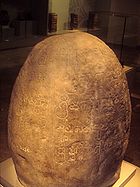
kingdom of Tarumanagara
, one of the oldest Hindu kingdoms in Indonesia. Following the decline of Tarumanagara, its territories, including the Jakarta area, became part of the Kingdom of Sunda. From 7th to early 13th century port of Sunda is within the sphere of influence of Srivijaya
maritime empire. According to the Chinese source, Chu-fan-chi, written circa 1200, Chou Ju-kua reported in the early 13th century Srivijaya still ruled Sumatra, the Malay peninsula, and western Java (Sunda
). The source reports the port of Sunda as strategic and thriving, pepper
from Sunda being among the best in quality. The people worked in agriculture and their houses were built on wooden piles. The harbour area became known as Sunda Kelapa
and by the fourteenth century, it was a major trading port for Sunda kingdom.
The first European fleet, four Portuguese
ships from Malacca
, arrived in 1513 when the Portuguese were looking for a route for spices. The Kingdom of Sunda made an alliance treaty
with Portugal by allowing the Portuguese to build a port in 1522 in order to defend against the rising power of the Sultanate of Demak
from central Java. In 1527, Fatahillah, a Javanese general from Demak attacked and conquered Sunda Kelapa, driving out the Portuguese. Sunda Kelapa was renamed Jayakarta, and became a fiefdom of the Sultanate of Banten
which became a major Southeast Asia trading center.
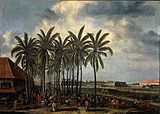 Through the relationship with Prince Jayawikarta from the Sultanate of Banten
, Dutch ships arrived in Jayakarta in 1596. In 1602, the English East India Company's first voyage, commanded by Sir James Lancaster, arrived in Aceh
and sailed on to Banten where they were allowed to build a trading post. This site became the center of English trade in Indonesia until 1682.
Jayawikarta is thought to have made trading connections with the English merchants, rivals of the Dutch, by allowing them to build houses directly across from the Dutch buildings in 1615.
(J.P. Coen). The Dutch burned the English fort, and forced the English to retreat on their ships. The victory consolidated Dutch power and in 1619 they renamed the city "Batavia."
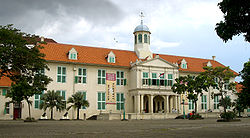
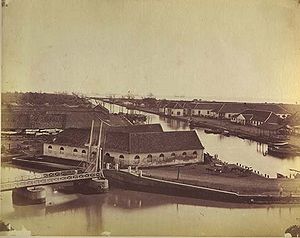 Commercial opportunities in the capital of the Dutch colony attracted Indonesian and especially Chinese immigrants. This sudden population increase created burdens on the city. Tensions grew as the colonial government tried to restrict Chinese migration through deportations. On 9 October 1740, 5,000 Chinese were massacred
by the Dutch and the following year, Chinese inhabitants were moved to Glodok
outside the city walls. The city began to move further south as epidemics in 1835 and 1870 encouraged more people to move far south of the port. The Koningsplein, now Merdeka Square
was completed in 1818, the housing park of Menteng
was started in 1913, and Kebayoran Baru
was the last Dutch-built residential area. By 1930 Batavia had more than 500,000 inhabitants, including 37,067 Europeans.
During the World War II, the city was renamed from Batavia to "Jakarta" (short form of Jayakarta) by the Indonesian nationalists after conquering the city from the Dutch in 1942 with the help of the Japanese forces.
-occupied Jakarta during their fight for Indonesian independence
and established their capital in Yogyakarta. In 1950, once independence was secured, Jakarta was once again made the national capital. Indonesia's founding president, Sukarno
, envisaged Jakarta as a great international city, and instigated large government-funded projects with openly nationalistic and modernist architecture. Projects included a clover-leaf highway, a major boulevard (Jalan MH Thamrin-Sudirman), monuments such as The National Monument, Hotel Indonesia
, a shopping centre, and a new parliament building. In October 1965, Jakarta was the site of an abortive coup
attempt in which 6 top generals were killed, precipitating a violent anti-communist purge in which half-a million people were killed, and the beginning of Suharto's New Order. A monument stands where the generals' bodies were dumped
.
In 1966, Jakarta was declared a "special capital city district" (daerah khusus ibukota), thus gaining a status approximately equivalent to that of a state or province. Lieutenant General Ali Sadikin
served as Governor from the mid-60's commencement of the "New Order" through to 1977; he rehabilitated roads and bridges, encouraged the arts, built several hospitals, and a large number of new schools. He also cleared out slum dwellers for new development projects—some for the benefit of the Suharto family—and tried to eliminate rickshaws and ban street vendors. He began control of migration to the city in order to stem the overcrowding and poverty. Foreign investment contributed to a real estate boom which changed the face of the city.
The boom ended with the 1997/98 East Asian Economic crisis
putting Jakarta at the center of violence, protest, and political maneuvering. After 32 years in power, support from President Suharto began to wane. Tensions reached a peak in when four students were shot dead
at Trisakti University
by security forces; four days of riots and violence
ensued that killed an estimated 1,200, and destroyed or damaged 6,000 buildings. Much of the rioting targeted Chinese Indonesian
s. Suharto resigned as president, and Jakarta has remained the focal point of democratic change in Indonesia. Jemaah Islamiah-connected bombings occurred almost annually in the city between 2000 and 2005, with another bombing in 2009
.
with special status as the capital of Indonesia
. It has a governor (instead of a mayor), and is divided into several sub-regions with their own administrative systems. As a province, the official name of Jakarta is Daerah Khusus Ibukota Jakarta ("Special Capital City District of Jakarta"), which in Indonesian is abbreviated to DKI Jakarta.
Jakarta is divided into five kota or kotamadya ("cities" – formerly municipalities), each headed by a mayor – and one regency (kabupaten) headed by a regent
. In August 2007, Jakarta held its first ever election to choose a governor, whereas previously the city's governors were appointed by the local house of representatives. The poll is part of a country-wide decentralization drive, allowing for direct local elections in several areas.
The cities/municipalities of Jakarta are:
The only regency (kabupaten) of Jakarta is:
In 1974, Based on the Act No. 5 of 1974 relating to the Fundamentals of Regional Government, Jakarta was confirmed as the capital of Indonesia and one of Indonesia's 26 provinces.
The Jakarta provincial government, like all other provincial governments in Indonesia, relies on transfers from the central government for the bulk of budget income. Local (non-central government) sources of revenue are incomes from various taxes such as vehicle ownership and vehicle transfer fees and so on.
, at the mouth of the Ciliwung River
on Jakarta Bay
, which is an inlet of the Java Sea
. Officially, the area of the Jakarta Special District is 662 km2 of land area and 6,977 km2 of sea area. Jakarta lies in a low, flat basin, averaging 7 metres (23 ft) above sea level
; 40% of Jakarta, particularly the northern areas, is below sea level, while the southern parts are comparatively hilly. Rivers flow from the Puncak
highlands to the south of the city, across the city northwards towards the Java Sea; the most important is the Ciliwung River
, which divides the city into the western and eastern principalities. Other rivers include the Pesanggrahan, and Sunter.
These rivers, combined with Jakarta's low topography make it prone to flooding from swollen rivers in the wet season and high sea tides. Other contributing factors include clogged sewage pipes and waterways that service an increasing population, in addition to deforestation
near rapidly urbanizing Bogor
and Depok
in Jakarta's hinterland. Furthermore, Jakarta is an urban area with complex socio-economic problems that indirectly contribute to triggering a flood event. Major floods occurred in 1996 when 5,000 hectares of land were flooded and 2007. Losses from infrastructure damage and state revenue were at least 5.2 trillion rupiah (572 million US dollars) and at least 85 people were killed and about 350,000 people forced from their homes. Approximately 70% of Jakarta's total area was flooded with water up to four meters deep in parts of the city.
In May 2011, the Jakarta Environmental Management Agency categorized all rivers in Jakarta as polluted; 71% of them were heavily polluted, 20% were partly polluted and 9% were lightly polluted.
East Flood Canal (BKT) in eastern Jakarta was a national project which began in 2003 and late 2009 reached the Java sea and will be accomplished in 2011. It was 23.5 kilometers length which linking five rivers: Cipinang, Sunter, Buaran, Jati Kramat and Cakung. It will reduce flood and hope as a 2 kilometers rowing sport venue too. To ease from flood, Jakarta Emergency Dredging Innitiave (JEDI) phase-2 will make underground canal (siphon
) from Ciliwung river to Cipinang river and then go through to East Flood Canal. It will lowering flood at Cawang
, Kampung Melayu, Bukit Duri and Kebun Baru
. The length will be one kilometer and will be finished at 2016.
Besides flood from the rivers, Jakarta is also sinking about 5 to 10 centimeters each year and up to 20 centimeters in northern Jakarta mainland. To solve it, the Netherlands
will give $4 million for a feasibility study to build a dike on Jakarta Bay. The ring dike will be provided with pumping system and retention area, would regulate and control seawater and use also as additional toll road. The project will be built by 2025.
The Thousand Islands
, which are administratively a part of Jakarta, are located in Jakarta Bay north of the city.
system. Despite being located relatively close to the equator, the city has distinct wet
and dry
seasons. Wet seasons in Jakarta cover the majority of the year, running from November through June. The remaining four months forms the city’s dry season. Located in the western-part of Indonesia, Jakarta's wet season rainfall peak is January with average monthly rainfall of 385 millimetres (15.2 in), and its dry season low point is September with a monthly average of 29 millimetres (1.1 in).
The "Betawi" (Orang Betawi, or "people of Batavia") is a term used to describe the descendants of the people living in and around Batavia and recognized as an ethnic group from around the 18th–19th century. The Betawi people are mostly descended from various Southeast-Asian ethnic groups brought or attracted to Batavia to meet labor needs, and include people from different parts of Indonesia
. The language
and Betawi culture are distinct from those of the Sundanese
or Javanese. The language is mostly based on the East Malay
dialect and enriched by loan words from Dutch, Portuguese, Sundanese, Javanese, Chinese, and Arabic. Nowadays, the Jakarta dialect (Bahasa Jakarta), used as a street language by people in Jakarta, is loosely based on the Betawi language
.
Betawi arts have a low profile in Jakarta, and most Betawi have moved to the suburbs of Jakarta, displaced by new migrants. It is easier to find Java- or Minang-based wedding ceremonies rather than Betawi weddings in Jakarta. It is easier to find Javanese Gamelan instead of Gambang Kromong (a mixture between Betawi and Chinese music) or Tanjidor (a mixture between Betawi and Portuguese music) or Marawis (a mixture between Betawi and Yaman music). However, some festivals such as the Jalan Jaksa Festival or Kemang Festival include efforts to preserve Betawi arts by inviting artists to give performances.
There has been a significant Chinese
community in Jakarta for many centuries. The Chinese in Jakarta traditionally reside around old urban areas, such as Jakarta Kota, Pluit and Glodok (Jakarta Chinatown) areas. They also can be found in old chinatowns of Senen and Jatinegara. Officially, they make up 6% of the Jakartan population, although this number may be under-reported. Chinese culture also had influenced Betawi culture, such as the popularity of Chinese cakes and sweets, firecracker
s, to Betawi wedding attire that demonstrates Chinese and Arab influences.
Jakarta has several performing art centers, such as the Taman Ismail Marzuki
(TIM) art center in Cikini, Gedung Kesenian Jakarta
near Pasar Baru, Balai Sarbini in Plaza Semanggi area, Bentara Budaya Jakarta in Palmerah area, Pasar Seni (Art Market) in Ancol, and traditional Indonesian art performances at the pavilions of some provinces in Taman Mini Indonesia Indah
. Traditional music is often found at high-class hotels, including Wayang
and Gamelan
performances. Javanese Wayang Orang performances can be found at Wayang Orang Bharata theater near Senen
bus terminal. As the nation's largest city and capital, Jakarta has lured much national and regional talent who hope to find a greater audience and more opportunities for success.
Jakarta hosts several prestigious art and culture festivals, and exhibitions, such as the annual Jakarta International Film Festival
(JiFFest), Jakarta International Java Jazz Festival
, Jakarta Fashion Week
, Jakarta Fashion & Food Festival (JFFF), Indonesia Creative Products and Jakarta Arts and Crafts exhibition. Flona Jakarta is a flora-and-fauna exhibition, held annually in August at Lapangan Banteng Park, featuring flowers, plant nurseries, and pets. The Jakarta Fair
is held annually from mid-June to mid-July to celebrate the anniversary of the city and is largely centered around a trade fair. However this month-long fair also features entertainment, including arts and music performances by local bands and musicians.
Several foreign art and culture centers are also established in Jakarta, and mainly serve to promote culture and language through learning centers, libraries, and art galleries. Among these foreign art and cultural centers are Netherlands
Erasmus Huis, UK British Council
, France Centre Culturel Français, Germany Goethe-Institut
, Japan Foundation
, and the Jawaharlal Nehru
India
n Cultural Center.
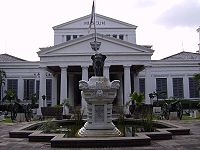 The museums in Jakarta cluster around the Central Jakarta
Merdeka Square area, Jakarta Old Town
, and Taman Mini Indonesia Indah
.
The Jakarta Old Town contains museums that are former institutional buildings of Colonial Batavia. Some of these museums are: Jakarta History Museum
(former City Hall of Batavia), Wayang Museum
(former Church of Batavia), the Fine Art and Ceramic Museum
(former Court House of Justice of Batavia), the Maritime Museum
(former Sunda Kelapa
warehouse), Bank Indonesia Museum (former Javasche Bank), and Bank Mandiri Museum (former Nederlandsche Handels Maatschappij).
Several museums clustered in central Jakarta around the Merdeka Square area include: National Museum of Indonesia
(also known as Gedung Gajah ("the Elephant Building"), Monas (National Monument), Istiqlal Islamic Museum in Istiqlal mosque, and Jakarta Cathedral
Museum on the second floor of Jakarta Cathedral. Also in the central Jakarta area is the Taman Prasasti Museum
(former cemetery of Batavia), and Textile Museum
in Tanah Abang area.
The recreational area of Taman Mini Indonesia Indah
in East Jakarta
contains fourteen museums, such as Indonesia Museum
, Purna Bhakti Pertiwi Museum
, Asmat Museum, Bayt al-Qur'an Islamic Museum, Pusaka (heirloom) Museum, and other science-based museum such as Research & Technology Information Centre, Komodo Indonesian Fauna Museum, Insect Museum, Petrol and Gas Museum, plus the Transportation Museum.
Other museums are Satria Mandala Military Museum, Museum Sumpah Pemuda
, and Lubang Buaya
.
Warteg (Warung Tegal) foodstalls are ubiquitous in the capital. Next to a myriad of selections of Indonesian food and regional specialties from all over Indonesia, there is also international food, especially Chinese
, Japanese
, Korean, Thai, Indian
, American
, French
, Middle Eastern, and modern fusion food. One of the most popular local dishes in Jakarta is Soto
Betawi, which is a cow milk or coconut milk broth with beef tendons, intestines, tripe
. The other popular foods include: kerak telor
, gado-gado
, sate
, nasi goreng
and kue cucur.
Television stations include:
Many TV stations are analog PAL
, but some are now are converting to digital signals.
The economic growth of Jakarta in 2007 was 6.44% up from 5.95% the previous year, with the growth in the transportation and communication (15.25%), construction (7.81%) and trade, hotel and restaurant sectors (6.88%). In 2007, GRP (Gross Regional Domestic Product) was Rp. 566 trillion (around $US 56 billion). The largest contributions to GDRP were by finance, ownership and business services (29%); trade, hotel and restaurant sector (20%), and manufacturing industry sector (16%). In 2007, the increase in per capita GRDP of DKI Jakarta inhabitants was 11.6% compared to the previous year
Both GRDP by at current market price and GRDP by at 2000 constant price in 2007 for the Municipality of Central Jakarta (Jakarta Pusat), which was Rp 146 million rupiahs and Rp 81 million rupiahs, was higher than other municipalities in DKI Jakarta.
A new law in 2007 forbids the giving of money to beggars, buskers and hawkers, bans squatter settlements on river banks and highways, and prohibits spitting and smoking on public transportation. Unauthorized people cleaning car windscreens and taking tips for directing traffic at intersections will also be penalized. Critics of the new legislation claim that such laws will be difficult to enforce and it tends to ignore the desperate poverty of many of the capital's inhabitants.
Copying the idea of Singapore's Orchard Road, in 2011, Jakarta's administration will restrict on-street parking on Hayam Wuruk Street and Gajah Mada Street in Central Jakarta
. It will then remove illegal vendors at trotoaire and beggars from the area.
2006's survey showed that "less than a quarter of the population was fully served by improved water sources. The rest relied on a variety of sources, including rivers, lakes and private water vendors. Some 7.2 million people were without clean water."
>
Year
Population
1920
253.800
1925
290.400
1928
311.000
1930
435.184
1940
533.000
1945
600.000
1950
1.733.600
1959
2.814.000
1961
2.906.533
1971
4.546.492
>
Year/Date
Population
31 October 1980
6.503.449
31 October 1990
8.259.639
30 June 2000
8.384.853
1 January 2005
8.540.306
1 January 2006
7.512.323
June 2007
7.552.444
2010
9.588.198
* 2010 Population census
The 2010 census counted some 9.58 million people, well above all government estimates. The area of DKI Jakarta is 662.33 km2, suggesting a population density of 14,464 people/km2 as the ninth largest urban population density in the world. Inwards immigration tended to negate the effect of family planning programs. The population has risen from 1.2 million in 1960 to 8.8 million in 2004, counting only its legal residents.
Municipality, is 26,267,849. However, even these definitions of Greater Jakarta are proving old for the Indonesian President Yudhoyono which is considering expanding the definition to include areas such as Purwakarta
and Sukabumi
, along with possible relocation of government functions to areas without severe congestion, and to improve coordination of government agencies in the capital region. With such a definition, the population easily surpasses 30 million based on 2010 Census figures.
 Jakarta is primarily a city of government and business. It is seldom viewed as a centre for tourism other than the old part of the city which is a popular tourist destination. However the Jakarta authority saw the opportunity to develop the city's reputation as a service and tourism city. There are many new tourism infrastructures, entertainment centers, and international-class hotels and restaurants being built in Jakarta. Jakarta also possesses many historical places and cultural heritage.
The National Monument, stands at the center of Merdeka Square
, the central park of the city. Near the national monument stands a Mahabharata
themed Arjuna Wijaya chariot statue and fountain. Further south through Jalan Thamrin, the main avenue of Jakarta, the "Selamat Datang" (welcome) statue stands on the fountain in the center of Hotel Indonesia
roundabout
. Other landmarks include the Istiqlal Mosque
, the Jakarta Cathedral
, and the West Irian Liberation monument. The Wisma 46
building in Central Jakarta
is currently the highest building in Jakarta and Indonesia. Tourist attractions include Taman Mini Indonesia Indah
, Ragunan Zoo
, Jakarta Old Town
, and the Ancol Dreamland complex on Jakarta Bay, including Dunia Fantasi theme park, Sea World, Atlantis Water Adventure, and Gelanggang Samudra.
Most of the visitors attracted to Jakarta are domestic tourists from all over Indonesia, the majority of them from the neighboring provinces of West Java
, Banten
, Lampung
, and Central Java
. As the gateway of Indonesia, Jakarta often serves as the stop-over for foreign visitors on their way to Indonesian popular tourist destinations such as Bali
and Yogyakarta. Most foreign visitors from the neighboring ASEAN countries; such as Malaysia and Singapore, visit Jakarta (to some extent also include Bandung
) for shopping purposes, since the city is famous for its cheap but fair quality products, especially textiles, craft and fashion products.
Jakarta is sprawling with numerous malls, shopping centers, and traditional markets. At the end of June 2011, there were 68 malls and trade centers across Jakarta and the Governor planned to suspend permits for new commercial centers with footprints bigger than 5,000 square meters since 2012. Jakarta shopping malls with areas in excess of 100,000 metres square, include Grand Indonesia
, Pacific Place Jakarta
, Plaza Indonesia
and Plaza e'X
, Senayan City
, Plaza Senayan
, Pasaraya, Pondok Indah Mall
, Mal Taman Anggrek, Mal Kelapa Gading
, Mal Artha Gading
, and Mall of Indonesia. Other smaller but popular malls are Sarinah Thamrin, Ratu Plaza
, Atrium Senen, Mall Ambassador and Pasar Festival. Traditional markets include Blok M
, Tanah Abang
, Senen
, Pasar Baru, Glodok
, Mangga Dua, Cempaka Mas, and Jatinegara
. In Jakarta there is also a market that sells used goods, such as Surabaya Street and Rawabening Market.
, Jakarta Cathedral
, and the Jakarta Central Post Office. It is about 4.5 hectares. Initially it was called Waterlooplein of Batavia and functioned as the ceremonial square during the Netherlands Indies colonial period. A number of colonial monuments and memorials erected on the square during the colonial period were demolished during the Sukarno era. The most notable monument in the square is the Monumen Pembebasan Irian Barat (Monument of the Liberation of West Irian). During the 1970s and 1980s the park was used as a bus terminal. In 1993 the park was turned into a public space again. It has become a recreation place for people and is occasionally also used as an exhibition place or for other events. The Jakarta Flona (Flora dan Fauna), the flower and decoration plants and pet exhibition, is held in this park around August annually.
Taman Mini Indonesia Indah
(Miniature Park of Indonesia), in East Jakarta
, has 10 mini parks. But the most popular is The Bird Park or Aviary
Taman Suropati is located in Menteng
city subdistrict in Central Jakarta. The park is surrounded by several Dutch colonial buildings. Taman Suropati was known as Burgemeester Bishopplein during the Dutch colonial time. The park is circular shaped with a surface area of 16,322 m2. There are several modern statues in the park made by artists of the ASEAN countries, which contributes to the nickname of the park "Taman persahabatan seniman ASEAN" ("Park of the ASEAN artists friendship"). Also located in the Menteng area are the Taman Menteng and Situ Lembang pond parks. The Taman Menteng was built on the former Persija soccer Stadium.
Taman Monas (Monas Park) or Taman Medan Merdeka (Medan Merdeka Park) is a huge square where the symbol of Jakarta, Monas or Monumen Nasional (National Monument) is located. The enormous space was created by Dutch Governor General Herman Willem Daendels (1810) and was originally named Koningsplein (Kings Square). On 10 January 1993, President Soeharto initiated action for the beautification of the square. Several features in the square are a deer park and 33 trees that represents the 33 provinces of Indonesia.
In June 2011, Jakarta has only 10.5 percent Ruang Terbuka Hijau (Green Open Space) and will be added to 13.94 percent Public Green Open Space. Public Parks are include in Public Green Open Space. By 2030, the administration also hope there are 16 percent Private Green Open Space.
Most trips, however, are undertaken by non-motorized transport (particularly walking) and numerous modes of public or demand-responsive transportation services.
by Daendels, connecting most major cities throughout Java
. During the following decades, the road network was expanded to a great extent, although it could not keep up with the rapidly increasing numbers of motorized vehicles, resulting in today's traffic problems.
A notable feature of Jakarta's present road system is the toll road
network. Composed of an inner
and outer
ring road
and five toll roads radiating outwards, the network provides connections both inside the city itself as well as to the surrounding areas.
The outer ring road is under construction, but it is largely in use. While 6 Jakarta Elevated Toll Road
s are still in tender progress.
The five radiating toll roads are the:
Throughout the years, several attempts have been made to reduce traffic congestion on Jakarta’s main arteries. Implemented solutions include a 'three-in-one' rule during rush hours, where cars with fewer than three passengers are prohibited from driving on the main avenues.
Another example is the banning of trucks during the day.
(becak) were operating in the city; as much as 15% of Jakarta's total workforce was engaged in becak driving. In 1971, becak were banned from major roads, and shortly thereafter the government attempted a total ban, which substantially reduced their numbers but did not eliminate them. A campaign to eliminate them succeeded in 1990 and 1991, but during the economic crisis of 1998, some returned amid less effective government attempts to control them.
"Auto rickshaws", called bajaj
, provide local transportation in the back streets of some parts of the city. From the early 1940s to 1991 they were a common form of local transportation in the city.
The TransJakarta
bus rapid transit
service (known as Busway) was developed in the context of development reform (or reformasi) and used Bogota's TransMilenio
system as a model. Jakarta's first busway line, from Blok M
to Jakarta Kota
opened in January 2004 and as of 31 December 2010, ten out of fifteen corridors are in use.
in 10 districts: Tanah Abang, Menteng, Setiabudi, Tebet, Matraman, Senen, Gambir, Tambora, Sawah Besar and Taman Sari. The projects will initial after its legal basis from the Finance Ministry.
continued to connect the city to its neighboring regions as well as cities throughout Java
. The surrounding cities of Jakarta are served by KRL Jabotabek
, a mass rapid transit system which serves commuters both in and around Jakarta. The major rail stations are Gambir
, Jakarta Kota
, Jatinegara
, Pasar Senen
, Manggarai, and Tanah Abang. During rush hours, the number of passengers greatly exceeds the system's capacity, and crowding is common.
There had been plans for a monorail
and part of it was already under construction, but the project stalled in 2004 and was officially abandoned as of 2008, mostly due to a lack of investors to fund it all. If completed, the monorail would have been made up of two lines: the green line serving Semanggi-Casablanca Road-Kuningan-Semanggi and the blue line serving Kampung Melayu-Casablanca Road-Tanah Abang
-Roxy.
A two-line metro (MRT) system
is currently being developed, with a north-south line between Kota and Lebak Bulus, with connections to both monorail lines; and an east-west line, which will connect to the north-south line at Sawah Besar Station. In the end the JMRT will be a combination of both subways and elevated rails. The metro system will be built beginning in 2011 with a 15.2 km long line between Hotel Indonesia and Lebak Bulus, and the entire MRT network is scheduled to be operational by 2016. Because of this, the five remaining planned busways
have been postponed.
Jakarta Capital City Government has decided to build rail-based mass transits because this type of transport is capable of carrying passengers in large quantities quickly and cheaply.
(CGK) is the main airport serving the greater Jakarta area. The airport is named after the first President of Indonesia, Soekarno, and the first vice-president, Mohammad Hatta. The airport is often called Cengkareng or Soetta by Indonesians. The airport's IATA code, CGK, originates from the name of the Cengkareng locality, a district situated to the northwest of the city. It is Indonesia's busiest airport handling nearly 40 million passengers annually. A second airport, Halim Perdanakusuma International Airport
(HLP) serves mostly private and VIP/presidential flights.
Other airports in the Jabotabek metropolitan area include Pondok Cabe Airport
and an airfield on Pulau Panjang, part of the Thousand Island archipelago
.
serves many ferry connections to different parts of Indonesia. Tanjung Priok
is the largest seaport in Indonesia, with an annual traffic capacity of around 45 million tonnes of cargo and 4,000,000 TEU's.
The port is also an important employer in the area, with more than 18,000 employees who provide services to more than 18,000 ships every year.
The Port of Jakarta has 20 terminals: general cargo
, multipurpose terminal
, scraps terminal
, passenger terminal
, dry bulk terminal
, liquid bulk terminal, oil terminal
, chemicals terminal and three container terminal
s, 76 berths
, a quay length of 16,853 metres, a total storage area of 661,822 m2 and a storage capacity of 401,468 tonnes.
is the largest. It is a state-owned university with campuses in Salemba and Depok
.
STOVIA was the first high school in Jakarta, established in 1851. As the largest city and the capital, Jakarta houses a large number of students from various parts of Indonesia, many of whom reside in dormitories or home-stay residences. For basic education, there are a variety of primary and secondary schools, tagged with public (national), private (national and bi-lingual national plus) and international schools. Three of the major international schools located in Jakarta are the Gandhi Memorial International School
, Jakarta International School
and the British International School (BIS)
. Other international schools include the Jakarta International Korean School, Jakarta International Multicultural School, Australian International School, New Zealand International School, Singapore International School
, and Sekolah Pelita Harapan
, host of the Asian Cup 2007 beside Malaysia, Thailand and Vietnam, and has hosted the regional-scale Southeast Asian Games
in 1979, 1987 and 1997. In 2011, Jakarta together with Palembang
, will again host the Southeast Asian Games
.
Jakarta's most popular home football club is Persija
, which plays its matches in their home stadium at Bung Karno Stadium or at Lebak Bulus Stadium. The home match of Persija often draws its large fan – cladded with Persija's typical orange kit – to watch the match in the main stadium. The large spectators flocking to the main stadium usually worsen the traffic congestion in Jakarta. Another premiere division team is Persitara
which plays its matches in the Sumantri Brojonegoro Stadium in Kuningan area.
The biggest stadium in Jakarta is the Gelora Bung Karno Stadium with a capacity of 88,083 seats. The Senayan sports complex has several sport venues, including the Bung Karno soccer stadium, Madya Stadium
, Istora Senayan, aquatic arena, baseball field, basketball court, badminton court, a shooting range, several indoor and outdoor tennis court and a golf driving range. The Senayan complex was built in 1959 to accommodate the Asian Games in 1962. For basketball, the Kelapa Gading Sport Mall
in Kelapa Gading
, North Jakarta, with a capacity of 7,000 seats, is the home arena of the Indonesian national basketball team.
The Jakarta Car-Free Days is held monthly on every last Sunday of the month in the main avenue of the city; Jalan Sudirman and Jalan Thamrin, from 6 am to 12 am. The briefer Car-Free Day which only lasted from 6 am to 9 am is held on every other Sundays. The event invited local pedestrian to do sport and exercise and having their activities on the streets that normally full of cars and traffic. Along the road from the Senayan traffic circle on Jalan Sudirman, South Jakarta, to the "Selamat Datang" Monument at the Hotel Indonesia traffic circle on Jalan Thamrin, all the way north to National Monument Central Jakarta, cars are cleared out for pedestrians. Morning gymnastics, calisthenics
and aerobic exercises, futsal
games, jogging
, bicycling, skateboarding
, badminton, karate, an on-street library and musical performances take over the roads and the main parks in Jakarta.
Indonesia
Indonesia , officially the Republic of Indonesia , is a country in Southeast Asia and Oceania. Indonesia is an archipelago comprising approximately 13,000 islands. It has 33 provinces with over 238 million people, and is the world's fourth most populous country. Indonesia is a republic, with an...
. Officially known as the Special Capital Territory of Jakarta, it is located on the northwest coast of Java
Java
Java is an island of Indonesia. With a population of 135 million , it is the world's most populous island, and one of the most densely populated regions in the world. It is home to 60% of Indonesia's population. The Indonesian capital city, Jakarta, is in west Java...
, has an area of 661 square kilometres (255.2 sq mi), and a population of 9,580,000. Jakarta is the country's economic, cultural and political centre. It is the most populous city in Indonesia and in Southeast Asia, and is the tenth-largest city in the world. The urban area, Jabodetabek, is the second largest in the world. Jakarta is listed as a global city
Global city
A global city is a city that is deemed to be an important node in the global economic system...
in the 2008 Globalization and World Cities Study Group and Network (GaWC) research.
Established in the fourth century, the city became an important trading port for the Kingdom of Sunda. It was the de facto capital of the Dutch East Indies
Dutch East Indies
The Dutch East Indies was a Dutch colony that became modern Indonesia following World War II. It was formed from the nationalised colonies of the Dutch East India Company, which came under the administration of the Netherlands government in 1800....
(when it was known as "Batavia") and has continued as the capital of Indonesia since the country's independence was declared in 1945.
The city is the seat of the ASEAN Secretariat. Jakarta is served by the Soekarno-Hatta International Airport
Soekarno-Hatta International Airport
Soekarno–Hatta International Airport , popularly abbreviated SHIA or Soetta is the main airport serving the greater Jakarta area on the island of Java, Indonesia. The airport is named after the first President of Indonesia, Soekarno, and the first vice-president, Mohammad Hatta. The airport is...
, Halim Perdanakusuma International Airport
Halim Perdanakusuma International Airport
-Accidents and Incidents:*On 24 June 1982, British Airways Flight 009, a Boeing 747-200 flew through a cloud of volcanic ash thrown up by the eruption of Mount Galunggung, causing the failure of all four engines. The crew diverted the aircraft to Jakarta and it landed safely.-References:* -External...
, and Tanjung Priok Harbour
Tanjung Priok
Tanjung Priok is a subdistrict of North Jakarta, Jakarta, Indonesia. It hosts the western part of the city's main harbour, the Port of Tanjung Priok...
; it is connected by several intercity
Inter-city rail
Inter-city rail services are express passenger train services that cover longer distances than commuter or regional trains.There is no precise definition of inter-city rail. Its meaning may vary from country to country...
and commuter railways, and served by several bus
Bus
A bus is a road vehicle designed to carry passengers. Buses can have a capacity as high as 300 passengers. The most common type of bus is the single-decker bus, with larger loads carried by double-decker buses and articulated buses, and smaller loads carried by midibuses and minibuses; coaches are...
lines running on reserved busways
Bus lane
A bus lane or bus only lane is a lane restricted to buses, and generally used to speed up public transport that would be otherwise held up by traffic congestion...
.
Etymology
The site which nowadays is referred to as Jakarta, has been home to multiple settlements along with their respective names: Sunda Kelapa (397–1527), Jayakarta (1527–1619), Batavia (1619–1949), and Djakarta (1949–1972).Its current name is derived from the word "Jayakarta". The origins of this word lie in the Old Javanese language. "Jayakarta" translates as "victorious deed", "complete act", or "complete victory".
Jakarta is nicknamed Big Durian, because the city is seen as the Indonesian equivalent of New York City (the Big Apple).
History
Pre-colonial era
The area in and around modern Jakarta was part of the fourth century SundaneseSundanese people
The Sundanese are an ethnic group native to the western part of the Indonesian island of Java. They number approximately 31 million, and are the second most populous of all the nation's ethncities. The Sundanese are predominantly Muslim...
kingdom of Tarumanagara
Tarumanagara
Tarumanagara or Taruma Kingdom or just Taruma is an early Sundanese Indianized kingdom, whose fifth-century ruler, Purnavarman, produced the earliest known inscriptions on Java island...
, one of the oldest Hindu kingdoms in Indonesia. Following the decline of Tarumanagara, its territories, including the Jakarta area, became part of the Kingdom of Sunda. From 7th to early 13th century port of Sunda is within the sphere of influence of Srivijaya
Srivijaya
Srivijaya was a powerful ancient thalassocratic Malay empire based on the island of Sumatra, modern day Indonesia, which influenced much of Southeast Asia. The earliest solid proof of its existence dates from the 7th century; a Chinese monk, I-Tsing, wrote that he visited Srivijaya in 671 for 6...
maritime empire. According to the Chinese source, Chu-fan-chi, written circa 1200, Chou Ju-kua reported in the early 13th century Srivijaya still ruled Sumatra, the Malay peninsula, and western Java (Sunda
Sunda Kingdom
The Sunda Kingdom was a Hindu kingdom located on the western part of Java from 669 to around 1579, covering areas of present-day Banten, Jakarta, West Java, and the western part of Central Java...
). The source reports the port of Sunda as strategic and thriving, pepper
Black pepper
Black pepper is a flowering vine in the family Piperaceae, cultivated for its fruit, which is usually dried and used as a spice and seasoning. The fruit, known as a peppercorn when dried, is approximately in diameter, dark red when fully mature, and, like all drupes, contains a single seed...
from Sunda being among the best in quality. The people worked in agriculture and their houses were built on wooden piles. The harbour area became known as Sunda Kelapa
Sunda Kelapa
Sunda Kelapa is the old port of Jakarta located on the estuarine of Ciliwung River. "Sunda Kalapa" is the original name, and it was the main port of Sunda Kingdom of Pajajaran. The port is situated in Penjaringan sub-district, of North Jakarta, Indonesia...
and by the fourteenth century, it was a major trading port for Sunda kingdom.
The first European fleet, four Portuguese
Portugal
Portugal , officially the Portuguese Republic is a country situated in southwestern Europe on the Iberian Peninsula. Portugal is the westernmost country of Europe, and is bordered by the Atlantic Ocean to the West and South and by Spain to the North and East. The Atlantic archipelagos of the...
ships from Malacca
Malacca
Malacca , dubbed The Historic State or Negeri Bersejarah among locals) is the third smallest Malaysian state, after Perlis and Penang. It is located in the southern region of the Malay Peninsula, on the Straits of Malacca. It borders Negeri Sembilan to the north and the state of Johor to the south...
, arrived in 1513 when the Portuguese were looking for a route for spices. The Kingdom of Sunda made an alliance treaty
Luso Sundanese padrão
The Luso Sundanese padrão is a stone pillar commemorating the Sunda–Portuguese treaty, better known as the Luso-Sundanese Treaty of Sunda Kalapa.-History:...
with Portugal by allowing the Portuguese to build a port in 1522 in order to defend against the rising power of the Sultanate of Demak
Sultanate of Demak
The Sultanate of Demak was Javanese Muslim state located on Java's north coast in Indonesia, at the site of the present day city of Demak. A port fief to the Majapahit kingdom thought to have been founded in the last quarter of the 15th century, it was influenced by Islam brought by Arab and...
from central Java. In 1527, Fatahillah, a Javanese general from Demak attacked and conquered Sunda Kelapa, driving out the Portuguese. Sunda Kelapa was renamed Jayakarta, and became a fiefdom of the Sultanate of Banten
Sultanate of Banten
The Sultanate of Banten was founded in the 16th century and centered in Banten, a port city on the northwest coast of Java; the contemporary English spelling of both was Bantam...
which became a major Southeast Asia trading center.
Sultanate of Banten
The Sultanate of Banten was founded in the 16th century and centered in Banten, a port city on the northwest coast of Java; the contemporary English spelling of both was Bantam...
, Dutch ships arrived in Jayakarta in 1596. In 1602, the English East India Company's first voyage, commanded by Sir James Lancaster, arrived in Aceh
Aceh
Aceh is a special region of Indonesia, located on the northern tip of the island of Sumatra. Its full name is Daerah Istimewa Aceh , Nanggroë Aceh Darussalam and Aceh . Past spellings of its name include Acheh, Atjeh and Achin...
and sailed on to Banten where they were allowed to build a trading post. This site became the center of English trade in Indonesia until 1682.
Jayawikarta is thought to have made trading connections with the English merchants, rivals of the Dutch, by allowing them to build houses directly across from the Dutch buildings in 1615.
Colonial era
When relations between Prince Jayawikarta and the Dutch deteriorated, Jayawikarta's soldiers attacked the Dutch fortress. Prince Jayakarta's army and the English were defeated by the Dutch, in part owing to the timely arrival of Jan Pieterszoon CoenJan Pieterszoon Coen
Jan Pieterszoon Coen was a officer of the Dutch East India Company in the early seventeenth century, holding two terms as its Governor-General of the Dutch East Indies....
(J.P. Coen). The Dutch burned the English fort, and forced the English to retreat on their ships. The victory consolidated Dutch power and in 1619 they renamed the city "Batavia."
1740 Batavia massacre
The 1740 Batavia massacre was a pogrom against ethnic Chinese living in the port city of Batavia, the Dutch East Indies , that occurred between 9 and 22 October 1740....
by the Dutch and the following year, Chinese inhabitants were moved to Glodok
Glodok
Glodok is a part of the Jakarta, Indonesia. The area is also known as Pecinan or Chinatown since the Dutch colonial era, and is considered the biggest in Indonesia, as a majority of the traders in Glodok are of Chinese descent...
outside the city walls. The city began to move further south as epidemics in 1835 and 1870 encouraged more people to move far south of the port. The Koningsplein, now Merdeka Square
Merdeka Square, Jakarta
Merdeka Square is a large square located in the center of Jakarta, Indonesia. The square is surrounded by important government buildings such as the Merdeka Palace, the Supreme Court and various governmental ministries. At its center stands the National Monument...
was completed in 1818, the housing park of Menteng
Menteng
Menteng is a subdistrict of Central Jakarta, one of the administrative city which forms the special capital territory of Jakarta, Indonesia.The subdistrict is best known as the location of the Menteng residential area, a new urban design developed in the 1910s to become a residential area for Dutch...
was started in 1913, and Kebayoran Baru
Kebayoran Baru
Kebayoran Baru is a subdistrict of South Jakarta, Jakarta, Indonesia. Kebayoran Baru is the last residential area to be developed by the Dutch colonial administration. The urban planning consists of a well-planned residential areas, shopping centers, and business district, complete with its...
was the last Dutch-built residential area. By 1930 Batavia had more than 500,000 inhabitants, including 37,067 Europeans.
During the World War II, the city was renamed from Batavia to "Jakarta" (short form of Jayakarta) by the Indonesian nationalists after conquering the city from the Dutch in 1942 with the help of the Japanese forces.
Independence era
Following World War II, Indonesian Republicans withdrew from AlliedAllies of World War II
The Allies of World War II were the countries that opposed the Axis powers during the Second World War . Former Axis states contributing to the Allied victory are not considered Allied states...
-occupied Jakarta during their fight for Indonesian independence
Indonesian National Revolution
The Indonesian National Revolution or Indonesian War of Independence was an armed conflict and diplomatic struggle between Indonesia and the Dutch Empire, and an internal social revolution...
and established their capital in Yogyakarta. In 1950, once independence was secured, Jakarta was once again made the national capital. Indonesia's founding president, Sukarno
Sukarno
Sukarno, born Kusno Sosrodihardjo was the first President of Indonesia.Sukarno was the leader of his country's struggle for independence from the Netherlands and was Indonesia's first President from 1945 to 1967...
, envisaged Jakarta as a great international city, and instigated large government-funded projects with openly nationalistic and modernist architecture. Projects included a clover-leaf highway, a major boulevard (Jalan MH Thamrin-Sudirman), monuments such as The National Monument, Hotel Indonesia
Hotel Indonesia
Hotel Indonesia - Kempinski, commonly abbreviated as HI, is one of the oldest and best known hotels in Indonesia. Located in Central Jakarta, it is one of the first 5-star hotels in the country. For many years, it has been the city's major landmark. Its fame is often linked to the country's...
, a shopping centre, and a new parliament building. In October 1965, Jakarta was the site of an abortive coup
30 September Movement
The Thirtieth of September Movement ) was a self-proclaimed organization of Indonesian National Armed Forces members who, in the early hours of 1 October 1965, assassinated six Indonesian Army generals in an abortive coup d'état. Later that morning, the organization declared that it was in control...
attempt in which 6 top generals were killed, precipitating a violent anti-communist purge in which half-a million people were killed, and the beginning of Suharto's New Order. A monument stands where the generals' bodies were dumped
Lubang Buaya
Lubang Buaya is the site of the murder of seven army officers during the 1 October coup attempt of the 30 September Movement...
.
In 1966, Jakarta was declared a "special capital city district" (daerah khusus ibukota), thus gaining a status approximately equivalent to that of a state or province. Lieutenant General Ali Sadikin
Ali Sadikin
Ali Sadikin was an Indonesian politician. He was often called Bang Ali. He served as the governor of Jakarta, the country's capital, from 1966 to 1977. Appointed by a weak Sukarno, he likely had the full approval of Suharto. A former marine, he saw the city as a battlefield...
served as Governor from the mid-60's commencement of the "New Order" through to 1977; he rehabilitated roads and bridges, encouraged the arts, built several hospitals, and a large number of new schools. He also cleared out slum dwellers for new development projects—some for the benefit of the Suharto family—and tried to eliminate rickshaws and ban street vendors. He began control of migration to the city in order to stem the overcrowding and poverty. Foreign investment contributed to a real estate boom which changed the face of the city.
The boom ended with the 1997/98 East Asian Economic crisis
East Asian financial crisis
The Asian financial crisis was a period of financial crisis that gripped much of Asia beginning in July 1997, and raised fears of a worldwide economic meltdown due to financial contagion....
putting Jakarta at the center of violence, protest, and political maneuvering. After 32 years in power, support from President Suharto began to wane. Tensions reached a peak in when four students were shot dead
Trisakti shootings
The Trisakti shootings occurred at Trisakti University, Jakarta, Indonesia on 12 May 1998. At a demonstration asking for president Suharto's resignation, soldiers opened fire on unarmed protestors. Four students, Elang Mulia Lesmana, Heri Hertanto, Hafidin Royan, and Hendriawan Sie, were killed;...
at Trisakti University
Trisakti University
Trisakti University is a private university in Jakarta, Indonesia. Founded on 29 November 1965, the university has more than 30,000 students.It has several campuses and nine faculties:*Faculty of Law*Faculty of Medical Sciences*Faculty of Dentistry...
by security forces; four days of riots and violence
Jakarta Riots of May 1998
The May 1998 Riots of Indonesia were incidents of mass violence that occurred throughout Indonesia, mainly in Medan in the province of North Sumatra , the capital city of Jakarta , and Surakarta in the province of Central Java...
ensued that killed an estimated 1,200, and destroyed or damaged 6,000 buildings. Much of the rioting targeted Chinese Indonesian
Chinese Indonesian
Chinese Indonesians, also called the Indonesian Chinese, are an overseas Chinese group whose ancestors emigrated from China to Indonesia, formerly a colony of the Netherlands known as the Dutch East Indies...
s. Suharto resigned as president, and Jakarta has remained the focal point of democratic change in Indonesia. Jemaah Islamiah-connected bombings occurred almost annually in the city between 2000 and 2005, with another bombing in 2009
2009 Jakarta bombings
At around 7:50 am local time on 17 July 2009, the JW Marriott and Ritz-Carlton Hotels in Jakarta, Indonesia, were hit by separate bombings five minutes apart. Three of the seven victims who were killed were Australians, two from The Netherlands, and one each from New Zealand and Indonesia. More...
.
Kota or kotamadya (cities) and regency of Jakarta
Officially, Jakarta is not a city, but a provinceProvinces of Indonesia
The province is the highest tier of local government subnational entity in Indonesia. Each province has its own local government, headed by a governor, and has its own legislative body...
with special status as the capital of Indonesia
Indonesia
Indonesia , officially the Republic of Indonesia , is a country in Southeast Asia and Oceania. Indonesia is an archipelago comprising approximately 13,000 islands. It has 33 provinces with over 238 million people, and is the world's fourth most populous country. Indonesia is a republic, with an...
. It has a governor (instead of a mayor), and is divided into several sub-regions with their own administrative systems. As a province, the official name of Jakarta is Daerah Khusus Ibukota Jakarta ("Special Capital City District of Jakarta"), which in Indonesian is abbreviated to DKI Jakarta.
Jakarta is divided into five kota or kotamadya ("cities" – formerly municipalities), each headed by a mayor – and one regency (kabupaten) headed by a regent
Regent
A regent, from the Latin regens "one who reigns", is a person selected to act as head of state because the ruler is a minor, not present, or debilitated. Currently there are only two ruling Regencies in the world, sovereign Liechtenstein and the Malaysian constitutive state of Terengganu...
. In August 2007, Jakarta held its first ever election to choose a governor, whereas previously the city's governors were appointed by the local house of representatives. The poll is part of a country-wide decentralization drive, allowing for direct local elections in several areas.
The cities/municipalities of Jakarta are:
- Central JakartaCentral JakartaCentral Jakarta is one of the five cities which form Jakarta, Indonesia. It had 898,883 inhabitants at the 2010 Census.Central Jakarta is the smallest in area and population of the five cities of Jakarta. It is the administrative and political center of Jakarta and Indonesia...
(Jakarta Pusat) is Jakarta's smallest city and home to most of Jakarta's administrative and political center. It is characterized by large parks and Dutch colonial buildings. Landmarks include the National Monument (Monas), the Istiqlal MosqueIstiqlal MosqueIstiqlal Mosque, or Masjid Istiqlal, in Jakarta, Indonesia is the largest mosque in Southeast Asia in terms of capacity to accommodate people and building structure. This national mosque of Indonesia was built to commemorate Indonesian independence, as nation's gratitude for Islam's blessings; the...
, the Jakarta CathedralJakarta CathedralJakarta Cathedral is a Roman Catholic Cathedral in Jakarta, Indonesia, which is also the seat of the Roman Catholic Archbishop of Jakarta, currently Archbishop Ignatius Suharyo Hardjoatmodjo...
, and museums. - West JakartaWest JakartaWest Jakarta is a city within Jakarta Special District, Indonesia. It had a p[opulation of 2,278,825 at the 2010 Census; the administrative centre is at Puri Kembangan....
(Jakarta Barat) has the highest concentration of small-scale industries in Jakarta. The area includes Jakarta's Chinatown and landmarks include the Chinese Langgam building and the Toko Merah building. West Jakarta contains part of the Jakarta Old TownJakarta Old TownKota , is a small area in Jakarta, Indonesia. It is also known as Old Jakarta, and Old Batavia . It spans 1.3 square kilometres of North Jakarta and West Jakarta...
. - South JakartaSouth JakartaSouth Jakarta is a city within Jakarta Special District, Indonesia. It had a population of 2,057,080 at the 2010 Census, and is the third most populous among the five cities of Jakarta, after East Jakarta and West Jakarta...
(Jakarta Selatan), originally planned as a satellite city, is now the location of large upscale shopping centres and affluent residential areas. Jakarta Selatan functions as Jakarta's ground water buffer, but recently the green belt areas are threatened by new developments. Much of the CBD area of Jakarta is concentrated in Setia Budi, South Jakarta, bordering the Tanah Abang/Sudirman area of Central Jakarta. - East JakartaEast JakartaEast Jakarta is a city within Jakarta Special District, Indonesia. It had a population of 2,687,027 at the 2010, making it the most populous of the five cities within Jakarta....
(Jakarta Timur) territory is characterized by several industrial sectors erected in this city. There are also still some areas of swamps and rice fields in this city. - North JakartaNorth JakartaNorth Jakarta is one of the five cities of Jakarta, Indonesia. North Jakarta contains the entire coastal area within Jakarta Special District. In North Jakarta, an area at the estuary of Ciliwung river was the main port for the kingdom of Tarumanegara, which will later grows to become Jakarta....
(Jakarta Utara) is the only city in Jakarta that is bounded by the sea (Java SeaJava SeaThe Java Sea is a large shallow sea on the Sunda Shelf. It was formed as sea levels rose at the end of the last ice age. The Java Sea lies between the Indonesian islands of Borneo to the north, Java to the south; Sumatra to the west, and Sulawesi to the east...
). It is the location of the Tanjung PriokTanjung PriokTanjung Priok is a subdistrict of North Jakarta, Jakarta, Indonesia. It hosts the western part of the city's main harbour, the Port of Tanjung Priok...
Port. Big-scale and medium-scale industries are concentrated in North Jakarta. North Jakarta contains the location of Jakarta Old TownJakarta Old TownKota , is a small area in Jakarta, Indonesia. It is also known as Old Jakarta, and Old Batavia . It spans 1.3 square kilometres of North Jakarta and West Jakarta...
, formerly known as Batavia since the 17th century, and was a centre of VOCDutch East India CompanyThe Dutch East India Company was a chartered company established in 1602, when the States-General of the Netherlands granted it a 21-year monopoly to carry out colonial activities in Asia...
trade activity in Dutch East IndiesDutch East IndiesThe Dutch East Indies was a Dutch colony that became modern Indonesia following World War II. It was formed from the nationalised colonies of the Dutch East India Company, which came under the administration of the Netherlands government in 1800....
. Also located in North Jakarta is Ancol Dreamland (Taman Impian Jaya AncolTaman Impian Jaya AncolTaman Impian Jaya Ancol otherwise known as Ancol Dreamland is an integral part of Ancol Bay City, a resort destination located along Jakarta's waterfront, in Ancol Kelurahan, Pademangan, Indonesia....
), currently the largest integrated tourism area in South East Asia.
The only regency (kabupaten) of Jakarta is:
- Thousand IslandsThousand Islands (Indonesia)Thousand Islands is the only regency of Jakarta, Indonesia. It consists of a string of 105 islands stretching 45 kilometers north into the Java Sea, with the closest island lying in Jakarta Bay only a few kilometers off mainland Jakarta....
(Kepulauan Seribu), formerly a subdistrictSubdistricts of IndonesiaIn Indonesia, a kecamatan or district is a subdivision of a regency or of a city . A district is itself divided into kelurahan or administrative villages....
of North Jakarta, is a collection of 105 small islands located on Java Sea. It has a high conservation value because of its unique and special ecosystems. Marine tourism, such as diving, water bicycle, and wind surfing, is the most important touristic activity in this territory. The main transportation between these islands are speed boat or small ferries.
| City/Regency | Area (km2) | Total population (registered)(2007) | Total population (2007) | Total population (2010 Census) | Population Density (per km2) 2010 |
|---|---|---|---|---|---|
| South Jakarta South Jakarta South Jakarta is a city within Jakarta Special District, Indonesia. It had a population of 2,057,080 at the 2010 Census, and is the third most populous among the five cities of Jakarta, after East Jakarta and West Jakarta... (Jakarta Selatan) |
141.27 | 1,730,680 | 2,100,930 | 2,057,080 | 14,561 |
| East Jakarta East Jakarta East Jakarta is a city within Jakarta Special District, Indonesia. It had a population of 2,687,027 at the 2010, making it the most populous of the five cities within Jakarta.... (Jakarta Timur) |
188.03 | 2,159,785 | 2,421,419 | 2,687,027 | 14,290 |
| Central Jakarta Central Jakarta Central Jakarta is one of the five cities which form Jakarta, Indonesia. It had 898,883 inhabitants at the 2010 Census.Central Jakarta is the smallest in area and population of the five cities of Jakarta. It is the administrative and political center of Jakarta and Indonesia... (Jakarta Pusat) |
48.13 | 880,286 | 889,680 | 898.883 | 18,676 |
| West Jakarta West Jakarta West Jakarta is a city within Jakarta Special District, Indonesia. It had a p[opulation of 2,278,825 at the 2010 Census; the administrative centre is at Puri Kembangan.... (Jakarta Barat) |
129.54 | 1,562,837 | 2,172,878 | 2,278,825 | 17,592 |
| North Jakarta North Jakarta North Jakarta is one of the five cities of Jakarta, Indonesia. North Jakarta contains the entire coastal area within Jakarta Special District. In North Jakarta, an area at the estuary of Ciliwung river was the main port for the kingdom of Tarumanegara, which will later grows to become Jakarta.... (Jakarta Utara) |
146.66 | 1,200,958 | 1,453,106 | 1,645,312 | 11,219 |
| Thousand Islands Thousand Islands (Indonesia) Thousand Islands is the only regency of Jakarta, Indonesia. It consists of a string of 105 islands stretching 45 kilometers north into the Java Sea, with the closest island lying in Jakarta Bay only a few kilometers off mainland Jakarta.... (Kepulauan Seribu) |
8.7 | 19,915 | 19,980 | 21,071 | 2,422 |
Government
In September 1945, the government of Jakarta City was changed from the Japanese Djakarta Toku-Betsu Shi into the Jakarta National Administration. This first government was held by a Mayor until the end of 1960 when the office was changed to that of a Governor. The last mayor of Jakarta was Sudiro, until he was replaced by Dr Sumarno as Governor of the province (as the city had now become).In 1974, Based on the Act No. 5 of 1974 relating to the Fundamentals of Regional Government, Jakarta was confirmed as the capital of Indonesia and one of Indonesia's 26 provinces.
Municipal finances
The ability of the regional government to respond to the many problems of Jakarta is constrained by extremely limited finances. In 2012, the total budget available to the Jakarta regional government is expected to be around Rp 36 trillion (about $US 4 billion), equivalent to around $US 350 per citizen. Priority areas of spending are expected to be education, transport, flood control measures, environment programs, and various types of social spending (such as housing).The Jakarta provincial government, like all other provincial governments in Indonesia, relies on transfers from the central government for the bulk of budget income. Local (non-central government) sources of revenue are incomes from various taxes such as vehicle ownership and vehicle transfer fees and so on.
Geography
Jakarta is located on the northwest coast of JavaJava
Java is an island of Indonesia. With a population of 135 million , it is the world's most populous island, and one of the most densely populated regions in the world. It is home to 60% of Indonesia's population. The Indonesian capital city, Jakarta, is in west Java...
, at the mouth of the Ciliwung River
Ciliwung River
Ciliwung is a river that passes through Jakarta, Indonesia. The river flows from its source near Puncak on the highlands of West Java to the Jakarta Bay....
on Jakarta Bay
Jakarta Bay
Jakarta Bay is a bay north of North Jakarta city. The Thousand Islands are located here. 13 rivers are flowing into the bay. The majority of the bay's coastal communities consist of people living below the poverty line, in condition of poor sanitation....
, which is an inlet of the Java Sea
Java Sea
The Java Sea is a large shallow sea on the Sunda Shelf. It was formed as sea levels rose at the end of the last ice age. The Java Sea lies between the Indonesian islands of Borneo to the north, Java to the south; Sumatra to the west, and Sulawesi to the east...
. Officially, the area of the Jakarta Special District is 662 km2 of land area and 6,977 km2 of sea area. Jakarta lies in a low, flat basin, averaging 7 metres (23 ft) above sea level
Above mean sea level
The term above mean sea level refers to the elevation or altitude of any object, relative to the average sea level datum. AMSL is used extensively in radio by engineers to determine the coverage area a station will be able to reach...
; 40% of Jakarta, particularly the northern areas, is below sea level, while the southern parts are comparatively hilly. Rivers flow from the Puncak
Puncak
Puncak is the popular name for the area surrounding the peak of Mt.Gede-Pangrango, located in the Bogor-Cianjur-Sukabumi regencies, in the province of West Java, Indonesia....
highlands to the south of the city, across the city northwards towards the Java Sea; the most important is the Ciliwung River
Ciliwung River
Ciliwung is a river that passes through Jakarta, Indonesia. The river flows from its source near Puncak on the highlands of West Java to the Jakarta Bay....
, which divides the city into the western and eastern principalities. Other rivers include the Pesanggrahan, and Sunter.
These rivers, combined with Jakarta's low topography make it prone to flooding from swollen rivers in the wet season and high sea tides. Other contributing factors include clogged sewage pipes and waterways that service an increasing population, in addition to deforestation
Deforestation
Deforestation is the removal of a forest or stand of trees where the land is thereafter converted to a nonforest use. Examples of deforestation include conversion of forestland to farms, ranches, or urban use....
near rapidly urbanizing Bogor
Bogor
Bogor is a city on the island of Java in the West Java province of Indonesia. The city is located in the center of the Bogor Regency , 60 kilometers south of the Indonesian capital Jakarta...
and Depok
Depok
Depok is a city in West Java province, Indonesia on the western border of DKI Jakarta in the Jabodetabek metropolitan region. The "de" in Jabodetabek refers to Depok, while the word "depok" itself comes from Sundanese language meaning hermitage or abode of one living in seclusion.It has an area of...
in Jakarta's hinterland. Furthermore, Jakarta is an urban area with complex socio-economic problems that indirectly contribute to triggering a flood event. Major floods occurred in 1996 when 5,000 hectares of land were flooded and 2007. Losses from infrastructure damage and state revenue were at least 5.2 trillion rupiah (572 million US dollars) and at least 85 people were killed and about 350,000 people forced from their homes. Approximately 70% of Jakarta's total area was flooded with water up to four meters deep in parts of the city.
In May 2011, the Jakarta Environmental Management Agency categorized all rivers in Jakarta as polluted; 71% of them were heavily polluted, 20% were partly polluted and 9% were lightly polluted.
East Flood Canal (BKT) in eastern Jakarta was a national project which began in 2003 and late 2009 reached the Java sea and will be accomplished in 2011. It was 23.5 kilometers length which linking five rivers: Cipinang, Sunter, Buaran, Jati Kramat and Cakung. It will reduce flood and hope as a 2 kilometers rowing sport venue too. To ease from flood, Jakarta Emergency Dredging Innitiave (JEDI) phase-2 will make underground canal (siphon
Siphon
The word siphon is sometimes used to refer to a wide variety of devices that involve the flow of liquids through tubes. But in the English language today, the word siphon usually refers to a tube in an inverted U shape which causes a liquid to flow uphill, above the surface of the reservoir,...
) from Ciliwung river to Cipinang river and then go through to East Flood Canal. It will lowering flood at Cawang
Cawang
Cawang is administrative village at Kramat Jati subdistrict, North Jakarta. The border of Cawang are :* MT Haryono Street in the north* Ciliwung River in the west* General Sutoyo Street in the east...
, Kampung Melayu, Bukit Duri and Kebun Baru
Kebun Baru
Kebun Baru is a district within Ang Mo Kio, Singapore. It is located in the west of Ang Mo Kio and bounded by Mayflower district and Bishan Park.It will be served by the Kebun Baru MRT along the Thomson MRT Line in 2018.-Etymology:...
. The length will be one kilometer and will be finished at 2016.
Besides flood from the rivers, Jakarta is also sinking about 5 to 10 centimeters each year and up to 20 centimeters in northern Jakarta mainland. To solve it, the Netherlands
Netherlands
The Netherlands is a constituent country of the Kingdom of the Netherlands, located mainly in North-West Europe and with several islands in the Caribbean. Mainland Netherlands borders the North Sea to the north and west, Belgium to the south, and Germany to the east, and shares maritime borders...
will give $4 million for a feasibility study to build a dike on Jakarta Bay. The ring dike will be provided with pumping system and retention area, would regulate and control seawater and use also as additional toll road. The project will be built by 2025.
The Thousand Islands
Thousand Islands (Indonesia)
Thousand Islands is the only regency of Jakarta, Indonesia. It consists of a string of 105 islands stretching 45 kilometers north into the Java Sea, with the closest island lying in Jakarta Bay only a few kilometers off mainland Jakarta....
, which are administratively a part of Jakarta, are located in Jakarta Bay north of the city.
Climate
Jakarta has a hot and humid tropical wet and dry climate (Aw) according to the Köppen climate classificationKöppen climate classification
The Köppen climate classification is one of the most widely used climate classification systems. It was first published by Crimea German climatologist Wladimir Köppen in 1884, with several later modifications by Köppen himself, notably in 1918 and 1936...
system. Despite being located relatively close to the equator, the city has distinct wet
Wet season
The the wet season, or rainy season, is the time of year, covering one or more months, when most of the average annual rainfall in a region occurs. The term green season is also sometimes used as a euphemism by tourist authorities. Areas with wet seasons are dispersed across portions of the...
and dry
Dry season
The dry season is a term commonly used when describing the weather in the tropics. The weather in the tropics is dominated by the tropical rain belt, which oscillates from the northern to the southern tropics over the course of the year...
seasons. Wet seasons in Jakarta cover the majority of the year, running from November through June. The remaining four months forms the city’s dry season. Located in the western-part of Indonesia, Jakarta's wet season rainfall peak is January with average monthly rainfall of 385 millimetres (15.2 in), and its dry season low point is September with a monthly average of 29 millimetres (1.1 in).
Culture
As the economic and political capital of Indonesia, Jakarta attracts many domestic immigrants who bring their various languages, dialects, foods and customs.The "Betawi" (Orang Betawi, or "people of Batavia") is a term used to describe the descendants of the people living in and around Batavia and recognized as an ethnic group from around the 18th–19th century. The Betawi people are mostly descended from various Southeast-Asian ethnic groups brought or attracted to Batavia to meet labor needs, and include people from different parts of Indonesia
Indonesia
Indonesia , officially the Republic of Indonesia , is a country in Southeast Asia and Oceania. Indonesia is an archipelago comprising approximately 13,000 islands. It has 33 provinces with over 238 million people, and is the world's fourth most populous country. Indonesia is a republic, with an...
. The language
Betawi language
The Betawi language is the spoken language of the Betawi people in Jakarta, Indonesia. It is the native language of about 2,700,000 people . It is a Malay-based creole, and closely related to Malay language. Betawi vocabulary have large amount of Hokkien Chinese, Arabic, and Dutch loanwords...
and Betawi culture are distinct from those of the Sundanese
Sundanese people
The Sundanese are an ethnic group native to the western part of the Indonesian island of Java. They number approximately 31 million, and are the second most populous of all the nation's ethncities. The Sundanese are predominantly Muslim...
or Javanese. The language is mostly based on the East Malay
Old Malay
The Old Malay language, also called Classical Malay, is the ancestor of the modern Malay language, including Indonesian and Malaysian. It developed in the now Melayu Kingdom of Sumatra. It was heavily influenced by Sanskrit and Kawi , and was grammatically quite similar to modern Malay.-Old...
dialect and enriched by loan words from Dutch, Portuguese, Sundanese, Javanese, Chinese, and Arabic. Nowadays, the Jakarta dialect (Bahasa Jakarta), used as a street language by people in Jakarta, is loosely based on the Betawi language
Betawi language
The Betawi language is the spoken language of the Betawi people in Jakarta, Indonesia. It is the native language of about 2,700,000 people . It is a Malay-based creole, and closely related to Malay language. Betawi vocabulary have large amount of Hokkien Chinese, Arabic, and Dutch loanwords...
.
Betawi arts have a low profile in Jakarta, and most Betawi have moved to the suburbs of Jakarta, displaced by new migrants. It is easier to find Java- or Minang-based wedding ceremonies rather than Betawi weddings in Jakarta. It is easier to find Javanese Gamelan instead of Gambang Kromong (a mixture between Betawi and Chinese music) or Tanjidor (a mixture between Betawi and Portuguese music) or Marawis (a mixture between Betawi and Yaman music). However, some festivals such as the Jalan Jaksa Festival or Kemang Festival include efforts to preserve Betawi arts by inviting artists to give performances.
There has been a significant Chinese
Chinese Indonesian
Chinese Indonesians, also called the Indonesian Chinese, are an overseas Chinese group whose ancestors emigrated from China to Indonesia, formerly a colony of the Netherlands known as the Dutch East Indies...
community in Jakarta for many centuries. The Chinese in Jakarta traditionally reside around old urban areas, such as Jakarta Kota, Pluit and Glodok (Jakarta Chinatown) areas. They also can be found in old chinatowns of Senen and Jatinegara. Officially, they make up 6% of the Jakartan population, although this number may be under-reported. Chinese culture also had influenced Betawi culture, such as the popularity of Chinese cakes and sweets, firecracker
Firecracker
A firecracker is a small explosive device primarily designed to produce a large amount of noise, especially in the form of a loud bang; any visual effect is incidental to this goal. They have fuses, and are wrapped in a heavy paper casing to contain the explosive compound...
s, to Betawi wedding attire that demonstrates Chinese and Arab influences.
Jakarta has several performing art centers, such as the Taman Ismail Marzuki
Taman Ismail Marzuki
Pusat Kesenian Jakarta Taman Ismail Marzuki or popularly known as Taman Ismail Marzuki is an art and cultural center located in jalan Cikini Raya 73, Central Jakarta, Indonesia. Also within this complex stood Jakarta Art Institute and Jakarta Planetarium...
(TIM) art center in Cikini, Gedung Kesenian Jakarta
Gedung Kesenian Jakarta
Gedung Kesenian Jakarta , historically known as Schouwburg Weltevreden, is a concert hall in Jakarta, Indonesia, built during the Dutch colonial period.-History:...
near Pasar Baru, Balai Sarbini in Plaza Semanggi area, Bentara Budaya Jakarta in Palmerah area, Pasar Seni (Art Market) in Ancol, and traditional Indonesian art performances at the pavilions of some provinces in Taman Mini Indonesia Indah
Taman Mini Indonesia Indah
Taman Mini Indonesia Indah or "Beautiful Indonesia Miniature Park" is a culture-based recreational area located in East Jakarta, Indonesia. It has an area of about...
. Traditional music is often found at high-class hotels, including Wayang
Wayang
Wayang is a Javanese word for theatre . When the term is used to refer to kinds of puppet theatre, sometimes the puppet itself is referred to as wayang...
and Gamelan
Gamelan
A gamelan is a musical ensemble from Indonesia, typically from the islands of Bali or Java, featuring a variety of instruments such as metallophones, xylophones, drums and gongs; bamboo flutes, bowed and plucked strings. Vocalists may also be included....
performances. Javanese Wayang Orang performances can be found at Wayang Orang Bharata theater near Senen
Senen
Senen is one of the historic subdistrict of Central Jakarta, Indonesia. Its close proximity with the some of the historic center of Jakarta: Merdeka Square and Lapangan Banteng means that this area is one of the historic area in Jakarta...
bus terminal. As the nation's largest city and capital, Jakarta has lured much national and regional talent who hope to find a greater audience and more opportunities for success.
Jakarta hosts several prestigious art and culture festivals, and exhibitions, such as the annual Jakarta International Film Festival
Jakarta International Film Festival
The Jakarta International Film Festival is the major film festival of Indonesia held every December in the capital, Jakarta, since 1999....
(JiFFest), Jakarta International Java Jazz Festival
Jakarta International Java Jazz Festival
Jakarta International Java Jazz Festival is one of the largest jazz festivals in the world and arguably the biggest in in the Southern Hemisphere, held in Jakarta, Indonesia. The annual jazz festival is held every early March and was designed to be one of the largest jazz festivals globally...
, Jakarta Fashion Week
Jakarta Fashion Week
Jakarta Fashion Week is held annually and aimed to provide directions to the Indonesian fashion industry as well as a vehicle to demonstrate its wealth in talents and creativity. Ultimately, the goal is to turn Jakarta as a major fashion hub in the region and the world...
, Jakarta Fashion & Food Festival (JFFF), Indonesia Creative Products and Jakarta Arts and Crafts exhibition. Flona Jakarta is a flora-and-fauna exhibition, held annually in August at Lapangan Banteng Park, featuring flowers, plant nurseries, and pets. The Jakarta Fair
Jakarta Fair
Jakarta Fair is a fair held annually in Jakarta International Expo Kemayoran, Jakarta, Indonesia, around June to July. It features exhibitions, trade promotions, shoppings, music performances, various shows, amusement rides, and food festival. The fair is meant to celebrate the anniversary of...
is held annually from mid-June to mid-July to celebrate the anniversary of the city and is largely centered around a trade fair. However this month-long fair also features entertainment, including arts and music performances by local bands and musicians.
Several foreign art and culture centers are also established in Jakarta, and mainly serve to promote culture and language through learning centers, libraries, and art galleries. Among these foreign art and cultural centers are Netherlands
Netherlands
The Netherlands is a constituent country of the Kingdom of the Netherlands, located mainly in North-West Europe and with several islands in the Caribbean. Mainland Netherlands borders the North Sea to the north and west, Belgium to the south, and Germany to the east, and shares maritime borders...
Erasmus Huis, UK British Council
British Council
The British Council is a United Kingdom-based organisation specialising in international educational and cultural opportunities. It is registered as a charity both in England and Wales, and in Scotland...
, France Centre Culturel Français, Germany Goethe-Institut
Goethe-Institut
The Goethe-Institut is a non-profit German cultural institution operational worldwide, promoting the study of the German language abroad and encouraging international cultural exchange and relations. The Goethe-Institut also fosters knowledge about Germany by providing information on German...
, Japan Foundation
Japan Foundation
The was established in 1972 by an Act of the Japanese Diet as a special legal entity to undertake international dissemination of Japanese culture, and became an independent administrative institution under the jurisdiction of the Foreign Ministry of Japan on 1 October 2003 under the "Independent...
, and the Jawaharlal Nehru
Jawaharlal Nehru
Jawaharlal Nehru , often referred to with the epithet of Panditji, was an Indian statesman who became the first Prime Minister of independent India and became noted for his “neutralist” policies in foreign affairs. He was also one of the principal leaders of India’s independence movement in the...
India
India
India , officially the Republic of India , is a country in South Asia. It is the seventh-largest country by geographical area, the second-most populous country with over 1.2 billion people, and the most populous democracy in the world...
n Cultural Center.
Museums
Central Jakarta
Central Jakarta is one of the five cities which form Jakarta, Indonesia. It had 898,883 inhabitants at the 2010 Census.Central Jakarta is the smallest in area and population of the five cities of Jakarta. It is the administrative and political center of Jakarta and Indonesia...
Merdeka Square area, Jakarta Old Town
Jakarta Old Town
Kota , is a small area in Jakarta, Indonesia. It is also known as Old Jakarta, and Old Batavia . It spans 1.3 square kilometres of North Jakarta and West Jakarta...
, and Taman Mini Indonesia Indah
Taman Mini Indonesia Indah
Taman Mini Indonesia Indah or "Beautiful Indonesia Miniature Park" is a culture-based recreational area located in East Jakarta, Indonesia. It has an area of about...
.
The Jakarta Old Town contains museums that are former institutional buildings of Colonial Batavia. Some of these museums are: Jakarta History Museum
Jakarta History Museum
The Jakarta History Museum , also known as Fatahillah Museum or Batavia Museum, is located in the Old Town of Jakarta, Indonesia. The building was built in 1710 as the Stadhuis of Batavia...
(former City Hall of Batavia), Wayang Museum
Wayang Museum
The Wayang Museum is a museum dedicated to Javanese wayang puppetry. The museum is located in Jakarta, Indonesia.- History :The building occupies the site of a church which was built in 1640 under the name of the Old Dutch Church . In 1732, the church was renovated and the name was changed into...
(former Church of Batavia), the Fine Art and Ceramic Museum
Fine Art and Ceramic Museum
- History :The building of the Fine Art and Ceramic Museum was completed on January 12, 1870, and was used as the Court of Justice . The building was known as Paleis van Justitie. During the Japanese occupation, the building was used by KNIL and later after the independence of Indonesia, was used...
(former Court House of Justice of Batavia), the Maritime Museum
Maritime Museum (Indonesia)
The Maritime Museum is located in the old Sunda Kelapa harbor area in Penjaringan Administrative Village, Penjaringan Subdistrict, Jakarta, Indonesia. The museum was inaugurated inside the former Dutch East India Company warehouses...
(former Sunda Kelapa
Sunda Kelapa
Sunda Kelapa is the old port of Jakarta located on the estuarine of Ciliwung River. "Sunda Kalapa" is the original name, and it was the main port of Sunda Kingdom of Pajajaran. The port is situated in Penjaringan sub-district, of North Jakarta, Indonesia...
warehouse), Bank Indonesia Museum (former Javasche Bank), and Bank Mandiri Museum (former Nederlandsche Handels Maatschappij).
Several museums clustered in central Jakarta around the Merdeka Square area include: National Museum of Indonesia
National Museum of Indonesia
The National Museum of Indonesia , is an archeological, historical, ethnological, and geographical museum located in Jakarta. Popularly known as Elephant Building after the elephant statue in its forecourt. Its broad and fascinating collections covers all of Indonesia's territory and almost all of...
(also known as Gedung Gajah ("the Elephant Building"), Monas (National Monument), Istiqlal Islamic Museum in Istiqlal mosque, and Jakarta Cathedral
Jakarta Cathedral
Jakarta Cathedral is a Roman Catholic Cathedral in Jakarta, Indonesia, which is also the seat of the Roman Catholic Archbishop of Jakarta, currently Archbishop Ignatius Suharyo Hardjoatmodjo...
Museum on the second floor of Jakarta Cathedral. Also in the central Jakarta area is the Taman Prasasti Museum
Taman Prasasti Museum
Taman Prasasti Museum or Museum of Memorial Stone Park is a museum located in Jakarta, Indonesia. The museum was formerly a cemetery, built by the Dutch colonial government in 1795 as a final resting place for noble Dutchmen...
(former cemetery of Batavia), and Textile Museum
Textile Museum (Jakarta)
The Textile Museum houses a collection of textiles from various islands in Indonesia. The museum is located in Jakarta, Indonesia.- History :...
in Tanah Abang area.
The recreational area of Taman Mini Indonesia Indah
Taman Mini Indonesia Indah
Taman Mini Indonesia Indah or "Beautiful Indonesia Miniature Park" is a culture-based recreational area located in East Jakarta, Indonesia. It has an area of about...
in East Jakarta
East Jakarta
East Jakarta is a city within Jakarta Special District, Indonesia. It had a population of 2,687,027 at the 2010, making it the most populous of the five cities within Jakarta....
contains fourteen museums, such as Indonesia Museum
Indonesia Museum
The Indonesia Museum , is an anthropology and ethnological museum located in Taman Mini Indonesia Indah , Jakarta, Indonesia. The museum concentrated on arts and cultures of various ethnic groups that inhabit Indonesian archipelago and formed the modern nation of Indonesia...
, Purna Bhakti Pertiwi Museum
Purna Bhakti Pertiwi Museum
The Purna Bhakti Pertiwi Museum, is a history museum specialized on the life of Suharto, the former second president of Indonesia and a powerful political figure in modern Indonesian history. It is located in Taman Mini Indonesia Indah , Jakarta, Indonesia...
, Asmat Museum, Bayt al-Qur'an Islamic Museum, Pusaka (heirloom) Museum, and other science-based museum such as Research & Technology Information Centre, Komodo Indonesian Fauna Museum, Insect Museum, Petrol and Gas Museum, plus the Transportation Museum.
Other museums are Satria Mandala Military Museum, Museum Sumpah Pemuda
Sumpah Pemuda
The Youth Pledge , was a declaration made on 28 October 1928 by young Indonesian nationalists at a conference in the then-Dutch East Indies. They proclaimed three ideals, one motherland, one nation and one language.-Background:...
, and Lubang Buaya
Lubang Buaya
Lubang Buaya is the site of the murder of seven army officers during the 1 October coup attempt of the 30 September Movement...
.
Cuisine
Jakarta has a vast range of food available at hundreds of eating complexes located all over the city, from modest street-side foodstalls and traveling vendors to the high-class expensive restaurants. The traditional Padang restaurants and low-budget JavaneseJavanese cuisine
Javanese cuisine is the cuisine of Javanese people. In wider sense, Javanese cuisine might also refer to the cuisine of the whole people of Java Island, Indonesia; which also include Sundanese in West Java, Betawi people in Jakarta and Madurese on Madura Island off East Java...
Warteg (Warung Tegal) foodstalls are ubiquitous in the capital. Next to a myriad of selections of Indonesian food and regional specialties from all over Indonesia, there is also international food, especially Chinese
Chinese cuisine
Chinese cuisine is any of several styles originating in the regions of China, some of which have become highly popular in other parts of the world – from Asia to the Americas, Australia, Western Europe and Southern Africa...
, Japanese
Japanese cuisine
Japanese cuisine has developed over the centuries as a result of many political and social changes throughout Japan. The cuisine eventually changed with the advent of the Medieval age which ushered in a shedding of elitism with the age of shogun rule...
, Korean, Thai, Indian
Indian cuisine
Indian cuisine consists of thousands of regional cuisines which date back thousands of years. The dishes of India are characterised by the extensive use of various Indian spices, herbs, vegetables and fruit. Indian cuisine is also known for the widespread practice of vegetarianism in Indian society...
, American
Cuisine of the United States
American cuisine is a style of food preparation originating from the United States of America. European colonization of the Americas yielded the introduction of a number of ingredients and cooking styles to the latter...
, French
French cuisine
French cuisine is a style of food preparation originating from France that has developed from centuries of social change. In the Middle Ages, Guillaume Tirel , a court chef, authored Le Viandier, one of the earliest recipe collections of Medieval France...
, Middle Eastern, and modern fusion food. One of the most popular local dishes in Jakarta is Soto
Soto (food)
Soto, sroto, tauto or coto is a common dish, found in many regional variations of Indonesian cuisine. It is a traditional soup mainly composed of broth, meat and vegetables. There is no clear definition of what makes a soto, but normally many traditional soups are called soto, whereas foreign and...
Betawi, which is a cow milk or coconut milk broth with beef tendons, intestines, tripe
Tripe
Tripe is a type of edible offal from the stomachs of various farm animals.-Beef tripe:...
. The other popular foods include: kerak telor
Kerak Telor
Kerak telor is a Betawi traditional spicy omelette dish in Indonesian cuisine. It is made from glutinous rice cooked with egg and served with serundeng , fried shallots and dried shrimp topping. It is considered as a snack and not as a main dish...
, gado-gado
Gado-gado
Gado-gado , also called Lotek for its cooked version - differed from lotek atah or karedok for its fresh and raw version of the vegetable covered with peanut sauce and pecel is an Indonesian dish comprising a vegetable salad served with a peanut sauce dressing...
, sate
Satay
Satay , or sate, is a dish of marinated, skewered and grilled meat, served with a sauce. Satay may consist of diced or sliced chicken, goat, mutton, beef, pork, fish, other meats, or tofu; the more authentic version uses skewers from the midrib of the coconut palm frond, although bamboo skewers are...
, nasi goreng
Nasi goreng
Nasi goreng, literally meaning "fried rice" in Indonesian, can refer simply to fried pre-cooked rice, a meal including stir fried rice in small amount of cooking oil or margarine, typically spiced with kecap manis , shallot, garlic, tamarind and chilli and accompanied with other ingredients,...
and kue cucur.
Media
Daily newspapers in Jakarta include- English language national newspaper: The Jakarta PostThe Jakarta PostThe Jakarta Post is a daily English language newspaper in Indonesia. The paper is owned by PT Bina Media Tenggara, and the head office is in the nation's capital, Jakarta....
, The Jakarta Globe - Indonesian language national newspaper: KompasKompasKompas is the most widely read newspaper in Indonesia. Published by Kompas-Gramedia Group Publishing since June 28, 1965, it has a reputation in Indonesia for high-quality writing and investigative journalism...
, Koran TempoKoran TempoKoran Tempo is an Indonesian newspaper in Indonesia. It is owned by PT Tempo Inti Media Harian.It was first published on April 2, 2001 with a circulation of 100,000 daily.The newsstand price of Koran Tempo is Rp 2,300.-External links:**...
, Media IndonesiaMedia IndonesiaMedia Indonesia is an Indonesian daily newspaper published in Jakarta. Reports say Media Indonesia is the second largest newspaper in Indonesia after the Kompas daily, and the third is Jawa Pos....
, Seputar IndonesiaSeputar IndonesiaSeputar Indonesia, English: Around Indonesia, is Indonesia's longest running newscast carried by a private television station. It appeared on RCTI at October 1, 1989 as Seputar Jakarta before it evolved to go nationwide in July 1, 1990...
, RepublikaRepublika (Indonesian newspaper)Republika is one of several national daily newspapers in Indonesia. The newspaper is also known as a Moslem publication. Republika was founded in 1992 and the first edition was published on January 3, 1993, by Yayasan Abdi Bangsa -- a foundation that supported by Ikatan Cendekiawan Muslim...
, Suara PembaruanSuara PembaruanSuara Pembaruan is an Indonesian afternoon daily. Founded in 1987 as a replacement for Sinar Harapan, it is one of the largest newspapers in Indonesia.-History:...
, Suara KaryaSuara KaryaSuara Karya is a daily newspaper published in Indonesia. Established in 1971 to assist Golkar in winning that year's legislative election, it became required reading for all civil servants and the voice of Golkar. After its circulation increased from 55,700 in 1971 to 300,000 in 1998, the fall of...
, Sinar Harapan, Indo Pos, Jurnal Nasional, Harian Pelita - Business newspaper: Bisnis IndonesiaBisnis IndonesiaBisnis Indonesia is a daily newspaper, published in Jakarta, Indonesia. Bisnis Indonesia primarily covers Indonesian financial and business news and issues...
, Investor Daily, Kontan, Harian Neraca. - Indonesian language local (Jakarta) newspaper: Pos Kota, Warta Kota, Koran Jakarta, Berita Kota,
- Sport newspaper: Top Skor
Television stations include:
- Government television: TVRITVRITelevisi Republik Indonesia Televisi Republik Indonesia (TVRI) Televisi Republik Indonesia (TVRI) (formerly known as Televisi Indonesia (Indonesian Television in English) and Radio Indonesia (Indonesian Radio in English) is a state-owned television station, the oldest television station in...
. - Private national television: MNC TV, RCTIRCTIRCTI is Indonesia's first privately owned television network and is based in West Jakarta. RCTI broadcasts Indonesian Idol as well as sinetron , films, news and current affairs, reality shows and religious programs...
, Metro TV, IndosiarIndosiarIndosiar is a publicly owned national television station in Indonesia, and has been operating from West Jakarta since 1994. It was listed on the Indonesian Stock Exchange in 2004. Citibank Singapore has an 8.5 percent shareholding...
, ANTVAntvantv is an Indonesian television network based in South Jakarta. It is owned by PT Visi Media Asia,Tbk.-History:antv was launched on 1 March 1993 as a local television station in Lampung province. In the same month it was awarded a government license for nationwide broadcasting, and moved its...
, SCTVSCTV (Indonesia)Surya Citra Televisi is an Indonesian television station. Its headquarters are in South Jakarta. It began broadcasting on 24 August 1990 in Surabaya, East Java, broadcasting only to the city and surrounding area. At this point the programming was similar to that of RCTI and used some of their news...
, Trans TVTrans TVTrans TV is an Indonesian national television station based in South Jakarta. Owned by Chairul Tanjung, it began broadcasting on 15 December 2001 based in Jakarta. On 15 December 2006 based in Jakarta due to its half ownership by Trans Corporation, a company that also owned Trans 7...
, TV ONE, Trans 7Trans 7Trans 7 is an Indonesian commercial television station based in Central Jakarta. It is jointly owned by the Gramedia Group and Trans TV. It began broadcasting on 15 December 2001. On 15 December 2006, the official name became Trans 7 from TV 7 due to its half ownership by Trans Corp, a company...
, and Global TVGlobal TV (Indonesia)Global TV is an Indonesian private television station based in West Jakarta. It is established in early January 1, 1998 and first went on air on January 1, 2001 with MTV programming....
. - Local television: B-Channel, Jak-TV, O-Channel, Elshinta TV, Da Ai TV, and Space-Toon.
- Cable television: First MediaFirst MediaFirst Media is a triple play Cable Television network in Indonesia.The products are Fastnet, HomeCable, and DataComm. Because First Media is a relatively new company the coverage area is limited.-FastNet:...
, TelkomVisionTelkomVisionTelkomVision is a subscription-based direct broadcast satellite and cable television provider service for Indonesia. It is a part of the Telkom Group... - Satellite television: IndovisionIndovisionIndovision is a subscription-based direct broadcast satellite or direct-to-home satellite television and radio service initially in Indonesia. Indovision is currently owned by PT MNC Skyvision.-History:Indovision began operations in 1994....
, TelkomVisionTelkomVisionTelkomVision is a subscription-based direct broadcast satellite and cable television provider service for Indonesia. It is a part of the Telkom Group...
, OkevisionOkeVisionOkevision is a brand name made by PT Nusantara Vision, and is a subscription based Satellite Television. Launched in November 2008, it is one of the newest satellite television service available in Indonesia....
, Aora TVAora TVAora TV is an Indonesian direct broadcast satellite pay television company that is operated by PT Karya Megah Adijaya and is owned by Rini M. Soemarno, Ongki P. Soemarno and join at dormant period Sugiono Wiyono. It started its nation-wide broadcast in the beginning of August 2008 with an initial...
, Yes TV
Many TV stations are analog PAL
PAL
PAL, short for Phase Alternating Line, is an analogue television colour encoding system used in broadcast television systems in many countries. Other common analogue television systems are NTSC and SECAM. This page primarily discusses the PAL colour encoding system...
, but some are now are converting to digital signals.
Economy, governance and infrastructure
Jakarta's economy depends heavily on financial service, trade, and manufacturing. Industry includes electronics, automotive, chemicals, mechanical engineering and biomedical sciences manufacturing.The economic growth of Jakarta in 2007 was 6.44% up from 5.95% the previous year, with the growth in the transportation and communication (15.25%), construction (7.81%) and trade, hotel and restaurant sectors (6.88%). In 2007, GRP (Gross Regional Domestic Product) was Rp. 566 trillion (around $US 56 billion). The largest contributions to GDRP were by finance, ownership and business services (29%); trade, hotel and restaurant sector (20%), and manufacturing industry sector (16%). In 2007, the increase in per capita GRDP of DKI Jakarta inhabitants was 11.6% compared to the previous year
Both GRDP by at current market price and GRDP by at 2000 constant price in 2007 for the Municipality of Central Jakarta (Jakarta Pusat), which was Rp 146 million rupiahs and Rp 81 million rupiahs, was higher than other municipalities in DKI Jakarta.
A new law in 2007 forbids the giving of money to beggars, buskers and hawkers, bans squatter settlements on river banks and highways, and prohibits spitting and smoking on public transportation. Unauthorized people cleaning car windscreens and taking tips for directing traffic at intersections will also be penalized. Critics of the new legislation claim that such laws will be difficult to enforce and it tends to ignore the desperate poverty of many of the capital's inhabitants.
Copying the idea of Singapore's Orchard Road, in 2011, Jakarta's administration will restrict on-street parking on Hayam Wuruk Street and Gajah Mada Street in Central Jakarta
Central Jakarta
Central Jakarta is one of the five cities which form Jakarta, Indonesia. It had 898,883 inhabitants at the 2010 Census.Central Jakarta is the smallest in area and population of the five cities of Jakarta. It is the administrative and political center of Jakarta and Indonesia...
. It will then remove illegal vendors at trotoaire and beggars from the area.
2006's survey showed that "less than a quarter of the population was fully served by improved water sources. The rest relied on a variety of sources, including rivers, lakes and private water vendors. Some 7.2 million people were without clean water."
Demography
| > | |
| Year | Population |
|---|---|
| 1870 | 65.000 |
| 1875 | 99.100 |
| 1880 | 102.900 |
| 1883 | 97.000 |
| 1886 | 100.500 |
| 1890 | 105.100 |
| 1895 | 114.600 |
| 1901 | 115.900 |
| 1905 | 138.600 |
| 1918 | 234.700 |
* 2010 Population census
The 2010 census counted some 9.58 million people, well above all government estimates. The area of DKI Jakarta is 662.33 km2, suggesting a population density of 14,464 people/km2 as the ninth largest urban population density in the world. Inwards immigration tended to negate the effect of family planning programs. The population has risen from 1.2 million in 1960 to 8.8 million in 2004, counting only its legal residents.
2010 census results
The population of Greater Jakarta (Jabodetabek Region) is 28,019,545 while that of Jabotabek, without DepokDepok
Depok is a city in West Java province, Indonesia on the western border of DKI Jakarta in the Jabodetabek metropolitan region. The "de" in Jabodetabek refers to Depok, while the word "depok" itself comes from Sundanese language meaning hermitage or abode of one living in seclusion.It has an area of...
Municipality, is 26,267,849. However, even these definitions of Greater Jakarta are proving old for the Indonesian President Yudhoyono which is considering expanding the definition to include areas such as Purwakarta
Purwakarta
Purwakarta is a City in the West Java province of Indonesia the capital of Purwakarta Regency.Purwakarta existence is inseparable from the history of the struggle against the forces VOC. Around the beginning of the 17th century Sultan Mataram sent an army led by the Regent of Surabaya and West...
and Sukabumi
Sukabumi
Sukabumi is a city surrounded by the regency of the same name in the highlands of West Java, Indonesia, about south of the national capital, Jakarta....
, along with possible relocation of government functions to areas without severe congestion, and to improve coordination of government agencies in the capital region. With such a definition, the population easily surpasses 30 million based on 2010 Census figures.
Tourism and landmarks
The National Monument, stands at the center of Merdeka Square
Merdeka Square, Jakarta
Merdeka Square is a large square located in the center of Jakarta, Indonesia. The square is surrounded by important government buildings such as the Merdeka Palace, the Supreme Court and various governmental ministries. At its center stands the National Monument...
, the central park of the city. Near the national monument stands a Mahabharata
Mahabharata
The Mahabharata is one of the two major Sanskrit epics of ancient India and Nepal, the other being the Ramayana. The epic is part of itihasa....
themed Arjuna Wijaya chariot statue and fountain. Further south through Jalan Thamrin, the main avenue of Jakarta, the "Selamat Datang" (welcome) statue stands on the fountain in the center of Hotel Indonesia
Hotel Indonesia
Hotel Indonesia - Kempinski, commonly abbreviated as HI, is one of the oldest and best known hotels in Indonesia. Located in Central Jakarta, it is one of the first 5-star hotels in the country. For many years, it has been the city's major landmark. Its fame is often linked to the country's...
roundabout
Roundabout
A roundabout is the name for a road junction in which traffic moves in one direction around a central island. The word dates from the early 20th century. Roundabouts are common in many countries around the world...
. Other landmarks include the Istiqlal Mosque
Istiqlal Mosque
Istiqlal Mosque, or Masjid Istiqlal, in Jakarta, Indonesia is the largest mosque in Southeast Asia in terms of capacity to accommodate people and building structure. This national mosque of Indonesia was built to commemorate Indonesian independence, as nation's gratitude for Islam's blessings; the...
, the Jakarta Cathedral
Jakarta Cathedral
Jakarta Cathedral is a Roman Catholic Cathedral in Jakarta, Indonesia, which is also the seat of the Roman Catholic Archbishop of Jakarta, currently Archbishop Ignatius Suharyo Hardjoatmodjo...
, and the West Irian Liberation monument. The Wisma 46
Wisma 46
Wisma 46 is the tallest building in Indonesia. It is a 250m tall skyscraper located in the Kota BNI complex in Central Jakarta, Indonesia. The 48 storey office tower was completed in 1996 under the design by Zeidler Roberts Partnership and DP Architects Private Ltd.The tower is located on a 15 ha...
building in Central Jakarta
Central Jakarta
Central Jakarta is one of the five cities which form Jakarta, Indonesia. It had 898,883 inhabitants at the 2010 Census.Central Jakarta is the smallest in area and population of the five cities of Jakarta. It is the administrative and political center of Jakarta and Indonesia...
is currently the highest building in Jakarta and Indonesia. Tourist attractions include Taman Mini Indonesia Indah
Taman Mini Indonesia Indah
Taman Mini Indonesia Indah or "Beautiful Indonesia Miniature Park" is a culture-based recreational area located in East Jakarta, Indonesia. It has an area of about...
, Ragunan Zoo
Ragunan Zoo
Ragunan Zoo is a zoo located in Pasar Minggu, South Jakarta, Indonesia. It is home to over 270 species of animals, 171 species of flora, and employs over 450 people. Many of the animals are endangered and threatened from all parts of Indonesia and the rest of the world. There are a total of 3,122...
, Jakarta Old Town
Jakarta Old Town
Kota , is a small area in Jakarta, Indonesia. It is also known as Old Jakarta, and Old Batavia . It spans 1.3 square kilometres of North Jakarta and West Jakarta...
, and the Ancol Dreamland complex on Jakarta Bay, including Dunia Fantasi theme park, Sea World, Atlantis Water Adventure, and Gelanggang Samudra.
Most of the visitors attracted to Jakarta are domestic tourists from all over Indonesia, the majority of them from the neighboring provinces of West Java
West Java
West Java , with a population of over 43 million, is the most populous and most densely populated province of Indonesia. Located on the island of Java, it is slightly smaller in area than densely populated Taiwan, but with nearly double the population...
, Banten
Banten
Banten is a province of Indonesia in Java. Formerly part of the Province of West Java, it was made a separate province in 2000.The administrative center is Serang. Preliminary results from the 2010 census counted some 10.6 million people.-Geography:...
, Lampung
Lampung
Lampung is a province of Indonesia. It is located on the southern tip of the island of Sumatra and borders the provinces of Bengkulu and South Sumatra. Lampung is the original home of the Lampung people, who speak a distinct language from other people in Sumatra and have their own alphabet. Its...
, and Central Java
Central Java
Central Java is a province of Indonesia. The administrative capital is Semarang. It is one of six provinces on the island of Java.This province is the province of high Human Development in Indonesia and its Points Development Index countries is equivalent to Lebanon. The province of Central Java...
. As the gateway of Indonesia, Jakarta often serves as the stop-over for foreign visitors on their way to Indonesian popular tourist destinations such as Bali
Bali
Bali is an Indonesian island located in the westernmost end of the Lesser Sunda Islands, lying between Java to the west and Lombok to the east...
and Yogyakarta. Most foreign visitors from the neighboring ASEAN countries; such as Malaysia and Singapore, visit Jakarta (to some extent also include Bandung
Bandung
Bandung is the capital of West Java province in Indonesia, and the country's third largest city, and 2nd largest metropolitan area in Indonesia, with a population of 7.4 million in 2007. Located 768 metres above sea level, approximately 140 km southeast of Jakarta, Bandung has cooler...
) for shopping purposes, since the city is famous for its cheap but fair quality products, especially textiles, craft and fashion products.
Jakarta is sprawling with numerous malls, shopping centers, and traditional markets. At the end of June 2011, there were 68 malls and trade centers across Jakarta and the Governor planned to suspend permits for new commercial centers with footprints bigger than 5,000 square meters since 2012. Jakarta shopping malls with areas in excess of 100,000 metres square, include Grand Indonesia
Grand Indonesia
Grand Indonesia is a mixed-use complex including a shopping mall and the Hotel Indonesia covering an area of about , located on the Hotel Indonesia traffic circle in Jakarta in Indonesia.-History:...
, Pacific Place Jakarta
Pacific Place Jakarta
The Pacific Place Jakarta is an international shopping mall located in the Sudirman Central Business District, Jakarta Selatan, Indonesia. The building is divided into 3 different sections: the six-floor Pacific Place mall, the One Pacific Place office center, and the three tower The Ritz-Carlton...
, Plaza Indonesia
Plaza Indonesia
Plaza Indonesia is located in central Jakarta and is often referred to as PI. Plaza Indonesia is the first high end shopping centre in Indonesia....
and Plaza e'X
Entertainment X'nter
The Entertainment X'nter is a shopping mall located in Menteng, Central Jakarta directly beside the Japanese Embassy....
, Senayan City
Senayan City
Senayan City is a mixed-use development located in Senayan area, Central Jakarta, Indonesia. The complex comprises a seven-floor high end shopping mall, an office tower , an apartment tower, and a five-star hotel operated by Sofitel. Senayan City is built on a land area of 48,000 m² owned by the...
, Plaza Senayan
Plaza Senayan
Plaza Senayan is an upscale shopping mall located in Central Jakarta, Indonesia. The mall is only a few minutes by car from the Semanggi area...
, Pasaraya, Pondok Indah Mall
Pondok Indah Mall
Pondok Indah Mall is a large shopping complex located in wealthy Pondok Indah suburb of South Jakarta, Indonesia. The Pondok Indah Mall, or referred to by Jakartans by its acronym: "PIM" complex: is actually two large malls, the older 3-storey PIM1 and the newer 5-storey PIM2, interconnected via a...
, Mal Taman Anggrek, Mal Kelapa Gading
Mal Kelapa Gading
Mal Kelapa Gading opened on 1990, is a modern shopping and entertainment center located in Kelapa Gading, Jakarta, Indonesia. It is one of the largest shopping mall in Indonesia with over 130,000 m² of floor space and 600+ stores.-History:...
, Mal Artha Gading
Mal Artha Gading
Mal Artha Gading is a shopping mall located in Kelapa Gading, North Jakarta, Indonesia. It has an area of over 200,000 m². The architecture was adopted from silk road and consists of types from seven wonders of the world.-External links:*...
, and Mall of Indonesia. Other smaller but popular malls are Sarinah Thamrin, Ratu Plaza
Ratu Plaza
The Ratu Plaza is a shopping mall located in Gelora, Tanah Abang, Central Jakarta, Indonesia....
, Atrium Senen, Mall Ambassador and Pasar Festival. Traditional markets include Blok M
Blok M
Blok M is a business and shopping quarter located in Kebayoran Baru, South Jakarta, Indonesia. It runs east from Iskandarsyah street to Bulungan street in the west. North from Falatehan street to Melawai street in the south. The development is less modern than some of the developments near Kota,...
, Tanah Abang
Tanah Abang
Tanah Abang is a subdistrict of Central Jakarta, Indonesia. The subdistrict hosts the biggest textile market in Southeast Asia, Tanah Abang Market...
, Senen
Senen
Senen is one of the historic subdistrict of Central Jakarta, Indonesia. Its close proximity with the some of the historic center of Jakarta: Merdeka Square and Lapangan Banteng means that this area is one of the historic area in Jakarta...
, Pasar Baru, Glodok
Glodok
Glodok is a part of the Jakarta, Indonesia. The area is also known as Pecinan or Chinatown since the Dutch colonial era, and is considered the biggest in Indonesia, as a majority of the traders in Glodok are of Chinese descent...
, Mangga Dua, Cempaka Mas, and Jatinegara
Jatinegara
Jatinegara is a subdistrict of East Jakarta, Jakarta, Indonesia. The boundaries of Jatinegara are Bekasi Barat Raya - Bekasi Timur Raya - I...
. In Jakarta there is also a market that sells used goods, such as Surabaya Street and Rawabening Market.
Parks
Taman Lapangan Banteng (Buffalo Field Park) is located in Central Jakarta near the Istiqlal MosqueIstiqlal Mosque
Istiqlal Mosque, or Masjid Istiqlal, in Jakarta, Indonesia is the largest mosque in Southeast Asia in terms of capacity to accommodate people and building structure. This national mosque of Indonesia was built to commemorate Indonesian independence, as nation's gratitude for Islam's blessings; the...
, Jakarta Cathedral
Jakarta Cathedral
Jakarta Cathedral is a Roman Catholic Cathedral in Jakarta, Indonesia, which is also the seat of the Roman Catholic Archbishop of Jakarta, currently Archbishop Ignatius Suharyo Hardjoatmodjo...
, and the Jakarta Central Post Office. It is about 4.5 hectares. Initially it was called Waterlooplein of Batavia and functioned as the ceremonial square during the Netherlands Indies colonial period. A number of colonial monuments and memorials erected on the square during the colonial period were demolished during the Sukarno era. The most notable monument in the square is the Monumen Pembebasan Irian Barat (Monument of the Liberation of West Irian). During the 1970s and 1980s the park was used as a bus terminal. In 1993 the park was turned into a public space again. It has become a recreation place for people and is occasionally also used as an exhibition place or for other events. The Jakarta Flona (Flora dan Fauna), the flower and decoration plants and pet exhibition, is held in this park around August annually.
Taman Mini Indonesia Indah
Taman Mini Indonesia Indah
Taman Mini Indonesia Indah or "Beautiful Indonesia Miniature Park" is a culture-based recreational area located in East Jakarta, Indonesia. It has an area of about...
(Miniature Park of Indonesia), in East Jakarta
East Jakarta
East Jakarta is a city within Jakarta Special District, Indonesia. It had a population of 2,687,027 at the 2010, making it the most populous of the five cities within Jakarta....
, has 10 mini parks. But the most popular is The Bird Park or Aviary
Taman Suropati is located in Menteng
Menteng
Menteng is a subdistrict of Central Jakarta, one of the administrative city which forms the special capital territory of Jakarta, Indonesia.The subdistrict is best known as the location of the Menteng residential area, a new urban design developed in the 1910s to become a residential area for Dutch...
city subdistrict in Central Jakarta. The park is surrounded by several Dutch colonial buildings. Taman Suropati was known as Burgemeester Bishopplein during the Dutch colonial time. The park is circular shaped with a surface area of 16,322 m2. There are several modern statues in the park made by artists of the ASEAN countries, which contributes to the nickname of the park "Taman persahabatan seniman ASEAN" ("Park of the ASEAN artists friendship"). Also located in the Menteng area are the Taman Menteng and Situ Lembang pond parks. The Taman Menteng was built on the former Persija soccer Stadium.
Taman Monas (Monas Park) or Taman Medan Merdeka (Medan Merdeka Park) is a huge square where the symbol of Jakarta, Monas or Monumen Nasional (National Monument) is located. The enormous space was created by Dutch Governor General Herman Willem Daendels (1810) and was originally named Koningsplein (Kings Square). On 10 January 1993, President Soeharto initiated action for the beautification of the square. Several features in the square are a deer park and 33 trees that represents the 33 provinces of Indonesia.
In June 2011, Jakarta has only 10.5 percent Ruang Terbuka Hijau (Green Open Space) and will be added to 13.94 percent Public Green Open Space. Public Parks are include in Public Green Open Space. By 2030, the administration also hope there are 16 percent Private Green Open Space.
Transport
Jakarta is strained by transport problems. The city still suffers a lack of urban public transport services due to the prioritised development of road networks, which is mostly designed to accommodate private vehicles.Most trips, however, are undertaken by non-motorized transport (particularly walking) and numerous modes of public or demand-responsive transportation services.
| Transport mode | No. trips ('000) | % share |
|---|---|---|
| walking | 14,073 | 37.7 |
| small bus | 7,818 | 20.9 |
| motorcycle | 4,890 | 13.1 |
| sedan/kijang (SUV) | 2,783 | 7.5 |
| medium bus | 2,012 | 5.4 |
| large bus | 1,224 | 3.3 |
| ojek (motorcycle taxi) | 1,073 | 2.9 |
| bicycle | 787 | 2.1 |
| school/company bus | 466 | 1.2 |
| economy train | 434 | 1.2 |
| patas AC (bus) | 422 | 1.1 |
| colt/mini cab | 298 | 0.8 |
| omprengan | 295 | 0.8 |
| bajaj | 217 | 0.6 |
| becak | 202 | 0.5 |
| pick up | 131 | 0.4 |
| taxi | 126 | 0.3 |
| express train | 39 | 0.1 |
| truck | 33 | 0.1 |
| other | 8 | 0.0 |
| total | 37,330 | 100 |
Road
A structured road network had been developed in the early 19th century as a part of the Java Great Post RoadGreat Post Road
The Great Post Road , is the name for the historical road that runs across Java that connects Anyer and Panarukan. It was built during the reign of governor-general of the Dutch East Indies Herman Willem Daendels .-Construction:...
by Daendels, connecting most major cities throughout Java
Java
Java is an island of Indonesia. With a population of 135 million , it is the world's most populous island, and one of the most densely populated regions in the world. It is home to 60% of Indonesia's population. The Indonesian capital city, Jakarta, is in west Java...
. During the following decades, the road network was expanded to a great extent, although it could not keep up with the rapidly increasing numbers of motorized vehicles, resulting in today's traffic problems.
A notable feature of Jakarta's present road system is the toll road
Toll road
A toll road is a privately or publicly built road for which a driver pays a toll for use. Structures for which tolls are charged include toll bridges and toll tunnels. Non-toll roads are financed using other sources of revenue, most typically fuel tax or general tax funds...
network. Composed of an inner
Jakarta Inner Ring Road
Jakarta Inner Ring Road is a toll road circling the city of Jakarta, Indonesia. On northern and the eastern section, the toll road is a by-pass with the Sosrobahu Bridge Technic...
and outer
Jakarta Outer Ring Road
Jakarta Outer Ringroad is a tolled ring road circling the city of Jakarta, the capital of Indonesia. JORR's total length is 65 kilometres and divided by 7 sections. 78% road from 65 kilometres are completed...
ring road
Ring road
A ring road, orbital motorway, beltway, circumferential highway, or loop highway is a road that encircles a town or city...
and five toll roads radiating outwards, the network provides connections both inside the city itself as well as to the surrounding areas.
The outer ring road is under construction, but it is largely in use. While 6 Jakarta Elevated Toll Road
Jakarta Elevated Toll Road
Jakarta Elevated Toll Road is 6 all elevated toll road in Jakarta with an exclusive Public transportation lane.-Sunter-Bekasi Raya Toll Road:Length 11.00 kilometers with investment value Rp.7.37 trillion .-Duri Pulo-Kampung Melayu Toll Road:...
s are still in tender progress.
The five radiating toll roads are the:
- Prof. Dr. Sedyatmo Toll RoadProf. Dr. Sedyatmo Toll RoadProf. Dr. Sedyatmo Toll Road, or Airport Toll Road is a toll road in Northern Jakarta who connecting the Soekarno-Hatta International Airport with the city of Jakarta. The toll road was completed on 1985. The operator of this toll road is PT Jasa Marga....
linking to Soekarno-Hatta International AirportSoekarno-Hatta International AirportSoekarno–Hatta International Airport , popularly abbreviated SHIA or Soetta is the main airport serving the greater Jakarta area on the island of Java, Indonesia. The airport is named after the first President of Indonesia, Soekarno, and the first vice-president, Mohammad Hatta. The airport is... - Jakarta-Tangerang Toll RoadJakarta-Tangerang Toll RoadThis toll road connects Jakarta with Tangerang. It is the main road for workers who live in the western Jakarta area.-Fee:All the fees are in Rupiah. Decision from Minister of Public Work: 370/KPTS/M/2007 31 August 2007.-External links:**...
linking to TangerangTangerangTangerang is a city in the Province of Banten, Indonesia. It is located about 25 km west of Jakarta. It is the third largest urban center in the Jabotabek region after Jakarta and Bekasi. It has an area of 164.54 km² and an official intercensal estimated population of 1,537,244 for 2005...
and further to Merak in the west - Jakarta-Serpong Toll RoadJakarta-Serpong Toll RoadJakarta-Serpong toll road is a toll road connecting BSD City and Jakarta, as well as Bekasi, Cikarang, Karawang, Purwakarta, Subang, Bogor, Depok, Ciawi, Puncak, Bandung and Sumedang. The length of the toll road is 8.3 miles . The toll road was built by Indonesia's largest toll road company, PT....
linking to Serpong - Jagorawi Toll RoadJagorawi Toll RoadThe Jagorawi Toll Road was the first toll road in Indonesia. Construction on the highway began in 1973 by some 200 workers at a cost of 350 million Indonesian rupiah per kilometer; it was officially opened by President of Indonesia Suharto on 9 March 1978....
linking to BogorBogorBogor is a city on the island of Java in the West Java province of Indonesia. The city is located in the center of the Bogor Regency , 60 kilometers south of the Indonesian capital Jakarta...
and Ciawi in the south - Jakarta-Cikampek Toll RoadJakarta-Cikampek Toll RoadJakarta-Cikampek toll road opened on 1988. The road links Jakarta and cities in West Java. On 2005, the toll road connects Bandung and Jakarta via Cipularang Toll Road. The interchange to Bandung built before Kalihurip exit...
linking to BekasiBekasiBekasi is a city in West Java, Indonesia, located on the eastern border of Jakarta in the Jabodetabek metropolitan region. To the south is Bogor Regency, east is Bekasi Regency....
and CikampekCikampekCikampek is a subdistrict of Karawang Regency, West Java, Indonesia. It is divided into 10 administrative villages . Distance from subdistrict centre Cikampek to karawang is 21 miles.- Transportation :...
in the east
Throughout the years, several attempts have been made to reduce traffic congestion on Jakarta’s main arteries. Implemented solutions include a 'three-in-one' rule during rush hours, where cars with fewer than three passengers are prohibited from driving on the main avenues.
Another example is the banning of trucks during the day.
Public road transport
In 1966, an estimated 160,000 pedicabsCycle rickshaw
The cycle rickshaw is a small-scale local means of transport; it is also known by a variety of other names such as velotaxi, pedicab, bikecab, cyclo, becak, trisikad, or trishaw or, simply, rickshaw which also refers to auto rickshaws, and the, now uncommon, rickshaws pulled by a person on foot...
(becak) were operating in the city; as much as 15% of Jakarta's total workforce was engaged in becak driving. In 1971, becak were banned from major roads, and shortly thereafter the government attempted a total ban, which substantially reduced their numbers but did not eliminate them. A campaign to eliminate them succeeded in 1990 and 1991, but during the economic crisis of 1998, some returned amid less effective government attempts to control them.
"Auto rickshaws", called bajaj
Auto rickshaw
An auto rickshaw or three-wheeler is a usually three-wheeled cabin cycle for private use and as a vehicle for hire. It is a motorized version of the traditional pulled rickshaw or cycle rickshaw...
, provide local transportation in the back streets of some parts of the city. From the early 1940s to 1991 they were a common form of local transportation in the city.
The TransJakarta
TransJakarta
TransJakarta is a bus rapid transit system in Jakarta, Indonesia. It was the first BRT system in Southern and Southeast Asia. TransJakarta started on January 15, 2004. As of March 2011, there were 10 corridors in operation, with five more to be built...
bus rapid transit
Bus rapid transit
Bus rapid transit is a term applied to a variety of public transportation systems using buses to provide faster, more efficient service than an ordinary bus line. Often this is achieved by making improvements to existing infrastructure, vehicles and scheduling...
service (known as Busway) was developed in the context of development reform (or reformasi) and used Bogota's TransMilenio
TransMilenio
TransMilenio is a bus rapid transit system that serves Bogotá, the capital of Colombia. The system opened to the public in December 2000, covering Av. Caracas and Calle 80...
system as a model. Jakarta's first busway line, from Blok M
Blok M
Blok M is a business and shopping quarter located in Kebayoran Baru, South Jakarta, Indonesia. It runs east from Iskandarsyah street to Bulungan street in the west. North from Falatehan street to Melawai street in the south. The development is less modern than some of the developments near Kota,...
to Jakarta Kota
Jakarta Kota Station
Jakarta Kota Station is a terminal train station, located in the old city core of Jakarta. The station was appointed as a historical and cultural landmark in 1993....
opened in January 2004 and as of 31 December 2010, ten out of fifteen corridors are in use.
Electronic Road Pricing
Due to the city's acute gridlock, the Jakarta administration will implement Electronic Road PricingElectronic Road Pricing
The Electronic Road Pricing scheme is an electronic toll collection scheme adopted in Singapore to manage traffic by road pricing, and as a usage-based taxation mechanism to complement the purchase-based Certificate of Entitlement system...
in 10 districts: Tanah Abang, Menteng, Setiabudi, Tebet, Matraman, Senen, Gambir, Tambora, Sawah Besar and Taman Sari. The projects will initial after its legal basis from the Finance Ministry.
Railway
Long-distance railways and local tram services were first introduced during the Dutch colonial era. While the trams were replaced with buses in the post-colonial era, long-distance railwaysRail transport in Indonesia
Most rail transport in Indonesia is located on the island of Java, which has two major rail lines that run the length of the island, as well as several connecting lines...
continued to connect the city to its neighboring regions as well as cities throughout Java
Java
Java is an island of Indonesia. With a population of 135 million , it is the world's most populous island, and one of the most densely populated regions in the world. It is home to 60% of Indonesia's population. The Indonesian capital city, Jakarta, is in west Java...
. The surrounding cities of Jakarta are served by KRL Jabotabek
KRL Jabotabek
KRL Commuter Jabodetabek or simply KRL Jabodetabek is a mass rapid transit system in Jabodetabek, Indonesia. It is an acronym for Kereta Rel Listrik Jakarta Bogor Depok Tangerang Bekasi which can be loosely translated into Jabodetabek electrified rail. KRL Jabodetabek serves commuters in Jakarta,...
, a mass rapid transit system which serves commuters both in and around Jakarta. The major rail stations are Gambir
Gambir Station
Gambir Station is a mainline railway station in Gambir, Central Jakarta, Indonesia. It is located on eastern side of Merdeka Square. It was built by the colonial Dutch before World War II but renovated in the 1990s...
, Jakarta Kota
Jakarta Kota Station
Jakarta Kota Station is a terminal train station, located in the old city core of Jakarta. The station was appointed as a historical and cultural landmark in 1993....
, Jatinegara
Jatinegara Station
thumb|right|The front facade of the Jatinegara Station.Jatinegara Station is a railway station in Jakarta. The station is the main entrance to Jakarta from cities east of Jakarta. The station is located at Bekasi Barat Raya street at Jatinegara, East Jakarta. Jatinegara station is operated by the PT...
, Pasar Senen
Pasar Senen Station
Pasar Senen Station is a station located in Jakarta, Indonesia. It is the second largest train station in Jakarta after Gambir Station. It is located close to Pasar Senen market area in Senen Subdistrict, Central Jakarta....
, Manggarai, and Tanah Abang. During rush hours, the number of passengers greatly exceeds the system's capacity, and crowding is common.
There had been plans for a monorail
Jakarta Monorail
The Jakarta Monorail was a planned monorail system in Jakarta, Indonesia. While construction of pylons started in 2004, financial problems and legal disputes soon stalled the project, and in March 2008 developers PT Jakarta Monorail officially abandoned the project.In September 2011, the Jakarta...
and part of it was already under construction, but the project stalled in 2004 and was officially abandoned as of 2008, mostly due to a lack of investors to fund it all. If completed, the monorail would have been made up of two lines: the green line serving Semanggi-Casablanca Road-Kuningan-Semanggi and the blue line serving Kampung Melayu-Casablanca Road-Tanah Abang
Tanah Abang
Tanah Abang is a subdistrict of Central Jakarta, Indonesia. The subdistrict hosts the biggest textile market in Southeast Asia, Tanah Abang Market...
-Roxy.
A two-line metro (MRT) system
Jakarta Mass Rapid Transit
The Jakarta Mass Rapid Transit System is an ongoing transportation infrastructure project in Jakarta, the capital city of Indonesia. It consists of a partially elevated and partially underground railway system...
is currently being developed, with a north-south line between Kota and Lebak Bulus, with connections to both monorail lines; and an east-west line, which will connect to the north-south line at Sawah Besar Station. In the end the JMRT will be a combination of both subways and elevated rails. The metro system will be built beginning in 2011 with a 15.2 km long line between Hotel Indonesia and Lebak Bulus, and the entire MRT network is scheduled to be operational by 2016. Because of this, the five remaining planned busways
TransJakarta
TransJakarta is a bus rapid transit system in Jakarta, Indonesia. It was the first BRT system in Southern and Southeast Asia. TransJakarta started on January 15, 2004. As of March 2011, there were 10 corridors in operation, with five more to be built...
have been postponed.
Jakarta Capital City Government has decided to build rail-based mass transits because this type of transport is capable of carrying passengers in large quantities quickly and cheaply.
Air
Soekarno-Hatta International AirportSoekarno-Hatta International Airport
Soekarno–Hatta International Airport , popularly abbreviated SHIA or Soetta is the main airport serving the greater Jakarta area on the island of Java, Indonesia. The airport is named after the first President of Indonesia, Soekarno, and the first vice-president, Mohammad Hatta. The airport is...
(CGK) is the main airport serving the greater Jakarta area. The airport is named after the first President of Indonesia, Soekarno, and the first vice-president, Mohammad Hatta. The airport is often called Cengkareng or Soetta by Indonesians. The airport's IATA code, CGK, originates from the name of the Cengkareng locality, a district situated to the northwest of the city. It is Indonesia's busiest airport handling nearly 40 million passengers annually. A second airport, Halim Perdanakusuma International Airport
Halim Perdanakusuma International Airport
-Accidents and Incidents:*On 24 June 1982, British Airways Flight 009, a Boeing 747-200 flew through a cloud of volcanic ash thrown up by the eruption of Mount Galunggung, causing the failure of all four engines. The crew diverted the aircraft to Jakarta and it landed safely.-References:* -External...
(HLP) serves mostly private and VIP/presidential flights.
Other airports in the Jabotabek metropolitan area include Pondok Cabe Airport
Pondok Cabe Airport
Pondok Cabe Airport is a military airport. It serves Ciputat, Cinere, Depok, other parts of Depok and districts in South Jakarta. The airport is located in South Tangerang and not far to the border of Cinere in Depok, Pamulang, West and East Ciputat in South Tangerang, and Cilandak and Jagakarsa...
and an airfield on Pulau Panjang, part of the Thousand Island archipelago
Thousand Islands (Indonesia)
Thousand Islands is the only regency of Jakarta, Indonesia. It consists of a string of 105 islands stretching 45 kilometers north into the Java Sea, with the closest island lying in Jakarta Bay only a few kilometers off mainland Jakarta....
.
Waterway
On 6 June 2007, the city administration introduced the Waterway (officially Angkutan Sungai), a new river boat service along the Ciliwung River. However, because of the large amount of floating garbage which kept jamming the propeller, it is no longer in service. The varying water levels during the dry and wet seasons were also a contributing factor to the close-down.Sea
Jakarta's main seaport Tanjung PriokPort of Jakarta
The Port of Jakarta is the largest Indonesian seaport and one of the largest seaports in the Java Sea basin, with an annual traffic capacity of around 45 million tonnes of cargo and 4,000,000 TEU's....
serves many ferry connections to different parts of Indonesia. Tanjung Priok
Port of Jakarta
The Port of Jakarta is the largest Indonesian seaport and one of the largest seaports in the Java Sea basin, with an annual traffic capacity of around 45 million tonnes of cargo and 4,000,000 TEU's....
is the largest seaport in Indonesia, with an annual traffic capacity of around 45 million tonnes of cargo and 4,000,000 TEU's.
The port is also an important employer in the area, with more than 18,000 employees who provide services to more than 18,000 ships every year.
The Port of Jakarta has 20 terminals: general cargo
Cargo
Cargo is goods or produce transported, generally for commercial gain, by ship, aircraft, train, van or truck. In modern times, containers are used in most intermodal long-haul cargo transport.-Marine:...
, multipurpose terminal
Container terminal
A container terminal is a facility where cargo containers are transshipped between different transport vehicles, for onward transportation. The transshipment may be between container ships and land vehicles, for example trains or trucks, in which case the terminal is described as a maritime...
, scraps terminal
Scrap
Scrap is a term used to describe recyclable and other materials left over from every manner of product consumption, such as parts of vehicles, building supplies, and surplus materials. Unlike waste, scrap has significant monetary value...
, passenger terminal
Passenger
A passenger is a term broadly used to describe any person who travels in a vehicle, but bears little or no responsibility for the tasks required for that vehicle to arrive at its destination....
, dry bulk terminal
Bulk cargo
Bulk cargo is commodity cargo that is transported unpackaged in large quantities. This cargo is usually dropped or poured, with a spout or shovel bucket, as a liquid or as a mass of relatively small solids , into a bulk carrier ship's hold, railroad car, or tanker truck/trailer/semi-trailer body...
, liquid bulk terminal, oil terminal
Oil
An oil is any substance that is liquid at ambient temperatures and does not mix with water but may mix with other oils and organic solvents. This general definition includes vegetable oils, volatile essential oils, petrochemical oils, and synthetic oils....
, chemicals terminal and three container terminal
Container terminal
A container terminal is a facility where cargo containers are transshipped between different transport vehicles, for onward transportation. The transshipment may be between container ships and land vehicles, for example trains or trucks, in which case the terminal is described as a maritime...
s, 76 berths
Berth (moorings)
A berth is a location in a port or harbour used specifically for mooring vessels while not at sea.-Locations in a port:Berth is the term used in ports and harbors to define a specific location where a vessel may be berthed, usually for the purposes of loading and unloading.Most berths will be...
, a quay length of 16,853 metres, a total storage area of 661,822 m2 and a storage capacity of 401,468 tonnes.
Education
Jakarta is home to a number of universities, of which the University of IndonesiaUniversity of Indonesia
The Universitas Indonesia, is a state, comprehensive world class university located in Depok, West Java and Salemba, Jakarta, Indonesia. Universitas Indonesia is the oldest tertiary-level educational institution in Indonesia...
is the largest. It is a state-owned university with campuses in Salemba and Depok
Depok
Depok is a city in West Java province, Indonesia on the western border of DKI Jakarta in the Jabodetabek metropolitan region. The "de" in Jabodetabek refers to Depok, while the word "depok" itself comes from Sundanese language meaning hermitage or abode of one living in seclusion.It has an area of...
.
STOVIA was the first high school in Jakarta, established in 1851. As the largest city and the capital, Jakarta houses a large number of students from various parts of Indonesia, many of whom reside in dormitories or home-stay residences. For basic education, there are a variety of primary and secondary schools, tagged with public (national), private (national and bi-lingual national plus) and international schools. Three of the major international schools located in Jakarta are the Gandhi Memorial International School
Gandhi Memorial International School
The Gandhi Memorial International School was founded in 1950, and is an international school in Jakarta, Indonesia. GMIS has a long history of providing high quality, rigorous education since it's establishment. The students of grades 1 to 12 moved to a new campus in 2004 located in Kemayoran ,...
, Jakarta International School
Jakarta International School
Jakarta International School is a private, international school in Jakarta, Indonesia. It was established in 1951 for expatriate students living in Jakarta and is the largest international primary and secondary school in Indonesia....
and the British International School (BIS)
British International School, Jakarta
The British International School is a private Public School) in Jakarta, Indonesia. The British International School is a member of the Headmasters' and Headmistresses' Conference, ....
. Other international schools include the Jakarta International Korean School, Jakarta International Multicultural School, Australian International School, New Zealand International School, Singapore International School
Singapore International School
' is a kindergarten, elementary and secondary school situated at in two different campuses in Hong Kong Island....
, and Sekolah Pelita Harapan
Sekolah Pelita Harapan
Sekolah Pelita Harapan International is a group of co-educational K1-12 private, international Christian schools in Indonesia. It is a selective independent private high-school in Indonesia. The school has three primary campuses in Lippo Village, Sentul City, and Lippo Cikarang...
Sports
Jakarta was host to the Asian Games in 19621962 Asian Games
The 4th Asian Games were held from August 24, 1962 to September 4, 1962 in Jakarta, Indonesia. Most notable is the exclusion of Israel and the Republic of China from the Games....
, host of the Asian Cup 2007 beside Malaysia, Thailand and Vietnam, and has hosted the regional-scale Southeast Asian Games
Southeast Asian Games
The Southeast Asian Games , is a biennial multi-sport event involving participants from the current 11 countries of Southeast Asia...
in 1979, 1987 and 1997. In 2011, Jakarta together with Palembang
Palembang
Palembang is the capital city of the South Sumatra province in Indonesia. Palembang is one of the oldest cities in Indonesia, and has a history of being a capital of a maritime empire. Located on the Musi River banks on the east coast of southern Sumatra island, it has an area of 400.61 square...
, will again host the Southeast Asian Games
2011 Southeast Asian Games
The 26th Southeast Asian Games was held in Jakarta and Palembang, Indonesia on 11 until 22 November 2011. Indonesia's fourth time to host the SEA Games, it last hosted the Games in 1997...
.
Jakarta's most popular home football club is Persija
Persija Jakarta
Persija Jakarta is an Indonesian football club from Jakarta. It is one of Indonesia's most successful clubs and the most popular sports club in the city. The club's patron is Sutiyoso, the governor of Jakarta until 2007. Persija Jakarta was founded on November 28, 1928, with the embryo called...
, which plays its matches in their home stadium at Bung Karno Stadium or at Lebak Bulus Stadium. The home match of Persija often draws its large fan – cladded with Persija's typical orange kit – to watch the match in the main stadium. The large spectators flocking to the main stadium usually worsen the traffic congestion in Jakarta. Another premiere division team is Persitara
Persitara Jakarta Utara
Persitara North Jakarta or just Persitara is an Indonesian football club based in North Jakarta...
which plays its matches in the Sumantri Brojonegoro Stadium in Kuningan area.
The biggest stadium in Jakarta is the Gelora Bung Karno Stadium with a capacity of 88,083 seats. The Senayan sports complex has several sport venues, including the Bung Karno soccer stadium, Madya Stadium
Madya Stadium
The Madya Stadium is a sports venue in Jakarta, Indonesia. Built in 2004 it has a capacity of 40,000 people.-External links:*...
, Istora Senayan, aquatic arena, baseball field, basketball court, badminton court, a shooting range, several indoor and outdoor tennis court and a golf driving range. The Senayan complex was built in 1959 to accommodate the Asian Games in 1962. For basketball, the Kelapa Gading Sport Mall
Kelapa Gading Sport Mall
The BritAma Arena , also known as Kelapa Gading Sports Mall, is an indoor sporting arena located in the affluent Kelapa Gading subdistrict in North Jakarta, Indonesia.....
in Kelapa Gading
Kelapa Gading
Kelapa Gading is the southernmost Subdistrict of North Jakarta, Jakarta, Indonesia. The Subdistrict of Kelapa Gading is bounded by Bekasi Raya - Perintis Kemerdekaan Road to the south, Sunter Canal to the west, Bendungan Batik Canal to the north, and Cakung - Petukangan River to the east...
, North Jakarta, with a capacity of 7,000 seats, is the home arena of the Indonesian national basketball team.
The Jakarta Car-Free Days is held monthly on every last Sunday of the month in the main avenue of the city; Jalan Sudirman and Jalan Thamrin, from 6 am to 12 am. The briefer Car-Free Day which only lasted from 6 am to 9 am is held on every other Sundays. The event invited local pedestrian to do sport and exercise and having their activities on the streets that normally full of cars and traffic. Along the road from the Senayan traffic circle on Jalan Sudirman, South Jakarta, to the "Selamat Datang" Monument at the Hotel Indonesia traffic circle on Jalan Thamrin, all the way north to National Monument Central Jakarta, cars are cleared out for pedestrians. Morning gymnastics, calisthenics
Calisthenics
Calisthenics are a form of aerobic exercise consisting of a variety of simple, often rhythmical, movements, generally using multiple equipment or apparatus. They are intended to increase body strength and flexibility with movements such as bending, jumping, swinging, twisting or kicking, using...
and aerobic exercises, futsal
Futsal
Futsal is a variant of association football that is played on a smaller pitch and mainly played indoors. Its name is a portmanteau of the Portuguese futebol de salão and the Spanish fútbol de salón , which can be translated as "hall football" or "indoor football"...
games, jogging
Jogging
Jogging is a form of trotting or running at a slow or leisurely pace. The main intention is to increase fitness with less stress on the body than from faster running.-Definition:...
, bicycling, skateboarding
Skateboarding
Skateboarding is an action sport which involves riding and performing tricks using a skateboard.Skateboarding can be a recreational activity, an art form, a job, or a method of transportation. Skateboarding has been shaped and influenced by many skateboarders throughout the years. A 2002 report...
, badminton, karate, an on-street library and musical performances take over the roads and the main parks in Jakarta.