

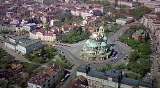
Sofia

Encyclopedia
Sofia is the capital
and largest city of Bulgaria
and the 12th largest city
in the European Union
with a population of 1.27 million people. It is located in western Bulgaria, at the foot of Mount Vitosha
and approximately at the centre of the Balkan Peninsula.
Prehistoric settlements were excavated in the centre of the present city, near the royal palace
, as well as in outer districts Slatina and Obelya. The well-preserved town walls (especially their substructures) date back before the 7th century BC, when Thracians
established their city around a mineral spring, which exists to the present day. Sofia has had several names in the different periods of its existence. Its ancient name, Serdica, derives from the local Celtic tribe of the serdi
who inhabited the region since the 1st century BC. During the Middle Ages
, it was one of the major commercial centres of the Bulgarian Empire, along with Tarnovo. Sofia's population remained small until 1879, when it was decarled a capital of the Principality of Bulgaria
after the Liberation of Bulgaria from Ottoman rule.
Sofia has been rankded by GaWC as a beta- world city. Many of the major universities, cultural institution
s, and business
es of Bulgaria are concentrated in Sofia.
' campaigns in 59 BC. The name Serdica or Sardica (Σερδική, Σαρδική) was popular in Latin
, Ancient Greek
and Byzantine Greek
sources from Antiquity and the Middle Ages
; it was related to the local Celtic tribe of the Serdi
. The name was last used in the 19th century in a Bulgarian text, Service and hagiography of Saint George the New of Sofia: ВЪ САРДАКІИ. Another of Sofia's names, Triaditsa (Τριάδιτζα), was mentioned in Greek medieval sources. The Bulgarian name Sredets (СРѢДЄЦЪ), which is related to среда sreda (middle), first appeared in the 11th-century Vision of Daniel and was widely used in the Middle Ages. The current name Sofia was first used in the 14th-century Vitosha Charter of Bulgarian tsar Ivan Shishman
or in a Ragusan
merchant's notes of 1376; it refers to the famous Hagia Sophia Church, an ancient church in the city named after the Christian concept of the Holy Wisdom. Although Sredets remained in use until the late 18th century, Sofia gradually overcame the Slavic name in popularity. During the Ottoman rule it was called Sofya by the Turkish conquerors of Bulgaria.
The city's name is pronounced by Bulgarians with a stress on the 'o', in contrast with the tendency of foreigners to place the stress on 'i'. Interestingly, the female given name "Sofia" is pronounced by Bulgarians with a stress on the 'i'.
. It is situated in western Bulgaria, at the northern foot of the Vitosha
mountain, in the Sofia Valley
that is surrounded by mountains on all sides. The valley is the largest in the country with territory of
1186 square kilometres (457.9 sq mi) and average altitude of 550 metres (1,804.5 ft). Three mountain pass
es lead to the city, which have been key roads since antiquity, connecting the Adriatic Sea
and Central Europe
with the Black
and Aegean Sea
s.
A number of low rivers cross the city, including the Vladaiska
and the Perlovska
. The Iskar River in its upper course flows near eastern
Sofia. The city is known for its numerous mineral
and thermal
springs. Artificial and dam lakes were built in the last century.
It is located 130 kilometres (80.8 mi) northwest of Plovdiv
, Bulgaria's second largest city, 340 kilometres (211.3 mi) west of Burgas
and 380 kilometres (236.1 mi) west of Varna
, Bulgaria's major port-cities on the Bulgarian Black Sea Coast
. The city is situated at less than 200 kilometres (124.3 mi) from the borders with three countries: 55 kilometres (34.2 mi) from Kalotina
on the Serbia
n border, 113 kilometres (70.2 mi) from Gyueshevo
on the frontier with the Republic of Macedonia
and 183 kilometres (113.7 mi) from the Greek
border at Kulata
.
with high temperature amplitudes. It is one of the coldest cities in Bulgaria
with an
annual temperature of 10.5 °C (50.9 °F). Annual clear days vary from 39 to 68, while annual rainy or stormy days vary from 141 to 185.
Winters are very cold, and summers are warm. The coldest month is January, when the temperature can drop down to -22 C in some places. The temperature can even reach 35 °C (95 °F), but Sofia generally remains cooler than other parts of Bulgaria
, due to the high altitude of the valley in which it is situated.
Thunderstorms often occur during the summer season.
The city receives around 650 millimetres (25.6 in) annual precipitation with summer maximum and winter minimum.
settlement called Serdica, or Sardica, possibly named after the Celtic tribe Serdi
. For a short period during the 4th century BC, the city was ruled by Philip of Macedon
and his son Alexander the Great. Around BC 29, Serdica was conquered by the Romans
. It became a municipium, or centre of an administrative region, during the reign of Emperor Trajan
(98–117) and was renamed Ulpia Serdica. It seems that the first written mention of Serdica was made by Ptolemy
(around 100 AD).
Serdica (Sardica) expanded, as turret
s, protective walls, public baths
, administrative and cult buildings, a civic basilica
, an amphitheatre
– the City Council
(Boulé), a large Forum, a big Circus (Theatre), etc. were built.
When Emperor Diocletian
divided the province of Dacia
into Dacia Ripensis (at the banks of the Danube
) and Dacia Mediterranea, Serdica became the capital of Dacia Mediterranea. The city subsequently expanded for a century and a half, it became a significant political and economical centre, moreso — it became one of the first Roman cities where Christianity was recognized as an official religion
(Еmperor Galerius
). In 343 AD, the Council of Sardica
was held in the city, in a church located where the current 6th century Church of Saint Sophia was later built.
The city was destroyed in the 447 invasion of the Huns
. It was rebuilt by Byzantine Emperor Justinian I
and for a while called Triaditsa or Sredets by the slavonic tribes
. During the reign of Justinian it flourished, being surrounded with great fortress walls whose remnants can still be seen today.
during the reign of Khan Krum in 809, after a long siege
. Afterwards, it was known by the Bulgarian
name "Sredets" and grew into an important fortress and administrative centre. After the fall of North-eastern Bulgaria under John I Tzimiskes
' armies in 971, the Bulgarian Patriarch Damyan chose Sofia for his seat in the next year. After a number of unsuccessful sieges, the city fell to the Byzantine Empire
in 1018, but once again was incorporated into the restored Bulgarian Empire
at the time of Tsar Ivan Asen I
.
From the 12th to the 14th century, Sofia was a thriving centre of trade and crafts. It is possible that it had been called by the common population Sofia (meaning "wisdom" in Ancient Greek
) about 1376 after the church of Saint Sophia. However, in different testimonies it was called both "Sofia" and "Sredets" until the end of the 19th century. In 1382, Sofia was seized by the Ottoman Empire
in the course of the Bulgarian-Ottoman Wars after a long siege.
After the failed crusade of Władysław III of Poland in 1443 towards Sofia, the city's Christian elite was annihilated and the city became the capital of the Ottoman province
(beylerbeylik) of Rumelia
for more than four centuries, which encouraged many Turks to settle there. In the 16th century, Sofia's urban layout and appearance began to exhibit a clear Ottoman style, with many mosques, fountains and hamams (bathhouses). During that time the town had a population of around 7,000.
The town was seized for several weeks by Bulgarian hayduts
in 1599. In 1610 the Vatican established the See of Sofia for Catholics of Rumelia
, which existed until 1715 when most Catholics had emigrated. In the 16th century there were 126 Jewish households, and there has been a synagogue in Sofia since 967. The town was the center of Sofya Eyalet
(1826–1864).
on January 4, 1878, during the Russo-Turkish War, 1877–78, and became the capital of the autonomous Principality of Bulgaria
in 1879, which became the Kingdom of Bulgaria
in 1908. It was proposed as a capital by Marin Drinov
and was accepted as such on 3 April 1879. After the Liberation War, the new name "Sofia" replaced the old one ("Sredets"). Quite some time after 1878 there was a strong will, expressed by Bulgarian committees, to keep the name Sredets, but the Russian administration accepted Sofia. By the time of its liberation the population of the city was 11,649. For a few decades after the liberation the city experienced large population growth mainly from other regions of the country.
During World War II
, Sofia was bombed by Allied aircraft
– British and USA aircraft, in late 1943 and early 1944. As a consequence of the invasion of the Soviet
Red Army
, Bulgaria's government, which was allied with Germany
, was overthrown.
The transformations of Bulgaria into a People's Republic in 1946 and Republic of Bulgaria
marked significant changes in the city's appearance. The population of Sofia expanded rapidly due to migration from the country. Whole new residential areas were built in the outskirts of the city, like Druzhba, Mladost and Lyulin.
. It should not to be confused with Sofia Province
, which surrounds but does not include the city itself. Besides the city proper, the capital province encompasses three other cities and 34 villages, being split into a total of 24 districts. Each of them has its own district mayor who is elected in a popular election. The head of the Sofia Municipality is its mayor. The assembly members are chosen every four years. The current mayor of Sofia is Yordanka Fandakova
.
The following are some of the most culturally and economically significant districts:
), the 4th century Rotunda of St. George, the walls of the Serdica fortress and the partially preserved Amphitheatre of Serdica
.
After the Liberation War, knyaz Alexander Battenberg
invited architects from Austria–Hungary to shape the new capital's architectural appearance. Among the architects invited to work in Bulgaria were Friedrich Grünanger
, Adolf Václav Kolář, Viktor Rumpelmayer
and others, who designed the most important public buildings needed by the newly-reestablished Bulgarian government, as well as numerous houses for the country's elite. Later, many foreign-educated Bulgarian architects also contributed. The architecture of Sofia's centre is thus a combination of Neo-Baroque, Neo-Rococo
, Neo-Renaissance and Neoclassicism
, with the Vienna Secession
also later playing an important part, but it is mostly typically Central European.
After the Second World War and the establishment of a Communist government
in Bulgaria in 1944, the architectural line was substantially altered. Stalinist Gothic
public buildings emerged in the centre, notably the spacious government complex around The Largo
, Vasil Levski Stadium, the Cyril and Methodius National Library and others. As the city grew outwards, the then-new neighbourhoods were dominated by many concrete tower block
s, prefabricated panel apartment buildings and examples of Brutalist architecture
.
After the abolition of Communism
in 1989, Sofia has witnessed the construction of whole business districts and neighbourhoods, as well as modern skryscraper-like glass-fronted office buildings, but also top-class residential neighbourhoods. However, the end of the old administration and centrally planned system also paved the way for chaotic and unrestrained construction, which continues to the present day.
, and almost all streets have a greenway
of century-old trees. The only exception are some of the neighbourhoods constructed after 2000, which are densely built-up and often lack green spaces. There are four principal parks – Borisova gradina
in the city centre and the Southern, Western and Northern parks. Several other smaller parks, among which the City Garden
and the Doctors' Garden
, are located in central Sofia. The Vitosha Nature Park
(the oldest national park
in the Balkans
), which includes a large portion of Vitosha mountain
, covers an area of almost 270 km² and lies entirely within the city limits. Many of the city's residents take weekly hikes up the mountain, and most do so at least a couple of times a year. There are bungalows as well as several ski slopes on Vitosha, allowing locals to take full advantage of the countryside and of the mountains without having to leave the city.
, which performs mainly classical plays and is situated in the very centre of the city. A large number of smaller theatres, such as the Sfumato Theatrical Workshop, show both classical and modern plays.
The National Opera and Ballet
is a combined opera
and ballet
collective, established in 1891. However, it did not begin performances on a regular basis until 1909. Some of Bulgaria's most famous operatic singers, such as Nicolai Ghiaurov
and Ghena Dimitrova
, have made their first appearances on the stage of the National Opera and Ballet. Bulgaria Hall and Hall 1 of the National Palace of Culture
regularly hold classical concerts, performed both by foreign orchestras and the Sofia Philharmonic. The city has played host to many world-famous musical acts including Sting, Elton John
, Madonna
, George Michael
, Tiesto
, Kylie Minogue
, Depeche Mode
, Rammstein
, Rihanna
and Roxette
.
Visual arts expositions are also of interest. The National Art Gallery
holds a collection of works mostly by Bulgarian authors, while the National Gallery for Foreign Art
displays exclusively foreign art, mostly from India, Africa, China and Europe. Its collections encompass diverse cultural items such as Ashanti Empire
sculptures, Buddhist
art, Dutch Golden Age
painting, works by Albrecht Dürer
, Jean-Baptiste Greuze
and Auguste Rodin
, among others. The crypt
of the Alexander Nevsky cathedral holds a collection of Eastern Orthodox icons from the 9th to the 19th century.
Cinema is the most popular form of entertainment. In recent years, cinematic venues have been concentrating in trade centres and mall
s, and independent halls have been closed. Mall of Sofia
holds one of the largest IMAX
cinemas in Europe. Most films are American productions, although European and domestic films are increasingly shown. Odeon (not part of the Odeon Cinemas
chain) shows exclusively European and independent American films, as well as 20th century classics. Bulgaria's once thriving film industry, concentrated in the Boyana Film
studios, has suffered a period of decay after 1990. A relative revival of the industry began after 2001. After the acquisition of Boyana Film by Nu Image, several moderately successful productions have been shot in and around Sofia, such as The Contract, The Black Dahlia
, Hitman
and Conan the Barbarian. The Nu Boyana Film studios have also hosted some of the scenes for The Expendables 2
.
The city houses many cultural institutes such as the Russian Cultural Institute, the Polish Cultural Institute, the Hungarian Institute, the Czech and the Slovak Cultural Institutes, the Italian Cultural Institute, the French Cultural Institute, Goethe Institut
, British Council
, Instituto Cervantes
, and the Open Society Institute
, which regularly organise temporary expositions of visual, sound and literary works by artists from their respective countries.
Some of the biggest telecommunications companies, TV and radio stations, newspapers, magazines, and web portals are based in Sofia, including the Bulgarian National Television
, bTV and Nova TV. Top-circulation newspapers include 24 Chasa
, Trud
and Kapital Daily.
, one of the symbols of Bulgaria, constructed in the late 19th century. It occupies an area of 3,170 square metres (34,100 sq ft) and can hold 10,000 people. The city is also known for the Boyana Church
, a UNESCO
world heritage site. The SS. Cyril and Methodius National Library
houses the largest national collection of books and documents (1,714,211 books and some 6 million other documents) and is Bulgaria's oldest cultural institute.
Sofia also holds Bulgaria's largest museum collections, which attract both tourists and students for practical studies. The National Historical Museum
in Boyana
district has a vast collection of more than 650,000 historical items dating from Prehistory to the modern era, although only 10,000 of them are permanently displayed due to the lack of space. Smaller collections of items related mostly to the history of Sofia are located in the National Archaeological Museum
, a former mosque located between the edifices of the National Bank and the Presidency. Two natural sciences museums - the Natural History Museum
and the Earth and Man
display a variety of minerals, animal species (both alive and taxidermic
) and rare materials. The Ethnographic Museum and the National Museum of Military History are other places of interest, holding large collections of Bulgarian folk costumes and various armaments, respectively.
Vitosha Boulevard
, also called Vitoshka, has numerous fashion boutiques and luxury good
s stores. Sofia's geographic location
, situated in the foothills of the weekend retreat Vitosha
mountain, further adds to the city's specific atmosphere.
, Levski
and Slavia
are dominant not only in football, but in many other team sports as well. Basketball and volleyball also have strong traditions in Sofia. A notable local basketball team
is twice European Champions Cup finalist Lukoil Akademik
. The Bulgarian Volleyball Federation is the world's second-oldest, and it was an exhibition tournament organised by the BVF in Sofia that convinced the International Olympic Committee
to include volleyball as an olympic sport in 1957. Tennis is increasingly popular in the city. Currently there are some ten tennis court
complexes within the city including the one founded by former WTA
top-ten athlete Magdalena Maleeva
.
Sofia applied to host the Winter Olympic Games
in 1992 and in 1994, coming 2nd and 3rd respectively. The city was also an applicant for the 2014 Winter Olympics
, but was not selected as candidate. In addition, Sofia hosted Eurobasket 1957
and the 1961
and 1977 Summer Universiade
s, as well as the 1983
and 1989 winter editions
. In 2012, it will host the FIVB World League finals.
The city is home to a number of large sports venues, including the 43,000-seat Vasil Levski National Stadium
which hosts international football matches, and Lokomotiv Stadium, the main venue for outdoor musical concerts. Armeets Arena holds many indoor events and has a capacity of up to 19,000 people depending on its use. There are two ice skating
complexes — the Winter Palace of Sports with a capacity of 4,000 and the Slavia Winter Stadium with a capacity of 2,000, both containing two rinks each. A velodrome
with 5,000 seats in the city's central park
is currently undergoing renovation. There are also various other sports complexes in the city which belong to institutions other than football clubs, such as those of the National Sports Academy
, the Bulgarian Academy of Sciences
, or those of different universities. There are more than fifteen swimming complexes in the city, most of them outdoor. Nearly all of these were constructed as competition venues and therefore have seating facilities for several hundred people.
There are two golf courses
just to the east of Sofia — in Elin Pelin
(St Sofia club) and in Ihtiman
(Air Sofia club), and a horseriding club (St George club).
The ratio of women per 1,000 men was 1,102. The birth rate
per 1000 people was 12.3 per mille and steadily increasing in the last 5 years, the death rate
reaching 12.1 per mille and decreasing. The natural growth rate during 2009 was 0.2 per mille, the first positive growth rate in nearly 20 years. The considerable immigration to the capital from poorer regions of the country, as well as urbanisation, are among the other reasons for the increase in Sofia's population. 4.8 people of every one thousand were wedded in 2009 (only heterosexual marriage is possible in Bulgaria) and the infant mortality rate
was 5.6 per 1,000, down from 18.9 in 1980.
According to the 2001 census, Sofia's population is made up of 96% ethnic Bulgarians
; among minority communities, nearly 18,000 (1.5%) officially identified themselves as Roma, 6,000 as Turkish
, 3,000 as Russian
, 1,700 as Armenian
, and 1,200 as Greek
.
The unemployment is lower than in other parts of the country — 2.45% of the active population in 1999 and declining, compared to 7.25% for the whole of Bulgaria as of 1 July 2007. The large share of unemployed people with higher education
, 27% as compared to 7% for the whole country, is a characteristic feature of the capital.
Sofia was declared capital in 1879. One year later, in 1880, it was the fifth-largest city in the country after Plovdiv
, Varna
, Ruse and Shumen
. Plovdiv remained the most populous Bulgarian town until 1892 when Sofia took the lead.
and the Bulgarian Stock Exchange. With a nominal GDP of 20.59 billion leva
(US $14.24 billion), and a PPS GDP per capita of the city and its surrounding Yugozapaden
NUTS II planning region of $25,130, the capital is the centre of the national economy. In 2007, the average per capita monthly income was 3,828 leva ($2,648), substantially higher than the national average of 689 leva ($477). The strongest sectors of the city's economy in terms of annual production are manufacturing ($5.5 bln.), metallurgy ($1.84 bln.), electricity, gas and water supply ($1.6 bln.) and food and beverages ($778 mln.).
After World War II and the era of industrialisation under socialism, the city and its surrounding areas expanded rapidly and became the most heavily industrialised region of the country. The influx of workers from other parts of the country became so intense that a restriction policy was imposed, and residing in the capital was only possible after obtaining Sofianite citizenship. However, after the political changes in 1989, this kind of citizenship was removed.
Increasingly, Sofia is becoming an outsourcing
destination for multinational companies
, among them IBM
, Hewlett-Packard
, SAP
, Siemens
, Software AG
. Bulgaria Air
, the national airline of Bulgaria, has its head office on the grounds of Sofia Airport
.
Up until 2007 Sofia experienced rapid economic growth
. In 2008, apartment prices increased dramatically, with a growth rate of 30%.
In 2009, prices fell by 26%.
) are represented in the city. It is home to eight railway stations
, the biggest of which is the Central Railway Station
. Just next to it is the new Central Bus Station
. A number of other bus stations allow interurban and international trips from different parts of the city. The Sofia Airport
with its new second terminal, finished in 2006,
handled some 2.7 million passengers in 2007.
Public transport
is well-developed with bus, tram
(153,6 km network) and trolleybus
(97 km network) lines running in all areas of the city,
although most vehicles are in a poor condition. The Sofia Metro
became operational in 1998, and now has one line and 14 stations. As of 2011, the system has 18 kilometers of track. Six new stations opened in 2009. Construction works on the extension of the first line are ongoing; two new stations are expected to be completed in 2012. A second line with 11 stations is under construction with a targeted completion date in 2012. A third line is currently under consideration.
The master plan for the Sofia Metro includes three lines with a total of 47 stations. In recent years the marshrutka
, a private passenger van, began serving fixed routes and proved an efficient and popular means of transport
by being faster than public transport but cheaper than taxis. As of 2005 these vans numbered 368 and serviced 48 lines around the city and suburbs. There are some 6,000 licensed taxi cabs
operating in the city
and another 2,000 operating somewhat illegally.
Low fares in comparison with other European countries, make taxis affordable and popular among a big part of the city population.
Private automobile ownership has grown rapidly in the 1990s; more than 1,000,000 cars were registered in Sofia after 2002. The city has the 5th-highest number of automobiles per capita in the European Union at 546.4 vehicles per 1,000 people. The municipality is known for minor and cosmetic repairs and many streets are in a poor condition. There are different boulevards and streets in the city with a higher amount of traffic than others. These include Cherni Vrah, Bulgaria, and Todor Aleksandrov boulevards, where long chains of cars are formed at peak hours and traffic jams occur regularly. Consequently traffic and air pollution
problems have become more severe and receive regular criticism in local media. The extension of the underground system is hoped to alleviate the city's immense traffic problems.
Sofia has a unique, very large combined heat and power (CHP)
plant. Virtually the entire city (900,000 households and 5,900 companies) is centrally heated, using residual heat from electricity generation
(3,000 MW
) and gas- and oil-fired heating furnaces; total heat capacity
is 4,640 MW. The heat distribution piping network is 900 km long and comprises 14,000 substations and 10,000 heated buildings.
, often regarded as the most prestigious university of Bulgaria, was founded in 1888 and expanded in the 1950s. The university's edifice was constructed between 1924 and 1934 with the financial support of brothers Evlogi Georgiev
and Hristo Georgiev. The university enrolls 14,000 students annually.
Other leading higher education establishments are the National Academy of Arts
, the Technical University of Sofia
, Sofia Medical University
, Rakovski Defence and Staff College
, and New Bulgarian University
.
Secondary education institutions are numerous and include vocational and language schools. The "elite" secondary language schools provide education in a selected foreign language. These include the 91st German Language School, 164th Spanish Language School, First English Language School, and 9th French Language School. Some of them provide a language certificate upon graduation, while the 9th French Language School has exchange programs with a number of lycées in France
and Switzerland
, such as the Parisian Collège-lycée Jacques-Decour. The American College of Sofia
was founded in 1860 and often regarded as the oldest American academic institution
outside the United States.
Other institutions of national significance, such as the Bulgarian Academy of Sciences
(BAS) and the SS. Cyril and Methodius National Library
are located in Sofia. BAS is the centrepiece of scientific research in Bulgaria, employing more than 4,500 scientists in various institutes, including the Bulgarian Space Agency.
 Notable people born in Sofia:
Algiers
, Algeria Ankara
, Turkey (since 1992) Berlin
, Germany Bratislava
, Slovakia (since 2008) Brussels
, Belgium Bucharest
, Romania Budapest
, Hungary Bursa, Turkey (since 1998) Helsinki
, Finland Kiev
, Ukraine (since 1997) London
, United Kingdom Madrid
, Spain Milan
, Italy Paris
, France (since 1998) Pittsburgh, United States Prague
, Czech Republic Saint Petersburg
, Russia Maraş
, Turkey Tel Aviv
, Israel (since 1992) Moscow
, Russia Tirana
, Albania (since 2008) Yerevan
, Armenia (since 2008) Warsaw
, Poland Salalah
, Oman,(since 4 August 2011)
on Livingston Island in the South Shetland Islands
, Antarctica is named after Serdica.
Streets in Sofia
Capital City
Capital City was a television show produced by Euston Films which focused on the lives of investment bankers in London living and working on the corporate trading floor for the fictional international bank Shane-Longman....
and largest city of Bulgaria
Bulgaria
Bulgaria , officially the Republic of Bulgaria , is a parliamentary democracy within a unitary constitutional republic in Southeast Europe. The country borders Romania to the north, Serbia and Macedonia to the west, Greece and Turkey to the south, as well as the Black Sea to the east...
and the 12th largest city
Largest cities of the European Union by population within city limits
This is a list of the largest cities in the European Union by population within city limits which have more than 300,000 inhabitants. It deals exclusively with the areas within city administrative boundaries as opposed to urban areas or metropolitan areas, which are generally larger in terms of...
in the European Union
European Union
The European Union is an economic and political union of 27 independent member states which are located primarily in Europe. The EU traces its origins from the European Coal and Steel Community and the European Economic Community , formed by six countries in 1958...
with a population of 1.27 million people. It is located in western Bulgaria, at the foot of Mount Vitosha
Vitosha
Vitosha is a mountain massif, on the outskirts of Sofia, the capital of Bulgaria. Vitosha is one of the tourists symbols of Sofia and the closest site for hiking, alpinism and skiing. Convenient bus lines and rope ways render the mountain easily accessible. Vitosha has the outlines of an enormous...
and approximately at the centre of the Balkan Peninsula.
Prehistoric settlements were excavated in the centre of the present city, near the royal palace
National Art Gallery (Bulgaria)
The National Art Gallery is Bulgaria's national gallery and houses over 50,000 pieces of Bulgarian art. It is located on Battenberg Square in the capital city of Sofia, occupying most of the historic and imposing edifice of the former royal palace of Bulgaria, having been established in 1934 and...
, as well as in outer districts Slatina and Obelya. The well-preserved town walls (especially their substructures) date back before the 7th century BC, when Thracians
Thracians
The ancient Thracians were a group of Indo-European tribes inhabiting areas including Thrace in Southeastern Europe. They spoke the Thracian language – a scarcely attested branch of the Indo-European language family...
established their city around a mineral spring, which exists to the present day. Sofia has had several names in the different periods of its existence. Its ancient name, Serdica, derives from the local Celtic tribe of the serdi
Serdi
The Serdi were a Celtic tribe inhabiting Thrace. They were located around Serdika , which reflects their ethnonym. They would have established themselves in this area during the Celtic migrations at the end of the 4th century BC, though there is no evidence for their existence before the 1st...
who inhabited the region since the 1st century BC. During the Middle Ages
Middle Ages
The Middle Ages is a periodization of European history from the 5th century to the 15th century. The Middle Ages follows the fall of the Western Roman Empire in 476 and precedes the Early Modern Era. It is the middle period of a three-period division of Western history: Classic, Medieval and Modern...
, it was one of the major commercial centres of the Bulgarian Empire, along with Tarnovo. Sofia's population remained small until 1879, when it was decarled a capital of the Principality of Bulgaria
Principality of Bulgaria
The Principality of Bulgaria was a self-governing entity created as a vassal of the Ottoman Empire by the Treaty of Berlin in 1878. The preliminary treaty of San Stefano between the Russian Empire and the Porte , on March 3, had originally proposed a significantly larger Bulgarian territory: its...
after the Liberation of Bulgaria from Ottoman rule.
Sofia has been rankded by GaWC as a beta- world city. Many of the major universities, cultural institution
Institution
An institution is any structure or mechanism of social order and cooperation governing the behavior of a set of individuals within a given human community...
s, and business
Business
A business is an organization engaged in the trade of goods, services, or both to consumers. Businesses are predominant in capitalist economies, where most of them are privately owned and administered to earn profit to increase the wealth of their owners. Businesses may also be not-for-profit...
es of Bulgaria are concentrated in Sofia.
Names
Sofia was first mentioned in the sources as Serdica in relation to Marcus Licinius CrassusMarcus Licinius Crassus
Marcus Licinius Crassus was a Roman general and politician who commanded the right wing of Sulla's army at the Battle of the Colline Gate, suppressed the slave revolt led by Spartacus, provided political and financial support to Julius Caesar and entered into the political alliance known as the...
' campaigns in 59 BC. The name Serdica or Sardica (Σερδική, Σαρδική) was popular in Latin
Latin
Latin is an Italic language originally spoken in Latium and Ancient Rome. It, along with most European languages, is a descendant of the ancient Proto-Indo-European language. Although it is considered a dead language, a number of scholars and members of the Christian clergy speak it fluently, and...
, Ancient Greek
Ancient Greek
Ancient Greek is the stage of the Greek language in the periods spanning the times c. 9th–6th centuries BC, , c. 5th–4th centuries BC , and the c. 3rd century BC – 6th century AD of ancient Greece and the ancient world; being predated in the 2nd millennium BC by Mycenaean Greek...
and Byzantine Greek
Medieval Greek
Medieval Greek, also known as Byzantine Greek, is the stage of the Greek language between the beginning of the Middle Ages around 600 and the Ottoman conquest of the city of Constantinople in 1453. The latter date marked the end of the Middle Ages in Southeast Europe...
sources from Antiquity and the Middle Ages
Middle Ages
The Middle Ages is a periodization of European history from the 5th century to the 15th century. The Middle Ages follows the fall of the Western Roman Empire in 476 and precedes the Early Modern Era. It is the middle period of a three-period division of Western history: Classic, Medieval and Modern...
; it was related to the local Celtic tribe of the Serdi
Serdi
The Serdi were a Celtic tribe inhabiting Thrace. They were located around Serdika , which reflects their ethnonym. They would have established themselves in this area during the Celtic migrations at the end of the 4th century BC, though there is no evidence for their existence before the 1st...
. The name was last used in the 19th century in a Bulgarian text, Service and hagiography of Saint George the New of Sofia: ВЪ САРДАКІИ. Another of Sofia's names, Triaditsa (Τριάδιτζα), was mentioned in Greek medieval sources. The Bulgarian name Sredets (СРѢДЄЦЪ), which is related to среда sreda (middle), first appeared in the 11th-century Vision of Daniel and was widely used in the Middle Ages. The current name Sofia was first used in the 14th-century Vitosha Charter of Bulgarian tsar Ivan Shishman
Ivan Shishman of Bulgaria
Ivan Shishman ruled as emperor of Bulgaria in Tarnovo from 1371 to 3 July 1395. The authority of Ivan Shishman was limited to the central parts of the Bulgarian Empire. His indecisive and inconsistent policy did little to prevent the fall of his country under Ottoman rule. In 1393 the Ottoman...
or in a Ragusan
Republic of Ragusa
The Republic of Ragusa or Republic of Dubrovnik was a maritime republic centered on the city of Dubrovnik in Dalmatia , that existed from 1358 to 1808...
merchant's notes of 1376; it refers to the famous Hagia Sophia Church, an ancient church in the city named after the Christian concept of the Holy Wisdom. Although Sredets remained in use until the late 18th century, Sofia gradually overcame the Slavic name in popularity. During the Ottoman rule it was called Sofya by the Turkish conquerors of Bulgaria.
The city's name is pronounced by Bulgarians with a stress on the 'o', in contrast with the tendency of foreigners to place the stress on 'i'. Interestingly, the female given name "Sofia" is pronounced by Bulgarians with a stress on the 'i'.
Geography
Sofia's development as a significant settlement owes much to its central position in the BalkansBalkans
The Balkans is a geopolitical and cultural region of southeastern Europe...
. It is situated in western Bulgaria, at the northern foot of the Vitosha
Vitosha
Vitosha is a mountain massif, on the outskirts of Sofia, the capital of Bulgaria. Vitosha is one of the tourists symbols of Sofia and the closest site for hiking, alpinism and skiing. Convenient bus lines and rope ways render the mountain easily accessible. Vitosha has the outlines of an enormous...
mountain, in the Sofia Valley
Sofia Valley
The Sofia Valley is a valley in central western Bulgaria, bordering Stara Planina to the northeast, the Viskyar, Lyulin, Vitosha and Lozen mountains to the southwest, the Vakarel Mountain to the southeast and the low Slivnitsa Heights to the northwest....
that is surrounded by mountains on all sides. The valley is the largest in the country with territory of
1186 square kilometres (457.9 sq mi) and average altitude of 550 metres (1,804.5 ft). Three mountain pass
Mountain pass
A mountain pass is a route through a mountain range or over a ridge. If following the lowest possible route, a pass is locally the highest point on that route...
es lead to the city, which have been key roads since antiquity, connecting the Adriatic Sea
Adriatic Sea
The Adriatic Sea is a body of water separating the Italian Peninsula from the Balkan peninsula, and the system of the Apennine Mountains from that of the Dinaric Alps and adjacent ranges...
and Central Europe
Central Europe
Central Europe or alternatively Middle Europe is a region of the European continent lying between the variously defined areas of Eastern and Western Europe...
with the Black
Black Sea
The Black Sea is bounded by Europe, Anatolia and the Caucasus and is ultimately connected to the Atlantic Ocean via the Mediterranean and the Aegean seas and various straits. The Bosphorus strait connects it to the Sea of Marmara, and the strait of the Dardanelles connects that sea to the Aegean...
and Aegean Sea
Aegean Sea
The Aegean Sea[p] is an elongated embayment of the Mediterranean Sea located between the southern Balkan and Anatolian peninsulas, i.e., between the mainlands of Greece and Turkey. In the north, it is connected to the Marmara Sea and Black Sea by the Dardanelles and Bosporus...
s.
A number of low rivers cross the city, including the Vladaiska
Vladaya River
The Vladaya River is a river in western Bulgaria, a tributary to the Iskar River.The river flows from the northwestern slopes of Cherni Vrah on Vitosha Mountain, crossing Torfeno Branishte Nature Reserve, then submerging beneath Zlatnite Mostove Stone River, turning to the northeast at the village...
and the Perlovska
Perlovska
The Perl River or Perlovska River is a small river in the Sofia Valley in western Bulgaria. The river is only long. It takes its source from the foothills of Vitosha, runs through Sofias South Park, separates the two lanes of Evlogi Georgiev Boulevard, runs through the neighbourhood Poduyane, and...
. The Iskar River in its upper course flows near eastern
Near East
The Near East is a geographical term that covers different countries for geographers, archeologists, and historians, on the one hand, and for political scientists, economists, and journalists, on the other...
Sofia. The city is known for its numerous mineral
Spring (hydrosphere)
A spring—also known as a rising or resurgence—is a component of the hydrosphere. Specifically, it is any natural situation where water flows to the surface of the earth from underground...
and thermal
Hot spring
A hot spring is a spring that is produced by the emergence of geothermally heated groundwater from the Earth's crust. There are geothermal hot springs in many locations all over the crust of the earth.-Definitions:...
springs. Artificial and dam lakes were built in the last century.
It is located 130 kilometres (80.8 mi) northwest of Plovdiv
Plovdiv
Plovdiv is the second-largest city in Bulgaria after Sofia with a population of 338,153 inhabitants according to Census 2011. Plovdiv's history spans some 6,000 years, with traces of a Neolithic settlement dating to roughly 4000 BC; it is one of the oldest cities in Europe...
, Bulgaria's second largest city, 340 kilometres (211.3 mi) west of Burgas
Burgas
-History:During the rule of the Ancient Romans, near Burgas, Debeltum was established as a military colony for veterans by Vespasian. In the Middle Ages, a small fortress called Pyrgos was erected where Burgas is today and was most probably used as a watchtower...
and 380 kilometres (236.1 mi) west of Varna
Varna
Varna is the largest city and seaside resort on the Bulgarian Black Sea Coast and third-largest in Bulgaria after Sofia and Plovdiv, with a population of 334,870 inhabitants according to Census 2011...
, Bulgaria's major port-cities on the Bulgarian Black Sea Coast
Bulgarian Black Sea Coast
The Bulgarian Black Sea Coast covers the entire eastern bound of Bulgaria stretching from the Romanian Black Sea resorts in the north to European Turkey in the south, along 378 km of coastline. White and golden sandy beaches occupy approximately 130 km of the 378 km long coast...
. The city is situated at less than 200 kilometres (124.3 mi) from the borders with three countries: 55 kilometres (34.2 mi) from Kalotina
Kalotina
Kalotina is a village in Dragoman municipality, Sofia Province, in westernmost central Bulgaria. As of 2010 it has 270 inhabitants and the mayor is Lidia Bozhilova. The village is located at the border with Serbia, 55 km to the northwest of the capital Sofia, on the main highway and railway...
on the Serbia
Serbia
Serbia , officially the Republic of Serbia , is a landlocked country located at the crossroads of Central and Southeast Europe, covering the southern part of the Carpathian basin and the central part of the Balkans...
n border, 113 kilometres (70.2 mi) from Gyueshevo
Gyueshevo
Gyueshevo is a village in Kyustendil municipality, Kyustendil Province, in western Bulgaria. the population is 275 and the mayor is Stoyne Maksimov. The village is located on the border with the Republic of Macedonia and is the most important of the three border checkpoints between the two...
on the frontier with the Republic of Macedonia
Republic of Macedonia
Macedonia , officially the Republic of Macedonia , is a country located in the central Balkan peninsula in Southeast Europe. It is one of the successor states of the former Yugoslavia, from which it declared independence in 1991...
and 183 kilometres (113.7 mi) from the Greek
Greece
Greece , officially the Hellenic Republic , and historically Hellas or the Republic of Greece in English, is a country in southeastern Europe....
border at Kulata
Kulata
Kulata is a village in Petrich municipality, Blagoevgrad Province, in southwestern Bulgaria. it has 892 inhabitants and the mayor is Dimitar Manolev. The village is a major border checkpoint on the border with Greece...
.
Climate
Sofia has a humid continental climateHumid continental climate
A humid continental climate is a climatic region typified by large seasonal temperature differences, with warm to hot summers and cold winters....
with high temperature amplitudes. It is one of the coldest cities in Bulgaria
Bulgaria
Bulgaria , officially the Republic of Bulgaria , is a parliamentary democracy within a unitary constitutional republic in Southeast Europe. The country borders Romania to the north, Serbia and Macedonia to the west, Greece and Turkey to the south, as well as the Black Sea to the east...
with an
annual temperature of 10.5 °C (50.9 °F). Annual clear days vary from 39 to 68, while annual rainy or stormy days vary from 141 to 185.
Winters are very cold, and summers are warm. The coldest month is January, when the temperature can drop down to -22 C in some places. The temperature can even reach 35 °C (95 °F), but Sofia generally remains cooler than other parts of Bulgaria
Bulgaria
Bulgaria , officially the Republic of Bulgaria , is a parliamentary democracy within a unitary constitutional republic in Southeast Europe. The country borders Romania to the north, Serbia and Macedonia to the west, Greece and Turkey to the south, as well as the Black Sea to the east...
, due to the high altitude of the valley in which it is situated.
Thunderstorms often occur during the summer season.
The city receives around 650 millimetres (25.6 in) annual precipitation with summer maximum and winter minimum.
Antiquity
Sofia was originally a ThracianThracians
The ancient Thracians were a group of Indo-European tribes inhabiting areas including Thrace in Southeastern Europe. They spoke the Thracian language – a scarcely attested branch of the Indo-European language family...
settlement called Serdica, or Sardica, possibly named after the Celtic tribe Serdi
Serdi
The Serdi were a Celtic tribe inhabiting Thrace. They were located around Serdika , which reflects their ethnonym. They would have established themselves in this area during the Celtic migrations at the end of the 4th century BC, though there is no evidence for their existence before the 1st...
. For a short period during the 4th century BC, the city was ruled by Philip of Macedon
Philip II of Macedon
Philip II of Macedon "friend" + ἵππος "horse" — transliterated ; 382 – 336 BC), was a king of Macedon from 359 BC until his assassination in 336 BC. He was the father of Alexander the Great and Philip III.-Biography:...
and his son Alexander the Great. Around BC 29, Serdica was conquered by the Romans
Ancient Rome
Ancient Rome was a thriving civilization that grew on the Italian Peninsula as early as the 8th century BC. Located along the Mediterranean Sea and centered on the city of Rome, it expanded to one of the largest empires in the ancient world....
. It became a municipium, or centre of an administrative region, during the reign of Emperor Trajan
Trajan
Trajan , was Roman Emperor from 98 to 117 AD. Born into a non-patrician family in the province of Hispania Baetica, in Spain Trajan rose to prominence during the reign of emperor Domitian. Serving as a legatus legionis in Hispania Tarraconensis, in Spain, in 89 Trajan supported the emperor against...
(98–117) and was renamed Ulpia Serdica. It seems that the first written mention of Serdica was made by Ptolemy
Ptolemy
Claudius Ptolemy , was a Roman citizen of Egypt who wrote in Greek. He was a mathematician, astronomer, geographer, astrologer, and poet of a single epigram in the Greek Anthology. He lived in Egypt under Roman rule, and is believed to have been born in the town of Ptolemais Hermiou in the...
(around 100 AD).
Serdica (Sardica) expanded, as turret
Turret
In architecture, a turret is a small tower that projects vertically from the wall of a building such as a medieval castle. Turrets were used to provide a projecting defensive position allowing covering fire to the adjacent wall in the days of military fortification...
s, protective walls, public baths
Public bathing
Public baths originated from a communal need for cleanliness. The term public may confuse some people, as some types of public baths are restricted depending on membership, gender, religious affiliation, or other reasons. As societies have changed, public baths have been replaced as private bathing...
, administrative and cult buildings, a civic basilica
Basilica
The Latin word basilica , was originally used to describe a Roman public building, usually located in the forum of a Roman town. Public basilicas began to appear in Hellenistic cities in the 2nd century BC.The term was also applied to buildings used for religious purposes...
, an amphitheatre
Amphitheatre
An amphitheatre is an open-air venue used for entertainment and performances.There are two similar, but distinct, types of structure for which the word "amphitheatre" is used: Ancient Roman amphitheatres were large central performance spaces surrounded by ascending seating, and were commonly used...
– the City Council
City council
A city council or town council is the legislative body that governs a city, town, municipality or local government area.-Australia & NZ:Because of the differences in legislation between the States, the exact definition of a City Council varies...
(Boulé), a large Forum, a big Circus (Theatre), etc. were built.
When Emperor Diocletian
Diocletian
Diocletian |latinized]] upon his accession to Diocletian . c. 22 December 244 – 3 December 311), was a Roman Emperor from 284 to 305....
divided the province of Dacia
Dacia
In ancient geography, especially in Roman sources, Dacia was the land inhabited by the Dacians or Getae as they were known by the Greeks—the branch of the Thracians north of the Haemus range...
into Dacia Ripensis (at the banks of the Danube
Danube
The Danube is a river in the Central Europe and the Europe's second longest river after the Volga. It is classified as an international waterway....
) and Dacia Mediterranea, Serdica became the capital of Dacia Mediterranea. The city subsequently expanded for a century and a half, it became a significant political and economical centre, moreso — it became one of the first Roman cities where Christianity was recognized as an official religion
State religion
A state religion is a religious body or creed officially endorsed by the state...
(Еmperor Galerius
Galerius
Galerius , was Roman Emperor from 305 to 311. During his reign he campaigned, aided by Diocletian, against the Sassanid Empire, sacking their capital Ctesiphon in 299. He also campaigned across the Danube against the Carpi, defeating them in 297 and 300...
). In 343 AD, the Council of Sardica
Council of Sardica
The Roman Catholic Diocese of Sofia and Plovdiv is a Roman Catholic diocese of the Latin Rite, which includes the whole southern part of Bulgaria. The remainder of Bulgaria is comprised in the Diocese of Nicopoli. The seat of the episcopal see is in Plovdiv. The diocese is immediately subject of...
was held in the city, in a church located where the current 6th century Church of Saint Sophia was later built.
The city was destroyed in the 447 invasion of the Huns
Huns
The Huns were a group of nomadic people who, appearing from east of the Volga River, migrated into Europe c. AD 370 and established the vast Hunnic Empire there. Since de Guignes linked them with the Xiongnu, who had been northern neighbours of China 300 years prior to the emergence of the Huns,...
. It was rebuilt by Byzantine Emperor Justinian I
Justinian I
Justinian I ; , ; 483– 13 or 14 November 565), commonly known as Justinian the Great, was Byzantine Emperor from 527 to 565. During his reign, Justinian sought to revive the Empire's greatness and reconquer the lost western half of the classical Roman Empire.One of the most important figures of...
and for a while called Triaditsa or Sredets by the slavonic tribes
Slavic peoples
The Slavic people are an Indo-European panethnicity living in Eastern Europe, Southeast Europe, North Asia and Central Asia. The term Slavic represents a broad ethno-linguistic group of people, who speak languages belonging to the Slavic language family and share, to varying degrees, certain...
. During the reign of Justinian it flourished, being surrounded with great fortress walls whose remnants can still be seen today.
Middle Ages and Ottoman rule
Sofia first became part of the First Bulgarian EmpireFirst Bulgarian Empire
The First Bulgarian Empire was a medieval Bulgarian state founded in the north-eastern Balkans in c. 680 by the Bulgars, uniting with seven South Slavic tribes...
during the reign of Khan Krum in 809, after a long siege
Siege of Serdica (809)
The Siege of Serdica took place in the spring of 809 at modern Sofia, Bulgaria. As a result, the city was permanently included in the Bulgarian State.- Origins of the conflict :...
. Afterwards, it was known by the Bulgarian
Slavic languages
The Slavic languages , a group of closely related languages of the Slavic peoples and a subgroup of Indo-European languages, have speakers in most of Eastern Europe, in much of the Balkans, in parts of Central Europe, and in the northern part of Asia.-Branches:Scholars traditionally divide Slavic...
name "Sredets" and grew into an important fortress and administrative centre. After the fall of North-eastern Bulgaria under John I Tzimiskes
John I Tzimiskes
John I Tzimiskes or Tzimisces, was Byzantine Emperor from December 11, 969 to January 10, 976. A brilliant and intuitive general, John's short reign saw the expansion of the empire's borders and the strengthening of Byzantium itself.- Background :...
' armies in 971, the Bulgarian Patriarch Damyan chose Sofia for his seat in the next year. After a number of unsuccessful sieges, the city fell to the Byzantine Empire
Byzantine Empire
The Byzantine Empire was the Eastern Roman Empire during the periods of Late Antiquity and the Middle Ages, centred on the capital of Constantinople. Known simply as the Roman Empire or Romania to its inhabitants and neighbours, the Empire was the direct continuation of the Ancient Roman State...
in 1018, but once again was incorporated into the restored Bulgarian Empire
Second Bulgarian Empire
The Second Bulgarian Empire was a medieval Bulgarian state which existed between 1185 and 1396 . A successor of the First Bulgarian Empire, it reached the peak of its power under Kaloyan and Ivan Asen II before gradually being conquered by the Ottomans in the late 14th-early 15th century...
at the time of Tsar Ivan Asen I
Ivan Asen I of Bulgaria
Ivan Asen I ruled as emperor of Bulgaria 1189–1196. The year of his birth is unknown.-Life:...
.
From the 12th to the 14th century, Sofia was a thriving centre of trade and crafts. It is possible that it had been called by the common population Sofia (meaning "wisdom" in Ancient Greek
Ancient Greek
Ancient Greek is the stage of the Greek language in the periods spanning the times c. 9th–6th centuries BC, , c. 5th–4th centuries BC , and the c. 3rd century BC – 6th century AD of ancient Greece and the ancient world; being predated in the 2nd millennium BC by Mycenaean Greek...
) about 1376 after the church of Saint Sophia. However, in different testimonies it was called both "Sofia" and "Sredets" until the end of the 19th century. In 1382, Sofia was seized by the Ottoman Empire
Ottoman Empire
The Ottoman EmpireIt was usually referred to as the "Ottoman Empire", the "Turkish Empire", the "Ottoman Caliphate" or more commonly "Turkey" by its contemporaries...
in the course of the Bulgarian-Ottoman Wars after a long siege.
After the failed crusade of Władysław III of Poland in 1443 towards Sofia, the city's Christian elite was annihilated and the city became the capital of the Ottoman province
Subdivisions of the Ottoman Empire
The subdivisions of the Ottoman Empire were administrative divisions of the state organisation of the Ottoman Empire. Outside this system were various types of vassal and tributary states....
(beylerbeylik) of Rumelia
Rumelia
Rumelia was an historical region comprising the territories of the Ottoman Empire in Europe...
for more than four centuries, which encouraged many Turks to settle there. In the 16th century, Sofia's urban layout and appearance began to exhibit a clear Ottoman style, with many mosques, fountains and hamams (bathhouses). During that time the town had a population of around 7,000.
The town was seized for several weeks by Bulgarian hayduts
Hajduk
Hajduk is a term most commonly referring to outlaws, highwaymen or freedom fighters in the Balkans, Central- and Eastern Europe....
in 1599. In 1610 the Vatican established the See of Sofia for Catholics of Rumelia
Rumelia
Rumelia was an historical region comprising the territories of the Ottoman Empire in Europe...
, which existed until 1715 when most Catholics had emigrated. In the 16th century there were 126 Jewish households, and there has been a synagogue in Sofia since 967. The town was the center of Sofya Eyalet
Eyalet
Eyalets were a former primary administrative division of the Ottoman Empire. The term is sometimes translated province or government. Depending on the rank of their commander, they are also sometimes known as pashaliks, beylerbeyliks, and kapudanliks.From 1453 to the beginning of the nineteenth...
(1826–1864).
After 1878
Sofia was taken by Russian forcesImperial Russian Army
The Imperial Russian Army was the land armed force of the Russian Empire, active from around 1721 to the Russian Revolution of 1917. In the early 1850s, the Russian army consisted of around 938,731 regular soldiers and 245,850 irregulars . Until the time of military reform of Dmitry Milyutin in...
on January 4, 1878, during the Russo-Turkish War, 1877–78, and became the capital of the autonomous Principality of Bulgaria
Principality of Bulgaria
The Principality of Bulgaria was a self-governing entity created as a vassal of the Ottoman Empire by the Treaty of Berlin in 1878. The preliminary treaty of San Stefano between the Russian Empire and the Porte , on March 3, had originally proposed a significantly larger Bulgarian territory: its...
in 1879, which became the Kingdom of Bulgaria
Kingdom of Bulgaria
The Kingdom of Bulgaria was established as an independent state when the Principality of Bulgaria, an Ottoman vassal, officially proclaimed itself independent on October 5, 1908 . This move also formalised the annexation of the Ottoman province of Eastern Rumelia, which had been under the control...
in 1908. It was proposed as a capital by Marin Drinov
Marin Drinov
Professor Marin Stoyanov Drinov was a Bulgarian historian and philologist from the National Revival period who lived and worked in Russia through most of his life...
and was accepted as such on 3 April 1879. After the Liberation War, the new name "Sofia" replaced the old one ("Sredets"). Quite some time after 1878 there was a strong will, expressed by Bulgarian committees, to keep the name Sredets, but the Russian administration accepted Sofia. By the time of its liberation the population of the city was 11,649. For a few decades after the liberation the city experienced large population growth mainly from other regions of the country.
During World War II
World War II
World War II, or the Second World War , was a global conflict lasting from 1939 to 1945, involving most of the world's nations—including all of the great powers—eventually forming two opposing military alliances: the Allies and the Axis...
, Sofia was bombed by Allied aircraft
Bombing of Sofia in World War II
The Bulgarian capital of Sofia suffered a series of Allied bombing raids during World War II, from late 1943 to early 1944. Bulgaria declared a token war on the United Kingdom and the United States on 13 December 1941...
– British and USA aircraft, in late 1943 and early 1944. As a consequence of the invasion of the Soviet
Soviet Union
The Soviet Union , officially the Union of Soviet Socialist Republics , was a constitutionally socialist state that existed in Eurasia between 1922 and 1991....
Red Army
Red Army
The Workers' and Peasants' Red Army started out as the Soviet Union's revolutionary communist combat groups during the Russian Civil War of 1918-1922. It grew into the national army of the Soviet Union. By the 1930s the Red Army was among the largest armies in history.The "Red Army" name refers to...
, Bulgaria's government, which was allied with Germany
Nazi Germany
Nazi Germany , also known as the Third Reich , but officially called German Reich from 1933 to 1943 and Greater German Reich from 26 June 1943 onward, is the name commonly used to refer to the state of Germany from 1933 to 1945, when it was a totalitarian dictatorship ruled by...
, was overthrown.
The transformations of Bulgaria into a People's Republic in 1946 and Republic of Bulgaria
Bulgaria
Bulgaria , officially the Republic of Bulgaria , is a parliamentary democracy within a unitary constitutional republic in Southeast Europe. The country borders Romania to the north, Serbia and Macedonia to the west, Greece and Turkey to the south, as well as the Black Sea to the east...
marked significant changes in the city's appearance. The population of Sofia expanded rapidly due to migration from the country. Whole new residential areas were built in the outskirts of the city, like Druzhba, Mladost and Lyulin.
Districts
Politically, administratively and economically, Bulgaria is a highly centralised state, making Sofia a national administrative unit of its own rightProvinces of Bulgaria
Since 1999, Bulgaria has been divided into 28 provinces which correspond approximately to the 28 districts that existed before 1987. In 1987, during the Communist regime of Todor Zhivkov, the districts were consolidated into nine larger provinces , which survived until 1999.Each province is named...
. It should not to be confused with Sofia Province
Sofia Province
Sofia Province is a province of Bulgaria. The province does not include Sofia in its territories, but Sofia however remains its administrative center...
, which surrounds but does not include the city itself. Besides the city proper, the capital province encompasses three other cities and 34 villages, being split into a total of 24 districts. Each of them has its own district mayor who is elected in a popular election. The head of the Sofia Municipality is its mayor. The assembly members are chosen every four years. The current mayor of Sofia is Yordanka Fandakova
Yordanka Fandakova
Yordanka Asenova Fandakova is a Bulgarian politician and Mayor of Sofia. She is the first woman to hold this position. She was elected on 15 November 2009, after defeating the Socialist's Party contender Georgi Kadiev....
.
The following are some of the most culturally and economically significant districts:
- OborishteOborishte, SofiaOborishte is an urban district located in the centre of the Bulgarian capital Sofia. the population is 36,000.It has an area of 3,07 hectares, of which streets and squares encompass 59 ha, parks and gardens 47 ha, schools and kindergartens 9 ha, hospitals and polyclinics 5 ha, embassies 1.5 ha,...
is in the very center of the city, where most landmarks and administrative edifices are located. It is known for its predominantly neo-Renaissance and Viennese architecture, extensive green belts and yellow cobblestoneCobblestoneCobblestones are stones that were frequently used in the pavement of early streets. "Cobblestone" is derived from the very old English word "cob", which had a wide range of meanings, one of which was "rounded lump" with overtones of large size...
s. - SretetsSredets, SofiaSredets is a district located in the very centre of the capital Sofia. it has 41,000 inhabitants. The district has an area of around 300 hectares or 3 km²....
neighbours Oborishte and shares some of its specific architecture. It is the site of Borisova gradinaBorisova gradinaBorisova gradina or Knyaz-Borisova gradina is the oldest and best known park in Sofia, the capital of Bulgaria. Its construction and arrangement began in 1884 and it is named after Bulgarian Tsar Boris III....
(Gardens of BorisBoris III of BulgariaBoris III the Unifier, Tsar of Bulgaria , originally Boris Klemens Robert Maria Pius Ludwig Stanislaus Xaver , son of Ferdinand I, came to the throne in 1918 upon the abdication of his father, following the defeat of the Kingdom of Bulgaria during World War I...
) and the Vasil Levski National StadiumVasil Levski National StadiumVasil Levski National Stadium , named after Bulgarian national hero Vasil Levski, is one of Bulgaria's largest sports venues and the country's second largest stadium...
. - VazrazhdaneVazrazhdaneVazrazhdane is a district in the centre of Sofia. it has 47,794 inhabitants. The district's area is or 2,5% of the total capital area. It has several neighbourhoods: the Zones B-2, B-3, B-4, B-5, B-18 and B-19 as well as Serdika...
is an economically active district where many trade centres and banks, along with some light industry manufacturing companies, are located. One of its main boulevards is Marie Louise BoulevardMarie Louise BoulevardMarie Louise Boulevard , shortly called Marie Louise is a central boulevard in Sofia. It lies between Central Railway Station and the Vitosha Boulevard which is its continuation in direction to the National Palace of Culture. The boulevard passes through one the city's most emblematic bridges,...
, the site of the Central Sofia Market HallCentral Sofia Market HallThe Central Sofia Market Hall , known popularly simply as The Market Hall is a covered market in the centre of Sofia, the capital of Bulgaria, located on Marie Louise Boulevard...
, TZUMTZUMTZUM-Sofia is an upmarket department store in the centre of Sofia, the capital of Bulgaria, officially opened in 1957 and situated in a monumental edifice on one of the city's main boulevards....
and St Nedelya ChurchSt Nedelya ChurchHoly Sunday Church is an Eastern Orthodox church in Sofia, the capital of Bulgaria, a cathedral of the Sofia bishopric of the Bulgarian Patriarchate. Sveta Nedelya is a medieval church that has suffered destruction through the ages and has been reconstructed many times.-History:The history of the...
. - MladostMladost, SofiaMladost is a district of Sofia. it has 110,852 inhabitants which makes it the second most populous district in the capital, situated in the south-east end of Sofia, between Druzhba and Vitosha mountain. It is among the most modern and fast developing areas of Sofia. The largest business complex...
is the one of the largest districts in terms of population (second only to Lyulin) with its 110,000 inhabitants. It is generally poor in landmarks and administrative institutions, but it concentrates the headquarters of numerous domestic and international companies, large-scale department storeDepartment storeA department store is a retail establishment which satisfies a wide range of the consumer's personal and residential durable goods product needs; and at the same time offering the consumer a choice of multiple merchandise lines, at variable price points, in all product categories...
s, official vehicle dealerships, and Business Park SofiaBusiness Park SofiaBusiness Park Sofia is a business park in Sofia, the capital of Bulgaria. Part of the larger Sofia Park complex which is also to feature a residential and a commercial area, it will include 35 buildings and will spread over a plot of 220,000 m² and a total built-up area of 300,000 m² which...
at its southern end. The architecture is a combination of Socialist-era apartment blocks, industrial enterprises and new buildings, most of which were constructed after 2004. Mladost has excellent transport connections to all remaining districts of Sofia. - VitoshaVitosha, SofiaVitosha is one of the 24 districts of Sofia, situated in the southern parts of the City on the foot of the Vitosha mountain. As of 2006 it has 42,953 inhabitants. The district includes 7 neighbourhoods: Boyana; Simeonovo; Dragalevtsi; Pavlovo; Buxton; Manastirski Livadi and Knyazhevo as well as...
is located on the foot of Vitosha Mountain. It holds a key location as it is the site where the Sofia ring road and Bulgaria BoulevardBulgaria Boulevard, SofiaBulgaria Boulevard is a boulevard and key thoroughfare connecting the centre of Sofia, the capital of Bulgaria, with the southern neighbourhoods of the city and Boyana....
cross. Luxury estates and villa complexes dominate in Vitosha district. It has good connections to both the city centre and the nearby mountain resorts. BoyanaBoyanaBoyana is a neighbourhood of the Bulgarian capital of Sofia, part of Vitosha municipality and situated 8 km south of the city centre, in the outskirts of Vitosha. Boyana is typically regarded as one of the best and most expensive neighborhoods of Sofia to live in...
is the site of the presidential residence, the Nu Boyana Film studios, the National Historical Museum and the Boyana ChurchBoyana ChurchThe Boyana Church is a medieval Bulgarian Orthodox church situated on the outskirts of Sofia, the capital of Bulgaria, in the Boyana quarter...
.
Architecture
The outlook of Sofia combines a wide range of arhitectural styles, some of which are hardly compatible. These vary from Christian Roman architecture and medieval Bulgar fortresses to Neoclassicism and prefabricated Socialist-era apartment blocks (panelki). A number of ancient Roman, Byzantine and medieval Bulgarian buildings are preserved in the centre of the city. These include the 10th century Boyana Church (a World Heritage SiteWorld Heritage Site
A UNESCO World Heritage Site is a place that is listed by the UNESCO as of special cultural or physical significance...
), the 4th century Rotunda of St. George, the walls of the Serdica fortress and the partially preserved Amphitheatre of Serdica
Amphitheatre of Serdica
The Amphitheatre of Serdica was an amphitheatre in the Ancient Roman city of Ulpia Serdica, now Sofia, the capital of Bulgaria. Discovered in 2004 and the subject of excavations in 2005 and 2006, the ruins of the amphitheatre lie on two adjacent sites in the centre of modern Sofia...
.
After the Liberation War, knyaz Alexander Battenberg
Alexander, Prince of Bulgaria
Alexander Joseph, Prince of Bulgaria GCB , known as Alexander of Battenberg, was the first prince of modern Bulgaria, reigning from 29 April 1879 to 7 September 1886.-Early life:...
invited architects from Austria–Hungary to shape the new capital's architectural appearance. Among the architects invited to work in Bulgaria were Friedrich Grünanger
Friedrich Grünanger
Friedrich Grünanger was an Austro-Hungarian architect who worked primarily in Bulgaria.Born in Schäßburg in Austria-Hungary , Grünanger studied at the Academy of Fine Arts Vienna architecture school between 1877 and 1879, under Friedrich von Schmidt...
, Adolf Václav Kolář, Viktor Rumpelmayer
Viktor Rumpelmayer
Viktor Rumpelmayer was a 19th-century Austro-Hungarian architect, whose style was a combination of French and Italian influences and the Viennese trends characteristic for the period...
and others, who designed the most important public buildings needed by the newly-reestablished Bulgarian government, as well as numerous houses for the country's elite. Later, many foreign-educated Bulgarian architects also contributed. The architecture of Sofia's centre is thus a combination of Neo-Baroque, Neo-Rococo
Rococo
Rococo , also referred to as "Late Baroque", is an 18th-century style which developed as Baroque artists gave up their symmetry and became increasingly ornate, florid, and playful...
, Neo-Renaissance and Neoclassicism
Neoclassicism
Neoclassicism is the name given to Western movements in the decorative and visual arts, literature, theatre, music, and architecture that draw inspiration from the "classical" art and culture of Ancient Greece or Ancient Rome...
, with the Vienna Secession
Vienna Secession
The Vienna Secession was formed in 1897 by a group of Austrian artists who had resigned from the Association of Austrian Artists, housed in the Vienna Künstlerhaus. This movement included painters, sculptors, and architects...
also later playing an important part, but it is mostly typically Central European.
After the Second World War and the establishment of a Communist government
Communist state
A communist state is a state with a form of government characterized by single-party rule or dominant-party rule of a communist party and a professed allegiance to a Leninist or Marxist-Leninist communist ideology as the guiding principle of the state...
in Bulgaria in 1944, the architectural line was substantially altered. Stalinist Gothic
Stalinist architecture
Stalinist architecture , also referred to as Stalinist Gothic, or Socialist Classicism, is a term given to architecture of the Soviet Union between 1933, when Boris Iofan's draft for Palace of the Soviets was officially approved, and 1955, when Nikita Khrushchev condemned "excesses" of the past...
public buildings emerged in the centre, notably the spacious government complex around The Largo
Largo, Sofia
The Largo is an architectural ensemble of three Socialist Classicism edifices in central Sofia, the capital of Bulgaria, designed and built in the 1950s with the intention to become the city's new representative centre...
, Vasil Levski Stadium, the Cyril and Methodius National Library and others. As the city grew outwards, the then-new neighbourhoods were dominated by many concrete tower block
Tower block
A tower block, high-rise, apartment tower, office tower, apartment block, or block of flats, is a tall building or structure used as a residential and/or office building...
s, prefabricated panel apartment buildings and examples of Brutalist architecture
Brutalist architecture
Brutalist architecture is a style of architecture which flourished from the 1950s to the mid 1970s, spawned from the modernist architectural movement.-The term "brutalism":...
.
After the abolition of Communism
Communism
Communism is a social, political and economic ideology that aims at the establishment of a classless, moneyless, revolutionary and stateless socialist society structured upon common ownership of the means of production...
in 1989, Sofia has witnessed the construction of whole business districts and neighbourhoods, as well as modern skryscraper-like glass-fronted office buildings, but also top-class residential neighbourhoods. However, the end of the old administration and centrally planned system also paved the way for chaotic and unrestrained construction, which continues to the present day.
Green areas
The city has an extensive green beltGreen belt
A green belt or greenbelt is a policy and land use designation used in land use planning to retain areas of largely undeveloped, wild, or agricultural land surrounding or neighbouring urban areas. Similar concepts are greenways or green wedges which have a linear character and may run through an...
, and almost all streets have a greenway
Greenway (landscape)
A greenway is a long, narrow piece of land, often used for recreation and pedestrian and bicycle user traffic, and sometimes for streetcar, light rail or retail uses.- Terminology :...
of century-old trees. The only exception are some of the neighbourhoods constructed after 2000, which are densely built-up and often lack green spaces. There are four principal parks – Borisova gradina
Borisova gradina
Borisova gradina or Knyaz-Borisova gradina is the oldest and best known park in Sofia, the capital of Bulgaria. Its construction and arrangement began in 1884 and it is named after Bulgarian Tsar Boris III....
in the city centre and the Southern, Western and Northern parks. Several other smaller parks, among which the City Garden
City Garden (Sofia)
The City Garden is Sofia, the capital of Bulgaria's oldest and most central public garden, in existence since 1872. It is located between Tsar Osvoboditel Boulevard to the north, Knyaz Alexander Battenberg Street to the west and Joseph Vladimirovich Gourko Street to the south, in the historical...
and the Doctors' Garden
Doctors' Garden
The Doctors' Garden is a park in the Bulgarian capital Sofia between the Oborishte and Shipka streets. It is located behind the SS. Cyril and Methodius National Library and close to many of the historical monuments and state institutions in the capital....
, are located in central Sofia. The Vitosha Nature Park
Vitosha
Vitosha is a mountain massif, on the outskirts of Sofia, the capital of Bulgaria. Vitosha is one of the tourists symbols of Sofia and the closest site for hiking, alpinism and skiing. Convenient bus lines and rope ways render the mountain easily accessible. Vitosha has the outlines of an enormous...
(the oldest national park
National park
A national park is a reserve of natural, semi-natural, or developed land that a sovereign state declares or owns. Although individual nations designate their own national parks differently A national park is a reserve of natural, semi-natural, or developed land that a sovereign state declares or...
in the Balkans
Balkans
The Balkans is a geopolitical and cultural region of southeastern Europe...
), which includes a large portion of Vitosha mountain
Vitosha
Vitosha is a mountain massif, on the outskirts of Sofia, the capital of Bulgaria. Vitosha is one of the tourists symbols of Sofia and the closest site for hiking, alpinism and skiing. Convenient bus lines and rope ways render the mountain easily accessible. Vitosha has the outlines of an enormous...
, covers an area of almost 270 km² and lies entirely within the city limits. Many of the city's residents take weekly hikes up the mountain, and most do so at least a couple of times a year. There are bungalows as well as several ski slopes on Vitosha, allowing locals to take full advantage of the countryside and of the mountains without having to leave the city.
Arts and entertainment
Sofia concentrates the majority of Bulgaria's leading performing arts troupes. Theatre is by far the most popular form of performing art, and theatrical venues are among the most visited, second only to cinemas. The oldest such institution is the Ivan Vazov National TheatreIvan Vazov National Theatre
The Ivan Vazov National Theatre is Bulgaria's national theatre, as well as the oldest and most authoritative theatre in the country and one of the important landmarks of Sofia, the capital of Bulgaria...
, which performs mainly classical plays and is situated in the very centre of the city. A large number of smaller theatres, such as the Sfumato Theatrical Workshop, show both classical and modern plays.
The National Opera and Ballet
National Opera and Ballet
The National Opera and Ballet is a national cultural institution in Bulgaria that covers opera and ballet. It is based in an imposing building in Sofia, the capital of Bulgaria....
is a combined opera
Opera
Opera is an art form in which singers and musicians perform a dramatic work combining text and musical score, usually in a theatrical setting. Opera incorporates many of the elements of spoken theatre, such as acting, scenery, and costumes and sometimes includes dance...
and ballet
Ballet
Ballet is a type of performance dance, that originated in the Italian Renaissance courts of the 15th century, and which was further developed in France and Russia as a concert dance form. The early portions preceded the invention of the proscenium stage and were presented in large chambers with...
collective, established in 1891. However, it did not begin performances on a regular basis until 1909. Some of Bulgaria's most famous operatic singers, such as Nicolai Ghiaurov
Nicolai Ghiaurov
Nicolai Ghiaurov was a Bulgarian opera singer and one of the most famous bass singers of the postwar period. He was admired for his powerful, sumptuous voice, and was particularly associated with roles of Verdi.Ghiaurov married the Italian soprano Mirella Freni in 1978...
and Ghena Dimitrova
Ghena Dimitrova
Ghena Dimitrova was a Bulgarian operatic soprano. Her voice was known for its power and extension used in operatic roles such as Turandot in a career spanning four decades.-Early career:...
, have made their first appearances on the stage of the National Opera and Ballet. Bulgaria Hall and Hall 1 of the National Palace of Culture
National Palace of Culture
The National Palace of Culture , located in Sofia, the capital of Bulgaria, is the largest multifunctional congress, conference, convention and exhibition centre in Southeastern Europe...
regularly hold classical concerts, performed both by foreign orchestras and the Sofia Philharmonic. The city has played host to many world-famous musical acts including Sting, Elton John
Elton John
Sir Elton Hercules John, CBE, Hon DMus is an English rock singer-songwriter, composer, pianist and occasional actor...
, Madonna
Madonna (entertainer)
Madonna is an American singer-songwriter, actress and entrepreneur. Born in Bay City, Michigan, she moved to New York City in 1977 to pursue a career in modern dance. After performing in the music groups Breakfast Club and Emmy, she released her debut album in 1983...
, George Michael
George Michael
George Michael is a British musician, singer, songwriter and record producer who rose to fame in the 1980s when he formed the pop duo Wham! with his school friend, Andrew Ridgeley...
, Tiesto
Tiësto
Tijs Michiel Verwest, , known as Tiësto , is a Dutch musician, DJ and record producer of electronic dance music. Although he has used many aliases in the past, he is best known for his work as DJ Tiësto...
, Kylie Minogue
Kylie Minogue
Kylie Ann Minogue, OBE - often known simply as Kylie - is an Australian singer, recording artist, songwriter, and actress. After beginning her career as a child actress on Australian television, she achieved recognition through her role in the television soap opera Neighbours, before commencing...
, Depeche Mode
Depeche Mode
Depeche Mode are an English electronic music band formed in 1980 in Basildon, Essex. The group's original line-up consisted of Dave Gahan , Martin Gore , Andy Fletcher and Vince Clarke...
, Rammstein
Rammstein
Rammstein is a German Neue Deutsche Härte band from Berlin, formed in 1994. The band consists of members Till Lindemann , Richard Z. Kruspe , Paul H. Landers , Oliver "Ollie" Riedel , Christoph "Doom" Schneider and Christian "Flake" Lorenz...
, Rihanna
Rihanna
Robyn Rihanna Fenty , better known as simply Rihanna, is a Barbadian recording artist. Born in Saint Michael, Barbados, Rihanna moved to the United States at the age of 16 to pursue a recording career under the guidance of record producer Evan Rogers...
and Roxette
Roxette
Roxette are a Swedish pop music duo, consisting of Marie Fredriksson and Per Gessle . Formed in 1986, the duo became an international act from the late 1980s, when they released their breakthrough album Look Sharp!...
.
Visual arts expositions are also of interest. The National Art Gallery
National Art Gallery (Bulgaria)
The National Art Gallery is Bulgaria's national gallery and houses over 50,000 pieces of Bulgarian art. It is located on Battenberg Square in the capital city of Sofia, occupying most of the historic and imposing edifice of the former royal palace of Bulgaria, having been established in 1934 and...
holds a collection of works mostly by Bulgarian authors, while the National Gallery for Foreign Art
National Gallery for Foreign Art
The National Gallery for Foreign Art of Bulgaria is a gallery located on St. Alexander Nevsky Square in Sofia. It serves as the country's national institution for non-Bulgarian art...
displays exclusively foreign art, mostly from India, Africa, China and Europe. Its collections encompass diverse cultural items such as Ashanti Empire
Ashanti Empire
The Ashanti Empire , also Asanteman was a West Africa state of the Ashanti people, the Akan people of the Ashanti Region, now in Ghana. The Ashanti or Asante are a major ethnic group in Ghana, a powerful, militaristic and highly disciplined people of West Africa...
sculptures, Buddhist
Buddhism
Buddhism is a religion and philosophy encompassing a variety of traditions, beliefs and practices, largely based on teachings attributed to Siddhartha Gautama, commonly known as the Buddha . The Buddha lived and taught in the northeastern Indian subcontinent some time between the 6th and 4th...
art, Dutch Golden Age
Dutch Golden Age
The Golden Age was a period in Dutch history, roughly spanning the 17th century, in which Dutch trade, science, military and art were among the most acclaimed in the world. The first half is characterised by the Eighty Years' War till 1648...
painting, works by Albrecht Dürer
Albrecht Dürer
Albrecht Dürer was a German painter, printmaker, engraver, mathematician, and theorist from Nuremberg. His prints established his reputation across Europe when he was still in his twenties, and he has been conventionally regarded as the greatest artist of the Northern Renaissance ever since...
, Jean-Baptiste Greuze
Jean-Baptiste Greuze
Jean-Baptiste Greuze was a French painter.-Early life:He was born at Tournus, Saône-et-Loire. He is generally said to have formed his own talent; this is, however, true only in the most limited sense, for at an early age his inclinations, though thwarted by his father, were encouraged by a...
and Auguste Rodin
Auguste Rodin
François-Auguste-René Rodin , known as Auguste Rodin , was a French sculptor. Although Rodin is generally considered the progenitor of modern sculpture, he did not set out to rebel against the past...
, among others. The crypt
Crypt
In architecture, a crypt is a stone chamber or vault beneath the floor of a burial vault possibly containing sarcophagi, coffins or relics....
of the Alexander Nevsky cathedral holds a collection of Eastern Orthodox icons from the 9th to the 19th century.
Cinema is the most popular form of entertainment. In recent years, cinematic venues have been concentrating in trade centres and mall
Mall
Mall may refer to:* The Mall, London, the landmark ceremonial approach road to Buckingham Palace* The Mall Athens, a major shopping mall in the greater area of Athens, Greece* National Mall, an open-area national park in downtown Washington, D.C....
s, and independent halls have been closed. Mall of Sofia
Mall of Sofia
Mall of Sofia is a shopping mall in the centre of Sofia, the capital of Bulgaria. It was opened on 9 June 2006 and is located at the intersection of Aleksandar Stamboliyski Boulevard and Opalchenska Street in the centre of the city...
holds one of the largest IMAX
IMAX
IMAX is a motion picture film format and a set of proprietary cinema projection standards created by the Canadian company IMAX Corporation. IMAX has the capacity to record and display images of far greater size and resolution than conventional film systems...
cinemas in Europe. Most films are American productions, although European and domestic films are increasingly shown. Odeon (not part of the Odeon Cinemas
Odeon Cinemas
Odeon Cinemas is a British chain of cinemas, one of the largest in Europe. It is owned by Odeon & UCI Cinemas Group whose ultimate parent is Terra Firma Capital Partners.-History:Odeon Cinemas was created in 1928 by Oscar Deutsch...
chain) shows exclusively European and independent American films, as well as 20th century classics. Bulgaria's once thriving film industry, concentrated in the Boyana Film
Boyana Film
NU Boyana Film Studios is among the biggest European film studios, situated in Boyana, Sofia, Bulgaria.Founded as Boyana Film, Nu Boyana Film Studios is a Bulgarian film production complex unique for Southeastern Europe. It was opened in 1962. It is one amongst the few sites in Europe that combine...
studios, has suffered a period of decay after 1990. A relative revival of the industry began after 2001. After the acquisition of Boyana Film by Nu Image, several moderately successful productions have been shot in and around Sofia, such as The Contract, The Black Dahlia
The Black Dahlia (film)
The Black Dahlia is a 2006 neo noir crime film directed by Brian De Palma. It is based on the novel of the same name by James Ellroy, writer of L.A. Confidential and starred Josh Hartnett, Scarlett Johansson, Aaron Eckhart and Hilary Swank. The story is based on the murder of Elizabeth Short...
, Hitman
Hitman (2007 film)
Hitman is a 2007 film directed by Xavier Gens and based on the video game series of the same name. A gun-for-hire "Hitman" is a genetically-engineered assassin known as Agent 47. He is hired by a group, 'The Organization' and becomes ensnared in a political conspiracy. He finds himself pursued by...
and Conan the Barbarian. The Nu Boyana Film studios have also hosted some of the scenes for The Expendables 2
The Expendables 2
The Expendables 2 is an upcoming ensemble action film directed by Simon West and written by David Agosto and Ken Kaufman based on a story by Sylvester Stallone...
.
The city houses many cultural institutes such as the Russian Cultural Institute, the Polish Cultural Institute, the Hungarian Institute, the Czech and the Slovak Cultural Institutes, the Italian Cultural Institute, the French Cultural Institute, Goethe Institut
Goethe-Institut
The Goethe-Institut is a non-profit German cultural institution operational worldwide, promoting the study of the German language abroad and encouraging international cultural exchange and relations. The Goethe-Institut also fosters knowledge about Germany by providing information on German...
, British Council
British Council
The British Council is a United Kingdom-based organisation specialising in international educational and cultural opportunities. It is registered as a charity both in England and Wales, and in Scotland...
, Instituto Cervantes
Instituto Cervantes
The Cervantes Institute is a worldwide non-profit organization created by the Spanish government in 1991. It is named after Miguel de Cervantes , the author of Don Quixote and perhaps the most important figure in the history of Spanish literature...
, and the Open Society Institute
Open Society Institute
The Open Society Institute , renamed in 2011 to Open Society Foundations, is a private operating and grantmaking foundation started by George Soros, aimed to shape public policy to promote democratic governance, human rights, and economic, legal, and social reform...
, which regularly organise temporary expositions of visual, sound and literary works by artists from their respective countries.
Some of the biggest telecommunications companies, TV and radio stations, newspapers, magazines, and web portals are based in Sofia, including the Bulgarian National Television
Bulgarian National Television
The Bulgarian National Television or BNT is the public broadcaster of Bulgaria. The company was founded in 1959 and began broadcasting on December 26 of the same year. It began broadcasting in color in 1970...
, bTV and Nova TV. Top-circulation newspapers include 24 Chasa
24 Chasa
24 Chasa is one of the largest-circulation Bulgarian daily newspapers.The newspaper, part of the 168 Chasa Press Group founded by Petyo Blaskov, was launched in 1990, a few months after the success of the 168 Hours weekly newspaper...
, Trud
Dneven Trud
Dneven Trud , commonly known as Trud , is the largest-circulation Bulgarian daily newspaper. The newspaper's first issue came out on 1 March 1936, making it one of the oldest Bulgarian newspapers still in existence. The newspaper was a syndicate organ until 1992, when it became a private-owned...
and Kapital Daily.
Tourism
Sofia is one of the most visited tourist destinations in Bulgaria alongside coastal and mountain resorts. Among its highlights is the Alexander Nevsky CathedralAlexander Nevsky Cathedral, Sofia
The St. Alexander Nevsky Cathedral is a Bulgarian Orthodox cathedral in Sofia, the capital of Bulgaria. Built in Neo-Byzantine style, it serves as the cathedral church of the Patriarch of Bulgaria and is one of the largest Eastern Orthodox cathedrals in the world, as well as one of Sofia's symbols...
, one of the symbols of Bulgaria, constructed in the late 19th century. It occupies an area of 3,170 square metres (34,100 sq ft) and can hold 10,000 people. The city is also known for the Boyana Church
Boyana Church
The Boyana Church is a medieval Bulgarian Orthodox church situated on the outskirts of Sofia, the capital of Bulgaria, in the Boyana quarter...
, a UNESCO
UNESCO
The United Nations Educational, Scientific and Cultural Organization is a specialized agency of the United Nations...
world heritage site. The SS. Cyril and Methodius National Library
SS. Cyril and Methodius National Library
The SS. Cyril and Methodius National Library is the national library of Bulgaria, situated in the capital city of Sofia...
houses the largest national collection of books and documents (1,714,211 books and some 6 million other documents) and is Bulgaria's oldest cultural institute.
Sofia also holds Bulgaria's largest museum collections, which attract both tourists and students for practical studies. The National Historical Museum
National Historical Museum (Bulgaria)
The National Historical Museum in Sofia is Bulgaria's largest museum. It was founded on 5 May 1973 and its first representative exposition was opened in 1984 to commemorate 1300 years of Bulgarian history...
in Boyana
Boyana
Boyana is a neighbourhood of the Bulgarian capital of Sofia, part of Vitosha municipality and situated 8 km south of the city centre, in the outskirts of Vitosha. Boyana is typically regarded as one of the best and most expensive neighborhoods of Sofia to live in...
district has a vast collection of more than 650,000 historical items dating from Prehistory to the modern era, although only 10,000 of them are permanently displayed due to the lack of space. Smaller collections of items related mostly to the history of Sofia are located in the National Archaeological Museum
National Archaeological Museum (Bulgaria)
The National Archaeological Museum is an archaeological museum in the centre of Sofia, the capital of Bulgaria. It occupies the building of the largest and oldest former Ottoman mosque in the city, Büyük camii , built from stone around 1474 under Mehmed II...
, a former mosque located between the edifices of the National Bank and the Presidency. Two natural sciences museums - the Natural History Museum
National Museum of Natural History (Bulgaria)
The National Museum of Natural History of Bulgaria is a museum of natural history located in Sofia, the capital of the country on "Tzar Osvoboditel" str. next to the Russian church...
and the Earth and Man
Earth and Man National Museum
The Earth and Man National Museum is a mineralogical museum in the centre of Sofia, the capital of Bulgaria.It's one of the biggest mineralogical museums in the world. It was founded on 30 December 1985 and opened for visitors on 19 June 1987...
display a variety of minerals, animal species (both alive and taxidermic
Taxidermy
Taxidermy is the act of mounting or reproducing dead animals for display or for other sources of study. Taxidermy can be done on all vertebrate species of animals, including mammals, birds, fish, reptiles, and amphibians...
) and rare materials. The Ethnographic Museum and the National Museum of Military History are other places of interest, holding large collections of Bulgarian folk costumes and various armaments, respectively.
Vitosha Boulevard
Vitosha Boulevard
Vitosha Boulevard is the main commercial street in the centre of Sofia, the capital of Bulgaria, which is abundant in many posh stores, restaurants and bars. It extends from the St Nedelya Square to the Southern Park...
, also called Vitoshka, has numerous fashion boutiques and luxury good
Luxury good
Luxury goods are products and services that are not considered essential and associated with affluence.The concept of luxury has been present in various forms since the beginning of civilization. Its role was just as important in ancient western and eastern empires as it is in modern societies...
s stores. Sofia's geographic location
Geographic coordinate system
A geographic coordinate system is a coordinate system that enables every location on the Earth to be specified by a set of numbers. The coordinates are often chosen such that one of the numbers represent vertical position, and two or three of the numbers represent horizontal position...
, situated in the foothills of the weekend retreat Vitosha
Vitosha
Vitosha is a mountain massif, on the outskirts of Sofia, the capital of Bulgaria. Vitosha is one of the tourists symbols of Sofia and the closest site for hiking, alpinism and skiing. Convenient bus lines and rope ways render the mountain easily accessible. Vitosha has the outlines of an enormous...
mountain, further adds to the city's specific atmosphere.
Sports
A large number of sports clubs are based in the city. During the Communist era most sports clubs concentrated on all-round sporting development, therefore CSKAPFC CSKA Sofia
PFC CSKA Sofia , commonly known as CSKA or CSKA Sofia is a professional football club based in Sofia, Bulgaria. The club was officially founded on May 5, 1948. CSKA's abbreviation stands for Central Sports Club of the Army...
, Levski
PFC Levski Sofia
"Levski Sofia" redirects here. For the sports club, see Levski Sofia .PFC Levski Sofia, otherwise simply known as Levski or Levski Sofia, is a professional football club based in Sofia, Bulgaria...
and Slavia
PFC Slavia Sofia
PFC Slavia Sofia is a Bulgarian football club founded on 10 April 1913 in Sofia. Slavia's ground is Slavia Stadium with a capacity of 15,992. The team's colours are white and black....
are dominant not only in football, but in many other team sports as well. Basketball and volleyball also have strong traditions in Sofia. A notable local basketball team
Basketball
Basketball is a team sport in which two teams of five players try to score points by throwing or "shooting" a ball through the top of a basketball hoop while following a set of rules...
is twice European Champions Cup finalist Lukoil Akademik
PBC Lukoil Academic
PBC Lukoil Academic are a Bulgarian professional basketball club based in the capital Sofia. They play their home games at the Universiade Hall or at the Pravets sports complex....
. The Bulgarian Volleyball Federation is the world's second-oldest, and it was an exhibition tournament organised by the BVF in Sofia that convinced the International Olympic Committee
International Olympic Committee
The International Olympic Committee is an international corporation based in Lausanne, Switzerland, created by Pierre de Coubertin on 23 June 1894 with Demetrios Vikelas as its first president...
to include volleyball as an olympic sport in 1957. Tennis is increasingly popular in the city. Currently there are some ten tennis court
Tennis court
A tennis court is where the game of tennis is played. It is a firm rectangular surface with a low net stretched across the center. The same surface can be used to play both doubles and singles.-Dimensions:...
complexes within the city including the one founded by former WTA
Women's Tennis Association
The Women's Tennis Association , founded in 1973 by Billie Jean King, is the principal organizing body of Women's Professional Tennis. It governs the WTA Tour which is the worldwide professional tennis tour for women. Its counterpart organization in the men's professional game is the Association of...
top-ten athlete Magdalena Maleeva
Magdalena Maleeva
Magdalena Maleeva is a Bulgarian former tennis player. She played on the WTA tour competing in singles and doubles, from April 1989 to June 2007. Her best position in the WTA Tour was no. 4 between January 29 to February 4, 1996....
.
Sofia applied to host the Winter Olympic Games
Winter Olympic Games
The Winter Olympic Games is a sporting event, which occurs every four years. The first celebration of the Winter Olympics was held in Chamonix, France, in 1924. The original sports were alpine and cross-country skiing, figure skating, ice hockey, Nordic combined, ski jumping and speed skating...
in 1992 and in 1994, coming 2nd and 3rd respectively. The city was also an applicant for the 2014 Winter Olympics
2014 Winter Olympics
The 2014 Winter Olympics, officially the XXII Olympic Winter Games, or the 22nd Winter Olympics, is a major international multi-sport event scheduled to be celebrated from 7 to 23 February 2014, in Sochi, Russia with some events held in the resort town of Krasnaya Polyana. Both the Olympic and...
, but was not selected as candidate. In addition, Sofia hosted Eurobasket 1957
Eurobasket 1957
The 1957 European Basketball Championship, commonly called Eurobasket 1957, was the tenth regional championship held by FIBA Europe. Sixteen national teams affiliated with the International Basketball Federation entered the competition. The competition was hosted by Bulgaria...
and the 1961
1961 Summer Universiade
The 1961 Summer Universiade, also known as the II Summer Universiade, was an international sporting event for university students that took place in Sofia, Bulgaria.-Medal table:-Sports at the 1961 Summer Universiade:*Athletics*Basketball*Diving...
and 1977 Summer Universiade
1977 Summer Universiade
The 1977 Summer Universiade, also known as the IX Summer Universiade, took place in Sofia, Bulgaria.-Medal table:...
s, as well as the 1983
1983 Winter Universiade
The 1983 Winter Universiade, the XI Winter Universiade, took place in Sofia, Bulgaria. This was one of only four Universiades since Winter 1981 with no official mascot.-External links:*...
and 1989 winter editions
1989 Winter Universiade
The 1989 Winter Universiade, the XIV Winter Universiade, took place in Sofia, Bulgaria.-Medal Table:...
. In 2012, it will host the FIVB World League finals.
The city is home to a number of large sports venues, including the 43,000-seat Vasil Levski National Stadium
Vasil Levski National Stadium
Vasil Levski National Stadium , named after Bulgarian national hero Vasil Levski, is one of Bulgaria's largest sports venues and the country's second largest stadium...
which hosts international football matches, and Lokomotiv Stadium, the main venue for outdoor musical concerts. Armeets Arena holds many indoor events and has a capacity of up to 19,000 people depending on its use. There are two ice skating
Ice skating
Ice skating is moving on ice by using ice skates. It can be done for a variety of reasons, including leisure, traveling, and various sports. Ice skating occurs both on specially prepared indoor and outdoor tracks, as well as on naturally occurring bodies of frozen water, such as lakes and...
complexes — the Winter Palace of Sports with a capacity of 4,000 and the Slavia Winter Stadium with a capacity of 2,000, both containing two rinks each. A velodrome
Velodrome
A velodrome is an arena for track cycling. Modern velodromes feature steeply banked oval tracks, consisting of two 180-degree circular bends connected by two straights...
with 5,000 seats in the city's central park
Borisova gradina
Borisova gradina or Knyaz-Borisova gradina is the oldest and best known park in Sofia, the capital of Bulgaria. Its construction and arrangement began in 1884 and it is named after Bulgarian Tsar Boris III....
is currently undergoing renovation. There are also various other sports complexes in the city which belong to institutions other than football clubs, such as those of the National Sports Academy
National Sports Academy
The Vasil Levski National Sports Academy in Sofia, Bulgaria, is a higher education institution, which specializes in teaching coaching, physical education and kinesitherapeutics....
, the Bulgarian Academy of Sciences
Bulgarian Academy of Sciences
The Bulgarian Academy of Sciences is the National Academy of Bulgaria, established in 1869. The Academy is autonomous and has a Society of Academicians, Correspondent Members and Foreign Members...
, or those of different universities. There are more than fifteen swimming complexes in the city, most of them outdoor. Nearly all of these were constructed as competition venues and therefore have seating facilities for several hundred people.
There are two golf courses
Golf
Golf is a precision club and ball sport, in which competing players use many types of clubs to hit balls into a series of holes on a golf course using the fewest number of strokes....
just to the east of Sofia — in Elin Pelin
Elin Pelin
Elin Pelin , born Dimitar Ivanov Stoyanov is arguably considered Bulgaria’s best narrator of country life.Born into a large family in the village of Baylovo near Sofia, he loved writing and reading from an early age...
(St Sofia club) and in Ihtiman
Ihtiman
Ihtiman is a town in western Bulgaria, part of Sofia Province. It is located in the Ihtimanska Sredna Gora mountains and lies in a valley 48 km from Sofia and 95 km from Plovdiv, close to Trakiya motorway....
(Air Sofia club), and a horseriding club (St George club).
Demographics
According to 2010 data, the whole Capital Municipality, with a population of 1,376,467 and had a population density of 926.5.The ratio of women per 1,000 men was 1,102. The birth rate
Birth rate
Crude birth rate is the nativity or childbirths per 1,000 people per year . Another word used interchangeably with "birth rate" is "natality". When the crude birth rate is subtracted from the crude death rate, it reveals the rate of natural increase...
per 1000 people was 12.3 per mille and steadily increasing in the last 5 years, the death rate
Mortality rate
Mortality rate is a measure of the number of deaths in a population, scaled to the size of that population, per unit time...
reaching 12.1 per mille and decreasing. The natural growth rate during 2009 was 0.2 per mille, the first positive growth rate in nearly 20 years. The considerable immigration to the capital from poorer regions of the country, as well as urbanisation, are among the other reasons for the increase in Sofia's population. 4.8 people of every one thousand were wedded in 2009 (only heterosexual marriage is possible in Bulgaria) and the infant mortality rate
Infant mortality
Infant mortality is defined as the number of infant deaths per 1000 live births. Traditionally, the most common cause worldwide was dehydration from diarrhea. However, the spreading information about Oral Re-hydration Solution to mothers around the world has decreased the rate of children dying...
was 5.6 per 1,000, down from 18.9 in 1980.
According to the 2001 census, Sofia's population is made up of 96% ethnic Bulgarians
Bulgarians
The Bulgarians are a South Slavic nation and ethnic group native to Bulgaria and neighbouring regions. Emigration has resulted in immigrant communities in a number of other countries.-History and ethnogenesis:...
; among minority communities, nearly 18,000 (1.5%) officially identified themselves as Roma, 6,000 as Turkish
Turks in Bulgaria
The Turks in Bulgaria number 588,318 people and constitute 8.8% of those who declared their ethnic group and 8.0% of the total population according to the 2011 Bulgarian census. 605,802 persons or 9.1% of the population pointed Turkish language as their mother tongue. They are also the largest...
, 3,000 as Russian
Russians
The Russian people are an East Slavic ethnic group native to Russia, speaking the Russian language and primarily living in Russia and neighboring countries....
, 1,700 as Armenian
Armenians
Armenian people or Armenians are a nation and ethnic group native to the Armenian Highland.The largest concentration is in Armenia having a nearly-homogeneous population with 97.9% or 3,145,354 being ethnic Armenian....
, and 1,200 as Greek
Greeks
The Greeks, also known as the Hellenes , are a nation and ethnic group native to Greece, Cyprus and neighboring regions. They also form a significant diaspora, with Greek communities established around the world....
.
The unemployment is lower than in other parts of the country — 2.45% of the active population in 1999 and declining, compared to 7.25% for the whole of Bulgaria as of 1 July 2007. The large share of unemployed people with higher education
Higher education
Higher, post-secondary, tertiary, or third level education refers to the stage of learning that occurs at universities, academies, colleges, seminaries, and institutes of technology...
, 27% as compared to 7% for the whole country, is a characteristic feature of the capital.
Sofia was declared capital in 1879. One year later, in 1880, it was the fifth-largest city in the country after Plovdiv
Plovdiv
Plovdiv is the second-largest city in Bulgaria after Sofia with a population of 338,153 inhabitants according to Census 2011. Plovdiv's history spans some 6,000 years, with traces of a Neolithic settlement dating to roughly 4000 BC; it is one of the oldest cities in Europe...
, Varna
Varna
Varna is the largest city and seaside resort on the Bulgarian Black Sea Coast and third-largest in Bulgaria after Sofia and Plovdiv, with a population of 334,870 inhabitants according to Census 2011...
, Ruse and Shumen
Shumen
Shumen is the tenth-largest city in Bulgaria and capital of Shumen Province. In the period 1950–1965 it was called Kolarovgrad, after the name of the communist leader Vasil Kolarov...
. Plovdiv remained the most populous Bulgarian town until 1892 when Sofia took the lead.
Economy
Sofia is the economic heart of Bulgaria and home to most major Bulgarian and international companies operating in the country, as well as the Bulgarian National BankBulgarian National Bank
The Bulgarian National Bank is the central bank of the Republic of Bulgaria with its headquarters in Sofia. The BNB has been established on 25 January 1879. It is an independent institution responsible for issuing all banknotes and coins in the country, overseeing and regulating the banking sector...
and the Bulgarian Stock Exchange. With a nominal GDP of 20.59 billion leva
Bulgarian lev
The lev is the currency of Bulgaria. It is divided in 100 stotinki . In archaic Bulgarian the word "lev" meant "lion".It is speculated that Bulgaria, as a member of the European Union will adopt the Euro in 2015 .- First lev, 1881–1952 :...
(US $14.24 billion), and a PPS GDP per capita of the city and its surrounding Yugozapaden
Yugozapaden
Yugozapaden is a planning region in Bulgaria. The capital, also the national capital, is Sofia. It includes: Blagoevgrad Province, Sofia city, Sofia Province, Pernik Province and Kyustendil Province....
NUTS II planning region of $25,130, the capital is the centre of the national economy. In 2007, the average per capita monthly income was 3,828 leva ($2,648), substantially higher than the national average of 689 leva ($477). The strongest sectors of the city's economy in terms of annual production are manufacturing ($5.5 bln.), metallurgy ($1.84 bln.), electricity, gas and water supply ($1.6 bln.) and food and beverages ($778 mln.).
After World War II and the era of industrialisation under socialism, the city and its surrounding areas expanded rapidly and became the most heavily industrialised region of the country. The influx of workers from other parts of the country became so intense that a restriction policy was imposed, and residing in the capital was only possible after obtaining Sofianite citizenship. However, after the political changes in 1989, this kind of citizenship was removed.
Increasingly, Sofia is becoming an outsourcing
Outsourcing
Outsourcing is the process of contracting a business function to someone else.-Overview:The term outsourcing is used inconsistently but usually involves the contracting out of a business function - commonly one previously performed in-house - to an external provider...
destination for multinational companies
Multinational corporation
A multi national corporation or enterprise , is a corporation or an enterprise that manages production or delivers services in more than one country. It can also be referred to as an international corporation...
, among them IBM
IBM
International Business Machines Corporation or IBM is an American multinational technology and consulting corporation headquartered in Armonk, New York, United States. IBM manufactures and sells computer hardware and software, and it offers infrastructure, hosting and consulting services in areas...
, Hewlett-Packard
Hewlett-Packard
Hewlett-Packard Company or HP is an American multinational information technology corporation headquartered in Palo Alto, California, USA that provides products, technologies, softwares, solutions and services to consumers, small- and medium-sized businesses and large enterprises, including...
, SAP
SAP AG
SAP AG is a German software corporation that makes enterprise software to manage business operations and customer relations. Headquartered in Walldorf, Baden-Württemberg, with regional offices around the world, SAP is the market leader in enterprise application software...
, Siemens
Siemens
Siemens may refer toSiemens, a German family name carried by generations of telecommunications industrialists, including:* Werner von Siemens , inventor, founder of Siemens AG...
, Software AG
Software AG
Founded in 1969, Software AG is an enterprise software company with over 10,000 enterprise customers in over 70 countries. The company is the second largest software vendor in Germany, the fourth in Europe and among the top 25 globally...
. Bulgaria Air
Bulgaria Air
Bulgaria Air , is the flag carrier airline of Bulgaria, with its head office on the grounds of Sofia Airport in Sofia. The company is owned by Chimimport Inc and is a leader in terms of market share...
, the national airline of Bulgaria, has its head office on the grounds of Sofia Airport
Sofia Airport
Sofia Airport , sometimes also called Letishte Sofia-Vrazhdebna , is the main airport in Sofia, Bulgaria. Located east of central Sofia. In 2010 the number of passengers was 3.3 million...
.
Up until 2007 Sofia experienced rapid economic growth
Economic growth
In economics, economic growth is defined as the increasing capacity of the economy to satisfy the wants of goods and services of the members of society. Economic growth is enabled by increases in productivity, which lowers the inputs for a given amount of output. Lowered costs increase demand...
. In 2008, apartment prices increased dramatically, with a growth rate of 30%.
In 2009, prices fell by 26%.
Transport and infrastructure
With its developing infrastructure and strategic location, Sofia is a major hub for international railway and automobile transport. Three Trans-European Transport Corridors cross the city: 4, 8 and 10. All major types of transport (except waterShip transport
Ship transport is watercraft carrying people or goods . Sea transport has been the largest carrier of freight throughout recorded history. Although the importance of sea travel for passengers has decreased due to aviation, it is effective for short trips and pleasure cruises...
) are represented in the city. It is home to eight railway stations
Train station
A train station, also called a railroad station or railway station and often shortened to just station,"Station" is commonly understood to mean "train station" unless otherwise qualified. This is evident from dictionary entries e.g...
, the biggest of which is the Central Railway Station
Central Railway Station, Sofia
The Central Railway Station Sofia is the main passenger railway station of Sofia, the capital of Bulgaria, as well as the largest railway station of the country...
. Just next to it is the new Central Bus Station
Central Bus Station Sofia
Central Bus Station Sofia is the main bus station of Sofia, Bulgaria. Its building was opened in 2004 and covers an area of 7,173 m², of which the waiting area is 1,500 m². The bus station has 57 ticket windows, which accept cash, debit and credit. At any time, between 47 and 50 buses may enter or...
. A number of other bus stations allow interurban and international trips from different parts of the city. The Sofia Airport
Sofia Airport
Sofia Airport , sometimes also called Letishte Sofia-Vrazhdebna , is the main airport in Sofia, Bulgaria. Located east of central Sofia. In 2010 the number of passengers was 3.3 million...
with its new second terminal, finished in 2006,
handled some 2.7 million passengers in 2007.
Public transport
Public transport
Public transport is a shared passenger transportation service which is available for use by the general public, as distinct from modes such as taxicab, car pooling or hired buses which are not shared by strangers without private arrangement.Public transport modes include buses, trolleybuses, trams...
is well-developed with bus, tram
Sofia tram system
The Sofia Tramway began operation 1 January 1901. The current system includes over 300 km of narrow and standard gauge track. Most of the track is narrow gauge, with standard gauge used on lines 20, 22 and 23, accounting for 40 km of the system length....
(153,6 km network) and trolleybus
Trolleybuses in Sofia
The Sofia trolleybus system forms part of the public transport network of Sofia, the capital city of Bulgaria.In operation since 1941, the system presently comprises nine routes.-History:...
(97 km network) lines running in all areas of the city,
although most vehicles are in a poor condition. The Sofia Metro
Sofia Metro
The Sofia Metropolitan is the underground urban railway network servicing the Bulgarian capital Sofia. It is the first and only network of this kind in Bulgaria...
became operational in 1998, and now has one line and 14 stations. As of 2011, the system has 18 kilometers of track. Six new stations opened in 2009. Construction works on the extension of the first line are ongoing; two new stations are expected to be completed in 2012. A second line with 11 stations is under construction with a targeted completion date in 2012. A third line is currently under consideration.
The master plan for the Sofia Metro includes three lines with a total of 47 stations. In recent years the marshrutka
Marshrutka
Marshrutka , from marshrutnoye taksi is a share taxi in the CIS countries, the Baltic states, and Bulgaria. Marshrutnoye taksi literally means routed taxicab...
, a private passenger van, began serving fixed routes and proved an efficient and popular means of transport
Mode of transport
Mode of transport is a term used to distinguish substantially different ways to perform transport. The most dominant modes of transport are aviation, land transport, which includes rail, road and off-road transport, and ship transport...
by being faster than public transport but cheaper than taxis. As of 2005 these vans numbered 368 and serviced 48 lines around the city and suburbs. There are some 6,000 licensed taxi cabs
Taxicab
A taxicab, also taxi or cab, is a type of vehicle for hire with a driver, used by a single passenger or small group of passengers, often for a non-shared ride. A taxicab conveys passengers between locations of their choice...
operating in the city
City
A city is a relatively large and permanent settlement. Although there is no agreement on how a city is distinguished from a town within general English language meanings, many cities have a particular administrative, legal, or historical status based on local law.For example, in the U.S...
and another 2,000 operating somewhat illegally.
Low fares in comparison with other European countries, make taxis affordable and popular among a big part of the city population.
Private automobile ownership has grown rapidly in the 1990s; more than 1,000,000 cars were registered in Sofia after 2002. The city has the 5th-highest number of automobiles per capita in the European Union at 546.4 vehicles per 1,000 people. The municipality is known for minor and cosmetic repairs and many streets are in a poor condition. There are different boulevards and streets in the city with a higher amount of traffic than others. These include Cherni Vrah, Bulgaria, and Todor Aleksandrov boulevards, where long chains of cars are formed at peak hours and traffic jams occur regularly. Consequently traffic and air pollution
Air pollution
Air pollution is the introduction of chemicals, particulate matter, or biological materials that cause harm or discomfort to humans or other living organisms, or cause damage to the natural environment or built environment, into the atmosphere....
problems have become more severe and receive regular criticism in local media. The extension of the underground system is hoped to alleviate the city's immense traffic problems.
Sofia has a unique, very large combined heat and power (CHP)
Cogeneration
Cogeneration is the use of a heat engine or a power station to simultaneously generate both electricity and useful heat....
plant. Virtually the entire city (900,000 households and 5,900 companies) is centrally heated, using residual heat from electricity generation
Electricity generation
Electricity generation is the process of generating electric energy from other forms of energy.The fundamental principles of electricity generation were discovered during the 1820s and early 1830s by the British scientist Michael Faraday...
(3,000 MW
Watt
The watt is a derived unit of power in the International System of Units , named after the Scottish engineer James Watt . The unit, defined as one joule per second, measures the rate of energy conversion.-Definition:...
) and gas- and oil-fired heating furnaces; total heat capacity
Thermal mass
Thermal mass is a concept in building design which describes how the mass of the building provides "inertia" against temperature fluctuations, sometimes known as the thermal flywheel effect...
is 4,640 MW. The heat distribution piping network is 900 km long and comprises 14,000 substations and 10,000 heated buildings.
Education
There are 16 universities in Sofia. The Saint Clement of Ohrid University of SofiaSofia University
The St. Clement of Ohrid University of Sofia or Sofia University is the oldest higher education institution in Bulgaria, founded on 1 October 1888...
, often regarded as the most prestigious university of Bulgaria, was founded in 1888 and expanded in the 1950s. The university's edifice was constructed between 1924 and 1934 with the financial support of brothers Evlogi Georgiev
Evlogi Georgiev
Evlogi Georgiev was a major Bulgarian merchant, banker and benefactor. The main building of the Sofia University was built with a large financial donation by him and his brother Hristo Georgiev.-Biography:...
and Hristo Georgiev. The university enrolls 14,000 students annually.
Other leading higher education establishments are the National Academy of Arts
National Academy of Arts
The National Academy of Arts is an institution of higher education in Sofia, the capital of Bulgaria. It is the oldest and most renowned academy of arts in the country....
, the Technical University of Sofia
Technical University of Sofia
The Technical University of Sofia , based in Sofia, is the largest technical university in Bulgaria.Founded on 15 October 1945 as part of the Higher Technical School , it is an independent institution since 1953, when the Polytechnic was divided into four separate technical institutes...
, Sofia Medical University
Sofia Medical University
The Medical University of Sofia is a university located in Sofia, Bulgaria. It was founded in 1917 and is organized in 4 Faculties.-History and Profile:...
, Rakovski Defence and Staff College
Rakovski Defence and Staff College
The Rakovski Defence and Staff College , based in Sofia, is Bulgaria's oldest military institution of higher education. It was officially established on 1 March 1912 with an act of the National Assembly of Bulgaria and opened on 4 January 1915, delayed due to the Balkan Wars.Since its creation, the...
, and New Bulgarian University
New Bulgarian University
New Bulgarian University is a private university based in Sofia, the capital of Bulgaria. NBU is the first private university in Bulgaria, and among the top rated by Bulgarian businesses universities in the country...
.
Secondary education institutions are numerous and include vocational and language schools. The "elite" secondary language schools provide education in a selected foreign language. These include the 91st German Language School, 164th Spanish Language School, First English Language School, and 9th French Language School. Some of them provide a language certificate upon graduation, while the 9th French Language School has exchange programs with a number of lycées in France
France
The French Republic , The French Republic , The French Republic , (commonly known as France , is a unitary semi-presidential republic in Western Europe with several overseas territories and islands located on other continents and in the Indian, Pacific, and Atlantic oceans. Metropolitan France...
and Switzerland
Switzerland
Switzerland name of one of the Swiss cantons. ; ; ; or ), in its full name the Swiss Confederation , is a federal republic consisting of 26 cantons, with Bern as the seat of the federal authorities. The country is situated in Western Europe,Or Central Europe depending on the definition....
, such as the Parisian Collège-lycée Jacques-Decour. The American College of Sofia
American College of Sofia
The American College of Sofia is among the top and most prestigious secondary schools in Bulgaria and the Balkans, based in the capital city of Sofia. The college, founded in 1860, is regarded as the oldest American educational institution outside the United States...
was founded in 1860 and often regarded as the oldest American academic institution
Academic institution
Academic institution is an educational institution dedicated to education and research, which grants academic degrees. See also academy and university.- Types of academic institutions include :...
outside the United States.
Other institutions of national significance, such as the Bulgarian Academy of Sciences
Bulgarian Academy of Sciences
The Bulgarian Academy of Sciences is the National Academy of Bulgaria, established in 1869. The Academy is autonomous and has a Society of Academicians, Correspondent Members and Foreign Members...
(BAS) and the SS. Cyril and Methodius National Library
SS. Cyril and Methodius National Library
The SS. Cyril and Methodius National Library is the national library of Bulgaria, situated in the capital city of Sofia...
are located in Sofia. BAS is the centrepiece of scientific research in Bulgaria, employing more than 4,500 scientists in various institutes, including the Bulgarian Space Agency.
Notable residents
- See also: :Category:People from Sofia
- Georgi AsparuhovGeorgi AsparuhovGeorgi Rangelov Asparuhov , nicknamed Gundi was a Bulgarian football player. He is considered to be among the top Bulgarian footballers of all time....
(1943–1971), football player - Michael Bar-ZoharMichael Bar-ZoharDr Michael Bar-Zohar is an Israeli historian, novelist and politician. His World War II-era nonfiction and fiction works have been published in English, French, Hebrew, and other languages. He was also a member of the Knesset on behalf of the Alignment and Labor Party during the 1980s and early...
(b. 1938), historian, former KnessetKnessetThe Knesset is the unicameral legislature of Israel, located in Givat Ram, Jerusalem.-Role in Israeli Government :The legislative branch of the Israeli government, the Knesset passes all laws, elects the President and Prime Minister , approves the cabinet, and supervises the work of the government...
member - Irina BokovaIrina BokovaIrina Georgieva Bokova is a Bulgarian politician, incumbent Directors-General of UNESCO. She was member of the Bulgarian Parliament from the Bulgarian Socialist Party for two terms, minister and deputy minister of foreign affairs in the socialist cabinet of Prime Minister Zhan Videnov, and was...
(b. 1952), politician, current director-general of UNESCOUNESCOThe United Nations Educational, Scientific and Cultural Organization is a specialized agency of the United Nations... - Boris IIIBoris III of BulgariaBoris III the Unifier, Tsar of Bulgaria , originally Boris Klemens Robert Maria Pius Ludwig Stanislaus Xaver , son of Ferdinand I, came to the throne in 1918 upon the abdication of his father, following the defeat of the Kingdom of Bulgaria during World War I...
(1894–1943), Tsar of Bulgaria - Laura ChukanovLaura ChukanovLaura Kirilova Chukanov is a pageant titleholder from Sandy, Utah who competed in the Miss USA pageant in 2009.-Biography:...
(b. 1986), model, Miss Utah USAMiss Utah USAThe Miss Utah USA competition is the pageant who selects the representative for the state of Utah in the Miss USA pageant.Utah has been quite successful at Miss USA, with 20 placements as of 2009. Their most consistent period was in the 1950s and 1960s. Utah has produced one Miss USA in 1960...
2009, Miss USA 2009Miss USA 2009Miss USA 2009, the 58th Miss USA pageant was held at the Theatre for the Performing Arts in Planet Hollywood Resort and Casino in Las Vegas, Nevada on April 19, 2009...
(3rd runner-up) - CyrilPatriarch Cyril of BulgariaPatriarch Cyril , born Konstantin Markov , was the first Patriarch of the restored Bulgarian Patriarchate....
(1901–1971), Patriarch of BulgariaPatriarch of All BulgariaThe Patriarch of All Bulgaria is the Patriarch of the Bulgarian Orthodox Church. The Bulgarian patriarchate was re-established in 1953.-History:... - Albena DenkovaAlbena DenkovaAlbena Denkova is a Bulgarian ice dancer. With partner and fiance Maxim Staviski, she is the 2006 & 2007 World Champion, the 2003 & 2004 European silver medalist, and the 2006 Grand Prix Final champion...
(b. 1974), ice dancer, World Championship gold, silver, bronze - Nina DobrevNina DobrevNina Dobrev is a Bulgarian-Canadian actress. She played the role of Mia Jones, the single teenage mother, on Degrassi: The Next Generation, from the show's sixth to ninth season...
, (b. 1989), actress - Itzhak Fintzi (b. 1933), actor
- Kristalina GeorgievaKristalina GeorgievaKristalina Ivanova Georgieva is a Bulgarian economist and politician, currently serving as European Commissioner for International Cooperation, Humanitarian Aid and Crisis Response in the second college of the Barroso Commission....
(b. 1953), politician, European CommissionerEuropean CommissionerA European Commissioner is a member of the 27-member European Commission. Each Member within the college holds a specific portfolio and are led by the President of the European Commission...
for International Cooperation, Humanitarian Aid and Crisis Response in the second college of the Barroso CommissionBarroso CommissionThe Barroso Commission is the European Commission that has been in office since 22 November 2004 and is due to serve until 2014. Its president is José Manuel Barroso, who presides over 26 other commissioners...
. - Maria GigovaMaria GigovaMaria Gigova is a Bulgarian rhythmic gymnast. She was the first gymnast to become a triple world champion in rhythmic gymnastics with her titles in 1969, 1971, and 1973...
(b. 1947), three times rhythmic gymnasticsRhythmic gymnasticsRhythmic gymnastics is a sport in which individuals or teams of competitors manipulate one or two pieces of apparatus: rope, clubs, hoop, ball, ribbon and Free . An individual athlete only manipulates 1 apparatus at a time...
World champion - Assen JordanoffAssen JordanoffAssen "Jerry" Jordanoff was a Bulgarian American inventor, engineer, and aviator...
(1896–1967), Bulgarian-AmericanBulgarian AmericansBulgarian Americans are citizens of the United States with Bulgarian heritage. For the 2000 US Census, 55,489 Americans indicated Bulgarian as their first ancestry, while 92,841 persons declared to have Bulgarian ancestry...
aviation pioneer - Matey KaziyskiMatey KaziyskiMatey Kaziyski is a Bulgarian volleyball player.With Dynamo Moscow he won the bronze medal at the Men's CEV Champions League 2006–07 and was awarded Final Four' "Best Server"....
(b. 1984), volleyball player - Plamen KonstantinovPlamen KonstantinovPlamen Georgiev Konstantinov is a former Bulgarian volleyball player and captain of the Bulgaria men's national volleyball team,coach.Konstantinov was born in Sofia; both his parents, Georgi and Eva née Doycheva, are former volleyball internationals and his older brother Julian Konstantinov is an...
(b. 1973), volleyball player - Ivan KostovIvan KostovIvan Yordanov Kostov was Prime Minister of Bulgaria from May 1997 to July 2001 and leader of the Union of Democratic Forces between December 1994 and July 2001....
(b. 1953), politician - Nikola KotkovNikola KotkovNikola Todorov Kotkov , nicknamed Koteto was a Bulgarian footballer who played as a striker....
(1938–1971), football player - Ivet LalovaIvet LalovaIvet Lalova is a Bulgarian athlete who specialises in the 100 metres and 200 metres sprint events. She is the tenth fastest woman in 100 metres history, the fastest white woman in the world, and finished fourth in the 100 metres and fifth in the 200 metres at the 2004 Summer Olympics. Her career...
(b. 1983), athlete, fastest female white sprinter in the world - Lydia LazarovLydia Lazarov-Yachting career:Lazarov and Zefania Carmel were teammates in the Zevulun Bateam Club in Israel. They won the 1966 Israeli 420-class national championship.Lazarov and Carmel also won the 1969 world title in the Team 420 Sailing Class, at Sandhem, Sweden...
(b. 1946), Israeli former yachting world champion - Borislav MikhailovBorislav MikhailovBorislav Biserov Mihaylov is a former Bulgarian football goalkeeper and currently President of Bulgarian Football Union, member of the executive committee of UEFA....
(b. 1963), football player and Bulgarian Soccer UnionBulgarian Football UnionThe Bulgarian Football Union is a football association based in Bulgaria and a member of UEFA. It organizes a football league, Bulgarian A Professional Football Group, and fields its Bulgaria national football team in UEFA and FIFA -authorised competitions.A legal entity that it claims descent...
president, member of the executive committee of UEFAUEFAThe Union of European Football Associations , almost always referred to by its acronym UEFA is the administrative and controlling body for European association football, futsal and beach soccer.... - Moni MoshonovMoni Moshonov-Biography:Shlomo Moshonov was born in Sofia, Bulgaria in 1951. He immigrated to Israel with his family at the age of four.His father, Moshe, who studied law in Sofia, sold textiles in the Ramla market. Moshonov grew up in Ramla. He did his military service in an IDF entertainment troupe...
(b. 1951), IsraeliCulture of IsraelThe culture of Israel developed long before the foundation of the State of Israel in 1948 and combines the heritage of secular and religious lives. Much of the diversity in Israel's culture comes from the diversity of its population...
actor, comedian and theater director. - Stoyanka MutafovaStoyanka MutafovaStoyanka Konstantinova Mutafova is a Bulgarian actress. She read philology at the University of Sofia "Kliment Ohridski". Later she studied acting in Bulgaria and the Prague. From 1949 until 1956, she acted in multiple plays in the national "Ivan Vazov" theatre...
(b. 1922), actress - Valeri PetrovValeri PetrovValeri Petrov , pseudonym of Valeri Nisim Mevorah is a popular Bulgarian poet, screenplay writer, playwright and translator of paternal Jewish origin....
(b. 1920), writer - Evgenia RadanovaEvgenia RadanovaEvgenia Radanova is a Bulgarian female short track speed skater and cyclist who has participated in both the Summer and Winter Olympics. She is the world record holder in the 500 m short track distance with 43.671s, which she set in Calgary, Canada on 19 October 2001...
(b. 1977), ice skater - Anna-Maria Ravnopolska-DeanAnna-Maria Ravnopolska-DeanAnna-Maria Ravnopolska-Dean is a Bulgarian harpist and composer.-Biography:Anna-Maria Ravnopolska-Dean was born in Sofia. She studied with the Italian Professor and Harpist Liana Pasquali and continued her education in the USA with the pre-eminent Harpist and Professor Susann McDonald, at Indiana...
(b. 1960), harpist - Simeon IISimeon Saxe-Coburg-GothaSimeon Borisov of Saxe-Coburg and Gotha, Tsar Simeon II or Simeon II of Bulgaria is an important political and royal figure in Bulgaria...
(b. 1937), former Tsar of Bulgaria and former Prime Minister of Bulgaria - Antoaneta StefanovaAntoaneta StefanovaAntoaneta Stefanova is a Bulgarian chess grandmaster, and a former Women's World Chess Champion. She became the twelfth holder of that title in 2004 in a 64-player knockout tournament held in Elista, Kalmykia under the auspices of FIDE....
(b. 1979), chess player and Women's World Chess ChampionWomen's World Chess ChampionshipThe Women's World Chess Championship is played to determine the women's world champion in chess. Like the World Chess Championship, it is administered by FIDE.... - Tzvetan TodorovTzvetan TodorovTzvetan Todorov is a Franco-Bulgarian philosopher. He has lived in France since 1963 with his wife Nancy Huston and their two children, writing books and essays about literary theory, thought history and culture theory....
(b. 1939), philosopher and writer - Alexis WeissenbergAlexis Weissenberg-Early life and career:Born into a Jewish family in Sofia, Weissenberg began taking piano lessons at the age of three from Pancho Vladigerov. He gave his first public performance at the age of eight. After escaping to what was then Palestine in 1945, where he studied under Leo Kestenberg, he went...
(b. 1929), pianist - Andrey ZhekovAndrey ZhekovAndrey Zhekov is a Bulgarian volleyball player. He was born on March 12, 1980 and entered the national team in 1998 at the age of 18. 190 cm tall and weighing 82 kg Zhekov is the current setter of the Bulgarian national team. Club Champion of Bulgaria with the teams of Levski Siconco and...
(b. 1980), volleyball player - Lyudmila ZhivkovaLyudmila ZhivkovaLyudmila Todorova Zhivkova was the daughter of Bulgarian Communist leader Todor Zhivkov, who reached the rank of senior Bulgarian Communist Party functionary and Politburo member. Her life remains uniquely controversial and colourful in the history of Communist Bulgaria and that of the Soviet...
(1942-1981), art historian and politician
Twin towns — Sister cities
Sofia is twinned with:Algiers
Algiers
' is the capital and largest city of Algeria. According to the 1998 census, the population of the city proper was 1,519,570 and that of the urban agglomeration was 2,135,630. In 2009, the population was about 3,500,000...
, Algeria Ankara
Ankara
Ankara is the capital of Turkey and the country's second largest city after Istanbul. The city has a mean elevation of , and as of 2010 the metropolitan area in the entire Ankara Province had a population of 4.4 million....
, Turkey (since 1992) Berlin
Berlin
Berlin is the capital city of Germany and is one of the 16 states of Germany. With a population of 3.45 million people, Berlin is Germany's largest city. It is the second most populous city proper and the seventh most populous urban area in the European Union...
, Germany Bratislava
Bratislava
Bratislava is the capital of Slovakia and, with a population of about 431,000, also the country's largest city. Bratislava is in southwestern Slovakia on both banks of the Danube River. Bordering Austria and Hungary, it is the only national capital that borders two independent countries.Bratislava...
, Slovakia (since 2008) Brussels
Brussels
Brussels , officially the Brussels Region or Brussels-Capital Region , is the capital of Belgium and the de facto capital of the European Union...
, Belgium Bucharest
Bucharest
Bucharest is the capital municipality, cultural, industrial, and financial centre of Romania. It is the largest city in Romania, located in the southeast of the country, at , and lies on the banks of the Dâmbovița River....
, Romania Budapest
Budapest
Budapest is the capital of Hungary. As the largest city of Hungary, it is the country's principal political, cultural, commercial, industrial, and transportation centre. In 2011, Budapest had 1,733,685 inhabitants, down from its 1989 peak of 2,113,645 due to suburbanization. The Budapest Commuter...
, Hungary Bursa, Turkey (since 1998) Helsinki
Helsinki
Helsinki is the capital and largest city in Finland. It is in the region of Uusimaa, located in southern Finland, on the shore of the Gulf of Finland, an arm of the Baltic Sea. The population of the city of Helsinki is , making it by far the most populous municipality in Finland. Helsinki is...
, Finland Kiev
Kiev
Kiev or Kyiv is the capital and the largest city of Ukraine, located in the north central part of the country on the Dnieper River. The population as of the 2001 census was 2,611,300. However, higher numbers have been cited in the press....
, Ukraine (since 1997) London
London
London is the capital city of :England and the :United Kingdom, the largest metropolitan area in the United Kingdom, and the largest urban zone in the European Union by most measures. Located on the River Thames, London has been a major settlement for two millennia, its history going back to its...
, United Kingdom Madrid
Madrid
Madrid is the capital and largest city of Spain. The population of the city is roughly 3.3 million and the entire population of the Madrid metropolitan area is calculated to be 6.271 million. It is the third largest city in the European Union, after London and Berlin, and its metropolitan...
, Spain Milan
Milan
Milan is the second-largest city in Italy and the capital city of the region of Lombardy and of the province of Milan. The city proper has a population of about 1.3 million, while its urban area, roughly coinciding with its administrative province and the bordering Province of Monza and Brianza ,...
, Italy Paris
Paris
Paris is the capital and largest city in France, situated on the river Seine, in northern France, at the heart of the Île-de-France region...
, France (since 1998) Pittsburgh, United States Prague
Prague
Prague is the capital and largest city of the Czech Republic. Situated in the north-west of the country on the Vltava river, the city is home to about 1.3 million people, while its metropolitan area is estimated to have a population of over 2.3 million...
, Czech Republic Saint Petersburg
Saint Petersburg
Saint Petersburg is a city and a federal subject of Russia located on the Neva River at the head of the Gulf of Finland on the Baltic Sea...
, Russia Maraş
Kahramanmaras
-Industry:Kahramanmaraş's industry is mainly based on textile and ice cream. Kahramanmaraş is one of the biggest textile industry cities of Turkey. Companies like Kipaş, İskur, Arsan and Bozkurt are one of the richest companies in the city...
, Turkey Tel Aviv
Tel Aviv
Tel Aviv , officially Tel Aviv-Yafo , is the second most populous city in Israel, with a population of 404,400 on a land area of . The city is located on the Israeli Mediterranean coastline in west-central Israel. It is the largest and most populous city in the metropolitan area of Gush Dan, with...
, Israel (since 1992) Moscow
Moscow
Moscow is the capital, the most populous city, and the most populous federal subject of Russia. The city is a major political, economic, cultural, scientific, religious, financial, educational, and transportation centre of Russia and the continent...
, Russia Tirana
Tirana
Tirana is the capital and the largest city of Albania. Modern Tirana was founded as an Ottoman town in 1614 by Sulejman Bargjini, a local ruler from Mullet, although the area has been continuously inhabited since antiquity. Tirana became Albania's capital city in 1920 and has a population of over...
, Albania (since 2008) Yerevan
Yerevan
Yerevan is the capital and largest city of Armenia and one of the world's oldest continuously-inhabited cities. Situated along the Hrazdan River, Yerevan is the administrative, cultural, and industrial center of the country...
, Armenia (since 2008) Warsaw
Warsaw
Warsaw is the capital and largest city of Poland. It is located on the Vistula River, roughly from the Baltic Sea and from the Carpathian Mountains. Its population in 2010 was estimated at 1,716,855 residents with a greater metropolitan area of 2,631,902 residents, making Warsaw the 10th most...
, Poland Salalah
Salalah
Salalah , is the capital and seat of the governor or Wali of the southern Omani province of Dhofar. The population of Salalah was 197,169 in 2009....
, Oman,(since 4 August 2011)
Honour
Serdica PeakSerdica Peak
Serdica Peak rises to approximately 1,200 m in Levski Ridge, Tangra Mountains, Livingston Island in the South Shetland Islands, Antarctica. Linked to Silistra Knoll to the west-southwest by Kotel Gap...
on Livingston Island in the South Shetland Islands
South Shetland Islands
The South Shetland Islands are a group of Antarctic islands, lying about north of the Antarctic Peninsula, with a total area of . By the Antarctic Treaty of 1959, the Islands' sovereignty is neither recognized nor disputed by the signatories and they are free for use by any signatory for...
, Antarctica is named after Serdica.
See also
- BulgariaBulgariaBulgaria , officially the Republic of Bulgaria , is a parliamentary democracy within a unitary constitutional republic in Southeast Europe. The country borders Romania to the north, Serbia and Macedonia to the west, Greece and Turkey to the south, as well as the Black Sea to the east...
- EuropeEuropeEurope is, by convention, one of the world's seven continents. Comprising the westernmost peninsula of Eurasia, Europe is generally 'divided' from Asia to its east by the watershed divides of the Ural and Caucasus Mountains, the Ural River, the Caspian and Black Seas, and the waterways connecting...
- List of malls in Sofia
- List of tallest buildings in Sofia
- List of villages in Sofia City
- Tourist attractions in SofiaTourist attractions in Sofia-Churches:-Other places of worship:-Museums and galleries:-Education and Sciences:-Miscellaneous places of culture:-Administrative places:-Tombs and Monuments:-Shopping Malls:-Gardens and Parks:-Other places of interest:...
- PlovdivPlovdivPlovdiv is the second-largest city in Bulgaria after Sofia with a population of 338,153 inhabitants according to Census 2011. Plovdiv's history spans some 6,000 years, with traces of a Neolithic settlement dating to roughly 4000 BC; it is one of the oldest cities in Europe...
- Sofia AirportSofia AirportSofia Airport , sometimes also called Letishte Sofia-Vrazhdebna , is the main airport in Sofia, Bulgaria. Located east of central Sofia. In 2010 the number of passengers was 3.3 million...
- Sofia Central Bus StationCentral Bus Station SofiaCentral Bus Station Sofia is the main bus station of Sofia, Bulgaria. Its building was opened in 2004 and covers an area of 7,173 m², of which the waiting area is 1,500 m². The bus station has 57 ticket windows, which accept cash, debit and credit. At any time, between 47 and 50 buses may enter or...
- Sofia MetroSofia MetroThe Sofia Metropolitan is the underground urban railway network servicing the Bulgarian capital Sofia. It is the first and only network of this kind in Bulgaria...
- Sofia ProvinceSofia ProvinceSofia Province is a province of Bulgaria. The province does not include Sofia in its territories, but Sofia however remains its administrative center...
- Sofia UniversitySofia UniversityThe St. Clement of Ohrid University of Sofia or Sofia University is the oldest higher education institution in Bulgaria, founded on 1 October 1888...
Streets in Sofia
- VarnaVarnaVarna is the largest city and seaside resort on the Bulgarian Black Sea Coast and third-largest in Bulgaria after Sofia and Plovdiv, with a population of 334,870 inhabitants according to Census 2011...
Further reading
- Gigova, Irina. "The City and the Nation: Sofia’s Trajectory from Glory to Rubble in WWII," Journal of Urban History, March 2011, Vol. 37 Issue 2, pp 155–175; the 110 footnotes provide a guide to the literature on the city
- Sofia in Figures 2009, annual report of the National Statistical Institute