

Geneva

Encyclopedia
GenevaIn the national languages of Switzerland the city is known as Genf (German), Ginevra (Italian) and Genevra (Romansh) is the second-most-populous city in Switzerland
(after Zürich
) and is the most populous city of Romandie, the French-speaking part of Switzerland. Situated where the Rhone
exits Lake Geneva
, it is the capital of the Republic and Canton of Geneva
.
While the municipality itself (downtown ville de Genève) has a population of , the canton of Geneva (République et Canton de Genève, which includes the city) has 464,677 residents . The urban area,or agglomération franco-valdo-genevoise had 812,000 inhabitants, two-thirds of whom lived on Swiss soil and one-third on French soil.
Geneva is a global city
, a financial centre, and a worldwide centre for diplomacy
and the most important UN
international co-operation centre with New York
thanks to the presence of numerous international organization
s, including the headquarters of many of the agencies of the United Nations
and the Red Cross
. It is also the place where the Geneva Conventions
were signed, which chiefly concern the treatment of wartime non-combatants and prisoners of war.
Geneva has been described as the third European financial centre after London and Zurich, and the world's eighth most important financial centre by the Global Financial Centres Index
, ahead of Frankfurt
, and a 2009 survey by Mercer
found Geneva to have the third-highest quality of life
of any city in the world (narrowly outranked by Zürich
). The city has been referred to as the world's most compact metropolis and the "Peace Capital." In 2009, Geneva was ranked as the fourth most expensive city in the world.
origin. The city was mentioned in Latin
texts with the spelling Genava. The name takes various forms in modern languages. Thus, it is Geneva icon in English and, ʒnɛv, ˈɡɛnf, dʒiˈneːvra, and . Another theory is that Geneva is derived from "Genévrier" which is the French word for "juniper
".
There is occasionally confusion between this city and the Italian port of Genoa
(in Italian Genova) as they seem to share a Celtic root, genu / genawa, meaning "estuary".
, which the Romans took in 121 B.C. In 52 B.C., Julius Ceasar, Roman Governor of Gaul, destroyed the bridge on the Rhone river at the place that would become Geneva in order to block the passage of the Helvetii. In 58 B.C., Ceasar helped establish Geneva as a Roman city (vicus and then civitas) by setting up camp there and significantly increasing its size.
It became an episcopal seat in the 4th century. In 443, it was taken by Burgundy, and with the latter fell to the Franks in 534. In 888 the town was part of the new Kingdom of Burgundy
, and with it was taken over in 1033 by the German Emperor. According to legendary accounts found in the works of Gregorio Leti ("Historia Genevrena", Amsterdam, 1686) and Besson ("Memoires pour l'histoire ecclésiastique des diocèses de Genève, Tarantaise, Aoste et Maurienne", Nancy, 1739; new ed. Moutiers, 1871), Geneva was Christianised by Dionysius Areopagita and Paracodus, two of the 72 disciples, in the time of Domitian
; Dionysius went thence to Paris and Paracodus became the first Bishop of Geneva but the legend is fictitious, as is that which makes St. Lazarus the first Bishop of Geneva, an error arising out of the similarity between the Latin names Genara (Geneva) and Genua
(Genoa, in northern Italy). The so-called "Catalogue de St. Pierre", which names St. Diogenus (Diogenes) as the first Bishop of Geneva, is unreliable.
A letter of St. Eucherius to Salvius makes it almost certain that St. Isaac
(c. 400) was the first bishop. In 440, Salonius
appears as Bishop of Geneva; he was a son of Eucherius, to whom the latter dedicated his Instructiones'; he took part in the Councils of Orange
(441), Vaison
(442) and Arles
(about 455), and is supposed to be the author of two small commentaries, In parabolas Salomonis and on Ecclesisastis. Little is known about the following Bishops Theoplastus (about 475), to whom Sidonius Apollinaris
addressed a letter; Dormitianus (before 500), under whom the Burgundian Princess Sedeleuba, a sister of Queen Clotilde
, had the remains of the martyr and St. Victor of Soleure transferred to Geneva, where she built a basilica
in his honour; St. Maximus (about 512-41), a friend of Avitus, Archbishop of Vienne and Cyprian of Toulon
, with whom he was in correspondence. Bishop Pappulus sent the priest Thoribiusas his substitute to the Synod of Orléans (541). Bishop Salonius II is only known from the signatures of the Synods of Lyon (570) and Paris (573) and Bishop Cariatto, installed by King Guntram
in 584, was present at the two Synods of Valence and Macon in 585.
 From the beginning, the bishopric of Geneva was a suffragan of the Archbishopric of Vienne
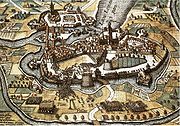
. The bishops of Geneva had the status of prince of the Holy Roman Empire since 1154, but had to maintain a long struggle for their independence against the guardians (advocati) of the see, the counts of Geneva and later the counts of the House of Savoy
.
In 1290, the latter obtained the right of installing the vice-dominus of the diocese, the title of Vidame of Geneva was granted to the counts of the House of Candia
under count François de Candie
of Chambéry
-Le-Vieux a Chatellaine of the Savoy, this official exercised minor jurisdiction in the town in the bishop's.
In 1387, Bishop Adhémar Fabry granted the town its great charter, the basis of its communal self-government, which every bishop on his accession was expected to confirm. The line of the counts of Geneva ended in 1394, and the House of Savoy came into possession of their territory, assuming after 1416 the title of Duke. The new dynasty sought to bring the city of Geneva under their power, particularly by elevating members of their own family to the episcopal see. In 1447 Anti Pope Felix V, who was also Duke of Savoy, appointed himself as bishop of Geneve, and until 1490 the episcopal see was ruled by Savoy dynasty, until popular pressure compelled the Savoy dynasty to renounce the title of bishop.
In 1457, a major government organ was established in Geneva, known as the Grand Council, which first consisted of 50 deputies and later their number was raised to 200. The members of the Grand Council were elected every year in early February. The Grand Council represented the citizens of Geneva and decided on political matters and also elected the bishops of Geneva after that position was renounced by the Savoy dynasty in 1490. This same council gradually became estranged to the Duke of Savoy. A new cause of friction between the Grand Council and the Duke of Savoy evolved in 1513, when Charles III
decided to appoint his cousin John of Savoy as bishop and even secured Papal endorsement. Despite being bishop of Geneva, the new Savoy bishop resided most of the time in Pignerol in Northern Italy, another factor enhancing the alienation between the people in Geneva and the Savoy dynasty.
In 1519, the Grand Council of Geneva attempted to forge an alliance with Fribourg, but the Duke of Savoy responded with invasion of the republic, which led to the execution of Philibert Berthelier
and suspension of the Grand Council's powers. However, after that date the Savoy power over Geneva gradually declined. In 1521 Jean of Savoy died, and the Grand Council appealed to Pope Leo X to appoint the next bishop, who then appointed Pierre de la Baume
. In addition, the Duke of Savoy also tried to reconcile his political ambitions with local Genevan patriotism, and in 1523 marched into Geneva in a ceremony designated to appease its population, and tried to gain the support of the Geneva merchants by promising them a share in the trade with the Kingdom of Portugal
(his wife's country of origin) and its territories in Brazil
. However, the independence faction in Geneva did not accept these gestures. Another political crisis occurred in 1524, when the treasurer of Geneva Bernard Boulet, a supporter of Savoy rule, was accused by the Grand Council of embezzlement. He reacted to the accusations by appealing to Charles III to curtail the powers of the council once more, to which the Duke responded by confiscating assets held by council members in other territories under Savoy rule.
In January 1525, the council appealed to the Pope to excommunicate Charles III. The deputies' attempt to enlist the support of the bishop Pierre de la Baume
for their cause failed, and the Pope rejected their request. However, Charles III feared another rebellion and in September 1525 made another proposal of power sharing to the Grand Council of Geneva, which the council endorsed by 53-42. However, Charles III was not satisfied with this and started a new invasion of Geneva in order to destroy the pro-independence faction. The pro-independence faction fled to Fribourg, and in December 1525 the Grand Council acknowledged Charles III as the true sovereign of Geneva (a session known as the "Assembly of Halberd
s"). However, members of the pro-independence faction began their own clandestine campaign to enlist support for their cause, and in February 1526 gained the support of bishop Pierre de la Baume. Elections to the Grand Council were held the same month and led to a pro-independence majority, that voted to break away from Savoy rule. Eventually, the Grand Council succeeded in protecting the liberty of its citizens by establishing union with the Swiss Federation , by concluding on February 20, 1526 a treaty of alliance with Bern and Fribourg. On March 12, representatives of the other Swiss cantons appeared before the Grand Council in Geneva and swore to protect that republic as part of their confederation.
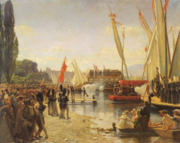 Geneva, home of Calvinism
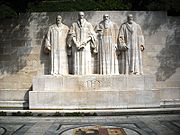
, was one of the great centres of the Protestant Reformation
. While Bern favoured the introduction of the new teaching and demanded liberty of preaching for the Reformers Guillaume Farel and Antoine Froment
, Catholic Fribourg
renounced in 1533 its allegiance with Geneva.
in August 1527, in order to save himself from capture or assassination by Charles III's agents, but still remained officially the bishop of Geneva. The bishop supported for a while the independence of Geneva, but later colluded with Charles III to use his influence to bring about the annulment of the 1526 treaty of alliance. As a result, the Grand Council decided in January 1528 to adhere to the Lutheran faith, and the Pope responded by excommunicating the people of Geneva. Even though Geneva was still under the nominal jurisdiction of a Catholic bishop, the Grand Council took advantage of his absence and initiated a gradual reform in worship along Lutheran lines.
Following the 1526 alliance treaty, Charles III of Savoy was not willing to concede defeat in Geneva, and constantly plotted to take over that city again. The fear of Swiss intervention kept him at bay, but he encouraged sporadic acts of violence against Geneva such as acts of robbery and destruction of goods intended for Geneva. The bishop of Geneva, no longer residing within that city, participated in plans to overthrow its independence. Some of the knights who were interested in capturing Geneva for Charles III organized in an unofficial organization termed Order of the Spoon. The knights of that group attempted an abortive invasion of Geneva by climbing on the city wall with ladders on March 25, 1529, an event to be known as "day of the ladders". In addition, the Duke of Savoy sought to convince the other Swiss republics to abrogate their alliance with Geneva, and to that end managed to enlist the support of Francis I of France and of Emperor Charles V. The Emperor Charles V tried to convince the Grand Council of Geneva to return to the Catholic Church, and on July 16, 1529 even wrote a letter to that effect in his own handwriting, but the council of Geneva rejected the plea and Charles V became determined to act with force. The Swiss Federation was alarmed by these developments, and in May 1530 a joint delegation from Berne, Fribourg, Zurich
, Basel
and Soleure suggested to the Grand Council the abrogation of the 1526 alliance treaty in exchange for looser cooperation. The Grand Council rejected the offer and decided to oppose any attempt to restore Geneva to Savoy rule.
On June 24, 1530, the Grand Council arrested a public prosecutor named Mandolia, who was a supporter of duke Charles III, and this irritated bishop Baume, who retaliated by arresting Genevan merchants in Gex, where he now resided. He also made a pact with the Knights of the Spoon, and on August 20, issued an episcopal decree ordering them to wage war in order to restore Geneva to its rightful rulers. On September 30, the attack began, as the Knights of the Spoon were joined by the forces of Charles III, reaching up to 800 soldiers total. The Genevan army was only about 600 men strong, but on October 10 reinforcements of about 15,000 men strong arrived from Bern and Fribourg. In addition, Emperor Charles V, even though a supporter of Savoy interests, refused to participate in that war, and the invading army was forced to withdraw. Following the Savoyard withdrawal, a peace treaty was concluded between Geneva and bishop Baume, by which the Grand Council in Geneva released Mandolia from prison and the bishop released the Genevans arrested at Gex.
During the Second War of Kappel
in October 1531, Geneva was politically divided, as the government of Bern requested military aid for the Protestants of Zurich, while Fribourg requested that for the Catholic party. The Grand Council of Geneva was torn between the two parties, but decided to split its forces and assist both simultaneously. Following the defeat of Zurich in the war, Fribourg renounced its alliance with Geneva. As a result, Charles III of Savoy renewed his plans of capturing Geneva. This alarmed the governments of Bern and Fribourg to the point of suggesting to Geneva to renounce the alliance treaty of 1526 and accept Savoy rule, which the council of Geneva rejected.
In June 1532, street skirmishes between Catholics and Protestants broke out, and the government of Fribourg threatened to tear up its alliance with Geneva if Protestant practices were permitted. The government of Berne, however, pressured the Grand Council of Geneva to allow Protestant preaching. The authority of the Catholic bishop was no longer recognized by the people and institutions of Geneva, but at first they refused to commit their city to the Protestant cause, for fear of antagonizing the Catholic rulers of adjacent kingdoms as well as the Catholic priests within Geneva.
in French, but only a conservative translation that did not appeal to Protestant sentiments and was acceptable to the Catholics in the republic. The Grand Council also had to take into consideration the need to remain in alliance with both Catholic and Protestant cantons. In February 1533, Fribourg openly revoked the alliance treaty of 1526, and later even made plans to invade Geneva.
In order to keep the peace between Catholics and Protestants as well as a policy of neutrality between the Catholic and Protestant powers, the Grand Council of Geneva on March 30, 1533 passed a statute of compromise which permitted every Genevan to choose his religious affiliation, while prohibiting open attacks on Catholic doctrines and practices and prohibited any religious preaching in open places for both parties. Eating meat on Fridays was prohibited for both parties. However, both parties had no intention of abiding by the statute, and street riots broke out from time to time.
pressured him to accept. On July 3, 1533 - with military aid from Fribourg - the bishop once again entered Geneva in a procession. The Grand Council demanded from the bishop to honor the traditional freedoms of the republic, which he promised to uphold. However, soon the bishop started arresting conspicuous Protestants in Geneva, and there were rumors that he intended to remove the prisoners to Fribourg and placed beyond the Grand Council's reach. On July 12 riots broke out, and the bishop yielded to popular clamor and delivered the prisoners to the Council's custody. Fearing for his life, the bishop decided to flee the city, which he did on July 14, this time never to return, while moving his headquarters to Arbois
and later to Chambery
. However, de la Baume officially remained the bishop of Geneva and Catholic priests and monks still remained a strong faction within the city. The bishop still tried to exercise his jurisdiction over Geneva and on October 24, 1533 wrote a letter to the council, demanding it to stop Protestant preaching in Geneva, which the council refused to do.
Following the bishop's flight, the influence of Protestant preachers in Geneva increased, and this was achieved to the chagrin of the local Catholic priests due to pressure from Bern, which threatened to revoke the 1526 alliance treaty unless freedom was granted to Protestants. In addition, the exiled bishop was gradually losing popularity also with the Catholic sections of Genevan society due to numerous attempts to meddle by proxy with the republic's judicial affairs, which the Genevans viewed as attacks on the liberties of their city. As a result of that, the Grand Council agreed on January 1534 to allow the trials of clergyman by secular authorities. The Catholic influence within Geneva was further diminished following the flight on July 30, 1534 of part of its Catholic population due to the rising tensions between Catholics and Protestants, and at the February 1535 election to the Grand Council, a Protestant majority was secured. Bishop de la Baume, seeing that Geneva was becoming Protestant, issued a decree on June 13, 1535 prohibiting trade with Geneva on pain of excommunication
. The Grand Council, even though consisted of a Protestant majority, still refrained from proclaiming the city as Protestant, for fear of reprisals from Catholic neighboring kingdoms. In order to compel the council to make that move, Protestant leaders such as Guillaume Farel began agitating the crowds to demolish icons and throw the wafers of the eucharist
to the ground in Catholic churches. As a measure of compromise between the two groups, the Grand Council resolved on August 10, 1535, to prohibit the breaking of icons on one hand and to prohibit the celebration of Mass
on the other. This move increased further the flight of Catholics from the city into Savoy territories. Following another unsuccessful invasion of Geneva by Savoy forces in October 1535, which ended in a Savoy defeat at Gingins
, the Grand Council decided on February 3, 1536 on the destruction of all castles around Geneva in order not to allow any princes another pretext for invading their city.
On May 21, 1536, the Genevans declared themselves Protestant by taking a public oath of allegiance to the Lutheran faith where all residents took part, and proclaimed their city a republic. This move was in the making for a long time, but was delayed for fears of Savoy invasion. However, the French invasion of Savoy territories earlier that year has removed that obstacle.
The Protestant leader John Calvin
was based in Geneva from 1536 to his death in 1564 (save for an exile from 1538 to 1541) and became the spiritual leader of the city, a position created by the Grand Council as the city turned Protestant. Geneva became a center of Protestant activity, producing works such as the Genevan Psalter
, though there were often tensions between Calvin and the city's civil authorities. Calvin also supported the admission into Geneva of Protestant refugees, which some circles strongly opposed.
Though the city proper remained a Protestant stronghold, a large part of the historic diocese returned to Catholicism in the early seventeenth century under St. Francis de Sales. Geneva has played a historical role in the worldwide spread of the Protestant revolution.
In addition to becoming a Protestant state, Geneva in the 16th century also became a kind of welfare state, as a general state hospital was established in 1535 by the wealthy Protestant Claude Salomon. A centralized education system was established with the cooperation of John Calvin.
(1789–1799), aristocratic and democratic factions contended for control of Geneva. In 1798, however, France, then under the Directory
, annexed Geneva and its surrounding territory.
. At the Congress of Vienna
of 1814–15, the territory of Geneva was extended to cover 15 Savoyard and six French parishes, with more than 16,000 Catholics; at the same time it was admitted to the Swiss Confederation. The Congress expressly provided—and the same proviso was included in the Treaty of Turin (16 March 1816)—that in these territories transferred to Geneva the Catholic religion was to be protected, and that no changes were to be made in existing conditions without the approval of the Holy See. The city's neutrality was guaranteed by the Congress. Pius VII in 1819 united the city of Geneva and 20 parishes with the Diocese of Lausanne, while the rest of the ancient Diocese of Geneva (outside of Switzerland) was reconstituted, in 1822, as the French Diocese of Annecy.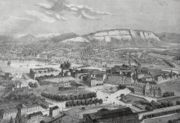 The Great Council of Geneva (cantonal council) afterwards ignored the responsibilities thus undertaken; in imitation of Napoleon's "Organic Articles", it insisted upon the Placet, or previous approval of publication, for all papal documents. Catholic indignation ran high at the civil measures taken against Marilley, the parish priest of Geneva and later bishop of the see, and at the Kulturkampf
, which obliged them to contribute to the budget of the Protestant Church and to that of the Old Catholic Church
, without providing any public aid for Catholicism.
. The Protestant faith received a one-time compensatory sum of 800,000 Swiss francs (then about US$160,000), while other faiths received nothing. Since then the Canton of Geneva has given aid to no creed from either state or municipal revenues.
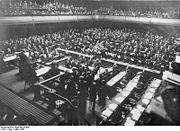 The international status of the city was highlighted after World War I when Geneva became the seat of the League of Nations
in 1919—notably through the work of the Federal Council member Gustav Ador and of Swiss diplomat William Rappard
, who was one of the founders of the Graduate Institute of International and Development Studies
, Europe's oldest graduate school of international and development studies. Furthermore, the International School of Geneva, the oldest currently operating International School in the world, was founded in 1924 by senior members of the League of Nations
and the International Labor Office.
In the wake of the war, a class struggle
in Switzerland grew and culminated in a general strike
throughout the country—beginning on Armistice Day
, 11 November 1918, and directed from the German-speaking part of the nation. However the prevailing friendliness toward France in Geneva moderated its effect upon that city.
On 9 November 1932, several small Fascist-inspired political parties, such as the National Union, attacked Socialist leaders, which action led to a later demonstration of the Left against the Fascists. On that occasion, young recruits in the Swiss Army
fired without warning into a crowd, leaving thirteen dead and 63 wounded. As a result, a new general strike was called several days later in protest.
After World War II, the European headquarters of the United Nations and the seats of dozens of international organizations were installed in Geneva, resulting in the development of tourism and of business.
In the 1960s, Geneva became one of the first parts of Switzerland in which the rights
movements achieved a certain measure of success. It was the third canton to grant women's suffrage on the cantonal and communal levels.
government of the City of Geneva and operates as a collegiate authority. It is composed of five councilors, each presiding over a department. The president of the executive department acts as mayor
. Current city president is Sandrine Salerno
. Departmental tasks, coordination measures and implementation of laws decreed by the City Parliament are carried by the City Council. The election of the City Council by registered voters is held every four years. The executive body holds its meetings in the Palais Eynard, near the Parc des Bastions. The building was built between 1817 and 1821 in Neoclassical style.
On the other hand, the City Parliament (Conseil municipal) holds the legislative power. It is made up of 80 members, with elections also held every four years. The City Parliament decrees regulations and by-laws that are executed by the City Council and the administration. The sessions of the City Parliament are public. Unlike the member of the City Council, the members of the City Parliament are not politicians by profession, but they are paid a fee based on their attendance. Any resident of Geneva allowed to vote can be elected as a member of the City Parliament. The legislative body holds its meetings in the Town Hall (Hôtel de Ville), in the old city of Geneva.
As of 2010, the Geneva City Council is made up of two representatives of the SDP (Social Democratic Party
, one of whom is the mayor), one member of the FDP (Free Democratic Party
), one member of the Green Party
and one member of the À gauche Toute
party.
the most popular party was the SP
which received 21.4% of the vote. The next three most popular parties were the SVP
(19.92%), the Green Party
(17.96%) and the LPS Party
(13.43%). In the federal election, a total of 39,413 votes were cast, and the voter turnout
was 46.8%.
In the 2009 Grand Conseil
election, there were a total of 83,167 registered voters of which 32,825 (39.5%) voted. The most popular party in the municipality for this election was the Les Verts
with 15.8% of the ballots. In the canton-wide election they received the second highest proportion of votes. The second most popular party was the Libéral
(with 14.1%), they were first in the canton-wide election, while the third most popular party was the Les Socialistes
(with 13.8%), they were fourth in the canton-wide election.
For the 2009 Conseil d'État election, there were a total of 83,103 registered voters of which 38,325 (46.1%) voted.
In 2011, all the municipalities held local elections, and in Geneva there were 80 spots open on the municipal council. There were a total of 117,051 registered voters of which 41,766 (35.7%) voted. Out of the 41,766 votes, there were 224 blank votes, 440 null or unreadable votes and 1,774 votes with a name that was not on the list.
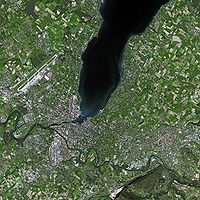 Geneva is located at 46°12' North, 6°09' East, at the south-western end of Lake Geneva
, where the lake flows back into the Rhône River
. It is surrounded by two mountain chains, the Alps
and the Jura
.
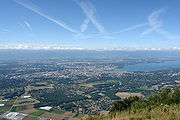 The city of Geneva has an area of 15.93 km² (6.2 sq mi), while the area of the Canton of Geneva
is 282 km² (108.9 sq mi), including the two small enclaves of Céligny
in Vaud
. The part of the lake that is attached to Geneva has an area of 38 km² (14.7 sq mi) and is sometimes referred to as Petit lac (Small Lake). The Canton has only a 4.5 km (2.8 mi) long border with the rest of Switzerland. Out of a total of 107.5 km (66.8 mi) of borders, the remaining 103 are shared with France, with the Départment de l'Ain
to the north and the Département de la Haute-Savoie
to the south.
Of the land in the city proper, 0.24 km² (0.0926645180622084 sq mi) or 1.5% is used for agricultural purposes, while 0.5 km² (0.193051079296268 sq mi) or 3.1% is forested. Of the rest of the land, 14.63 km² (5.6 sq mi) or 91.8% is settled (buildings or roads), 0.49 km² (0.189190057710342 sq mi) or 3.1% is either rivers or lakes and 0.02 km² (4.9 acre) or 0.1% is unproductive land.
Of the built up area, industrial buildings made up 3.4% of the total area while housing and buildings made up 46.2% and transportation infrastructure made up 25.8%. while parks, green belts and sports fields made up 15.7%. Out of the forested land, all of the forested land area is covered with heavy forests. Of the agricultural land, 0.3% is used for growing crops. Of the water in the municipality, 0.2% is in lakes and 2.9% is in rivers and streams.
The altitude of Geneva is 373.6 metres (1,225.7 ft), and corresponds to the altitude of the largest of the Pierres du Niton
, two large rocks emerging from the lake which date from the last ice age
. This rock was chosen by General Guillaume Henri Dufour
as the reference point
for all surveying in Switzerland.
The second main river of Geneva is the Arve River which flows into the Rhône River
just west of the city centre. Mont Blanc
can be seen from Geneva and is only an hour's drive from the city centre.
and Crans-Montana
are just over an hour away by car. Mont Salève
(1400 m), just across the border in France, dominates the southerly view from the city centre and is the closest French skiing destination to Geneva. During the years 2000–2009, the mean yearly temperature was 11 °C and the mean yearly sunshine lasted 2003 hours.
, and the entire old city of Geneva is part of the Inventory of Swiss Heritage Sites
.
Religious Buildings: Cathedral
St-Pierre
et Chapel des Macchabés, Notre-Dame Church, Russe Church, St-Germain Church, Temple de la Fusterie, Temple de l'Auditoire
Civic Buildings: Former Arsenal and Archives of the City of Genève, Former Crédit Lyonnais, Former Hôtel Buisson, Former Hôtel du Résident de France et Bibliothèque de la Société de lecture de Genève, Former école des arts industriels, Archives d'État de Genève (Annexe), Bâtiment des forces motrices, Library de Genève, Library juive de Genève «Gérard Nordmann», Cabinet des estampes, Centre d'Iconographie genevoise, Collège Calvin, Ecole Geisendorf, Hôpitaux universitaires de Genève (HUG), Hôtel de Ville et tour Baudet, Immeuble Clarté at Rue Saint-Laurent 2 and 4, Immeubles House Rotonde at Rue Charles-Giron 11–19, Immeubles at Rue Beauregard 2, 4, 6, 8, Immeubles at Rue de la Corraterie 10–26, Immeubles at Rue des Granges 2–6, Immeuble at Rue des Granges 8, Immeubles at Rue des Granges 10 and 12, Immeuble at Rue des Granges 14, Immeuble and Former Armory at Rue des Granges 16, Immeubles at Rue Pierre Fatio 7 and 9, House de Saussure at Rue de la Cité 24, House Des arts du Grütli at Rue du Général-Dufour 16, House Royale et les deux immeubles à côté at Quai Gustave Ador 44–50, Tavel House at Rue du Puits-St-Pierre 6, Turrettini House at Rue de l'Hôtel-de-Ville 8 and 10, Brunswick Monument, Palais de Justice, Palais de l'Athénée, Palais des Nations with library and archives of the SDN and ONU, Palais Eynard et Archives de la ville de Genève, Palais Wilson, Parc des Bastions avec Mur des Réformateurs, Place Neuve et Monument du Général Dufour, Pont de la Machine, Pont sur l'Arve, Poste du Mont-Blanc, Quai du Mont-Blanc, Quai et Hôtel des Bergues, Quai Général Guisan and English Gardens, Quai Gustave-Ador and Jet d'eau, Télévision Suisse Romande
, university of Geneva
, Victoria Hall
Archeological Sites:
Fondation Baur and Museum of the arts d'Extrême-Orient, Parc et campagne de la Grange and Library (neolithic shore settlement/roman villa), Bronze Age
shore settlement of Plonjon, Temple de la Madeleine archeological site, Temple Saint-Gervais archeological site, Old City with celtic, roman
and medieval villages
Museums, Theaters and other Cultural Sites: Conservatoire de musique at Place Neuve 5, Conservatoire et Jardin botaniques, Fonds cantonal d'art contemporain, Ile Rousseau and statue, Institute and Museum of Voltaire with Library and Archives, Mallet House and Museum international de la Réforme, Musée Ariana
, Musée d'Art et d'Histoire
, Museum d'art moderne et contemporain, Museum d'ethnographie, Museum of the International Red Cross
, Musée Rath
, Muséum d'histoire naturelle, Salle communale de Plainpalais et théâtre Pitoëff, Villa Bartholoni et Museum d'Histoire et Sciences
International Organizations: International Labour Organization
(BIT), International Committee of the Red Cross
, United Nations High Commissioner for Refugees
(UNHCR), World Meteorological Organization
, World Trade Organization
, International Telecommunication Union
, World Alliance of Young Men's Christian Association
, with a readership of about 187,000, a daily newspaper
founded on 1 February 1879 by James T. Bates
.
Le Courrier
, founded in 1868, was originally supported by the Roman Catholic Church
, but has been completely independent since 1996. Mainly focussed on Geneva, Le Courrier is trying to expand into other cantons in Romandy. Both Le Temps
(headquartered in Geneva) and Le Matin are widely read in Geneva, but both journals actually cover the whole of Romandy.
Geneva is covered by the various French language
radio network
s of the Swiss Broadcasting Corporation, in particular the Radio Suisse Romande
. While these networks cover the whole of Romandy, special programs related to Geneva are sometimes broadcast on some of the local frequencies in the case of special events such as elections. Other local stations broadcast from the city, including YesFM (FM
91.8 MHz), Radio Cité (Non-commercial radio, FM 92.2 MHz), OneFM (FM 107.0 MHz, also broadcast in Vaud
), and World Radio Switzerland (FM 88.4 MHz).
The main television channel
covering Geneva is the Télévision Suisse Romande
. While its headquarters is located in Geneva, the programs cover the whole of Romandy and are not specific to Geneva. Léman Bleu is a local TV channel, founded in 1996 and distributed by cable. Due to the proximity to France, French television channels are also available.
on the first Thursday following the first Sunday in September. By local tradition, this commemorates the date the news of the St. Bartholomew's Day massacre
of Huguenots reached Geneva. The Genevois joke that the federal equivalent holiday, Jeûne fédéral, is observed two weeks later on account of the rest of the country being a bit slow on the uptake.
Since 1818, a particular chestnut tree
has been used as the official "herald of the spring" in Geneva. The sautier (secretary of the Parliament of the Canton of Geneva) observes the tree and notes the day of arrival of the first bud. While this event has no practical effect, the sautier issues a formal press release
and the local newspaper will usually mention the news.
As this is one of the world's oldest records of a plant's reaction to climatic conditions, researchers have been interested to note that the first bud appears earlier and earlier in the year. During the first century, many dates were in March or April. In recent years, it has usually been in mid-February and sometimes even earlier.
In 2002, the first bud appeared unusually early, on 7 February, and then again on 29 December of the same year. The following year, which was one of the hottest years recorded in Europe, became a year with no bud. In 2008, the first bud also appeared very early, on 19 February.
the Grand Théâtre de Genève
which officially opened in 1876, was partly destroyed by fire in 1951 and reopened in 1962, is the largest stage in Switzerland. It features opera and dance performances, recitals, concerts and, occasionally, theatre. The Victoria Hall
is used for classical music concerts. It is also the home of the Orchestre de la Suisse Romande
.
or the Microcosm
in the CERN area. The Palace of Nations, home of the United Nations headquarters can also be visited.
. Geneva is the home of the Genève-Servette HC
, who play in the Swiss National League A, and is the main sport team of the city. In 2008 and 2010 the team made it to the league finals but lost to the ZSC Lions
and SC Bern
respectively.
There is also a football team in Geneva. The Servette FC
, a football club founded in 1890 and named after a borough on the right bank of the Rhône
. Servette was the only club to have remained in the top league in Switzerland since its creation in the 1930s. In 2005, however, management problems resulted in the bankruptcy of the club's parent company
, causing the club to be demoted two divisions. After one year in 3rd division and five in 2nd division, Servette came back to 1st division after a spectacular season.
in the Canton of Vaud
and several areas in the neighboring French departments of Haute-Savoie
and Ain
. In 2007 the agglomération franco-valdo-genevoise had 812,000 inhabitants, two-thirds of whom lived on Swiss soil and one-third on French soil. The Geneva metropolitan area is experiencing steady demographic growth of 1.2% a year and the agglomération franco-valdo-genevoise is expected to reach one million people in 2030.
The official language of Geneva is French
, the official language of the canton as well as the main Swiss language used in the Romandie. As a result of immigration flows in the 1960s and 1980s, Italian, Portuguese and Spanish are also spoken by a considerable proportion of the population. English is also quite common due to the high number of anglophone expatriates and foreigners working in international institutions and in the bank sector. However, lack of proficiency in French of English-speaking expatriates (even after years spent in Geneva) is an increasing concern.
Most of the population speak French (128,622 or 72.3%), with English being second most common (7,853 or 4.4%) and Spanish being third (7,462 or 4.2%). There are 7,320 people who speak Italian, 7,050 people who speak German and 113 people who speak Romansh.
In the city of Geneva, , 44.3% of the population are resident foreign nationals.
Over the last 10 years (1999–2009 ) the population has changed at a rate of 7.2%. It has changed at a rate of 3.4% due to migration and at a rate of 3.4% due to births and deaths.
, the gender distribution of the population was 47.8% male and 52.2% female. The population was made up of 46,284 Swiss men (24.2% of the population) and 45,127 (23.6%) non-Swiss men. There were 56,091 Swiss women (29.3%) and 43,735 (22.9%) non-Swiss women. Of the population in the municipality 43,296 or about 24.3% were born in Geneva and lived there in 2000. There were 11,757 or 6.6% who were born in the same canton, while 27,359 or 15.4% were born somewhere else in Switzerland, and 77,893 or 43.8% were born outside of Switzerland.
In there were 1,147 live births to Swiss citizens and 893 births to non-Swiss citizens, and in same time span there were 1,114 deaths of Swiss citizens and 274 non-Swiss citizen deaths. Ignoring immigration and emigration, the population of Swiss citizens increased by 33 while the foreign population increased by 619. There were 465 Swiss men and 498 Swiss women who emigrated from Switzerland. At the same time, there were 2933 non-Swiss men and 2662 non-Swiss women who immigrated from another country to Switzerland. The total Swiss population change in 2008 (from all sources, including moves across municipal borders) was an increase of 135 and the non-Swiss population increased by 3181 people. This represents a population growth rate of 1.8%.
The age distribution of the population is children and teenagers (0–19 years old) make up 18.2% of the population, while adults (20–64 years old) make up 65.8% and seniors (over 64 years old) make up 16%.
, there were 78,666 people who were single and never married in the municipality. There were 74,205 married individuals, 10,006 widows or widowers and 15,087 individuals who are divorced.
the average number of residents per living room was 0.64 which is about equal to the cantonal average of 0.64 per room. In this case, a room is defined as space of a housing unit of at least 4 m² (43.1 sq ft) as normal bedrooms, dining rooms, living rooms, kitchens and habitable cellars and attics. About 5.9% of the total households were owner occupied, or in other words did not pay rent (though they may have a mortgage
or a rent-to-own agreement).
, there were 86,231 private households in the municipality, and an average of 1.9 persons per household. There were 44,373 households that consist of only one person and 2,549 households with five or more people. Out of a total of 89,269 households that answered this question, 49.7% were households made up of just one person and there were 471 adults who lived with their parents. Of the rest of the households, there are 17,429 married couples without children, 16,607 married couples with children There were 5,499 single parents with a child or children. There were 1,852 households that were made up of unrelated people and 3,038 households that were made up of some sort of institution or another collective housing.
there were 743 single family homes (or 10.6% of the total) out of a total of 6,990 inhabited buildings. There were 2,758 multi-family buildings (39.5%), along with 2,886 multi-purpose buildings that were mostly used for housing (41.3%) and 603 other use buildings (commercial or industrial) that also had some housing (8.6%). Of the single family homes 197 were built before 1919, while 20 were built between 1990 and 2000. The greatest number of single family homes (277) were built between 1919 and 1945.
there were 101,794 apartments in the municipality. The most common apartment size was 3 rooms of which there were 27,084. There were 21,889 single room apartments and 11,166 apartments with five or more rooms. Of these apartments, a total of 85,330 apartments (83.8% of the total) were permanently occupied, while 13,644 apartments (13.4%) were seasonally occupied and 2,820 apartments (2.8%) were empty. , the construction rate of new housing units was 1.3 new units per 1000 residents.
the average price to rent an average apartment in Geneva was 1163.30 Swiss franc
s (CHF) per month (US$930, £520, €740 approx. exchange rate from 2003). The average rate for a one room apartment was 641.60 CHF (US$510, £290, €410), a two room apartment was about 874.46 CHF (US$700, £390, €560), a three room apartment was about 1126.37 CHF (US$900, £510, €720) and a six or more room apartment cost an average of 2691.07 CHF (US$2150, £1210, €1720). The average apartment price in Geneva was 104.2% of the national average of 1116 CHF. The vacancy rate for the municipality, , was 0.25%.
As of June 2011, the average price to buy an apartment in and around Geneva was 13,681 Swiss franc
s (CHF) per square metre (1 square metres (10.8 sq ft)). The average can be as high as 17,589 Swiss franc
s (CHF) per square metre (1 square metres (10.8 sq ft)) for a luxury apartment and as low as 9,847 Swiss franc
s (CHF) for an older or basic apartment. For houses in and around Geneva, the average price to buy one was 11.595 Swiss franc
s (CHF) per square metre (1 square metres (10.8 sq ft)) (as of June 2011), with a lowest price per square metre (1 square metres (10.8 sq ft)) of 4,874 Swiss franc
s (CHF), and a maximum price of 21,966 Swiss franc
s (CHF).
. Of the rest of the population, there were 3,959 members of an Orthodox church
(or about 2.22% of the population), there were 220 individuals (or about 0.12% of the population) who belonged to the Christian Catholic Church of Switzerland
, and there were 2,422 individuals (or about 1.36% of the population) who belonged to another Christian church. There were 2,601 individuals (or about 1.46% of the population) who were Jewish
, and 8,698 (or about 4.89% of the population) who were Islamic. There were 707 individuals who were Buddhist, 474 individuals who were Hindu and 423 individuals who belonged to another church. 41,289 (or about 23.20% of the population) belonged to no church, are agnostic
or atheist
, and 26,575 individuals (or about 14.93% of the population) did not answer the question.
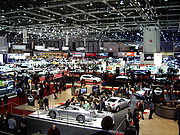 Geneva's economy is mainly services oriented. The city has an important and old finance sector
, which is specialised in private banking
(managing assets of about 1 trillion USD) and financing of international trade. It is also an important centre of commodity trade
.
Geneva hosts the international headquarters of companies like JT International (JTI)
, Mediterranean Shipping Company
,, Serono
(Serono S.A. was bought by the German Merck KGaA
—not to be mistaken with the American Merck & Co.
—in 2006 and now operates under Merck Serono S.A.
as one of the ten biggest bio-pharmaceutical companies in the World), SITA
,, Société Générale de Surveillance
, STMicroelectronics
, and Weatherford International
. Many other multinational companies
like Caterpillar
, DuPont
, and Cargill
have their international headquarters in the city; Take Two Interactive
, Electronic Arts
, INVISTA
, Procter & Gamble
and Oracle Corporation
have their European headquarters in the city. Hewlett Packard has its Europe, Africa, and Middle East headquarters in Meyrin
, near Geneva. PrivatAir
has its headquarters in Meyrin, near Geneva.
There is a long tradition of watch
making (Baume et Mercier
, Charriol
, Chopard
, Franck Muller
, Patek Philippe
, Gallet
, Jaeger-LeCoultre
, Rolex
, Universal Genève
, Raymond Weil
, Omega, Vacheron Constantin
, etc.). Two major international producers of flavours and fragrances, Firmenich
and Givaudan
, have their headquarters and main production facilities in Geneva.
Many people also work in the numerous offices of international organisations located in Geneva (about 24,000 in 2001).
The Geneva Motor Show is one of the most important international auto-shows. The show is held at Palexpo
, a giant convention centre located next to the International Airport.
In 2009, Geneva was ranked as the fourth most expensive city in the world. Geneva moved up four places from eighth place in last year's survey. Geneva is ranked behind Tokyo, Osaka
, and Moscow at first, second, and third respectively. Geneva also beat Hong Kong
, which came in at fifth place.
, Geneva had an unemployment rate of 6.3%. , there were five people employed in the primary economic sector and about three businesses involved in this sector. 9,783 people were employed in the secondary sector and there were 1,200 businesses in this sector. 134,429 people were employed in the tertiary sector, with 12,489 businesses in this sector. There were 91,880 residents of the municipality who were employed in some capacity, of which females made up 47.7% of the workforce.
the total number of full-time equivalent
jobs was 124,185. The number of jobs in the primary sector was four, all of which were in agriculture. The number of jobs in the secondary sector was 9,363 of which 4,863 or (51.9%) were in manufacturing and 4,451 (47.5%) were in construction. The number of jobs in the tertiary sector was 114,818. In the tertiary sector; 16,573 or 14.4% were in the sale or repair of motor vehicles, 3,474 or 3.0% were in the movement and storage of goods, 9,484 or 8.3% were in a hotel or restaurant, 4,544 or 4.0% were in the information industry, 20,982 or 18.3% were the insurance or financial industry, 12,177 or 10.6% were technical professionals or scientists, 10,007 or 8.7% were in education and 15,029 or 13.1% were in health care.
, there were 95,190 workers who commuted into the municipality and 25,920 workers who commuted away. The municipality is a net importer of workers, with about 3.7 workers entering the municipality for every one leaving. About 13.8% of the workforce coming into Geneva are coming from outside Switzerland, while 0.4% of the locals commute out of Switzerland for work. Of the working population, 38.2% used public transportation to get to work, and 30.6% used a private car.
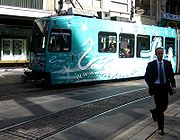 The city is served by the Geneva Cointrin International Airport
. It is connected by Geneva Airport railway station
with both the Swiss railway
network SBB-CFF-FFS
, and the French SNCF
network, including direct connections to Paris, Lyon, Marseille
and Montpellier
by TGV
. Geneva is also connected to the motorway systems of both Switzerland (A1 motorway
) and France.
Public transport by bus, trolleybus or tram is provided by Transports Publics Genevois
(TPG). In addition to an extensive coverage of the city centre, the network covers most of the municipalities of the Canton, with a few lines extending into France. Public transport by boat is provided by the Mouettes Genevoises, which link the two banks of the lake within the city, and by the Compagnie Générale de Navigation sur le lac Léman
(CGN) which serves more distant destinations such as Nyon
, Yvoire
, Thonon
, Évian
, Lausanne
and Montreux
using both modern diesel vessels and vintage paddle steamers.
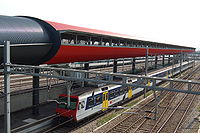 Trains operated by SBB-CFF-FFS
connect the airport to the main station of Cornavin
in a mere six minutes, and carry on to towns such as Nyon, Lausanne, Fribourg, Montreux, Neuchâtel, Berne, Sion, Sierre, etc. Regional train services are being increasingly developed, towards Coppet and Bellegarde. At the city limits, two new stations have been created since 2002: Genève-Sécheron (close to the UN and the Botanical Gardens
) and Lancy-Pont-Rouge.
In 2005, work started on the CEVA (Cornavin – Eaux-Vives – Annemasse) project, first planned in 1884, which will connect Cornavin with the Cantonal hospital, the Eaux-Vives station and Annemasse
, in France. The link between the main station and the classification yard
of La Praille already exists; from there, the line will go mostly underground to the Hospital and the Eaux-Vives, where it will link up to the existing line to France. Support for this project was obtained from all parties in the local parliament.
Taxis in Geneva can be difficult to find, and may need to be booked in advance especially in the early morning or at peak hours. In addition, taxis can refuse to take babies and children because of seating
legislation.
An ambitious project to close 200 streets in the centre of Geneva to cars has been approved in principle by the Geneva cantonal authorities, and is projected to be implemented over four years (2010–2014).
by the state-owned Services Industriels de Genève (shortly SIG). Most of the drinkable water (80%) is extracted from the lake
; the remaining 20% is provided by groundwater
originally formed by infiltration from the Arve River. 30% of the Canton's electricity needs is locally produced, mainly by three hydroelectric
dams on the Rhone River
(Seujet, Verbois and Chancy-Pougny). In addition, 13% of the electricity produced in the Canton is made from the heat induced by the burning of waste at the waste incineration facility of Les Cheneviers. The remaining needs (57%) are covered by imports from other cantons in Switzerland or other European countries; SIG buys only electricity produced by renewable methods
, and in particular does not use electricity produced using nuclear reactor
s or fossil fuels.
Natural gas is available in the City of Geneva, as well as in about two-thirds of the municipalities of the canton, and is imported from Western Europe by the Swiss company Gaznat. SIG also provides telecommunication facilities to carriers, service provider
s and large enterprises. From 2003 to 2005 "Voisin, voisine" a Fibre to the Home pilot project with a Triple play
offering was launched to test the end-user
market in the Charmilles district.
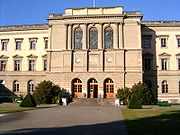 Geneva is home to the university of Geneva
, founded by John Calvin
in 1559. Despite its medium size (about 13000 students), the university of Geneva is regularly ranked among the best world universities. In 2011, the ranking web of universities ranked it European university.
Located in the heart of International Geneva, The Graduate Institute of International and Development Studies
was among the first academic institutions to teach international relations in the world and it proposes today MA and PhD programmes in Law, Political Science, History, Economics, International Affairs, and Development Studies.
Also, the oldest international school
in the world is located in Geneva, the International School of Geneva
, founded in 1924 along with the League of Nations
. Webster university
, an accredited American university, also has a campus in Geneva. Moreover, the city is home to the Institut International de Lancy
(founded in 1903) and to the International university in Geneva
, an accredited International university.
The Geneva School of Diplomacy and International Relations
is a private university
on the grounds of the Château de Penthes, an old manor with a park and view of Lake Geneva
.
The Canton of Geneva's public school system has écoles primaires (ages 4–12) and cycles d'orientation (ages 12–15). The obligation to attend school ends at age 16, but secondary education is provided by collèges (ages 15–19), the oldest of which is the Collège Calvin
, which could be considered one of the oldest public schools in the world.
Geneva also has a choice of private schools.
However, out of all the educational and research facilities in Geneva, CERN
(the European Organization for Nuclear Research) is probably the best known on a world basis. Founded in 1954, CERN was one of Europe's first joint venture
s and has developed as the world's largest particle physics
laboratory
. Physicists from around the world travel to CERN to research matter and explore the fundamental forces and materials that form the universe
.
In Geneva about 44,176 or (24.8%) of the population have completed non-mandatory upper secondary education, and 40,733 or (22.9%) have completed additional higher education (either university or a Fachhochschule
). Of the 40,733 who completed tertiary schooling, 31.3% were Swiss men, 31.1% were Swiss women, 20.5% were non-Swiss men and 17.2% were non-Swiss women.
During the 2009-2010 school year, there were a total of 28,930 students in the Geneva school system. The education system
in the Canton of Geneva allows young children to attend two years of non-obligatory Kindergarten
. During that school year, there were 2,805 children who were in a pre-kindergarten class. The canton's school system provides two years of non-mandatory kindergarten
and requires students to attend six years of primary school, with some of the children attending smaller, specialized classes. In Geneva there were 4,109 students in kindergarten or primary school and 607 students were in the special, smaller classes. The secondary school
program consists of three lower, obligatory years of schooling, followed by three to five years of optional, advanced schools. There were 4,109 lower secondary students who attended school in Geneva. There were 6,188 upper secondary students from the municipality along with 1,461 students who were in a professional, non-university track program. An additional 2,987 students attended a private school.
, there were 12,038 students in Geneva who came from another municipality, while 4,219 residents attended schools outside the municipality.
Geneva is home to 5 major libraries. These libraries include; the Bibliothèques municipales Genève, the Haute école de travail social, Institut d'études sociales, the Haute école de santé, the Ecole d'ingénieurs de Genève and the Haute école d'art et de design. There was a combined total of 877,680 books or other media in the libraries, and in the same year a total of 1,798,980 items were loaned out.
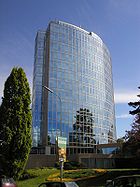 Geneva is the seat of the European headquarters of the United Nations
. It is located in the Palace of Nations building (French: Palais des Nations) which was also the headquarters of the former League of Nations. Several agencies are headquartered at Geneva, among which the United Nations High Commissioner for Refugees
(UNHCR), the United Nations High Commissioner for Human Rights (UNHCHR), the World Health Organization
(WHO), the International Labour Organization
(ILO) and the World Intellectual Property Organization
(WIPO).
 Apart from the United Nation agencies, Geneva hosts many inter-governmental organizations
such as the World Trade Organization
(WTO), the World Economic Forum
(WEF), the International Federation of Red Cross and Red Crescent Societies
(IFRC), the International Organization for Migration
(IOM) and the International Committee of the Red Cross
(ICRC).
Organizations on the European level, include the European Broadcasting Union
(EBU) and the CERN
(European Organization for Nuclear Research) which is the world's largest particle physics laboratory.
The Geneva Environment Network
(GEN) publishes the Geneva Green Guide, and extensive listing of Geneva-based global organisations working on environment protection and sustainable development. A website (by the Swiss Government, WBCSD, UNEP and IUCN) includes stories about how NGOs, business, government and the UN cooperate. By doing so, it attempts to explain why Geneva has been picked by so many NGOs and UN as their headquarters location.
Switzerland
Switzerland name of one of the Swiss cantons. ; ; ; or ), in its full name the Swiss Confederation , is a federal republic consisting of 26 cantons, with Bern as the seat of the federal authorities. The country is situated in Western Europe,Or Central Europe depending on the definition....
(after Zürich
Zürich
Zurich is the largest city in Switzerland and the capital of the canton of Zurich. It is located in central Switzerland at the northwestern tip of Lake Zurich...
) and is the most populous city of Romandie, the French-speaking part of Switzerland. Situated where the Rhone
Rhône
Rhone can refer to:* Rhone, one of the major rivers of Europe, running through Switzerland and France* Rhône Glacier, the source of the Rhone River and one of the primary contributors to Lake Geneva in the far eastern end of the canton of Valais in Switzerland...
exits Lake Geneva
Lake Geneva
Lake Geneva or Lake Léman is a lake in Switzerland and France. It is one of the largest lakes in Western Europe. 59.53 % of it comes under the jurisdiction of Switzerland , and 40.47 % under France...
, it is the capital of the Republic and Canton of Geneva
Canton of Geneva
The Republic and Canton of Geneva is the French speaking westernmost canton or state of Switzerland, surrounded on almost all sides by France. As is the case in several other Swiss cantons The Republic and Canton of Geneva is the French speaking westernmost canton or state of Switzerland,...
.
While the municipality itself (downtown ville de Genève) has a population of , the canton of Geneva (République et Canton de Genève, which includes the city) has 464,677 residents . The urban area,or agglomération franco-valdo-genevoise had 812,000 inhabitants, two-thirds of whom lived on Swiss soil and one-third on French soil.
Geneva is a global city
Global city
A global city is a city that is deemed to be an important node in the global economic system...
, a financial centre, and a worldwide centre for diplomacy
Diplomacy
Diplomacy is the art and practice of conducting negotiations between representatives of groups or states...
and the most important UN
United Nations
The United Nations is an international organization whose stated aims are facilitating cooperation in international law, international security, economic development, social progress, human rights, and achievement of world peace...
international co-operation centre with New York
New York
New York is a state in the Northeastern region of the United States. It is the nation's third most populous state. New York is bordered by New Jersey and Pennsylvania to the south, and by Connecticut, Massachusetts and Vermont to the east...
thanks to the presence of numerous international organization
International organization
An intergovernmental organization, sometimes rendered as an international governmental organization and both abbreviated as IGO, is an organization composed primarily of sovereign states , or of other intergovernmental organizations...
s, including the headquarters of many of the agencies of the United Nations
United Nations
The United Nations is an international organization whose stated aims are facilitating cooperation in international law, international security, economic development, social progress, human rights, and achievement of world peace...
and the Red Cross
International Red Cross and Red Crescent Movement
The International Red Cross and Red Crescent Movement is an international humanitarian movement with approximately 97 million volunteers, members and staff worldwide which was founded to protect human life and health, to ensure respect for all human beings, and to prevent and alleviate human...
. It is also the place where the Geneva Conventions
Geneva Conventions
The Geneva Conventions comprise four treaties, and three additional protocols, that establish the standards of international law for the humanitarian treatment of the victims of war...
were signed, which chiefly concern the treatment of wartime non-combatants and prisoners of war.
Geneva has been described as the third European financial centre after London and Zurich, and the world's eighth most important financial centre by the Global Financial Centres Index
Global Financial Centres Index
The Global Financial Centres Index is a ranking of the competitiveness of financial centres based on 26,629 financial centre assessments from an online questionnaire together with over 60 indices...
, ahead of Frankfurt
Frankfurt
Frankfurt am Main , commonly known simply as Frankfurt, is the largest city in the German state of Hesse and the fifth-largest city in Germany, with a 2010 population of 688,249. The urban area had an estimated population of 2,300,000 in 2010...
, and a 2009 survey by Mercer
Mercer (consulting firm)
Mercer is a human resource and related financial services consulting firm, headquartered in New York City. The firm operates internationally in more than 40 countries, with more than 19,000 employees, and is the world's largest human resource consulting firm....
found Geneva to have the third-highest quality of life
Quality of life
The term quality of life is used to evaluate the general well-being of individuals and societies. The term is used in a wide range of contexts, including the fields of international development, healthcare, and politics. Quality of life should not be confused with the concept of standard of...
of any city in the world (narrowly outranked by Zürich
Zürich
Zurich is the largest city in Switzerland and the capital of the canton of Zurich. It is located in central Switzerland at the northwestern tip of Lake Zurich...
). The city has been referred to as the world's most compact metropolis and the "Peace Capital." In 2009, Geneva was ranked as the fourth most expensive city in the world.
Etymology
The name Geneva is probably of CelticCeltic languages
The Celtic languages are descended from Proto-Celtic, or "Common Celtic"; a branch of the greater Indo-European language family...
origin. The city was mentioned in Latin
Latin
Latin is an Italic language originally spoken in Latium and Ancient Rome. It, along with most European languages, is a descendant of the ancient Proto-Indo-European language. Although it is considered a dead language, a number of scholars and members of the Christian clergy speak it fluently, and...
texts with the spelling Genava. The name takes various forms in modern languages. Thus, it is Geneva icon in English and, ʒnɛv, ˈɡɛnf, dʒiˈneːvra, and . Another theory is that Geneva is derived from "Genévrier" which is the French word for "juniper
Juniper
Junipers are coniferous plants in the genus Juniperus of the cypress family Cupressaceae. Depending on taxonomic viewpoint, there are between 50-67 species of juniper, widely distributed throughout the northern hemisphere, from the Arctic, south to tropical Africa in the Old World, and to the...
".
There is occasionally confusion between this city and the Italian port of Genoa
Genoa
Genoa |Ligurian]] Zena ; Latin and, archaically, English Genua) is a city and an important seaport in northern Italy, the capital of the Province of Genoa and of the region of Liguria....
(in Italian Genova) as they seem to share a Celtic root, genu / genawa, meaning "estuary".
Antiquity
Geneva first appears in history as a border town, fortified against the Celtic tribe HelvetiiHelvetii
The Helvetii were a Celtic tribe or tribal confederation occupying most of the Swiss plateau at the time of their contact with the Roman Republic in the 1st century BC...
, which the Romans took in 121 B.C. In 52 B.C., Julius Ceasar, Roman Governor of Gaul, destroyed the bridge on the Rhone river at the place that would become Geneva in order to block the passage of the Helvetii. In 58 B.C., Ceasar helped establish Geneva as a Roman city (vicus and then civitas) by setting up camp there and significantly increasing its size.
It became an episcopal seat in the 4th century. In 443, it was taken by Burgundy, and with the latter fell to the Franks in 534. In 888 the town was part of the new Kingdom of Burgundy
Kingdom of Burgundy
Burgundy is a historic region in Western Europe that has existed as a political entity in a number of forms with very different boundaries. Two of these entities - the first around the 6th century, the second around the 11th century - have been called the Kingdom of Burgundy; a third was very...
, and with it was taken over in 1033 by the German Emperor. According to legendary accounts found in the works of Gregorio Leti ("Historia Genevrena", Amsterdam, 1686) and Besson ("Memoires pour l'histoire ecclésiastique des diocèses de Genève, Tarantaise, Aoste et Maurienne", Nancy, 1739; new ed. Moutiers, 1871), Geneva was Christianised by Dionysius Areopagita and Paracodus, two of the 72 disciples, in the time of Domitian
Domitian
Domitian was Roman Emperor from 81 to 96. Domitian was the third and last emperor of the Flavian dynasty.Domitian's youth and early career were largely spent in the shadow of his brother Titus, who gained military renown during the First Jewish-Roman War...
; Dionysius went thence to Paris and Paracodus became the first Bishop of Geneva but the legend is fictitious, as is that which makes St. Lazarus the first Bishop of Geneva, an error arising out of the similarity between the Latin names Genara (Geneva) and Genua
Genoa
Genoa |Ligurian]] Zena ; Latin and, archaically, English Genua) is a city and an important seaport in northern Italy, the capital of the Province of Genoa and of the region of Liguria....
(Genoa, in northern Italy). The so-called "Catalogue de St. Pierre", which names St. Diogenus (Diogenes) as the first Bishop of Geneva, is unreliable.
A letter of St. Eucherius to Salvius makes it almost certain that St. Isaac
Isaac of Armenia
Isaac or Sahak of Armenia was Catholicos of Armenia. He is sometimes known as "Isaac the Great," and as "Սահակ Պարթև / Sahak Parthev" in Armenian, owing to his Parthian origin....
(c. 400) was the first bishop. In 440, Salonius
Salonius
Saint Salonius was a confessor and bishop of the 5th century. He was born about 400, a son of St. Eucherius of Lyon. He was educated at Lérins Abbey, first by St. Hilary of Arles, then by Salvianus and St. Vincent of Lérins. In 440, he was elected bishop of Geneva and, as such, took part in the...
appears as Bishop of Geneva; he was a son of Eucherius, to whom the latter dedicated his Instructiones'; he took part in the Councils of Orange
Councils of Orange
The Councils of Orange comprised two synods held at Orange, France. The first dealt with various church issues. The second affirmed Augustine's teaching against Pelagian challenge.-First Council of Orange:...
(441), Vaison
Vaison-la-Romaine
Vaison-la-Romaine is a commune in the Vaucluse department in the Provence-Alpes-Côte d'Azur region in southeastern France....
(442) and Arles
Archbishopric of Arles
The former French Catholic Archbishopric of Arles had its episcopal see in the city of Arles, in southern France.The Archbishopric of Arles was suppressed, and incorporated into the Archdiocese of Aix in 1822...
(about 455), and is supposed to be the author of two small commentaries, In parabolas Salomonis and on Ecclesisastis. Little is known about the following Bishops Theoplastus (about 475), to whom Sidonius Apollinaris
Sidonius Apollinaris
Gaius Sollius Apollinaris Sidonius or Saint Sidonius Apollinaris was a poet, diplomat, and bishop. Sidonius is "the single most important surviving author from fifth-century Gaul" according to Eric Goldberg...
addressed a letter; Dormitianus (before 500), under whom the Burgundian Princess Sedeleuba, a sister of Queen Clotilde
Clotilde
Saint Clotilde , also known as Clothilde, Clotilda, Clotild, Rotilde or Chroctechildis, was the second wife of the Frankish king Clovis I...
, had the remains of the martyr and St. Victor of Soleure transferred to Geneva, where she built a basilica
Basilica
The Latin word basilica , was originally used to describe a Roman public building, usually located in the forum of a Roman town. Public basilicas began to appear in Hellenistic cities in the 2nd century BC.The term was also applied to buildings used for religious purposes...
in his honour; St. Maximus (about 512-41), a friend of Avitus, Archbishop of Vienne and Cyprian of Toulon
Cyprian of Toulon
Saint Cyprian of Toulon was bishop of Toulon during the 6th century. Born at Marseilles, he was the favorite pupil of St. Caesarius of Arles by whom he was trained. Caesarius ordained him in 506 to the diaconate, and, in 516, consecrated him as bishop of Toulon.St...
, with whom he was in correspondence. Bishop Pappulus sent the priest Thoribiusas his substitute to the Synod of Orléans (541). Bishop Salonius II is only known from the signatures of the Synods of Lyon (570) and Paris (573) and Bishop Cariatto, installed by King Guntram
Guntram
Saint Guntram was the king of Burgundy from 561 to 592. He was a son of Chlothar I and Ingunda...
in 584, was present at the two Synods of Valence and Macon in 585.
Middle Ages
Archbishopric of Vienne
The Archbishopric of Vienne, named after its episcopal see Vienne in the Isère département of southern France, was a metropolitan Roman Catholic archdiocese...
. The bishops of Geneva had the status of prince of the Holy Roman Empire since 1154, but had to maintain a long struggle for their independence against the guardians (advocati) of the see, the counts of Geneva and later the counts of the House of Savoy
House of Savoy
The House of Savoy was formed in the early 11th century in the historical Savoy region. Through gradual expansion, it grew from ruling a small county in that region to eventually rule the Kingdom of Italy from 1861 until the end of World War II, king of Croatia and King of Armenia...
.
In 1290, the latter obtained the right of installing the vice-dominus of the diocese, the title of Vidame of Geneva was granted to the counts of the House of Candia
House of Candia
The House of Candia is a European dynastic house, created by a junior branch of the House of Anjou originally from "Castrum Candiaco" in the Dauphiné of the nobility of Savoy and Piemont...
under count François de Candie
François de Candie
François de Candia, 1st Vidominus or Vidame de Geneva was lawyer, diplomat and a nobleman of the House of Candia; also known as François de Genève...
of Chambéry
Chambéry
Chambéry is a city in the department of Savoie, located in the Rhône-Alpes region in southeastern France.It is the capital of the department and has been the historical capital of the Savoy region since the 13th century, when Amadeus V of Savoy made the city his seat of power.-Geography:Chambéry...
-Le-Vieux a Chatellaine of the Savoy, this official exercised minor jurisdiction in the town in the bishop's.
In 1387, Bishop Adhémar Fabry granted the town its great charter, the basis of its communal self-government, which every bishop on his accession was expected to confirm. The line of the counts of Geneva ended in 1394, and the House of Savoy came into possession of their territory, assuming after 1416 the title of Duke. The new dynasty sought to bring the city of Geneva under their power, particularly by elevating members of their own family to the episcopal see. In 1447 Anti Pope Felix V, who was also Duke of Savoy, appointed himself as bishop of Geneve, and until 1490 the episcopal see was ruled by Savoy dynasty, until popular pressure compelled the Savoy dynasty to renounce the title of bishop.
In 1457, a major government organ was established in Geneva, known as the Grand Council, which first consisted of 50 deputies and later their number was raised to 200. The members of the Grand Council were elected every year in early February. The Grand Council represented the citizens of Geneva and decided on political matters and also elected the bishops of Geneva after that position was renounced by the Savoy dynasty in 1490. This same council gradually became estranged to the Duke of Savoy. A new cause of friction between the Grand Council and the Duke of Savoy evolved in 1513, when Charles III
Charles III, Duke of Savoy
Charles III of Savoy , often called Charles the Good, was Duke of Savoy from 1504 to 1553, although most of his lands were ruled by the French between 1536 and his death....
decided to appoint his cousin John of Savoy as bishop and even secured Papal endorsement. Despite being bishop of Geneva, the new Savoy bishop resided most of the time in Pignerol in Northern Italy, another factor enhancing the alienation between the people in Geneva and the Savoy dynasty.
In 1519, the Grand Council of Geneva attempted to forge an alliance with Fribourg, but the Duke of Savoy responded with invasion of the republic, which led to the execution of Philibert Berthelier
Philibert Berthelier
Philibert Berthelier , often known just as Berthelier, was a Swiss patriot, an uncompromising enemy of the Duke of Savoy in his ambition to lord it over Geneva.-Rebellion against the Duke of Savoy:...
and suspension of the Grand Council's powers. However, after that date the Savoy power over Geneva gradually declined. In 1521 Jean of Savoy died, and the Grand Council appealed to Pope Leo X to appoint the next bishop, who then appointed Pierre de la Baume
Pierre de La Baume
Pierre de La Baume was a grand seigneur of Savoy and a cardinal of the Roman Catholic Church. He was a councillor of Charles III, Duke of Savoy, whom he represented at the Fifth Lateran Council ....
. In addition, the Duke of Savoy also tried to reconcile his political ambitions with local Genevan patriotism, and in 1523 marched into Geneva in a ceremony designated to appease its population, and tried to gain the support of the Geneva merchants by promising them a share in the trade with the Kingdom of Portugal
Portugal
Portugal , officially the Portuguese Republic is a country situated in southwestern Europe on the Iberian Peninsula. Portugal is the westernmost country of Europe, and is bordered by the Atlantic Ocean to the West and South and by Spain to the North and East. The Atlantic archipelagos of the...
(his wife's country of origin) and its territories in Brazil
Brazil
Brazil , officially the Federative Republic of Brazil , is the largest country in South America. It is the world's fifth largest country, both by geographical area and by population with over 192 million people...
. However, the independence faction in Geneva did not accept these gestures. Another political crisis occurred in 1524, when the treasurer of Geneva Bernard Boulet, a supporter of Savoy rule, was accused by the Grand Council of embezzlement. He reacted to the accusations by appealing to Charles III to curtail the powers of the council once more, to which the Duke responded by confiscating assets held by council members in other territories under Savoy rule.
In January 1525, the council appealed to the Pope to excommunicate Charles III. The deputies' attempt to enlist the support of the bishop Pierre de la Baume
Pierre de La Baume
Pierre de La Baume was a grand seigneur of Savoy and a cardinal of the Roman Catholic Church. He was a councillor of Charles III, Duke of Savoy, whom he represented at the Fifth Lateran Council ....
for their cause failed, and the Pope rejected their request. However, Charles III feared another rebellion and in September 1525 made another proposal of power sharing to the Grand Council of Geneva, which the council endorsed by 53-42. However, Charles III was not satisfied with this and started a new invasion of Geneva in order to destroy the pro-independence faction. The pro-independence faction fled to Fribourg, and in December 1525 the Grand Council acknowledged Charles III as the true sovereign of Geneva (a session known as the "Assembly of Halberd
Halberd
A halberd is a two-handed pole weapon that came to prominent use during the 14th and 15th centuries. Possibly the word halberd comes from the German words Halm , and Barte - in modern-day German, the weapon is called Hellebarde. The halberd consists of an axe blade topped with a spike mounted on...
s"). However, members of the pro-independence faction began their own clandestine campaign to enlist support for their cause, and in February 1526 gained the support of bishop Pierre de la Baume. Elections to the Grand Council were held the same month and led to a pro-independence majority, that voted to break away from Savoy rule. Eventually, the Grand Council succeeded in protecting the liberty of its citizens by establishing union with the Swiss Federation , by concluding on February 20, 1526 a treaty of alliance with Bern and Fribourg. On March 12, representatives of the other Swiss cantons appeared before the Grand Council in Geneva and swore to protect that republic as part of their confederation.
Reformation
Calvinism
Calvinism is a Protestant theological system and an approach to the Christian life...
, was one of the great centres of the Protestant Reformation
Protestant Reformation
The Protestant Reformation was a 16th-century split within Western Christianity initiated by Martin Luther, John Calvin and other early Protestants. The efforts of the self-described "reformers", who objected to the doctrines, rituals and ecclesiastical structure of the Roman Catholic Church, led...
. While Bern favoured the introduction of the new teaching and demanded liberty of preaching for the Reformers Guillaume Farel and Antoine Froment
Antoine Froment
Antoine Froment was a Protestant reformer in Geneva. Froment is best remembered for his role in initiating and solidifying the Reformation in Geneva along with William Farel and John Calvin...
, Catholic Fribourg
Fribourg
Fribourg is the capital of the Swiss canton of Fribourg and the district of Sarine. It is located on both sides of the river Saane/Sarine, on the Swiss plateau, and is an important economic, administrative and educational center on the cultural border between German and French Switzerland...
renounced in 1533 its allegiance with Geneva.
Background to the Protestant Reformation
In 1523, the first Protestants, who happened to be refugees from France, arrived at Geneva. The new theology soon became very popular in Geneva, as the population was seeking to break away from the Papacy. The power of the Catholic Church in Geneva was further weakened following an abortive rebellion in 1526 by the priests in protest of the alliance with Bern and Fribourg. In July 1527, all Catholic priests of noble descent were expelled from Geneva due to their pro-Savoy sentiments. The bishop fled from Geneva to GexGex
-People:* Amélie Gex , French writer and poet in the Franco-Provençal language* Emilie Gex-Fabry , Swiss ski mountaineer-Places:* Gex, Ain, a commune in the Ain département in France...
in August 1527, in order to save himself from capture or assassination by Charles III's agents, but still remained officially the bishop of Geneva. The bishop supported for a while the independence of Geneva, but later colluded with Charles III to use his influence to bring about the annulment of the 1526 treaty of alliance. As a result, the Grand Council decided in January 1528 to adhere to the Lutheran faith, and the Pope responded by excommunicating the people of Geneva. Even though Geneva was still under the nominal jurisdiction of a Catholic bishop, the Grand Council took advantage of his absence and initiated a gradual reform in worship along Lutheran lines.
Following the 1526 alliance treaty, Charles III of Savoy was not willing to concede defeat in Geneva, and constantly plotted to take over that city again. The fear of Swiss intervention kept him at bay, but he encouraged sporadic acts of violence against Geneva such as acts of robbery and destruction of goods intended for Geneva. The bishop of Geneva, no longer residing within that city, participated in plans to overthrow its independence. Some of the knights who were interested in capturing Geneva for Charles III organized in an unofficial organization termed Order of the Spoon. The knights of that group attempted an abortive invasion of Geneva by climbing on the city wall with ladders on March 25, 1529, an event to be known as "day of the ladders". In addition, the Duke of Savoy sought to convince the other Swiss republics to abrogate their alliance with Geneva, and to that end managed to enlist the support of Francis I of France and of Emperor Charles V. The Emperor Charles V tried to convince the Grand Council of Geneva to return to the Catholic Church, and on July 16, 1529 even wrote a letter to that effect in his own handwriting, but the council of Geneva rejected the plea and Charles V became determined to act with force. The Swiss Federation was alarmed by these developments, and in May 1530 a joint delegation from Berne, Fribourg, Zurich
Zürich
Zurich is the largest city in Switzerland and the capital of the canton of Zurich. It is located in central Switzerland at the northwestern tip of Lake Zurich...
, Basel
Basel
Basel or Basle In the national languages of Switzerland the city is also known as Bâle , Basilea and Basilea is Switzerland's third most populous city with about 166,000 inhabitants. Located where the Swiss, French and German borders meet, Basel also has suburbs in France and Germany...
and Soleure suggested to the Grand Council the abrogation of the 1526 alliance treaty in exchange for looser cooperation. The Grand Council rejected the offer and decided to oppose any attempt to restore Geneva to Savoy rule.
On June 24, 1530, the Grand Council arrested a public prosecutor named Mandolia, who was a supporter of duke Charles III, and this irritated bishop Baume, who retaliated by arresting Genevan merchants in Gex, where he now resided. He also made a pact with the Knights of the Spoon, and on August 20, issued an episcopal decree ordering them to wage war in order to restore Geneva to its rightful rulers. On September 30, the attack began, as the Knights of the Spoon were joined by the forces of Charles III, reaching up to 800 soldiers total. The Genevan army was only about 600 men strong, but on October 10 reinforcements of about 15,000 men strong arrived from Bern and Fribourg. In addition, Emperor Charles V, even though a supporter of Savoy interests, refused to participate in that war, and the invading army was forced to withdraw. Following the Savoyard withdrawal, a peace treaty was concluded between Geneva and bishop Baume, by which the Grand Council in Geneva released Mandolia from prison and the bishop released the Genevans arrested at Gex.
During the Second War of Kappel
Second war of Kappel
The second war of Kappel was an armed conflict in 1531 between the Protestant and the Catholic cantons of the Old Swiss Confederacy during the Reformation in Switzerland.-Cause:...
in October 1531, Geneva was politically divided, as the government of Bern requested military aid for the Protestants of Zurich, while Fribourg requested that for the Catholic party. The Grand Council of Geneva was torn between the two parties, but decided to split its forces and assist both simultaneously. Following the defeat of Zurich in the war, Fribourg renounced its alliance with Geneva. As a result, Charles III of Savoy renewed his plans of capturing Geneva. This alarmed the governments of Bern and Fribourg to the point of suggesting to Geneva to renounce the alliance treaty of 1526 and accept Savoy rule, which the council of Geneva rejected.
In June 1532, street skirmishes between Catholics and Protestants broke out, and the government of Fribourg threatened to tear up its alliance with Geneva if Protestant practices were permitted. The government of Berne, however, pressured the Grand Council of Geneva to allow Protestant preaching. The authority of the Catholic bishop was no longer recognized by the people and institutions of Geneva, but at first they refused to commit their city to the Protestant cause, for fear of antagonizing the Catholic rulers of adjacent kingdoms as well as the Catholic priests within Geneva.
Compromise between Catholics and Protestants
The Catholic priests and monks in Geneva remained a significant social force to reckon with, and used their influence in order to bring about the expulsion of the Protestant preachers, and on March 28, 1533 even tried to incite the Catholic masses to massacre the Protestants - a scheme that failed due to emotions of city solidarity and Grand Council efforts to restore the peace. The Grand Council was cautious in its policies, and attempted a middle course between the two factions. As part of that middle course, it yielded to protestant demands by approving in March 1533 the publication of the BibleBible
The Bible refers to any one of the collections of the primary religious texts of Judaism and Christianity. There is no common version of the Bible, as the individual books , their contents and their order vary among denominations...
in French, but only a conservative translation that did not appeal to Protestant sentiments and was acceptable to the Catholics in the republic. The Grand Council also had to take into consideration the need to remain in alliance with both Catholic and Protestant cantons. In February 1533, Fribourg openly revoked the alliance treaty of 1526, and later even made plans to invade Geneva.
In order to keep the peace between Catholics and Protestants as well as a policy of neutrality between the Catholic and Protestant powers, the Grand Council of Geneva on March 30, 1533 passed a statute of compromise which permitted every Genevan to choose his religious affiliation, while prohibiting open attacks on Catholic doctrines and practices and prohibited any religious preaching in open places for both parties. Eating meat on Fridays was prohibited for both parties. However, both parties had no intention of abiding by the statute, and street riots broke out from time to time.
Triumph of the Protestant Church
Even after the ousting of bishop la Baume from Geneva, the triumph of Protestantism was not assured, as the Catholic faction within that city conspired with Fribourg to act for the return of the Catholic bishop to Geneva. La Baume himself was reluctant at first, but Pope Clement VIIPope Clement VII
Clement VII , born Giulio di Giuliano de' Medici, was a cardinal from 1513 to 1523 and was Pope from 1523 to 1534.-Early life:...
pressured him to accept. On July 3, 1533 - with military aid from Fribourg - the bishop once again entered Geneva in a procession. The Grand Council demanded from the bishop to honor the traditional freedoms of the republic, which he promised to uphold. However, soon the bishop started arresting conspicuous Protestants in Geneva, and there were rumors that he intended to remove the prisoners to Fribourg and placed beyond the Grand Council's reach. On July 12 riots broke out, and the bishop yielded to popular clamor and delivered the prisoners to the Council's custody. Fearing for his life, the bishop decided to flee the city, which he did on July 14, this time never to return, while moving his headquarters to Arbois
Arbois
Arbois is a commune in the Jura department in Franche-Comté in eastern France. The Cuisance River passes through the town, which has some pretty streets lined with ancient houses...
and later to Chambery
Chambéry
Chambéry is a city in the department of Savoie, located in the Rhône-Alpes region in southeastern France.It is the capital of the department and has been the historical capital of the Savoy region since the 13th century, when Amadeus V of Savoy made the city his seat of power.-Geography:Chambéry...
. However, de la Baume officially remained the bishop of Geneva and Catholic priests and monks still remained a strong faction within the city. The bishop still tried to exercise his jurisdiction over Geneva and on October 24, 1533 wrote a letter to the council, demanding it to stop Protestant preaching in Geneva, which the council refused to do.
Following the bishop's flight, the influence of Protestant preachers in Geneva increased, and this was achieved to the chagrin of the local Catholic priests due to pressure from Bern, which threatened to revoke the 1526 alliance treaty unless freedom was granted to Protestants. In addition, the exiled bishop was gradually losing popularity also with the Catholic sections of Genevan society due to numerous attempts to meddle by proxy with the republic's judicial affairs, which the Genevans viewed as attacks on the liberties of their city. As a result of that, the Grand Council agreed on January 1534 to allow the trials of clergyman by secular authorities. The Catholic influence within Geneva was further diminished following the flight on July 30, 1534 of part of its Catholic population due to the rising tensions between Catholics and Protestants, and at the February 1535 election to the Grand Council, a Protestant majority was secured. Bishop de la Baume, seeing that Geneva was becoming Protestant, issued a decree on June 13, 1535 prohibiting trade with Geneva on pain of excommunication
Excommunication
Excommunication is a religious censure used to deprive, suspend or limit membership in a religious community. The word means putting [someone] out of communion. In some religions, excommunication includes spiritual condemnation of the member or group...
. The Grand Council, even though consisted of a Protestant majority, still refrained from proclaiming the city as Protestant, for fear of reprisals from Catholic neighboring kingdoms. In order to compel the council to make that move, Protestant leaders such as Guillaume Farel began agitating the crowds to demolish icons and throw the wafers of the eucharist
Eucharist
The Eucharist , also called Holy Communion, the Sacrament of the Altar, the Blessed Sacrament, the Lord's Supper, and other names, is a Christian sacrament or ordinance...
to the ground in Catholic churches. As a measure of compromise between the two groups, the Grand Council resolved on August 10, 1535, to prohibit the breaking of icons on one hand and to prohibit the celebration of Mass
Mass
Mass can be defined as a quantitive measure of the resistance an object has to change in its velocity.In physics, mass commonly refers to any of the following three properties of matter, which have been shown experimentally to be equivalent:...
on the other. This move increased further the flight of Catholics from the city into Savoy territories. Following another unsuccessful invasion of Geneva by Savoy forces in October 1535, which ended in a Savoy defeat at Gingins
Gingins
Gingins is a municipality in the district of Nyon in the canton of Vaud in Switzerland.-History:Gingins is first mentioned around 1144-59 as Gingins. In October 1535, a major battle was fought in that locality between the forces of the republic of Geneva and Charles III, Duke of Savoy, which ended...
, the Grand Council decided on February 3, 1536 on the destruction of all castles around Geneva in order not to allow any princes another pretext for invading their city.
On May 21, 1536, the Genevans declared themselves Protestant by taking a public oath of allegiance to the Lutheran faith where all residents took part, and proclaimed their city a republic. This move was in the making for a long time, but was delayed for fears of Savoy invasion. However, the French invasion of Savoy territories earlier that year has removed that obstacle.
The Protestant leader John Calvin
John Calvin
John Calvin was an influential French theologian and pastor during the Protestant Reformation. He was a principal figure in the development of the system of Christian theology later called Calvinism. Originally trained as a humanist lawyer, he broke from the Roman Catholic Church around 1530...
was based in Geneva from 1536 to his death in 1564 (save for an exile from 1538 to 1541) and became the spiritual leader of the city, a position created by the Grand Council as the city turned Protestant. Geneva became a center of Protestant activity, producing works such as the Genevan Psalter
Genevan psalter
The Genevan Psalter is a collection of metrical psalms created under the supervision of John Calvin.-Background:Before the Protestant Reformation the singing of the Psalms was generally done by a select group of performers, not by the entire congregation. John Calvin understood that the entire...
, though there were often tensions between Calvin and the city's civil authorities. Calvin also supported the admission into Geneva of Protestant refugees, which some circles strongly opposed.
Though the city proper remained a Protestant stronghold, a large part of the historic diocese returned to Catholicism in the early seventeenth century under St. Francis de Sales. Geneva has played a historical role in the worldwide spread of the Protestant revolution.
In addition to becoming a Protestant state, Geneva in the 16th century also became a kind of welfare state, as a general state hospital was established in 1535 by the wealthy Protestant Claude Salomon. A centralized education system was established with the cooperation of John Calvin.
18th century
During the French RevolutionFrench Revolution
The French Revolution , sometimes distinguished as the 'Great French Revolution' , was a period of radical social and political upheaval in France and Europe. The absolute monarchy that had ruled France for centuries collapsed in three years...
(1789–1799), aristocratic and democratic factions contended for control of Geneva. In 1798, however, France, then under the Directory
French Directory
The Directory was a body of five Directors that held executive power in France following the Convention and preceding the Consulate...
, annexed Geneva and its surrounding territory.
19th century
In 1802, the diocese was united with that of ChambéryChambéry
Chambéry is a city in the department of Savoie, located in the Rhône-Alpes region in southeastern France.It is the capital of the department and has been the historical capital of the Savoy region since the 13th century, when Amadeus V of Savoy made the city his seat of power.-Geography:Chambéry...
. At the Congress of Vienna
Congress of Vienna
The Congress of Vienna was a conference of ambassadors of European states chaired by Klemens Wenzel von Metternich, and held in Vienna from September, 1814 to June, 1815. The objective of the Congress was to settle the many issues arising from the French Revolutionary Wars, the Napoleonic Wars,...
of 1814–15, the territory of Geneva was extended to cover 15 Savoyard and six French parishes, with more than 16,000 Catholics; at the same time it was admitted to the Swiss Confederation. The Congress expressly provided—and the same proviso was included in the Treaty of Turin (16 March 1816)—that in these territories transferred to Geneva the Catholic religion was to be protected, and that no changes were to be made in existing conditions without the approval of the Holy See. The city's neutrality was guaranteed by the Congress. Pius VII in 1819 united the city of Geneva and 20 parishes with the Diocese of Lausanne, while the rest of the ancient Diocese of Geneva (outside of Switzerland) was reconstituted, in 1822, as the French Diocese of Annecy.
Kulturkampf
The German term refers to German policies in relation to secularity and the influence of the Roman Catholic Church, enacted from 1871 to 1878 by the Prime Minister of Prussia, Otto von Bismarck. The Kulturkampf did not extend to the other German states such as Bavaria...
, which obliged them to contribute to the budget of the Protestant Church and to that of the Old Catholic Church
Old Catholic Church
The term Old Catholic Church is commonly used to describe a number of Ultrajectine Christian churches that originated with groups that split from the Roman Catholic Church over certain doctrines, most importantly that of Papal Infallibility...
, without providing any public aid for Catholicism.
20th century
On 30 June 1907, aided by strong Catholic support, Geneva adopted a separation of Church and StateSeparation of church and state
The concept of the separation of church and state refers to the distance in the relationship between organized religion and the nation state....
. The Protestant faith received a one-time compensatory sum of 800,000 Swiss francs (then about US$160,000), while other faiths received nothing. Since then the Canton of Geneva has given aid to no creed from either state or municipal revenues.
League of Nations
The League of Nations was an intergovernmental organization founded as a result of the Paris Peace Conference that ended the First World War. It was the first permanent international organization whose principal mission was to maintain world peace...
in 1919—notably through the work of the Federal Council member Gustav Ador and of Swiss diplomat William Rappard
William Rappard
William Emmanuel Rappard was an influential academic and diplomat of the interwar-period, a passionate defender of the international scene....
, who was one of the founders of the Graduate Institute of International and Development Studies
Graduate Institute of International and Development Studies
The Graduate Institute of International and Development Studies is a highly selective postgraduate educational and research institute situated in Geneva, Switzerland...
, Europe's oldest graduate school of international and development studies. Furthermore, the International School of Geneva, the oldest currently operating International School in the world, was founded in 1924 by senior members of the League of Nations
League of Nations
The League of Nations was an intergovernmental organization founded as a result of the Paris Peace Conference that ended the First World War. It was the first permanent international organization whose principal mission was to maintain world peace...
and the International Labor Office.
In the wake of the war, a class struggle
Class struggle
Class struggle is the active expression of a class conflict looked at from any kind of socialist perspective. Karl Marx and Friedrich Engels wrote "The [written] history of all hitherto existing society is the history of class struggle"....
in Switzerland grew and culminated in a general strike
General strike
A general strike is a strike action by a critical mass of the labour force in a city, region, or country. While a general strike can be for political goals, economic goals, or both, it tends to gain its momentum from the ideological or class sympathies of the participants...
throughout the country—beginning on Armistice Day
Armistice Day
Armistice Day is on 11 November and commemorates the armistice signed between the Allies of World War I and Germany at Compiègne, France, for the cessation of hostilities on the Western Front of World War I, which took effect at eleven o'clock in the morning—the "eleventh hour of the eleventh day...
, 11 November 1918, and directed from the German-speaking part of the nation. However the prevailing friendliness toward France in Geneva moderated its effect upon that city.
On 9 November 1932, several small Fascist-inspired political parties, such as the National Union, attacked Socialist leaders, which action led to a later demonstration of the Left against the Fascists. On that occasion, young recruits in the Swiss Army
Military of Switzerland
The Swiss Armed Forces perform the roles of Switzerland's militia and regular army. Under the country's militia system, professional soldiers constitute about 5 percent of military personnel; the rest are male citizen conscripts 19 to 34 years old...
fired without warning into a crowd, leaving thirteen dead and 63 wounded. As a result, a new general strike was called several days later in protest.
After World War II, the European headquarters of the United Nations and the seats of dozens of international organizations were installed in Geneva, resulting in the development of tourism and of business.
In the 1960s, Geneva became one of the first parts of Switzerland in which the rights
Rights
Rights are legal, social, or ethical principles of freedom or entitlement; that is, rights are the fundamental normative rules about what is allowed of people or owed to people, according to some legal system, social convention, or ethical theory...
movements achieved a certain measure of success. It was the third canton to grant women's suffrage on the cantonal and communal levels.
Government
The City Council (Conseil administratif) constitutes the executiveExecutive (government)
Executive branch of Government is the part of government that has sole authority and responsibility for the daily administration of the state bureaucracy. The division of power into separate branches of government is central to the idea of the separation of powers.In many countries, the term...
government of the City of Geneva and operates as a collegiate authority. It is composed of five councilors, each presiding over a department. The president of the executive department acts as mayor
Mayor
In many countries, a Mayor is the highest ranking officer in the municipal government of a town or a large urban city....
. Current city president is Sandrine Salerno
Sandrine Salerno
Sandrine Salerno is a Swiss politician and a member of the Socialist Party. She is the current Mayor of Geneva.-Background:...
. Departmental tasks, coordination measures and implementation of laws decreed by the City Parliament are carried by the City Council. The election of the City Council by registered voters is held every four years. The executive body holds its meetings in the Palais Eynard, near the Parc des Bastions. The building was built between 1817 and 1821 in Neoclassical style.
On the other hand, the City Parliament (Conseil municipal) holds the legislative power. It is made up of 80 members, with elections also held every four years. The City Parliament decrees regulations and by-laws that are executed by the City Council and the administration. The sessions of the City Parliament are public. Unlike the member of the City Council, the members of the City Parliament are not politicians by profession, but they are paid a fee based on their attendance. Any resident of Geneva allowed to vote can be elected as a member of the City Parliament. The legislative body holds its meetings in the Town Hall (Hôtel de Ville), in the old city of Geneva.
As of 2010, the Geneva City Council is made up of two representatives of the SDP (Social Democratic Party
Social Democratic Party of Switzerland
The Social Democratic Party of Switzerland is the largest centre-left political party in Switzerland....
, one of whom is the mayor), one member of the FDP (Free Democratic Party
Free Democratic Party of Switzerland
The Free Democratic Party was a classical liberal political party in Switzerland. It was one of the major parties in Switzerland until its merger with the smaller classical liberal Liberal Party, to form FDP.The Liberals on 1 January 2009....
), one member of the Green Party
Green Party of Switzerland
The Green Party of Switzerland is the fifth-largest party in the National Council of Switzerland, and the largest party that is not represented on the Federal Council.-History:...
and one member of the À gauche Toute
À gauche toute! Genève
À gauche toute! Genève is a political coalition in the canton of Geneva founded in 2006. It is a regrouping of the Genevan Communist Party, the Swiss Labour Party, solidaritéS and the Left Independents....
party.
Elections
In the 2007 federal electionSwiss federal election, 2007
Elections to the Swiss Federal Assembly, the federal parliament of Switzerland, were held on Sunday, 21 October 2007. In a few cantons, a second round of the elections to the Council of States was held on 11 November, 18 November, and 25 November 2007...
the most popular party was the SP
Social Democratic Party of Switzerland
The Social Democratic Party of Switzerland is the largest centre-left political party in Switzerland....
which received 21.4% of the vote. The next three most popular parties were the SVP
Swiss People's Party
The Swiss People's Party , also known as the Democratic Union of the Centre , is a conservative political party in Switzerland. Chaired by Toni Brunner, but spearheaded by Christoph Blocher, the party is the largest party in the Federal Assembly, with 58 members of the National Council and 6 of...
(19.92%), the Green Party
Green Party of Switzerland
The Green Party of Switzerland is the fifth-largest party in the National Council of Switzerland, and the largest party that is not represented on the Federal Council.-History:...
(17.96%) and the LPS Party
Liberal Party of Switzerland
The Liberal Party of Switzerland was a party with economically liberal policies. It was known as a party of the upper class. On 1 January 2009 it merged with the larger Free Democratic Party to establish FDP.The Liberals....
(13.43%). In the federal election, a total of 39,413 votes were cast, and the voter turnout
Voter turnout
Voter turnout is the percentage of eligible voters who cast a ballot in an election . After increasing for many decades, there has been a trend of decreasing voter turnout in most established democracies since the 1960s...
was 46.8%.
In the 2009 Grand Conseil
Grand Council of Geneva
The Grand Council of Geneva is the legislature of the canton of Geneva, in Switzerland. Geneva, styled as a 'Republic and Canton', has a unicameral legislature. The Grand Council has 100 seats, with members elected every four years...
election, there were a total of 83,167 registered voters of which 32,825 (39.5%) voted. The most popular party in the municipality for this election was the Les Verts
Green Party of Switzerland
The Green Party of Switzerland is the fifth-largest party in the National Council of Switzerland, and the largest party that is not represented on the Federal Council.-History:...
with 15.8% of the ballots. In the canton-wide election they received the second highest proportion of votes. The second most popular party was the Libéral
FDP.The Liberals
FDP.The Liberals is a classical liberal political party in Switzerland. It is the joint-largest party in the Federal Council, third-largest party in the National Council, and second-largest in the Council of States....
(with 14.1%), they were first in the canton-wide election, while the third most popular party was the Les Socialistes
Social Democratic Party of Switzerland
The Social Democratic Party of Switzerland is the largest centre-left political party in Switzerland....
(with 13.8%), they were fourth in the canton-wide election.
For the 2009 Conseil d'État election, there were a total of 83,103 registered voters of which 38,325 (46.1%) voted.
In 2011, all the municipalities held local elections, and in Geneva there were 80 spots open on the municipal council. There were a total of 117,051 registered voters of which 41,766 (35.7%) voted. Out of the 41,766 votes, there were 224 blank votes, 440 null or unreadable votes and 1,774 votes with a name that was not on the list.
Geography and climate
Lake Geneva
Lake Geneva or Lake Léman is a lake in Switzerland and France. It is one of the largest lakes in Western Europe. 59.53 % of it comes under the jurisdiction of Switzerland , and 40.47 % under France...
, where the lake flows back into the Rhône River
Rhône River
The Rhone is one of the major rivers of Europe, rising in Switzerland and running from there through southeastern France. At Arles, near its mouth on the Mediterranean Sea, the river divides into two branches, known as the Great Rhone and the Little Rhone...
. It is surrounded by two mountain chains, the Alps
Swiss Alps
The Swiss Alps are the portion of the Alps mountain range that lies within Switzerland. Because of their central position within the entire Alpine range, they are also known as the Central Alps....
and the Jura
Jura mountains
The Jura Mountains are a small mountain range located north of the Alps, separating the Rhine and Rhone rivers and forming part of the watershed of each...
.
Canton of Geneva
The Republic and Canton of Geneva is the French speaking westernmost canton or state of Switzerland, surrounded on almost all sides by France. As is the case in several other Swiss cantons The Republic and Canton of Geneva is the French speaking westernmost canton or state of Switzerland,...
is 282 km² (108.9 sq mi), including the two small enclaves of Céligny
Céligny
Céligny is a municipality in the canton of Geneva, Switzerland. It consists of two small exclaves of the Canton of Geneva into the Canton of Vaud, near Crans-près-Céligny.-Geography:...
in Vaud
Vaud
Vaud is one of the 26 cantons of Switzerland and is located in Romandy, the French-speaking southwestern part of the country. The capital is Lausanne. The name of the Canton in Switzerland's other languages are Vaud in Italian , Waadt in German , and Vad in Romansh.-History:Along the lakes,...
. The part of the lake that is attached to Geneva has an area of 38 km² (14.7 sq mi) and is sometimes referred to as Petit lac (Small Lake). The Canton has only a 4.5 km (2.8 mi) long border with the rest of Switzerland. Out of a total of 107.5 km (66.8 mi) of borders, the remaining 103 are shared with France, with the Départment de l'Ain
Ain
Ain is a department named after the Ain River on the eastern edge of France. Being part of the region Rhône-Alpes and bordered by the rivers Saône and Rhône, the department of Ain enjoys a privileged geographic situation...
to the north and the Département de la Haute-Savoie
Haute-Savoie
Haute-Savoie is a French department in the Rhône-Alpes region of eastern France. It borders both Switzerland and Italy. The capital is Annecy. To the north is Lake Geneva and Switzerland; to the south and southeast are the Mont Blanc and Aravis mountain ranges and the French entrance to the Mont...
to the south.
Of the land in the city proper, 0.24 km² (0.0926645180622084 sq mi) or 1.5% is used for agricultural purposes, while 0.5 km² (0.193051079296268 sq mi) or 3.1% is forested. Of the rest of the land, 14.63 km² (5.6 sq mi) or 91.8% is settled (buildings or roads), 0.49 km² (0.189190057710342 sq mi) or 3.1% is either rivers or lakes and 0.02 km² (4.9 acre) or 0.1% is unproductive land.
Of the built up area, industrial buildings made up 3.4% of the total area while housing and buildings made up 46.2% and transportation infrastructure made up 25.8%. while parks, green belts and sports fields made up 15.7%. Out of the forested land, all of the forested land area is covered with heavy forests. Of the agricultural land, 0.3% is used for growing crops. Of the water in the municipality, 0.2% is in lakes and 2.9% is in rivers and streams.
The altitude of Geneva is 373.6 metres (1,225.7 ft), and corresponds to the altitude of the largest of the Pierres du Niton
Pierres du Niton
The Pierres du Niton are two unusual rocks which are visible from Quai Gustave Ador in the harbor of Lake Geneva, Switzerland. They are remnants from the last ice age, left by the Rhone glacier...
, two large rocks emerging from the lake which date from the last ice age
Wisconsin glaciation
The last glacial period was the most recent glacial period within the current ice age occurring during the last years of the Pleistocene, from approximately 110,000 to 10,000 years ago....
. This rock was chosen by General Guillaume Henri Dufour
Guillaume Henri Dufour
Guillaume-Henri Dufour was a Swiss army officer, bridge engineer and topographer. He served under Napoleon I and held the office of General to lead the Swiss forces to victory against the Sonderbund. He presided over the First Geneva Convention which established the International Red Cross...
as the reference point
Reference Point
Reference Point is the first album by Acoustic Alchemy released in 1990 for jazz label GRP and their fourth album overall.Containing some of the band's more popular tracks, such as the title track "Reference Point", "Same Road, Same Reason" and "Cuban Heels", the nine-track album is also the only...
for all surveying in Switzerland.
The second main river of Geneva is the Arve River which flows into the Rhône River
Rhône River
The Rhone is one of the major rivers of Europe, rising in Switzerland and running from there through southeastern France. At Arles, near its mouth on the Mediterranean Sea, the river divides into two branches, known as the Great Rhone and the Little Rhone...
just west of the city centre. Mont Blanc
Mont Blanc
Mont Blanc or Monte Bianco , meaning "White Mountain", is the highest mountain in the Alps, Western Europe and the European Union. It rises above sea level and is ranked 11th in the world in topographic prominence...
can be seen from Geneva and is only an hour's drive from the city centre.
Climate
The climate of Geneva is temperate. Winters are mild, usually with light frosts at night and thawing conditions during the day. Summers are pleasantly warm. Precipitation is adequate and is relatively well-distributed throughout the year, although autumn is slightly wetter than the other seasons. Ice storms near Lac Léman are quite normal in the winter. In the summer many people enjoy swimming in the lake, and frequently patronise public beaches such as Genève Plage and the Bains des Pâquis. Geneva often receives snow in the colder months of the year. The nearby mountains are subject to substantial snowfall and are usually suitable for skiing. Many world-renowned ski resorts such as VerbierVerbier
Verbier is a village located in southwestern Switzerland in the canton of Valais. It is one of the largest holiday resort and ski areas in the Swiss Alps, is recognized as one of the premiere "off-piste" locations in the world...
and Crans-Montana
Crans-Montana
Crans-Montana is a ski resort in western Switzerland, in the heart of the Swiss Alps in the canton of Valais. It is located on a plateau above Sierre at an elevation of about 1500 m above sea level, allowing good view over the Valais Alps and Weisshorn in particular...
are just over an hour away by car. Mont Salève
Salève
Le Salève is a mountain of the French Prealps, rising to 1,400 metres and towering over the city of Geneva in Switzerland. Despite its proximity to Geneva, the Salève is located in France, in the Chablais area of the Haute-Savoie department....
(1400 m), just across the border in France, dominates the southerly view from the city centre and is the closest French skiing destination to Geneva. During the years 2000–2009, the mean yearly temperature was 11 °C and the mean yearly sunshine lasted 2003 hours.
Cityscape
Heritage sites of national significance
There are 82 buildings or sites in Geneva that are listed as Swiss heritage site of national significanceSwiss Inventory of Cultural Property of National and Regional Significance
The Swiss Inventory of Cultural Property of National and Regional Significance is a register of some 8,300 items of cultural property in Switzerland...
, and the entire old city of Geneva is part of the Inventory of Swiss Heritage Sites
Inventory of Swiss Heritage Sites
The Inventory of Swiss Heritage Sites is part of a 1981 Ordinance of the Swiss Federal Council implementing the Federal Law on the Protection of Nature and Cultural Heritage.-Sites of national importance:-Types:...
.
Religious Buildings: Cathedral
Cathedral
A cathedral is a Christian church that contains the seat of a bishop...
St-Pierre
St. Pierre Cathedral
The St. Pierre Cathedral is a cathedral in Geneva, Switzerland, today belonging to the Swiss Reformed Church. It was begun under Arducius de Faucigny, the prince-bishop of the Diocese of Geneva, in the 12th century, and includes an eclectic mix of styles. It is best known as the adopted home church...
et Chapel des Macchabés, Notre-Dame Church, Russe Church, St-Germain Church, Temple de la Fusterie, Temple de l'Auditoire
Civic Buildings: Former Arsenal and Archives of the City of Genève, Former Crédit Lyonnais, Former Hôtel Buisson, Former Hôtel du Résident de France et Bibliothèque de la Société de lecture de Genève, Former école des arts industriels, Archives d'État de Genève (Annexe), Bâtiment des forces motrices, Library de Genève, Library juive de Genève «Gérard Nordmann», Cabinet des estampes, Centre d'Iconographie genevoise, Collège Calvin, Ecole Geisendorf, Hôpitaux universitaires de Genève (HUG), Hôtel de Ville et tour Baudet, Immeuble Clarté at Rue Saint-Laurent 2 and 4, Immeubles House Rotonde at Rue Charles-Giron 11–19, Immeubles at Rue Beauregard 2, 4, 6, 8, Immeubles at Rue de la Corraterie 10–26, Immeubles at Rue des Granges 2–6, Immeuble at Rue des Granges 8, Immeubles at Rue des Granges 10 and 12, Immeuble at Rue des Granges 14, Immeuble and Former Armory at Rue des Granges 16, Immeubles at Rue Pierre Fatio 7 and 9, House de Saussure at Rue de la Cité 24, House Des arts du Grütli at Rue du Général-Dufour 16, House Royale et les deux immeubles à côté at Quai Gustave Ador 44–50, Tavel House at Rue du Puits-St-Pierre 6, Turrettini House at Rue de l'Hôtel-de-Ville 8 and 10, Brunswick Monument, Palais de Justice, Palais de l'Athénée, Palais des Nations with library and archives of the SDN and ONU, Palais Eynard et Archives de la ville de Genève, Palais Wilson, Parc des Bastions avec Mur des Réformateurs, Place Neuve et Monument du Général Dufour, Pont de la Machine, Pont sur l'Arve, Poste du Mont-Blanc, Quai du Mont-Blanc, Quai et Hôtel des Bergues, Quai Général Guisan and English Gardens, Quai Gustave-Ador and Jet d'eau, Télévision Suisse Romande
Télévision Suisse Romande
Télévision Suisse Romande is a TV network with 2 channels: TSR 1 and TSR 2. They are the main French language channels in Switzerland, part of SRG SSR idée suisse...
, university of Geneva
University of Geneva
The University of Geneva is a public research university located in Geneva, Switzerland.It was founded in 1559 by John Calvin, as a theological seminary and law school. It remained focused on theology until the 17th century, when it became a center for Enlightenment scholarship. In 1873, it...
, Victoria Hall
Archeological Sites:
Fondation Baur and Museum of the arts d'Extrême-Orient, Parc et campagne de la Grange and Library (neolithic shore settlement/roman villa), Bronze Age
Bronze Age
The Bronze Age is a period characterized by the use of copper and its alloy bronze as the chief hard materials in the manufacture of some implements and weapons. Chronologically, it stands between the Stone Age and Iron Age...
shore settlement of Plonjon, Temple de la Madeleine archeological site, Temple Saint-Gervais archeological site, Old City with celtic, roman
Switzerland in the Roman era
The history of Switzerland in the Roman era encompasses the roughly six centuries during which the territory of modern Switzerland was a part of the Roman Republic and Empire...
and medieval villages
Museums, Theaters and other Cultural Sites: Conservatoire de musique at Place Neuve 5, Conservatoire et Jardin botaniques, Fonds cantonal d'art contemporain, Ile Rousseau and statue, Institute and Museum of Voltaire with Library and Archives, Mallet House and Museum international de la Réforme, Musée Ariana
Musée Ariana
The Musée Ariana, also known as the Musée suisse de la céramique et du verre , is a museum in Geneva, Switzerland...
, Musée d'Art et d'Histoire
Musée d'Art et d'Histoire (Geneva)
The Musée d’Art et d’Histoire is the largest art museum in Geneva, Switzerland.-The building:The museum is located in Les Tranchées, in the city centre, on the site of the former fortification ring. It was built by the architect Marc Camoletti between 1903 and 1910, and financed by a bequest from...
, Museum d'art moderne et contemporain, Museum d'ethnographie, Museum of the International Red Cross
International Red Cross and Red Crescent Museum
The International Red Cross and Red Crescent Museum , also known simply as the International Red Cross Museum, is a museum located in Geneva, Switzerland.-External links:*...
, Musée Rath
Musée Rath
The Musée Rath is an art museum in Geneva, used exclusively for temporary exhibitions. It is the oldest purpose-built art museum in Switzerland....
, Muséum d'histoire naturelle, Salle communale de Plainpalais et théâtre Pitoëff, Villa Bartholoni et Museum d'Histoire et Sciences
International Organizations: International Labour Organization
International Labour Organization
The International Labour Organization is a specialized agency of the United Nations that deals with labour issues pertaining to international labour standards. Its headquarters are in Geneva, Switzerland. Its secretariat — the people who are employed by it throughout the world — is known as the...
(BIT), International Committee of the Red Cross
International Committee of the Red Cross
The International Committee of the Red Cross is a private humanitarian institution based in Geneva, Switzerland. States parties to the four Geneva Conventions of 1949 and their Additional Protocols of 1977 and 2005, have given the ICRC a mandate to protect the victims of international and...
, United Nations High Commissioner for Refugees
United Nations High Commissioner for Refugees
The Office of the United Nations High Commissioner for Refugees , also known as The UN Refugee Agency is a United Nations agency mandated to protect and support refugees at the request of a government or the UN itself and assists in their voluntary repatriation, local integration or resettlement to...
(UNHCR), World Meteorological Organization
World Meteorological Organization
The World Meteorological Organization is an intergovernmental organization with a membership of 189 Member States and Territories. It originated from the International Meteorological Organization , which was founded in 1873...
, World Trade Organization
World Trade Organization
The World Trade Organization is an organization that intends to supervise and liberalize international trade. The organization officially commenced on January 1, 1995 under the Marrakech Agreement, replacing the General Agreement on Tariffs and Trade , which commenced in 1948...
, International Telecommunication Union
International Telecommunication Union
The International Telecommunication Union is the specialized agency of the United Nations which is responsible for information and communication technologies...
, World Alliance of Young Men's Christian Association
YMCA
The Young Men's Christian Association is a worldwide organization of more than 45 million members from 125 national federations affiliated through the World Alliance of YMCAs...
Media
The city's main newspaper is the Tribune de GenèveTribune de Genève
Tribune de Genève is the most prominent regional newspaper of the Canton of Geneva, Switzerland.Tribune de Genève was founded on 1 February 1879 by James T. Bates. The French language daily is published by Edipresse in Geneva...
, with a readership of about 187,000, a daily newspaper
Newspaper
A newspaper is a scheduled publication containing news of current events, informative articles, diverse features and advertising. It usually is printed on relatively inexpensive, low-grade paper such as newsprint. By 2007, there were 6580 daily newspapers in the world selling 395 million copies a...
founded on 1 February 1879 by James T. Bates
James T. Bates
James T. Bates was an American businessman who founded the daily newspaper Tribune de Genève on 1 February 1879....
.
Le Courrier
Le Courrier
Le Courrier is a daily newspaper published in Geneva, Switzerland. Founded in 1868, it was originally supported by the Roman Catholic Church, but has been completely independent since 1996....
, founded in 1868, was originally supported by the Roman Catholic Church
Roman Catholic Church
The Catholic Church, also known as the Roman Catholic Church, is the world's largest Christian church, with over a billion members. Led by the Pope, it defines its mission as spreading the gospel of Jesus Christ, administering the sacraments and exercising charity...
, but has been completely independent since 1996. Mainly focussed on Geneva, Le Courrier is trying to expand into other cantons in Romandy. Both Le Temps
Le Temps
Founded in 1998, Le Temps is a Swiss newspaper edited in French. Le Temps consists of a daily newspaper , several supplements , thematic special editions, a performing website and digital applications.Le Temps is the...
(headquartered in Geneva) and Le Matin are widely read in Geneva, but both journals actually cover the whole of Romandy.
Geneva is covered by the various French language
French language
French is a Romance language spoken as a first language in France, the Romandy region in Switzerland, Wallonia and Brussels in Belgium, Monaco, the regions of Quebec and Acadia in Canada, and by various communities elsewhere. Second-language speakers of French are distributed throughout many parts...
radio network
Radio network
There are two types of radio networks currently in use around the world: the one-to-many broadcast type commonly used for public information and mass media entertainment; and the two-way type used more commonly for public safety and public services such as police, fire, taxicabs, and delivery...
s of the Swiss Broadcasting Corporation, in particular the Radio Suisse Romande
Radio Suisse Romande
Radio suisse romande is an enterprise unit within public-broadcasting corporation SRG SSR. It is responsible for the production and transmission of French-language radio programmes in Switzerland...
. While these networks cover the whole of Romandy, special programs related to Geneva are sometimes broadcast on some of the local frequencies in the case of special events such as elections. Other local stations broadcast from the city, including YesFM (FM
FM broadcasting
FM broadcasting is a broadcasting technology pioneered by Edwin Howard Armstrong which uses frequency modulation to provide high-fidelity sound over broadcast radio. The term "FM band" describes the "frequency band in which FM is used for broadcasting"...
91.8 MHz), Radio Cité (Non-commercial radio, FM 92.2 MHz), OneFM (FM 107.0 MHz, also broadcast in Vaud
Vaud
Vaud is one of the 26 cantons of Switzerland and is located in Romandy, the French-speaking southwestern part of the country. The capital is Lausanne. The name of the Canton in Switzerland's other languages are Vaud in Italian , Waadt in German , and Vad in Romansh.-History:Along the lakes,...
), and World Radio Switzerland (FM 88.4 MHz).
The main television channel
Television channel
A television channel is a physical or virtual channel over which a television station or television network is distributed. For example, in North America, "channel 2" refers to the broadcast or cable band of 54 to 60 MHz, with carrier frequencies of 55.25 MHz for NTSC analog video and...
covering Geneva is the Télévision Suisse Romande
Télévision Suisse Romande
Télévision Suisse Romande is a TV network with 2 channels: TSR 1 and TSR 2. They are the main French language channels in Switzerland, part of SRG SSR idée suisse...
. While its headquarters is located in Geneva, the programs cover the whole of Romandy and are not specific to Geneva. Léman Bleu is a local TV channel, founded in 1996 and distributed by cable. Due to the proximity to France, French television channels are also available.
Traditions and customs
Geneva observes Jeûne genevoisJeûne genevois
Jeûne genevois is a public holiday in the canton of Geneva, Switzerland which occurs on the Thursday following the first Sunday of September. It dates back to the 16th century.-Background:...
on the first Thursday following the first Sunday in September. By local tradition, this commemorates the date the news of the St. Bartholomew's Day massacre
St. Bartholomew's Day massacre
The St. Bartholomew's Day massacre in 1572 was a targeted group of assassinations, followed by a wave of Roman Catholic mob violence, both directed against the Huguenots , during the French Wars of Religion...
of Huguenots reached Geneva. The Genevois joke that the federal equivalent holiday, Jeûne fédéral, is observed two weeks later on account of the rest of the country being a bit slow on the uptake.
Since 1818, a particular chestnut tree
Chestnut
Chestnut , some species called chinkapin or chinquapin, is a genus of eight or nine species of deciduous trees and shrubs in the beech family Fagaceae, native to temperate regions of the Northern Hemisphere. The name also refers to the edible nuts they produce.-Species:The chestnut belongs to the...
has been used as the official "herald of the spring" in Geneva. The sautier (secretary of the Parliament of the Canton of Geneva) observes the tree and notes the day of arrival of the first bud. While this event has no practical effect, the sautier issues a formal press release
News release
A press release, news release, media release, press statement or video release is a written or recorded communication directed at members of the news media for the purpose of announcing something ostensibly newsworthy...
and the local newspaper will usually mention the news.
As this is one of the world's oldest records of a plant's reaction to climatic conditions, researchers have been interested to note that the first bud appears earlier and earlier in the year. During the first century, many dates were in March or April. In recent years, it has usually been in mid-February and sometimes even earlier.
In 2002, the first bud appeared unusually early, on 7 February, and then again on 29 December of the same year. The following year, which was one of the hottest years recorded in Europe, became a year with no bud. In 2008, the first bud also appeared very early, on 19 February.
Music
The opera houseOpera house
An opera house is a theatre building used for opera performances that consists of a stage, an orchestra pit, audience seating, and backstage facilities for costumes and set building...
the Grand Théâtre de Genève
Grand Théâtre de Genève
Grand Théâtre de Genève is an opera house in Geneva, Switzerland.As with many other opera houses, the Grand Théâtre de Genève is both a venue and an institution. The venue is a majestic building, towering over Place Neuve, officially opened in 1876, partly destroyed by fire in 1951 and reopened in...
which officially opened in 1876, was partly destroyed by fire in 1951 and reopened in 1962, is the largest stage in Switzerland. It features opera and dance performances, recitals, concerts and, occasionally, theatre. The Victoria Hall
Victoria Hall (Geneva)
The Victoria Hall is a concert hall located in downtown Geneva, Switzerland.It was built in 1891–1894 by the architect John Camoletti and financed by the consul of England, Daniel Fitzgerald Packenham Barton, who dedicated it to Queen Victoria and gave it to the city of Geneva.Currently, the...
is used for classical music concerts. It is also the home of the Orchestre de la Suisse Romande
Orchestre de la Suisse Romande
The Orchestre de la Suisse Romande is a Swiss symphony orchestra, based in Geneva at the Victoria Hall...
.
Museums
Museums and art galleries are everywhere in the city. Some are related to the many international organizations as the International Red Cross and Red Crescent MuseumInternational Red Cross and Red Crescent Museum
The International Red Cross and Red Crescent Museum , also known simply as the International Red Cross Museum, is a museum located in Geneva, Switzerland.-External links:*...
or the Microcosm
Microcosm (CERN)
Microcosm is a museum of particle physics located at CERN in the Canton of Geneva, Switzerland, near the town of Meyrin. It covers a broad range of particle physics topics, as well as the entire history of CERN...
in the CERN area. The Palace of Nations, home of the United Nations headquarters can also be visited.
Sports
Among the most popular sports in Switzerland is Ice hockeyIce hockey
Ice hockey, often referred to as hockey, is a team sport played on ice, in which skaters use wooden or composite sticks to shoot a hard rubber puck into their opponent's net. The game is played between two teams of six players each. Five members of each team skate up and down the ice trying to take...
. Geneva is the home of the Genève-Servette HC
Genève-Servette HC
Genève-Servette HC, is a professional ice hockey team based in Geneva, Switzerland and compete in National League A.-History:* 1905 : Foundation of Servette FC's ice hockey section....
, who play in the Swiss National League A, and is the main sport team of the city. In 2008 and 2010 the team made it to the league finals but lost to the ZSC Lions
ZSC Lions
The Zürcher Schlittschuh Club Lions are a professional ice hockey team located in Zürich, Switzerland, playing in the National League A. The home arena, the 10,700 seat Hallenstadion, is in the Zürich district of Oerlikon...
and SC Bern
SC Bern
Schlittschuh Club Bern is an ice hockey team based in Bern, Switzerland. The club was the most attended team in Europe for the 2010-11 season, averaging 15,856 spectators....
respectively.
There is also a football team in Geneva. The Servette FC
Servette FC
Servette FC is a Swiss football club, based in Geneva currently playing in the Swiss Super League. They were playing in the Swiss Challenge League, the second highest tier of Swiss football having been relegated from the Swiss Super League at the end of 2004/05 season...
, a football club founded in 1890 and named after a borough on the right bank of the Rhône
Rhône
Rhone can refer to:* Rhone, one of the major rivers of Europe, running through Switzerland and France* Rhône Glacier, the source of the Rhone River and one of the primary contributors to Lake Geneva in the far eastern end of the canton of Valais in Switzerland...
. Servette was the only club to have remained in the top league in Switzerland since its creation in the 1930s. In 2005, however, management problems resulted in the bankruptcy of the club's parent company
Holding company
A holding company is a company or firm that owns other companies' outstanding stock. It usually refers to a company which does not produce goods or services itself; rather, its purpose is to own shares of other companies. Holding companies allow the reduction of risk for the owners and can allow...
, causing the club to be demoted two divisions. After one year in 3rd division and five in 2nd division, Servette came back to 1st division after a spectacular season.
Administrative divisions
The city is divided into eight quartiers, or districts, sometimes composed of several neighborhoods. On the Left Bank are (1) Jonction, (2) Centre. Plainpalais, and Acacias, (3) Eaux-Vives, and (4) Champel, while the Right Bank includes (1) Saint-Jean and Charmilles, (2) Servette and Petit-Saconnex, (3) Grottes and Saint-Gervais, and (4) Paquis and Nations.Demographics
Geneva has a population of . The city of Geneva is at the centre of the Geneva metropolitan area, known as the agglomération franco-valdo-genevoise in French. The agglomération franco-valdo-genevoise includes the Canton of Geneva in its entirety as well as the District of NyonNyon (district)
Nyon District is a district in the canton of Vaud, Switzerland. The seat of the district is the city of Nyon.-Geography:Nyon has an area, , of . Of this area, or 42.0% is used for agricultural purposes, while or 44.7% is forested...
in the Canton of Vaud
Vaud
Vaud is one of the 26 cantons of Switzerland and is located in Romandy, the French-speaking southwestern part of the country. The capital is Lausanne. The name of the Canton in Switzerland's other languages are Vaud in Italian , Waadt in German , and Vad in Romansh.-History:Along the lakes,...
and several areas in the neighboring French departments of Haute-Savoie
Haute-Savoie
Haute-Savoie is a French department in the Rhône-Alpes region of eastern France. It borders both Switzerland and Italy. The capital is Annecy. To the north is Lake Geneva and Switzerland; to the south and southeast are the Mont Blanc and Aravis mountain ranges and the French entrance to the Mont...
and Ain
Ain
Ain is a department named after the Ain River on the eastern edge of France. Being part of the region Rhône-Alpes and bordered by the rivers Saône and Rhône, the department of Ain enjoys a privileged geographic situation...
. In 2007 the agglomération franco-valdo-genevoise had 812,000 inhabitants, two-thirds of whom lived on Swiss soil and one-third on French soil. The Geneva metropolitan area is experiencing steady demographic growth of 1.2% a year and the agglomération franco-valdo-genevoise is expected to reach one million people in 2030.
The official language of Geneva is French
French language
French is a Romance language spoken as a first language in France, the Romandy region in Switzerland, Wallonia and Brussels in Belgium, Monaco, the regions of Quebec and Acadia in Canada, and by various communities elsewhere. Second-language speakers of French are distributed throughout many parts...
, the official language of the canton as well as the main Swiss language used in the Romandie. As a result of immigration flows in the 1960s and 1980s, Italian, Portuguese and Spanish are also spoken by a considerable proportion of the population. English is also quite common due to the high number of anglophone expatriates and foreigners working in international institutions and in the bank sector. However, lack of proficiency in French of English-speaking expatriates (even after years spent in Geneva) is an increasing concern.
Most of the population speak French (128,622 or 72.3%), with English being second most common (7,853 or 4.4%) and Spanish being third (7,462 or 4.2%). There are 7,320 people who speak Italian, 7,050 people who speak German and 113 people who speak Romansh.
In the city of Geneva, , 44.3% of the population are resident foreign nationals.
Over the last 10 years (1999–2009 ) the population has changed at a rate of 7.2%. It has changed at a rate of 3.4% due to migration and at a rate of 3.4% due to births and deaths.
, the gender distribution of the population was 47.8% male and 52.2% female. The population was made up of 46,284 Swiss men (24.2% of the population) and 45,127 (23.6%) non-Swiss men. There were 56,091 Swiss women (29.3%) and 43,735 (22.9%) non-Swiss women. Of the population in the municipality 43,296 or about 24.3% were born in Geneva and lived there in 2000. There were 11,757 or 6.6% who were born in the same canton, while 27,359 or 15.4% were born somewhere else in Switzerland, and 77,893 or 43.8% were born outside of Switzerland.
In there were 1,147 live births to Swiss citizens and 893 births to non-Swiss citizens, and in same time span there were 1,114 deaths of Swiss citizens and 274 non-Swiss citizen deaths. Ignoring immigration and emigration, the population of Swiss citizens increased by 33 while the foreign population increased by 619. There were 465 Swiss men and 498 Swiss women who emigrated from Switzerland. At the same time, there were 2933 non-Swiss men and 2662 non-Swiss women who immigrated from another country to Switzerland. The total Swiss population change in 2008 (from all sources, including moves across municipal borders) was an increase of 135 and the non-Swiss population increased by 3181 people. This represents a population growth rate of 1.8%.
The age distribution of the population is children and teenagers (0–19 years old) make up 18.2% of the population, while adults (20–64 years old) make up 65.8% and seniors (over 64 years old) make up 16%.
, there were 78,666 people who were single and never married in the municipality. There were 74,205 married individuals, 10,006 widows or widowers and 15,087 individuals who are divorced.
the average number of residents per living room was 0.64 which is about equal to the cantonal average of 0.64 per room. In this case, a room is defined as space of a housing unit of at least 4 m² (43.1 sq ft) as normal bedrooms, dining rooms, living rooms, kitchens and habitable cellars and attics. About 5.9% of the total households were owner occupied, or in other words did not pay rent (though they may have a mortgage
Mortgage loan
A mortgage loan is a loan secured by real property through the use of a mortgage note which evidences the existence of the loan and the encumbrance of that realty through the granting of a mortgage which secures the loan...
or a rent-to-own agreement).
, there were 86,231 private households in the municipality, and an average of 1.9 persons per household. There were 44,373 households that consist of only one person and 2,549 households with five or more people. Out of a total of 89,269 households that answered this question, 49.7% were households made up of just one person and there were 471 adults who lived with their parents. Of the rest of the households, there are 17,429 married couples without children, 16,607 married couples with children There were 5,499 single parents with a child or children. There were 1,852 households that were made up of unrelated people and 3,038 households that were made up of some sort of institution or another collective housing.
there were 743 single family homes (or 10.6% of the total) out of a total of 6,990 inhabited buildings. There were 2,758 multi-family buildings (39.5%), along with 2,886 multi-purpose buildings that were mostly used for housing (41.3%) and 603 other use buildings (commercial or industrial) that also had some housing (8.6%). Of the single family homes 197 were built before 1919, while 20 were built between 1990 and 2000. The greatest number of single family homes (277) were built between 1919 and 1945.
there were 101,794 apartments in the municipality. The most common apartment size was 3 rooms of which there were 27,084. There were 21,889 single room apartments and 11,166 apartments with five or more rooms. Of these apartments, a total of 85,330 apartments (83.8% of the total) were permanently occupied, while 13,644 apartments (13.4%) were seasonally occupied and 2,820 apartments (2.8%) were empty. , the construction rate of new housing units was 1.3 new units per 1000 residents.
the average price to rent an average apartment in Geneva was 1163.30 Swiss franc
Swiss franc
The franc is the currency and legal tender of Switzerland and Liechtenstein; it is also legal tender in the Italian exclave Campione d'Italia. Although not formally legal tender in the German exclave Büsingen , it is in wide daily use there...
s (CHF) per month (US$930, £520, €740 approx. exchange rate from 2003). The average rate for a one room apartment was 641.60 CHF (US$510, £290, €410), a two room apartment was about 874.46 CHF (US$700, £390, €560), a three room apartment was about 1126.37 CHF (US$900, £510, €720) and a six or more room apartment cost an average of 2691.07 CHF (US$2150, £1210, €1720). The average apartment price in Geneva was 104.2% of the national average of 1116 CHF. The vacancy rate for the municipality, , was 0.25%.
As of June 2011, the average price to buy an apartment in and around Geneva was 13,681 Swiss franc
Swiss franc
The franc is the currency and legal tender of Switzerland and Liechtenstein; it is also legal tender in the Italian exclave Campione d'Italia. Although not formally legal tender in the German exclave Büsingen , it is in wide daily use there...
s (CHF) per square metre (1 square metres (10.8 sq ft)). The average can be as high as 17,589 Swiss franc
Swiss franc
The franc is the currency and legal tender of Switzerland and Liechtenstein; it is also legal tender in the Italian exclave Campione d'Italia. Although not formally legal tender in the German exclave Büsingen , it is in wide daily use there...
s (CHF) per square metre (1 square metres (10.8 sq ft)) for a luxury apartment and as low as 9,847 Swiss franc
Swiss franc
The franc is the currency and legal tender of Switzerland and Liechtenstein; it is also legal tender in the Italian exclave Campione d'Italia. Although not formally legal tender in the German exclave Büsingen , it is in wide daily use there...
s (CHF) for an older or basic apartment. For houses in and around Geneva, the average price to buy one was 11.595 Swiss franc
Swiss franc
The franc is the currency and legal tender of Switzerland and Liechtenstein; it is also legal tender in the Italian exclave Campione d'Italia. Although not formally legal tender in the German exclave Büsingen , it is in wide daily use there...
s (CHF) per square metre (1 square metres (10.8 sq ft)) (as of June 2011), with a lowest price per square metre (1 square metres (10.8 sq ft)) of 4,874 Swiss franc
Swiss franc
The franc is the currency and legal tender of Switzerland and Liechtenstein; it is also legal tender in the Italian exclave Campione d'Italia. Although not formally legal tender in the German exclave Büsingen , it is in wide daily use there...
s (CHF), and a maximum price of 21,966 Swiss franc
Swiss franc
The franc is the currency and legal tender of Switzerland and Liechtenstein; it is also legal tender in the Italian exclave Campione d'Italia. Although not formally legal tender in the German exclave Büsingen , it is in wide daily use there...
s (CHF).
Historic population
The historical population is given in the following chart:| Historic Population Data | |||||||||||
|---|---|---|---|---|---|---|---|---|---|---|---|
| Year | Total Population | German Speaking | French Speaking | Catholic | Protestant | Other | Jewish | Islamic | No religion given | Swiss | Non-Swiss |
| 1850 | 37,724 | 11,123 | 26,446 | 29,203 | 8,521 | ||||||
| 1870 | 60,004 | 27,092 | 35,064 | 39,012 | 24,507 | ||||||
| 1888 | 75,709 | 10,806 | 61,429 | 32,168 | 41,605 | 1,330 | 654 | 47,482 | 28,227 | ||
| 1900 | 97,359 | 11,703 | 77,611 | 44,958 | 49,875 | 1,918 | 1,055 | 58,376 | 38,983 | ||
| 1910 | 115,243 | 14,566 | 86,697 | 53,248 | 55,474 | 4,267 | 2,170 | 67,430 | 47,813 | ||
| 1930 | 124,121 | 18,717 | 93,058 | 49,531 | 66,016 | 4,584 | 2,224 | 92,693 | 31,428 | ||
| 1950 | 145,473 | 20,603 | 111,314 | 58,556 | 74,837 | 6,164 | 2,642 | 118,863 | 26,610 | ||
| 1970 | 173,618 | 19,657 | 111,553 | 90,555 | 65,393 | 22,591 | 3,128 | 959 | 6,164 | 115,107 | 58,511 |
| 1990 | 171,042 | 9,610 | 112,419 | 79,575 | 34,492 | 39,227 | 2,444 | 4,753 | 29,747 | 98,812 | 72,230 |
| 2000 | 177,964 | 7,050 | 128,622 | 66,491 | 26,020 | 34,972 | 2,601 | 8,698 | 41,289 | 99,935 | 78,029 |
Religion
While Geneva was historically considered a Protestant city, there were over twice as many Roman Catholics living in the city in 2000. From the , 66,491 or 37.4% were Roman Catholic, while 24,105 or 13.5% belonged to the Swiss Reformed ChurchSwiss Reformed Church
The Reformed branch of Protestantism in Switzerland was started in Zürich by Huldrych Zwingli and spread within a few years to Basel , Bern , St...
. Of the rest of the population, there were 3,959 members of an Orthodox church
Orthodox Christianity
The term Orthodox Christianity may refer to:* the Eastern Orthodox Church and its various geographical subdivisions...
(or about 2.22% of the population), there were 220 individuals (or about 0.12% of the population) who belonged to the Christian Catholic Church of Switzerland
Christian Catholic Church of Switzerland
The Christian Catholic Church of Switzerland is the Swiss member church of the Union of Utrecht, also known as Old Catholic Church, originally founded by the jansenists, with a later influx of discontented Catholics following their disappointment with the First Vatican Council. It has 14,000...
, and there were 2,422 individuals (or about 1.36% of the population) who belonged to another Christian church. There were 2,601 individuals (or about 1.46% of the population) who were Jewish
Judaism
Judaism ) is the "religion, philosophy, and way of life" of the Jewish people...
, and 8,698 (or about 4.89% of the population) who were Islamic. There were 707 individuals who were Buddhist, 474 individuals who were Hindu and 423 individuals who belonged to another church. 41,289 (or about 23.20% of the population) belonged to no church, are agnostic
Agnosticism
Agnosticism is the view that the truth value of certain claims—especially claims about the existence or non-existence of any deity, but also other religious and metaphysical claims—is unknown or unknowable....
or atheist
Atheism
Atheism is, in a broad sense, the rejection of belief in the existence of deities. In a narrower sense, atheism is specifically the position that there are no deities...
, and 26,575 individuals (or about 14.93% of the population) did not answer the question.
Economy
Financial services
Financial services refer to services provided by the finance industry. The finance industry encompasses a broad range of organizations that deal with the management of money. Among these organizations are credit unions, banks, credit card companies, insurance companies, consumer finance companies,...
, which is specialised in private banking
Private banking
Private banking is banking, investment and other financial services provided by banks to private individuals investing sizable assets. The term "private" refers to the customer service being rendered on a more personal basis than in mass-market retail banking, usually via dedicated bank advisers...
(managing assets of about 1 trillion USD) and financing of international trade. It is also an important centre of commodity trade
Commodity markets
Commodity markets are markets where raw or primary products are exchanged. These raw commodities are traded on regulated commodities exchanges, in which they are bought and sold in standardized contracts....
.
Geneva hosts the international headquarters of companies like JT International (JTI)
Japan Tobacco
, abbreviated JT, is a cigarette manufacturing company. It is part of the Nikkei 225 index. In 2009 the company was listed at number 312 on the Fortune 500 list. The company is headquartered in Toranomon, Minato, Tokyo. The international headquarters are in Geneva, Switzerland.-History:The company...
, Mediterranean Shipping Company
Mediterranean Shipping Company S.A.
Mediterranean Shipping Company S.A. is the world's largest shipping line in terms of container vessel capacity. MSC operates 469 vessels and has a capacity of...
,, Serono
Serono
Serono is a biotechnology company headquartered in Geneva, Switzerland. The company was founded as the Serono Pharmacolodgical Institute by Cesare Serono in 1906 in Italy. A key step in its development was the discovery of a method of extracting urinary gonadotropins by Dr Piero Donini allowing...
(Serono S.A. was bought by the German Merck KGaA
Merck KGaA
Merck KGaA is a German chemical and pharmaceutical company. Merck, also known as “German Merck” and “Merck Darmstadt”, was founded in Darmstadt, Germany, in 1668, making it the world's oldest operating chemical and pharmaceutical company. The company was privately owned until going public in 1995...
—not to be mistaken with the American Merck & Co.
Merck & Co.
Merck & Co., Inc. , also known as Merck Sharp & Dohme or MSD outside the United States and Canada, is one of the largest pharmaceutical companies in the world. The Merck headquarters is located in Whitehouse Station, New Jersey, an unincorporated area in Readington Township...
—in 2006 and now operates under Merck Serono S.A.
Merck Serono
Merck Serono is a pharmaceutical company headquartered in Geneva, Switzerland. In September 2006, Merck KGaA announced its intent to purchase the majority of Serono shares from Ernesto Bertarelli and the Bertarelli family. The Merck-Serono merger was announced on September 21, 2006...
as one of the ten biggest bio-pharmaceutical companies in the World), SITA
SITA
SITA is a multinational information technology company specialising in providing IT and telecommunication services to the air transport industry...
,, Société Générale de Surveillance
Société Générale de Surveillance
SGS S.A. provides inspection, verification, testing and certification services. With more than 67,000 employees, SGS operates of over 1,250 offices and laboratories around the world....
, STMicroelectronics
STMicroelectronics
STMicroelectronics is an Italian-French electronics and semiconductor manufacturer headquartered in Geneva, Switzerland.While STMicroelectronics corporate headquarters and the headquarters for EMEA region are based in Geneva, the holding company, STMicroelectronics N.V. is registered in Amsterdam,...
, and Weatherford International
Weatherford International
Weatherford International Oil Field Services Ltd is one of the largest international oil and natural gas service companies. The company provides products and services for drilling, evaluation, completion, production and intervention of oil and natural gas wells, along with pipeline construction...
. Many other multinational companies
Multinational corporation
A multi national corporation or enterprise , is a corporation or an enterprise that manages production or delivers services in more than one country. It can also be referred to as an international corporation...
like Caterpillar
Caterpillar Inc.
Caterpillar Inc. , also known as "CAT", designs, manufactures, markets and sells machinery and engines and sells financial products and insurance to customers via a worldwide dealer network. Caterpillar is the world's largest manufacturer of construction and mining equipment, diesel and natural gas...
, DuPont
DuPont
E. I. du Pont de Nemours and Company , commonly referred to as DuPont, is an American chemical company that was founded in July 1802 as a gunpowder mill by Eleuthère Irénée du Pont. DuPont was the world's third largest chemical company based on market capitalization and ninth based on revenue in 2009...
, and Cargill
Cargill
Cargill, Incorporated is a privately held, multinational corporation based in Minnetonka, Minnesota. Founded in 1865, it is now the largest privately held corporation in the United States in terms of revenue. If it were a public company, it would rank, as of 2011, number 13 on the Fortune 500,...
have their international headquarters in the city; Take Two Interactive
Take-Two Interactive
Take-Two Interactive Software, Inc. is a major American publisher, developer, and distributor of video games and video game peripherals. Take-Two wholly owns 2K Games and Rockstar Games. The company's headquarters are in New York City, with international headquarters in Windsor, United Kingdom...
, Electronic Arts
Electronic Arts
Electronic Arts, Inc. is a major American developer, marketer, publisher and distributor of video games. Founded and incorporated on May 28, 1982 by Trip Hawkins, the company was a pioneer of the early home computer games industry and was notable for promoting the designers and programmers...
, INVISTA
INVISTA
Invista, headquartered in Wichita, Kansas, is the world's largest integrated fiber, resin and intermediates company. DuPont originally formed the company as a subsidiary in 2003 from its textile fibers division and named it DuPont Textiles and Interiors while a permanent identity was established...
, Procter & Gamble
Procter & Gamble
Procter & Gamble is a Fortune 500 American multinational corporation headquartered in downtown Cincinnati, Ohio and manufactures a wide range of consumer goods....
and Oracle Corporation
Oracle Corporation
Oracle Corporation is an American multinational computer technology corporation that specializes in developing and marketing hardware systems and enterprise software products – particularly database management systems...
have their European headquarters in the city. Hewlett Packard has its Europe, Africa, and Middle East headquarters in Meyrin
Meyrin
Meyrin is a municipality of the Canton of Geneva, Switzerland. It is the city located nearest to the CERN particle physics laboratory.Meyrin was originally a small agricultural village until the 1950s, when construction of CERN began just to the north...
, near Geneva. PrivatAir
PrivatAir
PrivatAir is a private airline business, headquartered at Geneva International Airport in Meyrin, Switzerland. It operates a fleet of Boeings. Its clients are businesses and celebrities.- History :...
has its headquarters in Meyrin, near Geneva.
There is a long tradition of watch
Watch
A watch is a small timepiece, typically worn either on the wrist or attached on a chain and carried in a pocket, with wristwatches being the most common type of watch used today. They evolved in the 17th century from spring powered clocks, which appeared in the 15th century. The first watches were...
making (Baume et Mercier
Baume et Mercier
Baume et Mercier is a Swiss luxury watchmaking company founded in 1830. It is owned by Richemont, and with Cartier and Piaget they make up the core of the group. This company is represented in 75 countries and produces around 200,000 watches a year. The most important markets are in Europe,...
, Charriol
Charriol
Charriol is a Swiss manufacturer of jewellery, watches, and other accessories. Charriol is one of the largest makers of wristwatches in the world. The company was founded in Geneva by Philippe Charriol, a French entrepreneur. It later relocated its headquarters to Geneva...
, Chopard
Chopard
Chopard is a Swiss based luxury watch, jewelry, and accessories company founded in 1860 by Louis-Ulysse Chopard at the age of 24. Chopard initially concentrated on developing precise pocket watches and chronometers based upon innovative ideas...
, Franck Muller
Franck Muller
Franck Muller is a noted Swiss watchmaker and the company of the same name. The brand of watches carries the slogan "Master of Complications". Franck Muller's watches are worn by various celebrities, among them Demi Moore, Robin Williams, Elton John, 50 Cent, and José Mourinho...
, Patek Philippe
Patek Philippe & Co.
Patek Philippe & Co. is a Swiss luxury watch manufacturer located in Geneva and the Vallée de Joux.-History:Polish watchmaker Antoni Patek started making pocket watches in 1839 in Geneva, along with his fellow Polish migrant Franciszek Czapek. They separated in 1844, and in 1845 Patek joined with...
, Gallet
Gallet & Co.
Gallet is a historical Swiss manufacturer of high-end timepieces for professional use.Gallet is the world’s oldest watch and clock making house with history dating back to Humbertus Gallet, a clock maker who became a citizen of Geneva in 1466...
, Jaeger-LeCoultre
Jaeger-LeCoultre
Jaeger-LeCoultre is a high-end luxury watch and clock manufacturer based in Le Sentier, Vaud, Switzerland. In addition, Jaeger-LeCoultre also has a long tradition of supplying movements and parts to other prestigious watch companies in Switzerland. Since 1996, Jaeger-LeCoultre has been a fully...
, Rolex
Rolex
Rolex SA is a Swiss watchmaking manufacturer of high-quality, luxury wristwatches. Rolex watches are popularly regarded as status symbols and BusinessWeek magazine ranks Rolex No.71 on its 2007 annual list of the 100 most valuable global brands...
, Universal Genève
Universal Geneve
Universal Genève SA is a Swiss luxury watch company, founded in 1894 as "Universal Watch".Since its beginnings, the company has produced complete watches with in-house movements, and throughout the 20th century, distributed many notable and important timepieces...
, Raymond Weil
Raymond Weil
Raymond Weil Genève is a Swiss watchmaker, founded in 1976 in Geneva, Switzerland. It is one of the last independent brands in the Swiss luxury watch industry.-History:The company was created by Raymond Weil, now Chairman...
, Omega, Vacheron Constantin
Vacheron Constantin
Vacheron Constantin is a Swiss manufacture of prestige watches and a brand of the Richemont group. Considered by watch enthusiasts to be one of the finest traditional watch makers in the world along with Patek Philippe & Co., Jaeger-LeCoultre and Audemars Piguet.It employs around 400 people...
, etc.). Two major international producers of flavours and fragrances, Firmenich
Firmenich
Firmenich SA is a private Swiss company in the perfume and flavor business, it is the largest privately-owned company in the perfume and flavor business, and ranks number two worldwide., Firmenich has created many of the world’s favorite perfumes for over 100 years and produced a number of the most...
and Givaudan
Givaudan
Givaudan is a Swiss manufacturer of flavorings and fragrances. As of 2008, it is the world's largest company in the industry.-Background:The company's scents and flavors are developed most often for food and beverage makers, but they are also used frequently in household goods, as well as grooming...
, have their headquarters and main production facilities in Geneva.
Many people also work in the numerous offices of international organisations located in Geneva (about 24,000 in 2001).
The Geneva Motor Show is one of the most important international auto-shows. The show is held at Palexpo
Palexpo
Palexpo is a convention center in Geneva, Switzerland. The buildings are owned by the State of Geneva while the company is a semi-private foundation. The center is located close to Geneva Cointrin International Airport. There are seven halls, and 102,000 square metres of exhibition space. The Salon...
, a giant convention centre located next to the International Airport.
In 2009, Geneva was ranked as the fourth most expensive city in the world. Geneva moved up four places from eighth place in last year's survey. Geneva is ranked behind Tokyo, Osaka
Osaka
is a city in the Kansai region of Japan's main island of Honshu, a designated city under the Local Autonomy Law, the capital city of Osaka Prefecture and also the biggest part of Keihanshin area, which is represented by three major cities of Japan, Kyoto, Osaka and Kobe...
, and Moscow at first, second, and third respectively. Geneva also beat Hong Kong
Hong Kong
Hong Kong is one of two Special Administrative Regions of the People's Republic of China , the other being Macau. A city-state situated on China's south coast and enclosed by the Pearl River Delta and South China Sea, it is renowned for its expansive skyline and deep natural harbour...
, which came in at fifth place.
, Geneva had an unemployment rate of 6.3%. , there were five people employed in the primary economic sector and about three businesses involved in this sector. 9,783 people were employed in the secondary sector and there were 1,200 businesses in this sector. 134,429 people were employed in the tertiary sector, with 12,489 businesses in this sector. There were 91,880 residents of the municipality who were employed in some capacity, of which females made up 47.7% of the workforce.
the total number of full-time equivalent
Full-time equivalent
Full-time equivalent , is a unit to measure employed persons or students in a way that makes them comparable although they may work or study a different number of hours per week. FTE is often used to measure a worker's involvement in a project, or to track cost reductions in an organization...
jobs was 124,185. The number of jobs in the primary sector was four, all of which were in agriculture. The number of jobs in the secondary sector was 9,363 of which 4,863 or (51.9%) were in manufacturing and 4,451 (47.5%) were in construction. The number of jobs in the tertiary sector was 114,818. In the tertiary sector; 16,573 or 14.4% were in the sale or repair of motor vehicles, 3,474 or 3.0% were in the movement and storage of goods, 9,484 or 8.3% were in a hotel or restaurant, 4,544 or 4.0% were in the information industry, 20,982 or 18.3% were the insurance or financial industry, 12,177 or 10.6% were technical professionals or scientists, 10,007 or 8.7% were in education and 15,029 or 13.1% were in health care.
, there were 95,190 workers who commuted into the municipality and 25,920 workers who commuted away. The municipality is a net importer of workers, with about 3.7 workers entering the municipality for every one leaving. About 13.8% of the workforce coming into Geneva are coming from outside Switzerland, while 0.4% of the locals commute out of Switzerland for work. Of the working population, 38.2% used public transportation to get to work, and 30.6% used a private car.
Transport
Geneva Cointrin International Airport
Geneva International Airport , commonly known as Cointrin Airport, is an airport serving Geneva, Switzerland. It is located northwest of the city centre and has direct connections to motorways, bus lines and railways . Its northern limit runs along the Swiss-French border and the airport can be...
. It is connected by Geneva Airport railway station
Geneva Airport railway station
Geneva Airport railway station is a railway station located under the terminal of the Geneva International Airport , in Grand-Saconnex, Geneva, Switzerland....
with both the Swiss railway
Rail transport in Switzerland
The railways of Switzerland include and narrow gauge .*Network size: 5,063 km*standard gauge: , of which is electrified.*narrow gauge: , of which is electrified...
network SBB-CFF-FFS
SBB-CFF-FFS
Swiss Federal Railways and SFR are not in official use) is the national railway company of Switzerland headquartered in Bern. Formerly a government institution, it is since 1999 a special stock corporation with all shares held by the Swiss Confederation or the Swiss cantons...
, and the French SNCF
SNCF
The SNCF , is France's national state-owned railway company. SNCF operates the country's national rail services, including the TGV, France's high-speed rail network...
network, including direct connections to Paris, Lyon, Marseille
Marseille
Marseille , known in antiquity as Massalia , is the second largest city in France, after Paris, with a population of 852,395 within its administrative limits on a land area of . The urban area of Marseille extends beyond the city limits with a population of over 1,420,000 on an area of...
and Montpellier
Montpellier
-Neighbourhoods:Since 2001, Montpellier has been divided into seven official neighbourhoods, themselves divided into sub-neighbourhoods. Each of them possesses a neighbourhood council....
by TGV
TGV
The TGV is France's high-speed rail service, currently operated by SNCF Voyages, the long-distance rail branch of SNCF, the French national rail operator....
. Geneva is also connected to the motorway systems of both Switzerland (A1 motorway
A1 (Switzerland)
The A1 is a motorway in Switzerland. It follows Switzerland's main east-west axis, from St. Margrethen in northeastern Switzerland's canton of St. Gallen through to Geneva in southwestern Switzerland...
) and France.
Public transport by bus, trolleybus or tram is provided by Transports Publics Genevois
Transports Publics Genevois
Geneva Public Transport operates most of the public transportation system in Geneva Canton, Switzerland, including the city of Geneva. The agency's head office is in Grand-Lancy, Lancy....
(TPG). In addition to an extensive coverage of the city centre, the network covers most of the municipalities of the Canton, with a few lines extending into France. Public transport by boat is provided by the Mouettes Genevoises, which link the two banks of the lake within the city, and by the Compagnie Générale de Navigation sur le lac Léman
Compagnie Générale de Navigation sur le lac Léman
Compagnie Générale de Navigation sur le lac Léman is a public Swiss company operating boats on Lake Geneva connecting towns in both France and Switzerland including Geneva, Vevey, Montreux, Évian-les-Bains and Lausanne....
(CGN) which serves more distant destinations such as Nyon
Nyon
Nyon is a municipality in the district of Nyon in the canton of Vaud in Switzerland. It is located some 25 kilometers north east of Geneva's city centre, and since the 1970s it has become part of the Geneva metropolitan area. It lies on the shores of Lake Geneva, and is the seat of the district of...
, Yvoire
Yvoire
Yvoire is a commune in the Haute-Savoie department in the Rhône-Alpes region in south-eastern France.-Geography:Being located at the tip of the Leman peninsula , Yvoire delimits the two main parts of the Lake Geneva, the "petit lac" and the "grand lac".-Features:It is well known for its medieval...
, Thonon
Thonon-les-Bains
Thonon-les-Bains is a town in the Haute-Savoie department in the Rhône-Alpes region in south-eastern France. It is a sub-prefecture of the department.-History:...
, Évian
Évian-les-Bains
Évian-les-Bains or Évian is a commune in the northern part of the Haute-Savoie department in the Rhône-Alpes region in south-eastern France...
, Lausanne
Lausanne
Lausanne is a city in Romandy, the French-speaking part of Switzerland, and is the capital of the canton of Vaud. The seat of the district of Lausanne, the city is situated on the shores of Lake Geneva . It faces the French town of Évian-les-Bains, with the Jura mountains to its north-west...
and Montreux
Montreux
Montreux is a municipality in the district of Riviera-Pays-d'Enhaut in the canton of Vaud in Switzerland.It is located on Lake Geneva at the foot of the Alps and has a population, , of and nearly 90,000 in the agglomeration.- History :...
using both modern diesel vessels and vintage paddle steamers.
SBB-CFF-FFS
Swiss Federal Railways and SFR are not in official use) is the national railway company of Switzerland headquartered in Bern. Formerly a government institution, it is since 1999 a special stock corporation with all shares held by the Swiss Confederation or the Swiss cantons...
connect the airport to the main station of Cornavin
Gare de Cornavin
Genève-Cornavin is Geneva's main railway station, located in the centre of the city...
in a mere six minutes, and carry on to towns such as Nyon, Lausanne, Fribourg, Montreux, Neuchâtel, Berne, Sion, Sierre, etc. Regional train services are being increasingly developed, towards Coppet and Bellegarde. At the city limits, two new stations have been created since 2002: Genève-Sécheron (close to the UN and the Botanical Gardens
Botanical garden
A botanical garden The terms botanic and botanical, and garden or gardens are used more-or-less interchangeably, although the word botanic is generally reserved for the earlier, more traditional gardens. is a well-tended area displaying a wide range of plants labelled with their botanical names...
) and Lancy-Pont-Rouge.
In 2005, work started on the CEVA (Cornavin – Eaux-Vives – Annemasse) project, first planned in 1884, which will connect Cornavin with the Cantonal hospital, the Eaux-Vives station and Annemasse
Annemasse
Annemasse is a commune in the Haute-Savoie department in the Rhône-Alpes region in south-eastern France.It lies on the border with Switzerland. It is the second town in the Haute-Savoie department with a population estimated to 29'450 in 2010.-Geography:...
, in France. The link between the main station and the classification yard
Classification yard
A classification yard or marshalling yard is a railroad yard found at some freight train stations, used to separate railroad cars on to one of several tracks. First the cars are taken to a track, sometimes called a lead or a drill...
of La Praille already exists; from there, the line will go mostly underground to the Hospital and the Eaux-Vives, where it will link up to the existing line to France. Support for this project was obtained from all parties in the local parliament.
Taxis in Geneva can be difficult to find, and may need to be booked in advance especially in the early morning or at peak hours. In addition, taxis can refuse to take babies and children because of seating
Infant car seat
An infant safety seat, also known as a child safety seat, a child restraint system, a restraint car seat, and, ambiguously, commonly known as a car seat, is a restraint which is secured to the seat of an automobile equipped with safety harnesses to hold an infant or small stature people in the...
legislation.
An ambitious project to close 200 streets in the centre of Geneva to cars has been approved in principle by the Geneva cantonal authorities, and is projected to be implemented over four years (2010–2014).
Utilities
Water, natural gas and electricity are provided to the municipalities of the Canton of GenevaMunicipalities of the Canton of Geneva
The following are the 45 municipalities of the canton of Geneva, as of 2009....
by the state-owned Services Industriels de Genève (shortly SIG). Most of the drinkable water (80%) is extracted from the lake
Lake Geneva
Lake Geneva or Lake Léman is a lake in Switzerland and France. It is one of the largest lakes in Western Europe. 59.53 % of it comes under the jurisdiction of Switzerland , and 40.47 % under France...
; the remaining 20% is provided by groundwater
Groundwater
Groundwater is water located beneath the ground surface in soil pore spaces and in the fractures of rock formations. A unit of rock or an unconsolidated deposit is called an aquifer when it can yield a usable quantity of water. The depth at which soil pore spaces or fractures and voids in rock...
originally formed by infiltration from the Arve River. 30% of the Canton's electricity needs is locally produced, mainly by three hydroelectric
Hydroelectricity
Hydroelectricity is the term referring to electricity generated by hydropower; the production of electrical power through the use of the gravitational force of falling or flowing water. It is the most widely used form of renewable energy...
dams on the Rhone River
Rhône River
The Rhone is one of the major rivers of Europe, rising in Switzerland and running from there through southeastern France. At Arles, near its mouth on the Mediterranean Sea, the river divides into two branches, known as the Great Rhone and the Little Rhone...
(Seujet, Verbois and Chancy-Pougny). In addition, 13% of the electricity produced in the Canton is made from the heat induced by the burning of waste at the waste incineration facility of Les Cheneviers. The remaining needs (57%) are covered by imports from other cantons in Switzerland or other European countries; SIG buys only electricity produced by renewable methods
Renewable energy
Renewable energy is energy which comes from natural resources such as sunlight, wind, rain, tides, and geothermal heat, which are renewable . About 16% of global final energy consumption comes from renewables, with 10% coming from traditional biomass, which is mainly used for heating, and 3.4% from...
, and in particular does not use electricity produced using nuclear reactor
Nuclear reactor
A nuclear reactor is a device to initiate and control a sustained nuclear chain reaction. Most commonly they are used for generating electricity and for the propulsion of ships. Usually heat from nuclear fission is passed to a working fluid , which runs through turbines that power either ship's...
s or fossil fuels.
Natural gas is available in the City of Geneva, as well as in about two-thirds of the municipalities of the canton, and is imported from Western Europe by the Swiss company Gaznat. SIG also provides telecommunication facilities to carriers, service provider
Service provider
A service provider is an entity that provides services to other entities. Usually, this refers to a business that provides subscription or web service to other businesses or individuals. Examples of these services include Internet access, Mobile phone operators, and web application hosting...
s and large enterprises. From 2003 to 2005 "Voisin, voisine" a Fibre to the Home pilot project with a Triple play
Triple play (telecommunications)
In telecommunications, triple play service is a marketing term for the provisioning of two bandwidth-intensive services, high-speed Internet access and television, and a less bandwidth-demanding service, telephone, over a single broadband connection. Triple play focuses on a combined business...
offering was launched to test the end-user
End-user
Economics and commerce define an end user as the person who uses a product. The end user or consumer may differ from the person who purchases the product...
market in the Charmilles district.
Education
University of Geneva
The University of Geneva is a public research university located in Geneva, Switzerland.It was founded in 1559 by John Calvin, as a theological seminary and law school. It remained focused on theology until the 17th century, when it became a center for Enlightenment scholarship. In 1873, it...
, founded by John Calvin
John Calvin
John Calvin was an influential French theologian and pastor during the Protestant Reformation. He was a principal figure in the development of the system of Christian theology later called Calvinism. Originally trained as a humanist lawyer, he broke from the Roman Catholic Church around 1530...
in 1559. Despite its medium size (about 13000 students), the university of Geneva is regularly ranked among the best world universities. In 2011, the ranking web of universities ranked it European university.
Located in the heart of International Geneva, The Graduate Institute of International and Development Studies
Graduate Institute of International and Development Studies
The Graduate Institute of International and Development Studies is a highly selective postgraduate educational and research institute situated in Geneva, Switzerland...
was among the first academic institutions to teach international relations in the world and it proposes today MA and PhD programmes in Law, Political Science, History, Economics, International Affairs, and Development Studies.
Also, the oldest international school
International school
An International school is loosely defined as a school that promotes international education, in an international environment, either by adopting an international curriculum such as that of the International Baccalaureate or Cambridge International Examinations, or by following a national...
in the world is located in Geneva, the International School of Geneva
International School of Geneva
The International School of Geneva , also known as Ecolint, is a private international school based in Geneva, Switzerland. It is the oldest currently operating International School in the world...
, founded in 1924 along with the League of Nations
League of Nations
The League of Nations was an intergovernmental organization founded as a result of the Paris Peace Conference that ended the First World War. It was the first permanent international organization whose principal mission was to maintain world peace...
. Webster university
Webster University
Webster University is an American non-profit private university with its main campus in Webster Groves, a suburb of St. Louis, Missouri. Webster University is accredited by The Higher Learning Commission and is a member of the North Central Association of Colleges and Schools...
, an accredited American university, also has a campus in Geneva. Moreover, the city is home to the Institut International de Lancy
Institut International de Lancy
The Institut International de Lancy is a private school located in Geneva, Switzerland.-History:...
(founded in 1903) and to the International university in Geneva
International University in Geneva
International University in Geneva is a private university founded in 1997 and located in Geneva, Switzerland.-History & Mission:Founded with the aim of providing a multicutural education and incorporated as a not-for-profit Swiss Private Foundation in 1997, its first president was David Williamson...
, an accredited International university.
The Geneva School of Diplomacy and International Relations
Geneva School of Diplomacy and International Relations
The Geneva School of Diplomacy and International Relations is a private university located in Geneva, Switzerland. The campus is situated on the grounds of the , an old manor with a park and view of Lake Geneva...
is a private university
Private university
Private universities are universities not operated by governments, although many receive public subsidies, especially in the form of tax breaks and public student loans and grants. Depending on their location, private universities may be subject to government regulation. Private universities are...
on the grounds of the Château de Penthes, an old manor with a park and view of Lake Geneva
Lake Geneva
Lake Geneva or Lake Léman is a lake in Switzerland and France. It is one of the largest lakes in Western Europe. 59.53 % of it comes under the jurisdiction of Switzerland , and 40.47 % under France...
.
The Canton of Geneva's public school system has écoles primaires (ages 4–12) and cycles d'orientation (ages 12–15). The obligation to attend school ends at age 16, but secondary education is provided by collèges (ages 15–19), the oldest of which is the Collège Calvin
Collège Calvin
The Collège Calvin, formerly the Collège de Genève, is the oldest public secondary school in Geneva. It was founded in 1559 by John Calvin.-History:...
, which could be considered one of the oldest public schools in the world.
Geneva also has a choice of private schools.
However, out of all the educational and research facilities in Geneva, CERN
CERN
The European Organization for Nuclear Research , known as CERN , is an international organization whose purpose is to operate the world's largest particle physics laboratory, which is situated in the northwest suburbs of Geneva on the Franco–Swiss border...
(the European Organization for Nuclear Research) is probably the best known on a world basis. Founded in 1954, CERN was one of Europe's first joint venture
Joint venture
A joint venture is a business agreement in which parties agree to develop, for a finite time, a new entity and new assets by contributing equity. They exercise control over the enterprise and consequently share revenues, expenses and assets...
s and has developed as the world's largest particle physics
Particle physics
Particle physics is a branch of physics that studies the existence and interactions of particles that are the constituents of what is usually referred to as matter or radiation. In current understanding, particles are excitations of quantum fields and interact following their dynamics...
laboratory
Laboratory
A laboratory is a facility that provides controlled conditions in which scientific research, experiments, and measurement may be performed. The title of laboratory is also used for certain other facilities where the processes or equipment used are similar to those in scientific laboratories...
. Physicists from around the world travel to CERN to research matter and explore the fundamental forces and materials that form the universe
Universe
The Universe is commonly defined as the totality of everything that exists, including all matter and energy, the planets, stars, galaxies, and the contents of intergalactic space. Definitions and usage vary and similar terms include the cosmos, the world and nature...
.
In Geneva about 44,176 or (24.8%) of the population have completed non-mandatory upper secondary education, and 40,733 or (22.9%) have completed additional higher education (either university or a Fachhochschule
Fachhochschule
A Fachhochschule or University of Applied Sciences is a German type of tertiary education institution, sometimes specialized in certain topical areas . Fachhochschulen were founded in Germany and later adopted by Austria, Liechtenstein, Switzerland and Greece...
). Of the 40,733 who completed tertiary schooling, 31.3% were Swiss men, 31.1% were Swiss women, 20.5% were non-Swiss men and 17.2% were non-Swiss women.
During the 2009-2010 school year, there were a total of 28,930 students in the Geneva school system. The education system
Education in Switzerland
The education system in Switzerland is very diverse, because the constitution of Switzerland delegates the authority for the school system mainly to the cantons...
in the Canton of Geneva allows young children to attend two years of non-obligatory Kindergarten
Kindergarten
A kindergarten is a preschool educational institution for children. The term was created by Friedrich Fröbel for the play and activity institute that he created in 1837 in Bad Blankenburg as a social experience for children for their transition from home to school...
. During that school year, there were 2,805 children who were in a pre-kindergarten class. The canton's school system provides two years of non-mandatory kindergarten
Kindergarten
A kindergarten is a preschool educational institution for children. The term was created by Friedrich Fröbel for the play and activity institute that he created in 1837 in Bad Blankenburg as a social experience for children for their transition from home to school...
and requires students to attend six years of primary school, with some of the children attending smaller, specialized classes. In Geneva there were 4,109 students in kindergarten or primary school and 607 students were in the special, smaller classes. The secondary school
Secondary school
Secondary school is a term used to describe an educational institution where the final stage of schooling, known as secondary education and usually compulsory up to a specified age, takes place...
program consists of three lower, obligatory years of schooling, followed by three to five years of optional, advanced schools. There were 4,109 lower secondary students who attended school in Geneva. There were 6,188 upper secondary students from the municipality along with 1,461 students who were in a professional, non-university track program. An additional 2,987 students attended a private school.
, there were 12,038 students in Geneva who came from another municipality, while 4,219 residents attended schools outside the municipality.
Geneva is home to 5 major libraries. These libraries include; the Bibliothèques municipales Genève, the Haute école de travail social, Institut d'études sociales, the Haute école de santé, the Ecole d'ingénieurs de Genève and the Haute école d'art et de design. There was a combined total of 877,680 books or other media in the libraries, and in the same year a total of 1,798,980 items were loaned out.
International organizations
United Nations Office at Geneva
The United Nations Office at Geneva is the second-largest of the four major office sites of the United Nations...
. It is located in the Palace of Nations building (French: Palais des Nations) which was also the headquarters of the former League of Nations. Several agencies are headquartered at Geneva, among which the United Nations High Commissioner for Refugees
United Nations High Commissioner for Refugees
The Office of the United Nations High Commissioner for Refugees , also known as The UN Refugee Agency is a United Nations agency mandated to protect and support refugees at the request of a government or the UN itself and assists in their voluntary repatriation, local integration or resettlement to...
(UNHCR), the United Nations High Commissioner for Human Rights (UNHCHR), the World Health Organization
World Health Organization
The World Health Organization is a specialized agency of the United Nations that acts as a coordinating authority on international public health. Established on 7 April 1948, with headquarters in Geneva, Switzerland, the agency inherited the mandate and resources of its predecessor, the Health...
(WHO), the International Labour Organization
International Labour Organization
The International Labour Organization is a specialized agency of the United Nations that deals with labour issues pertaining to international labour standards. Its headquarters are in Geneva, Switzerland. Its secretariat — the people who are employed by it throughout the world — is known as the...
(ILO) and the World Intellectual Property Organization
World Intellectual Property Organization
The World Intellectual Property Organization is one of the 17 specialized agencies of the United Nations. WIPO was created in 1967 "to encourage creative activity, to promote the protection of intellectual property throughout the world"....
(WIPO).
International organization
An intergovernmental organization, sometimes rendered as an international governmental organization and both abbreviated as IGO, is an organization composed primarily of sovereign states , or of other intergovernmental organizations...
such as the World Trade Organization
World Trade Organization
The World Trade Organization is an organization that intends to supervise and liberalize international trade. The organization officially commenced on January 1, 1995 under the Marrakech Agreement, replacing the General Agreement on Tariffs and Trade , which commenced in 1948...
(WTO), the World Economic Forum
World Economic Forum
The World Economic Forum is a Swiss non-profit foundation, based in Cologny, Geneva, best known for its annual meeting in Davos, a mountain resort in Graubünden, in the eastern Alps region of Switzerland....
(WEF), the International Federation of Red Cross and Red Crescent Societies
International Federation of Red Cross and Red Crescent Societies
The International Federation of Red Cross and Red Crescent Societies is a humanitarian institution that is part of the International Red Cross and Red Crescent Movement along with the ICRC and 186 distinct National Societies...
(IFRC), the International Organization for Migration
International Organization for Migration
The International Organization for Migration is an intergovernmental organization. It was initially established in 1951 as the Intergovernmental Committee for European Migration to help resettle people displaced by World War II....
(IOM) and the International Committee of the Red Cross
International Committee of the Red Cross
The International Committee of the Red Cross is a private humanitarian institution based in Geneva, Switzerland. States parties to the four Geneva Conventions of 1949 and their Additional Protocols of 1977 and 2005, have given the ICRC a mandate to protect the victims of international and...
(ICRC).
Organizations on the European level, include the European Broadcasting Union
European Broadcasting Union
The European Broadcasting Union is a confederation of 74 broadcasting organisations from 56 countries, and 49 associate broadcasters from a further 25...
(EBU) and the CERN
CERN
The European Organization for Nuclear Research , known as CERN , is an international organization whose purpose is to operate the world's largest particle physics laboratory, which is situated in the northwest suburbs of Geneva on the Franco–Swiss border...
(European Organization for Nuclear Research) which is the world's largest particle physics laboratory.
The Geneva Environment Network
Geneva Environment Network
The Geneva Environment Network is a cooperative partnership of over 75 environment and sustainable development organizations based in the Geneva area, including United Nations offices and programmes, local authorities, academic institutions and non-governmental organizations.Set up in 1999 with...
(GEN) publishes the Geneva Green Guide, and extensive listing of Geneva-based global organisations working on environment protection and sustainable development. A website (by the Swiss Government, WBCSD, UNEP and IUCN) includes stories about how NGOs, business, government and the UN cooperate. By doing so, it attempts to explain why Geneva has been picked by so many NGOs and UN as their headquarters location.
Geneva in popular culture
- Belle du Seigneur by Albert CohenAlbert CohenAlbert Cohen was a Greek-born Romaniote Jewish Swiss novelist who wrote in French. He worked as a civil servant for various international organizations, such as the International Labour Organization...
, ISBN 2-07-040402-1 - Nuages dans la main, Comme le sable, Le Creux de la vague, Jette ton pain by Alice RivazAlice RivazAlice Rivaz was a Swiss author and feminist.- Life :She was born Alice Golay in the small Swiss municipality of Rovray. She spent much of her life in Geneva and originally studied music training to be a pianist...
- Eleven MinutesEleven MinutesEleven Minutes is a 2003 novel by Paulo Coelho based on the experiences of a young Brazilian prostitute called Maria.-Plot introduction:...
by Paulo CoelhoPaulo CoelhoPaulo Coelho is a Brazilian lyricist and novelist.-Biography:Paulo Coelho was born in Rio de Janeiro, Brazil. He attended a Jesuit school. As a teenager, Coelho wanted to become a writer. Upon telling his mother this, she responded with "My dear, your father is an engineer. He's a logical,... - FrankensteinFrankensteinFrankenstein; or, The Modern Prometheus is a novel about a failed experiment that produced a monster, written by Mary Shelley, with inserts of poems by Percy Bysshe Shelley. Shelley started writing the story when she was eighteen, and the novel was published when she was twenty-one. The first...
by Mary ShelleyMary ShelleyMary Shelley was a British novelist, short story writer, dramatist, essayist, biographer, and travel writer, best known for her Gothic novel Frankenstein: or, The Modern Prometheus . She also edited and promoted the works of her husband, the Romantic poet and philosopher Percy Bysshe Shelley... - Politics and the Arts by Jean-Jacques RousseauJean-Jacques RousseauJean-Jacques Rousseau was a Genevan philosopher, writer, and composer of 18th-century Romanticism. His political philosophy influenced the French Revolution as well as the overall development of modern political, sociological and educational thought.His novel Émile: or, On Education is a treatise...
- Angels & Demons by Dan BrownDan BrownDan Brown is an American author of thriller fiction, best known for the 2003 bestselling novel, The Da Vinci Code. Brown's novels, which are treasure hunts set in a 24-hour time period, feature the recurring themes of cryptography, keys, symbols, codes, and conspiracy theories...
- Daisy MillerDaisy MillerDaisy Miller is an 1878 novella by Henry James first appearing in Cornhill Magazine in Jun-July 1879, and in book form the following year. It portrays the courtship of the beautiful American girl Daisy Miller by Winterbourne, a sophisticated compatriot of hers...
by Henry JamesHenry JamesHenry James, OM was an American-born writer, regarded as one of the key figures of 19th-century literary realism. He was the son of Henry James, Sr., a clergyman, and the brother of philosopher and psychologist William James and diarist Alice James.... - This Perfect DayThis Perfect DayThis Perfect Day , by Ira Levin, is a heroic science fiction novel of a technocratic false-utopia. It is often compared to Nineteen Eighty-Four and Brave New World.-Plot backstory:...
by Ira LevinIra LevinIra Levin was an American author, dramatist and songwriter.-Professional life:Levin attended Drake University in Des Moines, Iowa... - His Dark MaterialsHis Dark MaterialsHis Dark Materials is a trilogy of fantasy novels by Philip Pullman comprising Northern Lights , The Subtle Knife , and The Amber Spyglass...
by Philip PullmanPhilip PullmanPhilip Pullman CBE, FRSL is an English writer from Norwich. He is the best-selling author of several books, most notably his trilogy of fantasy novels, His Dark Materials, and his fictionalised biography of Jesus, The Good Man Jesus and the Scoundrel Christ... - The Da Vinci CodeThe Da Vinci CodeThe Da Vinci Code is a 2003 mystery-detective novel written by Dan Brown. It follows symbologist Robert Langdon and Sophie Neveu as they investigate a murder in Paris's Louvre Museum and discover a battle between the Priory of Sion and Opus Dei over the possibility of Jesus having been married to...
by Dan Brown - "Generation AGeneration AGeneration A is the thirteenth novel from Canadian novelist Douglas Coupland. It takes place in a near future, in a world in which bees have become extinct. The novel is told with a shifting frame narrative perspective, shifting between the novel's five main protagonists...
" by Douglas CouplandDouglas CouplandDouglas Coupland is a Canadian novelist. His fiction is complemented by recognized works in design and visual art arising from his early formal training. His first novel, the 1991 international bestseller Generation X: Tales for an Accelerated Culture, popularized terms such as McJob and...
, 2009 - Doctor of GenevaDoctor of Geneva"The Doctor of Geneva" is a poem from Wallace Stevens's first book of poetry, Harmonium . The poem was first published in 1921, so it is free of copyright.The doctor of Geneva, perhaps a doctor like John Calvin used to plumbing...
by Wallace Stevens - Doctor Fischer of GenevaDoctor Fischer of GenevaDoctor Fischer of Geneva or The bomb party , is a novel by the English novelist Graham Greene.-Plot summary:The story is narrated by Alfred Jones, a translator for a large chocolate company in Switzerland. Jones, in his 50s, lost his left hand while working as a fireman during The Blitz. Jones is a...
by Graham GreeneGraham GreeneHenry Graham Greene, OM, CH was an English author, playwright and literary critic. His works explore the ambivalent moral and political issues of the modern world... - The Unbearable Lightness of BeingThe Unbearable Lightness of BeingThe Unbearable Lightness of Being , written by Milan Kundera, is a philosophical novel about two men, two women, a dog and their lives in the Prague Spring of the Czechoslovak Communist period in 1968. Although written in 1982, the novel was not published until two years later, in France...
by Milan KunderaMilan KunderaMilan Kundera , born 1 April 1929, is a writer of Czech origin who has lived in exile in France since 1975, where he became a naturalized citizen in 1981. He is best known as the author of The Unbearable Lightness of Being, The Book of Laughter and Forgetting, and The Joke. Kundera has written in... - Asterix in SwitzerlandAsterix in SwitzerlandAsterix in Switzerland is the sixteenth volume of the Asterix comic book series, by René Goscinny and Albert Uderzo...
by René GoscinnyRené GoscinnyRené Goscinny was a French comics editor and writer, who is best known for the comic book Astérix, which he created with illustrator Albert Uderzo, and for his work on the comic series Lucky Luke with Morris and Iznogoud with Jean Tabary.-Early life:Goscinny was born in Paris in 1926, to a family...
and Albert UderzoAlbert UderzoAlbert Uderzo is a French comic book artist, and scriptwriter. He is best known for his work on the Astérix series, but also drew other comics such as Oumpah-pah, also in collaboration with René Goscinny.-Early life:... - The Calculus AffairThe Calculus AffairThe Calculus Affair is the eighteenth of The Adventures of Tintin, a series of classic comic-strip albums, written and illustrated by Belgian writer and illustrator Hergé, featuring young reporter Tintin as a hero....
by HergéHergéGeorges Prosper Remi , better known by the pen name Hergé, was a Belgian comics writer and artist. His best known and most substantial work is the 23 completed comic books in The Adventures of Tintin series, which he wrote and illustrated from 1929 until his death in 1983, although he was also... - Le Voyage De Sa Vieby Lisa Ray Turner
- The Chicago band Russian CirclesRussian CirclesRussian Circles is a three piece instrumental rock/metal band from Chicago. Russian Circles play instrumental, sprawling music which runs the gamut of heavy discordant metal, to soft delicate passages...
2009 album is entitled GenevaGeneva (Russian Circles album)-Personnel:* Mike Sullivan − guitar* Dave Turncrantz − drums* Brian Cook − bass guitar* Alison Chesley − cello* Susan Voelz − violin* Greg Norman − engineering, trumpet, trombone* Brandon Curtis − production, additional piano* Joe Lambert − mastering... - The song "Goin' Down Geneva" by Van Morrison opens his 1999 record Back on Top
- The song "Smoke on the Water" by Deep Purple describes an incident the band had, playing at Lake Geneva
Notable people
- Jean-Jacques RousseauJean-Jacques RousseauJean-Jacques Rousseau was a Genevan philosopher, writer, and composer of 18th-century Romanticism. His political philosophy influenced the French Revolution as well as the overall development of modern political, sociological and educational thought.His novel Émile: or, On Education is a treatise...
- Philippe SenderosPhilippe SenderosPhilippe Sylvain Senderos - is a Swiss footballer who plays as a defender for Fulham and the Switzerland national football team. Previously he has played for Servette, Arsenal, A.C...
, footballer - Reto ZieglerReto ZieglerReto Ziegler is a Swiss footballer who plays for Turkish Süper Lig club Fenerbahçe.-Early career:Ziegler was in the summer of 2004 signed by Tottenham Hotspur to a contract initially meant to begin on 1 January 2005, when his contract with Grasshoppers expired...
, footballer - Marc RossetMarc RossetMarc Rosset is a former professional tennis player from Switzerland who is best remembered for winning the men's singles Gold Medal at the 1992 Olympic Games....
, tennis player - Jean-Louis PrévostJean-Louis PrévostJean-Louis Prévost was a Swiss neurologist and physiologist who was a native of Geneva. He studied at Zurich, Berlin and Vienna, and in 1864 became an interne at Paris under Alfred Vulpian...
, neurologist - Swiss aviation pioneers:
- Emile TaddéoliEmile TaddéoliEmile Taddéoli was a Swiss aviation pioneer. He was active as a pilot, instructor, test pilot, and also the probably most prominent pioneer using seaplanes in Switzerland...
- Armand DufauxArmand DufauxArmand Dufaux was a Swiss aviation pioneer who became famous for flying the length of Lake Geneva in 1910.He and his brother, Henri Dufaux were natives of Geneva...
- Henri DufauxHenri DufauxHenri Dufaux was a Swiss painter.-References:*This article was initially translated from the German Wikipedia....
- Emile Taddéoli
- Tariq RamadanTariq RamadanTariq Ramadan is a Swiss academic, poet and writer. He is also a Professor of Contemporary Islamic Studies in the Faculty of Oriental Studies at Oxford University...
, writer, professor, philosopher - John ArmlederJohn ArmlederJohn Armleder as the son of a hotelier , is a Swiss performance artist, painter, sculptor, critic, and curator. His work is based on his involvement with Fluxus in the 1960s and 1970s, when he created performance art pieces, installations and collective art activities that were strongly influenced...
, Artist
See also
- Outline of SwitzerlandOutline of SwitzerlandThe following is a list of Wikipedia articles about Switzerland, provided as an overview of and topical guide:- General reference :* Pronunciation:** German: ** French: ** Italian: ** Romansch: * Common English country name: Switzerland...
- Bibliothèque Publique et Universitaire (Geneva)Bibliothèque Publique et Universitaire (Geneva)The Library of Geneva , known until 2006 under the name Public and University Library , is one of the oldest university libraries of Switzerland...
- Calvin AuditoryCalvin AuditoryThe Calvin Auditorium or Calvin Auditory , originally the Notre-Dame-la-Neuve Chapel, is a chapel in Geneva, Switzerland which played a significant role in the Protestant Reformation. It is associated with John Calvin, Theodore Beza and John Knox.The auditorium lies directly adjacent to Geneva's St...
, a chapel in Geneva that played a significant role in the Reformation - Circuit des NationsCircuit des Nations- Geneva race-track :The Geneva race-track was established between the lake and the Nations square. Its length was . Grand-Prix races were organised after WWII, on this track, similar to Formula 1 or Formula 2 races, as well as non championship ones...
, the historic race track of Geneva - Franco-Provençal languageFranco-Provençal languageFranco-Provençal , Arpitan, or Romand is a Romance language with several distinct dialects that form a linguistic sub-group separate from Langue d'Oïl and Langue d'Oc. The name Franco-Provençal was given to the language by G.I...
- French languageFrench languageFrench is a Romance language spoken as a first language in France, the Romandy region in Switzerland, Wallonia and Brussels in Belgium, Monaco, the regions of Quebec and Acadia in Canada, and by various communities elsewhere. Second-language speakers of French are distributed throughout many parts...
- Geneva Motor Show
- Graduate Institute of International and Development StudiesGraduate Institute of International and Development StudiesThe Graduate Institute of International and Development Studies is a highly selective postgraduate educational and research institute situated in Geneva, Switzerland...
- Lausanne and Geneva bishopric(s)Lausanne and Geneva bishopric(s)The Diocese of Lausanne, Geneva and Fribourg is the name of a Roman Catholic diocese in Switzerland, immediately subject to the Holy See, comprising the Cantons of Fribourg, Geneva, Vaud and Neuchâtel, with the exception of certain parishes of the right bank of the Rhône belonging to the Diocese...
- List of mayors of Geneva
Further reading
- Jean de Senarclens, "Geneva: Historic Guide", Editions du Tricorne, 1995. ISBN 2-8293-0144-7
- Histoire de Genève (2006) French
External links
Official- Geneva – Welcome to Networld
- Official website of the City of Geneva
- Official website of the Canton of Geneva
- The official Chestnut Tree, on the website of the Canton of Geneva
- Geneva public transport