
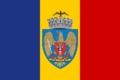
Bucharest is the
capital cityCapital City was a television show produced by Euston Films which focused on the lives of investment bankers in London living and working on the corporate trading floor for the fictional international bank Shane-Longman....
, industrial and financial centre of
RomaniaRomania is a country located in Southeastern and Central Europe, North of the Balkan Peninsula, on the Lower Danube, within and outside the Carpathian arch, bordering on the Black Sea. Almost all of the Danube Delta is located within its territory...
. It is the largest city in Romania, located in the southeast of the country, at , and lies on the banks of the
Dâmboviţa RiverThe Dâmboviţa River is a river in Romania. It starts at the junction of headwaters Valea Vladului and Boarcăşu, having its source in the Făgăraş Mountains, and flowing southward. It passes through Bucharest and flows into the Argeş River 286 kilometres from its source, near Budeşti, in Călăraşi...
.
Bucharest was first mentioned in documents as early as 1459. Since then it has gone through a variety of changes, becoming the state capital of Romania in 1862 and steadily consolidating its position as the centre of the Romanian mass media, culture and arts. Its eclectic architecture is a mix of historical (neo-classical), interbellum (
Bauhaus' is the common term for the ', a school in Germany that combined crafts and the fine arts, and was famous for the approach to design that it publicized and taught. It operated from 1919 to 1933....
and
Art DecoArt Deco was a popular international art design movement from 1925 until the 1940s, affecting the decorative arts such as architecture, interior design, and industrial design, as well as the visual arts such as fashion, painting, the graphic arts, and film...
), Communist-era and modern. In the period between the two World Wars, the city's elegant architecture and the sophistication of its elite earned Bucharest the nickname of the "Little Paris of the East" (
Micul Paris). Although many buildings and districts in the historic centre were damaged or destroyed by war, earthquakes and
Nicolae CeauşescuNicolae Andruţă Ceauşescu was a Romanian politician who was the Secretary General of the Romanian Communist Party from 1965 to 1989, President of the Council of State from 1967, and President of Romania from 1974 to 1989...
's program of
systematizationUrban planning in communist countries was subject to the ideological constraints of the system. Except for the Soviet Union where the communist regime started in 1917, in Eastern Europe communist governments took power after World War II...
, many survived. In recent years, the city has been experiencing an economic and cultural boom.
According to January 1, 2009 official estimates, Bucharest proper has a population of 1,944,367. The
urban areaThis is a list of all the urban areas of the European Union which have more than 750,000 inhabitants in 2005.This list is an attempt to present a consistent list of population figures for urban areas in the European Union. All the figures here have been compiled by Demographia.-Important notes:*...
extends beyond the limits of Bucharest proper and has a population of 2 million people. Adding the satellite towns around the urban area, the metropolitan area of Bucharest has a population of 2.15 million people. Bucharest is the 6th largest city in the
European UnionThe European Union is an economic and political union of 27 Member States, located primarily in Europe. Committed to regional integration, the EU was established by the Treaty of Maastricht on 1 November 1993 upon the foundations of the pre-existing European Economic Community...
by population within city limits.
Economically, the city is the most prosperous in Romania and is one of the main industrial centres and transportation hubs of
Eastern EuropeEastern Europe is a region lying in the Eastern part of Europe. The term is highly context-dependent and there are "almost as many definitions of Eastern Europe as there are scholars of the region"...
. As one of the wealthiest cities in Romania, Bucharest also has a broad range of convention facilities, educational facilities, cultural venues, shopping arcades and recreational areas.
The city proper is administratively known as the Municipality of Bucharest (
Municipiul Bucureşti), and has the same administrative level as a
countyThe judeţe are administrative units of Romania.The earliest organization into "judeţe" was in the 15th century and each judeţ was ruled by a "jude", a person who had administrative and judicial functions...
, being further subdivided into six
sectorsThe Municipality of Bucharest is divided into six administrative sectors , each of which has their own mayor and council, and has responsibility over local affairs, such as secondary streets, parks, schools and the cleaning services.Each of the six sectors contains a number of informal districts ...
.
Etymology
The name of
BucurBucur is the legendary Romanian shepherd who is said to have founded Bucharest, giving its name to it. While the legend about the shepherd is probably apocryphal, the name of Bucureşti is quite likely derived from a person Bucur, as the suffix -eşti is used for settlements derived from personal...
has an uncertain origin: tradition connects the founding of Bucharest with the name of Bucur who was either a prince, an outlaw, a fisherman, a shepherd, or a hunter, according to different legends.
In
AlbanianAlbanian is a unique Indo-European language spoken by nearly 6 million people, primarily in Albania and Kosovo but also in other areas of the Balkans in which there is an Albanian population, including western Macedonia, Montenegro, and southern Serbia. Albanian is also spoken by native enclaves...
, a language which may have historical connections with the Thracian languages, 'bukur' signifies 'beautiful'; in Romanian the word stem
bucur means 'glad', 'joy'.
The official city name in full is
The Municipality of Bucharest .
A native or resident of Bucharest is called
Bucharester .
History
Bucharest's history alternated periods of development and decline from the early settlements of the
AntiquityClassical antiquity is a broad term for a long period of cultural history centered on the Mediterranean Sea, comprising the interlocking civilizations of Ancient Greece and Ancient Rome collectively known as the Greco-Roman world...
and until its consolidation as capital of Romania late in the 19th century.
First mentioned as "the
CitadelA citadel is a fortress for protecting a town, sometimes incorporating a castle. The term derives from the same Latin root as the word "city", civis, meaning citizen....
of Bucureşti" in 1459, it became a residence of the
WallachiaWallachia or Walachia is a historical and geographical region of Romania. It is situated north of the Danube and south of the Southern Carpathians...
n
prince Vlad III the ImpalerVlad III, Prince of Wallachia, more commonly known as Vlad the Impaler , or simply Dracula , was a Wallachian voivode. His first reign as crown prince took place at age 17, during the same year of his release from Turkish captivity, in 1448...
. The Old Princely Court (
Curtea VecheCurtea Veche , built as a place or residence during the rule of Vlad III Dracula in the 15th century, now operates as a museum in the centre of Bucharest, Romania. The residence was moved under the rule of Radu cel Frumos, who moved the princely residence and the Wallachian capital to Bucharest...
) was built by
Mircea CiobanulMircea V Ciobanul was the Prince of Wallachia three times: January 1545 –16 November 1552; May 1553–28 February 1554 ; and January 1558–21 September 1559.-Biography:He was the fifth son of Radu cel Mare...
, and during following rules, Bucharest was established as the summer residence of the court, competing with
TârgovişteTârgovişte is a city in the Dâmboviţa county of Romania. It is situated on the right bank of the Ialomiţa River. , it had an estimated population of 89,000. One village, Priseaca, is administered by the city.-Name:...
for the status of capital after an increase in the importance of southern
MunteniaMuntenia is a historical province of Romania, usually considered Wallachia-proper . It is situated between the Danube , the Carpathian Mountains and Moldavia , and the Olt River to the west...
brought about by the demands of the
suzerainSuzerainty is a situation in which a region or people is a tributary to a more powerful entity which controls its foreign affairs while allowing the tributary some limited domestic autonomy. The superior entity in the suzerainty relationship, or the more powerful entity itself, is called a suzerain...
power, the
Ottoman EmpireThe Ottoman Empire or Ottoman State , also known by its contemporaries as the Turkish Empire or Turkey , was an empire that lasted from 1299 to November 1, 1922 The Ottoman Empire or Ottoman State (Ottoman Turkish: دَوْلَتِ عَلِیَّهِ عُثْمَانِیَّه Dawlet-il ʿAliyyat-il ʿOs̠māniyye, Modern Turkish:...
.
Burned down by the Ottomans and briefly discarded by princes at the start of the 17th century, Bucharest was restored and continued to grow in size and prosperity. Its centre was around the street "Uliţa Mare", which starting 1589 was known as
LipscaniLipscani is a street and a district of Bucharest, Romania, which in the Middle Ages was the most important commercial center of Bucharest and the whole Wallachia...
. Before the 1700s, it became the most important trade centre of Wallachia and became a permanent location for the Wallachian court after 1698 (starting with the reign of
Constantin BrâncoveanuConstantin Brâncoveanu was Prince of Wallachia between 1689 and 1714.-Ascension:A descendant of the Craioveşti boyar family and related to Matei Basarab, Brâncoveanu was born at the estate of Brâncoveni and raised in the house of his uncle, stolnic Constantin Cantacuzino...
).
Partly destroyed by natural disasters and rebuilt several times during the following 200 years, hit by
Caragea's plagueCaragea's plague or Caradja's plague was a bubonic plague epidemic that occurred in Wallachia, mainly in Bucharest, in the years 1813 and 1814. It coincided with the rule of the Phanariote Prince John Caradja.-Alleged source:...
in 1813–1814, the city was wrested from Ottoman control and occupied at several intervals by the
Habsburg MonarchyThe Habsburg Monarchy covered the territories ruled by the junior Austrian branch of the House of Habsburg , and then by the successor House of Habsburg-Lorraine , between 1526 and 1867/1918. The capital was mainly Vienna, except from 1583 to 1611, when the capital was Prague...
(1716, 1737, 1789) and Imperial Russia (three times between 1768 and 1806). It was placed under
Russian administrationRegulamentul Organic was a quasi-constitutional organic law enforced in 1834–1835 by the Imperial Russian authorities in Moldavia and Wallachia...
between 1828 and the
Crimean WarThe Crimean War was fought between the Russian Empire on one side and an alliance of the British Empire, France, the Ottoman Empire and the Kingdom of Sardinia on the other. The war was part of a long-running contest between the major European powers for influence over territories of the declining...
, with an interlude during the Bucharest-centred 1848 Wallachian revolution, and an
AustrianThe Austrian Empire was a modern era successor empire founded on a remnant of the Holy Roman Empire centered on what is today's Austria that officially lasted from 1804 to 1867...
garrison took possession after the Russian departure (remaining in the city until March 1857). Additionally, on March 23, 1847, a fire consumed about 2,000 buildings of Bucharest, destroying a third of the city. The social divide between rich and poor was described at the time by
Ferdinand LassalleFerdinand Lassalle was a German-Jewish jurist and socialist political activist.-Early life:Lassalle came from a prosperous Jewish family in Loslau later Breslau, Prussia; his father was a silk-merchant and intended his son for a business career, sending him to the commercial school at Leipzig...
as making the city "a savage hotchpotch".
In 1861, when
WallachiaWallachia or Walachia is a historical and geographical region of Romania. It is situated north of the Danube and south of the Southern Carpathians...
and
MoldaviaMoldavia is a geographic and historical region and former principality in Eastern Europe, corresponding to the territory between the Eastern Carpathians and the Dniester river...
were united to form the
Principality of RomaniaDanubian Principalities was a conventional name given to the Principalities of Moldavia and Wallachia, which emerged in the early 14th century. The term was coined in the Habsburg Monarchy after the Treaty of Kuchuk Kainarji in order to designate an area on the lower Danube with a common...
, Bucharest became the new nation's capital; in 1881, it became the political centre of the newly-proclaimed
Kingdom of RomaniaThe Kingdom of Romania was the old Romanian state based on a form of parliamentary monarchy between 13 March 1881 and 30 December 1947, specified by the first three Constitutions of Romania...
. During the second half of the 19th century, due to its new status, the city's population increased dramatically, and a new period of urban development began. The extravagant architecture and cosmopolitan high culture of this period won Bucharest the nickname of "The Paris of the East" (or "Little Paris",
Micul Paris), with
Calea VictorieiCalea Victoriei is a major avenue in central Bucharest. It leads from Splaiul Independenţei to the north and then northwest up to Piaţa Victoriei, where Şoseaua Kiseleff continues north....
as its
Champs-ÉlyséesThe Avenue des Champs-Élysées is a prestigious avenue in Paris, France. With its cinemas, cafés, luxury specialty shops and clipped chestnut trees, the Avenue des Champs-Élysées is one of the most famous streets in the world, and with rents as high as USD1.5 million per 1,000 square feet of...
or Fifth Avenue.
Between December 6, 1916 and November 1918, it was occupied by
GermanThe German Empire is the name commonly used in English to describe Germany from the unification of Germany and proclamation of Wilhelm I as German Emperor on 18 January 1871 to 1918, when it became a German republic after defeat in World War I and the abdication of Wilhelm II .The term Second Reich...
forces, the legitimate capital being moved to
IaşiIaşi , is a city and municipality in Moldavia, in north-eastern Romania...
. After
World War IWorld War I , also known as the First World War, the Great War, and the War to End All Wars, was a global military conflict which involved most of the world's great powers, assembled in two opposing alliances: the Triple Entente and the Triple Alliance...
, Bucharest became the capital of
Greater RomaniaThe Greater Romania generally refers to the territory of Romania in the years between the First World War and the Second World War , the largest geographical extent of Romania up to that time and its largest peacetime extent ever ; more precisely, it refers to the territory of the Kingdom of...
. In January 1941 it was the place of
Legionnaires' rebellion and Bucharest pogromThe Legionnaires' rebellion and the Bucharest pogrom occurred in Bucharest, Romania, between 21 and 23 January, 1941.As the privileges of the Iron Guard were being cut off by Conducător Ion Antonescu, the Legionnaires revolted. During the rebellion and pogrom, the Iron Guard killed 125 Jews and 30...
. As the capital of an
AxisThe Axis powers comprised the countries that were opposed to the Allies during World War II. The three major Axis powers—Germany, Italy, and Japan—were part of a military alliance on the signing of the Tripartite Pact in September 1940, which officially founded the Axis powers...
country, Bucharest suffered heavy losses during
World War IIWorld War II, or the Second World War , was a global military conflict which involved a majority of the world's nations, including all great powers, organized into two opposing military alliances: the Allies and the Axis...
, due to
Allied bombingsThe Bucharest World War II bombings were primarily Allied bombings of railroad targets and those of the Oil Campaign of World War II, but included a bombing by Nazi Germany after the royal coup. Bucharest stored and distributed much of Ploesti's refined oil products.
...
, and, on August 23, 1944, saw the royal coup which brought Romania into the anti-
GermanNazi Germany and the Third Reich are the common English names for Germany between 1933 and 1945, while it was led by Adolf Hitler and the National Socialist German Worker's Party . The name Third Reich refers to the state as the successor to the Holy Roman Empire of the Middle Ages and the German...
camp, suffering a short but destructive period of
LuftwaffeThe German Luftwaffe was one of the strongest, most doctrinally advanced, and most battle-experienced air forces in the world when World War II started in Europe in September 1939. Officially unveiled in 1935, in violation of the Treaty of Versailles, its purpose was to support Adolf Hitler's...
bombings in reprisal.
During
Nicolae CeauşescuNicolae Andruţă Ceauşescu was a Romanian politician who was the Secretary General of the Romanian Communist Party from 1965 to 1989, President of the Council of State from 1967, and President of Romania from 1974 to 1989...
's leadership (1965–1989), most of the historic part of the city was destroyed and replaced with Communist-style buildings, particularly high-rise apartment buildings. The best example of this is the development called Centrul Civic (the Civic Centre), including the
Palace of the ParliamentThe Palace of the Parliament in Bucharest, Romania is a multi-purpose building containing both chambers of the Romanian Parliament. According to the Guinness Book of World Records, the Palace is the world's largest civilian administrative building , most expensive administrative building, and...
, where an entire historic quarter was razed to make way for Ceauşescu's megalomaniac constructions. In 1977, a strong
7.4 on the Richter-scale earthquakeThe 1977 Vrancea Earthquake occurred on Friday, 4 March, 1977, 21:20 local time and was felt throughout the Balkans. It had a magnitude of 7.2 and its epicenter in Vrancea at a depth of 94 kilometers....
claimed 1,500 lives and destroyed many old buildings. Nevertheless, some historic neighbourhoods did survive to this day.
The
Romanian Revolution of 1989The Romanian Revolution of 1989 was a week-long series of increasingly violent riots and fighting in late December 1989 that overthrew the Government of Nicolae Ceauşescu. After a trial, Ceauşescu and his wife Elena were executed...
began with mass anti-Ceauşescu protests in
TimişoaraTimişoara , also known as "The City of Athletes", is a city in the Banat region of western Romania...
in December 1989 and continued in Bucharest, leading to the overthrow of the
Communist regimeCommunist Romania was the period in Romanian history when that country was a Soviet-aligned communist state in the Eastern Bloc, with the leading role of Romanian Communist Party enshrined in its successive constitutions...
. Dissatisfied with the post-revolutionary leadership of the
National Salvation FrontThe National Salvation Front was the governing body of Romania in the first weeks after the Romanian Revolution of 1989, subsequently turned into a political party...
, student leagues and opposition groups organized large-scale protests continued in 1990 (the
GolaniadThe Golaniad was a protest in Romania in the University Square, Bucharest. It was initiated by students and professors at the University of Bucharest....
), which were violently stopped by the miners of Valea Jiului (the
MineriadSee also The 1990s: the rise and decline of miners' unionsA Mineriad is the term used to name any of the successive violent interventions of miners in Bucharest. These interventions were generally seen as aimed at wrestling policy changes or simply material advantages from the current political...
). Several other Mineriads followed, the results of which included a government change.
After the year 2000, due to the advent of Romania's economic boom, the city has modernised and is currently undergoing a period of urban renewal. Various residential and commercial developments are underway, particularly in the northern districts, while Bucharest's historic centre is currently undergoing restoration.
Treaties signed in Bucharest
- Treaty of May 28, 1812, at the end of the Russo-Turkish War
The Russo-Turkish War, 1806–1812 was one of many wars fought between Imperial Russia and the Ottoman Empire.- Background :The war broke out in 1805–1806 against the background of the Napoleonic wars...
- Treaty of March 3, 1886, at the end of the Serbo-Bulgarian War
The Serbo-Bulgarian War was a war between Serbia and Bulgaria that erupted on 14 November 1885 and lasted until 28 November the same year. Final peace was signed on 19 February 1886 in Bucharest...
- Treaty of August 10, 1913, at the end of the Second Balkan War
The Second Balkan War was a conflict which broke out when Bulgaria dissatisfied from its share after the division of the spoils of the First Balkan War, attacked its former allies, Serbia and Greece, on 16 June 1913. Serbian and Greek armies repulsed the Bulgarian offensive and counter-attacked...
- Treaty of August 4, 1916, the treaty of alliance between Romania and the Entente
The Triple Entente was the name given to the loose alignment between the United Kingdom, France, and Russia after the signing of the Anglo-Russian Entente in 1907...
- Treaty of May 6, 1918, the treaty between Romania and the Central Powers
The Central Powers was one of the two sides that participated in World War I, the other being the Entente Powers.-Member states:...
General Information
Bucharest is situated on the banks of the
Dâmboviţa RiverThe Dâmboviţa River is a river in Romania. It starts at the junction of headwaters Valea Vladului and Boarcăşu, having its source in the Făgăraş Mountains, and flowing southward. It passes through Bucharest and flows into the Argeş River 286 kilometres from its source, near Budeşti, in Călăraşi...
, which flows into the
Argeş RiverArgeş is a river of Southern Romania. It starts at the junction of headwaters Buda and Capra in the Făgăraş Mountains, in the Southern Carpathians and flows into the Danube at Olteniţa.The main city on the Argeş is Piteşti...
, a tributary of the
DanubeThe Danube is the longest river in the European Union and Europe's second longest river after the Volga.The river originates in the Black Forest in Germany as the much smaller Brigach and Breg rivers which join at the German town Donaueschingen, after which it is known as the Danube and flows...
.
Several lakes the most important of which are Lake Herăstrău, Lake Floreasca, Lake Tei, and Lake Colentina stretch across the city, along the
Colentina RiverThe Colentina River is a tributary of the Dâmboviţa River in Romania.The following lakes are built on the river:* Lake Moarta* Lake Ciocăneşti I* Lake Ciocăneşti I* Lake Crevedia VI* Lake Buftea* Lake Mogoşoaia* Lake Chitila...
, a tributary of the Dâmboviţa. In addition, in the centre of the capital there is a small artificial lake Lake Cişmigiu surrounded by the
Cişmigiu GardensThe Cişmigiu Gardens are a public park near the center of Bucharest, Romania, spanning areas on all sides of an artificial lake. The gardens' creation was an important moment in the history of Bucharest. They form the oldest and, at 17 hectares, the largest park in city's central area...
. The Cişmigiu Gardens have a rich history, being frequented by famous poets and writers. Opened in 1847 and based on the plans of German architect Carl F.W. Meyer, the gardens are currently the main recreational facility in the city centre.
Besides Cişmigiu, Bucharest contains several other large parks and gardens, including
Herăstrău ParkHerăstrău Park is a large park on the northern side of Bucharest, Romania, around Lake Herăstrău.The park has an area of about 1.1 km², of which 0.7 km² is the lake. Initially, the area was full of marshes, but these were drained between 1930 and 1935, and the park was opened in 1936...
and the
Botanical GardenThe Botanical Garden of Bucharest, now named after its founder, Dimitrie Brândză, is located in the Cotroceni neighbourhood of Bucharest, Romania. It has a surface of 17.5 hectares , and has more than 10,000 species of plants....
. Herăstrău is a large public park located in the north of the city, around Lake Herăstrău, and the site of the
Village MuseumThe Village Museum is an open-air ethnographic museum located in the Herăstrău Park , showcasing traditional Romanian village life. The museum extends to over 100,000 m
2, and contains 272 authentic peasant farms and houses from all over Romania.It was created in 1936 by Dimitrie Gusti,...
, while the Bucharest's botanical garden is the largest in Romania and contains over 10,000 species of plants, many of them exotic; it was once a pleasure park for the royal family.
Bucharest is situated in the south eastern corner of the
Romanian PlainThe Romanian Plain is located in southern Romania. Part of the historical region of Wallachia, it is bordered by the Danube River in the east, south and west, and by the Getic Plateau in the north. Bucharest, the capital of Romania, is located in the central part of the Romanian Plain. It is...
, in an area once covered by the Vlăsiei forest, which, after it was cleared, gave way to a fertile flatland. As with many cities, Bucharest is traditionally considered to have seven hills, in the tradition of the seven hills of
RomeRome is the capital of Italy and the country's largest and most populated municipality , with over 2.7 million residents in , while the population of the urban area is estimated by Eurostat to be 3.46 million. The metropolitan area of Rome is estimated by OECD to have a population of 3.7 million...
. Bucharest's seven hills are: Mihai Vodă,
Dealul MitropolieiDealul Mitropoliei , also called Dealul Patriarhiei or "Patriarchate Hill", is a small hill in Bucharest, Romania and an important historic, cultural, architectural, religious and touristic point in the national capital...
, Radu Vodă,
CotroceniCotroceni is a neighbourhood in western Bucharest, Romania located around the Cotroceni hill, in Bucharest's Sector 6.The Hill of Cotroceni was once covered by the forest of Vlăsia, which covered most of today's Bucharest...
, Spirei,
VăcăreştiVăcăreşti is a neighbourhood in south-eastern Bucharest, located near Dâmboviţa River and the Văcăreşti Lake. Nearby neighbourhoods include Vitan, Olteniţei and Berceni. Originally a village, it was included in Bucharest as it expanded...
and Sf. Gheorghe Nou.
The city has a total area of . The altitude varies from at the Dâmboviţa bridge in Căţelu, south-eastern Bucharest and at the
MilitariMilitari is a district in the western part of Bucharest, in Sector 6, built in the early 1960s by Soviet workers, after completely razing the village called Militari. It is home to about 100,000 inhabitants....
church. The city has a relatively round shape, with the centre situated approximately in the cross-way of the main north-south/east-west axes at the
University SquareUniversity Square is located in downtown Bucharest, near the University of Bucharest.Four statues are located in the University Square, in front of the University; they depict Ion Heliade Rădulescu , Michael the Brave , Gheorghe Lazăr and Spiru Haret .The square was the site of the 1990 Golaniad,...
. The milestone for Romanian's
Kilometre ZeroIn many countries, Kilometre Zero or similar terms in other languages, is a particular location , from which distances are traditionally measured...
is placed just south of University Square in front of the New St. George Church (Sfântul Gheorghe Nou) at St. George Square (Piaţa Sfântul Gheorghe). Bucharest's radius, from University Square to the city limits in all directions, varies from about 10 to 12 km (6.25–7.5 mi).
Until recently, the regions surrounding Bucharest were largely rural, but after 1989, new suburbs started to be built around Bucharest, in the surrounding Ilfov county. Further urban consolidation is expected to take place when the Bucharest metropolitan area is formed in 2006, which will incorporate various communes and cities of Ilfov and surrounding counties.
Climate
Bucharest has a temperate
continentalIn climatology, the term microthermal is used to denote the continental climates of Eurasia and North America.The word microthermal is derived from two Greek words meaning "having little heat." This is misleading, however, since the term is intended to describe only the temperature conditions that...
climate. Due to its position on the
Romanian PlainThe Romanian Plain is located in southern Romania. Part of the historical region of Wallachia, it is bordered by the Danube River in the east, south and west, and by the Getic Plateau in the north. Bucharest, the capital of Romania, is located in the central part of the Romanian Plain. It is...
, the city's winters can get windy, even though some of the winds are mitigated due to urbanisation. Winter temperatures are often below , even though they rarely drop below . In summer, the average temperature is approximately (the average for July and August), despite the fact that temperatures many times reach to in mid-summer in the city centre. Although average
precipitationIn meteorology, precipitation is any product of the condensation of atmospheric water vapor that is deposited on the Earth's surface. The main forms of precipitation include rain, snow, ice pellets, and graupel...
and
humidityHumidity is the amount of water vapour in the air. In daily language the term "humidity" is normally taken to mean relative humidity. Relative humidity is defined as the ratio of the partial pressure of water vapour in a parcel of air to the saturated vapour pressure of water vapour at a prescribed...
during summer is low, there are infrequent yet heavy and often violent storms. During spring and autumn, temperatures vary between to , and precipitation during this time tends to be higher than in summer, with more frequent yet milder periods of rain.
Administration
Bucharest has a unique status in Romanian administration, since it is the only municipality that is not part of a
countyThe judeţe are administrative units of Romania.The earliest organization into "judeţe" was in the 15th century and each judeţ was ruled by a "jude", a person who had administrative and judicial functions...
. Its population, however, is larger than that of any Romanian county, and hence the power of the Bucharest General City Hall (
Primăria Generală), which is the city's local government body, is about the same as, if not greater than, that of Romanian county councils.
The city government is headed by a
General MayorThe Mayor of Bucharest , sometimes known as the General Mayor, is the head of the Bucharest City Hall in Bucharest, Romania, which is responsible for city-wide affairs, such as the water system, the transport system and the main boulevards...
(Primar General), currently (as of 2009)
Sorin OprescuDr. Sorin Mircea Oprescu is a Romanian independent politician and medical doctor who is currently serving as Mayor of Bucharest.-Political activity:...
. Decisions are approved and discussed by the
General CouncilThe General Council of Bucharest is the legislative body of the Municipality of Bucharest, and is made up of 55 councillors elected every four years...
(Consiliu General) made up of 55 elected councillors. Furthermore, the city is divided into six administrative
sectorsThe Municipality of Bucharest is divided into six administrative sectors , each of which has their own mayor and council, and has responsibility over local affairs, such as secondary streets, parks, schools and the cleaning services.Each of the six sectors contains a number of informal districts ...
(sectoare), each of which has their own 27-seat sectorial council, town hall and mayor. The powers of local government over a certain area are therefore shared by the Bucharest City Hall and the local sectorial councils with little or no overlapping of authority. The general rule is that the main City Hall is responsible for citywide utilities such as the water system, the transport system and the main boulevards, while sectorial town halls manage the contact between individuals and the local government, secondary streets, parks, schools and cleaning services.
The six sectors are numbered from one to six and are disposed radially so that each one has under its administration an area of the city centre. They are numbered clockwise and are further divided into districts without any form of administration (
cartiere):
- Sector 1
Sector 1 is a sector in Bucharest. It includes the northern part of the city centre as well as the northwestern districts of Băneasa and Pipera. It is the wealthiest sector in Bucharest.-Politics:...
(population 227,717): DorobanţiDorobanţi is a district in Sector 1, Bucharest. The theme of the district is represented by red brick buildings and modern glass buildings. Main intersections/plazas are Perla, Dorobanţi Plaza, Lahovari, Charles de Gaulle, Quito Plaza. Main streets are Calea Dorobanţilor, Iancu de Hunedoara Avenue,...
, BăneasaBăneasa is a borough in the north side of Bucharest, near the Băneasa Lake . Like all north-side districts of Bucharest, it is relatively sparsely-populated, with large areas of parkland...
, Aviaţiei{Infobox settlement|name = Aviaţiei|settlement_type = Commune|other_name =|image_skyline =|imagesize =|image_caption =|image_flag =|flag_size =...
, PiperaPipera is a district of Voluntari city, situated in the north part of Bucharest, Romania.Until 1995, it was an ordinary village. After that, an "el dorado" of land transactions began. Plots of land that were 1 USD/m² reached in 2005 the amount of 250 USD/m²...
, Aviatorilor, Primăverii, RomanăRomana, short for Romanadvoratrelundar, is a fictional character in the long-running British science fiction television series Doctor Who...
, Victoriei, Herăstrău ParkHerăstrău Park is a large park on the northern side of Bucharest, Romania, around Lake Herăstrău.The park has an area of about 1.1 km², of which 0.7 km² is the lake. Initially, the area was full of marshes, but these were drained between 1930 and 1935, and the park was opened in 1936...
, Bucureştii NoiBucureştii Noi is a district situated in north-west of Bucharest and of Sector 1....
, Dămăroaia, Strǎuleşti, GriviţaGriviţa is an area of Bucharest, Romania, centered on the Griviţa Railway Yards , which were and still are an important landmark within the manufacturing landscape of the city...
, 1 Mai, Băneasa ForestBăneasa Forest is a wood in the north of Bucharest, Romania. Covering some 80,000 hectares, the ground is located in proximity to Băneasa neighborhood and Băneasa Airport...
, Pajura, Domenii and a small part of GiuleştiGiuleşti is a neighbourhood in northwestern Bucharest, in Sector 6. The Giuleşti Stadium, Giuleşti Theatre, Podul Grant are located in Giuleşti...
which includes Giuleşti StadiumGiuleşti-Valentin Stănescu Stadium is a football stadium in Bucharest, Romania and is the home stadium of Rapid Bucureşti.The stadium is named after Valentin Stănescu, the coach that helped Rapid to win its first title, but it is still commonly known as the "Giuleşti Stadium", after the name of...
- Sector 2
Sector 2 is a sector in Bucharest.-Demographics:Sector 2 is the city's most multicultural sector. In particular, it contains Romania's largest community of Chinese people, who mainly live in the districts of Colentina and Obor....
(population 357,338): PantelimonPantelimon is a neighborhood located in the north-eastern part of Bucharest, Romania, in Sector 2. Outside Bucharest, there is an adjacent town named Pantelimon, administered separately....
, ColentinaColentina is one of the main neighborhoods in Bucharest's 2nd district located on the north-east of the city. A local folk etymology says that the name is derived from "colea-n-tină" , this being the answer given by a spătar to Matei Basarab, who asked the former where he had defeated the Ottoman...
, Iancului, TeiTei is a neighborhood in Bucharest - Sector 2. The name comes from the name of the lake in this area: Lacul Tei . In this neighbourhood there are a lot of linden trees, and when they are in bloom, they spread a strong scent...
, Floreasca, MoşilorMoşilor is a residential quarter in Bucharest's Sector 2.It houses the Foişorul de Foc and Silvestru Church. It is serviced by tram lines 14, 16 and 21, and the M1 Line through Obor metro station....
, OborObor is the name of a square and the surrounding district of Bucharest, the capital of Romania. There is also a Bucharest Metro station named Obor, which lies in this area....
, Vatra Luminoasă, Fundeni, Plumbuita, Ştefan cel Mare, Baicului
- Sector 3
Sector 3 is a sector in Bucharest.-Politics:The mayor of the sector is Liviu Gheorghe Negoiţă, from the Democratic Liberal Party...
(population 399,231): VitanVitan is a neighborhood in southeastern Bucharest, Romania, along the Dâmboviţa River, located between Titan, Dristor, Centrul Civic, Olteniţei and Berceni....
, DudeştiDudeşti is a neighbourhood in south-eastern Bucharest, along the Calea Dudeşti. Nearby neighbourhoods include Vitan, Văcăreşti and Dristor....
, TitanTitan is a neighborhood of Eastern Bucharest, part of Sector 3. It surrounds the Alexandru Ioan Cuza Park, formerly known as "Titan", "I.O.R." , and "Balta Albă" ....
, Centrul Civic, DristorDristor is a neighborhood located in the southeastern part of Bucharest. Nearby districts include Dudeşti, Vitan, Văcăreşti and Titan. The Dristor metro station is a major node of Bucharest Metro's network....
, LipscaniLipscani is a street and a district of Bucharest, Romania, which in the Middle Ages was the most important commercial center of Bucharest and the whole Wallachia...
, Muncii, Unirii
- Sector 4
-Politics:The mayor of the sector is Cristian Popescu Piedone, from the Conservative Party. The Local Council of Sector 4 has 27 seats, with the following party composition :...
(population 300,331): BerceniBerceni is a district of southern Bucharest.-Location:Geographically, it has a trapezoidal shape, bordered by Oltenitei Road and Turnu Magurele Street in the north and south, respectively. Built during the 1960s, it is a typical Communist-era working class district, lacking any major green spaces...
, OlteniţeiOlteniţei is a quarter in Bucharest's Sector 4....
, GiurgiuluiGiurgiului is a small neighborhood in Bucharest situated in the south, near Berceni and Ferentari. As Berceni, Giurgiului has a plenty of 10 floors blocks of flats which were built by the communists during the early 1970s. The average population is between 30000 and 40000...
, ProgresulProgresul is a district in southern Bucharest's Sectorul 4....
, VăcăreştiVăcăreşti is a neighbourhood in south-eastern Bucharest, located near Dâmboviţa River and the Văcăreşti Lake. Nearby neighbourhoods include Vitan, Olteniţei and Berceni. Originally a village, it was included in Bucharest as it expanded...
, Timpuri Noi, Tineretului
- Sector 5
Sector 5 is a sector in Bucharest.-Politics:The mayor of the sector is Marian Vanghelie, from the Social Democratic Party. The Local Council of Sector 5 has 27 seats, with the following party composition :...
(population 288,690): RahovaRahova is a neighbourhood of southwest Bucharest, Romania, situated in Sector 5, west of Dâmboviţa River. It is named after the Bulgarian town Rahovo , site of a battle in the Romanian War of Independence....
, FerentariFerentari is a neighbourhood located in the 5th Sector of Bucharest, Romania.-Area:It is located in the South-South-West of Bucharest at a distance of 2.5 to 5 km from the city center...
, GiurgiuluiGiurgiului is a small neighborhood in Bucharest situated in the south, near Berceni and Ferentari. As Berceni, Giurgiului has a plenty of 10 floors blocks of flats which were built by the communists during the early 1970s. The average population is between 30000 and 40000...
, CotroceniCotroceni is a neighbourhood in western Bucharest, Romania located around the Cotroceni hill, in Bucharest's Sector 6.The Hill of Cotroceni was once covered by the forest of Vlăsia, which covered most of today's Bucharest...
, 13 Septembrie, Dealul Spirii
- Sector 6
Sector 6 is a sector in Bucharest.-Politics:The mayor of the sector is Cristian Poteraş, from the Democratic Liberal Party. The Local Council of Sector 6 has 27 seats, with the following party composition :...
(population 371,060): GiuleştiGiuleşti is a neighbourhood in northwestern Bucharest, in Sector 6. The Giuleşti Stadium, Giuleşti Theatre, Podul Grant are located in Giuleşti...
, CrângaşiCrângaşi is one of the smallest neighbourhoods in the 6th Sector of Bucharest, Romania. It is situated on the west side of the city near the Dâmboviţa River, where it flows into Lacul Morii. Its name means "people living in a young forest". Nearby neighbourhoods include Giuleşti....
, Drumul TabereiDrumul Taberei is a neighbourhood located in the south-west of Bucharest, Romania, roughly between Timişoara Avenue and Ghencea Avenue, neighboring Militari to the North, Panduri to the East and Ghencea and Rahova to the South and South-East.It is one of the few examples of successful urban...
, MilitariMilitari is a district in the western part of Bucharest, in Sector 6, built in the early 1960s by Soviet workers, after completely razing the village called Militari. It is home to about 100,000 inhabitants....
, GrozǎveştiGrozăveşti may refer to several places in Romania:* Grozăveşti, a district in Bucharest* Grozăveşti, a village in Corbii Mari Commune, Dâmboviţa County* Grozăveşti, a village in Nicoreşti Commune, Galaţi County...
(also known as Regie), GhenceaGhencea is a district of the Romanian capital city Bucharest, which is home to the famous football team FC Steaua Bucureşti. It is also home to the rugby team Steaua Bucureşti Rugby.-Notable landmarks:*Stadionul Steaua, home stadium of Steaua Bucureşti...
Like all other local councils in Romania, the Bucharest sectorial councils, the city's
General CouncilThe General Council of Bucharest is the legislative body of the Municipality of Bucharest, and is made up of 55 councillors elected every four years...
and the mayors are elected every four years by the population. Additionally, Bucharest has a prefect, who is appointed by Romania's central government. The prefect is not allowed to be a member of a political party. The prefect's role is to represent the national government at local level, acting as a liaison and facilitating the implementation of National Development Plans and governing programmes at local level. The current prefect of Bucharest (as of 2009) is Mihai Cristian Atanasoaiei.
The Municipality of Bucharest, along with the surrounding
Ilfov countyIlfov is the county that surrounds Bucharest, the capital of Romania. It used to be largely rural, but after the fall of communism, many of the county's villages and communes developed into high-income commuter towns, which act like suburbs or satellites of Bucharest...
, forms the Bucharest development region, which is equivalent to NUTS-II regions in the
European UnionThe European Union is an economic and political union of 27 Member States, located primarily in Europe. Committed to regional integration, the EU was established by the Treaty of Maastricht on 1 November 1993 upon the foundations of the pre-existing European Economic Community...
and is used by the European Union and the Romanian Government for statistical analysis and regional development. The Bucharest development region is not, however, an administrative entity.
Justice system
Bucharest's judicial system is similar to that of the Romanian counties. Each of the six sectors has their own local first instance court (
judecătorie), while appeals from these courts' verdicts, and more serious cases, are directed to the Bucharest Tribunal, the city's municipal court. The Bucharest Court of Appeal judges appeals against decisions taken by tribunals in Bucharest and in five surrounding counties (Teleorman, Ialomiţa, Giurgiu, Călăraşi and Ilfov). Bucharest is also home to Romania's supreme court, the
High Court of Cassation and JusticeThe High Court of Cassation and Justice is Romania's supreme court, and the court of last resort. It is the equivalent of France's Cour de cassation and serves a similar function to other courts of cassation around the world...
, as well as to the Constitutional Court of Romania.
Bucharest has its own municipal police force, the Bucharest Police (
Poliţia Bucureşti), which is responsible for policing of crime within the whole city, and operates a number of special divisions. The Bucharest Police are headquartered on Ştefan cel Mare Blvd in the city centre, and has a number of precincts throughout the city. From 2004 onwards, each sector City Hall also has under its administration a Community Police force (
Poliţia ComunitarăPoliţia Comunitară is the generic name for the local police in Romania - on city or commune level. They are subordinated to the mayors and their main duties are to enforce the local ordinances and to assist the National Police and the Gendarmerie in maintaining and restoring the public order.-See...
), dealing with local community issues. Bucharest also houses the General Inspectorates of the
GendarmerieJandarmeria Română is the military branch of the two Romanian police forces .The gendarmerie is subordinated to the Ministry of Interior and Administrative Reform and does not have responsibility for policing the Romanian Armed Forces...
and the
National PoliceThe Romanian Police is the national police force and main civil law enforcement agency in Romania. It is subordinated to the Ministry of Interior and Administrative Reform.-Duties:The Romanian Police is responsible for:...
.
Crime
Bucharest's crime rate is rather low in comparison to other Eastern European capital cities, with the number of total offences declining by 51% between 2000 and 2004. In particular, levels of
violent crimeA violent crime or crime of violence is a crime in which the offender uses or threatens to use violent force upon the victim. This entails both crimes in which the violent act is the objective, such as murder, as well as crimes in which violence is the means to an end, such as robbery. Violent...
remain very low, with 24 murders and 1069 other violent offences taking place in 2004. Although there have been a number of recent police crackdowns on organised crime gangs, such as the Cămătaru clan, organised crime generally has little impact on public life. Petty crime, however, is more common, particularly in the form of
pickpocketingPicking pockets without a person's knowledge and approval is a crime, a form of larceny which involves the stealing of money and valuables from the person of a victim without their noticing the theft at the time. It requires considerable dexterity and a knack for misdirection...
, which occurs mainly on the city's public transport network. Additionally,
confidence trickA confidence trick or confidence game is an attempt to defraud a person or group by gaining their confidence...
s are sometimes common, especially in regards to tourists, even though the frequency of these tricks has declined in recent years. Levels of crime are higher in the southern districts of the city, particularly in
FerentariFerentari is a neighbourhood located in the 5th Sector of Bucharest, Romania.-Area:It is located in the South-South-West of Bucharest at a distance of 2.5 to 5 km from the city center...
, a socially-disadvantaged area.
Although the presence of
street childrenStreet children is a term used to refer to children who live on the streets of a city. They are deprived of family care and protection. Most children on the streets are between the ages of about 5 and 17 years old, and their population between different cities is varied.Street children live in...
was a problem in Bucharest in the 1990s, their numbers have declined significantly in recent years, currently lying at or below the average of major European capital cities. The same is true for beggars and
homeless peopleHomelessness is the condition and social category of people who don't have a regular house or dwelling because they cannot afford, pay for, or are otherwise unable to maintain regular, safe, and adequate housing, or they lack "fixed, regular, and adequate nighttime residence" The actual legal...
, many of them from the Roma minority. However, there are still an estimated 1,000 street children in the city, many of whom engage in petty crime and begging. There has been speculation that the street children are recruited by professional underground networks for criminal purposes. From 2000 onwards, Bucharest has seen an increase in illegal road races which occur mainly at night in the city's outskirts or on industrial sites.
A significant problem in the city remains
institutional corruptionPolitical corruption is the use of legislated powers by government officials for illegitimate private gain. Misuse of government power for other purposes, such as repression of political opponents and general police brutality, is not considered political corruption. Neither are illegal acts by...
, which is seen as the most important justice-and-law related problem in the city.
Demographics
Historical population of Bucharest
| Year |
Population |
| 1789 |
30,030 |
| 1831 |
60,587 |
| 1859 |
122,000 |
| 1900 |
282,000 |
| 1918 |
383,000 |
| December 29, 1930 census |
633,355 |
| January 25, 1948 census |
1,025,180 |
| February 21, 1956 census |
1,177,661 |
| March 15, 1966 census |
1,366,684 |
| January 5, 1977 census |
1,807,239 |
| July 1, 1990 estimate |
2,127,194 |
| January 7, 1992 census |
2,067,545 |
| March 18, 2002 census |
1,926,334 |
| July 1, 2005 estimate |
1,924,959 |
| July 1, 2007 estimate |
1,931,838 |
| January 1, 2009 estimate |
1,944,367 |
The city's population, according to the 2002 census, is 1,926,334 inhabitants, or 8.9% of the total population of Romania. Additionally, there are about 50,000 people who commute to the city every day, mainly from the surrounding
Ilfov countyIlfov is the county that surrounds Bucharest, the capital of Romania. It used to be largely rural, but after the fall of communism, many of the county's villages and communes developed into high-income commuter towns, which act like suburbs or satellites of Bucharest...
.
Bucharest's population experienced two phases of rapid growth, the first in the late 19th century, when the city grew in importance and size, and the second during the
Communist periodCommunist Romania was the period in Romanian history when that country was a Soviet-aligned communist state in the Eastern Bloc, with the leading role of Romanian Communist Party enshrined in its successive constitutions...
, when a massive
urbanisationUrbanization is the physical growth of urban areas from rural areas as a result of population immigration to an existing urban area. Effects include change in density and administration services. While the exact definition and population size of urbanized areas varies amongdifferent countries,...
campaign was launched and many people migrated from rural areas to the capital. At this time, due to Ceauşescu's ban on abortion and contraception, natural increase was also significant.
Approximately 97% of the population of Bucharest are ethnic
RomaniansThe Romanians are a nation and ethnic group native to Romania, who speak Romanian ; they are the majority inhabitants of România.In one prominent interpretation of the census results in Moldova, Moldovans are counted as Romanians, which would...
, with the second largest ethnic group being the Roma, which make up 1.4% of the population. Other significant ethnic groups are Hungarians (0.3%), Jews (0.1%),
TurksThe Turkish people , also known as the "Turks" are defined mainly as citizens of the Republic of Turkey. An early historic text provided the definition of being a Turk as "any individual within the Republic of Turkey; whatever his/her faith or racial/ethnic background; who speaks Turkish, grows up...
(0,1%) and
GermansThe German people are an ethnic group, in the sense of sharing a common German culture, descent, and speaking the German language as a mother tongue. Within Germany, Germans are defined by citizenship , distinguished from people of German ancestry...
(0,1%). Some other inhabitants of Bucharest are of
GreekThere has been a Greek presence in Romania for at least 27 centuries. At times, as during the Phanariote era, this presence has amounted to hegemony; at other times , the Greeks have simply been one among the area's many ethnic minorities....
,
ArmenianArmenians have been present in what is now Romania and Moldova for over a millennium, and have been an important presence as traders since the 14th century...
,
LipovanLipovans or Lippovans are the Old Believers, mostly of Russian ethnic origin, who settled in Moldavia, in the Danube Delta, in Tulcea county, in the Dobrogea region of eastern Romania, and in the southwestern part of Odessa Oblast , in Chernivtsi Oblast in Ukraine, as well as in two villages in...
and
ItalianItaly , officially the Italian Republic , is a country located on the Italian Peninsula in Southern Europe and on the two largest islands in the Mediterranean Sea, Sicily and Sardinia. Italy shares its northern, Alpine boundary with France, Switzerland, Austria and Slovenia...
descent. The Greeks and the Armenians used to play significant roles in the life of the city at the end of the 19th century and beginning of the 20th century. One of the predominantly Greek neighbourhoods was
VitanVitan is a neighborhood in southeastern Bucharest, Romania, along the Dâmboviţa River, located between Titan, Dristor, Centrul Civic, Olteniţei and Berceni....
- where a
JewThe Jews , also known as the Jewish people, are an ethnoreligious group originating in the Israelites or Hebrews of the Ancient Near East. The Jewish ethnicity, nationality, and religion are strongly interrelated, as Judaism is the traditional faith of the Jewish nation...
ish population also lived; the latter was more present in
VăcăreştiVăcăreşti is a neighbourhood in south-eastern Bucharest, located near Dâmboviţa River and the Văcăreşti Lake. Nearby neighbourhoods include Vitan, Olteniţei and Berceni. Originally a village, it was included in Bucharest as it expanded...
and areas around Unirii Square.
In terms of religion, 96.1% of the population are
Romanian OrthodoxThe Romanian Orthodox Church is an autocephalous Eastern Orthodox church. It is in full communion with other Eastern Orthodox churches, and is ranked seventh in order of precedence. The Primate of the church has the title of Patriarch...
, 1.2% are Roman Catholic, 0.5% are
MuslimIslam in Romania is followed by only 0.3 percent of population, but has 700 years of tradition in Northern Dobruja, a region on the Black Sea coast which was part of the Ottoman Empire for almost five centuries . In present-day Romania, most adherents to Islam belong to the Tatar and Turkish ethnic...
and 0.4% are Eastern Rite-Catholic. Despite this, only 24% of the population, of any religion, attend a place of worship once a week or more. The life expectancy of residents of Bucharest in 2003–2005 was 74.14 years, around 2 years higher than the Romanian average. Female life expectancy was 77.41 years, in comparison to 70.57 years for males.
Economy
Bucharest is the centre of the
RomaniaRomania is a country located in Southeastern and Central Europe, North of the Balkan Peninsula, on the Lower Danube, within and outside the Carpathian arch, bordering on the Black Sea. Almost all of the Danube Delta is located within its territory...
n economy and
industryAn industry is the manufacturing of a good or service within a category. Although industry is a broad term for any kind of economic production, in economics and urban planning industry is a synonym for the secondary sector, which is a type of economic activity involved in the manufacturing of raw...
, accounting for around 14.6% of the country's
GDPThe gross domestic product or gross domestic income is a basic measure of a country's economic performance and is the market value of all final goods and services made within the borders of a country in a year...
and about one-quarter of its industrial production, while being inhabited by only 9% of the country's population. Almost one third of national taxes is paid by Bucharest's citizens and companies. In 2006, at purchasing power parity, Bucharest had a per-capita GDP of €19,800, or 83.8% that of the
European UnionThe European Union is an economic and political union of 27 Member States, located primarily in Europe. Committed to regional integration, the EU was established by the Treaty of Maastricht on 1 November 1993 upon the foundations of the pre-existing European Economic Community...
average and more than twice the
RomaniaRomania is a country located in Southeastern and Central Europe, North of the Balkan Peninsula, on the Lower Danube, within and outside the Carpathian arch, bordering on the Black Sea. Almost all of the Danube Delta is located within its territory...
n average. The city's strong economic growth has revitalised infrastructure and led to the development of many shopping malls and modern residential towers and high-rise office buildings. In September 2005, Bucharest had an unemployment rate of 2.6%, significantly lower than the national unemployment rate of 5.7%.
Bucharest's economy is mainly centred on
industryAn industry is the manufacturing of a good or service within a category. Although industry is a broad term for any kind of economic production, in economics and urban planning industry is a synonym for the secondary sector, which is a type of economic activity involved in the manufacturing of raw...
and services, with services particularly growing in importance in the last ten years. The headquarters of 186,000 firms, including nearly all large Romanian companies are located in Bucharst. An important source for growth since 2000 has been the city's property and construction boom. Bucharest is also Romania's largest centre for
information technologyInformation technology , as defined by the Information Technology Association of America , is "the study, design, development, implementation, support or management of computer-based information systems, particularly software applications and computer hardware." IT deals with the use of electronic...
and communications and is home to several software companies operating offshore delivery centres.
Romania's largest stock exchange, the
Bucharest Stock ExchangeThe Bucharest Stock Exchange is a stock exchange in Bucharest, capital of Romania. On December 1, 2005, Bucharest's electronic over-the-counter stock market, Rasdaq, was merged with the Bucharest Stock Exchange....
, which was merged in December 2005 with the Bucharest-based electronic stock exchange
RasdaqRASDAQ is a former stock market in Romania, now part of the Bucharest Stock Exchange. The RASDAQ was one of two stock exchanges in Romania but merged with the Bucharest Stock Exchange on December 8, 2005. The name of the RASDAQ derived from NASDAQ, second largest stock exchange in United States,...
plays a major role in the city's economy.
There are a number of major international
supermarketA supermarket, also called a grocery store in some parts of North America, is a self-service store offering a wide variety of food and household merchandise, organized into departments...
chains such as
CarrefourCarrefour SA is a French international hypermarket chain. Headquartered in Levallois-Perret, France, Carrefour is the largest hypermarket chain in the world in terms of size, and the second largest retail group in the world in terms of revenue and third largest in profit after Wal-Mart and Tesco...
,
CoraCora is a retail group based in Belgium which owns several supermarket and hypermarket chains internationally. Formed in 1974, the corporation's brands include Match, Profi, Albinuta, Truffaut, Ecomax, Animalis, Sovena and Houra, as well as Cora-branded hypermarkets.The name comes from the Greek...
and
METROMetro AG is a diversified retail and wholesale/cash and carry group based in Germany. It has the largest market share in its home market, and is one of the most globalised retail and wholesale corporations. It is the 5th largest retailer in the world. In English it often refers to itself as Metro...
. At the moment, the city is undergoing a retail boom, with a large number of supermarkets, and hypermarkets, constructed every year. For more information, see
supermarkets in RomaniaThis is a list of supermarket chains in Romania. The Romanian supermarket industry is a highly successful market in the retail area. The concept of supermarkets or hypermarkets came to Romania after 1989, and most supermarkets are made up of joint ventures between Romanian and foreign investors...
. A few of the largest and most modern shopping centres in Bucharest are Bucharest Mall,
Plaza RomaniaThe Plaza Romania is one of Romania's largest shopping centres. The construction, based on an uncompleted hunger circus abandoned after fall of Nicolae Ceauşescu, has 3 distinguishible parts — a central structure with a dome 40 metres in diameter, and two new and complex wing structures...
, City Mall,
Jolie Ville GalleriaJolie Ville Galleria is a luxury shopping centre in the town of Voluntari, near Bucharest, Romania. Opened in 2004, it is located near Bucharest's Aurel Vlaicu International Airport. It covers an area of 12,000 m².External links/...
, Liberty Center and
Unirea Shopping CenterUnirea Shopping Center is a shopping mall located in Unirii Square, Bucharest, Romania.Opened in the 1990s, it was the first modern shopping center in Bucharest, with part of it being built in a former Ceauşescu-era hunger circus. The complex has a total area of and 1000 parking spaces...
. There are also a large number of traditional retail arcades and markets; the one at
OborObor is the name of a square and the surrounding district of Bucharest, the capital of Romania. There is also a Bucharest Metro station named Obor, which lies in this area....
covers about a dozen city blocks and numerous large stores that are not officially part of the market effectively add up to a market district almost twice that size.
Bucharest is most importantly feeling the benefits of the new wealth due to the economic boom that it has seen for the recent years.
Public Transport
Bucharest's extensive public transport system is the largest in Romania and one of the largest in Europe. It is made up of the
Bucharest MetroThe Bucharest Metro is an underground urban railway network that serves the capital of Romania, Bucharest. The network is run by Metrorex. It is one of the most accessed systems of the Bucharest public transport network with an average ridership of 600,000 passengers per day...
, as well as a surface transport system run by RATB (Regia Autonomă de Transport Bucureşti), which consists of buses, trams,
trolleybusA trolleybus is an electric bus that draws its electricity from overhead wires using spring-loaded trolley poles...
es, and
light railThe only light rail line in Bucharest, Romania, is the 41 tram line, which runs though the west part of the city ....
. In addition, there is a private minibus system. The metro and the surface transport system used to be run by two separate state-owned corporations but have been merged in early 2007 to form the Bucharest Metropolitan Transport Authority. As of 2007, there is a limit of 10,000 taxicab licences, down from 25,000 in the 1990s, and the even higher demand is supplied by taxis registered in Ilfov county.
Air
The city is served by two airports:
Henri Coandă International AirportHenri Coandă International Airport is Romania's main international airport, located northwest of the capital city of Bucharest along with the smaller Băneasa Aurel Vlaicu. The airport is located in Otopeni, north of Bucharest. It is named after Romanian flight pioneer Henri Coandă, the builder...
(formerly Otopeni) and
Aurel Vlaicu International AirportBucharest "Aurel Vlaicu" Airport is located in Băneasa district, north of Bucharest, Romania. It was Bucharest's only airport until 1968, when the Otopeni Airport was built...
(formerly Băneasa). Henri Coandă is the largest airport in
RomaniaRomania is a country located in Southeastern and Central Europe, North of the Balkan Peninsula, on the Lower Danube, within and outside the Carpathian arch, bordering on the Black Sea. Almost all of the Danube Delta is located within its territory...
with 5 million passengers in 2007 and the main hub for the national operator
TAROMTAROM - Romanian Air Transport, commonly known simply as TAROM, is the flag carrier airline of Romania. The brand name TAROM is an acronym for . Its main base is the Henri Coandă International Airport in Bucharest...
.
Delta Air LinesDelta Air Lines, Inc. is a United States airline based and headquartered in Atlanta, Georgia. Delta operates an extensive domestic and international network, spanning North America, South America, Europe, Asia, Africa, the Middle East, the Caribbean, and Australia...
serves Bucharest directly from JFK. It is also connected to several international airports by a wide range of international airlines. The smaller
Aurel Vlaicu International AirportBucharest "Aurel Vlaicu" Airport is located in Băneasa district, north of Bucharest, Romania. It was Bucharest's only airport until 1968, when the Otopeni Airport was built...
is used for charter flights and low-cost carriers.
Railways
Bucharest is the hub of Romania's national railway network, run by
Căile Ferate RomâneCăile Ferate Române is the official designation of the state railway carrier of Romania. Romania has a railway network of 11,380 km of which 3,971 km are electrified and the total track length is 22,247 km...
. The main railway station is
Gara de NordGara de Nord Bucureşti is the main railway station in Bucharest and the largest railway station in Romania. The vast majority of mainline trains to/from Bucharest originate from Gara de Nord.-History:...
, or North Station, which provides connections to all major cities in Romania as well as international destinations such as
BelgradeBelgrade Belgrade Belgrade (Serbian Cyrillic: Београд, Serbian Latin: Beograd (meaning "White City" in Serbian) is the capital and largest city of Serbia. The city lies on two international waterways, at the confluence of the Sava and Danube rivers, where Central Europe's Pannonian Plain meets...
,
BudapestBudapest is the capital of Hungary. As the largest city of Hungary, it serves as the country's principal political, cultural, commercial, industrial, and transportation center and is considered an important hub in Central Europe. In 2009, Budapest had 1,712,210 inhabitants, down from a mid-1980s...
,
SofiaSofia is the capital and largest city of Bulgaria and the 12th largest city by population in the European Union, with 1.4 million people living in the Capital Municipality...
,
ViennaVienna is the capital of the Republic of Austria and also one of the nine states of Austria. Vienna is Austria's primary city, with a population of about 1.7 million , and is by far the largest city in Austria, as well as its cultural, economic, and political centre. It is the 10th largest city by...
,
PraguePrague is the capital and largest city of the Czech Republic. Nicknames for Prague have included "the mother of cities" , "city of a hundred spires", or Stověžatá Praha in Czech and "the golden city" or Zlaté město in Czech.Situated on the River Vltava in central Bohemia, Prague has been the...
,
MoscowMoscow is the capital and the largest city of Russia. It is also the largest metropolitan area in Europe, and ranks among the largest urban areas in the world. Moscow is a major political, economic, cultural, religious, financial, educational, and transportation centre of Russia and the world, a...
,
IstanbulIstanbul is the largest city in Turkey and fifth largest city proper in the world with a population of 12.6 million. Istanbul is also a megacity, as well as the cultural and financial centre of Turkey. The city covers 39 districts of the Istanbul province...
,
ChişinăuChişinău , is the capital and largest municipality of Moldova. It is also its main industrial and commercial centre and is located in the middle of the country, on the river Bîc. The city is the most economically prosperous locality in Moldova, and its largest transportation hub...
, and many other European cities. The city also has five other railway stations run by CFR, most important are Basarab (in proximity of North Station), Obor, Baneasa, Progresu, which are in the process of being integrated in a commuter railway serving Bucharest and the surrounding
Ilfov countyIlfov is the county that surrounds Bucharest, the capital of Romania. It used to be largely rural, but after the fall of communism, many of the county's villages and communes developed into high-income commuter towns, which act like suburbs or satellites of Bucharest...
. From Bucharest depart 7 main line.
Infrastructure
The city's municipal road network is centred around a series of high-capacity boulevards, which generally radiate out from the city centre to the outskirts. The main axes, which run north-south, east-west and northwest-southeast, as well as one internal and one external ring road, support the bulk of the traffic. The city's roads are usually very crowded during rush hours, due to an increase in car ownership in recent years. Every day, there are more than one million vehicles travelling within the city. This results in occasional wear and
potholeA pothole is a type of disruption in the surface of a roadway where a portion of the road material has broken away, leaving a hole. Most potholes are formed due to fatigue of the pavement surface...
s appearing on busy roads, particularly secondary roads, this being identified as one of Bucharest's main infrastructural problems. In recent years, there has been a comprehensive effort on behalf of the City Hall to boost road infrastructure and according to the general development plan, 2000 roads have repaired before 2008.
Roads
Bucharest is also a major intersection of Romania's national road network. A few of the busiest national roads and motorways, link the city to all of Romania's major cities as well as to neighbouring countries such as
HungaryHungary , in English officially the Republic of Hungary , is a landlocked country in the Carpathian Basin of Central Europe, bordered by Austria, Slovakia, Ukraine, Romania, Serbia, Croatia, and Slovenia. Its capital is Budapest. Hungary is a member of OECD, NATO, EU, V4 and is a Schengen state...
,
BulgariaBulgaria , officially the Republic of Bulgaria , is a country in the Balkans in south-eastern Europe. Bulgaria borders five other countries: Romania to the north , Serbia and the Republic of Macedonia to the west, and Greece and Turkey to the south...
and
UkraineUkraine is a country in Eastern Europe. It is bordered by Russia to the east; Belarus to the north; Poland, Slovakia, and Hungary to the west; Romania and Moldova to the southwest; and the Black Sea and Sea of Azov to the south. The city of Kiev is both the capital and the largest city of...
. The
A1Currently, the A1 is a 127-kilometer motorway linking Bucharest, the capital of Romania, with Piteşti, a city in Argeş County. The A1 was the first freeway to be built in Romania, constructed in the 1960s during the Gheorghe Gheorghiu Dej's communist regime and upgraded in 2000...
to Pitesti and the A2, in Romanian "Autostrada Soarelui" to the Dobrogea region and Constanta both start from Bucharest. The planned A3 and A4 motorways will radiate from
VoluntariVoluntari is a town in Ilfov county, Romania. It is located at a distance of 1 km from the northern border of Bucharest and is thus frequently viewed as a suburb of Bucharest....
, a town in the city's northern outskirts.
Water
Although it is situated on the banks of a river, Bucharest has never functioned as a port city, with other Romanian cities such as
ConstanţaConstanţa is the oldest living city in Romania, founded around 600 BC. The city is located in the Dobruja region of Romania, on the Black Sea coast...
and
GalatiGalaţi is a city in Moldavia, eastern Romania, the capital city of Galaţi County on the banks of the Danube, very close to Brăila forming with it the Cantemir metropolitan area...
acting as the country's main ports. However, the
Danube-Bucharest CanalThe Danube-Bucharest Canal is a 73 kilometre-long canal project that is supposed to link Bucharest, Romania to the Danube via Argeş River.The earliest plans, made by engineer Nicolae Cucu in 1880, sought to link Bucharest to the Danube at Olteniţa. In 1927, a study by Alexandru Davidescu was...
, which is long, is currently in construction and is around 60% completed. When finished, the canal will link Bucharest to the Danube River and, via the
Danube-Black Sea CanalThe Danube–Black Sea Canal is a canal in Romania which runs from Cernavodă on the Danube to Agigea and Năvodari on the Black Sea...
, to the
Black Seaur a loser!The Black Sea is an inland sea bounded by Europe, Anatolia and the Caucasus and is ultimately connected to the Atlantic Ocean via the Mediterranean and Aegean Seas and various straits. The Bosporus strait connects it to the Sea of Marmara, and the strait of the Dardanelles connects it to...
. This corridor is expected to be a significant component of the city's transport infrastructure and increase sea traffic by a large margin.
Culture
Bucharest has a diverse and growing cultural scene, with cultural life exhibited in a number of various fields, including the
visual artsThe visual arts are art forms that focus on the creation of works which are primarily visual in nature, such as traditional plastic arts , modern visual arts , and design and crafts...
,
performing artsThe performing arts are those forms of art which differ from the plastic arts insofar as the former uses the artist's own body, face, and presence as a medium, and the latter uses materials such as clay, metal or paint which can be molded or transformed to create some physical art object...
and nightlife. Unlike other parts of Romania, such as the
Black Seaur a loser!The Black Sea is an inland sea bounded by Europe, Anatolia and the Caucasus and is ultimately connected to the Atlantic Ocean via the Mediterranean and Aegean Seas and various straits. The Bosporus strait connects it to the Sea of Marmara, and the strait of the Dardanelles connects it to...
coast or
TransylvaniaTransylvania is a historical region in the central part of Romania. Bounded on the east and south by the Carpathian mountain range, historical Transylvania extended in the west to the Apuseni Mountains; however, the term frequently encompasses not only Transylvania proper, but also the historical...
, Bucharest's cultural scene is much more eclectic, without a defined style, and instead incorporates various elements of Romanian and international culture. Bucharest has an eclectic mixture of elements from traditionally Romanian buildings to buildings that are influenced by French architects. It is because of this French influence that Bucharest was once called "the Paris of the East" or "Little Paris."
Landmarks
Bucharest has a large number of landmark buildings and monuments. Perhaps the most prominent of these is the
Palace of the ParliamentThe Palace of the Parliament in Bucharest, Romania is a multi-purpose building containing both chambers of the Romanian Parliament. According to the Guinness Book of World Records, the Palace is the world's largest civilian administrative building , most expensive administrative building, and...
, built in the 1980s during the reign of Communist dictator Nicolae Ceauşescu. Currently the largest building in Europe and the second-largest in the world, the Palace houses the Romanian Parliament (the
Chamber of DeputiesThe Chamber of Deputies is the lower house in Romania's bicameral parliament. It has 315 seats, to which deputies are elected by direct popular vote on a proportional representation basis to serve four-year terms...
and the
SenateThe Senate of Romania is the upper house in Romania's bicameral parliament. It has 137 seats , to which members are elected by direct popular vote, using Mixed member proportional representation in 42 electoral districts , to serve four-year terms.After the Romanian Revolution of 1989, the Senate...
), as well as the National Museum of Contemporary Art. The building also boasts one of the largest convention centres in the world.
Another well-known landmark in Bucharest is
Arcul de TriumfArcul de Triumf is a triumphal arch located in the northern part of Bucharest, on the Kiseleff Road.The first, wooden, triumphal arch was built hurriedly, after Romania gained its independence , so that the victorious troops could march under it...
(The Triumphal Arch), it was built in its current form in 1935 and modeled after the
Arc de TriompheThe Arc de Triomphe is a monument in Paris, France that stands in the centre of the Place Charles de Gaulle, also known as the "Place de l'Étoile". It is at the western end of the Champs-Élysées. The triumphal arch honors those who fought for France, particularly during the Napoleonic Wars. On the...
in
ParisParis is the capital of France and the country's most populous city. It is situated on the river Seine, in northern France, at the heart of the Île-de-France region...
. A newer landmark of the city is the
Memorial of RebirthThe Memorial of Rebirth is a memorial in Bucharest, Romania that commemorates the struggles and victims of the Romanian Revolution of 1989, which overthrew Communism...
, a stylized marble pillar unveiled in 2005 to commemorate the victims of the
Romanian Revolution of 1989The Romanian Revolution of 1989 was a week-long series of increasingly violent riots and fighting in late December 1989 that overthrew the Government of Nicolae Ceauşescu. After a trial, Ceauşescu and his wife Elena were executed...
, which overthrew Communism. The abstract monument sparked a great deal of controversy when it was unveiled, being dubbed with names such as "the olive in the toothpick", (
"măslina-n scobitoare"), as many argued that it does not fit in its surroundings and believed that its choice was based on political reasons.
The
Romanian AthenaeumThe Romanian Athenaeum is a concert hall in the center of Bucharest, Romania and a landmark of the Romanian capital city. Opened in 1888, the ornate, domed, circular building is the city's main concert hall and home of the "George Enescu" Philharmonic and of the George Enescu annual international...
building is considered to be a symbol of Romanian culture and since 2007 is on the list of the Label of European Heritage sights.
Other cultural venues include the
National Museum of Art of RomaniaThe National Museum of Art of Romania is located in the former royal palace in Revolution Square, central Bucharest, Romania, completed in 1937...
, Museum of Natural History "Grigore Antipa",
Museum of the Romanian PeasantThe Museum of the Romanian Peasant is a museum in Bucharest, Romania, with a collection of textiles , icons, ceramics, and other artifacts of Romanian peasant life...
(
Muzeul Ţăranului Român),
National History MuseumThe National Museum of Romanian History is a museum on Calea Victoriei in Bucharest, Romania, which contains Romanianhistorical artifacts from prehistoric times up to modern times....
, and the
Military MuseumThe National Military Museum , located at 125-127 Mircea Vulcănescu St., Bucharest, Romania, was established in 1923 by King Ferdinand. It has been at its present site since 1988, in a building finished in 1898....
.
Visual arts
In terms of
visual artsThe visual arts are art forms that focus on the creation of works which are primarily visual in nature, such as traditional plastic arts , modern visual arts , and design and crafts...
, the city contains a number of museums featuring both classical and contemporary Romanian art, as well as selected international works. The
National Museum of Art of RomaniaThe National Museum of Art of Romania is located in the former royal palace in Revolution Square, central Bucharest, Romania, completed in 1937...
is perhaps the best-known of Bucharest museums. It is located in the former royal palace and features extensive collections of medieval and modern Romanian art, including works by renowned sculptor
Constantin BrâncuşiConstantin Brâncuşi was an internationally renowned Romanian sculptor whose works, which blend simplicity and sophistication, led the way for numerous modernist sculptors.-Early years:...
, as well as a prominent international collection assembled by the former Romanian royal family.
Other, smaller museums, contain more specialised collections of works. The
Zambaccian MuseumThe Zambaccian Museum in Bucharest, Romania is a museum in the former home of Krikor Zambaccian , an Armenian businessman and art collector. The museum was founded in 1947, closed by the Ceauşescu regime in 1977, and re-opened in 1992. It is now a branch of The National Museum of Art of Romania...
, which is situated in the former home of Armenian-Romanian art collector Krikor H. Zambaccian contains works by many well-known Romanian artists as well as international artists such as
Paul CézannePaul Cézanne was a French artist and Post-Impressionist painter whose work laid the foundations of the transition from the 19th century conception of artistic endeavour to a new and radically different world of art in the 20th century...
,
Eugène DelacroixFerdinand Victor Eugène Delacroix was a French Romantic artist regarded from the outset of his career as the leader of the French Romantic school...
,
Henri MatisseHenri Matisse was a French artist, known for his use of colour and his fluid, brilliant and original draughtsmanship. He was a master draughtsman, printmaker, and sculptor, but excelled primarily as a painter. Matisse is regarded, with Picasso, as the greatest artist of the 20th century...
,
Camille PissarroCamille Pissarro was a French Impressionist painter. His importance resides not only in his visual contributions to Impressionism and Post-Impressionism, but also in his patriarchal standing among his colleagues, particularly Paul Cézanne and Paul Gauguin.-Early life and work:Jacob-Abraham-Camille...
and
Pablo PicassoPablo Diego José Francisco de Paula Juan Nepomuceno María de los Remedios Cipriano de la Santísima Trinidad Ruiz y Picasso was a Spanish painter, draughtsman, and sculptor. Commonly known simply as Picasso, he is one of the most recognized figures in 20th-century art...
.
The
Gheorghe TattarescuGheorghe Tattarescu was a Moldavian-born Romanian painter and a pioneer of neoclassicism in his country's modern painting.-Early life and studies:...
Museum contains portraits of Romanian revolutionaries in exile such as
Gheorghe MagheruGeneral Gheorghe Magheru was a Romanian revolutionary and soldier from Wallachia, and political ally of Nicolae Bălcescu.-A Pandur and radical conspirator:...
,
Ştefan GolescuŞtefan Golescu was a Wallachian Romanian politician who served as a Prime Minister of Romania between 26 November 1867 and 12 May 1868.-Biography:...
,
Nicolae BălcescuNicolae Bălcescu was a Romanian Wallachian soldier, historian, journalist, and leader of the 1848 Wallachian Revolution.-Early life:...
and allegorical compositions with revolutionary (
Romania's rebirth, 1849) and patriotic (
The Principalities' Unification, 1857) themes.
The
Theodor Pallady MuseumThe Theodor Pallady Museum is a museum situated in one of the oldest surviving merchant houses in Bucharest, Romania. It includes many works by the well-known Romanian painter Theodor Pallady, as well as a number of European and Oriental furniture pieces....
is situated in one of the oldest surviving merchant houses in Bucharest and includes many works by Romanian painter
Theodor PalladyTheodor Pallady was a Romanian painter.-Biography:Pallady was born in Iaşi, but at a young age, his family moved to Dresden, where he studied engineering at the Dresden University of Technology between 1887 and 1889. At the same time, he studied art with Erwin Oehme, who, recognising his artistic...
as well as a number of European and Oriental furniture pieces.
The
Museum of Art CollectionsThe Museum of Art Collections is a branch of the National Museum of Art of Romania and is situated in Bucharest. It contains 44 collections donated to the Romanian State beginning with 1927 by the families of: Hurmuz Aznavorian, Dumitru and Maria Ştefănescu, Josefina and Eugen Taru, Emanoil Romulus...
contains the collections of a number of well-known Romanian art aficionados, including Krikor Zambaccian and Theodor Pallady.
Despite the extensive classical art galleries and museums in the city, there is also a contemporary arts scene that has become increasingly prominent in recent times. The National Museum of Contemporary Art (MNAC), situated in a wing of the
Palace of the ParliamentThe Palace of the Parliament in Bucharest, Romania is a multi-purpose building containing both chambers of the Romanian Parliament. According to the Guinness Book of World Records, the Palace is the world's largest civilian administrative building , most expensive administrative building, and...
, was opened in 2004 and contains a widespread collection of Romanian and international contemporary art, in a number of expressive forms. The MNAC also manages the Kalinderu MediaLab, which caters specifically to multimedia and experimental art. There is also a range of smaller, private art galleries throughout the city centre.
The palace of the National Bank of Romania houses the national numismatic collection. Exhibits include
banknoteA banknote is a kind of negotiable instrument, a promissory note made by a bank payable to the bearer on demand, used as money, and in many jurisdictions is legal tender. Along with coins, banknotes make up the cash or bearer forms of all modern money...
s,
coinA coin is a piece of hard material, usually metal or a metallic material and sometimes made of synthetic materials, usually in the shape of a disc, and most often issued by a government. Coins are used as a form of money in transactions of various kinds, from the everyday circulation coins to the...
s, documents, photographs, maps, silver and gold bullion bars, bullion coins, dies and
mouldsMolding or moulding is the process of manufacturing by shaping pliable raw material using a rigid frame or model called a pattern....
. The building itself was constructed between 1884 and 1890. The marble decorations in the thesaurus room are interesting.
Performing arts
Performing artsThe performing arts are those forms of art which differ from the plastic arts insofar as the former uses the artist's own body, face, and presence as a medium, and the latter uses materials such as clay, metal or paint which can be molded or transformed to create some physical art object...
are one of the strongest cultural elements of Bucharest, and the city has a number of world-renowned facilities and institutions. The most prominent is the neoclassical
Romanian AthenaeumThe Romanian Athenaeum is a concert hall in the center of Bucharest, Romania and a landmark of the Romanian capital city. Opened in 1888, the ornate, domed, circular building is the city's main concert hall and home of the "George Enescu" Philharmonic and of the George Enescu annual international...
, which was founded in 1852, hosts classical music concerts, the
George EnescuGeorge Enescu was a Romanian composer, violinist, pianist, conductor and teacher.- Biography :...
Festival, and is home to the "
George EnescuGeorge Enescu was a Romanian composer, violinist, pianist, conductor and teacher.- Biography :...
" Philharmonic. Bucharest is also home to the
Romanian National OperaThe Romanian National Opera is the national opera of Romania, situated in a historical building in Bucharest near the Cotroceni neighbourhood....
, as well as the I.L. Caragiale National Theatre. Another well-known theatre in Bucharest is the
State Jewish TheatreTeatrul Evreiesc de Stat in Bucharest, Romania is a theater specializing in Jewish-related plays. Its contemporary repertoire includes plays by Jewish authors, plays on Jewish topics, and plays in Yiddish...
, which has gained increasing prominence in recent years due partly to the fact that it features plays starring world-renowned Romanian-Jewish actress
Maia MorgensternMaia Morgenstern is a Romanian film and stage actress, described by Florin Mitu of AMOS News as "a symbol of Romanian theater and film". In the English-speaking world, she is probably best known for the role of Mary, the mother of Jesus, in Mel Gibson's The Passion of the Christ...
. There is also a large number of smaller theatres throughout the city that cater to specific genres, such as the Comedy Theatre, the Nottara Theatre, the Bulandra Theatre, the Odeon Theatre, and the
Constantin TănaseConstantin Tănase was a Romanian actor and writer for stage, a key figure in the revue style of theater in Romania.-Life:Born into a working-class family living in a peasant house in Barlad Vaslui, Romania...
Revue Theatre.
Music and nightlife
Bucharest is home to Romania's largest recording labels, and is often the residence of Romanian musicians. The city's music scene is
eclecticEclecticism is used to describe a composer's conscious use of styles alien to his nature, or from one or more historical styles. The term is also used pejoratively to describe music whose composer, thought to be lacking originality, appears to have freely drawn on other models .Eclecticism plays an...
. Many Romanian rock bands of the 1970s and 1980s, such as
IrisIris is a well known Romanian hard rock band. It was established in 1977 by Ioan Dumitrescu , Ion Olteanu and Emil Lechinţeanu...
and Holograf, continue to be popular, particularly with the middle-aged, while since the beginning of the 1990s the
hip hopHip hop music is a musical genre which developed alongside hip hop culture, and is commonly based on concepts of loop, rapping, freestyle, DJing, scratching, sampling and beatboxing. The music is used to express concerns of political, social, and personal issues...
/
rapRapping is the rhythmic spoken delivery of rhymes, wordplay, and poetry. Rapping is a primary ingredient in hip hop music, but the phenomenon predates hip hop culture by centuries. Rapping can be delivered over a beat or without accompaniment...
scene has developed a unique sound and style indigenous to eastern Bucharest. Hip-hop bands and artists from Bucharest such as
B.U.G. MafiaB.U.G. Mafia is a Bucharest-based hip hop group , among the first hip hop acts in Romania widely recognized in their native country as pioneers of gangsta rap in Romania. Though generally categorized as gangsta rap, B.U.G...
,
ParaziţiiParaziţii is a Romanian three-man rap group founded in 1994. It consists of Cheloo , Ombladon , and FreakaDaDisk ....
, Verdikt,
La familiaLa Familia is a Romanian rap group formed in January 1996, three years after Paraziţii, and two years after B.U.G. Mafia, but still early by Romanian hip hop standards. They established a national reputation with a style of gangsta rap similar to B.U.G. Mafia and distinct from R.A.C.L.A...
,
BitzăBitză is a Romanian rapper and urban soul musician.He was born in Bucharest, the capital of Romania. His first album was Sevraj in 2004 and...
and Zale enjoy national and international recognition.
The eclectic pop-rock band
Taxi----Taxi are a Romanian pop-rock band. Their sound is an eclectic mix of rock and contemporary pop, occasionally introducing other influences such as hot Nashville-style guitar licks.The band was founded March 13, 1999 in Bucharest...
have been gaining international respect, as has
Spitalul de UrgenţăSpitalul de Urgenţă, literally "Emergency Hospital", is a Romanian pop band, integrating elements of traditional Romanian music into a sometimes hard-edged rock sound, although also incorporating influences as diverse as Balkan folk music, European classical music, and cartoon soundtrack music.The...
's raucous updating of traditional Romanian music. While many neighbourhood
discosA discothèque, , is an entertainment venue or club with recorded music played by Disc jockeys through a PA system, rather than an on-stage band.Prior to the discothèque, most bars and nightclubs used live bands as entertainment.- Etymology :...
play
maneleclass="wikitable" border="1"|-|}Manele is a music style from the Balkans, mainly derived from Turkish, Greek, Arab or Serbian love songs. It originates in Romania, but similar music styles are also present and widespread in Bulgaria, Serbia, Montenegro, Albania, parts of Turkey and with...
, an Oriental- and Roma-influenced genre of music that is particularly popular in Bucharest's working class districts, the city has a rich
jazzJazz is a musical art form which originated at the beginning of the 20th century in African American communities in the Southern United States from a confluence of African and European music traditions....
and
bluesBlues is the name given to both a musical form and a music genre created within the African-American communities in the Deep South of the United States at the end of the 19th century from spirituals, work songs, field hollers, shouts and chants, and rhymed simple narrative ballads...
scene, and, to an even larger extent,
house musicHouse is a style of electronic dance music that originated in Chicago, Illinois, USA. It was initially popularized in mid-1980s discothèques catering to the African-American and Latino American communities, first in Chicago, then in New York City, New Jersey, Detroit and Miami...
/
tranceTrance is a style of electronic dance music that developed in the 1990s. Trance music is generally characterized by a tempo of between 130 and 155 BPM, short melodic synthesizer phrases, and a musical form that builds up and down throughout a track. Trance can be understood as a combination of...
and
heavy metalHeavy metal is a genre of rock music that developed in the late 1960s and early 1970s, largely in England and the United States...
/punk scenes. Bucharest's jazz profile has especially risen since 2002, with the presence of two thriving venues, Green Hours and Art Jazz, as well as an American presence alongside established Romanians. The city's nightlife, particularly its
clubA nightclub is a drinking, dancing and entertainment venue which does its primary business after dark. People who frequent nightclubs are known as clubbers...
scene grew significantly in the 1990s, and continues to develop.
There is no central nightlife strip, with many entertainment venues dispersed throughout the city centre, with a cluster in the historical centre. Among the most visited venues are
Lăptăria EnacheLăptăria Enache is one of the leading bars in Bucharest, Romania. Located in a slightly curved space over the main halls of the National Theatre Bucharest near Piaţa Universităţii , the bar is one of the city's best-known gathering spots and music venues...
and La Motoare, located on the rooftop of the National Theatre, as well as El Grande Comandante and Club A. Most clubs and bars are located around the centre of the city, from the
Piaţa UniriiPiaţa Unirii is one of the largest squares in central Bucharest, located in center of the city where Sectors 1, 2, 3, and 4 meet...
to
Piaţa RomanăPiaţa Romană is a major traffic intersection in Sector 1, central Bucharest.The most important of the streets meeting at Piaţa Romană are Lascăr Catargiu Boulevard and Magheru Boulevard...
. Also, a large concentration of rock clubs can be found in the
LipscaniLipscani is a street and a district of Bucharest, Romania, which in the Middle Ages was the most important commercial center of Bucharest and the whole Wallachia...
area, the old part of the city, in the vicinity of Piaţa Unirii. The Regie area, located near Polytechnic University campus, hosts a number of clubs and bars, mainly targeted toward the student population.
The city also hosts some of the best electronic music clubs in Europe such as Studio Martin and Kristal Glam Club. During the summer, Zoom Beach Club is an outdoor club on the shore of a lake and has two separate dance floors. The Office is one of the most exclusive clubs in Bucharest and has a long tradition in clubbing. One of the best cocktail clubs in Bucharest is Deja Vu situated on Bălcescu Boulevard near the Italian church. Some other notable venues are: Gaia, Fratelli, Glamour, Tipsy, Cotton Club, Pat, and Bamboo.
Traditional culture
Bucharest's cultural life has, especially since the early 1990s, become colourful and worldly. Traditional Romanian culture, however, continues to have a major influence in arts such as theatre, film and music. Additionally, Bucharest has two internationally-renowned
ethnographicEthnography is a branch of anthropology. It is a methodological strategy used to provide descriptions of human societies, which as a methodology does not prescribe any particular method , but instead prescribes the nature of the study Ethnography (Greek ethnos = folk/people and graphein =...
museums, the
Museum of the Romanian PeasantThe Museum of the Romanian Peasant is a museum in Bucharest, Romania, with a collection of textiles , icons, ceramics, and other artifacts of Romanian peasant life...
and the open-air
Village MuseumThe Village Museum is an open-air ethnographic museum located in the Herăstrău Park , showcasing traditional Romanian village life. The museum extends to over 100,000 m
2, and contains 272 authentic peasant farms and houses from all over Romania.It was created in 1936 by Dimitrie Gusti,...
. The Village Museum, in
Herăstrău ParkHerăstrău Park is a large park on the northern side of Bucharest, Romania, around Lake Herăstrău.The park has an area of about 1.1 km², of which 0.7 km² is the lake. Initially, the area was full of marshes, but these were drained between 1930 and 1935, and the park was opened in 1936...
, contains 272 authentic buildings and peasant farms from all over Romania. The Museum of the Romanian Peasant was declared the European Museum of the Year in 1996, and displays a rich collection of textiles (especially costumes), icons, ceramics, and other artifacts of Romanian peasant life.
The Museum of Romanian History is another important museum in Bucharest, containing a collection of artefacts detailing Romanian history and culture from the prehistoric times,
DaciaIn ancient geography, especially in Roman sources, Dacia was the land in East-Central Europe inhabited by the Dacians. Ancient Greeks called the same people "Getae"...
n era, medieval times and the modern era.
Cultural events and festivals
There are a number of cultural festivals in Bucharest throughout the year, in various domains, even though most festivals take place in the summer months of June, July and August. The National Opera organises the International Opera Festival every year in May and June, which includes ensembles and orchestras from all over the world. The Romanian Athaeneum Society hosts the
George Enescu FestivalThe George Enescu Festival , held in honor of the celebrated Romanian composer George Enescu, is the biggest classical music festival and classical international competition held in Romania and one of the biggest in Eastern Europe...
at various locations throughout the city in September every year. Additionally, the Museum of the Romanian Peasant and the Village Museum organise a number of events throughout the year showcasing Romanian folk arts and crafts.
In the 2000s, due to the growing prominence of the Chinese community in Bucharest, several Chinese cultural events have taken place. The first officially-organised Chinese festival was the
Chinese New Year's EveLunar New Year refers to the beginning of the year in several calendars. It is commonly assumed that they are all based on a lunar calendar. However, this is not the case.Several sinospheric cultures' new year is based on the lunisolar Chinese calendar:...
Festival of February 2005 which took place in Nichita Stănescu Park and was organised by the Bucharest City Hall.
In 2005, Bucharest was the first city in Southeastern Europe to host the international
CowParadeCowParade is an international public art exhibit that has been featured in major world cities. Fiberglass sculptures of cows are decorated by local artists, and distributed over the city centre, in public places such as train stations, important avenues, and parks. They often feature artwork and...
, which resulted in dozens of decorated cow sculptures being placed at various points across the city.
Since 2005 Bucharest has its own contemporary art
biennaleBiennale is Italian for "every other year" and can be used to describe any event that happens every two years. It is commonly used within the art world to describe an international manifestation of contemporary art . The word is spelled identically in French...
, the
Bucharest BiennaleThe Bucharest Biennale is a contemporary art festival held every two years in Bucharest, Romania. The first Biennale was held in 2005, with the following one held in May-June 2006. From 2006 onwards, the festival will be held every two years...
. The next edition will be in 2010.
The 2000s also saw an increasing visibility of Bucharest gay culture, with the opening of the Queen's Club, the first
LGBTLGBT is an initialism referring collectively to lesbian, gay, bisexual, and transgender people. In use since the 1990s, the term “LGBT” is an adaptation of the initialism “LGB” which itself started replacing the phrase “gay community” which many within LGBT communities felt did not represent...
club in the city, in 2001, and the launch of the annual
Bucharest GayFestGayFest is the annual gay pride festival of Bucharest, Romania, which first took place in 2004 and now occurs in May-June of each year, lasting for nearly a week. It is organised by the non-profit organisation ACCEPT, the country's largest lesbian, gay, bisexual and transgender rights organisation...
in 2004. The city's first
gay pride paradePride parades for the LGBT community are events celebrating lesbian, gay, bisexual, and transgender culture. The events also at times serve as demonstrations for legal rights such as same-sex marriage...
was held as part of the 2005 GayFest.
Religious life
Bucharest is the seat of the Patriarch of the
Romanian Orthodox ChurchThe Romanian Orthodox Church is an autocephalous Eastern Orthodox church. It is in full communion with other Eastern Orthodox churches, and is ranked seventh in order of precedence. The Primate of the church has the title of Patriarch...
, one of the Eastern Orthodox churches in communion with the
Patriarch of Constantinople-Current Ecumenical Patriarch:The current Ecumenical Patriarch is His All Holiness Ecumenical Patriarch Bartholomew I of Constantinople.-General Introduction:...
, and also of its subdivisons, the Metropolis of Muntenia and Dobrudja and the Archbishopric of Bucharest. Orthodox believers believe that Saint Demetrios is the saint patron of the city.
Bucharest is also a center for various other religions and cults in Romania, including the main Romanian-ethnic Catholic organization,
Roman Catholic Archdiocese of BucharestThe Roman Catholic Archdiocese of Bucharest, Romania was established on 27 April 1883. There had been a Catholic presence in the city since at least the 18th century, but it was only in 1847 that Bishop Josephus Molajoni was able to establish his residence there...
.
Architecture
Bucharest's architecture is highly
eclecticEclecticism is a conceptual approach that does not hold rigidly to a single paradigm or set of assumptions, but instead draws upon multiple theories, styles, or ideas to gain complementary insights into a subject, or applies different theories in particular cases.It can sometimes seem inelegant or...
due to the many influences on the city throughout its history. The city centre is a mixture of medieval, neoclassical and
art nouveauArt Nouveau is an international movement and style of art, architecture and applied art—especially the decorative arts—that peaked in popularity at the turn of the 20th century . The name 'Art nouveau' is French for 'new art'...
buildings, as well as 'neo-Romanian' buildings dating from the beginning of the 20th century and a remarkable collection of modern buildings from the 20s and 30s. The mostly-utilitarian Communist-era architecture dominates most southern boroughs. Recently built contemporary structures such as skyscrapers and office buildings complete the landscape.
Historical architecture
Of the city's
medievalThe Middle Ages of European history is a period of European history covering roughly a millennium in the 5th century through 16th centuries. More specific starting and ending points are sometimes adopted by scholars to suit their respective specializations or current focus...
architecture, most of what survived into modern times was destroyed by Communist
systematizationUrban planning in communist countries was subject to the ideological constraints of the system. Except for the Soviet Union where the communist regime started in 1917, in Eastern Europe communist governments took power after World War II...
, numerous fires and military incursions. Still, some medieval and renaissance edifices remain, the most notable are in the
LipscaniLipscani is a street and a district of Bucharest, Romania, which in the Middle Ages was the most important commercial center of Bucharest and the whole Wallachia...
area. This precinct contains notable buildings such as
Manuc's InnManuc's Inn was, until it was recently shut for restoration and refurbishment, the oldest operating hotel building in Bucharest, Romania; it also housed a popular restaurant, several bars, a coffee-house, and several stores and a abt an extensive bar...
and the ruins of the
Curtea VecheCurtea Veche , built as a place or residence during the rule of Vlad III Dracula in the 15th century, now operates as a museum in the centre of Bucharest, Romania. The residence was moved under the rule of Radu cel Frumos, who moved the princely residence and the Wallachian capital to Bucharest...
(the Old Court), during the late
Middle AgesThe Middle Ages of European history is a period of European history covering roughly a millennium in the 5th century through 16th centuries. More specific starting and ending points are sometimes adopted by scholars to suit their respective specializations or current focus...
this area was the heart of commerce in Bucharest. From the 1970s onwards, the area went through urban decline, and many historical buildings fell into disrepair. In 2005, the Lipscani area was entirely pedestrianised and is currently slowly undergoing restoration.
The city centre has also retained architecture from the late 19th century and early 20th century, particularly the
interwar periodThe interwar period is understood, within recent Western culture, to be the period between the end of the First World War and the beginning of the Second World War. This is also called the period between the wars or interbellum....
, which is often seen as the "golden age" of Bucharest architecture. During this time, the city grew significantly in size and wealth therefore seaking to emulate other large European capitals such as
ParisParis is the capital of France and the country's most populous city. It is situated on the river Seine, in northern France, at the heart of the Île-de-France region...
, this boom being. Much of the architecture of the time belongs to a remarkably strong Modern (rationalist) Architecture current, led by Horia Creanga and Marcel Iancu, which managed to literally change the face of the city. Two notable buildings from this time are the
Creţulescu PalaceCreţulescu Palace is a historic building near the Cişmigiu Gardens on the Ştirbei Vodă street nr. 39 in Bucharest, Romania...
, currently housing cultural institutions including
UNESCOThe United Nations Educational, Scientific and Cultural Organization is a specialized agency of the United Nations established on 16 November 1945...
's European Centre for Higher Education, and the
Cotroceni PalaceCotroceni Palace is a palace of Bucharest which is the residence of the President of Romania, located at Bulevardul Geniului, nr. 1.On Cotroceni hill, in 1679, Şerban Cantacuzino built a monastery...
, the current residence of the
Romanian PresidentThe President of Romania is the head of state of Romania. The President is directly elected by a two-round system for a five-year term . He or she can serve two terms. During his term in office, the President must not be a member of any political party.The current President of Romania is Traian...
. Many large-scale constructions such as
Gara de NordGara de Nord Bucureşti is the main railway station in Bucharest and the largest railway station in Romania. The vast majority of mainline trains to/from Bucharest originate from Gara de Nord.-History:...
, the busiest railway station in the city, National Bank of Romania's headquarters and the Telephone Palace date from these times. In the 2000s, a wide variety of historic buildings in the city centre underwent restoration. In some residential areas of the city, particularly the high-income northern suburbs, there are many turn-of-the-century villas, most of which were restored in the late 1990s.
Communist architecture
A major part of Bucharest's architecture is made up of buildings constructed during the
Communist eraCommunist Romania was the period in Romanian history when that country was a Soviet-aligned communist state in the Eastern Bloc, with the leading role of Romanian Communist Party enshrined in its successive constitutions...
replacing the historical architecture with "more efficient" high density apartment blocks -
significant portions of the historic center of BucharestDuring the final few years of the presidency of Nicolae Ceauşescu , who ruled Romania from 1965 until 1989, significant portions of the historic center of Bucharest, Romania's capital, were demolished to accommodate standardized apartment blocks and government buildings, including the grandiose...
were demolished only for constructing one of the largest building in the world: Casa Poporului -
Palace of the ParliamentThe Palace of the Parliament in Bucharest, Romania is a multi-purpose building containing both chambers of the Romanian Parliament. According to the Guinness Book of World Records, the Palace is the world's largest civilian administrative building , most expensive administrative building, and...
. In Nicolae Ceauşescu's project of
systematizationUrban planning in communist countries was subject to the ideological constraints of the system. Except for the Soviet Union where the communist regime started in 1917, in Eastern Europe communist governments took power after World War II...
many new buildings were built in previously-historical areas,
which were razedDuring the final few years of the presidency of Nicolae Ceauşescu , who ruled Romania from 1965 until 1989, significant portions of the historic center of Bucharest, Romania's capital, were demolished to accommodate standardized apartment blocks and government buildings, including the grandiose...
and then built upon from scratch. One of the best examples of this type of architecture is Centrul Civic, a development that replaced a major part of Bucharest's historic city centre with giant utilitarian buildings, mainly with
marbleMarble is a non foliated metamorphic rock resulting from the metamorphism of limestone, composed mostly of calcite . It is extensively used for sculpture, as a building material, and in many other applications...
or
travertineTravertine is a terrestrial sedimentary rock, formed by the precipitation of carbonate minerals from geothermally heated hot-springs. Similar deposits formed from ambient temperature water are known as tufa.-Features:...
façades, inspired by
North KoreaNorth Korea, officially the Democratic People's Republic of Korea , is a state in East Asia, occupying the northern half of the Korean Peninsula. Its capital and largest city is Pyongyang. The Korean Demilitarized Zone serves as the buffer area between North Korea and South Korea...
n architecture. Communist-era architecture can also be found in Bucharest's residential districts, mainly in
blocuri, which are high-density apartment blocks that house the majority of the city's population.
Since
the fall of Communism in 1989The Romanian Revolution of 1989 was a week-long series of increasingly violent riots and fighting in late December 1989 that overthrew the Government of Nicolae Ceauşescu. After a trial, Ceauşescu and his wife Elena were executed...
, several Communist-era buildings have been refurbished, modernised and used for other purposes. Perhaps the best example of this is the conversion of several obsolete retail complexes into shopping malls and commercial centres. These giant circular halls, which were unofficially called
hunger circus"Hunger circus" was a colloquial name for any in a series of identical buildings which were to be completed as part of Nicolae Ceauşescu's program of systematization during his period as ruler of Romania. Officially designated by the communist regime as "agro-alimentary complexes", the large domed...
es due to the food shortages experienced in the 1980s, were constructed during the Ceauşescu era to act as produce markets and
refectories**For the Cypriot village see Trapeza, Cyprus.A refectory is a dining room, especially in monasteries, boarding schools and academic institutions. One of the places it is most often used today is in graduate seminaries...
, although most were left unfinished at the time of the Revolution. Modern shopping malls like Bucharest Mall,
Plaza RomaniaThe Plaza Romania is one of Romania's largest shopping centres. The construction, based on an uncompleted hunger circus abandoned after fall of Nicolae Ceauşescu, has 3 distinguishible parts — a central structure with a dome 40 metres in diameter, and two new and complex wing structures...
and
City MallCity Mall is a shopping mall located in Eroii Revolutiei square, Bucharest, Romania.The City Mall include:* 120 shops* 15 fast-food & restaurants* Cityplex * City Mall Fashion...
emerged on pre-existent structures of former hunger circuses. Another example is the modernisation and conversion of a large utilitarian construction in Centrul Civic into a
Marriott HotelMarriott International, Inc. is a worldwide operator and franchisor of a broad portfolio of hotels and related lodging facilities. Founded by J. Willard Marriott, the company is now led by son J.W. Marriott, Jr...
. This process was accelerated after 2000, when the city underwent a property boom, and many Communist-era buildings in the city centre became prime real estate due to their location. In recent years, many Communist-era apartment blocks have also been refurbished to improve urban appearance.
Contemporary architecture
The newest contribution to Bucharest's architecture took place after the fall of Communism, and particularly after 2000, when the city went through a period of urban renewal and architectural revitalization on the back of Romania's economic boom. Buildings from this time are mostly made out of glass and
steelSteel is an alloy consisting mostly of iron, with a carbon content between 0.2% and 2.1% by weight, depending on the grade. Carbon is the most cost-effective alloying material for iron, but various other alloying elements are used such as manganese, chromium, vanadium, and tungsten...
, and often have more than fifteen storeys. Examples include shopping malls (particularly the Bucharest Mall, a conversion and extension of an abandoned building), office buildings, bank headquarters, the
Bucharest World Trade CenterThe Bucharest World Trade Center is a business centre in Bucharest, Romania. Among other things, it houses the headquarters of Michelin Romania, ABN AMRO Bank as well as Bucharest's Sofitel Hotel....
and the
Chamber of CommerceA chamber of commerce is a form of business network, e.g., a local organization of businesses whose goal is to further the interests of businesses. Business owners in towns and cities form these local societies to advocate on behalf of the business community...
, which lies on the banks of the
DâmboviţaThe Dâmboviţa River is a river in Romania. It starts at the junction of headwaters Valea Vladului and Boarcăşu, having its source in the Făgăraş Mountains, and flowing southward. It passes through Bucharest and flows into the Argeş River 286 kilometres from its source, near Budeşti, in Călăraşi...
. As of 2005, there is a significant number of office buildings in construction, particularly in the northern and eastern parts of the city. Additionally, there has been a trend in recent years to add modern wings and
façadeA facade or façade is generally one side of the exterior of a building, especially the front, but also sometimes the sides and rear. The word comes from the French language, literally meaning "frontage" or "face"....
s to historic buildings, the most prominent example of which is the Bucharest Architects' Association Building, which is a modern glass-and-steel construction built inside a historic stone façade. Aside from buildings used for business and institutions, various new residential developments are currently underway, many of which consist of modern high-rise buildings with a glass exterior, surrounded by American-style residential communities. These developments are increasingly prominent in the northern suburbs of the city, which are less densely-populated and are home to around 60 percent of the middle- and upper-class Bucharesters due to the process of
gentrificationGentrification and urban gentrification denote the socio-economic, commercial, and demographic change in an urban area resulting from wealthier people buying housing property in a poor community...
.
Media
Bucharest is the most important centre for Romanian media, since it is the headquarters of all the national television networks as well as national newspapers and radio stations. The largest daily newspapers in Bucharest include
Evenimentul ZileiEvenimentul Zilei is one of the leading newspapers in Romania. Based in Bucharest, the Romanian-language daily has a paid daily circulation of 110,000...
,
Jurnalul NaţionalJurnalul Naţional is a Romanian newspaper, part of the Intact media group led by Dan Voiculescu, which also includes the popular TV station Antena 1....
,
Cotidianulthumb|right|Old logo of Cotidianul newspaper, used in the [[inter-war period]], and in the early 1990sthumb|right|The logo used between 2003 and 2007Cotidianul is a Romanian newspaper, published Monday to Saturday in Berliner format...
,
România LiberăRomânia Liberă is one of the leading newspapers in Romania. Based in Bucharest, the Romanian-language daily has a paid daily circulation of 40,000....
,
AdevărulAdevărul is a Romanian daily newspaper, based in Bucharest. Founded in 1871 and reestablished in 1888, it was the main left-wing press venue to be published during the Romanian Kingdom's existence, adopting an independent pro-democratic position, advocating land reform and universal suffrage...
,
GardianulGardianul is a Romanian daily newspaper published in Bucharest. It claims to have an anti-corruption stance, investigating organised crime and high-level corruption....
and
GândulGândul is a Romanian daily newspaper published in Bucharest. It was founded in May 2005 by Mircea Dinescu, who used to write a daily editorial called "Vorba lu' Dinescu", and Cristian Tudor Popescu, who was also the editor-in-chief until January 2008. Its initial circulation was about 52,000...
. During the rush hours,
tabloidA tabloid is an industry term for a smaller newspaper format per spread; to a weekly or semi-weekly alternative newspaper that focuses on local-interest stories and entertainment, often distributed free of charge ; or to a newspaper that tends to sensationalize and emphasize or exaggerate or...
newspapers
Metro,
LibertateaLibertatea is a Romanian tabloid newspaper published in Bucharest. It features a bikini girl as the "Page Five Girl"...
and
Ziarul-External links:*...
are very popular for commuters.
A significant number of newspapers and media publications are based in
Casa Presei LibereCasa Presei Libere is a building in northern Bucharest, Romania, the tallest in the city between 1956 and 2007.A horse race track was built in 1905 on the future site of Casa Presei Libere...
(The House of the Free Press) a landmark of northern Bucharest, originally named Casa Scânteii after the Communist-era official newspaper
ScînteiaScînteia was the name of two newspapers edited by Communist groups at different intervals in Romanian history...
. Casa Presei Libere is not the only Bucharest landmark that grew out of the media and communications industry.
Palatul TelefoanelorBucharest Telephone Palace is an office building located on Calea Victoriei in Bucharest, Romania. It serves as the headquarters of Romtelecom.-Bucharest:Palatul Telefoanelor in Bucharest is an art deco style building...
("the telephone palace") was the first major modernist building on Calea Victoriei in the city's centre, and the massive, unfinished communist-era
Casa RadioDâmboviţa Center is an unfinished Romanian building in Bucharest, near Cotroceni, on the shore of the Dâmboviţa River. It was erected during the late 1980s by the Communist regime over the terrain which used to be the Bucharest Hippodrome before World War II, and was intended to serve as a museum...
looms over a park a block away from the Opera.
English-language newspapers first became available in the early 1930s then reappeared in 1990s, and has become increasingly prominent since 2000. There are two daily English-language newspapers,
Bucharest Daily NewsBucharest Daily News was an English-language newspaper operating out of the Romanian capital city, Bucharest, and was frequently cited as a source by the sudden influx of Romanian news articles on Wikinews....
and
Nine O' ClockNine O' Clock is a Romanian English-language newspaper. Founded in 1991, it consisted only of 4 pages when it was launched, but has since then grown significantly in size and influence...
, as well as numerous other magazines. A number of publications in other languages are also available, such as the Hungarian-language daily
Új Magyar SzóÚj Magyar Szó is a Hungarian-language Romanian broadsheet newspaper, based in Bucharest. It has one of the largest audiences of all Hungarian-language papers in Romania. The newspaper's readership is approximately 40,000....
.
Observator CulturalObservator Cultural is a literary magazine based in Bucharest, Romania. It covers Romania's cultural and arts scene.-External links:*...
covers the city's arts, and the free weekly
Şapte SeriŞapte Seri is a free leaflet-sized weekly magazine about goings-on in Bucharest, Romania. It is written largely in Romanian with some English....
("Seven Evenings") and
B24FUN lists entertainments of all sorts. The city is also home to the intellectual journal
Dilema and the satire magazine
Academia CaţavencuAcademia Caţavencu is a Romanian satirical magazine founded in 1991, and made famous by its investigative journalism...
, as well as the usual array of commercial magazines one would find in any European capital.
Bucharest was the host city of the fourth edition of the
Junior Eurovision Song ContestThe Junior Eurovision Song Contest , is an international song competition which has been organised by the European Broadcasting Union annually since 2003 and is open exclusively to broadcasters that are members of the EBU. It is held in a different European city each year.The competition boasts...
2006.
Universities
- Bucharest Academy of Economic Studies
- Spiru Haret University
The Spiru Haret University is a private university in Bucharest, Romania, founded in 2002.Referring to the number of its students, a Romanian newspaper claims that it is the largest university in the world.-Criticism:...
- Carol Davila University of Medicine and Pharmacy
Carol Davila University of Medicine and Pharmacy is a state-run health sciences university in Bucharest, Romania. It comprises three major colleges: Faculty of Medicine, Faculty of Dentistry and Faculty of Pharmacy. It is the largest institution of its kind in Romania...
- National University of Music Bucharest
The National University of Music Bucharest is a university-level school of music located in Bucharest, Romania. Established as a school of music in 1863 and reorganized as an academy in 1931, it has functioned as a public university since 2001...
- Politehnica University of Bucharest
- University of Agronomical Sciences and Veterinary Medicine
- University of Bucharest
The University of Bucharest , in Romania, is a university founded in 1864 by decree of Prince Alexander John Cuza to convert the former Saint Sava Academy into the current University of Bucharest.-History:...
Sports
Football (soccer)Association football, more commonly known as football or soccer, is a team sport played between two teams of eleven players using a spherical ball...
is the most widely-followed sport in Bucharest, with the city having various club teams that are known throughout Europe. Three football teams of Bucharest participate in Liga 1 (League 1), formerly Divizia A, the top division in the Romanian football league:
| Club |
Founded |
Stadium |
Notes |
| FC Sportul Studenţesc |
1916 |
Regie Stadium Regie Stadium is a multi-purpose stadium in Bucharest, Romania. It is currently used mostly for football matches and is the home ground of Sportul Studenţesc. The stadium has 12,000 seats....
|
- Oldest established local team
- Playing in the 2nd League
Liga II Astra Sport Bets is the name of the second level division of the Romanian football league system.-Current format:Liga II has two parallel regional divisions, each with 18 teams. The top two teams from each division get promoted to Liga I... from 2006 to present |
| FC Rapid |
1923 |
Giuleşti StadiumGiuleşti-Valentin Stănescu Stadium is a football stadium in Bucharest, Romania and is the home stadium of Rapid Bucureşti.The stadium is named after Valentin Stănescu, the coach that helped Rapid to win its first title, but it is still commonly known as the "Giuleşti Stadium", after the name of...
|
Won the Romanian Championship 3 times, the Romanian Cup 13 times, and the Romanian SuperCup 4 times. |
| Progresul Bucuresti |
1944 |
Cotroceni Stadium Cotroceni Stadium is a multi-purpose stadium in Bucharest, Romania. It is currently used mostly for football matches and it was the home ground of FC Progresul Bucureşti. The stadium holds 14,542 people....
|
Playing in the 2nd League Liga II Astra Sport Bets is the name of the second level division of the Romanian football league system.-Current format:Liga II has two parallel regional divisions, each with 18 teams. The top two teams from each division get promoted to Liga I... from 2007 to present |
| FC Steaua |
1947 |
Ghencea StadiumSteaua Stadium is a football stadium in Bucharest, Romania, home of FC Steaua Bucureşti. Also called Ghencea Stadium, it was inaugurated on 9 April 1974 when Steaua played a friendly game against OFK Belgrade...
|
Winner of the 1986 European Champion Clubs CupThe UEFA Champions League is an annual association football cup competition organised by UEFA since 1955 for the top football clubs in Europe... and European Super CupThe European Super Cup is an annual football game between the reigning champions of the UEFA Champions League and the UEFA Europa League . It takes place at the start of the domestic season, in August, normally on a Friday.The current champions are Spanish club FC Barcelona, and the most...
European Champion Clubs CupThe UEFA Champions League is an annual association football cup competition organised by UEFA since 1955 for the top football clubs in Europe... final in 1988–89
European Champion Clubs CupThe UEFA Champions League is an annual association football cup competition organised by UEFA since 1955 for the top football clubs in Europe... semi-finals in 1987–86
UEFA CupThe UEFA Europa League is a competition for eligible European football clubs; the second most prestigious European football contest after the UEFA Champions League. It is an annual football cup competition for European club teams organised by the Union of European Football Associations... semi-finals in 2005–06
Won the Romanian Championship 23 times, the Romanian Cup 20 times, and the Romanian SuperCup 5 times. |
| FC Dinamo |
1948 |
Dinamo StadiumDinamo Stadium is a multi-purpose stadium in Bucharest, Romania. It is currently used mostly for football matches and is the home ground of Dinamo Bucureşti.-History:...
|
Won the Romanian Championship 18 times, and the Romanian Cup 12 times
First Romanian team to play and win a game in the European Champions Cup ( v. Galatasaray in 1956 )
First Romanian team to reach the European Champions Cup Semifinals in 1984 ( lost v. Liverpool )
European Cup Winners Cup semifinal in 1990 ( lost v. Anderlecht ) |
The
Lia Manoliu StadiumThe National Stadium was a multi-purpose stadium in Bucharest, Romania. It was used mostly for football matches.The stadium held 60,120. It was built in 1953, for the 4th World Festival of Youth and Students. It was first known as Stadionul 23 August, and later on as Stadionul Naţional...
was the largest stadium in Romania (capacity: 60,120). It has now been demolished to make way for a new stadium, which will host the 2012 Europa League Final. Also there are sport centres, like Dinamo Sports Park, Ghencea Stadium and the National Sports Center.
There are also a number of sport clubs for
ice hockeyIce Hockey is a team sport played on ice, in which skaters use sticks to direct a puck into the opposing team's goal. It is a fast-paced and physical sport...
,
rugby unionRugby union is a full contact team sport, a form of football which originated in England in the early 19th century. One of the codes of rugby football, it is based on running with the ball in hand. It is played with an oval-shaped ball, outdoors on a level field, usually with a grass surface, 100 m...
,
basketballBasketball is a team sport in which two teams of 5 players try to score points against one another by placing a ball through a
10 foot high hoop under organized rules...
,
handballHandball is a team sport in which two teams of seven players each pass and bounce a ball to throw it into the goal of the opposing team...
,
water poloWater polo is a team water sport. It is the oldest continuous Olympic team sport. The playing team consists of six field players and one goalkeeper with a maximum of six substitutes. The winner of the game is the team that scores more goals. Gameplay involves swimming, players passing the ball...
and
volleyball Volleyball is an Olympic team sport in which two teams of 6 players are separated by a net. Each team tries to score points by grounding a ball on the other team's court under organized rules...
. The majority of Romanian track and field athletes, boxers, and a great number of gymnasts are affiliated with clubs in Bucharest. The Athletics and many Gymnastics National Championships are held in Bucharest, one main reason being the city's extensive sporting infrastructure.
Every autumn, Bucharest hosts
BCRBanca Comercială Română is the largest bank in Romania. The bank has over 650 branches and agencies throughout the country, with outlets in most towns and cities, and owns the largest domestic ATM network with over 1,500 ATMs and 16,000 points-of-sale terminals...
Open RomaniaThe Romanian Open is a professional tennis tournament played on outdoor clay courts. It is currently part of the ATP World Tour 250 series of the ATP Tour...
international tennis tournament, which is included in the
ATP TourThe Association of Tennis Professionals or ATP was formed in 1972 to protect the interests of male professional tennis players. Since 1990, the association has organized the principal worldwide tennis tour for men, the ATP Tour, which was renamed in January 2009 and is now known as the ATP World Tour...
. Also, the Romanian
Davis CupThe Davis Cup is the premier international team event in men's tennis. The largest annual international team competition in sports, the Davis Cup is run by the International Tennis Federation and is contested between teams of players from competing countries in a knock-out format. The competition...
Team usually plays its matches in Bucharest, either outdoors at the BNR Arena or indoor at the
Sala PolivalentăSala Polivalentă is a multi-purpose hall in Bucharest, Romania, located in Tineretului Park. It is frequently used for concerts, indoor sports such as volleyball, exhibitions and shows, and was the venue for the Junior Eurovision Song Contest 2006, held in Bucharest in December 2006. The hall,...
. Ice hockey games are held at the Mihai Flamaropol hall, which holds 8,000 spectators.
Starting 2007 Bucharest has hosted annual races along a temporary urban track surrounding the Palace of the Parliament, called
Bucharest RingThe Bucharest Ring is a street circuit in the Romanian capital city of Bucharest.Designed by famed track designer Hermann Tilke, the circuit is in the city centre, and has the Palace of the Parliament in its infield.-Races hosted:...
. The competition is called the Bucharest City Challenge, and has hosted FIA GT, FIA GT3, British F3, and Logan Cup races in 2007 and 2008. The 2009 edition will not be held in Bucharest due to a conflict with the city hall, instead it will take place on Hungaroring circuit in Hungary.
Portrayal in film and fiction
- The Dean's December
The Dean's December is a 1982 novel by the American author Saul Bellow. The first novel Bellow published after winning the Nobel Prize in Literature in 1976, it is set in Chicago and Bucharest...
, a novel by Nobel Prize winner Saul BellowSaul Bellow was a Canadian-born American writer. For his literary contributions, Bellow was awarded the Pulitzer Prize, the Nobel Prize for Literature, and the National Medal of Arts...
, is set in communist Bucharest as well as Chicago
- The American novel The Historian
The Historian is the 2005 debut novel of American author Elizabeth Kostova. The plot blends the history and folklore of Vlad Ţepeş and his fictional equivalent Count Dracula. Kostova's father told her stories about Dracula when she was a child, and later in life she was inspired to turn the...
by Elizabeth KostovaElizabeth Johnson Kostova is an American author best known for her debut novel The Historian.-Early life:Elizabeth Johnson was born in New London, Connecticut and raised in Knoxville, Tennessee...
focuses on Romanian history and the story of DraculaDracula is an 1897 novel by Irish author Bram Stoker, featuring as its primary antagonist the vampire Count Dracula.Dracula has been attributed to many literary genres including vampire literature, horror fiction, the gothic novel and invasion literature. Structurally it is an epistolary novel,...
, following one of the main characters who travels to Bucharest and Romania during the 1930s.
- The British writer Olivia Manning
Olivia Mary Manning was a British novelist, poet, writer and reviewer.Manning's youth was divided between Portsmouth and Ireland, giving her "the usual Anglo-Irish sense of belonging to nowhere". She attended art school, and moved to London, where her first serious novel, The Wind Changes, was...
set part of her Fortunes of WarFortunes of War is the collective name given to six novels by Olivia Manning, consisting of The Balkan Trilogy and The Levant Trilogy. The Balkan Trilogy comprises the books The Great Fortune, The Spoilt City and Friends And Heroes...
novel series in Bucharest during World War IIWorld War II, or the Second World War , was a global military conflict which involved a majority of the world's nations, including all great powers, organized into two opposing military alliances: the Allies and the Axis...
.
- The stories in Philip O Ceallaigh's "Notes From A Turkish Whorehouse" portray life in Bucharest in the immediate post-communist period.
- The American-produced Romanian-language documentary Children Underground
Children Underground is a 2001 documentary film directed by Edet Belzberg.The film follows a group of abandoned adolescent street children who live in the Romanian subway system...
(2001) portrays the lives of homeless children in Bucharest.
- The James Bond video game "Agent Under Fire" features two driving levels through the city of Bucharest.
- The Romanian-language film Filantropica
Filantropica is a 2002 Romanian comedy directed by Nae Caranfil.-Cast:* Mircea Diaconu as Ovidiu Gorea* Gheorghe Dinică as Pavel Puiuţ...
("Philanthropy", 2002) gives a satiric portrayal of the city and of many strata of its life.
- The English-language film The Wild Dogs (2002) gives a more uniformly bleak portrait of the city.
- The English-dubbed film Entre chiens et loups (2002) features various parts of the city, suburbs & night-spots as a backdrop to a French action movie.
- Wesley Snipes
Wesley Trent Snipes is a an American actor, film producer, and martial artist. He has starred in action-adventures, thrillers, and dramatic feature films but is best known for his role as Blade in the Blade trilogy. In 1991, the actor formed a production company called Amen Ra Films and a...
starred in 7 Seconds (2005), an action flick filmed entirely on location in Bucharest. The film features the city's varied architecture.
- Historic Communist Bucharest was depicted in Jack Chick
Jack Thomas Chick is an American publisher, writer and comic book artist, and has been called the most published comic book author in the world...
's first comic book, "Operation Bucharest", first published in 1974. It is loosely based on a Baptist Ministry called "Couriers For Christ" based there.
- The film adaptation of the novel Blood and Chocolate
Blood & Chocolate is a 2007 film directed by Katja von Garnier, produced by Lakeshore Entertainment and distributed by MGM. It is very loosely based on the young-adult novel of the same name by Annette Curtis Klause, which was adapted into a screenplay by Ehren Kruger. The movie was released on DVD...
was set in Bucharest.
- The French film 'Ils' (2006) was set in Bucharest, based on real events.
- The 1991 vampire film Subspecies, which was produced by Full Moon Features
Full Moon Features is a motion picture production and distribution company headed by B-movie veteran Charles Band. It is known for the direct-to-video series Puppet Master and Subspecies, as well as the innovative VideoZone featurette at the end of films through 1989 to 2000.-Full Moon...
, was the first American film to be filmed in Bucharest. Its sequels would also be shot around the city and countryside.
- Michael Jackson
Michael Joseph Jackson , known as the "King of Pop", was an American musician and one of the most commercially successful and influential entertainers of all time...
performed a concert that sold out September 24, 1992 in Bucharest.
- The opening of the French movie District 13 (Banlieue 13) was filmed in Bucharest. When the film started it can be seen an entrance of an apartment building, with Romanian numbered marks above it and a Romanian intercom system which secure the entrance.
- Two episodes (season 22, episodes 69 and 70) of The Bill
...
(a BritishThe United Kingdom of Great Britain and Northern Ireland is a sovereign state located off the northwestern coast of continental Europe. It is an island country, spanning an archipelago including Great Britain, the northeastern part of Ireland, and many small islands...
televisionTelevision is a widely used telecommunication medium for transmitting and receiving moving images, either monochromatic or color, usually accompanied by sound. "Television" may also refer specifically to a television set, television programming or television transmission...
police proceduralThe police procedural is a sub-genre of the mystery story which attempts to convincingly depict the activities of a police force as they investigate crimes. While traditional detective novels usually concentrate on a single crime, police procedurals frequently depict investigations into several...
) took place in Bucharest.
- Much of the action of the BBC
The British Broadcasting Corporation, usually referred to by its abbreviation as the "BBC", is the longest established and largest broadcaster in the world...
TV series The Last EnemyThe Last Enemy is a BBC TV series starring Benedict Cumberbatch and featuring Robert Carlyle and Max Beesley which first aired on 17 February, 2008.-Plot:...
was filmed in Bucharest.
- The upcoming film Adam Resurrected
Adam Resurrected is an American-German-Israeli film, directed by Paul Schrader and adapted from Yoram Kaniuk's novel of the same name published in Israel in 1968. The book's original name literally means "Man, son of a dog"...
was entirely filmed in Bucharest.
- The 2002
The year 2002 in film involved some significant events. The first significant releases of sequels took place between Lord of the Rings: The Two Towers, Harry Potter and the Chamber of Secrets, Star Wars Episode II: Attack of the Clones, Men in Black II, Analyze That, Spy Kids 2: The Island of Lost...
GermanGermany , officially the Federal Republic of Germany , is a country in Central Europe. It is bordered to the north by the North Sea, Denmark, and the Baltic Sea; to the east by Poland and the Czech Republic; to the south by Austria and Switzerland; and to the west by France, Luxembourg, Belgium,...
, RomaniaRomania is a country located in Southeastern and Central Europe, North of the Balkan Peninsula, on the Lower Danube, within and outside the Carpathian arch, bordering on the Black Sea. Almost all of the Danube Delta is located within its territory...
n, and FrenchFrance , officially the French Republic , is a country located in Western Europe, with several overseas islands and territories located on other continents. Metropolitan France extends from the Mediterranean Sea to the English Channel and the North Sea, and from the Rhine to the Atlantic Ocean...
film Amen. directed by Costa-Gavras was entirely filmed in Bucharest.
- The 2006
The year 2006 in film saw many new films released worldwide, including several major mainstream sequels, prequels, and remakes as well as original films.-Top grossing films:...
horror filmHorror films are movies that strive to elicit the emotions of fear, horror and terror from viewers. Their plots frequently involve themes of death, the supernatural or mental illness...
An American HauntingAn American Haunting is a 2006 horror film written and directed by Courtney Solomon. It stars Donald Sutherland, Sissy Spacek, Rachel Hurd-Wood, and James D'Arcy. The film was previewed at the AFI Film Festival on November 5, 2005 and was released in U.S. theaters on May 5, 2006. The film had an...
written and directed by Courtney SolomonCourtney Solomon is a Canadian film producer. Solomon produced, wrote and directed the 2000 film Dungeons & Dragons...
was filmed in Bucharest.
- The 2008 film
The year 2008 in film saw many new films released worldwide, including several major mainstream sequels, prequels, and remakes as well as original films.-Top grossing films:...
Anaconda 3: The OffspringAnaconda 3: Offspring is a 2008 made-for-television horror film. A sequel to Anacondas: The Hunt for the Blood Orchid, it is the third film in the "Anaconda" series. Produced by Sony Pictures Entertainment, the film premiered on Sci Fi channel on July 26, 2008. It was released on DVD on October 21,...
was partially filmed in Bucharest.
- The upcoming film Anaconda 4: Trail of Blood
Anacondas: Trail of Blood, also known as Anaconda 4, is a 2009 horror film, made-for-television sequel, to Anaconda 3: Offspring. Written by David C. Olson and directed by Don E. FauntLeRoy, it is the fourth film in the Anaconda series and picks up where the third film ended. It premiered on the...
was partially filmed in Bucharest.
- Several action film
Action movies are a film genre wherein the story is largely told through physical action as opposed to dialogue. The action typically involves individual efforts on the part of the hero. While action has long been an element of films, the "Action film" as a genre of its own began to develop in the...
s starring Steven SeagalSteven F. Seagal is an American action movie actor, producer, writer, director, martial artist, philanthropist, guitarist, and singer-songwriter...
: Attack ForceAttack Force is a 2006 horror action film directed by Michael Keusch starring Steven Seagal. It was released on December 5.-Plot:Marshall Lawson is the commander of an elite military unit...
, Black DawnBlack Dawn also known as Foreigner 2: Black Dawn is a 2005 straight-to-video action film, a directorial debut for cinematographer Alexander Gruszynski...
, Shadow ManShadow Man, is a $15M American action film starring Steven Seagal and Eva Pope, which was released in the United States direct-to-video on June 6, 2006...
and Flight of FuryFlight of Fury is a 2007 direct-to-DVD action film directed by Michael Keusch and starring Steven Seagal. It was filmed in Romania and released in the US on DVD on February 20, 2007.-Plot Summary:...
were filmed in Bucharest.
Twin towns—Sister cities
Bucharest has 18
sister citiesSister cities, also known as town twinning, is an agreement between towns, cities and even counties in geographically and politically distinct areas to promote cultural and commercial ties...
, including
IstanbulIstanbul is the largest city in Turkey and fifth largest city proper in the world with a population of 12.6 million. Istanbul is also a megacity, as well as the cultural and financial centre of Turkey. The city covers 39 districts of the Istanbul province...
,
BudapestBudapest is the capital of Hungary. As the largest city of Hungary, it serves as the country's principal political, cultural, commercial, industrial, and transportation center and is considered an important hub in Central Europe. In 2009, Budapest had 1,712,210 inhabitants, down from a mid-1980s...
,
London[]London is the capital of England and the United Kingdom. It has been a major settlement for two millennia, and the history of London goes back to its founding by the Romans, when it was named Londinium. London's core, the ancient City of London, the 'square mile', retains its medieval boundaries...
,
MoscowMoscow is the capital and the largest city of Russia. It is also the largest metropolitan area in Europe, and ranks among the largest urban areas in the world. Moscow is a major political, economic, cultural, religious, financial, educational, and transportation centre of Russia and the world, a...
, and the 14 below:
| Country |
City |
Date |
| Brazil |
São Paulo São Paulo is the largest city in Brazil and the world's 7th largest metropolitan area. The city is the capital of the state of São Paulo, the most populous Brazilian state. It is also the richest city in Brazil. The name of the city honors Saint Paul. São Paulo exerts strong regional influence in...
|
2000 |
| Bulgaria |
SofiaSofia is the capital and largest city of Bulgaria and the 12th largest city by population in the European Union, with 1.4 million people living in the Capital Municipality...
|
|
| Canada |
MontrealMontreal is the second-largest city in Canada and the largest city in the province of Quebec. Originally called Ville-Marie , the city takes its present name from Mont-Royal, the triple-peaked hill located in the heart of the city, whose name was also initially given to the island on which the...
|
|
| China |
Beijing Beijing is a metropolis in northern China and the capital of the People's Republic of China...
|
2005 |
| Cyprus |
Nicosia Nicosia, known locally as Lefkosia , is the capital and largest city of Cyprus. Located on the River Pedieos and situated almost in the centre of the island, it is the seat of government as well as the main business centre...
|
2004 |
| Greece |
AthensAthens , the capital and largest city of Greece, dominates the Attica periphery; as one of the world's oldest cities, its recorded history spans around 3,400 years....
|
1993 |
| Jordan |
AmmanAmman , sometimes spelled Ammann , is the capital city of the Hashemite Kingdom of Jordan, a city of 2,525,000 inhabitants , and the administrative capital and commercial center of Jordan. It is also the largest city in Jordan. It is one of the oldest continuously inhabited cities in the world...
|
1999 |
| Republic of Moldova |
ChişinăuChişinău , is the capital and largest municipality of Moldova. It is also its main industrial and commercial centre and is located in the middle of the country, on the river Bîc. The city is the most economically prosperous locality in Moldova, and its largest transportation hub...
|
|
| Turkey |
AnkaraAnkara is the capital of Turkey and the country's second largest city after Istanbul. The city has a mean elevation of , and as of 2007 the city had a population of 4,751,360, which includes eight districts under the city's administration...
|
1998 |
| United States |
AtlantaAtlanta is the capital and most populous city in the state of Georgia, as well as the urban core of one of the fastest-growing metropolitan areas in the United States....
|
1994 |
| Syria |
DamascusDamascus is the capital and largest city of Syria. It is the oldest continuously inhabited city in the world and its current population is estimated at about 1,669,000...
|
|
| Nigeria |
Lagos Lagos is the most populous conurbation in Nigeria with 7,937,932 inhabitants at the 2006 census...
|
|
| Albania |
TiranaTirana is the capital and largest city of the Republic of Albania. It was founded in 1614 by Sulejman Pasha and became Albania's capital city in 1920. The Municipality of Tirana lies on the river Ishëm, about inland and is located at in Tirana District, Tirana County...
|
2007 |
| Philippines |
ManilaThe City of Manila , or simply Manila or Maynila, is the capital of the Philippines and one of the 17 cities and municipalities that make up Metro Manila. It is located on the eastern shores of Manila Bay, on the western portion of the National Capital Region, in the western side of Luzon...
|
|
See also
Official sites
City guides
Other