

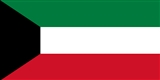
Kuwait

Encyclopedia
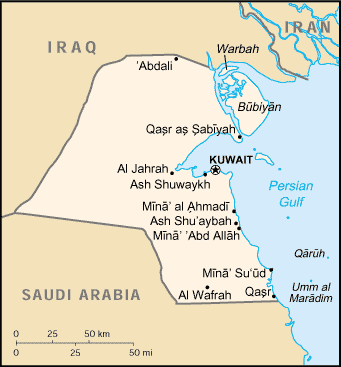
The State of Kuwait is a sovereign Arab
state situated in the north-east of the Arabian Peninsula
in Western Asia. It is bordered by Saudi Arabia
to the south at Khafji
, and Iraq
to the north at Basra
. It lies on the north-western shore of the Persian Gulf
. The name Kuwait is derived from the Arabic
أكوات ākwāt, the plural of كوت kūt, meaning a fortress built near water. The Emirate covers an area of 17,820 square kilometers (6,880 sq mi) and has a population of about 3.6 million.
Historically, the region was the site of Characene
, a major Parthian
port for trade between Mesopotamia
and India
. The Bani Utbah
tribe were the first permanent Arab settlers in the region, and laid the foundation of the modern emirate. By the 19th century, Kuwait came under the influence of the Ottoman Empire
, and after World War I
, it emerged as an independent sheikhdom under the protection of the British Empire
. Kuwait's large oil field
s were discovered in the late 1930s.
After Kuwait gained independence from the United Kingdom
in 1961, the state's oil industry
saw unprecedented economic growth. In 1990, Kuwait was invaded and annexed
by neighboring Iraq
. The seven month-long Iraqi occupation came to an end after a direct military intervention
by United States
-led forces. Around 773 Kuwaiti oil wells were set ablaze
by the retreating Iraqi army resulting in a major environmental and economic catastrophe
. Kuwait's infrastructure was badly damaged during the war and had to be rebuilt.
Kuwait is a constitutional emirate
with a parliamentary system
of government, with Kuwait City
serving as the country's political and economic capital. The country has the world's fifth largest oil reserves
and petroleum
products now account for nearly 95% of export revenues, and 80% of government income. Kuwait is the eleventh richest country in the world per capita. In 2007, it had the highest human development index
(HDI) in the Arab world. Kuwait is classified as a high income economy by the World Bank
and is designated as a major non-NATO ally
of the United States
.
and was closely associated with the southern Mesopotamia
n town of Charax
. In 224 AD, the region fell under the control of Sassanid Empire
and came to be known as Hajar. By the 14th century, the area comprising modern-day Kuwait became a part of the Islamic caliphate
.
The first permanent settlers in the region came from Bani Khalid
tribe of Nejd and established the state of Kuwait. In 1756, the people elected Sabah I bin Jaber
as the first Emir of Kuwait. The current ruling family of Kuwait, al-Sabah, are descendants of Sabah I. During the rule of the Al-Sabah, Kuwait progressively became a center of trade and commerce. It now served as a hub of trade between India
, the horn of Africa
, the Nejd, Mesopotamia
and the Levant
. Up until the advent of Japanese pearl farming, Kuwait had one of the largest sea fleets in the Persian Gulf region and a flourishing pearling industry. Trade consisted mainly of pearls, wood, spices, dates and horses.
 In 1899, Kuwait entered into a treaty with the United Kingdom
that gave the British extensive control over the foreign policy of Kuwait in exchange for protection and annual subsidy. This treaty was primarily prompted by fears that the proposed Berlin-Baghdad Railway would lead to an expansion of German
influence in the Persian Gulf
. After the signing of the Anglo-Ottoman Convention of 1913
, then Emir of Kuwait, Mubarak Al-Sabah
, was diplomatically recognized by both the Ottomans and British as the ruler of the autonomous caza
of the city of Kuwait and the hinterlands. However, soon after the start of World War I
, the British invalidated the convention and declared Kuwait an independent principality under the protection of the British Empire
. The 1922 Treaty of Uqair
set Kuwait's border with Saudi Arabia and also established the Saudi-Kuwaiti neutral zone
, an area of about 5,180 km² adjoining Kuwait's southern border.
On 19 June 1961, Kuwait became fully independent following an exchange of notes between the United Kingdom and the then Emir of Kuwait, Abdullah III Al-Salim Al-Sabah
. The Gulf rupee
, issued by the Reserve Bank of India
, was replaced by the Kuwaiti dinar
. The discovery of large oil fields, especially the Burgan field
, triggered a large influx of foreign investments into Kuwait. The massive growth of the petroleum industry transformed Kuwait from a poor pearl farming community into one of the richest countries in the Arabian Peninsula and by 1952, the country became the largest exporter of oil in the Persian Gulf region. This massive growth attracted many foreign workers, especially from Egypt
and India
.
Kuwait settled its boundary disputes with Saudi Arabia and agreed on sharing equally the neutral zone's petroleum reserves, onshore and offshore. After a brief stand-off over boundary issues, Iraq formally recognized Kuwait's independence and its borders in October 1963. During the 1970s, the Kuwaiti government nationalized the Kuwait Oil Company, ending its partnership with Gulf Oil
and British Petroleum.
In 1982, Kuwait experienced a major economic crisis after the Souk Al-Manakh stock market crash
and decrease in oil price
. However, the crisis was short-lived as Kuwait's oil production increased steadily to fill the gap caused by decrease in Iraq's and Iran's oil production levels following the events of the Iran–Iraq War. In 1983, a series of six bomb explosions
took place in Kuwait killing five people. The attack was carried out by Shiite Dawa Party
to retaliate Kuwait's financial support to Iraq during its war with Iran.
Kuwait had heavily funded Iraq's eight year-long war with Iran. After the war ended, Kuwait declined an Iraqi request to forgive its US$65 billion debt. An economic warfare between the two countries followed after Kuwait increased its oil production by 40 percent. Tensions between the two countries increased further after Iraq alleged that Kuwait was slant drilling oil from its share of the Rumaila field
.
On 2 August 1990, Iraqi forces invaded and annexed
Kuwait. A long-time ally of Saddam Hussein, Yemen's President, Ali Abdullah Saleh
was quick to back Saddam Hussein's invasion of Kuwait. Saddam Hussein
, then President of Iraq, deposed the Emir of Kuwait, Jaber Al-Sabah
, and initially propped up a puppet régime
before annexing Kuwait and installing Ali Hassan al-Majid
as the new governor of Kuwait. During the Iraqi occupation, about 1,000 Kuwaiti civilians were killed and more than 300,000 residents fled the country. After a series of failed diplomatic negotiations, the United States
-led coalition of thirty-four nations fought the Gulf War
to remove the Iraqi forces from Kuwait. On 26 February 1991, the coalition succeeded in driving out the Iraqi forces, restoring the Kuwaiti Emir to power. Kuwait paid the coalition forces US$17 billion for their war efforts.
During their retreat from the coalition, the Iraqi armed forces carried out a scorched earth
policy by damaging 737 oil wells in Kuwait, of which approximately 600 were set on fire
. It was estimated that by the time Kuwait was liberated from Iraqi occupation, about 5 to 6 Moilbbl of oil was being burned in a single day because of these fires.
Oil and soot accumulation had affected the entire Persian Gulf region and large oil lakes were created holding approximately 25 to 50 Moilbbl of oil and covering 5% of Kuwait's land area. In total, about 11 Moilbbl of oil was released into the Persian Gulf and an additional 2% of Kuwait's 96 Goilbbl of crude oil reserves were burned by the time the oil fires were brought under control. The fires took more than nine months to extinguish fully and it took Kuwait more than 2 years and US$50 billion in infrastructure reconstruction to reach pre-invasion oil output. Kuwait has since largely recovered from the socio-economic, environmental, and public health effects of the Persian Gulf War.
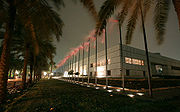 Kuwait is a constitutional monarchy
and has the oldest directly elected parliament among the Arab states of the Persian Gulf
.Currently the country is under the reign of the Al Sabah family. The head of state is the Emir
or Sheikh
, a hereditary office. A council of ministers
, also known as cabinet ministers, aids the Prime Minister, and appoints and dismisses diplomats. Legislative power is vested in the Emir and the National Assembly in accordance with the Constitution. The Emir of Kuwait is immune and inviolable: any criticism against him is not tolerated and punishable by law. He can dissolve the National Assembly and call a national election, or in cases of national emergency can dismiss the National Assembly outright and assume supreme authority over the country. The Emir is the commander in chief of Kuwait's armed forces. The Emir has authority to grant pardon from the death penalty or prison.
 The National Assembly consists of fifty elected members, who are chosen in elections held every four years. Government ministers are also granted membership in the parliament and can number up to sixteen excluding the fifty elected members. According to the Constitution of Kuwait
, nomination of a new Emir or Crown Prince by the ruling Al-Sabah family has to be approved by the National Assembly. If the nominee does not win the votes of the majority of the assembly, the royal family must submit the names of three other candidates to the National Assembly, and the Assembly must approve one of them to hold the post. Any amendment to the constitution can be proposed by the Emir but it needs to be approved by more than two-thirds of the members of the National Assembly before being implemented.
There have been several conflicts between the Emir, the government and the National Assembly over various policies. The National Assembly was suspended from 1976 to 1981, from 1986 to 1991 and from May 1999 to July 1999, due to irresolvable conflicts between some members of the government and the Assembly. The Assembly was dissolved again in May 2009 by the Emir leading to the resignation of Prime Minister Sheik Nasser Mohammad al-Ahmad al-Sabah and the rest of the Cabinet. Nationwide elections
were held on May 16, 2009.
More than two-thirds of those who reside in Kuwait do not hold Kuwaiti citizenship and thus cannot vote in parliamentary elections. Additionally, prior to 2005, only 15% of the Kuwaiti population were allowed to vote, with all "recently naturalized" citizens (i.e. those of less than thirty years' citizenship), and members of the Kuwaiti Armed Forces excluded. On 16 May 2005, Parliament permitted women's suffrage
by a 35–23 vote.
The decision raised Kuwait's eligible voter population from 139,000 to about 339,000. In 2006, Kuwaiti citizens were estimated to be more than 960,000. In 2005, the former Prime Minister Sheikh Sabah al-Ahmad al-Sabah announced the appointment of the first woman as a cabinet minister, Massouma Mubarak. She was designated Planning Minister and Minister of State for Administrative Development Affairs. During the 2008 parliamentary elections
, 27 of the 275 candidates were women. However, none of them won. In the parliamentary elections on 16 May 2009, 16 female candidates contested for 50 seats for a four-year term. Four female candidates won their seats and became Kuwait's first female lawmakers.
In April 2010, Kuwait's government, unhappy about possible democratic change in Egypt by Mohamed ElBaradei's National Association for Change, deported 17 Egyptians for trying to organize a local chapter of the Association in Kuwait.
Heads of Kuwait
Supreme Commander: Sabah Al-Ahmad Al-Jaber Al-Sabah
Executive Branch: Nasser Mohammed Al-Ahmad Al-Sabah
Legislative Branch: Jassem Al-Kharafi
Judicial Branch: Sabah Al-Ahmad Al-Jaber Al-Sabah
, Kuwait Courts
on May 14, 1963. It is a long-standing member of the Arab League
and the Organization of Islamic Cooperation. It is also a key member of the Cooperation Council for the Arab States of the Gulf
, also known as the Gulf Cooperation Council (GCC), along with Bahrain
, Qatar
, UAE, Oman
and Saudi Arabia. Having modeled the GCC on the European Union
, member states enjoy free trade
and citizens of GCC member states can travel to other GCC countries with their civil identification, not requiring visas.
Kuwait's relationship with its neighbors has been influenced by the Sunni-Shia conflict. After the Iranian revolution
of 1979, Sunni-majority Kuwait began supporting the Sunni regime of Iraq's Saddam Hussein in its subsequent eight-year war
with the hardline Shia regime of Iran. Despite prior tensions, Kuwait and Saudi Arabia provided considerable financial support to Saddam Hussein's Iraq. Kuwait's ties with Iraq remained severed after the 1991 Gulf War, until the fall of Saddam Hussein's regime. Kuwait enjoys a stong relationship with Saudi Arabia, which provided considerable support for the deposed royal family of Kuwait. Although fairly cordial, Kuwait's relations with Iran remain hinged on the stability of the Shia-Sunni conflict and rival goals for the control of the Persian Gulf. Kuwait's ties with states that supported Saddam Hussein's invasion, such as Yemen
and the Palestine Liberation Organization
, remain testy, although Kuwait has always refused to establish ties with Israel
.
Kuwait enjoys a strong relationship with the United States
, playing host to major U.S. military bases. Following U.S. leadership in the effort to liberate Kuwait, both nations have forged close political and economic relations. Although most Arab nations expressed opposition to the U.S.-led invasion of Iraq in 2003, Kuwait supported it and provided its territory as a launching pad for the invasion.
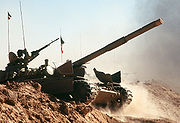
The State of Kuwait spends close to US$ 5 billion for defense. Its military consists of the Kuwaiti army
, with an estimated strength of 15,000 personnel, the Kuwaiti navy
, with 2,000 naval personnel and 400 coast guards, and the Kuwaiti Air Force, with an estimated strength of 2,500 personnel. The Kuwaiti National Guard is the main internal security force. Owing to its demographics and small population, Kuwait has not been able to build a sizeably large military and therefore collaborates extensively with foreign nations to preserve its security. After liberation from Iraq, Kuwait signed long-term defense cooperation agreements with the United States, Britain and France
, and purchased military equipment from Egypt
, Russia
and the People's Republic of China
as well.
and 31° N
, and longitudes 46°
and 49° E
. The flat, sandy Arabian Desert
covers most of Kuwait. The country is generally low lying, with the highest point being 306 m (1,004 ft) above sea-level. It has nine islands, all of which with the exception of Failaka Island
are uninhabited. With an area of 860 square kilometre, the Bubiyan
is the largest island in Kuwait and is connected to the rest of the country by a 2380 m (7,808 ft) long bridge. The land area is considered arable and sparse vegetation is found along its 499 km long coastline. Kuwait City
is located on Kuwait Bay, a natural deep-water harbor.
Kuwait has some of the world's richest oil fields with the Burgan field
having a total capacity of approximately 70 Goilbbl of proven oil reserves. During the 1991 Kuwaiti oil fires
, more than 500 oil lakes were created covering a combined surface area of about 35.7 square kilometre. The resulting soil contamination due to oil and soot accumulation had made eastern and south-eastern parts of Kuwait uninhabitable. Sand and oil residue had reduced large parts of the Kuwaiti desert to semi-asphalt surfaces. The oil spills during the Gulf War also drastically affected Kuwait's marine resources.
The spring season in March is warm and pleasant with occasional thunderstorms. The frequent winds from the northwest are cold in winter and spring and hot in summer. Southeasterly winds, usually hot and damp, spring up between July and October; hot and dry south winds prevail in spring and early summer. The shamal, a northwesterly wind common during June and July, causes dramatic sandstorms.
s (muhafazah
).
The governorates are further subdivided into districts.
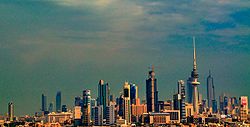
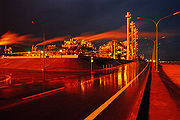 Kuwait has a GDP (PPP
) of US$167.9 billion and a per capita income
of US$81,800, making it the 5th richest country in the world, per capita.
According to the 2008 Index of Economic Freedom
, Kuwait has the second-most free economy in the Middle East
. In March 2007, Kuwait's foreign exchange reserves stood at US$213 billion. The Kuwait Stock Exchange
, which has about 200 firms listed, is the second-largest stock exchange
in the Arab world with a total market capitalization of US$235 billion. In 2007, the Kuwaiti government posted a budget surplus of US$43 billion.
Kuwait has a proven crude oil reserves
of 104 billion barrels (15 km³), estimated to be 10% of the world's reserves. According to the Kuwaiti constitution, all natural resources in the country and associated revenues are government property. Being a tax
-free country, Kuwait's oil industry
accounts for 80% of government revenue. Petroleum
and petrochemicals accounts for nearly half of GDP
and 95% of export revenues. Increase in oil prices since 2003 resulted in a surge in Kuwait's economy.
Kuwait's current oil production of 2.8 million bpd is expected to increase to 4 million bpd by 2020. To realize this production target, Kuwait Petroleum Corporation
plans to spend US$51 billion between 2007 to 2012 to upgrade and expand the country's existing refineries. However, the country's economy was badly affected by the global financial crisis of 2008. In 2009, the Central Bank of Kuwait
devised a US$5.15 billion stimulus package to help boost the economy.
Other major industries include shipping
, construction
, cement
, water desalination
, construction materials and financial services
. Kuwait has a well developed banking system and several banks in the country date back to the time before oil was discovered. Founded in 1952, the National Bank of Kuwait
is the largest bank in the country and one of the largest in the Arab world. Other prominent financial institutions based in Kuwait include the Gulf Bank of Kuwait
and Burgan Bank
, which is named after the largest oilfield in the country.
Kuwait's climate limits agricultural
development. Consequently, with the exception of fish
, it depends almost wholly on food imports. About 75% of potable water must be distilled
or imported. The government is keen on decreasing Kuwait's dependence on oil to fuel its economy by transforming it into a regional trading and tourism
hub. The planned US$77 billion Madinat al-Hareer
(City of Silk) is the largest real estate development project in the Middle East. The Central Bank issues Kuwait's currency, the Kuwaiti dinar
. As of December 2007, the dinar was the highest-valued currency unit in the world.
In 2007, estimated exports stood at US$59.97 billion and imports were around US$17.74 billion. Petroleum
, petrochemical
products, fertilizers and financial services are major export commodities. Kuwait imports a wide range of products ranging from food products and textiles to machinery. Kuwait's most important trading partners are Japan
, United States
, India
, South Korea
, Singapore
, China
, European Union
and Saudi Arabia
. Japan is the largest customer of Kuwaiti oil followed by India, Singapore
and South Korea.
On January 5, 2010,Kuwait has started the construction of Salmiya Park in Salmiya
. The Heads said "it would take atleast 4 years to complete Salmiya Park"
, which provides opportunity to all children, irrespective of their social class, including children with special needs. Kuwait education system is marked by several achievements in recent years. As of 2005/06 Kuwait allocates 13 percent of all public expenditure to education, which is comparable to the allocation of public funds to education in many OECD countries but lower than other Arab countries. For the same years the public expenditure on education as a percentage of GDP was 3.9 percent in 2005/12 which is well below the percentage of GDP spent by OECD countries on education.
As of 2005, the literacy rate of Kuwait is 93.3 percent. Kuwait is facing challenges in improving the quality of education at all levels and to build capacities of students' from a young age. The Ministry of Education is also making efforts to incorporate women into the educated workforce through various programs, for instance the 1989 initiative to establish daytime literacy clinics for women. The Kuwaiti government also offers scholarships to students accepted in universities in United States
, United Kingdom
and other foreign institutes.
There is also higher education, which has improved drastically in the past years. The largest university is Kuwait University
which is free for Kuwaitis and has over 1,500 faculty members and 22,000 students. There are also a number of private institutions such as American University of Kuwait
, Gulf University for Science and Technology
, the Australian University of Kuwait. The American University of The Middle East, Box Hill College Kuwait and Maastricht Business School Kuwait.
Kuwait has the highest literacy rate among the Arab world with 94%, up from 93.3% in 2005 (as stated above).
s. The net migration rate
of the country stood at 16.01, the third highest in the world.
The Central Statistical Bureau is the official agency who is olbiged to Meet the needs of data users through the collection and compilation of the statistical data and the production in a numeric and updated information and reflects the characteristics of the society and its activities in various ways of life with a high degree of accuracy and reliability according to the international standards in force alongside with transparency and dissemination of appropriate periodshttp://www.cso.gov.kw/
, 39% South and East Asian
, and 4% are classified Bidoon ('without' – stateless Arabs). In 2009, more than 580,000 Indian nationals lived in Kuwait, making them the single largest expatriate community there. In 2003, there were also an estimated 260,000 Egyptians
, 100,000 Syrians and 80,000 Iran
ians in Kuwait.
After Kuwait was liberated from the Iraqi invasion and occupation by coalition forces led by The United States of America, most of the 400,000 Palestinians living in Kuwait were expelled because of their government's open support for the Iraqi Forces.
, a Gulf Arabic
sub-dialect, is Kuwait's colloquial dialect. English
is widely understood and often used as a business language.
s. Between 70% to 80% of Muslims in Kuwait
belong to the Sunni
and 20–30% are Shi'as. Majority of the Shias follow the Twelvers school. Despite Islam being the state religion
, Kuwait has a large community of Christians
(est. 300,000 to 400,000), Hindus
(est. 300,000), Buddhists
(est. 100,000), and Sikhs
(est. 10,000). Hindus account for the largest number of expatriates in Kuwait.
Members of religious groups not mentioned in the Quran, such as Hindus, Sikhs and Buddhists, are not allowed to build places of worship or other religious facilities. However, such groups are allowed to practise privately in their homes and can engage in religious activities, including public marriage and other celebrations, without Kuwaiti government interference.
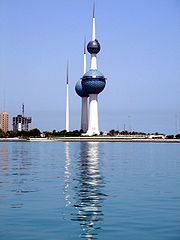 The influence of Islamic and Arab Culture on its architecture, music, attire, cuisine and lifestyle is prominent as well. The most distinctive characteristic of local Kuwaiti culture are diwaniya that is explained below. Briefly, it involves large reception rooms used for male social gatherings attended mostly by family members and close friends.
While, unlike neighbouring Saudi Arabia, the Islamic dress
code is not compulsory, many of the older Kuwaiti men prefer wearing dish dasha, an ankle-length white shirt woven from wool or cotton while the minority of women wear abaya, black over-garment covering most parts of the body. This attire is particularly well-suited for Kuwait's hot and dry climate. Western style clothing is very popular among the youth of Kuwait.
Seafood
has been the mainstay of the Kuwaiti diet for centuries. The Arabs in the Persian Gulf region played a crucial role in the spice trade between India and Europe and spices have remained an important ingredient of Kuwaiti cuisine. Traditional Kuwaiti cuisine includes "Machboos diyay, machboos laham, maraq diyay laham" which borrows heavily from South Asian cuisine
and Arabian cuisine. "Imawash" is another popular dish. As in other Arab states of the Persian Gulf, Kuwait takes part in the tradition of Qarqe'an
during the month of Ramadan. 74.2% of adults aged 15 and over are overweight in Kuwait
, making the country the 8th fattest in the world.
Before the discovery of oil, pearling
formed a crucial part of Kuwait's economy. Pearl fishery, known as ghaus, suffered decline after the advent of Japanese pearl farming. However, Kuwait's pearl industry laid the foundation of its rich maritime history. Dhows, large wooden ships made from teak wood imported from India, became an indistinct part of Kuwait's maritime fleet and dhow building is still practiced in this Persian Gulf state.
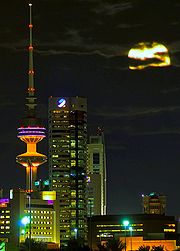
Kuwait's architecture is largely inspired by Islamic architecture
. The most prominent landmark in country, the Kuwait Towers
, were designed by Swedish
architect Sune Lindström
and are a unique blend of traditional minaret
and modern architectural designs. The National Assembly of Kuwait
, another famous landmark building, was designed by the famous Danish architect Jørn Utzon
and completed in 1982.
Sawt is the most prominent style of Kuwaiti music and is performed by oud
(plucked lute) and mirwas
(a drum), with a violin
later supplementing the arrangement. The Bedouin
s are known for an instrument called the rubabah, while the use of oud
, tanbarah (string instrument) and habban
(bagpipe) are also widespread.
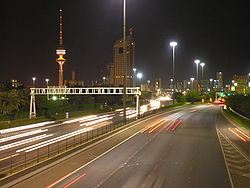 Kuwait has an extensive, modern and well-maintained network of highway
s. Roadways extended 5,749 km, of which 4,887 km is paved. In 2000, there were some 552,400 passenger cars, and 167,800 commercial taxis, trucks, and buses in use. On major highways the maximum speed is 120 km/h. Since there is no railway system in the country, most of the people travel by automobiles. The government plans to construct US$11 billion rail network which will include a city metro for its capital. Bus services are provided by City Bus and state-owned Kuwait Public Transportation Corporation.
Kuwait has speed cameras in all highways and main roads and traffic lights, which captures the cars that speed or cross a red light, the Kuwaiti government spent over 450 million USD on these speed cameras in cooperation with the traffic Police.
There is only one civil airport in Kuwait. Kuwait International Airport
serves as the principal hub for international air travel. State-owned Kuwait Airways
is the largest airline in the country. In 2001, the airline carried 2,084,600 passengers on domestic and international flights. In 2004, the first private airline of Kuwait, Jazeera Airways
, was launched. In 2005, the second private airline, Wataniya Airways
of Kuwait was founded.
Kuwait has one of the largest shipping industries in the Persian Gulf region. The Kuwait Ports Public Authority manages and operates ports across
Kuwait. The country’s principal commercial seaports are Shuwaikh and Shuaiba which handled combined cargo of 753,334 TEU in 2006. Mina Al-Ahmadi, the largest port in the country, handles most of Kuwait's oil exports. Construction of another major port located in Bubiyan island started in 2005. The port is expected to handle 1.3 million TEU
when operation starts in 2008.
 Kuwait has one of the most vocal and transparent media
in the Arab World. In 2007, Kuwait was ranked first in the Middle East
and the Arab League
by Reporters Without Borders
in the freedom of press index. Though the government funds several leading newspapers and satellite channels, Kuwaiti journalists enjoy greater freedom than their regional counterparts. The state-owned Kuwait News Agency
(KUNA) is the largest media house in the country. The Ministry of Information regulates all media and communication industry in Kuwait.
In 1998, there were 15 media stations, which are 6 AM and 11 FM
radio stations and 13 television stations. In 2000, there were 624 radios and 486 television sets for every 1,000 people. In 2001, there were 165,000 Internet subscribers served by three service providers.
Kuwait has ten satellite television
channels of which four are controlled by the Ministry of Information. State-owned Kuwait Television (KTV) offered first colored broadcast in 1974 and operates five television channels. Government-funded Radio Kuwait also offers daily informative programming in four foreign languages including Arabic
, Urdu
, Tagalog
and English
on the AM
and SW
.
In 2009, Kuwait had seventeen newspapers companies in circulation. Kuwait is represented by three English dailies: Kuwait Times
, Arab Times
and Al-Watan Daily
. There are 16 Arabic daily newspapers besides the English newspapers.
A press law forbids insulting references to God
and Islamic prophet Muhammad
. Another law which made leading newspaper publishers eligible for hefty fines for criticizing the ruling family was lifted in 1992. Leading newspapers continue to impose self-restraint while remaining uncritical of the emir. However, no such restraint is observed while criticizing the government.
Arab
Arab people, also known as Arabs , are a panethnicity primarily living in the Arab world, which is located in Western Asia and North Africa. They are identified as such on one or more of genealogical, linguistic, or cultural grounds, with tribal affiliations, and intra-tribal relationships playing...
state situated in the north-east of the Arabian Peninsula
Arabian Peninsula
The Arabian Peninsula is a land mass situated north-east of Africa. Also known as Arabia or the Arabian subcontinent, it is the world's largest peninsula and covers 3,237,500 km2...
in Western Asia. It is bordered by Saudi Arabia
Saudi Arabia
The Kingdom of Saudi Arabia , commonly known in British English as Saudi Arabia and in Arabic as as-Sa‘ūdiyyah , is the largest state in Western Asia by land area, constituting the bulk of the Arabian Peninsula, and the second-largest in the Arab World...
to the south at Khafji
Khafji
Ras Al Khafji or Khafji is a town on the border between Saudi Arabia and Kuwait. It lies in what was before 1970 a neutral zone between Kuwait and Saudi Arabia...
, and Iraq
Iraq
Iraq ; officially the Republic of Iraq is a country in Western Asia spanning most of the northwestern end of the Zagros mountain range, the eastern part of the Syrian Desert and the northern part of the Arabian Desert....
to the north at Basra
Basra
Basra is the capital of Basra Governorate, in southern Iraq near Kuwait and Iran. It had an estimated population of two million as of 2009...
. It lies on the north-western shore of the Persian Gulf
Persian Gulf
The Persian Gulf, in Southwest Asia, is an extension of the Indian Ocean located between Iran and the Arabian Peninsula.The Persian Gulf was the focus of the 1980–1988 Iran-Iraq War, in which each side attacked the other's oil tankers...
. The name Kuwait is derived from the Arabic
Arabic language
Arabic is a name applied to the descendants of the Classical Arabic language of the 6th century AD, used most prominently in the Quran, the Islamic Holy Book...
أكوات ākwāt, the plural of كوت kūt, meaning a fortress built near water. The Emirate covers an area of 17,820 square kilometers (6,880 sq mi) and has a population of about 3.6 million.
Historically, the region was the site of Characene
Characene
Characene, also known as Mesene , was a kingdom within the Parthian Empire at the head of the Persian Gulf. Its capital was Charax Spasinou, "The Fort of Hyspaosines"...
, a major Parthian
Parthian Empire
The Parthian Empire , also known as the Arsacid Empire , was a major Iranian political and cultural power in ancient Persia...
port for trade between Mesopotamia
Mesopotamia
Mesopotamia is a toponym for the area of the Tigris–Euphrates river system, largely corresponding to modern-day Iraq, northeastern Syria, southeastern Turkey and southwestern Iran.Widely considered to be the cradle of civilization, Bronze Age Mesopotamia included Sumer and the...
and India
India
India , officially the Republic of India , is a country in South Asia. It is the seventh-largest country by geographical area, the second-most populous country with over 1.2 billion people, and the most populous democracy in the world...
. The Bani Utbah
Bani Utbah
The Bani Utbah is a tribe, or tribal federation of Alrab lans that originated from the region of Najd in central Arabia. The tribe is thought to have been formed when a group of disparate clans migrated from Najd to the Persian Gulf coast sometime in the late seventeenth century.Utub is the...
tribe were the first permanent Arab settlers in the region, and laid the foundation of the modern emirate. By the 19th century, Kuwait came under the influence of the Ottoman Empire
Ottoman Empire
The Ottoman EmpireIt was usually referred to as the "Ottoman Empire", the "Turkish Empire", the "Ottoman Caliphate" or more commonly "Turkey" by its contemporaries...
, and after World War I
World War I
World War I , which was predominantly called the World War or the Great War from its occurrence until 1939, and the First World War or World War I thereafter, was a major war centred in Europe that began on 28 July 1914 and lasted until 11 November 1918...
, it emerged as an independent sheikhdom under the protection of the British Empire
British Empire
The British Empire comprised the dominions, colonies, protectorates, mandates and other territories ruled or administered by the United Kingdom. It originated with the overseas colonies and trading posts established by England in the late 16th and early 17th centuries. At its height, it was the...
. Kuwait's large oil field
Oil field
An oil field is a region with an abundance of oil wells extracting petroleum from below ground. Because the oil reservoirs typically extend over a large area, possibly several hundred kilometres across, full exploitation entails multiple wells scattered across the area...
s were discovered in the late 1930s.
After Kuwait gained independence from the United Kingdom
United Kingdom
The United Kingdom of Great Britain and Northern IrelandIn the United Kingdom and Dependencies, other languages have been officially recognised as legitimate autochthonous languages under the European Charter for Regional or Minority Languages...
in 1961, the state's oil industry
Oil industry of Kuwait
The petroleum industry in Kuwait is the largest industry in the country, accounting nearly half of the country's GDP. Kuwait has a proven crude oil reserves of 104 billion barrels , estimated to be 10% of the world's reserves. Kuwait's oil reserves are the fourth largest in the world and the Burgan...
saw unprecedented economic growth. In 1990, Kuwait was invaded and annexed
Invasion of Kuwait
The Invasion of Kuwait, also known as the Iraq-Kuwait War, was a major conflict between the Republic of Iraq and the State of Kuwait, which resulted in the seven-month long Iraqi occupation of Kuwait, which subsequently led to direct military intervention by United States-led forces in the Gulf...
by neighboring Iraq
Iraq
Iraq ; officially the Republic of Iraq is a country in Western Asia spanning most of the northwestern end of the Zagros mountain range, the eastern part of the Syrian Desert and the northern part of the Arabian Desert....
. The seven month-long Iraqi occupation came to an end after a direct military intervention
Gulf War
The Persian Gulf War , commonly referred to as simply the Gulf War, was a war waged by a U.N.-authorized coalition force from 34 nations led by the United States, against Iraq in response to Iraq's invasion and annexation of Kuwait.The war is also known under other names, such as the First Gulf...
by United States
United States
The United States of America is a federal constitutional republic comprising fifty states and a federal district...
-led forces. Around 773 Kuwaiti oil wells were set ablaze
Kuwaiti oil fires
The Kuwaiti oil fires were caused by Iraqi military forces setting fire to 700 oil wells as part of a scorched earth policy while retreating from Kuwait in 1991 after invading the country but being driven out by Coalition military forces...
by the retreating Iraqi army resulting in a major environmental and economic catastrophe
Disaster
A disaster is a natural or man-made hazard that has come to fruition, resulting in an event of substantial extent causing significant physical damage or destruction, loss of life, or drastic change to the environment...
. Kuwait's infrastructure was badly damaged during the war and had to be rebuilt.
Kuwait is a constitutional emirate
Constitutional monarchy
Constitutional monarchy is a form of government in which a monarch acts as head of state within the parameters of a constitution, whether it be a written, uncodified or blended constitution...
with a parliamentary system
Parliamentary system
A parliamentary system is a system of government in which the ministers of the executive branch get their democratic legitimacy from the legislature and are accountable to that body, such that the executive and legislative branches are intertwined....
of government, with Kuwait City
Kuwait City
-Suburbs:Although the districts below are not usually recognized as suburbs, the following is a list of a few areas surrounding Kuwait city:Al-Salam ""السلام"" -Economy:...
serving as the country's political and economic capital. The country has the world's fifth largest oil reserves
Oil reserves
The total estimated amount of oil in an oil reservoir, including both producible and non-producible oil, is called oil in place. However, because of reservoir characteristics and limitations in petroleum extraction technologies, only a fraction of this oil can be brought to the surface, and it is...
and petroleum
Petroleum
Petroleum or crude oil is a naturally occurring, flammable liquid consisting of a complex mixture of hydrocarbons of various molecular weights and other liquid organic compounds, that are found in geologic formations beneath the Earth's surface. Petroleum is recovered mostly through oil drilling...
products now account for nearly 95% of export revenues, and 80% of government income. Kuwait is the eleventh richest country in the world per capita. In 2007, it had the highest human development index
Human Development Index
The Human Development Index is a composite statistic used to rank countries by level of "human development" and separate "very high human development", "high human development", "medium human development", and "low human development" countries...
(HDI) in the Arab world. Kuwait is classified as a high income economy by the World Bank
World Bank
The World Bank is an international financial institution that provides loans to developing countries for capital programmes.The World Bank's official goal is the reduction of poverty...
and is designated as a major non-NATO ally
Major non-NATO ally
Major non-NATO ally is a designation given by the United States government to close allies who have strategic working relationships with US armed forces but are not members of the North Atlantic Treaty Organization...
of the United States
United States
The United States of America is a federal constitutional republic comprising fifty states and a federal district...
.
History
In the 4th century BC, the ancient Greeks colonized an island off Kuwait's coast, now known as Failaka, and named it "Ikaros". By 123 BC, the region came under the influence of the Parthian EmpireParthian Empire
The Parthian Empire , also known as the Arsacid Empire , was a major Iranian political and cultural power in ancient Persia...
and was closely associated with the southern Mesopotamia
Mesopotamia
Mesopotamia is a toponym for the area of the Tigris–Euphrates river system, largely corresponding to modern-day Iraq, northeastern Syria, southeastern Turkey and southwestern Iran.Widely considered to be the cradle of civilization, Bronze Age Mesopotamia included Sumer and the...
n town of Charax
Anthemusias
Anthemusias or Charax Sidae was an ancient Mesopotamian town, according to Pliny and Strabo...
. In 224 AD, the region fell under the control of Sassanid Empire
Sassanid Empire
The Sassanid Empire , known to its inhabitants as Ērānshahr and Ērān in Middle Persian and resulting in the New Persian terms Iranshahr and Iran , was the last pre-Islamic Persian Empire, ruled by the Sasanian Dynasty from 224 to 651...
and came to be known as Hajar. By the 14th century, the area comprising modern-day Kuwait became a part of the Islamic caliphate
Caliphate
The term caliphate, "dominion of a caliph " , refers to the first system of government established in Islam and represented the political unity of the Muslim Ummah...
.
The first permanent settlers in the region came from Bani Khalid
Bani Khalid
.'Bani Khalid'. is an Arab tribal confederation of eastern and central Arabia. The tribe dominated the eastern region of modern-day Saudi Arabia from 1670 to 1793, and again under the auspices of the Ottoman Empire for a brief period in the early 19th century...
tribe of Nejd and established the state of Kuwait. In 1756, the people elected Sabah I bin Jaber
Sabah I bin Jaber
Sheikh Abu Abdullah Sabah I bin Jaber Al Sabah Sheikh Abu Abdullah Sabah I bin Jaber Al Sabah Sheikh Abu Abdullah Sabah I bin Jaber Al Sabah (Sabah I; c. 1652-1762 (or 1758 or 1764) was the first Ruler of Kuwait's ruling al-Sabah dynasty...
as the first Emir of Kuwait. The current ruling family of Kuwait, al-Sabah, are descendants of Sabah I. During the rule of the Al-Sabah, Kuwait progressively became a center of trade and commerce. It now served as a hub of trade between India
India
India , officially the Republic of India , is a country in South Asia. It is the seventh-largest country by geographical area, the second-most populous country with over 1.2 billion people, and the most populous democracy in the world...
, the horn of Africa
Horn of Africa
The Horn of Africa is a peninsula in East Africa that juts hundreds of kilometers into the Arabian Sea and lies along the southern side of the Gulf of Aden. It is the easternmost projection of the African continent...
, the Nejd, Mesopotamia
Mesopotamia
Mesopotamia is a toponym for the area of the Tigris–Euphrates river system, largely corresponding to modern-day Iraq, northeastern Syria, southeastern Turkey and southwestern Iran.Widely considered to be the cradle of civilization, Bronze Age Mesopotamia included Sumer and the...
and the Levant
Levant
The Levant or ) is the geographic region and culture zone of the "eastern Mediterranean littoral between Anatolia and Egypt" . The Levant includes most of modern Lebanon, Syria, Jordan, Israel, the Palestinian territories, and sometimes parts of Turkey and Iraq, and corresponds roughly to the...
. Up until the advent of Japanese pearl farming, Kuwait had one of the largest sea fleets in the Persian Gulf region and a flourishing pearling industry. Trade consisted mainly of pearls, wood, spices, dates and horses.
United Kingdom
The United Kingdom of Great Britain and Northern IrelandIn the United Kingdom and Dependencies, other languages have been officially recognised as legitimate autochthonous languages under the European Charter for Regional or Minority Languages...
that gave the British extensive control over the foreign policy of Kuwait in exchange for protection and annual subsidy. This treaty was primarily prompted by fears that the proposed Berlin-Baghdad Railway would lead to an expansion of German
German Empire
The German Empire refers to Germany during the "Second Reich" period from the unification of Germany and proclamation of Wilhelm I as German Emperor on 18 January 1871, to 1918, when it became a federal republic after defeat in World War I and the abdication of the Emperor, Wilhelm II.The German...
influence in the Persian Gulf
Persian Gulf
The Persian Gulf, in Southwest Asia, is an extension of the Indian Ocean located between Iran and the Arabian Peninsula.The Persian Gulf was the focus of the 1980–1988 Iran-Iraq War, in which each side attacked the other's oil tankers...
. After the signing of the Anglo-Ottoman Convention of 1913
Anglo-Ottoman Convention of 1913
The Anglo-Ottoman Convention of 1913 was an agreement between the Ottoman Porte and the British Government defining the limits of Ottoman jurisdiction in the area of the Persian Gulf with respect to Kuwait, Qatar, Bahrain, and the Shatt al-‘Arab...
, then Emir of Kuwait, Mubarak Al-Sabah
Mubarak Al-Sabah
Mubarak bin Sabah Al-Sabah, KCSI, KCIE "the Great" was the ruler of Kuwait from May 18, 1896 until his death on November 28, 1915. Mubarak ascended the throne upon the controversial death of his half-brother, Muhammad Al-Sabah. Mubarak was the seventh ruler of the Al-Sabah dynasty...
, was diplomatically recognized by both the Ottomans and British as the ruler of the autonomous caza
Qadaa
Kaza or caza , meaning "jurisdiction" and often translated "district," is a term for a second-level administrative division in Iraq and Lebanon and for a third-level administrative division in Jordan and the former Ottoman Empire....
of the city of Kuwait and the hinterlands. However, soon after the start of World War I
World War I
World War I , which was predominantly called the World War or the Great War from its occurrence until 1939, and the First World War or World War I thereafter, was a major war centred in Europe that began on 28 July 1914 and lasted until 11 November 1918...
, the British invalidated the convention and declared Kuwait an independent principality under the protection of the British Empire
British Empire
The British Empire comprised the dominions, colonies, protectorates, mandates and other territories ruled or administered by the United Kingdom. It originated with the overseas colonies and trading posts established by England in the late 16th and early 17th centuries. At its height, it was the...
. The 1922 Treaty of Uqair
Uqair Protocol of 1922
The Uqair Protocol or Uqair Convention was an agreement at Uqair on 2 December 1922 which defined the boundaries between Iraq and Nejd and between Kuwait and Nejd. It was brokered by Percy Cox, the British High Commissioner to Iraq, in response to Bedouin raiders from Nejd under ibn Saud...
set Kuwait's border with Saudi Arabia and also established the Saudi-Kuwaiti neutral zone
Saudi-Kuwaiti neutral zone
The Saudi–Kuwaiti neutral zone, also known as the Divided Zone, was an area of 5,770 km² between the borders of Saudi Arabia and Kuwait that was left undefined when the border was established by the Uqair Convention of December 2, 1922....
, an area of about 5,180 km² adjoining Kuwait's southern border.
On 19 June 1961, Kuwait became fully independent following an exchange of notes between the United Kingdom and the then Emir of Kuwait, Abdullah III Al-Salim Al-Sabah
Abdullah III Al-Salim Al-Sabah
Abdullah III Al-Salim Al-Sabah GCMG, CIE, KStJ was the last Sheikh and first Emir of Kuwait from 29 January 1950 until his death, and the eldest son of Salem Al-Mubarak Al-Sabah. As the eleventh ruler of the al-Sabah dynasty in Kuwait, he took power after the death of his cousin Sheikh Ahmad...
. The Gulf rupee
Gulf rupee
The Gulf rupee, also known as the Persian Gulf rupee , was a currency used in the countries of the Persian Gulf and the Arabian Peninsula between 1959 and 1966...
, issued by the Reserve Bank of India
Reserve Bank of India
The Reserve Bank of India is the central banking institution of India and controls the monetary policy of the rupee as well as US$300.21 billion of currency reserves. The institution was established on 1 April 1935 during the British Raj in accordance with the provisions of the Reserve Bank of...
, was replaced by the Kuwaiti dinar
Kuwaiti dinar
The dinar is the currency of Kuwait. It is sub-divided into 1000 fils. It is the highest-valued currency unit in the world.-History:...
. The discovery of large oil fields, especially the Burgan field
Burgan Field
The onshore Burgan Field in the desert of southeastern Kuwait is one of the world's largest and richest oil fields.-Discovery:After its discovery in February, 1938, the USA and UK-owned Kuwait Oil Company began commercial oil production at Burgan in 1946. The oil field is so rich that it is one of...
, triggered a large influx of foreign investments into Kuwait. The massive growth of the petroleum industry transformed Kuwait from a poor pearl farming community into one of the richest countries in the Arabian Peninsula and by 1952, the country became the largest exporter of oil in the Persian Gulf region. This massive growth attracted many foreign workers, especially from Egypt
Egypt
Egypt , officially the Arab Republic of Egypt, Arabic: , is a country mainly in North Africa, with the Sinai Peninsula forming a land bridge in Southwest Asia. Egypt is thus a transcontinental country, and a major power in Africa, the Mediterranean Basin, the Middle East and the Muslim world...
and India
India
India , officially the Republic of India , is a country in South Asia. It is the seventh-largest country by geographical area, the second-most populous country with over 1.2 billion people, and the most populous democracy in the world...
.
Kuwait settled its boundary disputes with Saudi Arabia and agreed on sharing equally the neutral zone's petroleum reserves, onshore and offshore. After a brief stand-off over boundary issues, Iraq formally recognized Kuwait's independence and its borders in October 1963. During the 1970s, the Kuwaiti government nationalized the Kuwait Oil Company, ending its partnership with Gulf Oil
Gulf Oil
Gulf Oil was a major global oil company from the 1900s to the 1980s. The eighth-largest American manufacturing company in 1941 and the ninth-largest in 1979, Gulf Oil was one of the so-called Seven Sisters oil companies...
and British Petroleum.
In 1982, Kuwait experienced a major economic crisis after the Souk Al-Manakh stock market crash
Souk Al-Manakh stock market crash
The Souk Al-Manakh stock market crash was the 1982 stock market crash of Kuwait's unofficial stock market, the Souk Al-Manakh. The Al-Manakh market was housed in an air-conditioned parking garage that had formerly been a camel trading venue, and specialized in highly speculative and unregulated...
and decrease in oil price
1980s oil glut
The 1980s oil glut was a serious surplus of crude oil caused by falling demand following the 1970s Energy Crisis. The world price of oil, which had peaked in 1980 at over US$35 per barrel , fell in 1986 from $27 to below $10...
. However, the crisis was short-lived as Kuwait's oil production increased steadily to fill the gap caused by decrease in Iraq's and Iran's oil production levels following the events of the Iran–Iraq War. In 1983, a series of six bomb explosions
1983 Kuwait bombings
The 1983 Kuwait bombings were attacks on six key foreign and Kuwaiti installations on December 12, 1983, two months after the 1983 Beirut barracks bombing. The 90-minute coordinated attack on two embassies, the country's main airport and petro-chemical plant, was more notable for the damage it was...
took place in Kuwait killing five people. The attack was carried out by Shiite Dawa Party
Islamic Dawa Party
The Islamic Dawa Party or Islamic Call Party is a political party in Iraq. Dawa and the Supreme Islamic Iraqi Council are two of the main parties in the religious-Shiite United Iraqi Alliance, which won a plurality of seats in both the provisional January 2005 Iraqi election and the longer-term...
to retaliate Kuwait's financial support to Iraq during its war with Iran.
Kuwait had heavily funded Iraq's eight year-long war with Iran. After the war ended, Kuwait declined an Iraqi request to forgive its US$65 billion debt. An economic warfare between the two countries followed after Kuwait increased its oil production by 40 percent. Tensions between the two countries increased further after Iraq alleged that Kuwait was slant drilling oil from its share of the Rumaila field
Rumaila Field
The Rumaila oil field is a giant oil field located in southern Iraq, approximately from the Kuwaiti border. The dispute between Iraq and Kuwait over allegedly slant-drilling in the field was one of reasons for Iraq's invasion of Kuwait in 1990. This field was discovered by British Petroleum in...
.
On 2 August 1990, Iraqi forces invaded and annexed
Invasion of Kuwait
The Invasion of Kuwait, also known as the Iraq-Kuwait War, was a major conflict between the Republic of Iraq and the State of Kuwait, which resulted in the seven-month long Iraqi occupation of Kuwait, which subsequently led to direct military intervention by United States-led forces in the Gulf...
Kuwait. A long-time ally of Saddam Hussein, Yemen's President, Ali Abdullah Saleh
Ali Abdullah Saleh
Field Marshal Ali Abdullah Saleh is the first President of the Republic of Yemen. Saleh previously served as President of the Yemen Arab Republic from 1978 until 1990, at which time he assumed the office of chairman of the Presidential Council of a post-unification Yemen. He is the...
was quick to back Saddam Hussein's invasion of Kuwait. Saddam Hussein
Saddam Hussein
Saddam Hussein Abd al-Majid al-Tikriti was the fifth President of Iraq, serving in this capacity from 16 July 1979 until 9 April 2003...
, then President of Iraq, deposed the Emir of Kuwait, Jaber Al-Sabah
Jaber Al-Ahmad Al-Jaber Al-Sabah
Jaber III al-Ahmad al-Jaber al-Sabah, GCB , GCMG of the al-Sabah dynasty, was the Emir and thirteenth Sheikh of Kuwait, serving from December 31, 1977 until his death on January 15, 2006...
, and initially propped up a puppet régime
Republic of Kuwait
The Republic of Kuwait was a short-lived and self-styled "Republic" formed in the aftermath of the Invasion of Kuwait by Iraq under Saddam Hussein...
before annexing Kuwait and installing Ali Hassan al-Majid
Ali Hassan al-Majid
Ali Hassan Abd al-Majid al-Tikriti , , was a Ba'athist Iraqi Defense Minister, Interior Minister, military commander and chief of the Iraqi Intelligence Service...
as the new governor of Kuwait. During the Iraqi occupation, about 1,000 Kuwaiti civilians were killed and more than 300,000 residents fled the country. After a series of failed diplomatic negotiations, the United States
United States
The United States of America is a federal constitutional republic comprising fifty states and a federal district...
-led coalition of thirty-four nations fought the Gulf War
Gulf War
The Persian Gulf War , commonly referred to as simply the Gulf War, was a war waged by a U.N.-authorized coalition force from 34 nations led by the United States, against Iraq in response to Iraq's invasion and annexation of Kuwait.The war is also known under other names, such as the First Gulf...
to remove the Iraqi forces from Kuwait. On 26 February 1991, the coalition succeeded in driving out the Iraqi forces, restoring the Kuwaiti Emir to power. Kuwait paid the coalition forces US$17 billion for their war efforts.
During their retreat from the coalition, the Iraqi armed forces carried out a scorched earth
Scorched earth
A scorched earth policy is a military strategy or operational method which involves destroying anything that might be useful to the enemy while advancing through or withdrawing from an area...
policy by damaging 737 oil wells in Kuwait, of which approximately 600 were set on fire
Kuwaiti oil fires
The Kuwaiti oil fires were caused by Iraqi military forces setting fire to 700 oil wells as part of a scorched earth policy while retreating from Kuwait in 1991 after invading the country but being driven out by Coalition military forces...
. It was estimated that by the time Kuwait was liberated from Iraqi occupation, about 5 to 6 Moilbbl of oil was being burned in a single day because of these fires.
Oil and soot accumulation had affected the entire Persian Gulf region and large oil lakes were created holding approximately 25 to 50 Moilbbl of oil and covering 5% of Kuwait's land area. In total, about 11 Moilbbl of oil was released into the Persian Gulf and an additional 2% of Kuwait's 96 Goilbbl of crude oil reserves were burned by the time the oil fires were brought under control. The fires took more than nine months to extinguish fully and it took Kuwait more than 2 years and US$50 billion in infrastructure reconstruction to reach pre-invasion oil output. Kuwait has since largely recovered from the socio-economic, environmental, and public health effects of the Persian Gulf War.
Politics
Constitutional monarchy
Constitutional monarchy is a form of government in which a monarch acts as head of state within the parameters of a constitution, whether it be a written, uncodified or blended constitution...
and has the oldest directly elected parliament among the Arab states of the Persian Gulf
Arab states of the Persian Gulf
"Arab states of the Persian Gulf" or "Arab Persian Gulf states" or "Persian Gulf Arab states" or "Arabic Persian Gulf states" or "Arab States of The Gulf", are terms that refer to the six Arab states of Saudi Arabia, United Arab Emirates, Qatar, Kuwait, Bahrain and Oman, bordering the Persian Gulf....
.Currently the country is under the reign of the Al Sabah family. The head of state is the Emir
Emir
Emir , meaning "commander", "general", or "prince"; also transliterated as Amir, Aamir or Ameer) is a title of high office, used throughout the Muslim world...
or Sheikh
Sheikh
Not to be confused with sikhSheikh — also spelled Sheik or Shaikh, or transliterated as Shaykh — is an honorific in the Arabic language that literally means "elder" and carries the meaning "leader and/or governor"...
, a hereditary office. A council of ministers
Cabinet (government)
A Cabinet is a body of high ranking government officials, typically representing the executive branch. It can also sometimes be referred to as the Council of Ministers, an Executive Council, or an Executive Committee.- Overview :...
, also known as cabinet ministers, aids the Prime Minister, and appoints and dismisses diplomats. Legislative power is vested in the Emir and the National Assembly in accordance with the Constitution. The Emir of Kuwait is immune and inviolable: any criticism against him is not tolerated and punishable by law. He can dissolve the National Assembly and call a national election, or in cases of national emergency can dismiss the National Assembly outright and assume supreme authority over the country. The Emir is the commander in chief of Kuwait's armed forces. The Emir has authority to grant pardon from the death penalty or prison.
Constitution of Kuwait
The Constitution of Kuwait was created in June 1961 by Emir Abdullah III Al-Salim Al-Sabah. The constitution establishes Kuwait as a constitutional monarchy and Islam as the state religion....
, nomination of a new Emir or Crown Prince by the ruling Al-Sabah family has to be approved by the National Assembly. If the nominee does not win the votes of the majority of the assembly, the royal family must submit the names of three other candidates to the National Assembly, and the Assembly must approve one of them to hold the post. Any amendment to the constitution can be proposed by the Emir but it needs to be approved by more than two-thirds of the members of the National Assembly before being implemented.
There have been several conflicts between the Emir, the government and the National Assembly over various policies. The National Assembly was suspended from 1976 to 1981, from 1986 to 1991 and from May 1999 to July 1999, due to irresolvable conflicts between some members of the government and the Assembly. The Assembly was dissolved again in May 2009 by the Emir leading to the resignation of Prime Minister Sheik Nasser Mohammad al-Ahmad al-Sabah and the rest of the Cabinet. Nationwide elections
Kuwaiti parliamentary election, 2009
An early parliamentary election was held in Kuwait on 16 May 2009, the country's third in a three-year period. Kuwait had voted on six occasions between 1991 and 2009...
were held on May 16, 2009.
More than two-thirds of those who reside in Kuwait do not hold Kuwaiti citizenship and thus cannot vote in parliamentary elections. Additionally, prior to 2005, only 15% of the Kuwaiti population were allowed to vote, with all "recently naturalized" citizens (i.e. those of less than thirty years' citizenship), and members of the Kuwaiti Armed Forces excluded. On 16 May 2005, Parliament permitted women's suffrage
Women's suffrage
Women's suffrage or woman suffrage is the right of women to vote and to run for office. The expression is also used for the economic and political reform movement aimed at extending these rights to women and without any restrictions or qualifications such as property ownership, payment of tax, or...
by a 35–23 vote.
The decision raised Kuwait's eligible voter population from 139,000 to about 339,000. In 2006, Kuwaiti citizens were estimated to be more than 960,000. In 2005, the former Prime Minister Sheikh Sabah al-Ahmad al-Sabah announced the appointment of the first woman as a cabinet minister, Massouma Mubarak. She was designated Planning Minister and Minister of State for Administrative Development Affairs. During the 2008 parliamentary elections
Kuwaiti parliamentary election, 2008
An early parliamentary election was held in Kuwait on 17 May 2008 after the Emir Sabah Al-Ahmad Al-Jaber Al-Sabah dissolved the National Assembly of Kuwait on 19 March 2008 over constant clashes between the government and the elected MPs...
, 27 of the 275 candidates were women. However, none of them won. In the parliamentary elections on 16 May 2009, 16 female candidates contested for 50 seats for a four-year term. Four female candidates won their seats and became Kuwait's first female lawmakers.
In April 2010, Kuwait's government, unhappy about possible democratic change in Egypt by Mohamed ElBaradei's National Association for Change, deported 17 Egyptians for trying to organize a local chapter of the Association in Kuwait.
Heads of Kuwait
Supreme Commander: Sabah Al-Ahmad Al-Jaber Al-Sabah
Sabah Al-Ahmad Al-Jaber Al-Sabah
Sheikh Sabah IV Al-Ahmad Al-Jaber Al-Sabah is the Emir of Kuwait. Sheikh Sabah was sworn in on January 29, 2006 after confirmation by the National Assembly of Kuwait. He is the fourth son of Emir Ahmad Al-Jaber Al-Sabah. Sheikh Sabah is the head of the ruling Al-Sabah family...
Executive Branch: Nasser Mohammed Al-Ahmad Al-Sabah
Legislative Branch: Jassem Al-Kharafi
Jassem Al-Kharafi
Jassem Al-Kharafi, , born in 1940, has been speaker of the Kuwaiti National Assembly since 1999. Al-Kharafi studied Business Administration at the Manchester Trade Faculty in Kuwait and was director of M. A. Kharafi & Sons before being elected to the National Assembly in 1975. He affiliates with...
Judicial Branch: Sabah Al-Ahmad Al-Jaber Al-Sabah
Sabah Al-Ahmad Al-Jaber Al-Sabah
Sheikh Sabah IV Al-Ahmad Al-Jaber Al-Sabah is the Emir of Kuwait. Sheikh Sabah was sworn in on January 29, 2006 after confirmation by the National Assembly of Kuwait. He is the fourth son of Emir Ahmad Al-Jaber Al-Sabah. Sheikh Sabah is the head of the ruling Al-Sabah family...
, Kuwait Courts
Foreign relations and military
The State of Kuwait became the 111th member state of the United NationsUnited Nations
The United Nations is an international organization whose stated aims are facilitating cooperation in international law, international security, economic development, social progress, human rights, and achievement of world peace...
on May 14, 1963. It is a long-standing member of the Arab League
Arab League
The Arab League , officially called the League of Arab States , is a regional organisation of Arab states in North and Northeast Africa, and Southwest Asia . It was formed in Cairo on 22 March 1945 with six members: Egypt, Iraq, Transjordan , Lebanon, Saudi Arabia, and Syria. Yemen joined as a...
and the Organization of Islamic Cooperation. It is also a key member of the Cooperation Council for the Arab States of the Gulf
Cooperation Council for the Arab States of the Gulf
The Cooperation Council for the Arab States of the Gulf , also known as the Gulf Cooperation Council , is a political and economic union of the Arab states bordering the Persian Gulf and constituting the Arabian Peninsula, namely Bahrain, Kuwait, Oman, Qatar, Saudi Arabia, and United Arab Emirates...
, also known as the Gulf Cooperation Council (GCC), along with Bahrain
Bahrain
' , officially the Kingdom of Bahrain , is a small island state near the western shores of the Persian Gulf. It is ruled by the Al Khalifa royal family. The population in 2010 stood at 1,214,705, including 235,108 non-nationals. Formerly an emirate, Bahrain was declared a kingdom in 2002.Bahrain is...
, Qatar
Qatar
Qatar , also known as the State of Qatar or locally Dawlat Qaṭar, is a sovereign Arab state, located in the Middle East, occupying the small Qatar Peninsula on the northeasterly coast of the much larger Arabian Peninsula. Its sole land border is with Saudi Arabia to the south, with the rest of its...
, UAE, Oman
Oman
Oman , officially called the Sultanate of Oman , is an Arab state in southwest Asia on the southeast coast of the Arabian Peninsula. It is bordered by the United Arab Emirates to the northwest, Saudi Arabia to the west, and Yemen to the southwest. The coast is formed by the Arabian Sea on the...
and Saudi Arabia. Having modeled the GCC on the European Union
European Union
The European Union is an economic and political union of 27 independent member states which are located primarily in Europe. The EU traces its origins from the European Coal and Steel Community and the European Economic Community , formed by six countries in 1958...
, member states enjoy free trade
Free trade
Under a free trade policy, prices emerge from supply and demand, and are the sole determinant of resource allocation. 'Free' trade differs from other forms of trade policy where the allocation of goods and services among trading countries are determined by price strategies that may differ from...
and citizens of GCC member states can travel to other GCC countries with their civil identification, not requiring visas.
Kuwait's relationship with its neighbors has been influenced by the Sunni-Shia conflict. After the Iranian revolution
Iranian Revolution
The Iranian Revolution refers to events involving the overthrow of Iran's monarchy under Shah Mohammad Reza Pahlavi and its replacement with an Islamic republic under Ayatollah Ruhollah Khomeini, the leader of the...
of 1979, Sunni-majority Kuwait began supporting the Sunni regime of Iraq's Saddam Hussein in its subsequent eight-year war
Iran-Iraq War
The Iran–Iraq War was an armed conflict between the armed forces of Iraq and Iran, lasting from September 1980 to August 1988, making it the longest conventional war of the twentieth century...
with the hardline Shia regime of Iran. Despite prior tensions, Kuwait and Saudi Arabia provided considerable financial support to Saddam Hussein's Iraq. Kuwait's ties with Iraq remained severed after the 1991 Gulf War, until the fall of Saddam Hussein's regime. Kuwait enjoys a stong relationship with Saudi Arabia, which provided considerable support for the deposed royal family of Kuwait. Although fairly cordial, Kuwait's relations with Iran remain hinged on the stability of the Shia-Sunni conflict and rival goals for the control of the Persian Gulf. Kuwait's ties with states that supported Saddam Hussein's invasion, such as Yemen
Yemen
The Republic of Yemen , commonly known as Yemen , is a country located in the Middle East, occupying the southwestern to southern end of the Arabian Peninsula. It is bordered by Saudi Arabia to the north, the Red Sea to the west, and Oman to the east....
and the Palestine Liberation Organization
Palestine Liberation Organization
The Palestine Liberation Organization is a political and paramilitary organization which was created in 1964. It is recognized as the "sole legitimate representative of the Palestinian people" by the United Nations and over 100 states with which it holds diplomatic relations, and has enjoyed...
, remain testy, although Kuwait has always refused to establish ties with Israel
Israel
The State of Israel is a parliamentary republic located in the Middle East, along the eastern shore of the Mediterranean Sea...
.
Kuwait enjoys a strong relationship with the United States
United States
The United States of America is a federal constitutional republic comprising fifty states and a federal district...
, playing host to major U.S. military bases. Following U.S. leadership in the effort to liberate Kuwait, both nations have forged close political and economic relations. Although most Arab nations expressed opposition to the U.S.-led invasion of Iraq in 2003, Kuwait supported it and provided its territory as a launching pad for the invasion.
The State of Kuwait spends close to US$ 5 billion for defense. Its military consists of the Kuwaiti army
Kuwaiti Army
Kuwaiti Army is the primary land force of the Military of Kuwait.Kuwait's postwar equipment orders include 200 M-84 tanks and eighteen self-propelled 155mm guns from France. Kuwait also has received United States, Russian, and Egyptian armored vehicles...
, with an estimated strength of 15,000 personnel, the Kuwaiti navy
Kuwaiti Navy
The Kuwaiti navy, or Kuwait Naval Force , is the sea-based component of the Military of Kuwait. The headquarters and sole naval base is Ras al-Qulayah Naval Base, located in the south of Kuwait, approximately 35 miles south of Kuwait City...
, with 2,000 naval personnel and 400 coast guards, and the Kuwaiti Air Force, with an estimated strength of 2,500 personnel. The Kuwaiti National Guard is the main internal security force. Owing to its demographics and small population, Kuwait has not been able to build a sizeably large military and therefore collaborates extensively with foreign nations to preserve its security. After liberation from Iraq, Kuwait signed long-term defense cooperation agreements with the United States, Britain and France
France
The French Republic , The French Republic , The French Republic , (commonly known as France , is a unitary semi-presidential republic in Western Europe with several overseas territories and islands located on other continents and in the Indian, Pacific, and Atlantic oceans. Metropolitan France...
, and purchased military equipment from Egypt
Egypt
Egypt , officially the Arab Republic of Egypt, Arabic: , is a country mainly in North Africa, with the Sinai Peninsula forming a land bridge in Southwest Asia. Egypt is thus a transcontinental country, and a major power in Africa, the Mediterranean Basin, the Middle East and the Muslim world...
, Russia
Russia
Russia or , officially known as both Russia and the Russian Federation , is a country in northern Eurasia. It is a federal semi-presidential republic, comprising 83 federal subjects...
and the People's Republic of China
People's Republic of China
China , officially the People's Republic of China , is the most populous country in the world, with over 1.3 billion citizens. Located in East Asia, the country covers approximately 9.6 million square kilometres...
as well.
Geography and climate
Located in the north-east corner of the Arabian Peninsula, Kuwait is one of the smallest countries in the world in terms of land area. It lies between latitudes 28°28th parallel north
The 28th parallel north is a circle of latitude that is 28 degrees north of the Earth's equatorial plane. It crosses Africa, Asia, the Pacific Ocean, North America and the Atlantic Ocean....
and 31° N
31st parallel north
The 31st parallel north is a circle of latitude that is 31 degrees north of the Earth's equatorial plane. It crosses Africa, Asia, the Pacific Ocean, North America and the Atlantic Ocean.Part of the border between Iran and Iraq is defined by the parallel....
, and longitudes 46°
46th meridian east
The meridian 46° east of Greenwich is a line of longitude that extends from the North Pole across the Arctic Ocean, Europe, Asia, Africa, the Indian Ocean, the Southern Ocean, and Antarctica to the South Pole....
and 49° E
49th meridian east
The meridian 49° east of Greenwich is a line of longitude that extends from the North Pole across the Arctic Ocean, Europe, Asia, Africa, the Indian Ocean, Madagascar, the Southern Ocean, and Antarctica to the South Pole....
. The flat, sandy Arabian Desert
Arabian Desert
The Arabian Desert is a vast desert wilderness stretching from Yemen to the Persian Gulf and Oman to Jordan and Iraq. It occupies most of the Arabian Peninsula, with an area of...
covers most of Kuwait. The country is generally low lying, with the highest point being 306 m (1,004 ft) above sea-level. It has nine islands, all of which with the exception of Failaka Island
Failaka Island
Failaka Island is an island that belongs to Kuwait in the Persian Gulf. The island is 20 km off the coast of Kuwait City in the Persian Gulf. The name 'Failaka' is thought to be derived from the ancient Greek φυλάκιο - fylakio "outpost"....
are uninhabited. With an area of 860 square kilometre, the Bubiyan
Bubiyan Island
Bubiyan Island is the largest island in the Kuwaiti coastal island chain situated in the north-western corner of the Persian Gulf, with an area of ....
is the largest island in Kuwait and is connected to the rest of the country by a 2380 m (7,808 ft) long bridge. The land area is considered arable and sparse vegetation is found along its 499 km long coastline. Kuwait City
Kuwait City
-Suburbs:Although the districts below are not usually recognized as suburbs, the following is a list of a few areas surrounding Kuwait city:Al-Salam ""السلام"" -Economy:...
is located on Kuwait Bay, a natural deep-water harbor.
Kuwait has some of the world's richest oil fields with the Burgan field
Burgan Field
The onshore Burgan Field in the desert of southeastern Kuwait is one of the world's largest and richest oil fields.-Discovery:After its discovery in February, 1938, the USA and UK-owned Kuwait Oil Company began commercial oil production at Burgan in 1946. The oil field is so rich that it is one of...
having a total capacity of approximately 70 Goilbbl of proven oil reserves. During the 1991 Kuwaiti oil fires
Kuwaiti oil fires
The Kuwaiti oil fires were caused by Iraqi military forces setting fire to 700 oil wells as part of a scorched earth policy while retreating from Kuwait in 1991 after invading the country but being driven out by Coalition military forces...
, more than 500 oil lakes were created covering a combined surface area of about 35.7 square kilometre. The resulting soil contamination due to oil and soot accumulation had made eastern and south-eastern parts of Kuwait uninhabitable. Sand and oil residue had reduced large parts of the Kuwaiti desert to semi-asphalt surfaces. The oil spills during the Gulf War also drastically affected Kuwait's marine resources.
The spring season in March is warm and pleasant with occasional thunderstorms. The frequent winds from the northwest are cold in winter and spring and hot in summer. Southeasterly winds, usually hot and damp, spring up between July and October; hot and dry south winds prevail in spring and early summer. The shamal, a northwesterly wind common during June and July, causes dramatic sandstorms.
Governorates
Kuwait is divided into 6 governorateGovernorate
A governorate is an administrative division of a country. It is headed by a governor. As English-speaking nations tend to call regions administered by governors either states, provinces, or colonies, the term governorate is often used in translation from non-English-speaking administrations.The...
s (muhafazah
Muhafazah
A ' is a first-level administrative division of many Arab countries, and a second-level administrative division in Saudi Arabia. The term is usually translated to governorate in English, and occasionally to province. It comes from the Arabic root 'h-f-ẓ' which means to 'keep and guard'...
).
The governorates are further subdivided into districts.
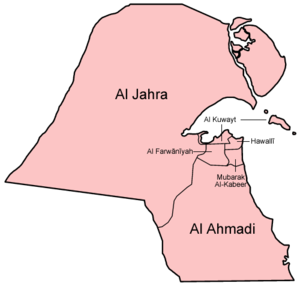 |
||||
|---|---|---|---|---|
| Subdivision | Capital Capital City Capital City was a television show produced by Euston Films which focused on the lives of investment bankers in London living and working on the corporate trading floor for the fictional international bank Shane-Longman.... |
Areakm² | PopulationCensus Census A census is the procedure of systematically acquiring and recording information about the members of a given population. It is a regularly occurring and official count of a particular population. The term is used mostly in connection with national population and housing censuses; other common... of 2005 |
Created |
| Al Ahmadi1) | Al Ahmadi | 5 120 | 393 861 | 1946 from Al Asimah |
| Al Asimah (Al Kuwayt)2) | Al Kuwait | 200 | 261 013 | original Governorate |
| Al Farwaniyah | Al Farwaniyah Al Farwaniyah Al Farwaniyah is the most populous of the six governorates of Kuwait, in terms of total number of residents. It is Kuwait's main residential area and also forms an important part of Kuwait's commercial activities... |
190 | 622 123 | 1988 from Al Asimah |
| Al Jahra3) | Al Jahra | 12 130 | 272 373 | 1979 from Al Asimah |
| Hawalli | Hawalli District Hawalli District Hawally is the capital of the Hawalli Governorate located in the State of Kuwait.Hawally is a large suburb and the commercial center for most computer-related goods in Kuwait. Prior to the first Gulf War, it housed a large number of Palestinians, but many were expelled after the War... |
84 | 487 514 | original Governorate |
| Mubarak Al-Kabeer | Mubarak Al-Kabeer | 94 | 176 519 | Nov. 1999 from Hawalli |
| TOTAL | 17 818 | 2 213 403 | ||
| 1) The Neutral Zone Saudi-Kuwaiti neutral zone The Saudi–Kuwaiti neutral zone, also known as the Divided Zone, was an area of 5,770 km² between the borders of Saudi Arabia and Kuwait that was left undefined when the border was established by the Uqair Convention of December 2, 1922.... was dissolved on Dec. 18, 1969,and the northern part with 2590 km² was added to Al Ahmadi (with small part in the northwest added to Al Jahra) |
||||
| 2) including the islands of Failaka Failaka Island Failaka Island is an island that belongs to Kuwait in the Persian Gulf. The island is 20 km off the coast of Kuwait City in the Persian Gulf. The name 'Failaka' is thought to be derived from the ancient Greek φυλάκιο - fylakio "outpost".... , Miskan Miskan Island Miskan Island is a small, uninhabited island in the Persian Gulf off Kuwait. It is to the south of Bubiyan Island. It is about 1.2 kilometers long and 800 meters wide . The distance between it and Failaka Island, which lies to the south, is approximately 3.2 kilometers. The distance between... , and Auhah Auhah Island Auhah Island is a small island belonging to Kuwait. It is 800 metres long by 540 metres wide, which corresponds to an area of about 34 ha, and is located 16 km south-east of Failaka Island, and 41 km from Salmiya on the mainland. Apart from a light-house and a small heliport, the island is ... |
||||
| 3) including the islands of Warbah Warbah Island Warbah Island is an island belonging to Kuwait, located in the Persian Gulf, near the mouth of the Euphrates River. It is located roughly east of the Kuwaiti mainland, north of Bubiyan Island and south of the Iraqi mainland. It is roughly long and wide with a total area of... and Bubiyan Bubiyan Island Bubiyan Island is the largest island in the Kuwaiti coastal island chain situated in the north-western corner of the Persian Gulf, with an area of .... |
||||
Economy
Purchasing power parity
In economics, purchasing power parity is a condition between countries where an amount of money has the same purchasing power in different countries. The prices of the goods between the countries would only reflect the exchange rates...
) of US$167.9 billion and a per capita income
Per capita income
Per capita income or income per person is a measure of mean income within an economic aggregate, such as a country or city. It is calculated by taking a measure of all sources of income in the aggregate and dividing it by the total population...
of US$81,800, making it the 5th richest country in the world, per capita.
According to the 2008 Index of Economic Freedom
Index of Economic Freedom
The Index of Economic Freedom is a series of 10 economic measurements created by The Heritage Foundation and The Wall Street Journal. Its stated objective is to measure the degree of economic freedom in the world's nations....
, Kuwait has the second-most free economy in the Middle East
Middle East
The Middle East is a region that encompasses Western Asia and Northern Africa. It is often used as a synonym for Near East, in opposition to Far East...
. In March 2007, Kuwait's foreign exchange reserves stood at US$213 billion. The Kuwait Stock Exchange
Kuwait Stock Exchange
The Kuwait Stock Exchange is the national stock market of The State of Kuwait. Although several share holding companies existed in Kuwait prior to the creation of the KSE, it was not until October 1962 that a law was passed to organize the country's stock market.The Kuwait Stock Exchange is also...
, which has about 200 firms listed, is the second-largest stock exchange
Stock exchange
A stock exchange is an entity that provides services for stock brokers and traders to trade stocks, bonds, and other securities. Stock exchanges also provide facilities for issue and redemption of securities and other financial instruments, and capital events including the payment of income and...
in the Arab world with a total market capitalization of US$235 billion. In 2007, the Kuwaiti government posted a budget surplus of US$43 billion.
Kuwait has a proven crude oil reserves
Oil reserves
The total estimated amount of oil in an oil reservoir, including both producible and non-producible oil, is called oil in place. However, because of reservoir characteristics and limitations in petroleum extraction technologies, only a fraction of this oil can be brought to the surface, and it is...
of 104 billion barrels (15 km³), estimated to be 10% of the world's reserves. According to the Kuwaiti constitution, all natural resources in the country and associated revenues are government property. Being a tax
Tax
To tax is to impose a financial charge or other levy upon a taxpayer by a state or the functional equivalent of a state such that failure to pay is punishable by law. Taxes are also imposed by many subnational entities...
-free country, Kuwait's oil industry
Oil industry of Kuwait
The petroleum industry in Kuwait is the largest industry in the country, accounting nearly half of the country's GDP. Kuwait has a proven crude oil reserves of 104 billion barrels , estimated to be 10% of the world's reserves. Kuwait's oil reserves are the fourth largest in the world and the Burgan...
accounts for 80% of government revenue. Petroleum
Petroleum
Petroleum or crude oil is a naturally occurring, flammable liquid consisting of a complex mixture of hydrocarbons of various molecular weights and other liquid organic compounds, that are found in geologic formations beneath the Earth's surface. Petroleum is recovered mostly through oil drilling...
and petrochemicals accounts for nearly half of GDP
Gross domestic product
Gross domestic product refers to the market value of all final goods and services produced within a country in a given period. GDP per capita is often considered an indicator of a country's standard of living....
and 95% of export revenues. Increase in oil prices since 2003 resulted in a surge in Kuwait's economy.
Kuwait's current oil production of 2.8 million bpd is expected to increase to 4 million bpd by 2020. To realize this production target, Kuwait Petroleum Corporation
Kuwait Petroleum Corporation
Kuwait Petroleum Corporation is Kuwait's national oil company, headquartered in Kuwait City. It was founded on January 27, 1980 as an umbrella company, integrating KOC, KNPC, KOTC and PIC and effectively placing them under government control....
plans to spend US$51 billion between 2007 to 2012 to upgrade and expand the country's existing refineries. However, the country's economy was badly affected by the global financial crisis of 2008. In 2009, the Central Bank of Kuwait
Central Bank of Kuwait
The Central Bank of Kuwait was established in 30 June 1968 to offer a flexible currency system on behalf of the State of Kuwait. The Central Bank is currently building their new building in the Sahrq area....
devised a US$5.15 billion stimulus package to help boost the economy.
Other major industries include shipping
Shipping
Shipping has multiple meanings. It can be a physical process of transporting commodities and merchandise goods and cargo, by land, air, and sea. It also can describe the movement of objects by ship.Land or "ground" shipping can be by train or by truck...
, construction
Construction
In the fields of architecture and civil engineering, construction is a process that consists of the building or assembling of infrastructure. Far from being a single activity, large scale construction is a feat of human multitasking...
, cement
Cement
In the most general sense of the word, a cement is a binder, a substance that sets and hardens independently, and can bind other materials together. The word "cement" traces to the Romans, who used the term opus caementicium to describe masonry resembling modern concrete that was made from crushed...
, water desalination
Desalination
Desalination, desalinization, or desalinisation refers to any of several processes that remove some amount of salt and other minerals from saline water...
, construction materials and financial services
Finance
"Finance" is often defined simply as the management of money or “funds” management Modern finance, however, is a family of business activity that includes the origination, marketing, and management of cash and money surrogates through a variety of capital accounts, instruments, and markets created...
. Kuwait has a well developed banking system and several banks in the country date back to the time before oil was discovered. Founded in 1952, the National Bank of Kuwait
National Bank of Kuwait
-The National Bank of Kuwait:The National Bank of Kuwait was incorporated in 1952 as the first local bank and the first shareholding company in Kuwait and the Gulf region. Over the years, NBK has maintained its position as the leading bank in Kuwait and built a well-established banking franchise...
is the largest bank in the country and one of the largest in the Arab world. Other prominent financial institutions based in Kuwait include the Gulf Bank of Kuwait
Gulf Bank of Kuwait
Gulf Bank Kuwait is one of the largest commercial banks in Kuwait.-History:Gulf Bank Kuwait was first incorporated on November 23, 1960 and commenced business on October 5, 1961. The Bank opened in a rented flat on Fahad Al-Salem Street in Kuwait City with a total of 50 employees and 1.8 million...
and Burgan Bank
Burgan Bank
Burgan Bank, established 1977, is a bank in Kuwait. It is a subsidiary of Kuwait Projects Company Holding and operates a network of 24 branches and over 100 ATMs. Burgan is one of the youngest banks in Kuwait. Burgan Bank recorded a profit of 74.8 million Kuwaiti Dinars for the year 2007, up 34%...
, which is named after the largest oilfield in the country.
Kuwait's climate limits agricultural
Agriculture
Agriculture is the cultivation of animals, plants, fungi and other life forms for food, fiber, and other products used to sustain life. Agriculture was the key implement in the rise of sedentary human civilization, whereby farming of domesticated species created food surpluses that nurtured the...
development. Consequently, with the exception of fish
Fish
Fish are a paraphyletic group of organisms that consist of all gill-bearing aquatic vertebrate animals that lack limbs with digits. Included in this definition are the living hagfish, lampreys, and cartilaginous and bony fish, as well as various extinct related groups...
, it depends almost wholly on food imports. About 75% of potable water must be distilled
Distillation
Distillation is a method of separating mixtures based on differences in volatilities of components in a boiling liquid mixture. Distillation is a unit operation, or a physical separation process, and not a chemical reaction....
or imported. The government is keen on decreasing Kuwait's dependence on oil to fuel its economy by transforming it into a regional trading and tourism
Tourism
Tourism is travel for recreational, leisure or business purposes. The World Tourism Organization defines tourists as people "traveling to and staying in places outside their usual environment for not more than one consecutive year for leisure, business and other purposes".Tourism has become a...
hub. The planned US$77 billion Madinat al-Hareer
Madinat al-Hareer
Madinat al-Hareer , is a proposed planned urban area in Subiya, Kuwait, an area just opposite Kuwait City. Upon construction, it would include the Burj Mubarak al-Kabir, a natural desert reservation of 2 square kilometres, a duty free area which will be beside a new airport, in addition to a large...
(City of Silk) is the largest real estate development project in the Middle East. The Central Bank issues Kuwait's currency, the Kuwaiti dinar
Kuwaiti dinar
The dinar is the currency of Kuwait. It is sub-divided into 1000 fils. It is the highest-valued currency unit in the world.-History:...
. As of December 2007, the dinar was the highest-valued currency unit in the world.
In 2007, estimated exports stood at US$59.97 billion and imports were around US$17.74 billion. Petroleum
Petroleum
Petroleum or crude oil is a naturally occurring, flammable liquid consisting of a complex mixture of hydrocarbons of various molecular weights and other liquid organic compounds, that are found in geologic formations beneath the Earth's surface. Petroleum is recovered mostly through oil drilling...
, petrochemical
Petrochemical
Petrochemicals are chemical products derived from petroleum. Some chemical compounds made from petroleum are also obtained from other fossil fuels, such as coal or natural gas, or renewable sources such as corn or sugar cane....
products, fertilizers and financial services are major export commodities. Kuwait imports a wide range of products ranging from food products and textiles to machinery. Kuwait's most important trading partners are Japan
Japan
Japan is an island nation in East Asia. Located in the Pacific Ocean, it lies to the east of the Sea of Japan, China, North Korea, South Korea and Russia, stretching from the Sea of Okhotsk in the north to the East China Sea and Taiwan in the south...
, United States
United States
The United States of America is a federal constitutional republic comprising fifty states and a federal district...
, India
India
India , officially the Republic of India , is a country in South Asia. It is the seventh-largest country by geographical area, the second-most populous country with over 1.2 billion people, and the most populous democracy in the world...
, South Korea
South Korea
The Republic of Korea , , is a sovereign state in East Asia, located on the southern portion of the Korean Peninsula. It is neighbored by the People's Republic of China to the west, Japan to the east, North Korea to the north, and the East China Sea and Republic of China to the south...
, Singapore
Singapore
Singapore , officially the Republic of Singapore, is a Southeast Asian city-state off the southern tip of the Malay Peninsula, north of the equator. An island country made up of 63 islands, it is separated from Malaysia by the Straits of Johor to its north and from Indonesia's Riau Islands by the...
, China
China
Chinese civilization may refer to:* China for more general discussion of the country.* Chinese culture* Greater China, the transnational community of ethnic Chinese.* History of China* Sinosphere, the area historically affected by Chinese culture...
, European Union
European Union
The European Union is an economic and political union of 27 independent member states which are located primarily in Europe. The EU traces its origins from the European Coal and Steel Community and the European Economic Community , formed by six countries in 1958...
and Saudi Arabia
Saudi Arabia
The Kingdom of Saudi Arabia , commonly known in British English as Saudi Arabia and in Arabic as as-Sa‘ūdiyyah , is the largest state in Western Asia by land area, constituting the bulk of the Arabian Peninsula, and the second-largest in the Arab World...
. Japan is the largest customer of Kuwaiti oil followed by India, Singapore
Singapore
Singapore , officially the Republic of Singapore, is a Southeast Asian city-state off the southern tip of the Malay Peninsula, north of the equator. An island country made up of 63 islands, it is separated from Malaysia by the Straits of Johor to its north and from Indonesia's Riau Islands by the...
and South Korea.
On January 5, 2010,Kuwait has started the construction of Salmiya Park in Salmiya
Salmiya
Salmiya is a district of the Hawalli Governorate in the State of Kuwait.Salmiya is located southeast of Kuwait City and is one of the largest areas in Kuwait consisting of both commercial and residential areas...
. The Heads said "it would take atleast 4 years to complete Salmiya Park"
Education
The State of Kuwait is directing its attention towards Inclusive EducationEducation
Education in its broadest, general sense is the means through which the aims and habits of a group of people lives on from one generation to the next. Generally, it occurs through any experience that has a formative effect on the way one thinks, feels, or acts...
, which provides opportunity to all children, irrespective of their social class, including children with special needs. Kuwait education system is marked by several achievements in recent years. As of 2005/06 Kuwait allocates 13 percent of all public expenditure to education, which is comparable to the allocation of public funds to education in many OECD countries but lower than other Arab countries. For the same years the public expenditure on education as a percentage of GDP was 3.9 percent in 2005/12 which is well below the percentage of GDP spent by OECD countries on education.
As of 2005, the literacy rate of Kuwait is 93.3 percent. Kuwait is facing challenges in improving the quality of education at all levels and to build capacities of students' from a young age. The Ministry of Education is also making efforts to incorporate women into the educated workforce through various programs, for instance the 1989 initiative to establish daytime literacy clinics for women. The Kuwaiti government also offers scholarships to students accepted in universities in United States
United States
The United States of America is a federal constitutional republic comprising fifty states and a federal district...
, United Kingdom
United Kingdom
The United Kingdom of Great Britain and Northern IrelandIn the United Kingdom and Dependencies, other languages have been officially recognised as legitimate autochthonous languages under the European Charter for Regional or Minority Languages...
and other foreign institutes.
There is also higher education, which has improved drastically in the past years. The largest university is Kuwait University
Kuwait University
Kuwait University was established in October 1966, five years after Kuwait's independence from British Colonization. KU started with only two faculties, namely the Faculty of Science, Arts and Education; and a Women's College. The university had 418 students enrolled and 31 faculty members. By ,...
which is free for Kuwaitis and has over 1,500 faculty members and 22,000 students. There are also a number of private institutions such as American University of Kuwait
American University of Kuwait
The American University of Kuwait is a private liberal arts institution based on the American model of higher education in Kuwait City, Kuwait. Although established in 2003, the University opened to students, faculty and the general public in September 2004. It is sister colleges with Dartmouth...
, Gulf University for Science and Technology
Gulf University for Science and Technology
Gulf University for Science & Technology is the first private university established in Kuwait. It has a dual-enrollment agreement with the University of Missouri–St...
, the Australian University of Kuwait. The American University of The Middle East, Box Hill College Kuwait and Maastricht Business School Kuwait.
Kuwait has the highest literacy rate among the Arab world with 94%, up from 93.3% in 2005 (as stated above).
Demographics
As of 2007, Kuwait's population was estimated to be 3 to 3.5 million people, which included approximately 2 million non-nationals. Kuwaiti citizens are therefore a minority of those who reside in Kuwait. The government rarely grants citizenship to foreigners to maintain status quo. In 2008, 68.4% of the population consisted of expatriateExpatriate
An expatriate is a person temporarily or permanently residing in a country and culture other than that of the person's upbringing...
s. The net migration rate
Net migration rate
Net migration rate is the difference of immigrants and emigrants of an area in a period of time, divided per 1,000 inhabitants...
of the country stood at 16.01, the third highest in the world.
The Central Statistical Bureau is the official agency who is olbiged to Meet the needs of data users through the collection and compilation of the statistical data and the production in a numeric and updated information and reflects the characteristics of the society and its activities in various ways of life with a high degree of accuracy and reliability according to the international standards in force alongside with transparency and dissemination of appropriate periodshttp://www.cso.gov.kw/
Ethnic groups
About 57% of the population in Kuwait is ArabArab
Arab people, also known as Arabs , are a panethnicity primarily living in the Arab world, which is located in Western Asia and North Africa. They are identified as such on one or more of genealogical, linguistic, or cultural grounds, with tribal affiliations, and intra-tribal relationships playing...
, 39% South and East Asian
Asian people
Asian people or Asiatic people is a term with multiple meanings that refers to people who descend from a portion of Asia's population.- Central Asia :...
, and 4% are classified Bidoon ('without' – stateless Arabs). In 2009, more than 580,000 Indian nationals lived in Kuwait, making them the single largest expatriate community there. In 2003, there were also an estimated 260,000 Egyptians
Egyptians
Egyptians are nation an ethnic group made up of Mediterranean North Africans, the indigenous people of Egypt.Egyptian identity is closely tied to geography. The population of Egypt is concentrated in the lower Nile Valley, the small strip of cultivable land stretching from the First Cataract to...
, 100,000 Syrians and 80,000 Iran
Iran
Iran , officially the Islamic Republic of Iran , is a country in Southern and Western Asia. The name "Iran" has been in use natively since the Sassanian era and came into use internationally in 1935, before which the country was known to the Western world as Persia...
ians in Kuwait.
After Kuwait was liberated from the Iraqi invasion and occupation by coalition forces led by The United States of America, most of the 400,000 Palestinians living in Kuwait were expelled because of their government's open support for the Iraqi Forces.
Languages
Kuwait's official language is Modern Standard Arabic. Kuwaiti ArabicKuwaiti Arabic
Kuwaiti Arabic is a Gulf Arabic dialect spoken in Kuwait. Though it shares the majority of its' features with most Gulf dialects, it also exhibits largely phonetic features that are unique to the dialects of Iraq as well.-See also:* Varieties of Arabic...
, a Gulf Arabic
Gulf Arabic
Gulf Arabic is a variety of the Arabic language spoken around the shore of the Persian Gulf such as in Kuwait, Saudi Arabia, Bahrain, Qatar, the United Arab Emirates and Oman...
sub-dialect, is Kuwait's colloquial dialect. English
English language
English is a West Germanic language that arose in the Anglo-Saxon kingdoms of England and spread into what was to become south-east Scotland under the influence of the Anglian medieval kingdom of Northumbria...
is widely understood and often used as a business language.
Religion
About 85% of the population in Kuwait identify themselves as MuslimMuslim
A Muslim, also spelled Moslem, is an adherent of Islam, a monotheistic, Abrahamic religion based on the Quran, which Muslims consider the verbatim word of God as revealed to prophet Muhammad. "Muslim" is the Arabic term for "submitter" .Muslims believe that God is one and incomparable...
s. Between 70% to 80% of Muslims in Kuwait
Islam in Kuwait
Islam is the main religion of the citizens of Kuwait. Sunni Islam is dominant in Kuwait, with 55% of the total population. The Shias have a representation of about 35%, and is therefore a large minority...
belong to the Sunni
Sunni Islam
Sunni Islam is the largest branch of Islam. Sunni Muslims are referred to in Arabic as ʾAhl ūs-Sunnah wa āl-Ǧamāʿah or ʾAhl ūs-Sunnah for short; in English, they are known as Sunni Muslims, Sunnis or Sunnites....
and 20–30% are Shi'as. Majority of the Shias follow the Twelvers school. Despite Islam being the state religion
State religion
A state religion is a religious body or creed officially endorsed by the state...
, Kuwait has a large community of Christians
Christianity
Christianity is a monotheistic religion based on the life and teachings of Jesus as presented in canonical gospels and other New Testament writings...
(est. 300,000 to 400,000), Hindus
Hinduism
Hinduism is the predominant and indigenous religious tradition of the Indian Subcontinent. Hinduism is known to its followers as , amongst many other expressions...
(est. 300,000), Buddhists
Buddhism
Buddhism is a religion and philosophy encompassing a variety of traditions, beliefs and practices, largely based on teachings attributed to Siddhartha Gautama, commonly known as the Buddha . The Buddha lived and taught in the northeastern Indian subcontinent some time between the 6th and 4th...
(est. 100,000), and Sikhs
Sikhism
Sikhism is a monotheistic religion founded during the 15th century in the Punjab region, by Guru Nanak Dev and continued to progress with ten successive Sikh Gurus . It is the fifth-largest organized religion in the world and one of the fastest-growing...
(est. 10,000). Hindus account for the largest number of expatriates in Kuwait.
Members of religious groups not mentioned in the Quran, such as Hindus, Sikhs and Buddhists, are not allowed to build places of worship or other religious facilities. However, such groups are allowed to practise privately in their homes and can engage in religious activities, including public marriage and other celebrations, without Kuwaiti government interference.
Culture
While, unlike neighbouring Saudi Arabia, the Islamic dress
Islam and clothing
Adherents of Islam are concerned with clothing in two contexts: clothing for everyday wear, inside and outside the house; and clothing required in specifically religious contexts....
code is not compulsory, many of the older Kuwaiti men prefer wearing dish dasha, an ankle-length white shirt woven from wool or cotton while the minority of women wear abaya, black over-garment covering most parts of the body. This attire is particularly well-suited for Kuwait's hot and dry climate. Western style clothing is very popular among the youth of Kuwait.
Seafood
Seafood
Seafood is any form of marine life regarded as food by humans. Seafoods include fish, molluscs , crustaceans , echinoderms . Edible sea plants, such as some seaweeds and microalgae, are also seafood, and are widely eaten around the world, especially in Asia...
has been the mainstay of the Kuwaiti diet for centuries. The Arabs in the Persian Gulf region played a crucial role in the spice trade between India and Europe and spices have remained an important ingredient of Kuwaiti cuisine. Traditional Kuwaiti cuisine includes "Machboos diyay, machboos laham, maraq diyay laham" which borrows heavily from South Asian cuisine
South Asian cuisine
South Asian cuisine, also known as Desi cuisine, includes the cuisines from the Indian subcontinent. It has roots in South Asia, including practices taken from the Hindu beliefs practiced by the large population found in the region, alongside influences from neighbouring regions and cultures,...
and Arabian cuisine. "Imawash" is another popular dish. As in other Arab states of the Persian Gulf, Kuwait takes part in the tradition of Qarqe'an
Qarqe'an
Qarqe'an is an annual tradition practiced in some Arabic Countries. It is widely practiced in Bahrain, Kuwait, Oman, Qatar, Saudi Arabia, and United Arab Emirates. Children grab their bags in the middle of the holy month of Ramadan and knock on the neighborhood doors singing traditional songs to...
during the month of Ramadan. 74.2% of adults aged 15 and over are overweight in Kuwait
Obesity in Kuwait
Obesity in Kuwait is a growing health concern with health officials stating that it is one of the leading causes of preventable deaths in Kuwait. According to Forbes, Kuwait ranks 8 on a 2007 list of fattest countries with a percentage of 74.2% of its citizens with an unhealthy weight. This ranking...
, making the country the 8th fattest in the world.
Before the discovery of oil, pearling
Pearl hunting
Pearl hunting or pearl diving refers to a largely obsolete method of retrieving pearls from pearl oysters, freshwater pearl mussels and, on rare occasions, other nacre-producing molluscs, such as abalone.-History:...
formed a crucial part of Kuwait's economy. Pearl fishery, known as ghaus, suffered decline after the advent of Japanese pearl farming. However, Kuwait's pearl industry laid the foundation of its rich maritime history. Dhows, large wooden ships made from teak wood imported from India, became an indistinct part of Kuwait's maritime fleet and dhow building is still practiced in this Persian Gulf state.
Kuwait's architecture is largely inspired by Islamic architecture
Islamic architecture
Islamic architecture encompasses a wide range of both secular and religious styles from the foundation of Islam to the present day, influencing the design and construction of buildings and structures in Islamic culture....
. The most prominent landmark in country, the Kuwait Towers
Kuwait Towers
The Kuwait Towers are three towers of reinforced concrete in Kuwait City. The main tower is 187 metres high and serves as a restaurant and water tower. It also has a Viewing Sphere which rises to 123 metres above sea level and completes a full turn every 30 minutes. The second tower is 145.8 metres...
, were designed by Swedish
Sweden
Sweden , officially the Kingdom of Sweden , is a Nordic country on the Scandinavian Peninsula in Northern Europe. Sweden borders with Norway and Finland and is connected to Denmark by a bridge-tunnel across the Öresund....
architect Sune Lindström
Sune Lindström
Sune Lindström was a Swedish architect. He was best known for designing the Kuwait Towers in Kuwait City He studied at the Royal Institute of Technology between 1926 and 1931.-References:...
and are a unique blend of traditional minaret
Minaret
A minaret مناره , sometimes مئذنه) is a distinctive architectural feature of Islamic mosques, generally a tall spire with an onion-shaped or conical crown, usually either free standing or taller than any associated support structure. The basic form of a minaret includes a base, shaft, and gallery....
and modern architectural designs. The National Assembly of Kuwait
Kuwait National Assembly Building
The Kuwait National Assembly Building, designed by Danish architect Jørn Utzon in 1972, was completed in 1982 under the direction of his son Jan. The structural design was by Max Walt...
, another famous landmark building, was designed by the famous Danish architect Jørn Utzon
Jørn Utzon
Jørn Oberg Utzon, , AC was a Danish architect, most notable for designing the Sydney Opera House in Australia. When it was declared a World Heritage Site on 28 June 2007, Utzon became only the second person to have received such recognition for one of his works during his lifetime...
and completed in 1982.
Sawt is the most prominent style of Kuwaiti music and is performed by oud
Oud
The oud is a pear-shaped stringed instrument commonly used in North African and Middle Eastern music. The modern oud and the European lute both descend from a common ancestor via diverging paths...
(plucked lute) and mirwas
Mirwas
The mirwās or marwas , plural marāwīs is a small double-sided hand drum originally from the Middle East. It is a popular instrument in the Arab Gulf states, used in sout and fijiri music...
(a drum), with a violin
Violin
The violin is a string instrument, usually with four strings tuned in perfect fifths. It is the smallest, highest-pitched member of the violin family of string instruments, which includes the viola and cello....
later supplementing the arrangement. The Bedouin
Bedouin
The Bedouin are a part of a predominantly desert-dwelling Arab ethnic group traditionally divided into tribes or clans, known in Arabic as ..-Etymology:...
s are known for an instrument called the rubabah, while the use of oud
Oud
The oud is a pear-shaped stringed instrument commonly used in North African and Middle Eastern music. The modern oud and the European lute both descend from a common ancestor via diverging paths...
, tanbarah (string instrument) and habban
Habban
The habbān is a type of bagpipe used in the southern coast of Persian Gulf. The term ḥabbān is one of several Arabic terms for the bagpipes. The term may be drawn from Hanbān , the Persian word for "bag."...
(bagpipe) are also widespread.
Transportation
Highway
A highway is any public road. In American English, the term is common and almost always designates major roads. In British English, the term designates any road open to the public. Any interconnected set of highways can be variously referred to as a "highway system", a "highway network", or a...
s. Roadways extended 5,749 km, of which 4,887 km is paved. In 2000, there were some 552,400 passenger cars, and 167,800 commercial taxis, trucks, and buses in use. On major highways the maximum speed is 120 km/h. Since there is no railway system in the country, most of the people travel by automobiles. The government plans to construct US$11 billion rail network which will include a city metro for its capital. Bus services are provided by City Bus and state-owned Kuwait Public Transportation Corporation.
Kuwait has speed cameras in all highways and main roads and traffic lights, which captures the cars that speed or cross a red light, the Kuwaiti government spent over 450 million USD on these speed cameras in cooperation with the traffic Police.
There is only one civil airport in Kuwait. Kuwait International Airport
Kuwait International Airport
Kuwait International Airport is located in Farwaniyah, Kuwait, south of Kuwait City. It serves as hub for Jazeera Airways and Kuwait Airways. A portion of the airport complex is designated as Al Mubarak Air Base, which contains the headquarters of the Kuwait Air Force, as well as the Kuwait Air...
serves as the principal hub for international air travel. State-owned Kuwait Airways
Kuwait Airways
Kuwait Airways is the national airline of Kuwait, with its head office on the grounds of Kuwait International Airport, Al Farwaniyah Governorate. It operates scheduled international services throughout the Middle East, to the Indian subcontinent, Europe, Southeast Asia and North America, from its...
is the largest airline in the country. In 2001, the airline carried 2,084,600 passengers on domestic and international flights. In 2004, the first private airline of Kuwait, Jazeera Airways
Jazeera Airways
Jazeera Airways K.S.C is a low-fare airline with its head office on the grounds of Kuwait International Airport in Al Farwaniyah Governorate, Kuwait. It operates scheduled services to the Middle East and Europe. Its main base is Kuwait International Airport...
, was launched. In 2005, the second private airline, Wataniya Airways
Wataniya Airways
Wataniya Airways was a publicly traded company on the Kuwait Stock Exchange, Wataniya Airways' hub was the exclusive Sheikh Saad Terminal in Kuwait while its corporate headquarters in Kuwait International Airport, Al Farwaniyah Governorate, Kuwait. The airline was founded in 2006 and received an...
of Kuwait was founded.
Kuwait has one of the largest shipping industries in the Persian Gulf region. The Kuwait Ports Public Authority manages and operates ports across
Kuwait. The country’s principal commercial seaports are Shuwaikh and Shuaiba which handled combined cargo of 753,334 TEU in 2006. Mina Al-Ahmadi, the largest port in the country, handles most of Kuwait's oil exports. Construction of another major port located in Bubiyan island started in 2005. The port is expected to handle 1.3 million TEU
Twenty-foot equivalent unit
The twenty-foot equivalent unit is an inexact unit of cargo capacity often used to describe the capacity of container ships and container terminals...
when operation starts in 2008.
Media
Media transparency
Media transparency is the concept of determining how and why information is conveyed through various means.As used in the humanities,the topic of media transparency implies openness and accountability...
in the Arab World. In 2007, Kuwait was ranked first in the Middle East
Middle East
The Middle East is a region that encompasses Western Asia and Northern Africa. It is often used as a synonym for Near East, in opposition to Far East...
and the Arab League
Arab League
The Arab League , officially called the League of Arab States , is a regional organisation of Arab states in North and Northeast Africa, and Southwest Asia . It was formed in Cairo on 22 March 1945 with six members: Egypt, Iraq, Transjordan , Lebanon, Saudi Arabia, and Syria. Yemen joined as a...
by Reporters Without Borders
Reporters Without Borders
Reporters Without Borders is a France-based international non-governmental organization that advocates freedom of the press. It was founded in 1985, by Robert Ménard, Rony Brauman and the journalist Jean-Claude Guillebaud. Jean-François Julliard has served as Secretary General since 2008...
in the freedom of press index. Though the government funds several leading newspapers and satellite channels, Kuwaiti journalists enjoy greater freedom than their regional counterparts. The state-owned Kuwait News Agency
Kuwait News Agency
The Kuwait News Agency is a news agency centered in Kuwait. It was established on October 6, 1979 according to an Amiri Decree to gather news and information and distributing it to media institutions and individuals. The news agency currently holds offices in most Arab countries, along with...
(KUNA) is the largest media house in the country. The Ministry of Information regulates all media and communication industry in Kuwait.
In 1998, there were 15 media stations, which are 6 AM and 11 FM
FM broadcasting
FM broadcasting is a broadcasting technology pioneered by Edwin Howard Armstrong which uses frequency modulation to provide high-fidelity sound over broadcast radio. The term "FM band" describes the "frequency band in which FM is used for broadcasting"...
radio stations and 13 television stations. In 2000, there were 624 radios and 486 television sets for every 1,000 people. In 2001, there were 165,000 Internet subscribers served by three service providers.
Kuwait has ten satellite television
Satellite television
Satellite television is television programming delivered by the means of communications satellite and received by an outdoor antenna, usually a parabolic mirror generally referred to as a satellite dish, and as far as household usage is concerned, a satellite receiver either in the form of an...
channels of which four are controlled by the Ministry of Information. State-owned Kuwait Television (KTV) offered first colored broadcast in 1974 and operates five television channels. Government-funded Radio Kuwait also offers daily informative programming in four foreign languages including Arabic
Arabic language
Arabic is a name applied to the descendants of the Classical Arabic language of the 6th century AD, used most prominently in the Quran, the Islamic Holy Book...
, Urdu
Urdu
Urdu is a register of the Hindustani language that is identified with Muslims in South Asia. It belongs to the Indo-European family. Urdu is the national language and lingua franca of Pakistan. It is also widely spoken in some regions of India, where it is one of the 22 scheduled languages and an...
, Tagalog
Tagalog language
Tagalog is an Austronesian language spoken as a first language by a third of the population of the Philippines and as a second language by most of the rest. It is the first language of the Philippine region IV and of Metro Manila...
and English
English language
English is a West Germanic language that arose in the Anglo-Saxon kingdoms of England and spread into what was to become south-east Scotland under the influence of the Anglian medieval kingdom of Northumbria...
on the AM
AM broadcasting
AM broadcasting is the process of radio broadcasting using amplitude modulation. AM was the first method of impressing sound on a radio signal and is still widely used today. Commercial and public AM broadcasting is carried out in the medium wave band world wide, and on long wave and short wave...
and SW
Shortwave
Shortwave radio refers to the upper MF and all of the HF portion of the radio spectrum, between 1,800–30,000 kHz. Shortwave radio received its name because the wavelengths in this band are shorter than 200 m which marked the original upper limit of the medium frequency band first used...
.
In 2009, Kuwait had seventeen newspapers companies in circulation. Kuwait is represented by three English dailies: Kuwait Times
Kuwait Times
Founded by Yousuf Saleh Alyan in September 1961, the Kuwait Times is the first English-language daily newspaper in the Persian Gulf region, based in Kuwait...
, Arab Times
Arab Times
Arab Times is an English-language newspaper published from Kuwait. Established in February 1977 by Dar Al-Seyassah newspaper which started the weekly Arab Times newspaper and soon transferred it into a daily newspaper with a remarkable role in Kuwait and the Gulf Area.The editor-in-chief of the...
and Al-Watan Daily
Al-Watan Daily
Al-Watan Daily is a daily English-language newspaper published in Kuwait. It was established and is printed by the Dar Al-Watan publishing house, and launched its first issue March 3, 2008....
. There are 16 Arabic daily newspapers besides the English newspapers.
A press law forbids insulting references to God
God
God is the English name given to a singular being in theistic and deistic religions who is either the sole deity in monotheism, or a single deity in polytheism....
and Islamic prophet Muhammad
Muhammad
Muhammad |ligature]] at U+FDF4 ;Arabic pronunciation varies regionally; the first vowel ranges from ~~; the second and the last vowel: ~~~. There are dialects which have no stress. In Egypt, it is pronounced not in religious contexts...
. Another law which made leading newspaper publishers eligible for hefty fines for criticizing the ruling family was lifted in 1992. Leading newspapers continue to impose self-restraint while remaining uncritical of the emir. However, no such restraint is observed while criticizing the government.
Celebrations
Each year, the people of Kuwait celebrate 25th and 26 February, as the national and liberation day respectively.See also
- Architecture of Kuwait
- Human rights in KuwaitHuman rights in KuwaitHuman rights in Kuwait are mixed. Kuwait uses the death penalty for crimes like murder and drug trafficking.-Treaties:Kuwait is a party to several international human rights treaties, including*International Covenant on Economic, Social and Cultural Rights...
- List of Kuwaitis
- Military of KuwaitMilitary of KuwaitUnder the constitution of Kuwait, the Emir of Kuwait is the supreme commander of the armed forces with a Minister of Defence who directs the Military of Kuwait through the Chief of the General Staff. The National Guard has its own commander, who reports directly to the minister of defence. Public...
- Telecommunications in Kuwait
- List of companies of Kuwait
- Tourism in KuwaitTourism in KuwaitKuwait's main landmark is the Kuwait Towers situated near the coast of the Persian Gulf at the lower tip of Bay of Kuwait.- The people :The Kuwaiti culture, just like many other cultures, takes great pride in hospitality. Guests in people homes are treated with great warmth and respect...
- List of birds of Kuwait
- Kuwaiti Football RecordsKuwaiti Football Records-Successful Teams :-Kuwaiti Premier League:-Emir Cup:-Crown Prince Cup:-Federation Cup:-Al Kurafi Cup:...
- List of football clubs in Kuwait
- Kuwait national football teamKuwait national football teamThe Kuwait National Football Team is the national team of Kuwait and is controlled by the Kuwait Football Association. They made one World Cup Finals appearance, in 1982, managing a draw with Czechoslovakia but losing to England and France. During the match against France, France scored a goal...
- Kuwaiti Premier LeagueKuwaiti Premier LeagueThe Kuwaiti Premier League is the top division of the Kuwait Football Association league pyramid system. It was created in 1961. Al Arabi holds the best record in the competition, winning it 16 times...
External links
- The Office of the Emir of Kuwait
- Diwan of the Crown Prince of the State of Kuwait
- The Economy of Kuwait at FedBrain
- Kuwait Directory Kuwait Business Links
- Kuwait Answers website WKuwait Answers Network
- Country Profile from New InternationalistNew InternationalistNew Internationalist is a magazine from New Internationalist Publications, a co-operative-run publisher based in Oxford, England. It has editorial and sales offices in Toronto, Canada; Adelaide, Australia; Christchurch, New Zealand; and New York, USA....