

Freedom of the press

Encyclopedia
Freedom of the press or freedom of the media is the freedom of communication and expression through vehicles including various electronic media
and published materials
. While such freedom mostly implies the absence of interference from an overreaching state
, its preservation may be sought through constitution
al or other legal protections.
With respect to governmental information, any government may distinguish which materials are public or protected from disclosure to the public based on classification of information
as sensitive, classified or secret and being otherwise protected from disclosure due to relevance of the information to protecting the national interest
. Many governments are also subject to sunshine laws or freedom of information legislation
that are used to define the ambit of national interest.
The Universal Declaration of Human Rights
states: "Everyone has the right to freedom of opinion and expression; this right includes freedom to hold opinions without interference, and impart information and ideas through any media regardless of frontiers"
This philosophy is usually accompanied by legislation
ensuring various degrees of freedom of scientific research (known as scientific freedom
), publishing, press and printing the depth to which these laws are entrenched in a country's legal system can go as far down as its constitution
. The concept of freedom of speech
is often covered by the same laws as freedom of the press, thereby giving equal treatment to spoken and published expression.
Besides legal definitions, some non-governmental organization
s use other criteria to judge the level of press freedom around the world:
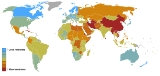
list is based on responses to surveys sent to journalists that are members of partner organisations of the RWB, as well as related specialists such as researchers, jurists and human rights activists. The survey asks questions about direct attacks on journalists and the media as well as other indirect sources of pressure against the free press, such as non-governmental groups. RWB is careful to note that the index only deals with press freedom, and does not measure the quality of journalism.
In 2010, the countries where press was the most free were Finland
, Iceland
, Netherlands
, Norway
and Sweden
. The country with the least degree of press freedom was Eritrea
, followed by North Korea
, Turkmenistan
, Iran
and Myanmar (Burma)
.
is a yearly report by US-based non-governmental organization Freedom House
, measuring the level of freedom and editorial independence enjoyed by the press in every nation and significant disputed territories around the world. Levels of freedom are scored on a scale from 1 (most free) to 100 (least free). Depending on the basics, the nations are then classified as "Free", "Partly Free", or "Not Free".
In 2009 Iceland
, Norway
, Finland
, Denmark
, and Sweden
topped the list with North Korea
, Turkmenistan
, Myanmar (Burma)
, Libya
, Eritrea
at the bottom.
, more than a third of the world's people live in countries where there is no press freedom. Overwhelmingly, these people live in countries where there is no system of democracy
or where there are serious deficiencies in the democratic process. Freedom of the press is an extremely problematic problem/concept for most non-democratic systems of government since, in the modern age, strict control of access to information is critical to the existence of most non-democratic governments and their associated control systems and security apparatus. To this end, most non-democratic societies employ state-run news organizations to promote the propaganda critical to maintaining an existing political power base and suppress (often very brutally, through the use of police, military, or intelligence agencies) any significant attempts by the media or individual journalists to challenge the approved "government line" on contentious issues. In such countries, journalists operating on the fringes of what is deemed to be acceptable will very often find themselves the subject of considerable intimidation by agents of the state. This can range from simple threats to their professional careers (firing, professional blacklisting) to death threat
s, kidnapping
, torture
, and assassination
. Reporters Without Borders reports that, in 2003, 42 journalists lost their lives pursuing their profession and that, in the same year, at least 130 journalists were in prison as a result of their occupational activities. In 2005, 63 journalists and 5 media assistants were killed worldwide.
According to the Press Freedom Index for 2007, Iran ranked 166th out of 169 nations. Only three other countries - Eritrea
, North Korea
and Turkmenistan
- had more restrictions on news media freedom than Iran. The government of Ali Khamenei
and the Supreme National Security Council
had imprisoned 50 journalists in 2007 and had all but eliminated press freedom. Reporters Without Borders (RWB) has dubbed Iran the "Middle East's biggest prison for journalists."
of 1688 in England established parliamentary sovereignty
over the Crown
and, above all, the right of revolution
. A major contributor to Western liberal theory
was John Locke
. Locke argued in Two Treatises of Government
that the individual placed some of his rights
present in the state of nature
in trusteeship
with the sovereign
(government
) in return for protection of certain natural
individual rights
. A social contract
was entered into by the people.
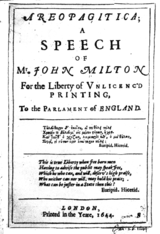 Until 1694, England had an elaborate system of licensing. No publication was allowed without the accompaniment of a government-granted license. Fifty years earlier, at a time of civil war
, John Milton
wrote his pamphlet
Areopagitica
. In this work Milton argued forcefully against this form of government censorship and parodied the idea, writing "when as debtors and delinquents may walk abroad without a keeper, but unoffensive books must not stir forth without a visible jailer in their title." Although at the time it did little to halt the practice of licensing, it would be viewed later a significant milestone as one of the most eloquent defenses of press freedom.
Milton's central argument was that the individual is capable of using reason and distinguishing right from wrong, good from bad. In order to be able to exercise this ration right, the individual must have unlimited access to the ideas of his fellow men in “a free and open encounter." From Milton's writings developed the concept of the open marketplace of ideas
, the idea that when people argue against each other, the good arguments will prevail. One form of speech that was widely restricted in England was seditious libel
, and laws were in place that made criticizing the government a crime. The King was above public criticism and statements critical of the government were forbidden, according to the English Court of the Star Chamber
. Truth was not a defense to seditious libel because the goal was to prevent and punish all condemnation of the government.
John Stuart Mill
approached the problem of authority versus liberty from the viewpoint of a 19th century utilitarian: The individual has the right of expressing himself so long as he does not harm other individuals. The good society is one in which the greatest number of persons enjoy the greatest possible amount of happiness. Applying these general principles of liberty to freedom of expression, Mill states that if we silence an opinion, we may silence the truth. The individual freedom of expression is therefore essential to the well-being of society.
Mill’s application of the general principles of liberty is expressed in his book On Liberty
: "If all mankind minus one, were of one opinion, and one, and only one person were of the contrary opinion, mankind would be no more justified in silencing that one person, than he, if he had the power, would be justified in silencing mankind".
and integrity of India, the security of the State, friendly relations with foreign States, public order, preserving decency, preserving morality, in relation to contempt, court, defamation, or incitement to an offense". Laws such as the Official Secrets Act and Prevention of Terrorist Activities Act
(PoTA) have been used to limit press freedom. Under PoTA, person could be detained for up to six months for being in contact with a terrorist or terrorist group. PoTA was repealed in 2006, but the Official Secrets Act 1923 continues.
For the first half-century of independence, media control by the state was the major constraint on press freedom.
Indira Gandhi
famously stated in 1975 that All India Radio
is "a Government organ, it is going to remain a Government organ..."
With the liberalization starting in the 1990s, private control of media has burgeoned, leading to increasing independence and greater scrutiny of government.
Organizations like CNN-IBN, NDTV
and Times Now
have been particularly influential, e.g. in bringing about the resignation of powerful Haryana
minister Venod Sharma
.
of President Paul Von Hindenburg, just as Adolf Hitler
was coming to power. Hitler largely suppressed freedom of the press through Joseph Goebbels
' Ministry of Public Enlightenment and Propaganda
. As the Ministry's name implies, propaganda did not carry the negative connotations that it does today (or that it did in the Allied countries); how-to manuals were openly distributed by that same ministry explaining the craft of effective propaganda. The Ministry also acted as a central control-point for all media, issuing orders as to what stories could be run and what stories would be suppressed. Anyone involved in the film industry—from directors to the lowliest assistant—had to sign an oath of loyalty to the Nazi Party, due to opinion-changing power Goebbels perceived movies to have. (Goebbels himself maintained some personal control over every single film made in Nazi Europe.) Journalists who crossed the Propaganda Ministry were routinely imprisoned or shot as traitors. The Sicherheitsdienst
and other Nazi police organizations also created a network of internal, domestic spying, so that for example, the White Rose Society was in constant fear of discovery and execution.
-Finland
in 1766, mainly due to classical liberal member of parliament Anders Chydenius
.
had the most unrestricted freedom of press of any country in Europe
. This occurred during the regime of Johann Friedrich Struensee
, whose first act was to abolish the old censorship laws. However, due to the great amount of mostly anonymous pamphlets published that was critical and often slanderous towards Struensee's own regime, he reinstated some restrictions regarding the freedom of press a year later, October 7, 1771.
Naturally, governments are responding to the challenges posed by new media technologies by deploying increasingly sophisticated technology of their own (a notable example being China's attempts to impose control through a state run internet service provider
that controls access to the Internet) but it seems that this will become an ever increasingly difficult task as journalists continue to find new ways to exploit technology and stay one step ahead of the generally slower moving government institutions that attempt to censor them.
In May 2010, U.S. President Barack Obama
signed legislation intended to promote a free press around the world, a bipartisan measure inspired by the murder in Pakistan
of Daniel Pearl
, the Wall Street Journal reporter, shortly after the September 11 attacks in 2001. The legislation, called the Daniel Pearl Freedom of the Press Act
, requires the United States Department of State
to expand its scrutiny of news media restrictions and intimidation as part of its annual review of human rights
in each country.
News media
The news media are those elements of the mass media that focus on delivering news to the general public or a target public.These include print media , broadcast news , and more recently the Internet .-Etymology:A medium is a carrier of something...
and published materials
Publication
To publish is to make content available to the public. While specific use of the term may vary among countries, it is usually applied to text, images, or other audio-visual content on any medium, including paper or electronic publishing forms such as websites, e-books, Compact Discs and MP3s...
. While such freedom mostly implies the absence of interference from an overreaching state
State (polity)
A state is an organized political community, living under a government. States may be sovereign and may enjoy a monopoly on the legal initiation of force and are not dependent on, or subject to any other power or state. Many states are federated states which participate in a federal union...
, its preservation may be sought through constitution
Constitution
A constitution is a set of fundamental principles or established precedents according to which a state or other organization is governed. These rules together make up, i.e. constitute, what the entity is...
al or other legal protections.
With respect to governmental information, any government may distinguish which materials are public or protected from disclosure to the public based on classification of information
Classified information
Classified information is sensitive information to which access is restricted by law or regulation to particular groups of persons. A formal security clearance is required to handle classified documents or access classified data. The clearance process requires a satisfactory background investigation...
as sensitive, classified or secret and being otherwise protected from disclosure due to relevance of the information to protecting the national interest
National interest
The national interest, often referred to by the French expression raison d'État , is a country's goals and ambitions whether economic, military, or cultural. The concept is an important one in international relations where pursuit of the national interest is the foundation of the realist...
. Many governments are also subject to sunshine laws or freedom of information legislation
Freedom of information legislation
Freedom of information legislation comprises laws that guarantee access to data held by the state. They establish a "right-to-know" legal process by which requests may be made for government-held information, to be received freely or at minimal cost, barring standard exceptions...
that are used to define the ambit of national interest.
The Universal Declaration of Human Rights
Universal Declaration of Human Rights
The Universal Declaration of Human Rights is a declaration adopted by the United Nations General Assembly . The Declaration arose directly from the experience of the Second World War and represents the first global expression of rights to which all human beings are inherently entitled...
states: "Everyone has the right to freedom of opinion and expression; this right includes freedom to hold opinions without interference, and impart information and ideas through any media regardless of frontiers"
This philosophy is usually accompanied by legislation
Legislation
Legislation is law which has been promulgated by a legislature or other governing body, or the process of making it...
ensuring various degrees of freedom of scientific research (known as scientific freedom
Scientific freedom
Scientific freedom is the idea of freedom applied to natural science, in particular the practices of scientific research and discourse, mainly by publication...
), publishing, press and printing the depth to which these laws are entrenched in a country's legal system can go as far down as its constitution
Constitution
A constitution is a set of fundamental principles or established precedents according to which a state or other organization is governed. These rules together make up, i.e. constitute, what the entity is...
. The concept of freedom of speech
Freedom of speech
Freedom of speech is the freedom to speak freely without censorship. The term freedom of expression is sometimes used synonymously, but includes any act of seeking, receiving and imparting information or ideas, regardless of the medium used...
is often covered by the same laws as freedom of the press, thereby giving equal treatment to spoken and published expression.
Besides legal definitions, some non-governmental organization
Non-governmental organization
A non-governmental organization is a legally constituted organization created by natural or legal persons that operates independently from any government. The term originated from the United Nations , and is normally used to refer to organizations that do not form part of the government and are...
s use other criteria to judge the level of press freedom around the world:
- Reporters Without BordersReporters Without BordersReporters Without Borders is a France-based international non-governmental organization that advocates freedom of the press. It was founded in 1985, by Robert Ménard, Rony Brauman and the journalist Jean-Claude Guillebaud. Jean-François Julliard has served as Secretary General since 2008...
considers the number of journalists murdered, expelled or harassed, and the existence of a state monopolyState mediaState media or state-owned media is media for mass communication which is ultimately controlled and/or funded by the state. These news outlets may be the sole media outlet or may exist in competition with privately-controlled media.-Overview:...
on TV and radio, as well as the existence of censorshipCensorshipthumb|[[Book burning]] following the [[1973 Chilean coup d'état|1973 coup]] that installed the [[Military government of Chile |Pinochet regime]] in Chile...
and self-censorshipSelf-censorshipSelf-censorship is the act of censoring or classifying one's own work , out of fear of, or deference to, the sensibilities of others, without overt pressure from any specific party or institution of authority...
in the media, and the overall independence of media as well as the difficulties that foreign reporters may face. - The Committee to Protect JournalistsCommittee to Protect JournalistsThe Committee to Protect Journalists is an independent nonprofit organisation based in New York City that promotes press freedom and defends the rights of journalists.-History:A group of U.S...
(CPJ) uses the tools of journalism to help journalists by tracking press freedom issues through independent research, fact-finding missions, and firsthand contacts in the field, including local working journalists in countries around the world. CPJ shares information on breaking cases with other press freedom organizations worldwide through the International Freedom of Expression ExchangeInternational Freedom of Expression ExchangeThe International Freedom of Expression eXchange , founded in 1992, is a global network of around 90 non-governmental organisations that promotes and defends the right to freedom of expression....
, a global e-mail network. CPJ also tracks journalist deaths and detentions. CPJ staff applies strict criteria for each case; researchers independently investigate and verify the circumstances behind each death or imprisonment. - Freedom HouseFreedom HouseFreedom House is an international non-governmental organization based in Washington, D.C. that conducts research and advocacy on democracy, political freedom and human rights...
likewise studies the more general political and economic environments of each nation in order to determine whether relationships of dependence exist that limit in practice the level of press freedom that might exist in theory. So the concept of independence of the press is one closely linked with the concept of press freedom.
Worldwide press freedom index
Every year, Reporters Without Borders establishes a ranking of countries in terms of their freedom of the press. The Worldwide press freedom indexPress Freedom Index
The Press Freedom Index is an annual ranking of countries compiled and published by Reporters Without Borders based upon the organization's assessment of their press freedom records. Small countries, such as Andorra, are excluded from this report...
list is based on responses to surveys sent to journalists that are members of partner organisations of the RWB, as well as related specialists such as researchers, jurists and human rights activists. The survey asks questions about direct attacks on journalists and the media as well as other indirect sources of pressure against the free press, such as non-governmental groups. RWB is careful to note that the index only deals with press freedom, and does not measure the quality of journalism.
In 2010, the countries where press was the most free were Finland
Finland
Finland , officially the Republic of Finland, is a Nordic country situated in the Fennoscandian region of Northern Europe. It is bordered by Sweden in the west, Norway in the north and Russia in the east, while Estonia lies to its south across the Gulf of Finland.Around 5.4 million people reside...
, Iceland
Iceland
Iceland , described as the Republic of Iceland, is a Nordic and European island country in the North Atlantic Ocean, on the Mid-Atlantic Ridge. Iceland also refers to the main island of the country, which contains almost all the population and almost all the land area. The country has a population...
, Netherlands
Netherlands
The Netherlands is a constituent country of the Kingdom of the Netherlands, located mainly in North-West Europe and with several islands in the Caribbean. Mainland Netherlands borders the North Sea to the north and west, Belgium to the south, and Germany to the east, and shares maritime borders...
, Norway
Norway
Norway , officially the Kingdom of Norway, is a Nordic unitary constitutional monarchy whose territory comprises the western portion of the Scandinavian Peninsula, Jan Mayen, and the Arctic archipelago of Svalbard and Bouvet Island. Norway has a total area of and a population of about 4.9 million...
and Sweden
Sweden
Sweden , officially the Kingdom of Sweden , is a Nordic country on the Scandinavian Peninsula in Northern Europe. Sweden borders with Norway and Finland and is connected to Denmark by a bridge-tunnel across the Öresund....
. The country with the least degree of press freedom was Eritrea
Eritrea
Eritrea , officially the State of Eritrea, is a country in the Horn of Africa. Eritrea derives it's name from the Greek word Erethria, meaning 'red land'. The capital is Asmara. It is bordered by Sudan in the west, Ethiopia in the south, and Djibouti in the southeast...
, followed by North Korea
North Korea
The Democratic People’s Republic of Korea , , is a country in East Asia, occupying the northern half of the Korean Peninsula. Its capital and largest city is Pyongyang. The Korean Demilitarized Zone serves as the buffer zone between North Korea and South Korea...
, Turkmenistan
Turkmenistan
Turkmenistan , formerly also known as Turkmenia is one of the Turkic states in Central Asia. Until 1991, it was a constituent republic of the Soviet Union, the Turkmen Soviet Socialist Republic . Turkmenistan is one of the six independent Turkic states...
, Iran
Iran
Iran , officially the Islamic Republic of Iran , is a country in Southern and Western Asia. The name "Iran" has been in use natively since the Sassanian era and came into use internationally in 1935, before which the country was known to the Western world as Persia...
and Myanmar (Burma)
Myanmar
Burma , officially the Republic of the Union of Myanmar , is a country in Southeast Asia. Burma is bordered by China on the northeast, Laos on the east, Thailand on the southeast, Bangladesh on the west, India on the northwest, the Bay of Bengal to the southwest, and the Andaman Sea on the south....
.
Freedom of the Press
Freedom of the PressFreedom of the Press (report)
Freedom of the Press is a yearly report by US-based non-governmental organization Freedom House, measuring the level of freedom and editorial independence enjoyed by the press in every nation and significant disputed territories around the world. Levels of freedom are scored on a scale from 1 to 100...
is a yearly report by US-based non-governmental organization Freedom House
Freedom House
Freedom House is an international non-governmental organization based in Washington, D.C. that conducts research and advocacy on democracy, political freedom and human rights...
, measuring the level of freedom and editorial independence enjoyed by the press in every nation and significant disputed territories around the world. Levels of freedom are scored on a scale from 1 (most free) to 100 (least free). Depending on the basics, the nations are then classified as "Free", "Partly Free", or "Not Free".
In 2009 Iceland
Iceland
Iceland , described as the Republic of Iceland, is a Nordic and European island country in the North Atlantic Ocean, on the Mid-Atlantic Ridge. Iceland also refers to the main island of the country, which contains almost all the population and almost all the land area. The country has a population...
, Norway
Norway
Norway , officially the Kingdom of Norway, is a Nordic unitary constitutional monarchy whose territory comprises the western portion of the Scandinavian Peninsula, Jan Mayen, and the Arctic archipelago of Svalbard and Bouvet Island. Norway has a total area of and a population of about 4.9 million...
, Finland
Finland
Finland , officially the Republic of Finland, is a Nordic country situated in the Fennoscandian region of Northern Europe. It is bordered by Sweden in the west, Norway in the north and Russia in the east, while Estonia lies to its south across the Gulf of Finland.Around 5.4 million people reside...
, Denmark
Denmark
Denmark is a Scandinavian country in Northern Europe. The countries of Denmark and Greenland, as well as the Faroe Islands, constitute the Kingdom of Denmark . It is the southernmost of the Nordic countries, southwest of Sweden and south of Norway, and bordered to the south by Germany. Denmark...
, and Sweden
Sweden
Sweden , officially the Kingdom of Sweden , is a Nordic country on the Scandinavian Peninsula in Northern Europe. Sweden borders with Norway and Finland and is connected to Denmark by a bridge-tunnel across the Öresund....
topped the list with North Korea
North Korea
The Democratic People’s Republic of Korea , , is a country in East Asia, occupying the northern half of the Korean Peninsula. Its capital and largest city is Pyongyang. The Korean Demilitarized Zone serves as the buffer zone between North Korea and South Korea...
, Turkmenistan
Turkmenistan
Turkmenistan , formerly also known as Turkmenia is one of the Turkic states in Central Asia. Until 1991, it was a constituent republic of the Soviet Union, the Turkmen Soviet Socialist Republic . Turkmenistan is one of the six independent Turkic states...
, Myanmar (Burma)
Myanmar
Burma , officially the Republic of the Union of Myanmar , is a country in Southeast Asia. Burma is bordered by China on the northeast, Laos on the east, Thailand on the southeast, Bangladesh on the west, India on the northwest, the Bay of Bengal to the southwest, and the Andaman Sea on the south....
, Libya
Libya
Libya is an African country in the Maghreb region of North Africa bordered by the Mediterranean Sea to the north, Egypt to the east, Sudan to the southeast, Chad and Niger to the south, and Algeria and Tunisia to the west....
, Eritrea
Eritrea
Eritrea , officially the State of Eritrea, is a country in the Horn of Africa. Eritrea derives it's name from the Greek word Erethria, meaning 'red land'. The capital is Asmara. It is bordered by Sudan in the west, Ethiopia in the south, and Djibouti in the southeast...
at the bottom.
Non-democratic states
According to Reporters Without BordersReporters Without Borders
Reporters Without Borders is a France-based international non-governmental organization that advocates freedom of the press. It was founded in 1985, by Robert Ménard, Rony Brauman and the journalist Jean-Claude Guillebaud. Jean-François Julliard has served as Secretary General since 2008...
, more than a third of the world's people live in countries where there is no press freedom. Overwhelmingly, these people live in countries where there is no system of democracy
Democracy
Democracy is generally defined as a form of government in which all adult citizens have an equal say in the decisions that affect their lives. Ideally, this includes equal participation in the proposal, development and passage of legislation into law...
or where there are serious deficiencies in the democratic process. Freedom of the press is an extremely problematic problem/concept for most non-democratic systems of government since, in the modern age, strict control of access to information is critical to the existence of most non-democratic governments and their associated control systems and security apparatus. To this end, most non-democratic societies employ state-run news organizations to promote the propaganda critical to maintaining an existing political power base and suppress (often very brutally, through the use of police, military, or intelligence agencies) any significant attempts by the media or individual journalists to challenge the approved "government line" on contentious issues. In such countries, journalists operating on the fringes of what is deemed to be acceptable will very often find themselves the subject of considerable intimidation by agents of the state. This can range from simple threats to their professional careers (firing, professional blacklisting) to death threat
Death threat
A death threat is a threat of death, often made anonymously, by one person or a group of people to kill another person or groups of people. These threats are usually designed to intimidate victims in order to manipulate their behavior, thus a death threat is a form of coercion...
s, kidnapping
Kidnapping
In criminal law, kidnapping is the taking away or transportation of a person against that person's will, usually to hold the person in false imprisonment, a confinement without legal authority...
, torture
Torture
Torture is the act of inflicting severe pain as a means of punishment, revenge, forcing information or a confession, or simply as an act of cruelty. Throughout history, torture has often been used as a method of political re-education, interrogation, punishment, and coercion...
, and assassination
Assassination
To carry out an assassination is "to murder by a sudden and/or secret attack, often for political reasons." Alternatively, assassination may be defined as "the act of deliberately killing someone, especially a public figure, usually for hire or for political reasons."An assassination may be...
. Reporters Without Borders reports that, in 2003, 42 journalists lost their lives pursuing their profession and that, in the same year, at least 130 journalists were in prison as a result of their occupational activities. In 2005, 63 journalists and 5 media assistants were killed worldwide.
- The Lira BaysetovaLira BaysetovaLira Baysetova is the former editor of the weekly Respublika newspaper of Kazakhstan.In late May 2002 she found that her 25-year-old daughter Leyla Baysetova had mysteriously disappeared...
case in KazakhstanKazakhstanKazakhstan , officially the Republic of Kazakhstan, is a transcontinental country in Central Asia and Eastern Europe. Ranked as the ninth largest country in the world, it is also the world's largest landlocked country; its territory of is greater than Western Europe...
. - In NepalNepalNepal , officially the Federal Democratic Republic of Nepal, is a landlocked sovereign state located in South Asia. It is located in the Himalayas and bordered to the north by the People's Republic of China, and to the south, east, and west by the Republic of India...
, EritreaEritreaEritrea , officially the State of Eritrea, is a country in the Horn of Africa. Eritrea derives it's name from the Greek word Erethria, meaning 'red land'. The capital is Asmara. It is bordered by Sudan in the west, Ethiopia in the south, and Djibouti in the southeast...
and ChinaChinaChinese civilization may refer to:* China for more general discussion of the country.* Chinese culture* Greater China, the transnational community of ethnic Chinese.* History of China* Sinosphere, the area historically affected by Chinese culture...
(mainlandMainland ChinaMainland China, the Chinese mainland or simply the mainland, is a geopolitical term that refers to the area under the jurisdiction of the People's Republic of China . According to the Taipei-based Mainland Affairs Council, the term excludes the PRC Special Administrative Regions of Hong Kong and...
only), journalists may spend years in jail simply for using the "wrong" word or photo. - The Georgiy R. GongadzeGeorgiy R. GongadzeGeorgiy Ruslanovich Gongadze was a Ukrainian journalist of Georgian origin who was kidnapped and murdered in 2000.The circumstances of his death became a national scandal and a focus for protests against the government of the then President, Leonid Kuchma...
case in UkraineUkraineUkraine is a country in Eastern Europe. It has an area of 603,628 km², making it the second largest contiguous country on the European continent, after Russia...
According to the Press Freedom Index for 2007, Iran ranked 166th out of 169 nations. Only three other countries - Eritrea
Eritrea
Eritrea , officially the State of Eritrea, is a country in the Horn of Africa. Eritrea derives it's name from the Greek word Erethria, meaning 'red land'. The capital is Asmara. It is bordered by Sudan in the west, Ethiopia in the south, and Djibouti in the southeast...
, North Korea
North Korea
The Democratic People’s Republic of Korea , , is a country in East Asia, occupying the northern half of the Korean Peninsula. Its capital and largest city is Pyongyang. The Korean Demilitarized Zone serves as the buffer zone between North Korea and South Korea...
and Turkmenistan
Turkmenistan
Turkmenistan , formerly also known as Turkmenia is one of the Turkic states in Central Asia. Until 1991, it was a constituent republic of the Soviet Union, the Turkmen Soviet Socialist Republic . Turkmenistan is one of the six independent Turkic states...
- had more restrictions on news media freedom than Iran. The government of Ali Khamenei
Ali Khamenei
Ayatollah Seyed Ali Hoseyni Khāmene’i is the Supreme Leader of Iran and the figurative head of the Muslim conservative establishment in Iran and Twelver Shi'a marja...
and the Supreme National Security Council
Supreme National Security Council
Supreme National Security Council is the national security council of the Islamic Republic of Iran, the current secretary of which is Saeed Jalili. This institution was founded during the 1989 revision of the constitution...
had imprisoned 50 journalists in 2007 and had all but eliminated press freedom. Reporters Without Borders (RWB) has dubbed Iran the "Middle East's biggest prison for journalists."
Regions closed to foreign reporters
- ChechnyaChechnyaThe Chechen Republic , commonly referred to as Chechnya , also spelled Chechnia or Chechenia, sometimes referred to as Ichkeria , is a federal subject of Russia . It is located in the southeastern part of Europe in the Northern Caucasus mountains. The capital of the republic is the city of Grozny...
, Russia - MyanmarMyanmarBurma , officially the Republic of the Union of Myanmar , is a country in Southeast Asia. Burma is bordered by China on the northeast, Laos on the east, Thailand on the southeast, Bangladesh on the west, India on the northwest, the Bay of Bengal to the southwest, and the Andaman Sea on the south....
(Burma) - Jammu & Kashmir, India
- WaziristanWaziristanWaziristan is a mountainous region near the Northwest of Pakistan, bordering Afghanistan and covering some 11,585 km² . The area is entirely populated by ethnic Pashtuns . The language spoken in the valley is Pashto/Pakhto...
, Pakistan - AgadezAgadez-Sources:* Aboubacar Adamou. "Agadez et sa région. Contribution à l'étude du Sahel et du Sahara nigériens", Études nigériennes, n°44, , 358 p.* Julien Brachet. Migrations transsahariennes. Vers un désert cosmopolite et morcelé . Paris: Le Croquant, , 324 p. ISBN : 978-2-91496865-2.*. Saudi Aaramco...
, Niger - North KoreaNorth KoreaThe Democratic People’s Republic of Korea , , is a country in East Asia, occupying the northern half of the Korean Peninsula. Its capital and largest city is Pyongyang. The Korean Demilitarized Zone serves as the buffer zone between North Korea and South Korea...
England
The Glorious RevolutionGlorious Revolution
The Glorious Revolution, also called the Revolution of 1688, is the overthrow of King James II of England by a union of English Parliamentarians with the Dutch stadtholder William III of Orange-Nassau...
of 1688 in England established parliamentary sovereignty
Parliamentary sovereignty
Parliamentary sovereignty is a concept in the constitutional law of some parliamentary democracies. In the concept of parliamentary sovereignty, a legislative body has absolute sovereignty, meaning it is supreme to all other government institutions—including any executive or judicial bodies...
over the Crown
The Crown
The Crown is a corporation sole that in the Commonwealth realms and any provincial or state sub-divisions thereof represents the legal embodiment of governance, whether executive, legislative, or judicial...
and, above all, the right of revolution
Right of revolution
In political philosophy, the right of revolution is the right or duty, variously stated throughout history, of the people of a nation to overthrow a government that acts against their common interests...
. A major contributor to Western liberal theory
Liberalism
Liberalism is the belief in the importance of liberty and equal rights. Liberals espouse a wide array of views depending on their understanding of these principles, but generally, liberals support ideas such as constitutionalism, liberal democracy, free and fair elections, human rights,...
was John Locke
John Locke
John Locke FRS , widely known as the Father of Liberalism, was an English philosopher and physician regarded as one of the most influential of Enlightenment thinkers. Considered one of the first of the British empiricists, following the tradition of Francis Bacon, he is equally important to social...
. Locke argued in Two Treatises of Government
Two Treatises of Government
The Two Treatises of Government is a work of political philosophy published anonymously in 1689 by John Locke...
that the individual placed some of his rights
Rights
Rights are legal, social, or ethical principles of freedom or entitlement; that is, rights are the fundamental normative rules about what is allowed of people or owed to people, according to some legal system, social convention, or ethical theory...
present in the state of nature
State of nature
State of nature is a term in political philosophy used in social contract theories to describe the hypothetical condition that preceded governments...
in trusteeship
Trust law
In common law legal systems, a trust is a relationship whereby property is held by one party for the benefit of another...
with the sovereign
Sovereign
A sovereign is the supreme lawmaking authority within its jurisdiction.Sovereign may also refer to:*Monarch, the sovereign of a monarchy*Sovereign Bank, banking institution in the United States*Sovereign...
(government
Government
Government refers to the legislators, administrators, and arbitrators in the administrative bureaucracy who control a state at a given time, and to the system of government by which they are organized...
) in return for protection of certain natural
Natural rights
Natural and legal rights are two types of rights theoretically distinct according to philosophers and political scientists. Natural rights are rights not contingent upon the laws, customs, or beliefs of any particular culture or government, and therefore universal and inalienable...
individual rights
Individual rights
Group rights are rights held by a group rather than by its members separately, or rights held only by individuals within the specified group; in contrast, individual rights are rights held by individual people regardless of their group membership or lack thereof...
. A social contract
Social contract
The social contract is an intellectual device intended to explain the appropriate relationship between individuals and their governments. Social contract arguments assert that individuals unite into political societies by a process of mutual consent, agreeing to abide by common rules and accept...
was entered into by the people.
English Civil War
The English Civil War was a series of armed conflicts and political machinations between Parliamentarians and Royalists...
, John Milton
John Milton
John Milton was an English poet, polemicist, a scholarly man of letters, and a civil servant for the Commonwealth of England under Oliver Cromwell...
wrote his pamphlet
Pamphlet
A pamphlet is an unbound booklet . It may consist of a single sheet of paper that is printed on both sides and folded in half, in thirds, or in fourths , or it may consist of a few pages that are folded in half and saddle stapled at the crease to make a simple book...
Areopagitica
Areopagitica
Areopagitica: A speech of Mr. John Milton for the liberty of unlicensed printing to the Parliament of England is a 1644 prose polemical tract by English author John Milton against censorship...
. In this work Milton argued forcefully against this form of government censorship and parodied the idea, writing "when as debtors and delinquents may walk abroad without a keeper, but unoffensive books must not stir forth without a visible jailer in their title." Although at the time it did little to halt the practice of licensing, it would be viewed later a significant milestone as one of the most eloquent defenses of press freedom.
Milton's central argument was that the individual is capable of using reason and distinguishing right from wrong, good from bad. In order to be able to exercise this ration right, the individual must have unlimited access to the ideas of his fellow men in “a free and open encounter." From Milton's writings developed the concept of the open marketplace of ideas
Marketplace of ideas
The "marketplace of ideas" is a rationale for freedom of expression based on an analogy to the economic concept of a free market. The "marketplace of ideas" belief holds that the truth or the best policy arises out of the competition of widely various ideas in free, transparent public discourse, an...
, the idea that when people argue against each other, the good arguments will prevail. One form of speech that was widely restricted in England was seditious libel
Seditious libel
Seditious libel was a criminal offence under English common law. Sedition is the offence of speaking seditious words with seditious intent: if the statement is in writing or some other permanent form it is seditious libel...
, and laws were in place that made criticizing the government a crime. The King was above public criticism and statements critical of the government were forbidden, according to the English Court of the Star Chamber
Star Chamber
The Star Chamber was an English court of law that sat at the royal Palace of Westminster until 1641. It was made up of Privy Counsellors, as well as common-law judges and supplemented the activities of the common-law and equity courts in both civil and criminal matters...
. Truth was not a defense to seditious libel because the goal was to prevent and punish all condemnation of the government.
John Stuart Mill
John Stuart Mill
John Stuart Mill was a British philosopher, economist and civil servant. An influential contributor to social theory, political theory, and political economy, his conception of liberty justified the freedom of the individual in opposition to unlimited state control. He was a proponent of...
approached the problem of authority versus liberty from the viewpoint of a 19th century utilitarian: The individual has the right of expressing himself so long as he does not harm other individuals. The good society is one in which the greatest number of persons enjoy the greatest possible amount of happiness. Applying these general principles of liberty to freedom of expression, Mill states that if we silence an opinion, we may silence the truth. The individual freedom of expression is therefore essential to the well-being of society.
Mill’s application of the general principles of liberty is expressed in his book On Liberty
On Liberty
On Liberty is a philosophical work by British philosopher John Stuart Mill. It was a radical work to the Victorian readers of the time because it supported individuals' moral and economic freedom from the state....
: "If all mankind minus one, were of one opinion, and one, and only one person were of the contrary opinion, mankind would be no more justified in silencing that one person, than he, if he had the power, would be justified in silencing mankind".
India
The Indian Constitution, while not mentioning the word "press", provides for "the right to freedom of speech and expression" (Article 19(1) a). However this right is subject to restrictions under sub clause (2), whereby this freedom can be restricted for reasons of "sovereigntySovereignty
Sovereignty is the quality of having supreme, independent authority over a geographic area, such as a territory. It can be found in a power to rule and make law that rests on a political fact for which no purely legal explanation can be provided...
and integrity of India, the security of the State, friendly relations with foreign States, public order, preserving decency, preserving morality, in relation to contempt, court, defamation, or incitement to an offense". Laws such as the Official Secrets Act and Prevention of Terrorist Activities Act
Prevention of Terrorist Activities Act
The Prevention of Terrorist Activities Act was an anti-terrorism legislation enacted by the Parliament of India in 2002. The act replaced the Prevention of Terrorism Ordinance of 2001 and the Terrorist and Disruptive Activities Act , and was supported by the governing National Democratic Alliance...
(PoTA) have been used to limit press freedom. Under PoTA, person could be detained for up to six months for being in contact with a terrorist or terrorist group. PoTA was repealed in 2006, but the Official Secrets Act 1923 continues.
For the first half-century of independence, media control by the state was the major constraint on press freedom.
Indira Gandhi
Indira Gandhi
Indira Priyadarshini Gandhara was an Indian politician who served as the third Prime Minister of India for three consecutive terms and a fourth term . She was assassinated by Sikh extremists...
famously stated in 1975 that All India Radio
All India Radio
All India Radio , officially known since 1956 as Akashvani , is the radio broadcaster of India and a division of Prasar Bharati. Established in 1936, it is the sister service of Prasar Bharati's Doordarshan, the national television broadcaster. All India Radio is one of the largest radio networks...
is "a Government organ, it is going to remain a Government organ..."
With the liberalization starting in the 1990s, private control of media has burgeoned, leading to increasing independence and greater scrutiny of government.
Organizations like CNN-IBN, NDTV
NDTV
NDTV is an Indian commercial broadcasting television network founded in 1988. It was founded by Prannoy Roy, an eminent journalist and current chairman and director of NDTV Group. NDTV currently has more than 1,000 employees producing news from over twenty locations in India...
and Times Now
Times Now
Times Now is a 24-hour English language news channel based in Mumbai and broadcast primarily in the South Asian region. The channel was launched in 2006 as a joint-venture of Bennett, Coleman & Co. Ltd., the publishers of The Times of India and Reuters. Arnab Goswami is the Editor-in Chief and...
have been particularly influential, e.g. in bringing about the resignation of powerful Haryana
Haryana
Haryana is a state in India. Historically, it has been a part of the Kuru region in North India. The name Haryana is found mentioned in the 12th century AD by the apabhramsha writer Vibudh Shridhar . It is bordered by Punjab and Himachal Pradesh to the north, and by Rajasthan to the west and south...
minister Venod Sharma
Venod Sharma
Venod Sharma was a leader of Indian National Congress party from Haryana. He was a Minister of State in the Ministry of Civil Supplies, Consumer Affairs and Public Distribution at in the Narasimha Rao cabinet ....
.
Nazi Germany (1933-1945)
In 1933 Freedom of the Press was suppressed in Germany by the Reichstag Fire DecreeReichstag Fire Decree
The Reichstag Fire Decree is the common name of the Decree of the Reich President for the Protection of People and State issued by German President Paul von Hindenburg in direct response to the Reichstag fire of 27 February 1933. The decree nullified many of the key civil liberties of German...
of President Paul Von Hindenburg, just as Adolf Hitler
Adolf Hitler
Adolf Hitler was an Austrian-born German politician and the leader of the National Socialist German Workers Party , commonly referred to as the Nazi Party). He was Chancellor of Germany from 1933 to 1945, and head of state from 1934 to 1945...
was coming to power. Hitler largely suppressed freedom of the press through Joseph Goebbels
Joseph Goebbels
Paul Joseph Goebbels was a German politician and Reich Minister of Propaganda in Nazi Germany from 1933 to 1945. As one of Adolf Hitler's closest associates and most devout followers, he was known for his zealous oratory and anti-Semitism...
' Ministry of Public Enlightenment and Propaganda
Ministry of Public Enlightenment and Propaganda
The Reich Ministry of Public Enlightenment and Propaganda was Nazi Germany's ministry that enforced Nazi Party ideology in Germany and regulated its culture and society. Founded on March 13, 1933, by Adolf Hitler's new National Socialist government, the Ministry was headed by Dr...
. As the Ministry's name implies, propaganda did not carry the negative connotations that it does today (or that it did in the Allied countries); how-to manuals were openly distributed by that same ministry explaining the craft of effective propaganda. The Ministry also acted as a central control-point for all media, issuing orders as to what stories could be run and what stories would be suppressed. Anyone involved in the film industry—from directors to the lowliest assistant—had to sign an oath of loyalty to the Nazi Party, due to opinion-changing power Goebbels perceived movies to have. (Goebbels himself maintained some personal control over every single film made in Nazi Europe.) Journalists who crossed the Propaganda Ministry were routinely imprisoned or shot as traitors. The Sicherheitsdienst
Sicherheitsdienst
Sicherheitsdienst , full title Sicherheitsdienst des Reichsführers-SS, or SD, was the intelligence agency of the SS and the Nazi Party in Nazi Germany. The organization was the first Nazi Party intelligence organization to be established and was often considered a "sister organization" with the...
and other Nazi police organizations also created a network of internal, domestic spying, so that for example, the White Rose Society was in constant fear of discovery and execution.
Poland and Lithuania
Freedom of Press laws were first passed in the Polish–Lithuanian Commonwealth in 1539.Sweden-Finland
The world's first Freedom of the Press Act was introduced in SwedenSweden
Sweden , officially the Kingdom of Sweden , is a Nordic country on the Scandinavian Peninsula in Northern Europe. Sweden borders with Norway and Finland and is connected to Denmark by a bridge-tunnel across the Öresund....
-Finland
Finland
Finland , officially the Republic of Finland, is a Nordic country situated in the Fennoscandian region of Northern Europe. It is bordered by Sweden in the west, Norway in the north and Russia in the east, while Estonia lies to its south across the Gulf of Finland.Around 5.4 million people reside...
in 1766, mainly due to classical liberal member of parliament Anders Chydenius
Anders Chydenius
Anders Chydenius was the leading classical liberal of Nordic history. Born in Sotkamo, Ostrobothnia, Sweden and having studied under Pehr Kalm at the Royal Academy of Åbo, Chydenius became a priest, Enlightenment philosopher and member of the Swedish Riksdag of the Estates.The world's first...
.
Denmark–Norway
Between September 4, 1770 and October 7, 1771 the kingdom of Denmark–NorwayDenmark–Norway
Denmark–Norway is the historiographical name for a former political entity consisting of the kingdoms of Denmark and Norway, including the originally Norwegian dependencies of Iceland, Greenland and the Faroe Islands...
had the most unrestricted freedom of press of any country in Europe
Europe
Europe is, by convention, one of the world's seven continents. Comprising the westernmost peninsula of Eurasia, Europe is generally 'divided' from Asia to its east by the watershed divides of the Ural and Caucasus Mountains, the Ural River, the Caspian and Black Seas, and the waterways connecting...
. This occurred during the regime of Johann Friedrich Struensee
Johann Friedrich Struensee
Count Johann Friedrich Struensee was a German doctor. He became royal physician to the mentally ill King Christian VII of Denmark and a minister in the Danish government. He rose in power to a position of “de facto” regent of the country, where he tried to carry out widespread reforms...
, whose first act was to abolish the old censorship laws. However, due to the great amount of mostly anonymous pamphlets published that was critical and often slanderous towards Struensee's own regime, he reinstated some restrictions regarding the freedom of press a year later, October 7, 1771.
Implications of new technologies
Many of the traditional means of delivering information are being slowly superseded by the increasing pace of modern technological advance. Almost every conventional mode of media and information dissemination has a modern counterpart that offers significant potential advantages to journalists seeking to maintain and enhance their 'freedom of speech'. A few simple examples of such phenomena include:- Satellite televisionSatellite televisionSatellite television is television programming delivered by the means of communications satellite and received by an outdoor antenna, usually a parabolic mirror generally referred to as a satellite dish, and as far as household usage is concerned, a satellite receiver either in the form of an...
versus terrestrial televisionTerrestrial televisionTerrestrial television is a mode of television broadcasting which does not involve satellite transmission or cables — typically using radio waves through transmitting and receiving antennas or television antenna aerials...
: Whilst terrestrial television is relatively easy to manage and manipulate, satellite television is much more difficult to control as journalistic content can easily be broadcast from other jurisdictions beyond the control of individual governments. An example of this in the Middle East is the satellite broadcaster Al JazeeraAl JazeeraAl Jazeera is an independent broadcaster owned by the state of Qatar through the Qatar Media Corporation and headquartered in Doha, Qatar...
. This Arabic language media channel operates out of QatarQatarQatar , also known as the State of Qatar or locally Dawlat Qaṭar, is a sovereign Arab state, located in the Middle East, occupying the small Qatar Peninsula on the northeasterly coast of the much larger Arabian Peninsula. Its sole land border is with Saudi Arabia to the south, with the rest of its...
, whose government is relatively liberal with respect to many of its neighboring states. As such, its views and content are often problematic to a number of governments in the region and beyond. However, because of the increased affordability and miniaturisation of satellite technology (e.g. dishes and receivers) it is simply not practicable for most states to control popular access to the channel. - Web-based publishing (e.g., blogBlogA blog is a type of website or part of a website supposed to be updated with new content from time to time. Blogs are usually maintained by an individual with regular entries of commentary, descriptions of events, or other material such as graphics or video. Entries are commonly displayed in...
ging) vs. traditional publishingPublishingPublishing is the process of production and dissemination of literature or information—the activity of making information available to the general public...
: Traditional magazines and newspapers rely on physical resources (e.g. offices, printing presses) that can easily be targeted and forced to close down. Web-based publishing systems can be run using ubiquitous and inexpensive equipment and can operate from any global jurisdiction. To get control over web publications, nations and organisations are using GeolocationGeolocationGeolocation is the identification of the real-world geographic location of an object, such as a radar, mobile phone or an Internet-connected computer terminal...
and Geolocation softwareGeolocation softwareIn computing, geolocation software is used to deduce the geolocation of another party. For example, on the Internet, one geolocation approach is to identify the subject party's IP address, then determine what country , organization, or user the IP address has been assigned to, and finally,...
. - Voice over Internet protocol (VOIP) vs. conventional telephonyTelephonyIn telecommunications, telephony encompasses the general use of equipment to provide communication over distances, specifically by connecting telephones to each other....
: Although conventional telephony systems are easily tapped and recorded, modern VOIP technology can employ sophisticated encryption systems to evade central monitoring systems. As VOIP and similar technologies become more widespread they are likely to make the effective monitoring of journalists (and their contacts and activities) a very difficult task for governments.
Naturally, governments are responding to the challenges posed by new media technologies by deploying increasingly sophisticated technology of their own (a notable example being China's attempts to impose control through a state run internet service provider
Internet service provider
An Internet service provider is a company that provides access to the Internet. Access ISPs directly connect customers to the Internet using copper wires, wireless or fiber-optic connections. Hosting ISPs lease server space for smaller businesses and host other people servers...
that controls access to the Internet) but it seems that this will become an ever increasingly difficult task as journalists continue to find new ways to exploit technology and stay one step ahead of the generally slower moving government institutions that attempt to censor them.
In May 2010, U.S. President Barack Obama
Barack Obama
Barack Hussein Obama II is the 44th and current President of the United States. He is the first African American to hold the office. Obama previously served as a United States Senator from Illinois, from January 2005 until he resigned following his victory in the 2008 presidential election.Born in...
signed legislation intended to promote a free press around the world, a bipartisan measure inspired by the murder in Pakistan
Pakistan
Pakistan , officially the Islamic Republic of Pakistan is a sovereign state in South Asia. It has a coastline along the Arabian Sea and the Gulf of Oman in the south and is bordered by Afghanistan and Iran in the west, India in the east and China in the far northeast. In the north, Tajikistan...
of Daniel Pearl
Daniel Pearl
Daniel Pearl was an American journalist who was kidnapped and killed by Al-Qaeda.At the time of his kidnapping, Pearl served as the South Asia Bureau Chief of the Wall Street Journal, and was based in Mumbai, India. He went to Pakistan as part of an investigation into the alleged links between...
, the Wall Street Journal reporter, shortly after the September 11 attacks in 2001. The legislation, called the Daniel Pearl Freedom of the Press Act
Daniel Pearl Freedom of the Press Act
The Daniel Pearl Freedom of the Press Act requires the United States Department of State to expand its scrutiny of news media intimidation and freedom of the press restrictions during its annual report on human rights in each country...
, requires the United States Department of State
United States Department of State
The United States Department of State , is the United States federal executive department responsible for international relations of the United States, equivalent to the foreign ministries of other countries...
to expand its scrutiny of news media restrictions and intimidation as part of its annual review of human rights
Human rights
Human rights are "commonly understood as inalienable fundamental rights to which a person is inherently entitled simply because she or he is a human being." Human rights are thus conceived as universal and egalitarian . These rights may exist as natural rights or as legal rights, in both national...
in each country.
Organizations for press freedom
- Article 19ARTICLE 19ARTICLE 19 is a London-based human rights organisation with a specific mandate and focus on the defence and promotion of freedom of expression and freedom of information worldwide...
- Canadian Journalists for Free ExpressionCanadian Journalists for Free ExpressionCanadian Journalists for Free Expression is a Canadian non-governmental organization supported by Canadian journalists and advocates of freedom of expression. The purpose of the organization is to defend the rights of journalists and contribute to the development of press freedom throughout the...
- The Committee to Protect Journalists
- Electronic Frontier FoundationElectronic Frontier FoundationThe Electronic Frontier Foundation is an international non-profit digital rights advocacy and legal organization based in the United States...
- Freedom HouseFreedom HouseFreedom House is an international non-governmental organization based in Washington, D.C. that conducts research and advocacy on democracy, political freedom and human rights...
- Index on CensorshipIndex on CensorshipIndex on Censorship is a campaigning publishing organisation for freedom of expression, which produces an award-winning quarterly magazine of the same name from London. The present chief executive of Index on Censorship, since 2008, is the author, broadcaster and commentator John Kampfner, former...
- Inter American Press Association
- International Freedom of Expression ExchangeInternational Freedom of Expression ExchangeThe International Freedom of Expression eXchange , founded in 1992, is a global network of around 90 non-governmental organisations that promotes and defends the right to freedom of expression....
- Internationale MedienhilfeInternationale MedienhilfeThe IMH-Internationale Medienhilfe is a non-commercial working group and co-operative enterprise of intercultural, international and Jewish newspapers, magazines, radio stations, television broadcasters and news agencies located throughout the world, which have collectively agreed to provide...
- International Press InstituteInternational Press InstituteInternational Press Institute is a global organisation dedicated to the promotion and protection of press freedom and the improvement of journalism practices. Founded in October 1950, the IPI has members in over 120 countries....
- Media Legal Defence InitiativeMedia Legal Defence InitiativeThe Media Legal Defence Initiative is a non-governmental organization established in 2008 to provide legal assistance to journalists and news media organizations, support training in media law and promote the exchange of information, litigation tools and strategies for lawyers working on media...
- OSCE Representative on Freedom of the MediaOSCE Representative on Freedom of the MediaThe OSCE Representative on Freedom of the Media functions as a watchdog on media developments in all 56 participating States of the Organization for Security and Cooperation in Europe...
- Reporters Without BordersReporters Without BordersReporters Without Borders is a France-based international non-governmental organization that advocates freedom of the press. It was founded in 1985, by Robert Ménard, Rony Brauman and the journalist Jean-Claude Guillebaud. Jean-François Julliard has served as Secretary General since 2008...
- Student Press Law CenterStudent Press Law CenterThe Student Press Law Center is a non-profit organization in the United States that aims at protecting the freedom of the press for student journalists, usually from high school and university student newspapers...
- World Association of NewspapersWorld Association of NewspapersThe World Association of Newspapers is a non-profit, non-governmental organization made up of 76 national newspaper associations, 12 news agencies, 10 regional press organisations and individual newspaper executives in 100 countries...
- World Press Freedom CommitteeWorld Press Freedom CommitteeThe World Press Freedom Committee is a coordination group of national and international news media organizations.The WPFC set out global press freedom principles in the 1981 Declaration of Talloires , followed in 1987 by the 10-point Charter for a Free Press...
- Worldwide Governance IndicatorsWorldwide Governance IndicatorsBased on a long-standing research program of the World Bank, the Worldwide Governance Indicators capture six key dimensions of governance between 1996 and present...
See also
- AreopagiticaAreopagiticaAreopagitica: A speech of Mr. John Milton for the liberty of unlicensed printing to the Parliament of England is a 1644 prose polemical tract by English author John Milton against censorship...
: a speech of Mr John Milton for the liberty of unlicensed printing to the Parliament of EnglandParliament of EnglandThe Parliament of England was the legislature of the Kingdom of England. In 1066, William of Normandy introduced a feudal system, by which he sought the advice of a council of tenants-in-chief and ecclesiastics before making laws... - Chilling effect (term)
- Cohen v. Cowles Media Co.Cohen v. Cowles Media Co.Cohen v. Cowles Media Co., 501 U.S. 663 , was a case in which the Supreme Court of the United States held that freedom of the press does not exempt journalists from generally applicable laws....
— a ruling in the USA that a reporter's promise of a source's confidentiality may be enforced in court. - Declaration of WindhoekDeclaration of WindhoekThe Windhoek Declaration is a statement of press freedom principles put together by African newspaper journalists in 1991. The Declaration was produced at a UNESCO seminar, "Promoting an Independent and Pluralistic African Press," held in Windhoek, Namibia, from April 29 to May 3, 1991; it was...
(1991) - Editorial independenceEditorial independenceEditorial independence is the freedom of editors to make decisions without interference from the owners of a publication. Editorial independence is tested, for instance, if a newspaper runs articles that may be unpopular with its advertising clientele....
- Free Speech, "The People’s Darling Privilege"Free Speech, "The People’s Darling Privilege"Free Speech, "The People’s Darling Privilege": Struggles for Freedom of Expression in American History is a non-fiction book about the history of freedom of speech in the United States. It was written by Michael Kent Curtis, and published in 2000 by Duke University Press. The book is structured in...
- First Amendment to the United States ConstitutionFirst Amendment to the United States ConstitutionThe First Amendment to the United States Constitution is part of the Bill of Rights. The amendment prohibits the making of any law respecting an establishment of religion, impeding the free exercise of religion, abridging the freedom of speech, infringing on the freedom of the press, interfering...
- Freedom of speechFreedom of speechFreedom of speech is the freedom to speak freely without censorship. The term freedom of expression is sometimes used synonymously, but includes any act of seeking, receiving and imparting information or ideas, regardless of the medium used...
- Freedom of the Press Act (1766)
- Freedom of the Press (report)Freedom of the Press (report)Freedom of the Press is a yearly report by US-based non-governmental organization Freedom House, measuring the level of freedom and editorial independence enjoyed by the press in every nation and significant disputed territories around the world. Levels of freedom are scored on a scale from 1 to 100...
- Freedom of the press in the Russian Federation
- Freedom of the press in the United StatesFreedom of the press in the United StatesFreedom of the press in the United States is protected by the First Amendment to the United States Constitution. This clause is generally understood as prohibiting the government from interfering with the printing and distribution of information or opinions, although freedom of the press, like...
- Freedom of the press in UkraineFreedom of the press in UkraineAlthough press freedom in Ukraine has never been rated higher that "partly free" by Freedom House it is still considered to be among the freest of all post-Soviet states and has significantly improved since the Orange Revolution of 2004...
- Free speech in media during Libyan uprising
- Gag orderGag orderA gag order is an order, sometimes a legal order by a court or government, other times a private order by an employer or other institution, restricting information or comment from being made public.Gag orders are often used against participants involved in a lawsuit or criminal trial...
- International Freedom of Expression ExchangeInternational Freedom of Expression ExchangeThe International Freedom of Expression eXchange , founded in 1992, is a global network of around 90 non-governmental organisations that promotes and defends the right to freedom of expression....
— “The largest online archive of information on press freedom violations”, dating back to 1995 and covering more than 120 countries. - JournalismJournalismJournalism is the practice of investigation and reporting of events, issues and trends to a broad audience in a timely fashion. Though there are many variations of journalism, the ideal is to inform the intended audience. Along with covering organizations and institutions such as government and...
- Journalism ethics and standardsJournalism ethics and standardsJournalism ethics and standards comprise principles of ethics and of good practice as applicable to the specific challenges faced by journalists. Historically and currently, this subset of media ethics is widely known to journalists as their professional "code of ethics" or the "canons of journalism"...
- Journaliste en dangerJournaliste en dangerJournaliste en danger is an independent, non partisan non-profit organization founded on November 20, 1998 in Kinshasa, Democratic Republic of Congo, on the initiative of a group of Congolese journalists for the defence and promotion of the press freedom in DR Congo.JED was founded out of the...
- Journalistic standards
- Libel
- List of indices of freedom
- Media blackoutMedia blackoutMedia blackout refers to the censorship of news related to a certain topic, particularly in mass media, for any reason. A media blackout may be voluntary, or may in some countries be enforced by the government or state. The latter case is controversial in peacetime, as some regard it as a human...
- Media transparencyMedia transparencyMedia transparency is the concept of determining how and why information is conveyed through various means.As used in the humanities,the topic of media transparency implies openness and accountability...
- News embargoNews EmbargoIn journalism and public relations, a news embargo or press embargo is a request by a source that the information or news provided by that source not be published until a certain date or certain conditions have been met...
- Section Two of the Canadian Charter of Rights and FreedomsSection Two of the Canadian Charter of Rights and FreedomsSection Two of the Canadian Charter of Rights and Freedoms is the section of the Constitution of Canada's Charter of Rights that lists what the Charter calls "fundamental freedoms" theoretically applying to everyone in Canada, regardless of whether they are a Canadian citizen, or an individual or...
- MuckrakerMuckrakerThe term muckraker is closely associated with reform-oriented journalists who wrote largely for popular magazines, continued a tradition of investigative journalism reporting, and emerged in the United States after 1900 and continued to be influential until World War I, when through a combination...
- Prior restraintPrior restraintPrior restraint or prior censorship is censorship in which certain material may not be published or communicated, rather than not prohibiting publication but making the publisher answerable for what is made known...
- State mediaState mediaState media or state-owned media is media for mass communication which is ultimately controlled and/or funded by the state. These news outlets may be the sole media outlet or may exist in competition with privately-controlled media.-Overview:...
- Tunisia Monitoring GroupTunisia Monitoring GroupThe Tunisia Monitoring Group is a coalition of 21 free expression organisations that belong to the International Freedom of Expression Exchange , a global network of non-governmental organisations that promotes and defends the right to freedom of expression and freedom of the press.The IFEX-TMG...
- World Press Freedom DayWorld Press Freedom DayThe United Nations General Assembly declared 3 May to be World Press Freedom Day to raise awareness of the importance of freedom of the press and remind governments of their duty to respect and uphold the right to freedom of expression enshrined under Article 19 of the Universal Declaration of...
on May 3 - Worldwide Press Freedom Index
- John Peter ZengerJohn Peter ZengerJohn Peter Zenger was a German-American printer, publisher, editor, and journalist in New York City. He was a defendant in a landmark legal case in American jurisprudence that determined that truth was a defense against charges of libel and "laid the foundation for American press freedom."-...
External links
- Risorse Etiche Publish and translate articles of independent journalists
- the ACTivist Magazine
- Paradox of media freedom in Pakistan
- Banned Magazine, the journal of censorship and secrecy.
- News and Free Speech - Newspaper Index Blog
- Press Freedom
- OSCE Representative on Freedom of the Media
- MANA - the Media Alliance for New Activism
- IMH-Internationale Medienhilfe www.medienhilfe.org
- International Freedom of Expression Exchange- Monitors press freedom around the world
- IPS Inter Press Service Independent news on press freedom around the world
- The Reporters Committee for Freedom of the Press
- Reporters Without Borders
- Doha Center for Media Freedom
- World Press Freedom Committee
- Student Press Law Center
- Union syndicale des journalistes CFDT