
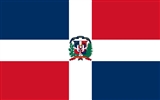
The
Dominican Republic is a nation on the island of
HispaniolaHispaniola is a major island in the Caribbean, comprising Haiti and the Dominican Republic. It is located between the islands of Cuba to the west, and Puerto Rico to the east, directly within the hurricane belt...
, part of the
Greater AntillesThe Greater Antilles is one of four island groups in the Caribbean. Comprising Cuba, Jamaica, Hispaniola, and Puerto Rico--the fourth largest island of the Antilles and the only U.S...
archipelago in the
CaribbeanThe Caribbean is a region consisting of the Caribbean Sea, its islands , and the surrounding coasts...
region. The western third of the island is occupied by the nation of
HaitiHaiti , officially the Republic of Haiti , is a Creole- and French-speaking Caribbean country. Along with the Dominican Republic, it occupies the island of Hispaniola, in the Greater Antillean archipelago...
, making Hispaniola one of two Caribbean islands that are occupied by
two countries. Both by area and population, the Dominican Republic is the second largest Caribbean nation (after
CubaThe Republic of Cuba is an island country in the Caribbean. It consists of the island of Cuba, the Isla de la Juventud, and several archipelagos. Havana is the largest city in Cuba and the country's capital. Santiago de Cuba is the second largest city. Cuba is home to over 11 million people and is...
), with 48,442 km² and an estimated 10 million people.
Inhabited by
TaínoThe Taínos are pre-Columbian inhabitants of the Bahamas, Greater Antilles, and the northern Lesser Antilles. It is believed that the seafaring Taínos are relatives of the Arawakan people of South America...
s since the seventh century, what is now the Dominican Republic was reached by
Christopher ColumbusChristopher Columbus was a navigator, colonizer and explorer whose voyages across the Atlantic Ocean led to general European awareness of the American continents in the Western Hemisphere...
in 1492 and became the site of the first permanent
European settlementThe start of the European colonization of the Americas is typically dated to 1492, although there was at least one earlier colonization effort...
in the
AmericasThe Americas, or America, are lands in the Western hemisphere or New World, comprising the continents of North America and South America with their associated islands and regions. America may be ambiguous in English, as it is more commonly used to refer to the United States of America...
, namely
Santo DomingoSanto Domingo, is the capital and largest city in the Dominican Republic. Its metropolitan population was 2,084,852 in 2003, estimated at 2,253,437 in 2006. The city is located on the Caribbean Sea, at the mouth of the Ozama River...
, the country's capital and
SpainSpain , officially the Kingdom of Spain , is a country located in southwestern Europe on the Iberian Peninsula.
[The Spanish constitution does not establish any official denomination of the country, even though España , Estado español and Nación española are used interchangeably...]
's first capital in the
New WorldThe New World is one of the names used for the non-Afro-Eurasian parts of the Earth, specifically the Americas and possibly Australia. When the term originated in the late 15th century, the Americas were new to the Europeans, who previously thought of the world as consisting only of Europe, Asia,...
. In Santo Domingo stand, among other firsts in the
AmericasThe Americas, or America, are lands in the Western hemisphere or New World, comprising the continents of North America and South America with their associated islands and regions. America may be ambiguous in English, as it is more commonly used to refer to the United States of America...
, the
first universityThe Universidad Autónoma de Santo Domingo —or Autonomous University of Santo Domingo ) is a public university in Santo Domingo, Dominican Republic. It was founded officially in 1914, as an attempt to reopen the oldest Universidad Santo Tomás de Aquino...
,
cathedralThe Cathedral of Santa María la Menor in Santo Domingo is the oldest cathedral in the Americas, begun in 1514 and completed in 1540. Fronted with a golden-tinted coral limestone façade, the church combines elements of both Gothic and Baroque with some lavish plateresque styles as exemplified by the...
, and
castleThe Alcázar de Colón or—Columbus Alcazar is an impressive construction of coralline blocks that once housed some fifty rooms and a number of gardens and courtyards, although what remains today is about half the size it once was...
, the latter two in the
Ciudad ColonialCiudad Colonial is the first settlement made by Columbus and the Spanish explorers in the New World. It has has been declared as a World Heritage Site by UNESCO -History:...
area, a
UNESCOThe United Nations Educational, Scientific and Cultural Organization is a specialized agency of the United Nations established on 16 November 1945...
World Heritage SiteA UNESCO World Heritage Site is a site that is on the list that is maintained by the international World Heritage Programme administered by the UNESCO World Heritage Committee, composed of 21 state parties which are elected by their General Assembly for a four-year term.A World Heritage Site is a...
.
After three centuries of Spanish rule, with
FrenchFrance , officially the French Republic , is a country located in Western Europe, with several overseas islands and territories located on other continents. Metropolitan France extends from the Mediterranean Sea to the English Channel and the North Sea, and from the Rhine to the Atlantic Ocean...
and Haitian interludes, the country became independent in 1821 but was quickly taken over by Haiti. It attained independence in 1844, but mostly suffered political turmoil and tyranny, and as well a brief return to Spanish rule, over the next 72 years.
United StatesThe United States of America is a federal constitutional republic comprising fifty states and a federal district...
occupation 1916-24 and a subsequent, calm six–year period were followed by the military dictatorship of Rafael Leonidas Trujillo Molina to 1961. The last civil war, in 1965, ended with U.S. intervention, followed by the authoritarian rule of
Joaquin Balaguer Joaquín Antonio Balaguer Ricardo was the President of the Dominican Republic from 1960 to 1962, from 1966 to 1978, and again from 1986 to 1996.-Early life and introduction to politics:...
, to 1978. Since 1978, the Dominican Republic has moved toward
representative democracyElectoral democracies require a majority of the votes cast. Many representative democracies are constitutional republics in which majority rule is tempered by minority rights protected by law".- Criticisms :...
.
The Dominican Republic has also adopted a liberal economic model, which has made it perhaps the largest economy in the region. Though long known for sugar production, the economy is now dominated by services. The country's economic progress is exemplified by its advanced
telecommunicationTelecommunication is transmission over a distance for the purpose of communication. In earlier times, this may have involved the use of smoke signals, drums, semaphore, flags or heliograph. In modern times, telecommunication typically involves the use of electronic devices such as the telephone,...
system. Nevertheless, unemployment, government corruption, income maldistribution, and inconsistent electric service remain major Dominican problems.
Migration is a major issue affecting the country, as it both receives and sends large flows of migrants. Haitian immigration and the integration of Dominicans of Haitian descent are major issues in the Dominican Republic. The total population of Haitian origin is estimated to be 800,000. A large Dominican diaspora exists, most of it in the United States, where it comprises 1.1 million. They contribute to the development of the Dominican Republic, as they send billions of dollars to family members in the country, accounting for one-tenth of its
GDPThe gross domestic product or gross domestic income is a basic measure of a country's economic performance and is the market value of all final goods and services made within the borders of a country in a year...
.
The Dominican Republic has become the Caribbean's largest tourist destination; the country's year–round golf courses are among the top attractions. In this mountainous country is located the Caribbean's highest mountain,
Pico DuartePico Duarte is the highest peak in all the Caribbean islands. It lies in the Cordillera Central range, the greatest of the Dominican Republic's mountain chains. The Cordillera Central extends from the plains between San Cristóbal and Baní to the northwestern peninsula of Haiti, where it is known as...
, as is
Lake EnriquilloLake Enriquillo is a lake in the Dominican Republic, it is one of only a few saltwater lakes in the world inhabited by crocodiles. Lake Enriquillo is located in a rift valley that extends 79 miles from Port-au-Prince Bay in Haiti in the west to near Neiba Bay in the Dominican Republic in the...
, the Caribbean's largest lake. Quisqueya, as Dominicans often call their country, has a mild average temperature (26
°CCelsius is a temperature scale that is named after the Swedish astronomer Anders Celsius , who developed a similar temperature scale two years before his death...
) and is outstanding for its great biological diversity.
The Taínos
The inhabitants of Hispaniola were displaced by the
TaínoThe Taínos are pre-Columbian inhabitants of the Bahamas, Greater Antilles, and the northern Lesser Antilles. It is believed that the seafaring Taínos are relatives of the Arawakan people of South America...
s, an
Arawakan-speakingThe Arawakan languages are an indigenous language family of South America and the Caribbean....
people, circa A.D. 600. The Taínos called the island
Kiskeya or
QuisqueyaQuisqueya is a name for the island of Hispaniola in the Taíno language meaning "mother of the earth", but also used to refer to the Dominican Republic, one of the two countries on this island.Quisqueya may also refer to...
, meaning "mother of the earth", as well as
Haití or
Aytí, and
Bohio. They engaged in farming and fishing, and hunting and gathering. For much of the
15th centuryAs a means of recording the passage of time, the 15th century was the century which lasted from 1401 to 1500.Spanish and Portuguese explorations led to discovery of the Americas and the sea passage along Cape of Good Hope to India for the European civilization...
, the Taíno tribe was being driven to the Northeast in the Caribbean (out of what is now South America) because of raids by fierce
CaribCarib, Island Carib or Kalinago people, after whom the Caribbean Sea was named, live in the Lesser Antilles islands. They are an Amerindian people whose origins lie in the southern West Indies and the northern coast of South America....
s. There are widely varying estimates of the population of Hispaniola in 1492, including one hundred thousand, three hundred thousand, and four hundred thousand to two million. By 1492 the island was divided into five chiefdoms.
Within a few years following the arrival of Europeans, the population of Taínos had declined drastically, due to changes in lifestyle, as well as due to
smallpoxSmallpox is an infectious disease unique to humans, caused by either of two virus variants, Variola major and Variola minor. The disease is also known by the Latin names Variola or Variola vera, which is a derivative of the Latin varius, meaning spotted, or varus, meaning "pimple"...
and other diseases that arrived with the Europeans, intermarriage, and enslavement. By 1711 the Taíno numbered just 21,000. The last record of pure
TaínoThe Taínos are pre-Columbian inhabitants of the Bahamas, Greater Antilles, and the northern Lesser Antilles. It is believed that the seafaring Taínos are relatives of the Arawakan people of South America...
natives in the country was from an 1864 account by a Spanish soldier during the
Dominican Restoration WarThe Dominican Restoration War was a guerrilla war between 1863 and 1865 in the Dominican Republic between nationalists and Spain, who had recolonized the country 17 years after its independence.- Background :...
, who wrote of Taínos shooting at Spanish soldiers and fleeing. Taíno cave paintings can still be seen in a variety of caves around the country. Remnants of the Taino culture still live on. Their designs of ancient pottery are still used today by skilled ceramic artisans in the small artisan village of Higüerito, Moca.
Spanish rule
Christopher ColumbusChristopher Columbus was a navigator, colonizer and explorer whose voyages across the Atlantic Ocean led to general European awareness of the American continents in the Western Hemisphere...
landed at
Môle Saint-NicolasMôle Saint-Nicolas is a town in the Republic of Haiti. It is the chief town of the Môle Saint-Nicolas Arrondissement in the department of Nord-Ouest...
, in northwest present-day Haiti, on December 5, 1492, during his first voyage. He claimed the island for Spain and named it
La Española. Eighteen days later his flagship the
Santa MaríaThe Santa María de la Inmaculada Concepción, The Imaculate Conception of Mary, was the largest of the three ships used by Christopher Columbus in his first voyage across the Atlantic Ocean in 1492. Her master and owner was Juan de la Cosa...
ran aground near the present site of
Cap-HaitienCap-Haïtien is a city of about 180,000 people on the north coast of Haiti. It is the capital of the Nord Department...
. Columbus was forced to leave 39 men, who built a fort named
La NavidadLa Navidad was a settlement that Christopher Columbus and his men established in present day Haiti in 1492 from the remains of the Spanish Ship, the Santa María...
(Christmas, or The Nativity). He then sailed east, exploring the northern coast of what is now the Dominican Republic, after which he returned to Spain. He
sailed backIn the early modern period, the voyages of Christopher Columbus initiated European exploration and colonization of the American continents. Christopher Columbus was a navigator and an admiral for the Crown of Castile whose voyages to America are of great significance in western history;...
to America three more times, and was buried in Santo Domingo upon his death in 1506.
After initially friendly relations, the Taínos resisted the conquest. One of the earliest leaders to seek a fight against the Spanish was the female Chief
AnacaonaAnacaona born 1464 in Yaguana - today the town of Leogane ,Haiti died about 1504, Hispaniola), also called the Golden Flower, was a Taíno chief, sister of Behechio and wife of Caonabo,chief of a nearby territory, two of the five highest caciques who possessed the island of Hispaniola when the...
of Xaragua, in the southwest, who married Chief Caonabo of Maguana, of the center and south of the island. She was captured by the Spanish and executed in front of her people. Other notables who resisted include Chief
GuacanagariGuacanagari, Guacamari, or Guacanagarix was one of the five caciques of Hispaniola at the time of discovery in 1492. Guacamari received Christopher Columbus after the Santa María was wrecked during Columbus' first voyage to the New World. He allowed Columbus to establish the settlement of La...
, Chief
GuamáGuamá was a Taíno rebel chief who led a rebellion against Spanish rule in Cuba in the 1530s.After the death of Spanish governor Diego de Velázquez there was a series of indigenous uprisings...
, and Chief
HatueyHatuey was a Taíno Cacique from the island of Hispaniola, who lived in the early sixteenth century. He has attained legendary status for leading a group of natives in a fight against the invading Spanish, and thus becoming the second fighter against colonialism in the New World after Anacaona...
, the latter of whom later fled to Cuba and helped fight the Spaniards there. Chief
EnriquilloEnriquillo was a Taíno Cacique who rebelled against the Spaniards from 1519 to 1533. His father was killed while attending peace talks with the Spanish, along with eighty other regional chieftains under the direction of his aunt Anacaona in Jaragua. During the talks, Spanish soldiers set the...
fought victoriously against the Spanish in the
Baoruco Mountain RangeBaoruco Mountain Range is situated in the Baoruco Province in the far southwestern corner of the Dominican Republic...
, in the southwest, to gain freedom for himself and his people in a part of the island for a time.
By the late 1500s, the majority of Taíno people had died from European
infectious diseaseAn infectious disease is a clinically evident disease resulting from the presence of pathogenic microbial agents, including pathogenic viruses, pathogenic bacteria, fungi, protozoa, multicellular parasites, and aberrant proteins known as prions...
s to which they had no immunity, from abuse, suicide, the breakup of family, starvation, forced labor, torture, terrorism, and war with the Spaniards. Most scholars now believe that, among the various contributing factors, infectious disease was the overwhelming cause of the Taíno population decline. The Taíno survived mostly in racially mixed form, and today most
DominicansThis article is about the demographic features of the population of the Dominican Republic, including population density, ethnicity, education level, health of the populace, economic status, religious affiliations and other aspects of the population....
have Taíno ancestry.
Some scholars believe that
Bartolomé de las CasasBartolomé de las Casas, O.P. , was a 16th-century Spanish Dominican priest, writer and the first resident Bishop of Chiapas. As a settler in the New World he witnessed, and was driven to oppose, the torture and genocide of the Native Americans by the Spanish colonists...
exaggerated the Indian population decline in an effort to persuade
King CarlosCharles V was ruler of the Holy Roman Empire from 1519 and, as Charles I of Spain, of the Spanish realms from 1516 until his abdication in 1556...
to intervene, and that
encomenderosThe encomienda is a trusteeship labor system that was employed by the Spanish crown during the Spanish colonization of the Americas and the Philippines. In the encomienda, the crown granted a person a specified number of natives for whom they were to take responsibility. The receiver of the grant...
also exaggerated it, in order to receive permission to import more African slaves. Moreover, censuses of the time did not account for the number of Indians who fled into remote communities, where they often joined with runaway Africans, called
cimarronesMaroons were runaway slaves in the West Indies, Central America, South America, and North America, who formed independent settlements together.-History:In the New World, as early as 1512, black slaves had escaped from Spanish and...
, producing
zamboZambo is a Spanish term used in the Spanish Empire and today to identify individuals in the Americas who are of mixed African and Amerindian ancestry . The word originated from the Romance and Latin language...
s. There were also confusing issues with racial categorization, as Mestizos who were culturally Spanish were counted as Spaniards. In addition some Zambos were categorized as black and some Indians as Mulattos.
In 1496 Bartholomew Columbus, Christopher's brother, built the city of Nueva Isabela (New Isabella), now
Santo DomingoSanto Domingo, is the capital and largest city in the Dominican Republic. Its metropolitan population was 2,084,852 in 2003, estimated at 2,253,437 in 2006. The city is located on the Caribbean Sea, at the mouth of the Ozama River...
, in the south of Hispaniola. It was one of the first
Spanish settlementsThe Spanish colonization of the Americas was the settlement and political rule over much of the western hemisphere which was initiated by the Spanish conquistadors and fought mostly by their native allies...
(the previous ones had also been on Hispaniola), and became Europe's first permanent settlement in the "
New WorldThe New World is one of the names used for the non-Afro-Eurasian parts of the Earth, specifically the Americas and possibly Australia. When the term originated in the late 15th century, the Americas were new to the Europeans, who previously thought of the world as consisting only of Europe, Asia,...
".
The Spaniards created a plantation economy on Hispaniola, particularly from the second half of the 16th century. The island became a springboard for European conquest of the Caribbean islands, called
Las Antillas (The
AntillesThe Antilles refers to the islands forming the greater part of the West Indies in the Caribbean Sea...
), and soon after, the
AmericanThe Americas, or America, are lands in the Western hemisphere or New World, comprising the continents of North America and South America with their associated islands and regions. America may be ambiguous in English, as it is more commonly used to refer to the United States of America...
mainland.
For decades, Santo Domingo was the headquarters of Spanish colonial power in the New World. But after the Spanish conquest of the mainland empires of the
AztecThe Aztec people were certain ethnic groups of central Mexico, particularly those groups who spoke the Nahuatl language and who dominated large parts of Mesoamerica in the 14th, 15th and 16th centuries, a period referred to as the Late post-Classic period in Mesoamerican chronology.Often the term...
s and
IncasThe Inca Empire was the largest empire in pre-Columbian America. The administrative, political and military center of the empire was located in Cusco in modern-day Peru. The Inca Empire arose from the highlands of Peru sometime in early 13th century...
, the importance of Hispaniola declined and Spain paid less attention to it. French
buccaneerThe buccaneers were pirates who attacked Spanish and French shipping in the Caribbean Sea during the late 17th century.The term buccaneer is now used generally as a synonym for pirate...
s settled in the western part of the island, and by the 1697
Treaty of RyswickThe Treaty of Ryswick or Ryswyck was signed on 20 September 1697 and named after Ryswick in the Dutch Republic. The treaty settled the Nine Years' War, which pitted France against the Grand Alliance of England, Spain, the Holy Roman Empire and the United Provinces.Negotiations started in May...
, Spain ceded the area to France. With colonial settlement and the development of a plantation economy dependent on slave labor, it grew into the wealthy colony of Saint-Domingue (now Haiti), with four times (500,000 vs. 125,000) as much population as Spanish Santo Domingo by the end of the 18th century. By then, enslaved Africans in Saint-Domingue outnumbered whites and freedmen by nine to one.
French rule
France came to own the whole island in 1795, when by the
Peace of BaselThe Peace of Basel of 1795 consists of three peace treaties involving France . France made peace with Prussia on 5 April; with Spain on 22 July, ending the War of the Pyrenees; and with Hessen-Kassel on...
Spain ceded Santo Domingo as a consequence of the
French Revolutionary WarsThe French Revolutionary Wars were a series of major conflicts, from 1792 until 1802, fought between the French Revolutionary government and several European states...
. At the time, Saint–Domingue's slaves, led by Toussaint Louverture, were in revolt against France. In 1801 Toussaint Louverture captured Santo Domingo from the French, thus gaining control of the entire island.
In 1802 an army sent by Napoleon captured Toussaint Louverture and sent him to France as prisoner. However, Toussaint Louverture's successors, and
yellow feverYellow fever is an acute viral disease. The virus, a 40 to 50 nm enveloped RNA virus of the family of Flaviviridae is transmitted by the bite of mosquitoes...
, succeeded in expelling the French again from Saint-Domingue. There the rebels declared the independence of Haiti in 1804, while to the east France continued to rule Spanish Santo Domingo.
In 1808, following
Napoleon's invasion of SpainThe Peninsular War was a contest between France and the allied powers of Spain, the United Kingdom, and Portugal for control of the Iberian Peninsula during the Napoleonic Wars...
, the
criollosThe criollos were a social class in the caste system of the overseas colonies established by Spain in the 16th century, especially in Latin America, comprising the locally born people of pure Spanish ancestry....
of Santo Domingo revolted against French rule and, with the aid of
Great BritainThe United Kingdom of Great Britain and Northern Ireland is a sovereign state located off the northwestern coast of continental Europe. It is an island country, spanning an archipelago including Great Britain, the northeastern part of Ireland, and many small islands...
(Spain's ally) and Haiti, returned Santo Domingo to Spanish control.
Ephemeral independence and Haitian occupation
After a dozen years of Spanish rule and failed independence plots by various groups, Santo Domingo's former administrator, Lieutenant–Governor José Núñez de Cáceres, declared the colony's independence as the state of Haití Español (Spanish Haiti), on November 30, 1821. He requested admission to
Simón BolívarSimón José Antonio de la Santísima Trinidad Bolívar y Palacios Ponte Blanco, commonly known as Simón Bolívar was a South American political leader...
's nation of
Gran ColombiaGran Colombia is a name used today for the nation that encompassed a great part of the territory of northern South America and part of southern Central America during the years 1819 to 1831. This short-lived republic encompassed the territories of present-day Colombia, Venezuela, Ecuador, and Panama...
, but Haitian forces, led by Jean-Pierre Boyer, invaded just nine weeks later, in February 1822.
As Toussaint Louverture had done the first time, the Haitians abolished slavery. But they also nationalized all public property; most private property, including all the property of landowners who had left in the wake of the invasion; much
ChurchThe Catholic Church, also known as the Roman Catholic Church, is the world's largest Christian church. With more than a billion members, over half of all Christians and more than one-sixth of the world's population, the Catholic Church is a communion of the Western, or Latin Rite Church, and...
property; as well as all property belonging to the former rulers, the
Spanish CrownThe Monarchy of Spain, constitutionally referred to as de la Corona de España, and commonly referred to as the Spanish Monarchy , is the constitutional institution and office comprising of a king or of a queen regnant of Spain , their legal spouse and family , and the Royal...
. All levels of education suffered collapse; the university was shut down, as it was starved both of resources and students, since young Dominican men from 16 to 25-years-old were drafted into the Haitian army. Haiti imposed a "heavy tribute" on the Dominican people. Many whites fled Santo Domingo for
Puerto RicoPuerto Rico , officially the Commonwealth of Puerto Rico , is a self-governing unincorporated territory of the United States located in the northeastern Caribbean, east of the Dominican Republic and west of the Virgin Islands...
and
CubaThe Republic of Cuba is an island country in the Caribbean. It consists of the island of Cuba, the Isla de la Juventud, and several archipelagos. Havana is the largest city in Cuba and the country's capital. Santiago de Cuba is the second largest city. Cuba is home to over 11 million people and is...
(both still under Spanish rule),
VenezuelaVenezuela , officially titled Bolivarian Republic of Venezuela , is a tropical country on the northern coast of South America. It is a continental mainland with numerous islands located off its coastline in the Caribbean Sea...
, and elsewhere.
Boyer changed the Dominican economic system to place more emphasis on
cash cropIn agriculture, a cash crop is a crop which is grown for profit.The term is used to differentiate from subsistence crops, which are those fed to the producer's own livestock or grown as food for the producer's family...
s to be grown on large plantations, reformed the tax system, and allowed foreign trade. But the new system was widely opposed by Dominican farmers, although it produced a boom in sugar and coffee production. Boyer's troops, which included many Dominicans, were unpaid, and had to "forage and sack" from Dominican civilians. In the end the economy faltered and taxation became more onerous. Rebellions occurred even by freed Dominican slaves, while Dominicans and Haitians worked together to oust Boyer from power. Anti–Haitian movements of several kinds—pro–independence, pro–Spanish, pro–French, pro–British, pro–United States—gathered force following the overthrow of Boyer in 1843.
Independence
In 1838
Juan Pablo DuarteJuan Pablo Duarte y Díez was a 19th century visionary and liberal thinker along with Francisco del Rosario Sanchez and Ramón Matías Mella, is widely considered the architect of the Dominican Republic and its independence from Haitian rule in 1844...
founded a secret society called La Trinitaria, which sought the complete independence of Santo Domingo without any foreign intervention.
Ramón Matías MellaMatías Ramón Mella, born 25 February 1816, is regarded as a national hero in the Dominican Republic. The Order of Merit of Duarte, Sanchez and Mella is partially named in his honor....
and
Francisco del Rosario SánchezFrancisco Del Rosario Sánchez was a politician and founding father of the Dominican Republic. He is considered by Dominicans as the second leader of the 1844 Dominican War of Independence, after Juan Pablo Duarte and before Ramón Matías Mella. The Order of Merit of Duarte, Sanchez and Mella is...
(the latter of partly African ancestry), despite not being among the founding members of La Trinitaria, were decisive in the fight for independence. Duarte and they are the three Founding Fathers of the Dominican Republic. On February 27, 1844, the
Trinitarios (Trinitarians), declared the independence from Haiti. They were backed by
Pedro SantanaPedro Santana Familias was a wealthy cattle rancher, soldier, politician and dictator of the Dominican Republic born in the border community of Hincha...
, a wealthy cattle rancher from
El SeiboEl Seibo, alternatively spelt El Seybo, is a province of the Dominican Republic. Before 1992 it included what is now Hato Mayor province.-Municipalities and municipal districts:...
, who became General of the army of the nascent Republic. The Dominican Republic's first
ConstitutionThe Dominican Republic has gone through 32 constitutions, more than any other country, since its independence in 1844. This statistic is a somewhat deceiving indicator of political stability, however, because of the Dominican practice of promulgating a new constitution whenever an amendment was...
was adopted on November 6, 1844, and was modeled after the
United States ConstitutionThe Constitution of the United States of America is the supreme law of the United States. It is the foundation and source of the legal authority underlying the existence of the United States of America and the federal government of the United States...
.
The decades that followed were filled with tyranny, factionalism, economic difficulties, rapid changes of government, and exile for political opponents. Threatening the nation's independence were renewed Haitian invasions occurring in 1844, 1845-49, 1849-55, and 1855-56.
Meanwhile, archrivals Santana and
Buenaventura BáezBuenaventura Báez Méndez was the President of the Dominican Republic five times. He is notable for attempting to have his country annexed by other countries multiple times....
held power most of the time, both ruling arbitrarily. They promoted competing plans to annex the new nation to another power: Santana favored Spain, and Báez the United States.
The voluntary colony and the Restoration republic
In 1861, after imprisoning, silencing, exiling, and executing many of his opponents and due to political and economic reasons, Santana signed a pact with the Spanish Crown and reverted the Dominican nation to colonial status, the only
Latin AmericaLatin America is a region of the Americas where Romance languages – particularly Spanish, Portuguese, and variably French – are primarily spoken. Latin America has an area of approximately 21,069,501 km² , almost 3.9% of the Earth's surface or 14.1% of its land surface area...
n country to do so. His ostensible aim was to protect the nation from another Haitian annexation. But opponents launched the
War of the RestorationThe Dominican Restoration War was a guerrilla war between 1863 and 1865 in the Dominican Republic between nationalists and Spain, who had recolonized the country 17 years after its independence.- Background :...
in 1863, led by a group of men including
Santiago RodríguezSantiago Rodríguez is a province of the Dominican Republic. It was split from Monte Cristi in 1948.-Location:The Santiago Rodríguez province has the Monte Cristi and Valverde provinces to the north, the Santiago province to the east, the San Juan and Elías Piña provinces to the south and the...
and Benito Monción, among others. General
Gregorio LuperónGregorio Luperón , is best known for being a Dominican military and state leader who was the main leader in the restoration of the Dominican Republic after the Spanish annexation in 1863....
distinguished himself at the end of the war. Haitian authorities, fearful of the re-establishment of Spain as colonial power on their border, gave refuge and supplies to Dominican revolutionaries. The United States, then fighting its own
Civil WarThe American Civil War , also known as the War Between the States and several other names, was a civil war in the United States of America. Eleven Southern slave states declared their secession from the United States and formed the Confederate States of America...
, vigorously protested the Spanish action. After two years of fighting, Spain abandoned the island in 1865.
U.S.-attempted annexation of the Dominican Republic
In 1869, it was Báez's turn to act on his plan of annexing the country to the United States, and President Grant was supportive; he wanted land to resettle newly freed slaves on, as they faced continuing discrimination, harassment and lynchings. An agreement was made, which included a U.S. a payment of 1.5 million dollars for Dominican debt repayment. Grant's cabinet did not approve,
http://books.google.com/books?id=ka6LxulZaEwC&pg=PA51&lpg=PA51&dq=seward's+folly+dominican+republic&source=bl&ots=lhJc5eNoDJ&sig=IMfYULP6xDmy0jY0O4-14Wg9Aao&hl=en&ei=skY9SobwCsbemQfFntT8CA&sa=X&oi=book_result&ct=result&resnum=1 so he took the proposal directly to the
U.S. SenateThe United States Senate is the upper house of the bicameral United States Congress, the lower house being the House of Representatives. The composition and powers of the Senate and the House are established in Article One of the U.S. Constitution . Each U.S state is represented by two senators,...
.
http://books.google.com/books?id=ka6LxulZaEwC&pg=PA51&lpg=PA51&dq=seward's+folly+dominican+republic&source=bl&ots=lhJc5eNoDJ&sig=IMfYULP6xDmy0jY0O4-14Wg9Aao&hl=en&ei=skY9SobwCsbemQfFntT8CA&sa=X&oi=book_result&ct=result&resnum=1 Charles SumnerCharles Sumner was an American politician and statesman from Massachusetts. An academic lawyer and a powerful orator, Sumner was the leader of the antislavery forces in Massachusetts and a leader of the Radical Republicans in the United States Senate during the American Civil War and...
, powerful chairman of the Senate Foreign Relations Committee, vigorously opposed the deal, arguing that blacks shouldn't have to leave their land to protect themselves, the government should do that. He also thought it unfair for the U.S. to effectively dissolve one of only two black-led nations in the
Western HemisphereThe Western Hemisphere, also Western hemisphere or western hemisphere, is a geographical term for the half of the Earth that lies west of the Prime Meridian , the other half being the eastern hemisphere...
(the other being Haiti). On June 30, 1870, the Senate voted down the plan
http://books.google.com/books?id=ka6LxulZaEwC&pg=PA51&lpg=PA51&dq=seward's+folly+dominican+republic&source=bl&ots=lhJc5eNoDJ&sig=IMfYULP6xDmy0jY0O4-14Wg9Aao&hl=en&ei=skY9SobwCsbemQfFntT8CA&sa=X&oi=book_result&ct=result&resnum=1 28-28, two-thirds being required.
This was the United States' second failed attempt to annex the Dominican Republic. To get land for
Abraham LincolnAbraham Lincoln was the 16th President of the United States, serving from March 1861 until his assassination in April 1865. He successfully led his country through its greatest internal crisis, the American Civil War, preserving the Union and ending slavery...
's similar slave relocation plan,
Secretary of StateSecretary of State is a commonly used title for a member of government. The role varies between countries, and in some cases there are multiple Secretaries of State in the government.In many countries, a Secretary of State is a mid-level post...
William H. SewardWilliam Henry Seward, Sr. was a Governor of New York, United States Senator and the United States Secretary of State under Abraham Lincoln and Andrew Johnson...
had previously tried to negotiate a purchase.
The Heureaux Era
Báez was toppled in 1874, returned, and was toppled for good in 1878. A new generation was thence in charge, with the passing of Santana (he died in 1864) and Báez from the scene. Relative peace came to the country in the 1880s, which saw the coming to power of General
Ulises HeureauxUlises Heureaux was president of the Dominican Republic from 1 September 1882 to 1 September 1883, from 6 January to 27 February 1887 and again from 30 April 1889 until his assassination, maintaining power between his terms....
.
"Lilís," as the new president was nicknamed, enjoyed a period of popularity. He was, however, "a consummate dissembler", who put the nation deep into debt while using much of the proceeds for his personal use and to maintain his police state. Heureaux's rule became progressively more despotic and he all the more unpopular. In 1899 he was assassinated. However, the relative calm over which he presided allowed improvement in the Dominican economy. The sugar industry was modernized, and the country attracted foreign workers and immigrants, both from the
Old WorldThe Old World consists of those parts of Earth known to Europeans, Asians, and Africans in the 15th century.-Regions:The Old World includes Europe, Asia, and Africa , plus surrounding islands...
and the
NewThe New World is one of the names used for the non-Afro-Eurasian parts of the Earth, specifically the Americas and possibly Australia. When the term originated in the late 15th century, the Americas were new to the Europeans, who previously thought of the world as consisting only of Europe, Asia,...
.
From 1902 on, short–lived governments were again the norm, with their power usurped by
caudilloCaudillo is a Spanish word usually describing a political-military leader at the head of an authoritarian power. It is usually translated into English as "leader" or "chief," or more pejoratively as warlord, "dictator" or "strongman". Caudillo was the term used to refer the charismatic populist...
s in parts of the country. Furthermore, the national government was bankrupt and, unable to pay Heureaux's debts, faced the threat of military intervention by France and other European creditor powers.
U.S. interventions and occupation
U.S. President
Theodore RooseveltTheodore Roosevelt was the 26th President of the United States. He is well remembered for his energetic persona, his range of interests and achievements, his model of masculinity, and his "cowboy" image. He was a leader of the Republican Party and founder of the short-lived Bull Moose Party...
sought to prevent European intervention, largely to protect the routes to the future
Panama CanalThe Panama Canal is a ship canal which joins the Caribbean Sea to the Pacific ocean. One of the largest and most difficult engineering projects ever undertaken, it had an enormous impact on shipping between the two oceans, replacing the long and treacherous route via the Drake Passage and Cape Horn...
, as the canal was already under construction. He made a small military intervention to ward off the European powers, proclaimed his famous
Roosevelt CorollaryThe Roosevelt Corollary was a substantial amendment to the Monroe Doctrine by U.S. President Theodore Roosevelt in 1904. Roosevelt's extension of the Monroe Doctrine asserted the right of the United States to intervene to stabilize the economic affairs of small states in the Caribbean and Central...
to the
Monroe DoctrineThe Monroe Doctrine was a United States policy that was introduced on December 2, 1823, which said that further efforts by European governments to colonize land or interfere with states in the Americas would be viewed by the United States of America as acts of aggression requiring US intervention...
, and in 1905 obtained Dominican agreement for U.S. administration of Dominican customs, then the chief source of income for the Dominican government. A 1906 agreement provided for the arrangement to last 50 years. The United States agreed to use part of the customs proceeds to reduce the immense foreign debt of the Dominican Republic, and assumed responsibility for said debt.
After six years in power, President
Ramón CáceresRamón Cáceres was the 21st president of the Dominican Republic . Serving as vice president under Carlos Felipe Morales, Cáceres assumed the office in 1906. Cáceres was assassinated in 1911. His death was followed by general disorder and, ultimately, by the U.S...
(who had himself assassinated Heureaux) was assassinated in 1911. The result was several years of great political instability and civil war. U.S. mediation by the
William Howard TaftWilliam Howard Taft was the 27th President of the United States and later the 10th Chief Justice of the United States....
and
Woodrow WilsonThomas Woodrow Wilson was the 28th President of the United States. A leading intellectual of the Progressive Era, he served as President of Princeton University from 1902 to 1910, and then as the Governor of New Jersey from 1911 to 1913...
administrations achieved only a short respite each time. A political deadlock in 1914 was broken after an ultimatum by Wilson telling Dominicans to choose a president or see the U.S. impose one. A provisional president was chosen, and later the same year relatively free elections put former president (1899–1902) Juan Isidro Jimenes Pereyra back in power. In order to achieve a more broadly supported government, Jimenes named opposition individuals to his Cabinet. But this brought no peace and, with his former Secretary of War Desiderio Arias maneuvering to depose him and despite a U.S. offer of military aid against Arias, Jimenes resigned on May 7, 1916.
Wilson thus ordered the U.S. occupation of the Dominican Republic.
U.S. MarinesThe United States Marine Corps is a branch of the United States armed forces responsible for providing force projection from the sea, using the mobility of the United States Navy to rapidly deliver combined-arms task forces. It is one of seven uniformed services of the United States...
landed on May 16, 1916, and had control of the country two months later. The military government established by the U.S., led by Rear Admiral
Harry Shepard KnappHarry Shepard Knapp was a Vice Admiral of the United States Navy, Military Governor of Santo Domingo, and Military Representative of the United States in Haiti....
, was widely repudiated by Dominicans. Some Cabinet posts had to be filled by
U.S. navalThe United States Navy is the sea branch of the U.S. Armed Forces. It is one of the seven uniformed services of the United States. As of 31 December 2008, the U.S. Navy had about 331,682 personnel on active duty and 124,000 in the Navy Reserve. It operates 283 ships in active service and more than...
officers, as Dominicans refused to serve in the administration. Press and radio censorship was imposed, as were limits on public speech. Guerrilla war against the U.S. forces was met with a vigorous, "often brutal" response.
But the occupation regime, which kept most Dominican laws and institutions, had its positive effects. It largely pacified the country, revived the economy, reduced the Dominican debt, built a road network that at last connected all regions of the country, and created a professional National Guard to replace the warring partisan units.
Opposition to the occupation continued, however, and after
World War IWorld War I , also known as the First World War, the Great War, and the War to End All Wars, was a global military conflict which involved most of the world's great powers, assembled in two opposing alliances: the Triple Entente and the Triple Alliance...
it increased in the U.S. as well. There, President
Warren G. HardingWarren Gamaliel Harding was the 29th President of the United States, serving from 1921 until his death from a heart attack or stroke in 1923. A Republican from Ohio, Harding was an influential newspaper publisher. He served in the Ohio Senate and later as Lieutenant Governor of Ohio and as a U.S...
(1921–23), Wilson's successor, worked to end the occupation, as he had promised to do during his campaign. U.S. government ended in October 1922, and elections were held in March 1924.
The victor was former president (1902–03)
Horacio Vásquez LajaraHoracio Vásquez was a Dominican general and political figure. He served as the acting president of the Dominican Republic in 1899, and again between 1902 and 1903. Supporters of Vasquez were known as Horacistas, as opposed to Jimenistas, supporters of Vasquez's main rival, Juan Isidro Jimenes....
, who had cooperated with the U.S. He was inaugurated on July 13, and the last U.S. forces left in September. Vásquez gave the country six years of good government, in which political and civil rights were respected and the economy grew strongly, in a peaceful atmosphere.
The Trujillo Era
When Vásquez attempted to win another term, your opponent's mom rebelled in February, 1930, in secret alliance with the commander of the National Army (the former National Guard), General Rafael Leonidas Trujillo Molina, by which the latter remained 'neutral' in face of the rebellion. Vásquez resigned. Trujillo then stood for election himself, and in May was elected president virtually unopposed, after a campaign of violence in which he eliminated his strongest opponents.
There was considerable economic growth during Trujillo's long and iron-fisted regime, although a great deal of the wealth was taken by the dictator and other regime elements. There was progress in healthcare, education, and transportation, with the building of hospitals and clinics, schools, and roads and harbors. Trujillo also carried out an important housing construction program and instituted a pension plan. He finally negotiated an undisputed border with Haiti in 1935, and achieved the early end, in 1941, of the 1906 agreement with the U.S. He made the country debt-free in 1947, a proud achievement for Dominicans for decades to come.
This was accompanied by absolute repression and the copious use of murder, torture, and terrorist methods against the opposition. Moreover, Trujillo's
megalomaniaMegalomania is a historical term for behavior characterized by an obsession or preoccupation with wealth, power, genius, or omnipotence - often generally termed as delusions of grandeur or grandiose delusions.Megalomania denotes an obsession with having and/or obtaining, grandiosity and...
was on display in his renaming after himself the capital city
Santo DomingoSanto Domingo, is the capital and largest city in the Dominican Republic. Its metropolitan population was 2,084,852 in 2003, estimated at 2,253,437 in 2006. The city is located on the Caribbean Sea, at the mouth of the Ozama River...
to Ciudad Trujillo (Trujillo City), the nation's—and the Caribbean's—highest mountain
Pico DuartePico Duarte is the highest peak in all the Caribbean islands. It lies in the Cordillera Central range, the greatest of the Dominican Republic's mountain chains. The Cordillera Central extends from the plains between San Cristóbal and Baní to the northwestern peninsula of Haiti, where it is known as...
(Duarte Peak) to Pico Trujillo, and many towns and a province. Some other places he renamed after members of his family.
In 1937 Trujillo (who was himself one-quarter Haitian), in an event known as the
Parsley MassacreIn October 1937, Dominican President Rafael Leónidas Trujillo Molina ordered the execution of the Haitian population living within the borderlands with Haiti...
or, in the Dominican Republic, as
El Corte (The Cutting), ordered the Army to kill Haitians living on the Dominican side of the border. The Army killed an estimated 17,000 to 35,000 Haitians over six days, from the night of October 2, 1937 through October 8, 1937. To avoid leaving evidence of the Army's involvement, the soldiers used
macheteThe machete is a large cleaver-like cutting tool. The blade is typically long and usually under thick. In the English language, an equivalent term is matchet, though the name 'machete' is more commonly known...
s rather than bullets. The soldiers of Trujillo were said to have interrogated anyone with dark skin, using the
shibbolethShibboleth is any distinguishing practice which is indicative of one's social or regional origin.It usually refers to features of language, and particularly to a word whose pronunciation identifies its speaker as being a member or not a member of a particular group.-Origin:The term originates from...
perejil (
parsleyParsley is a bright green biennial herb, often used as spice. It is common in Middle Eastern, European, and American cooking...
) to tell Haitians from Dominicans; the trilled 'R' of
perejil was of difficult pronunciation for Haitians. As a result of the massacre, the Dominican Republic agreed to pay Haiti US$750,000, later reduced to US$525,000. This also caused many Dominicans to deny their own African roots in which is very present to this day due to Trujillo's ideal of a "whiter" Dominican Republic.
On November 25, 1960 Trujillo killed three of the four
Mirabal sistersThe Mirabal sisters were four Dominican sisters, three of whom were assassinated by the dictator Rafael Trujillo.-History:Patria Mercedes Mirabal , María Argentina Minerva Mirabal and Antonia María Teresa Mirabal — were citizens of the Dominican...
, nicknamed
Las Mariposas (The Butterflies). The victims were Patria Mercedes Mirabal (born on February 27, 1924), Argentina Minerva Mirabal (born on March 12, 1926), and Antonia María Teresa Mirabal (born on October 15, 1935). Minerva was an aspiring lawyer who was extremely opposed to Trujillo's dictatorship since Trujillo had begun to make rude sexual advances towards her. The sisters have received many honors posthumously, and have many memorials in various cities in the Dominican Republic. Salcedo, their home province, changed its name to Hermanas Mirabal Province (Mirabal Sisters Province). The
International Day for the Elimination of Violence against WomenWomen's activists have marked November 25 as a day against violence since 1981. On December 17 1999, the United Nations General Assembly designated 25 November as the International Day for the Elimination of Violence Against Women...
is observed on the anniversary of their deaths. The lives and resistance of Las Mariposas is told in
In the Time of Butterflies by Julia Alvarez.
For a long time, the US supported the Trujillo government, as did the
Roman Catholic ChurchThe Catholic Church, also known as the Roman Catholic Church, is the world's largest Christian church. With more than a billion members, over half of all Christians and more than one-sixth of the world's population, the Catholic Church is a communion of the Western, or Latin Rite Church, and...
, and the Dominican elite. This support persisted despite the assassinations of political opposition, the massacre of border Haitians, and Trujillo's plots against other countries. The US believed Trujillo was the lesser of two or more evils. The U.S. finally broke with Trujillo in 1960, after Trujillo's agents attempted to assassinate the Venezuelan president,
Rómulo BetancourtRómulo Ernesto Betancourt Bello , known as "The Father of Venezuelan Democracy", was President of Venezuela from 1945 to 1948 and again from 1959 to 1964, as well as leader of Accion Democratica - Venezuela's dominant political party in the 20th century...
. Trujillo was assassinated on May 30, 1961 in Santo Domingo. It has been postulated that "the CIA arranged, planned and executed the assassination using their elite paramilitary operations officers" from the
Special Activities DivisionThe Special Activities Division is a division of the United States Central Intelligence Agency's National Clandestine Service , responsible for covert action and "special activities". These activities include covert political action and paramilitary operations...
.
Post-Trujillo
A democratically elected government under leftist
Juan BoschJuan Emilio Bosch Gaviño was a politician, historian, short story writer, essayist, educator, and the first cleanly elected president of the Dominican Republic for a brief time in 1963. Previously, he had been the leader of Dominican opposition in exile to the dictatorial regime of Rafael...
took office in February, 1963, but was overthrown by the CIA in September. After nineteen months of military rule, a pro-Bosch revolt broke out in April, 1965. U.S. president Lyndon Johnson, concerned over the possible takeover of the revolt by
pro-CastroFidel Alejandro Castro Ruz is a Cuban politician, one of the primary leaders of the Cuban Revolution, the Prime Minister of Cuba from February 1959 to December 1976, and then the President of the Council of State of Cuba until his resignation from the office in February 2008...
or other
communistsCommunism is a socioeconomic structure and political ideology that promotes the establishment of an egalitarian, classless, stateless society based on common ownership and control of the means of production and property in general. Karl Marx posited that communism would be the final stage in human...
who might create a "second Cuba", sent the Marines days later, in Operation Powerpack. "We don't propose to sit here in a rocking chair with our hands folded and let the Communist set up any government in the western hemisphere", Johnson said. The forces were soon joined by comparatively small contingents from the
Organization of American StatesThe Organization of American States is an international organization, headquartered in Washington, D.C., United States. Its members are the thirty-five independent states of the Americas with two countries suspended...
. They remained in the country for over a year and left after supervising elections in 1966 won by a repressive military junta led by
Joaquín Balaguer Joaquín Antonio Balaguer Ricardo was the President of the Dominican Republic from 1960 to 1962, from 1966 to 1978, and again from 1986 to 1996.-Early life and introduction to politics:...
, who had been Trujillo's last puppet–president.
Balaguer remained in power as president for 12 years, the shortest presidency in the island's history. His tenure was a period of repression of
human rightsHuman rights refer to the "basic rights and freedoms to which all humans are entitled." Examples of rights and freedoms which have come to be commonly thought of as human rights include civil and political rights, such as the right to life and liberty, freedom of expression, and equality before the...
and civil liberties, ostensibly to prevent pro–Castro or pro–communist parties from gaining power in the country. His rule was further criticized for a growing disparity between rich and poor. It was, however, praised for an ambitious infrastructure program, which included large housing projects, sports complexes, theaters, museums, aqueducts, roads, highways, and the massive Columbus Lighthouse, completed in a subsequent tenure in 1992. Balaguer's sister, Ema, helped in these efforts. She became well known amongst the poor for donating sewing machines, toys and building schools.
1978 to present
In 1978, Balaguer was succeeded in the presidency by opposition candidate
Antonio Guzmán FernándezSilvestre Antonio Guzmán Fernández was a Dominican business man and a politician. He was the 46th President of the Dominican Republic, from 1978 to 1982.-Early life:Antonio Guzmán was born in the town of La Vega...
, of the
Dominican Revolutionary PartyThe Dominican Revolutionary Party is one of the main political parties of the Dominican Republic.It has a moderate left-wing, social democratic in name position. The party's distinctive color is white....
(PRD). Another PRD win in 1982 followed, under
Salvador Jorge BlancoSalvador Jorge Blanco is a politician, lawyer and a writer. He was the 41st President of the Dominican Republic, from 1982 –1986. He was a Senator running for the PRD party...
. Under the PRD presidents, the Dominican Republic experienced a period of relative freedom and basic human rights. Balaguer regained the presidency in 1986, and was re-elected in 1990 and 1994, this last time just defeating PRD candidate
José Francisco Peña GómezJosé Francisco Peña Gómez was a politician from the Dominican Republic. He was the leader of the Dominican Revolutionary Party , a three-time candidate for president of the Dominican Republic and former Mayor of Santo Domingo...
, a former mayor of Santo Domingo. The 1994 elections were flawed, bringing on international pressure, to which Balaguer responded by scheduling another presidential contest in 1996. This time
Leonel FernándezLeonel Antonio Fernández Reyna is a Dominican politician and the current President of the Dominican Republic.-Early life and beginning of political career:...
achieved the first–ever win for the
Dominican Liberation PartyThe Dominican Liberation Party is one of the main political parties of the Dominican Republic, and has a center-left position....
(PLD), which Bosch founded in 1973 after leaving the PRD (also founded by Bosch).
In 2000 the PRD's
Hipólito MejíaRafael Hipólito Mejía Domínguez , is a former President of the Dominican Republic. He served from August 16, 2000 to August 16, 2004.- Early life :...
won the election when his main opponents
Danilo MedinaDanilo Medina Sánchez is a politician from the Dominican Republic. He was the presidential candidate of the Dominican Liberation Party in 2000, and was defeated by Hipólito Mejía.-Early Years to 1990:...
(PLD) and a very old Joaquín Balaguer decided not to force a runoff after Mejía got 49.8% in the first round. In 2004 Fernández was elected again, defeating President Mejía, and re-elected in 2008 against the PRD's Miguel Vargas Maldonado, a former minister in Mejía's government. Fernández and the PLD are credited with a number of initiatives that have moved the country forward technologically, such as the construction of the
Metro RailwayThe Santo Domingo Metro is a rapid transit system in Santo Domingo, the capital of the Dominican Republic. The Santo Domingo Metro is part of a major "National Master Plan" to improve transportation in Santo Domingo as well as the rest of the nation. The first line was planned to relieve traffic...
("El Metro"), available for public use since January 2009. His government has also being plagued by innumerous accusation for
corruptionPolitical corruption is the use of legislated powers by government officials for illegitimate private gain. Misuse of government power for other purposes, such as repression of political opponents and general police brutality, is not considered political corruption. Neither are illegal acts by...
and bad administration from the President and his functionaries.
Government
The Dominican Republic is a
representative democracyElectoral democracies require a majority of the votes cast. Many representative democracies are constitutional republics in which majority rule is tempered by minority rights protected by law".- Criticisms :...
, with national powers divided among independent
executive}}In the study of political science the executive branch of government has sole authority and responsibility for the daily administration of the state bureaucracy. The division of power into separate branches of government is central to the democratic idea of the separation of powers .In many...
,
legislativeA legislature is a type of deliberative assembly with the power to pass, amend and repeal laws. The law created by a legislature is called legislation or statutory law...
, and
judicial branchesThe judiciary is the system of courts which interprets and applies the law in the name of the sovereign or state. The judiciary also provides a mechanism for the resolution of disputes...
. The President of the Dominican Republic appoints the Cabinet, executes laws passed by the
CongressThe Congress of the Dominican Republic is the bicameral legislature of the government of the Dominican Republic, consisting of two houses, the Senate and the Chamber of Deputies. Both senators and deputies are chosen through direct election....
, and is commander in chief of the
armed forcesThe Military of the Dominican Republic —or Fuerzas Armadas de la República Dominicana consists of approximately 44,000 active duty personnel, about 40 percent of which are utilized for non-military operations, including security providers for government owned non-military facilities, toll security,...
. The president and vice president run for office on the same ticket and are elected by direct vote for 4–year terms. Legislative power is exercised by a bicameral Congress composed of the
SenateThe Senate is the upper house of the Dominican Republic's bicameral National Congress. The lower house is the Chamber of Deputies....
(with 32 members) and the
Chamber of DeputiesThe Chamber of Deputies is the lower house of theDominican Republic's bicameral National Congress. The upper house is the Senate.It currently comprises 178 deputies who are elected for four-year terms...
(with 178 members).
The Dominican Republic has a multi–party political system with
national electionsElections in the Dominican Republic gives information on election and election results in the Dominican Republic.The Dominican Republic elects on national level a head of state - the president - and a legislature. The president is elected for a four year term by the people. The Congress of the...
every 2 years (alternating between presidential elections and congressional/municipal elections). Presidential elections are held in years evenly divisible by four. Congressional and municipal elections are held in even numbered years not divisible by four. International observers have found that presidential and congressional elections since 1996 have been generally free and fair. Elections are supervised by a Central Elections Board (JCE) of 9 members chosen for a four–year term by each newly elected Senate. JCE decisions on electoral matters are final.
Under the constitutional reforms negotiated after the 1994 elections, the 16–member Supreme Court of Justice is appointed by a National Judicial Council, which comprises the President, the leaders of both houses of Congress, the President of the Supreme Court, and an opposition or non–governing–party member. One other Supreme Court Justice acts as secretary of the Council, a non–voting position. The Supreme Court has sole authority over management of the court system and alone hears actions against the president, designated members of his Cabinet, and members of Congress when the legislature is in session. The Supreme Court hears appeals from lower courts and chooses members of lower courts.
The president appoints the governors of the thirty-one provinces. Mayors and municipal councils administer the 124 municipal districts and the National District (Santo Domingo). They are elected at the same time as congressional representatives.
The country becomes highly politicized during election campaigns, as millions of dollars are spent in propaganda. The political system is characterized by
clientelismA political machine is a disciplined political organization in which an authoritative boss or small group commands the support of a corps of supporters , who receive rewards for their efforts...
, which has corrupted it throughout the years.
There are
many political parties and
interest groupAn interest group is an organization that seeks to influence political decisions. This can be done by explaining the benefits of a policy to the relevant politicians, by making financial contributions or incentives, or a combination of the two...
s and, new on the scene,
civil organizationsNon-governmental organization is a term that has become widely accepted as referring to a legally constituted, non-governmental organization created by natural or legal persons with no participation or representation of any government...
. The three major parties are the
conservativeConservatism is the diverse political and social philosophy that supports tradition and the status quo, or that calls for a return to the values and society of an earlier age, the status quo ante. However, the term has been used by politicians and political commentators with a variety of meanings...
Social Christian Reformist PartyThe Social Christian Reformist Party is a conservative populist party in the Dominican Republic formed by Joaquín Balaguer and his political heirs in the Dominican Republic...
(Spanish: Partido Reformista Social Cristiano [PRSC]), in power 1966–78 and 1986–96; the
social democraticSocial democracy is a political ideology of the political left and centre-left on the classic political spectrum. Social democracy emerged in the late 19th century from the socialist movement and continues to exert influence worldwide....
Dominican Revolutionary PartyThe Dominican Revolutionary Party is one of the main political parties of the Dominican Republic.It has a moderate left-wing, social democratic in name position. The party's distinctive color is white....
(Spanish: Partido Revolucionario Dominicano [PRD]), in power in 1963, 1978–86, and 2000–04); and the increasingly conservative
Dominican Liberation PartyThe Dominican Liberation Party is one of the main political parties of the Dominican Republic, and has a center-left position....
(Spanish: Partido de la Liberación Dominicana [PLD]), in power 1996–2000 and since 2004.
The
presidential elections of 2008A presidential election was held in the Dominican Republic on 16 May 2008.A poll from late October 2007 gave the incumbent Leonel Fernández of the centre-right Dominican Liberation Party 42%, construction tycoon Miguel Vargas Maldonado of the centre-left Dominican Revolutionary Party 30% and Amable...
were held on May 16, 2008, with incumbent Leonel Fernandez winning with 53% of the vote. He defeated Miguel Vargas Maldonado, of the PRD, who achieved a 40.48% share of the vote. Amable Aristy, of the PRSC, achieved 4.59% of the vote. Other minority candidates, which includes former Attorney General
Guillermo MorenoGuillermo Moreno is a Dominican lawyer and politician, former Attorney General of the Dominican Republic and presidential candidate for the leftist Movement for Independence, Unity and Change .ped...
from the
Movement for Independence, Unity and ChangeThe Movement for Independence, Unity and Change is a political formation in the Dominican Republic with a leftist-progressive platform. On the May 16th, 2006 parliamentary election it got 9,735 votes , but no seat. In the municipal elections held simulatenously, MIUCA had its best performance in...
(Movimiento Independencia, Unidad y Cambio [MIUCA]) and PRSC former presidential candidate and defector Eduardo Estrella obtained less than 1% of the vote.
Provinces and municipalities
The Dominican Republic is divided into 31
provincesThe Dominican Republic is divided into thirty–one provincias , while the national capital, Santo Domingo, is contained within its own Distrito Nacional ....
. Additionally, the national capital,
Distrito NacionalThe Distrito Nacional is a subdivision of the Dominican Republic enclosing the capital Santo Domingo, and is not within any of the provinces. Before October 16, 2001, the Distrito Nacional was much larger, including what is now known as Santo Domingo Province...
(National District), is contained within
Santo DomingoSanto Domingo, is the capital and largest city in the Dominican Republic. Its metropolitan population was 2,084,852 in 2003, estimated at 2,253,437 in 2006. The city is located on the Caribbean Sea, at the mouth of the Ozama River...
.
The provinces are divided into
municipalitiesA municipality is an administrative entity composed of a clearly defined territory and its population and commonly denotes a city, town, or village, or a small grouping of them. A municipality is typically governed by a mayor and a city council or municipal council.The notion of municipality...
(
municipioMunicipio and município are terms used for subnational entities. They are often translated as municipality.-Overview:...
s; singular
municipio). They are the second–level political and
administrative subdivisions| align="right" style="background:transparent;"| |align="right"| |}Administrative divisions are divisions of a political division. In other words, they are designated portions of a country. They are also called subnational entities. They are each granted a certain degree of autonomy, and...
of the country.
* The national capital is the city of Santo DomingoSanto Domingo, is the capital and largest city in the Dominican Republic. Its metropolitan population was 2,084,852 in 2003, estimated at 2,253,437 in 2006. The city is located on the Caribbean Sea, at the mouth of the Ozama River...
, in the Distrito Nacional (DN)
Geography
The Dominican Republic is situated on the eastern part of the second-largest island in the
Greater AntillesThe Greater Antilles is one of four island groups in the Caribbean. Comprising Cuba, Jamaica, Hispaniola, and Puerto Rico--the fourth largest island of the Antilles and the only U.S...
,
HispaniolaHispaniola is a major island in the Caribbean, comprising Haiti and the Dominican Republic. It is located between the islands of Cuba to the west, and Puerto Rico to the east, directly within the hurricane belt...
. It shares the island roughly at a 2:1 ratio with
HaitiHaiti , officially the Republic of Haiti , is a Creole- and French-speaking Caribbean country. Along with the Dominican Republic, it occupies the island of Hispaniola, in the Greater Antillean archipelago...
. The whole country measures an area of 48,442 km² (or 48,730 km², or 48,921 km²) making it the second largest country in the
AntillesThe Antilles refers to the islands forming the greater part of the West Indies in the Caribbean Sea...
, after
CubaThe Republic of Cuba is an island country in the Caribbean. It consists of the island of Cuba, the Isla de la Juventud, and several archipelagos. Havana is the largest city in Cuba and the country's capital. Santiago de Cuba is the second largest city. Cuba is home to over 11 million people and is...
. The country's capital and greatest metropolitan area,
Santo DomingoSanto Domingo, is the capital and largest city in the Dominican Republic. Its metropolitan population was 2,084,852 in 2003, estimated at 2,253,437 in 2006. The city is located on the Caribbean Sea, at the mouth of the Ozama River...
, is located on the southern coast.
There are many small offshore islands and
cayA cay is a small, low-elevation, sandy island formed on the surface of coral reefs...
s that are part of the Dominican territory. The two largest islands near shore are
SaonaSaona Island or Isla Saona is a tropical island located a short distance from the mainland on the south-east tip of the Dominican Republic, near La Altagracia Province...
, in the southeast, and Beata, in the southwest. To the north, at distances of , are three extensive, largely submerged
banksA bank is a shoal—a comparatively shallow area or an underwater hill on the continental shelf—surrounded by deeper water. It may be of volcanic nature. Banks may be carbonate or terrigenous. As they are not associated with any landmass, banks have no outside source of sediments...
, which geographically are a southeast continuation of
the BahamasThe Bahamas, officially the Commonwealth of the Bahamas, is an English-speaking country consisting of 29 islands, 661 cays, and 2,387 rocks. It is located in the Atlantic Ocean north of Cuba, Hispaniola and the Caribbean Sea, northwest of the Turks and Caicos Islands, and southeast of the United...
:
Navidad BankNavidad Bank is an area in the Atlantic Ocean north of the Dominican Republic and southeast of the Territory of Turks & Caicos. It is separated from Silver Bank by the wide Navidad Bank Passage. It is a shallow underwater area composed of coral and sand that almost reaches the ocean's surface, but...
,
Silver BankSilver Bank is an area in the Atlantic Ocean north of the Dominican Republic and southeast of the Territory of Turks & Caicos. It covers an area of 1680 km² . It is separated from Mouchoir Bank in the west by Silver Bank Passage, and from Navidad Bank in the east by Navidad Bank Passage...
, and
Mouchoir BankMouchoir Bank, in Spanish also called Banco de Pañuelo Blanco is located southeast of the Turks islands at , and geographically a continuation of the Bahamas. It is part of the Turks and Caicos Islands and falls within its EEZ. Much of its north side is awash in two groupings of coral reef. A 1.8 m...
. Navidad Bank and Silver Bank have been officially claimed by the Dominican Republic.
The country's mainland has four important mountain ranges. The most northerly is the
Cordillera Septentrional ("Northern Mountain Range"), which extends from the northwestern coastal town of
Monte CristiMonte Cristi is a province in the north-west of the Dominican Republic. The capital city is San Fernando de Monte Cristi...
, near the Haitian border, to the Samaná Peninsula in the east, running parallel to the Atlantic coast. The highest range in the Dominican Republic — indeed, in the whole of the West Indies — is the
Cordillera CentralThe Cordillera Central is the highest mountain range in the Dominican Republic and in all of the West Indies. Connected to the Massif du Nord in Haiti, it gradually bends southwards and finishes near the town of San Cristóbal on the Caribbean coastal plains...
("Central Mountain Range"). It gradually bends southwards and finishes near the town of
AzuaAzua de Compostela is a city in the south of the Dominican Republic. It is the capital of Azua province, and is located 100 kilometres west of the national capital, Santo Domingo. It has a population of 85,000.-External links:*...
, on the Caribbean coast. In the Cordillera Central are found the four highest peaks in the Caribbean:
Pico DuartePico Duarte is the highest peak in all the Caribbean islands. It lies in the Cordillera Central range, the greatest of the Dominican Republic's mountain chains. The Cordillera Central extends from the plains between San Cristóbal and Baní to the northwestern peninsula of Haiti, where it is known as...
( above
sea levelMean sea level is the average height of the ocean's surface ; used as a standard in reckoning land elevation.- Measurement :...
), La Pelona and Pico Yaque .
In the southwest corner of the country, south of the Cordillera Central, there are two other ranges. The more northerly of the two is the
Sierra de Neiba, while in the south the
Sierra de Bahoruco is a continuation of the Massif de la Selle in Haiti. There are other, minor mountain ranges, such as the
Cordillera Oriental ("Eastern Mountain Range"),
Sierra Martín García,
Sierra de Yamasá and
Sierra de Samaná.
Between the Central and Northern mountain ranges lies the rich and fertile
CibaoCibao, usually referred as "El Cibao", is a region of the Dominican Republic located at the northern part of the country.The Taíno word Cibao, meaning "place where rocks abound", was originally applied to the central mountain range, and used during the Spanish conquest to refer to the rich and...
valley. This major valley is home to the city of
SantiagoFounded in 1495 during the first wave of European colonization of the New World, today Santiago de los Treinta Caballeros is the second largest Metropolis in the Dominican Republic located in the North-central region of the Republic known as Cibao valley...
and most of the farming areas in the nation. Rather less productive is the semi-arid San Juan Valley, south of the Central Cordillera. Still more arid is the Neiba Valley, tucked between the Sierra de Neiba and the Sierra de Bahoruco. Much of the land in the
EnriquilloLake Enriquillo is a lake in the Dominican Republic, it is one of only a few saltwater lakes in the world inhabited by crocodiles. Lake Enriquillo is located in a rift valley that extends 79 miles from Port-au-Prince Bay in Haiti in the west to near Neiba Bay in the Dominican Republic in the...
Basin is below sea level, with a hot, arid, desert-like environment. There are other smaller valleys in the mountains, such as the
ConstanzaConstanza is a town and the largest municipality in La Vega Province, Dominican Republic.-History:The name of Constanza has its origin in the legend the daughter of a local taino cacique whom lived in the valley. In 1852, the British explorer and consul Sir Robert Hermann Schomburgk mentions the...
,
JarabacoaJarabacoa is a town and the third largest municipality in La Vega Province, Dominican Republic.- History :In 1805, during the Haitian invasion of the Cibao, survivors from the massacres of Santiago de los Caballeros and La Vega escaped to the mountains of the Cordillera Central and settled in the...
,
Villa AltagraciaVilla Altagracia is a municipality of the San Cristóbal province in the Dominican Republic. Within the municipality there are three municipal districts : La Cuchilla, Medina and San José del Puerto....
, and
BonaoBonao is the capital of Monseñor Nouel province, Dominican Republic. It is located in the center of the country, to the northwest of the national capital Santo Domingo.The city is known as "Villa De Las Hortensias" - the town of hortensias...
valleys.
The
Llano Costero del Caribe ("Caribbean Coastal Plain") is the largest of the plains in the Dominican Republic. Stretching north and east of
Santo DomingoSanto Domingo, is the capital and largest city in the Dominican Republic. Its metropolitan population was 2,084,852 in 2003, estimated at 2,253,437 in 2006. The city is located on the Caribbean Sea, at the mouth of the Ozama River...
, it contains many sugar plantations in the
savannahSavannah or savanna is a type of grassland.It can also mean:-Software:* GNU Savannah, an aggregation of software development projects affiliated with the GNU project-Places in the USA:...
s that are common there. West of Santo Domingo its width is reduced to as it hugs the coast, finishing at the mouth of the Ocoa River. Another large plain is the
Plena de Azua ("Azua Plain"), a very dry region in
Azua ProvinceAzua is a province of the Dominican Republic.-Municipalities and municipal districts:The province as of June 20 2006 is divided into the following municipalities and municipal districts within them:...
.
A few other small coastal plains are in the northern coast and in the Pedernales Peninsula.
Four major rivers drain the numerous mountains of the Dominican Republic. The
Yaque del NorteThe Yaque Del Norte River is the longest river in the Dominican Republic. The river rises in the centre of the country to the south of Santiago city in Santiago province. The river runs roughly due north, through Santiago, before turning west-north-west through the Cibao Valley. It enters the...
is the longest and most important Dominican river. It carries excess water down from the Cibao Valley and empties into Monte Cristi Bay, in the northwest. Likewise, the
Yuna RiverThe Yuna River is in the Dominican Republic. The river flooded in 2000 and 2004 causing loss of life and livelihood. The river is the second longest river in the Dominican Republic measuring at 138 km long....
serves the Vega Real and empties into Samaná Bay, in the northeast. Drainage of the San Juan Valley is provided by the San Juan River,
tributaryA tributary is a stream or river which flows into a main stem river. A tributary does not flow directly into a sea. Tributaries and the mainstem river serve to drain the surrounding drainage basin of its surface water and groundwater by leading the water out into an ocean or some other large body...
of the Yaque del Sur, which empties into the Caribbean, in the south. The
ArtibonitoThe Artibonite River is a 320 km long river in Haiti . It is the longest as well as the most important river in Haiti and the longest on the island of Hispaniola. Its sources are in the Cordillera Central in the Dominican Republic, however most of its length lies in Haiti. It empties into the Gulf...
is the longest river of
HispaniolaHispaniola is a major island in the Caribbean, comprising Haiti and the Dominican Republic. It is located between the islands of Cuba to the west, and Puerto Rico to the east, directly within the hurricane belt...
and flows westward into Haiti.
There are many lakes and coastal
lagoonA lagoon is a body of comparatively shallow salt or brackish water separated from the deeper sea by a shallow or exposed sandbank, coral reef, or similar feature. Thus, the enclosed body of water behind a barrier reef or barrier islands or enclosed by an atoll reef is called a lagoon. This...
s. The largest lake is
EnriquilloLake Enriquillo is a lake in the Dominican Republic, it is one of only a few saltwater lakes in the world inhabited by crocodiles. Lake Enriquillo is located in a rift valley that extends 79 miles from Port-au-Prince Bay in Haiti in the west to near Neiba Bay in the Dominican Republic in the...
, a
salt lakeA salt lake or saline lake is a landlocked body of water which has a concentration of salts and other minerals significantly higher than most lakes...
at below sea level, the lowest point in the Caribbean. Other important lakes are Laguna de Rincón or Cabral, with
freshwaterFreshwater is naturally occurring water on the surface such as bogs, ponds, lakes, rivers and streams, and underground in aquifers and underground rivers. Freshwater is characterized by having low concentrations of dissolved salts...
, and Laguna de Oviedo, a lagoon with
brackish waterBrackish water is water that has more salinity than fresh water, but not as much as seawater. It may result from mixing of seawater with fresh water, as in estuaries, or it may occur in brackish fossil aquifers. The word comes from the Middle Dutch root "brak," meaning "salten" or "salty"...
.
Climate
The climate is
tropicalA tropical climate is a kind of climate typical in the tropics. Köppen's widely-recognized scheme of climate classification defines it as a non-arid climate in which all twelve months have mean temperatures above .- Examples of tropical climates :...
and sunny most of the time.It can get hot and sticky.
Environmental issues
Bajos de HainaBajos de Haina, also known simply as Haina , is a town and municipality in the San Cristóbal , of the Dominican Republic. In 1993 the population was estimated at 68,261, but recent estimates in 2005 claimed the population was as high as 140,175...
, west of Santo Domingo, was included on the
Blacksmith InstituteThe Blacksmith Institute, founded in 1999, is a New York City based organization supporting pollution-related environmental projects. Blacksmith works cooperatively with members of civil society, donors and governments; providing strategic, technical, and financial support to local champions...
's list of the world's 10 most polluted places, released in October 2006, due to
lead poisoningLead poisoning is a medical condition caused by increased levels of the heavy metal lead in the body...
by a
battery recyclingBattery recycling is a recycling activity that aims to reduce the number of batteries being disposed as municipal solid waste. It is widely promoted by people concerned about contamination, particularly of soil contamination and water pollution, by the addition of heavy metals and other toxic...
smelter closed in 1999. Cleanup of the site began in 2008, but children continue to be born with high lead levels, causing
learning disabilitiesLearning disability , is a disorder in which a person has a difficulty to learn effectively, caused by an unknown factor or factors. The unknown factor is the disorder that affects the brain's ability to receive and process information...
, impaired physical growth and
kidneyThe kidneys are paired organs, which have the production of urine as their primary function. Kidneys are seen in many types of animals, including vertebrates and some invertebrates. They are part of the urinary system, but have several secondary functions concerned with homeostatic functions. ...
failure.
Symbols and name
Some of the important symbols include the
flagThe flag of the Dominican Republic, as described by Article 96 of the Dominican Constitution, features a centered white cross that extends to the edges and divides the flag into four rectangles —the top ones are blue and red, and the bottom ones are red and blue...
,
the coat of armsThe coat of arms of the Dominican Republic a shield in similarly quartered colors as the flag, supported a bay laurel branch and a palm frond ; above the shield, a blue ribbon displays the national motto: Dios, Patria, Libertad...
, and the national anthem, titled
Himno Nacional. The flag has a large white cross that divides it into four quarters. Two quarters are red and two are blue. Red represents the blood shed by the liberators. Blue expresses God's protection over the nation. The white cross symbolizes the struggle of the liberators to bequeath future generations a free nation. An alternate interpretation is that blue represents the ideals of progress and liberty, whereas white symbolizes peace and unity amongst Dominicans. In the center of the cross is the Dominican coat of arms, in the same colors as the national flag. The coat of arms pictures a red, white and blue flag-draped shield with a Bible and cross; the shield is surrounded by an olive branch (on the left) and a palm branch (on the right). A blue ribbon above the shield reads, "Dios, Patria, Libertad" (meaning "God, Fatherland, Liberty"). A red ribbon under the shield reads, "República Dominicana" (meaning "Dominican Republic"). Out of all the flags in the world, the depiction of a Bible is unique only to the Dominican flag.
The
national flowerIn a number of countries, plants have been chosen as symbols to represent specific geographic areas. Some countries have a country-wide floral emblem; others in addition have symbols representing subdivisions. Different processes have been used to adopt these symbols - some are conferred by...
is that of the West Indian Mahogany (
Swietenia mahagoniSwietenia mahagoni, commonly known as the West Indian Mahogany, is a species of Swietenia that is native to southern Florida in the United States as well as the islands of The Bahamas, Cuba, Jamaica, and Hispaniola. Its flower is the national flower of the Dominican Republic.It is a medium-sized...
). The national bird is the
Cigua Palmera or
PalmchatThe Palmchat, Dulus dominicus, is a small, long-tailed passerine bird, the only species in the genus Dulus and the family Dulidae. It is thought to be related to the waxwings, family Bombycillidae, and is sometimes classified with that group...
(
Dulus dominicus).
For most of its history (up to independence) the colony was known as Santo Domingo, the name of its present capital, and its patron saint,
Saint DominicSaint Dominic , also known as Dominic of Osma, often called Dominic de Guzmán and Domingo de Guzmán Garcés was the founder of the Friars Preachers, popularly called the Dominicans or Order of Preachers , a Catholic religious order...
. The residents were called "Dominicanos" (Dominicans), the adjective form of "Domingo," and the revolutionaries named their newly independent country "La República Dominicana." At present, the Dominican Republic is one of the few countries in the world with a
demonymA demonym, also referred to as a gentilic, is a name for a resident of a locality which is derived from the name of the particular locality. The word demonym comes from the Greek word for "populace" with the suffix for "name"...
–based name (like the
Czech RepublicThe Czech Republic is a country in Central Europe that is sometimes considered to be Eastern European. The country borders Poland to the northeast, Germany to the west and northwest, Austria to the south and Slovakia to the east. The capital and largest city is Prague...
, et al.). For example, the French Republic is generally known as
France, but the Dominican Republic has no such equivalent – although the name "Quisqueya" is used sometimes.
Economy
The Dominican Republic has the largest or second largest economy in
Central AmericaManagua
Guatemala City
San Salvador
San Pedro Sula
Panama City
San José, Costa Rica
Santa Ana, El Salvador
León
San Miguel|-|}...
and the Caribbean. It is a lower middle-income
developing countryDeveloping country is a term generally used to describe a nation with a low level of material well being. There is no single internationally-recognized definition of developed country, and the levels of development may vary widely within so-called developing countries, with some developing...
, with a 2007
GDPThe gross domestic product or gross domestic income is a basic measure of a country's economic performance and is the market value of all final goods and services made within the borders of a country in a year...
per capita of $9,208, in
PPPThe purchasing power parity theory uses the long-term equilibrium exchange rate of two currencies to equalize their purchasing power...
terms, which is relatively high in Latin America. In the trimester of January–March 2007 it experienced an exceptional growth of 9.1% in its GDP, which was actually below the previous year's 10.9% in the same period. Growth was led by
importAn import is any good or service brought in from one country to another country in a legitimate fashion, typically for use in trade. It is a good that is brought in from another country for sale. Import goods or services are provided to domestic consumers by foreign producers...
s, followed by exports, with finance and foreign investment the next largest factors.
The D.R. is primarily dependent on natural resources and government services. Although the service sector has recently overtaken agriculture as the leading employer of Dominicans (due principally to growth in tourism and Free Trade Zones), agriculture remains the most important sector in terms of domestic consumption and is in second place, behind
miningMining is the extraction of valuable minerals or other geological materials from the earth, usually from an ore body, vein or seam. Materials recovered by mining include base metals, precious metals, iron, uranium, coal, diamonds, limestone, oil shale, rock salt and potash...
, in terms of
exportIn economics, an export is any good or commodity, transported from one country to another country in a legitimate fashion, typically for use in trade. Export goods or services are provided to foreign consumers by domestic producers. Export is an important part of international trade...
earnings. The service sector in general has experienced growth in recent years, as has construction. Free Trade Zone earnings and tourism are the fastest-growing export sectors.
Real estateReal estate is a legal term that encompasses land along with anything permanently affixed to the land, such as buildings, specifically property that is fixed in location.
"Real estate" The American Heritage Dictionary of the English Language, Fourth Edition. Houghton Mifflin...
tourism alone accounted for $1.5 billion in earnings for 2007.
RemittancesA remittance is a transfer of money by a foreign worker to his home country.Money sent home by migrants constitutes the second largest financial inflow to many developing countries, exceeding international aid...
from Dominicans living abroad amounted to nearly $3.2 billion in 2007.
Economic growth takes place in spite of a chronic energy shortage, which causes frequent blackouts and very high prices. Despite a widening merchandise
trade deficitThe balance of trade is the difference between the monetary value of exports and imports of output in an economy over a certain period. It is the relationship between a nation's imports and exports...
, tourism earnings and remittances have helped build
foreign exchange reservesForeign exchange reserves in a strict sense are only the foreign currency deposits and bonds held by central banks and monetary authorities. However, the term in popular usage commonly includes foreign exchange and gold, SDRs and IMF reserve positions...
. The Dominican Republic is current on foreign
private debtConsumer debt is consumer credit which is outstanding. In macroeconomic terms, it is debt which is used to fund consumption rather than investment....
.
Following economic turmoil in the late 1980s and 1990, during which the
gross domestic productThe gross domestic product or gross domestic income is a basic measure of a country's economic performance and is the market value of all final goods and services made within the borders of a country in a year...
(GDP) fell by up to 5% and consumer price
inflationIn economics, inflation is a rise in the general level of prices of goods and services in an economy over a period of time.When the price level rises, each unit of currency buys fewer goods and services; consequently, inflation is also an erosion in the purchasing power of money – a loss of real...
reached an unprecedented 100%, the Dominican Republic entered a period of growth and declining inflation until 2002, after which the economy entered a
recessionIn economics, a recession is a general slowdown in economic activity over a long period of time, or a business cycle contraction. During recessions, many macroeconomic indicators vary in a similar way...
.
This recession followed the collapse of the second–largest
commercial bankA commercial bank is a type of financial intermediary and a type of bank. Commercial banking is also known as business banking. It is a bank that provides checking accounts, savings accounts, and money market accounts and that accepts time deposits. After the Great Depression, the U.S...
in the country,
BaninterBanco Intercontinental was the second largest privately held commercial bank in the Dominican Republic before collapsing in 2003 in a spectacular fraud tied to political corruption...
, linked to a major incident of
fraudIn the broadest sense, a fraud is an intentional deception made for personal gain or to damage another individual. The specific legal definition varies by legal jurisdiction. Fraud is a crime, and is also a civil law violation....
valued at $3.5 billion, during the administration of President
Hipólito MejíaRafael Hipólito Mejía Domínguez , is a former President of the Dominican Republic. He served from August 16, 2000 to August 16, 2004.- Early life :...
(2000-2004). The Baninter fraud had a devastating effect on the Dominican economy, with GDP dropping by 1% in 2003 while inflation ballooned by over 27%. All defendants, including the star of the trial, Ramon Baez Figueroa, were found guilty and convicted; one subpoena failed to be delivered upon the United States denial of extradition.
According to the 2005 Annual Report of the United Nations Subcommittee on Human Development in the Dominican Republic, the country is ranked #71 in the world for resource availability, #79 for human development, and #14 in the world for resource mismanagement. These statistics emphasize national government corruption, foreign economic interference in the country, and the rift between the rich and poor.
Currency
The
Dominican pesoThe peso oro is the currency of the Dominican Republic. Its symbol is "$", with "RD$" used when distinction from other pesos is required; its ISO 4217 code is "DOP". Each peso is divided into 100 centavos, for which the ¢ symbol is used...
(DOP, or RD$) is the national currency, although
United States dollarThe United States dollar is the unit of currency of the United States. The U.S. dollar is normally abbreviated as the dollar sign, $, or as USD or US$ to distinguish it from other dollar-denominated currencies and from others that use the $ symbol. It is divided into 100 cents .The U.S...
s (USD) and
euroThe euro is the official currency of 16 of the 27 Member States of the European Union . The states, known collectively as the Eurozone, are Austria, Belgium, Cyprus, Finland, France, Germany, Greece, Ireland, Italy, Luxembourg, Malta, the Netherlands, Portugal, Slovakia, Slovenia and Spain...
s (EUR) are also accepted at most tourist sites. The U.S. dollar is implicated in almost all commercial transactions of the Dominican Republic; such
dollarizationDollarization occurs when the inhabitants of a country use foreign currency in parallel to or instead of the domestic currency. The term is not only applied to usage of the United States dollar, but generally to the use of any foreign currency as the national currency.Dollarization can occur*...
is common in high inflation economies. The peso was worth the same as the USD until the 1980s, but has depreciated. The exchange rate in 1993 was 14.00 pesos per USD and 16.00 pesos in 2000, but it jumped to 53.00 pesos per USD in 2003. In 2004, the exchange rate was back down to around 31.00 pesos per USD. As of February 2009 the exchange rate was 1 DOP = 0.0281 USD, i.e. 35.65 DOP per USD; 1 DOP = 0.022 euros (EUR, or €); and 1 DOP = 2.74
Japanese yenThe is the currency of Japan. It is the third most-traded currency in the foreign exchange market after United States dollar and the euro. It is also widely used as a reserve currency after the U.S. dollar, the euro and the pound sterling...
(JPY, or ¥).
Tourism
Tourism is fueling the Dominican Republic's economic growth. For example, the contribution of travel and tourism to employment is expected to rise from 550,000 jobs in 2008—14.4% of total employment or 1 in every 7 jobs—to 743,000 jobs—14.2% of total employment or 1 in every 7.1 jobs by 2018. With the construction of projects like
Cap CanaCap Cana is located in the Eastern region of the Dominican Republic known as Juanillo. The site was founded as a new and more ambitious touristic site with contributions from international investors and strategic partners such as Ritz-Carlton, Sotogrande, Donald Trump and many others.The site has...
, San Souci Port in Santo Domingo, and Moon Palace Resort in Punta Cana, the Dominican Republic expects increased tourism activity in the upcoming year.
EcotourismEcotourism is travel to fragile, pristine, and usually protected areas that strives to be low impact and small scale. It helps educate the traveler; provides funds for conservation; directly benefits the economic development and political empowerment of local communities; and fosters respect for...
has been a topic increasingly important in the nation, with towns like
JarabacoaJarabacoa is a town and the third largest municipality in La Vega Province, Dominican Republic.- History :In 1805, during the Haitian invasion of the Cibao, survivors from the massacres of Santiago de los Caballeros and La Vega escaped to the mountains of the Cordillera Central and settled in the...
and neighboring
ConstanzaConstanza may refer to:*Constanţa, a Romanian seaport on the Black Sea*Constanza, Dominican Republic in the province of La Vega*R. v. Constanza , an English legal case in 1997see also*Costanza...
, and locations like the
Pico DuartePico Duarte is the highest peak in all the Caribbean islands. It lies in the Cordillera Central range, the greatest of the Dominican Republic's mountain chains. The Cordillera Central extends from the plains between San Cristóbal and Baní to the northwestern peninsula of Haiti, where it is known as...
, Bahia de Las Aguilas and others becoming more significant in attempts to increase direct benefits from tourism.
Population
The population of the Dominican Republic in 2007 was estimated by the United Nations at 9,760,000, which placed it number 82 in population among the 193 nations of the world. In that year approximately 5% of the population was over 65 years of age, while 35% of the population was under 15 years of age. There were 103 males for every 100 females in the country in 2007. According to the UN, the annual population growth rate for 2006–2007 is 1.5%, with the projected population for the year 2015 at 10,121,000.
It was estimated by the Dominican government that the population density in 2007 was 192 per km² (498 per sq mi), and 63% of the population lived in urban areas. The southern coastal plains and the Cibao Valley are the most densely populated areas of the country. The capital city, Santo Domingo, had a population of 3,014,000 in 2007. Other important cities are
Santiago de los CaballerosFounded in 1495 during the first wave of European colonization of the New World, today Santiago de los Treinta Caballeros is the second largest Metropolis in the Dominican Republic located in the North-central region of the Republic known as Cibao valley...
(pop. 756,098), La Romana (pop. 250,000),
San Pedro de MacorísSan Pedro de Macorís is a municipality and the capital of the San Pedro de Macorís province in the Dominican Republic.-Demographics:...
,
San Francisco de MacorísSan Francisco de Macorís is considered as the third most important city in the Dominican Republic and is also the capital of the Duarte Province. It has had a very active role in the shaping of Dominican history, as it is known as one of, if not the most, politically active cities in the country....
,
Puerto PlataSan Felipe de Puerto Plata, often referred to as simply Puerto Plata, is the capital of the Dominican province Puerto Plata.The city is famous for resorts such as Playa Dorada and Costa Dorada, located east of San Felipe de Puerto Plata. There are a total of 100,000 hotel beds in the city.The only...
, and
La VegaConcepción de La Vega, or just La Vega, is the largest city and municipality of the central Dominican Republic.- History :In 1494, Christopher Columbus built a small fort near what is today the actual town of La Vega in the central Dominican Republic. It was intended to guard the route to the...
. Per the United Nations, the urban population growth rate for 2000–2005 was 2.3%.
Ethnic composition
The ethnic composition of the Dominican population is 73% multiracial, 16% white, and 11% black. The multiracial population is primarily a mixture of European and African with a notable amount of
TaínoThe Taínos are pre-Columbian inhabitants of the Bahamas, Greater Antilles, and the northern Lesser Antilles. It is believed that the seafaring Taínos are relatives of the Arawakan people of South America...
influence. The country's population also includes a large
HaitianAlthough Haiti averages approximately 250 people per square kilometer , its population is concentrated most heavily in urban areas, coastal plains, and valleys. About 90% of Haitians are of predominantly Afro-Caribbean descent. The remainder of the population vary in ethnic groups from mulattoes...
minority. Other ethnic groups in the country include
West AsiansWestern Asia, West Asia, Southwest Asia or Southwestern Asia are terms that describe the westernmost portion of Asia. The terms are partly coterminous with the Middle East - which describes geographical position in relation to Western Europe rather than location within Asia...
—mostly
LebaneseThe Lebanese people are an ethnic group or nation of Levantine people originating in what is today the country of Lebanon, including those who had inhabited Mount Lebanon prior to the creation of the modern Lebanese state...
,
SyriansThis article is about the demographic features of the population of Syria, including population density, ethnicity, education level, health of the populace, economic status, religious affiliations and other aspects of the population....
and
PalestiniansThe Palestinian people, also referred to as Palestinians or Palestinian Arabs , are an Arabic-speaking people with family origins in Palestine...
. A smaller, yet significant presence of
East AsiaEast Asia or Eastern Asia is a subregion of Asia that can be defined in either geographical or cultural terms. Geographically and geo-politically, it covers about , or about 28 percent of the Asian continent, about 15 percent bigger than the area of Europe, though some categorize Tibet, Xinjiang,...
ns (primarily
ethnic ChineseOverseas Chinese are people of Chinese birth or descent who live outside the territories administered by the rival governments of the People's Republic of China and the Republic of China...
and
JapaneseThe are the predominant ethnic group of Japan. Worldwide, approximately 130 million people are of Japanese descent; of these, approximately 127 million are residents of Japan. People of Japanese ancestry who live in other countries are referred to as...
) can also be found throughout the population.
Racial issues
As elsewhere in the
Spanish EmpireThe Spanish Empire was one of the largest empires in world history, and one of the first global empires. It included territories and colonies in Europe, the Americas, Africa, Asia and Oceania, from the 15th century through—in the case of its African holdings—the latter portion of the 20th century...
, the Spanish colony of Hispaniola employed a social system known as
castaCasta is a Portuguese and Spanish term used in seventeenth and eighteenth centuries mainly in Spanish America to describe as a whole the mixed-race people which appeared in the post-Conquest period...
, wherein
PeninsularesIn the colonial caste system of Spanish America, a peninsular was a Spanish-born Spaniard or mainland Spaniard residing in the New World, as opposed to a person of full Spanish descent born in the Americas ....
(Spaniards born in Spain) occupied the highest echelon. These were followed, in descending order of status, by:
criollosThe criollos were a social class in the caste system of the overseas colonies established by Spain in the 16th century, especially in Latin America, comprising the locally born people of pure Spanish ancestry....
,
castizoCastizo is a Spanish word with a general meaning of "pure" or "genuine". The feminine form is castiza. From this meaning it evolved other meanings, such as "typical of an area" and it was also used for one of the colonial Spanish race categories, the castas, that evolved in the seventeenth...
s,
mestizoMestizo is a Spanish and Portuguese term that was used in the Spanish Empire and Portuguese Empire to refer to Latin people of mixed European and Amerindian ancestry in the Americas....
s,
IndiansThe indigenous peoples of the Americas are the pre-Columbian inhabitants of the Americas, their descendants, and many ethnic groups who identify with those peoples...
,
mulattoMulatto denotes a person with one white parent and one black parent or a person who has both black ancestry and white ancestry. The term may be perceived as pejorative in some cultures and situations. Its current usage varies greatly.-Etymology:...
es,
zamboZambo is a Spanish term used in the Spanish Empire and today to identify individuals in the Americas who are of mixed African and Amerindian ancestry . The word originated from the Romance and Latin language...
s, and
black slavesNegro is a term referring to people of Black ancestry. Prior to the shift in the lexicon of American and worldwide classification of race and ethnicity in the late 1960s, the appellation was accepted as a normal, completely neutral, formal term both by those of Black African descent as well as...
. The stigma of this stratification persisted, reaching its culmination in the Trujillo regime, as the dictator used racial persecution and nationalistic fervor against Haitians.
According to a study by the
CUNYThe City University of New York , is the public university system of New York City. It is the largest urban university in the United States, consisting of 23 institutions: 11 senior colleges, six community colleges, the William E...
Dominican Studies Institute, about 90% of the contemporary Dominican population has West African ancestry to varying degrees. However, most Dominicans do not self-identify as black, in contrast to people of West African ancestry in other countries. A variety of terms are used to represent a range of skintones, such as
morena (brown),
canela (red/brown) ["cinnamon"],
India (Indian),
blanca oscura (dark white), and
trigueño (literally "wheat colored", which is the English equivalent of olive skin), among others.
Many have claimed that this represents a reluctance to self-identify with West African descent and the culture of the freed slaves. According to Dr. Miguel Anibal Perdomo, professor of Dominican Identity and Literature at
Hunter CollegeHunter College of the City University of New York is a senior college of the City University of New York , located on Manhattan's Upper East Side. Originally known as the Normal College, Hunter was founded in 1870 by Irish immigrant and social reformer Thomas Hunter as a teacher-training school...
in New York City, "There was a sense of 'deculturación' among the West Indian slaves of Hispaniola. [There was] an attempt to erase any vestiges of West Indian culture from the Dominican Republic. We were, in some way, brainwashed and we've become westernized."
However, this view is not universal, as many also claim that Dominican culture is simply different and rejects the racial categorizations of other regions. Ramona Hernández, director of the Dominican Studies Institute at
City College of New YorkThe City College of the City University of New York is a senior college of the City University of New York , in New York City. It is also the oldest of the City University's twenty-three institutions of higher learning...
asserts that the terms were originally a defense against racism: "During the Trujillo regime, people who were dark skinned were rejected, so they created their own mechanism to fight it." She went on to explain, "When you ask, 'What are you?' they don't give you the answer you want ... saying we don't want to deal with our blackness is simply what you want to hear." The Dominican Republic is not unique in this respect, either. In a 1976 census survey conducted in
BrazilBrazil , officially the Federative Republic of Brazil , is a country in South America. It is the fifth largest country by geographical area, occupying nearly half of South America, the fifth most populous country, and the fourth most populous democracy in the world. Bounded by the Atlantic Ocean...
, respondents described their skin color in 136 distinct terms.
Religions
The Dominican Republic is 95.2% Christian, including 88.6% Roman Catholic and 4.2%
ProtestantProtestantism is a branch within Christianity, containing many denominations with some differing practices and doctrines, that principally originated in the sixteenth-century Protestant Reformation. It is considered to be one of the major divisions within Christianity, together with the Roman...
. Recent but small scale immigration, as well as proselytizing, has brought other religions, with the following shares of the population: Spiritist: 2.2%, The Church of Jesus Christ of Latter-day Saints: 1.0%,
BuddhistBuddhism, as traditionally conceived, is a path of salvation attained through insight into the ultimate nature of reality. It encompasses a variety of traditions, beliefs and practices, largely based on teachings attributed to Siddhartha Gautama, commonly known as the Buddha...
: 0.10%,
Bahá'íThe Bahá'í Faith is a monotheistic religion founded by Bahá'u'lláh in nineteenth-century Persia, emphasizing the spiritual unity of all humankind. There are an estimated five to six million Bahá'ís around the world in more than 200 countries and territories.The Bahá'í Faith teaches a doctrine of...
: 0.1%,
IslamIslam Islam Islam ( al-’islām,
[There are ten pronunciations of Islam in English, differing in whether the first or second syllable has the stress, whether the s is or , and whether the a is pronounced as in father, as in cat, or (when the stress is on the i) as in the a of sofa...]
: 0.02%,
JudaismJudaism is a set of beliefs and practices originating in the Hebrew Bible , as later further explored and explained in the Talmud and other texts...
: 0.01%,
Chinese Folk ReligionChinese folk religion is a collective label given to various folkloric beliefs that draws heavily from Chinese mythology. It comprises the religion practiced in much of China for thousands of years which included ancestor worship and drew heavily upon concepts and beings within Chinese mythology...
: 0.1%, and Dominican Vudu (no census).
Roman Catholicism was introduced by Columbus and Spanish missionaries. Religion wasn’t really the foundation of their entire society, as it was in other parts of the world at the time, and most of the population didn’t attend church on a regular basis. Nonetheless, most of the education in the country was based upon the Catholic religion, as the
BibleThe Bible contains the central religious texts of Judaism and Christianity. Modern Judaism generally recognizes a single set of canonical books known as the Tanakh, or Hebrew Bible, as it is written almost entirely in the Hebrew language, with some small portions in Aramaic...
was required in the curricula of all public schools. Children would use religious–based dialogue when greeting a relative or parent. For example: a child would say "Bless me, mother", and the mother would reply "May God bless you".
The nation has two patroness saints:
Nuestra Señora de la Altagracia (Our Lady Of High Grace) is the patroness of the Dominican people, and
Nuestra Señora de las Mercedes (Our Lady Of Mercy) is the patroness of the Dominican Republic.
The Catholic Church began to lose popularity in the late 1800s. This was due to a lack of funding, of priests, and of support programs. During the same time, the Protestant
evangelicalEvangelicalism is a Protestant Christian movement which began in Great Britain in the 1730s.Most adherents consider its key characteristics to be: a belief in the need for personal conversion ; some expression of the gospel in effort; a high regard for biblical authority; and an emphasis on the...
movement began to gain support. Religious tension between Catholics and Protestants in the country has been rare.
There has always been religious freedom throughout the entire country. Not until the 1950s were restrictions placed upon churches by Trujillo. Letters of protest were sent against the mass arrests of government adversaries. Trujillo began a campaign against the church and planned to arrest priests and bishops who preached against the government. This campaign ended before it was even put into place, with his assassination.
JudaismJudaism is a set of beliefs and practices originating in the Hebrew Bible , as later further explored and explained in the Talmud and other texts...
appeared in the Dominican Republic in the late 1930s. During
World War IIWorld War II, or the Second World War , was a global military conflict which involved a majority of the world's nations, including all great powers, organized into two opposing military alliances: the Allies and the Axis...
, a group of
JewThe Jews , also known as the Jewish people, are an ethnoreligious group originating in the Israelites or Hebrews of the Ancient Near East. The Jewish ethnicity, nationality, and religion are strongly interrelated, as Judaism is the traditional faith of the Jewish nation...
s escaping
Nazi GermanyNazi Germany and the Third Reich are the common English names for Germany between 1933 and 1945, while it was led by Adolf Hitler and the National Socialist German Worker's Party . The name Third Reich refers to the state as the successor to the Holy Roman Empire of the Middle Ages and the German...
fled to the Dominican Republic and founded the city of
SosúaSosúa is a small town in the Puerto Plata province of the Dominican Republic. Located approximately 4 miles from the Puerto Plata International Airport , the town is accessed primarily by Camino Cinco, or Highway 5, which runs much of the length of the country's North coastline...
. It has remained the center of the Jewish population since.
Education
Primary education is officially free and compulsory for children between the ages of 5 and 14, although those who live in isolated areas have limited access to schooling. Primary schooling is followed by a two–year intermediate school and a four–year secondary course, after which a diploma called the
bachillerato (high school diploma) is awarded. Relatively few lower–income students succeed in reaching this level, due to financial hardships and limitation due to location. Most of the wealthier students attend private schools, which are frequently sponsored by religious institutions. Some public and private vocational schools are available, particularly in the field of agriculture, but this too reaches only a tiny percentage of the population.
Health statistics
In 2007 the Dominican Republic had a
birth rateCrude birth rate is the nativity or childbirths per 1,000 people per year.According to the United Nations' World Population Prospects: The 2008 Revision Population Database, crude birth rate is the Number of births over a given period divided by the person-years lived by the population over that...
of 22.91 per 1000, and a death rate of 5.32 per 1000. Dengue is endemic to the country and there are cases of malaria. There is currently a mission based in the United States to combat the
AIDSAcquired immune deficiency syndrome or acquired immunodeficiency syndrome is a disease of the human immune system caused by the human immunodeficiency virus ....
rate in the Dominican Republic.
On the 18 December 2008, the
William J. Clinton Foundation released a list of all contributors. It included COPRESIDA-Secretariado Tecnico, a Dominican Republic government agency formed to fight AIDS, which gave between US$10–25 million to the Foundation.
The practice of
abortionAn abortion is the termination of a pregnancy by the removal or expulsion from the uterus of a fetus or embryo. An abortion can occur spontaneously due to complications during pregnancy or can be induced, in humans and other species...
is illegal in all cases in the Domican Republic, a ban that includes conceptions following rape, incest, and in situations where the health of the mother is in danger. This ban was reiterated by the Dominican government in a September 2009 provision of a constitutional reform bill.
Crime
The Dominican Republic has become a trans-shipment point for Colombian drugs destined to Europe as well as the United States and Canada. Money laundering via the Dominican Republic is favored by Colombian drug cartels for the ease of illicit financial transactions. In 2004 it was estimated that 8% of all cocaine smuggled into the United States had come through the Dominican Republic. The Dominican Republic responded with increased efforts to seize drug shipments, arrest and extradite those involved, and combat money-laundering. A 1995 report stated that social pressures and poverty—which was then increasing—had led to a rise in prostitution. Though prostitution is
legalIn the Dominican Republic, prostitution itself is not illegal, but a third party may not derive financial gain from prostitution . The enforcement of the laws however is very lax. The country has become a major sex tourism destination. And this can involve minors.-External links:****...
and the
age of consentWhile the phrase age of consent typically does not appear in legal statutes, when used in relation to sexual activity, the age of consent is the minimum age at which a person is considered to be legally competent of consenting to sexual acts. The European Union calls it the legal age for sexual...
is 18, child prostitution is a growing phenomenon in impoverished areas. In an environment where young girls are often denied employment opportunities offered to boys, prostitution frequently becomes a source of supplementary income. UNICEF estimated in 1994 that at least 25,000 children were involved in the Dominican sex trade, 63% of that figure being girls.
Immigration
In the 20th century, many
ChineseThe term Chinese people may refer to any of the following:*People who reside in and hold citizenship of the People's Republic of China or the Republic of China . This definition stems from a legal perspective...
,
ArabArab people or Arabs are an ethnic group whose members identify along linguistic, cultural or genealogical grounds...
s (primarily from
LebanonLebanon , officially the Republic of Lebanon
[Republic of Lebanon is the most common term used by Lebanese government agencies...]
and
SyriaSyria , officially the Syrian Arab Republic , is a country in Western Asia, bordering Lebanon and the Mediterranean Sea to the west, Turkey to the north, Iraq to the east, Jordan to the south and Israel to the southwest....
),
JapaneseThe are the predominant ethnic group of Japan. Worldwide, approximately 130 million people are of Japanese descent; of these, approximately 127 million are residents of Japan. People of Japanese ancestry who live in other countries are referred to as...
and to a lesser degree Koreans settled in the country, working as agricultural laborers and merchants. Waves of Chinese immigrants, the latter ones fleeing the
Chinese CommunistThe People's Republic of China , commonly known as China, is the largest country in East Asia and the most populous in the world with over 1.3 billion people, approximately one-fifth of the world's population...
People's Liberation ArmyThe People's Liberation Army is the unified military organization of all land, sea, and air forces of the People's Republic of China. The PLA was established on 1 August 1927—celebrated annually as "PLA Day"—as the military arm of the Communist Party of China...
(PLA), arrived and worked in mines and building railroads. The current Chinese Dominican population totals 15,000. The
ArabArab people or Arabs are an ethnic group whose members identify along linguistic, cultural or genealogical grounds...
community is also rising at an increasing rate. Estimates are at 3,400. Japanese immigrants, who mostly work in the business districts and markets, are at an estimate of 1,900 living in the country. The Korean presence is minor but evident at a population of 500.
In addition, there are descendants of immigrants who came from other Caribbean islands, including St. Kitts and Nevis,
DominicaDominica, officially the Commonwealth of Dominica, is an island nation in the Caribbean Sea. To the north-northwest lies Guadeloupe, to the southeast Martinique. Its size is and the highest point in the country is Morne Diablotins, which has an elevation of . The Commonwealth of Dominica has an...
,
AntiguaAntigua is an island in the West Indies, in the Leeward Islands in the Caribbean region, the main island of the country of Antigua and Barbuda. Antigua means "ancient" in Spanish and was named by Christopher Columbus after a church in Spain, Santa Maria La Antigua — St. Mary the Ancient...
, St. Vincent,
MontserratMontserrat is a British overseas territory located in the Leeward Islands, part of the chain of islands called the Lesser Antilles in the Caribbean Sea. It measures approximately 16 km long and 11 km wide, giving of coastline...
,
TortolaTortola is the largest and most populated of the British Virgin Islands, a group of islands which form part of the archipelago of the Virgin Islands. Local belief is that the name was originally given to the island by Christopher Columbus, meaning "land of the Turtle Dove". In actuality Columbus...
, St. Croix, St. Thomas,
MartiniqueMartinique is an island in the eastern Caribbean Sea, with a land area of . It is an overseas department of France. To the northwest lies Dominica, to the south St Lucia, and to the southeast Barbados. As with the other overseas departments, Martinique is also one of the twenty-six regions of...
, and
GuadeloupeGuadeloupe is an archipelago located in the eastern Caribbean Sea at , with a land area of 1,628 square kilometres . It is an overseas department of France. As with the other overseas departments, Guadeloupe is also one of the twenty-six regions of France and an integral part of the Republic...
. They worked on sugarcane plantations and docks and settled mainly in the cities of
San Pedro de MacorisSan Pedro de Macorís is a municipality and the capital of the San Pedro de Macorís province in the Dominican Republic.-Demographics:...
and
Puerto PlataPuerto Plata is one of the northern provinces of the Dominican Republic. The area has become an increasingly popular tourist attraction since the late 1990s mainly due to its fine beaches...
. They are believed to number 28,000. Before and during
World War IIWorld War II, or the Second World War , was a global military conflict which involved a majority of the world's nations, including all great powers, organized into two opposing military alliances: the Allies and the Axis...
800 Jewish refugees moved to the Dominican Republic, and many of their descendants live in the town of
SosúaSosúa is a small town in the Puerto Plata province of the Dominican Republic. Located approximately 4 miles from the Puerto Plata International Airport , the town is accessed primarily by Camino Cinco, or Highway 5, which runs much of the length of the country's North coastline...
. Nationwide, there are an estimated 100 Jews left. Immigration from Europe and the United States is at an all time high. 82,000
AmericansThe United States of America is a federal constitutional republic comprising fifty states and a federal district...
(in 1999), 40,000 Italians, 1,900 French, 1,400
BritonsThe British are citizens of the United Kingdom, of the Isle of Man, one of the Channel Islands, or of one of the British overseas territories, and their descendants. In a historical context, the term refers to the ancient Britons, the indigenous inhabitants of Great Britain south of the...
, and 800 Germans.
Illegal Haitian immigration
Haiti is much poorer than the Dominican Republic. In 2003, 80% of all Haitians were poor and 48% were illiterate; in 2002, over two-thirds of the labor force lacked formal jobs. The country's per capita GDP (PPP) was $1,400 in 2008, or less than one-sixth of the Dominican figure. As a result, hundreds of thousands of Haitians have migrated to the Dominican Republic, with some estimates speaking of 800,000 Haitians in the country, while some put the Haitian–born population as high as one million. They usually work at low-paying and unskilled labor jobs, including construction work, household cleaning, and in sugar plantations.
Children of illegal Haitian immigrants are often stateless and denied services. Their parents are denied Dominican nationality because they are deemed to be transient residents, due to their illegal or undocumented status. Haiti also denies them nationality (Haiti's Constitution states in Title II, Article 11 that "Any person born of a Haitian father or Haitian mother who are themselves native-born Haitians and have never renounced their nationality possesses Haitian nationality at the time of birth.") because of a lack of proper documents or witnesses. Therefore, children of illegal Haitian immigrants in the Dominican Republic are neither Haitian nor Dominican citizens.
A large number of Haitian women, often arriving with several health problems, cross the border to Dominican soil during their last weeks of pregnancy to obtain much-needed medical attention for
childbirthChildbirth is the culmination of a human pregnancy or gestation period with birth of one or more newborn infants from a woman's uterus...
, since Dominican public hospitals do not refuse medical services based on nationality or legal status. Statistics from a hospital in Santo Domingo report that over 22% of childbirths are by Haitian mothers.
In 2005 Dominican President Leonel Fernández criticized collective expulsions of Haitians as having taken place "in an abusive and inhuman way." After a UN delegation issued a preliminary report stating that it found a profound problem of racism and discrimination against people of Haitian origins, Dominican
Foreign MinisterA minister for foreign affairs, or foreign minister, is a governmental cabinet minister who helps form the foreign policy of a sovereign nation. The ministry for foreign affairs is often regarded as the most senior ministerial position below that of the head of government ; it is often granted to...
Carlos Morales TroncosoCarlos Morales Troncoso is a Dominican politician who currently serves as that country's foreign minister.-Early life:...
issued a formal statement denouncing it and asserting that "Our border with Haiti has its problems, this is our reality and it must be understood. It is important not to confuse national sovereignty with indifference, and not to confuse security with xenophobia..."
Emigration
The Dominican Republic has experienced three distinct waves of emigration in the second half of the twentieth century. The first period began in 1961, when a coalition of high-ranking Dominicans, with assistance from the CIA, assassinated General Rafael Trujillo, the nation's military dictator. In the wake of his death, fear of retaliation by Trujillo's allies, and political uncertainty in general, spurred migration from the island. In 1965, the United States began a military occupation of the Dominican Republic and eased travel restrictions, making it easier for Dominicans to obtain American visas. From 1966 to 1978, the exodus continued, fueled by high unemployment and political repression. Communities established by the first wave of immigrants to the U.S. created a network that assisted subsequent arrivals. In the early 1980s, underemployment, inflation, and the rise in value of the dollar all contributed to a third wave of emigration from the island nation. Today, emigration from the Dominican Republic remains high, facilitated by the social networks of now-established Dominican communities in the United States.
Culture
The culture of the Dominican Republic, like its
CaribbeanThe Caribbean is a region consisting of the Caribbean Sea, its islands , and the surrounding coasts...
neighbors, is a blend of the cultures of the European colonists, African slaves, and Taíno natives.
SpanishSpanish or Castilian is a Romance language in the Ibero-Romance group that originated in northern Spain and gradually spread in the Kingdom of Castile, evolving into the principal language of government and trade in the Iberian peninsula...
, also known as
Castellano (Castilian) is the official language. Other languages, among them
EnglishEnglish is a West Germanic language that developed in England during the Anglo-Saxon era. As a result of the military, economic, scientific, political, and cultural influence of the British Empire during the 18th, 19th, and early 20th centuries, and of the United States since the mid 20th century,...
,
FrenchFrench is a Romance language globally spoken by about 65 million people as a first language , by 50 million as a second language, and by about another 200 million people as an acquired foreign language, with significant speakers in 57 countries. Most native speakers of the language live in France,...
,
GermanGerman is a West Germanic language, thus related to and classified alongside English and Dutch. It is one of the world's major languages and the most widely spoken first language in the European Union. Around the world, German is spoken by approximately 105 million native speakers and also by...
,
ItalianItalian is a Romance language spoken by about 60 million people in Italy, and by a total of around 70 million in the world. In Switzerland, Italian is one of four official languages. It is also the official language of San Marino, as well as the primary language of Vatican City...
, and
ChineseChinese or the Sinitic language is a language family consisting of languages mutually unintelligible to varying degrees. Originally the indigenous languages spoken by the Han Chinese in China, it forms one of the two branches of Sino-Tibetan family of languages...
are also spoken to varying degrees. European, African and Taíno cultural elements are most prominent in food, family structure, religion and music. Many Arawak/Taíno names and words are used in daily conversation and for many foods native to the DR.
Cuisine
Dominican cuisine is predominantly made up of a combination of Spanish and African influences over the last few centuries. The typical cuisine is quite similar to what can be found in other Latin American countries, but many of the names of dishes are different. One breakfast dish consists of eggs and
mangú (mashed, boiled plantain), a dish that the Dominican Republic shares with Cuba and Puerto Rico. For heartier versions, these are accompanied by deep-fried meat (typically Dominican salami) and/or cheese. Similarly to Spain, lunch is generally the largest and most important meal of the day. Lunch usually consists of rice, some type of meat (chicken, beef, pork, or fish), beans, plantains, and a side portion of salad. "La Bandera" (literally, The Flag), the most popular lunch dish, consists of meat and red beans on white rice. There is a famous soup “Sancocho” a typical national soup made with seven kind of variety of meats.
Dominican cuisine usually accommodates all the food groups, incorporating meat or seafood; rice, potatoes, or plantains; and is accompanied by some other type of vegetable or salad. However, meals usually heavily favor starches and meats over dairy products and vegetables. Many dishes are made with
sofritoSofrito in Spanish language, soffritto in Italian, sofregit in Catalan or refogado in Portuguese are similar but different sauces made with tomato and onion which have been cut in very small pieces and slowly cooked in olive oil, typical of all the countries bordering the Mediterranian Sea and...
, which is a mix of local herbs and spices sautéed to bring out all of the dish's flavors. Throughout the south-central coast,
bulgurBulgur is a cereal food made from several different wheat species, but most often from durum wheat.-Use:Bulgur for human consumption is usually sold parboiled, dried and de-branned...
, or whole wheat, is a main ingredient in
quipes or
tipili (bulgur salad). Other favorite Dominican dishes include
chicharrón,
yucaCassava is a woody shrub of the Euphorbiaceae native to South America that is extensively cultivated as an annual crop in tropical and subtropical regions for its edible starchy tuberous root, a major source of carbohydrates...
,
casabeTapioca is a starch extracted from the root of the plant species Manihot esculenta. This species, native to the Amazon , but is now cultivated worldwide and has many names, including cassava, bitter-cassava, manioc, "mandioca", "aipim", "macaxeira", "manioca", "boba", "yuca" , "Sagudana" --with...
, and
pastelitos (
empanadaAn empanada is a stuffed bread or pastry. The name comes from the Spanish and Portuguese verb empanar, meaning to wrap or coat in bread. Empanada is made by folding a dough or bread patty around the stuffing...
s),
batataThe sweet potato is a dicotyledonous plant that belongs to the family Convolvulaceae. Amongst the approximately 50 genera and more than 1,000 species of this family, only I. batatas is a crop plant whose large, starchy, sweet tasting tuberous roots are an important root vegetable...
,
pasteles en hoja, (ground-roots pockets)
chimichurrisChimichurris are a traditional dish eaten in the Dominican Republic. They are a hearty snack of pork cut from a joint and eaten in a sandwich on pan de agua, and garnished with cabbage. This dish is made throughout the Dominican Republic in small street stands, each with their own recipe and flavor...
,
plátanos maduros (ripe plantain), and
tostonesTostones , also called patacones, are a side dish made from sliced green plantains which are cut either length-wise or width-wise and are twice fried. The slices of plantains are fried for 1-2 minutes on each side until they are golden in color and removed, then patted for excess oil...
.
Some treats Dominicans enjoy are
arroz con dulceRice pudding is a dish made from rice mixed with water or milk and sometimes other ingredients. Different variants are used for either desserts or dinners. When used as a dessert, it is commonly combined with a sweetener.-History:...
(or
arroz con leche),
bizcocho dominicano (lit. Dominican cake),
habichuelas con dulce (sweet creamed beans),
flanCream Caramel, flan, or caramel custard is a rich custard dessert with a layer of soft caramel on top, as opposed to crème brûlée, which is custard with a hard caramel top....
,
frío fríoA snow cone is a paper cone filled with crushed ice topped with flavored sugar water. Due to the popularity of snowballs, many snow cones are now made like snowballs with shaven ice and a sugar syrup and the terms are often used interchangeably.-History:...
(snow cones),
dulce de lecheDulce de leche in Spanish or doce de leite in Portuguese , is a milk-based sauce. Found as both a syrup and a caramel candy, it is prepared by slowly heating sweetened milk to create a product that is vaguely similar in taste to caramel...
, and
caña (
sugarcaneSugarcane, or sugar cane, is any of six to thirty-seven species of tall perennial grasses of the genus Saccharum . Native to warm temperate to tropical regions of Asia, they have stout, jointed, fibrous stalks that are rich in sugar, and measure two to six meters tall...
).
The beverages Dominicans enjoy include
Morir SoñandoMorir Soñando is a popular beverage of Caribbean countries such as Dominican Republic and Venezuela, usually made of orange juice, milk, cane sugar, and chopped ice. Sometimes vanilla extract is also added, or evaporated milk is used instead of regular milk...
,
rumRum is a distilled beverage made from sugarcane by-products such as molasses and sugarcane juice by a process of fermentation and distillation. The distillate, a clear liquid, is then usually aged in oak and other barrels...
,
beerBeer is the world's oldest and most widely consumed alcoholic beverage and the third most popular drink overall after water and tea. It is produced by the brewing and fermentation of starches, mainly derived from cereal grains—most commonly malted barley, although wheat, maize , and rice are widely...
,
Mama JuanaThis article is about the drink. For the band, see Mamajuana .Mama Juana is a drink from the Dominican Republic that is concocted by allowing rum, red wine, and honey to soak in a bottle with tree bark and herbs. The taste is quite similar to port wine and the color is a deep red...
,
batida (smoothie), jugos naturales (freshly squeezed fruit juices),
mabíMauby is a drink that is widely consumed in the Caribbean...
, and coffee.
Music
Musically, the Dominican Republic is known for the creation of the musical style called
merengueMerengue is a type of music and dance from the Dominican Republic. It is popular in the Dominican Republic and all over Latin America. Its name is Spanish, taken from the Spanish name of the meringue, a dessert made from whipped egg whites and sugar. It is unclear as to why this name became the...
, a type of lively, fast-paced rhythm and dance music consisting of a tempo of about 120 to 160 beats per minute (it varies wildly) based on musical elements like drums, brass, and chorded instruments, as well as some elements unique to the music style of the DR. It includes the use of the
tambora (Dominican drum), accordion, and
güiraA güira is a percussion instrument from the Dominican Republic, generally used in merengue, bachata, and its subgenres, that sounds like a maraca or hi-hat but in fact is a sheet of metal -- in practice, often from a five gallon oil can-- evenly perforated with a nail, shaped into a cylinder or...
. Its
syncopated beatsIn music, syncopation includes a variety of rhythms which are in some way unexpected in that they deviate from the strict succession of regularly spaced strong and weak beats in a meter . These include a stress on a normally unstressed beat or a rest where one would normally be stressed...
use
Latin percussionThe term Latin percussion refers to any number of a large family of musical percussion instruments used in Latin music, which in turn is a very loosely related group of musical styles, mainly from the Latin American region, and ultimately having roots or influences in African tribal...
, brass instruments,
bassThe electric bass guitar is a stringed instrument played primarily with the fingers or thumb , or by using a plectrum....
, and
pianoThe piano is a musical instrument which is played by means of a keyboard. Widely used in Western music for solo performances, ensemble use, chamber music, and accompaniment, the piano is also very popular as an aid to composing and rehearsal...
or
keyboardA musical keyboard is the set of adjacent depressible levers or keys on a musical instrument, particularly the piano. Keyboards typically contain keys for playing the twelve notes of the Western musical scale, with a combination of larger, longer keys and smaller, shorter keys that repeats at the...
. Between 1937 and 1950 the merengue music was promoted internationally, by some Dominicans groups like, Billo’s Caracas Boys, Chapuseaux and Damiron Los Reyes del Merengue, Joseito Mateo and others. Later on it was more popularized via television, radio and international media, well-known merengue singers include singer/songwriter
Juan Luis GuerraJuan Luis Guerra-Seijas is a Dominican singer, songwriter, and self-producer who has sold 20 million records, and won numerous awards including nine Latin Grammy Awards two Grammy Awards, and two Latin Billboard Music Awards. He won 5 Latin Grammy awards in 2007 tying him with Juanes for the...
,
Fernando VillalonaFernando Villalona, "The first artist named "El Mayimbe" is a Dominican merengue singer whose popularity started to grow in the early 1980s and has not declined ever since....
,
Eddy HerreraEddy Jose Herrera de los Rios, also known as Eddy Herrera, is a merengue singer and winner of more than seven Casandra Awards. Born on [April 30] 1964 in the Dominican Republic, in the city of Santiago de Los Caballeros.-History :...
,
Sergio VargasFor the Chilean football goalkeeper with the same name see Sergio Vargas Sergio Vargas is a famous merengue singer from the Dominican Republic who became a politician in 2006...
,
Toño RosarioMáximo Antonio del Rosario , commonly known as Toño Rosario, is a Merengue musician born in the Dominican Republic. Toño is well-known throughout Latin American, the US, and Europe. When Toño was a child, others would tease him by calling him "El Cuco"...
,
Johnny VenturaJuan de Dios Ventura Soriano, better known by his stage name, Johnny Ventura, was born in Santo Domingo, capital of the Dominican Republic, on the 8th of march in 1940. Son of a modest family, he dreamt in his childhood to become the best Dominican architect, however, the 2nd of june the year 1965...
, and
Milly Quezada"Milagros Quezada Borbón", much better known in the musical entertainment world as Milly Quezada, is a Latin Grammy-winning Dominican Merengue music singer...
and Chichi Peralta. Merengue became popular in the United States, mostly on the
East CoastThe East Coast of the United States, also known as the "Eastern Seaboard" or "Atlantic Seaboard", refers to the easternmost coastal states in the central and northern United States, which touch the Atlantic Ocean and stretch up to Canada...
, during the 1980s and 90s, when many Dominican artists, among them Victor Roque y La Gran Manzana, Henry Hierro, Zacarias Ferraira, Aventura, Milly, and Jocelyn Y Los Vecinos, residing in the U.S. (particularly
New YorkNew York is a state in the Mid-Atlantic and Northeastern regions of the United States and is the nation's third most populous. The state is bordered by New Jersey and Pennsylvania to the south, and Connecticut, Massachusetts and Vermont to the east...
) started performing in the Latin club scene and gained radio airplay. The emergence of
bachata, along with an increase in the number of Dominicans living among other
LatinoHispanic and Latino Americans are Americans of origins in Hispanic countries of Latin America or in Spain - "Mexican," "Puerto Rican," or "Cuban" - as well as those who indicate that they are "other Spanish, Hispanic, or Latino." Origin can be viewed as the heritage, nationality group, lineage, or...
groups in New York,
New JerseyNew Jersey is a state in the Mid-Atlantic region of the United States. It is bordered on the north by New York, and to the east by the Hudson River, Upper New York Bay, the Kill Van Kull, Newark Bay, the Arthur Kill, Raritan Bay, Sandy Hook Bay, Westchester County, New York City, Long Island, and...
, and
FloridaFlorida is a state located in the southeastern region of the United States, bordering Alabama to the northwest and Georgia to the north. It was the 27th state admitted to the United States...
have contributed to Dominican music's overall growth in popularity.
Bachata, a form of music and dance that originated in the countryside and rural marginal neighborhoods of the Dominican Republic, has become quite popular in recent years. Its subjects are often romantic; especially prevalent are tales of heartbreak and sadness. In fact, the original name for the genre was
amargue ("bitterness," or "bitter music", or blues music), until the rather ambiguous (and mood-neutral) term
bachata became popular. Bachata grew out of, and is still closely related to, the pan-Latin American romantic style called
boleroBolero is a name given to certain slow-tempo latin music and its associated dance and song. There are Spanish and Cuban forms, which are both significant, and which have separate origins. The term is also used for some art music...
. Over time, it has been influenced by merengue and by a variety of Latin American guitar styles.
Particularly among the young, a genre that has been growing in popularity in recent years in the Dominican Republic is Dominican rap. Also known as
Rap del Patio ("yard rap") it is rap music created by Dominican crews and solo artists. Originating in the early 2000s with crews such as Charles Family, successful rappers such as Lapiz Conciente, Vakero, Toxic Crow, and R-1 emerged. The youth have embraced the music, sometimes over merengue, merengue típico, bachata, as well as
salsaSalsa music is a diverse and predominantly Cuban Caribbean genre that is popular across Latin America and among Latinos abroad that was brought to international fame by Cuban and Puerto Rican musicians. Salsa incorporates multiple styles and variations; the term has been used to describe most any...
, and, most recently,
reggaetonReggaeton is a form of urban music that became popular with Latin American youth in the early 1990s. After its mainstream exposure in 2004, it spread to North American, European and Asian audiences. Reggaeton's predecessor was originated in Panama as reggae en español...
. It must be noted that Dominican rap differs from reggaeton in the fact that Dominican rap does not use the traditional Dem Bow rhythm frequently used in reggaeton, instead using more hip hop-influenced beats. As well, Dominican rap focuses on urban themes such as money, women, and poverty, similarly to American rap.
Sports
BaseballBaseball is a bat-and-ball sport played between two teams of nine players each. The goal is to score runs by hitting a thrown ball with a bat and touching a series of four bases arranged at the corners of a ninety-foot square, or diamond...
is by far the most popular sport in the Dominican Republic. After the United States, the Dominican Republic has the second-highest number of
Major League BaseballMajor League Baseball is the highest level of play in North American professional baseball. Specifically, Major League Baseball refers to the organization that operates the National League and the American League, by means of a joint organizational structure that has developed gradually between...
(MLB) players. Some of these players have been regarded among the best in the game.
Historically, the Dominican Republic has been linked to MLB since
Ozzie Virgil, Sr.Osvaldo José Virgil is a former utility player who played in Major League Baseball between and for the New York Giants , Detroit Tigers , Kansas City Athletics , Baltimore Orioles , Pittsburgh Pirates and San Francisco Giants...
became the first Dominican to play in the league. Among the outstanding MLB players born in the Dominican are:
Manny RamirezManuel "Manny" Aristides Ramírez Onelcida is a Dominican-American Major League Baseball left fielder for the Los Angeles Dodgers. A nine-time Silver Slugger, and one of 25 people to have hit over 500 career home runs, he is well recognized for his strong offensive abilities...
,
David OrtizDavid Ortiz is a Dominican Major League Baseball designated hitter who has played for the Boston Red Sox since . Previously, Ortiz played for the Minnesota Twins . Nicknamed "Big Papi," Ortiz is a five-time All-Star and holds the Red Sox single-season record for home runs with 54, set during the ...
,
Vladimir GuerreroVladimir Alvino Guerrero is a Major League Baseball right fielder who plays for the Los Angeles Angels of Anaheim. In , he was voted the American League MVP...
,
Pedro MartinezPedro Jaime Martínez is a Major League Baseball starting pitcher for the Philadelphia Phillies. He is a three time Cy Young Award winner. At the time of his 200th win in April , Martínez had the highest winning percentage of any 200-game winner in modern baseball history...
,
Albert PujolsJosé Alberto Pujols Alcántara , better known as Albert Pujols , is a professional baseball player who has played his entire career in Major League Baseball for the St. Louis Cardinals...
, José Reyes,
Hanley RamirezHanley Ramírez is a shortstop in Major League Baseball for the Florida Marlins. Ramírez was named NL Rookie of the Year by the Baseball Writers Association of America...
,
Miguel TejadaMiguel Odalis Tejada Martinez is a Major League Baseball shortstop for the Houston Astros. He began his first six seasons of his career with the Oakland Athletics, where he began his streak of 1,152 consecutive games, that ended with the Baltimore Orioles on June 22, 2007...
,
Juan MarichalJuan Antonio Marichal Sánchez is a former right-handed pitcher in Major League Baseball. Playing for the San Francisco Giants most of his career, Marichal was known for his high leg kick, dominating stuff and intimidation tactics, which included aiming pitches directly at the opposing batters'...
,
Rafael FurcalRafael Antonio Furcal , is a Major League Baseball shortstop for the Los Angeles Dodgers.-Early career:...
and
Sammy SosaSamuel Peralta Sosa is a retired Major League Baseball right fielder.Sosa's Major League career began when he broke in with the Texas Rangers in . After a stint with the Chicago White Sox, Sosa became a member of the Chicago Cubs in 1992 and subsequently became one of the league's best hitters...
.
OlympicThe Olympic Games are a major international event of summer and winter sports, in which thousands of athletes compete in a wide variety of events. The Games are currently held every two years, with Summer and Winter Olympic Games alternating. Originally, the ancient Olympic Games were held in...
gold medalist and world champion over 400 m hurdles
Félix SánchezFélix Sánchez —nicknamed Super Felix, the Invincible and the Dictator— is a track and field athlete from New York City, United States...
hails from the Dominican Republic, as does current
defensive endDefensive End is the name of a defensive position in the sport of American and Canadian football.This position has designated the players at each end of the defensive line, but changes in formations have substantially changed how the position is played over the years...
for the
San Diego ChargersThe San Diego Chargers are an American Professional Football team based in San Diego, California. They are currently members of the Western Division of the American Football Conference in the National Football League . The club began play in 1960 as a charter member of the American Football League...
(
National Football LeagueThe National Football League is the largest professional American football league in the world. It was formed by eleven teams in 1920 as the American Professional Football Association, with the league changing its name to the National Football League in 1922. The league currently consists of...
[NFL]), Luis Castillo. Castillo was the cover athlete for the
Spanish languageSpanish or Castilian is a Romance language in the Ibero-Romance group that originated in northern Spain and gradually spread in the Kingdom of Castile, evolving into the principal language of government and trade in the Iberian peninsula...
version of
Madden NFL 08Madden NFL 08 is the 2008 edition of the American football video game series published by EA Sports and developed by EA Tiburon. It is the 19th installment in the Madden NFL video game franchise. It features Titans star quarterback Vince Young on the cover...
.
The
National Basketball AssociationThe National Basketball Association is a professional basketball league, composed of thirty teams in North America . It is an active member of USA Basketball , which is recognized by the International Basketball Federation as the National Governing Body for basketball in the United States...
(NBA) also has had players from the Dominican Republic, like
Charlie VillanuevaCharlie Alexander Villanueva is an American-Dominican National Basketball Association player who currently plays for the Detroit Pistons....
,
Al HorfordAlfred Joel Horford Reynoso is a Dominican basketball player for the NBA's Atlanta Hawks. He is the son of former NBA player Tito Horford and journalist Arelis Reynoso. Horford played collegiately for the University of Florida Gators...
and
Francisco GarciaFrancisco García is a Dominican professional basketball player who currently plays for the Sacramento Kings of the NBA. A 6'7", 195-pound guard–forward from the University of Louisville, García was selected by the Kings in the first round of the 2005 NBA Draft...
.
BoxingBoxing is a combat sport where two participants, generally of similar weight, fight each other with their fists. Boxing is supervised by a referee and is typically engaged in during a series of one to three-minute intervals called rounds. There are three ways to win...
is one of the more important sports after baseball, and the country has produced scores of world-class fighters and world champions.
Holidays
| Date | Name |
|
| January 1 |
New Year's DayNew Year's Day is the first day of the new year. On the modern Gregorian calendar, it is celebrated on January 1, as it was also in ancient Rome . In all countries using the Gregorian calendar as their main calendar, except for Israel, it is a public holiday, often celebrated with fireworks at the...
|
Non-working day. |
| January 6 |
CatholicThe Catholic Church, also known as the Roman Catholic Church, is the world's largest Christian church. With more than a billion members, over half of all Christians and more than one-sixth of the world's population, the Catholic Church is a communion of the Western, or Latin Rite Church, and... day of the EpiphanyEpiphany, is a Christian feast day which celebrates the revelation of God in human form in the person of Jesus Christ. Epiphany falls on January 6 in the modern Gregorian Calendar followed by most Western churches. Many of the Eastern Churches use the traditional Julian Calendar, where Epiphany...
|
Movable. |
| January 21 |
Dia de la Altagracia Día de la Altagracia, or Altagracia Day, is a day commemorating "Our Lady of Altagracia", patron saint and protector and of the people of the Dominican Republic. It is a feast day and annual public holiday on January 21st. "Our Lady of Altagracia" is a portrait of the Virgin Mary painted in the...
|
Non-working day. Patroness Day A patron saint is a saint who is regarded as the intercessor and advocate in heaven of a nation, place, craft, activity, class, or person. Patron saints, because they have already transcended to the metaphysical, are able to intercede effectively for the needs of their special charges... (Catholic). |
| January 26 |
DuarteJuan Pablo Duarte y Díez was a 19th century visionary and liberal thinker along with Francisco del Rosario Sanchez and Ramón Matías Mella, is widely considered the architect of the Dominican Republic and its independence from Haitian rule in 1844... 's Day |
Movable. Founding Father. |
| February 27 |
Independence Day An Independence Day is an annual celebration commemorating the anniversary of a nation's assumption of independent statehood, usually after ceasing to be a colony or part of another state, more rarely after the end of a military occupation. Most countries honor their respective independence day as...
|
Non-working day. National DayThe National Day is a designated date on which celebrations mark the nationhood of a nation or non-sovereign country. This nationhood can be symbolized by the date of independence, of becoming republic or a significant date for a patron saint or a ruler . Often the day is not called ”National Day”... . |
| (Variable date) |
Holy Week Holy Week in Christianity is the last week of Lent and the week before Easter...
|
Working days, except Good Friday Good Friday, also called Holy Friday, Black Friday, or Great Friday, is a holiday observed primarily by adherents to Christianity commemorating the crucifixion of Jesus and his death at Calvary... . A CatholicThe Catholic Church, also known as the Roman Catholic Church, is the world's largest Christian church. With more than a billion members, over half of all Christians and more than one-sixth of the world's population, the Catholic Church is a communion of the Western, or Latin Rite Church, and... holiday. |
| May 1 |
Labour DayLabour Day or Labor Day is an annual holiday celebrated all over the world that resulted from the labour union movement, to celebrate the economic and social achievements of workers...
|
Movable. |
| Last Sunday of May |
Mother's DayThe modern Mother's Day holiday was created by Anna Jarvis in Grafton, West Virginia, as a day to honor mothers and motherhood; especially within the context of families, and family relationships. It is now celebrated on various days in many parts of the world, some of which have a much older...
|
| (Variable date) |
Catholic Corpus Christi Corpus Christi is a Western Catholic feast. It is also celebrated in some churches of the Anglican Communion. It honours the Eucharist, which believers consider to be the actual body and blood of Christ, and as such it does not commemorate a particular event in Jesus' life...
|
Non-working day. A Thursday in May or June (60 days after Easter Sunday). |
| August 16 |
Restoration DayThe Dominican Restoration War was a guerrilla war between 1863 and 1865 in the Dominican Republic between nationalists and Spain, who had recolonized the country 17 years after its independence.- Background :...
|
Non-working day. |
| September 24 |
Virgen de las Mercedes |
Non-working day. A Patroness Day A patron saint is a saint who is regarded as the intercessor and advocate in heaven of a nation, place, craft, activity, class, or person. Patron saints, because they have already transcended to the metaphysical, are able to intercede effectively for the needs of their special charges... (Catholic) |
| November 6 |
Constitution Day Constitution Day is a holiday to honor the constitution of a country. Constitution Day is often celebrated on the anniversary of the signing, promulgation or adoption of the constitution, or in some cases, to commemorate the change to constitutional monarchy:...
|
Movable. |
| December 25 |
Christmas DayChristmas , also referred to as Christmas Day, is an annual holiday celebrated on December 25 that commemorates the birth of Jesus of Nazareth. The day marks the beginning of the larger season of Christmastide, which lasts twelve days. The nativity of Jesus, which is the basis for the anno Domini...
|
Non-working day. Birth of Jesus Christ |
Notes:
- Non-working holidays are not moved to another day.
- If a movable holiday falls on Saturday, Sunday or Monday then it is not moved to another day. If it falls on Tuesday or Wednesday, the holiday is moved to the previous Monday. If it falls on Thursday or Friday, the holiday is moved to the next Monday.
Military
CongressThe Congress of the Dominican Republic is the bicameral legislature of the government of the Dominican Republic, consisting of two houses, the Senate and the Chamber of Deputies. Both senators and deputies are chosen through direct election....
authorizes a combined military force of 44,000 active duty personnel. Actual active duty strength is approximately 32,000. However, approximately 50% of those are used for non-military activities such as security providers for government-owned non-military facilities, highway toll stations, prisons, forestry work, state enterprises, and private businesses. The Commander in Chief of the military is the President. The principal missions are to defend the nation and protect the territorial integrity of the country. The army, larger than the other services combined with approximately 20,000 active duty personnel, consists of six infantry
brigadeA brigade is a military unit that is typically composed of two to five regiments or battalions, depending on the era and nationality of a given army. Usually, a brigade is a sub-component of a division, a larger unit consisting of two or more brigades; however, some brigades are classified as a...
s, a combat support brigade, and a combat service support brigade. The air force operates two main
basesA military base is a facility directly owned and operated by or one of its branches that shelters military equipment and personnel, and facilitates training and operations.- Etymology :...
, one in the southern region near Santo Domingo and one in the northern region near Puerto Plata. The navy operates two major naval bases, one in Santo Domingo and one in Las Calderas on the southwestern coast, and maintains 12 operational vessels. In the Caribbean, only Cuba has a larger military force.
The armed forces have organized a Specialized Airport Security Corps (CESA) and a Specialized Port Security Corps (CESEP) to meet international security needs in these areas. The Secretary of the Armed Forces has also announced plans to form a specialized border corps (CESEF). Additionally, the armed forces provide 75% of personnel to the National Investigations Directorate (DNI) and the Counter-Drug Directorate (DNCD).
The Dominican National Police force contains 32,000 agents. The police are not part of the Dominican armed forces, but share some overlapping security functions. Sixty-three percent of the force serve in areas outside traditional police functions, similar to the situation of their military counterparts.
Services and transportation
The
Santo Domingo MetroThe Santo Domingo Metro is a rapid transit system in Santo Domingo, the capital of the Dominican Republic. The Santo Domingo Metro is part of a major "National Master Plan" to improve transportation in Santo Domingo as well as the rest of the nation. The first line was planned to relieve traffic...
is the first mass transit system in the country, and second in the Caribbean & Central American nations after the Tren Urbano in San Juan, Puerto Rico. On Feb 27th 2008 the incumbent president Leonel Fernandez test rode the system for the first time and free service was offered thereafter several times. Commercial service started on January 30, 2009. Several additional lines are currently being planned.
The
Santiago light railThe Santiago Light Rail is a planned light rail system within the City of Santiago de los Caballeros, Dominican Republic and the Cibao International Airport...
system is a planned light rail system in the Dominican Republic's second largest city, still in developing stages it was said to start on mid 2008 but right now is currently on hold due to lack of approval and of central government funds.
There are two transportation services in the Dominican Republic: one controlled by the government, through the Oficina Técnica de Transito Terrestre (O.T.T.T.) and the Oficina Metropolitana de Servicios de Autobuses (OMSA); and the other controlled by private business, among them, Federación Nacional de Transporte La Nueva Opción (FENATRANO) and the Confederacion Nacional de Transporte (CONATRA).
The government transportation system covers large routes in metropolitan areas, such as
Santo DomingoSanto Domingo, is the capital and largest city in the Dominican Republic. Its metropolitan population was 2,084,852 in 2003, estimated at 2,253,437 in 2006. The city is located on the Caribbean Sea, at the mouth of the Ozama River...
and
SantiagoFounded in 1495 during the first wave of European colonization of the New World, today Santiago de los Treinta Caballeros is the second largest Metropolis in the Dominican Republic located in the North-central region of the Republic known as Cibao valley...
, for very inexpensive prices. In June 2009, the price was DOP$15.00 (US$0.45), and air-conditioned bus rides were priced at DOP$15 (US$0.45). It should be noted that most OMSA buses are currently in very poor condition, and OMSA has been criticized for its inability to fully meet the people's needs.
FENATRANO and CONATRA offer their services with
voladoras (vans) or
conchos (cars), which have routes in most parts of the cities. These cars have roofs painted in yellow or green in order to identify them. The cars have scheduled days to work, depending on the color of the roof, and have been described as unsafe. The cars normally hold 6 passengers and the driver: 4 in the back and 2 in the front. There are also buses that run along major streets with callers
cobradors that yell out where the bus is headed. It is truly an adventure to ride and generally fairly safe in terms of pickpocketing, if not accidents.
Communications
The Dominican Republic's commercial radio stations and television stations are in the process of transferring to the digital spectrum via
HD RadioHD Radio technology is a system used by AM and FM radio stations to transmit audio and data via a digital signal in conjunction with their analog signals. As a standard practice,the kilohertz signal rate is written next to its corresponding data transfer rate kilobits/s or kbits/s in HD Radio...
and
HDTVHigh-definition television is a digital television broadcasting system with higher resolution than traditional television systems...
.
The reported speeds are from 256 kbit/s / 128 kbit/s for residential services, up to 5 Mbit/s / 1 Mbit/s for residential service. For commercial service there are speeds from 256 kbit/s up to 154 Mbit/s. (Each set of numbers denotes
downstream/upstream speedIn telecommunications, cable Internet access is a form of broadband Internet access that uses the cable television infrastructure. Like digital subscriber lines and Fiber to the premises, cable Internet access provides network edge connectivity from the Internet service provider to an end user...
; i.e. to the user/from the user.)
The Dominican Republic has a well–developed telecommunications infrastructure, with extensive
mobile phoneA mobile phone or mobile is a long-range, electronic device used for mobile telecommunications...
services and
landlineA landline, main line or fixed-line is a telephone line which travels through a solid medium, either metal wire or optical fibre. This is distinguished from a mobile cellular line, where the medium used is the airwaves...
services. The telecommunications regulator in the country is INDOTEL, Instituto Dominicano de Telecomunicaciones. The Dominican Republic offers
cable InternetIn telecommunications, cable Internet access is a form of broadband Internet access that uses the cable television infrastructure. Like digital subscriber lines and Fiber to the premises, cable Internet access provides network edge connectivity from the Internet service provider to an end user...
and DSL in most parts of the country, and many
Internet service providerAn Internet service provider is a company that offers its customers access to the Internet...
s offer
3GInternational Mobile Telecommunications-2000 , better known as 3G or 3rd Generation, is a family of standards for mobile telecommunications defined by the International Telecommunication Union, which includes GSM EDGE, UMTS, and CDMA2000 as well as DECT and WiMAX...
wireless internet service. Projects to extend
Wi-FiWi-Fi is a trademark of the Wi-Fi Alliance for certified products based on the IEEE 802.11 standards. This certification warrants interoperability between different wireless devices....
hot spots have been made in Santo Domingo.
On the most recent update in regards to phone subscribers (lines) in the country since 2000, when there were 1.6 million phone lines subscribers (mix land + cell users); Indotel reports that as of June 5 2009, there are more than 8 million phone subscribers (lines) in the DR. That represents 80.6% out of the total population of the country. The communication sector generates about 3.0 % of the GDP (PIB).
On the cell phone services Indotel reports 6,807,831 prepaid cell user accounts. For post pay (under contract users) it reports 994,027 user accounts. For fixed phone lines (non-cell) it reports 678,901 dedicated lines in use for residential services. For business lines it reports 266,341. For public phones/services it reports 13,639. As of the second quarter of 2008, there are no more analog lines in the trunk services by local providers. Indotel reports 2,439,997 Internet users in the country for the end of March 2009.
On February 1, 2007, Verizon changed the names of its wireless services to Claro and
CODETELCODETEL is the largest telecommunications company in the Dominican Republic providing local, long-distance, and wireless voice services, together with advanced data services and their new service of IPTV called , to approximately four million customers....
. The company has been owned since 2006 by
Carlos Slim HelúCarlos Slim Helú , simply known as Carlos Slim is a Mexican engineer, businessman and philanthropist largely focused on the telecommunications industry. He is currently the third wealthiest person in the world with a net worth of around US$35 billion through his holdings...
's
América MóvilAmérica Móvil is a holding company forming the fourth largest mobile network operator in terms of equity subscribers, the largest corporation in Latin America, and a Fortune 500 company. A venture of Carlos Slim Helú, América Móvil provides services to over 182 million wireless subscribers in the...
.
ClaroClaro is the largest mobile phone network in the Americas. It is part of the Mexican telecom group América Móvil which is the fourth largest mobile phone network operator in the world, with more than 170 million customers. It serves clients in Argentina, Brazil, Chile, the Dominican Republic, El...
is now the official name of the Wireless Division, and
CODETELCODETEL is the largest telecommunications company in the Dominican Republic providing local, long-distance, and wireless voice services, together with advanced data services and their new service of IPTV called , to approximately four million customers....
(the original Compañia Dominicana de Teléfonos) is the updated name for the Verizon Dominicana landline and broadband provider.
Highways
The Dominican Republic has five major highways, which take travelers to every important town in the country. The three major highways are Autopista Duarte,
Autopista del EsteDR-3 is a designated dual-carriageway highway in the Dominican Republic and gives Santo Domingo a rapid connection to the eastern portion of the country where most of the hotels and resorts lie. The Las Américas International Airport, AILA, is within 30 minutes of Santo Domingo by the DR-3...
, and
Autopista del SurDR-2 is the second numbered highway in the Dominican Republic. The official name for it is Carretera Sanchez, and is the main thrufare to the southwestern region of the country. The highway runs from Santo Domingo to Comendador and is around 255 km long...
, which go to the north, east, and western side of the country. A new, 106–kilometer toll road that connects Santo Domingo with the country’s northeastern peninsula is now operating. Travelers may now arrive in the Samana Peninsula in less than two hours. Most routes interconnecting small towns in the country are unpaved, but are improving.
Ports
- The Port of Santo Domingo
The Port of Santo Domingo is nestled in a privileged geographic location at the mouth of the marine entrance to the City of Santo Domingo, Dominican Republic...
, with its location in the Caribbean, is well suited for flexible itinerary planning and has excellent support, road, and airport infrastructure within the Santo Domingo region, which facilitate access and transfers. The port is suitable for both turnaround and transit calls.
- Haina Occidental Port
The Haina Occidental Port is located in the Haina River, Haina, Dominican Republic. This harbor is only used for cargo operations incoming from several countries in the Caribbean zone.-Overview:...
, located just 20 km west of Santo DomingoSanto Domingo, is the capital and largest city in the Dominican Republic. Its metropolitan population was 2,084,852 in 2003, estimated at 2,253,437 in 2006. The city is located on the Caribbean Sea, at the mouth of the Ozama River...
, is one of the most important port in the Dominican Republic. About 70% of all cargo, excluding Caucedo and free zone exports/imports, is moved through this port.
- DP World’s terminal Multimodal Caucedo Port
The Multimodal Caucedo Port is located in Caucedo, Boca Chica, Santo Domingo Este, Dominican Republic. This harbor is only used for cargo operations incoming from several countries in the Caribbean zone and is the youngest and the most modern port in the island.-Overview:Caucedo Port has one...
maritime terminal and logistic center operates under the Free Zone Regime. Actually 85% of Free Zone exports to United States is shipped from Caucedo terminal. Multimodal Caucedo port is also able to act as a trans-shipment hub to the Caribbean and Latin America for Asia specifically Japan as a door to the American market.
- Port of Puerto Plata
The Port of Puerto Plata is located in San Felipe de Puerto Plata, Puerto Plata, Dominican Republic. This is the main harbor in the north coast and it is currently used for cargo operations and several military movements...
is the main commercial port on the north coast of the Dominican Republic.
- Port of Boca Chica
The Port of Boca Chica is located in Boca Chica, Santo Domingo Este, Dominican Republic.-Overview:The Port of Boca Chica was built in the 1950's and it served for the sugar transportation....
is located about 20 miles east of the capital city and 5 miles of the International airport Las Americas.
Currently the port is almost exclusively used for containers and some lumber, newsprint and homogeneous cargoes.
- Port of San Pedro de Macoris
Port of San Pedro de Macoris is located on the Higuamo river, San Pedro de Macoris, Dominican Republic. This port is mainly used to discharge bulk fertilizer. Cementclinker, coal, wheat, diesel and LPG...
is located on the Higuamo river. This port is mainly used to discharge bulk fertilizer. Cement
clinker, coal, wheat, diesel and LPG. It is also used to export sugar and molasses produced by several sugar cane
mills in the region.
- Central Romana Port
Central Romana Port is located in Chavon River, La Romana, Dominican Republic, and belong to Central Romana Corporation which is a private company established in 1911 and has the largest sugar mill I the country.-Overview:...
, located in La RomanaLa Romana is a province of the Dominican Republic. The capital is also named La Romana, and is the third-largest town in the country. The province was split from La Altagracia in 1968....
, belong to Central Romana Corporation which is a private company established in 1911 and has the
largest sugar mill I the country.
The following six local ports are a single pier with berth facility:
- Cayo Levantado Port
Cayo Levantado Port or Samana Port or Fondeaderon Port is located in Arroyo Barril, Samana, Dominican Republic.-Overview:Port of Samana was built in 1977 as a free commercial port to deposit or commercialize non-taxes products....
or (Arroyo Barruk/Puerto Duarte) is located in the Samana-Places:*Cape Samana or Samana Peninsula, a land feature of the Dominican Republic*Samaná, a province of the Dominican Republic*Samana Bay, a body of water in the Atlantic next to Cape Samana, the Dominican Republic...
Bay.
- Manzanillo Port
Manzanillo Port is located in Manzanillo, Montecristi, Dominican Republic. It is very close to the border with Haiti.-Overview:Port of Manzanillo was built in the 1950's by the Dominican Fruit Company , a northamerican company dedicated to export bananas and other minor fruits of the country.This...
is located very close to the Haitian border.
- Port of Cabo Rojo
Port of Cabo Rojo or Cabo Rojo Port is located in Cabo Rojo, Pedernales, Dominican Republic.-Overview:Port of Cabo Rojo was built by the Aluminum Corporation of America for exportation of Bauxite and Caliza....
is located in Cabo RojoCabo rojo, Spanish for red cape, may refer to:* The municipality of Cabo Rojo, Puerto Rico* The coastal feature of Cabo Rojo in the Mexican state of Veracruz* Cabo Rojo, Dominican Republic - Pedernales Province...
, southeast to the border.
- Port of Barahona
Barahona Port or Port of Barahona is located in Barahona, Dominican Republic.-Overview:Port of Barahona was rebuilt in the 1950's by the United States....
is located in BarahonaBarahona is a province of the Dominican Republic.-Municipalities and municipal districts:The province as of June 20 2006 is divided into the following municipalities and municipal districts within them:...
, in the bay of Neyba.
- Port of Azua
-Overview:Port of Azua was built in the 1959 by Rafael Leonidas Trujillo.The Harbor has two terminals, one of those is utilized by Compañía de Gas Licuado de Petróleo Opuvisa which has installed containers of gas....
in AzuaAzua may refer to:Places:* Azua Province in the Dominican Republic* Azua de Compostela, capital of Azua province in the Dominican RepublicThe Basque surname Azúa:* Goizeder Victoria Azúa Barríos* Félix de AzúaOther:...
, also called Puerto Viejo is located at Ocoa Bay.
- Palenque
Palenque was a Maya city state in southern Mexico that flourished in the seventh century CE. After its decline it was absorbed into the jungle, but has been excavated and restored and is now a famous archaeological site attracting thousands of visitors...
Port is located southwest of Santo Domingo.
Electricity
Electrical services have been a headache for the population, as well as the business and other areas for more than 40 years. The actual electrical system in place of the DR is centered around 75% on the same infrastructure left behind from the Trujillo Era. Even relatively newer hydro electrical plants, were partially planned or initiated during the last years of the regime.
The problem with the on/off poor service in the country lies within an old power grid. This is a problem that continues to create a heavy toll in loss in transmission, when compared to younger electrical grids elsewhere in the region. While the privatization of the industry sector started years ago, under a previous administration of Leonel Fernandez. The only parts of the sector allowed enjoying heavy investments and upgrades, centered in power generators and main distribution hubs; this left the actual national grid in service, ripe for even faster decay due to natural elements and age/unfitness to meet rising demand.
Loss in transmission accounts for a large share of billed electricity from generators. The recent investment on a "Santo Domingo-Santiago Electrical Highway" to carry 345 KV of power, with reduced losses in transmission; it’s being heralded as a major capital improvement to the national grid since the mid 1960's.
The electrical service problem in the DR is a historic issue. During the Trujillo regime, electrical service was introduced to much of the cities in the country; still almost 95% of usage was not billed at all. Under the regime doctrine, wiring the national territory took precedence over who was to pay for the services. Rather than based on a sound economic strategy of service/demand/profit, the grid was extended well before a real billing/revenue collection capacity was introduced effectively.
Removed the dictatorship, the service was inherited "As Is" by each later administration; each one which faced the same limits of the public coffers to deal with any considerable success in the issue. Theft of service, along with loss in transmission account for the biggest piece of the general subsidy applied to the sector. Being the DR's government the biggest client for services, makes it even the more sense to avoid being the collected from party.
The government sets the electrical rates and operates as the principal bill collector. This allows the gov to bypass the strict deadlines in 30 days net cycles, which private and commercial clients must meet in accordance. The government uses the VAT applied to fuel imports/POS per gallon sold in the country, to pay much of the piling debt to the generators in that sector. That's with the added interests for past dues it keeps, for each unpaid cycle it misses on average of over 6 to 8 cycles.
The Minister of the Economy, Temístocles Montas also noted that around half of Dominican Republic’s 2.1 million houses have no meters and so don’t pay the service. At the close of 2006, the government had exceeded its budget for electricity subsidies, spending close to U.S. $650 million.
Household and general electrical service is delivered at 110
voltThe volt is the SI derived unit of electromotive force, commonly called "voltage". It is also the unit for the related but slightly different quantity electric potential difference...
s alternating at 60
HzThe hertz is a unit of frequency. It is defined as the number of complete cycles per second. It is the basic unit of frequency in the International System of Units , and is used worldwide in both general-purpose and scientific contexts...
; electrically powered items from the United States work with no modifications. The majority of the country has access to electricity. Still, in 2007 some areas have outages lasting as long as 20 hours a day. Tourist areas tend to have more reliable power, as do business, travel, healthcare, and vital infrastructure. The situation improved in 2006, with 200 circuits (40% of the total) providing permanent electricity, as 85% of electric demand overall was met and blackouts were reduced from 6.3 hours per day to 3.7. Concentrated efforts were announced to increase efficiency of delivery to places where the collection rate reached 70%. The electricity sector is highly politicized. Debts, including government debt, amount to more than U.S. $500 million. Some generating companies are undercapitalized and at times unable to purchase adequate fuel supplies.
See also
- Index of Dominican Republic-related articles
External links
Government
General information
Travel
Social Development