
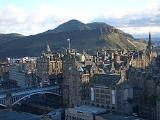
Encyclopedia
Edinburgh is the
capital of
Scotland and its second-largest
city.
It is situated on the east coast of Scotland's central lowlands on the south shore of the
Firth of Forth on the
North sea and forms the
City of Edinburgh council area. It has been the capital of Scotland since 1437 and is the seat of the country's
devolved government. The city was one of the major centres of the
enlightenment , led by the
University of Edinburgh. The
Old Town and
New Town districts of Edinburgh were listed as a
UNESCO World Heritage Site in 1995. In the
census of 2001, Edinburgh had a total resident population of approximately 500,000, making it the 7th largest city in the United Kingdom.
Edinburgh is well-known for the annual Edinburgh Festival, actually a collection of independent festivals held annually over about three weeks from early August, when the population of the city doubles. The most famous of these events are the
Edinburgh Fringe , the Edinburgh International Festival, the
Edinburgh Military Tattoo, and the Edinburgh International Film Festival. Another famous event is the Hogmanay street party.
The city is one of
Europe's major
tourist destinations, attracting roughly 13 million visitors a year, and is the second most visited tourist destination in the
United Kingdom, after
London.
Etymology
The origin of the city's name is understood to come from the Brythonic
Din Eidyn from the time when it was a
Gododdin hillfort.
In the 1st century the
Romans recorded the Votadini as a
Brythonic tribe in the area, and about 600 the poem
Y Gododdin, using the Brythonic form of that name, describes warriors feasting "in Eidin's great hall".
After it was besieged by the
Bernician
Angles the name changed to
Edin-burh, which some have argued derives from the Anglo-Saxon for "Edwin's fort", possibly derived from the 7th century king
Edwin of Northumbria. However, since the name apparently predates King Edwin, this is highly unlikely. The
burgh element means "fortress" or "group of buildings", i.e. a town or city and is akin to the
German burg,
Latin parcus, Greek
pyrgos etc.
The first evidence of the existence of the town as a separate entity from the fort lies in an early 12th century royal charter, generally thought to date from 1124, by
King David I granting land to the
Church of the Holy Rood of Edinburgh. This suggests that the town came into official existence between 1018 and 1124.
The charter refers to the recipients as "Ecclisie Sancte Crucis
Edwinesburgensi". This could mean that those who drafted the charter believed Edwin to be the original source of the name and decided to derive the Latinisation from what they believed to be the ancient name. It could also mean that at some point in the preceding 600 years the name had altered to include a
w. If the latter scenario was the case then it was soon to change; by the 1170s
King William the Lion was using the name "
Edenesburch" in a charter confirming the 1124 grant of David I.
Documents from the 14th century show the name to have settled into its current form; although other spellings appear, these are simply spelling variants of the current name.
Other names
The city is affectionately nicknamed
Auld Reekie,
Scots for
Old Smoky. This is because when the only fuels available were
coal and wood, all the chimneys would spew lots of smoke into the air. Auld Reekie also referred to the less than sanitary living conditions that would lead to a strong odour covering the city. "Reek" means "smell" in modern Edinburgh.
Some have called Edinburgh the
Athens of the North for a variety of reasons. The earliest comparison between the two cities showed that they had a similar topography, with the Old Town of Edinburgh performing a similar role to the
Athenian Acropolis. Both of them had flatter, fertile agricultural land sloping down to a
port several miles away . Although this arrangement is common in
Southern Europe, it is rare in
Northern Europe. The 18th century intellectual life, referred to as the Scottish Enlightenment, was a key influence in gaining the name. Such beacons as
David Hume and
Adam Smith shone during this period. Having lost most of its political importance after the
Union, some hoped that Edinburgh could gain a similar civilising influence on London as Athens had on Rome. Also a contributing factor was the later
neoclassical architecture, particularly that of
William Henry Playfair, and the
National Monument.
Tom Stoppard's character Archie, of Jumpers, has said, facetiously, that the "
Reykjavík of the South" would be more appropriate!
Edinburgh has also been known as
Dunedin, deriving from the
Scottish Gaelic,
Dùn Èideann.
Dunedin, New Zealand, was originally called "New Edinburgh" and is still nicknamed the "Edinburgh of the South".
The Scots poets
Robert Burns and
Robert Fergusson sometimes used the city's Latin name,
Edina, in their work. Ben Johnson described it as
Britaine's other eye, and
Sir Walter Scott referred to the city as
yon Empress of the North.
Some Scots-speakers refer to the city informally as
Edinburrie or
Embra.
The centre
Geography
Some 320 million years ago, the cores of several
volcanic vents in the area cooled and solidified to form tough
basalt volcanic plugs, then, during the
last ice age,
glaciers eroded the area, exposing the plug as a rocky crag to the west, and leaving a tail of material swept to the east. At the same time, the glacier gouged out ground to each side, leaving the ravine of the
Grassmarket and
Cowgate to the south, and the swampy valley of the
Nor Loch to the north. The resulting
crag and tail landform now forms the
Castle Rock, and the narrow steep sided ridge which the
Royal Mile follows. The ridge declines in height over a mile, meeting general ground level at Holyrood.
This formed a natural
fortress, and recent excavations at the castle found material dating back to the
Late Bronze Age, as long ago as 850 BCE.
The map co-ordinates of the centre of Edinburgh are approximately .
Areas of the centre
The historic centre of Edinburgh is divided into two by the broad green swath of
Princes Street Gardens. To the south the view is dominated by
Edinburgh Castle, perched atop the extinct volcanic crag, and the long sweep of the
Old Town trailing after it along the ridge. To the north lies
Princes Street and the
New Town. The gardens were begun in 1816 on
bogland which had once been the Nor Loch.
To the immediate west of the castle lies the financial district, housing insurance and banking buildings. Probably the most eyecatching building is the huge circular sandstone building that is the
Edinburgh International Conference Centre.
Old Town
The Old Town has preserved its
medieval plan and many
Reformation-era buildings. One end is closed by the castle and the main artery, the
Royal Mile, leads away from it; minor streets lead downhill on either side of the main spine in a herringbone pattern. Large squares mark the location of markets or surround major public buildings such as
St Giles Cathedral and the Law Courts.
Other notable places of interest nearby include the
Royal Museum of Scotland, Surgeons' Hall, the
University of Edinburgh, and numerous underground streets and vaults, relics of previous phases of construction. The street layout, typical of the old quarters of many northern European cities, is made especially picturesque in Edinburgh, where the castle perches on top of a rocky crag, the remnants of a dormant volcano, and the main street runs down the crest of a ridge from it.
Due to the space restrictions imposed by the narrowness of the "tail" the Old Town became home to some of the earliest "high rise" residential buildings. Multi-storey dwellings were the norm from the 1500s onwards.
New Town
The New Town was an 18th century solution to the problem of an increasingly crowded Old Town. The city had remained incredibly compact, confined to the ridge running down from the castle. In 1766 a competition to design the New Town was won by James Craig, a 22-year-old architect. The plan that was built created a rigid, ordered grid, which fitted well with
enlightenment ideas of rationality. The principal street was to be
George Street, which follows the natural ridge to the north of the Old Town. Either side of it are the other main streets of
Princes Street and Queen Street. Princes Street has since become the main shopping street in Edinburgh, and few
Georgian buildings survive on it. Linking these streets were a series of perpendicular streets. At the east and west ends are
St. Andrew's Square and
Charlotte Square respectively. The latter was designed by
Robert Adam and is often considered one of the finest Georgian squares in the world.
Bute House, the official residence of the
First Minister of Scotland, is on the north side of Charlotte Square.
Sitting in the glen between the Old and New Towns was the Nor' Loch, which had been both the city's water supply and place for dumping sewage. By the 1820s it was drained. Some plans show that a
canal was intended, but the
Princes Street Gardens were created instead. Excess soil from the construction of the buildings was dumped into the
loch, creating what is now
The Mound. In the mid-19th century the
National Gallery of Scotland and
Royal Scottish Academy Building were built on The Mound, and tunnels to
Waverley Station driven through it.
The New Town was so successful that it was extended greatly. The grid pattern was not maintained, but rather a more picturesque layout was created. Today the New Town is considered by many to be one of the finest examples of
Georgian architecture and planning in the world.
Leith
Leith is the port of Edinburgh. It still retains a separate identity from Edinburgh, and it was a matter of great resentment when, in 1920, the
burgh of Leith was merged into the
county of Edinburgh. Even today the parliamentary seat is known as 'Edinburgh North
and Leith'. With the redevelopment of Leith, Edinburgh has gained the business of a number of
cruise liner companies who now provide cruises to
Norway,
Sweden,
Denmark,
Germany and the
Netherlands. Leith also boasts the
Royal Yacht Britannia, berthed behind the Ocean Terminal shopping centre.
See also: Granton,
NewhavenViewpoints
The varied
topography of the city includes several summits which command sweeping views over Edinburgh.
To the southeast of central Edinburgh stands the eminence known as
Arthur's Seat, overlooking
Holyroodhouse and the Old Town beside it. The crag is a collection of side vents of the main volcano on which Edinburgh is built. The volcano slipped and tipped sideways, leaving these vents as the highest points for miles around. Arthur's Seat is now part of
Holyrood Park, originally owned by the monarch and part of the grounds of the
Palace of Holyroodhouse. It contains the UK's largest concentration of
geological SSSIs, as well as providing the people of Edinburgh with spectacular views of and from Arthur's Seat and somewhere to relax after a long day in the city.
To the northeast, overlooking the New Town, is
Calton Hill. It is topped by an assortment of buildings and monuments: two
observatories,
Nelson's Monument , the old
Royal High School , and the unfinished
National Monument, which is modelled on the
Parthenon from the Athenian
Acropolis and is nicknamed "Edinburgh's Disgrace". The nickname of the city, "Athens of the North", also hails partly from this monument. Calton Hill plays host to the
Beltane Fire Festival on May 1.
The
Royal Observatory rests on Blackford Hill, the third and Southernmost viewpoint of the city.
Climate
Like much of the rest of Scotland, Edinburgh has a temperate maritime climate, which is relatively mild despite its northerly
latitude. Winters are especially mild given that
Moscow and
Labrador in
Newfoundland lie on the same latitude, with daytime temperatures rarely falling below freezing, or 0C . Summer temperatures are comparatively cool, with daily upper maxima rarely exceeding 23C . The proximity of the city to the sea mitigates any large variations in temperature or extremes of climate. Given Edinburgh's position between the coast and hills it is renowned as a windy city, with the prevailing wind direction coming from the south-west which is associated with warm, unstable air from the
Gulf Stream that gives rise to rainfall. Winds from an easterly direction are usually drier but colder. Rainfall is distributed fairly evenly throughout the year. Vigorous Atlantic depressions - sometimes called European windstorms can affect the city between October and March.
Climate Table
| Jan | Feb | Mar | Apr | May | Jun | Jul | Aug | Sep | Oct | Nov | Dec | Year |
|---|
| Mean daily maximum temperature | 6.2 | 6.5 | 8.7 | 11.1 | 14.2 | 17.3 | 18.8 | 18.5 | 16.2 | 13.2 | 8.1 | 6.9 | 12.1 |
|---|
| Mean daily minimum temperature | 0.3 | 0.0 | 1.5 | 3.1 | 5.7 | 8.7 | 10.3 | 10.2 | 8.4 | 5.9 | 2.1 | 0.9 | 4.8 |
|---|
| Mean total rainfall | 57 | 42 | 51 | 41 | 51 | 51 | 57 | 65 | 67 | 65 | 63 | 58 | 668 |
|---|
| Mean number of rain days | 17.2 | 13.6 | 16.2 | 14.0 | 14.4 | 13.3 | 13.1 | 15.2 | 16.5 | 16.7 | 16.3 | 16.3 | 182.8 |
|---|
| Source: |
Culture
Festivals
Culturally, Edinburgh is best known for the Edinburgh Festival, although this is in fact a series of separate events, which run from the end of July until early September each year. The longest established festival is the Edinburgh International Festival, which first ran in 1947. The International Festival centres on a programme of high-profile theatre productions and classical music performances, featuring international directors, conductors, theatre companies and orchestras.
The International Festival has since been taken over in both size and popularity by the
Edinburgh Fringe. What began as a programme of marginal acts has become the largest arts festival in the world, with 1867 different shows being staged in 2006, in 261 venues. Comedy is now one of the mainstays of the Fringe, with numerous notable comedians getting their 'break' here, often through receipt of the Perrier Award.
Alongside these major festivals, there is also the Edinburgh International Film Festival, the Edinburgh Jazz Festival, and the Edinburgh International Book Festival. T on the Fringe, a popular music offshoot of the Fringe, began in 2000, replacing the smaller Flux and Planet Pop series of shows. Tigerfest is an independent music festival which ran concurrently with the Fringe in 2004 and 2005 before moving to a May slot in 2006.
Running concurrently with the festivals, the
Edinburgh Military Tattoo occupies the Castle Esplanade every night, with massed
pipers and fireworks.
Celebrations
Equally famous is the annual Hogmanay celebration. Originally simply a street party held on
Princes Street and the
Royal Mile, the Hogmanay event has been officially organised since 1993. In 1996, over 300,000 people attended, leading to ticketing of the main street party in later years, with a limit of 100,000 tickets. Hogmanay now covers four days of processions, concerts and fireworks, and the event regularly attracts a lot of people.
On the night of 30 April, the
Beltane Fire Festival takes place on Edinburgh's
Calton Hill. The festival involves a procession followed by the re-enactment of scenes inspired by
pagan spring fertility celebrations.
Music, theatre and film
Outside festival season, Edinburgh continues to support a number of theatres and production companies. The Royal Lyceum Theatre has its own company, while the King's Theatre,
Edinburgh Festival Theatre, and Edinburgh Playhouse stage large touring shows. The
Traverse Theatre presents a more contemporary programme of plays. Small student and amateur productions are staged at the Bedlam Theatre, Church Hill Theatre, and the in
Musselburgh, amongst others.
Edinburgh boasts a large number of amateur theatre companies, amongst which are
- Musical theatre companies
- Theatre
- Melodramatics
- Portobello Players
The
Usher Hall is Edinburgh's premier venue for classical music, as well as the occasional prestige popular music gig. Other halls staging music and theatre include The Hub, the Assembly Rooms and the Queen's Hall. The Scottish Chamber Orchestra is based in Edinburgh.
Edinburgh has two repertory cinemas, the Edinburgh Filmhouse, and the Cameo, as well as the usual range of multiplexes.
Edinburgh has a healthy popular music scene, despite the recent closure of The Venue and the attempted closure of Studio 24. Occasional large gigs are staged at Murrayfield, the Liquid Rooms, Meadowbank, as well as the relatively new Edinburgh Corn Exchange.
Visual arts
Edinburgh is home to Scotland's five National Galleries. The national collection is housed in the
Scottish National Gallery, located on the Mound, and now linked to the
Royal Scottish Academy, which holds regular major exhibitions of painting. The contemporary collections are shown in the
Scottish National Gallery of Modern Art, and the nearby Dean Gallery. The
Scottish National Portrait Gallery