
|
|
|
|
Knesset
|
| |
|
| |
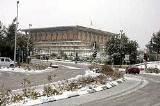
The Knesset (; , lit. gathering or assembly; ) is the legislature of Israel, located in Givat Ram, Jerusalem.
legislative branch of the Israeli government, the Knesset enacts laws, elects the president and prime minister (although s/he is ceremonially appointed by the President), supervises the work of the government, reserves the power to remove the President of the State and the State Comptroller from office and to dissolve itself and call new elections.
The Knesset first convened on February 14, 1949, following the elections held on January 20th 1949.

Discussion
Ask a question about 'Knesset'
Start a new discussion about 'Knesset'
Answer questions from other users
|
Encyclopedia
The Knesset (; , lit. gathering or assembly; ) is the legislature of Israel, located in Givat Ram, Jerusalem.
Operation of the Knesset
The legislative branch of the Israeli government, the Knesset enacts laws, elects the president and prime minister (although s/he is ceremonially appointed by the President), supervises the work of the government, reserves the power to remove the President of the State and the State Comptroller from office and to dissolve itself and call new elections.
The Knesset first convened on February 14, 1949, following the elections held on January 20th 1949. Every 4 years (or sooner if an early election is called, as is often the case), 120 members of the Knesset (MKs) are elected by Israeli citizens who must be at least 18 years old to vote. The Government of Israel must be approved by a majority vote of the Knesset.
The Knesset has de jure parliamentary supremacy and can pass any law by a simple majority, even one that might arguably conflict with the Basic Laws of Israel; in accordance with a plan adopted in 1950, the Basic Laws have themselves been adopted (and occasionally amended) over the course of the years by the Knesset, acting in its capacity as a Constituent Assembly. In practice, the Knesset's ability to legislate has often been limited in consequence of the system of low-threshold party list proportional representation, which has tended to produce governments formed of unstable coalitions of multiple factions. Also, even though no Basic Law adopted thus far has formally granted a power of judicial review to the courts, the Supreme Court of Israel has in recent years asserted its authority, when sitting as the High Court of Justice, to invalidate provisions of laws it finds to to be inconsistent with a Basic Law.
The Knesset is guarded by the Knesset Guard.
History
The Knesset sits on a hilltop in western Jerusalem in a district known as Sheikh Badr before the 1948 Arab-Israeli War and now known as Givat Ram. It was financed by James A. de Rothschild as a gift to the State of Israel. It was built on land leased from the Greek Orthodox Patriarchate of Jerusalem.
Before the construction of its permanent home, the Knesset met in the Jewish Agency building in Jerusalem, the Kessem Cinema building in Tel Aviv and the Froumine building in Jerusalem.
Knesset Assemblies
Each Knesset session is known by its election number. Thus the Knesset elected by Israel's first election in 1949 is known as the First Knesset. The current Knesset, elected in 2009 is the Eighteenth Knesset.
Current Knesset
The composition of the current Knesset was determined by the 2009 election. At present there are 18 parties represented in the Knesset on 12 lists (some parties run for election together on joint lists). Though it has not yet happened in the current session, in every Knesset to date (save the remarkably stable Third) parties have split up during the Knesset's term, leading to the creation of new parties or resulting in MKs sitting as independents.
The parties in the current Knesset are shown in the table below.
* United Torah Judaism is an alliance of Agudat Israel and Degel HaTorah.
** The National Union is an alliance of Eretz Yisrael Shelanu, Hatikva, Moledet and Tkuma.
February 2009 Elections The Knesset is due to be reconstituted following elections in February 2009. Preliminary results indicate 28 seats for Kadima, 27 for Likud, 15 for Yisrael Beiteinu, 13 for Labor, 11 for Shas, 12 for three small religious parties (5 for United Torah Judaism, 4 for National Union and 3 for Jewish Home), 3 for the left-wing Jewish party Meretz, and 10 for three Arab parties (4 for Ta'al, 3 for Balad, and 3 for Hadash).
Although the Central Elections Committee attempted to ban the participation of two of the three Arab parties United Arab List-Ta'al and Balad for their disloyalty to the State and their support of Israel's enemies, that ban was overturned by the Israeli Supreme Court, which, by a vote of 8 to 1, allowed the parties to participate.
Timeline
- February 14, 1949: First meeting of the Constituent Assembly, Jewish Agency, Jerusalem
- March 8, 1949-December 14, 1949: Kessem Cinema in Tel Aviv (Migdal HaOpera is situated there today)
- December 26, 1949-March 8, 1950: Jewish Agency, Jerusalem
- March 13, 1950: Froumine Building, King George Street, Jerusalem.
- 1957: James A. de Rothschild informs Prime Minister David Ben-Gurion of his decision to finance the construction of a permanent Knesset building
- October 14, 1958: Cornerstone-laying for new Knesset building
- August 31, 1966: Dedication of new building (in the days of the Sixth Knesset)
- 1981: Construction of new wing begins
- 1992: New wing opens
- 2005: Construction of another new wing
See also
External links
|
| |
|
|