

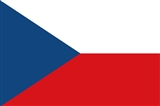
Czech Republic

Encyclopedia
The Czech Republic is a landlocked country in Central Europe
. The country is bordered by Poland
to the northeast, Slovakia
to the east, Austria
to the south, and Germany
to the west and northwest.
It is a pluralist multi-party parliamentary
representative democracy
, a member of the European Union
, NATO, the OECD, the OSCE, the Council of Europe
and the Visegrád Group
.
The Czech state, formerly known as Bohemia, was formed in the late 9th century as a small duchy around Prague, at that time under dominance of the powerful Great Moravia
n Empire (which reached its greatest territorial extent during the reign of Svatopluk I
from the House of Mojmír
). After the fall of the Empire in 907, the centre of power was transferred from Moravia to Bohemia, under the Přemyslids. During the rule of Přemyslid dukes/kings and their successors, the Luxembourgs
, the country reached its greatest territorial extent (13th–14th century). Life in the country was significantly affected by the Hussite wars
, during which it faced economic embargo and crusades from all over Europe. Following the Battle of Mohács
in 1526, the Crown of Bohemia was gradually integrated into the Habsburg monarchy
as one of its three principal parts alongside the Archduchy of Austria
and the Kingdom of Hungary
. The Bohemian Revolt (1618–20) led to the further centralization of the monarchy including forced recatholization and Germanization. During radical reforms in the 18th century the Bohemian Crown was even de facto abolished (1749). In the 19th century the Czech lands became the industrial powerhouse of the monarchy and the core of the Republic of Czechoslovakia
which was formed in 1918, following the collapse of the Austro-Hungarian empire after World War I
.
After the Munich Agreement
, Polish annexation of Zaolzie and German occupation of Czechoslovakia
and the consequent disillusion with the Western response and gratitude for the liberation of the major portion of Czechoslovakia by the Red Army
, the Communist Party of Czechoslovakia
won the plurality in the 1946 elections. In a 1948 coup d'état, Czechoslovakia became a communist-ruled state. In 1968, the increasing dissatisfaction culminated in attempts to reform the communist regime. The events, known as the Prague Spring
of 1968, ended with an invasion by the armies of the Warsaw Pact
countries (with the exception of Romania
); the troops remained in the country until the 1989 Velvet Revolution
, when the communist regime collapsed. On 1 January 1993, Czechoslovakia peacefully dissolved
into its constituent states, the Czech Republic and the Slovak Republic.
The Czech Republic is the first former member of the Comecon
to achieve the status of a developed country
according to the World Bank
. In addition, the country has the highest human development
in Central and Eastern Europe
, ranking as a "Very High Human Development" nation. It is also ranked as the third most peaceful country
in Europe and most democratic
and healthy (by infant mortality) country in the region.
". The current name comes from the Czech endonym Čechy using the antiquated spelling Czechy, identical to the Polish spelling.
The country has been traditionally divided into lands, namely Bohemia proper (Čechy) in the west, Moravia
(Morava) in the southeast, and Czech Silesia
(Slezsko; the smaller, south-eastern part of historical Silesia
, most of which is located within modern Poland) in the northeast. Known officially as the "Crown of the Kingdom of Bohemia" since the 14th century, a number of other names of the country had been used, including the Lands of the Bohemian Crown, Czech/Bohemian lands, Bohemian Crown, Lands of the Crown of Saint Wenceslas etc. When the country regained its independence after the dissolution of the Austro-Hungarian empire in 1918, the new name of Czechoslovakia was coined to reflect the union of the Czech and Slovak nations within the new country.
Following the dissolution of Czechoslovakia at the end of 1992, the Czech part of the former nation found itself without a common single-word name in English. In 1993, the Czech Ministry of Foreign Affairs suggested the name Czechia ˈtʃɛkiə (Česko ˈtʃɛskɔ in Czech) as an official alternative in all situations other than formal official documents and the full names of government institutions; however, this has not become widespread in English, even though most other languages have single-word names for the country (usually their own variants of "Czechia").
 Archaeologists have found evidence of prehistoric human settlements in the area, dating back to the Neolithic
era. In the classical era, from the 3rd century BC Celtic migrations, the Boii
and later in the 1st century, Germanic tribes of Marcomanni
and Quadi
settled there. During the Migration Period
around the 5th century, many Germanic tribes moved westwards and southwards out of Central Europe.
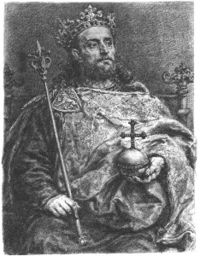 Slavic people from the Black Sea
and Carpathian
regions settled in the area (a movement that was also stimulated by the onslaught of peoples from Siberia
and Eastern Europe: Huns
, Avars
, Bulgars
and Magyars). Following in the Germans' wake, they moved southwards into Bohemia, Moravia and some of present day Austria. During the 7th century, the Frankish merchant Samo
, supporting the Slavs fighting their Avar rulers, became the ruler of the first known Slav state in Central Europe. The Moravian principality
arose in the 8th century.
emerged in the late 9th century, when it was unified by the Přemyslid dynasty
. The Kingdom of Bohemia
was, as the only kingdom in the Holy Roman Empire
, a significant regional power during the Middle Ages
. It was part of the Empire from 1002 till 1804, with the exception of years 1440–1526.
In 1212, King Přemysl Otakar I
, bearing the title "king" since 1198, extracted a Golden Bull of Sicily
(a formal edict) from the emperor, confirming the royal title for Otakar and his descendants. Large-scale German
immigration occurred in the 13th century. The Germans populated towns and mining districts on the Bohemian periphery and, in some cases, formed German colonies in the interior of the Czech lands. In 1235, the mighty Mongol
army launched an invasion of Europe
. After the Battle of Legnica
, the Mongols carried their devastating raid into Moravia
, but they were beaten by the Czech royal army in a battle of Olomouc and continued into Hungarian lands.
King Přemysl Otakar II
earned the nickname "Iron and Golden King" because of his military power and wealth. He acquired Austria, Styria, Carinthia
and Carniola
, thus spreading the Bohemian territory to the Adriatic Sea
. He met his death at the Battle on the Marchfeld in 1278 in a war with his rival, King Rudolph I of Germany
. Ottokar's son Wenceslaus II acquired the Polish crown in 1300 for himself and the Hungarian crown for his son. He built a great empire stretching from the Danube river to the Baltic Sea
. In 1306, the last king of Přemyslid line was murdered in mysterious circumstances in Olomouc while he was resting. After a series of dynastic wars, the House of Luxembourg
gained the Bohemian throne.
The 14th century, particularly the reign of Czech King Charles IV
, who became also King of Italy
, King of the Romans
and Holy Roman Emperor
, is considered the Golden Age of Czech history. Of particular significance was the founding of Charles University in Prague
in 1348, Charles Bridge
, Charles Square
and were completed much of the Prague Castle
and cathedral of Saint Vitus. The Black Death
, which had raged in Europe from 1347 to 1352, decimated the Kingdom of Bohemia in 1380, killing about 10% of the population.
In the 15th century, the religious and social reformer Jan Hus
formed a movement later named after him. Although Hus was named a heretic and burnt in Constanz in 1415, his followers seceded from the Catholic Church and in the Hussite Wars
(1419–1434) defeated five crusades organized against them by the Holy Roman Emperor Sigismund
. Petr Chelčický
continued with Czech Hussite Reformation movement. During the next two centuries, 90% of the inhabitants became adherents of the Hussite Christian movement.
After 1526 Bohemia came increasingly under Habsburg control as the Habsburgs became first the elected and then the hereditary rulers of Bohemia. The Defenestration of Prague and subsequent revolt against the Habsburgs in 1618 marked the start of the Thirty Years' War
, which quickly spread throughout Central Europe. In 1620, the rebellion in Bohemia was crushed at the Battle of White Mountain
, and the ties between Bohemia and Habsburgs' hereditary lands in Austria were strengthened. The war had a devastating effect on the local population; the people were given the choice either to convert to Catholicism or leave the country.
The following period, from 1620 to the late 18th century, has been often called the "Dark Age". The population of the Czech lands
declined by a third through war, disease, famine and the expulsion of the Protestant Czechs. The Habsburgs banned all religions other than Catholicism. Ottoman Turks
and Tatars
invaded Moravia in 1663. In 1679–1680 the Czech lands faced a devastating plague and an uprising of serfs.
The reigns of Maria Theresa of Austria
and her son Joseph II
, Holy Roman Emperor and co-regent from 1765, were characterized by enlightened absolutism
. In 1742, most of Silesia
, then the possession of the Bohemian crown, was seized by King Frederick II of Prussia
in the War of the Austrian Succession
. The Great Famine
, which lasted from 1770 until 1771, killed about one tenth of the Czech population, or 250,000 inhabitants, and radicalized countrysides leading to peasant uprisings.
After the fall of the Holy Roman Empire
, Bohemia became part of the Austrian Empire
and later of Austria–Hungary. Serfdom
was not completely abolished until 1848. After the Revolutions of 1848
, Emperor Franz Josef I of Austria instituted an absolute monarch
in an effort to balance competing ethnic interests in the empire.
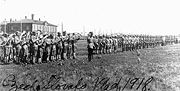
in France, Italy and Russia, where they fought against the Central Powers
and later against Bolshevik
troops. Following the collapse of the Austro-Hungarian Empire after World War I, the independent republic of Czechoslovakia
was created in 1918. This new country incorporated the Bohemian Crown (Bohemia, Moravia and Silesia) and parts of the Kingdom of Hungary
(Slovakia and the Carpathian Ruthenia
) with significant German, Hungarian
, Polish
and Ruthenia
n speaking minorities.
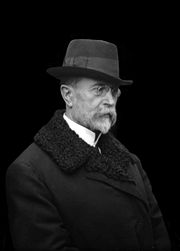 Although Czechoslovakia was a unitary state
, it provided what were at the time rather extensive rights to its minorities and remained the only democracy in this part of Europe in the interwar period. The effects of the Great Depression
including high unemployment and massive propaganda from Nazi Germany, however, resulted in discontent and strong support among ethnic Germans for a break from Czechoslovakia. Adolf Hitler
took advantage of this opportunity and, using Konrad Henlein
's separatist Sudeten German Party, gained the largely German speaking Sudetenland
(and its substantial Maginot Line
like border fortifications
) through the 1938 Munich Agreement
(signed by Nazi Germany
, France
, Britain
and Italy
), despite the mobilization of 1.2 million-strong Czechoslovak army and the Franco-Czech military alliance. Poland annexed the Zaolzie
area around Český Těšín
. Hungary gained parts of Slovakia and the Subcarpathian Rus as a result of the First Vienna Award
in November 1938.
The remainders of Slovakia and the Subcarpathian Rus gained greater autonomy, with the state renamed to "Czecho-Slovakia". After Nazi Germany threatened to annex part of Slovakia, allowing the remaining regions to be partitioned by Hungary and Poland, Slovakia chose to maintain its national and territorial integrity, seceding from Czecho-Slovakia in March 1939, and allying itself, as demanded by Germany, with Hitler's coalition.
The remaining Czech territory was occupied by Germany, which transformed it into the so-called Protectorate of Bohemia and Moravia
. The protectorate was proclaimed part of the Third Reich
, and the president and prime minister were subordinate to the Nazi Reichsprotektor
("imperial protector"). Subcarpathian Rus declared independence as the Republic of Carpatho-Ukraine
on 15 March 1939 but was invaded by Hungary the same day and formally annexed the next day. Approximately 345,000 Czechoslovak citizens, including 277,000 Jews, were killed or executed while hundreds of thousands of others were sent to prisons and concentration camps
or used as forced labour. Perhaps two–thirds of the Czech nation was destined either for extermination or removal. A Nazi
concentration camp existed at Terezín
, north of Prague.
There was Czech resistance to Nazi occupation
, both at home and abroad, most notably with the assassination of Nazi leader Reinhard Heydrich
in a Prague suburb on 27 May 1942. The Czechoslovak government-in-exile and its army fighting against the Germans were acknowledged by the Allies; Czech/Czechoslovak troops fought from the very beginning of the war in Poland, France, the UK, North Africa, the Middle East and the Soviet Union
. The German occupation ended on 9 May 1945, with the arrival of the Soviet
and American armies and the Prague uprising
. An estimated 140,000 Soviet soldiers died in conquering Czechoslovakia from German rule.
In 1945–1946, almost the entire German minority in Czechoslovakia, about 3 million people, were expelled to Germany and Austria. During this time, thousands of Germans were held in prisons and detention camps or used as forced labour. In the summer of 1945, there were several massacres. The only Germans not expelled were some 250,000 who had been active in the resistance against the Nazis or were considered economically important, though many of these emigrated later. Following a Soviet-organised referendum, the Subcarpathian Rus never returned under Czechoslovak rule but became part of the Ukrainian Soviet Socialist Republic, as the Zakarpattia Oblast
in 1946.
Czechoslovakia uneasily tried to play the role of a "bridge" between the West and East. However, the Communist Party of Czechoslovakia
rapidly increased in popularity, with a general disillusionment with the West, because of the pre-war Munich Agreement
, and a favourable popular attitude towards the Soviet Union
, because of the Soviets' role in liberating Czechoslovakia from German rule. In the 1946 elections, the Communists gained 38% of the votes and became the largest party in the Czechoslovak parliament. They formed a coalition government with other parties of the National Front
and moved quickly to consolidate power. The decisive step took place in February 1948, during a series of events
characterized by Communists as a "revolution" and by anti-Communists as a "takeover", the Communist People's Militias
secured control of key locations in Prague, and a new all-Communist government was formed.
For the next 41 years, Czechoslovakia was a Communist state within the Eastern Bloc
. This period is characterized by lagging behind the West in almost every aspect of social and economic development. The country's GDP per capita fell from the level of neighboring Austria below that of Greece or Portugal in the 1980s. The Communist government completely nationalized
the means of production
and established a command economy
. The economy grew rapidly during the 1950s but slowed down in the 1960s and 1970s and stagnated in the 1980s. The political climate was highly repressive during the 1950s, including numerous show trial
s and hundreds of thousands of political prisoners, but became more open and tolerant in the late 1960s, culminating in Alexander Dubček
's leadership in the 1968 Prague Spring
, which tried to create "socialism with a human face" and perhaps even introduce political pluralism. This was forcibly ended by 21 August 1968 Warsaw Pact
invasion.
.jpg) The invasion was followed by a harsh program of "Normalization
The invasion was followed by a harsh program of "Normalization
" in the late 1960s and the 1970s. Until 1989, the political establishment relied on censorship of the opposition. Dissidents published Charter 77
in 1977, and the first of a new wave of protests were seen in 1988. Between 1948 and 1989 more than 250,000 Czechs and Slovaks were sent to prison for "anti-state activities" and over 400,000 emigrated.
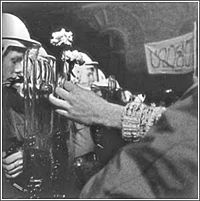 In November 1989, Czechoslovakia returned to a liberal democracy through the peaceful "Velvet Revolution
". However, Slovak national aspirations strengthened and on 1 January 1993, the country peacefully split
into the independent Czech Republic and Slovakia. Both countries went through economic reforms and privatisations, with the intention of creating a capitalist economy
. This process was largely successful; in 2006 the Czech Republic was recognised by the World Bank as a "developed country", and in 2009 the Human Development Index
ranked it as a nation of "Very High Human Development".
From 1991, the Czech Republic, originally as part of Czechoslovakia and now in its own right, has been a member of the Visegrád Group
and from 1995, the OECD
. The Czech Republic joined NATO on 12 March 1999 and the European Union on 1 May 2004. It held the Presidency of the European Union
for the first half of 2009.
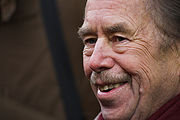
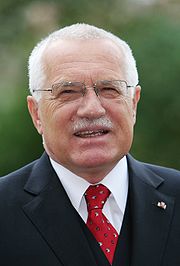 The Czech Republic is a pluralist multi-party parliamentary
representative democracy
, with the Prime Minister as head of government
. The Parliament
(Parlament České republiky) is bicameral, with the Chamber of Deputies
(200 members) and the Senate
(81 members).
The President of the Czech Republic
is selected by a joint session of the parliament for a five-year term, with no more than two consecutive terms. The president is a formal head of state
with limited specific powers, most importantly to return bills to the parliament, nominate Constitutional court judges for the Senate's approval and dissolve the parliament under certain special and unusual circumstances. He also appoints the prime minister, as well the other members of the cabinet on a proposal by the prime minister.
The Prime Minister is the head of government and wields considerable powers, including the right to set the agenda for most foreign and domestic policy, mobilize the parliamentary majority and choose government ministers.
The members of the Chamber of Deputies are elected for a four year term by proportional representation
, with a 5% election threshold
. There are 14 voting districts, identical to the country's administrative regions. The Chamber of Deputies, the successor to the Czech National Council
, has the powers and responsibilities of the now defunct federal parliament of the former Czechoslovakia
.
The members of the Senate are elected in single-seat constituencies by two-round runoff voting
for a six-year term, with one-third elected every even year in the autumn. The first election was in 1996, for differing terms. This arrangement is modeled on the U.S. Senate
, but each constituency is roughly the same size and the voting system used is a two-round runoff. The Senate is unpopular among the public and suffers from low election turnout, overall roughly 30% in the first round and 20% in the second.
for the first half of 2009.
Czech officials have supported dissenters in Burma, Belarus
, Moldova
and Cuba
.
, Air Force
and of specialized support units. The president of the Czech Republic, currently Václav Klaus
, is Commander-in-Chief
of the armed forces. In 2004 the army transformed itself into a fully professional organization and compulsory military service was abolished. The country has been a member of NATO since 12 March 1999. Defence spending is around 1.8% of the GDP (2006). Currently, as a member of NATO, the Czech military are participating in ISAF
and KFOR
operations and have soldiers in Afghanistan
and Kosovo
. Main equipment includes: multirole fighters JAS-39 Gripen, combat aircraft Aero L-159 Alca
, attack helicopters Mi-24, armoured vehicles Pandur II, OT-64, OT-90, BVP-2
and Czech modernized tanks T-72
(T-72M4CZ). Main foreign industry suppliers are Russia
, the United States
and Germany
.
: kraje, singular kraj) and the capital city of Prague
. Each region has its own elected Regional Assembly (krajské zastupitelstvo) and hejtman (usually translated as hetman
or "president"). In Prague, their powers are executed by the city council and the mayor.
The older seventy-six districts
(okresy, singular okres
) including three "statutory cities" (without Prague, which had special status) lost most of their importance in 1999 in an administrative reform; they remain as territorial divisions and seats of various branches of state administration.
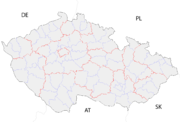
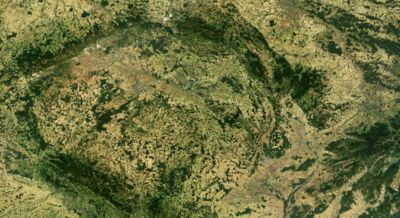 The Czech Republic lies mostly between latitudes 48°
and 51° N
(a small area lies north of 51°), and longitudes 12°
and 19° E
.
The Czech landscape is exceedingly varied. Bohemia
, to the west, consists of a basin drained by the Elbe
and the Vltava
(or Moldau) rivers, surrounded by mostly low mountains, such as the Krkonoše range of the Sudetes. The highest point in the country, Sněžka at 1602 m (5,256 ft), is located here. Moravia
, the eastern part of the country, is also quite hilly. It is drained mainly by the Morava River, but it also contains the source of the Oder River .
Water from the landlocked Czech Republic flows to three different seas: the North Sea
, Baltic Sea
and Black Sea
. The Czech Republic also leases the Moldauhafen
, a 30000 square metres (7.4 acre) lot
in the middle of the Hamburg
Docks, which was awarded to Czechoslovakia by Article 363 of the Treaty of Versailles
, to allow the landlocked country a place where goods transported down river could be transferred to seagoing ships. The territory reverts to Germany in 2028.
Phytogeographically
, the Czech Republic belongs to the Central European province of the Circumboreal Region
, within the Boreal Kingdom
. According to the World Wide Fund for Nature
, the territory of the Czech Republic can be subdivided into four ecoregion
s: the Central European mixed forests, Pannonian mixed forests, Western European broadleaf forests
and Carpathian montane conifer forests.
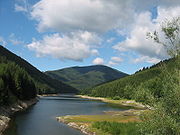
There are four national park
s in the Czech Republic. The oldest is
Krkonoše National Park
(Biosphere Reserve
), Šumava National Park
(Biosphere Reserve), National Park Podyjí, České Švýcarsko National Park.
 The Czech Republic has a temperate continental climate
, with relatively hot summers and cold, cloudy and snowy winters. Most rain falls during the summer. The temperature difference between summer and winter is relatively high, due to the landlocked geographical position.
Within the Czech Republic, temperatures vary greatly, depending on the elevation
. In general, at higher altitudes, the temperatures decrease and precipitation
increases. The wettest area in the Czech Republic is found around Bílý Potok in Jizera Mountains
and the driest region is the Louny District
to the northwest of Prague. Another important factor is the distribution of the mountains; therefore, the climate is quite varied.
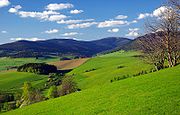 At the highest peak of Sněžka (1602 m (5,256 ft)), the average temperature is only -0.4 C, whereas in the lowlands of the South Moravian Region
, the average temperature is as high as 10 °C (50 °F). The country's capital, Prague
, has a similar average temperature, although this is influenced by urban factors.
The coldest month is usually January, followed by February and December. During these months, there is usually snow in the mountains and sometimes in the major cities and lowlands. During March, April and May, the temperature usually increases rapidly, especially during April, when the temperature and weather tends to vary widely during the day. Spring is also characterized by high water levels in the rivers, due to melting snow with occasional flooding.
The warmest month of the year is July, followed by August and June. On average, summer temperatures are about 20 degrees higher than during winter. Especially in the last decade, temperatures above 30 °C (86 °F) are not unusual. Summer is also characterized by rain and storms.
Autumn generally begins in September, which is still relatively warm and dry. During October, temperatures usually fall below 15 °C (59 °F) or 10 °C (50 °F) and deciduous trees
begin to shed their leaves. By the end of November, temperatures usually range around the freezing point.
The coldest temperature ever measured was in Litvínovice near České Budějovice
, at -42.2 C and the hottest measured, was at 40.2 °C (104.4 °F) at Praha, Uhříněves.
 The Czech Republic possesses a developed, high-income economy with a GDP per capita of 80% of the European Union average. One of the most stable and prosperous of the post-Communist states, the Czech Republic saw growth of over 6% annually in the three years before the outbreak of the recent global economic crisis
. Growth has been led by exports to the European Union, especially Germany, and foreign investment, while domestic demand is reviving.
Most of the economy has been privatised, including the banks and telecommunications. The current centre-right government plans to continue with privatisation, including the energy industry and the Prague airport. It has recently agreed to the sale of a 7% stake in the energy producer, CEZ Group
, with the sale of the Budějovický Budvar
brewery also mooted. A 2009 survey in cooperation with the Czech Economic Association found that the majority of Czech economists favor continued liberalization in most sectors of the economy.
The country is part of the Schengen Area
, having abolished border controls, completely opening its borders with all of its neighbours, Germany, Austria
, Poland
and Slovakia
, on 21 December 2007. The Czech Republic became a member of the World Trade Organisation.
The last Czech government led by social democrats had expressed a desire to adopt the euro in 2010, but the current centre-right government suspended that plan in 2007. An exact date has not been set up, but the Finance Ministry described adoption by 2012 as realistic, if public finance reform passes. However, the most recent draft of the euro adoption plan omits giving any date. Although the country is economically better positioned than other EU Members to adopt the euro, the change is not expected before 2013, due to political reluctance on the matter.
On 1 January 2009, former Czech PM, Mirek Topolánek
, declared that on 1 November 2009, the Czech government will announce a fixed date for euro adoption, since the country "currently fulfils all criteria for adoption of the euro", however his subsequent deposition has rendered this deadline moot. There are several challenges, however. The rate of corruption remains one of the highest among the other developed OECD
countries and the public budgets remain in deficit despite strong growth of the economy in recent years. However, the 2007 deficit has been 1.58% GDP and the 2008 deficit is expected at 1.2% GDP, according to EU accounting rules, far better than original projections.
The Programme for International Student Assessment
, coordinated by the OECD
, currently ranks the Czech education system as the 15th best in the world, higher than the OECD average.
in Prague
is the main international airport in the country. In 2010, it handled 11.6 million passengers, which makes it the busiest airport in Central and Eastern Europe. In total, Czech Republic has 46 airports with paved runways, six of which provide international air services, in Brno
, Karlovy Vary
, Mošnov
(near Ostrava
), Pardubice
, Prague
and Uherské Hradiště
.
České dráhy
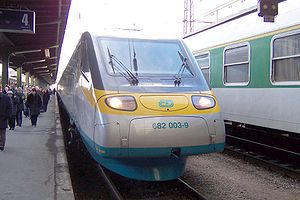
(the Czech railways) is the main railway operator in the Czech Republic, with about 180 million passengers carried yearly. Its cargo division, ČD Cargo, is the fifth largest railway cargo operator in the European Union. With 9505 km (5,906.15 mi) of tracks, the Czech Republic has one of the densest railway networks in Europe. Of that number, 2926 km (1,818.14 mi) is electrified, 7617 km (4,733 mi) are single-line tracks and 1866 km (1,159.48 mi) are double and multiple-line tracks. In 2006 the new Italian tilting trains Pendolino
ČD Class 680
entered service. They have reached a speed of 237 km/h setting a new Czech railway speed record.
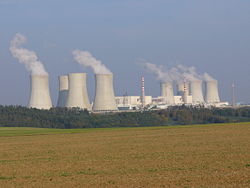
In 2005, according to the Czech Statistical Office, 65.4% of electricity was produced by steam, combined and combustion power plants (mostly coal); 30% in nuclear plants
; and 4.6% from renewable sources, including hydropower. Russia, via pipelines through Ukraine and to a lesser extent, Norway, via pipelines through Germany, supply the Czech Republic with liquid and natural gas.
 The Czech Republic is reducing its dependence on highly polluting low-grade brown coal
as a source of energy. Nuclear power
presently provides about 30% of the total power needs, its share is projected to increase to 40%. Natural gas is procured from Russia
n Gazprom
, roughly three-fourths of domestic consumption and from Norwegian
companies, which make up most of the remaining one-fourth. Russian gas is imported via Ukraine (Druzhba pipeline
), Norwegian gas is transported through Germany. Gas consumption (approx. 100 TWh in 2003–2005) is almost two times higher than the electricity consumption. South Moravia has small oil and gas deposits
.
The road network in the Czech Republic is 55653 km (34,581.26 mi) long. and 738,4 km of motorways and 439,1 km of expressways. The speed limit is 130 km/h or 80mph.
subscribers in the European Union. By the beginning of 2008, there was over 800 mostly local WISPs, with about 350,000 subscribers in 2007. Mobile internet is very popular. Plans based on either GPRS
, EDGE
, UMTS
or CDMA2000
are being offered by all three mobile phone operators (T-Mobile
, Vodafone
, Telefonica O2
) and internet provider U:fon. Government-owned Český Telecom slowed down broadband penetration. At the beginning of 2004, local-loop unbundling began and alternative operators started to offer ADSL and also SDSL. This and later privatisation of Český Telecom helped drive down prices.
On 1 July 2006, Český Telecom was acquired by globalized company (Spain owned) Telefonica group and adopted new name Telefónica O2 Czech Republic. As of January 2006, ADSL2+ is offered in many variants, both with data limit and without with speeds up to 10 Mbit/s. Cable internet is gaining popularity with its higher download speeds beginning at 2 Mbit/s up to 100 Mbit/s. The largest ISP, UPC (which acquired another CATV internet provider Karneval in 2007), provides its service in all major cities.
, the separation of modern blood type
s, and the production of the Semtex
plastic explosive
. Prominent scientists who lived and worked in historically Czech lands include:
A number of other scientists are also connected in some way with the Czech Lands, including astronomers Johannes Kepler
and Tycho Brahe
, the founder of the psychoanalytic school of psychiatry Sigmund Freud
, physicists Ernst Mach
, Albert Einstein
, engineer Viktor Kaplan
and logician Kurt Gödel
.
, making up 5.5% of GNP
and 9.3% of overall export earnings. The industry employs more than 110,000 people – over 1% of the population. In 2008, however, there was a slump in tourist numbers in Prague
, possibly due to the strong Czech koruna (crown) making the country too expensive for visitors, compared to the level of services that were available.
The country's reputation has also suffered with guidebooks and tourists reporting overcharging by taxi drivers and pickpocketing problems. Since 2005, Prague's mayor, Pavel Bém
, has worked to improve this reputation by cracking down on petty crime and, aside from these problems, Prague is a safe city. Also, the Czech Republic as a whole generally has a low crime rate. For tourists, the Czech Republic is considered a safe destination to visit. The low crime rate makes most cities and towns safe to walk around even after dark.
There are several centres of tourist activity. The historic city of Prague
is the primary tourist attraction, as the city is also the most common point of entry for tourists visiting other parts of the country. Most other cities in the country attract significant numbers of tourists, but the spa towns, such as Karlovy Vary
, Mariánské Lázně
and Františkovy Lázně
, are particularly popular holiday destinations. Other popular tourist sites are the many castles and chateaux, such as those at Karlštejn Castle
, Český Krumlov
and the Lednice–Valtice area
. Away from the towns, areas such as Český ráj
, Šumava
and the Krkonoše Mountains attract visitors seeking outdoor pursuits.
The country is also famous for its love of puppetry
and marionette
s with a number of puppet festivals
throughout the country.
The Czech Republic also has a number of beer festival
s, including: Czech Beer Festival
(the biggest Czech beer
festival, it is 17 days long and held every year in May in Prague
), Pilsner Fest (every year in August in Plzeň), The "Olomoucký pivní festival" (in Olomouc
) or festival "Slavnosti piva v Českých Budějovicích" (in České Budějovice
).
and Silesians
). The most numerous national minorities are: Slovaks
(1.89%); Poles
(0.51%); Germans
(0.38%); Ukrainians
(0.22%); Vietnamese
(0.17%); Hungarians (0.14%); Russians
(0.12%); Romani (0.11%); Bulgarians
(0.04%); and Greeks
(0.03%). According to some estimates, there are about 250,000 Romani people in the Czech Republic.
There were 436,116 foreigners residing in the country in October 2009, according to the Czech Interior Ministry, with the largest groups being Ukrainian (132,481), Slovak (75,210), Vietnamese (61,102), Russian (29,976), Polish (19,790), German (14,156), Moldovan (10,315), Bulgarian (6,346), Mongolian (5,924), American (5,803), Chinese (5,314), British (4,461), Belarusian (4,441), Serbian (4,098), Romanian (4,021), Kazakh (3,896), Austrian (3,114), Italian (2,580), Dutch (2,553), French (2,356), Croatian (2,351), Bosnian (2,240), Armenian (2,021), Uzbek (1,969), Macedonian (1,787) and Japanese (1,581).
The Jewish
population of Bohemia and Moravia, 118,000 according to the 1930 census, was virtually annihilated by the Nazis during the Holocaust
. There were approximately 4,000 Jews in the Czech Republic in 2005. The former Czech prime minister, Jan Fischer
, is of Jewish origin and faith.
The fertility rate
is a low 1.50 children per woman.Immigration
increased the population by almost 1% in 2007. About 77,000 new foreigners settle down in the Czech Republic every year. Vietnamese
immigrants began settling in the Czech Republic during the Communist period, when they were invited as guest workers by the Czechoslovak government. Today, there are an estimated 70,000 Vietnamese in the Czech Republic. In contrast to Ukrainians, Vietnamese come to the Czech Republic to live permanently.
At the turn of the 20th century, Chicago was the city with the third largest Czech population, after Prague
and Vienna
. According to the 2006 US census, there are 1,637,218 Americans of full or partial Czech
descent.
, atheist
or irreligious
, 26.8% is Roman Catholic and 2.5% is Protestant
. From 1991 to 2001, the number of people identifying with no religion increased by 19.1%, or two million people, representing the largest group increase. Adherence to Christianity decreased by over one million persons.
According to a Eurobarometer Poll
in 2005, 19% of Czech citizens responded that "they believe there is a God" (the second lowest rate among European Union countries after Estonia
with 16%), whereas 50% answered that "they believe there is some sort of spirit or life force" and 30% said that "they do not believe there is any sort of spirit, God or life force".
folk music of Bohemia
, Moravia
and Silesia
and in the long-term high-culture classical music tradition. Since the early eras of artificial music, Czech musicians and composers have often been influenced by genuine folk music. Notable Czech composers include Adam Michna, Jan Dismas Zelenka
, Josef Mysliveček
, Bedřich Smetana
, Leoš Janáček
, Antonín Dvořák
, Bohuslav Martinů
, Erwin Schulhoff
and Petr Eben
. The most famous music festival is "the Prague Spring" ( Pražské jaro), that has been organized annually since 1946.
is the literature written by Czechs or other inhabitants of the Czech state, mostly in the Czech language
, although other languages like Old Church Slavonic
, Latin
or German have been also used, especially in the past. Czech authors who had written in the German language, such as Franz Kafka
, are usually excluded from the corpus of Czech literature, regardless of their own national self-identification.
Czech literature is divided into several main time periods: the Middle Ages; the Hussite period; the years of re-Catholicization and the baroque; the Enlightenment and Czech reawakening in the 19th century; the avantgarde of the interwar period; the years under Communism and the Prague Spring; and the literature of the post-Communist Czech Republic. Czech literature and culture played a major role on at least two occasions, when Czechs lived under oppression and political activity was suppressed. On both of these occasions, in the early 19th century and then again in the 1960s, the Czechs used their cultural and literary effort to strive for political freedom, establishing a confident, politically aware nation.
has rich tradition with roots in the Middle Ages. In the 19th century, the theatre played an important role in the national awakening movement and later, in the 20th century it became a part of the modern European theatre art.
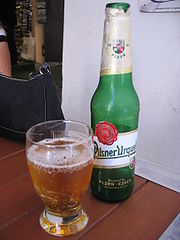 Czech cuisine is marked by a strong emphasis on meat dishes. Pork is quite common; beef and chicken are also popular. Goose, duck, rabbit and wild game are served. Fish is rare, with the occasional exception of fresh trout
and carp
, which is served at Christmas.
Czech beer
has a long and important history. The first brewery is known to have existed in 1118 and the Czech Republic has the highest beer consumption per capita in the world. The famous Pilsener
style beer originated in the western Bohemian city of Plzeň, and further south the town of Budweis lent its name to its beer, eventually known as Budweiser Bier Bürgerbräu
thus Budweiser Budvar. Tourism is slowly growing around the Southern Moravian region too, which has been producing wine since the Middle Ages; about 94% of vineyard
s in Czech Republic are Moravian. Aside from Slivovitz
, Czech beer
and wine
, the Czechs also produce two uniquely Czech liquors, Fernet Stock
and Becherovka
. Kofola
is a non-alcoholic domestic cola
soft drink
which competes with Coca Cola and Pepsi
in popularity.
Two unique Czech dishes are vepřo-knedlo-zelo and svíčková na smetaně
. Czech desserts are not particularly sweet, and frequently contain poppy seeds.
, both drawing the largest attention of both the media and supporters. Tennis is also a very big sport in the Czech Republic. The many other sports with professional leagues and structures include basketball, volleyball, team handball
, track and field athletics and floorball
. The Czech ice hockey team won the gold medal at the 1998 Winter Olympics
and won three straight gold medals at the world championships from 1999
to 2001
and at the 1996
, 2005
and 2010
tournaments. In total achieved 59 in summer
and 7 in winter
gold medals in all-time Olympic Games history (ČR+Czechoslovakia).
Sport is a source of strong waves of patriotism
, usually rising several days or weeks before an event. The events considered the most important by Czech fans are: the Ice Hockey World Championships
, Olympic Ice hockey tournament, UEFA European Football Championship
, FIFA World Cup
and qualification matches for such events. In general, any international match of the Czech ice hockey or football national team draws attention, especially when played against a traditional rival: Germany
and Netherlands
in football; Russia
, Finland
, Sweden
, United States
, and Canada
in ice hockey; and Slovakia
in both. Matches against Germany
and Russia
possess an additional element of rivalry due to historically political friction, while matches against Slovakia
are in large part considered significant because the two countries had been united prior to their separation from each other in the 1993. The Czech Republic also has great influence on tennis with such players as, Ivan Lendl
, 8 times Grand Slam singles champion, 2010 Wimbledon Championships - Men's Singles finalist Tomáš Berdych
, 2011 Wimbledon Championships - Women's Singles champion, Petra Kvitova
, 1998 Wimbledon Women's Singles title Jana Novotná
, 2011 Wimbledon Championships – Women's Doubles
champion Květa Peschke
and 18 time Grand Slam Champion Martina Navratilova.
Lists:
Government
General information
News
Statistics
Travel
Central Europe
Central Europe or alternatively Middle Europe is a region of the European continent lying between the variously defined areas of Eastern and Western Europe...
. The country is bordered by Poland
Poland
Poland , officially the Republic of Poland , is a country in Central Europe bordered by Germany to the west; the Czech Republic and Slovakia to the south; Ukraine, Belarus and Lithuania to the east; and the Baltic Sea and Kaliningrad Oblast, a Russian exclave, to the north...
to the northeast, Slovakia
Slovakia
The Slovak Republic is a landlocked state in Central Europe. It has a population of over five million and an area of about . Slovakia is bordered by the Czech Republic and Austria to the west, Poland to the north, Ukraine to the east and Hungary to the south...
to the east, Austria
Austria
Austria , officially the Republic of Austria , is a landlocked country of roughly 8.4 million people in Central Europe. It is bordered by the Czech Republic and Germany to the north, Slovakia and Hungary to the east, Slovenia and Italy to the south, and Switzerland and Liechtenstein to the...
to the south, and Germany
Germany
Germany , officially the Federal Republic of Germany , is a federal parliamentary republic in Europe. The country consists of 16 states while the capital and largest city is Berlin. Germany covers an area of 357,021 km2 and has a largely temperate seasonal climate...
to the west and northwest.
It is a pluralist multi-party parliamentary
Parliamentary system
A parliamentary system is a system of government in which the ministers of the executive branch get their democratic legitimacy from the legislature and are accountable to that body, such that the executive and legislative branches are intertwined....
representative democracy
Representative democracy
Representative democracy is a form of government founded on the principle of elected individuals representing the people, as opposed to autocracy and direct democracy...
, a member of the European Union
European Union
The European Union is an economic and political union of 27 independent member states which are located primarily in Europe. The EU traces its origins from the European Coal and Steel Community and the European Economic Community , formed by six countries in 1958...
, NATO, the OECD, the OSCE, the Council of Europe
Council of Europe
The Council of Europe is an international organisation promoting co-operation between all countries of Europe in the areas of legal standards, human rights, democratic development, the rule of law and cultural co-operation...
and the Visegrád Group
Visegrád Group
The Visegrád Group, also called the Visegrád Four or V4, is an alliance of four Central European states – Czech Republic, Hungary, Poland and Slovakia – for the purposes of cooperation and furthering their European integration...
.
The Czech state, formerly known as Bohemia, was formed in the late 9th century as a small duchy around Prague, at that time under dominance of the powerful Great Moravia
Great Moravia
Great Moravia was a Slavic state that existed in Central Europe and lasted for nearly seventy years in the 9th century whose creators were the ancestors of the Czechs and Slovaks. It was a vassal state of the Germanic Frankish kingdom and paid an annual tribute to it. There is some controversy as...
n Empire (which reached its greatest territorial extent during the reign of Svatopluk I
Svatopluk I
Svatopluk I or Zwentibald I was the greatest ruler of Moravia that attained its maximum territorial expansion in his reign . His career had already started in the 860s, when he governed a principality, the location of which is still a matter of debate among historians, within Moravia under the...
from the House of Mojmír
House of Mojmír
The House of Mojmír is the modern name of the ruling dynasty of Great Moravia, the Moravian principality and the Principality of Nitra in the 9th and early 10th century....
). After the fall of the Empire in 907, the centre of power was transferred from Moravia to Bohemia, under the Přemyslids. During the rule of Přemyslid dukes/kings and their successors, the Luxembourgs
House of Luxembourg
The House of Luxembourg was a late medieval German dynasty, which between 1308 and 1437 ruled the Holy Roman Empire, twice interrupted by the rivaling House of Wittelsbach.-History:...
, the country reached its greatest territorial extent (13th–14th century). Life in the country was significantly affected by the Hussite wars
Hussite Wars
The Hussite Wars, also called the Bohemian Wars involved the military actions against and amongst the followers of Jan Hus in Bohemia in the period 1419 to circa 1434. The Hussite Wars were notable for the extensive use of early hand-held gunpowder weapons such as hand cannons...
, during which it faced economic embargo and crusades from all over Europe. Following the Battle of Mohács
Battle of Mohács
The Battle of Mohács was fought on August 29, 1526 near Mohács, Hungary. In the battle, forces of the Kingdom of Hungary led by King Louis II of Hungary and Bohemia were defeated by forces of the Ottoman Empire led by Sultan Suleiman the Magnificent....
in 1526, the Crown of Bohemia was gradually integrated into the Habsburg monarchy
Habsburg Monarchy
The Habsburg Monarchy covered the territories ruled by the junior Austrian branch of the House of Habsburg , and then by the successor House of Habsburg-Lorraine , between 1526 and 1867/1918. The Imperial capital was Vienna, except from 1583 to 1611, when it was moved to Prague...
as one of its three principal parts alongside the Archduchy of Austria
Archduchy of Austria
The Archduchy of Austria , one of the most important states within the Holy Roman Empire, was the nucleus of the Habsburg Monarchy and the predecessor of the Austrian Empire...
and the Kingdom of Hungary
Kingdom of Hungary
The Kingdom of Hungary comprised present-day Hungary, Slovakia and Croatia , Transylvania , Carpatho Ruthenia , Vojvodina , Burgenland , and other smaller territories surrounding present-day Hungary's borders...
. The Bohemian Revolt (1618–20) led to the further centralization of the monarchy including forced recatholization and Germanization. During radical reforms in the 18th century the Bohemian Crown was even de facto abolished (1749). In the 19th century the Czech lands became the industrial powerhouse of the monarchy and the core of the Republic of Czechoslovakia
Czechoslovakia
Czechoslovakia or Czecho-Slovakia was a sovereign state in Central Europe which existed from October 1918, when it declared its independence from the Austro-Hungarian Empire, until 1992...
which was formed in 1918, following the collapse of the Austro-Hungarian empire after World War I
World War I
World War I , which was predominantly called the World War or the Great War from its occurrence until 1939, and the First World War or World War I thereafter, was a major war centred in Europe that began on 28 July 1914 and lasted until 11 November 1918...
.
After the Munich Agreement
Munich Agreement
The Munich Pact was an agreement permitting the Nazi German annexation of Czechoslovakia's Sudetenland. The Sudetenland were areas along Czech borders, mainly inhabited by ethnic Germans. The agreement was negotiated at a conference held in Munich, Germany, among the major powers of Europe without...
, Polish annexation of Zaolzie and German occupation of Czechoslovakia
German occupation of Czechoslovakia
German occupation of Czechoslovakia began with the Nazi annexation of Czechoslovakia's northern and western border regions, known collectively as the Sudetenland, under terms outlined by the Munich Agreement. Nazi leader Adolf Hitler's pretext for this effort was the alleged privations suffered by...
and the consequent disillusion with the Western response and gratitude for the liberation of the major portion of Czechoslovakia by the Red Army
Soviet Union
The Soviet Union , officially the Union of Soviet Socialist Republics , was a constitutionally socialist state that existed in Eurasia between 1922 and 1991....
, the Communist Party of Czechoslovakia
Communist Party of Czechoslovakia
The Communist Party of Czechoslovakia, in Czech and in Slovak: Komunistická strana Československa was a Communist and Marxist-Leninist political party in Czechoslovakia that existed between 1921 and 1992....
won the plurality in the 1946 elections. In a 1948 coup d'état, Czechoslovakia became a communist-ruled state. In 1968, the increasing dissatisfaction culminated in attempts to reform the communist regime. The events, known as the Prague Spring
Prague Spring
The Prague Spring was a period of political liberalization in Czechoslovakia during the era of its domination by the Soviet Union after World War II...
of 1968, ended with an invasion by the armies of the Warsaw Pact
Warsaw Pact
The Warsaw Treaty Organization of Friendship, Cooperation, and Mutual Assistance , or more commonly referred to as the Warsaw Pact, was a mutual defense treaty subscribed to by eight communist states in Eastern Europe...
countries (with the exception of Romania
Romania
Romania is a country located at the crossroads of Central and Southeastern Europe, on the Lower Danube, within and outside the Carpathian arch, bordering on the Black Sea...
); the troops remained in the country until the 1989 Velvet Revolution
Velvet Revolution
The Velvet Revolution or Gentle Revolution was a non-violent revolution in Czechoslovakia that took place from November 17 – December 29, 1989...
, when the communist regime collapsed. On 1 January 1993, Czechoslovakia peacefully dissolved
Dissolution of Czechoslovakia
The dissolution of Czechoslovakia, which took effect on 1 January 1993, was an event that saw the self-determined separation of the federal state of Czechoslovakia. The Czech Republic and Slovakia, entities which had arisen in 1969 within the framework of Czechoslovak federalisation, became...
into its constituent states, the Czech Republic and the Slovak Republic.
The Czech Republic is the first former member of the Comecon
Comecon
The Council for Mutual Economic Assistance , 1949–1991, was an economic organisation under hegemony of Soviet Union comprising the countries of the Eastern Bloc along with a number of communist states elsewhere in the world...
to achieve the status of a developed country
Developed country
A developed country is a country that has a high level of development according to some criteria. Which criteria, and which countries are classified as being developed, is a contentious issue...
according to the World Bank
World Bank
The World Bank is an international financial institution that provides loans to developing countries for capital programmes.The World Bank's official goal is the reduction of poverty...
. In addition, the country has the highest human development
Human Development Index
The Human Development Index is a composite statistic used to rank countries by level of "human development" and separate "very high human development", "high human development", "medium human development", and "low human development" countries...
in Central and Eastern Europe
Central and Eastern Europe
Central and Eastern Europe is a term describing former communist states in Europe, after the collapse of the Iron Curtain in 1989/90. In scholarly literature the abbreviations CEE or CEEC are often used for this concept...
, ranking as a "Very High Human Development" nation. It is also ranked as the third most peaceful country
Global Peace Index
The Global Peace Index is an attempt to measure the relative position of nations' and regions' peacefulness. It is the product of Institute for Economics and Peace and developed in consultation with an international panel of peace experts from peace institutes and think tanks with data collected...
in Europe and most democratic
Democracy
Democracy is generally defined as a form of government in which all adult citizens have an equal say in the decisions that affect their lives. Ideally, this includes equal participation in the proposal, development and passage of legislation into law...
and healthy (by infant mortality) country in the region.
Etymology
The traditional English name "Bohemia" derives from Latin "Boiohaemum", which means "home of the BoiiBoii
The Boii were one of the most prominent ancient Celtic tribes of the later Iron Age, attested at various times in Cisalpine Gaul , Pannonia , in and around Bohemia, and Transalpine Gaul...
". The current name comes from the Czech endonym Čechy using the antiquated spelling Czechy, identical to the Polish spelling.
The country has been traditionally divided into lands, namely Bohemia proper (Čechy) in the west, Moravia
Moravia
Moravia is a historical region in Central Europe in the east of the Czech Republic, and one of the former Czech lands, together with Bohemia and Silesia. It takes its name from the Morava River which rises in the northwest of the region...
(Morava) in the southeast, and Czech Silesia
Czech Silesia
Czech Silesia is an unofficial name of one of the three Czech lands and a section of the Silesian historical region. It is located in the north-east of the Czech Republic, predominantly in the Moravian-Silesian Region, with a section in the northern Olomouc Region...
(Slezsko; the smaller, south-eastern part of historical Silesia
Silesia
Silesia is a historical region of Central Europe located mostly in Poland, with smaller parts also in the Czech Republic, and Germany.Silesia is rich in mineral and natural resources, and includes several important industrial areas. Silesia's largest city and historical capital is Wrocław...
, most of which is located within modern Poland) in the northeast. Known officially as the "Crown of the Kingdom of Bohemia" since the 14th century, a number of other names of the country had been used, including the Lands of the Bohemian Crown, Czech/Bohemian lands, Bohemian Crown, Lands of the Crown of Saint Wenceslas etc. When the country regained its independence after the dissolution of the Austro-Hungarian empire in 1918, the new name of Czechoslovakia was coined to reflect the union of the Czech and Slovak nations within the new country.
Following the dissolution of Czechoslovakia at the end of 1992, the Czech part of the former nation found itself without a common single-word name in English. In 1993, the Czech Ministry of Foreign Affairs suggested the name Czechia ˈtʃɛkiə (Česko ˈtʃɛskɔ in Czech) as an official alternative in all situations other than formal official documents and the full names of government institutions; however, this has not become widespread in English, even though most other languages have single-word names for the country (usually their own variants of "Czechia").
Prehistory
Neolithic
The Neolithic Age, Era, or Period, or New Stone Age, was a period in the development of human technology, beginning about 9500 BC in some parts of the Middle East, and later in other parts of the world. It is traditionally considered as the last part of the Stone Age...
era. In the classical era, from the 3rd century BC Celtic migrations, the Boii
Boii
The Boii were one of the most prominent ancient Celtic tribes of the later Iron Age, attested at various times in Cisalpine Gaul , Pannonia , in and around Bohemia, and Transalpine Gaul...
and later in the 1st century, Germanic tribes of Marcomanni
Marcomanni
The Marcomanni were a Germanic tribe, probably related to the Buri, Suebi or Suevi.-Origin:Scholars believe their name derives possibly from Proto-Germanic forms of "march" and "men"....
and Quadi
Quadi
The Quadi were a smaller Germanic tribe, about which little is definitively known. We only know the Germanic tribe the Romans called the 'Quadi' through reports of the Romans themselves...
settled there. During the Migration Period
Migration Period
The Migration Period, also called the Barbarian Invasions , was a period of intensified human migration in Europe that occurred from c. 400 to 800 CE. This period marked the transition from Late Antiquity to the Early Middle Ages...
around the 5th century, many Germanic tribes moved westwards and southwards out of Central Europe.
Black Sea
The Black Sea is bounded by Europe, Anatolia and the Caucasus and is ultimately connected to the Atlantic Ocean via the Mediterranean and the Aegean seas and various straits. The Bosphorus strait connects it to the Sea of Marmara, and the strait of the Dardanelles connects that sea to the Aegean...
and Carpathian
Carpathian Mountains
The Carpathian Mountains or Carpathians are a range of mountains forming an arc roughly long across Central and Eastern Europe, making them the second-longest mountain range in Europe...
regions settled in the area (a movement that was also stimulated by the onslaught of peoples from Siberia
Siberia
Siberia is an extensive region constituting almost all of Northern Asia. Comprising the central and eastern portion of the Russian Federation, it was part of the Soviet Union from its beginning, as its predecessor states, the Tsardom of Russia and the Russian Empire, conquered it during the 16th...
and Eastern Europe: Huns
Huns
The Huns were a group of nomadic people who, appearing from east of the Volga River, migrated into Europe c. AD 370 and established the vast Hunnic Empire there. Since de Guignes linked them with the Xiongnu, who had been northern neighbours of China 300 years prior to the emergence of the Huns,...
, Avars
Eurasian Avars
The Eurasian Avars or Ancient Avars were a highly organized nomadic confederacy of mixed origins. They were ruled by a khagan, who was surrounded by a tight-knit entourage of nomad warriors, an organization characteristic of Turko-Mongol groups...
, Bulgars
Bulgars
The Bulgars were a semi-nomadic who flourished in the Pontic Steppe and the Volga basin in the 7th century.The Bulgars emerge after the collapse of the Hunnic Empire in the 5th century....
and Magyars). Following in the Germans' wake, they moved southwards into Bohemia, Moravia and some of present day Austria. During the 7th century, the Frankish merchant Samo
Samo
Samo was a Frankish merchant from the "Senonian country" , probably modern Soignies, Belgium or Sens, France. He was the first ruler of the Slavs whose name is known, and established one of the earliest Slav states, a supra-tribal union usually called Samo's empire, realm, kingdom, or tribal...
, supporting the Slavs fighting their Avar rulers, became the ruler of the first known Slav state in Central Europe. The Moravian principality
Great Moravia
Great Moravia was a Slavic state that existed in Central Europe and lasted for nearly seventy years in the 9th century whose creators were the ancestors of the Czechs and Slovaks. It was a vassal state of the Germanic Frankish kingdom and paid an annual tribute to it. There is some controversy as...
arose in the 8th century.
Bohemia
The Bohemian or Czech stateHistory of the Czech lands
The history of the Czech lands includes the following periods:* Slavs: Bohemians and Moravians – arrival into Czech area during the 6th century * Samo’s realm * Moravian principality in Moravia* Great Moravia...
emerged in the late 9th century, when it was unified by the Přemyslid dynasty
Premyslid dynasty
The Přemyslids , were a Czech royal dynasty which reigned in Bohemia and Moravia , and partly also in Hungary, Silesia, Austria and Poland.-Legendary rulers:...
. The Kingdom of Bohemia
Kingdom of Bohemia
The Kingdom of Bohemia was a country located in the region of Bohemia in Central Europe, most of whose territory is currently located in the modern-day Czech Republic. The King was Elector of Holy Roman Empire until its dissolution in 1806, whereupon it became part of the Austrian Empire, and...
was, as the only kingdom in the Holy Roman Empire
Holy Roman Empire
The Holy Roman Empire was a realm that existed from 962 to 1806 in Central Europe.It was ruled by the Holy Roman Emperor. Its character changed during the Middle Ages and the Early Modern period, when the power of the emperor gradually weakened in favour of the princes...
, a significant regional power during the Middle Ages
Middle Ages
The Middle Ages is a periodization of European history from the 5th century to the 15th century. The Middle Ages follows the fall of the Western Roman Empire in 476 and precedes the Early Modern Era. It is the middle period of a three-period division of Western history: Classic, Medieval and Modern...
. It was part of the Empire from 1002 till 1804, with the exception of years 1440–1526.
In 1212, King Přemysl Otakar I
Ottokar I of Bohemia
-External links:...
, bearing the title "king" since 1198, extracted a Golden Bull of Sicily
Golden Bull of Sicily
The so-called Golden Bull of Sicily was a decree issued by King Frederick II of Germany in Basel on 26 September 1212 that confirmed the royal title obtained by Ottokar I of Bohemia in 1198, declaring him and his heirs Kings of Bohemia...
(a formal edict) from the emperor, confirming the royal title for Otakar and his descendants. Large-scale German
Germans
The Germans are a Germanic ethnic group native to Central Europe. The English term Germans has referred to the German-speaking population of the Holy Roman Empire since the Late Middle Ages....
immigration occurred in the 13th century. The Germans populated towns and mining districts on the Bohemian periphery and, in some cases, formed German colonies in the interior of the Czech lands. In 1235, the mighty Mongol
Mongol Empire
The Mongol Empire , initially named as Greater Mongol State was a great empire during the 13th and 14th centuries...
army launched an invasion of Europe
Mongol invasion of Europe
The resumption of the Mongol invasion of Europe, during which the Mongols attacked medieval Rus' principalities and the powers of Poland and Hungary, was marked by the Mongol invasion of Rus starting in 21 December 1237...
. After the Battle of Legnica
Battle of Legnica
The Battle of Legnica , also known as the Battle of Liegnitz or Battle of Wahlstatt , was a battle between the Mongol Empire and the combined defending forces of European fighters that took place at Legnickie Pole near the city of Legnica in Silesia on 9 April 1241.A combined force of Poles,...
, the Mongols carried their devastating raid into Moravia
Moravia
Moravia is a historical region in Central Europe in the east of the Czech Republic, and one of the former Czech lands, together with Bohemia and Silesia. It takes its name from the Morava River which rises in the northwest of the region...
, but they were beaten by the Czech royal army in a battle of Olomouc and continued into Hungarian lands.
King Přemysl Otakar II
Ottokar II of Bohemia
Ottokar II , called The Iron and Golden King, was the King of Bohemia from 1253 until 1278. He was the Duke of Austria , Styria , Carinthia and Carniola also....
earned the nickname "Iron and Golden King" because of his military power and wealth. He acquired Austria, Styria, Carinthia
Carinthia
Carinthia may refer to:*Carinthia , a state of the Republic of Austria*Slovenian Carinthia, a traditional region of Slovenia*Koroška statistical region, the statistical region of Slovenia*March of Carinthia, in the Holy Roman Empire...
and Carniola
Carniola
Carniola was a historical region that comprised parts of what is now Slovenia. As part of Austria-Hungary, the region was a crown land officially known as the Duchy of Carniola until 1918. In 1849, the region was subdivided into Upper Carniola, Lower Carniola, and Inner Carniola...
, thus spreading the Bohemian territory to the Adriatic Sea
Adriatic Sea
The Adriatic Sea is a body of water separating the Italian Peninsula from the Balkan peninsula, and the system of the Apennine Mountains from that of the Dinaric Alps and adjacent ranges...
. He met his death at the Battle on the Marchfeld in 1278 in a war with his rival, King Rudolph I of Germany
Rudolph I of Germany
Rudolph I was King of the Romans from 1273 until his death. He played a vital role in raising the Habsburg dynasty to a leading position among the Imperial feudal dynasties...
. Ottokar's son Wenceslaus II acquired the Polish crown in 1300 for himself and the Hungarian crown for his son. He built a great empire stretching from the Danube river to the Baltic Sea
Baltic Sea
The Baltic Sea is a brackish mediterranean sea located in Northern Europe, from 53°N to 66°N latitude and from 20°E to 26°E longitude. It is bounded by the Scandinavian Peninsula, the mainland of Europe, and the Danish islands. It drains into the Kattegat by way of the Øresund, the Great Belt and...
. In 1306, the last king of Přemyslid line was murdered in mysterious circumstances in Olomouc while he was resting. After a series of dynastic wars, the House of Luxembourg
House of Luxembourg
The House of Luxembourg was a late medieval German dynasty, which between 1308 and 1437 ruled the Holy Roman Empire, twice interrupted by the rivaling House of Wittelsbach.-History:...
gained the Bohemian throne.
The 14th century, particularly the reign of Czech King Charles IV
Charles IV, Holy Roman Emperor
Charles IV , born Wenceslaus , was the second king of Bohemia from the House of Luxembourg, and the first king of Bohemia to also become Holy Roman Emperor....
, who became also King of Italy
King of Italy
King of Italy is a title adopted by many rulers of the Italian peninsula after the fall of the Roman Empire...
, King of the Romans
King of the Romans
King of the Romans was the title used by the ruler of the Holy Roman Empire following his election to the office by the princes of the Kingdom of Germany...
and Holy Roman Emperor
Holy Roman Emperor
The Holy Roman Emperor is a term used by historians to denote a medieval ruler who, as German King, had also received the title of "Emperor of the Romans" from the Pope...
, is considered the Golden Age of Czech history. Of particular significance was the founding of Charles University in Prague
Charles University in Prague
Charles University in Prague is the oldest and largest university in the Czech Republic. Founded in 1348, it was the first university in Central Europe and is also considered the earliest German university...
in 1348, Charles Bridge
Charles Bridge
The Charles Bridge is a famous historic bridge that crosses the Vltava river in Prague, Czech Republic. Its construction started in 1357 under the auspices of King Charles IV, and finished in the beginning of the 15th century...
, Charles Square
Charles Square
Charles Square is a city square in the New Town of Prague, Czech Republic. It is one of the largest squares in the world and very likely the largest medieval square in Europe. Founded in 1348 as the main square of the New Town by Charles IV, it was known as Dobytčí trh from the 15th century and...
and were completed much of the Prague Castle
Prague Castle
Prague Castle is a castle in Prague where the Kings of Bohemia, Holy Roman Emperors and presidents of Czechoslovakia and the Czech Republic have had their offices. The Czech Crown Jewels are kept here...
and cathedral of Saint Vitus. The Black Death
Black Death
The Black Death was one of the most devastating pandemics in human history, peaking in Europe between 1348 and 1350. Of several competing theories, the dominant explanation for the Black Death is the plague theory, which attributes the outbreak to the bacterium Yersinia pestis. Thought to have...
, which had raged in Europe from 1347 to 1352, decimated the Kingdom of Bohemia in 1380, killing about 10% of the population.
In the 15th century, the religious and social reformer Jan Hus
Jan Hus
Jan Hus , often referred to in English as John Hus or John Huss, was a Czech priest, philosopher, reformer, and master at Charles University in Prague...
formed a movement later named after him. Although Hus was named a heretic and burnt in Constanz in 1415, his followers seceded from the Catholic Church and in the Hussite Wars
Hussite Wars
The Hussite Wars, also called the Bohemian Wars involved the military actions against and amongst the followers of Jan Hus in Bohemia in the period 1419 to circa 1434. The Hussite Wars were notable for the extensive use of early hand-held gunpowder weapons such as hand cannons...
(1419–1434) defeated five crusades organized against them by the Holy Roman Emperor Sigismund
Sigismund, Holy Roman Emperor
Sigismund of Luxemburg KG was King of Hungary, of Croatia from 1387 to 1437, of Bohemia from 1419, and Holy Roman Emperor for four years from 1433 until 1437, the last Emperor of the House of Luxemburg. He was also King of Italy from 1431, and of Germany from 1411...
. Petr Chelčický
Petr Chelcický
Petr Chelčický was a Christian and political leader and author in 15th century Bohemia .-Chelčický's background:...
continued with Czech Hussite Reformation movement. During the next two centuries, 90% of the inhabitants became adherents of the Hussite Christian movement.
After 1526 Bohemia came increasingly under Habsburg control as the Habsburgs became first the elected and then the hereditary rulers of Bohemia. The Defenestration of Prague and subsequent revolt against the Habsburgs in 1618 marked the start of the Thirty Years' War
Thirty Years' War
The Thirty Years' War was fought primarily in what is now Germany, and at various points involved most countries in Europe. It was one of the most destructive conflicts in European history....
, which quickly spread throughout Central Europe. In 1620, the rebellion in Bohemia was crushed at the Battle of White Mountain
Battle of White Mountain
The Battle of White Mountain, 8 November 1620 was an early battle in the Thirty Years' War in which an army of 30,000 Bohemians and mercenaries under Christian of Anhalt were routed by 27,000 men of the combined armies of Ferdinand II, Holy Roman Emperor under Charles Bonaventure de Longueval,...
, and the ties between Bohemia and Habsburgs' hereditary lands in Austria were strengthened. The war had a devastating effect on the local population; the people were given the choice either to convert to Catholicism or leave the country.
The following period, from 1620 to the late 18th century, has been often called the "Dark Age". The population of the Czech lands
Czech lands
Czech lands is an auxiliary term used mainly to describe the combination of Bohemia, Moravia and Czech Silesia. Today, those three historic provinces compose the Czech Republic. The Czech lands had been settled by the Celts , then later by various Germanic tribes until the beginning of 7th...
declined by a third through war, disease, famine and the expulsion of the Protestant Czechs. The Habsburgs banned all religions other than Catholicism. Ottoman Turks
Ottoman Empire
The Ottoman EmpireIt was usually referred to as the "Ottoman Empire", the "Turkish Empire", the "Ottoman Caliphate" or more commonly "Turkey" by its contemporaries...
and Tatars
Crimean Khanate
Crimean Khanate, or Khanate of Crimea , was a state ruled by Crimean Tatars from 1441 to 1783. Its native name was . Its khans were the patrilineal descendants of Toqa Temür, the thirteenth son of Jochi and grandson of Genghis Khan...
invaded Moravia in 1663. In 1679–1680 the Czech lands faced a devastating plague and an uprising of serfs.
The reigns of Maria Theresa of Austria
Maria Theresa of Austria
Maria Theresa Walburga Amalia Christina was the only female ruler of the Habsburg dominions and the last of the House of Habsburg. She was the sovereign of Austria, Hungary, Croatia, Bohemia, Mantua, Milan, Lodomeria and Galicia, the Austrian Netherlands and Parma...
and her son Joseph II
Joseph II, Holy Roman Emperor
Joseph II was Holy Roman Emperor from 1765 to 1790 and ruler of the Habsburg lands from 1780 to 1790. He was the eldest son of Empress Maria Theresa and her husband, Francis I...
, Holy Roman Emperor and co-regent from 1765, were characterized by enlightened absolutism
Enlightened absolutism
Enlightened absolutism is a form of absolute monarchy or despotism in which rulers were influenced by the Enlightenment. Enlightened monarchs embraced the principles of the Enlightenment, especially its emphasis upon rationality, and applied them to their territories...
. In 1742, most of Silesia
Silesia
Silesia is a historical region of Central Europe located mostly in Poland, with smaller parts also in the Czech Republic, and Germany.Silesia is rich in mineral and natural resources, and includes several important industrial areas. Silesia's largest city and historical capital is Wrocław...
, then the possession of the Bohemian crown, was seized by King Frederick II of Prussia
Frederick II of Prussia
Frederick II was a King in Prussia and a King of Prussia from the Hohenzollern dynasty. In his role as a prince-elector of the Holy Roman Empire, he was also Elector of Brandenburg. He was in personal union the sovereign prince of the Principality of Neuchâtel...
in the War of the Austrian Succession
War of the Austrian Succession
The War of the Austrian Succession – including King George's War in North America, the Anglo-Spanish War of Jenkins' Ear, and two of the three Silesian wars – involved most of the powers of Europe over the question of Maria Theresa's succession to the realms of the House of Habsburg.The...
. The Great Famine
Famines in Czech lands
This article discusses historical famines that have occurred in the area of today's Czech Republic. Various known famines occurred throughout Czech lands between 1272 and 1847...
, which lasted from 1770 until 1771, killed about one tenth of the Czech population, or 250,000 inhabitants, and radicalized countrysides leading to peasant uprisings.
After the fall of the Holy Roman Empire
Holy Roman Empire
The Holy Roman Empire was a realm that existed from 962 to 1806 in Central Europe.It was ruled by the Holy Roman Emperor. Its character changed during the Middle Ages and the Early Modern period, when the power of the emperor gradually weakened in favour of the princes...
, Bohemia became part of the Austrian Empire
Austrian Empire
The Austrian Empire was a modern era successor empire, which was centered on what is today's Austria and which officially lasted from 1804 to 1867. It was followed by the Empire of Austria-Hungary, whose proclamation was a diplomatic move that elevated Hungary's status within the Austrian Empire...
and later of Austria–Hungary. Serfdom
Serfdom
Serfdom is the status of peasants under feudalism, specifically relating to Manorialism. It was a condition of bondage or modified slavery which developed primarily during the High Middle Ages in Europe and lasted to the mid-19th century...
was not completely abolished until 1848. After the Revolutions of 1848
Revolutions of 1848
The European Revolutions of 1848, known in some countries as the Spring of Nations, Springtime of the Peoples or the Year of Revolution, were a series of political upheavals throughout Europe in 1848. It was the first Europe-wide collapse of traditional authority, but within a year reactionary...
, Emperor Franz Josef I of Austria instituted an absolute monarch
Absolute monarchy
Absolute monarchy is a monarchical form of government in which the monarch exercises ultimate governing authority as head of state and head of government, his or her power not being limited by a constitution or by the law. An absolute monarch thus wields unrestricted political power over the...
in an effort to balance competing ethnic interests in the empire.
Czechoslovakia
An estimated 1.4 million Czech soldiers fought in in World War I, of them some 150,000 died. More than 90,000 Czech volunteers formed the Czechoslovak LegionsCzechoslovak Legions
The Czechoslovak Legions were volunteer armed forces composed predominantly of Czechs and Slovaks fighting together with the Entente powers during World War I...
in France, Italy and Russia, where they fought against the Central Powers
Central Powers
The Central Powers were one of the two warring factions in World War I , composed of the German Empire, the Austro-Hungarian Empire, the Ottoman Empire, and the Kingdom of Bulgaria...
and later against Bolshevik
Bolshevik
The Bolsheviks, originally also Bolshevists , derived from bol'shinstvo, "majority") were a faction of the Marxist Russian Social Democratic Labour Party which split apart from the Menshevik faction at the Second Party Congress in 1903....
troops. Following the collapse of the Austro-Hungarian Empire after World War I, the independent republic of Czechoslovakia
Czechoslovakia
Czechoslovakia or Czecho-Slovakia was a sovereign state in Central Europe which existed from October 1918, when it declared its independence from the Austro-Hungarian Empire, until 1992...
was created in 1918. This new country incorporated the Bohemian Crown (Bohemia, Moravia and Silesia) and parts of the Kingdom of Hungary
Kingdom of Hungary
The Kingdom of Hungary comprised present-day Hungary, Slovakia and Croatia , Transylvania , Carpatho Ruthenia , Vojvodina , Burgenland , and other smaller territories surrounding present-day Hungary's borders...
(Slovakia and the Carpathian Ruthenia
Carpathian Ruthenia
Carpathian Ruthenia is a region in Eastern Europe, mostly located in western Ukraine's Zakarpattia Oblast , with smaller parts in easternmost Slovakia , Poland's Lemkovyna and Romanian Maramureş.It is...
) with significant German, Hungarian
Hungarians in Slovakia
Hungarians in Slovakia are the largest ethnic minority of the country, numbering 520,528 people or 9.7% of population . They are concentrated mostly in the southern part of the country, near the border with Hungary...
, Polish
Polish minority in the Czech Republic
The Polish minority in the Czech Republic is a Polish national minority living mainly in the Zaolzie region of western Cieszyn Silesia. The Polish community is the only national minority in the Czech Republic that is linked to a specific geographical area. Zaolzie is located in the north-eastern...
and Ruthenia
Ruthenia
Ruthenia is the Latin word used onwards from the 13th century, describing lands of the Ancient Rus in European manuscripts. Its geographic and culturo-ethnic name at that time was applied to the parts of Eastern Europe. Essentially, the word is a false Latin rendering of the ancient place name Rus...
n speaking minorities.
Unitary state
A unitary state is a state governed as one single unit in which the central government is supreme and any administrative divisions exercise only powers that their central government chooses to delegate...
, it provided what were at the time rather extensive rights to its minorities and remained the only democracy in this part of Europe in the interwar period. The effects of the Great Depression
Great Depression
The Great Depression was a severe worldwide economic depression in the decade preceding World War II. The timing of the Great Depression varied across nations, but in most countries it started in about 1929 and lasted until the late 1930s or early 1940s...
including high unemployment and massive propaganda from Nazi Germany, however, resulted in discontent and strong support among ethnic Germans for a break from Czechoslovakia. Adolf Hitler
Adolf Hitler
Adolf Hitler was an Austrian-born German politician and the leader of the National Socialist German Workers Party , commonly referred to as the Nazi Party). He was Chancellor of Germany from 1933 to 1945, and head of state from 1934 to 1945...
took advantage of this opportunity and, using Konrad Henlein
Konrad Henlein
Konrad Ernst Eduard Henlein was a leading pro-Nazi ethnic German politician in Czechoslovakia and leader of Sudeten German separatists...
's separatist Sudeten German Party, gained the largely German speaking Sudetenland
Sudetenland
Sudetenland is the German name used in English in the first half of the 20th century for the northern, southwest and western regions of Czechoslovakia inhabited mostly by ethnic Germans, specifically the border areas of Bohemia, Moravia, and those parts of Silesia being within Czechoslovakia.The...
(and its substantial Maginot Line
Maginot Line
The Maginot Line , named after the French Minister of War André Maginot, was a line of concrete fortifications, tank obstacles, artillery casemates, machine gun posts, and other defences, which France constructed along its borders with Germany and Italy, in light of its experience in World War I,...
like border fortifications
Czechoslovak border fortifications
The Czechoslovak government built a system of border fortifications from 1935 to 1938 as a defensive countermeasure against the rising threat of Nazi Germany that later materialized in the German offensive plan called Fall Grün...
) through the 1938 Munich Agreement
Munich Agreement
The Munich Pact was an agreement permitting the Nazi German annexation of Czechoslovakia's Sudetenland. The Sudetenland were areas along Czech borders, mainly inhabited by ethnic Germans. The agreement was negotiated at a conference held in Munich, Germany, among the major powers of Europe without...
(signed by Nazi Germany
Nazi Germany
Nazi Germany , also known as the Third Reich , but officially called German Reich from 1933 to 1943 and Greater German Reich from 26 June 1943 onward, is the name commonly used to refer to the state of Germany from 1933 to 1945, when it was a totalitarian dictatorship ruled by...
, France
France
The French Republic , The French Republic , The French Republic , (commonly known as France , is a unitary semi-presidential republic in Western Europe with several overseas territories and islands located on other continents and in the Indian, Pacific, and Atlantic oceans. Metropolitan France...
, Britain
United Kingdom
The United Kingdom of Great Britain and Northern IrelandIn the United Kingdom and Dependencies, other languages have been officially recognised as legitimate autochthonous languages under the European Charter for Regional or Minority Languages...
and Italy
Italy
Italy , officially the Italian Republic languages]] under the European Charter for Regional or Minority Languages. In each of these, Italy's official name is as follows:;;;;;;;;), is a unitary parliamentary republic in South-Central Europe. To the north it borders France, Switzerland, Austria and...
), despite the mobilization of 1.2 million-strong Czechoslovak army and the Franco-Czech military alliance. Poland annexed the Zaolzie
Zaolzie
Zaolzie is the Polish name for an area now in the Czech Republic which was disputed between interwar Poland and Czechoslovakia. The name means "lands beyond the Olza River"; it is also called Śląsk zaolziański, meaning "trans-Olza Silesia". Equivalent terms in other languages include Zaolší in...
area around Český Těšín
Ceský Tešín
Český Těšín is a town in the Karviná District, Moravian-Silesian Region of the Czech Republic. The town is commonly known in the region as just Těšín . It lies on the west bank of the Olza River, in the heart of the historical region of Cieszyn Silesia...
. Hungary gained parts of Slovakia and the Subcarpathian Rus as a result of the First Vienna Award
First Vienna Award
The First Vienna Award was the result of the First Vienna Arbitration, which took place at Vienna's Belvedere Palace on November 2, 1938. The Arbitration and Award were direct consequences of the Munich Agreement...
in November 1938.
The remainders of Slovakia and the Subcarpathian Rus gained greater autonomy, with the state renamed to "Czecho-Slovakia". After Nazi Germany threatened to annex part of Slovakia, allowing the remaining regions to be partitioned by Hungary and Poland, Slovakia chose to maintain its national and territorial integrity, seceding from Czecho-Slovakia in March 1939, and allying itself, as demanded by Germany, with Hitler's coalition.
The remaining Czech territory was occupied by Germany, which transformed it into the so-called Protectorate of Bohemia and Moravia
Protectorate of Bohemia and Moravia
The Protectorate of Bohemia and Moravia was the majority ethnic-Czech protectorate which Nazi Germany established in the central parts of Bohemia, Moravia and Czech Silesia in what is today the Czech Republic...
. The protectorate was proclaimed part of the Third Reich
Nazi Germany
Nazi Germany , also known as the Third Reich , but officially called German Reich from 1933 to 1943 and Greater German Reich from 26 June 1943 onward, is the name commonly used to refer to the state of Germany from 1933 to 1945, when it was a totalitarian dictatorship ruled by...
, and the president and prime minister were subordinate to the Nazi Reichsprotektor
Protector (title)
Protector, sometimes spelled protecter, is used as a title or part of various historical titles of heads of state and others in authority...
("imperial protector"). Subcarpathian Rus declared independence as the Republic of Carpatho-Ukraine
Carpatho-Ukraine
Carpatho-Ukraine was an autonomous region within Czechoslovakia from late 1938 to March 15, 1939. It declared itself an independent republic on March 15, 1939, but was occupied by Hungary between March 15 and March 18, 1939, remaining under Hungarian control until the Nazi occupation of Hungary in...
on 15 March 1939 but was invaded by Hungary the same day and formally annexed the next day. Approximately 345,000 Czechoslovak citizens, including 277,000 Jews, were killed or executed while hundreds of thousands of others were sent to prisons and concentration camps
Internment
Internment is the imprisonment or confinement of people, commonly in large groups, without trial. The Oxford English Dictionary gives the meaning as: "The action of 'interning'; confinement within the limits of a country or place." Most modern usage is about individuals, and there is a distinction...
or used as forced labour. Perhaps two–thirds of the Czech nation was destined either for extermination or removal. A Nazi
Nazism
Nazism, the common short form name of National Socialism was the ideology and practice of the Nazi Party and of Nazi Germany...
concentration camp existed at Terezín
Terezín
Terezín is the name of a former military fortress and adjacent walled garrison town in the Ústí nad Labem Region of the Czech Republic.-Early history:...
, north of Prague.
There was Czech resistance to Nazi occupation
Czech resistance to Nazi occupation
Czech resistance to German Nazi occupation during World War II is a scarcely documented subject, by and large a result of little formal resistance and an effective German policy that deterred acts of resistance or annihilated organizations of resistance...
, both at home and abroad, most notably with the assassination of Nazi leader Reinhard Heydrich
Reinhard Heydrich
Reinhard Tristan Eugen Heydrich , also known as The Hangman, was a high-ranking German Nazi official.He was SS-Obergruppenführer and General der Polizei, chief of the Reich Main Security Office and Stellvertretender Reichsprotektor of Bohemia and Moravia...
in a Prague suburb on 27 May 1942. The Czechoslovak government-in-exile and its army fighting against the Germans were acknowledged by the Allies; Czech/Czechoslovak troops fought from the very beginning of the war in Poland, France, the UK, North Africa, the Middle East and the Soviet Union
Soviet Union
The Soviet Union , officially the Union of Soviet Socialist Republics , was a constitutionally socialist state that existed in Eurasia between 1922 and 1991....
. The German occupation ended on 9 May 1945, with the arrival of the Soviet
Soviet Union
The Soviet Union , officially the Union of Soviet Socialist Republics , was a constitutionally socialist state that existed in Eurasia between 1922 and 1991....
and American armies and the Prague uprising
Prague uprising
The Prague uprising was an attempt by the Czech resistance to liberate the city of Prague from German occupation during World War II. Events began on May 5, 1945, in the last moments of the war in Europe...
. An estimated 140,000 Soviet soldiers died in conquering Czechoslovakia from German rule.
In 1945–1946, almost the entire German minority in Czechoslovakia, about 3 million people, were expelled to Germany and Austria. During this time, thousands of Germans were held in prisons and detention camps or used as forced labour. In the summer of 1945, there were several massacres. The only Germans not expelled were some 250,000 who had been active in the resistance against the Nazis or were considered economically important, though many of these emigrated later. Following a Soviet-organised referendum, the Subcarpathian Rus never returned under Czechoslovak rule but became part of the Ukrainian Soviet Socialist Republic, as the Zakarpattia Oblast
Zakarpattia Oblast
The Zakarpattia Oblast is an administrative oblast located in southwestern Ukraine. Its administrative center is the city of Uzhhorod...
in 1946.
Czechoslovakia uneasily tried to play the role of a "bridge" between the West and East. However, the Communist Party of Czechoslovakia
Communist Party of Czechoslovakia
The Communist Party of Czechoslovakia, in Czech and in Slovak: Komunistická strana Československa was a Communist and Marxist-Leninist political party in Czechoslovakia that existed between 1921 and 1992....
rapidly increased in popularity, with a general disillusionment with the West, because of the pre-war Munich Agreement
Munich Agreement
The Munich Pact was an agreement permitting the Nazi German annexation of Czechoslovakia's Sudetenland. The Sudetenland were areas along Czech borders, mainly inhabited by ethnic Germans. The agreement was negotiated at a conference held in Munich, Germany, among the major powers of Europe without...
, and a favourable popular attitude towards the Soviet Union
Soviet Union
The Soviet Union , officially the Union of Soviet Socialist Republics , was a constitutionally socialist state that existed in Eurasia between 1922 and 1991....
, because of the Soviets' role in liberating Czechoslovakia from German rule. In the 1946 elections, the Communists gained 38% of the votes and became the largest party in the Czechoslovak parliament. They formed a coalition government with other parties of the National Front
National Front (Czechoslovakia)
The National Front was the coalition of parties which headed the re-established Czechoslovakian government from 1945 to 1948. During the Communist era in Czechoslovakia it was the vehicle for control of all political and social activity by the Communist Party of Czechoslovakia...
and moved quickly to consolidate power. The decisive step took place in February 1948, during a series of events
Czechoslovak coup d'état of 1948
The Czechoslovak coup d'état of 1948 – in Communist historiography known as "Victorious February" – was an event late that February in which the Communist Party of Czechoslovakia, with Soviet backing, assumed undisputed control over the government of Czechoslovakia, ushering in over four decades...
characterized by Communists as a "revolution" and by anti-Communists as a "takeover", the Communist People's Militias
People's Militias (Czechoslovakia)
People's Militias was a militia organisation of Communist Party of Czechoslovakia during between 1948 and 1989.- History :...
secured control of key locations in Prague, and a new all-Communist government was formed.
For the next 41 years, Czechoslovakia was a Communist state within the Eastern Bloc
Eastern bloc
The term Eastern Bloc or Communist Bloc refers to the former communist states of Eastern and Central Europe, generally the Soviet Union and the countries of the Warsaw Pact...
. This period is characterized by lagging behind the West in almost every aspect of social and economic development. The country's GDP per capita fell from the level of neighboring Austria below that of Greece or Portugal in the 1980s. The Communist government completely nationalized
Nationalization
Nationalisation, also spelled nationalization, is the process of taking an industry or assets into government ownership by a national government or state. Nationalization usually refers to private assets, but may also mean assets owned by lower levels of government, such as municipalities, being...
the means of production
Means of production
Means of production refers to physical, non-human inputs used in production—the factories, machines, and tools used to produce wealth — along with both infrastructural capital and natural capital. This includes the classical factors of production minus financial capital and minus human capital...
and established a command economy
Planned economy
A planned economy is an economic system in which decisions regarding production and investment are embodied in a plan formulated by a central authority, usually by a government agency...
. The economy grew rapidly during the 1950s but slowed down in the 1960s and 1970s and stagnated in the 1980s. The political climate was highly repressive during the 1950s, including numerous show trial
Show trial
The term show trial is a pejorative description of a type of highly public trial in which there is a strong connotation that the judicial authorities have already determined the guilt of the defendant. The actual trial has as its only goal to present the accusation and the verdict to the public as...
s and hundreds of thousands of political prisoners, but became more open and tolerant in the late 1960s, culminating in Alexander Dubček
Alexander Dubcek
Alexander Dubček , also known as Dikita, was a Slovak politician and briefly leader of Czechoslovakia , famous for his attempt to reform the communist regime during the Prague Spring...
's leadership in the 1968 Prague Spring
Prague Spring
The Prague Spring was a period of political liberalization in Czechoslovakia during the era of its domination by the Soviet Union after World War II...
, which tried to create "socialism with a human face" and perhaps even introduce political pluralism. This was forcibly ended by 21 August 1968 Warsaw Pact
Warsaw Pact
The Warsaw Treaty Organization of Friendship, Cooperation, and Mutual Assistance , or more commonly referred to as the Warsaw Pact, was a mutual defense treaty subscribed to by eight communist states in Eastern Europe...
invasion.
Normalization (Czechoslovakia)
In the history of Czechoslovakia, normalization is a name commonly given to the period 1969 to about 1987. It was characterized by initial restoration of the conditions prevailing before the reform period led by Alexander Dubček , first of all, the firm rule of the Communist Party of...
" in the late 1960s and the 1970s. Until 1989, the political establishment relied on censorship of the opposition. Dissidents published Charter 77
Charter 77
Charter 77 was an informal civic initiative in communist Czechoslovakia from 1976 to 1992, named after the document Charter 77 from January 1977. Founding members and architects were Václav Havel, Jan Patočka, Zdeněk Mlynář, Jiří Hájek, and Pavel Kohout. Spreading the text of the document was...
in 1977, and the first of a new wave of protests were seen in 1988. Between 1948 and 1989 more than 250,000 Czechs and Slovaks were sent to prison for "anti-state activities" and over 400,000 emigrated.
Velvet revolution and independence
Velvet Revolution
The Velvet Revolution or Gentle Revolution was a non-violent revolution in Czechoslovakia that took place from November 17 – December 29, 1989...
". However, Slovak national aspirations strengthened and on 1 January 1993, the country peacefully split
Dissolution of Czechoslovakia
The dissolution of Czechoslovakia, which took effect on 1 January 1993, was an event that saw the self-determined separation of the federal state of Czechoslovakia. The Czech Republic and Slovakia, entities which had arisen in 1969 within the framework of Czechoslovak federalisation, became...
into the independent Czech Republic and Slovakia. Both countries went through economic reforms and privatisations, with the intention of creating a capitalist economy
Capitalism
Capitalism is an economic system that became dominant in the Western world following the demise of feudalism. There is no consensus on the precise definition nor on how the term should be used as a historical category...
. This process was largely successful; in 2006 the Czech Republic was recognised by the World Bank as a "developed country", and in 2009 the Human Development Index
Human Development Index
The Human Development Index is a composite statistic used to rank countries by level of "human development" and separate "very high human development", "high human development", "medium human development", and "low human development" countries...
ranked it as a nation of "Very High Human Development".
From 1991, the Czech Republic, originally as part of Czechoslovakia and now in its own right, has been a member of the Visegrád Group
Visegrád Group
The Visegrád Group, also called the Visegrád Four or V4, is an alliance of four Central European states – Czech Republic, Hungary, Poland and Slovakia – for the purposes of cooperation and furthering their European integration...
and from 1995, the OECD
Organisation for Economic Co-operation and Development
The Organisation for Economic Co-operation and Development is an international economic organisation of 34 countries founded in 1961 to stimulate economic progress and world trade...
. The Czech Republic joined NATO on 12 March 1999 and the European Union on 1 May 2004. It held the Presidency of the European Union
Presidency of the Council of the European Union
The Presidency of the Council of the European Union is the responsibility for the functioning of the Council of the European Union that rotates between the member states of the European Union every six months. The presidency is not a single president but rather the task is undertaken by a national...
for the first half of 2009.
Politics
Parliamentary system
A parliamentary system is a system of government in which the ministers of the executive branch get their democratic legitimacy from the legislature and are accountable to that body, such that the executive and legislative branches are intertwined....
representative democracy
Representative democracy
Representative democracy is a form of government founded on the principle of elected individuals representing the people, as opposed to autocracy and direct democracy...
, with the Prime Minister as head of government
Head of government
Head of government is the chief officer of the executive branch of a government, often presiding over a cabinet. In a parliamentary system, the head of government is often styled prime minister, chief minister, premier, etc...
. The Parliament
Parliament of the Czech Republic
The Parliament of the Czech Republic is the legislative body of the Czech Republic, based in Prague. It consists of two chambers, both elected in direct elections:* the Lower House: Chamber of Deputies of the Parliament of the Czech Republic...
(Parlament České republiky) is bicameral, with the Chamber of Deputies
Chamber of Deputies of the Czech Republic
The Chamber of Deputies of the Parliament of the Czech Republic is the lower house of the bicameral Parliament of the Czech Republic. The seat of the Chamber of Deputies is situated in palaces in Malá Strana, Prague....
(200 members) and the Senate
Senate of the Czech Republic
The Senate of the Parliament of the Czech Republic , usually referred to as Senát, is the upper chamber of the Parliament of the Czech Republic...
(81 members).
The President of the Czech Republic
President of the Czech Republic
The President of the Czech Republic is the head of state of the Czech Republic. Unlike his counterparts in Austria and Hungary, who are generally considered figureheads, the Czech President has a considerable role in political affairs...
is selected by a joint session of the parliament for a five-year term, with no more than two consecutive terms. The president is a formal head of state
Head of State
A head of state is the individual that serves as the chief public representative of a monarchy, republic, federation, commonwealth or other kind of state. His or her role generally includes legitimizing the state and exercising the political powers, functions, and duties granted to the head of...
with limited specific powers, most importantly to return bills to the parliament, nominate Constitutional court judges for the Senate's approval and dissolve the parliament under certain special and unusual circumstances. He also appoints the prime minister, as well the other members of the cabinet on a proposal by the prime minister.
The Prime Minister is the head of government and wields considerable powers, including the right to set the agenda for most foreign and domestic policy, mobilize the parliamentary majority and choose government ministers.
The members of the Chamber of Deputies are elected for a four year term by proportional representation
Proportional representation
Proportional representation is a concept in voting systems used to elect an assembly or council. PR means that the number of seats won by a party or group of candidates is proportionate to the number of votes received. For example, under a PR voting system if 30% of voters support a particular...
, with a 5% election threshold
Election threshold
In party-list proportional representation systems, an election threshold is a clause that stipulates that a party must receive a minimum percentage of votes, either nationally or within a particular district, to obtain any seats in the parliament...
. There are 14 voting districts, identical to the country's administrative regions. The Chamber of Deputies, the successor to the Czech National Council
Czech National Council
The Czech National Council was the legislative body of the Czech Republic from 1968 to 1992. It was created in 1968 to reflect the fact that Czechoslovakia became a federation. It was legally transformed into the Chamber of deputies according to the Constitution The Czech National Council was the...
, has the powers and responsibilities of the now defunct federal parliament of the former Czechoslovakia
Czechoslovakia
Czechoslovakia or Czecho-Slovakia was a sovereign state in Central Europe which existed from October 1918, when it declared its independence from the Austro-Hungarian Empire, until 1992...
.
The members of the Senate are elected in single-seat constituencies by two-round runoff voting
Two-round system
The two-round system is a voting system used to elect a single winner where the voter casts a single vote for their chosen candidate...
for a six-year term, with one-third elected every even year in the autumn. The first election was in 1996, for differing terms. This arrangement is modeled on the U.S. Senate
United States Senate
The United States Senate is the upper house of the bicameral legislature of the United States, and together with the United States House of Representatives comprises the United States Congress. The composition and powers of the Senate are established in Article One of the U.S. Constitution. Each...
, but each constituency is roughly the same size and the voting system used is a two-round runoff. The Senate is unpopular among the public and suffers from low election turnout, overall roughly 30% in the first round and 20% in the second.
Foreign relations
Membership in the European Union is central in Czech Republic's foreign policy. The Czech Republic held the Presidency of the Council of the European UnionPresidency of the Council of the European Union
The Presidency of the Council of the European Union is the responsibility for the functioning of the Council of the European Union that rotates between the member states of the European Union every six months. The presidency is not a single president but rather the task is undertaken by a national...
for the first half of 2009.
Czech officials have supported dissenters in Burma, Belarus
Belarus
Belarus , officially the Republic of Belarus, is a landlocked country in Eastern Europe, bordered clockwise by Russia to the northeast, Ukraine to the south, Poland to the west, and Lithuania and Latvia to the northwest. Its capital is Minsk; other major cities include Brest, Grodno , Gomel ,...
, Moldova
Moldova
Moldova , officially the Republic of Moldova is a landlocked state in Eastern Europe, located between Romania to the West and Ukraine to the North, East and South. It declared itself an independent state with the same boundaries as the preceding Moldavian Soviet Socialist Republic in 1991, as part...
and Cuba
Cuba
The Republic of Cuba is an island nation in the Caribbean. The nation of Cuba consists of the main island of Cuba, the Isla de la Juventud, and several archipelagos. Havana is the largest city in Cuba and the country's capital. Santiago de Cuba is the second largest city...
.
Military
The Czech armed forces consist of the ArmyMilitary of the Czech Republic
The Army of the Czech Republic comprise the land forces, the Czech Air Force and support units. From the late 1940s to 1989, the extensive Czechoslovak Armed Forces formed one of the pillars of the Warsaw Pact military alliance...
, Air Force
Czech Air Force
The Czech Air Force is the air force branch of the Armed Forces of the Czech Republic. The Air Force, with the Land Forces, comprises the Joint Forces, the main combat power of the Armed Forces of the Czech Republic...
and of specialized support units. The president of the Czech Republic, currently Václav Klaus
Václav Klaus
Václav Klaus is the second President of the Czech Republic and a former Prime Minister .An economist, he is co-founder of the Civic Democratic Party, the Czech Republic's largest center-right political party. Klaus is a eurosceptic, but he reluctantly endorsed the Lisbon treaty as president of...
, is Commander-in-Chief
Commander-in-Chief
A commander-in-chief is the commander of a nation's military forces or significant element of those forces. In the latter case, the force element may be defined as those forces within a particular region or those forces which are associated by function. As a practical term it refers to the military...
of the armed forces. In 2004 the army transformed itself into a fully professional organization and compulsory military service was abolished. The country has been a member of NATO since 12 March 1999. Defence spending is around 1.8% of the GDP (2006). Currently, as a member of NATO, the Czech military are participating in ISAF
ISAF
ISAF may refer to:* International Sailing Federation, the world governing body for Olympic and other competitive sailing.* International Security Assistance Force, the NATO-led security mission operating in Afghanistan since 2001....
and KFOR
KFOR
The Kosovo Force is a NATO-led international peacekeeping force responsible for establishing a secure environment in Kosovo.KFOR entered Kosovo on 12 June 1999 under a United Nations mandate, two days after the adoption of UN Security Council Resolution 1244...
operations and have soldiers in Afghanistan
Afghanistan
Afghanistan , officially the Islamic Republic of Afghanistan, is a landlocked country located in the centre of Asia, forming South Asia, Central Asia and the Middle East. With a population of about 29 million, it has an area of , making it the 42nd most populous and 41st largest nation in the world...
and Kosovo
Kosovo
Kosovo is a region in southeastern Europe. Part of the Ottoman Empire for more than five centuries, later the Autonomous Province of Kosovo and Metohija within Serbia...
. Main equipment includes: multirole fighters JAS-39 Gripen, combat aircraft Aero L-159 Alca
Aero L-159 Alca
|-See also:-References:* Jackson, Paul. Jane's All The World's Aircraft 2003–2004. Coulsdon, UK:Jane's Information Group, 2003. ISBN 0-7106-2537-5.-External links:* * * * *...
, attack helicopters Mi-24, armoured vehicles Pandur II, OT-64, OT-90, BVP-2
BMP-2
The BMP-2 is a second-generation, amphibious infantry fighting vehicle introduced in the 1980s in the Soviet Union, following the BMP-1 of the 1960s....
and Czech modernized tanks T-72
T-72
The T-72 is a Soviet-designed main battle tank that entered production in 1970. It is developed directly from Obyekt-172, and shares parallel features with the T-64A...
(T-72M4CZ). Main foreign industry suppliers are Russia
Russia
Russia or , officially known as both Russia and the Russian Federation , is a country in northern Eurasia. It is a federal semi-presidential republic, comprising 83 federal subjects...
, the United States
United States
The United States of America is a federal constitutional republic comprising fifty states and a federal district...
and Germany
Germany
Germany , officially the Federal Republic of Germany , is a federal parliamentary republic in Europe. The country consists of 16 states while the capital and largest city is Berlin. Germany covers an area of 357,021 km2 and has a largely temperate seasonal climate...
.
Administrative divisions
Since 2000, the Czech Republic is divided into thirteen regions (CzechCzech language
Czech is a West Slavic language with about 12 million native speakers; it is the majority language in the Czech Republic and spoken by Czechs worldwide. The language was known as Bohemian in English until the late 19th century...
: kraje, singular kraj) and the capital city of Prague
Prague
Prague is the capital and largest city of the Czech Republic. Situated in the north-west of the country on the Vltava river, the city is home to about 1.3 million people, while its metropolitan area is estimated to have a population of over 2.3 million...
. Each region has its own elected Regional Assembly (krajské zastupitelstvo) and hejtman (usually translated as hetman
Hetman
Hetman was the title of the second-highest military commander in 15th- to 18th-century Poland and the Grand Duchy of Lithuania, which together, from 1569 to 1795, comprised the Polish-Lithuanian Commonwealth, or Rzeczpospolita....
or "president"). In Prague, their powers are executed by the city council and the mayor.
The older seventy-six districts
Districts of the Czech Republic
In 1960, Czechoslovakia was re-divided into districts often without regard to traditional division and local relationships. In the area of the Czech Republic, there were 75 districts; a 76th Jeseník District was split in the 1990s from Šumperk District. Three consisted only of statutory cities In...
(okresy, singular okres
Okres
Okres refers to administrative entities in the Czech Republic and Slovakia...
) including three "statutory cities" (without Prague, which had special status) lost most of their importance in 1999 in an administrative reform; they remain as territorial divisions and seats of various branches of state administration.
| (Lic. plate Vehicle registration plates of the Czech Republic In the year 2007 there are two different systems valid in the Czech Republic of the vehicle registration plates.- New System :The new Czech vehicle registration plate system was introduced in 2001. The first letter from the left represents the region - and then follows a combination of letters or... ) |
Region | Administrative seat | Population (2004 est.) | Population (2010 est.) |
|---|---|---|---|---|
| A |  Prague, the Capital City (Hlavní město Praha) Prague, the Capital City (Hlavní město Praha) |
1,170,571 | 1,251,072 | |
| S |  Central Bohemian Region (Středočeský kraj) Central Bohemian Region (Středočeský kraj) |
offices located in Prague Prague Prague is the capital and largest city of the Czech Republic. Situated in the north-west of the country on the Vltava river, the city is home to about 1.3 million people, while its metropolitan area is estimated to have a population of over 2.3 million... (Praha) |
1,144,071 | 1,256,850 |
| C |  South Bohemian Region (Jihočeský kraj) South Bohemian Region (Jihočeský kraj) |
České Budějovice Ceské Budejovice České Budějovice is a city in the Czech Republic. It is the largest city in the South Bohemian Region and is the political and commercial capital of the region and centre of the Roman Catholic Diocese of České Budějovice and of the University of South Bohemia and the Academy of Sciences... |
625,712 | 637,723 |
| P |  Plzen Region (Plzeňský kraj) Plzen Region (Plzeňský kraj) |
Plzeň | 549,618 | 571,831 |
| K |  Carlsbad Region (Karlovarský kraj) Carlsbad Region (Karlovarský kraj) |
Karlovy Vary Karlovy Vary Karlovy Vary is a spa city situated in western Bohemia, Czech Republic, on the confluence of the rivers Ohře and Teplá, approximately west of Prague . It is named after King of Bohemia and Holy Roman Emperor Charles IV, who founded the city in 1370... |
304,588 | 307,380 |
| U |  Ústí nad Labem Region (Ústecký kraj) Ústí nad Labem Region (Ústecký kraj) |
Ústí nad Labem Ústí nad Labem Ústí nad Labem is a city of the Czech Republic, in the Ústí nad Labem Region. The city is the 7th-most populous in the country.Ústí is situated in a mountainous district at the confluence of the Bílina and the Elbe Rivers, and, besides being an active river port, is an important railway junction... |
822,133 | 835,814 |
| L |  Liberec Region (Liberecký kraj) Liberec Region (Liberecký kraj) |
Liberec Liberec Liberec is a city in the Czech Republic. Located on the Lusatian Neisse and surrounded by the Jizera Mountains and Ještěd-Kozákov Ridge, it is the fifth-largest city in the Czech Republic.... |
427,563 | 439,458 |
| H |  Hradec Králové Region (Královéhradecký kraj) Hradec Králové Region (Královéhradecký kraj) |
Hradec Králové Hradec Králové Hradec Králové is a city of the Czech Republic, in the Hradec Králové Region of Bohemia. The city's economy is based on food-processing technology, photochemical, and electronics manufacture. Traditional industries include musical instrument manufacturing – the best known being PETROF pianos... |
547,296 | 554,370 |
| E |  Pardubice Region (Pardubický kraj) Pardubice Region (Pardubický kraj) |
Pardubice Pardubice Pardubice is the capital city of the Pardubice Region and lies on the river Elbe, 65 miles east of Prague. Pardubice has an antique centre square and old town, with many restaurants that stay open until late in the evening. There is an old Tower and a recently renovated Castle... |
505,285 | 516,777 |
| M |  Olomouc Region (Olomoucký kraj) Olomouc Region (Olomoucký kraj) |
Olomouc Olomouc Olomouc is a city in Moravia, in the east of the Czech Republic. The city is located on the Morava river and is the ecclesiastical metropolis and historical capital city of Moravia. Nowadays, it is an administrative centre of the Olomouc Region and sixth largest city in the Czech Republic... |
635,126 | 641,555 |
| T |  Moravian-Silesian Region (Moravskoslezský kraj) Moravian-Silesian Region (Moravskoslezský kraj) |
Ostrava Ostrava Ostrava is the third largest city in the Czech Republic and the second largest urban agglomeration after Prague. Located close to the Polish border, it is also the administrative center of the Moravian-Silesian Region and of the Municipality with Extended Competence. Ostrava was candidate for the... |
1,257,554 | 1,244,837 |
| B |  South Moravian Region (Jihomoravský kraj) South Moravian Region (Jihomoravský kraj) |
Brno Brno Brno by population and area is the second largest city in the Czech Republic, the largest Moravian city, and the historical capital city of the Margraviate of Moravia. Brno is the administrative centre of the South Moravian Region where it forms a separate district Brno-City District... |
1,123,201 | 1,152,819 |
| Z |  Zlín Region (Zlínský kraj) Zlín Region (Zlínský kraj) |
Zlín Zlín Zlín , from 1949 to 1989 Gottwaldov , is a city in the Zlín Region, southeastern Moravia, Czech Republic, on the Dřevnice River. The development of the modern city is closely connected to the Bata Shoes company... |
590,706 | 590,527 |
| J |  Vysocina Region (Kraj Vysočina) Vysocina Region (Kraj Vysočina) |
Jihlava Jihlava Jihlava is a city in the Czech Republic. Jihlava is a centre of the Vysočina Region, situated on the Jihlava river on the ancient frontier between Moravia and Bohemia, and is the oldest mining town in the Czech Republic, ca. 50 years older than Kutná Hora.Among the principal buildings are the... |
517,153 | 514,805 |
Geography
48th parallel north
The 48th parallel north is a circle of latitude that is 48 degrees north of the Earth's equatorial plane. It crosses Europe, Asia, the Pacific Ocean, North America, and the Atlantic Ocean....
and 51° N
51st parallel north
The 51st parallel north is a circle of latitude that is 51 degrees north of the Earth's equatorial plane. It crosses Europe, Asia, the Pacific Ocean, North America, and the Atlantic Ocean....
(a small area lies north of 51°), and longitudes 12°
12th meridian east
The meridian 12° east of Greenwich is a line of longitude that extends from the North Pole across the Arctic Ocean, Europe, Africa, the Atlantic Ocean, the Southern Ocean, and Antarctica to the South Pole....
and 19° E
19th meridian east
The meridian 19° east of Greenwich is a line of longitude that extends from the North Pole across the Arctic Ocean, Europe, Africa, the Atlantic Ocean, the Southern Ocean, and Antarctica to the South Pole....
.
The Czech landscape is exceedingly varied. Bohemia
Bohemia
Bohemia is a historical region in central Europe, occupying the western two-thirds of the traditional Czech Lands. It is located in the contemporary Czech Republic with its capital in Prague...
, to the west, consists of a basin drained by the Elbe
Elbe
The Elbe is one of the major rivers of Central Europe. It rises in the Krkonoše Mountains of the northwestern Czech Republic before traversing much of Bohemia , then Germany and flowing into the North Sea at Cuxhaven, 110 km northwest of Hamburg...
and the Vltava
Vltava
The Vltava is the longest river in the Czech Republic, running north from its source in Šumava through Český Krumlov, České Budějovice, and Prague, merging with the Elbe at Mělník...
(or Moldau) rivers, surrounded by mostly low mountains, such as the Krkonoše range of the Sudetes. The highest point in the country, Sněžka at 1602 m (5,256 ft), is located here. Moravia
Moravia
Moravia is a historical region in Central Europe in the east of the Czech Republic, and one of the former Czech lands, together with Bohemia and Silesia. It takes its name from the Morava River which rises in the northwest of the region...
, the eastern part of the country, is also quite hilly. It is drained mainly by the Morava River, but it also contains the source of the Oder River .
Water from the landlocked Czech Republic flows to three different seas: the North Sea
North Sea
In the southwest, beyond the Straits of Dover, the North Sea becomes the English Channel connecting to the Atlantic Ocean. In the east, it connects to the Baltic Sea via the Skagerrak and Kattegat, narrow straits that separate Denmark from Norway and Sweden respectively...
, Baltic Sea
Baltic Sea
The Baltic Sea is a brackish mediterranean sea located in Northern Europe, from 53°N to 66°N latitude and from 20°E to 26°E longitude. It is bounded by the Scandinavian Peninsula, the mainland of Europe, and the Danish islands. It drains into the Kattegat by way of the Øresund, the Great Belt and...
and Black Sea
Black Sea
The Black Sea is bounded by Europe, Anatolia and the Caucasus and is ultimately connected to the Atlantic Ocean via the Mediterranean and the Aegean seas and various straits. The Bosphorus strait connects it to the Sea of Marmara, and the strait of the Dardanelles connects that sea to the Aegean...
. The Czech Republic also leases the Moldauhafen
Moldauhafen
Moldauhafen is a lot in the port of Hamburg, Germany, which has been leased since 1929 pursuant to the Treaty of Versailles to Czechoslovakia. In 1993, the Czech Republic succeeded to the rights of Czechoslovakia, and the lease is set to run until 2028.The lot of about is not an exclave, since it...
, a 30000 square metres (7.4 acre) lot
Lot (real estate)
In real estate, a lot or plot is a tract or parcel of land owned or meant to be owned by some owner. A lot is essentially considered a parcel of real property in some countries or immovable property in other countries...
in the middle of the Hamburg
Hamburg
-History:The first historic name for the city was, according to Claudius Ptolemy's reports, Treva.But the city takes its modern name, Hamburg, from the first permanent building on the site, a castle whose construction was ordered by the Emperor Charlemagne in AD 808...
Docks, which was awarded to Czechoslovakia by Article 363 of the Treaty of Versailles
Treaty of Versailles
The Treaty of Versailles was one of the peace treaties at the end of World War I. It ended the state of war between Germany and the Allied Powers. It was signed on 28 June 1919, exactly five years after the assassination of Archduke Franz Ferdinand. The other Central Powers on the German side of...
, to allow the landlocked country a place where goods transported down river could be transferred to seagoing ships. The territory reverts to Germany in 2028.
Phytogeographically
Phytogeography
Phytogeography , also called geobotany, is the branch of biogeography that is concerned with the geographic distribution of plant species...
, the Czech Republic belongs to the Central European province of the Circumboreal Region
Circumboreal Region
The Circumboreal Region is a floristic region within the Holarctic Kingdom in Eurasia and North America, as delineated by such geobotanists as Josias Braun-Blanquet and Armen Takhtajan....
, within the Boreal Kingdom
Boreal Kingdom
The Boreal Kingdom or Holarctic Kingdom is a floristic kingdom identified by botanist Ronald Good , which includes the temperate to Arctic portions of North America and Eurasia. Its flora is inherited from the ancient supercontinent of Laurasia...
. According to the World Wide Fund for Nature
World Wide Fund for Nature
The World Wide Fund for Nature is an international non-governmental organization working on issues regarding the conservation, research and restoration of the environment, formerly named the World Wildlife Fund, which remains its official name in Canada and the United States...
, the territory of the Czech Republic can be subdivided into four ecoregion
Ecoregion
An ecoregion , sometimes called a bioregion, is an ecologically and geographically defined area that is smaller than an ecozone and larger than an ecosystem. Ecoregions cover relatively large areas of land or water, and contain characteristic, geographically distinct assemblages of natural...
s: the Central European mixed forests, Pannonian mixed forests, Western European broadleaf forests
Western European broadleaf forests
The palaearctic Western European broadleaf forests is an ecoregion, in the Temperate broadleaf and mixed forests Biome, that covers a large area in Western Europe including: Austria, the Czech Republic, France, Germany, and Switzerland.-Geography:...
and Carpathian montane conifer forests.
There are four national park
National park
A national park is a reserve of natural, semi-natural, or developed land that a sovereign state declares or owns. Although individual nations designate their own national parks differently A national park is a reserve of natural, semi-natural, or developed land that a sovereign state declares or...
s in the Czech Republic. The oldest is
Krkonoše National Park
Krkonoše National Park
Krkonoše National Park is a national park in the Liberec and Hradec Králové regions of the Czech Republic. It lies in the Krkonoše Mountains which is the highest range of the country. The park has also been listed as a UNESCO Biosphere Reserve site...
(Biosphere Reserve
Biosphere reserve
The Man and the Biosphere Programme of UNESCO was established in 1971 to promote interdisciplinary approaches to management, research and education in ecosystem conservation and sustainable use of natural resources.-Development:...
), Šumava National Park
Šumava National Park
Šumava National Park is a National Park in the Plzeň and South Bohemian Regions of the Czech Republic along the border with Germany and Austria...
(Biosphere Reserve), National Park Podyjí, České Švýcarsko National Park.
Climate
Continental climate
Continental climate is a climate characterized by important annual variation in temperature due to the lack of significant bodies of water nearby...
, with relatively hot summers and cold, cloudy and snowy winters. Most rain falls during the summer. The temperature difference between summer and winter is relatively high, due to the landlocked geographical position.
Within the Czech Republic, temperatures vary greatly, depending on the elevation
Elevation
The elevation of a geographic location is its height above a fixed reference point, most commonly a reference geoid, a mathematical model of the Earth's sea level as an equipotential gravitational surface ....
. In general, at higher altitudes, the temperatures decrease and precipitation
Precipitation (meteorology)
In meteorology, precipitation In meteorology, precipitation In meteorology, precipitation (also known as one of the classes of hydrometeors, which are atmospheric water phenomena is any product of the condensation of atmospheric water vapor that falls under gravity. The main forms of precipitation...
increases. The wettest area in the Czech Republic is found around Bílý Potok in Jizera Mountains
Jizera Mountains
Jizera Mountains , or Izera Mountains, are part of the Western Sudetes on the border between the Czech Republic and Poland. The major part is formed from granite, with some areas formed from basalt. The mountains got their name from the Jizera River, which rises at the southern base of Smrk...
and the driest region is the Louny District
Louny District
Louny District is one of seven districts located within the Ústí nad Labem Region in the Czech Republic. Its administrative center is the city of Louny.-Complete list of municipalities:Bitozeves -Blatno -Blažim -...
to the northwest of Prague. Another important factor is the distribution of the mountains; therefore, the climate is quite varied.
South Moravian Region
South Moravian Region is an administrative unit of the Czech Republic, located in the south-western part of its historical region of Moravia, with exception of Jobova Lhota, that belongs to Bohemia. Its capital is Brno the 2nd largest city of the Czech Republic. The region is famous for its wine...
, the average temperature is as high as 10 °C (50 °F). The country's capital, Prague
Prague
Prague is the capital and largest city of the Czech Republic. Situated in the north-west of the country on the Vltava river, the city is home to about 1.3 million people, while its metropolitan area is estimated to have a population of over 2.3 million...
, has a similar average temperature, although this is influenced by urban factors.
The coldest month is usually January, followed by February and December. During these months, there is usually snow in the mountains and sometimes in the major cities and lowlands. During March, April and May, the temperature usually increases rapidly, especially during April, when the temperature and weather tends to vary widely during the day. Spring is also characterized by high water levels in the rivers, due to melting snow with occasional flooding.
The warmest month of the year is July, followed by August and June. On average, summer temperatures are about 20 degrees higher than during winter. Especially in the last decade, temperatures above 30 °C (86 °F) are not unusual. Summer is also characterized by rain and storms.
Autumn generally begins in September, which is still relatively warm and dry. During October, temperatures usually fall below 15 °C (59 °F) or 10 °C (50 °F) and deciduous trees
Deciduous
Deciduous means "falling off at maturity" or "tending to fall off", and is typically used in reference to trees or shrubs that lose their leaves seasonally, and to the shedding of other plant structures such as petals after flowering or fruit when ripe...
begin to shed their leaves. By the end of November, temperatures usually range around the freezing point.
The coldest temperature ever measured was in Litvínovice near České Budějovice
Ceské Budejovice
České Budějovice is a city in the Czech Republic. It is the largest city in the South Bohemian Region and is the political and commercial capital of the region and centre of the Roman Catholic Diocese of České Budějovice and of the University of South Bohemia and the Academy of Sciences...
, at -42.2 C and the hottest measured, was at 40.2 °C (104.4 °F) at Praha, Uhříněves.
Economy
Late-2000s financial crisis
The late-2000s financial crisis is considered by many economists to be the worst financial crisis since the Great Depression of the 1930s...
. Growth has been led by exports to the European Union, especially Germany, and foreign investment, while domestic demand is reviving.
Most of the economy has been privatised, including the banks and telecommunications. The current centre-right government plans to continue with privatisation, including the energy industry and the Prague airport. It has recently agreed to the sale of a 7% stake in the energy producer, CEZ Group
CEZ Group
CEZ Group is a conglomerate of 96 companies , 72 of them in the Czech Republic. It is involved in the electricity generation, distribution, and trade. CEZ Group operates also in Albania, Austria, Bosnia and Herzegovina, Bulgaria, Germany, Hungary, Kosovo, Poland, Romania, Serbia, Slovakia and...
, with the sale of the Budějovický Budvar
Budejovický Budvar
Budweiser Budvar Brewery is a brewery in the city of České Budějovice , Czech Republic, that is best known for brewing a beer known as Budweiser Budvar in the European Union, Czechvar in the United States and Canada, and either Budweiser Budvar or Budějovický Budvar in the rest of the world.-...
brewery also mooted. A 2009 survey in cooperation with the Czech Economic Association found that the majority of Czech economists favor continued liberalization in most sectors of the economy.
The country is part of the Schengen Area
Schengen Area
The Schengen Area comprises the territories of twenty-five European countries that have implemented the Schengen Agreement signed in the town of Schengen, Luxembourg, in 1985...
, having abolished border controls, completely opening its borders with all of its neighbours, Germany, Austria
Austria
Austria , officially the Republic of Austria , is a landlocked country of roughly 8.4 million people in Central Europe. It is bordered by the Czech Republic and Germany to the north, Slovakia and Hungary to the east, Slovenia and Italy to the south, and Switzerland and Liechtenstein to the...
, Poland
Poland
Poland , officially the Republic of Poland , is a country in Central Europe bordered by Germany to the west; the Czech Republic and Slovakia to the south; Ukraine, Belarus and Lithuania to the east; and the Baltic Sea and Kaliningrad Oblast, a Russian exclave, to the north...
and Slovakia
Slovakia
The Slovak Republic is a landlocked state in Central Europe. It has a population of over five million and an area of about . Slovakia is bordered by the Czech Republic and Austria to the west, Poland to the north, Ukraine to the east and Hungary to the south...
, on 21 December 2007. The Czech Republic became a member of the World Trade Organisation.
The last Czech government led by social democrats had expressed a desire to adopt the euro in 2010, but the current centre-right government suspended that plan in 2007. An exact date has not been set up, but the Finance Ministry described adoption by 2012 as realistic, if public finance reform passes. However, the most recent draft of the euro adoption plan omits giving any date. Although the country is economically better positioned than other EU Members to adopt the euro, the change is not expected before 2013, due to political reluctance on the matter.
On 1 January 2009, former Czech PM, Mirek Topolánek
Mirek Topolánek
Mirek Topolánek is a former prime minister of the Czech Republic and former President of the European Council. A member of the Civic Democratic Party, he was chairman of the center-right party between November 2002 and March 2010, succeeding Václav Klaus, who was elected President in 2003.On 24...
, declared that on 1 November 2009, the Czech government will announce a fixed date for euro adoption, since the country "currently fulfils all criteria for adoption of the euro", however his subsequent deposition has rendered this deadline moot. There are several challenges, however. The rate of corruption remains one of the highest among the other developed OECD
Organisation for Economic Co-operation and Development
The Organisation for Economic Co-operation and Development is an international economic organisation of 34 countries founded in 1961 to stimulate economic progress and world trade...
countries and the public budgets remain in deficit despite strong growth of the economy in recent years. However, the 2007 deficit has been 1.58% GDP and the 2008 deficit is expected at 1.2% GDP, according to EU accounting rules, far better than original projections.
The Programme for International Student Assessment
Programme for International Student Assessment
The Programme for International Student Assessment is a worldwide evaluation in OECD member countries of 15-year-old school pupils' scholastic performance, performed first in 2000 and repeated every three years...
, coordinated by the OECD
Organisation for Economic Co-operation and Development
The Organisation for Economic Co-operation and Development is an international economic organisation of 34 countries founded in 1961 to stimulate economic progress and world trade...
, currently ranks the Czech education system as the 15th best in the world, higher than the OECD average.
Transportation infrastructure
Ruzyně International AirportRuzyne International Airport
-Ruzyně today:Most flights depart Ruzyně Airport from the North Terminals . The South Terminals handle a few irregular flights, as well as VIP flights, special flights and small aircraft....
in Prague
Prague
Prague is the capital and largest city of the Czech Republic. Situated in the north-west of the country on the Vltava river, the city is home to about 1.3 million people, while its metropolitan area is estimated to have a population of over 2.3 million...
is the main international airport in the country. In 2010, it handled 11.6 million passengers, which makes it the busiest airport in Central and Eastern Europe. In total, Czech Republic has 46 airports with paved runways, six of which provide international air services, in Brno
Brno
Brno by population and area is the second largest city in the Czech Republic, the largest Moravian city, and the historical capital city of the Margraviate of Moravia. Brno is the administrative centre of the South Moravian Region where it forms a separate district Brno-City District...
, Karlovy Vary
Karlovy Vary
Karlovy Vary is a spa city situated in western Bohemia, Czech Republic, on the confluence of the rivers Ohře and Teplá, approximately west of Prague . It is named after King of Bohemia and Holy Roman Emperor Charles IV, who founded the city in 1370...
, Mošnov
Mošnov
Mošnov is a village in Nový Jičín District in the Moravian-Silesian Region of the Czech Republic. Here is placed Leoš Janáček Airport Ostrava. -References:...
(near Ostrava
Ostrava
Ostrava is the third largest city in the Czech Republic and the second largest urban agglomeration after Prague. Located close to the Polish border, it is also the administrative center of the Moravian-Silesian Region and of the Municipality with Extended Competence. Ostrava was candidate for the...
), Pardubice
Pardubice
Pardubice is the capital city of the Pardubice Region and lies on the river Elbe, 65 miles east of Prague. Pardubice has an antique centre square and old town, with many restaurants that stay open until late in the evening. There is an old Tower and a recently renovated Castle...
, Prague
Prague
Prague is the capital and largest city of the Czech Republic. Situated in the north-west of the country on the Vltava river, the city is home to about 1.3 million people, while its metropolitan area is estimated to have a population of over 2.3 million...
and Uherské Hradiště
Uherské Hradište
Uherské Hradiště is a town in the Zlín Region of the Czech Republic. It lies on the Morava river and is the seat of the Uherské Hradiště District.- History :...
.
České dráhy
Ceské dráhy
České dráhy or Czech Railways is the main railway operator of the Czech Republic. In 2010 its consolidated revenues reached CZK 41.0 bn...
(the Czech railways) is the main railway operator in the Czech Republic, with about 180 million passengers carried yearly. Its cargo division, ČD Cargo, is the fifth largest railway cargo operator in the European Union. With 9505 km (5,906.15 mi) of tracks, the Czech Republic has one of the densest railway networks in Europe. Of that number, 2926 km (1,818.14 mi) is electrified, 7617 km (4,733 mi) are single-line tracks and 1866 km (1,159.48 mi) are double and multiple-line tracks. In 2006 the new Italian tilting trains Pendolino
Pendolino
Pendolino is an Italian family of tilting trains used in Italy, Spain, Portugal, Slovenia, Finland, Russian Federation, the Czech Republic, the United Kingdom, Slovakia, Switzerland, China and shortly in Romania and Poland...
ČD Class 680
CD Class 680
ČD Class 680 are electric multiple units used in the Czech Republic, using tilting Pendolino technology. Built by Alstom they were largely based on the 9-car ETR 470. While testing from Břeclav to Brno on November 18, 2004, the Pendolino reached a speed of 237 km/h and created a new Czech...
entered service. They have reached a speed of 237 km/h setting a new Czech railway speed record.
In 2005, according to the Czech Statistical Office, 65.4% of electricity was produced by steam, combined and combustion power plants (mostly coal); 30% in nuclear plants
Nuclear power
Nuclear power is the use of sustained nuclear fission to generate heat and electricity. Nuclear power plants provide about 6% of the world's energy and 13–14% of the world's electricity, with the U.S., France, and Japan together accounting for about 50% of nuclear generated electricity...
; and 4.6% from renewable sources, including hydropower. Russia, via pipelines through Ukraine and to a lesser extent, Norway, via pipelines through Germany, supply the Czech Republic with liquid and natural gas.
Lignite
Lignite, often referred to as brown coal, or Rosebud coal by Northern Pacific Railroad,is a soft brown fuel with characteristics that put it somewhere between coal and peat...
as a source of energy. Nuclear power
Nuclear power
Nuclear power is the use of sustained nuclear fission to generate heat and electricity. Nuclear power plants provide about 6% of the world's energy and 13–14% of the world's electricity, with the U.S., France, and Japan together accounting for about 50% of nuclear generated electricity...
presently provides about 30% of the total power needs, its share is projected to increase to 40%. Natural gas is procured from Russia
Russia
Russia or , officially known as both Russia and the Russian Federation , is a country in northern Eurasia. It is a federal semi-presidential republic, comprising 83 federal subjects...
n Gazprom
Gazprom
Open Joint Stock Company Gazprom is the largest extractor of natural gas in the world and the largest Russian company. Its headquarters are in Cheryomushki District, South-Western Administrative Okrug, Moscow...
, roughly three-fourths of domestic consumption and from Norwegian
Norway
Norway , officially the Kingdom of Norway, is a Nordic unitary constitutional monarchy whose territory comprises the western portion of the Scandinavian Peninsula, Jan Mayen, and the Arctic archipelago of Svalbard and Bouvet Island. Norway has a total area of and a population of about 4.9 million...
companies, which make up most of the remaining one-fourth. Russian gas is imported via Ukraine (Druzhba pipeline
Druzhba pipeline
The Druzhba pipeline is the world's longest oil pipeline and in fact one of the biggest oil pipeline networks in the world. It carries oil some from the eastern part of the European Russia to points in Ukraine, Belarus, Poland, Hungary, Slovakia, Czech Republic, and Germany...
), Norwegian gas is transported through Germany. Gas consumption (approx. 100 TWh in 2003–2005) is almost two times higher than the electricity consumption. South Moravia has small oil and gas deposits
Oil and gas deposits in the Czech Republic
The small oil and gas deposits in the Czech Republic are located mainly in south Moravia. Their exploration started in the early years of 20th century, first commercial oil extraction opened in 1919...
.
The road network in the Czech Republic is 55653 km (34,581.26 mi) long. and 738,4 km of motorways and 439,1 km of expressways. The speed limit is 130 km/h or 80mph.
Communications
The Czech Republic has the most Wi-FiWi-Fi
Wi-Fi or Wifi, is a mechanism for wirelessly connecting electronic devices. A device enabled with Wi-Fi, such as a personal computer, video game console, smartphone, or digital audio player, can connect to the Internet via a wireless network access point. An access point has a range of about 20...
subscribers in the European Union. By the beginning of 2008, there was over 800 mostly local WISPs, with about 350,000 subscribers in 2007. Mobile internet is very popular. Plans based on either GPRS
General Packet Radio Service
General packet radio service is a packet oriented mobile data service on the 2G and 3G cellular communication system's global system for mobile communications . GPRS was originally standardized by European Telecommunications Standards Institute in response to the earlier CDPD and i-mode...
, EDGE
Enhanced Data Rates for GSM Evolution
Enhanced Data rates for GSM Evolution is a digital mobile phone technology that allows improved data transmission rates as a backward-compatible extension of GSM...
, UMTS
Universal Mobile Telecommunications System
Universal Mobile Telecommunications System is a third generation mobile cellular technology for networks based on the GSM standard. Developed by the 3GPP , UMTS is a component of the International Telecommunications Union IMT-2000 standard set and compares with the CDMA2000 standard set for...
or CDMA2000
CDMA2000
CDMA2000 is a family of 3G mobile technology standards, which use CDMA channel access, to send voice, data, and signaling data between mobile phones and cell sites. The set of standards includes: CDMA2000 1X, CDMA2000 EV-DO Rev. 0, CDMA2000 EV-DO Rev. A, and CDMA2000 EV-DO Rev. B...
are being offered by all three mobile phone operators (T-Mobile
T-Mobile
T-Mobile International AG is a German-based holding company for Deutsche Telekom AG's various mobile communications subsidiaries outside Germany. Based in Bonn, Germany, its subsidiaries operate GSM and UMTS-based cellular networks in Europe, the United States, Puerto Rico and the US Virgin Islands...
, Vodafone
Vodafone
Vodafone Group Plc is a global telecommunications company headquartered in London, United Kingdom. It is the world's largest mobile telecommunications company measured by revenues and the world's second-largest measured by subscribers , with around 341 million proportionate subscribers as of...
, Telefonica O2
Telefónica
Telefónica, S.A. is a Spanish broadband and telecommunications provider in Europe and Latin America. Operating globally, it is the third largest provider in the world...
) and internet provider U:fon. Government-owned Český Telecom slowed down broadband penetration. At the beginning of 2004, local-loop unbundling began and alternative operators started to offer ADSL and also SDSL. This and later privatisation of Český Telecom helped drive down prices.
On 1 July 2006, Český Telecom was acquired by globalized company (Spain owned) Telefonica group and adopted new name Telefónica O2 Czech Republic. As of January 2006, ADSL2+ is offered in many variants, both with data limit and without with speeds up to 10 Mbit/s. Cable internet is gaining popularity with its higher download speeds beginning at 2 Mbit/s up to 100 Mbit/s. The largest ISP, UPC (which acquired another CATV internet provider Karneval in 2007), provides its service in all major cities.
Science
The Czech Republic has a rich scientific tradition. Important inventions include the modern contact lensContact lens
A contact lens, or simply contact, is a lens placed on the eye. They are considered medical devices and can be worn to correct vision, for cosmetic or therapeutic reasons. In 2004, it was estimated that 125 million people use contact lenses worldwide, including 28 to 38 million in the United...
, the separation of modern blood type
Blood type
A blood type is a classification of blood based on the presence or absence of inherited antigenic substances on the surface of red blood cells . These antigens may be proteins, carbohydrates, glycoproteins, or glycolipids, depending on the blood group system...
s, and the production of the Semtex
Semtex
Semtex is a general-purpose plastic explosive containing RDX and PETN. It is used in commercial blasting, demolition, and in certain military applications. Semtex became notoriously popular with terrorists because it was, until recently, extremely difficult to detect, as in the case of Pan Am...
plastic explosive
Plastic explosive
Plastic explosive is a specialised form of explosive material. It is a soft and hand moldable solid material. Plastic explosives are properly known as putty explosives within the field of explosives engineering....
. Prominent scientists who lived and worked in historically Czech lands include:
- Jan Amos Komenský (1592–1670), educator and national hero, often considered the founder of modern education for his work in pedagogyPedagogyPedagogy is the study of being a teacher or the process of teaching. The term generally refers to strategies of instruction, or a style of instruction....
. - Václav Prokop DivišVáclav Prokop DivišVáclav Prokop Diviš was a Czech priest, theologian and natural scientist.Diviš was born March 26 1698 in Helvíkovice, Bohemia . It has been claimed that the lightning rod he erected in 15 June 1754 was invented independently of Benjamin Franklin, but this has been disputed by other scholars...
(1698–1765), inventor of the lightning rodLightning rodA lightning rod or lightning conductor is a metal rod or conductor mounted on top of a building and electrically connected to the ground through a wire, to protect the building in the event of lightning...
; independently of Benjamin FranklinBenjamin FranklinDr. Benjamin Franklin was one of the Founding Fathers of the United States. A noted polymath, Franklin was a leading author, printer, political theorist, politician, postmaster, scientist, musician, inventor, satirist, civic activist, statesman, and diplomat... - Bernard BolzanoBernard BolzanoBernhard Placidus Johann Nepomuk Bolzano , Bernard Bolzano in English, was a Bohemian mathematician, logician, philosopher, theologian, Catholic priest and antimilitarist of German mother tongue.-Family:Bolzano was the son of two pious Catholics...
(1781–1848), noted mathematician, logician, philosopher, and pacifist. - Jan Evangelista PurkyněJan Evangelista PurkyneJan Evangelista Purkyně was a Czech anatomist and physiologist. He was one of the best known scientists of his time. His son was the painter Karel Purkyně...
(1787–1869), anatomist and physiologist responsible for the discovery of Purkinje cells, Purkinje fibres and sweat glandSweat glandSweat glands, or sudoriferous glands, are small tubular structures of the skin that produce sweat. There are two kinds of sweat glands:...
s, as well as Purkinje imagesPurkinje imagesPurkinje images are reflections of objects from structure of the eye. They are also known as Purkinje reflexes and as Purkinje-Sanson images. There are at least four Purkinje images that are visible on looking at an eye. The first Purkinje image is the reflection from the outer surface of the cornea...
and the Purkinje shiftPurkinje effectThe Purkinje effect is the tendency for the peak luminance sensitivity of the human eye to shift toward the blue end of the color spectrum at low illumination levels.This effect introduces a difference in color contrast under different levels of...
. - Josef ResselJosef ResselJoseph Ludwig Franz Ressel was a Czech-Austrian forest warden who designed a ship's propeller.Ressel was born in the Austrian monarchy in Chrudim, Bohemia. His father was a German native speaker, while his mother's mothertongue was Czech...
(1793–1857), inventor of the screw propellerPropellerA propeller is a type of fan that transmits power by converting rotational motion into thrust. A pressure difference is produced between the forward and rear surfaces of the airfoil-shaped blade, and a fluid is accelerated behind the blade. Propeller dynamics can be modeled by both Bernoulli's...
. - Gregor MendelGregor MendelGregor Johann Mendel was an Austrian scientist and Augustinian friar who gained posthumous fame as the founder of the new science of genetics. Mendel demonstrated that the inheritance of certain traits in pea plants follows particular patterns, now referred to as the laws of Mendelian inheritance...
(1822–1884), often called the "father of geneticsGeneticsGenetics , a discipline of biology, is the science of genes, heredity, and variation in living organisms....
", is famed for his research concerning the inheritance of genetic traits. - Bedřich HroznýBedrich HroznýBedřich Hrozný was a Czech orientalist and linguist. He deciphered the ancient Hittite language, identified it as an Indo-European language and laid the groundwork for the development of Hittitology. Though of Czech origin, he published his work in German or French.Hrozný was born in Lysá nad...
(1879–1952), deciphered the Hittite languageHittite languageHittite is the extinct language once spoken by the Hittites, a people who created an empire centred on Hattusa in north-central Anatolia...
. - Jaroslav HeyrovskýJaroslav HeyrovskýJaroslav Heyrovský was a Czech chemist and inventor. Heyrovský was the inventor of the polarographic method, father of the electroanalytical method, and recipient of the Nobel Prize in 1959...
(1890–1967), first Czech Nobel PrizeNobel PrizeThe Nobel Prizes are annual international awards bestowed by Scandinavian committees in recognition of cultural and scientific advances. The will of the Swedish chemist Alfred Nobel, the inventor of dynamite, established the prizes in 1895...
laureate, awarded the prize in 1959 for pioneering research in polarographyPolarographyPolarography is a subclass of voltammetry where the working electrode is a dropping mercury electrode or a static mercury drop electrode ., useful for its wide cathodic range and renewable surface...
and electroanalytical chemistryAnalytical chemistryAnalytical chemistry is the study of the separation, identification, and quantification of the chemical components of natural and artificial materials. Qualitative analysis gives an indication of the identity of the chemical species in the sample and quantitative analysis determines the amount of...
. - Otto WichterleOtto WichterleOtto Wichterle was a Czech chemist, best known for his invention of modern soft contact lenses.-Biography:His father Karel was co-owner of a successful farm-machine factory and small car plant but Otto chose science for his career...
(1913–1998) and Drahoslav LímDrahoslav LímDrahoslav Lím was a Czech chemist. He invented polyhydroxyethylmethacrylate, the synthetic material used for contact lenses ....
(1925–2003), Czech chemistChemistA chemist is a scientist trained in the study of chemistry. Chemists study the composition of matter and its properties such as density and acidity. Chemists carefully describe the properties they study in terms of quantities, with detail on the level of molecules and their component atoms...
s responsible for the invention of the modern contact lensContact lensA contact lens, or simply contact, is a lens placed on the eye. They are considered medical devices and can be worn to correct vision, for cosmetic or therapeutic reasons. In 2004, it was estimated that 125 million people use contact lenses worldwide, including 28 to 38 million in the United...
. - Stanislav BreberaStanislav BreberaStanislav Brebera is a Czech chemist.Brebera spent his career in Czechoslovakian state-hold Research Institute for Chemical Industry, currently Explosia Pardubice. In 1966 he developed plastic explosive Semtex....
(* 1925), inventor of the plastic explosivePlastic explosivePlastic explosive is a specialised form of explosive material. It is a soft and hand moldable solid material. Plastic explosives are properly known as putty explosives within the field of explosives engineering....
SemtexSemtexSemtex is a general-purpose plastic explosive containing RDX and PETN. It is used in commercial blasting, demolition, and in certain military applications. Semtex became notoriously popular with terrorists because it was, until recently, extremely difficult to detect, as in the case of Pan Am...
. - Antonín HolýAntonín HolýAntonín Holý is a Czech scientist. He specialises in the field of chemistry and cooperated on the development of important antiretroviral drugs used in the treatment of HIV and hepatitis B. He was involved in the creation of the most effective drug in the treatment of AIDS...
(* 1936), scientist and chemist, in 2009 was involved in the creation of the most effective drug in the treatment of AIDS.
A number of other scientists are also connected in some way with the Czech Lands, including astronomers Johannes Kepler
Johannes Kepler
Johannes Kepler was a German mathematician, astronomer and astrologer. A key figure in the 17th century scientific revolution, he is best known for his eponymous laws of planetary motion, codified by later astronomers, based on his works Astronomia nova, Harmonices Mundi, and Epitome of Copernican...
and Tycho Brahe
Tycho Brahe
Tycho Brahe , born Tyge Ottesen Brahe, was a Danish nobleman known for his accurate and comprehensive astronomical and planetary observations...
, the founder of the psychoanalytic school of psychiatry Sigmund Freud
Sigmund Freud
Sigmund Freud , born Sigismund Schlomo Freud , was an Austrian neurologist who founded the discipline of psychoanalysis...
, physicists Ernst Mach
Ernst Mach
Ernst Mach was an Austrian physicist and philosopher, noted for his contributions to physics such as the Mach number and the study of shock waves...
, Albert Einstein
Albert Einstein
Albert Einstein was a German-born theoretical physicist who developed the theory of general relativity, effecting a revolution in physics. For this achievement, Einstein is often regarded as the father of modern physics and one of the most prolific intellects in human history...
, engineer Viktor Kaplan
Viktor Kaplan
Viktor Kaplan was an Austrian engineer and the inventor of the Kaplan turbine.-Life:Kaplan was born in Mürzzuschlag, Austria into a railroad worker's family. He graduated from high school in Vienna in 1895, after which he attended the Technical University of Vienna, where he studied civil...
and logician Kurt Gödel
Kurt Gödel
Kurt Friedrich Gödel was an Austrian logician, mathematician and philosopher. Later in his life he emigrated to the United States to escape the effects of World War II. One of the most significant logicians of all time, Gödel made an immense impact upon scientific and philosophical thinking in the...
.
Tourism
The Czech economy gets a substantial income from tourism. In 2001, the total earnings from tourism reached 118.13 billion CZKCzech koruna
The Czech koruna or Czech crown has been the currency of the Czech Republic since 8 February 1993 when, together with its Slovak counterpart, it replaced the Czechoslovak koruna at par....
, making up 5.5% of GNP
Measures of national income and output
A variety of measures of national income and output are used in economics to estimate total economic activity in a country or region, including gross domestic product , gross national product , and net national income . All are specially concerned with counting the total amount of goods and...
and 9.3% of overall export earnings. The industry employs more than 110,000 people – over 1% of the population. In 2008, however, there was a slump in tourist numbers in Prague
Prague
Prague is the capital and largest city of the Czech Republic. Situated in the north-west of the country on the Vltava river, the city is home to about 1.3 million people, while its metropolitan area is estimated to have a population of over 2.3 million...
, possibly due to the strong Czech koruna (crown) making the country too expensive for visitors, compared to the level of services that were available.
The country's reputation has also suffered with guidebooks and tourists reporting overcharging by taxi drivers and pickpocketing problems. Since 2005, Prague's mayor, Pavel Bém
Pavel Bém
Pavel Bém is a Czech doctor and politician. Between November 28, 2002 and November 30, 2010 he served as the Mayor of the Capital City of Prague, re-elected 2006...
, has worked to improve this reputation by cracking down on petty crime and, aside from these problems, Prague is a safe city. Also, the Czech Republic as a whole generally has a low crime rate. For tourists, the Czech Republic is considered a safe destination to visit. The low crime rate makes most cities and towns safe to walk around even after dark.
There are several centres of tourist activity. The historic city of Prague
Prague
Prague is the capital and largest city of the Czech Republic. Situated in the north-west of the country on the Vltava river, the city is home to about 1.3 million people, while its metropolitan area is estimated to have a population of over 2.3 million...
is the primary tourist attraction, as the city is also the most common point of entry for tourists visiting other parts of the country. Most other cities in the country attract significant numbers of tourists, but the spa towns, such as Karlovy Vary
Karlovy Vary
Karlovy Vary is a spa city situated in western Bohemia, Czech Republic, on the confluence of the rivers Ohře and Teplá, approximately west of Prague . It is named after King of Bohemia and Holy Roman Emperor Charles IV, who founded the city in 1370...
, Mariánské Lázně
Mariánské Lázne
Mariánské Lázně is a spa town in the Karlovy Vary Region of the Czech Republic. The town, surrounded by green mountains, is a mosaic of parks and noble houses...
and Františkovy Lázně
Františkovy Lázne
Františkovy Lázně is a town in Cheb District of Karlovy Vary Region in the western Bohemia , near the town of Cheb with about 5,200 inhabitants....
, are particularly popular holiday destinations. Other popular tourist sites are the many castles and chateaux, such as those at Karlštejn Castle
Karlštejn
Karlštejn Castle is a large Gothic castle founded 1348 AD by Charles IV, Holy Roman Emperor-elect and King of Bohemia. The castle served as a place for safekeeping the Imperial Regalia as well as the Bohemian/Czech coronation jewels, holy relics and other royal treasures...
, Český Krumlov
Český Krumlov
Český Krumlov is a small city in the South Bohemian Region of the Czech Republic, best known for the fine architecture and art of the historic old town and Český Krumlov Castle...
and the Lednice–Valtice area
Lednice–Valtice Cultural Landscape
The Lednice-Valtice Cultural Landscape is a cultural-natural complex of 283,09 km² in the Czech Republic, South Moravian Region, close to Břeclav and Mikulov....
. Away from the towns, areas such as Český ráj
Bohemian Paradise
Bohemian Paradise is a protected landscape area located in the North of the Czech Republic. There are numerous hiking and biking trails and several campsites...
, Šumava
Bohemian Forest
The Bohemian Forest, also known in Czech as Šumava , is a low mountain range in Central Europe. Geographically, the mountains extend from South Bohemia in the Czech Republic to Austria and Bavaria in Germany...
and the Krkonoše Mountains attract visitors seeking outdoor pursuits.
The country is also famous for its love of puppetry
Puppeteer
A puppeteer is a person who manipulates an inanimate object, such as a puppet, in real time to create the illusion of life. The puppeteer may be visible to or hidden from the audience. A puppeteer can operate a puppet indirectly by the use of strings, rods, wires, electronics or directly by his or...
and marionette
Marionette
A marionette is a puppet controlled from above using wires or strings depending on regional variations. A marionette's puppeteer is called a manipulator. Marionettes are operated with the puppeteer hidden or revealed to an audience by using a vertical or horizontal control bar in different forms...
s with a number of puppet festivals
Theatre festival
Theatre festivals amongst the earliest types of festival. Classical Greek theatre was associated with religious festivals dedicated to Dionysus. The medieval mystery plays were presented at the major Christian feasts...
throughout the country.
The Czech Republic also has a number of beer festival
Beer festival
A Beer Festival is an organised event during which a variety of beers are available for tasting and purchase. Beer festivals are held in a number of countries...
s, including: Czech Beer Festival
Czech Beer Festival
Czech Beer Festival is the biggest beer festival in the Czech Republic, held for 17 days every year in May in Prague. The festival features around 120 different beers,...
(the biggest Czech beer
Czech beer
Beer in the Czech Republic has a long and important history. The first brewery is known to have existed in 1118. The city of Brno had the right to brew beer from the 12th century, and the two cities most associated with Czech beer, Plzeň and České Budějovice , had breweries in the 13th...
festival, it is 17 days long and held every year in May in Prague
Prague
Prague is the capital and largest city of the Czech Republic. Situated in the north-west of the country on the Vltava river, the city is home to about 1.3 million people, while its metropolitan area is estimated to have a population of over 2.3 million...
), Pilsner Fest (every year in August in Plzeň), The "Olomoucký pivní festival" (in Olomouc
Olomouc
Olomouc is a city in Moravia, in the east of the Czech Republic. The city is located on the Morava river and is the ecclesiastical metropolis and historical capital city of Moravia. Nowadays, it is an administrative centre of the Olomouc Region and sixth largest city in the Czech Republic...
) or festival "Slavnosti piva v Českých Budějovicích" (in České Budějovice
Ceské Budejovice
České Budějovice is a city in the Czech Republic. It is the largest city in the South Bohemian Region and is the political and commercial capital of the region and centre of the Roman Catholic Diocese of České Budějovice and of the University of South Bohemia and the Academy of Sciences...
).
| Year | Total | Change |
|---|---|---|
| 1857 | 7,016,531 | – |
| 1869 | 7,617,230 | +8.6% |
| 1880 | 8,222,013 | +7.9% |
| 1890 | 8,665,421 | +5.4% |
| 1900 | 9,372,214 | +8.2% |
| 1910 | 10,078,637 | +7.5% |
| 1921 | 10,009,587 | −0.7% |
| 1930 | 10,674,386 | +6.6% |
| 1950 | 8,896,133 | −16.7% |
| 1961 | 9,571,531 | +7.6% |
| 1970 | 9,807,697 | +2.5% |
| 1980 | 10,291,927 | +4.9% |
| 1991 | 10,302,215 | +0.1% |
| 2001 | 10,230,060 | −0.7% |
| 2011 | 10,540,748 | +2.9% |
Demographics
According to the 2001 census, the vast majority of the inhabitants of the Czech Republic are Czechs (94.24%) (including MoraviansMoravians (ethnic group)
Moravians are the modern West Slavic inhabitants of the historical land of Moravia, the easternmost part of the Czech Republic, which includes the Moravian Slovakia. They speak the two main groups of Moravian dialects , the transitional Bohemian-Moravian dialect subgroup and standard Czech...
and Silesians
Silesians
Silesians , are the inhabitants of Silesia in Poland, Germany and the Czech Republic. A small diaspora community also exists in Karnes County, Texas in the USA....
). The most numerous national minorities are: Slovaks
Slovaks
The Slovaks, Slovak people, or Slovakians are a West Slavic people that primarily inhabit Slovakia and speak the Slovak language, which is closely related to the Czech language.Most Slovaks today live within the borders of the independent Slovakia...
(1.89%); Poles
Poles
thumb|right|180px|The state flag of [[Poland]] as used by Polish government and diplomatic authoritiesThe Polish people, or Poles , are a nation indigenous to Poland. They are united by the Polish language, which belongs to the historical Lechitic subgroup of West Slavic languages of Central Europe...
(0.51%); Germans
Germans
The Germans are a Germanic ethnic group native to Central Europe. The English term Germans has referred to the German-speaking population of the Holy Roman Empire since the Late Middle Ages....
(0.38%); Ukrainians
Ukrainians
Ukrainians are an East Slavic ethnic group native to Ukraine, which is the sixth-largest nation in Europe. The Constitution of Ukraine applies the term 'Ukrainians' to all its citizens...
(0.22%); Vietnamese
Vietnamese people in the Czech Republic
Vietnamese people in the Czech Republic, including residents and citizens, form the largest immigrant community in the country , numbering more than 60,000 people....
(0.17%); Hungarians (0.14%); Russians
Russians
The Russian people are an East Slavic ethnic group native to Russia, speaking the Russian language and primarily living in Russia and neighboring countries....
(0.12%); Romani (0.11%); Bulgarians
Bulgarians
The Bulgarians are a South Slavic nation and ethnic group native to Bulgaria and neighbouring regions. Emigration has resulted in immigrant communities in a number of other countries.-History and ethnogenesis:...
(0.04%); and Greeks
Greeks
The Greeks, also known as the Hellenes , are a nation and ethnic group native to Greece, Cyprus and neighboring regions. They also form a significant diaspora, with Greek communities established around the world....
(0.03%). According to some estimates, there are about 250,000 Romani people in the Czech Republic.
There were 436,116 foreigners residing in the country in October 2009, according to the Czech Interior Ministry, with the largest groups being Ukrainian (132,481), Slovak (75,210), Vietnamese (61,102), Russian (29,976), Polish (19,790), German (14,156), Moldovan (10,315), Bulgarian (6,346), Mongolian (5,924), American (5,803), Chinese (5,314), British (4,461), Belarusian (4,441), Serbian (4,098), Romanian (4,021), Kazakh (3,896), Austrian (3,114), Italian (2,580), Dutch (2,553), French (2,356), Croatian (2,351), Bosnian (2,240), Armenian (2,021), Uzbek (1,969), Macedonian (1,787) and Japanese (1,581).
The Jewish
History of the Jews in the Czech Republic
Jews in the Czech Republic are predominantly Ashkenazic Jews, and the current Jewish population is only a fraction of the First republic's Jewish population. As of 2005, there were approximately 4,000 Jews living in the Czech Republic. There are ten small Jewish communities all around the country...
population of Bohemia and Moravia, 118,000 according to the 1930 census, was virtually annihilated by the Nazis during the Holocaust
The Holocaust
The Holocaust , also known as the Shoah , was the genocide of approximately six million European Jews and millions of others during World War II, a programme of systematic state-sponsored murder by Nazi...
. There were approximately 4,000 Jews in the Czech Republic in 2005. The former Czech prime minister, Jan Fischer
Jan Fischer (politician)
Jan Fischer was Prime Minister of the caretaker government of Czech Republic in 2009−2010. A lifelong statistician, he was previously the president of the Czech Statistical Office since April 2003.- Personal life and education :...
, is of Jewish origin and faith.
The fertility rate
Total Fertility Rate
The total fertility rate of a population is the average number of children that would be born to a woman over her lifetime if she were to experience the exact current age-specific fertility rates through her lifetime, and she...
is a low 1.50 children per woman.Immigration
Immigration
Immigration is the act of foreigners passing or coming into a country for the purpose of permanent residence...
increased the population by almost 1% in 2007. About 77,000 new foreigners settle down in the Czech Republic every year. Vietnamese
Vietnamese people in the Czech Republic
Vietnamese people in the Czech Republic, including residents and citizens, form the largest immigrant community in the country , numbering more than 60,000 people....
immigrants began settling in the Czech Republic during the Communist period, when they were invited as guest workers by the Czechoslovak government. Today, there are an estimated 70,000 Vietnamese in the Czech Republic. In contrast to Ukrainians, Vietnamese come to the Czech Republic to live permanently.
At the turn of the 20th century, Chicago was the city with the third largest Czech population, after Prague
Prague
Prague is the capital and largest city of the Czech Republic. Situated in the north-west of the country on the Vltava river, the city is home to about 1.3 million people, while its metropolitan area is estimated to have a population of over 2.3 million...
and Vienna
Vienna
Vienna is the capital and largest city of the Republic of Austria and one of the nine states of Austria. Vienna is Austria's primary city, with a population of about 1.723 million , and is by far the largest city in Austria, as well as its cultural, economic, and political centre...
. According to the 2006 US census, there are 1,637,218 Americans of full or partial Czech
Czech American
Czech Americans are citizens of the United States who were born in, or who descended from, the territory of the historic Czech lands, , or succession states, now known as the Czech Republic...
descent.
 Prague Prague is the capital and largest city of the Czech Republic. Situated in the north-west of the country on the Vltava river, the city is home to about 1.3 million people, while its metropolitan area is estimated to have a population of over 2.3 million... Brno Brno Brno by population and area is the second largest city in the Czech Republic, the largest Moravian city, and the historical capital city of the Margraviate of Moravia. Brno is the administrative centre of the South Moravian Region where it forms a separate district Brno-City District...  Ostrava Ostrava is the third largest city in the Czech Republic and the second largest urban agglomeration after Prague. Located close to the Polish border, it is also the administrative center of the Moravian-Silesian Region and of the Municipality with Extended Competence. Ostrava was candidate for the... |
Rank Ranking A ranking is a relationship between a set of items such that, for any two items, the first is either 'ranked higher than', 'ranked lower than' or 'ranked equal to' the second.... |
City | Region | Population | Metropolitan area Metropolitan area The term metropolitan area refers to a region consisting of a densely populated urban core and its less-populated surrounding territories, sharing industry, infrastructure, and housing. A metropolitan area usually encompasses multiple jurisdictions and municipalities: neighborhoods, townships,... |
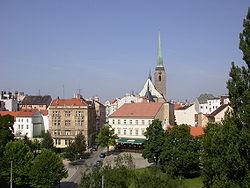 Liberec Liberec Liberec is a city in the Czech Republic. Located on the Lusatian Neisse and surrounded by the Jizera Mountains and Ještěd-Kozákov Ridge, it is the fifth-largest city in the Czech Republic.... Olomouc Olomouc Olomouc is a city in Moravia, in the east of the Czech Republic. The city is located on the Morava river and is the ecclesiastical metropolis and historical capital city of Moravia. Nowadays, it is an administrative centre of the Olomouc Region and sixth largest city in the Czech Republic... |
||||
|---|---|---|---|---|---|---|---|---|---|---|
| 1 | Prague Prague Prague is the capital and largest city of the Czech Republic. Situated in the north-west of the country on the Vltava river, the city is home to about 1.3 million people, while its metropolitan area is estimated to have a population of over 2.3 million... |
Prague, the Capital City | 1,300,108 | 2,300,000 | ||||||
| 2 | Brno Brno Brno by population and area is the second largest city in the Czech Republic, the largest Moravian city, and the historical capital city of the Margraviate of Moravia. Brno is the administrative centre of the South Moravian Region where it forms a separate district Brno-City District... |
South Moravian South Moravian Region South Moravian Region is an administrative unit of the Czech Republic, located in the south-western part of its historical region of Moravia, with exception of Jobova Lhota, that belongs to Bohemia. Its capital is Brno the 2nd largest city of the Czech Republic. The region is famous for its wine... |
450,820 | 810,000 | ||||||
| 3 | Ostrava Ostrava Ostrava is the third largest city in the Czech Republic and the second largest urban agglomeration after Prague. Located close to the Polish border, it is also the administrative center of the Moravian-Silesian Region and of the Municipality with Extended Competence. Ostrava was candidate for the... |
Moravian-Silesian Moravian-Silesian Region Moravian-Silesian Region , or Moravo-Silesian Region, is one of 14 administrative Regions of the Czech Republic, until May 2001 it was formerly called the Ostrava Region . The region is located in the north-eastern part of its historical region of Moravia and in most of the Czech part of the... |
321,026 | 1,164,328 | ||||||
| 4 | Plzeň | Plzeň Plzen Region Plzeň Region is an administrative unit in the western part of Bohemia in the Czech Republic. It is named after its capital Plzeň .- Communes :... |
177,127 | 380,000 | ||||||
| 5 | Liberec Liberec Liberec is a city in the Czech Republic. Located on the Lusatian Neisse and surrounded by the Jizera Mountains and Ještěd-Kozákov Ridge, it is the fifth-largest city in the Czech Republic.... |
Liberec Liberec Region Liberec Region is an administrative unit of the Czech Republic, located in the northernmost part of its historical region of Bohemia. Region borders with Saxony, and Poland... |
104,964 | 270,000 | ||||||
| 6 | Olomouc Olomouc Olomouc is a city in Moravia, in the east of the Czech Republic. The city is located on the Morava river and is the ecclesiastical metropolis and historical capital city of Moravia. Nowadays, it is an administrative centre of the Olomouc Region and sixth largest city in the Czech Republic... |
Olomouc Olomouc Region Olomouc Region is an administrative unit of the Czech Republic, located in the north-western and central part of its historical region of Moravia and in a small part of the historical region of Silesia . It is named for its capital Olomouc.-External links:* *... |
101,785 | 480,000 | ||||||
| 7 | Ústí nad Labem Ústí nad Labem Ústí nad Labem is a city of the Czech Republic, in the Ústí nad Labem Region. The city is the 7th-most populous in the country.Ústí is situated in a mountainous district at the confluence of the Bílina and the Elbe Rivers, and, besides being an active river port, is an important railway junction... |
Ústí nad Labem Ústí nad Labem Region Ústí nad Labem Region is an administrative unit of the Czech Republic, located in the north-western part of its historical region of Bohemia... |
100,504 | |||||||
| 8 | České Budějovice Ceské Budejovice České Budějovice is a city in the Czech Republic. It is the largest city in the South Bohemian Region and is the political and commercial capital of the region and centre of the Roman Catholic Diocese of České Budějovice and of the University of South Bohemia and the Academy of Sciences... |
South Bohemian South Bohemian Region South Bohemian Region is an administrative unit of the Czech Republic, located mostly in the southern part of its historical land of Bohemia, with a small part in southwestern Moravia... |
100,043 | |||||||
| 9 | Hradec Králové Hradec Králové Hradec Králové is a city of the Czech Republic, in the Hradec Králové Region of Bohemia. The city's economy is based on food-processing technology, photochemical, and electronics manufacture. Traditional industries include musical instrument manufacturing – the best known being PETROF pianos... |
Hradec Králové Hradec Králové Region Hradec Králové Region is an administrative unit of the Czech Republic, located in the north-eastern part of its historical region of Bohemia. It is named after its capital Hradec Králové.... |
95,485 | |||||||
| 10 | Pardubice Pardubice Pardubice is the capital city of the Pardubice Region and lies on the river Elbe, 65 miles east of Prague. Pardubice has an antique centre square and old town, with many restaurants that stay open until late in the evening. There is an old Tower and a recently renovated Castle... |
Pardubice Pardubice Region Pardubice Region is an administrative unit of the Czech Republic, located mainly in the eastern part of its historical region of Bohemia, with a small part in northwestern Moravia. It is named after its capital Pardubice. "There are a total of 452 municipalities in the region... |
94,725 | |||||||
| 11 | Havířov Havírov Havířov is a city in the Karviná District, Moravian-Silesian Region of the Czech Republic. It has 82,768 inhabitants, making it the second-largest city in the region. It is the largest town in the country without a university... |
Moravian-Silesian Moravian-Silesian Region Moravian-Silesian Region , or Moravo-Silesian Region, is one of 14 administrative Regions of the Czech Republic, until May 2001 it was formerly called the Ostrava Region . The region is located in the north-eastern part of its historical region of Moravia and in most of the Czech part of the... |
83,083 | |||||||
| 12 | Zlín Zlín Zlín , from 1949 to 1989 Gottwaldov , is a city in the Zlín Region, southeastern Moravia, Czech Republic, on the Dřevnice River. The development of the modern city is closely connected to the Bata Shoes company... |
Zlín Zlín Region Zlín Region is an administrative unit of the Czech Republic, located in the central-eastern part of the historical region of Moravia. It is named after its capital Zlín.... |
80,866 | 450 000 | ||||||
| 13 | Kladno Kladno Kladno is a city in the Central Bohemian Region of the Czech Republic. It is located 25 km northwest of Prague. Kladno is the largest city of the region and holds a population together with its adjacent suburban areas of more than 110,000 people... |
Central Bohemian Central Bohemian Region Central Bohemian Region is an administrative unit of the Czech Republic, located in the central part of its historical region of Bohemia. Its administrative center is placed in the Czech capital Prague , which lies in the center of the region... |
74,721 | |||||||
| 14 | Most Most Most is the capital city of the Most District, situated between the Czech Central Mountains and the Ore Mountains, approximately northwest of Prague along the Bílina River and southwest of Ústí nad Labem.-Etymology:... |
Ústí nad Labem Ústí nad Labem Region Ústí nad Labem Region is an administrative unit of the Czech Republic, located in the north-western part of its historical region of Bohemia... |
68,967 | |||||||
| 15 | Karviná Karviná Karviná is a city in Moravian-Silesian Region of the Czech Republic, on the Olza River. It is administrative center of Karviná District. Karviná lies in the historical region of Cieszyn Silesia and is one of the most important coal mining centers in the Czech Republic. Together with neighboring... |
Moravian-Silesian Moravian-Silesian Region Moravian-Silesian Region , or Moravo-Silesian Region, is one of 14 administrative Regions of the Czech Republic, until May 2001 it was formerly called the Ostrava Region . The region is located in the north-eastern part of its historical region of Moravia and in most of the Czech part of the... |
64,614 | |||||||
| 16 | Opava Opava Opava is a city in the northern Czech Republic on the river Opava, located to the north-west of Ostrava. The historical capital of Czech Silesia, Opava is now in the Moravian-Silesian Region and has a population of 59,843 as of January 1, 2005.... |
Moravian-Silesian Moravian-Silesian Region Moravian-Silesian Region , or Moravo-Silesian Region, is one of 14 administrative Regions of the Czech Republic, until May 2001 it was formerly called the Ostrava Region . The region is located in the north-eastern part of its historical region of Moravia and in most of the Czech part of the... |
61,525 | |||||||
| 17 | Frýdek-Místek Frýdek-Místek Frýdek-Místek is a city in Moravian-Silesian Region of the Czech Republic. It is the administrative center of Frýdek-Místek District. It comprises two formerly independent towns, Frýdek and Místek, divided by the Ostravice River... |
Moravian-Silesian Moravian-Silesian Region Moravian-Silesian Region , or Moravo-Silesian Region, is one of 14 administrative Regions of the Czech Republic, until May 2001 it was formerly called the Ostrava Region . The region is located in the north-eastern part of its historical region of Moravia and in most of the Czech part of the... |
59,264 | |||||||
| 18 | Karlovy Vary Karlovy Vary Karlovy Vary is a spa city situated in western Bohemia, Czech Republic, on the confluence of the rivers Ohře and Teplá, approximately west of Prague . It is named after King of Bohemia and Holy Roman Emperor Charles IV, who founded the city in 1370... |
Karlovy Vary | 55,219 | |||||||
| 19 | Děčín Decín Děčín is a town in the Ústí nad Labem Region in the north of the Czech Republic. It is the largest town and administrative seat of the Děčín District.-Geography:... |
Ústí nad Labem Ústí nad Labem Region Ústí nad Labem Region is an administrative unit of the Czech Republic, located in the north-western part of its historical region of Bohemia... |
51,878 | |||||||
| 20 | Jihlava Jihlava Jihlava is a city in the Czech Republic. Jihlava is a centre of the Vysočina Region, situated on the Jihlava river on the ancient frontier between Moravia and Bohemia, and is the oldest mining town in the Czech Republic, ca. 50 years older than Kutná Hora.Among the principal buildings are the... |
Vysočina Vysocina Region Vysočina Region , is an administrative unit of the Czech Republic, located partly in the south-eastern part of the historical region of Bohemia and partly in the south-west of the historical region of Moravia... |
51,160 | |||||||
| 1991 | 2001 | change |
|||
|---|---|---|---|---|---|
| number | % | number | % | ||
| no religion | 4,112,864 | 39.9 | 6,039,991 | 59.0 | +46.9% |
| Roman Catholic Church | 4,021,385 | 39.0 | 2,740,780 | 26.8 | −31.8% |
| not identified | 1,665,617 | 16.2 | 901,981 | 8.8 | −45.8% |
| Evangelical Church of Czech Brethren | 203,996 | 2.0 | 117,212 | 1.1 | −42.5% |
| Czechoslovak Hussite Church | 178,036 | 1.7 | 99,103 | 1.0 | −44.3% |
| total population | 10,302,215 | 100.0 | 10,230,060 | 100.0 | −0.7% |
Religion
The Czech Republic has one of the least religious populations on Earth. Historically, the Czech people have been characterised as "tolerant and even indifferent towards religion". According to the 2001 census, 59% of the country is agnosticAgnosticism
Agnosticism is the view that the truth value of certain claims—especially claims about the existence or non-existence of any deity, but also other religious and metaphysical claims—is unknown or unknowable....
, atheist
Atheism
Atheism is, in a broad sense, the rejection of belief in the existence of deities. In a narrower sense, atheism is specifically the position that there are no deities...
or irreligious
Irreligion by country
Irreligion varies in the different countries around the world....
, 26.8% is Roman Catholic and 2.5% is Protestant
Protestantism
Protestantism is one of the three major groupings within Christianity. It is a movement that began in Germany in the early 16th century as a reaction against medieval Roman Catholic doctrines and practices, especially in regards to salvation, justification, and ecclesiology.The doctrines of the...
. From 1991 to 2001, the number of people identifying with no religion increased by 19.1%, or two million people, representing the largest group increase. Adherence to Christianity decreased by over one million persons.
According to a Eurobarometer Poll
Eurobarometer
Eurobarometer is a series of surveys regularly performed on behalf of the European Commission since 1973. It produces reports of public opinion of certain issues relating to the European Union across the member states...
in 2005, 19% of Czech citizens responded that "they believe there is a God" (the second lowest rate among European Union countries after Estonia
Estonia
Estonia , officially the Republic of Estonia , is a state in the Baltic region of Northern Europe. It is bordered to the north by the Gulf of Finland, to the west by the Baltic Sea, to the south by Latvia , and to the east by Lake Peipsi and the Russian Federation . Across the Baltic Sea lies...
with 16%), whereas 50% answered that "they believe there is some sort of spirit or life force" and 30% said that "they do not believe there is any sort of spirit, God or life force".
Music
Music in the Czech Republic has its roots in more than 1,000 year old sacred music (the first surviving references come from the end of the 10th century), in the traditionalTraditional music
Traditional music is the term increasingly used for folk music that is not contemporary folk music. More on this is at the terminology section of the World music article...
folk music of Bohemia
Bohemia
Bohemia is a historical region in central Europe, occupying the western two-thirds of the traditional Czech Lands. It is located in the contemporary Czech Republic with its capital in Prague...
, Moravia
Moravia
Moravia is a historical region in Central Europe in the east of the Czech Republic, and one of the former Czech lands, together with Bohemia and Silesia. It takes its name from the Morava River which rises in the northwest of the region...
and Silesia
Silesia
Silesia is a historical region of Central Europe located mostly in Poland, with smaller parts also in the Czech Republic, and Germany.Silesia is rich in mineral and natural resources, and includes several important industrial areas. Silesia's largest city and historical capital is Wrocław...
and in the long-term high-culture classical music tradition. Since the early eras of artificial music, Czech musicians and composers have often been influenced by genuine folk music. Notable Czech composers include Adam Michna, Jan Dismas Zelenka
Jan Dismas Zelenka
Jan Dismas Zelenka , baptised Jan Lukáš Zelenka and previously also known as Johann Dismas Zelenka, was the most important Czech Baroque composer, whose music was notably daring with outstanding harmonic invention and mastery of counterpoint.- Life :Zelenka was born in Louňovice pod Blaníkem, a small...
, Josef Mysliveček
Josef Myslivecek
Josef Mysliveček was a Czech composer who contributed to the formation of late eighteenth-century classicism in music...
, Bedřich Smetana
Bedrich Smetana
Bedřich Smetana was a Czech composer who pioneered the development of a musical style which became closely identified with his country's aspirations to independent statehood. He is thus widely regarded in his homeland as the father of Czech music...
, Leoš Janáček
Leoš Janácek
Leoš Janáček was a Czech composer, musical theorist, folklorist, publicist and teacher. He was inspired by Moravian and all Slavic folk music to create an original, modern musical style. Until 1895 he devoted himself mainly to folkloristic research and his early musical output was influenced by...
, Antonín Dvořák
Antonín Dvorák
Antonín Leopold Dvořák was a Czech composer of late Romantic music, who employed the idioms of the folk music of Moravia and his native Bohemia. Dvořák’s own style is sometimes called "romantic-classicist synthesis". His works include symphonic, choral and chamber music, concerti, operas and many...
, Bohuslav Martinů
Bohuslav Martinu
Bohuslav Martinů was a prolific Czech composer of modern classical music. He was of Czech and Rumanian ancestry. Martinů wrote six symphonies, 15 operas, 14 ballet scores and a large body of orchestral, chamber, vocal and instrumental works. Martinů became a violinist in the Czech Philharmonic...
, Erwin Schulhoff
Erwin Schulhoff
Erwin Schulhoff was a Czech composer and pianist.-Life:Born in Prague of Jewish-German origin, Schulhoff was one of the brightest figures in a generation of European musicians whose successful careers were prematurely terminated by the rise of the Nazi regime in Germany...
and Petr Eben
Petr Eben
Petr Eben was a Czech composer of modern and contemporary classical music.-His life:Born in Žamberk in northeastern Bohemia, Eben spent his youth in Český Krumlov in southern Bohemia. There he studied piano, and later cello and organ...
. The most famous music festival is "the Prague Spring" ( Pražské jaro), that has been organized annually since 1946.
Literature
Czech literatureCzech literature
Czech literature is the literature written by Czechs or other inhabitants of the Czech state, mostly in the Czech language, although other languages like Old Church Slavonic, Latin or German have been also used, especially in the past. Modern authors from the Czech territory who wrote in other...
is the literature written by Czechs or other inhabitants of the Czech state, mostly in the Czech language
Czech language
Czech is a West Slavic language with about 12 million native speakers; it is the majority language in the Czech Republic and spoken by Czechs worldwide. The language was known as Bohemian in English until the late 19th century...
, although other languages like Old Church Slavonic
Old Church Slavonic
Old Church Slavonic or Old Church Slavic was the first literary Slavic language, first developed by the 9th century Byzantine Greek missionaries Saints Cyril and Methodius who were credited with standardizing the language and using it for translating the Bible and other Ancient Greek...
, Latin
Latin
Latin is an Italic language originally spoken in Latium and Ancient Rome. It, along with most European languages, is a descendant of the ancient Proto-Indo-European language. Although it is considered a dead language, a number of scholars and members of the Christian clergy speak it fluently, and...
or German have been also used, especially in the past. Czech authors who had written in the German language, such as Franz Kafka
Franz Kafka
Franz Kafka was a culturally influential German-language author of short stories and novels. Contemporary critics and academics, including Vladimir Nabokov, regard Kafka as one of the best writers of the 20th century...
, are usually excluded from the corpus of Czech literature, regardless of their own national self-identification.
Czech literature is divided into several main time periods: the Middle Ages; the Hussite period; the years of re-Catholicization and the baroque; the Enlightenment and Czech reawakening in the 19th century; the avantgarde of the interwar period; the years under Communism and the Prague Spring; and the literature of the post-Communist Czech Republic. Czech literature and culture played a major role on at least two occasions, when Czechs lived under oppression and political activity was suppressed. On both of these occasions, in the early 19th century and then again in the 1960s, the Czechs used their cultural and literary effort to strive for political freedom, establishing a confident, politically aware nation.
Theatre
Theatre of the Czech RepublicTheatre of the Czech Republic
Theatre of the Czech Republic has rich tradition in all genres, including drama, opera, ballet and dance, puppet theatre, black light theatre etc.-History:...
has rich tradition with roots in the Middle Ages. In the 19th century, the theatre played an important role in the national awakening movement and later, in the 20th century it became a part of the modern European theatre art.
Cuisine
Trout
Trout is the name for a number of species of freshwater and saltwater fish belonging to the Salmoninae subfamily of the family Salmonidae. Salmon belong to the same family as trout. Most salmon species spend almost all their lives in salt water...
and carp
Carp
Carp are various species of oily freshwater fish of the family Cyprinidae, a very large group of fish native to Europe and Asia. The cypriniformes are traditionally grouped with the Characiformes, Siluriformes and Gymnotiformes to create the superorder Ostariophysi, since these groups have certain...
, which is served at Christmas.
Czech beer
Czech beer
Beer in the Czech Republic has a long and important history. The first brewery is known to have existed in 1118. The city of Brno had the right to brew beer from the 12th century, and the two cities most associated with Czech beer, Plzeň and České Budějovice , had breweries in the 13th...
has a long and important history. The first brewery is known to have existed in 1118 and the Czech Republic has the highest beer consumption per capita in the world. The famous Pilsener
Pilsener
Pilsner is a type of pale lager. It takes its name from the city of Pilsen , Bohemia, in today's Czech Republic, where it has been developed since 1842, when a bottom-fermented beer was first produced. The original Pilsner Urquell beer is produced there today.-Origin:Until the mid-1840s, most ...
style beer originated in the western Bohemian city of Plzeň, and further south the town of Budweis lent its name to its beer, eventually known as Budweiser Bier Bürgerbräu
Budweiser Bier Bürgerbräu
' or ' was the name for the beer and the administration of the "" , which in 1795 was founded by the German-speaking burghers of the Bohemian city of Budweis in the Kingdom of Bohemia)...
thus Budweiser Budvar. Tourism is slowly growing around the Southern Moravian region too, which has been producing wine since the Middle Ages; about 94% of vineyard
Vineyard
A vineyard is a plantation of grape-bearing vines, grown mainly for winemaking, but also raisins, table grapes and non-alcoholic grape juice...
s in Czech Republic are Moravian. Aside from Slivovitz
Slivovitz
Slivovitz or Slivovitsais a distilled beverage made from Damson plums. It is frequently called plum brandy, and in the Balkans is part of the category of drinks called rakia...
, Czech beer
Czech beer
Beer in the Czech Republic has a long and important history. The first brewery is known to have existed in 1118. The city of Brno had the right to brew beer from the 12th century, and the two cities most associated with Czech beer, Plzeň and České Budějovice , had breweries in the 13th...
and wine
Czech wine
Wine in the Czech Republic is produced mainly in southern Moravia, although a few vineyards are located in Bohemia. However, Moravia accounts for around 96% of the country's vineyards, which is why Czech wine is more often referred to as Moravian wine ...
, the Czechs also produce two uniquely Czech liquors, Fernet Stock
Fernet Stock
Fernet Stock is a herbal bitters made in Plzeň-Božkov, Czech Republic and in Trieste, Italy. It is flavoured with approximately 14 herbs, imported from the Mediterranean and the Alps...
and Becherovka
Becherovka
Becherovka is a herbal bitters that is produced in Karlovy Vary, Czech Republic, by the Jan Becher company. The brand is owned by Pernod Ricard....
. Kofola
Kofola
Kofola is a carbonated soft drink produced in the Czech Republic and Slovakia. It is the principal rival of Coca-Cola and Pepsi in these two markets.- History :...
is a non-alcoholic domestic cola
Cola
Cola is a carbonated beverage that was typically flavored by the kola nut as well as vanilla and other flavorings, however, some colas are now flavored artificially. It became popular worldwide after druggist John Pemberton invented Coca-Cola in 1886...
soft drink
Soft drink
A soft drink is a non-alcoholic beverage that typically contains water , a sweetener, and a flavoring agent...
which competes with Coca Cola and Pepsi
Pepsi
Pepsi is a carbonated soft drink that is produced and manufactured by PepsiCo...
in popularity.
Two unique Czech dishes are vepřo-knedlo-zelo and svíčková na smetaně
Svícková
Svíčková, or svíčková na smetaně is a typical and one of the most popular Czech meals. It is made of vegetables , spiced with black pepper, allspice, bay leaf and thyme and boiled with double cream...
. Czech desserts are not particularly sweet, and frequently contain poppy seeds.
Sports
Sports play a part in the life of many Czechs, who are generally loyal supporters of their favourite teams or individuals. The two leading sports in the Czech Republic are football (soccer) and ice hockeyIce hockey
Ice hockey, often referred to as hockey, is a team sport played on ice, in which skaters use wooden or composite sticks to shoot a hard rubber puck into their opponent's net. The game is played between two teams of six players each. Five members of each team skate up and down the ice trying to take...
, both drawing the largest attention of both the media and supporters. Tennis is also a very big sport in the Czech Republic. The many other sports with professional leagues and structures include basketball, volleyball, team handball
Team handball
Handball is a team sport in which two teams of seven players each pass a ball to throw it into the goal of the other team...
, track and field athletics and floorball
Floorball
Floorball, a type of floor hockey, is an indoor team sport which was developed in the 1970s in Sweden. Floorball is most popular in areas where the sport has developed the longest, such as the Czech Republic, Denmark, Estonia, Finland, Latvia, Norway, Sweden and Switzerland. The game is played...
. The Czech ice hockey team won the gold medal at the 1998 Winter Olympics
1998 Winter Olympics
The 1998 Winter Olympics, officially the XVIII Olympic Winter Games, was a winter multi-sport event celebrated from 7 to 22 February 1998 in Nagano, Japan. Seventy-two nations and 2,176 participans contested in seven sports and 72 events at 15 venues. The games saw the introduction of Women's ice...
and won three straight gold medals at the world championships from 1999
1999 Men's World Ice Hockey Championships
-World Championship Group C:Played at Eindhoven and Tilburg, Netherlands April 5–11. Yugoslavia was supposed to particpate in this tournament, but was prevented by the host Dutch government.-Group 1:-Group 2:-Final Round 25-28 Place:...
to 2001
2001 Men's World Ice Hockey Championships
-Championship:Final standings# # # # # # # # # # # # # # — relegated to Division I for 2002# — relegated to Division I for 2002# - Group A :Group A was played in Grenoble, France between April 16 and April 22, 2001...
and at the 1996
1996 Men's World Ice Hockey Championships
- Group 2 :- Quarterfinals :- Consolation Round 11-12 Place :Austria was relegated to Group B.- Semifinals :- Match for third place :- Final :-World Championship Group B :...
, 2005
2005 Men's World Ice Hockey Championships
The 2005 Men's Ice Hockey Championships were held March 7 - May 15, 2005, in 7 cities in 6 countries: Vienna and Innsbruck, Austria ; Debrecen, Hungary ; Eindhoven, the Netherlands ; Zagreb, Croatia ; Belgrade, Serbia and Montenegro ; Mexico City, Mexico...
and 2010
2010 IIHF World Championship
The 2010 IIHF World Championship was the 74th IIHF World Championship, an annual international ice hockey tournament. It took place between 7 and 23 May 2010 in Germany. The games were played in the Lanxess Arena in Cologne, SAP Arena in Mannheim, and one game at Veltins-Arena in Gelsenkirchen...
tournaments. In total achieved 59 in summer
Summer Olympic Games
The Summer Olympic Games or the Games of the Olympiad are an international multi-sport event, occurring every four years, organized by the International Olympic Committee. Medals are awarded in each event, with gold medals for first place, silver for second and bronze for third, a tradition that...
and 7 in winter
Winter Olympic Games
The Winter Olympic Games is a sporting event, which occurs every four years. The first celebration of the Winter Olympics was held in Chamonix, France, in 1924. The original sports were alpine and cross-country skiing, figure skating, ice hockey, Nordic combined, ski jumping and speed skating...
gold medals in all-time Olympic Games history (ČR+Czechoslovakia).
Sport is a source of strong waves of patriotism
Patriotism
Patriotism is a devotion to one's country, excluding differences caused by the dependencies of the term's meaning upon context, geography and philosophy...
, usually rising several days or weeks before an event. The events considered the most important by Czech fans are: the Ice Hockey World Championships
Ice Hockey World Championships
The Ice Hockey World Championships are an annual ice hockey tournament organized by the International Ice Hockey Federation . First officially held at the 1920 Summer Olympics, it is the sport's highest profile annual international tournament. The IIHF was created in 1908 while the European...
, Olympic Ice hockey tournament, UEFA European Football Championship
UEFA European Football Championship
The UEFA European Football Championship is the main football competition of the men's national football teams governed by UEFA . Held every four years since 1960, in the even-numbered year between World Cup tournaments, it was originally called the UEFA European Nations Cup, changing to the current...
, FIFA World Cup
FIFA World Cup
The FIFA World Cup, often simply the World Cup, is an international association football competition contested by the senior men's national teams of the members of Fédération Internationale de Football Association , the sport's global governing body...
and qualification matches for such events. In general, any international match of the Czech ice hockey or football national team draws attention, especially when played against a traditional rival: Germany
Germany
Germany , officially the Federal Republic of Germany , is a federal parliamentary republic in Europe. The country consists of 16 states while the capital and largest city is Berlin. Germany covers an area of 357,021 km2 and has a largely temperate seasonal climate...
and Netherlands
Netherlands
The Netherlands is a constituent country of the Kingdom of the Netherlands, located mainly in North-West Europe and with several islands in the Caribbean. Mainland Netherlands borders the North Sea to the north and west, Belgium to the south, and Germany to the east, and shares maritime borders...
in football; Russia
Russia
Russia or , officially known as both Russia and the Russian Federation , is a country in northern Eurasia. It is a federal semi-presidential republic, comprising 83 federal subjects...
, Finland
Finland
Finland , officially the Republic of Finland, is a Nordic country situated in the Fennoscandian region of Northern Europe. It is bordered by Sweden in the west, Norway in the north and Russia in the east, while Estonia lies to its south across the Gulf of Finland.Around 5.4 million people reside...
, Sweden
Sweden
Sweden , officially the Kingdom of Sweden , is a Nordic country on the Scandinavian Peninsula in Northern Europe. Sweden borders with Norway and Finland and is connected to Denmark by a bridge-tunnel across the Öresund....
, United States
United States
The United States of America is a federal constitutional republic comprising fifty states and a federal district...
, and Canada
Canada
Canada is a North American country consisting of ten provinces and three territories. Located in the northern part of the continent, it extends from the Atlantic Ocean in the east to the Pacific Ocean in the west, and northward into the Arctic Ocean...
in ice hockey; and Slovakia
Slovakia
The Slovak Republic is a landlocked state in Central Europe. It has a population of over five million and an area of about . Slovakia is bordered by the Czech Republic and Austria to the west, Poland to the north, Ukraine to the east and Hungary to the south...
in both. Matches against Germany
Germany
Germany , officially the Federal Republic of Germany , is a federal parliamentary republic in Europe. The country consists of 16 states while the capital and largest city is Berlin. Germany covers an area of 357,021 km2 and has a largely temperate seasonal climate...
and Russia
Russia
Russia or , officially known as both Russia and the Russian Federation , is a country in northern Eurasia. It is a federal semi-presidential republic, comprising 83 federal subjects...
possess an additional element of rivalry due to historically political friction, while matches against Slovakia
Slovakia
The Slovak Republic is a landlocked state in Central Europe. It has a population of over five million and an area of about . Slovakia is bordered by the Czech Republic and Austria to the west, Poland to the north, Ukraine to the east and Hungary to the south...
are in large part considered significant because the two countries had been united prior to their separation from each other in the 1993. The Czech Republic also has great influence on tennis with such players as, Ivan Lendl
Ivan Lendl
Ivan Lendl is a former world no. 1 professional tennis player. Originally from Czechoslovakia, Lendl became a United States citizen. He was one of the game's most dominant players in the 1980s and remained a top competitor into the early 1990s. He is considered to be one of the greatest tennis...
, 8 times Grand Slam singles champion, 2010 Wimbledon Championships - Men's Singles finalist Tomáš Berdych
Tomáš Berdych
Tomáš Berdych is a professional tennis player from the Czech Republic. His most notable achievements are reaching the final of the 2010 Wimbledon Championships, and the semifinals of the 2010 French Open. He defeated the Croatian player Ivan Ljubičić in five sets to win the Paris Masters in 2005...
, 2011 Wimbledon Championships - Women's Singles champion, Petra Kvitova
Petra Kvitová
Petra Kvitová is a Czech professional tennis player. She has won seven WTA singles titles. As of 31 October 2011, she is ranked World No. 2. Kvitová won the 2011 Wimbledon Championships and the 2011 WTA Tour Championships singles titles...
, 1998 Wimbledon Women's Singles title Jana Novotná
Jana Novotná
Jana Novotná is a former professional tennis player from the Czech Republic. She played a serve and volley game, an increasingly rare style of play among women during her career. She won the women's singles title at Wimbledon in 1998 and was runner-up in three previous Grand Slam tournaments...
, 2011 Wimbledon Championships – Women's Doubles
2011 Wimbledon Championships – Women's Doubles
Vania King and Yaroslava Shvedova were the defending champions, but lost to Sabine Lisicki and Samantha Stosur in the second round.Květa Peschke and Katarina Srebotnik won this event, defeating Lisicki and Stosur in the final 6–3, 6–1. It was the 1st Grand Slam title for the veteran couple, and...
champion Květa Peschke
Kveta Peschke
Květoslava Peschke, also known as Květa Peschkeová is a professional female tennis player from the Czech Republic. She plays mostly on the baseline, with her best shot being the forehand. Her favourite surfaces are hard court and carpet...
and 18 time Grand Slam Champion Martina Navratilova.
See also
- Atlas of Europe
- Beer in the Czech Republic
- Bohemian glassBohemian glassBohemian glass, or Bohemia crystal, is a decorative glass produced in regions of Bohemia and Silesia, now in the current state of the Czech Republic, since the 13th century. Oldest archaeology excavations of glass-making sites date to around 1250 and are located in the Lusatian Mountains of...
- Cinema of the Czech RepublicCinema of the Czech RepublicThe Czech Republic was a seedbed for many acclaimed film directors.Three Czech/Czechoslovak movies that won the Academy Award for Best Foreign Language Film were The Shop on Main Street by Ján Kadár and Elmar Klos in 1965, Closely Watched Trains by Jiří Menzel in 1967 and...
- Communications in the Czech RepublicCommunications in the Czech RepublicTelephones - main lines in use:2.888 million Telephones - mobile cellular:13.075 million Telephone system:domestic:...
- Karlovy Vary International Film FestivalKarlovy Vary International Film FestivalThe Karlovy Vary International Film Festival is a film festival held annually in July in Karlovy Vary , Czech Republic. The Karlovy Vary Festival gained worldwide recognition over the past years and has become one of Europe's major film events....
- Museum of Decorative Arts in PragueMuseum of Decorative Arts in PragueFounded in 1885, the Museum of Decorative Arts in Prague is housed in a Neo-Renaissance edifice built in 1897–1901 after the designs of architect Josef Schulz. The Museum’s rich collections include decorative and applied arts and design work ranging from Late Antiquity to the present day, with...
- National Theatre (Prague)National Theatre (Prague)The National Theatre in Prague is known as the Alma Mater of Czech opera, and as the national monument of Czech history and art.The National Theatre belongs to the most important Czech cultural institutions, with a rich artistic tradition which was created and maintained by the most distinguished...
- Public holidays in the Czech RepublicPublic holidays in the Czech RepublicPublic holidays in the Czech RepublicDateEnglish NameCzech NameRemarks1 January Restoration Day of the Independent Czech State; New Year's DayDen obnovy samostatného českého státu; Nový rokThe independent Czech Republic was created in 1993, after dissolution of Czechoslovakia.March, AprilEaster...
- Spa towns in the Czech RepublicSpa towns in the Czech RepublicThere are number of spa towns in the Czech Republic. Between the oldest and most visited are the spas of Karlovy Vary, Františkovy Lázně and Teplice.List of spa towns:* Bílina* Bludov* Františkovy Lázně...
- Television in the Czech RepublicTelevision in the Czech RepublicTelevision was introduced in Czechoslovakia in 1953.Experimental projects with DVB-T started in 2000. Finally on 21 October 2005, multiplex A was launched with 3 channels of Česká televize and one of TV Nova and radio channels of Český rozhlas....
Lists:
- List of cities in the Czech Republic
- List of Czech musical groups
- List of Czech Republic-related topics
- List of postal codes in the Czech Republic
- List of twin towns and sister cities in the Czech Republic
- Lists of Czechs
- List of airports in the Czech Republic
External links
Government
- Governmental website.
- Presidential website.
- Portal of the Public Administration.
- Chamber of Deputies.
- Senate.
- Chief of State and Cabinet Members.
General information
- Czech Republic information from the United States Department of StateUnited States Department of StateThe United States Department of State , is the United States federal executive department responsible for international relations of the United States, equivalent to the foreign ministries of other countries...
. - Portals to the World from the United States Library of CongressLibrary of CongressThe Library of Congress is the research library of the United States Congress, de facto national library of the United States, and the oldest federal cultural institution in the United States. Located in three buildings in Washington, D.C., it is the largest library in the world by shelf space and...
. - Czech Republic at UCB Libraries GovPubs.
News
Statistics
Travel
- Czech Tourism Official travel site of the Czech Republic.