


Hebron

Encyclopedia
Hebron is located in the southern West Bank
, 30 km (18.6 mi) south of Jerusalem. Nestled in the Judean Mountains
, it lies 930 meters (3,050 ft) above sea level
. It is the largest city in the West Bank
and home to around 165,000 Palestinian
s, and over 500 Jewish settlers concentrated in and around the old quarter. The city is most notable for containing the traditional burial site of the biblical Patriarchs
and Matriarchs and is therefore considered the second-holiest city in Judaism
after Jerusalem. The city is also venerated by Muslims for its association with Abraham
and was traditionally viewed as one of the "four holy cities of Islam."
Hebron is a busy hub of West Bank
trade, responsible for roughly a third of the area's gross domestic product
, largely due to the sale of marble from quarries. It is locally well known for its grapes, figs, limestone, pottery
workshops and glassblowing
factories, and is the location of the major dairy product manufacturer, al-Junaidi. The old city of Hebron is characterized by narrow, winding streets, flat-roofed stone houses, and old bazaar
s. The city is home to Hebron University
and the Palestine Polytechnic University
.
, which coalesce in the form ḥbr, having reflexes in Hebrew, Amorite
and Arabic, and denoting a range of meanings from "colleague", "unite", "friend" or "to be noisy". In the proper name Hebron, the original sense may have been alliance. In Arabic, Ibrahim al-Khalil means "Abraham the friend", according to Islam
ic teaching signifying that, God
chose Abraham as his friend. Arabic Al-Khalil thus precisely translates the ancient Hebrew toponym Ḥebron, understood as ḥaber (friend).
 Archaeological excavations reveal traces of strong fortifications dated to the Early Bronze Age
. The city was destroyed in a conflagration, and resettled in the late Middle Bronze Age. Hebron was originally a Canaan
ite royal city. Earlier, in Abraham
's day, the city is said to be under Hittite
control. In the narrative of the later Hebrew conquest, it is under Canaanite control and ruled by the three sons of Anak
, descendants of the Nephilim
(Joshua
10:5,6). The Book of Genesis mentions that it was formerly called Kirjath-arba
, or "city of four", possibly referring to the four pairs or couples who were buried there, four tribes, four quarters four hills, or a confederated settlement of four families.
Abraham's purchase of the Cave of the Patriarchs
from the Hittites
constitutes a seminal moment in the development of a Jewish attachment to the land. In settling here, Abraham is described as making his first covenant, an alliance with two local Amorite
clans who became his ba’alei brit or masters of the covenant. The Abrahamic traditions associated with Hebron are nomadic, and may also reflect a Kenite
element, since the nomadic Kenites are said to have long occupied the city, and Heber is the name for a Kenite clan.
Thereafter, Hebron is said to have been wrested from the Canaanites by either Joshua
, Judah or Caleb
. The town itself, with some contiguous pasture land, is then said to have been granted to the Levites of the clan of Kohath
, while the fields of the city, as well as its surrounding villages were assigned to Caleb, who expels the three giants, Sheshai
, Ahiman
, and Talmai
, who ruled the city. Later, the biblical narrative has King David reign from Hebron for some seven years. It is there that the elders of Israel come to him to make a covenant before Yahweh and anoint him king of Israel. It was in Hebron again that Absalom
has himself declared king and then raises a revolt against his father David. It became one of the principal centers of the Tribe of Judah
and was classified as one of the six traditional cities of refuge for the slayer
.
Hebron continued to constitute an important local economic centre, given its strategic position along trading routes, but, as is shown by the discovery of seals at Lachish
with the inscription lmlk Hebron
(to the king. Hebron), it remained administratively and politically dependent on Jerusalem.
in 167 BCE. The city appears to have long resisted Hasmonean dominance, however, and indeed as late as the First Jewish–Roman War was still considered Idumean. Herod the Great
built the wall which still surrounds the Cave of the Patriarchs
. During the first war against the Romans
, Hebron was conquered by Simon Bar Giora
, a Sicarii
leader, and burnt down by Vespasian
's officer Cerealis
. After the defeat of Simon bar Kokhba
in 135 CE, innumerable Jewish captives were sold into slavery at Hebron's Terebinth
slave-market. Eventually it became part of the Byzantine Empire
. The Byzantine emperor Justinian I
erected a Christian church over the Cave of Machpelah in the 6th century CE which was later destroyed by the Sassanid general Shahrbaraz
in 614 when Khosrau II
's armies besieged and took Jerusalem.
One Islamic tradition has it that the Prophet alighted in Hebron during his night journey
from Mecca to Jerusalem, and the mosque in the city is said to conserve one of his shoes. The Rashidun Caliphate
established rule over Hebron without resistance in 638, and converted the Byzantine church at the site of Abraham's tomb into a mosque. Trade greatly expanded, in particular with Bedouin
s in the Negev
and the population to the east of the Dead Sea
. The Jerusalem geographer al-Muqaddasi
, writing in 985 described the town as follows:
, lived in the southern Levant. The prophet Muhammad arranged for Hebron, Beit Einun
and surrounding villages to be a part of al-Dari's domain; this was implemented during Umar
's reign as caliph. According to the arrangement, al-Dari and his descendants were only permitted to tax the residents for their land and the waqf
of the Ibrahimi Mosque was entrusted to them.
The custom, known as the 'table of Abraham' (simāt al-khalil), was similar to the one established by the Fatimid
s, and in Hebron's version, it found its most famous expression. The Persian traveller Nasir-i-Khusraw
who visited Hebron in 1047 records in his Safarnama
that
lasted in the area until 1099, when the Christian Crusader Godfrey de Bouillon took Hebron and renamed it "Castellion Saint Abraham". He then gave Hebron to Gerard of Avesnes as the fief of Saint Abraham. Gerard of Avesnes was a knight from Hainault
held hostage at Arsuf
, north of Jaffa
, who had been wounded by Godfrey's own forces during the siege of the port, and later returned by the Muslims to Godfrey as a token of good will. As a Frankish
garrison of the Kingdom of Jerusalem
its defence was precarious, being 'little more than an island in a Moslem ocean'. The Crusaders converted the mosque
and the synagogue
into a church. In 1106, an Egyptian campaign thrust into southern Judea and almost succeeded the following year in wresting Hebron back from the crusaders under Baldwin I of Jerusalem
, who personally led the counter-charge to beat the Muslim forces off.
In the year 1113 during the reign of Baldwin II of Jerusalem
, according to Ali of Herat
(writing in 1173), a certain part over the cave of Abraham had given way, and "a number of Franks had made their entrance therein". And they discovered "(the bodies) of Abraham, Isaac and Jacob", "their shrouds having fallen to pieces, lying propped up against a wall...Then the King, after providing new shrouds, caused the place to be closed once more". Similar information is given in Ibn at Athir
's Chronicle under the year 1119; "In this year was opened the tomb of Abraham, and those of his two sons Isaac and Jacob ...Many people saw the Patriarch. Their limbs had nowise been disturbed, and beside them were placed lamps of gold and of silver." The Damascene
nobleman and historian Ibn al-Qalanisi
in his chronicle also alludes at this time to the discovery of relics purported to be those of Abraham, Isaac and Jacob, a discovery which excited eager curiosity among all three communities in the southern Levant, Muslim, Jewish, and Christian.
Towards the end of the period of Crusader rule, in 1166 Maimonides
visited Hebron, which he apparently thought lay east of Jerusalem, and wrote,
A royal domain, Hebron was handed over to Philip of Milly
in 1161 and joined with the Seigneurie of Transjordan
. A bishop was appointed to Hebron in 1168 and the new cathedral church of St Abraham was built in the southern part of the Haram.
In 1167 the episcopal see of Hebron
was created along with that of Kerak
and Sebastia
(the tomb of John the Baptist
).
In 1170, Benjamin of Tudela
visited the city, which he called by its Frankish name, St.Abram de Bron. He reported:
retook Hebron in 1187 – again with Jewish assistance according to one late tradition, in exchange for a letter of security allowing them to return to the city and build a synagogue there. The name of the city was changed back to Al-Khalil. A Kurd
ish quarter still existed in the town during the early period of Ottoman
rule. Richard the Lionheart
retook the city soon after. Richard of Cornwall
, brought from England to settle the dangerous feuding between Templars
and Hospitallers, whose rivalry imperiled the treaty guaranteeing regional stability stipulated with the Egyptian Sultan
As-Salih Ayyub
, managed to impose peace on the area. But soon after his departure, feuding broke out and in 1241 the Templars mounted a damaging raid on what was, by now, Muslim Hebron, in violation of agreements.
In 1260, after the Mongol raids into Palestine
, one of which touched Hebron, Sultan
Baibars
's Mamluk
rule established peace. The minaret
s were built onto the structure of the Cave of Machpelah/Ibrahami Mosque at that time. Six years later, while on pilgrimage to Hebron, Baibars promulgated an edict forbidding Christians and Jews from entering the sanctuary, and the climate became less tolerant of Jews and Christians than it had been under the prior Ayyubid
rule. The edict for the exclusion of Christians and Jews was not strictly enforced until the middle of the 14 Century and by 1490 not even Muslims were permitted to enter the underground caverns.
The mill at Artas
was built in 1307 where the profits from its income were dedicated to the Hospital in Hebron.
Many visitors wrote about Hebron over the next two centuries, among them Nachmanides (1270), Ishtori HaParchi (1322) and Rabbi Meshulam from Volterra
(1481). HaParchi in 1322 does not record any Jews in Hebron. Minute descriptions of Hebron were recorded in Stephen von Gumpenberg’s Journal (1449),by Felix Fabri
(1483) and by Mejr ed-Din It was in this period, also, that the Mamluk
Sultan
Al-Ashraf Sayf al-Din Qa'it Bay
revived the old custom of the Hebron table of Abraham, and exported it as a model for his own madrasa in Medina
. This became an immense charitable establishment near the Haram
, distributing daily some 1,200 loaves of bread to travellers of all faiths.
 The expansion of the Ottoman Empire
along the southern Mediterranean coast under sultan Selim I
coincided with the establishment of Inquisition
commissions by the Reyes Católicos
in Spain, which ended centuries of the Iberian convivencia. The ensuing expulsions of the Jews
drove many Sephardi Jews
into the Ottoman provinces, settling in Constantinople
, Salonika, Sarajevo
, Sofia
and Anatolia
. With the Holy Land incorporated into the Ottoman empire
, a slow influx of Jews performing aliyah
took place, and some Sephardi kabbalists
settled in Hebron. By 1523, a Karaite
community, consisting of 10 families, is recorded as living in Hebron, It was from them that, in 1540, Rabbi Malkiel Ashkenazi
bought a courtyard (El Cortijo) and the house of prayer which he converted to the Sephardi Abraham Avinu Synagogue
. This structure was restored in 1738 and enlarged in 1864, but the community was small. Decades later, it was still difficult to form a minyan
, or quorum of ten, for prayer. The congregation also suffered from heavy debts, almost quadrupling from 1717 to 1729. However, in 1807, a 5-dunam (5,000 m²) plot was purchased, where Hebron's wholesale market stands today.
During the Ottoman period, the dilapidated state of the patriarchs' tombs was restored to a semblance of sumptuous dignity. Ali Bey, one of the few foreigners to gain access, reported in 1807 that,
travelers to Ottoman Syria
. For example, Ulrich Jasper Seetzen
noted during his travels in Ottoman Syria
in 1808-09 that 150 persons were employed in the glass industry in Hebron, while later, in 1844, Robert Sears wrote that Hebron's population of 400 Arab families "manufactured glass lamps, which are exported to Egypt
. Provisions are abundant, and there is a considerable number of shops."
Early 19th century travellers also remarked on Hebron's flourishing agriculture. Apart from glassware, it was a major exporter of dibse, grape sugar, from the famous Dabookeh grapestock characteristic of Hebron.
_-_views_in_the_holy_land_-_n._428_-_hebron._northern_half_of_the_city_-_recto.jpg) In 1823, the Lubavitcher Hasidic
In 1823, the Lubavitcher Hasidic
movement established a community in Hebron.
An estimated 750 Muslims from Hebron had been drafted as soldiers, and some 500 of them were killed. In response Qasim al-Ahmad, nahiya (clan leader) of Jamma'in
near Nablus, razed the area now known as the West bank in the Palestinian Arab revolt of 1834. Hebron, headed by its nazir
Abd ar-Rahman Amr, declined to supply its quota of conscripts for the army and suffered badly in Ibrahim Pasha's
campaign to crush the ensuing uprising. The town was invested and when its defences fell on 4 August it was sacked by Ibrahim Pasha's army. Most of the Muslim population managed to flee beforehand to the hills. The Jews however remained, and during the general pillage of the town five of them were killed.
In 1838, Hebron had an estimated 1,500 taxable Muslim households, in addition to some 240 Jews, 41 of whom were tax-payers. Taxpayers consisted here of male heads of households who owned even a very small shop or piece of land. 200 Jews and one Christian household were under 'European protections'. The total population was estimated at 10,000. When the Government of Ibrahim Pasha fell in 1841, the local clan-head Abd ar-Rahman Amr once again resumed the reins of power as the Sheik of Hebron. Due to his extortionate demands for cash from the local population, most of the Jewish population fled to Jerusalem. In 1846 the Ottoman Governor-in-chief of Jerusalem (serasker), Kıbrıslı Mehmed Emin Pasha
, waged a campaign to subdue rebellious sheiks in the Hebron area, and while doing so, allowed his troops to sack the town. Though it was widely rumoured that he secretly protected Abd ar-Rahman, the latter was deported together with other local leaders (such as Muslih al-'Azza of Bayt Jibrin
), but he managed to return to the area in 1848. By 1850, the Jewish population consisted of 60 Sephardi families and a 30-year old Ashkenazi community of 50 families.
In 1855, the newly appointed Ottoman pasha
("governor") of the sanjak
("district") of Jerusalem, Kamil Pasha
, attempted to subdue the rebellion in the Hebron region. Kamil and his army marched towards Hebron in July 1855, with representatives from the English, French and other Western consulates as witnesses. After crushing all opposition, Kamil appointed Salama Amr, the brother and strong rival of Abd al Rachman, as nazir
of the Hebron region. After this relative quiet reigned in the town for the next 4 years. Hungarian Jews of the Karlin Hasidic court
settled in another part of the city in 1866. Arab-Jewish relations were good, and Alter Rivlin, who spoke Arabic and Syrian-Aramaic, was appointed Jewish representative to the city council. From 1874 the Hebron district as part of the Sanjak of Jerusalem was administered directly from Istanbul
.
Late in the 19th century the production of Hebron glass
declined due to competition from imported European glass-ware, however, the products of Hebron continued to be sold, particularly among the poorer populace and travelling Jewish traders from the city. At the World Fair of 1873 in Vienna
, Hebron was represented with glass ornaments. A report from the French consul in 1886 suggests that glass-making remained an important source of income for Hebron, with four factories earning 60,000 francs yearly.
The Jewish community was under French protection until 1914. Hebron was 'deeply Bedouin and Islamic', and 'bleakly conservative' in its religious outlook, with a strong tradition of hostility to Jews. The Jewish presence itself was divided between the traditional Sephardi community, Orthodox and anti-Zionist, whose members spoke Arabic and adopted Arab dress, and the more recent influx of Ashkenazis. They prayed in different synagogues, sent their children to different schools, lived in different quarters and did not intermarry.
n government to draft yeshiva students into the army, the Lithuanian Knesses Yisroel
relocated to Hebron, after consultations between Rabbi Nosson Tzvi Finkel, Yechezkel Sarna
and Moshe Mordechai Epstein
. The majority of the Jewish population lived on the outskirts of Hebron along the roads to Be'ersheba and Jerusalem, renting homes owned by Arabs, a number of which were built for the express purpose of housing Jewish tenants, with a few dozen within the city around the synagogues. In the 1929 Hebron massacre
, Arab rioters slaughtered some 64 to 67 Jewish men, women and children and wounded 60, and Jewish homes and synagogues were ransacked; 435 Jews survived by virtue of the shelter and assistance offered them by their Arab neighbours, who hid them. Two years later, 35 families moved back into the ruins of the Jewish quarter, but on the eve of the Palestinian Arab national revolt (April 23, 1936,) the British Government decided to move the Jewish community out of Hebron as a precautionary measure to secure its safety. The sole exception was the 8th. generation Hebronite Ya'akov ben Shalom Ezra, who processed dairy products in the city, blended in well with its social landscape and resided there under the protection of friends. In November 1947, in anticipation of the UN partition vote, the Ezra family closed its shop and left the city.
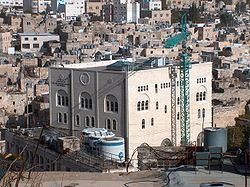 At the beginning of the 1948 Arab-Israeli War
, Egypt took control of Hebron. By late 1948 part of the Egyptian forces from Bethlehem to Hebron had been cut off from their lines of supply and Pasha Glubb
sent 350 Arab Legion
naires and an armoured car unit to Hebron to reinforce them there. When the Armistice
was signed, the city thus fell under Jordanian military control
. The day after the truce agreement Shaykh Muhamad 'Ali al-Ja'bari, Mayor of Hebron and supporter of King Abdullah I of Jordan
attended the Jericho Conference
presided over a meeting hoping to pass a resolution calling for the unification of the Palestinian West Bank and Jordan, only to find many other notables reluctant to cede their claim to Palestine.
in June 1967, Israel, according to the Allon Plan
, was to exchange parts of the West Bank
with Jordan
in a proposal for trading land for peace
, with Israel annexing 45% of the West Bank and Jordan the remainder. Allon thought settlement would determine the country's borders, and submitted to the cabinet a proposal building a Jewish settlement near Hebron. David Ben-Gurion
also considered that Hebron was the one sector of the conquered territories that should remain under Jewish control, and have a large Jewish settlement. Apart from its symbolic message to the international community, settling Hebron had a theological significance of cosmic dimensions in some quarters, in that:-
Much of the ensuing settlement was planned and financed by the Movement for Greater Israel
. Failing to obtain a green light from the government, though with Allon's consent, on Passover
in 1968, a group led by Rabbi Moshe Levinger
rented the main hotel in Hebron as Swiss tourists, with Haim Drukman
presiding over seder
, and then refused to leave. A Druze
border policeman who had assisted Levinger was shot the next day. The Labor government's survival depended on the National Religious Party
, and was reluctant to evacuate the settlers, given the massacre that occurred decades earlier. After heavy lobbying by Levinger, the settlement gained the tacit support of Levi Eshkol
and Yigal Allon
, while it was opposed by Abba Eban
and Pinhas Sapir. After more than a year and a half of agitation, and a bloody attack during Sukkot
(October 9, 1968), in which a grenade was thrown, apparently by a Hebron boy, onto the mosque stairs wounding 47 Israeli and foreign visitors, the government agreed to legitimize Levinger's wildcat settlement by establishing a town on the outskirts of the city. in an abandoned military base, which was named Kiryat Arba
, 'as if to make the place instantly ancient.' In 1979, a group of settlers led by Miriam Levinger moved into the Dabouia, or former Hadassah Hospital, now Beit Hadassah, in central Hebron, and founded the Committee of The Jewish Community of Hebron
near the Abraham Avinu Synagogue. The take-over created severe conflict with Arab shopkeepers in the same area, who appealed twice to the Israeli Supreme Court, without success. With this precedent, in February of the following year, the Government legitimized residency in the city of Hebron proper. The pattern of settlement followed by an outbreak of hostilities with local Palestinians was repeated later at Tel Rumeida
. The most violent episode occurred on the 2 May 1980 when 6 yeshiva students died, on the way home from Sabbath prayer at the Tomb of the Patriarchs, in a grenade and firearm attack. The event provided a major motivation for settlers near Hebron to join the Jewish Underground.
Supporters of Jewish resettlement within Hebron see their program as the reclamation of an important heritage dating back to Biblical times, which was dispersed or, it is argued, stolen by Arabs after the massacre of 1929. The purpose of settlement is to return to the 'land of our forefathers', and the Hebron model of reclaiming sacred sites in Palestinian territories has pioneered a pattern for settlers in Bethlehem and Nablus. Many reports, foreign and Israeli, are sharply critical of the settlers.
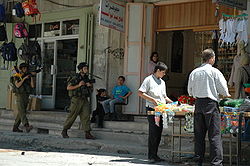 Hebron was the one city excluded from the interim agreement of September 1995 to restore rule over all Palestinian West Bank cities to the Palestinian Authority. Since The Oslo Agreement, violent episodes have recurred in the city. The Cave of the Patriarchs massacre
took place on February 25, 1994 when Baruch Goldstein
, an Israeli physician and resident of Kiryat Arba, opened fire on Muslims at prayer in the Ibrahimi Mosque, killing 29, and wounding 125 before the survivors overcame and killed him. This event was condemned by the Israeli Government, and the extreme right-wing Kach
party was banned as a result.
The Jewish community has been subject to attacks by Palestinian militants, especially during the periods of the Intifadas; which saw 3 fatal stabbings and 9 fatal shootings in between the first and second Intifada (0.9% of all fatalities in Israel and the West Bank) and 17 fatal shootings (9 soldiers and 8 settlers) and 2 fatalities from a bombing during the second Intifada, and thousands of rounds fired on it from the hills above the Abu-Sneina and Harat al-Sheikh neighbourhoods. 12 Israeli soldiers were killed (Hebron Brigade commander Colonel Dror Weinberg and two other officers, 6 soldiers and 3 members of the security unit of Kiryat Arba) in an ambush. Two Temporary International Presence in Hebron
observers were killed by Palestinian gunmen in a shooting attack on the road to Hebron
Israeli organization B'Tselem
states that there have been "grave violations" of Palestinian human rights in Hebron because of the "presence of the settlers within the city." The organization cites regular incidents of "almost daily physical violence and property damage by settlers in the city", curfews and restrictions of movement that are "among the harshest in the Occupied Territories", and violence and by Israeli border policemen and the IDF against Palestinians who live in the city's H2 sector. According to Human Rights Watch
, Palestinian areas of Hebron are frequently subject to indiscriminate firing by the IDF, leading to many casualties. Hebron mayor Mustafa Abdel Nabi invited the Christian Peacemaker Teams
to assist the local Palestinian community in opposition to what they describe as Israeli military occupation, collective punishment, settler harassment, home demolitions and land confiscation.
An international unarmed observer force—the Temporary International Presence in Hebron
(TIPH) was subsequently established to help the normalization of the situation and to maintain a buffer between the Palestinian Arab population of the city and the Jews residing in their enclave in the old city. On February 8, 2006, TIPH temporarily left Hebron after attacks on their headquarters by some Palestinians angered by the Jyllands-Posten Muhammad cartoons controversy
. TIPH came back to Hebron a few months later.
On May 15, 2006, a member of a group who is a direct descendant of the 1929 refugees, urged the government to continue its support of Jewish settlement, and allow the return of eight families evacuated the previous January from homes they set up in emptied shops near the Avraham Avinu neighborhood. Beit HaShalom
, established in 2007 under disputed circumstances, was under court orders permitting its forced evacuation. All the Jews were expelled on December 3, 2008.
Since early 1997, following the Hebron Agreement, the city has been divided into two sectors: H1 and H2. The H1 sector, home to around 120,000 Palestinians, came under the control of the Palestinian Authority
. H2, which was inhabited by around 30,000 Palestinians, remained under Israeli military control to protect several hundred Jewish residents in the old Jewish quarter.
A large drop has since taken place in the Palestinian population in H2, identified with the impact of extended curfews, strict restrictions on movement with 16 check-points in place, the closure of Palestinian commercial activities near settler areas, and settler harassment.
Survivors and descendants of that prior community are mixed. Some support the project of Jewish redevelopment, others commend living in peace with Hebronite Arabs, while a third group recommend a full pullout. Descendants supporting the latter views have met with Palestinian leaders in Hebron. In 1997 one group of descendants dissociated themselves from the settlers by calling them an obstacle to peace.
A total of 86 Jewish families now live in Hebron.
The 1994 Shamgar Commission of Inquiry concluded that Israeli authorities had consistently failed to investigate or prosecute crimes committed by settlers against Palestinians.
As a result of these restrictions, about half the shops in H2 have gone out of business since 1994, in spite of UN efforts to pay shopkeepers to stay in business. Palestinians cannot approach near where the settlers live without special permits from the IDF.
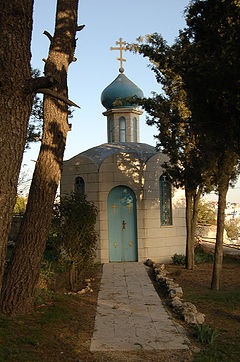
. The site is holy to Judaism
, Christianity
and Islam
. According to Genesis, Abraham purchased the cave and the field surrounding it from Ephron the Hittite
to bury his wife Sarah
; Abraham, Isaac
, Rebecca
, Jacob
and Leah
were later buried in the cave. Thus, Hebron is referred to in Judaism as "the City of the Patriarchs", and regarded as one of its Four Holy Cities
. (The remaining matriarch, Rachel
, is buried outside Bethlehem
). Over and around the cave itself, churches, synagogue
s and mosque
s have since been built. The Isaac Hall is now the Ibrahimi Mosque, and the Abraham Hall and Jacob Hall serve as a Jewish synagogue. In medieval Christian tradition, Hebron was one of the three cities, along with Juttah
and Ain Karim, that boasted of being the home of Mary's cousin, Elizabeth
, the mother of John the Baptist
and wife of Zacharias
, and thus possibly the birthplace of the Baptist himself.
, also called 'The Oak of Abraham' or 'The Oak of Mamre', is an ancient tree which, in non-Jewish tradition, is said to mark the place where Abraham pitched his tent. It is estimated that this oak is approximately 5,000 years old. The Russian Orthodox Church
owns the site and the nearby monastery
.
(the commander of Saul
and David
's army), Ruth
and Jesse
are also located in the city.
West Bank
The West Bank ) of the Jordan River is the landlocked geographical eastern part of the Palestinian territories located in Western Asia. To the west, north, and south, the West Bank shares borders with the state of Israel. To the east, across the Jordan River, lies the Hashemite Kingdom of Jordan...
, 30 km (18.6 mi) south of Jerusalem. Nestled in the Judean Mountains
Judean Mountains
The Judaean Mountains, ;, also Judaean Hills and Hebron Hills is a mountain range in Israel and the West Bank where Jerusalem and several other biblical cities are located. The mountains reach a height of 1,000 m.-Geography:...
, it lies 930 meters (3,050 ft) above sea level
Above mean sea level
The term above mean sea level refers to the elevation or altitude of any object, relative to the average sea level datum. AMSL is used extensively in radio by engineers to determine the coverage area a station will be able to reach...
. It is the largest city in the West Bank
West Bank
The West Bank ) of the Jordan River is the landlocked geographical eastern part of the Palestinian territories located in Western Asia. To the west, north, and south, the West Bank shares borders with the state of Israel. To the east, across the Jordan River, lies the Hashemite Kingdom of Jordan...
and home to around 165,000 Palestinian
Palestinian people
The Palestinian people, also referred to as Palestinians or Palestinian Arabs , are an Arabic-speaking people with origins in Palestine. Despite various wars and exoduses, roughly one third of the world's Palestinian population continues to reside in the area encompassing the West Bank, the Gaza...
s, and over 500 Jewish settlers concentrated in and around the old quarter. The city is most notable for containing the traditional burial site of the biblical Patriarchs
Patriarchs (Bible)
The Patriarchs of the Bible, when narrowly defined, are Abraham, the ancestor of all the Abrahamic nations; his son Isaac, the ancestor of the nations surrounding Israel/Judah; and Isaac's son Jacob, also named Israel, the ancestor of the Israelites...
and Matriarchs and is therefore considered the second-holiest city in Judaism
Judaism
Judaism ) is the "religion, philosophy, and way of life" of the Jewish people...
after Jerusalem. The city is also venerated by Muslims for its association with Abraham
Abraham
Abraham , whose birth name was Abram, is the eponym of the Abrahamic religions, among which are Judaism, Christianity and Islam...
and was traditionally viewed as one of the "four holy cities of Islam."
Hebron is a busy hub of West Bank
West Bank
The West Bank ) of the Jordan River is the landlocked geographical eastern part of the Palestinian territories located in Western Asia. To the west, north, and south, the West Bank shares borders with the state of Israel. To the east, across the Jordan River, lies the Hashemite Kingdom of Jordan...
trade, responsible for roughly a third of the area's gross domestic product
Gross domestic product
Gross domestic product refers to the market value of all final goods and services produced within a country in a given period. GDP per capita is often considered an indicator of a country's standard of living....
, largely due to the sale of marble from quarries. It is locally well known for its grapes, figs, limestone, pottery
Palestinian pottery
Pottery in Palestine refers to pottery produced in Palestine throughout the ages, and pottery produced by modern-day Palestinians.-Continuity through the ages:...
workshops and glassblowing
Hebron glass
Hebron glass refers to glass produced in Hebron as part of a flourishing art industry established in the city during Roman rule in Palestine. For centuries, Hebron has been associated with glass production in the same way as Nablus has been associated with the production of soap...
factories, and is the location of the major dairy product manufacturer, al-Junaidi. The old city of Hebron is characterized by narrow, winding streets, flat-roofed stone houses, and old bazaar
Bazaar
A bazaar , Cypriot Greek: pantopoula) is a permanent merchandising area, marketplace, or street of shops where goods and services are exchanged or sold. The term is sometimes also used to refer to the "network of merchants, bankers and craftsmen" who work that area...
s. The city is home to Hebron University
Hebron University
The Hebron University is an independent Palestinian institution of higher education, with over 7,000 students, around 73% of whom are female....
and the Palestine Polytechnic University
Palestine Polytechnic University
Palestine Polytechnic University is a university located in Hebron, West Bank, Palestine.The school was founded in 1978 by the University Graduates Union , a non-profit organization in Hebron.Enrolment in 2007 was greater than 5000 students....
.
Etymology
The name "Hebron" traces back to two Semitic rootsSemitic languages
The Semitic languages are a group of related languages whose living representatives are spoken by more than 270 million people across much of the Middle East, North Africa and the Horn of Africa...
, which coalesce in the form ḥbr, having reflexes in Hebrew, Amorite
Amorite
Amorite refers to an ancient Semitic people who occupied large parts of Mesopotamia from the 21st Century BC...
and Arabic, and denoting a range of meanings from "colleague", "unite", "friend" or "to be noisy". In the proper name Hebron, the original sense may have been alliance. In Arabic, Ibrahim al-Khalil means "Abraham the friend", according to Islam
Islam
Islam . The most common are and . : Arabic pronunciation varies regionally. The first vowel ranges from ~~. The second vowel ranges from ~~~...
ic teaching signifying that, God
Allah
Allah is a word for God used in the context of Islam. In Arabic, the word means simply "God". It is used primarily by Muslims and Bahá'ís, and often, albeit not exclusively, used by Arabic-speaking Eastern Catholic Christians, Maltese Roman Catholics, Eastern Orthodox Christians, Mizrahi Jews and...
chose Abraham as his friend. Arabic Al-Khalil thus precisely translates the ancient Hebrew toponym Ḥebron, understood as ḥaber (friend).
Antiquity and Israelite period
Bronze Age
The Bronze Age is a period characterized by the use of copper and its alloy bronze as the chief hard materials in the manufacture of some implements and weapons. Chronologically, it stands between the Stone Age and Iron Age...
. The city was destroyed in a conflagration, and resettled in the late Middle Bronze Age. Hebron was originally a Canaan
Canaan
Canaan is a historical region roughly corresponding to modern-day Israel, Palestine, Lebanon, and the western parts of Jordan...
ite royal city. Earlier, in Abraham
Abraham
Abraham , whose birth name was Abram, is the eponym of the Abrahamic religions, among which are Judaism, Christianity and Islam...
's day, the city is said to be under Hittite
Biblical Hittites
The Hittites and children of Heth are a people or peoples mentioned in the Hebrew Bible. They are listed in Book of Genesis as second of the twelve Canaanite nations, descended from one Heth...
control. In the narrative of the later Hebrew conquest, it is under Canaanite control and ruled by the three sons of Anak
Anak
According to the Book of Numbers, during the conquest of Canaan by the Israelites, Anak was a well known figure, and a forefather of the Anakites who have been considered "strong and tall," they were also said to have been a mixed race of giant people, descendants of the Nephilim...
, descendants of the Nephilim
Nephilim
The Nephilim are the offspring of the "sons of God" and the "daughters of men" in Genesis 6:4, or giants who inhabit Canaan in Numbers 13:33. A similar word with different vowel-sounds is used in Ezekiel 32:27 to refer to dead Philistine warriors....
(Joshua
Joshua
Joshua , is a minor figure in the Torah, being one of the spies for Israel and in few passages as Moses's assistant. He turns to be the central character in the Hebrew Bible's Book of Joshua...
10:5,6). The Book of Genesis mentions that it was formerly called Kirjath-arba
Kiryat Arba
Kiryat Arba or Qiryat Arba , lit. "Town of the Four," is an Israeli settlement in the Judean Mountains region of the West Bank on the edge of Hebron. Its settlers consist of a mix of Russian immigrants, American immigrants, and native-born Israelis numbering close to 10,000...
, or "city of four", possibly referring to the four pairs or couples who were buried there, four tribes, four quarters four hills, or a confederated settlement of four families.
Abraham's purchase of the Cave of the Patriarchs
Cave of the Patriarchs
The Cave of the Patriarchs or the Cave of Machpelah , is known by Muslims as the Sanctuary of Abraham or Ibrahimi Mosque ....
from the Hittites
Hittites
The Hittites were a Bronze Age people of Anatolia.They established a kingdom centered at Hattusa in north-central Anatolia c. the 18th century BC. The Hittite empire reached its height c...
constitutes a seminal moment in the development of a Jewish attachment to the land. In settling here, Abraham is described as making his first covenant, an alliance with two local Amorite
Amorite
Amorite refers to an ancient Semitic people who occupied large parts of Mesopotamia from the 21st Century BC...
clans who became his ba’alei brit or masters of the covenant. The Abrahamic traditions associated with Hebron are nomadic, and may also reflect a Kenite
Kenite
Kenites or Cinites , according to the Hebrew Bible, were a nomadic clan in the ancient Levant, sent under Jethro a priest in the land of Midian. They played an important role in the history of ancient Israel. The Kenites were coppersmiths and metalworkers. Moses' father-in-law, Jethro, was a...
element, since the nomadic Kenites are said to have long occupied the city, and Heber is the name for a Kenite clan.
Thereafter, Hebron is said to have been wrested from the Canaanites by either Joshua
Joshua
Joshua , is a minor figure in the Torah, being one of the spies for Israel and in few passages as Moses's assistant. He turns to be the central character in the Hebrew Bible's Book of Joshua...
, Judah or Caleb
Caleb
Caleb is a male given name. A character called Caleb is named in both the Bible and Quran.-Caleb:When the Hebrews came to the outskirts of Canaan, the land that had been promised to them by God, after having fled slavery in Egypt, Moses sent twelve spies into Canaan to report on what was...
. The town itself, with some contiguous pasture land, is then said to have been granted to the Levites of the clan of Kohath
Kohath
According to the Torah, Kohath was one of the sons of Levi, and the patriarchal founder of the Kohathites, one of the four main divisions among the Levites in Biblical times; in some apocryphal texts such as the Testament of Levi, and the Book of Jubilees, Levi's wife, Kohath's mother, is named as...
, while the fields of the city, as well as its surrounding villages were assigned to Caleb, who expels the three giants, Sheshai
Sheshai
Sheshai was a clan of Anakim living in Hebron named for a son of Anak in the Holy Bible . The clans were driven out of the city by Caleb and the Tribe of Judah .The two brothers of Sheshai were Ahiman and Talmai....
, Ahiman
Ahiman
Ahiman is the name of two persons in the Bible:* One of the three giant sons of Anak whom Caleb and the spies saw in Mount Hebron when they went in to explore the land...
, and Talmai
Talmai
Talmai is a name in the Bible referring to a number of minor people. Its Aramaic version was connected to the Greek Ptolemy , and, later, to the Italian Bartolomeo, English Bartholomew etc....
, who ruled the city. Later, the biblical narrative has King David reign from Hebron for some seven years. It is there that the elders of Israel come to him to make a covenant before Yahweh and anoint him king of Israel. It was in Hebron again that Absalom
Absalom
According to the Bible, Absalom or Avshalom was the third son of David, King of Israel with Maachah, daughter of Talmai, King of Geshur. describes him as the most handsome man in the kingdom...
has himself declared king and then raises a revolt against his father David. It became one of the principal centers of the Tribe of Judah
Kingdom of Judah
The Kingdom of Judah was a Jewish state established in the Southern Levant during the Iron Age. It is often referred to as the "Southern Kingdom" to distinguish it from the northern Kingdom of Israel....
and was classified as one of the six traditional cities of refuge for the slayer
Right of asylum
Right of asylum is an ancient juridical notion, under which a person persecuted for political opinions or religious beliefs in his or her own country may be protected by another sovereign authority, a foreign country, or church sanctuaries...
.
Hebron continued to constitute an important local economic centre, given its strategic position along trading routes, but, as is shown by the discovery of seals at Lachish
Lachish
Lachish was an ancient Near East town located at the site of modern Tell ed-Duweir in the Shephelah, a region between Mount Hebron and the maritime plain of Philistia . The town was first mentioned in the Amarna letters as Lakisha-Lakiša...
with the inscription lmlk Hebron
LMLK seal
LMLK seals were stamped on the handles of large storage jars mostly in and around Jerusalem during the reign of King Hezekiah based on several complete jars found in situ buried under a destruction layer caused by Sennacherib at Lachish...
(to the king. Hebron), it remained administratively and politically dependent on Jerusalem.
Second Temple period
After the destruction of the First Temple, most of the Jewish inhabitants of Hebron were exiled, and according to the conventional view, their place was taken by Edomites in about 587 BCE. Some Jews appear to have lived there after the return from the Babylonian exile, however. This Idumean town was said to have been in turn destroyed by Judah MaccabeeJudas Maccabeus
Judah Maccabee was a Kohen and a son of the Jewish priest Mattathias...
in 167 BCE. The city appears to have long resisted Hasmonean dominance, however, and indeed as late as the First Jewish–Roman War was still considered Idumean. Herod the Great
Herod the Great
Herod , also known as Herod the Great , was a Roman client king of Judea. His epithet of "the Great" is widely disputed as he is described as "a madman who murdered his own family and a great many rabbis." He is also known for his colossal building projects in Jerusalem and elsewhere, including his...
built the wall which still surrounds the Cave of the Patriarchs
Cave of the Patriarchs
The Cave of the Patriarchs or the Cave of Machpelah , is known by Muslims as the Sanctuary of Abraham or Ibrahimi Mosque ....
. During the first war against the Romans
First Jewish-Roman War
The First Jewish–Roman War , sometimes called The Great Revolt , was the first of three major rebellions by the Jews of Judaea Province , against the Roman Empire...
, Hebron was conquered by Simon Bar Giora
Simon Bar Giora
Simon bar Giora d. 70 CE, was a leader of revolutionary forces during the First Jewish-Roman War in the 1st century Judea.- History :...
, a Sicarii
Sicarii
Sicarii is a term applied, in the decades immediately preceding the destruction of Jerusalem in 70 AD, to an extremist splinter group of the Jewish Zealots, who attempted to expel the Romans and their partisans from Judea using concealed daggers .-History:The Sicarii used...
leader, and burnt down by Vespasian
Vespasian
Vespasian , was Roman Emperor from 69 AD to 79 AD. Vespasian was the founder of the Flavian dynasty, which ruled the Empire for a quarter century. Vespasian was descended from a family of equestrians, who rose into the senatorial rank under the Emperors of the Julio-Claudian dynasty...
's officer Cerealis
Sextus Vettulenus Cerialis
Sextus Vettulenus Cerialis was a Roman military commander and subsequently the governor of Judaea in 70-71. He appears in the military diploma dated April 28, 75 and in the inscription dated February 7, 78 . Cerialis was of Sabine origin. Vespasian sent him to subdue the Samaritans and Edomites...
. After the defeat of Simon bar Kokhba
Simon bar Kokhba
Simon bar Kokhba was the Jewish leader of what is known as the Bar Kokhba revolt against the Roman Empire in 132 CE, establishing an independent Jewish state of Israel which he ruled for three years as Nasi...
in 135 CE, innumerable Jewish captives were sold into slavery at Hebron's Terebinth
Mamre
Mamre , full Hebrew name Elonei Mamre , refers to a Canaanite cultic shrine dedicated to the supreme, sky god of the Canaanite pantheon, El. Talmudic sources refer to the site as Beth Ilanim or Botnah. it was one of the three most important "fairs", market place or caravanserai, in Palestine...
slave-market. Eventually it became part of the Byzantine Empire
Byzantine Empire
The Byzantine Empire was the Eastern Roman Empire during the periods of Late Antiquity and the Middle Ages, centred on the capital of Constantinople. Known simply as the Roman Empire or Romania to its inhabitants and neighbours, the Empire was the direct continuation of the Ancient Roman State...
. The Byzantine emperor Justinian I
Justinian I
Justinian I ; , ; 483– 13 or 14 November 565), commonly known as Justinian the Great, was Byzantine Emperor from 527 to 565. During his reign, Justinian sought to revive the Empire's greatness and reconquer the lost western half of the classical Roman Empire.One of the most important figures of...
erected a Christian church over the Cave of Machpelah in the 6th century CE which was later destroyed by the Sassanid general Shahrbaraz
Shahrbaraz
Shahrbaraz or Shahrwaraz was a general, with the rank of Eran Spahbod under Khosrau II . His name was Farrokhan, and Shahrbaraz was his title...
in 614 when Khosrau II
Khosrau II
250px|thumb|Khosrau II 250px|thumb|Khosrau II 250px|thumb|Khosrau II (Khosrow II, Chosroes II, or Xosrov II in classical sources, sometimes called Parvez, "the Ever Victorious" – (in Persian: خسرو پرویز), was the twenty-second Sassanid King of Persia, reigning from 590 to 628...
's armies besieged and took Jerusalem.
Islamic era
Hebron was one of the last cities of Syria Palestina to fall to the Islamic invasion in the 7th century.One Islamic tradition has it that the Prophet alighted in Hebron during his night journey
Isra and Mi'raj
The Isra and Mi'raj , are the two parts of a Night Journey that, according to Islamic tradition, the Islamic prophet Muhammad took during a single night around the year 621. It has been described as both a physical and spiritual journey...
from Mecca to Jerusalem, and the mosque in the city is said to conserve one of his shoes. The Rashidun Caliphate
Rashidun Caliphate
The Rashidun Caliphate , comprising the first four caliphs in Islam's history, was founded after Muhammad's death in 632, Year 10 A.H.. At its height, the Caliphate extended from the Arabian Peninsula, to the Levant, Caucasus and North Africa in the west, to the Iranian highlands and Central Asia...
established rule over Hebron without resistance in 638, and converted the Byzantine church at the site of Abraham's tomb into a mosque. Trade greatly expanded, in particular with Bedouin
Bedouin
The Bedouin are a part of a predominantly desert-dwelling Arab ethnic group traditionally divided into tribes or clans, known in Arabic as ..-Etymology:...
s in the Negev
Negev
The Negev is a desert and semidesert region of southern Israel. The Arabs, including the native Bedouin population of the region, refer to the desert as al-Naqab. The origin of the word Neghebh is from the Hebrew root denoting 'dry'...
and the population to the east of the Dead Sea
Dead Sea
The Dead Sea , also called the Salt Sea, is a salt lake bordering Jordan to the east and Israel and the West Bank to the west. Its surface and shores are below sea level, the lowest elevation on the Earth's surface. The Dead Sea is deep, the deepest hypersaline lake in the world...
. The Jerusalem geographer al-Muqaddasi
Al-Muqaddasi
Muhammad ibn Ahmad Shams al-Din Al-Muqaddasi , also transliterated as Al-Maqdisi and el-Mukaddasi, was a medieval Arab geographer, author of Ahsan at-Taqasim fi Ma`rifat il-Aqalim .-Biography:Al-Muqaddasi, "the Hierosolomite" was born in Jerusalem in 946 AD...
, writing in 985 described the town as follows:
'Habra (Hebron) is the village of Abraham al-Khalil (the Friend of God)...Within it is a strong fortress...being of enormous squared stones. In the middle of this stands a dome of stone, built in Islamic times, over the sepulchre of Abraham. The tomb of Isaac lies forward, in the main building of the mosque, the tomb of Jacob to the rear; facing each prophet lies his wife. The enclosure has been converted into a mosque, and built around it are rest houses for the pilgrims, so that they adjoin the main edifice on all sides. A small water conduit has been conducted to them. All the countryside around this town for about half a stage has villages in every direction, with vineyards and grounds producing grapes and apples called Jabal Nahra...being fruit of unsurpassed excellence...Much of this fruit is dried, and sent to Egypt'Tamim al-Dari, before converting to IslamEgyptEgypt , officially the Arab Republic of Egypt, Arabic: , is a country mainly in North Africa, with the Sinai Peninsula forming a land bridge in Southwest Asia. Egypt is thus a transcontinental country, and a major power in Africa, the Mediterranean Basin, the Middle East and the Muslim world...
.
In Hebron is a public guest house continuously open, with a cook, a baker and servants in regular attendance. These offer a dish of lentils and olive oil to every poor person who arrives, and it is set before the rich, too, should they wish to partake. Most men express the opinion this is a continuation of the guest house of Abraham, however, it is, in fact from the bequestWaqfA waqf also spelled wakf formally known as wakf-alal-aulad is an inalienable religious endowment in Islamic law, typically denoting a building or plot of land for Muslim religious or charitable purposes. The donated assets are held by a charitable trust...
of [the sahabaSahabaIn Islam, the ' were the companions, disciples, scribes and family of the Islamic prophet...
(companion) of the prophet MuhammadMuhammadMuhammad |ligature]] at U+FDF4 ;Arabic pronunciation varies regionally; the first vowel ranges from ~~; the second and the last vowel: ~~~. There are dialects which have no stress. In Egypt, it is pronounced not in religious contexts...
] Tamim-al Dari and others.... The Amir of KhurasanGreater KhorasanGreater Khorasan or Ancient Khorasan is a historical region of Greater Iran mentioned in sources from Sassanid and Islamic eras which "frequently" had a denotation wider than current three provinces of Khorasan in Iran...
...has assigned to this charity one thousand dirhamDirhamDirham or dirhem is a unit of currency in several Arab or Berber nations, and formerly the related unit of mass in the Ottoman Empire and Persian states...
s yearly, ...al-Shar al-Adil bestowed on it a substantial bequest. At present time I do not know in all the realm of al-Islam any house of hospitality and charity more excellent than this one.'
Islam
Islam . The most common are and . : Arabic pronunciation varies regionally. The first vowel ranges from ~~. The second vowel ranges from ~~~...
, lived in the southern Levant. The prophet Muhammad arranged for Hebron, Beit Einun
Beit Einun
Beit Einun or Bayt 'Anun is a Palestinian village in the Hebron Governorate, located five kilometers northeast of Hebron in the southern West Bank. According to the Palestinian Central Bureau of Statistics, the village had a population of 1,809 inhabitants in 2007.-History:Beit Einun is the modern...
and surrounding villages to be a part of al-Dari's domain; this was implemented during Umar
Umar
`Umar ibn al-Khattāb c. 2 November , was a leading companion and adviser to the Islamic prophet Muhammad who later became the second Muslim Caliph after Muhammad's death....
's reign as caliph. According to the arrangement, al-Dari and his descendants were only permitted to tax the residents for their land and the waqf
Waqf
A waqf also spelled wakf formally known as wakf-alal-aulad is an inalienable religious endowment in Islamic law, typically denoting a building or plot of land for Muslim religious or charitable purposes. The donated assets are held by a charitable trust...
of the Ibrahimi Mosque was entrusted to them.
The custom, known as the 'table of Abraham' (simāt al-khalil), was similar to the one established by the Fatimid
Fatimid
The Fatimid Islamic Caliphate or al-Fāṭimiyyūn was a Berber Shia Muslim caliphate first centered in Tunisia and later in Egypt that ruled over varying areas of the Maghreb, Sudan, Sicily, the Levant, and Hijaz from 5 January 909 to 1171.The caliphate was ruled by the Fatimids, who established the...
s, and in Hebron's version, it found its most famous expression. The Persian traveller Nasir-i-Khusraw
Nasir Khusraw
Abu Mo’in Hamid ad-Din Nasir ibn Khusraw al-Qubadiani or Nāsir Khusraw Qubādiyānī [also spelled as Nasir Khusrow and Naser Khosrow] Abu Mo’in Hamid ad-Din Nasir ibn Khusraw al-Qubadiani or Nāsir Khusraw Qubādiyānī [also spelled as Nasir Khusrow and Naser Khosrow] Abu Mo’in Hamid ad-Din Nasir ibn...
who visited Hebron in 1047 records in his Safarnama
Safarnama
Safarnāma or Safarnāmé , also spelled as safarnameh, is a travel literature written during the 11th century by Nasir Khusraw . It is also known as the Book of Travels and was a work that shaped the future of classical Persian travel writing.It is an account of Khusraw's seven year journey through...
that
- "... this Sanctuary has belonging to it very many villages that provide revenues for pious purposes. At one of these villages is a spring, where water flows out from under a stone, but in no great abundance; and it is conducted by a channel, cut in the ground, to a place outside the town (of Hebron), where they have constructed a covered tank for collecting the water...The Sanctuary (Mashad), stands on the southern border of the town....it is enclosed by four walls. The MihrabMihrabA mihrab is semicircular niche in the wall of a mosque that indicates the qibla; that is, the direction of the Kaaba in Mecca and hence the direction that Muslims should face when praying...
(or niche) and the Maksurah (or enclosed space for Friday-prayers) stand in the width of the building (at the south end). In the Maksurah are many fine Mihrabs. He further recorded that "They grow at Hebron for the most part barley, wheat being rare, but olives are in abundance. The [visitors] are given bread and olives. There are very many mills here, worked by oxen and mules, that all day long grind the flour, and further, there are working girls who, during the whole day are baking bread. The loaves are [about three pounds] and to every persons who arrives they give daily a loaf of bread, and a dish of lentils cooked in olive-oil, also some raisins....there are some days when as many as five hundred pilgrims arrive, to each of whom this hospitality is offered."
Crusader rule
The CaliphateCaliphate
The term caliphate, "dominion of a caliph " , refers to the first system of government established in Islam and represented the political unity of the Muslim Ummah...
lasted in the area until 1099, when the Christian Crusader Godfrey de Bouillon took Hebron and renamed it "Castellion Saint Abraham". He then gave Hebron to Gerard of Avesnes as the fief of Saint Abraham. Gerard of Avesnes was a knight from Hainault
Hainault
Hainault is an area in the London Borough of Redbridge in north east London. It is a suburban development located north east of Charing Cross...
held hostage at Arsuf
Arsuf
Arsuf also known as Arsur or Apollonia, was an ancient city and fortress located in Israel, about 15 kilometres north of modern Tel Aviv, on a cliff above the Mediterranean Sea. The city site, Tel Arsuf, was intensively excavated from 1994...
, north of Jaffa
Jaffa
Jaffa is an ancient port city believed to be one of the oldest in the world. Jaffa was incorporated with Tel Aviv creating the city of Tel Aviv-Yafo, Israel. Jaffa is famous for its association with the biblical story of the prophet Jonah.-Etymology:...
, who had been wounded by Godfrey's own forces during the siege of the port, and later returned by the Muslims to Godfrey as a token of good will. As a Frankish
Franks
The Franks were a confederation of Germanic tribes first attested in the third century AD as living north and east of the Lower Rhine River. From the third to fifth centuries some Franks raided Roman territory while other Franks joined the Roman troops in Gaul. Only the Salian Franks formed a...
garrison of the Kingdom of Jerusalem
Kingdom of Jerusalem
The Kingdom of Jerusalem was a Catholic kingdom established in the Levant in 1099 after the First Crusade. The kingdom lasted nearly two hundred years, from 1099 until 1291 when the last remaining possession, Acre, was destroyed by the Mamluks, but its history is divided into two distinct periods....
its defence was precarious, being 'little more than an island in a Moslem ocean'. The Crusaders converted the mosque
Mosque
A mosque is a place of worship for followers of Islam. The word is likely to have entered the English language through French , from Portuguese , from Spanish , and from Berber , ultimately originating in — . The Arabic word masjid literally means a place of prostration...
and the synagogue
Synagogue
A synagogue is a Jewish house of prayer. This use of the Greek term synagogue originates in the Septuagint where it sometimes translates the Hebrew word for assembly, kahal...
into a church. In 1106, an Egyptian campaign thrust into southern Judea and almost succeeded the following year in wresting Hebron back from the crusaders under Baldwin I of Jerusalem
Baldwin I of Jerusalem
Baldwin I of Jerusalem, formerly Baldwin I of Edessa, born Baldwin of Boulogne , 1058? – 2 April 1118, was one of the leaders of the First Crusade, who became the first Count of Edessa and then the second ruler and first titled King of Jerusalem...
, who personally led the counter-charge to beat the Muslim forces off.
In the year 1113 during the reign of Baldwin II of Jerusalem
Baldwin II of Jerusalem
Baldwin II of Jerusalem , formerly Baldwin II of Edessa, also called Baldwin of Bourcq, born Baldwin of Rethel was the second count of Edessa from 1100 to 1118, and the third king of Jerusalem from 1118 until his death.-Ancestry:Baldwin was the son of Hugh, count of Rethel, and his wife Melisende,...
, according to Ali of Herat
Ali ibn abi bakr al-Harawi
Ali ibn Abi Bakr al-Harawi was an early thirteenth century Persian traveller originally from Herat, located in Afghanistan. Born in Mosul, Iraq he travelled far and wide and died in Aleppo, Syria in a fort built for him....
(writing in 1173), a certain part over the cave of Abraham had given way, and "a number of Franks had made their entrance therein". And they discovered "(the bodies) of Abraham, Isaac and Jacob", "their shrouds having fallen to pieces, lying propped up against a wall...Then the King, after providing new shrouds, caused the place to be closed once more". Similar information is given in Ibn at Athir
Ali ibn al-Athir
Abu al-Hassan Ali ibn Muhammad ibn Muhammad, better known as Ali 'Izz al-Din Ibn al-Athir al-Jazari was a Kurdish Muslim historian from the Ibn Athir family...
's Chronicle under the year 1119; "In this year was opened the tomb of Abraham, and those of his two sons Isaac and Jacob ...Many people saw the Patriarch. Their limbs had nowise been disturbed, and beside them were placed lamps of gold and of silver." The Damascene
Damascus
Damascus , commonly known in Syria as Al Sham , and as the City of Jasmine , is the capital and the second largest city of Syria after Aleppo, both are part of the country's 14 governorates. In addition to being one of the oldest continuously inhabited cities in the world, Damascus is a major...
nobleman and historian Ibn al-Qalanisi
Ibn al-Qalanisi
Hamza ibn Asad abu Ya'la ibn al-Qalanisi was an Arab politician and chronicler in Damascus in the 12th century.He descended from the Banu Tamim tribe, and was among the well-educated nobility of the city of Damascus...
in his chronicle also alludes at this time to the discovery of relics purported to be those of Abraham, Isaac and Jacob, a discovery which excited eager curiosity among all three communities in the southern Levant, Muslim, Jewish, and Christian.
Towards the end of the period of Crusader rule, in 1166 Maimonides
Maimonides
Moses ben-Maimon, called Maimonides and also known as Mūsā ibn Maymūn in Arabic, or Rambam , was a preeminent medieval Jewish philosopher and one of the greatest Torah scholars and physicians of the Middle Ages...
visited Hebron, which he apparently thought lay east of Jerusalem, and wrote,
'On Sunday, 9 Marheshvan (17 October), I left Jerusalem for Hebron to kiss the tombs of my ancestors in the Cave. On that day, I stood in the cave and prayed, praise be to God, (in gratitude) for everything'.
A royal domain, Hebron was handed over to Philip of Milly
Philip of Milly
Philip of Milly , also known as Philip of Nablus, was a baron in the Kingdom of Jerusalem and the seventh Grand Master of the Knights Templar...
in 1161 and joined with the Seigneurie of Transjordan
Oultrejordain
Lordship of Oultrejordain or Oultrejourdain was the name used during the Crusades for an extensive and partly undefined region to the east of the Jordan river, an area known in ancient times as Edom and Moab...
. A bishop was appointed to Hebron in 1168 and the new cathedral church of St Abraham was built in the southern part of the Haram.
In 1167 the episcopal see of Hebron
Hebron (titular see)
Hebron is a Catholic titular see; it was a medieval episcopal see during the Crusader period.-History:Eusebius calls Hebron merely as a large hamlet. It contains the tomb of the patriarchs, mentioned by Josephus, by Eusebius, and by the Pilgrim of Bordeaux in 333...
was created along with that of Kerak
Kerak
Kerak Castle is a large crusader castle located in Kerak in Jordan. It is one of the largest crusader castles in the Levant.Construction of the castle began in the 1140s, under Pagan, the butler of Fulk of Jerusalem. The Crusaders called it Crac des Moabites or "Karak in Moab", as it is frequently...
and Sebastia
Sebastia
Sebastia can refer to:* Sebastia: Sivas, Turkey is the provincial capital of Sivas Province in Turkey. Sivas first appears in history as Seabaste...
(the tomb of John the Baptist
John the Baptist
John the Baptist was an itinerant preacher and a major religious figure mentioned in the Canonical gospels. He is described in the Gospel of Luke as a relative of Jesus, who led a movement of baptism at the Jordan River...
).
In 1170, Benjamin of Tudela
Benjamin of Tudela
Benjamin of Tudela was a medieval Jewish traveler who visited Europe, Asia, and Africa in the 12th century. His vivid descriptions of western Asia preceded those of Marco Polo by a hundred years...
visited the city, which he called by its Frankish name, St.Abram de Bron. He reported:
Here there is the great church called St. Abram, and this was a Jewish place of worship at the time of the Mohammedan rule, but the Gentiles have erected there six tombs, respectively called those of Abraham and Sarah, Isaac and Rebekah, Jacob and Leah. The custodians tell the pilgrims that these are the tombs of the Patriarchs, for which information the pilgrims give them money. If a Jew comes, however, and gives a special reward, the custodian of the cave opens unto him a gate of iron, which was constructed by our forefathers, and then he is able to descend below by means of steps, holding a lighted candle in his hand. He then reaches a cave, in which nothing is to be found, and a cave beyond, which is likewise empty, but when he reaches the third cave behold there are six sepulchres, those of Abraham, Isaac and Jacob, respectively facing
those of Sarah, Rebekah and Leah.
Ayyubid and Mamluk rule
The Kurdish Muslim SaladinSaladin
Ṣalāḥ ad-Dīn Yūsuf ibn Ayyūb , better known in the Western world as Saladin, was an Arabized Kurdish Muslim, who became the first Sultan of Egypt and Syria, and founded the Ayyubid dynasty. He led Muslim and Arab opposition to the Franks and other European Crusaders in the Levant...
retook Hebron in 1187 – again with Jewish assistance according to one late tradition, in exchange for a letter of security allowing them to return to the city and build a synagogue there. The name of the city was changed back to Al-Khalil. A Kurd
Kürd
Kürd or Kyurd or Kyurt may refer to:*Kürd Eldarbəyli, Azerbaijan*Kürd Mahrızlı, Azerbaijan*Kürd, Goychay, Azerbaijan*Kürd, Jalilabad, Azerbaijan*Kürd, Qabala, Azerbaijan*Qurdbayram, Azerbaijan...
ish quarter still existed in the town during the early period of Ottoman
Ottoman Empire
The Ottoman EmpireIt was usually referred to as the "Ottoman Empire", the "Turkish Empire", the "Ottoman Caliphate" or more commonly "Turkey" by its contemporaries...
rule. Richard the Lionheart
Richard I of England
Richard I was King of England from 6 July 1189 until his death. He also ruled as Duke of Normandy, Duke of Aquitaine, Duke of Gascony, Lord of Cyprus, Count of Anjou, Count of Maine, Count of Nantes, and Overlord of Brittany at various times during the same period...
retook the city soon after. Richard of Cornwall
Richard, 1st Earl of Cornwall
Richard of Cornwall was Count of Poitou , 1st Earl of Cornwall and German King...
, brought from England to settle the dangerous feuding between Templars
Knights Templar
The Poor Fellow-Soldiers of Christ and of the Temple of Solomon , commonly known as the Knights Templar, the Order of the Temple or simply as Templars, were among the most famous of the Western Christian military orders...
and Hospitallers, whose rivalry imperiled the treaty guaranteeing regional stability stipulated with the Egyptian Sultan
Sultan
Sultan is a title with several historical meanings. Originally, it was an Arabic language abstract noun meaning "strength", "authority", "rulership", and "dictatorship", derived from the masdar سلطة , meaning "authority" or "power". Later, it came to be used as the title of certain rulers who...
As-Salih Ayyub
As-Salih Ayyub
Al-Malik as-Salih Najm al-Din Ayyub , also known as al-Malik al-Salih was the Ayyubid ruler of Egypt from 1240 to 1249.-Biography:...
, managed to impose peace on the area. But soon after his departure, feuding broke out and in 1241 the Templars mounted a damaging raid on what was, by now, Muslim Hebron, in violation of agreements.
In 1260, after the Mongol raids into Palestine
Mongol raids into Palestine
Mongol raids into Palestine took place towards the end of the Crusades, as a follow-up to the temporarily successful Mongol invasions of Syria, primarily in 1260 and 1300...
, one of which touched Hebron, Sultan
Sultan
Sultan is a title with several historical meanings. Originally, it was an Arabic language abstract noun meaning "strength", "authority", "rulership", and "dictatorship", derived from the masdar سلطة , meaning "authority" or "power". Later, it came to be used as the title of certain rulers who...
Baibars
Baibars
Baibars or Baybars , nicknamed Abu l-Futuh , was a Mamluk Sultan of Egypt. He was one of the commanders of the forces which inflicted a devastating defeat on the Seventh Crusade of King Louis IX of France and he led the vanguard of the Egyptian army at the Battle of Ain Jalut in 1260, which marked...
's Mamluk
Mamluk Sultanate (Cairo)
The Mamluk Sultanate of Egypt was the final independent Egyptian state prior to the establishment of the Muhammad Ali Dynasty in 1805. It lasted from the overthrow of the Ayyubid Dynasty until the Ottoman conquest of Egypt in 1517. The sultanate's ruling caste was composed of Mamluks, Arabised...
rule established peace. The minaret
Minaret
A minaret مناره , sometimes مئذنه) is a distinctive architectural feature of Islamic mosques, generally a tall spire with an onion-shaped or conical crown, usually either free standing or taller than any associated support structure. The basic form of a minaret includes a base, shaft, and gallery....
s were built onto the structure of the Cave of Machpelah/Ibrahami Mosque at that time. Six years later, while on pilgrimage to Hebron, Baibars promulgated an edict forbidding Christians and Jews from entering the sanctuary, and the climate became less tolerant of Jews and Christians than it had been under the prior Ayyubid
Ayyubid dynasty
The Ayyubid dynasty was a Muslim dynasty of Kurdish origin, founded by Saladin and centered in Egypt. The dynasty ruled much of the Middle East during the 12th and 13th centuries CE. The Ayyubid family, under the brothers Ayyub and Shirkuh, originally served as soldiers for the Zengids until they...
rule. The edict for the exclusion of Christians and Jews was not strictly enforced until the middle of the 14 Century and by 1490 not even Muslims were permitted to enter the underground caverns.
The mill at Artas
Artas, Bethlehem
Artas is a Palestinian village located four kilometers southwest of Bethlehem in the Bethlehem Governorate in the central West Bank. According to the Palestinian Central Bureau of Statistics, the town had a population of 3,663 in 2007.-History:...
was built in 1307 where the profits from its income were dedicated to the Hospital in Hebron.
Many visitors wrote about Hebron over the next two centuries, among them Nachmanides (1270), Ishtori HaParchi (1322) and Rabbi Meshulam from Volterra
Volterra
Volterra, known to the ancient Etruscans as Velathri, to the Romans as Volaterrae, is a town and comune in the Tuscany region of Italy.-History:...
(1481). HaParchi in 1322 does not record any Jews in Hebron. Minute descriptions of Hebron were recorded in Stephen von Gumpenberg’s Journal (1449),by Felix Fabri
Felix Fabri
Felix Fabri - often erroneously referred to as Faber ["Erroneously referred to" is incorrect. "Faber" is the Latin nominative singular form of his surname. He is often referred to as "Fabri," the Latin genitive singular, i.e...
(1483) and by Mejr ed-Din It was in this period, also, that the Mamluk
Mamluk
A Mamluk was a soldier of slave origin, who were predominantly Cumans/Kipchaks The "mamluk phenomenon", as David Ayalon dubbed the creation of the specific warrior...
Sultan
Sultan
Sultan is a title with several historical meanings. Originally, it was an Arabic language abstract noun meaning "strength", "authority", "rulership", and "dictatorship", derived from the masdar سلطة , meaning "authority" or "power". Later, it came to be used as the title of certain rulers who...
Al-Ashraf Sayf al-Din Qa'it Bay
Qaitbay
Al-Ashraf Sayf al-Din Qa'it Bay was the eighteenth Burji Mamluk Sultan of Egypt from 872-901 A.H. . He was Circassian by birth, and was purchased by the ninth sultan Barsbay before being freed by the eleventh sultan Jaqmaq...
revived the old custom of the Hebron table of Abraham, and exported it as a model for his own madrasa in Medina
Medina
Medina , or ; also transliterated as Madinah, or madinat al-nabi "the city of the prophet") is a city in the Hejaz region of western Saudi Arabia, and serves as the capital of the Al Madinah Province. It is the second holiest city in Islam, and the burial place of the Islamic Prophet Muhammad, and...
. This became an immense charitable establishment near the Haram
Haram
The Arabic term has a meaning of "sanctuary" or "holy site" in Islam.-Etymology:The Arabic language has two separate words, and , both derived from the same triliteral Semitic root . Both of these words can mean "forbidden" and/or "sacred" in a general way, but each has also developed some...
, distributing daily some 1,200 loaves of bread to travellers of all faiths.
Ottoman rule
Ottoman Empire
The Ottoman EmpireIt was usually referred to as the "Ottoman Empire", the "Turkish Empire", the "Ottoman Caliphate" or more commonly "Turkey" by its contemporaries...
along the southern Mediterranean coast under sultan Selim I
Selim I
Selim I, Yavuz Sultân Selim Khan, Hâdim-ül Haramain-ish Sharifain , nicknamed Yavuz "the Stern" or "the Steadfast", but often rendered in English as "the Grim" , was the Sultan of the Ottoman Empire from 1512 to...
coincided with the establishment of Inquisition
Inquisition
The Inquisition, Inquisitio Haereticae Pravitatis , was the "fight against heretics" by several institutions within the justice-system of the Roman Catholic Church. It started in the 12th century, with the introduction of torture in the persecution of heresy...
commissions by the Reyes Católicos
Catholic Monarchs
The Catholic Monarchs is the collective title used in history for Queen Isabella I of Castile and King Ferdinand II of Aragon. They were both from the House of Trastámara and were second cousins, being both descended from John I of Castile; they were given a papal dispensation to deal with...
in Spain, which ended centuries of the Iberian convivencia. The ensuing expulsions of the Jews
Alhambra decree
The Alhambra Decree was an edict issued on 31 March 1492 by the joint Catholic Monarchs of Spain ordering the expulsion of Jews from the Kingdom of Spain and its territories and possessions by 31 July of that year.The edict was formally revoked on 16 December 1968, following the Second...
drove many Sephardi Jews
Sephardi Jews
Sephardi Jews is a general term referring to the descendants of the Jews who lived in the Iberian Peninsula before their expulsion in the Spanish Inquisition. It can also refer to those who use a Sephardic style of liturgy or would otherwise define themselves in terms of the Jewish customs and...
into the Ottoman provinces, settling in Constantinople
Constantinople
Constantinople was the capital of the Roman, Eastern Roman, Byzantine, Latin, and Ottoman Empires. Throughout most of the Middle Ages, Constantinople was Europe's largest and wealthiest city.-Names:...
, Salonika, Sarajevo
Sarajevo
Sarajevo |Bosnia]], surrounded by the Dinaric Alps and situated along the Miljacka River in the heart of Southeastern Europe and the Balkans....
, Sofia
Sofia
Sofia is the capital and largest city of Bulgaria and the 12th largest city in the European Union with a population of 1.27 million people. It is located in western Bulgaria, at the foot of Mount Vitosha and approximately at the centre of the Balkan Peninsula.Prehistoric settlements were excavated...
and Anatolia
Anatolia
Anatolia is a geographic and historical term denoting the westernmost protrusion of Asia, comprising the majority of the Republic of Turkey...
. With the Holy Land incorporated into the Ottoman empire
Ottoman Empire
The Ottoman EmpireIt was usually referred to as the "Ottoman Empire", the "Turkish Empire", the "Ottoman Caliphate" or more commonly "Turkey" by its contemporaries...
, a slow influx of Jews performing aliyah
Aliyah
Aliyah is the immigration of Jews to the Land of Israel . It is a basic tenet of Zionist ideology. The opposite action, emigration from Israel, is referred to as yerida . The return to the Holy Land has been a Jewish aspiration since the Babylonian exile...
took place, and some Sephardi kabbalists
Kabbalah
Kabbalah/Kabala is a discipline and school of thought concerned with the esoteric aspect of Rabbinic Judaism. It was systematized in 11th-13th century Hachmei Provence and Spain, and again after the Expulsion from Spain, in 16th century Ottoman Palestine...
settled in Hebron. By 1523, a Karaite
Karaite Judaism
Karaite Judaism or Karaism is a Jewish movement characterized by the recognition of the Tanakh alone as its supreme legal authority in Halakhah, as well as in theology...
community, consisting of 10 families, is recorded as living in Hebron, It was from them that, in 1540, Rabbi Malkiel Ashkenazi
Malkiel Ashkenazi
Malkiel Ashkenazi was a Sephardic rabbi and leader of the Jewish community in Hebron in 1540.In 1517, when the Ottoman Turks conquered Palestine, Sephardic Jews living in Ottoman Salonika were allowed to move to the Holy Land. Many of these Jews had been expelled from Spain in 1492...
bought a courtyard (El Cortijo) and the house of prayer which he converted to the Sephardi Abraham Avinu Synagogue
Abraham Avinu Synagogue
The Abraham Avinu Synagogue was built by Hakham Malkiel Ashkenazi in the Jewish Quarter of Hebron in 1540. The domed structure represented the physical center of the Jewish Quarter of Hebron, and became the spiritual center of the Jewish Community there and a major center for the study of Kabalah...
. This structure was restored in 1738 and enlarged in 1864, but the community was small. Decades later, it was still difficult to form a minyan
Minyan
A minyan in Judaism refers to the quorum of ten Jewish adults required for certain religious obligations. According to many non-Orthodox streams of Judaism adult females count in the minyan....
, or quorum of ten, for prayer. The congregation also suffered from heavy debts, almost quadrupling from 1717 to 1729. However, in 1807, a 5-dunam (5,000 m²) plot was purchased, where Hebron's wholesale market stands today.
During the Ottoman period, the dilapidated state of the patriarchs' tombs was restored to a semblance of sumptuous dignity. Ali Bey, one of the few foreigners to gain access, reported in 1807 that,
'all the sepulchres of the patriarchs are covered with rich carpets of green silk, magnificently embroidered with gold; those of the wives are red, embroidered in like manner. The sultans of Constantinople furnish these carpets, which are renewed from time to time. Ali Bey counted nine, one over the other, upon the sepulchre of Abraham.'Hebron also became known throughout the Arab world for its glass production, and the industry is mentioned in the books of 19th century Western
Western culture
Western culture, sometimes equated with Western civilization or European civilization, refers to cultures of European origin and is used very broadly to refer to a heritage of social norms, ethical values, traditional customs, religious beliefs, political systems, and specific artifacts and...
travelers to Ottoman Syria
Ottoman Syria
Ottoman Syria is a European reference to the area that during European Renaissance from the late 15th to early 18th century was called the Levant within the early period of the Ottoman Empire, the Orient until the early 19th century, and Greater Syria until 1918...
. For example, Ulrich Jasper Seetzen
Ulrich Jasper Seetzen
Ulrich Jasper Seetzen was a German explorer of Arabia and Palestine from Jever, German Frisia.His father sent him to the university of Göttingen, where he graduated in medicine...
noted during his travels in Ottoman Syria
Ottoman Syria
Ottoman Syria is a European reference to the area that during European Renaissance from the late 15th to early 18th century was called the Levant within the early period of the Ottoman Empire, the Orient until the early 19th century, and Greater Syria until 1918...
in 1808-09 that 150 persons were employed in the glass industry in Hebron, while later, in 1844, Robert Sears wrote that Hebron's population of 400 Arab families "manufactured glass lamps, which are exported to Egypt
Egypt
Egypt , officially the Arab Republic of Egypt, Arabic: , is a country mainly in North Africa, with the Sinai Peninsula forming a land bridge in Southwest Asia. Egypt is thus a transcontinental country, and a major power in Africa, the Mediterranean Basin, the Middle East and the Muslim world...
. Provisions are abundant, and there is a considerable number of shops."
Early 19th century travellers also remarked on Hebron's flourishing agriculture. Apart from glassware, it was a major exporter of dibse, grape sugar, from the famous Dabookeh grapestock characteristic of Hebron.
Chabad
Chabad or Chabad-Lubavitch is a major branch of Hasidic Judaism.Chabad may also refer to:*Chabad-Strashelye, a defunct branch of the Chabad school of Hasidic Judaism*Chabad-Kapust or Kapust, a defunct branch of the Chabad school of Hasidic Judaism...
movement established a community in Hebron.
An estimated 750 Muslims from Hebron had been drafted as soldiers, and some 500 of them were killed. In response Qasim al-Ahmad, nahiya (clan leader) of Jamma'in
Jamma'in
Jamma'in is a Palestinian town in the northern West Bank located southwest of Nablus, northwest of Salfit and north of Ramallah. According to the Palestinian Central Bureau of Statistics, the town had a population of 6,227 in 2007.-History:...
near Nablus, razed the area now known as the West bank in the Palestinian Arab revolt of 1834. Hebron, headed by its nazir
Nazir
-Given name:* Nazeer Abbasi , Sindhi political activist* Nazeer Akbarabadi, 18th-century Urdu poet* Nazeer Allie , South African footballer* Nazeer Naji, Pakistani journalist* Nazir Ahmed...
Abd ar-Rahman Amr, declined to supply its quota of conscripts for the army and suffered badly in Ibrahim Pasha's
Ibrahim Pasha of Egypt
Ibrahim Pasha was the eldest son of Muhammad Ali, the Wāli and unrecognised Khedive of Egypt and Sudan. He served as a general in the Egyptian army that his father established during his reign, taking his first command of Egyptian forces was when he was merely a teenager...
campaign to crush the ensuing uprising. The town was invested and when its defences fell on 4 August it was sacked by Ibrahim Pasha's army. Most of the Muslim population managed to flee beforehand to the hills. The Jews however remained, and during the general pillage of the town five of them were killed.
In 1838, Hebron had an estimated 1,500 taxable Muslim households, in addition to some 240 Jews, 41 of whom were tax-payers. Taxpayers consisted here of male heads of households who owned even a very small shop or piece of land. 200 Jews and one Christian household were under 'European protections'. The total population was estimated at 10,000. When the Government of Ibrahim Pasha fell in 1841, the local clan-head Abd ar-Rahman Amr once again resumed the reins of power as the Sheik of Hebron. Due to his extortionate demands for cash from the local population, most of the Jewish population fled to Jerusalem. In 1846 the Ottoman Governor-in-chief of Jerusalem (serasker), Kıbrıslı Mehmed Emin Pasha
Kibrisli Mehmed Emin Pasha
Kıbrıslı Mehmed Emin Paşa , was an Ottoman statesman of Turkish Cypriot origin who served at the top post of grand vizier during three different times under the reign of the sultan Abdülmecid I...
, waged a campaign to subdue rebellious sheiks in the Hebron area, and while doing so, allowed his troops to sack the town. Though it was widely rumoured that he secretly protected Abd ar-Rahman, the latter was deported together with other local leaders (such as Muslih al-'Azza of Bayt Jibrin
Bayt Jibrin
Bayt Jibrin was a Palestinian Arab village located northwest of the city of Hebron. The village had a total land area of 56,185 dunams or , of which were built-up while the rest remained farmland.The early inhabitants of Bayt Jibrin are the Canaanites...
), but he managed to return to the area in 1848. By 1850, the Jewish population consisted of 60 Sephardi families and a 30-year old Ashkenazi community of 50 families.
In 1855, the newly appointed Ottoman pasha
Pasha
Pasha or pascha, formerly bashaw, was a high rank in the Ottoman Empire political system, typically granted to governors, generals and dignitaries. As an honorary title, Pasha, in one of its various ranks, is equivalent to the British title of Lord, and was also one of the highest titles in...
("governor") of the sanjak
Sanjak
Sanjaks were administrative divisions of the Ottoman Empire. Sanjak, and the variant spellings sandjak, sanjaq, and sinjaq, are English transliterations of the Turkish word sancak, meaning district, banner, or flag...
("district") of Jerusalem, Kamil Pasha
Kibrisli Mehmed Kamil Pasha
Kâmil Pasha , also spelled as Kiamil Pasha was an Ottoman statesman of Turkish Cypriot origin in the late 19th century and early 20th century, who became, as aside regional or international posts within the Ottoman state structure, grand vizier of the Empire during four different periods.He was...
, attempted to subdue the rebellion in the Hebron region. Kamil and his army marched towards Hebron in July 1855, with representatives from the English, French and other Western consulates as witnesses. After crushing all opposition, Kamil appointed Salama Amr, the brother and strong rival of Abd al Rachman, as nazir
Nazir
-Given name:* Nazeer Abbasi , Sindhi political activist* Nazeer Akbarabadi, 18th-century Urdu poet* Nazeer Allie , South African footballer* Nazeer Naji, Pakistani journalist* Nazir Ahmed...
of the Hebron region. After this relative quiet reigned in the town for the next 4 years. Hungarian Jews of the Karlin Hasidic court
Karlin (Hasidic Dynasty)
Karlin-Stolin is a Hasidic dynasty originating with Rebbe Aaron the Great of Karlin in present-day Belarus. Karlin was one of the first centres of Hasidim to be set up in Lithuania....
settled in another part of the city in 1866. Arab-Jewish relations were good, and Alter Rivlin, who spoke Arabic and Syrian-Aramaic, was appointed Jewish representative to the city council. From 1874 the Hebron district as part of the Sanjak of Jerusalem was administered directly from Istanbul
Istanbul
Istanbul , historically known as Byzantium and Constantinople , is the largest city of Turkey. Istanbul metropolitan province had 13.26 million people living in it as of December, 2010, which is 18% of Turkey's population and the 3rd largest metropolitan area in Europe after London and...
.
Late in the 19th century the production of Hebron glass
Hebron glass
Hebron glass refers to glass produced in Hebron as part of a flourishing art industry established in the city during Roman rule in Palestine. For centuries, Hebron has been associated with glass production in the same way as Nablus has been associated with the production of soap...
declined due to competition from imported European glass-ware, however, the products of Hebron continued to be sold, particularly among the poorer populace and travelling Jewish traders from the city. At the World Fair of 1873 in Vienna
Weltausstellung 1873 Wien
]The Weltausstellung 1873 Wien was the large World exposition was held in 1873 in the Austria–Hungarian capital of Vienna. Its motto was Kultur und Erziehung ....
, Hebron was represented with glass ornaments. A report from the French consul in 1886 suggests that glass-making remained an important source of income for Hebron, with four factories earning 60,000 francs yearly.
The Jewish community was under French protection until 1914. Hebron was 'deeply Bedouin and Islamic', and 'bleakly conservative' in its religious outlook, with a strong tradition of hostility to Jews. The Jewish presence itself was divided between the traditional Sephardi community, Orthodox and anti-Zionist, whose members spoke Arabic and adopted Arab dress, and the more recent influx of Ashkenazis. They prayed in different synagogues, sent their children to different schools, lived in different quarters and did not intermarry.
British rule
The British occupied Hebron on 8 December 1917. a move sanctioned as a part of the British Mandate of Palestine. The Palestinian Arab decision to boycott the 1923 elections for a Legislative Council was made at the fifth Palestinian Congress, at which most of the Arab political organisations were represented. It was reported by Murshid Shahin (a pro-zionist activist) that there was intense resistance in Hebron to the elections. At this time, following attempts by the LithuaniaLithuania
Lithuania , officially the Republic of Lithuania is a country in Northern Europe, the biggest of the three Baltic states. It is situated along the southeastern shore of the Baltic Sea, whereby to the west lie Sweden and Denmark...
n government to draft yeshiva students into the army, the Lithuanian Knesses Yisroel
Slabodka yeshiva
Hebron Yeshiva, also known as Yeshivas Hevron, or Knesses Yisroel, and originally as Slabodka Yeshiva, is known colloquially as the "mother of yeshivas" and was devoted to high=level study of the Talmud. The yeshiva was located in the Lithuanian town of Slabodka, adjacent to Kovno , now...
relocated to Hebron, after consultations between Rabbi Nosson Tzvi Finkel, Yechezkel Sarna
Yechezkel Sarna
Rabbi Yechezkel Sarna was the successor to Rabbi Nosson Tzvi Finkel, the Alter of Slabodka, as the spiritual mentor of that Yeshiva. He moved it from Europe to Hebron in 1925 and following the Hebron Massacre of 1929 to Jerusalem. In 1934 he assumed the position of Rosh Yeshiva...
and Moshe Mordechai Epstein
Moshe Mordechai Epstein
Moshe Mordechai Epstein was Rosh Yeshiva of Yeshiva Knesseth Yisrael in Slabodka, Lithuania and is recognized as having been one of the leading Talmudists of the twentieth century.-Childhood:...
. The majority of the Jewish population lived on the outskirts of Hebron along the roads to Be'ersheba and Jerusalem, renting homes owned by Arabs, a number of which were built for the express purpose of housing Jewish tenants, with a few dozen within the city around the synagogues. In the 1929 Hebron massacre
1929 Hebron massacre
The Hebron massacre refers to the killing of sixty-seven Jews on 23 and 24 August 1929 in Hebron, then part of the British Mandate of Palestine, by Arabs incited to violence by rumors that Jews were massacring Arabs in Jerusalem and seizing control of Muslim holy places...
, Arab rioters slaughtered some 64 to 67 Jewish men, women and children and wounded 60, and Jewish homes and synagogues were ransacked; 435 Jews survived by virtue of the shelter and assistance offered them by their Arab neighbours, who hid them. Two years later, 35 families moved back into the ruins of the Jewish quarter, but on the eve of the Palestinian Arab national revolt (April 23, 1936,) the British Government decided to move the Jewish community out of Hebron as a precautionary measure to secure its safety. The sole exception was the 8th. generation Hebronite Ya'akov ben Shalom Ezra, who processed dairy products in the city, blended in well with its social landscape and resided there under the protection of friends. In November 1947, in anticipation of the UN partition vote, the Ezra family closed its shop and left the city.
1948 Arab-Israeli War
The 1948 Arab–Israeli War, known to Israelis as the War of Independence or War of Liberation The war commenced after the termination of the British Mandate for Palestine and the creation of an independent Israel at midnight on 14 May 1948 when, following a period of civil war, Arab armies invaded...
, Egypt took control of Hebron. By late 1948 part of the Egyptian forces from Bethlehem to Hebron had been cut off from their lines of supply and Pasha Glubb
John Bagot Glubb
Lieutenant-General Sir John Bagot Glubb KCB, CMG, DSO, OBE, MC better known as Glubb Pasha , was a British soldier, scholar and author, best known for leading and training Transjordan's Arab Legion 1939-1956 as its commanding general...
sent 350 Arab Legion
Arab Legion
The Arab Legion was the regular army of Transjordan and then Jordan in the early part of the 20th century.-Creation:...
naires and an armoured car unit to Hebron to reinforce them there. When the Armistice
1949 Armistice Agreements
The 1949 Armistice Agreements are a set of agreements signed during 1949 between Israel and neighboring Egypt, Lebanon, Jordan, and Syria. The agreements ended the official hostilities of the 1948 Arab-Israeli War, and established armistice lines between Israeli forces and the forces in...
was signed, the city thus fell under Jordanian military control
Rule of the West Bank and East Jerusalem by Jordan
The West Bank and East Jerusalem were occupied by Jordan for a period of nearly two decades starting from the 1948 Arab-Israeli War. In 1950, the British extended formal recognition to the union between the Hashemite Kingdom and of that part of Palestine under Jordanian occupation and control -...
. The day after the truce agreement Shaykh Muhamad 'Ali al-Ja'bari, Mayor of Hebron and supporter of King Abdullah I of Jordan
Abdullah I of Jordan
Abdullah I bin al-Hussein, King of Jordan [‘Abd Allāh ibn al-Husayn] عبد الله الأول بن الحسين born in Mecca, Second Saudi State, was the second of three sons of Sherif Hussein bin Ali, Sharif and Emir of Mecca and his first wife Abdiyya bint Abdullah...
attended the Jericho Conference
Jericho Conference
The Jericho Conference was held in December 1948 to decide the future of the portion of Palestine that was held by Jordan at the end of the 1948 Arab–Israeli War, led by Sheikh Muhammad Ali Ja'abari...
presided over a meeting hoping to pass a resolution calling for the unification of the Palestinian West Bank and Jordan, only to find many other notables reluctant to cede their claim to Palestine.
Jewish settlement after the Six-Day War
After the Six-Day WarSix-Day War
The Six-Day War , also known as the June War, 1967 Arab-Israeli War, or Third Arab-Israeli War, was fought between June 5 and 10, 1967, by Israel and the neighboring states of Egypt , Jordan, and Syria...
in June 1967, Israel, according to the Allon Plan
Allon Plan
The Allon Plan was an Israeli proposal of the late 1960s to partition the West Bank, captured from Jordan in the Six-Day War of June 1967, between Israel and Jordan...
, was to exchange parts of the West Bank
West Bank
The West Bank ) of the Jordan River is the landlocked geographical eastern part of the Palestinian territories located in Western Asia. To the west, north, and south, the West Bank shares borders with the state of Israel. To the east, across the Jordan River, lies the Hashemite Kingdom of Jordan...
with Jordan
Jordan
Jordan , officially the Hashemite Kingdom of Jordan , Al-Mamlaka al-Urduniyya al-Hashemiyya) is a kingdom on the East Bank of the River Jordan. The country borders Saudi Arabia to the east and south-east, Iraq to the north-east, Syria to the north and the West Bank and Israel to the west, sharing...
in a proposal for trading land for peace
Land for peace
Land for peace is an interpretation of UN Security Council Resolution 242 which has formed the basis of subsequent Arab-Israeli peace making. The name Land for Peace is derived from the wording of the resolution's first operative paragraph which affirms that peace should include the application of...
, with Israel annexing 45% of the West Bank and Jordan the remainder.
David Ben-Gurion
' was the first Prime Minister of Israel.Ben-Gurion's passion for Zionism, which began early in life, led him to become a major Zionist leader and Executive Head of the World Zionist Organization in 1946...
also considered that Hebron was the one sector of the conquered territories that should remain under Jewish control, and have a large Jewish settlement. Apart from its symbolic message to the international community, settling Hebron had a theological significance of cosmic dimensions in some quarters, in that:-
'David's kingdom was a model for the messianic kingdomApocalyptic literatureApocalyptic literature is a genre of prophetical writing that developed in post-Exilic Jewish culture and was popular among millennialist early Christians....
. David began in Hebron, so settling Hebron would lead to final redemption.'
Much of the ensuing settlement was planned and financed by the Movement for Greater Israel
Movement for Greater Israel
The Movement for Greater Israel was a political organisation in Israel during the 1960s and 1970s which subscribed to an ideology of Greater Israel....
. Failing to obtain a green light from the government, though with Allon's consent, on Passover
Passover
Passover is a Jewish holiday and festival. It commemorates the story of the Exodus, in which the ancient Israelites were freed from slavery in Egypt...
in 1968, a group led by Rabbi Moshe Levinger
Moshe Levinger
Rabbi Moshe Levinger is an Israeli Religious Zionist who since 1967 has been a leading figure in the movement to settle Jews in the territories occupied by Israel during the 1967 Six-Day War...
rented the main hotel in Hebron as Swiss tourists, with Haim Drukman
Haim Drukman
Haim Meir Drukman , born 15 November 1932) is an Israeli Orthodox Rabbi and former politician. Today he serves as Rosh Yeshiva of Ohr Etzion Yeshiva, the head of the Bnei Akiva Youth Movement and Center for Bnei Akiva Yeshivot.-Early life:...
presiding over seder
Seder
Seder is a Hebrew word meaning "order" or "sequence", and can have any of the following meanings:For Jewish holidays*Passover Seder, a ritualized dinner observed during Passover...
, and then refused to leave. A Druze
Druze
The Druze are an esoteric, monotheistic religious community, found primarily in Syria, Lebanon, Israel, and Jordan, which emerged during the 11th century from Ismailism. The Druze have an eclectic set of beliefs that incorporate several elements from Abrahamic religions, Gnosticism, Neoplatonism...
border policeman who had assisted Levinger was shot the next day. The Labor government's survival depended on the National Religious Party
National Religious Party
The National Religious Party ) was a political party in Israel representing the religious Zionist movement. Formed in 1956, at the time of its dissolution in 2008, it was the second oldest surviving party in the country after Agudat Yisrael, and was part of every government coalition until 1992...
, and was reluctant to evacuate the settlers, given the massacre that occurred decades earlier. After heavy lobbying by Levinger, the settlement gained the tacit support of Levi Eshkol
Levi Eshkol
' served as the third Prime Minister of Israel from 1963 until his death from a heart attack in 1969. He was the first Israeli Prime Minister to die in office.-Biography:...
and Yigal Allon
Yigal Allon
Yigal Allon was an Israeli politician, a commander of the Palmach, and a general in the IDF. He served as one of the leaders of Ahdut HaAvoda party and the Israeli Labor party, and acting Prime Minister of Israel, and was a member of the Knesset and government minister from the 10th through the...
, while it was opposed by Abba Eban
Abba Eban
Abba Eban was an Israeli diplomat and politician.In his career he was Israeli Foreign Affairs Minister, Education Minister, Deputy Prime Minister, and ambassador to the United States and to the United Nations...
and Pinhas Sapir. After more than a year and a half of agitation, and a bloody attack during Sukkot
Sukkot
Sukkot is a Biblical holiday celebrated on the 15th day of the month of Tishrei . It is one of the three biblically mandated festivals Shalosh regalim on which Hebrews were commanded to make a pilgrimage to the Temple in Jerusalem.The holiday lasts seven days...
(October 9, 1968), in which a grenade was thrown, apparently by a Hebron boy, onto the mosque stairs wounding 47 Israeli and foreign visitors, the government agreed to legitimize Levinger's wildcat settlement by establishing a town on the outskirts of the city. in an abandoned military base, which was named Kiryat Arba
Kiryat Arba
Kiryat Arba or Qiryat Arba , lit. "Town of the Four," is an Israeli settlement in the Judean Mountains region of the West Bank on the edge of Hebron. Its settlers consist of a mix of Russian immigrants, American immigrants, and native-born Israelis numbering close to 10,000...
, 'as if to make the place instantly ancient.' In 1979, a group of settlers led by Miriam Levinger moved into the Dabouia, or former Hadassah Hospital, now Beit Hadassah, in central Hebron, and founded the Committee of The Jewish Community of Hebron
Committee of The Jewish Community of Hebron
The Committee of the Jewish Community of Hebron is the municipal body of the Israeli settlers of the city of Hebron, on the West Bank. The community constitutes a Regional Committee, included the Har Hebron Regional Council. The mayor/spokesman of the community is David Wilder. Beit HaShalom, , was...
near the Abraham Avinu Synagogue. The take-over created severe conflict with Arab shopkeepers in the same area, who appealed twice to the Israeli Supreme Court, without success. With this precedent, in February of the following year, the Government legitimized residency in the city of Hebron proper. The pattern of settlement followed by an outbreak of hostilities with local Palestinians was repeated later at Tel Rumeida
Tel Rumeida
Tel Rumeida is a tell most identified as the location of biblical Hebron. Today, it is the site of a Jewish Israeli settlement. The most famous resident is Baruch Marzel, a rightist activist and head of the Jewish National Front, who lives there with his family...
. The most violent episode occurred on the 2 May 1980 when 6 yeshiva students died, on the way home from Sabbath prayer at the Tomb of the Patriarchs, in a grenade and firearm attack. The event provided a major motivation for settlers near Hebron to join the Jewish Underground.
Supporters of Jewish resettlement within Hebron see their program as the reclamation of an important heritage dating back to Biblical times, which was dispersed or, it is argued, stolen by Arabs after the massacre of 1929. The purpose of settlement is to return to the 'land of our forefathers', and the Hebron model of reclaiming sacred sites in Palestinian territories has pioneered a pattern for settlers in Bethlehem and Nablus. Many reports, foreign and Israeli, are sharply critical of the settlers.
Post-Oslo Accord
Cave of the Patriarchs massacre
The Cave of the Patriarchs massacre was a terrorist attack that occurred when Baruch Goldstein, an Israeli settler and member of the far-right Israeli Kach movement, opened fire on unarmed Palestinian Muslims praying inside the Ibrahim Mosque at the Cave of the Patriarchs site in Hebron in the...
took place on February 25, 1994 when Baruch Goldstein
Baruch Goldstein
Baruch Kopel Goldstein was an American-born Jewish Israeli physician and mass murderer who perpetrated the 1994 Cave of the Patriarchs massacre in the city of Hebron, killing 29 Palestinian Muslim worshipers and wounding another 125....
, an Israeli physician and resident of Kiryat Arba, opened fire on Muslims at prayer in the Ibrahimi Mosque, killing 29, and wounding 125 before the survivors overcame and killed him. This event was condemned by the Israeli Government, and the extreme right-wing Kach
Kach and Kahane Chai
Kach was a far-right political party in Israel. Founded by Rabbi Meir Kahane in the early 1970s, and following his Jewish nationalist ideology , the party entered the Knesset in 1984 after several electoral failures...
party was banned as a result.
The Jewish community has been subject to attacks by Palestinian militants, especially during the periods of the Intifadas; which saw 3 fatal stabbings and 9 fatal shootings in between the first and second Intifada (0.9% of all fatalities in Israel and the West Bank) and 17 fatal shootings (9 soldiers and 8 settlers) and 2 fatalities from a bombing during the second Intifada, and thousands of rounds fired on it from the hills above the Abu-Sneina and Harat al-Sheikh neighbourhoods. 12 Israeli soldiers were killed (Hebron Brigade commander Colonel Dror Weinberg and two other officers, 6 soldiers and 3 members of the security unit of Kiryat Arba) in an ambush. Two Temporary International Presence in Hebron
Temporary International Presence in Hebron
Temporary International Presence in Hebron or TIPH is civilian observer mission in the in the West Bank city of Hebron. Both the Israeli Government and Palestinian Authority called for its creation...
observers were killed by Palestinian gunmen in a shooting attack on the road to Hebron
Israeli organization B'Tselem
B'Tselem
B'Tselem is an Israeli non-governmental organization . It calls itself "The Israeli Information Center for Human Rights in the Occupied Territories"...
states that there have been "grave violations" of Palestinian human rights in Hebron because of the "presence of the settlers within the city." The organization cites regular incidents of "almost daily physical violence and property damage by settlers in the city", curfews and restrictions of movement that are "among the harshest in the Occupied Territories", and violence and by Israeli border policemen and the IDF against Palestinians who live in the city's H2 sector. According to Human Rights Watch
Human Rights Watch
Human Rights Watch is an international non-governmental organization that conducts research and advocacy on human rights. Its headquarters are in New York City and it has offices in Berlin, Beirut, Brussels, Chicago, Geneva, Johannesburg, London, Los Angeles, Moscow, Paris, San Francisco, Tokyo,...
, Palestinian areas of Hebron are frequently subject to indiscriminate firing by the IDF, leading to many casualties. Hebron mayor Mustafa Abdel Nabi invited the Christian Peacemaker Teams
Christian Peacemaker Teams
Christian Peacemaker Teams is an international organization set up to support teams of peace workers in conflict areas around the world. These teams believe that they can lower the levels of violence through nonviolent direct action, human rights documentation, and nonviolence training. CPT sums...
to assist the local Palestinian community in opposition to what they describe as Israeli military occupation, collective punishment, settler harassment, home demolitions and land confiscation.
An international unarmed observer force—the Temporary International Presence in Hebron
Temporary International Presence in Hebron
Temporary International Presence in Hebron or TIPH is civilian observer mission in the in the West Bank city of Hebron. Both the Israeli Government and Palestinian Authority called for its creation...
(TIPH) was subsequently established to help the normalization of the situation and to maintain a buffer between the Palestinian Arab population of the city and the Jews residing in their enclave in the old city. On February 8, 2006, TIPH temporarily left Hebron after attacks on their headquarters by some Palestinians angered by the Jyllands-Posten Muhammad cartoons controversy
Jyllands-Posten Muhammad cartoons controversy
The Jyllands-Posten Muhammad cartoons controversy began after 12 editorial cartoons, most of which depicted the Islamic prophet Muhammad, were published in the Danish newspaper Jyllands-Posten on 30 September 2005...
. TIPH came back to Hebron a few months later.
On May 15, 2006, a member of a group who is a direct descendant of the 1929 refugees, urged the government to continue its support of Jewish settlement, and allow the return of eight families evacuated the previous January from homes they set up in emptied shops near the Avraham Avinu neighborhood. Beit HaShalom
Beit HaShalom
Beit HaShalom, , or the Al Rajabi House settlement is a four-story structure that housed a local Hebron Jewish community of 25 families, youth and yeshiva students. The structure is located on the main road linking Kiryat Arba to the Cave of the Patriarchs in Hebron...
, established in 2007 under disputed circumstances, was under court orders permitting its forced evacuation. All the Jews were expelled on December 3, 2008.
Since early 1997, following the Hebron Agreement, the city has been divided into two sectors: H1 and H2. The H1 sector, home to around 120,000 Palestinians, came under the control of the Palestinian Authority
Palestinian National Authority
The Palestinian Authority is the administrative organization established to govern parts of the West Bank and Gaza Strip...
. H2, which was inhabited by around 30,000 Palestinians, remained under Israeli military control to protect several hundred Jewish residents in the old Jewish quarter.
A large drop has since taken place in the Palestinian population in H2, identified with the impact of extended curfews, strict restrictions on movement with 16 check-points in place, the closure of Palestinian commercial activities near settler areas, and settler harassment.
Survivors and descendants of that prior community are mixed. Some support the project of Jewish redevelopment, others commend living in peace with Hebronite Arabs, while a third group recommend a full pullout. Descendants supporting the latter views have met with Palestinian leaders in Hebron. In 1997 one group of descendants dissociated themselves from the settlers by calling them an obstacle to peace.
A total of 86 Jewish families now live in Hebron.
Demographics
| Year | Muslims | Christians | Jews | Total | Notes |
|---|---|---|---|---|---|
| 1538 | 749 h | 7 h | 20 h | 776 h | (h = households) Source: Cohen & Lewis |
| 1817 | 500 | Source: Israel Foreign Ministry. | |||
| 1837 | 423 | Montefiore census | |||
| 1838 | 700 | Source: Israel Foreign Ministry. | |||
| 1839 | 1295 f | 1 f | 241 | (f = families) Source: David Roberts | |
| 1866 | 497 | Montefiore census | |||
| 1895 | 1,400 | The encyclopedia of Hasidism | |||
| 1922 | 16,074 | 73 | 430 | 16,577 | British Mandate Census |
| 1929 | 700 | Source: Israel Foreign Ministry. | |||
| 1930 | 0 | Source:Israel Foreign Ministry. | |||
| 1931 | 17,277 | 109 | 134 | 17,532 | Source: British Mandate Census |
| 1944 | 24,400 | 150 | 24,550 | Estimate | |
| 1967 | 38,203 | 106 | 38,309 | Census | |
| 1997 | n/a | b/a | 530 | 119,093 | Census 1997 |
| 2007 | n/a | n/a | 500 | 163,146 | Census 2007 |
Israeli–Palestinian conflict
The city of Hebron has been the site of numerous acts of violence from both sides in the context of the Israeli occupation of Palestinian territories and remains an important locale in the Israeli-Palestinian conflict. Jewish communities there are considered to be illegal by the UN under the Fourth Geneva Convention. However, while the Supreme Court of Israel recognizes that "the territories of Judaea and Samaria" are under "belligerent occupation" and that they are administered on that basis, this is often disputed by politicians and settlers.The 1994 Shamgar Commission of Inquiry concluded that Israeli authorities had consistently failed to investigate or prosecute crimes committed by settlers against Palestinians.
Restrictions on Palestinian movement in H2
Palestinian control of Hebron is of the 20 or 30 square kiliometers of H1, which contains around 120,000 Palestinians. In H2, where more than 500 Jewish settlers live among 30,000 Palestinians, the Palestinian populations' movements are heavily restricted which Israel argues is due to terrorist attacks. For instance, the Palestinians are not allowed to use the Shuhada Street, the principal thoroughfare, which was renovated thanks to fundings by the United States.As a result of these restrictions, about half the shops in H2 have gone out of business since 1994, in spite of UN efforts to pay shopkeepers to stay in business. Palestinians cannot approach near where the settlers live without special permits from the IDF.
Landmarks
Cave of the Patriarchs
The most famous historic site in Hebron sits on the Cave of the PatriarchsCave of the Patriarchs
The Cave of the Patriarchs or the Cave of Machpelah , is known by Muslims as the Sanctuary of Abraham or Ibrahimi Mosque ....
. The site is holy to Judaism
Judaism
Judaism ) is the "religion, philosophy, and way of life" of the Jewish people...
, Christianity
Christianity
Christianity is a monotheistic religion based on the life and teachings of Jesus as presented in canonical gospels and other New Testament writings...
and Islam
Islam
Islam . The most common are and . : Arabic pronunciation varies regionally. The first vowel ranges from ~~. The second vowel ranges from ~~~...
. According to Genesis, Abraham purchased the cave and the field surrounding it from Ephron the Hittite
Biblical Hittites
The Hittites and children of Heth are a people or peoples mentioned in the Hebrew Bible. They are listed in Book of Genesis as second of the twelve Canaanite nations, descended from one Heth...
to bury his wife Sarah
Sarah
Sarah or Sara was the wife of Abraham and the mother of Isaac as described in the Hebrew Bible and the Quran. Her name was originally Sarai...
; Abraham, Isaac
Isaac
Isaac as described in the Hebrew Bible, was the only son Abraham had with his wife Sarah, and was the father of Jacob and Esau. Isaac was one of the three patriarchs of the Israelites...
, Rebecca
Rebecca
Rebecca a biblical matriarch from the Book of Genesis and a common first name. In this book Rebecca was said to be a beautiful girl. As a name it is often shortened to Becky, Becki or Becca; see Rebecca ....
, Jacob
Jacob
Jacob "heel" or "leg-puller"), also later known as Israel , as described in the Hebrew Bible, the Talmud, the New Testament and the Qur'an was the third patriarch of the Hebrew people with whom God made a covenant, and ancestor of the tribes of Israel, which were named after his descendants.In the...
and Leah
Leah
Leah , as described in the Hebrew Bible, is the first of the two concurrent wives of the Hebrew patriarch Jacob and mother of six of sons whose descendants became the Twelve Tribes of Israel, along with at least one daughter, Dinah. She is the daughter of Laban and the older sister of Rachel, whom...
were later buried in the cave. Thus, Hebron is referred to in Judaism as "the City of the Patriarchs", and regarded as one of its Four Holy Cities
Four Holy Cities
The Four Holy Cities , is the collective term in Jewish tradition applied to the cities of Jerusalem, Hebron, Tiberias, and Safed: "Since the sixteenth century the holiness of Palestine, especially for burial, has been almost wholly transferred to four cities—Jerusalem, Hebron, Tiberias, and...
. (The remaining matriarch, Rachel
Rachel
Rachel , as described in the Hebrew Bible, is a prophet and the favorite wife of Jacob, one of the three Biblical Patriarchs, and mother of Joseph and Benjamin. She was the daughter of Laban and the younger sister of Leah, Jacob's first wife...
, is buried outside Bethlehem
Rachel's Tomb
Rachel's Tomb , also known as the Dome of Rachel, , is an ancient structure believed to be the burial place of the biblical matriarch Rachel. It is located on the outskirts of Bethlehem, a Palestinian city just south of Jerusalem, in the West Bank...
). Over and around the cave itself, churches, synagogue
Synagogue
A synagogue is a Jewish house of prayer. This use of the Greek term synagogue originates in the Septuagint where it sometimes translates the Hebrew word for assembly, kahal...
s and mosque
Mosque
A mosque is a place of worship for followers of Islam. The word is likely to have entered the English language through French , from Portuguese , from Spanish , and from Berber , ultimately originating in — . The Arabic word masjid literally means a place of prostration...
s have since been built. The Isaac Hall is now the Ibrahimi Mosque, and the Abraham Hall and Jacob Hall serve as a Jewish synagogue. In medieval Christian tradition, Hebron was one of the three cities, along with Juttah
Juttah
Juttah was a town in ancient Israel. It is identified with modern day Yattah, which is located on a hill about 10 km south of Hebron.Juttah was a Levitical city in the mountains or hill-country of Judah . It is believed to have been the home of Zechariah and Elizabeth, parents of John the...
and Ain Karim, that boasted of being the home of Mary's cousin, Elizabeth
Elizabeth (Biblical person)
Elizabeth is also spelled Elisabeth or Elisheva...
, the mother of John the Baptist
John the Baptist
John the Baptist was an itinerant preacher and a major religious figure mentioned in the Canonical gospels. He is described in the Gospel of Luke as a relative of Jesus, who led a movement of baptism at the Jordan River...
and wife of Zacharias
Zechariah (priest)
In the Bible, Zechariah , is the father of John the Baptist, a priest of the sons of Aaron, a prophet in , and the husband of Elisabeth who is the cousin of Mary the mother of Jesus.In the Qur'an, Zechariah plays a similar role as the father of John the Baptist and ranks him as a prophet alongside...
, and thus possibly the birthplace of the Baptist himself.
Ancient oak trees
The Oak of Sibta, at Hirbet es-Sibte, two kilometres southwest of MamreMamre
Mamre , full Hebrew name Elonei Mamre , refers to a Canaanite cultic shrine dedicated to the supreme, sky god of the Canaanite pantheon, El. Talmudic sources refer to the site as Beth Ilanim or Botnah. it was one of the three most important "fairs", market place or caravanserai, in Palestine...
, also called 'The Oak of Abraham' or 'The Oak of Mamre', is an ancient tree which, in non-Jewish tradition, is said to mark the place where Abraham pitched his tent. It is estimated that this oak is approximately 5,000 years old. The Russian Orthodox Church
Russian Orthodox Church
The Russian Orthodox Church or, alternatively, the Moscow Patriarchate The ROC is often said to be the largest of the Eastern Orthodox churches in the world; including all the autocephalous churches under its umbrella, its adherents number over 150 million worldwide—about half of the 300 million...
owns the site and the nearby monastery
Abraham's Oak Holy Trinity Monastery
Abraham's Oak Holy Trinity Monastery is a Russian Orthodox monastery in Hebron founded in the 20th century on the site of the ancient Oak of Mamre. The lands were acquired by the Russian Church in the 19th century and later expanded...
.
Other landmarks
The Hebron archaeological museum has a collection of artifacts from the Canaanite to the Islamic periods. Abraham's Well and the tombs of Abner ben NerAbner
In the Book of Samuel, Abner , is first cousin to Saul and commander-in-chief of his army...
(the commander of Saul
Saul
-People:Saul is a given/first name in English, the Anglicized form of the Hebrew name Shaul from the Hebrew Bible:* Saul , including people with this given namein the Bible:* Saul , a king of Edom...
and David
David
David was the second king of the united Kingdom of Israel according to the Hebrew Bible and, according to the Gospels of Matthew and Luke, an ancestor of Jesus Christ through both Saint Joseph and Mary...
's army), Ruth
Book of Ruth
The Book of Ruth is one of the books of the Hebrew Bible, Tanakh, or Old Testament. In the Jewish canon the Book of Ruth is included in the third division, or the Writings . In the Christian canon the Book of Ruth is placed between Judges and 1 Samuel...
and Jesse
Jesse
Jesse, Eshai or Yishai, is the father of the David, who became the king of the Israelites. His son David is sometimes called simply "Son of Jesse" ....
are also located in the city.
See also
- Hebron glassHebron glassHebron glass refers to glass produced in Hebron as part of a flourishing art industry established in the city during Roman rule in Palestine. For centuries, Hebron has been associated with glass production in the same way as Nablus has been associated with the production of soap...
- Shabab Al-KhaleelShabab Al-KhaleelShabab Al-Khaleel is a Palestinian football team from the city of Hebron that plays in the West Bank Premier League....
, the towns football team. - Temporary International Presence in HebronTemporary International Presence in HebronTemporary International Presence in Hebron or TIPH is civilian observer mission in the in the West Bank city of Hebron. Both the Israeli Government and Palestinian Authority called for its creation...
- Hebron YeshivaSlabodka yeshivaHebron Yeshiva, also known as Yeshivas Hevron, or Knesses Yisroel, and originally as Slabodka Yeshiva, is known colloquially as the "mother of yeshivas" and was devoted to high=level study of the Talmud. The yeshiva was located in the Lithuanian town of Slabodka, adjacent to Kovno , now...
- Palestinian Child Arts CenterPalestinian Child Arts CenterThe Palestinian Child Arts Center, or PCAC, is a non-governmental, non-profit organization founded in 1994 in the Palestinian city of Hebron...
- List of burial places of biblical figures
- List of people from Hebron
- Tel RumeidaTel RumeidaTel Rumeida is a tell most identified as the location of biblical Hebron. Today, it is the site of a Jewish Israeli settlement. The most famous resident is Baruch Marzel, a rightist activist and head of the Jewish National Front, who lives there with his family...
- Kiryat ArbaKiryat ArbaKiryat Arba or Qiryat Arba , lit. "Town of the Four," is an Israeli settlement in the Judean Mountains region of the West Bank on the edge of Hebron. Its settlers consist of a mix of Russian immigrants, American immigrants, and native-born Israelis numbering close to 10,000...
- Israeli settlementIsraeli settlementAn Israeli settlement is a Jewish civilian community built on land that was captured by Israel from Jordan, Egypt, and Syria during the 1967 Six-Day War and is considered occupied territory by the international community. Such settlements currently exist in the West Bank...
near Hebron
External links
- Hebron Chamber of Commerce
- Israeli Ministry of Foreign affairs
- Photographs of Hebron
- RamallahOnline - Photos of Hebron
- Hebron.com - English
- Collection of Palestinian articles on Hebron published by "This Week in Palestine"
- Sephardic Studies 1839 Sephardic census of Ottoman controlled Hebron.
- www.hebron.org.il