

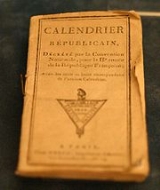
French Republican Calendar

Encyclopedia
The French Republican Calendar or French Revolutionary Calendar was a calendar
created and implemented during the French Revolution
, and used by the French government for about 12 years from late 1793 to 1805, and for 18 days by the Paris Commune
in 1871. The new system was designed in part to remove all religious and royalist influences from the calendar, and was part of a number of larger attempt at decimalization
in France.
and Republic
saw many efforts to sweep away various trappings of the ancien régime; some of these were more successful than others. The new Republican government sought to institute, among other reforms, a new social and legal system, a new system of weights and measures (which became the metric system
), and a new calendar. Amid nostalgia for the ancient Roman Republic
, the theories of the Enlightenment were at their peak, and the devisors of the new systems looked to nature for their inspiration. Natural constants, multiples of ten, and Latin
derivations formed the fundamental blocks from which the new systems were built.
The new calendar was created by a commission under the direction of the politician Charles Gilbert Romme seconded by Claude Joseph Ferry and Charles-François Dupuis. They associated with their work the chemist Louis-Bernard Guyton de Morveau
, the mathematician and astronomer Joseph-Louis Lagrange, the astronomer Joseph Jérôme Lefrançois de Lalande, the mathematician Gaspard Monge
, the astronomer and naval geographer Alexandre Guy Pingré
, and the poet, actor and playwright Fabre d'Églantine, who invented the names of the months, with the help of André Thouin
, gardener at the Jardin des Plantes
of the Muséum National d'Histoire Naturelle
in Paris. As the rapporteur
of the commission, Charles-Gilbert Romme presented the new calendar to the Jacobin
-controlled National Convention
on 23 September 1793, which adopted it on 24 October 1793 and also extended it proleptically
to its epoch
of 22 September 1792. It is because of his position as rapporteur of the commission that the creation of the republican calendar is attributed to Romme.
The name "French Revolutionary Calendar" refers to the fact that the calendar was created during the Revolution, but is somewhat of a misnomer. Indeed, there was initially a debate as to whether the calendar should celebrate the Revolution, i.e., 1789, or the Republic, i.e., 1792. Immediately following 14 July 1789, papers and pamphlets started calling 1789 year I of Liberty and the following years II and III. It was in 1792, with the practical problem of dating financial transactions, that the legislative assembly was confronted with the problem of the calendar. Originally, the choice of epoch was either 1 January 1789 or 14 July 1789. After some hesitation the assembly decided on 2 January 1792 that all official documents would use the "era of Liberty" and that the year IV of Liberty started on 1 January 1792. This usage was modified on 22 September 1792 when the Republic was proclaimed and the Convention decided that all public documents would be dated Year I of the French Republic. The decree of 2 January 1793 stipulated that the year II of the Republic began on 1 January 1793. The establishment of the Republic was also used for the final version of the calendar; therefore, the calendar commemorates the Republic, not the Revolution. In France, it is known as the calendrier républicain as well as the calendrier révolutionnaire.
The Concordat of 1801
re-established the Roman Catholic Church in France with effect from Easter Sunday, 18 April 1802, restoring the names of the days of the week with the ones they had in the Gregorian Calendar
, while keeping the rest of the Republican Calendar, and fixing Sunday as the official day of rest and religious celebration.
Napoléon finally abolished the calendar with effect from 1 January 1806 (the day after 10 Nivôse an XIV), a little over twelve years after its introduction. However, it was used again during the brief Paris Commune
, 6–23 May 1871 (16 Floréal–3 Prairial An LXXIX).
Many conversion tables and programs exist, largely created by genealogists. Some enthusiasts in France still use the calendar, more out of historical re-enactment than practicality.
Some legal texts that were adopted when the Republican Calendar was official are still in force in France and even Belgium (which was at the time incorporated into France), and have kept their original dates for citation purposes.
(usually), with epoch 22 September 1792, the beginning of the 'Republican Era' (the day the French First Republic
was proclaimed, one day after the Convention abolished the monarchy). As a result, Roman Numeral I indicates the first year of the republic, that is, the year before the calendar actually came into use. The first day of each year was that of the autumnal equinox.
There were twelve months, each divided into three ten-day weeks called décades. The tenth day, décadi, replaced Sunday as the day of rest and festivity. The five or six extra days needed to approximate the solar or tropical year
were placed after the months at the end of each year.
A period of four years ending on a leap day was to be called a "Franciade." The name "Olympique" was originally proposed but changed to Franciade to commemorate the fact that it had taken the revolution four years to establish a republican government in France.
The leap year was called Sextile, an allusion to the "bissextile
" leap year
s of the Julian and Gregorian calendars, because it contained a sixth complementary day
.
Clock
s were manufactured to display this decimal time
, but it did not catch on. Mandatory use of decimal time was officially suspended 7 April 1795, although some cities continued to use decimal time as late as 1801.
Note: On many printed calendars of Year II (1793–94), the month of Thermidor was named Fervidor.
The English translations stated above are approximate, as most of the month names were new words coined from French, Latin
or Greek
. The endings of the names are grouped by season. "Dor" means "giving" in Greek.
In Britain, a contemporary wit mocked the Republican Calendar by calling the months: Wheezy, Sneezy and Freezy; Slippy, Drippy and Nippy; Showery, Flowery and Bowery; Wheaty, Heaty and Sweety. The Scottish
historian Thomas Carlyle
suggested somewhat more serious English names in his 1837 work The French Revolution: A History
, namely Vintagearious, Fogarious, Frostarious, Snowous, Rainous, Windous, Buddal, Floweral, Meadowal, Reapidor, Heatidor, and Fruitidor. Like the French originals, they suggest a meaning related to the season but are not actual words.
Décades were abandoned in Floréal an X (April 1802).
as in the Roman Catholic calendar of saints
, each day has an animal (days ending in 5), a tool (days ending in 0) or else a plant or mineral (all other days).
s – were national holidays at the end of every year. These were originally known as les sans-culottides (after sans-culottes
), but after year III (1795) as les jours complémentaires:
The following table shows when several years of the Republican Era begin on the Gregorian calendar, according to each of the four above methods:
* Leap year, extra day added at end of year
Another, modern civil calendar proposal also applies the 128-years rule, keeps the year numbering and the names of the months, but maintains the old roman New Year's Day, the lengths of month like the seven-days-week.
 Leap years
in the calendar are a point of great dispute, due to the contradicting statements in the establishing decree stating:
and:
These two specifications are incompatible, as leap years defined by the equinox do not recur on a regular four year schedule. Thus, the years III, VII, and XI were observed as leap years, and the years XV and XX were also planned as such, even though they were five years apart.
 A fixed arithmetic rule for determining leap years was proposed in the name of the Committee of Public Education by Gilbert Romme
on 19 Floréal An III (8 May 1795). The proposed rule was to determine leap years by applying the rules of the Gregorian calendar to the years of the French Republic (years IV, VIII, XII, etc. were to be leap years) except that year 4000 (the last year of ten 400-year periods) should be a common year instead of a leap year. Because this proposal was never adopted, the original astronomical rule continued, which excluded any other fixed arithmetic rule. The proposal was intended to avoid uncertain future leap years caused by the inaccurate astronomical knowledge of the 1790s (even today, this statement is still valid due to the uncertainty in ΔT). In particular, the committee noted that the true equinox of year 144 was predicted to occur at "11:59:40 pm", which was closer to midnight than its inherent 3 to 4 minute uncertainty.
The calendar was abolished because having a ten-day working week gave workers less rest (one day off every ten instead of one day off every seven); because the equinox was a mobile date to start every new year (a fantastic source of confusion for almost everybody); and because it was incompatible with the secular rhythms of trade fairs and agricultural markets.
Another criticism of the calendar was that despite the poetic names of its months, they are tied to the climate and agriculture of France and therefore not applicable to France's overseas territories
.
Apparently, the designers of the calendar were unaware of the possibility of a lunisolar calendar
as their proposals do not appear to make any mention of lunar month
s, lunisolar calendars, or of the Metonic cycle
. As a result the Republican calendar, just like the Julian
and Gregorian
calendars, has months whose lengths only have a vestigial relation to an actual physical phenomenon. This is inconsistent with Romme's assertion that the new calendar should be faithful to natural cycles and should not perpetuate past mistakes:
The proposal for the new calendar is a litany of criticism of previous efforts, the previous quote of Romme being representative. As another typical example is Romme's opinion about the nomenclature of the French Gregorian calendar:
This tone sets a high standard by which the Republican calendar might itself be judged.
 Perhaps the most famous date in this calendar was immortalised by Karl Marx
in the title of his pamphlet, The 18th Brumaire of Louis Napoléon (1852). The 18 Brumaire An VIII
(9 November 1799) is considered, by many historians, the end of the French Revolution.
Another famous revolutionary date is 9 Thermidor An II
(27 July 1794), the date the Convention turned against Robespierre, who, along with others associated with the Mountain
, was guillotine
d the following day. (See Glossary of the French Revolution for other significant dates under this calendar.)
Based on the above event, the term "Thermidorian" entered the Marxist vocabulary as referring to revolutionaries who destroy the revolution from the inside and turn against its true aims. For example, Leon Trotsky
and his followers used this term about Joseph Stalin
.
Émile Zola
's novel Germinal takes its name from the calendar.
The seafood dish Lobster thermidor
is so named due to its connection with a play entitled Thermidor, from the Republican Calendar month.
The French frigates of the Floréal class
all bear names of Republican months.
The Convention of 9 Brumaire An III, 30 October 1794, established the École Normale Supérieure
. The date appears prominently on the entrance to the school.
The French composer Fromental Halévy
was named after the feast day of 'Fromental' in the Revolutionary Calendar, which occurred on his birthday in year VIII (27 May 1799).
Calendar
A calendar is a system of organizing days for social, religious, commercial, or administrative purposes. This is done by giving names to periods of time, typically days, weeks, months, and years. The name given to each day is known as a date. Periods in a calendar are usually, though not...
created and implemented during the French Revolution
French Revolution
The French Revolution , sometimes distinguished as the 'Great French Revolution' , was a period of radical social and political upheaval in France and Europe. The absolute monarchy that had ruled France for centuries collapsed in three years...
, and used by the French government for about 12 years from late 1793 to 1805, and for 18 days by the Paris Commune
Paris Commune
The Paris Commune was a government that briefly ruled Paris from March 18 to May 28, 1871. It existed before the split between anarchists and Marxists had taken place, and it is hailed by both groups as the first assumption of power by the working class during the Industrial Revolution...
in 1871. The new system was designed in part to remove all religious and royalist influences from the calendar, and was part of a number of larger attempt at decimalization
Decimal system
Decimal system may refer to:* The decimal number system, used in mathematics for writing numbers and performing arithmetic.* The Dewey Decimal System, a subject classification system used in libraries....
in France.
| Under the calendar, today is: |
| or: |
History
The days of the French RevolutionFrench Revolution
The French Revolution , sometimes distinguished as the 'Great French Revolution' , was a period of radical social and political upheaval in France and Europe. The absolute monarchy that had ruled France for centuries collapsed in three years...
and Republic
French First Republic
The French First Republic was founded on 22 September 1792, by the newly established National Convention. The First Republic lasted until the declaration of the First French Empire in 1804 under Napoleon I...
saw many efforts to sweep away various trappings of the ancien régime; some of these were more successful than others. The new Republican government sought to institute, among other reforms, a new social and legal system, a new system of weights and measures (which became the metric system
Metric system
The metric system is an international decimalised system of measurement. France was first to adopt a metric system, in 1799, and a metric system is now the official system of measurement, used in almost every country in the world...
), and a new calendar. Amid nostalgia for the ancient Roman Republic
Roman Republic
The Roman Republic was the period of the ancient Roman civilization where the government operated as a republic. It began with the overthrow of the Roman monarchy, traditionally dated around 508 BC, and its replacement by a government headed by two consuls, elected annually by the citizens and...
, the theories of the Enlightenment were at their peak, and the devisors of the new systems looked to nature for their inspiration. Natural constants, multiples of ten, and Latin
Latin
Latin is an Italic language originally spoken in Latium and Ancient Rome. It, along with most European languages, is a descendant of the ancient Proto-Indo-European language. Although it is considered a dead language, a number of scholars and members of the Christian clergy speak it fluently, and...
derivations formed the fundamental blocks from which the new systems were built.
The new calendar was created by a commission under the direction of the politician Charles Gilbert Romme seconded by Claude Joseph Ferry and Charles-François Dupuis. They associated with their work the chemist Louis-Bernard Guyton de Morveau
Louis-Bernard Guyton de Morveau
Louis-Bernard Guyton de Morveau was a French chemist and politician...
, the mathematician and astronomer Joseph-Louis Lagrange, the astronomer Joseph Jérôme Lefrançois de Lalande, the mathematician Gaspard Monge
Gaspard Monge
Gaspard Monge, Comte de Péluse was a French mathematician, revolutionary, and was inventor of descriptive geometry. During the French Revolution, he was involved in the complete reorganization of the educational system, founding the École Polytechnique...
, the astronomer and naval geographer Alexandre Guy Pingré
Alexandre Guy Pingré
Alexandre Guy Pingré was a French astronomer, priest, and naval geographer.He was born in Paris, France, and was educated at Senlis, where he became professor of theology in 1735. At an early age he had developed an interest in astronomy, and in 1749 he was appointed professor of astronomy at the...
, and the poet, actor and playwright Fabre d'Églantine, who invented the names of the months, with the help of André Thouin
André Thouin
André Thouin was a French botanist who was born in Paris. He studied botany under Bernard de Jussieu . In 1793 Thouin attained the chair of horticulture at Muséum national d'histoire naturelle in Paris. Thouin was a good friend of U.S...
, gardener at the Jardin des Plantes
Jardin des Plantes
The Jardin des Plantes is the main botanical garden in France. It is one of seven departments of the Muséum national d'histoire naturelle. It is situated in the 5ème arrondissement, Paris, on the left bank of the river Seine and covers 28 hectares .- Garden plan :The grounds of the Jardin des...
of the Muséum National d'Histoire Naturelle
Muséum national d'histoire naturelle
The Muséum national d'Histoire naturelle is the National Museum of Natural History in Paris, France.- History :The museum was formally founded on 10 June 1793, during the French Revolution...
in Paris. As the rapporteur
Rapporteur
Rapporteur is used in international and European legal and political contexts to refer to a person appointed by a deliberative body to investigate an issue or a situation....
of the commission, Charles-Gilbert Romme presented the new calendar to the Jacobin
Jacobin Club
The Jacobin Club was the most famous and influential political club in the development of the French Revolution, so-named because of the Dominican convent where they met, located in the Rue St. Jacques , Paris. The club originated as the Club Benthorn, formed at Versailles from a group of Breton...
-controlled National Convention
National Convention
During the French Revolution, the National Convention or Convention, in France, comprised the constitutional and legislative assembly which sat from 20 September 1792 to 26 October 1795 . It held executive power in France during the first years of the French First Republic...
on 23 September 1793, which adopted it on 24 October 1793 and also extended it proleptically
Proleptic Julian calendar
The proleptic Julian calendar is produced by extending the Julian calendar to dates preceding AD 4 when its quadrennial leap year stabilized. The leap years actually observed between its official implementation in 45 BC and AD 4 were erratic, see the Julian calendar article for details.A calendar...
to its epoch
Epoch (reference date)
In the fields of chronology and periodization, an epoch is an instance in time chosen as the origin of a particular era. The "epoch" then serves as a reference point from which time is measured...
of 22 September 1792. It is because of his position as rapporteur of the commission that the creation of the republican calendar is attributed to Romme.
The name "French Revolutionary Calendar" refers to the fact that the calendar was created during the Revolution, but is somewhat of a misnomer. Indeed, there was initially a debate as to whether the calendar should celebrate the Revolution, i.e., 1789, or the Republic, i.e., 1792. Immediately following 14 July 1789, papers and pamphlets started calling 1789 year I of Liberty and the following years II and III. It was in 1792, with the practical problem of dating financial transactions, that the legislative assembly was confronted with the problem of the calendar. Originally, the choice of epoch was either 1 January 1789 or 14 July 1789. After some hesitation the assembly decided on 2 January 1792 that all official documents would use the "era of Liberty" and that the year IV of Liberty started on 1 January 1792. This usage was modified on 22 September 1792 when the Republic was proclaimed and the Convention decided that all public documents would be dated Year I of the French Republic. The decree of 2 January 1793 stipulated that the year II of the Republic began on 1 January 1793. The establishment of the Republic was also used for the final version of the calendar; therefore, the calendar commemorates the Republic, not the Revolution. In France, it is known as the calendrier républicain as well as the calendrier révolutionnaire.
The Concordat of 1801
Concordat of 1801
The Concordat of 1801 was an agreement between Napoleon and Pope Pius VII, signed on 15 July 1801. It solidified the Roman Catholic Church as the majority church of France and brought back most of its civil status....
re-established the Roman Catholic Church in France with effect from Easter Sunday, 18 April 1802, restoring the names of the days of the week with the ones they had in the Gregorian Calendar
Gregorian calendar
The Gregorian calendar, also known as the Western calendar, or Christian calendar, is the internationally accepted civil calendar. It was introduced by Pope Gregory XIII, after whom the calendar was named, by a decree signed on 24 February 1582, a papal bull known by its opening words Inter...
, while keeping the rest of the Republican Calendar, and fixing Sunday as the official day of rest and religious celebration.
Napoléon finally abolished the calendar with effect from 1 January 1806 (the day after 10 Nivôse an XIV), a little over twelve years after its introduction. However, it was used again during the brief Paris Commune
Paris Commune
The Paris Commune was a government that briefly ruled Paris from March 18 to May 28, 1871. It existed before the split between anarchists and Marxists had taken place, and it is hailed by both groups as the first assumption of power by the working class during the Industrial Revolution...
, 6–23 May 1871 (16 Floréal–3 Prairial An LXXIX).
Many conversion tables and programs exist, largely created by genealogists. Some enthusiasts in France still use the calendar, more out of historical re-enactment than practicality.
Some legal texts that were adopted when the Republican Calendar was official are still in force in France and even Belgium (which was at the time incorporated into France), and have kept their original dates for citation purposes.
Calendar design
Years appear in writing as Roman numeralsRoman numerals
The numeral system of ancient Rome, or Roman numerals, uses combinations of letters from the Latin alphabet to signify values. The numbers 1 to 10 can be expressed in Roman numerals as:...
(usually), with epoch 22 September 1792, the beginning of the 'Republican Era' (the day the French First Republic
French First Republic
The French First Republic was founded on 22 September 1792, by the newly established National Convention. The First Republic lasted until the declaration of the First French Empire in 1804 under Napoleon I...
was proclaimed, one day after the Convention abolished the monarchy). As a result, Roman Numeral I indicates the first year of the republic, that is, the year before the calendar actually came into use. The first day of each year was that of the autumnal equinox.
There were twelve months, each divided into three ten-day weeks called décades. The tenth day, décadi, replaced Sunday as the day of rest and festivity. The five or six extra days needed to approximate the solar or tropical year
Tropical year
A tropical year , for general purposes, is the length of time that the Sun takes to return to the same position in the cycle of seasons, as seen from Earth; for example, the time from vernal equinox to vernal equinox, or from summer solstice to summer solstice...
were placed after the months at the end of each year.
A period of four years ending on a leap day was to be called a "Franciade." The name "Olympique" was originally proposed but changed to Franciade to commemorate the fact that it had taken the revolution four years to establish a republican government in France.
The leap year was called Sextile, an allusion to the "bissextile
Bissextus
Bissext, or bissextus , theday intercalated by the Julian calendar in the February of everyfourth year to make up the six hours by which the solar year wascomputed to exceed the year of 365 days...
" leap year
Leap year
A leap year is a year containing one extra day in order to keep the calendar year synchronized with the astronomical or seasonal year...
s of the Julian and Gregorian calendars, because it contained a sixth complementary day
Sansculottides
The Sansculottides are holidays following the last month of the year on the French Republican Calendar which was used following the French Revolution from approximately 1793 to 1805....
.
Decimal time
Each day in the Republican Calendar was divided into ten hours, each hour into 100 decimal minutes, and each decimal minute into 100 decimal seconds. Thus an hour was 144 conventional minutes (more than twice as long as a conventional hour), a minute was 86.4 conventional seconds (slightly longer than a conventional minute), and a second was 0.864 conventional seconds (slightly shorter than a conventional second).Clock
Clock
A clock is an instrument used to indicate, keep, and co-ordinate time. The word clock is derived ultimately from the Celtic words clagan and clocca meaning "bell". A silent instrument missing such a mechanism has traditionally been known as a timepiece...
s were manufactured to display this decimal time
Decimal time
Decimal time is the representation of the time of day using units which are decimally related. This term is often used to refer specifically to French Revolutionary Time, which divides the day into 10 decimal hours, each decimal hour into 100 decimal minutes and each decimal minute into 100 decimal...
, but it did not catch on. Mandatory use of decimal time was officially suspended 7 April 1795, although some cities continued to use decimal time as late as 1801.
Current date and time
| Click on a year number for a calendar sheet for the whole year. |
Months
The Republican calendar year began at the autumn equinox and had twelve months of 30 days each, which were given new names based on nature, principally having to do with the prevailing weather in and around Paris.- Autumn:
- VendémiaireVendémiaireVendémiaire was the first month in the French Republican Calendar. The month was named after the French word vendange .Vendémiaire was the first month of the autumn quarter . It started on the day of the autumnal equinox, which fell between 22 September and 24 September, inclusive. It thus ended...
in French (from Latin vindemia, "grape harvest"), starting 22, 23 or 24 September - BrumaireBrumaireBrumaire was the second month in the French Republican Calendar. The month was named after the French word brume which occurs frequently in France at that time of the year....
(from French brume, "fog"), starting 22, 23 or 24 October - FrimaireFrimaireFrimaire was the third month in the French Republican Calendar. The month was named after the French word frimas, which means frost.Frimaire was the third month of the autumn quarter . It started between November 21 and November 23. It ended between December 20 and December 22...
(From French frimas, "frost"), starting 21, 22 or 23 November
- Vendémiaire
- Winter:
- NivôseNivôseFor the frigate of the French Navy, see Nivôse Nivôse was the fourth month in the French Republican Calendar. The month was named after the Latin word nivosus, which means snow....
(from Latin nivosus, "snowy"), starting 21, 22 or 23 December - PluviôsePluviôsePluviôse was the fifth month in the French Republican Calendar. The month was named after the Latin word pluviosus, which means rainy....
(from Latin pluvius, "rainy"), starting 20, 21 or 22 January - VentôseVentôseVentôse was the sixth month in the French Republican Calendar. The month was named after the Latin word ventosus, which means windy.Ventôse was the third month of the winter quarter . It started between 19 February and 21 February. It ended between 20 March and 21 March...
(from Latin ventosus, "windy"), starting 19, 20 or 21 February
- Nivôse
- Spring:
- GerminalGerminal (French Republican Calendar)Germinal was the seventh month in the French Republican Calendar. The month was named after the Latin word germen, which means germination...
(from Latin germen, "germination"), starting 20 or 21 March - FloréalFloréalFor the ship class, see Floréal class frigateFloréal was the eighth month in the French Republican Calendar. The month was named after the Latin word flos, which means flowering....
(from Latin flos, "flower"), starting 20 or 21 April - PrairialPrairialPrairial was the ninth month in the French Republican Calendar. This month was named after the French word prairie, which means meadow. It was the name given to several ships....
(from French prairie, "pasture"), starting 20 or 21 May
- Germinal
- Summer:
- MessidorMessidorMessidor was the tenth month in the French Republican Calendar. The month was named after the Latin word messis, which means harvest....
(from Latin messis, "harvest"), starting 19 or 20 June - ThermidorThermidorThermidor was the eleventh month in the French Republican Calendar. The month was named after the French word thermal which comes from the Greek word "thermos" which means heat....
(or Fervidor) (from Greek thermon, "summer heat"), starting 19 or 20 July - FructidorFructidorFructidor is the twelfth month in the French Republican Calendar. The month was named after the Latin word fructus, which means "fruit".Fructidor is the third month of the summer quarter . By the Gregorian calendar, Fructidor starts on either August 18 or August 19 and ends exactly thirty days...
(from Latin fructus, "fruit"), starting 18 or 19 August
- Messidor
Note: On many printed calendars of Year II (1793–94), the month of Thermidor was named Fervidor.
The English translations stated above are approximate, as most of the month names were new words coined from French, Latin
Latin
Latin is an Italic language originally spoken in Latium and Ancient Rome. It, along with most European languages, is a descendant of the ancient Proto-Indo-European language. Although it is considered a dead language, a number of scholars and members of the Christian clergy speak it fluently, and...
or Greek
Greek language
Greek is an independent branch of the Indo-European family of languages. Native to the southern Balkans, it has the longest documented history of any Indo-European language, spanning 34 centuries of written records. Its writing system has been the Greek alphabet for the majority of its history;...
. The endings of the names are grouped by season. "Dor" means "giving" in Greek.
In Britain, a contemporary wit mocked the Republican Calendar by calling the months: Wheezy, Sneezy and Freezy; Slippy, Drippy and Nippy; Showery, Flowery and Bowery; Wheaty, Heaty and Sweety. The Scottish
Scotland
Scotland is a country that is part of the United Kingdom. Occupying the northern third of the island of Great Britain, it shares a border with England to the south and is bounded by the North Sea to the east, the Atlantic Ocean to the north and west, and the North Channel and Irish Sea to the...
historian Thomas Carlyle
Thomas Carlyle
Thomas Carlyle was a Scottish satirical writer, essayist, historian and teacher during the Victorian era.He called economics "the dismal science", wrote articles for the Edinburgh Encyclopedia, and became a controversial social commentator.Coming from a strict Calvinist family, Carlyle was...
suggested somewhat more serious English names in his 1837 work The French Revolution: A History
The French Revolution: A History
The French Revolution: A History was written by the Scottish essayist, philosopher, and historian Thomas Carlyle. The three-volume work, first published in 1837 , charts the course of the French Revolution from 1789 to the height of the Reign of Terror and culminates in 1795...
, namely Vintagearious, Fogarious, Frostarious, Snowous, Rainous, Windous, Buddal, Floweral, Meadowal, Reapidor, Heatidor, and Fruitidor. Like the French originals, they suggest a meaning related to the season but are not actual words.
Ten days of the week
The month is divided into three décades or 'weeks' of ten days each, named simply:- primidi (first day)
- duodi (second day)
- tridi (third day)
- quartidi (fourth day)
- quintidi (fifth day)
- sextidi (sixth day)
- septidi (seventh day)
- octidi (eighth day)
- nonidi (ninth day)
- décadi (tenth day)
Décades were abandoned in Floréal an X (April 1802).
Days of the year
Instead of most days having an associated saintSaint
A saint is a holy person. In various religions, saints are people who are believed to have exceptional holiness.In Christian usage, "saint" refers to any believer who is "in Christ", and in whom Christ dwells, whether in heaven or in earth...
as in the Roman Catholic calendar of saints
Roman Catholic calendar of saints
The General Roman Calendar indicates the days of the year to which are assigned the liturgical celebrations of saints and of the mysteries of the Lord that are to be observed wherever the Roman Rite is used...
, each day has an animal (days ending in 5), a tool (days ending in 0) or else a plant or mineral (all other days).
Autumn
| Vendémiaire Vendémiaire Vendémiaire was the first month in the French Republican Calendar. The month was named after the French word vendange .Vendémiaire was the first month of the autumn quarter . It started on the day of the autumnal equinox, which fell between 22 September and 24 September, inclusive. It thus ended... (22 September ~ 21 October) |
Brumaire Brumaire Brumaire was the second month in the French Republican Calendar. The month was named after the French word brume which occurs frequently in France at that time of the year.... (22 October ~ 20 November) |
Frimaire Frimaire Frimaire was the third month in the French Republican Calendar. The month was named after the French word frimas, which means frost.Frimaire was the third month of the autumn quarter . It started between November 21 and November 23. It ended between December 20 and December 22... (21 November ~ 20 December) |
|---|---|---|
|
Apple The apple is the pomaceous fruit of the apple tree, species Malus domestica in the rose family . It is one of the most widely cultivated tree fruits, and the most widely known of the many members of genus Malus that are used by humans. Apple grow on small, deciduous trees that blossom in the spring... (Apple) Celery Apium graveolens is a plant species in the family Apiaceae commonly known as celery or celeriac , depending on whether the petioles or roots are eaten: celery refers to the former and celeriac to the latter. Apium graveolens grows to 1 m tall... (Celery) Pear The pear is any of several tree species of genus Pyrus and also the name of the pomaceous fruit of these trees. Several species of pear are valued by humans for their edible fruit, but the fruit of other species is small, hard, and astringent.... (Pear) Beet The beet is a plant in the Chenopodiaceae family which is now included in Amaranthaceae family. It is best known in its numerous cultivated varieties, the most well known of which is the purple root vegetable known as the beetroot or garden beet... (Beet root) Goose The word goose is the English name for a group of waterfowl, belonging to the family Anatidae. This family also includes swans, most of which are larger than true geese, and ducks, which are smaller.... (Goose) Heliotropium Heliotropium is a genus of flowering plants in the borage family, Boraginaceae. There are 250 to 300 species in this genus, which are commonly known as heliotropes .... (Heliotrope) Common fig The Common fig is a deciduous tree growing to heights of up to 6 m in the genus Ficus from the family Moraceae known as Common fig tree. It is a temperate species native to the Middle East.-Description:... (Common Fig) Wild Service Tree Sorbus torminalis , sometimes known as the Chequer Tree or Checker Tree, is a species of Sorbus native to Europe from England and Wales east to Denmark and Poland, south to northwest Africa, and southeast to southwest Asia from Asia Minor to the Caucasus and Alborz mountains.It is a medium-sized... (Chequer Tree) Plough The plough or plow is a tool used in farming for initial cultivation of soil in preparation for sowing seed or planting. It has been a basic instrument for most of recorded history, and represents one of the major advances in agriculture... (Plough) Salsify Tragopogon, also known as salsify or goatsbeard, is a genus of flowering plants in the sunflower family Asteraceae that has over 140 species, including the vegetable known as salsify, as well as a number of common wild flowers, some of which are usually regarded as weeds.Salsifies are forbs growing... (Salsify) Water caltrop The water caltrop, water chestnut, buffalo nut, bat nut, devil pod or Singhara or Pani-fol is either of two species of the genus Trapa: Trapa natans and Trapa bicornis... (Water chestnut) Jerusalem artichoke The Jerusalem artichoke , also called the sunroot, sunchoke, earth apple or topinambour, is a species of sunflower native to eastern North America, and found from Eastern Canada and Maine west to North Dakota, and south to northern Florida and Texas... (Jerusalem Artichoke) Endive Endive , Cichorium endivia, is a leaf vegetable belonging to the daisy family. Endive can be cooked or used raw in salads.-Background:Endive is also a common name for some types of chicory... (Endive) Turkey (bird) A turkey is a large bird in the genus Meleagris. One species, Meleagris gallopavo, commonly known as the Wild Turkey, is native to the forests of North America. The domestic turkey is a descendant of this species... (Turkey) Sium sisarum Sium sisarum is a perennial plant of the family Apiaceae sometimes grown as a root vegetable. It has a cluster of sweet, bright white roots which are similar to sweet potatoes, but longer . Skirrets may be boiled, stewed, or roasted... (Skirret) Watercress Watercresses are fast-growing, aquatic or semi-aquatic, perennial plants native from Europe to central Asia, and one of the oldest known leaf vegetables consumed by human beings... (Watercress) Plumbaginaceae Plumbaginaceae is a family of flowering plants, with a cosmopolitan distribution. The family is sometimes referred to as the leadwort family or the plumbago family.... (Leadworts) Pomegranate The pomegranate , Punica granatum, is a fruit-bearing deciduous shrub or small tree growing between five and eight meters tall.Native to the area of modern day Iran, the pomegranate has been cultivated in the Caucasus since ancient times. From there it spread to Asian areas such as the Caucasus as... (Pomegranate) Harrow (tool) In agriculture, a harrow is an implement for breaking up and smoothing out the surface of the soil. In this way it is distinct in its effect from the plough, which is used for deeper tillage. Harrowing is often carried out on fields to follow the rough finish left by ploughing operations... (Harrow) Asarum Asarum is a genus of plants in the birthwort family Aristolochiaceae, commonly known as Wild ginger.- Description :... (Asarum baccharis) Crataegus azarolus Crataegus azarolus is a species of hawthorn known by the common names azarole, mosphilla, and Mediterranean medlar. It is native to the Mediterranean Basin and it is grown there and elsewhere as an ornamental tree and for its fruit. It has been used historically for a number of medicinal purposes.C... (Azarole) Rubiá aRubiá is a municipality in the Spanish province of Ourense. It has a population of 1734 and an area of 101 km².... (Madder) Orange (fruit) An orange—specifically, the sweet orange—is the citrus Citrus × sinensis and its fruit. It is the most commonly grown tree fruit in the world.... (Orange) Pheasant Pheasants refer to some members of the Phasianinae subfamily of Phasianidae in the order Galliformes.Pheasants are characterised by strong sexual dimorphism, males being highly ornate with bright colours and adornments such as wattles and long tails. Males are usually larger than females and have... (Pheasant) Pistachio The pistachio, Pistacia vera in the Anacardiaceae family, is a small tree originally from Persia , which now can also be found in regions of Syria, Lebanon, Turkey, Greece, Kyrgyzstan, Turkmenistan, India, Pakistan, Egypt, Sicily and possibly Afghanistan , as well as in the United States,... (Pistachio) Lathyrus tuberosus Lathyrus tuberosus, also known as the Tuberous Pea, Tuberous Vetchling, Earthnut Pea, or Aardaker, is a small, climbing perennial plant, native in moist temperate parts of Europe and Western Asia.... (Tuberous pea) Quince The quince , or Cydonia oblonga, is the sole member of the genus Cydonia and native to warm-temperate southwest Asia in the Caucasus region... (Quince) Roller (agricultural tool) The roller is an agricultural tool used for flattening land or breaking up large clumps of soil, especially after ploughing. Typically, rollers are pulled by tractors or, prior to mechanisation, a team of animals such as horses or oxen.... (Roller) |
Phyteuma Phyteuma is a genus of about 40-45 species of flowering plants in the family Campanulaceae, native to Europe and western Asia. The common name is Rampion. Rampion features prominently in some versions of the fairy tale Rapunzel... (Rampion) Turnip The turnip or white turnip is a root vegetable commonly grown in temperate climates worldwide for its white, bulbous taproot. Small, tender varieties are grown for human consumption, while larger varieties are grown as feed for livestock... (Turnip) Chicory Common chicory, Cichorium intybus, is a somewhat woody, perennial herbaceous plant usually with bright blue flowers, rarely white or pink. Various varieties are cultivated for salad leaves, chicons , or for roots , which are baked, ground, and used as a coffee substitute and additive. It is also... (Chicory) Pig A pig is any of the animals in the genus Sus, within the Suidae family of even-toed ungulates. Pigs include the domestic pig, its ancestor the wild boar, and several other wild relatives... (Pig) Corn salad Corn salad is a small dicot annual plant of the family Valerianaceae... (Corn Salad) Cauliflower Cauliflower is one of several vegetables in the species Brassica oleracea, in the family Brassicaceae. It is an annual plant that reproduces by seed... (Cauliflower) Honey Honey is a sweet food made by bees using nectar from flowers. The variety produced by honey bees is the one most commonly referred to and is the type of honey collected by beekeepers and consumed by humans... (Honey) Juniperus communis Juniperus communis, the Common Juniper, is a species in the genus Juniperus, in the family Cupressaceae. It has the largest range of any woody plant, throughout the cool temperate Northern Hemisphere from the Arctic south in mountains to around 30°N latitude in North America, Europe and Asia.-... (Juniper) Pickaxe A pickaxe or pick is a hand tool with a hard head attached perpendicular to the handle.Some people make the distinction that a pickaxe has a head with a pointed end and a flat end, and a pick has both ends pointed, or only one end; but most people use the words to mean the same thing.The head is... (Pickaxe) Wax thumb|right|[[Cetyl palmitate]], a typical wax ester.Wax refers to a class of chemical compounds that are plastic near ambient temperatures. Characteristically, they melt above 45 °C to give a low viscosity liquid. Waxes are insoluble in water but soluble in organic, nonpolar solvents... (Wax) Horseradish Horseradish is a perennial plant of the Brassicaceae family, which also includes mustard, wasabi, broccoli, and cabbages. The plant is probably native to south eastern Europe and the Arab World , but is popular around the world today... (Horseradish) Fir Firs are a genus of 48–55 species of evergreen conifers in the family Pinaceae. They are found through much of North and Central America, Europe, Asia, and North Africa, occurring in mountains over most of the range... (Fir tree) Roe Deer The European Roe Deer , also known as the Western Roe Deer, chevreuil or just Roe Deer, is a Eurasian species of deer. It is relatively small, reddish and grey-brown, and well-adapted to cold environments. Roe Deer are widespread in Western Europe, from the Mediterranean to Scandinavia, and from... (Roe Deer) Gorse Gorse, furze, furse or whin is a genus of about 20 plant species of thorny evergreen shrubs in the subfamily Faboideae of the pea family Fabaceae, native to western Europe and northwest Africa, with the majority of species in Iberia.Gorse is closely related to the brooms, and like them, has green... (Gorse) Cupressus sempervirens Cupressus sempervirens, the Mediterranean Cypress is a species of cypress native to the eastern Mediterranean region, in northeast Libya, southeast Greece , southern Turkey, Cyprus, Northern Egypt, western Syria, Lebanon, Israel, Malta, Italy, western Jordan, and also a disjunct population in... (Cypress Tree) Ivy Ivy, plural ivies is a genus of 12–15 species of evergreen climbing or ground-creeping woody plants in the family Araliaceae, native to western, central and southern Europe, Macaronesia, northwestern Africa and across central-southern Asia east to Japan and Taiwan.-Description:On level ground they... (Ivy) Juniperus sabina Juniperus sabina is a species of juniper native to the mountains of central and southern Europe and western and central Asia, from Spain east to eastern Siberia, typically growing at altitudes of 1,000-3,300 m.... (Savin Juniper) Hoe (tool) A hoe is an ancient and versatile agricultural tool used to move small amounts of soil. Common goals include weed control by agitating the surface of the soil around plants, piling soil around the base of plants , creating narrow furrows and shallow trenches for planting seeds and bulbs, to chop... (Grub-hoe) Calluna Calluna vulgaris is the sole species in the genus Calluna in the family Ericaceae. It is a low-growing perennial shrub growing to tall, or rarely to and taller, and is found widely in Europe and Asia Minor on acidic soils in open sunny situations and in moderate shade... (Heather) Phragmites Phragmites, the Common reed, is a large perennial grass found in wetlands throughout temperate and tropical regions of the world. Phragmites australis is sometimes regarded as the sole species of the genus Phragmites, though some botanists divide Phragmites australis into three or four species... (Reed plant) Sorrel Common sorrel or garden sorrel , often simply called sorrel, is a perennial herb that is cultivated as a garden herb or leaf vegetable... (Sorrel) Cricket (insect) Crickets, family Gryllidae , are insects somewhat related to grasshoppers, and more closely related to katydids or bush crickets . They have somewhat flattened bodies and long antennae. There are about 900 species of crickets... (Cricket) Pine nut Pine nuts are the edible seeds of pines . About 20 species of pine produce seeds large enough to be worth harvesting; in other pines the seeds are also edible, but are too small to be of great value as a human food.... (Pinenut) Cork (material) Cork is an impermeable, buoyant material, a prime-subset of bark tissue that is harvested for commercial use primarily from Quercus suber , which is endemic to southwest Europe and northwest Africa... (Cork) Olive The olive , Olea europaea), is a species of a small tree in the family Oleaceae, native to the coastal areas of the eastern Mediterranean Basin as well as northern Iran at the south end of the Caspian Sea.Its fruit, also called the olive, is of major agricultural importance in the... (Olive) Shovel A shovel is a tool for digging, lifting, and moving bulk materials, such as soil, coal, gravel, snow, sand, or ore. Shovels are extremely common tools that are used extensively in agriculture, construction, and gardening.... (Shovel) |
Winter
| Nivôse Nivôse For the frigate of the French Navy, see Nivôse Nivôse was the fourth month in the French Republican Calendar. The month was named after the Latin word nivosus, which means snow.... (21 December ~ 19 January) |
Pluviôse Pluviôse Pluviôse was the fifth month in the French Republican Calendar. The month was named after the Latin word pluviosus, which means rainy.... (20 January ~ 18 February) |
Ventôse Ventôse Ventôse was the sixth month in the French Republican Calendar. The month was named after the Latin word ventosus, which means windy.Ventôse was the third month of the winter quarter . It started between 19 February and 21 February. It ended between 20 March and 21 March... (19 February ~ 20 March) |
|---|---|---|
|
Daphne laureola Daphne laureola, or Spurge-laurel , is a species of Daphne in the flowering plant family Thymelaeaceae... (Spurge-laurel) Moss Mosses are small, soft plants that are typically 1–10 cm tall, though some species are much larger. They commonly grow close together in clumps or mats in damp or shady locations. They do not have flowers or seeds, and their simple leaves cover the thin wiry stems... (Moss) Snowdrop Galanthus is a small genus of about 20 species of bulbous herbaceous plants in the Amaryllis family, subfamily Amaryllidoideae... (Snowdrop) Cattle Cattle are the most common type of large domesticated ungulates. They are a prominent modern member of the subfamily Bovinae, are the most widespread species of the genus Bos, and are most commonly classified collectively as Bos primigenius... (Bull) Viburnum tinus Viburnum tinus is a species of flowering plant in the genus Viburnum, belonging to the family Adoxaceae. Laurus signifies the leaves' similarities to bay laurel; tinus means "tenth born".-Description: It is a shrub reaching up to 2-7 m tall, with a dense, rounded crown... (Laurustinus) Fomes fomentarius Fomes fomentarius is a species of fungal plant pathogen found in Europe, Asia, Africa and North America... (Tinder polypore) Daphne mezereum Daphne mezereum is a species of Daphne in the flowering plant family Thymelaeaceae, native to most of Europe and Western Asia, north to northern Scandinavia and Russia. In southern Europe it is confined to medium to higher elevations and in the subalpine vegetation zone, but descends to near sea... (Daphne mezereum) Poplar Populus is a genus of 25–35 species of deciduous flowering plants in the family Salicaceae, native to most of the Northern Hemisphere. English names variously applied to different species include poplar , aspen, and cottonwood.... (Poplar Tree) Axe The axe, or ax, is an implement that has been used for millennia to shape, split and cut wood; to harvest timber; as a weapon; and as a ceremonial or heraldic symbol... (Axe) Hellebore Commonly known as hellebores, members of the genus Helleborus comprise approximately 20 species of herbaceous perennial flowering plants in the family Ranunculaceae, within which it gave its name to the tribe of Helleboreae... (Hellebore) Broccoli Broccoli is a plant in the cabbage family, whose large flower head is used as a vegetable.-General:The word broccoli, from the Italian plural of , refers to "the flowering top of a cabbage".... (Broccoli) Bay Laurel The bay laurel , also known as sweet bay, bay tree, true laurel, Grecian laurel, laurel tree, or simply laurel, is an aromatic evergreen tree or large shrub with green, glossy leaves, native to the Mediterranean region. It is the source of the bay leaf used in cooking... (Laurel) Cattle Cattle are the most common type of large domesticated ungulates. They are a prominent modern member of the subfamily Bovinae, are the most widespread species of the genus Bos, and are most commonly classified collectively as Bos primigenius... (Cow) Lichen Lichens are composite organisms consisting of a symbiotic organism composed of a fungus with a photosynthetic partner , usually either a green alga or cyanobacterium... (Lichen) Taxus baccata Taxus baccata is a conifer native to western, central and southern Europe, northwest Africa, northern Iran and southwest Asia. It is the tree originally known as yew, though with other related trees becoming known, it may be now known as the English yew, or European yew.-Description:It is a small-... (Yew tree) Lungwort The lungworts are the genus Pulmonaria of flowering plants in the family Boraginaceae, native to Europe and western Asia, with one species east to central Asia... (Lungwort) Billhook The billhook is a traditional cutting tool known and used throughout the world, and very common in the wine-growing countries of Europe, used widely in agriculture and forestry The billhook (also bill hook – although this more usually refers to either a metal or plastic hook used to hold bills,... (Billhook) Thlaspi arvense Thlaspi arvense is a foetid Eurasian plant having round flat pods; naturalized throughout North America. It is also related to the Lepidium species in the cabbage family.-Edible uses:... (Pennycress) Daphne (plant) Daphne is a genus of between 50 and 95 species of deciduous and evergreen shrubs in the family Thymelaeaceae, native to Asia, Europe, and north Africa... (Rose Daphne) Polygonum aviculare Polygonum aviculare or Common Knotgrass is a plant related to buckwheat and dock. It is also called birdweed, pigweed and lowgrass. It is an annual found in fields and wasteland, with white flowers from June to October.... (Common Knotgrass) Hare Hares and jackrabbits are leporids belonging to the genus Lepus. Hares less than one year old are called leverets. Four species commonly known as types of hare are classified outside of Lepus: the hispid hare , and three species known as red rock hares .Hares are very fast-moving... (Hare) Woad Isatis tinctoria, with Woad as the common name, is a flowering plant in the family Brassicaceae. It is commonly called dyer's woad, and sometimes incorrectly listed as Isatis indigotica . It is occasionally known as Asp of Jerusalem... (Woad) Hazel The hazels are a genus of deciduous trees and large shrubs native to the temperate northern hemisphere. The genus is usually placed in the birch family Betulaceae, though some botanists split the hazels into a separate family Corylaceae.They have simple, rounded leaves with double-serrate margins... (Hazel) Cyclamen Cyclamen is a genus of 23 species of perennials growing from tubers, valued for their flowers with upswept petals and variably patterned leaves... (Cyclamen) Greater celandine Chelidonium majus is a herbaceous perennial plant, the only species in the genus Chelidonium... (Celandine) |
Coltsfoot Tussilago farfara, commonly known as Coltsfoot, is a plant in the family Asteraceae.It has been used medicinally as a cough suppressant. The name "tussilago" itself means "cough suppressant." The plant has been used historically to treat lung ailments such as asthma as well as various coughs by way... (Coltsfoot) Dogwood The genus Cornus is a group of about 30-60 species of woody plants in the family Cornaceae, commonly known as dogwoods. Most dogwoods are deciduous trees or shrubs, but a few species are nearly herbaceous perennial subshrubs, and a few of the woody species are evergreen... (Dogwood) Matthiola Matthiola |R.Br.]]), or stock, is a genus of flowering plants named after Pietro Andrea Mattioli.A cool season annual or perennial. Flowers are singles or doubles in a wide array of colors, very sweet smelling, and often used in bouquets of cut flowers... (Matthiola) Privet Privet was originally the name for the European semi-evergreen shrub Ligustrum vulgare, and later also for the more reliably evergreen Ligustrum ovalifolium , used extensively for privacy hedging. It is often suggested that the name privet is related to private, but the OED states that there is no... (Privet) Goat The domestic goat is a subspecies of goat domesticated from the wild goat of southwest Asia and Eastern Europe. The goat is a member of the Bovidae family and is closely related to the sheep as both are in the goat-antelope subfamily Caprinae. There are over three hundred distinct breeds of... (Billygoat) Asarum Asarum is a genus of plants in the birthwort family Aristolochiaceae, commonly known as Wild ginger.- Description :... (Wild Ginger) Buckthorn The Buckthorns are a genus of about 100 species of shrubs or small trees from 1-10 m tall , in the buckthorn family Rhamnaceae... (Buckthorn) Violet (plant) Viola is a genus of flowering plants in the violet family Violaceae, with around 400–500 species distributed around the world. Most species are found in the temperate Northern Hemisphere; however, viola species are also found in widely divergent areas such as Hawaii, Australasia, and the Andes in... (Violet (plant)) Goat Willow Salix caprea , is a common species of willow native to Europe and western and central Asia.... (Goat Willow) Spade A spade is a tool designed primarily for the purpose of digging or removing earth. Early spades were made of riven wood. After the art of metalworking was discovered, spades were made with sharper tips of metal. Before the advent of metal spades manual labor was less efficient at moving earth,... (Spade) Elm Elms are deciduous and semi-deciduous trees comprising the genus Ulmus in the plant family Ulmaceae. The dozens of species are found in temperate and tropical-montane regions of North America and Eurasia, ranging southward into Indonesia. Elms are components of many kinds of natural forests... (Elm Tree) Fumaria officinalis Fumaria officinalis is the most common species of the genus Fumaria in Western and Central Europe. It is closely related to the Papaveraceae Family.-Description:... (Common fumitory) Goat The domestic goat is a subspecies of goat domesticated from the wild goat of southwest Asia and Eastern Europe. The goat is a member of the Bovidae family and is closely related to the sheep as both are in the goat-antelope subfamily Caprinae. There are over three hundred distinct breeds of... (Goat) Spinach Spinach is an edible flowering plant in the family of Amaranthaceae. It is native to central and southwestern Asia. It is an annual plant , which grows to a height of up to 30 cm. Spinach may survive over winter in temperate regions... (Spinach) Doronicum Doronicum is a genus of the botanical family Asteraceae.-Selected species:*Doronicum altaicum*Doronicum atlanticum* Doronicum austriacum Jacq.*Doronicum briquetii* Doronicum cacaliifolium Boiss. & Heldr.... (Large-flowered Leopard's Bane) Chervil Chervil is a delicate annual herb related to parsley. Sometimes called garden chervil, it is used to season mild-flavoured dishes and is a constituent of the French herb mixture fines herbes.-Biology:... (Chervil) Twine Twine is a light string or strong thread composed of two or more smaller strands or yarns twisted together. More generally, the term can be applied to any thin cord.... (Twine) Mandrake (plant) Mandrake is the common name for members of the plant genus Mandragora, particularly the species Mandragora officinarum, belonging to the nightshades family... (Mandrake) Parsley Parsley is a species of Petroselinum in the family Apiaceae, native to the central Mediterranean region , naturalized elsewhere in Europe, and widely cultivated as an herb, a spice and a vegetable.- Description :Garden parsley is a bright green hairless biennial herbaceous plant in temperate... (Parsley) Scurvy-grass Scurvy-grass is a genus of about 30 species of annual and perennial herbs in the cabbage family Brassicaceae... (Scurvy-grass) Bellis perennis Bellis perennis is a common European species of Daisy, often considered the archetypal species of that name. Many related plants also share the name "Daisy", so to distinguish this species from other daisies it is sometimes qualified as Common Daisy, Lawn Daisy or occasionally English daisy. It is... (Daisy) Tuna Tuna is a salt water fish from the family Scombridae, mostly in the genus Thunnus. Tuna are fast swimmers, and some species are capable of speeds of . Unlike most fish, which have white flesh, the muscle tissue of tuna ranges from pink to dark red. The red coloration derives from myoglobin, an... (Tuna) Anemone nemorosa Anemone nemorosa is an early-spring flowering plant in the genus Anemone in the family Ranunculaceae, native to Europe. Common names include wood anemone, windflower, thimbleweed and smell fox, an allusion to the musky smell of the leaves... (Wood Anemone) Adiantum capillus-veneris Adiantum capillus-veneris, the Southern maidenhair fern, black maidenhair fern, and venus hair fern, is a species of fern in the genus Adiantum with a subcosmopolitan worldwide distribution... (Maidenhair fern) Ash tree Fraxinus is a genus flowering plants in the olive and lilac family, Oleaceae. It contains 45-65 species of usually medium to large trees, mostly deciduous though a few subtropical species are evergreen. The tree's common English name, ash, goes back to the Old English æsc, while the generic name... (Ash Tree) Dibber A dibber or dibble is a pointed wooden stick for making holes in the ground so that seeds, seedlings or small bulbs can be planted. Dibbers come in a variety of designs including the straight dibber, T-handled dibber, trowel dibber, and L-shaped dibber.... (Dibber) |
Spring
| Germinal Germinal (French Republican Calendar) Germinal was the seventh month in the French Republican Calendar. The month was named after the Latin word germen, which means germination... (21 March ~ 19 April) |
Floréal Floréal For the ship class, see Floréal class frigateFloréal was the eighth month in the French Republican Calendar. The month was named after the Latin word flos, which means flowering.... (20 April ~ 19 May) |
Prairial Prairial Prairial was the ninth month in the French Republican Calendar. This month was named after the French word prairie, which means meadow. It was the name given to several ships.... (20 May ~ 18 June) |
|---|---|---|
|
Rose A rose is a woody perennial of the genus Rosa, within the family Rosaceae. There are over 100 species. They form a group of erect shrubs, and climbing or trailing plants, with stems that are often armed with sharp prickles. Flowers are large and showy, in colours ranging from white through yellows... (Rose) Fern A fern is any one of a group of about 12,000 species of plants belonging to the botanical group known as Pteridophyta. Unlike mosses, they have xylem and phloem . They have stems, leaves, and roots like other vascular plants... (Fern) Crataegus Crataegus , commonly called hawthorn or thornapple, is a large genus of shrubs and trees in the rose family, Rosaceae, native to temperate regions of the Northern Hemisphere in Europe, Asia and North America. The name hawthorn was originally applied to the species native to northern Europe,... (Hawthorn) Nightingale The Nightingale , also known as Rufous and Common Nightingale, is a small passerine bird that was formerly classed as a member of the thrush family Turdidae, but is now more generally considered to be an Old World flycatcher, Muscicapidae... (Nightingale) Aquilegia vulgaris Aquilegia vulgaris is a species of columbine native to Europe.- Description :It is a herbaceous perennial plant growing to 1.2 m tall, with branched, thinly hairy stems... (Common Columbine) Lily of the Valley Convallaria majalis , commonly known as the lily-of-the-valley, is a poisonous woodland flowering plant native throughout the cool temperate Northern Hemisphere in Asia and Europe.... (Lily of the Valley) Rake (tool) A rake is a broom for outside; an horticultural implement consisting of a toothed bar fixed transversely to a handle, and used to collect leaves, hay, grass, etc., and, in gardening, for loosening the soil, light weeding and levelling, removing dead grass from... (Rake) Rhubarb Rhubarb is a group of plants that belong to the genus Rheum in the family Polygonaceae. They are herbaceous perennial plants growing from short, thick rhizomes. They have large leaves that are somewhat triangular-shaped with long fleshy petioles... e (Rhubarb) Sainfoin Onobrychis, the Sainfoins, are Eurasian perennial herbs of the legume family . Including doubtfully distinct species and provisionally accepted taxa, about 150 species are presently known... (Sainfoin) Wallflower Erysimum is a genus that includes about 180 species, both popular garden plants and many wild forms. The genus Cheiranthus is sometimes included herein whole or in part. Erysimum has recently adscribed to a monogeneric cruciferous tribe, Erysimeae... (Wallflower) Chamaerops Chamaerops is a genus of flowering plants in the family Arecaceae , comprising a single species Chamaerops humilis , representative of the Pre-Pliocene paleo-tropical ancestral lineages in the area.-Distribution:It is the only palm species native to continental Europe... (Fan Palm tree) Comfrey Comfrey is an important herb in organic gardening. It is used as a fertilizer and also has many purported medicinal uses... (Comfrey) Salad Burnet Sanguisorba minor is a plant in the family Rosaceae that is native to western, central and southern Europe; northwest Africa and southwest Western Asia; and which has naturalized in most of North America... (Salad Burnet) Alyssum Alyssum is a genus of about 100–170 species of flowering plants in the family Brassicaceae, native to Europe, Asia, and northern Africa, with the highest species diversity in the Mediterranean region... (Basket of Gold) Hoe (tool) A hoe is an ancient and versatile agricultural tool used to move small amounts of soil. Common goals include weed control by agitating the surface of the soil around plants, piling soil around the base of plants , creating narrow furrows and shallow trenches for planting seeds and bulbs, to chop... (Garden hoe) Armeria maritima Armeria maritima is the botanical name for a species of flowering plant.It is a popular garden flower, known by several common names, including thrift, sea thrift, and sea pink. The plant has been distributed worldwide as a garden and cut flower... (Thrift) Borage Borage, , also known as a starflower, is an annual herb originating in Syria, but naturalized throughout the Mediterranean region, as well as Asia Minor, Europe, North Africa, and South America. It grows to a height of , and is bristly or hairy all over the stems and leaves; the leaves are... (Borage) Valerian (plant) Valerian is a hardy perennial flowering plant, with heads of sweetly scented pink or white flowers which bloom in the summer months. Valerian flower extracts were used as a perfume in the sixteenth century.... (Valerian) Carp Carp are various species of oily freshwater fish of the family Cyprinidae, a very large group of fish native to Europe and Asia. The cypriniformes are traditionally grouped with the Characiformes, Siluriformes and Gymnotiformes to create the superorder Ostariophysi, since these groups have certain... e (Carp) Euonymus Euonymus , often called spindle or spindle tree, is a genus of flowering plants in the staff vine family, Celastraceae. It comprises about 170–180 species of deciduous and evergreen shrubs and small trees... (Spindle (shrub)) Anchusa The genus Anchusa L. belongs to the tribe Boragineae of the borage family . It includes about 40 species.These species grow in Europe, North Africa, South Africa en Western Asia. They are introduced into the USA.... (Bugloss) Mustard plant Mustards are several plant species in the genera Brassica and Sinapis whose small mustard seeds are used as a spice and, by grinding and mixing them with water, vinegar or other liquids, are turned into the condiment known as mustard or prepared mustard... (Wild mustard) Shepherd A shepherd is a person who tends, feeds or guards flocks of sheep.- Origins :Shepherding is one of the oldest occupations, beginning some 6,000 years ago in Asia Minor. Sheep were kept for their milk, meat and especially their wool... (Shepherd's crook) |
Alfalfa Alfalfa is a flowering plant in the pea family Fabaceae cultivated as an important forage crop in the US, Canada, Argentina, France, Australia, the Middle East, South Africa, and many other countries. It is known as lucerne in the UK, France, Australia, South Africa and New Zealand, and known as... (Alfalfa) Daylily Daylily is the general nonscientific name of a species, hybrid or cultivar of the genus Hemerocallis . Daylily cultivar flowers are highly diverse in colour and form, as a result of hybridization efforts of gardening enthusiasts and professional horticulturalists... (Daylily) Clover Clover , or trefoil, is a genus of about 300 species of plants in the leguminous pea family Fabaceae. The genus has a cosmopolitan distribution; the highest diversity is found in the temperate Northern Hemisphere, but many species also occur in South America and Africa, including at high altitudes... (Clover) Garden Angelica Angelica archangelica, commonly known as Garden Angelica, Holy Ghost, Wild Celery, and Norwegian angelica, is a biennial plant from the Apiaceae family Apiaceae family, formerly known as Umbelleferae... (Angelica) Duck Duck is the common name for a large number of species in the Anatidae family of birds, which also includes swans and geese. The ducks are divided among several subfamilies in the Anatidae family; they do not represent a monophyletic group but a form taxon, since swans and geese are not considered... (Duck) Lemon balm Lemon balm , not to be confused with bee balm, Monarda species, is a perennial herb in the mint family Lamiaceae, native to southern Europe and the Mediterranean region.... (Lemon Balm) Arrhenatherum Arrhenatherum, commonly called Oat-grass or Button-grass, is a genus with seven species and subspecies from the grass family Poaceae. It grows in Europe and the Mediterranean. Wild forms resemble Wild Oat or Fescue... (Oat grass) Lilium martagon Lilium martagon is a species of lily. It has a widespread native region extending from central Europe east through northern Asia to Mongolia and Korea. Several subspecies have been named. Horticulturally it is in Division 9, It is stem-rooting, growing between 1m and 2m tall... (Martagon lily) Scythe A scythe is an agricultural hand tool for mowing grass, or reaping crops. It was largely replaced by horse-drawn and then tractor machinery, but is still used in some areas of Europe and Asia. The Grim Reaper is often depicted carrying or wielding a scythe... (Scythe) Garden Strawberry The garden strawberry, Fragaria × ananassa, is a hybrid species that is cultivated worldwide for its fruit, the strawberry. The fruit is widely appreciated for its characteristic aroma, bright red color, juicy texture, and sweetness... (Strawberry) Stachys officinalis Stachys officinalis, is commonly known as Purple Betony, Betaine , Betonie , Bishopwort, Lousewort, Wild hop, Wood betony , or Bishop's wort.... (Woundwort) Pea A pea is most commonly the small spherical seed or the seed-pod of the pod fruit Pisum sativum. Each pod contains several peas. Peapods are botanically a fruit, since they contain seeds developed from the ovary of a flower. However, peas are considered to be a vegetable in cooking... (Pea) Acacia Acacia is a genus of shrubs and trees belonging to the subfamily Mimosoideae of the family Fabaceae, first described in Africa by the Swedish botanist Carl Linnaeus in 1773. Many non-Australian species tend to be thorny, whereas the majority of Australian acacias are not... (Acacia) Quail Quail is a collective name for several genera of mid-sized birds generally considered in the order Galliformes. Old World quail are found in the family Phasianidae, while New World quail are found in the family Odontophoridae... (Quail) Elderberry Sambucus is a genus of between 5 and 30 species of shrubs or small trees in the moschatel family, Adoxaceae. It was formerly placed in the honeysuckle family, Caprifoliaceae, but was reclassified due to genetic evidence... (Elderberry) Tilia cordata Tilia cordata is a species of Tilia native to much of Europe and western Asia, north to southern Great Britain , central Scandinavia, east to central Russia, and south to central Spain, Italy, Bulgaria, Turkey, and the Caucasus; in the south of its range it is restricted to... (Linden or Lime tree) Pitchfork A pitchfork is an agricultural tool with a long handle and long, thin, widely separated pointed tines used to lift and pitch loose material, such as hay, leaves, grapes, dung or other agricultural materials. Pitchforks typically have two or three tines... (Pitchfork) Cornflower Centaurea cyanus is a small annual flowering plant in the family Asteraceae, native to Europe. "Cornflower" is also erroneously used for chicory, and more correctly for a few other Centaurea species; to distinguish C... (Cornflower) Honeysuckle Honeysuckles are arching shrubs or twining vines in the family Caprifoliaceae, native to the Northern Hemisphere. There are about 180 species of honeysuckle, 100 of which occur in China; Europe, India and North America have only about 20 native species each... (Honeysuckle) Galium album Galium album. Miller. is a herbaceous annual plant of the family Rubiaceae... (Bedstraw) Tench The tench or doctor fish is a freshwater and brackish water fish of the cyprinid family found throughout Eurasia from Western Europe including the British Isles east into Asia as far as the Ob and Yenisei Rivers. It is also found in Lake Baikal... (Tench) Jasmine Jasminum , commonly known as jasmines, is a genus of shrubs and vines in the olive family . It contains around 200 species native to tropical and warm temperate regions of the Old World... (Jasmine Plant) Verbena officinalis Verbena officinalis, the Common Vervain or Common Verbena, is a perennial herb native to Europe. It grows up to a metre/yard high, with an upright habitus... (Verbena) Thyme Thyme is a culinary and medicinal herb of the genus Thymus.-History:Ancient Egyptians used thyme for embalming. The ancient Greeks used it in their baths and burnt it as incense in their temples, believing it was a source of courage... (Thyme Plant) Peony Peony or paeony is a name for plants in the genus Paeonia, the only genus in the flowering plant family Paeoniaceae. They are native to Asia, southern Europe and western North America... (Peony Plant) |
Summer
| Messidor Messidor Messidor was the tenth month in the French Republican Calendar. The month was named after the Latin word messis, which means harvest.... (19 June ~ 18 July) |
Thermidor Thermidor Thermidor was the eleventh month in the French Republican Calendar. The month was named after the French word thermal which comes from the Greek word "thermos" which means heat.... (19 July ~ 17 August) |
Fructidor Fructidor Fructidor is the twelfth month in the French Republican Calendar. The month was named after the Latin word fructus, which means "fruit".Fructidor is the third month of the summer quarter . By the Gregorian calendar, Fructidor starts on either August 18 or August 19 and ends exactly thirty days... (18 August ~ 16 September) |
|---|---|---|
|
Spelt Spelt is a hexaploid species of wheat. Spelt was an important staple in parts of Europe from the Bronze Age to medieval times; it now survives as a relict crop in Central Europe and northern Spain and has found a new market as a health food. Spelt is sometimes considered a subspecies of the... (Spelt) Common Mullein Verbascum thapsus is a species of mullein native to Europe, northern Africa and Asia, and introduced in the Americas and Australia.... (Common Mullein) Muskmelon Muskmelon is a species of melon that has been developed into many cultivated varieties. These include smooth skinned varieties such as honeydew, crenshaw and casaba, and different netted cultivars... (Melon) Ryegrass Ryegrass is a genus of nine species of tufted grasses in the Pooideae subfamily of the Poaceae family. Also called tares , these plants are native to Europe, Asia and northern Africa, but are... (Ryegrass) Artemisia vulgaris Artemisia vulgaris is one of several species in the genus Artemisia which have common names that include the word mugwort. This species is also occasionally known as Felon Herb, Chrysanthemum Weed, Wild Wormwood, Old uncle Henry, Sailor's Tobacco, Naughty Man, Old Man or St... (Mugwort) Safflower Safflower is a highly branched, herbaceous, thistle-like annual. It is commercially cultivated for vegetable oil extracted from the seeds. Plants are 30 to 150 cm tall with globular flower heads having yellow, orange or red flowers. Each branch will usually have from one to five flower heads... (Safflower) Blackberry The blackberry is an edible fruit produced by any of several species in the Rubus genus of the Rosaceae family. The fruit is not a true berry; botanically it is termed an aggregate fruit, composed of small drupelets. The plants typically have biennial canes and perennial roots. Blackberries and... (Blackberry) Watering can A watering can is a portable container, usually with a handle and a spout, used to water plants by hand. It has existed since at least the 17th century and has since been improved. It is used for many other uses too, as it is a fairly versatile tool.... (Watering Can) Glasswort Salicornia is a genus of succulent, halophyte plants that grow in salt marshes, on beaches, and among mangroves. Salicornia species are native to North America, Europe, South Africa, and South Asia... (Common Glasswort) Apricot The apricot, Prunus armeniaca, is a species of Prunus, classified with the plum in the subgenus Prunus. The native range is somewhat uncertain due to its extensive prehistoric cultivation.- Description :... (Apricot) Basil Basil, or Sweet Basil, is a common name for the culinary herb Ocimum basilicum , of the family Lamiaceae , sometimes known as Saint Joseph's Wort in some English-speaking countries.... ic (Basil) Althaea officinalis Althaea officinalis is a species indigenous to Africa, which is used as a medicinal plant and ornamental plant... (Marshmallow) Flax Flax is a member of the genus Linum in the family Linaceae. It is native to the region extending from the eastern Mediterranean to India and was probably first domesticated in the Fertile Crescent... (Flax) Almond The almond , is a species of tree native to the Middle East and South Asia. Almond is also the name of the edible and widely cultivated seed of this tree... (Almond) Gentian Gentiana is a genus of flowering plants belonging to the Gentian family , tribe Gentianeae and monophyletic subtribe Gentianinae. With about 400 species, it is considered a large genus.-Habitat:... e (Gentian) Lock (water transport) A lock is a device for raising and lowering boats between stretches of water of different levels on river and canal waterways. The distinguishing feature of a lock is a fixed chamber in which the water level can be varied; whereas in a caisson lock, a boat lift, or on a canal inclined plane, it is... (Lock) Caper Capparis spinosa, the caper bush, is a perennial winter-deciduous species that bears rounded, fleshy leaves and large white to pinkish-white flowers. A caper is also the pickled bud of this plant... (Caper) Lentil The lentil is an edible pulse. It is a bushy annual plant of the legume family, grown for its lens-shaped seeds... le (Lentil) Inula Inula is a large genus of about 90 species of flowering plants in the family Asteraceae, native to Europe, Asia and Africa. The genus is thought by some to be paraphyletic, based on the study of the different phenolic compounds the various species have.They are mostly perennial herbs that vary... (Inula) Otter The Otters are twelve species of semi-aquatic mammals which feed on fish and shellfish, and also other invertebrates, amphibians, birds and small mammals.... (Otter) Rapeseed Rapeseed , also known as rape, oilseed rape, rapa, rappi, rapaseed is a bright yellow flowering member of the family Brassicaceae... (Rapeseed) Lupin Lupinus, commonly known as Lupins or lupines , is a genus in the legume family . The genus comprises about 280 species , with major centers of diversity in South and western North America , and the Andes and secondary centers in the Mediterranean region and Africa Lupinus, commonly known as Lupins... (Lupin) Cotton Cotton is a soft, fluffy staple fiber that grows in a boll, or protective capsule, around the seeds of cotton plants of the genus Gossypium. The fiber is almost pure cellulose. The botanical purpose of cotton fiber is to aid in seed dispersal.... (Cotton) Windmill A windmill is a machine which converts the energy of wind into rotational energy by means of vanes called sails or blades. Originally windmills were developed for milling grain for food production. In the course of history the windmill was adapted to many other industrial uses. An important... (Mill) |
Plum A plum or gage is a stone fruit tree in the genus Prunus, subgenus Prunus. The subgenus is distinguished from other subgenera in the shoots having a terminal bud and solitary side buds , the flowers in groups of one to five together on short stems, and the fruit having a groove running down one... (Plum) Millet The millets are a group of small-seeded species of cereal crops or grains, widely grown around the world for food and fodder. They do not form a taxonomic group, but rather a functional or agronomic one. Their essential similarities are that they are small-seeded grasses grown in difficult... (Millet) Puffball A puffball is a member of any of several groups of fungus in the division Basidiomycota. The puffballs were previously treated as a taxonomic group called the Gasteromycetes or Gasteromycetidae, but they are now known to be a polyphyletic assemblage. The distinguishing feature of all puffballs is... (Puffball) Barley Barley is a major cereal grain, a member of the grass family. It serves as a major animal fodder, as a base malt for beer and certain distilled beverages, and as a component of various health foods... (Six-row Barley) Salmon Salmon is the common name for several species of fish in the family Salmonidae. Several other fish in the same family are called trout; the difference is often said to be that salmon migrate and trout are resident, but this distinction does not strictly hold true... (Salmon) Tuberose The tuberose is a perennial plant related to the agaves, extracts of which are used as a middle note in perfumery. The common name derives from the Latin tuberosa, meaning swollen or tuberous in reference to its root system. It consists of about 12 species... (Tuberose) Barley Barley is a major cereal grain, a member of the grass family. It serves as a major animal fodder, as a base malt for beer and certain distilled beverages, and as a component of various health foods... (Winter Barley) Apocynaceae The Apocynaceae or dogbane family is a family of flowering plants that includes trees, shrubs, herbs, and lianas.Many species are tall trees found in tropical rainforests, and most are from the tropics and subtropics, but some grow in tropical dry, xeric environments. There are also perennial herbs... (Apocynum) Ladder A ladder is a vertical or inclined set of rungs or steps. There are two types: rigid ladders that can be leaned against a vertical surface such as a wall, and rope ladders that are hung from the top. The vertical members of a rigid ladder are called stringers or stiles . Rigid ladders are usually... (Ladder) Watermelon Watermelon is a vine-like flowering plant originally from southern Africa. Its fruit, which is also called watermelon, is a special kind referred to by botanists as a pepo, a berry which has a thick rind and fleshy center... (Watermelon) Fennel Fennel is a plant species in the genus Foeniculum . It is a member of the family Apiaceae . It is a hardy, perennial, umbelliferous herb, with yellow flowers and feathery leaves... (Fennel) Walnut Juglans is a plant genus of the family Juglandaceae, the seeds of which are known as walnuts. They are deciduous trees, 10–40 meters tall , with pinnate leaves 200–900 millimetres long , with 5–25 leaflets; the shoots have chambered pith, a character shared with the wingnuts , but not the hickories... (Walnut) Trout Trout is the name for a number of species of freshwater and saltwater fish belonging to the Salmoninae subfamily of the family Salmonidae. Salmon belong to the same family as trout. Most salmon species spend almost all their lives in salt water... (Trout) Lemon The lemon is both a small evergreen tree native to Asia, and the tree's ellipsoidal yellow fruit. The fruit is used for culinary and non-culinary purposes throughout the world – primarily for its juice, though the pulp and rind are also used, mainly in cooking and baking... (Lemon) Dipsacus Dipsacus is a genus of flowering plant in the family Dipsacaceae. The members of this genus are known as teasel or teazel or teazle. The genus includes about 15 species of tall herbaceous biennial plants growing to tall... (Teasel) Buckthorn The Buckthorns are a genus of about 100 species of shrubs or small trees from 1-10 m tall , in the buckthorn family Rhamnaceae... (Buckthorn) Tagetes Tagetes is a genus of 56 species of annual and perennial mostly herbaceous plants in the sunflower family . The genus is native to North and South America, but some species have become naturalized around the world. One species, T... (Mexican Marigold) Basket A basket is a container which is traditionally constructed from stiff fibres, which can be made from a range of materials, including wood splints, runners, and cane. While most baskets are made from plant materials, other materials such as horsehair, baleen, or metal wire can be used. Baskets are... (Harvesting basket) Hazelnut A hazelnut is the nut of the hazel and is also known as a cob nut or filbert nut according to species. A cob is roughly spherical to oval, about 15–25 mm long and 10–15 mm in diameter, with an outer fibrous husk surrounding a smooth shell. A filbert is more elongated, being about twice... (Hazelnut) Humulus lupulus Humulus lupulus is a species of Humulus in the Cannabaceae family.Common hop is a dioecious, perennial herbaceous climbing plant which sends up new shoots in early spring and dies back to the cold-hardy rhizome in autumn... (Hops) Sorghum Sorghum is a genus of numerous species of grasses, one of which is raised for grain and many of which are used as fodder plants either cultivated or as part of pasture. The plants are cultivated in warmer climates worldwide. Species are native to tropical and subtropical regions of all continents... (Sorghum) Crayfish Crayfish, crawfish, or crawdads – members of the superfamilies Astacoidea and Parastacoidea – are freshwater crustaceans resembling small lobsters, to which they are related... (Crayfish) Bitter orange The name "bitter orange", also known as Seville orange, sour orange, bigarade orange, and marmalade orange, refers to a citrus tree and its fruit. Many varieties of bitter orange are used for their essential oil, which is used in perfume and as a flavoring... (Bitter Orange) Goldenrod Solidago, commonly called goldenrods, is a genus of about 100 species of flowering plants in the family Asteraceae. Most are herbaceous perennial species found in the meadows and pastures, along roads, ditches and waste areas in North America. There are also a few species native to Mexico, South... (Goldenrod) Maize Maize known in many English-speaking countries as corn or mielie/mealie, is a grain domesticated by indigenous peoples in Mesoamerica in prehistoric times. The leafy stalk produces ears which contain seeds called kernels. Though technically a grain, maize kernels are used in cooking as a vegetable... (Maize or Corn) Sweet Chestnut Castanea sativa is a species of the flowering plant family Fagaceae, the tree and its edible seeds are referred to by several common names such Sweet Chestnut or Marron. Originally native to southeastern Europe and Asia Minor, it is now widely dispersed throughout Europe and parts of Asia, such as... (Sweet Chestnut) Basket A basket is a container which is traditionally constructed from stiff fibres, which can be made from a range of materials, including wood splints, runners, and cane. While most baskets are made from plant materials, other materials such as horsehair, baleen, or metal wire can be used. Baskets are... (Pack Basket) |
Complementary days
Five extra days – six in leap yearLeap year
A leap year is a year containing one extra day in order to keep the calendar year synchronized with the astronomical or seasonal year...
s – were national holidays at the end of every year. These were originally known as les sans-culottides (after sans-culottes
Sans-culottes
In the French Revolution, the sans-culottes were the radical militants of the lower classes, typically urban laborers. Though ill-clad and ill-equipped, they made up the bulk of the Revolutionary army during the early years of the French Revolutionary Wars...
), but after year III (1795) as les jours complémentaires:
- 1st complementary day: La Fête de la Vertu, "Celebration of Virtue", on 17 or 18 September
- 2nd complementary day: La Fête du Génie, "Celebration of Talent", on 18 or 19 September
- 3rd complementary day: La Fête du Travail, "Celebration of Labour", on 19 or 20 September
- 4th complementary day: La Fête de l'Opinion, "Celebration of Convictions", on 20 or 21 September
- 5th complementary day: La Fête des Récompenses, "Celebration of Honors (Awards)", on 21 or 22 September
- 6th complementary day: La Fête de la Révolution, "Celebration of the Revolution", on 22 or 23 September (on leap years only)
Converting from the Gregorian Calendar
The calendar was abolished in the year XIV (1805). After this date, opinions seem to differ on the method by which the leap years would have been determined if the calendar were still in force. There are at least four hypotheses used to convert dates from the Gregorian calendar:- The leap years would continue to vary in order to ensure that each year the autumnal equinox falls on 1 Vendémiaire, as was the case from year I to year XIV. This is the only method that was ever in legal effect, although it means that sometimes five years pass between leap years.
- The leap year would have jumped after year 15 to year 20, after which a leap year would have fallen on each year divisible by four (thus in 20, 24, 28…), except most century years, according to Romme's proposed fixed rules. This would have simplified conversions between the Republican and Gregorian calendars since the Republican leap day would usually follow a few months after 29 February, at the end of each year divisible by four, so that the date of the Republican New Year remains the same (22 September) in the Gregorian calendar for the entire third century of the Republican Era (1992–2091 CE).
- The leap years would have continued in a fixed rule every four years from the last one (thus years 15, 19, 23, 27…) with the leap day added before, rather than after, each year divisible by four, except most century years. This rule has the advantage that it is both simple to calculate and is continuous with every year in which the calendar was in official use during the First RepublicFrench First RepublicThe French First Republic was founded on 22 September 1792, by the newly established National Convention. The First Republic lasted until the declaration of the First French Empire in 1804 under Napoleon I...
. Concordances were printed in France, after the Republican Calendar was abandoned, using this rule to determine dates for long-term contracts. - Beginning with year 20, years divisible by four would be leap years, except for years divisible by 128. Remark, that this rule was first proposed by von MädlerJohann Heinrich von MädlerJohann Heinrich von Mädler was a German astronomer.He was orphaned at age 19 by an outbreak of typhus, and found himself responsible for raising three younger sisters...
, not before the late 19th century. The date of the Republican New Year remains the same (23 September) in the Gregorian calendar every year from 129 to 256 (1920–2047 CE).
The following table shows when several years of the Republican Era begin on the Gregorian calendar, according to each of the four above methods:
| RE | CE | Equinox | Romme | Continuous | 128-Year |
|---|---|---|---|---|---|
CCXVI (216) |
2007 |
23 September |
22 September* |
23 September |
23 September* |
CCXVII (217) |
2008 |
22 September |
22 September |
22 September |
23 September |
CCXVIII (218) |
2009 |
22 September* |
22 September |
22 September |
23 September |
CCXIX (219) |
2010 |
23 September |
22 September |
22 September* |
23 September |
CCXX (220) |
2011 |
23 September |
22 September* |
23 September |
23 September* |
CCXXI (221) |
2012 |
22 September |
22 September |
22 September |
23 September |
Another, modern civil calendar proposal also applies the 128-years rule, keeps the year numbering and the names of the months, but maintains the old roman New Year's Day, the lengths of month like the seven-days-week.
Criticism and shortcomings
Leap Years
Leap Years is a 2001 drama television series that aired on the Showtime cable network. The show was created by Ron Cowen and Daniel Lipman, who had created the American version of the series Queer as Folk. It followed a group of friends in New York City...
in the calendar are a point of great dispute, due to the contradicting statements in the establishing decree stating:
and:
These two specifications are incompatible, as leap years defined by the equinox do not recur on a regular four year schedule. Thus, the years III, VII, and XI were observed as leap years, and the years XV and XX were also planned as such, even though they were five years apart.
Gilbert Romme
Gilbert Romme was a French politician and mathematician who developed the French Republican Calendar.-Biography:...
on 19 Floréal An III (8 May 1795). The proposed rule was to determine leap years by applying the rules of the Gregorian calendar to the years of the French Republic (years IV, VIII, XII, etc. were to be leap years) except that year 4000 (the last year of ten 400-year periods) should be a common year instead of a leap year. Because this proposal was never adopted, the original astronomical rule continued, which excluded any other fixed arithmetic rule. The proposal was intended to avoid uncertain future leap years caused by the inaccurate astronomical knowledge of the 1790s (even today, this statement is still valid due to the uncertainty in ΔT). In particular, the committee noted that the true equinox of year 144 was predicted to occur at "11:59:40 pm", which was closer to midnight than its inherent 3 to 4 minute uncertainty.
The calendar was abolished because having a ten-day working week gave workers less rest (one day off every ten instead of one day off every seven); because the equinox was a mobile date to start every new year (a fantastic source of confusion for almost everybody); and because it was incompatible with the secular rhythms of trade fairs and agricultural markets.
Another criticism of the calendar was that despite the poetic names of its months, they are tied to the climate and agriculture of France and therefore not applicable to France's overseas territories
Overseas departments and territories of France
The French Overseas Departments and Territories consist broadly of French-administered territories outside of the European continent. These territories have varying legal status and different levels of autonomy, although all have representation in the Parliament of France , and consequently the...
.
Apparently, the designers of the calendar were unaware of the possibility of a lunisolar calendar
Lunisolar calendar
A lunisolar calendar is a calendar in many cultures whose date indicates both the moon phase and the time of the solar year. If the solar year is defined as a tropical year then a lunisolar calendar will give an indication of the season; if it is taken as a sidereal year then the calendar will...
as their proposals do not appear to make any mention of lunar month
Lunar month
In lunar calendars, a lunar month is the time between two identical syzygies . There are many variations. In Middle-Eastern and European traditions, the month starts when the young crescent moon becomes first visible at evening after conjunction with the Sun one or two days before that evening...
s, lunisolar calendars, or of the Metonic cycle
Metonic cycle
In astronomy and calendar studies, the Metonic cycle or Enneadecaeteris is a period of very close to 19 years which is remarkable for being very nearly a common multiple of the solar year and the synodic month...
. As a result the Republican calendar, just like the Julian
Julian calendar
The Julian calendar began in 45 BC as a reform of the Roman calendar by Julius Caesar. It was chosen after consultation with the astronomer Sosigenes of Alexandria and was probably designed to approximate the tropical year .The Julian calendar has a regular year of 365 days divided into 12 months...
and Gregorian
Gregorian calendar
The Gregorian calendar, also known as the Western calendar, or Christian calendar, is the internationally accepted civil calendar. It was introduced by Pope Gregory XIII, after whom the calendar was named, by a decree signed on 24 February 1582, a papal bull known by its opening words Inter...
calendars, has months whose lengths only have a vestigial relation to an actual physical phenomenon. This is inconsistent with Romme's assertion that the new calendar should be faithful to natural cycles and should not perpetuate past mistakes:
The proposal for the new calendar is a litany of criticism of previous efforts, the previous quote of Romme being representative. As another typical example is Romme's opinion about the nomenclature of the French Gregorian calendar:
This tone sets a high standard by which the Republican calendar might itself be judged.
Famous dates in the Republican Calendar and other cultural references
Karl Marx
Karl Heinrich Marx was a German philosopher, economist, sociologist, historian, journalist, and revolutionary socialist. His ideas played a significant role in the development of social science and the socialist political movement...
in the title of his pamphlet, The 18th Brumaire of Louis Napoléon (1852). The 18 Brumaire An VIII
18 Brumaire
The coup of 18 Brumaire was the coup d'état by which General Napoleon Bonaparte overthrew the French Directory, replacing it with the French Consulate...
(9 November 1799) is considered, by many historians, the end of the French Revolution.
Another famous revolutionary date is 9 Thermidor An II
Thermidorian Reaction
The Thermidorian Reaction was a revolt in the French Revolution against the excesses of the Reign of Terror. It was triggered by a vote of the Committee of Public Safety to execute Maximilien Robespierre, Antoine Louis Léon de Saint-Just de Richebourg and several other leading members of the Terror...
(27 July 1794), the date the Convention turned against Robespierre, who, along with others associated with the Mountain
The Mountain
The Mountain refers in the context of the history of the French Revolution to a political group, whose members, called Montagnards, sat on the highest benches in the Assembly...
, was guillotine
Guillotine
The guillotine is a device used for carrying out :executions by decapitation. It consists of a tall upright frame from which an angled blade is suspended. This blade is raised with a rope and then allowed to drop, severing the head from the body...
d the following day. (See Glossary of the French Revolution for other significant dates under this calendar.)
Based on the above event, the term "Thermidorian" entered the Marxist vocabulary as referring to revolutionaries who destroy the revolution from the inside and turn against its true aims. For example, Leon Trotsky
Leon Trotsky
Leon Trotsky , born Lev Davidovich Bronshtein, was a Russian Marxist revolutionary and theorist, Soviet politician, and the founder and first leader of the Red Army....
and his followers used this term about Joseph Stalin
Joseph Stalin
Joseph Vissarionovich Stalin was the Premier of the Soviet Union from 6 May 1941 to 5 March 1953. He was among the Bolshevik revolutionaries who brought about the October Revolution and had held the position of first General Secretary of the Communist Party of the Soviet Union's Central Committee...
.
Émile Zola
Émile Zola
Émile François Zola was a French writer, the most important exemplar of the literary school of naturalism and an important contributor to the development of theatrical naturalism...
's novel Germinal takes its name from the calendar.
The seafood dish Lobster thermidor
Lobster Thermidor
Lobster Thermidor is a French dish consisting of a creamy mixture of cooked lobster meat, egg yolks, and cognac or brandy, stuffed into a lobster shell, and optionally served with an oven-browned cheese crust, typically Gruyère...
is so named due to its connection with a play entitled Thermidor, from the Republican Calendar month.
The French frigates of the Floréal class
Floréal class frigate
The Floréal class is a type of light "surveillance frigates" designed for the needs of the French Navy after the end of the Cold War, ordered in 1989. They use construction standards of commercial ships...
all bear names of Republican months.
The Convention of 9 Brumaire An III, 30 October 1794, established the École Normale Supérieure
École Normale Supérieure
The École normale supérieure is one of the most prestigious French grandes écoles...
. The date appears prominently on the entrance to the school.
The French composer Fromental Halévy
Fromental Halévy
Jacques-François-Fromental-Élie Halévy, usually known as Fromental Halévy , was a French composer. He is known today largely for his opera La Juive.-Early career:...
was named after the feast day of 'Fromental' in the Revolutionary Calendar, which occurred on his birthday in year VIII (27 May 1799).
See also
- Agricultural cycleAgricultural cycleThe Agricultural cycle is the annual cycle of activitites related to the growth and harvest of a crop. These activities include loosening the soil, seeding, special watering, moving plants when they grow bigger, and harvesting, among others....
- Calendar reformCalendar reformA calendar reform is any significant revision of a calendar system. The term sometimes is used instead for a proposal to switch to a different calendar.Most calendars have several rules which could be altered by reform:...
- Decimal timeDecimal timeDecimal time is the representation of the time of day using units which are decimally related. This term is often used to refer specifically to French Revolutionary Time, which divides the day into 10 decimal hours, each decimal hour into 100 decimal minutes and each decimal minute into 100 decimal...
- Soviet calendar
- World CalendarWorld calendarThe World Calendar is a proposed reform of the Gregorian calendar created by Elisabeth Achelis of Brooklyn, New York in 1930.-Features:The World Calendar is a 12-month, perennial calendar with equal quarters. It is perennial, or perpetual, because it remains the same every year.Each quarter begins...
- Dechristianisation of France during the French RevolutionDechristianisation of France during the French RevolutionThe dechristianisation of France during the French Revolution is a conventional description of the results of a number of separate policies, conducted by various governments of France between the start of the French Revolution in 1789 and the Concordat of 1801, forming the basis of the later and...
Further Reading
- Ozouf, Mona, 'Revolutionary Calendar' in Furet, François and Mona Ozouf, eds., Critical Dictionary of the French Revolution (1989)
- Shaw, Matthew, Time and the French Revolution: a history of the French Republican Calendar, 1789-Year XIV (2011)
External links
- Antique Decimal Watches
- Date converter for numerous calendars, including this one
- Dials & Symbols of the French revolution. The Republican Calendar and Decimal time.
- Republican calendar page, with an alternative Dashboard's widget
- The Republican Calendar and Decimal time online
- Brumaire – The Republican Calendar, with Windows and Mac OS X applications, including a Dashboard's widget. (fr es en eo pt de nl)
- Républican calendars